Posts Tagged ‘Baseball’

Cy Young’s Perfect Game.

February 5, 2010

Cy Young's 511 WIns Is Baseball's Safest Record.

In the entire history of baseball, from the 19th century forward, only eighteen pitchers have thrown perfect games. Two of those gems came about in the 19th century; fifteen unfolded in the 20th century; and one by Mark Buerhle has perfectly Christened the 21st century.

They don’t come easy. an official perfect game has to go nine innings, resulting in a victory that prevents the other team from producing so much as a single base runner. That’s 27 batters up and down on outs without a hit, a walk, an error in the field, a hit batsman, or a catcher’s interference call ever happening in the game for the losing team. Unlike the much easier achievement of a no-hitter, a pitcher cannot lose a perfect game, nor will he be credited for satisfying all these conditions if the game ends earlier than nine innings due to bad weather or whatever – or if a pitcher is perfect through nine innings and then allows a base runner in extra frames.  It is possible for more than one pitcher to combine their work for a perfect game. It simply hasn’t happened yet.

Cy Young nailed his perfect game on May 5, 1904 as a pitcher for the Boston American League club that one day find their identity as the Red Sox. He did it at home against the Philadelphia Athletics and a Boston crowd of 10, 267 fans, a strong attendance for that day and time. He also did it hurling against fellow future Hall of Fame pitcher Rube Waddell and the wiley strategies of “The Tall Tactician,” Mr. Connie Mack.

10,267 fans, a good crowd for that day and time, were there to see the classic game that Young would pitch that day.They would be privileged to watch the first perfect game in 24 years. Both 19th century perfectos happened in 1880. The pitchers in those earlier contests were Lee Richmond (6/12/1880) and five days later, John Montgomery Ward (6/17/1880).

Cy Young had all his best stuff working that day and this “stuff” included a blazing fastball, a just as fast curve that broke in reverse, breaking away from a right-handed batter and then turning in like a fastball, and a slower, wider-breaking curve. Young used them all that special day, but it’s important to note that he never even admitted to having these two different curve ball pitches until long after his career was done. Young believed that owning up to what he was doing on the mound only helped batters adjust to him. He would have nothing to do with anything that brought aid or comfort to the enemy. Remember. The man won 511 big league games in the big leagues. He didn’t get there by handicapping himself.

Boston finally broke the ice with a one run in the seventh and two more in the eighth. Young’s only close call came in the third when Monte Cross of the A’s dropped a bloop fly between first and second that first looked as though it was going to drop into short right field for a base hit. Boston right fielder Buck Freeman saved the day for Young with a running grab off the top of the grass for the out.

When Young reached 26 outs, he found himself facing pitcher Rube Waddell as the last hope of the A’s and, even though the home Boston crowd curiously clamored for Mack to send in a pinch hitter so that Young could finish strong against a regular position player hitter, Waddell was allowed to approach the plate as Philadelphia’s last hope.

Waddell took two strikes and then lifted a fly ball to center that caused Boston center fielder Chick Stahl to drift back a few steps for the catch. There was never any doubt on the play. Stahl made the easy catch and Cy Young had won his perfect game.

Fans stormed the field, all wanting to shake hands with Cy Young, who tried as much as possible to oblige their wishes. One older gent even placed a five dollar bill in Cy’s hand as tangible sign of his appreciation. Young kept the tip.

The whole game took only one hour and twenty-three minutes to play. It doesn’t take long to earn eternal memory. All you have to do is be perfect.
Hippo Vaughn’s Disappointing Game.

February 4, 2010
J

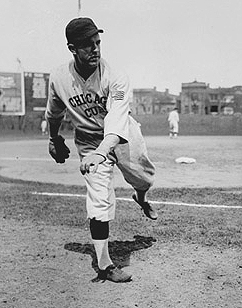
Hippo Vaughn lost a no-hitter in 10th after he and rival Fred Toney each gave up no hits in 9.

James Leslie “Hippo” Vaughn of Weatherford, Texas did allright for himself over 13 seasons as a left handed big league pitcher for the New York Yankees (1908, 1910-12), Washington Senators (1912), and Chicago Cubs (1913-21).  He won 20 games or more five times in his eight seasons as a Cub, finishing with a career record of 178 wins, 137 losses, and an outstanding ERA of 2.49. At 6″4″ and 215 pounds, he was one of the really big men of his early 20th century period and he carried his weight and size with the kind of plodding walk that over time earned him the “Hippo” nickname that all but obliterated all public memory of his given first name of James.

Hippo Vaughn also found himself involved in one of the most frustrating losses in baseball history. It happened on May 2, 1917 at Weeghman Park in Chicago in the days before that venerable venue came to be much better known for its “friendly confines” as Wrigley Field. Vaughn drew the starting assignment for the home town Chicago Cubs that day. Right-handed Fred Toney got the pitching nod for the visiting Cincinnati Reds.

The game turned out to be one of the classic pitching duels of all time. For nine innings, neither pitcher gave up a single hit. Both men also hung around to take a double no-hitter duel into the 10th inning. In those days, pitchers arms didn’t fall off after 100 pitches and the macho code of the times stated expectations straight and strong: If you can still do it, stay in there and get the job done.

Both Vaughn and Toney would take the mound for their clubs in the 10th. It was the right thing to do. It was the only thing to do.

Gus Getz, third baseman, was the first batter up for the Reds in the top of the 10th. Getz was a short-time role player in his brief big league career and, even though he batted in the two-hole this day, he only had 14 t bats for the Reds in the 1917 season. The right hand hitting Getz popped a high fly in front of the plate that Cubs  catcher Art Wilson captured easily for the first out of the inning.

Then it happened.

Batting right, the switch-hitting shortstop Larry Kopf laced a Vaughn pitch into right center for the first hit of the game. Vaughn sighed visibly in disappointment, but then quickly settled back into the important business of trying to win the game. With a man on first now and only one out, he had work to do.

Reds center fielder Greasy Neale, a lefty hitter, then lifted a can-of-corn fly ball to Cy Williams in center for the second out of the inning. Hope was floating good, even if the no-no had been lost from the Hippo bandwagon.

Then the wheels started to come off, as they sometimes do, even in the best played baseball games.

Lefty Hal Chase of the Reds followed Neale with a fly ball of his own to Williams in center, but this time, Cy dropped the ball. He got two hands on it. Then he just dropped it. What should have been the safe end of the inning for Vaughn did not happen due to the Williams error. Any runs that scored from here would be unearned, but they would be just as deadly as any earned ones. Kopf advanced from first to third on Williams’ drop of the fly ball by Chase. Prince Hal Chase held at first after the miscue, but he quickly stole second during the next Reds hitter’s time at bat. Now the Reds had runners at second and third with two outs.

The next Reds hitter was a fellow named Jim Thorpe. The great Native American Olympic champion and professional football player was now trying his skills at baseball as a right handed hitting right fielder.

Hippo Vaughn respected Thorpe’s speed and athleticism. He knew he had to bear down on Thorpe. In spite of this awareness, no one could protect Hippo and the Cubs from the damage that’s always possible from a swinging bunt. And a swinging bunt down the third base line is what Thorpe unleashed inadvertently – a high bouncer that Vaughn knew immediately would be good enough for an infield scratch hit for the speedy Thorpe.

Vaughn was the Cubs’ only hope for a play at the plate on Kopf. He raced over to get the ball and he fielded it cleanly and threw it to catcher Wilson, not realizing that Kopf was right behind him on the base path for an easy tag, had Hippo only known to turn around. Instead, Kopf stopped in the baseline and he and Hippo both stared in disbelief at what they saw happening with catcher Wilson and the ball.

The throw from Hippo bounced off catcher Wilson’s chest protector and fell to the ground. Wilson just stood there, frozen from action. Seeing that, Kopf raced in to score as Wilson just continued standing there in a state of mental paralysis.

Noting it all, Chase came tearing around third in an attempt to also score from second on Wilson’s brain freeze. Hippo screamed at Wilson in frustration: “Are you going to let him score too?”

Wilson suddenly  recovered in time to pick up the ball and tag Chase for the third out, but the damage had been done. Toney retired the Cubs with no further damage in the bottom of the 10th to preserve his own 10-inning no-hitter as Hippo Vaughn lost a heartbreaking 1-0 final score, as he recorded a one-hit losing game effort against the Reds.

The Cubs clubhouse was an atmosphere of bitter frustration after the game. Catcher Wilson broke down in tears apologizing to Hippo for his brain lock on the critical play at home. Meanwhile, Hippo bounced back and forth between his own frustration while impossibly trying to console his game-pressure-stupified catcher. Cubs owner Charlie Weeghman didn’t help matters much either by sticking his head into the Cubs clubhouse long enough to yell to the whole team, “You’re all a bunch of asses!”

Sometimes life’s not fair. And sometimes unfairness comes with an extra little twist of the knife. Hippo Vaughn found out about both these truths on May 2, 1917.

Lefty Gomez’s Biggest Day!

February 3, 2010

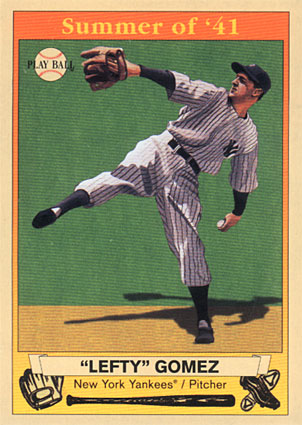
189 Wins, 102 Losses, 3.34 ERA; Inducted into the HOF in 1972.

As a tall and gangly built  left-handed flame-thrower, Lefty Gomez was one of those rarified pitchers who helped the New York Yankees bridge their way from the Babe Ruth to the Joe DiMaggio eras. He toiled for the Yankees from 1930 through 1942 and then wrapped up his career with the 1943 Washington Senators. Over his career, he was selected to the first American League All Star Team and also was named to seven all-star clubs in seven consecutive years from 1933 to 1939. As a Yankee, he got to taste the sweet joy of playing for five World Series Champions in 1932, 1936, 1937, 1938, and 1939.

Lefty was also a true character who loved the company of fellow Yankees who also embraced the gliiter and brew of the night life action and still managed to override the effects of bad habits with their superior talent the next day at the ballpark. Lefty joked that he was “like” the old whiskey soaker who could never quite recall his wife’s final instructions before he left the house for a night on the town with the boys.

“I could never remember if she said ‘have one drink and be home by 12 – or 12 drinks and be home by 1,'” Lefty quipped.

Gomez also had the the same glib sense of humor  for what happened on the field. Once, in a late afternoon game in which Bob Feller of the Cleveland Indians was striking out Yankees left and right. Lefty came to bat against Rapid Robert as the sun was going down. Before Lefty stepped in to hit, he lit a match in the batter’s box and stared out at Feller. The umpire asked if Lefty was hoping the match would help him see where the ball was crossing the plate. “Nope,” Lefty answered, “I’m just hoping the match helps Feller see where  I am!” Then, once the laughter subsided and the match burned out, Gomez stood there in the gathering darkness of the batter’s box and struck out like nearly everyone else before him.

Lefty Gomez says his biggest day in baseball occurred in Game Two of the 1932 World Series at Yankee stadium in which he scattered nine hits to defeat the Chicago Cubs, 5-2, in a complete game victory. Lefty had far better, more artistic wins  over time, but he chose this special-for-the-team game of  September 29, 1932, for what it was – his first first World Series victory at age 23. He got no second chance to pitch in ’32 because the Yankees needed only four games to dispose of the Cubs, That was also the Series in which Babe Ruth supposedly “called his shot” prior to a game-winning homer to center at Wrigley Field.

Lefty Gomez kept his quick wit for the rest of his life. He left us on February 17, 1980 at the age of 80.  Thanks for being one of the bright lights of the game, Lefty Gomez. You will always be one of those guys I wish I’d been privilieged to have watched play in person.

The Pecan Park Eagle Revisited.

February 1, 2010

"To soar once more in spirit, like The Pecan Park Eagle, high above the billowing clouds of a summer morning, in flight destiny - to all that is bright and beautiful."

With most of us getting tired of the cold weather, and with some of us having to call the repair guy this morning because the heating system failed last night, this seemed like a really  good Monday morning to remember one central weather fact in our daily lives. – We live in Houston, Texas. The normal furnace of our shared lives will be back among us soon enough – as will all the wonderful things we love about spring in Houston. Thoughts of baseball, the beach, blossoming vegetation, watermelon, cold beer, and the cornflower blue skies that house the billowing white cotton candy clouds of our almost forever summers all serve to remind us that we will soon enough be out of the cold and into the heat that will surround us in ways that will seem eternal.

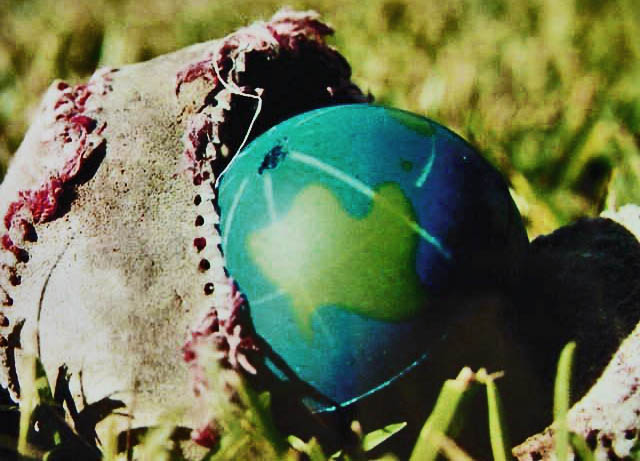
With the real time temperature on February 1st in Houston at 7:22 AM hovering near 39 degrees at 7:25 AM, it seems like a good morning to revisit the poem I wrote several years ago that sort of side-glances off this topic. It wrote itself through me one SUnday afternoon when my then young son and I came home from playing a little flies-and-rollers baseball at what was then an abandoned school yard near our home. The trip,  and the discovery of an old baseball cover in the weeds as we were walking home,  pulled the trigger on my personal memories and tweaked my lifelong bond with baseball. I placed the old baseball cover on the kitchen table when we got home that day. Then I sat down with pen and paper and wrote this poem inside of ten minutes.

My bond with baseball is a tie that goes all the way back to my East End Houston sandlot days. Those were days and experiences that I simply shared with a lot of other kids from my generation as we who grew and came of age in Houston during the years that immediately followed World War II. Other kids in other American towns and cities share the same heritage, thanks mainly to our fathers.

Our dads from the great generation gave us the game. Then they got out of the way and allowed us to discover everything else we needed to learn about baseball on our own. That all began to change with the advent of Little League, but those of us who were lucky enough to have known the sandlot first learned some things no adult could have taught us. We also got to bat more often and practice catching more live balls in actual game play – while also working out game play and ego disputes on our own.

What none of us understood at that time is clear today: Things would never get any better for us at the heart of life’s joy than they were back then on the summer sandlot.

One more time, here’s “The Pecan Park Eagle,” the poem that never really leaves my awareness these days. You see, finding that old baseball cover on that particular summer day in 1993, for me, carried all the power of running into a lost soul mate after decades of heartbreaking separation.

""Tattered friend, I found you again, laying flat in a field of yesterday’s hope."

The Pecan Park Eagle

Ode To An Old Baseball Cover I Found While Playing Catch with My 8 Year Old Son Neal In An Abandoned School Yard.


Tattered friend, I found you again, Laying flat in a field of yesterday’s hope. Your resting place? An abandoned schoolyard. When parents move away, the children go too.

How long have you been here, Strangling in the entanglement of your grassy grave, Bleaching your brown-ness in the summer sun, Freezing your frailness in the ice of winter?

How long, old friend, how long?

Your magical essence exploded from you long ago. God only knows when. Perhaps, it was the result of one last grand slam. One last grand slam, a solitary cherishment, Now remembered only by the doer of that distant past deed. Only the executioner long remembers the little triumphs. The rest of the world never knows, or else, soon forgets.

I recovered you today from your ancient tomb, From your place near the crunching sound of my footsteps. I pulled you from your enmeshment in the dying July grass, And I wanted to take you home with me.

Oh, would that the warm winds of spring might call us, One more time, awakening our souls in green renewal To that visceral awareness of hope and possibility.

To soar once more in spirit, like The Pecan Park Eagle, High above the billowing clouds of a summer morning, In flight destiny – to all that is bright and beautiful.

There is a special consolation in this melancholy reunion. Because you once held a larger world within you, I found a larger world in me.

Come home with me, my friend, Come home.

… Bill McCurdy, July 4, 1993.

Houston Baseball’s 1st Pennant Had to Pause.

January 27, 2010

The 1889 Houston Mud Cats Brought Our Town Its First Flag.

As we have written recently and often over the years, baseball faced a lot of obstacles getting started in Houston and Texas during the late 19th ccentury. Scheduling problems, competitive imbalance between the really good and really bad teams, building a pattern of regular game attendance among fans who were not yet accustomed to that idea, the poor condition of fields and playing venues, the absence of “revenue stream” thinking, the scarcity of “revenue streams period” beyond gameday gate tickets and minor food concession sales, poor club projections on operating expenses, player abandonments from clubs that delayed paydays, the general inadequacy of financial backing, and the limited availability of really talented players all fed into the problem.

In many ways, all these factors fed into the 1889 second season of the Texas League. 1889 proved to be the year for Houston’s first professional baseball pennant, but it was a flag that came with some administrative resistance and quite a bit of tarnish to the cloth of our city’s first glorious flag of victory. The way things turned out, 1889 was as much a victory over financial dragons as it was a win on the field of play.

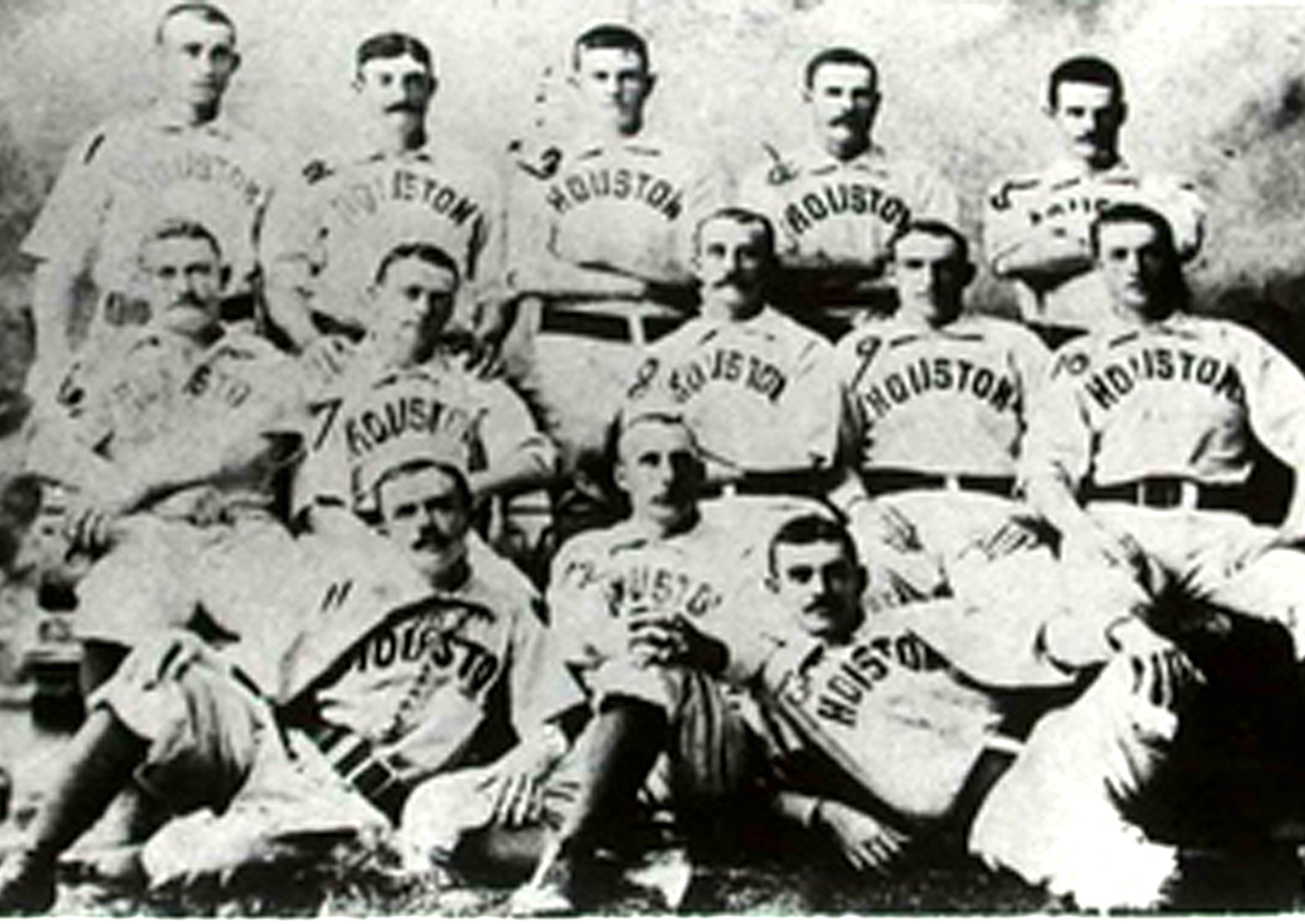
The 1889 Houston Mud Cats of the second-season Texas League finished their year with a record of 54 wins, 44 losses, and a winning percentage of .551. John McCloskey, the man remembered today by most historians as the “Father of the Texas League,” served as the fiery playing manager of the Houston Mud Cats.

Our town’s team nickname changed often in the early years. Houston had been the Babies/Red Stockings in their first year not-so-good start with the new Texas League in 1888. The 1889 re-christened fish club, however, proved they were anything but “bottom feeders.” The Mud Cats soared to Houston’s first baseball and professional sports crown of any kind.

Led by the inspirational spark and upbeat personality tempo of John McCloskey, Houston did great on the field of play, but they still almost lost their  first title on a technicality. The club had never paid their league membership dues in full for the 1889 season. Those unpaid dues were only a part of the financial landslide that soon came avalanching down upon Houston in early August of 1889.

Because of these massive money problems, and in spite of their comfortable game performance lead in the Texas League, the Mud Cats decided to resign from play on August 9, 1889. Three days later, on August 12, 1889, the whole Texas League collapsed under a pile of debt – and in realistic respect for the fact that dwindling attendance offered no hope for recovery.

When Houston then moved to accept the temporarily fallen league’s designation as the official champions of 1889 because of their record through the date of total collapse, they ran into a little hitch. As for earning it, the Texas League office and other clubs had no problem with the fact that Houston had proved themselves champions in actual game play, but league officials still withheld the championship award until Houston agreed to pay its late membership dues to the league office.

Once Houston scrambled around for the cash and paid the late dues money, the city got its first pennant.

How glorious is that memory?

The Monster Team Nine.

January 25, 2010

"If you can't stretch for a few of my wild and hairy throws to first base, I'm going for the jugular!"

For want of a better Monday morning idea this week, here’s my Monster Club Baseball Nine. All those days at the Avalon Theatre armed me hard and fast for days like today.

Pitcher: Count Dracula. Biggest Assets: (1) Knows how to handle bats. (2) When everything is at stake, you will find his heart where it needs to be. Biggest Drawbacks: (1) Never available for day games. (2) When he gets knocked out of the box, he really gets knocked out of the box.

Catcher: The Thing from Another World. Biggest Asset: Possessing the vegetative body of an alien carrot, he has nothing to fear from proximity to his blood-hungry battery mate. Biggest Drawback: Tends to strike base runners with the back of his open right hand at the cost of ignoring the out tag with his ball-clutched glove hand.

First Base: The Frankenstein Monster. Biggest Asset: Plays with an extra charge of enthusiasm and power in games that follow rain-outs from thunderstorms. Biggest Drawback: Bad relations and misunderstandings with teammates are blamed on his poor communication skills.

Second Base: The Wolfman. Biggest Asset: Facial expressions are given credit for stopping baserunners from even trying to steal second base. Biggest Drawback: Only available to play once in a blue moon.

Third Base: The Wicked Witch of Oz. Biggest Asset: Doesn’t monkey around with batters who attempt to bunt their way safe with dribblers down the line. She’ll get you, you pretty fast base runners, and your little dog too. You may as well surrender to the idea of either holding back or swinging away. Biggest Drawback: She’s only good to go til it rains.

Shortstop: The Blob. Biggest Asset: No shortstop in history ever covered more ground. Biggest Drawbacks: (1) He is stuck on himself and anyone else who comes along. (2) He’s best known to his frustrated teammates as “the place where relay throws go to die.”

Left Field: Godzilla. Biggest Asset: Hits the long ball fifty times farther than McGwire, Sosa, or Bonds, and with no questions raised about his ‘roids use. Biggest Drawbacks: (1) Property damage judgments against him and the team for destruction caused simply by his ordinary game day walks to and from the ballpark  have destroyed the club’s profit edge. (2) Club has to bear the extra cost of paying for his Japanese translator.

Center Field: The Mummy. Biggest Asset: No need for expensive sun block lotions. Biggest Drawback: His snail-like locomotion is an issue. No game is ever considered “under wraps” with “Da Mum” on patrol in the huge central pasture of the outfield. In fact, any ball hit past The Mummy will routinely convert to either a four-base error or an inside-the-park home run.

Right Field: Bernie Madoff. Biggest Asset: His teammates trust him. Biggest Drawback: His teammates trust him.

That’s it for today. Maybe I’ll get serious tomorrow. Maybe I won’t.

Have a great week, everybody!

Top Ten Reasons Why The Astros Have a Better Chance of Reaching the World Series Than the Texans Do of Reaching the Super Bowl.

January 24, 2010

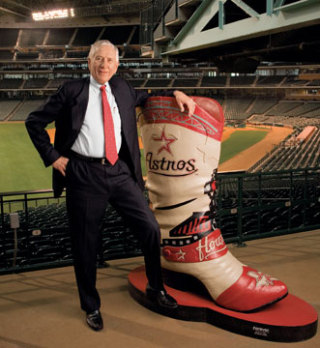
Drayton McLane, Houston Astros.

10. The Astros don’t have to worry about finding a running game. If there’s any running to be done, the Astros have Michael Bourn.

9. The Astros play their games in Minute Maid Park, which already saw a World Series in its sixth year of play. The Texans, however, play their games at Reliant Stadium, which has only seen the Carolina Panthers play there and the New England Patriots win there in a Super Bowl. Reliant is also too close to the moribund and without-a-Super-Bowl-action-champion-site-of-any-kind as the Astrodome for over forty years,

8. The Astrodome and Reliant Stadium are rumored to have been built on the site of a Native American burial ground. Minute Maid Park was built on the site  of the former Union Station, a ground walked upon by every major champion from all sports and all walks of life in the 20th century who ever visited Houston.

7. Lightning regularly strikes Minute Maid Park at 3:00 AM following every Astros home-stand opening game win. These events are usually followed by double-digit win streaks by the Astros and instant wealth and social good fortune for all fans who happened to have been sitting in the area of the ballpark that was later that night struck by lightning.

6. Relative to each other geographically in Houston, the Astros are located to the north and the Texans are situated to the south. As everybody who has studied history already knows, the North always wins. Right?

Bob McNair, Houston Texans.

5. Astro fans main-gate the ballpark, going inside and pouring all of their positive energies into pulling for the Astros live at the actual game. Many Texan fans simply tail-gate in the parking lots next to Reliant Stadium and never go inside. They watch the game on portable television sets and are too busy pouring beer down their gullets to pour positive energy live into the Texans.

4. As a source of good-buddy-knowledge talent, the Astros rely upon outcasts from the lately very successful Philadelphia Phillies. The Texans rely upon refugees from the so-so Denver Broncos.

3. The Astros once traded Larry Andersen to Boston for a rookie named Jeff Bagwell. The Texans once used the top pick in the NFL draft to select Mario Williams over either Vince Young or Reggie Bush.

2. Astros owner Drayton McLane is in the wholesale grocery business. He could afford to feed his club during hard times. Astros owner Bob McNair is into oil and horse racing Axle grease on horse meat burgers does not sound like a diet that many Texans could sustain over time.

1. Tal Smith is President of Baseball Operations for the MLB Astros. Rick Smith is General Manager of the NFL Texans. Astros take home the “Senior Smithsonian of Sports Award.”

Baseball’s Bobby Bragan Passes Away at 92.

January 23, 2010

Nobody Did More for Kids Than Bobby Bragan!

Sometimes the end comes quietly and mercifully to the lions of this world. It seems to have happened that way for Bobby Bragan this week. He had been suffering a cold for about week and had simply retired early from watching television for a shave and shower before going to bed at his home in Fort Worth around 6:30 PM on Thursday, January 21, 2010.  When he did not return in a normal amount of time, his wife Betty went to the bathroom to check on him. She found him sitting on the dressing bench, leaning against the wall as though he were asleep.

In this final quiet exit from the dugout of Home Team Earth, the brassy 92-year old Bobby Bragan was gone from the game of life forever and those of us who knew him and were touched directly by his kindness will miss him greatly.

Bragan was truly a Renaissance Man. He was an athlete, a baseball player, a manager, an innovator, an artist, a comedian, an entertainer, a musician, an actor, a good friend, a loyal husband and family man, and one of the most generous humanitarians and philanthropists who ever came down the pike.

"You Can't Hit the Ball with the Bat on Your Shoulder!" - Bobby Bragan.

From its 1992 inception forward, the Bobby Bragan Foundation in Fort Worth raised around one million dollars in scholarship money for deserving students. It was the thing that Bobby put the full weight of his personal influence and friends energies into and it paid off handsomely for the kids he supported. Now it’s up the foundation and Bobby’s friends to make sure that the good work continues. The effort takes a great hit with the loss of Bobby.

Bobby Bragan was born In Birmingham, Alabama on October 30, 1917. As a kid who grew up loving baseball, he had a seven-year playing record as a shortstop/catcher for the Philadelphia Phillies (1940-42) and Brooklyn Dodgers (1943-44, 1947-48). Bobby had five brothers who also played professional baseball, but none of them made it to the major leagues.

Bragan only hit .240 with 15 homers over his MLB career, but his real talent was leadership. After four seasons as manager of the Fort Worth Cats (1948-52) and three seasons as manager of the Hollywood Stars (1953-55) Bobby Bragan moved up to the big leagues for stints as field manager of the Pittsburgh Pirates (1956-57), the Cleveland Indians (1958), and the Milwaukee Braves (1964-65) / Atlanta Braves (1966). Bobby also served time as a coach for the Los Angeles Dodgers and was a member of the original club developmental staff for the 1962 Houston Colt .45s.

Bobby Bragan managed five Hall of Famers: Roberto Clemente, Bob Lemon, Hank Aaron, Eddie Mathews, and Warren Spahn.

In his later years, he served as President of the Texas League when the designated hitter rule was put on trial for later use by the American League. Bobby never defended the “DH” rule in his discussions with me, but he did feel strongly that MLB should either apply the rule across the board, or else, get rid of it.

Bobby Bragan was a member of several halls of fame, including the Alabama Sports Hall of Fame, the Texas Sports Hall of Fame, and the Texas Baseball Hall of Fame. He had a reputation as a manager for being thrown out of games for arguing with umpires that later spilled over into his later years. When the independent league Fort Worth Cats decided to honor Bobby by making their official manager for one game at age 87, Bragan not only established a record as the oldest official manager in baseball history, he also managed to get thrown out of that game early for arguing with an umpire.

Some spots never go away.

My favorite Bragan story concerns the exciting role he played in the 1947 Word Series for the Brooklyn Dodgers against the New York Yankees. It almost didn’t happen. Bragan seemed destined for bullpen catching as the great Roy Campanella, another Hall of Famer, took charge in the starting lineup as expected.

In spite of his remote chances for game action, Bobby persuaded his parents, George and Corinne Bragan, to take the train up to New York from Birmingham in the hope of seeing him play. By Game Six, it was beginning to look as though that wasn’t going to happen, but suddenly, Bobby’s luck changed.

The Dodgers were down 3 games to 2 in the Series and 5 to 4 in the 6th inning of Game Six and facing elimination when, suddenly, they got two runners on base.

Dodger manager Burt Shotton sent a call to the bullpen. He wanted Bragan to come in and hit for pitcher Ralph Branca against Yankee relief ace Joe Page. Bobby’s heart ascended to his throat, but he heeded the word and trotted out of the shadows and into the limelight.

On a 1-2 count, Bragan put the wood on a double down the left field line, tying the game. The Dodgers went on to win the game, 8-6, forcing the decisive Game Seen that would unfortunately lose, but Bragan had known his moment in the sun.

Here’s the kicker. After the game, Bobby couldn’t wait to hear his parents’ reaction to seeing his heroic moment. It wasn’t there. George and Corinne had chosen the moment immediately prior to the announcement of Bobby’s entry into the game to leave their seats for a quick bathroom trip. They missed the whole thing. And that turned out to be Bobby’s only World Series appearance.

Bobby's Pinch Hit Double Saved Game 6 of the '47 world Series.

Bobby Bragan played the piano, sang and wrote songs, and even recorded his own CD album in later years to help boost contributions to his foundation. My favorite Bragan number will always be the one that best typifies his character and attitude about baseball and life. Its title and second line in the verse says everything you need to know about how Bobby Bragan felt about facing life’s challenges: “You can’t hit the ball with the bat on your shoulder. You got step up there and swing.”

We’ll keep swinging down here, Bobby, but we’ll miss seeing you in that third base coaching box, from here to eternity. Keep us in mind even now, old friend. We shall continue to thrive upon precious memory and contact with your indomitable spirit.

Michael Bourn Named 2009 Astros MVP!

January 22, 2010

Houston Baseball Dinner Picks Michael Bourn as 2009 Astros MVP!

The 2010 Houston Baseball Dinner at the downtown Hilton near Discovery Green came off as scheduled last night, Thursday, Jannuary 21st. The winter banquet that normally lights the hot stove fire on Houston’s hope for the coming baseball season worked its usual magic before a crowd of over 1,000, picking several Astros and a few others for post and pre season honors.

Michael Bourn was chosen by the Houston Chapter of the Baseball Writers of America as the 2009 Most Valuable Astro Player. Bourn had a breakout season in 2009, hitting .285 with a .354 one-base percentage and a National League leading total of 61 stolen bases, a figure that fell only four shy of the club record. Michael hit .353 with runners in scoring position and he led the National League in in both infield hits and bunt hits. He also ranked second in the league with 12 triples. Defensively, Bourn also became  the first Astro outfielder in 33 years to win a Gold Glove for fielding excellence.

Wandy Rodriguez Was the Astro Ace in 2009.

Wandy Rodriguez was named ast the 2009 Astro Pitcher of the Year. Wandy’s 14-12 record came with a 3.09 ERA, 9th best in the National League. His 193 strikeouts and 205 innings pitched placed him 8th in the NL, and he was 7th i the league with 33 starts. His 2009 home ERA was a remarkable 2.05. Wandy’s 4-0 record and 0.75 ERA last July also earned him Pitcher of te Month honors for that time frame.

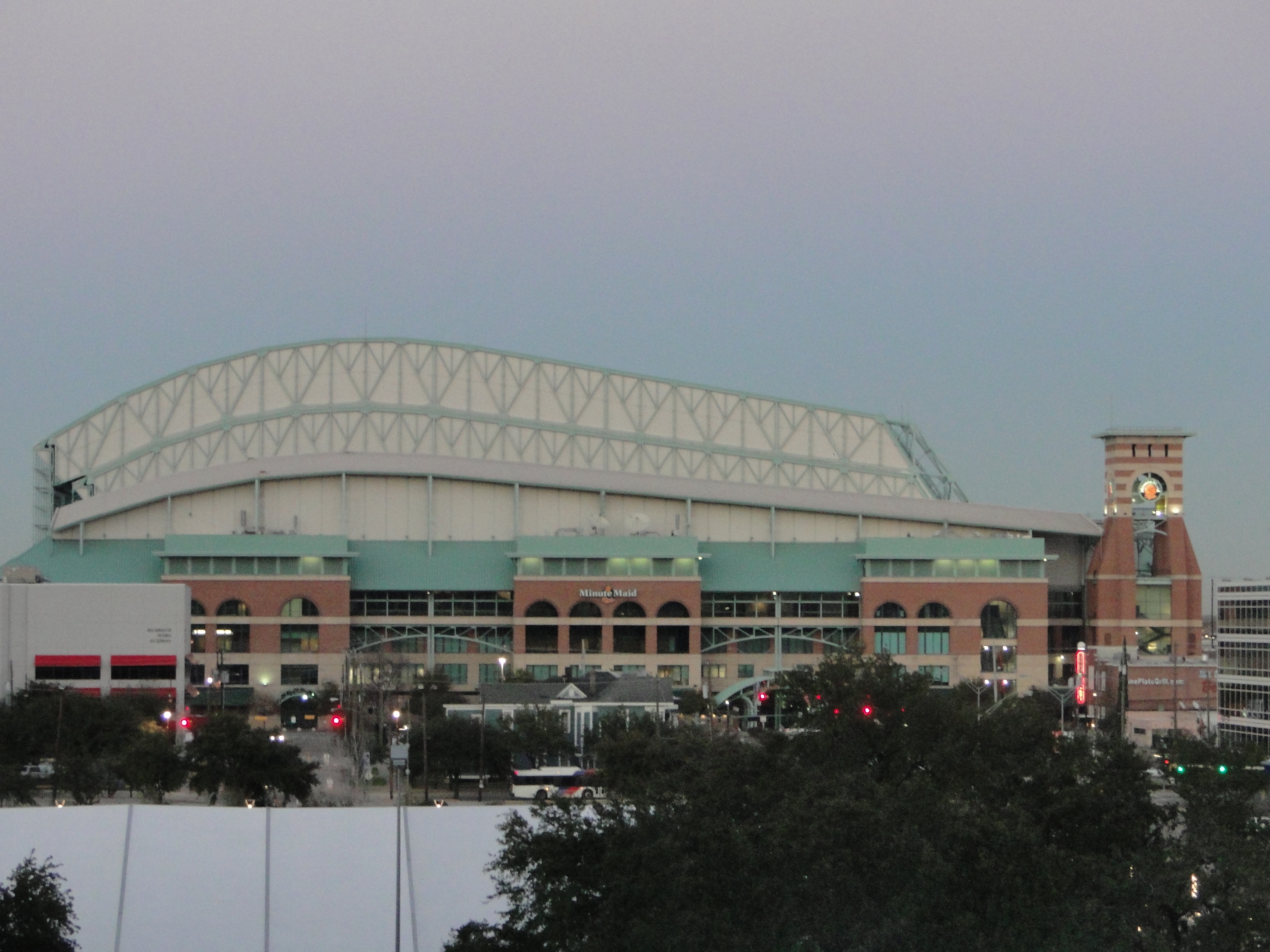
Minute Maid Park View from Banquet Site: January 21, 2010.

Jeff Fulcino won the Astro Roookie of the Year award for 2009. Fulcino posted an all relief record of 6-4 with a 3.40 ERA. He recorded 71 strikeouts in his 82 innings and 61 game appearances, holding right-handed batters to a .209 batting average.

Pitcher Brian Moehler was the recipient of the Darryl Kile Award as the player who best exemplified victory over hard times and commitment to the team above personal gain.

Outfielder Adam Dunn of the Washington Nationals won the 2009 Houston Area Major League Player of the Year Award. Dunn cranked out 38 home runs and posted 105 RBI in 2009, while also becoming only the 123rd player in big league history to hit 300 homers over his career. Dunn now ranks 106th on the all-time home run total list.

First baseman Lance Berkman took the 2009 Allen Russell Award for Distinguished Achievement, Lance is a five-time All Star who ranks 12th among active players for highest career batting average (.303), 5th among active players in on-base percentage, 12th among players in slugging percentage (.561) and 7th among active players in on-base plus slugging percentage (.983).

Former sports writer and Houston Baseball Dinner Co-Founder Ivy McLemore took the Fred Hartman Award for Long and Meritorious Service to the community.

Anthony Rendon of Rice was named as the Pre-Season 2010 College Player of the Year; Coach Jim Long of the Brenham Cubs was tabbed as the 2009 Houston Area High School Coach of the Year; and sixteen high school players were chosen as members of the 2010 Houston Area Pre-Season High School All Star Team. These high school baseball stars of the present and future included: Nick Bergmann, Memorial; Krey Bratsen, Bryan; John Cialone, St. John’s; Stefan Crichton, Cinco Ranch; Dave DeKerlegand, Pearland; Jordan Jolly, Fort Bend Elskins; Jared Lakind, Cypress Woods; Cody Perkins, Kingwood; Kendrick Perkins, LaPorte; Kevin Semien, Atascosita; Alex Silver, Bellaire; John Simms, College Park; Jameson Taillon; Trevor Teykl, Fort Bend Kempner; Erich Weiss, Brenham; and Jake Wise, Cypress Falls.

Astros General Manager Ed Wade and Field Manager Brad Mills capped the evening with some “hope springs eternal” talk about the coming new season and their 2010 roster of upside-bearing younger players. MVP Michael Bourn serves well as the poster boy for more team speed and positive change on offense and defense. How many games the 2009 Astros can actually win with their reconstructed pitching staff and roster of new starters at catcher, short, and third remains to be seen. The outfield is 67% fast and furious and 33% slow and plodding for the second year in a row. We’ll see how that string plays again too.

You had to be a deep blue baseball fan to enjoy the Houston Baseball Dinner, but all of us were. And now we’re chomping at the bit for spring training to start over  in Florida.

This year marks the 25th anniversary of the annual dinners started by Allen and Jo Russell to honor local baseball accomplishments and other community achievements by baseball people. Former Houston Buffs President Allen Russell passed away in January 1996, but his widow, Jo Russell, has done a beautiful job of making sure this torch keeps passing forward to the younger generations that make up the grand community of loyal and knowledgeable baseball fans in Houston.

Thanks, Jo Russell, for another job well done!

Have a nice weekend, everybody!

Johnny Grodzicki: Another Buffs Might-Have-Been!

January 21, 2010

For of all sad words of tongue or pen, the saddest are these: ''It might have been.'' - John Greenleaf Whittier.

At 6’2″ and 200 pounds, Johnny Grodicki (BR/TR) was another of those young Houston Buff arms from the 1930s who might have been something had fate broken a little differently. It just wasn’t to be.

Grodzicki arrived in Houston late in 1936 at age 19 after registering a 16-12 record for New Iberia of the Evangeline League, a place that saw the start of many future great Cardinal pitchers. Howie Pollet and ed Munger both got their starts there.

Grodzicki got into three games for ten innings of work with the Buffs in 1936, picking up a single loss as his only Texas League mark in that first year, but hopes were high in St. Louis for his success at Houston in 1937.

Grodzicki’s fastball had good heat and his curve was decent enough. As often happened, his problem was control. In 244 innings of work for the 1937 Buffs, Grodzicki walked 174 batters. He still finished the season with a great record of 18 wins against only 11 losses and he complied an attention-getting earned run average of only 2.88 for a Houston club that finished in 7th place with a 67-91 record.

Young Grodzicki also starred in the 1937 Texas League All Star Game at Buff Stadium. In only the second game of its kind in league history, an overlow crowd of over 8,000 Houston fans showed up that day to watch the North and South All Stars square off against each other. Grodzicki came into the game in the fourth inning, bringing form and focus with him. He proceeded to imitate the earlier accomplishments of major league great Carl Hubbell by striking out six of the best hitters in the North lineup as his first item of business. The hitters, all of whom carrying .300+ batting averages with them into the game, included Homer Peel, Red Harvel, Joe Bilgere, Lou Brower, Norman McKaskill, and Ed “Bear Tracks” Greer.

1938 saw Grodzicki post a 12-21 record for a 5th place Houston Buffs (74-84) club. His innings of work increased to 269 and his walks dropped to 169, but his ERA ballooned to 4,25.

1939-1940 saw Grodzicki moving up the Cardinal chain for two seasons at Rochester where he compiled a total record for two seasons of 11 wins and 10 losses. In 1941, “Grod” moved over to Columbus for a record of 19-5, 2.58 ERA and his best season record in professional baseball. His success at Columbus earned Grodzicki a late season call-up to the parent St. Louis Cardinals where he posted a 2-1 record and a drop-dead gorgeous ERA of only 1.35 in 13.1 innings of work.

Then came World War II and a hiatus from the game that finished the future of Johnny Grodzicki. In his first season back, 1946, “Grod” worked only four innings, recording no record, but posting a 9.00 ERA for the Cardinals. In 1947, Johnny worked only 23.1 innings for the Cards, posting a record of 0-1 with an ERA of 5.40. Aging, injury, and ineffectiveness, plus four years of war rust wouldn’t go away. They were collectively the end of Johnny  Grodicki’s stock as a prospect. After 1947, he would never again darken the doorway of an MLB clubhouse.

Twelve years after his first arrival, Johnny Grodzicki returned to the Houston Buffs in 1948 as a an old 31-year old minor league veteran. “Grod” did OK in limited action as a 6-5, 2.05 ERA starter/reliever in 88 innings. Coming off their 1947 Dixie Series championship year, the ’48 Buffs under manager Johnny Keane were only an 82-71 3rd place club. “Grod” was starting to be a fit for mediocrity.

1949 saw Grodzicki go 4-5 for the Buffs before moving up to Rochester again for a 2-1 mediocre finish. Johnny Grodzicki continued to plod his way through the minors for three extra seasons of unremarkable achievement before hanging it all up after 1952 at the age of 36. He finished with a career minor league record of 108 wins, 83 losses and an ERA of 3.65

Johnny Grodzicki passed away in retirement at the age of 83 on May 2, 1998 in Daytona Beach, Florida. As a faded away former minor league prospect, he was the living embodiment of “what might have been.” With a little more control, a tad bit more of good luck contact with the right mentor who never showed up in reality, and with a lot less wear and tear from World War II, who knows what might otherwise have become of Johnny Grodzicki?

Johnny, we hardly knew you.