A Short Ride on Houston’s First Rail System.

January 28, 2010
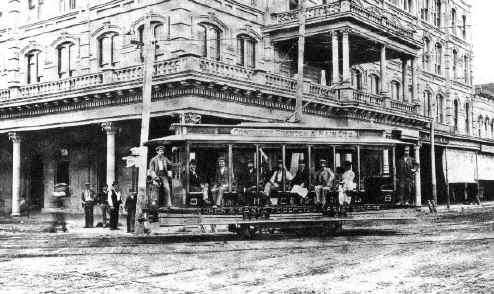
"Car 8 was built as one of the original 12 cars to inaugurate electric service in June of 1891." - As with all other photos & text used in these column pictorials, this material is courtesy of Steve Baron, Houston Streetcar History Pages.

“Car 8 was built as one of the original 12 cars to inaugurate electric service in June of 1891.” – As with all other photos & text used in these column pictorials, this material is courtesy of Steve Baron, Houston Streetcar History Pages @ http://members.iglou.com/baron/

From its 1836 inception, people saw Houston’s long range potential as a seaport because of its access to the Gulf of Mexico via Buffalo Bayou and Galveston Bay. As the port idea grew in the 19th century, it wasn’t long before incremental improvements to the waterway route over time led to the formal christening of the Houston Ship Channel in 1914. Over this same economic time frame, Houston grew exponentially as a shipping center for cotton, cattle, and that newly found nearby commodity known as oil.

The thing that made it all come together was rail, local and long distance tracks that moved both people and products around town and out of state or country. Had it not been for the invention and growing ecopolitical punch of the spontaneous combustion engine industries, Houston and other developing western cities would have stayed with rail and grown quite differently, but as we know, that is not what happened. A short run at our first local history with rail is still a fun and factually packed trip to take.
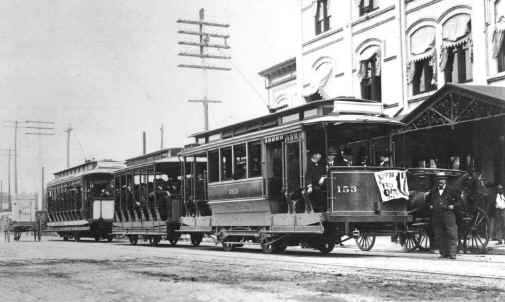
"Posed in front of Grand Central Depot (Southern Pacific lines) are brand new "California" car 153, trailer 33, and an 1896-built nine-bench open car.   Such was public transit in Houston in 1902.  Sic transit gloria mundi!" - Courtesy, Steve Baron.

“Posed in front of Grand Central Depot (Southern Pacific lines) are brand new “California” car 153, trailer 33, and an 1896-built nine-bench open car. Such was public transit in Houston in 1902. Sic transit gloria mundi!” – Courtesy, Steve Baron, http://members.iglou.com/baron/

Houston’s first mule-drawn streetcars began service in 1868.  On May 2, 1874, the  Houston City Street Railway began mule-powered operations on Travis Street, marking the true beginning of organized rail service in Houston. By 1889, a competing company, the Bayou City Street Railway began operations. It will later be absorbed by the Houston City Street Railway.

On June 12, 1891, the first local operation of electric streetcars began. In 1892,  the Houston Heights line also opened.  For several years thereafter, it operated as a separate company.

In 1896, a court-ordered receivership forced the sale of the Houston City Street Railway. It was reorganized by its new owners as the Houston Electric Street Railway. In 1901, following another receivership, the street railway was sold to investors associated with the Stone & Webster firm of Boston, Mass.  It was reorganized this time as the Houston Electric Company.
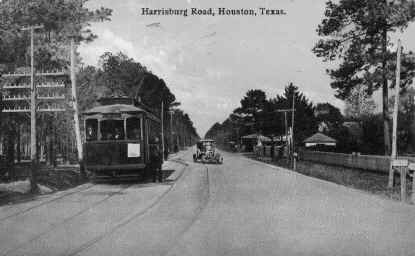
"The Harrisburg line was opened to streetcar traffic in 1908, and this postcard view was made not long after.  The car is a double-truck semiconvertible design, the mainstay of the fleet during this period." - Courtesy, Steve Baron.

“The Harrisburg line was opened to streetcar traffic in 1908, and this postcard view was made not long after. The car is a double-truck semiconvertible design, the mainstay of the fleet during this period.” – Courtesy, Steve Baron, http://members.iglou.com/baron/

By 1908, the Harrisburg line opened from downtown to Houston’s growing east end. By 1910, the Bellaire line opened to the west from South Main along the lazy country lane that is now the car-clogged boulevard  we know as the Holcombe-Bellaire continuum. My mom spoke often of how she and my maternal grandparents took the street car south from their home in the Heights back in the 1920s to visit relatives in Bellaire. “By the time we transferred way out South Main to the Bellaire line,” Mom said, “it already felt like we were way out in the country. Now we’re getting ready for a rail ride through the woods. There wasn’t anything out there back in the 1920s. Then, when, you finally got to Bellaire, there wasn’t much there either, except for relatives and a few strange folks that we didn’t know.”

On December 5, 1911, the Interurban route to Galveston opened. The Galveston-Houston Electric Railway operated as a separate company from HECo., but it too remained under the ownership and control of the parent company. By 1911, public service companies were sensitive to the need for obscuring any kind of expansion that might begin to look to federal authorities like a monopoly. That ball would stay in economic play forevermore, except for periods of obvious disregard.

"A busy downtown scene in the late 1920's finds car 416 on the Mandell line, preparing to head outbound to the Montrose district.  These cars, built in 1927, were the last series of streetcars ordered by the Houston Electric Co.  (There were two later experimental cars, but that's another story.)" Courtesy, Steve Baron.

“A busy downtown scene in the late 1920’s finds car 416 on the Mandell line, preparing to head outbound to the Montrose district. These cars, built in 1927, were the last series of streetcars ordered by the Houston Electric Co. (There were two later experimental cars, but that’s another story.)” Courtesy, Steve Baron, http://members.iglou.com/baron/

The downtown shot of this Mandell Line car also features the newer kid on the block in the far ight hand corner. The automobile was making its presence felt big time in Houston as the city rolled through the Jazz Age on its way with the rest of the country to the Great Depression.

The appeal of cars always was the fact that they weren’t tied to fixed route travel by tracks. Their growing affordability and the bountifulness of cheap gas made them a growing-in-popularity alternative to rail travel. Since 194, some individual attempted to use their cars as public transport “jitney” service upon open and fixed routes. These were finally banned by City Council in the early 1920s in favor of public busses. On April 1, 1924, the first Houston bus route, on Austin Street, began operations in Houston in the wake of a city referendum outlawing jitneys.

The 1930s saw the growth of bus service and private automobile use. By the end of the decade, the streetcar and interurban rail lines were dead. On October 31, 1936, the last run of the Galveston-Houston interurban line clattered its way north and south between the two cities. The section that served people from downtown to Park Place, however, continued under HECo. operation until 1940.

On June 9, 1940, the Houston Electric Company took its last run with electric rail streetcars. The final two routes to give way to automobiles and busses were the lines serving Pierce and Park Place. Even by this time, local highly placed politicians and real estate entrepreneurs were beginning to plan freeways that would both “solve” the growing congestion problem of increasing auto travel and more privately and quietly help certain individuals invest and profit from planned growth to the far-reaching suburbs that they also would create from the recent earlier purchase of cheap land on the nearby prairies woodlands.
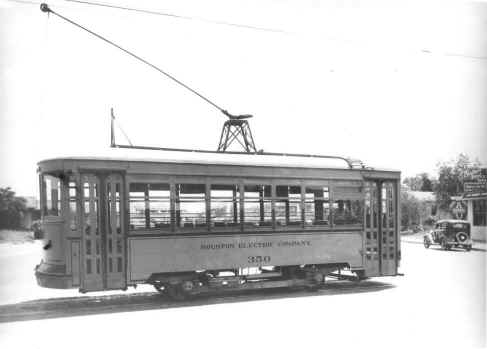
"A 1930's view of one of Houston's single-truck Birney cars.  Built in 1918, this was one of several cars that were modernized in the company shops, changing them from double-end to single-ended, and installing full length doors with inside steps." - Courtesy, Steve Baron, website: (http://members.iglou.com/baron/)

“A 1930’s view of one of Houston’s single-truck Birney cars. Built in 1918, this was one of several cars that were modernized in the company shops, changing them from double-end to single-ended, and installing full length doors with inside steps.” – Courtesy, Steve Baron, website: (http://members.iglou.com/baron/)

Once again, in 2010, the inner, older, and more compact center of Houston is being best served practically by new rail service. The far-reaching Houston, the one that grew from the ambitions of the few and the addiction of us all to the automobile, is now unserviceable by any single form of mass public transportation – nor are we inclined in Houston to want to use public transportation as anything other than an occasionally quaint reminder of our long ago past.

It is what is. And we are what we are. Take me out to the ballgame, but let’s use your car or mine.

For a complete look at the magnificent work that historian Steve Baron has done on the history of rail transportation in Houston, please do yourself a favor and check out his website, Houston Streetcar History, at http://members.iglou.com/baron/
Houston Baseball’s 1st Pennant Had to Pause.

January 27, 2010

The 1889 Houston Mud Cats Brought Our Town Its First Flag.

As we have written recently and often over the years, baseball faced a lot of obstacles getting started in Houston and Texas during the late 19th ccentury. Scheduling problems, competitive imbalance between the really good and really bad teams, building a pattern of regular game attendance among fans who were not yet accustomed to that idea, the poor condition of fields and playing venues, the absence of “revenue stream” thinking, the scarcity of “revenue streams period” beyond gameday gate tickets and minor food concession sales, poor club projections on operating expenses, player abandonments from clubs that delayed paydays, the general inadequacy of financial backing, and the limited availability of really talented players all fed into the problem.

In many ways, all these factors fed into the 1889 second season of the Texas League. 1889 proved to be the year for Houston’s first professional baseball pennant, but it was a flag that came with some administrative resistance and quite a bit of tarnish to the cloth of our city’s first glorious flag of victory. The way things turned out, 1889 was as much a victory over financial dragons as it was a win on the field of play.

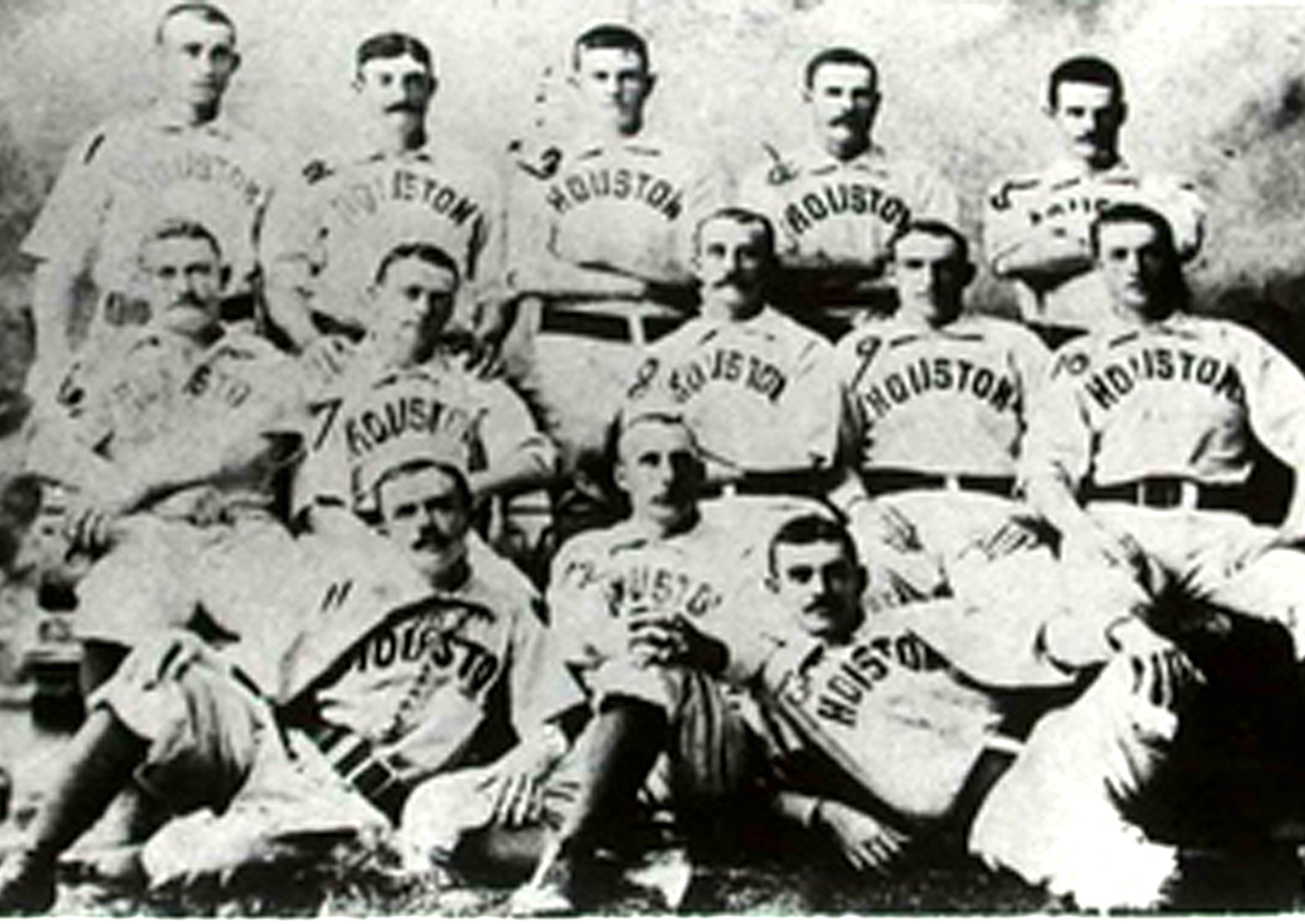
The 1889 Houston Mud Cats of the second-season Texas League finished their year with a record of 54 wins, 44 losses, and a winning percentage of .551. John McCloskey, the man remembered today by most historians as the “Father of the Texas League,” served as the fiery playing manager of the Houston Mud Cats.

Our town’s team nickname changed often in the early years. Houston had been the Babies/Red Stockings in their first year not-so-good start with the new Texas League in 1888. The 1889 re-christened fish club, however, proved they were anything but “bottom feeders.” The Mud Cats soared to Houston’s first baseball and professional sports crown of any kind.

Led by the inspirational spark and upbeat personality tempo of John McCloskey, Houston did great on the field of play, but they still almost lost their  first title on a technicality. The club had never paid their league membership dues in full for the 1889 season. Those unpaid dues were only a part of the financial landslide that soon came avalanching down upon Houston in early August of 1889.

Because of these massive money problems, and in spite of their comfortable game performance lead in the Texas League, the Mud Cats decided to resign from play on August 9, 1889. Three days later, on August 12, 1889, the whole Texas League collapsed under a pile of debt – and in realistic respect for the fact that dwindling attendance offered no hope for recovery.

When Houston then moved to accept the temporarily fallen league’s designation as the official champions of 1889 because of their record through the date of total collapse, they ran into a little hitch. As for earning it, the Texas League office and other clubs had no problem with the fact that Houston had proved themselves champions in actual game play, but league officials still withheld the championship award until Houston agreed to pay its late membership dues to the league office.

Once Houston scrambled around for the cash and paid the late dues money, the city got its first pennant.

How glorious is that memory?

Some Major Dates in Houston History.

January 26, 2010

"What do you say we buy some cheap boondocks land and then get the city to build a freeway that runs out to it?"

A couple of years ago, at my previous blog site on Chron.Com, we went through a daily review of Houston by the year from 1836 through 2000. We will not repeat the process here, but I thought it might be interesting to briefly recall some of the major events in Houston’s chronology by the year.

By now, everybody should know where it starts:

1836: On april 21st, General Sam Houston and his citizen army wins independence from Mexico at the Battle of San Jacinto.

1836: Two land-speculating brothers from New York, A.C. and J.K. Allen, purchase  land on and near the headwaters of Buffalo Bayou from Mr. Elizabeth Parrott, the widow of colonist John Austin. They pay $1.40 per acre for 6,642 acres. On August 3oth, They name the site “Houston” after their friend and hero, General Sam Houston.

1837: First Texas Republic President Sam Houston signs an act allowing Houston to incorporate as a city. For two years (1837-39), Houston serves as Capitol of the Republic of Texas at a site built at the corner of Texas and Main, the current location of the Rice Hotel Apartments and Lofts. The new city’s population is a cool 1,000.

1841: The Port of Houston is established.

1842: Due to building new threats of invasion by Mexico, President Houston moves the capitol back to the City of Houston from Austin. It will remain the capital through 1843 and then be moved back to Austin in 1844.

1845: Texas is admitted to the Union.

1846: Texas becomes the 28th state.

1860: Houston’s population is 5,000. The city is growing as a railroad center and struggling inland seaport via Buffalo Bayou.

1861: On February 2nd, Texas secedes from the Union to affiliate with those other states that are forming the Confederacy.

1861: On April 16th, led by F.A. Rice, a group of Houstonians meets in a 2nd floor room above J.H. Evans’ store on Market Square to form the original Houston Base Ball Club.

1870: Texas is readmitted to the Union. Houston’s population is now 9,332. Congress designates Houston as an official seaport via the ever-expanding new ship channel that has been deepened and widened through natural waterways from the city to the Gulf.

1877: Houston gets its its first telephone. It has a range of about one mile. Nobody is texting.

1882: The Houston Electric Company was organized to plan electricity service to the city.

1888: Houston’s first professional base ball club, the Houston Babies, begins play as a member of the new Texas League.

1889: Now known as the Houston Mudcats, the local base ball team brings Houston its first professional sports championship.

1897: The first “horseless carriage” appears in Houston. Contrary to urban legend, City Council did not call an immediate meeting to plan the construction of the Gulf Freeway.

1899: The first Houston city park (now called Sam Houston Park) opens downtown.

1900: The great Galveston hurricane sends refugees pouring north to Houston. Houston’s population is now 44,600.

1901: Discovery oil at Spindletop near Beaumont immediately positions Houston and its vast and fast growing shipping power into becoming the oil capital of the world.

1912: Rice Institute (now Rice University) begins classes.

1913: The Houston Symphony is formed.

1914: The 25′ deep Houston Ship Channel is formally dedicated and opened to the world.

1922: WEV goes on the air as Houston’s first radio station, broadcasting music and impromptu speeches.1922 Progamming sounds better when you remember that listeners of that era didn’t have to put up with great “intellects” like Jim Rome.

1923: The second National Bank site becomes Houston’s first air-conditioned building.

1924: The Museum of Fine Arts of Houston opens as the first art museum in Texas.

1926: Natural gas is piped into Houston for consumer use for the first time.

1927: The University of Houston is established as the “Houston Junior College.” Because of segregation, Texas Southern University is also formed by its original identity as the “Houston Black Junior College.”

1928: Houston receives its first air mail at the new Houston airport, a glorified cow pasture.

1928: On April 11th, the new $400,000 Buffalo Stadium opens as the new home of the Houston Buffs baseball club at a site about four miles east of downtown.

1928: Thanks largely to the influence of local mover-shaker Jesse Jones, the Democratic Party holds their National Convention in Houston.

1929: City Council rejects zoning, a condition which continues to characterize the growth patterns of our city in the 21st century.

1940: Houston adopts a bus system to replace its 60-year commitment to street cars and light rail.

1943: The Texas Medical Center is founded.

1947: The Alley Theatre is established.

1947: Engineering begins on plans for new Gulf Freeway. The state’s  first freeway is sold to the public as a “super highway” that will solve all our problems of commuting between downtown and the suburbs.

1949: KLEE-TV signs on the air as Houston’s first television station.

195o: Houston’s population has jumped to 596,000. Enthusiasm for growth is tempered by health threats that some believe are amplified by the intense heat of our summers. In 1950, the months of June through August produce over foo new cases of polio in children.

1953: Houston commits to artificial cooling. By 1953, Houston is named as America’s most air-conditioned city.

1953: KUHT-TV at the University of Houston is created as America’s first educational television station. KGUL-TV also opens as Channel 11. It will change its call letters to KHOU-TV in 1959 and remain on the air as Channel 11.

1954: KPRC-TV broadcasts the first television program in color over Houston airways. KTRK-TV also comes on the air as Channel 13.

1954: On May 27th, Bob Boyd of the Houston Buffs breaks a different kind of color barrier when he becomes the first black to integrate organized sports play in Houston as a professional baseball player. Segregation on Houston city buses also ends in 1954.

1955: The Houston Grand Opera Association and Ballet are founded.

1960: The Houston Oilers begin plays as members of the American Football League, winning the first championship season played by the new organization.

1962: Houston begins major league baseball play as the Houston Colt .45s.

1962: NASA’s Manned Spacecraft Center is moved to the Houston area.

1962: Mayor Lewis Cutrer desegregates the use of all city-owned buildings.

1965: The Astrodome opens as the first domed stadium. The Colt .45s are renamed “the Astros”.

1969: Houston Intercontinental (now George H.W. Bush) Airport opens.

1969: “Houston” is the first word spoken from the lunar surface of the Moon.

1971: The San Diego Rockets of the NBA move to Houston to become the Houston Rockets.

1991: Houston’s population reaches 3,338,900.

1994: The Houston Rockets win the NBA title, bringing the city its first major national sports title.

1997: The Houston Oilers leave town when owner Bud Adams fails to extort the taxpayers into paying for the new stadium that he demands. Adams is universally urged to not let the back door hit him in the posterior on his way out to Nashville. Adams takes “Luv Ya Blue” and the Oiler team name with him.

2000: The Houston Astros begin play in their new downtown stadium. Originally called “Enron Field”, the identity of the venue has now been sanitized from the ensuing scandal that pretty much ruined the word “Enron” from the list of respectable names. The site is now called “Minute Maid Park.”

2002: Houston gets a new professional football team and begins NFL play under new owner Bob McNair at the new Reliant Stadium next to the old Astrodome.

2005: The Houston Astros win their first National League pennant under manager Phil Garner, but they fall to the Chicago White Sox in a four-game World Series.

That’s enough for this brief look at our city’s history. Obviously, we’ve also done other things since 1836, played a few other sports, and built some other important museums and industries. I simply do not have space for them all in one blog. If you’re really interested in Houston history, however, Google the heck out of the web. Or visit the mind-blowing Texana section of the Julia Ideson downtown library. It’s all over the place.

Meanwhile, enjoy the Tuesday sunshine. It’s supposed to rain again by Thursday.

The Monster Team Nine.

January 25, 2010

"If you can't stretch for a few of my wild and hairy throws to first base, I'm going for the jugular!"

For want of a better Monday morning idea this week, here’s my Monster Club Baseball Nine. All those days at the Avalon Theatre armed me hard and fast for days like today.

Pitcher: Count Dracula. Biggest Assets: (1) Knows how to handle bats. (2) When everything is at stake, you will find his heart where it needs to be. Biggest Drawbacks: (1) Never available for day games. (2) When he gets knocked out of the box, he really gets knocked out of the box.

Catcher: The Thing from Another World. Biggest Asset: Possessing the vegetative body of an alien carrot, he has nothing to fear from proximity to his blood-hungry battery mate. Biggest Drawback: Tends to strike base runners with the back of his open right hand at the cost of ignoring the out tag with his ball-clutched glove hand.

First Base: The Frankenstein Monster. Biggest Asset: Plays with an extra charge of enthusiasm and power in games that follow rain-outs from thunderstorms. Biggest Drawback: Bad relations and misunderstandings with teammates are blamed on his poor communication skills.

Second Base: The Wolfman. Biggest Asset: Facial expressions are given credit for stopping baserunners from even trying to steal second base. Biggest Drawback: Only available to play once in a blue moon.

Third Base: The Wicked Witch of Oz. Biggest Asset: Doesn’t monkey around with batters who attempt to bunt their way safe with dribblers down the line. She’ll get you, you pretty fast base runners, and your little dog too. You may as well surrender to the idea of either holding back or swinging away. Biggest Drawback: She’s only good to go til it rains.

Shortstop: The Blob. Biggest Asset: No shortstop in history ever covered more ground. Biggest Drawbacks: (1) He is stuck on himself and anyone else who comes along. (2) He’s best known to his frustrated teammates as “the place where relay throws go to die.”

Left Field: Godzilla. Biggest Asset: Hits the long ball fifty times farther than McGwire, Sosa, or Bonds, and with no questions raised about his ‘roids use. Biggest Drawbacks: (1) Property damage judgments against him and the team for destruction caused simply by his ordinary game day walks to and from the ballpark  have destroyed the club’s profit edge. (2) Club has to bear the extra cost of paying for his Japanese translator.

Center Field: The Mummy. Biggest Asset: No need for expensive sun block lotions. Biggest Drawback: His snail-like locomotion is an issue. No game is ever considered “under wraps” with “Da Mum” on patrol in the huge central pasture of the outfield. In fact, any ball hit past The Mummy will routinely convert to either a four-base error or an inside-the-park home run.

Right Field: Bernie Madoff. Biggest Asset: His teammates trust him. Biggest Drawback: His teammates trust him.

That’s it for today. Maybe I’ll get serious tomorrow. Maybe I won’t.

Have a great week, everybody!

Top Ten Reasons Why The Astros Have a Better Chance of Reaching the World Series Than the Texans Do of Reaching the Super Bowl.

January 24, 2010

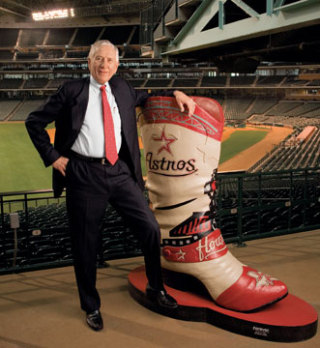
Drayton McLane, Houston Astros.

10. The Astros don’t have to worry about finding a running game. If there’s any running to be done, the Astros have Michael Bourn.

9. The Astros play their games in Minute Maid Park, which already saw a World Series in its sixth year of play. The Texans, however, play their games at Reliant Stadium, which has only seen the Carolina Panthers play there and the New England Patriots win there in a Super Bowl. Reliant is also too close to the moribund and without-a-Super-Bowl-action-champion-site-of-any-kind as the Astrodome for over forty years,

8. The Astrodome and Reliant Stadium are rumored to have been built on the site of a Native American burial ground. Minute Maid Park was built on the site  of the former Union Station, a ground walked upon by every major champion from all sports and all walks of life in the 20th century who ever visited Houston.

7. Lightning regularly strikes Minute Maid Park at 3:00 AM following every Astros home-stand opening game win. These events are usually followed by double-digit win streaks by the Astros and instant wealth and social good fortune for all fans who happened to have been sitting in the area of the ballpark that was later that night struck by lightning.

6. Relative to each other geographically in Houston, the Astros are located to the north and the Texans are situated to the south. As everybody who has studied history already knows, the North always wins. Right?

Bob McNair, Houston Texans.

5. Astro fans main-gate the ballpark, going inside and pouring all of their positive energies into pulling for the Astros live at the actual game. Many Texan fans simply tail-gate in the parking lots next to Reliant Stadium and never go inside. They watch the game on portable television sets and are too busy pouring beer down their gullets to pour positive energy live into the Texans.

4. As a source of good-buddy-knowledge talent, the Astros rely upon outcasts from the lately very successful Philadelphia Phillies. The Texans rely upon refugees from the so-so Denver Broncos.

3. The Astros once traded Larry Andersen to Boston for a rookie named Jeff Bagwell. The Texans once used the top pick in the NFL draft to select Mario Williams over either Vince Young or Reggie Bush.

2. Astros owner Drayton McLane is in the wholesale grocery business. He could afford to feed his club during hard times. Astros owner Bob McNair is into oil and horse racing Axle grease on horse meat burgers does not sound like a diet that many Texans could sustain over time.

1. Tal Smith is President of Baseball Operations for the MLB Astros. Rick Smith is General Manager of the NFL Texans. Astros take home the “Senior Smithsonian of Sports Award.”

Baseball’s Bobby Bragan Passes Away at 92.

January 23, 2010

Nobody Did More for Kids Than Bobby Bragan!

Sometimes the end comes quietly and mercifully to the lions of this world. It seems to have happened that way for Bobby Bragan this week. He had been suffering a cold for about week and had simply retired early from watching television for a shave and shower before going to bed at his home in Fort Worth around 6:30 PM on Thursday, January 21, 2010.  When he did not return in a normal amount of time, his wife Betty went to the bathroom to check on him. She found him sitting on the dressing bench, leaning against the wall as though he were asleep.

In this final quiet exit from the dugout of Home Team Earth, the brassy 92-year old Bobby Bragan was gone from the game of life forever and those of us who knew him and were touched directly by his kindness will miss him greatly.

Bragan was truly a Renaissance Man. He was an athlete, a baseball player, a manager, an innovator, an artist, a comedian, an entertainer, a musician, an actor, a good friend, a loyal husband and family man, and one of the most generous humanitarians and philanthropists who ever came down the pike.

"You Can't Hit the Ball with the Bat on Your Shoulder!" - Bobby Bragan.

From its 1992 inception forward, the Bobby Bragan Foundation in Fort Worth raised around one million dollars in scholarship money for deserving students. It was the thing that Bobby put the full weight of his personal influence and friends energies into and it paid off handsomely for the kids he supported. Now it’s up the foundation and Bobby’s friends to make sure that the good work continues. The effort takes a great hit with the loss of Bobby.

Bobby Bragan was born In Birmingham, Alabama on October 30, 1917. As a kid who grew up loving baseball, he had a seven-year playing record as a shortstop/catcher for the Philadelphia Phillies (1940-42) and Brooklyn Dodgers (1943-44, 1947-48). Bobby had five brothers who also played professional baseball, but none of them made it to the major leagues.

Bragan only hit .240 with 15 homers over his MLB career, but his real talent was leadership. After four seasons as manager of the Fort Worth Cats (1948-52) and three seasons as manager of the Hollywood Stars (1953-55) Bobby Bragan moved up to the big leagues for stints as field manager of the Pittsburgh Pirates (1956-57), the Cleveland Indians (1958), and the Milwaukee Braves (1964-65) / Atlanta Braves (1966). Bobby also served time as a coach for the Los Angeles Dodgers and was a member of the original club developmental staff for the 1962 Houston Colt .45s.

Bobby Bragan managed five Hall of Famers: Roberto Clemente, Bob Lemon, Hank Aaron, Eddie Mathews, and Warren Spahn.

In his later years, he served as President of the Texas League when the designated hitter rule was put on trial for later use by the American League. Bobby never defended the “DH” rule in his discussions with me, but he did feel strongly that MLB should either apply the rule across the board, or else, get rid of it.

Bobby Bragan was a member of several halls of fame, including the Alabama Sports Hall of Fame, the Texas Sports Hall of Fame, and the Texas Baseball Hall of Fame. He had a reputation as a manager for being thrown out of games for arguing with umpires that later spilled over into his later years. When the independent league Fort Worth Cats decided to honor Bobby by making their official manager for one game at age 87, Bragan not only established a record as the oldest official manager in baseball history, he also managed to get thrown out of that game early for arguing with an umpire.

Some spots never go away.

My favorite Bragan story concerns the exciting role he played in the 1947 Word Series for the Brooklyn Dodgers against the New York Yankees. It almost didn’t happen. Bragan seemed destined for bullpen catching as the great Roy Campanella, another Hall of Famer, took charge in the starting lineup as expected.

In spite of his remote chances for game action, Bobby persuaded his parents, George and Corinne Bragan, to take the train up to New York from Birmingham in the hope of seeing him play. By Game Six, it was beginning to look as though that wasn’t going to happen, but suddenly, Bobby’s luck changed.

The Dodgers were down 3 games to 2 in the Series and 5 to 4 in the 6th inning of Game Six and facing elimination when, suddenly, they got two runners on base.

Dodger manager Burt Shotton sent a call to the bullpen. He wanted Bragan to come in and hit for pitcher Ralph Branca against Yankee relief ace Joe Page. Bobby’s heart ascended to his throat, but he heeded the word and trotted out of the shadows and into the limelight.

On a 1-2 count, Bragan put the wood on a double down the left field line, tying the game. The Dodgers went on to win the game, 8-6, forcing the decisive Game Seen that would unfortunately lose, but Bragan had known his moment in the sun.

Here’s the kicker. After the game, Bobby couldn’t wait to hear his parents’ reaction to seeing his heroic moment. It wasn’t there. George and Corinne had chosen the moment immediately prior to the announcement of Bobby’s entry into the game to leave their seats for a quick bathroom trip. They missed the whole thing. And that turned out to be Bobby’s only World Series appearance.

Bobby's Pinch Hit Double Saved Game 6 of the '47 world Series.

Bobby Bragan played the piano, sang and wrote songs, and even recorded his own CD album in later years to help boost contributions to his foundation. My favorite Bragan number will always be the one that best typifies his character and attitude about baseball and life. Its title and second line in the verse says everything you need to know about how Bobby Bragan felt about facing life’s challenges: “You can’t hit the ball with the bat on your shoulder. You got step up there and swing.”

We’ll keep swinging down here, Bobby, but we’ll miss seeing you in that third base coaching box, from here to eternity. Keep us in mind even now, old friend. We shall continue to thrive upon precious memory and contact with your indomitable spirit.

Michael Bourn Named 2009 Astros MVP!

January 22, 2010

Houston Baseball Dinner Picks Michael Bourn as 2009 Astros MVP!

The 2010 Houston Baseball Dinner at the downtown Hilton near Discovery Green came off as scheduled last night, Thursday, Jannuary 21st. The winter banquet that normally lights the hot stove fire on Houston’s hope for the coming baseball season worked its usual magic before a crowd of over 1,000, picking several Astros and a few others for post and pre season honors.

Michael Bourn was chosen by the Houston Chapter of the Baseball Writers of America as the 2009 Most Valuable Astro Player. Bourn had a breakout season in 2009, hitting .285 with a .354 one-base percentage and a National League leading total of 61 stolen bases, a figure that fell only four shy of the club record. Michael hit .353 with runners in scoring position and he led the National League in in both infield hits and bunt hits. He also ranked second in the league with 12 triples. Defensively, Bourn also became  the first Astro outfielder in 33 years to win a Gold Glove for fielding excellence.

Wandy Rodriguez Was the Astro Ace in 2009.

Wandy Rodriguez was named ast the 2009 Astro Pitcher of the Year. Wandy’s 14-12 record came with a 3.09 ERA, 9th best in the National League. His 193 strikeouts and 205 innings pitched placed him 8th in the NL, and he was 7th i the league with 33 starts. His 2009 home ERA was a remarkable 2.05. Wandy’s 4-0 record and 0.75 ERA last July also earned him Pitcher of te Month honors for that time frame.

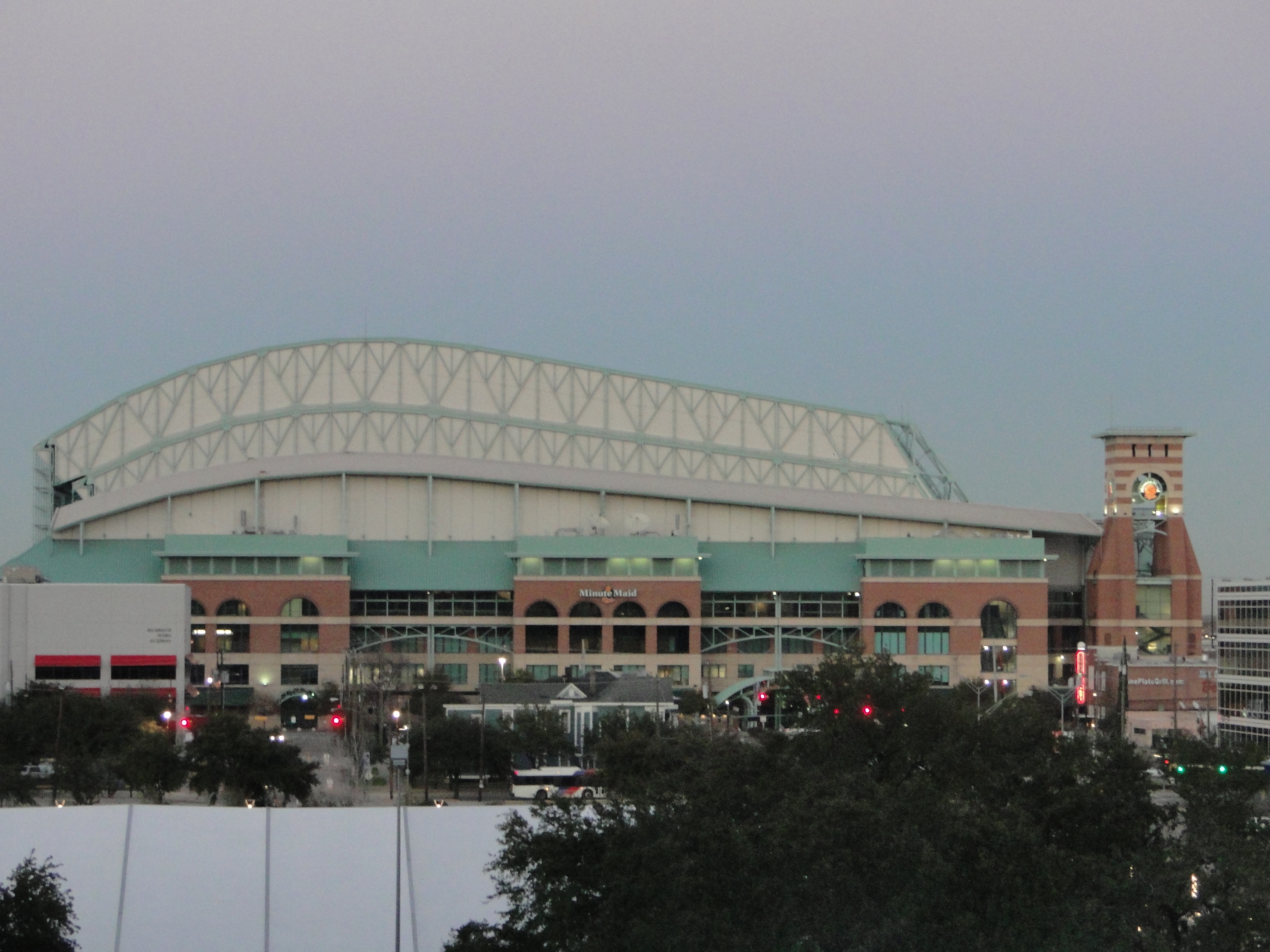
Minute Maid Park View from Banquet Site: January 21, 2010.

Jeff Fulcino won the Astro Roookie of the Year award for 2009. Fulcino posted an all relief record of 6-4 with a 3.40 ERA. He recorded 71 strikeouts in his 82 innings and 61 game appearances, holding right-handed batters to a .209 batting average.

Pitcher Brian Moehler was the recipient of the Darryl Kile Award as the player who best exemplified victory over hard times and commitment to the team above personal gain.

Outfielder Adam Dunn of the Washington Nationals won the 2009 Houston Area Major League Player of the Year Award. Dunn cranked out 38 home runs and posted 105 RBI in 2009, while also becoming only the 123rd player in big league history to hit 300 homers over his career. Dunn now ranks 106th on the all-time home run total list.

First baseman Lance Berkman took the 2009 Allen Russell Award for Distinguished Achievement, Lance is a five-time All Star who ranks 12th among active players for highest career batting average (.303), 5th among active players in on-base percentage, 12th among players in slugging percentage (.561) and 7th among active players in on-base plus slugging percentage (.983).

Former sports writer and Houston Baseball Dinner Co-Founder Ivy McLemore took the Fred Hartman Award for Long and Meritorious Service to the community.

Anthony Rendon of Rice was named as the Pre-Season 2010 College Player of the Year; Coach Jim Long of the Brenham Cubs was tabbed as the 2009 Houston Area High School Coach of the Year; and sixteen high school players were chosen as members of the 2010 Houston Area Pre-Season High School All Star Team. These high school baseball stars of the present and future included: Nick Bergmann, Memorial; Krey Bratsen, Bryan; John Cialone, St. John’s; Stefan Crichton, Cinco Ranch; Dave DeKerlegand, Pearland; Jordan Jolly, Fort Bend Elskins; Jared Lakind, Cypress Woods; Cody Perkins, Kingwood; Kendrick Perkins, LaPorte; Kevin Semien, Atascosita; Alex Silver, Bellaire; John Simms, College Park; Jameson Taillon; Trevor Teykl, Fort Bend Kempner; Erich Weiss, Brenham; and Jake Wise, Cypress Falls.

Astros General Manager Ed Wade and Field Manager Brad Mills capped the evening with some “hope springs eternal” talk about the coming new season and their 2010 roster of upside-bearing younger players. MVP Michael Bourn serves well as the poster boy for more team speed and positive change on offense and defense. How many games the 2009 Astros can actually win with their reconstructed pitching staff and roster of new starters at catcher, short, and third remains to be seen. The outfield is 67% fast and furious and 33% slow and plodding for the second year in a row. We’ll see how that string plays again too.

You had to be a deep blue baseball fan to enjoy the Houston Baseball Dinner, but all of us were. And now we’re chomping at the bit for spring training to start over  in Florida.

This year marks the 25th anniversary of the annual dinners started by Allen and Jo Russell to honor local baseball accomplishments and other community achievements by baseball people. Former Houston Buffs President Allen Russell passed away in January 1996, but his widow, Jo Russell, has done a beautiful job of making sure this torch keeps passing forward to the younger generations that make up the grand community of loyal and knowledgeable baseball fans in Houston.

Thanks, Jo Russell, for another job well done!

Have a nice weekend, everybody!

Johnny Grodzicki: Another Buffs Might-Have-Been!

January 21, 2010

For of all sad words of tongue or pen, the saddest are these: ''It might have been.'' - John Greenleaf Whittier.

At 6’2″ and 200 pounds, Johnny Grodicki (BR/TR) was another of those young Houston Buff arms from the 1930s who might have been something had fate broken a little differently. It just wasn’t to be.

Grodzicki arrived in Houston late in 1936 at age 19 after registering a 16-12 record for New Iberia of the Evangeline League, a place that saw the start of many future great Cardinal pitchers. Howie Pollet and ed Munger both got their starts there.

Grodzicki got into three games for ten innings of work with the Buffs in 1936, picking up a single loss as his only Texas League mark in that first year, but hopes were high in St. Louis for his success at Houston in 1937.

Grodzicki’s fastball had good heat and his curve was decent enough. As often happened, his problem was control. In 244 innings of work for the 1937 Buffs, Grodzicki walked 174 batters. He still finished the season with a great record of 18 wins against only 11 losses and he complied an attention-getting earned run average of only 2.88 for a Houston club that finished in 7th place with a 67-91 record.

Young Grodzicki also starred in the 1937 Texas League All Star Game at Buff Stadium. In only the second game of its kind in league history, an overlow crowd of over 8,000 Houston fans showed up that day to watch the North and South All Stars square off against each other. Grodzicki came into the game in the fourth inning, bringing form and focus with him. He proceeded to imitate the earlier accomplishments of major league great Carl Hubbell by striking out six of the best hitters in the North lineup as his first item of business. The hitters, all of whom carrying .300+ batting averages with them into the game, included Homer Peel, Red Harvel, Joe Bilgere, Lou Brower, Norman McKaskill, and Ed “Bear Tracks” Greer.

1938 saw Grodzicki post a 12-21 record for a 5th place Houston Buffs (74-84) club. His innings of work increased to 269 and his walks dropped to 169, but his ERA ballooned to 4,25.

1939-1940 saw Grodzicki moving up the Cardinal chain for two seasons at Rochester where he compiled a total record for two seasons of 11 wins and 10 losses. In 1941, “Grod” moved over to Columbus for a record of 19-5, 2.58 ERA and his best season record in professional baseball. His success at Columbus earned Grodzicki a late season call-up to the parent St. Louis Cardinals where he posted a 2-1 record and a drop-dead gorgeous ERA of only 1.35 in 13.1 innings of work.

Then came World War II and a hiatus from the game that finished the future of Johnny Grodzicki. In his first season back, 1946, “Grod” worked only four innings, recording no record, but posting a 9.00 ERA for the Cardinals. In 1947, Johnny worked only 23.1 innings for the Cards, posting a record of 0-1 with an ERA of 5.40. Aging, injury, and ineffectiveness, plus four years of war rust wouldn’t go away. They were collectively the end of Johnny  Grodicki’s stock as a prospect. After 1947, he would never again darken the doorway of an MLB clubhouse.

Twelve years after his first arrival, Johnny Grodzicki returned to the Houston Buffs in 1948 as a an old 31-year old minor league veteran. “Grod” did OK in limited action as a 6-5, 2.05 ERA starter/reliever in 88 innings. Coming off their 1947 Dixie Series championship year, the ’48 Buffs under manager Johnny Keane were only an 82-71 3rd place club. “Grod” was starting to be a fit for mediocrity.

1949 saw Grodzicki go 4-5 for the Buffs before moving up to Rochester again for a 2-1 mediocre finish. Johnny Grodzicki continued to plod his way through the minors for three extra seasons of unremarkable achievement before hanging it all up after 1952 at the age of 36. He finished with a career minor league record of 108 wins, 83 losses and an ERA of 3.65

Johnny Grodzicki passed away in retirement at the age of 83 on May 2, 1998 in Daytona Beach, Florida. As a faded away former minor league prospect, he was the living embodiment of “what might have been.” With a little more control, a tad bit more of good luck contact with the right mentor who never showed up in reality, and with a lot less wear and tear from World War II, who knows what might otherwise have become of Johnny Grodzicki?

Johnny, we hardly knew you.

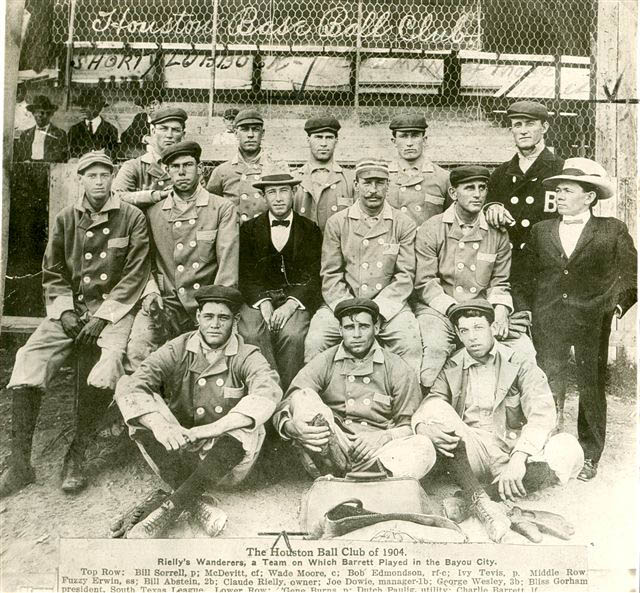
The 1904 Houston Wanderers.

January 20, 2010

The Buffs Called Themselves the Houston Wanderers Back in 1904.

As I hope you could glimpse from the piece I recently wrote here on the start of the Texas League, baseball didn’t exactly get off to a seamless start in Houston or any other Texas city back in 1888. Teams and season schedules sometimes folded like a House of Cards when the going got tough. Unstable lineups led to unstable results; unstable results led to unstable attendance;  unstable attendance led to players not getting paid on time; missed paydays led to teams failing to keep their travel commitments for road games; abruptly canceled games drove fans away; and lost fans meant lost teams. It wasn’t very pretty, especially at the start.

By 1902, the Texas League had recovered sufficiently to reorganize, but Houston was not among the clubs that came together for another go at playing a full season. In 1903, Houston joined with Galveston, Beaumont, and San Antonio to form the four-team South Texas League as competition for the four-club Texas League group of Dallas, Fort Worth, Paris,/Waco, and Corsicana. For the first time in 1903, our local baseball team was known as the “Houston Buffalos.”

The 1903 Buffs were followed by a one-season identity hiccup. The 1904 club changed their name to the “Houston Wanderers” for that single season. By 1905, the club had gone back to “Buffalos” and they never looked elsewhere again for a better moniker. From 1905-1942, 1946-1961, our boys would be known as the Houston Buffs in the South Texas League, the Texas League, and the American Association.

After the 1906 season, the two competing state circuits settled their differences and reorganized the Texas League that continues to exist from 1907 through 2010. The 1904 Wanderers finished with a 66-59 record (.528), or only good enough for a third place spot in a four club league. Claude Rielly was the club owner by this time. The 1904 Houston Wanderers  featured the league’s leading hitter (Bob Edmundson, .340) and the league’s winningest pitcher (Clayton Robb, 26 wins). In fairness, we note that Robb won some of those game for Beaumont before he was traded during the season to Houston. Robb also finished in a tie for most wins with Baldo Luitich of Galveston/Beaumont. Luitich also bagged 26 South Texas League wins in 1904. Add one more local leader. Houston’s Bill Sorrells led the 1904 Texas League in strikeouts with 243.

Yes, Houston club owner (and sometimes manager) Claude Rielly really spelled his name “ie” rather than the conventional “”ei”, but that’s not surprising. The rules that governed the early years of professional baseball had nothing to do with following guidelines like “i after e, except after c”. The early baseball founders made up their own rules and boundaries, sometimes taxing their full faith and credit investment in the public’s trust in the integrity of the game. The only rule they could not suspend is the one that governs the bottom line: If you don’t make money over time, you have to fold your tent and go away.

For Houston, the 1904 Wanderers were simply another step in the right direction. They played all the games they were scheduled to play, and they finished the season without crashing their payroll commitments to their players. 1904 Houston club leader Claude Rielly understood a basic tenet about baseball in particular and business in general. That is, before you can hope to expect profitable “success,” you better be able to spell “infrastructure solvency.”

First Look at the 2010 Astros.

January 19, 2010

How many games will the 2010 Houston Astros win during the regular 162-game season? Spring training may alter some of your guesses, but it’s hard to see this year as being anything other than what it needs to be. The club has taken steps to rebuilding the talent-decimated farm system, but it will take three to five years to see how that works out. Meanwhile, I’m hoping General Manager Ed Wade and Owner Drayton McLane will resist throwing big dollar, multi-year contracts at any more lead-footed sluggers or heavy-armed over-the-hill starting pitchers. Let’s rebuild this club with good young prospects that develop within the Astros system. If our professionals can’t do that successfully, it says to me that our pros are really no better than us fans when it comes to signing talent. Given the money, any serious fan could find a way to throw one hundred million dollars at an established star. It takes a better knowledge base to draft and sign the kids who are going to grow into those star shoes in three to five seasons.

With as little comment as possible, here’s how I see the 25-man roster of the 2010 Astros based upon the current 40-man list. Using five years from now (2015) as our developmental target line, I’ve bold-typed only those players who may have some future with the club by that time. Those who aren’t bold-typed have either already convinced me we’ve seen their best and that their best is not good enough – or that they will be over-the-hill by 2015 and probably need to either retire or be traded before the time comes. I’m only looking at players on the current 40-man roster:

2010 Houston Astros (Possible 2015 Astros in Bold Type):

catchers: Humberto Quintero; J.R. Towles.

1st Base: Lance Berkman.

2nd Base: Kazuo Matsui.

3rd Base: Pedro Feliz; Chris Johnson.

Shortstop: Tommy Manzella.

Utility Infielders: Geoff Blum; Jeff Keppinger, Edwin Maysonet.

Left Field: Carlos Lee.

Center Field: Michael Bourn.

Right Field: Hunter Pence.

Utility Outfielders: Brian Bogusevec; Jason Michaels.

Starting Pitchers: Roy Oswalt; Wandy Rodriguez: Brett Myers; Brian Moehler: Bud Norris.

Spot Starters & Relief Pitchers: Feilipe Paulino; Brandon Lyon; Wesley Wright; Tim Byrdak; Jeff Fulchino; Matt Lindstrom.

That’s it for now. The club does have some prospects who are not currently on the 40-man roster, along with somenice  younger pitchers on the 40-man roster who probably won’t make the club by Opening Day, but could be around here in the very near future. It’s just hard for us Astro fans to face up to the fact that our two current greatest stars, Roy Oswalt and Lancy Berkman, probably have seen their better daysas stars. 2010 is going to tell us a lot about Berkman’s down year and Oswalt’s lingering health issues in 2009.  If those two guys don’t come back dtrong in 2010, it’s going to be an even tougher year at Minute Maid Park.

We’ll revisit this topic at the end of spring training. Spring Training is always a place where someone, or something, stirs up a new batch of hope tonic. We won’t give up hope, anyway. We will just have to place hope on a more realistic timetable. I like to think that the club is already taking that position and that it is now reinvesting in the long term as the place for big results.

No matter how you slice it, one thing should be blatantly obvious from the talent we have on hand: Reaching the World Series in 2010 is way off the table for the Houston Astros. I’d love to be wrong, but in the meanwhile, please don’t bet the ranch that I am.