Archive for the ‘Uncategorized’ Category

Happy Birthday, Jimmy Wynn!

March 12, 2015
"Happy Birthday. Jimmy Wynn! Podnah, a few years down the road, you're going to be askin' for my autograph down there in Houston, a special place to both of us, and I'm gonna give it to you! _ Heck! I oughta be askin' for yours!"  ~ Dizzy Dean, March 12, 1937

“Happy Birthday. Jimmy Wynn! Podnah, a few years down the road, you’re going to be askin’ for my autograph down there in Houston, a special place to both of us, and I’m gonna give it to you! – Heck! I oughta be askin’ for yours!”
~ Dizzy Dean, March 12, 1937


Happy Birthday, Jimmy Wynn! Before we say more, however, let’s take a brief look at the baseball news that was going on exactly five years prior to the day you were born in Cincinnati.

Seventy-eight years ago today, on March 12, 1937, an AP spring training briefs story by Eddie Brietz for the Amarillo News Globe does much to confirm, that over the passage of time, some things change, but a whole lot of other things pretty much stay the same. In fact, the money holdouts by players back in 1937  just seemed to fulcrum on differences with management over hundreds of dollars for one contract year – versus differences today over millions, multi-years, guaranteed money, and aggregate salaries penalty caps. OK, we concede. It’s a lot different today on the money volume side – and we also know the players have much more leverage today in this era of free agency, but disagreements are still mostly about money valuations on a player’s worth to any club.

____________________

SPORTS ROUNDUP By Eddie Brietz

(March 3, 1937)

ST. PETERSBURG, Fla., March 12 (AP) – On the way to Daytona Beach to talk things over with the Cards yesterday, Dizzy Dean stopped off at the filling station at Bradenton and in fifteen minutes won $15 pitching quarters with the boys. …. “Looks like I can pick up that $50,000 dollars a year right here at home,” commented Dizzy as he pocketed the dough. …. Loneliest camp in Florida is Detroit’s because of (manager) Mickey Cochrane’s “no wives allowed” edict. … You should have seen the almost bald head of (Reds) General Manager Warren C. Giles after he had celebrated his first day in the Cincinnati camp by sitting in the bleachers throughout the Reds’ first full nine innings practice game.

_____

The Yankees haven’t given up on Lou Gehrig yet. … They recall the last Lou was a hold-out, he and Col. Ruppert (Yankees owner) rode South on the same train. … Not a word has been heard from Joe DiMaggio. …  Baseball men, who can’t imagine a Yankee exhibition tour through the south and southwest without Gehrig to draw the customers, believe Lou will get his $40,000 if he waits long enough, but one and all say Ruppert is just stubborn enough to let DiMaggio sit at home a year before paying (him) the $25,000 he demands.

~ Amarillo News Globe, March 12, 1937, Page 13.

____________________

FAST FORWARD FROM 1937 TO 1968 ~ An older DIZZY DEAN  signs n autograph for 26 year old JIMMY WYNN of the Astros. Wish Jimmy Happy Birthday! He turned 73 today, March 12, 2015!

FAST FORWARD FROM 1937 TO 1968 ~
An older DIZZY DEAN, at the Dome for an Oldtimers Game,  signs an autograph for 26 year old JIMMY WYNN of the Houston Astros.
Wish Jimmy Happy Birthday! He turned 73 today, March 12, 2015!


MARCH 12, 2015: HAPPY BIRTHDAY TO ONE OF OUR TRUE HOUSTON BASEBALL ICONS AND COMMUNITY TREASURES, THE ONE AND ONLY, JIMMY “THE TOY CANNON” WYNN!

Jimmy Wynn has given of himself to this community in the right spirit ever since his arrival in Houston 52 years ago. Please leave a public comment wishing Jimmy a HAPPY BIRTHDAY here at this column space – and also drop him an e-mail birthday wish today at the following e-mail address: toycannon24@msn.com
 

Great Player! Great Man! Great Story!

Great Player!
Great Man!
Great Story!


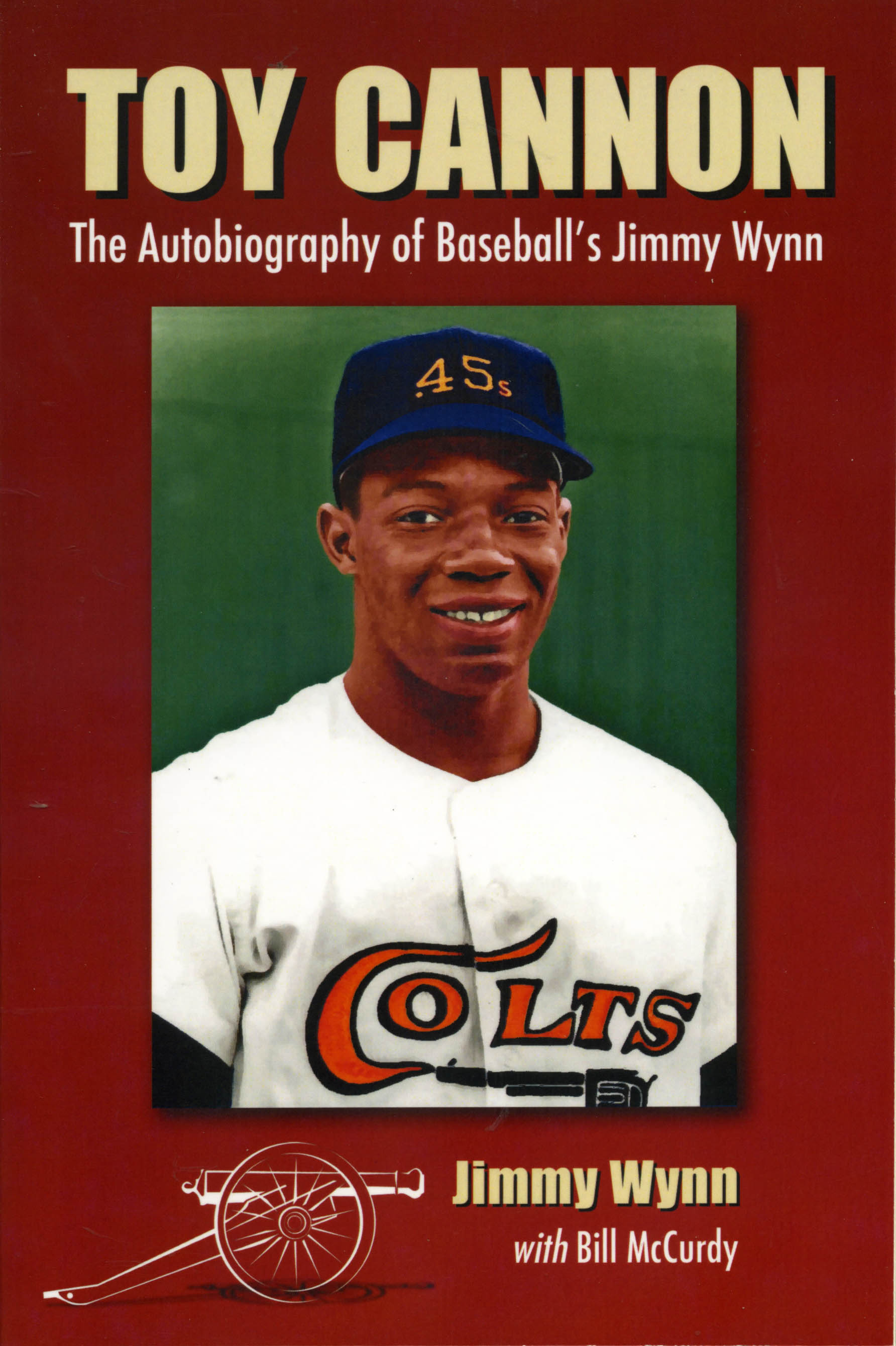
Not just “by the way”, if you never acquired your copy of Jimmy Wynn’s wonderful life story, “Toy Cannon”, or if you would like to own or purchase a gift copy, signed by the man himself, personally to you or another, now is time to fill that void in your library.

“Toy Cannon” is available for $30.00, plus sales tax and shipping from Amazon.Com, but Jimmy and I have a much better offer.

Jimmy Wynn and I still have less than 80 copies of the book that we wrote in 2010 that we are now selling directly for $30.00 – a complete price that includes the full cost of the book, sales tax, and book rate shipping – PLUSJimmy Wynn will also autograph it to whomever you wish to designate for that special honor by written instruction. Amazon cannot provide autographed fresh copies at a discounted rate. We can. For a short while.

If you are interested, feel free to submit multiple orders in one envelope for the same rate times however many copies you order. We  have not been very aggressive in selling away our personal copies until now, but we do not expect our small supply to last for  long at this discounted rate – especially with Jimmy Wynn’s personal signature attached to each treasured copy.

If you are interested, send $30.00 total for each autographed copy of “Toy Cannon”, with payment by check or money order. Endorse payment to “Bill McCurdy” and include a clear return mailing address and any special written instructions on how you wish Jimmy to sign the book for you. If no instructions are included, Jimmy will simply sign his name in the appropriate place on the interior title page.

Please: Send no cash payments!

Mail your check and any signage instructions for each book you order to:

Bill McCurdy, Publisher

Pecan Park Eagle Press

P.O. Box 940871

Houston, TX 77094-7871

____________________

Regards, Godspeed, and Happy Birthday, Jimmy Wynn!
Van Lingle Mungo: Pitcher and Song Title Too

March 11, 2015
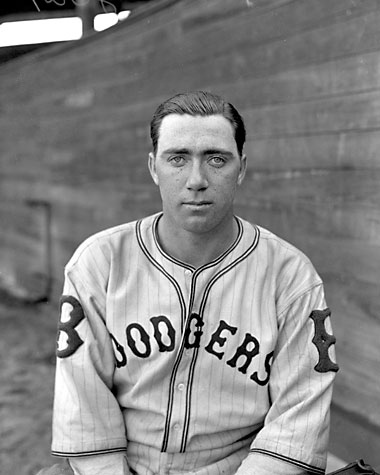
Van Lingle Mungo ~ If they ever make his movie, The Pecan Park Eagle recommends Nicholas Cage for the title role.

Van Lingle Mungo
 If they ever make his movie, The Pecan Park Eagle recommends
Nicholas Cage
for the title role.

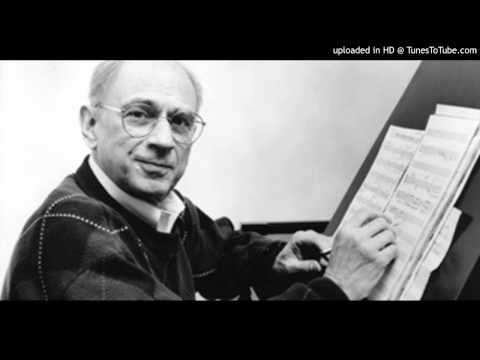
The story of Van Lingle Mungo is a case in which two passions of the same person finally merged and transformed one of the most interesting baseball player names into the title of a song that has been acclaimed as one of the most important jazz numbers of the very late 1960s through the entirety of the 1970s.  The fellow whose creative forces put it all together was Dave Frishberg, a jazz pianist and composer who just happened to also have gone on to become of the early members of SABR because his fascination with the game we don’t even need to name in this part of the universe, but probably will, anyway. Baseball is a love that rests as comfortably on the muse farms and in the hearts of the artfully inclined creative types as it does in the scientific minds of those saber-metric mathematicians who have formulated their “money game” ways into decision-making roles with almost every MLB club these days.

Dave Frishberg Composer "Van Lingle Mungo"

Dave Frishberg
Composer
“Van Lingle Mungo”

Back in 1969, Frishberg apparently was going through one of those little pre-natal labor pains that comes with creative writing. He had a little melody that had been rolling through his head that would then be filled with interesting name that he pulled from the Baseball Encyclopedia. There was one little five-note hole to be filled at the end of the repetitive melody stanza that he needed as memorable punchline. Frishberg found his solution when he ran across the wonderful name of a 1930s Brooklyn Dodger pitcher named Van Lingle Mungo.

In case you might care for the countdown on the syllables of that fabled moniker – that name again was Van-Ling-le-Mun-go! Five! Five syllables! Five Notes! It sounded strange, but fit so well, it earned its way up to song title too. First released as a 1969 single, Frishberg later that same year included “Van Lingle Mungo” as one of the numbers of his new album, “Oklahoma Toad”.

There are forty MLB ballplayers named in “Van Lingle Mungo” – the light piano jazz number that both sounds and plays well as a “for listening and background music only” that was once so popular during the “Lizard Lounge Era” that saw its best days from post-WWII through the 1970s. The song has been incorporated into the National Baseball Library Archives at Cooperstown – and much information is available on the Internet about the history of the song.

Here’s a nice summary on the history of the song that includes the names of ballplayers it included as lyrics:

http://en.wikipedia.org/wiki/Van_Lingle_Mungo_%28song%29

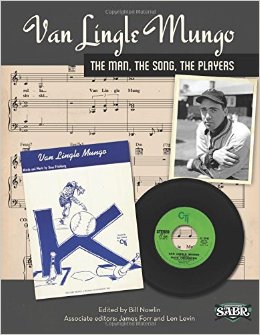
"Van Lingle Mungo" The Book A SABR Production

“Van Lingle Mungo”
The Book
A SABR Production

A book also has been written by 32 SABR members, with Bill Nowlin acting as the primary editor, and it is entitled “Van Lingle Mungo: The Man, The Song, The Players”. It is available in paperback and e-book versions. Also, at this same link, look for the link midway down the page that will transfer you to You-Tube to hear Dave Frishberg performing the song and playing the piano.

http://sabr.org/latest/sabr-digital-library-van-lingle-mungo

Last, but not least, here’s the Baseball Almanac link to Van Lingle Mungo’s MLB career pitching record (1941-43, 1945) with the Brooklyn Dodgers and New York Giants. All but the last three years were spent as either a Brooklyn Robin, during the clubs last season as Robins in 1931. From 1932 to 1941, Mungo played as a Brooklyn Dodger for all of ten years.

http://www.baseball-almanac.com/players/player.php?p=mungova01

Baseball – you are a mighty river that carries all who ride with you to the ocean of everything else that is truly good and important in life. If you don’t understand what I’m talking about, it is probably because you are not that deeply involved with the soul of the game, but that’s OK too. Find your own river to the sea. This one just happens to work fine for me.


The 1st Problem of Perfection is Its Measurability

March 10, 2015
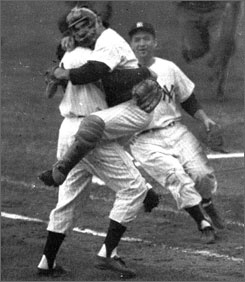
Don Larsen, New York Yankees World Series Perfect Game Pitcher October 3, 1956

Don Larsen, New York Yankees
World Series Perfect Game Pitcher
October 3, 1956

While looking over the linked list of all the perfect games in MLB history this morning, I stumbled totally into a lifelong question about that truly unattainable state. All I know for sure at this time in my life, the afternoon of the late and long shadows, is that whatever it may be, it sure isn’t me. And, truth to tell, it probably isn’t you either. Neither of us are capable of attaining true perfection – nor should we be shackled to the ruinous pressure of trying to pursue it. And the first problem of perfection, in life or baseball, is the always present challenge of finding a way to measure the unmeasurable because – whatever you come up with – and vice versa, you to me, the other person will always have some solid reason for finding another’s definition of perfection as either lacking some key element – or incomplete in its’ conceptual design.

In the end, as we have done with the so-called “perfect game” in baseball, we have to come up with working definitions of perfection that are realistically achievable on a rarity basis, but achievable, nonetheless.

http://mlb.mlb.com/mlb/history/rare_feats/index.jsp?feature=perfect_game

The names on that referenced list of perfect game pitchers in regular season MLB history makes the point. By our everyday, easy-to-see, perfect game standard, one only occurs to the credit of a pitcher when he faces the minimum 27 batters in nine innings – without giving up a hit or allowing a batter to reach base in any other way, even if it is by a teammate’s error – and the nine innings conclude with the pitcher’s team having more runs than the “0” runs posted by the opposition.

Clear, Very difficult to achieve, but doable on a rare basis. Just look at the list again relative to the total number of games played in MLB history for an easy confirmation of the point. So, how could we have come up with a “closer” definition of “perfect game” that would have made it truer of a condition that would confirm our original premise –  that none of us are really even close to perfect?

Easy. I can think of two further stipulations that would surely elevate the perfect game to the status of perfection, but at the cost of making it virtually certain of never happening in the future because, with either of these additions, it never has – so far – happened at all. Simply add either or both of these stipulations to the ones that already define “perfect game”:

A “perfect game” will only occur when either (1) the pitcher retires every batter he faces on one pitch; or else (2) the pitcher strikes out all 27 betters he faces on three pitches, without ever throwing a called “ball pitch” – or allowing even a single foul ball.

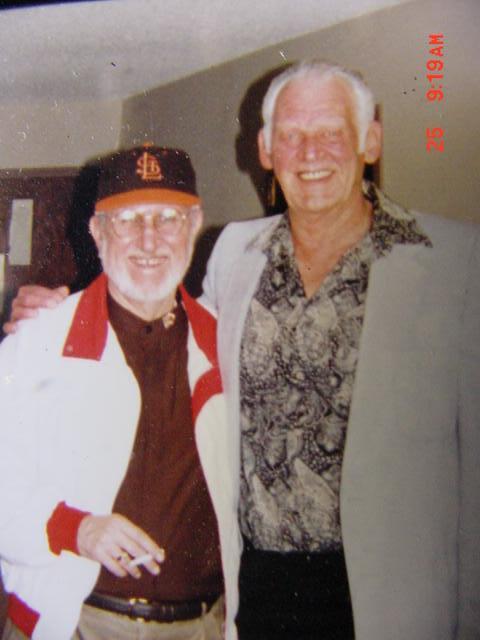
Nobody's Perfect. Don Larsen and I were both still smoking when I interviewed him in St. Louis years ago. I quit smoking in 2006, but it wasn't easy. Now I wouldn't touch one for anything.

Nobody’s Perfect.
Don Larsen and I were both still smoking when I interviewed him in St. Louis years ago. I quit smoking on March 24, 2006, but it wasn’t easy. Now I wouldn’t touch one for anything.

Conclusion: Our current definition of “perfect game” is close enough for us flawed mortals, even for those of us who actually possess the ability to “once in a very blue moon” pitch a major league game and retire all 27 batters we face without a man reaching base while playing for a team that possesses the ability to score a single run for us on a day in which our curves and sliders are “breaking bad”.

Longest Game in Houston MLB History

March 9, 2015
Using his bat for his misplaced glove, AL WEISS, SS of the Mets on 4/15/68, used this body  position to demonstrate his readiness for the ground ball that turned hiim into a human croquet wicket and that allowed a gound ball to slp through him for a 1-0 Astros win the bottom of the 24th.

AL WEISS, SS of the Mets on 4/15/68, made the fatigue error that allowed a ground ball to slip through him with the bases loaded for a 1-0 Astros win in the 24th.


The longest regular season MLB game by innings in Houston history occured at the Astrodome on April 15, 1968. It lasted until the bottom of the 24th. As quoted later by Astros Daily.Com, here’s how writer Vito Stellino of The Sporting News described the final inning for his game retrospective article of April 27, 1968:

Norm Miller was on his own personal 0-for-14 skid when he greeted Mets reliever Les Rohr with a single to right that started the bottom of the 24th. A balk moved him to second and a grounder by Rusty Staub advanced him to third with only one out. Meanwhile, Jim Wynn and John Bateman received intentional walks to load the bases setting the stage for (Bob) Aspromonte. On a 2-and-1 pitch, Aspro sent a sharp roller to Al Weis at shortstop. Whether it was fatigue or anticipating a double play to get out of the jam, Weis didn’t stay down and the ball rolled between his legs into left field as Miller came across the plate to win the game.” – Vito Stellino, The Sporting News, 4/27/68.

The 1968 Astros’ 1-0 bottom of the 24th win over the Mets game took 6 hours and 6 minutes. The record for longest regulation game by time, however, is that Chicago 7- Milwaukee 6 contest of 5/08/84 that you will also find in the following charting of the longest top games by inning. It lasted 8 hours and 6 minutes before it reached the end.

The 1-0 Astros victory over the Mets on 4/15/68 in 24 innings also zoomed to the top of the list as the longest shutout game ever played in MLB history..


BASEBALL ALMANAC
Longest Games / Inning Based Records
Record Lg Teams Innings

Date

Longest Game
By Innings
(20+ Innings)

[Bold=Record Holders]

NL

Brooklyn 1 at Boston 1

26

05-01-1920

NL St. Louis 4 at New York 3 25 09-11-1974
AL Chicago 7 vs. Milwaukee 6 25 05-08-1984
AL Philadelphia 4 at Boston 1 24 09-01-1906
AL Detroit 1 at Philadelphia 1 24 07-21-1945
NL Houston 1 vs. New York 0 24 04-15-1968


For a complete read of the Stellino TSN article, the box score, and a commentary by Astros historian Bob Hulsey on the Astros-Mets 24 inning game from April 15, 1968, click the following link:

http://www.astrosdaily.com/history/19680415/


Ollie Pickering and His “Texas Leaguer” Legacy

March 8, 2015
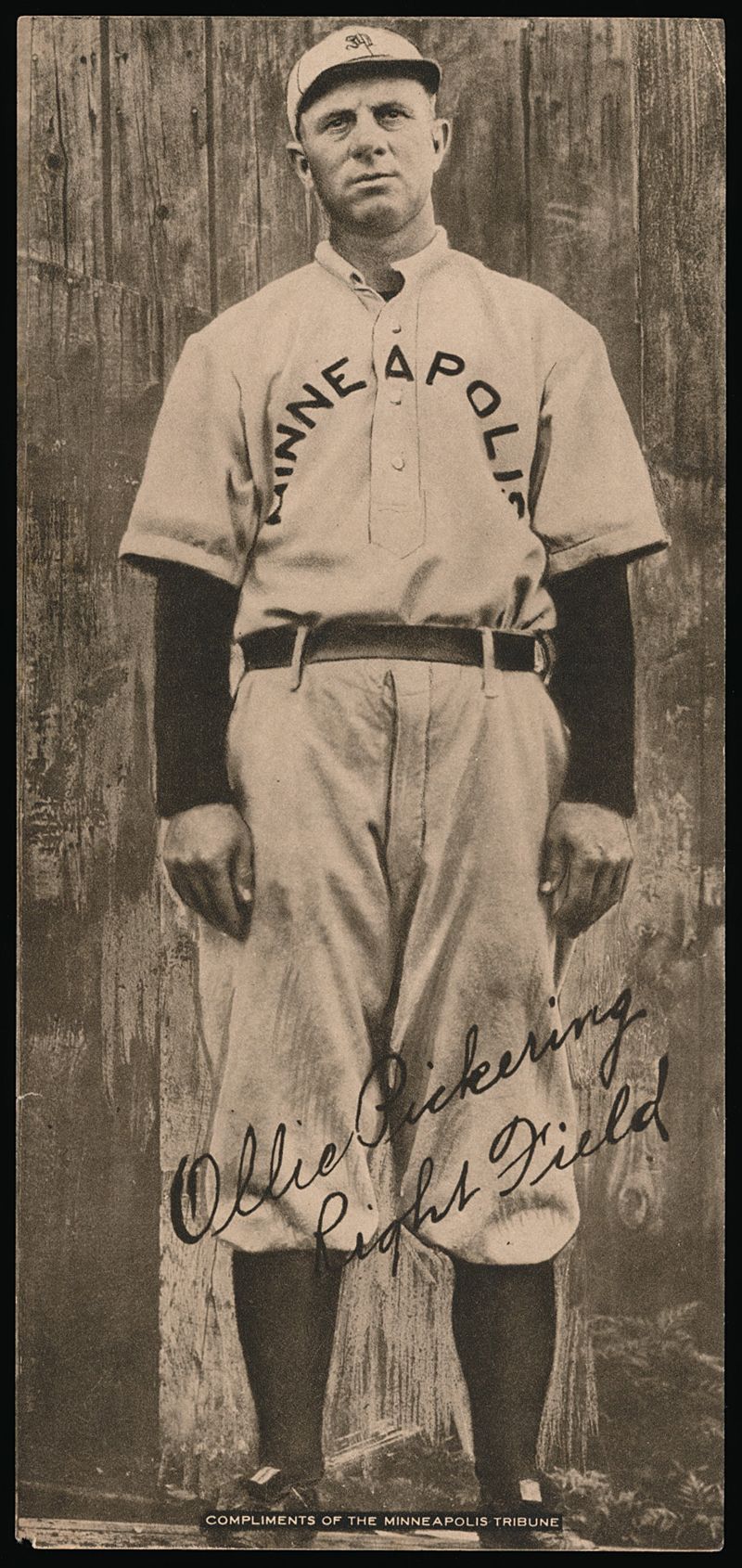
OLLIE PICKERING FATHER OF THE TEXAS LEAGUER

OLLIE PICKERING
FATHER OF THE TEXAS LEAGUER

Ollie Pickering was born April 9, 1870 in Olney, Illinois. He was a 5’11”, 170 lb. center fielder who batted left and threw right. “Pick” began his professional baseball career at the age of 22 with the Houston Mudcats of the Texas League in a trek through the majors and minors that finally concluded at age 52 with the 1922 Paducah Indians. Interesting to note that Pickering could have become famous for a career that was long. Instead, he achieved recognition for hits that were both too long and two short at the same time.

Here’s link to the career record of Ollie Pickering:

http://www.baseball-reference.com/minors/player.cgi?id=picker001oli

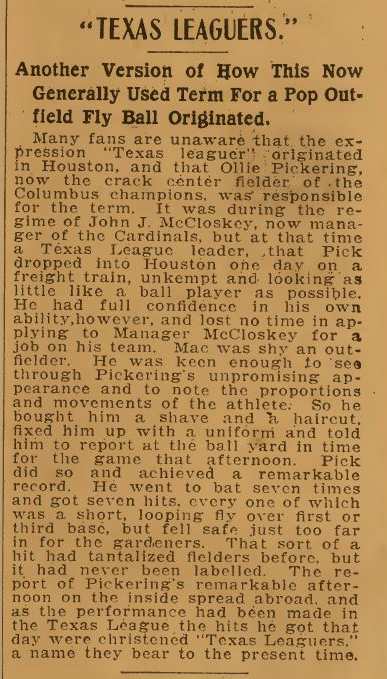
Back in 1892, legend has it that a 22-year old ballplayer named Ollie Pickering hopped a freight train to Houston, dropping in on Houston Mudcats Manager John McCloskey on May 21st to apply for a job on his player roster. Pickering’s physique and athletic movements apparently counted far more to McCloskey than his unkempt appearance, and the Houston manager was short an outfielder, anyway, going into a game to be played that same day.

McCloskey picked up Pickering on the spot. He had him cleaned up with a shave and a haircut and provided him with a uniform – and then told him to show up at the ballpark for the game scheduled for that afternoon. Pickering showed up, all right. He went to bat seven times and, each time he did, he softly stroked a looping, dink fly ball  beyond the first base side infielders that then landed before the right fielder could keep it from touching the ground – or else – he hit the same kind of lazy looper just beyond the reach of the third base side infielders that also touched down before the left fielder could catch it. – News of Pickering’s feat spread rapidly to the rest of the country and, because these easy to spot soft sailing singles all look so much alike, and because they took place every time in Pickering’s  seven-single Texas League game in Houston, these seven dwarf hits, and all of the thousands that have since followed them off all the bats of countless others, have became best known forever from that day as “Texas Leaguers”.

Have a peaceful Sunday, everybody – and don’t forget to move your clocks an hour forward.


Thank you, Darrell Pittman, for this article from the April 21, 1906 issue of The Sporting Life.

Thank you, Darrell Pittman, for this relevant article from the April 21, 1906 issue of The Sporting Life.

The Ballad of Billy Wags (An Oldie)

March 7, 2015
The Ballad of Billy Wags By Bill McCurdy November 2003

The Ballad of Billy Wags


The Ballad of Billy Wags (composed in the wake of Astros’ closer Billy Wagner’s trade to the Philadelphia Phillies on November 3, 2003 for Ezequiel Astacio, Taylor Buchholz and Brandon Duckworth. It’s sung to the tune of The Beverly Hillbillies theme.)


By Bill McCurdy (2003)


Come ‘n listen to my story ’bout a man named Billy,

Poor Mountaineer ~ livin’ broke and willy-nilly.

An’ then one day, he was outside throwin’ rocks,

And up came an Astro scout and signed him outta hock!


Astro baseball contract, that is! ~ Pure gold! ~ Texas closer tea!


Well, the next thing ya know, young Bill’s a millionaire

Kin-folks said, ~ “Bill, ~ change yer underwear.”

Said “Houston, Texas is the place yer gonna be,

Ya cain’t go ta Houston smellin’ of our misery!”


Hills, that is! ~ West Virginia muck! ~ Possum soup and Hoover bugs!


So he chunked his dirty clothes, and he took hisself a bath.

Then he looked at his contract and quickly did the math.

“If they pay for throwin’ baseballs like they pay for hurlin’ rocks,

Ah can git a better deal ~ and make out like a fox!”


Multi-years, that is! ~ Millions of bucks! ~ Dadgum shore-fire good-at-the-bank Drayton-Dollars!


Ol’ Billy bought a Houston mansion. ~ Lawdy it was swank.

He did real good at ‘pitchin and he took ’em to the bank.

Next time they signed him up ~ it cost about a jillion bucks,

And then the Astros brung his pay ~ in six great big ole trucks.


“Guaranteed, that is! ~ Don’t matter if ah do or ah don’t! ~ Ah still gits mah pay! ~ It’s in mah contract!”


Well now it’s time to say goodbye to Billy and his kin,

His mouth and big ole contract both have finally done him in.

Next time we see The Sandman he’ll be just plain rich guy Billy,

He’ll be a runnin’ to the pitcher’s mound as a Philadelphia Phillie!


Duck everybody!

Here comes Brandon Duckworth!

And we ain’t got no ballad for his beginnings!


Ya’ll come back now – anyhow!

Houston’s gittin’ more mediocre by the day!


Birds Do It. Bees Do It. Let’s Do It.

March 6, 2015
BEES DO IT! Exception to the Rule: The Boston Bees 1936-1940

BEES DO IT!
Exception to the Rule:
The Boston Bees
1936-1940


Ode To The 2015 Houston Astros

(A hopeful parody, and not a mere parody of that slippery slope that so often devours Houston Hope. If you are familiar with the verse/chorus transitional melodies, this little springtime aspirational expression is  singable to the score from Cole Porter’s classic musical call to action, “Let’s Do It, Let’s Fall in Love”.)

By Bill McCurdy


Birds do it
Bees do it
Orioles from Baltimore with fleas do it
Let’s do it, Astros, LET’S WIN THIS YEAR

Out in the west
All the best do it
Dodgers, Angels, A’s and even Snakes do it
Let’s do it, LET’S WIN THIS YEAR

The Yanks in old Amsterdam do it
Not to mention the Bums
Pirates and Reds do it,
Only Cubs live on crumbs

Some smaller teams
Without means do it
Bochy Giants out on Frisco Bay do it
Let’s do it, LET’S WIN THIS YEAR

Phillies and Twins
In rare sins do it
People say in Boston even beans do it
Let’s do it, LET’S WIN THIS YEAR

Tigers and Mets, ‘gainst all bets do it
Shocks the world every time
Florida fish do it
Then return to their slime.

In the Midwest, Cardinal crests do it
Two birds on a bat says clearly, “Let’s do it”
Let’s do it too, Houston
LET’S WIN THIS YEAR

In shallow shoals
Padre soles do it
D Rays in the privacy of bowls do it
Let’s do it, LET’S WIN THIS YEAR

Now if the birds and the bees and the trees can do it
Time for us to sneeze and squeeze and just plain do it
LET’S DO IT, ASTROS
LET’S WIN THIS YEAR


J.R. Richard Has New Book Coming Out Soon

March 5, 2015

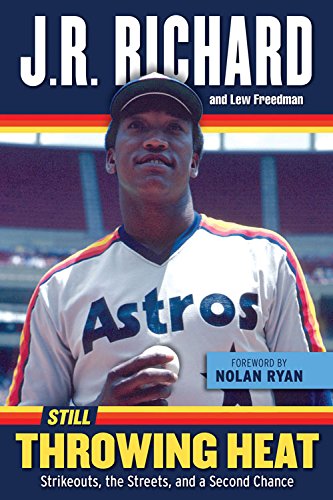
JR-RICHARD

“Still Throwing Heat: Strikeouts, the Streets, and a Second Chance”, an autobiography by J.R. Richard and veteran sports book author Lew Freedman, with a forward by Nolan Ryan is due for release on Amazon, June 1, 2015.

Having only today learned of its coming publication, all we know of its contents are summarized in this marketing blurb from the following link:

http://www.amazon.com/gp/product/1629370991/ref=s9_newr_gw_d0_g14_i3?pf_rd_m=ATVPDKIKX0DER&pf_rd_s=desktop-1&pf_rd_r=00BYQW6T8HYT6W1MHK7H&pf_rd_t=36701&pf_rd_p=1970559082&pf_rd_i=desktop

“A flame-throwing star with the Houston Astros, J. R. Richard was at the top of his profession when he inexplicably began complaining of arm weakness in 1980. Initially scoffed at because he continued approaching 100 mph on the radar gun, everything changed when Richard collapsed while playing catch with a teammate—later diagnosed as a life-threatening stroke. The shocking development ended Richard’s major league career and set off a chain of events that led to the former All-Star being homeless by the mid-1990s. This rapid rise and sudden, tragic fall define the unusual, moving, and inspirational life of a Houston icon who has endured many hardships but has become an admired figure in his adopted hometown. J. R. Richard tells that story now in his own words, including the highs and the lows of his brilliant athletic career, the difficulties that befell him on and off the field, abandonment by those he counted on after his stroke, the despair of losing everything, and his ultimate redemption and giving back to the community.”

(L-R) Bill McCurdy, Johnny Storenski, and J.R. Richard Josephine's Ristorante 2002

(L-R) Bill McCurdy, Johnny Storenski, and J.R. Richard
Josephine’s Ristorante
2002

The Pecan Park Eagle wishes J.R. Richard well for all the success that is possible for his book. We may only hope that his memory of all the factors that contributed to his rise, fall and redemption are as wholly covered as they needed to be. When one has been down a tough road in life, it isn’t ever easy to embrace, own – and then write and publish all that needs to be said. All we can know for sure as readers, old friend, is that you covered the whole truth to the best of your ability – and that none of us will ever know the whole truth of yours – or any other’s life. We are only capable of perceiving what appears to be the truth of another from our direct experience with them – and even that perception is subjective and possibly not true at all.

All I know for sure is that you were one of the greatest and, hands down, certainly the scariest pitchers I ever saw work the mound – and that you most probably could have been another Hall of Fame pitcher in time, had you not encountered the 1980 career-ending, and almost life-ending stroke. As a friend from many years ago, I know you sometimes mistook urges for decisions – and entitlement with love. We just wrote those things off as warts. Everybody’s got some rough spots, right? And today it sounds as though a lot of healing has taken place with your marriage and new calling to the ministry. That’s great. Norma and I are happy for you.

J.R. Richard At a Houston Celebration Of his 2002 Induction Into The Texas Baseball Hall of Fame

J.R. Richard
At a Houston Celebration
Of his 2002 Induction Into
The Texas Baseball Hall of Fame

Oh yeah, two more things I see as true – and I’m reasonably sure that the first is not in your book, even though I saw it happen as one of the most jaw-dropping basketball shots of all time. Do you remember the time you came over to our house with your son for the oxtails that Norma cooked for you? During the dinner waiting period, we all went out to the driveway to shoot some hoops. Then you quickly tired of making close up shots and took the ball through the back gate down the right side of the house and took a side shot from about 50 feet away. It was a high arching heave that had to disappear briefly over an eave in the roof before it came down. – BUT – when it came down, it was nothing but net.

Then you made a decision that was no response to urge. You quit shooting any more baskets. And that was cool. – You did – what Babe Ruth should have done in Pittsburgh back in 1935 when he hit those three home runs. – He should have never picked up another bat again for the rest of his life and retired on the spot. – And I will only hope that you have never taken another basketball shot since 2002.

Yeah, we know that basketball shot story didn’t get in your book, but this perception – one that I share with thousands of Astros fans – surely should have made it, in some way:

In spite of the new Walk of Honor at Minute Maid Park, the Houston Astros still should retire # 50 as a jersey number in your honor!


Who Is the Guy Misidentified as Bob Aspromonte?

March 4, 2015


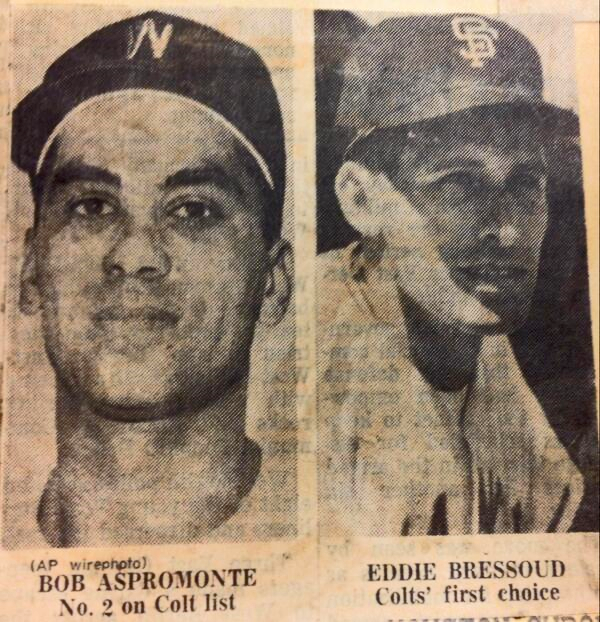
The Pecan Park Eagle received the following photo and note from our friend, Darrell Pittman of Astros Daily two days ago, 3.02.2015::

Who is the guy on the left with the "W" on his cap? It is NOT Bob Aspromonte!

Who is the guy on the left with the “W” on his cap? It is NOT Bob Aspromonte!

____________________

I believe this picture was first posted on Twitter by Mike Acosta a year or so back.

 On October 10, 1961, one of the Houston papers posted pictures of Houston’s first two choices in the expansion draft, Eddie Bressoud and Bob Aspromonte, except it showed a different player than Aspro. I’m wondering whose picture it was.

 Of course, Bressoud never appeared in a Houston uniform. The Colt .45s flipped him to Boston for SS Don Buddin on 11.26.1961. Buddin went on to hit the first grand slam in Colt .45s history on 6.10.1962.

~ Darrell Pittman

____________________

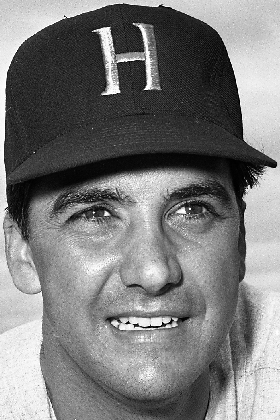
In case you don’t know, or need a reminder, here’s a close-up of the real Bob Aspromonte that was taken early in his Houston baseball career:

The REAL Bob Aspromonte ~Early in his Houston Career.

The REAL Bob Aspromonte
~Early in his Houston Career.

So, what do you think? Did the guy with the “W” on his cap that AP tagged as “Bob Aspromonte” really play for the Washington Senators? And did someone at AP or the local Houston newspaper that posted the photo simply get the mystery player confused with Bob Aspromonte because of his dark, less handsome Mediterranean look? Is it that simple?

The real Aspro hailed from Brooklyn and from an Italian-American family.

Please submit your convictions or guesses as material for the Comment Section which follows this column. This is one stone of mystery that we should be able to overturn quickly in our relentless search for the truth.

Please don’t send your responses to The Pecan Park Eagle as e-mails. We want every reader to have the public benefit of what you choose to offer.

Thanks!

The Pecan Park Eagle

______________________________

THIS JUST IN…1 HOUR, 50 MINUTES POST-COLUMN PUBLICATION

THE WINNER …. BY A 1ST ROUND KO …. READER “OLBERMANN”

The misidentified player is NOT Bob Aspromonte … it is…

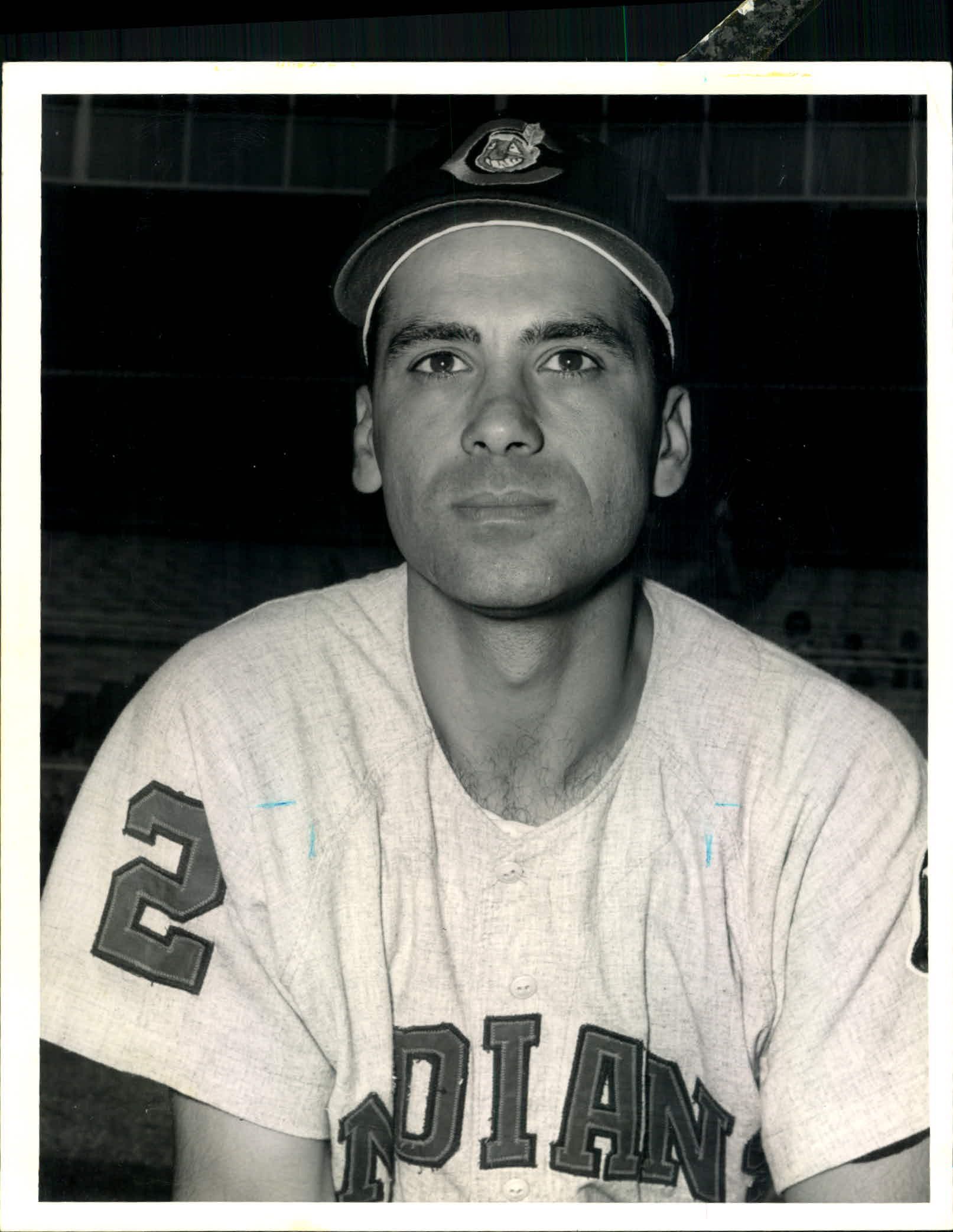
“It’s his brother KEN Aspromonte.” …. (Reader) OLBERMANN

(SEE COMMENT SECTION AND THE TWO PHOTOS THAT FOLLOW):

KEN AASPROMONTE PLAYED FOR THE WASHINGTON SENATORS FROM 1958 TO 1960

KEN ASPROMONTE PLAYED FOR WASHINGTON FROM 1958 TO 1960

For a better comparison to the miidentified Apromonte brother, here's one of Ken as a Cleveland Indian earlier in his career. - We ar convinced.

For a better comparison to the misidentified Apromonte brother, here’s one of Ken as a Cleveland Indian earlier in his career. – We are convinced.

Chuck Connors: Bullet Notes on “The Rifleman”

March 3, 2015
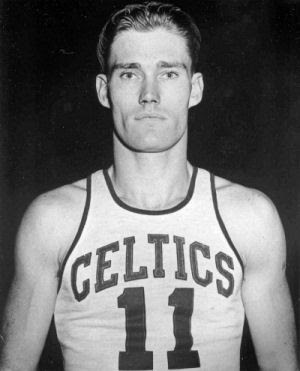
CHUCK CONNORS 1946 ONE OF THE ORIGINAL BOSTON CELTICS

CHUCK CONNORS
1946
ONE OF THE ORIGINAL BOSTON CELTICS


* Technical Point: We know. – Hand guns hold bullets; rifles hold shells. It’s just that “Shell Points on ‘The Rifleman’ ” lacked a certain ring to it as a column title.

Addendum Note: My collegial contributor, Cliff Blau, already has corrected my brain-freeze error on this one point. – See his comment and my response in the Comment section which follows the column. – I do know that shells are for shotguns, not rifles. I simply misspoke. Forgive me as you now read through the rigorously researched points below on the fascinating career trail of former ballplayer and actor Chuck Connors:

* Kevin “Chuck” Connors was born in Brooklyn New York on 04/10/1921.

* Kevin was the second of two children and the only son of Allan and Marcella Connors, immigrants from the Dominion of Newfoundland, now a Canadian province.

* Kevin Connors was raised Roman Catholic and served as an altar boy at the Basilica of Our Lady of Perpetual Help in Brooklyn.

"WATCH OUT FOR THAT FAST BREAK PASS, KEVIN!"

“WATCH OUT FOR THAT FAST BREAK PASS, KEVIN!”

* At full growth, left-handed Kevin had grown into a bright 6’5”, 200 lb. very athlete baseball and basketball player.

* He attended Adelphi Academy on an athletic scholarship. At high school graduation, he had no fewer than 27 college athletic scholarship offers.

* Chuck chose Seton Hall, the future alma mater of Craig Biggio, where he played both basketball and baseball for two years.

* At Seton Hall, Chuck revealed a clue to his ultimate future by winning an elocution contest reciting Vachel Lindsay’s “The Congo”.

* As a Seton Hall first baseman, Connors adopted his nickname “Chuck” from his redundant calls to teammates with the ball to “chuck it to me” because he preferred the nickname to his legal first name Kevin.

"CHUCK IT TO ME!    CHUCK IT TO ME!"

“CHUCK IT TO ME!
CHUCK IT TO ME!”

* After Chuck Connors left Seton Hall, it is also variously reported that he was drafted by the Chicago Bears of the NFL, but, if he was, it obviously never materialized into anything.

* Baseball Reference notes that Connors first signed to play baseball with the Brooklyn Dodgers in 1940. Except for brief stints of minor league ball in 1940 and 1942, WWII pretty much placed those plans on hold.

* Chuck enlisted in the Army at Fort Knox, Kentucky, and spent most of the war as a tank-warfare instructor at Fort Campbell, Kentucky and later at West Point, New York.

* During his Army service, Connors moonlighted as a professional basketball player, joining the Rochester Royals, helping lead them to the 1946 National Basketball League championship.

CHUCK CONNORS MADE HIS MLB DEBUT WITH THE BROOKLYN DODGERS MAY 1, 1949

CHUCK CONNORS
MADE HIS MLB DEBUT
WITH THE BROOKLYN DODGERS
MAY 1, 1949

* In 1942, Chuck Connors made his very unofficial movie debut as one of the unaccredited real soldiers used in a backdrop scene shot for the Brian Donlevy war movie, “Wake Island”.

* Following his military discharge in 1946, Chuck joined the newly formed Boston Celtics of the Basketball Association of America as one of their original players.

* Shortly thereafter, Connors left the Celtics for spring training with Major League Baseball’s Brooklyn Dodgers in 1946, but after a minor league baseball assignment in 1946, he was back with the Celtics and basketball in the fall.

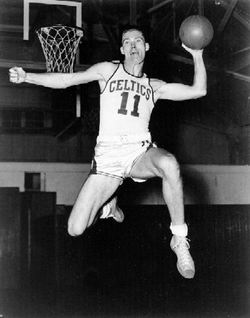
* On 11/05/1946, prior to the very first game in Celtics history, Chuck Connors became the first NBA player to shatter a backboard during warm ups prior to the Celtics first game at Boston Arena. His hard dunk shot attempt caught the front of the rim, shattering the wooden backboard that was hardly ready for that kind of violent action. As a result, Connors also gets the credit and blame for causing the first game in Celtics history also to become the first game in NBA history whose starting time had to be delayed about an hour due to his player-inflicted damage to the court of play.

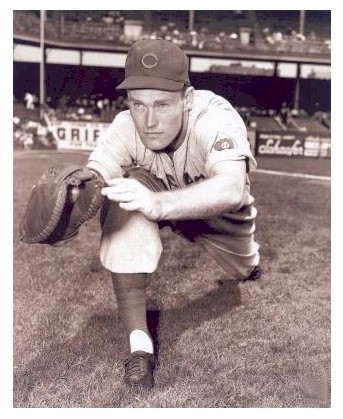
CHUCK CONNORS, 1B 1952 CHICAGO CUBS .236 BA, 2 HR, IN 66 GAMES

CHUCK CONNORS, 1B
1951 CHICAGO CUBS
.239 BA, 2 HR, IN 66 GAMES

* In 1947, Connors played first base for the Dodger AA farm club, the Mobile Bears, and helped the team win the Southern Association pennant.

* In the 1947 Dixie Series, Chuck Connors homered for Mobile at Buff Stadium in Houston in Game One, but the Texas League Champion Houston Buffaloes won the opener, 8-2, and went on to defeat Chuck’s Bears in six.

* After three seasons (1948-50) at AAA Montreal, a span in which Connors averaged over .300 as a full-season batter, he only managed to get in one “0 for 1” late season MLB plate appearance in 1949 with Brooklyn. The Dodgers had a fellow named Gil Hodges entrenched at first base.

* Chuck requested and the Dodgers obliged him with a trade to the Chicago Cubs on 10/10/1950.

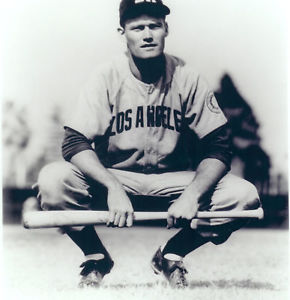
CHUCK CONNORS, 1B LOS ANGELES ANGELS 1951-1952 HIT .322, 25 HR IN '51

CHUCK CONNORS, 1B
LOS ANGELES ANGELS
1951-1952
HIT .321, 22 HR IN 1951

* The Cubs trade proved to be a life-changing event for the multi-talented, always open to testing some new skill guy that was Chuck Connors. The Cubs assigned him to their AAA farm club, the Los Angeles Angels of the Pacific Coast League.

* Connors hit .321 with 22 HR for the Angels in 98 games, earning him a call up to the Cubs in 1951, where he hit only .239 and 2 HR in 66 games.

* Now 31, Chuck hit only .259 with 6 HR in 113 games for the 1952 Angels. Age and performance “suddenly” had moved the baseball future of Kevin “Chuck” Connors from the “prospect list” to the “suspect pile”. It was time to go.

ANOTHER ANGELS PHOTO ~THANKS AGAIN TO ~ DARYL AND ROBERT BLAIR

ANOTHER ANGELS PHOTO
~THANKS AGAIN TO ~
DARYL AND ROBERT BLAIR

* Leaving baseball was no big income loss problem for Chuck Connors. In his two years of hobnobbing in the LA/Hollywood movie culture, his rugged good looks and affable personality had made him a favorite among the Hollywood crowd, starting with the Hollywood baseball fans, but quickly expanding to a much larger social/business circle.

* 1952 would be Connor’s time for the life lesson best known today as “when one door closes, another opens”. It was the end of baseball and the beginning of movie/TV star status for Chuck Connors. He began his official movie career with a bit part in the Spencer Tracy/Kathryn Hepburn classic, “Pat and Mike”.

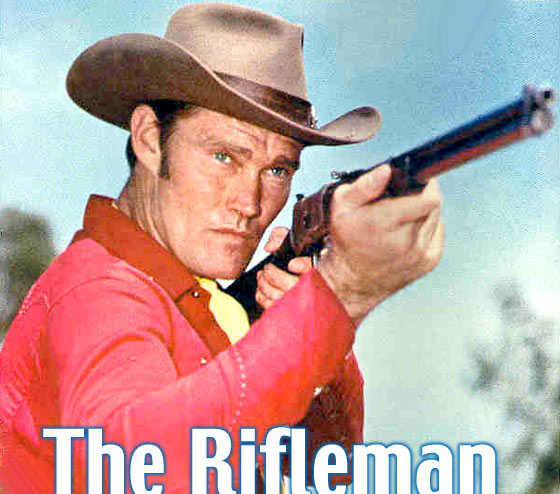
* From 1952 to 1958, Chuck Connors made 57 movie and TV appearances on the way to a five-season ride as Lucas McCain in the iconic TV western “The Rifleman” (1958-63).

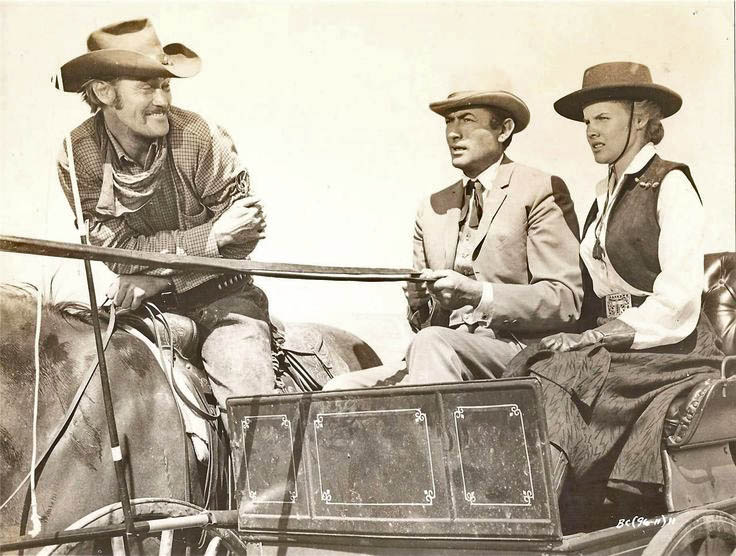
CHUCK CONNORS (L) WAS A COWARDLY BULLY IN "THE BIG COUNTRY" AND IS PUT TO SHAME IN THE END BY GREGORY PECK (CENTER) AND THEN KILLED BY HIS OWN FATHER (BURL IVES) FOR BEING A COWARD.

CHUCK CONNORS (L) WAS A COWARDLY BULLY IN “THE BIG COUNTRY” AND IS PUT TO SHAME IN THE END BY GREGORY PECK (CENTER) AND THEN KILLED BY HIS OWN FATHER (BURL IVES) FOR BEING A COWARD.

* Beyond “The Rifleman”, Chuck Connors made, at least, another sixty movie/TV appearances on his way to a financially comfortable old age, but on that surely came with some rough emotional times along the way.

* As he achieved success, Connors hosted the annual Chuck Connors Charitable Invitational Golf Tournament, through the Chuck Connors Charitable Foundation, at the Canyon Country Club in Palm Springs, California. Proceeds went directly to the Angel View Crippled Children’s Foundation and over $400,000.00 was raised

* Connors was married and divorced three times. He and his first wife had four sons together. He spent the last twelve years as a divorced father, but we have no information on his relationship status with the four adult sons. He did have a significant other woman in his life at the time of his death, Her name was Rose Mary Grumley.

AS "THE RIFLEMAN" (1958-63), CHUCK WAS 180 DEGREES FROM COWARDICE AS THE "STRAIGHT-SHOOTING LUCAS McCain.

AS “THE RIFLEMAN” (1958-63), CHUCK WAS 180 DEGREES FROM COWARDICE AS THE “STRAIGHT-SHOOTING LUCAS McCain.

* Kevin “Chuck” Connors died at the age of 71 in Los Angeles, California on November 10. 1991. He died of pneumonia that had been helped along by lung cancer. Chuck had been a three-packs-a-day Camel smoker from 1940 into the mid-1970s, but he never quit smoking completely because of sporadic binge periods.

* Chuck was interred in the San Fernando Mission Cemetery in Los Angeles.

* Frivolous Chuck Connors “What’s Your Guess” Trivia Question to bring this wagon train of facts to an end: Chuck Connors supposedly was a big fan of Spencer Tracy, the star of the former ballplayers first official movie. BUT … We still must ask: Had Kevin Connors’ first name also been “Spencer”, do you think he might have sought an even earlier change to “Chuck” than he had with “Kevin”?