Archive for 2012

That’s Life

December 17, 2012
That's Life.

That’s Life.

That’s Life

by Bill McCurdy


We come into this world alone – and someday leave the same,

Joy and sorrow to the bone – yield miles of smiles and blame.

Some plans we have come true for us – while others bend in time,

Bowing to reality’s sword – when wisdom cuts sublime.


What happened to the rainbows – of our youthful destiny?

Who rearranged the future – that we cherished hopefully?

Where did we start to question thoughts – that once danced sacredly?

When did we first see – clear and straight – those answers rest with me?


Money, Power, Fame, and Comfort – The Directors of Ambition,

All lead us on a weary path – as Gods of no Contrition.

They leave out Love and worse – its source – demanding all we are,

And when they’re finally done with us – we haven’t traveled far.


Until we see that God Is Love – and Love is all we need,

And giving through our passion fills – our soulful path from seed,

We cannot know the mindfulness – of who we really are.

We sputter in the moonlight – waiting for a shooting star.


And if that star arrives for us – in low or burning light,

We finally see the waywardness – of personal lost flight,

And if we give it up – to the life of giving all,

Our life will fill with “God Is Love,” – and God and Love are all.


That’s Life.


Sandy Hook

December 15, 2012
Sandy Hook: "Born on Earth to Bloom in Heaven"

Sandy Hook: “Born on Earth to Bloom in Heaven”

Yesterday’s horror came with all the shocks of the now long list of previous violent attacks upon the innocent in America by mentally disturbed gunmen, but with two powerful statistical and demographic differences. “Sandy Hook” claimed over twice the lives of the infamous “Columbine” – and 20 of these now dead souls were simply little children – babies in life – and now no more or less than babies in death, to be mourned forever by their shocked and grieving parents – but probably soon enough forgotten by the rest of us, as our turbulent world moves on to the next media blanket coverage of our building path of self-inflicted disaster.

Is that just how it’s going to be from here on out? Are we going to simply keep on playing dodgeball with the issues that stand in the way of, hopefully, but not warrantably, making things better for everyday life in America?

The social problem behind incidents like “Sandy Hook” is extremely complicated and polarizing around a number of issues we normally either avoid or butt heads upon, and there’s no wizard alive who can speak to the certainty of how much each major factor contributes to these sporadic outbursts of violence. As one who has spent most of his life as a mental health professional, working with some people who fit the psychological profile of most mass killers, I’m going to make a humble attempt here to outline what’s involved in causing the increase in this violence. All these factors share this much in common: They are all issues that we have failed to resolve, anyway:

(1) Breakdown of the Traditional Nuclear Family. Thank God, I’ve never worked with an adolescent or young man who acted out as the perpetrator in Sandy Hook did yesterday, but each of those I saw who were on shaky ground were either products of a divorced marriage, a home in which there never was a father, or they were kids who suffered from serious abuse or neglect. These circumstances often produced kids who grew up as loners, sometimes surviving quietly on the sidelines of everything, while building up enormous blame for peers, parents, authority, God, and the world in general. – And here’s the kicker. – Sometimes these kids grew up with this outlook, even when all the externals of their lives (Mom, Dad, etc.) were apparently in place and in working order.

(2) The Evaporation of a Guiding God Concept in Childhood. Most of us older Americans grew up with a working concept of God that came to us everyday, and more often on Sundays, of who God Is – and what our spiritual purpose is as the Children of God on earth. Today, the word “God” is hardly even spoken aloud in many homes, except as the third initial in a texted expression of “OMG.”

(3) The Decline and Failure of Mental Health Services in the 21st Century. Effective individual and family counseling and therapy was more broadly available forty years ago than it is today. Today these services are often defeated by insurance companies and health care plans that limit both the services and the providers that one may choose to engage for help. In the meanwhile, social/mental health problems have expanded far beyond the intelligence of those elite psychiatrists who design and try to periodically update the industry’s standard diagnostic manual. I can almost guarantee you that the diagnosis we finally get for the “Sandy Hook” killer will seem to fit, but still fall far short of telling us who the young man really was. – He will be the kind of guy who should have been on medication, but wasn’t. – A lot of good that does those dead children now. We need better mental health services, including better research into the biochemical factors that may sometimes be the major contributing factors in this kind of anti-social behavior.

(4) Guns. Guns are the stickiest wicket in the pack and we all know it. What do we do now? Isn’t it possible for us to keep our single-shot defense and hunting weapons, while getting rid of automatic and semi-automatic weapons of war, and making private ownership of a gun tougher than ever? Is that too hard to do? Aren’t the 100,000 Americans who take a bullet annually worth the effort? I have no illusions that we will ever be able to totally eliminate the illegal black market for all kinds of weapons, but can’t we do a better job of making that harder to do – and harder upon the people caught selling, possessing, or using an illegal gun?

(5) Technology. Today it is possible to gain instant attention from the whole world for almost anything. Just click on to Facebook, Twitter, or You Tube sometime to see how popular electronic attention-getting has become. – That’s right. – Mass killers crave attention too – and in a most perverse way. – And they know they are going to get it for their sick actions in today’s “wired world.”

Summary: Enough is enough. We need to do something that will outlive the immediate emotional bruising of “Sandy Hook” and survive as a step in the right corrective direction. Based upon all the factors listed above, and the possible factor that I too could be wrong, here is my brief anticipatory finding we shall get about the “Sandy Hook” killer:

This younger of two brothers probably grew up as a loner. He likely never felt close to his father, but he was most probably controlled and protected by a mother that other people seemed to really like. He took his parents’ divorce hard, but buried the rage he felt over the loss of his dad. He possibly blamed his mom for the loss of his dad – and maybe he even blamed the kids she gave herself to as a teacher’s aide years earlier at the Sandy Hook School for “stealing” the of love and attention he craved.

When he reached the point of giving up as a young man, he planned to take out his mom and then go to Sandy Hook to pay them back for getting the love that he felt belonged to him. He also acted out upon strangers (that may not have been so innocent in his sick view of things) to assure that he would not be forgotten by the world he was leaving. Killing Mom alone would not have caused the networks to rearrange their Friday schedules as this act would do, even bringing the President of the United States near tears in televised commentary upon the vile act.

Footnote: When God evaporates, we have to function as God – and when we do – things can go terribly awry.

I’m hoping and praying we do something this time. It’s only going to get worse, if we can’t find a way to start a walk down the path of recovery and remedy.

A Baseball Christmas Contractual Wisdom

December 14, 2012
Wisdom must be received to be owned and usually comes on the wings of painful experience. The absence of innate wisdom in human beings is one of the major reasons we have written contracts between people.

Wisdom must be received to be owned and it usually comes on the wings of painful experience. The absence of innate wisdom in human beings is one of the major reasons we have written contracts between people.


A Baseball Christmas Contractual Wisdom

by Bill McCurdy

(Reading meter & tune for each verse below work with the first stanza in “The 12 Days of Christmas” repeated continuously.)


On the first day of Christmas, the Astros signed for free,

A kid who’d never hit successfully!


They sent him down to Greeneville, where he learned capably,

And moved up to the Valley Cats, Tri-C!


As a Tri-City Valley Cat, he learned to hit the curve,

And other throws that rise, fall, split, or swerve!


Next year moved on to Quad Cities, but never to demand it,

He just went out and led the River Bandits!


He stayed short-term at Lancaster, and really hit the books,

His next stop up, the Corpus Christi Hooks!


The warm Gulf breeze did please him, as the scouts got in their gawks,

Next big jump, the Okla-C Redhawks!


The Redhawks saw “The Kid” shake out – his full potential form,

Achieving to the sky – became his norm!


By now, the kid was five-tool-class, in all the ways that count,

And people praised the Astros talent fount!


At season’s end, he rested, awaiting glorious spring,

When he could finally do his Astros thing!


A guy who hits for power, and batting average too,

Was on the way to Houston, with speed, too!


Before our man could get there, he played some flag football,

Destroying both his knees in one bad fall!


And the moral for the Astros, is slightly old, but true:

Make them sign what they can, and cannot, do!


Our 2012 Astros Fans Christmas Song

December 12, 2012

(The following is written benevolently in the Christmas Spirit that it turns out be absolutely the wrong call on the plans of the new ownership. And I’ll give ’em this too: They seem to be totally committed to saving printer’s ink money by eliminating words like “payroll” from their everyday working business dictionary.)

Merry Christmas, Mr. Luhnow! Deep down inside, moat of us Houston Astros fans are hoping you really can make it happen for our town.

Merry Christmas, Mr. Luhnow! Deep down inside, most of us Astros fans are hoping you really can make it happen. In the meanwhile, toughen your hide to a little seasonal humor.

Our 2012 Astros Fans Christmas Song

Prospects roasting – in the minor leagues,

The AL – nipping at our nose,

Long term hopes – being sung by the choir,

Sales staff dressed up – like “grab & gos”


Everybody knows – a turkey – is a bird that bakes,

Just like the – young team – playing – for us now,

Ticket holders – get the shivers and shakes,

Repeating fairly loudly – “Holy Cow!”


They know that Luhnow’s – on his way!

He’s loaded lots of toys and goodies on his sleigh!

And every Astros fan – has gotta know,

That every promise – is also – part snow!


And so – I’m offering – this simple phrase,

To fans – from one – to ninety-two!

Although it’s been said – many times – many ways,

Watch your wallets – or this one’s – on you!


Merry Christmas, Houston Baseball Fans!

Our time is comin’ ! – Sure as shootin’ !

I’m just sayin’ – after fifty one years of tryin’ – and hearin’ all this stuff many times over,

It’s bound to happen in the next few years to come now – right? – Right? – Right?


Gary Gaetti Is Bright Christmas Light for SABR!

December 11, 2012
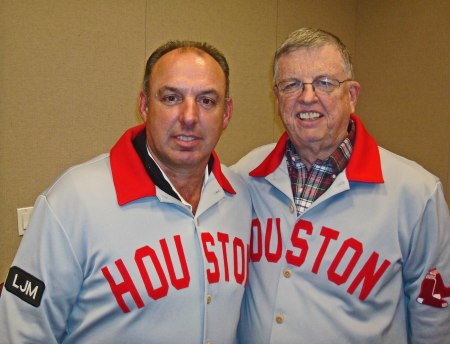
Gary Gaetti (L) and Bob Dorrill at the 12/10/12 meeting of SABR's Larry Dierker Chapter.

Gary Gaetti (L) and Bob Dorrill at the 12/10/12 meeting of SABR’s Larry Dierker Chapter.

On a night when most Houston sports fans were out there falling off a cliff with the football team we know locally as the Houston Texans, 19 of us completely, or mainly, baseball souls were downtown at the Inn at the Ballpark, lapping up the diamond-shining thoughts of Gary Gaetti, the manager of the independent Atlantic League’s Sugar Land Skeeters. Gaetti, an excellent former major leaguer, is also a former batting coach for the Houston Astros and a passionate baseball mind.

How good was he? Gaetti finished his 20-season (1981-2000) big league career with 360 home runs, just one shy of the 361 HR put on the books by a fellow named Joe DiMaggio. He also is one of the few men in history to have homered in his first two post-season times at bat in the major leagues – after first homering in his very first major league time at bat and going on from there to collect the most career home runs (360) among all other members of that select group. And, as Mike McCroskey also points out in an additional comment below, Gary Gaetti was only ejected from one MLB game over the course of his 20-year career – and that one sprang from the thumb of rookie umpire Phil Cuzzi in 1999. (Thanks for the important corrections and contributions, Mr. McCroskey!)

More than anything, Gary Gaetti is a bright, positive, strong baseball mind and the man who now plies his many gifts and skills to the job of directing young men who play the game out of love for the sport and in the abiding hope that independent baseball will become their gateway to a career in the professional game.

Last year was the maiden voyage season of the Houston suburbs’ Sugar Land Skeeters, as it was for their mentor and field manager, Gary Gaetti. The product at Constellation Field is off to a shining start for families looking for an enjoyable and entertaining way to involve themselves in the game.

As a baseball town, Gaetti rates Houston as one of the best at the grass root level. “From the standpoint of playing and instructional opportunities, and family support for same, the greater Houston area is either stronger, or as strong, as any other city in the country. People in this town know their baseball – and far beyond the credit they get for it nationally.” Gaetti doesn’t mince words in his evaluation of Houston as a baseball town.

As an independent league manager, Gaetti wants players who are capable of converting their low-paying opportunities in independent league ball into a contract with one of the big league clubs. Even though you get the impression that Gaetti the Competitor has come to realize from experience that a club at this level also needs a certain number of players whose abilities and ages make them less vulnerable to being yanked up from the Skeeters’ roster in the middle of a pennant race, that Gary the Man still prefers the guys who can turn the experience into a stepping-stone to bigger, greener pastures for themselves.

How else could he feel? Spend the evening with this guy and you come away convinced that he doesn’t spend time on things that are just about money. The man comes across as a strong, likeable teacher, the kind of guy who was born to be here as both a mentor to the young and a guardian of all the game stands for.

In a later portion of tonight’s program, SABR member Mike McCroskey gave us an excellent report on a book about the early years of baseball, going through the way the general rules and styles of play came to be. As I watched Gary Gaetti during the presentation, he was reading the handout on the 1845 Cartwright Rules and soaking up everything that McCroskey had to say. That’s passion in motion. It’s a beautiful thing to see.

Gary Gaetti admittedly came to speak tonight with a very unclear sense of how he had come to even make the commitment. He says he knew nothing of SABR before tonight, other than the fact that the group had this relentless guy named Bob Dorrill who kept calling him to come speak.

Gary Gaetti left tonight on the heels of spirited interaction with our questions and comments. He even arrived in time to have a beer with some of us as we were breaking bread in the hotel dining lobby. Gary left with a much better feel for who we are and a nodding informal agreement to see us again down the road.

Thank you again for being the persistent relentless out-reaching arm of SABR, Bob Dorrill! You just got us a new and valued friend, I think.

SABR DAY, USA. Later in the evening, Mark Rejmaniak reported on local plans for the annual observance of SABR day. Our Houston SABR meeting will be held on Saturday, January 26, 2013, from 1-4 PM, at the Home Plate Bar & Grill on Texas Avenue, just across the street from Minute Maid Park. We hope everyone will make an effort to join us that day. We will have a private room and some plan for book exchanges and maybe even a DVD presentation – and that’s all to the good of the delicious ballpark food and drinks that are available at “HP.”

(L->R) Garry Gaetti, Larry Hajduk, Bob Dorrill. Larry Miggins, Mike McCroskey. Mark Hudec, Bill McCurdy, Bob Stevens.

(L->R) Garry Gaetti, Larry Hajduk, Bob Dorrill. Larry Miggins, Mike McCroskey. Mark Hudec, Bill McCurdy, Bob Stevens.

The evening program actually began with our presentation of two identically framed and matted family photos of Larry Joe Miggins and his wife and parents in attendance at an early Houston Babies vintage ball game at the George Ranch Field. One copy was prepared for SABR member Larry Miggins and his wife Kathleen Miggins; the other was for Sherl Miggins, Larry Joe’s widow. Each framed photo contained one of the “LBJ” memorial patches that we are now wearing on the right sleeves of our Babies uniforms in honor of the man who shall remain forever with us as “The Spirit of the Houston Babies.” (For those who don’t know, our Larry Joe Miggins died in a car wreck on 9/14/12. We are all still trying to heal from the loss.)

Our message to the Miggins family was simple: “Larry Joe Miggins was your family member, but he belonged to our vintage ball family too. We all miss him, but we hold onto his spirit. And we want you each to have copies of the same “LJM” patch that still bonds us all together forever.”

Larry (The Elder) Miggins also shared this poem that Larry Joe wrote on 9/04/09, but only gave to his father on 8/019/12 at the day early celebration of the older Miggins’ 87th birthday. Unfortunately, or perhaps, most fortutiously, the father only discovered that he had missed reading the poem until two days ago.

Considering the fact the poem was only given to his father less than a month prior to his own death, it takes on an even more powerful impact upon the soul walls of all that life is about for those of us whose faiths travel on a similar track. All I can do from here is leave you with the message that Larry Joe Miggins delivered in close contemplation of his own older brother’s death just a handful of years ago:

If I Were To Die Today

by Larry Joseph Miggins                                                                                                                                           

If I were to die today,

I’d want my friends, family to say

Of all the good that I had done

and friendships made, many more than one

I’d pray the Good Lord forgive my sins

And never mention, I’d offended Him

I only hope He will forgiveEternal life, I wnt to live

For in this life, s history stored

We all are judged, nothing ignored

But seldom do we feel God’s scorn

Thru his Death, we are Re-born

His life’s a lesson, make it your plan

He gave His life, He made a stand 

He is looking through the cleanest lens

And all of my faults I hope to mend.

And if I were to die today

I’d hope my sins be washed away

For at times my light, not be so bright

But it shines bright, even tonight

larry joe miggins 9-4-09

THE PHOTO IN THE FRAME: Sherl Miggins, standing; Larry Miggins, Larry Joe Miggins & Kathleen Miggins. - At the George Ranch Main Field.

THE PHOTO IN THE FRAME: Sherl Miggins, standing; Larry Miggins, Larry Joe Miggins & Kathleen Miggins. – At the George Ranch Main Field near Sugar Land on a baseball day made in Heaven.

Memories of My College Sales Job

December 10, 2012
Merchant's Wholesale Exchange in Houston was similar to this place, but not quite as fancy.

Merchant’s Wholesale Exchange in Houston was similar to this place, but not quite as fancy.

For the first three of my four undergraduate years at the University of Houston, I worked after class every weekday and all day Saturday at a little downtown men’s clothing store on San Jacinto Street called Merchant’s Wholesale Exchange. I guess you could call it work. It turned out to be one of the most entertaining and educational jobs I would ever have. The store and its retail era are long-gone now, but the fond memories of the family who ran the place and the stuff that happened there will last with a smile and a few laughs forever.

My biggest customers from that era were a an old wrestler named Blackie Guzman, a young crime photographer named Marvin Zindler, and a new singer from Houston named Kenny Rogers.

Merchant’s Whole Exchange (MWE) was nothing less than a little time capsule on how things were in the late 1950s (1956-59).

George and Esther Golden, both in their late 50s, and their 30-year old son, Stanley Golden, owned the place and they often provided their own intramural show of how families can sometimes disagree generationally over how a business should be run. In the first place, George and Esther were old style ethnic city folks from Philadelphia and they each had their own styles when it came to dealing with the world.

George was tall and portly, with shocking white curly hair and big brown eyes. He ate fruit all day under the fairly constant admonishment from Esther that dropping juice on his shirt was “not a very good way to greet people.”

“I have to tell you, George,” said in Esther from a constant state of redundant frustration, “you absolutely amaze me! – You’d think a man your age would know how to behave in the presence of customers!”

Some of George’s favorite new customer greeting salvos included these general snippets”

(1) Any time a man came in alone with a 10 years old and under son, George liked to say to the kid: “Good day, young man. How are you today? – Are you going to stay single like your daddy did?”

(2) If a stranger came in looking for a particular color suit, George loved to bellow a command to one of his “college boy” clerks: “Turn on the blue light, the man wants a blue suit.”

(3) One time, George tried to sell a one-of-a-kind, way too big for most people, way too heavy suit to a too passive tall, but not fat man who was shopping MWE for the first time. George got the man to try on the pants that just swallowed him. “Look at these pants in the back, Mister,” the man exclaimed. “When I pull both sides together in the back to where they would have to be hemmed, the two back pockets come together as one.

“Don’t worry about it,” George responded. “You will be out there with the brand newest style in the world. The one big pocket in the back of the pants is now called ‘The Kangaroo Cut.'”

Almost needless to add, most people took George with a grain of salt, but he did come close at times to catching a mouthful of fist, especially, with that “single like your daddy” crack.

Esther, on the other hand, was the lady who watched the money and the cash register for the business. “Mrs. G,” as we called her , watched everything and everyone, and, when she wasn’t tilling the register and looking over her shoulder to check on who was watching her, she sat in a chair that faced the front with a full view of any new person who may have walked into the long shotgun-house shaped building.

Mrs. G. may have been 4’9″ tops. She had bright red hair, dark brown eyes, a clownishly rouged face, bright red lips, and a perfumed presence that masked everything else. “Come sit next to me while I finish this Limburger cheese sandwich for lunch, Esther,” George once said. “I don’t want the smell to offend any customers.”

Payment at MWE was easy: Cash or an approved Houston bank check. Once a man came in from Freeport and piled up about ten suits in front of Mrs. G. in preparation for his checkout. Well, Mrs. G. somehow knew the man was from Freeport and she was ready. She didn’t even bother to ask ow he planned to pay.

“Sir, I think you need to know something,” Mrs. G. stammered, as she always did when the subject was money, “we don’t take out of town checks.”

“Well,” said the man as he opened his wallet and dumped out a snowfall of one hundred-dollar bills on top of his pile of purchases, “you do take out-of-town money, don’t you?”

I thought Mrs. G. was going to choke on her chewing gum as she groveled over the green resting before her.

Mrs. G. was an avid movie fan and authority on feminine beauty: “That Kim Novak. She’s not so special. We had lots of girls in the neighborhood where I grew up who looked just like her.”

Son Stanley was a whole other story from his dad. Stan Golden was the ethnically cleansed, college educated business degree prepared graduate from the University of Texas who battled long and hard with his father over the store’s need for a more professional relationship with the store’s customers. He just didn’t battle too deeply. He knew his dad was a good man, but not one who was likely to change.

“That suit fits you just like a glove. Too bad it doesn’t fit like a suit.”

“You say you need some handkerchiefs? Well, what for? Blow or show?

Those kinds of greetings were not going to go away – not as long as George Golden was around.

I was sort of wise-acre at age 19. One time, I asked George a very fundamental haberdashery question:

“Mr. Golden,” I asked, “have you ever smelled moth balls?”

“What kind of question is that?” George answered, with some irritation. “Of course, I’ve smelled moth balls!”

“Then tell me,” I further asked, “how did you hold them when you did smell them – by the wings? Or the tail?”

Silence fell. Then guffaws of knee-slapping laughter followed. I thought George was going down for the count on that one, but oh no. That would have felt awful. I really loved the old man.

George recovered. He reached out red-faced to another old man shopper friend in the store and pointed to me.

“Come over here, Ed,” George spat out the words. “I’ve gotta tell you this joke this college boy here just told me: – Have you ever smelled camphor balls?”

“Yes, I have,” replied Ed.

Silence. Sputtering. Frustration. Appeal to original source.

“Hey, Bill,” George cried out, “how did that joke go?”

The Golden family is gone now, but their memory, and the memory of Merchant’s Wholesale Exchange (MWE), will live within me forever.

 

Heisman Note: Who You Play For Helps

December 9, 2012
Johnny Manziel was a deserving winner in 2012.

Johnny Manziel was a deserving winner in 2012.

Congratulations again to Johnny Manziel of Texas A&M. He was the most exciting player of 2012 college football season and his numbers and accomplishments against some of the best teams in the country, notably Alabama, speak loudly for the fact that he owned every heavy ounce of that massive Heisman Trophy. His signature moment probably will aways be that the snap he fumbled in the air near the Alabama goal that he promptly recovered in flight on a short roll to the left and then zipped quickly over the middle as a pass into the end zone for a killer-breath touchdown, dagger-in-the-heart style.

My only point here is that it could have been Coach Kevin Sumlin’s second Heisman Trophy player in a row, if the award were neutral to where a player spent his college career and about statistics alone. But. That’s not the way this worm turns.

Last year at Houston, with Kevin Sumlin and assistant coach Kliff Kingsbury also coaching him in the same “hurry-up” offense, UH QB Case Keenum practically destroyed every college record that remained in the 2011 year, finishing his personal career with an amazing 20,114 yards total offense and, incredibly for inclusion in one sentence, a whopping count of 178 passing/rushing touchdowns.

So, what was Case Keenum’s reward?

Keenum got written off as a “system quarterback,” not even receiving an invitation to the New York Heisman dinner. And, who knows, maybe Robert Griffin III of Baylor, the 2011 winner, was the actual most deserving winner for his less gaudy stats, but more athletic accomplishments against some of the more glamorous teams of the Big 12.

My point is simple: Keenum had less chance of winning because he played for The University of Houston, leading them in 2011 to a not-too-shabby 13-1 record against a schedule that only included UCLA as a college blue blood team and a psychologically wobbly bowl foe that was Penn State. – Bottom Line: It matters what you do, when it comes to winning the Heisman, but it matters more where you play and who you play against.

When Andre Ware of UH won the Heisman in 1989, the Cougars were members of the Southwest Conference, playing schools like Texas, Texas A&M, and Arkansas on a regular basis. – From 2007-2011, Case Keenum of UH mainly had to do his thing against schools like Marshall, Tulane, and East Carolina. It doesn’t quite carry the same solid gold ring as before, when the Cougars belonged to the Southwest Conference.

Give the Cougars credit. They played well enough in 2011 to showcase Kevin Sumlin, the coach that Texas A&M needed to make the successful transition from the Big 12 to the SEC, and, along the way, uncovering Johnny Manziel as the “Johnny Football” guy he will now always be.

Statistically, both Keenum of UH and Manziel of AM were/are both system quarterbacks. In his 2012 Heisman year, Johnny Manziel set an SEC record for total yards with 4600, while passing and running for a total of 43 touchdowns. – All Case Keenum did in his 2011 senior year was pile up a total yardage figure of 5,666 yards and a total of 51 passing/rushing touchdowns.

As I said, what other conclusion is there? As for the Heisman, it isn’t so much what you do, but who you are playing for when you do it, and who you do it against, and how bright the TV lights of national attention are when you do it.

Congratulations one more time to Johnny Manziel in 2012, but congratulations also extend to Case Keenum, Coach Sumlin’s forgotten man from 2011. Both of you guys are stellar performers and proud sons of the great State of Texas. You just played your football for the same coach under (for now) differently burning lights.

Most of you know that I am lifelong diehard UH Cougar alum and that I cannot make any great claim for total objectivity in the area of college sports. Most of you who know me better also know that I still try to be fair and give credit where credit is due.

I wasn’t happy when Kevin Sumlin left UH last year, but I have to give him credit for the fine job he’s done at Texas A&M this big first season for the Aggies in the SEC. I also like the kid they call Johnny Football and am very happy that he took the Heisman. I just couldn’t help but notice that Manziel was not discounted in 2012 for some of the same “system QB” charges that destroyed the Heisman chances of Case Keenum at UH in 2011 when he was playing for the same coach, Kevin Sumlin.

UH will get back to where we belong among the respected athletic programs of this country. Even as I write these words, we are on our way to a better day. “In Time,” our university motto, we’ll get there.

Good Luck Tonight, Johnny Football!

December 8, 2012
Bring it home, Johnny Football, bring it home!

Bring it home, Johnny Football, bring it home!

THE HEISMAN TROPHY WINNERS BY SCHOOL & POSITION, 1935-2011:
1935: Jay Berwanger * (Chicago) Halfback
1936: Larry Kelley (Yale) End
1937: Clint Frank (Yale) Halfback
1938: Davey O’Brien (TCU) Quarterback
1939: Nile Kinnick (Iowa) Quarterback
1940: Tom Harmon * (Michigan) Halfback
1941: Bruce Smith (Minnesota) Halfback
1942: Frank Sinkwich * (Georgia) Halfback
1943: Angelo Bertelli * (Note Dame) Quarterback
1944: Les Orvath (Ohio State) Quarterback/Halfback
1945: Doc Blanchard (Army) Fullback
1946: Glenn Davis (Army) Halfback
1947: Johnny Lujack (Notre Dame) Quarterback
1948: Doak Walker + (SMU) Halfback
1949: Leon Hart * (Notre Dame) End
1950: Vic Janowicz (Ohio State) Halfback/Punter
1951: Dick Kazmaier (Princeton) Halfback
1952: Billy Vessels (Oklahoma) Halfback
1953: Johnny Lattner (Notre Dame) Halfback
1954: Alan Ameche (Wisconsin) Fullback
1955: Howard Cassady (Ohio State) Halfback
1956: Paul Hornung *+ (Notre Dame) Quarterback
1957: John David Crow (Texas A&M) Halfback
1958: Pete Dawkins (Army) Halfback
1959: Billy Cannon * (LSU) Halfback
1960: Joe Bellino (Navy) Halfback
1961: Ernie Davis * (Syracuse) Halfback/Linebacker/Fullback
1962: Terry Baker * (Oregon State) Quarterback
1963: Roger Staubach + (Navy) Quarterback
1964: John Huarte (Notre Dame) Quarterback
1965: Mike Garrett (USC) Halfback
1966: Steve Spurrier (Florida) Quarterback
1967: Gary Beban (UCLA) Quarterback
1968: O.J. Simpson *+ (USC) Halfback
1969: Steve Owens (Oklahoma) Fullback
1970: Jim Plunkett * (Stanford) Quarterback
1971: Pat Sullivan (Auburn) Quarterback
1972: Johnny Rodgers (Nebraska) Wide Receiver
1973: John Cappelleti (Penn State) Running Back
1974: Archie Griffin (Ohio State) Running Back
1975: Archie Griffin (Ohio State) Running Back
1976: Tony Dorsett + (Pittsburgh) Running Back
1977: Earl Campbell *+ (Texas) Running Back
1978: Billy Sims * (Oklahoma) Running Back
1979: Charles White (USC) Running Back
1980: George Rogers (South Carolina) Running Back
1981: Marcus Allen + (USC) Running Back
1982: Herschel Walker (Georgia) Running Back
1983: Mike Rozier (Nebraska) Running Back
1984: Doug Flutie (Boston College) Quarterback
1985: Bo Jackson * (Auburn) Running Back
1986: Vinny Testaverde * (Miami) Quarterback
1987: Tim Brown (Notre Dame) Wide Receiver
1988: Barry Sanders + (Oklahoma State) Running Back
1989: Andre Ware (Houston) Quarterback
1990: Ty Detmer (BYU) Quarterback
1991: Desmond Howard (Michigan) Wide Receiver
1992: Gino Torretta (Miami) Quarterback
1993: Charlie Ward (Florida State) Quarterback
1994: Rashaan Salaam (Colorado) Running Back
1995: Eddie George (Ohio State) Running Back
1996: Danny Wuerffel (Florida) Quarterback
1997: Charles Woodson (Michigan) Cornerback/Punt Returner
1998: Ricky Williams (Texas) Running Back
1999: Ron Dayne (Wisconsin) Running Back
2000: Chris Weinke (Florida State) Quarterback
2001: Eric Crouch (Nebraska) Quarterback
2002: Carson Palmer * (USC) Quarterback
2003: Jason White (Oklahoma) Quarterback
2004: Max Leinart (USC) Quarterback
2005: Reggie Bush (USC) Running Back (vacated)
2006: Troy Smith (Ohio State) Quarterback
2007: Tim Tebow (Florida) Quarterback
2008: Sam Bradford * (Oklahoma) Quarterback
2009: Mark Ingram, Jr. (Alabama) Running Back)
2010: Cam Newton * (Auburn) Quarterback
2011: Robert Griffin, III (Baylor) Quarterback
2012: ???

* = #1 selection in NFL draft

+ = Inducted into Pro Football Hall of Fame

* + = Both selections

Vacated = Removed from List of Heisman Trophy winners

The Seven (7) Texas school winners through 2011 are shown in bold type. Perhaps, that number will increase to eight (8) before this day is done.

GOOD LUCK to Johnny Manziel of Texas A&M tonight as he goes for the honor of becoming the second consecutive year winner from a Texas university, the second Heisman honoree from his university, and the eighth winner from all Texas universities since the 1935 creation date of the first Heisman Trophy presentation to the top player in college football by season.

The Heisman list is a fun exercise for the eyes. It doesn’t take long for your eyes to see all the early appearances by Notre Dame or the frequent printings of the words “USC” or “Oklahoma.” Surprisingly, the great “Alabama” has no more than one winner, tying them with Baylor, Houston, TCU, and SMU among quite a few others on the prestigious list.

As a curious USC note, it is interesting to see that one of their winners (Reggie Bush) had his Heisman “vacated” from his grasp for some fairly egregious recruiting violations that involved him at his university, while another USC winner (O.J. Simpson) escaped the smell of murder allegations in Los Angeles and later ended up in his current residence, the State of Nevada Penitentiary System, for armed robbery – but with no penalty on his place in the Hall of Honor among Heisman winners.

It is  a curious world, indeed.


Potholes on The Road of Life

December 7, 2012

If we live long enough, we all get to experience some kind of major to minor disappointment in life that may look like the derailment of all our hopes and dreams. A number of former employees and ancillary personnel in the Houston Astros organization have been provided with that opportunity over the past year by the new ownership.

I wrote the following to Dave Raymond as a comment upon an article he wrote on his own blog about his current search for a new broadcasting job yesterday, but I’ve decided this morning that it was broad enough in content to stand as a Pecan Park Eagle column on its own right too.

Hope you get something out of it. It certainly won’t hurt you to read it. And please, for your own sake, check out Dave Raymond’s wonderful column, plus the many wonderful things that people are writing to him there at Everybody Reads Raymond. The particular Raymond column title of reference is #Fail:

http://mlblogsraymond.mlblogs.com/

This photo of me was taken when I was only a bench player for the original Houston Babies. I couldn't even begin to see all the potholes and derailments that lay ahead of me down the road on this early somber day. Fortunately, my sense of humor has improved since this picture was taken.

This photo of me was taken when I was only a bench player for the original Houston Babies. I couldn’t even begin to see all the potholes and derailments that lay ahead of me down the road on this early somber day. Fortunately, my sense of humor has improved since this picture was taken.

Dave (Raymond),

Synchronicity

Before I even knew you wrote these wisdoms here today, you just happened to have been a major part of the column I wrote and posted about the same time yesterday at my “The Pecan Park Eagle” site.

Simplicity

As I’ve tried to say more implicitly a couple of times in recent public writings, you are on your way to becoming one of the best radio play-by-play guys of all time. Allow me here to move what I think directly into the daylight: In every technical way, you are already there. You just needed more time and tenure under the growing strength of public support for what you do. A bigger public persona might have spared you from the stupidity of your recent release by the Astros. Look what it’s done for Milo. The guy’s retired, but he’s still talking about coming back to do a few games next year.

Unfairness

Life’s full of it. When we are on the receiving end of unfairness, whether it comes in the form of rejection, abandonment, or a flat-out f-ing over in business, it doesn’t feel good and we feel a little unclean and less lovable for a while. My worst reckoning with the experience happened about 24 years ago, in 1988, when I got to be on good writing terms with a fellow named Scott Peck, who wrote the iconic story of personal growth and transformation that still sells today as “The Road Less Traveled.” In short, Scott liked a course I had written based on his book so much that he reached out and encouraged me to apply for the new job as CEO/Director of a new foundation in Tennessee that some people were establishing to carry out his programatic ideas for healthy community building. – I applied, but never even got to the interview phase. The letter I got in the mail from the interviewing committee didn’t say I had been rejected. It just said, after reading my written responses to their initial questions, that I had been “deselected from the list of candidates under consideration.” – What a stink bomb that little piece of candy-coated disappointment turned out to be. – How in the world is a “deselected” person supposed to feel about themselves, anyway?

Closed Door/Open Door

Once I got past the smell, the “deselection” experience turned into a life changer for me. It made me take a long hard look at how we use language in so-called professional circles and start turning back to the use of plainer, simpler words. It also became part of my pull back to the game of baseball, where we still have foul lines that protect us from egregious errors (most of the time, anyway) and a game that plays out like the long season of life itself. We have our good and bad games – and long streaks of one kind or another – but we never forget: We are here to win – no matter how long it takes.

The Sandlot

“You gotta have heart, miles and miles of heart!” We learned that on the sandlot, long before there even was a song from “Damn Yankees” to carry that spirit to everyone else in our little part of the world. – And nobody deselected any of us on the sandlot. They might have called us names or tried to run us off, but we refused rejection. We fought our way back until our playing abilities earned us places on the field.

We hung in there with heart and hope until we earned a place to stand. And we didn’t walk away because we saw what it did to the kids who gave up.

I didn’t know it then, but I know it now. I learned more about life on the sandlot than I ever did in graduate school.

Tomorrow

It belongs to you, Dave. Better days are coming.

The Baseball Broadcasting Evolution

December 6, 2012
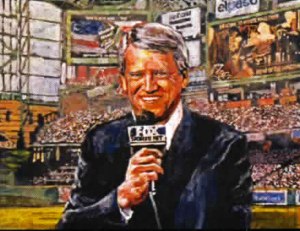
(oil by Opie Oterstad)Bill Brown, Astros TV Broadcaster, 1987-2012 and counting.

(oil by Opie Oterstad)
Bill Brown, Astros TV Broadcaster, 1987-2012 and counting.

Over the years, baseball broadcasts have changed for the better. Once we kind of weeded our way through the older generation of announcers who only saw television as “radio with pictures,” we began to experience some differential styles that categorically separated  those who called the games over radio from those who do the same honors for television.

Here’s the history of baseball broadcasting in a nutshell:

1920: Baseball radio games are first treated as though they are newspaper reports of a five-second old past event that is now being reported live by the eye-witness broadcaster, speaking in the past tense.

Example: “The batter hit the ball to the shortstop, who then threw the ball to first base for the out.”

1920s: Broadcaster Graham McNamee comes along and introduces radio coverage to present tense voice play- by-play reports on the game as each play occurs in real-time. As he does, he brings a sense of connection to the fans that was previously lacking over the radio, but he also incurs the ire of the newspaper icons who resent his quickly soaring popularity. Some of the old egos claim that they wonder what game McNamee was watching when he describes action in the present tense. McNamee should have told his critics: “I’m watching the game that’s going on now because that’s the game our listeners want to hear about as though they were here with us.”

Example: “The batter swings and hits the ball to short; he’s up with it; he throws it to first; and it’s in time for the out!”

1930s: Broadcaster Red Barber leads the way on play-by-play inclusion of color into play-calling.

Example: “The stands are packed today. The folks in the last row of the far away upper bleachers are just a handshake from heaven in their views of today’s game. And there’s a high pop fly into a robin’s egg blue sky above the third baseman. And it’s captured by a very patient third base fellow along the short left field line. Hope he’s able to uncrank his neck from the posture he had to take on that last one.”

1940s: Television comes along, but some broadcasters first treat it as radio with pictures – and they continue to tell fans about things they can see for themselves on camera.

Example: “The pitcher has called for a brief timeout to talk with his catcher. He’s using his glove to cover his mouth and hide what he’s saying. The catcher is tapping him on the chest for some reason. And now the pitcher is turning away and walking back to the mound.”

1950s: Dizzy Dean arrives on the CBS televised “Game of the Week,” introducing fans to the pure “culture-caster” – with Old Diz Dean serving as the southern fried chicken personality on the air. Slaughtered English is in; total attention to the game is out too, when it interferes with the narrative in one of Old Diz’s stories.

Example: “It’s a beautiful day for baseball, fans, just so’s you ain’t too particular about keepin’ up with stuff on the field like the score.”

1960s: Broadcasters like Gene Elston come along, prepared for the game, prepared for the setting, and prepared to deliver their work one way for radio and another for TV. The content would be the same; the broadcast would simply take into account that people didn’t need descriptions of things they could see and in the recognition that sometimes the picture itself was enough.

(Exemplary Scenario: Mike Scott throws a no-hitter to clinch the division title for the Houston Astros on the last day of the 1986 season. The Astrodome crowd on the field swells with happy Astros player celebrants.) Gene Elston’s only comment is iconic. It costs him his job, but it brings him immortality in the annals of baseball broadcasting.

Example: “There it is!”

1980s: Harry Caray is elevated by WGN cable television as the biggest culture-caster of all time as the television voice of the Chicago Cubs. Pronouncing difficult player names is not Harry’s forte, especially after he is a couple of drinks past the seventh inning stretch and another iconic delivery of “Take Me Out To The Ballgame.”

Example: “And the Cardinals are bringing in the Mad Hungarian from the pen to try to put a lid on the Cubs here in the ninth. Most of you know him by his Christian name, Al … HA-ROB-BOW-WOW-SKI!”

1980s to Now and Forever as Long as He Has Gas Left in the Tank:  Bill Brown of the Astros carries on in the fine understated style of the greats who came before him in the personages of men like Gene Elston of the Astros, Jon Miller of the Giants and national network play, and the incomparable Vin Scully of the Dodgers. These men all come to mind at my first sweep of the mind. Recently dismissed Astros radio broadcaster Dave Raymond was also on his way to joining their company at the time of his release, in my view, and Greg Lucas, late of the FOX Astros team is in there too as one of Houston’s publicity buried treasures. Greg brings a bright aliveness to everything he does in sports too. I would love to see him go for and get the now unfortunately open job as the Astros radio play-by-play man. Everybody in the community loves Greg already and will quickly rally to hear him pick up on what Dave Raymond was already doing: calling the games as they happen.

All these men share a deep abiding love and knowledge of the game. They come prepared to talk about the records and abilities of the players in each contest they work, and they all call the action as they see it happening, with great consistent accuracy, avoiding blatant “homerism”  at every turn of fate or fortune.

Keep it up, Brownie, Lucas, Raymond and Company. You are each creating an example that needs to be seen by those younger members of your field who now come after you. And, of yeah, not just by the way – my two favorite color broadcasters will always be another pair of Astros broadcast veterans: the great Larry Dierker and the now departing intellectual baseball authority and comic, Jim DeShaies.

Break a leg, you guys! – And just keep telling us the truth about what’s going on in the games we watch. If you think we can figure it out for ourselves on TV, your silence will be both accepted and appreciated.