Posts Tagged ‘History’

Lone Stars of the Diamond

November 20, 2009

One of the all-time most interesting books on Texas baseball history was published in 2007 by Halcyon Press here in Houston. “Lone Stars of the Diamond” by  David King and Chuck Pickard was a landmark documentation of every native Texan who had ever played a single smidgeon second in the big leagues through the 2006 season. There may have some minor additions over the past three uncovered years (2007-09), but not enough to detract from this reference work’s historical value to bedrock students of the game’s past. The book is still available from

Amazon. Com for $24.95, plus tax and shipping, if you’re interested.

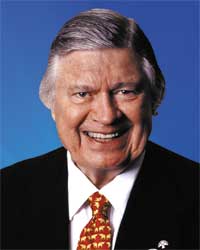
The book tracks every native Texan since the first one made it to the big leagues in 1895. Needless to say by name, the two fellows pictured at the the top of this article stand together, alone above all others, as the two greatest native Texan ballplayers in big league history. One is renowned as the greatest right-handed hitter in all of baseball history; the other is remembered as the greatest center-fielder of his time and the all-time leader in doubles. Both men managed teams to World Series wins and each is enshrined in the Hall of Fame at Cooperstown.

This book goes far beyond Rogers Hornsby and Tris Speaker in its treatment of the facts about native Texan roots and accomplishments. It’s so factual, in fact (which is what a reference book is supposed to be), that it could’ve been written in years past by Sergeants Joe Friday and Frank Smith from the old TV show, “Dragnet.”

If you want to know who else reached the Hall of Fame besides Hornsby and Speaker, it’s in there. If you want to know the leaders in a wide range of statistical categories, it’s in there. If you want to know who and how many major leaguers were born in your Texas home town, it’s in there. If you want to know about the great native Texan Negro Leaguers, that’s tight, one more time, it’s in there.

I am walking proof that there’s no way to come even close to knowing all that much about the history of baseball. There’s just too much to absorb from a clear factual standpoint – and that’s why we need the kinds of help we get from people like David King and Chuck Pickard.

I did find one error that I need to address under the list of native Texan big leaguers by city of birth. My birth home town of Beeville is responsible for four native Texan big leaguers. Three of them (Bert Gallia, Curt Walker, and Lloyd Brown) all played in the early part of the 20th century. The fourth (Eddie Taubensee) was a former Houston Astro from the latter part of the 20th century. The “Lone Stars” list also includes Beau Bell as hailing from Beeville, which he didn’t. Beau Bell actually was born in Bellville, Texas. For all I know, his family may have even founded the place before they lost credit as Bellville in “Lone Stars” for their only native son.

(Wait a minute. I think I know what some of you are are thinking and the answer is “No, Ernie Koy was not born in Bellville, the town that became his well-known home through most of his life. Ernie Koy was born down the road at Sealy – which did receive proper credit for him as a birthplace son in “Lone Stars.”)

Mssrs. King and Pickard are to be forgiven here for this minor mistake. The “sounds-the-same” and “looks alike” confusion between Beeville and Bellville is historical. My grandfather, who owned and ran the Beeville Bee back in the 19th century, used to complain in print about receiving mail that was actually intended for the Bellville, Texas newspaper editor. “Beeville and Bellville need to get together and find a way to decide which town changes its name,” Grandfather Will McCurdy wrote back in 1888. “Unless the cities do get together and change one of the town names, people far into the future will still be confusing the two places with each other long after we are all gone.”

The erroneous listing of Beau Bell as a native of Beeville just proves one more time that Grandfather McCurdy was right. It’s still a matter too slight to detract from all the important hard work that went into the making of “Lone Stars.” I have no stake in the matter, but I highly recommend this work to those of you who are members of SABR and also to anyone else who is even slightly interested in the nuts and bolts of Texas baseball history.

Ed Mickelson: Minor League All Star!

November 19, 2009

Mickelson Got the Last RBI in St. Louis Browns History.

Today at 83, Ed Mickelson is a silver-haired Cary Grant type living out his happy life in St. Louis, Missouri. Yesterday at 27, he collected the last run batted in recorded in St. Louis Browns history. He did it in a 2-1 losing cause against the Chicago White Sox on the last day of the 1953 season at old Sportsman’s Park. I wrote a parody to commemorate the event, once upon a time.  That signature RBI wasn’t the only thing that Ed ever did in baseball, but it is the thing he wants to be remembered for having done as a member of the Browns’ far from legendary last club on earth back in 1953. The next season, the franchise moved to Baltimore and hatched upon the scene as the Orioles.

In 2007, Ed Mickelson personally wrote his own story and published it through McFarland’s.  Still available through Amazon, the Mickelson biography is entitled “Out of the Park: Memoir of a Minor League Baseball All Star.” It’s well written and a good read, detailing Mickelson’s eleven season career (1947-57). He started with Decatur and ended up with Portland, achieving a lifetime minor league batting average of .316 and 108 home runs in 1,089 minor league games played. Ed even went 3 for 9 as a Houston Buff in 1952 before being reassigned by the parent Cardinals club to Rochester.

Mickelson also played 18 games total in the major leagues for the 1950 St. Louis Cardinals, the 1953 St. Louis Browns, and the 1957 Chicago Cubs. That record RBI single that scored Johnny Groth from second base in 1953 also was one of only three RBI that Ed managed in his brief major league career. His MLB average of .089 helps to explain his limited action beyond the minor leagues.

Ed Mickelson is one of the nicest people you could ever meet. He’s a bright guy who looks the part of his current role as an aging gracefully first baseman. The BR/TR, 6’3″ and still lanky guy could not better look the part if he tried.

Mickelson compiled a number of honors for his minor league play over the years, but that’s the stuff of Ed’s story in the book. Just one peek here: Ed Mickelson is also notably proud of the fact that he got his first major league hit in the form of a single off the great Warren Spahn back in 1950. I definitely remember Ed’s short 1952 stay with the Buffs too, but the Cardinals didn’t leave him here long enough to do that sad Buff team much good.

In honor of Ed Mickelson’s last RBI in St. Louis Browns history, here’s that parody I wrote years ago in all their honors:

The Lost Hurrah: September 27, 1953
Chicago White Sox 2 – St. Louis Browns 1.

(A respectful parody of “Casey At The Bat” by Ernest L. Thayer in application to the last game ever played by our beloved St. Louis Browns.)

by Bill McCurdy (1997)

The outlook wasn’t brilliant for the Brownie nine that day;
They were moving from St. Louis – to a place quite far away,
And all because Bill Veeck had said, “I can’t afford to stay,”
The team was playing their last game – in that fabled Brownie way.

With hopes of winning buried deep – beneath all known dismay,
The Brownies ate their cellar fate, but still charged out to play.
In aim to halt a last hard loss – in a season dead since May,
They sent Pillette out to the mound – to speak their final say.

The White Sox were that last dance foe – at the former Sportsman’s Park,
And our pitcher pulsed the pallor of those few fans in the dark.
To the dank and empty stands they came, – one final, futile time,
To witness their dear Brownies reach – ignominy sublime.

When Mickelson then knocked in Groth – for the first run of the game,
It was to be the last Browns score, – from here to kingdom came.
And all the hopes that fanned once more, – in that third inning spree,
Were briefly blowing in the wind, – but lost eternally.

For over seven innings then, – Dee bleached the White Sox out,
And the Browns were up by one to oh, – when Rivera launched his clout.
That homer tied the score at one, – and then the game ran on.
Until eleven innings played, – the franchise was not gone.

But Minnie’s double won the game – for the lefty, Billy Pierce,
And Dee picked up the last Browns loss; – one hundred times is fierce!
And when Jim Dyck flew out to end – the Browns’ last time at bat,
The SL Browns were here no more, and that was that, – was that!

Oh, somewhere in this favored land, the sun is shining bright;

The band is playing somewhere, and somewhere hearts are light;

And somewhere men are laughing, – and little children shout,

But there’s no joy in Sislerville, – the Brownies have pulled out.

Speaking of Fingers…

November 18, 2009

"Have a Nice Day, Buffalo Bills!"

What was Bud Adams thinking last Sunday in Nashville?

His NFL club, the Tennessee Titans, had just dispatched the visiting Buffalo Bills, 41-17, for their third win in a row and all looked well for America’s favorite hillbilly team. Why oh why then did the 86-year old Budman suddenly feel the need to rise from his suite box seat and issue the visiting Bills the universally unpleasant one-finger salute goodbye, serially, and with both hands?

NFL Commissioner Roger Goodell just happened to be present in Nashville for the game and had spent most of his time on Sunday watching it with Adams from his private suite box on the upper level of the stadium. Goodell had left Adams in the 4th quarter to smooze a little time away with fans before game’s end. He did not see the actual salute performance, but he sure got a load of the images made available to him later from some fan in the lower deck’s cell phone camera.

As a result of all these circumstances, Commissioner Goodell quickly levied a fine upon Titans owner Bud Adams of $250,000. Wow! That works out to a quarter million dollars, or, breaking it down, $125,000 a finger! The fine also derived an apology from Adams to everyone in the conceivably offended universe as he waxed away also on the notion that his actions were among those that never should have happened in the first place.

Gee whiz! You think so, Bud? ‘Cause if you do, that’s a monumental piece of insight all onto itself! It never should have happened in the first place, but what the heck. You’re only 86 years old, going on 87. You’ve got plenty of time to reckon with the basic questions that face us all on the spiritual plane. May as well get cranked with anger and spite in the meanwhile and either curse or one-finger salute someone else’s football team for losing to or beating up on your own club while there’s still plenty of time to waste.

The one-finger salute is a lot like drinking too much. In fact, those two human events often go hand-in-hand down the aisle of violent promise. They are things some people do to punctuate both the thrill of victory and the agony of defeat in the face of some identified enemy. Even though they seem to be very different actions, one arising from celebration and the other emanating from consternation, they are really the same thing – and they each are expressions of violence. One salute says “take this for what I did to you” and the other says “take this for what you did to me.” Both are put forth like bulletin board material to further inspire the anger and desire for revenge that will dominate our next meeting on the field of battle or play.

Sometimes the one-finger salute comes in the form of a few more muscles being put into play then the few it takes to raise the big digit on either hand. Bud Adams knows about that kind of salute too. Back in the mid-1990s, when the city refused to finance Adams’ plan for a new stadium downtown to house his Houston Oilers, Bud gave us all a much more painful version of the one-finger salute. He took his NFL team out of Houston and turned them into the Tennessee Titans.

Keep that in mind when the Titans come to town next Monday night to play our Houston Texans, folks. – It’s time to salute Bud and the boys again.

"When you're smilin' - when you're smilin' - the whole world smiles at you!"

Houston Buffs: Ted Wilks.

November 17, 2009

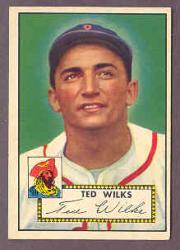
Right hander Ted Wilks broke into baseball with the 1938 Houston Buffs. His 3-5 record with an ERA of  2.74. He pitched well enough that rookie season to earn a promotion that same year to Rochester, where he posted a 4-2 mark with an ERA of 3.94. A subtle difference in how he was used at Houston and Rochester was nothing less than a career harbinger on things to come. Here in Houston, Ted was primarily a starting pitcher; at Rochester, Wilks saw most of his mound action in relief.

The following three seasons saw Ted Wilks back in Houston for more seasoning. He went 14-15 with a 2.60 ERA in 1939; 13-10 with a 2.51 ERA in 1940; and 20-10 with a 2.50 ERA for the 1941 Buffs. All three Buff clubs (1939-41) finished in first place; the ’40 club also won the league pennant playoffs; and Ted Wilks was a big part of that Buff era of success.

After going 12-9, 2.41, for the ’42 Columbus Redbirds and 16-8, 2.66, for the same club in ’43, Ted Wilks finally joined the big club in St. Louis in time to help the 1944 Cardinals take another world Series crown with the streetcar series win over the same hometown Brown of the American League. Wilks was used pretty evenly in 1944 as a starter and reliever (21/15), going 17-4 with another sub-three ERA of 2.64 on the season.

In his eight seasons as a Cardinal (1944-51), Ted Wilks won 54 games against only 20 losses, posting a sub-three ERA on three separate occasions. It was early during this period that he moved from split duty as a starter-reliever to recognition and exclusive use as one of the top relief pitchers in the game.

On June 15, 1951, the Cardinals traded Ted Wilks, Bill Howerton, Howie Pollet, Joe Garagiola, and Dick Cole to the Pittsburgh Pirates in exchange for pitcher Cliff Chambers and outfielder Wally Westlake.

Wilks went 8-10 in two seasons with the Pirates (1951-52) before he was again dealt away, this time  to the Cleveland Indians on August 18, 1952, along with shortstop George Strickland for infielder Johnny (General Hospital) Berardino, minor league pitcher Charlie Sipple, and $50,000 cash. By this time, Wilks was was pretty much out of gas for major league ball. He posted no decisions in his two partial seasons with Cleveland (1952-53) and he finished his major league career working only 15 1/3 innings in the American League city.

Ted Wilks finished his total career working four poor seasons of minor league ball (1953-55: Indianapolis; 1956: Austin) before retiring for good. He finished up with a career minor league record of 91-65, 2.70 for 10 seasons – and a career major league record of 59-30, 3.26. Ted wilks posted 46 saves as a major leaguer. The “save” stat for his minor league work is not readily available.

Like a number of ballplayers whose careers passed through Houston, upstate New Yorker Ted Wilks adopted Houston as his post-career home town. He died here in Houston in 1989 at the age of 73 and he is buried in the East End at Forest Park Cemetery on Lawndale. His final resting place is only two miles from where he first took the mound as a Houston Buff in 1938.

Rest in Peace, Prince Ted, but stay ready to come into the game whenever old St. Peter dials your number.

Houston Buffs: Danny Murtaugh.

November 16, 2009
20090830pg_murtaugh_330

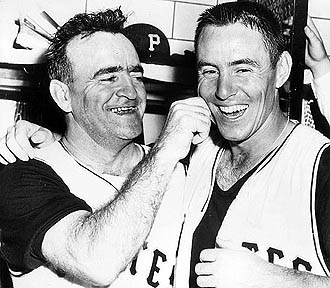
Murtaugh (L) & Mazeroski were all smiles after Game 7 in 1960!

Danny Murtaugh started out his baseball career as a tough-nosed 20-year old infielder from Chester, PA for the 1937 Cambridge Cardinals of the Class D Eastern Shore league. He batted .297 in his rookie season, following that year with a .312 mark in his second round with the ’39 Cambridge club in the St. Louis Cardinals farm system. He played shortstop his first season; second base his second year. At 5’9″ and 165 pounds, Danny had the right body type and low center of gravity for a middle infielder. More importantly, he had the right kind of aggressive attitude as a critical playmaker.
After batting .255 and .326 in a split-season performance for Columbus and Rochester in 1939, Murtaugh joined the 1940 Texas League Champion Houston Buffs of the Texas League. This time around, Danny played third base, batting .299. The following season, Danny Murtaugh returned to the 1941 Buffs as a second baseman and batted .317 in 69 games. His performance was good enough to get him dealt to Philadelphia (NL), where Danny broke into the big leagues with as a “good field, seldom hit” second baseman (.219) who also reached base often enough to lead the National League in stolen bases with 18.
Murtaugh then improved steadily with the Phils, batting .241 in 1942 and .273 in 1943. Military service got the call in 1944-45. Danny returned in 1946, but, after a handful of at bats with the Phils, he was dealt back to the Cardinals and assigned again to Rochester. This time he excelled, hitting .322 over the road of a whole season.
Dealt next to Boston (NL) in the off-season, Danny again picked up a hand scoop of at bats with the Braves before he was assigned to AAA Milwaukee, where he again did well, batting a “Punch and Judy” .302 in 119 games.
Then Danny Murtaugh acquired his lasting identity. He was dealt to the Pittsburgh Pirates, where he played second base for four seasons (1948-51). In the two seasons he played over 100 games for the Pirates, Murtaugh batted .290 in 1948 and .294 in 1950. He finished his nine major league season career in 1951 with a total batting average of .254 and a strong reputation for tough, heads up baseball savvy.
Danny Murtaugh’s ability earned him a four-year assignment by the Pirates as a minor league manager for New Orleans (1952-54) and Charleston (1955). He continued to play ball a little in 1952-53, wrapping up his nine season, 901-game minor league career with an impressive .297 batting average.
Danny Murtaugh began the memorable phase of his career when he took over as manager of the Pittsburgh Pirates in 1957. For eight consecutive years (1957-64), Danny Murtaugh steadied the Pirates and led them in 1960 to their first pennant since 1927 and first World Series title since 1925. Who among us fans with blood flowing in our veins will ever forget Bill Mazeroski’s dramatic and iconic home run that gave the Pirates a freak-out, walk off victory over the New York Yankees in extra innings at Forbes Field in Game Seven back in 1960?
Pittsburgh’s administration never forgot the moment either. They brought Danny Murtaugh back three additional times as manager in 1967, in 1970-71, and one more time in 1973-76. He guided the Pirates to a second World Series title on his watch in 1971.
I’ve never read anything from anyone in the Pittsburgh organization back in those days that ever reflected badly on Danny Murtaugh as a manager. He really comes across as a never-give-up winner who believed in the value of solid fundamentally sound baseball and the importance of players psychologically leaning into the game with an attitude toward winning as the only acceptable outcome. It was the same attitude that some of us in Houston got to see in person through one of his former players who became a manager here and elsewhere. In his own quiet way, Bill Virdon exuded that same winning Murtaugh attitude. One doesn’t have to be a loudmouth screamer to be totally dedicated to winning.
Sadly, we lost Danny Murtaugh early. He passed away at his home in Chester, PA in 1976 at age 59. Happily, Danny spent most of his last year on earth doing the thing he did best: managing the Pittsburgh Pirates.

The Latest on the Finger’s Museum.

November 15, 2009
DSC00231

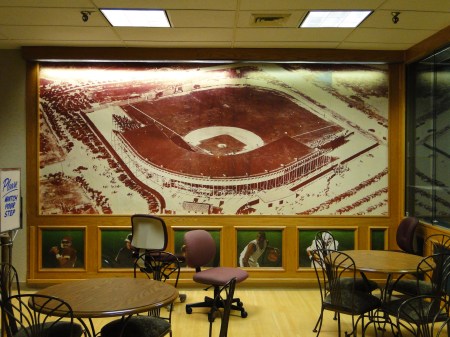
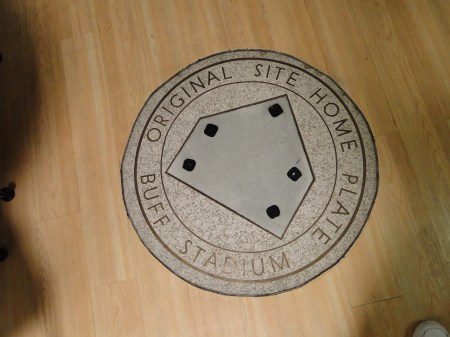
Finger's Houston Sports Museum on Halloween Saturday 2009.

Fans of Houston’s baseball history have spent the past few months wondering what was to become of the artifacts that once were on display at the Houston Sports Museum. The museum closed earlier this year when the Finger Furniture store on the Gulf Freeway that housed it on the original site of old Buff Stadium closed their doors for business. The small museum was located within the store, built around the spot where the home plate of Buff Stadium still stood, imbedded in the floor as a signature on owner Sammy Finger’s dedication to preserving the memory of Houston baseball history.

Opening in the 1960s, the museum started as a baseball-focused effort, with all artifacts coming from Sammy Finger’s personal collections and items donated or loaned to him on a handshake by his baseball pals. Over the years, football and basketball items crept into the picture too, and the lace was renamed from baseball to the “Houston Sports Museum.”

Without a curator or knowledgeable dedication to how items were handled, many of the items were faded in the display cases from improper lighting. The volume of items also led to a condition which could only be described as careless storage in the company’s warehouses. For example, Sammy Finger died around the turn of this new century. When former Houston Buff Jerry Witte died in 2002, his family tried to reclaim the items he had loaned the museum years earlier. The items could not be found. There was no record at Finger’s as to what they were – nor any detail on hand in writing that noted whether the Witte items were there as gifts or loans.

Cut to the story chase here. – Once Sammy Finger’s son Bobby Finger died two or three years ago, the family started moving toward changes in their operations. At first they were going to change their business name to Ashley’s. That plan didn’t work out, but the family supposedly decided to shut down the Gulf Freeway location and museum, anyway, as a business decision. No plan was announced for the future of the museum.

On Halloween Saturday morning, Bob Dorrill of SABR and I stopped off at the old Finger’s store on the Gulf Freeway, just to check out what was happening. It was still open as a furniture inventory liquidation business operation, but without the Finger name in place. We found the physical setting of the old museum still in place, of course, with all the old artifacts now removed.

DSC00234

Buff Stadium Home Plate Site: Halloween Saturday 2009.

We asked to speak with anyone at the store who could tell us anything about any plans for the museum and its artifacts. We were directed to a floor manager who talked as though she knew what was going on. Unfortunately, I cannot remember her name, but I do recall what she told us.

The store employee told us that the furniture liquidation business will continue for a while, but that the store would eventually re-open again. I’m not sure if it will bear the Finger name again, but it apparently will still be owned or controlled by the Finger family.

Our informant said that plans included sprucing up and re-opening the museum. I asked about the Buff Stadium mural. I’ve been especially concerned that it might just be whacked down with the wall to make room for more sales space. The store woman told us that it was going to be preserved and that they actually were working on ways to make it more even and secure against the wall. The display items supposedly will be returned to the museum. She said they were currently in storage.

We also asked about the lighting problem that had faded so many of the items in the past. She even indicated that they were aware of that issue and that they will be working to improve display conditions.

That’s all we know. What actually happens now, remains to be seen.

I’d still like to know what happened to that larger than life sculpture of pitcher Dickie Kerr. It was transferred from the Astrodome to the Houston Sports Museum years ago where it remained on display for quite a while. Then, one day, suddenly, it was gone.

I never found anyone at Finger’s who could tell me what happened to the Kerr statue beyond offering the familiar vague statement that it’s in storage somewhere.

The mystery rolls on.

Baseball Quiz No. 1

November 14, 2009

question-mark1aI’ve something different for you this morning. It’s just a little ten question baseball history quiz. It’s really not all that hard. Just pay attention to what you are being asked and what you see. If you’ve followed baseball at all, and if you’ve done any baseball history reading, you should be able to get all ten answers right.
Have fun:

1. Frank Mancuso and Bobby Bragan were only two of the 37 major league catchers to receive for this starting pitcher over the course of his MLB career. Who was he?

2. He and Al Benton were the only two pitchers whose MLB careers spanned the eras of both Babe Ruth and Mickey Mantle. Benton actually faced both Yankee legends. This second man just never got a chance to face Mantle. Who was he?

3. This man and Jack Powell are the only two pitchers in MLB history to have won more than 200 big league games and still finished their careers with a sub-.500 winning percentage. Who is he?

4. Who was the last big league player from the 1920s to still be playing at that level in the 1950s?

5. In poet Ogden Nash’s “Lineup for Yesterday,” he is the only player mentioned who didn’t make it to the Hall of Fame. Who is he?

6. What pitcher won 30 games for the Los Angeles Angels of the Pacific Coast League back in 1933?

7. He pitched for 9 distinct MLB franchise clubs over the course of 17 changes of big league team affiliation during his career. Who are we we talking about here?

8. He won exactly 20 games in a season twice as a big league pitcher, but he lost exactly 20 games in a season three times as a major leaguer. Who was he?

9. He is the only pitcher to play for one big league club on five separate occasions? Who is he?

10. He and Ray Kremer of the 1930 Pittsburgh Pirates are the only two big league pitchers in history to win 20 games and still post Earned Run Averages of over 5 runs per nine inning game over the course of a single season. Who is he?

When someone has posted the winning answers to all ten questions below as a comment on this quiz, I will confirm the winner with a comment post of my own.

BOBBY BRAGAN: GOING STRONG AT 92!

November 13, 2009

BobbyBragan5300

One of my favorite people anywhere, Bobby Bragan, turned 92 years young back on October 30th. I’m sorry it’s taken me this long to acknowledge the fact here in this blog because the man is truly amazing and deserving of all the recognition we can give him.

Number One: The man is all heart. Since 1992, his Bobby Bragan Youth Foundation has raised over $900,000 i support of 367 deserving students. It just gets stronger over time – and that’s just another reason it’s aptly named. It came  into being at a time in the life of its founder when he would have been more than justified in hanging up his charitable ventures and just moved over to take it easy with his music and other personal entertainments.

Not so Bobby Bragan. He loves kids and wanted to do something material to help those young people who needed a little extra support getting down the road with positive life goals.

Bobby was a feisty infielder-catcher for the Brooklyn Dodgers (1943-44, 47-48) Dodgers after starting his big league career with those awful Philadelphia Phillies teams of 1940-42. He managed the Fort Worth Cats to a couple of first place finishes in the Texas League in 1948 and 1949. Those clubs won the playoff pennant in ’48 and then lost in seven in ’49, setting the stage for Bragan’s ascent to his big league mentoring jobs at Pittsburgh (1956-57), Cleveland (1958), Milwaukee (1963-65), and Atlanta (1966). Bobby also managed at Hollywood during the early 1950s and was also one the original coaching/scouting people for the Houston Colt .45 team when it came into being in 1962.

Bragan was always a run-and-gun manager who didn’t mind mixing it up with the umpires when he felt they had erred in their vision of what was going on in the game. As a result, he was also no stranger to the early shower directives that often result from these expressions of a different viewpoint from the game arbiters.

One of my favorite Bragan stories is about the time he followed Birdie Tebbetts as manager of the Milwaukee Braves in 1963. It seems that Tebbetts had left him with two sealed envelopes, duly marked as “No. 1” and “No. 2”, and each bearing the caution: “Open only in case of crisis.”

After a little more than a year at the helm, Bragan and the ’64 Braves got off to a bad start. Everyone was screaming for Bobby’s head. He decided it was time to open that first envelope from former manager Tebbetts.

The note said: “Blame it on me and the old guys! – Birdie Tebbetts”

Bragan went to the front office and laid it out his way. “You’ve saddled me with an old Adcock, Logan, Bruton, and Burdette,” Bobby protested. “Birdie left me with a terrible team. I can’t win with these old guys here. Get me younger players.”

Bragan weathered the storm when the team improved enough to take the heat off him as manager, but a couple of years later, when the team really hoped to make good during their first season as new 1966 Atlanta Braves, they again began to struggle in the tank. This time the front office, the media, and the fans wanted Bobby’s head in no certain terms.

Bobby decided it was time to check out Birdie Tebbetts second envelope. He went to his desk, pulled it out, ttore it open, and quickly read its very brief message:

“Prepare two more envelopes,” the message read.

112 games into the 1966 season, Bobby Bragan was fired as manager of the Atlanta Braves. He left with a mark of 52 wins, 59 losses, and 1 tie.

Like the Energizer Bunny, Bobby Bragan never stay fired for long. Today he keeps on going and going – and leaving his mark of goodness on everything he touches.

Belated Happy Birthday No. 92, Bobby Bragan! And keep on truckin’, my friend!

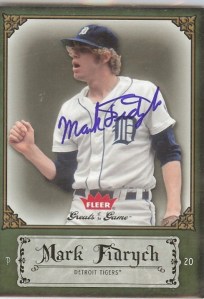
Mark Fidrych: The Birdman of ’76.

November 11, 2009

mark fydrich ttm

At age 53, Mark “The Birdman” Fidrych died when the truck he was working on fell on him last spring, The date was April 13, 2009. The place was Fidrych’s own 107 acre farm in Northborough, MA. The truck was Mark’s very own pickup.

So sad. Family found the body in the early afternoon of the same day. Once again, the talented and colorful young man who set the baseball world on its ear during his 1976 rookie season as a pitcher for the Detroit Tigers had left the scene too soon. Far too soon.

Selected in the 10th round of the 1974 amateur draft by the Detroit Tigers, Fidrych quickly found the roster of the big league club, winning 19, losing 9, and posting a 2.34 ERA to boot. More than games alone, Mark won the hearts and imagination of baseball fans everywhere by his fresh and unorthodox physical approach to the art of pitching. People thought he was talking to the baseballs as he prepared to throw them. It was actually an exercise in focus upon the job at hand. If he was speaking to anyone, Mark was actually speaking to himself along these lines: “Be here now fully in this moment. Give this pitch your very best shot. Visualize in you mind the outcome of this pitch as an easy out.” The young pitcher really subscribed to the belief that we cannot accomplish any goal we cannot actually see ourselves reaching. While he was meditating, a lot of people thought Mark Fidrych was simply being superstitious. They were wrong.

fidrych-300x177 Fidrych did like to get down on the ground prior to games and hand prune tiny rocks and paper trash out of the soil before he worked. He also tended to abandon and mistreat baseballs that hitters converted into hits from his pitches. More than once, he asked umpires to take balls out of play that  had been struck for hits. He wanted the umpires to place these errant balls in the company of balls that knew how to behave as outs once they left a pitcher’s hand. So, there’s no denying that Mr. Fidrych came wrapped with his own flavor of special eccentricity.
The sad elements of the Mark Fidrych story are the things that took him out of baseball – and eventually out of life. In both instances, these things happened as Mark simply went about the business of  being himself.


image001

Mark Fidrych got his "Bird" nickname from Big Bird himself!

Mark Fidrych’s future in baseball looked wide and deep as he went to spring training in the the spring of 1977. Unfortunately, while clowning around in the outfield, Mark tore some cartilage in his knee and was forced out of action for a short period. When he came back to work, he pitched fine, but about six weeks after his return, in a game against Baltimore, Mark said he suddenly just felt his right throwing arm simply “go dead.”

Mark had torn a rotator cuff, but it wasn’t diagnosed as such until 1985, eight years later, and five years beyond his forced retirement from baseball  at age 29 in 1980.

Mark Fidrych was only 10-10 over those last four post-injury seasons (1977-80) and he retired with very incomplete information about the cause of his lost skill and effectiveness. Still, he handled the end of his career well, but probably never fully appreciating the extent of the enthusiasm that his personal style had pumped back into the game. Baseball even gives Fidrych credit today for pumping several additional millions into the gate during his 1976 hay-day.

Then he goes out and gets killed by a sick truck that wasn’t  jacked up properly. What a waste.

Too bad Mark Fidrych couldn’t have hung around longer. In baseball. And in life.

Eddie Waitkus: An “Unnatural” Destiny.

November 10, 2009

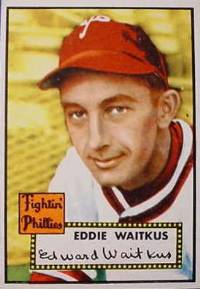
waitkus-52t When Bernard Malamud wrote about baseball phenom Roy Hobbs getting shot by a mysterious woman in black in his novel “The Natural,” he was doing what a lot of writers do for the sake of art. He was drawing from real life. Oh, there never was a real Roy Hobbs, just a lot of young guys who may have looked like him or Robert Redford on the field, but even they were all lost in a barrel with the one guy who really was him on the diamond, a fellow named Mickey Mantle, but even ladies man Mickey somehow always dodged the bullet. We likely will never know how close that guys like Mantle or Ruth ever came to suffering in reality the artful Hobbsian fate.

First baseman Eddie Waitkus of the Philadelphia Phillies and a disturbed young woman from Chicago named Ruth Ann Steinhagen were another story. On June 14, 1949, Waitkus and Steinhagen spent no more than five minutes of their lives together in a Chicago hotel room, but that shared time almost turned out to be the last five minutes in Eddie’s life – and definitely enough stuff to later make up a baseball story dream launcher for writer Malamud.

Here’s how it happened.

Ruth Ann Steinhagen grew up a troubled young girl In Chicago. In 1946, at age 16, she went to a Cubs game at Wrigley Field with her girl friend and the latter’s boy friend. She became fixated on Eddie Waitkus at this game. Waitkus was then the Cubs’ first baseman and he was having a pretty good year at the plate, but that didn’t really matter. Steinhagen thought he was cute.

Ruth Steinhagen started an intense scrapbook on Eddie Waitkus, documenting his every achievement and printed picture as religiously as later generations of young girls would similarly record and celebrate the lives of certain rock stars. Ruth still had major issues with her self esteem and was episodically involved in psychiatric therapy during her adolescence. She doesn’t appear to have ever experienced an actual relationship with any male as a boy friend during this early period of life.

When Eddie Waitkus was traded by the Cubs to the Phillies on December 14, 1948, Ruth Ann cried and said she didn’t want to live. She went through a very shaky period, but finally decided she needed to see Eddie Waitkus and let him know that she wanted to be his girl friend. It was a very psychotic idea. I rather doubt she shared it with anyone in any position to stop her back then. Even in 1948, it would have raised red flags among the psychiatrically trained. Even then, mental health experts knew that patients who are suicidal over psychotically perceived  losses are equally capable of turning around their self-destructive thoughts and converting them into thoughts of harming the perceived cause of loss and pain.

In this case, Eddie Waitkus was perceived as the one to blame for the pain of Ruth Ann Steinhagen. It was all Eddie’s fault, in her mind, and he didn’t even know the girl.

In May 1949, now 19 and an attractive young woman, Ruth Ann Steinhagen took out a two-day room reservation at the Edgewater Beach Hotel on Lake Shore Drive in Chicago, where Waitkus and the Phillies would also be staying during a series with the Cubs.

Ruth Ann also invited a friend, Helen Farazis, over to the hotel on her first night  there, June 13th. Ruth told Helen that she had a a gun and that her real intentions in being there were to shoot Eddie Waitkus. Helen did not believe Ruth Ann, nor did she tell anyone else about what seemed like a joking threat.

The next day day, June 14, 1949, Ruth Ann went to Wrigley Field and watched Eddie Waitkus and the Phillies beat up on the Cubs, 9-2. She then went back to her hotel room after the game and ordered three drinks from room service. When the bellboy arrived, she gave him five dollars and told him to take a written message to Eddie Waitkus. The note read as follows:

““It is extremely important that I see you as soon as possible.  We are not acquainted, but I have something of importance to speak to you about.  I think it would be to your advantage to let me explain this to you as I am leaving the hotel the day after tomorrow.  I realize this is out of the ordinary, but as I say, it is extremely important.”

Steinhagem signed the note “Ruth Ann Burns” and the bellboy left in the room that was shared by Waitkus with teammate Russ Meyer. (Here’s the story gets a little tricky, almost as though a Hollywood scriptwriter or Barnard Malamud had come up with the gimmick on a cup of coffee and five or six cigarettes!)

Meyer came  back to the room first. He found  the note inviting Waitkus to join Ruth in Room 1297. Meyer assumed the note was from a real girl friend of Eddie, a woman named Ruth Martin. When Waitkus then arrived, Meyer just told him that Ruth was waiting for him in Room 1297. Eddie went on up to the noted room, all the while thinking it was an invitation from his real friend.

When Eddie arrived at Room 1297, he asked for his friend, Ruth Martin. Ruth Ann Steinhagen simply introduced herself as a friend of Martin’s and explained that she had stepped out for a minute. She invited Eddie into the room for a short wait for Ruth Martin. Eddie suspected nothing and accepted. He stepped into the room and took a seat.

As Eddie was seating himself, Ruth Ann walked straight to the closet and pulled out a loaded .22 rifle. She took aim at Eddie Waitkus and pulled the trigger, hitting him once in the chest under the heart. As she did so, she yelled the most famous words ever expressed by most people in cases of relationship “love” violence: “If I can’t have you, nobody can!”

The bullet lodged in the muscles near the spine as Eddie Waitkus’s right lung collapsed. Ruth Ann Steinhagen then calmly called the front desk and told them that had just shot a man in Room 1297. Had she not placed the call immediately, it is likely that Eddie Waitkus would have bled to death.

Eddie Waitkus recovered physically and went on to highlight  his career as a member of the 1950 Phillies Whiz Kids champions, finishing in 1955 with a lifetime batting average of .285. Eddie passed away from cancer at age 53 on September 15, 1972.

Ruth Ann Steinhagen was found innocent by reason of  insanity and committed for psychiatric treatment of schizophrenia and therapy that included a long period of hospitalization and shock therapy. On April 17, 1952, less than three years after the shooting, Ruth Ann Steinhagen was declared sane and released.  The charge of assault with intent to kill was dropped. She and Eddie never saw each other again.

Years later, Eddie Waitkus looked back on his near fatal encounter with the psychotic Ms. Steinhagen and remarked, ““She had the coldest-looking face that I ever saw.”

You bet she did, Eddie. It was cold steel cold.