This has to be said up front. There really is no way to come up with a Top Ten Early Rock ‘n Roll Hits list that doesn’t leave someone or something deserving totally out of the picture. When it come to all the early performing giants, people like Little Richard, Chuck Berry, Fats Domino, Jerry Lee Lewis, and Elvis, we could take almost any of their songs and justify its place on a legitimate list.
With that much in mind, what I’ve tried to do here is simply list the songs that came along and struck me hard, from 1954 through 1957, when I was 16 to 19 years old, when Jimmy Menutis’s club in Houston was about to start its reign, as the mind-set, music, and culture changing songs of that era. The songs I love from that era are ten times greater, at least, so that means that my final top tem bunch leaves out many great hits – and even some great artists – people like Buddy “Cricking” Holly, for gosh sakes. That being said, here’s my list:

Turner's work fore-ran the great radio crossover of "black music" to mainstream radio, but it all begin to happen in 1954.
(1) “Shake, Rattle, and Roll” (1954). Who among us from that era could ever forget the beat and the lyrics of the song – and the deep, happy voice of the man who performed them, Big Joe Turner? “I’m like a one-eyed cat, peepin’ in a seafood store! – I can look at you and tell you ain’t no child no more!”
“Shake, Rattle, and Roll” should be the unarguable first rock ‘n roll song on everyone’s list. If it’s not, you weren’t listening at the moment of the genre’s big bang experience, when the music you could only hear on all black radio stations suddenly got too big and too commercial to be passed over any longer by the all-white “Goodnight, Irene” – playing music stations. I may be wrong, but I think “Shake” was the first to make it all the way over to Houston’s two most popular white AM radio DJ’s, Paul Berlin of KNUZ and Bob Byron of KILT.
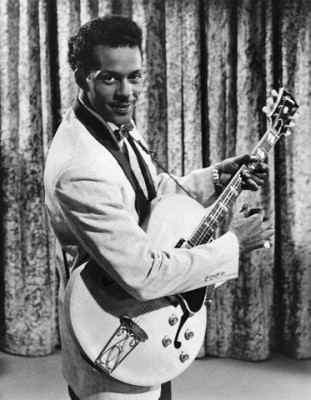
"Maybelline" was a real gas pedal pusher.
(2) “Maybelline” (1955). This one blows past our earliest discovery of Elvis in “That’s All Right” and I don’t know how many other songs by Little Richard and Fats Domino, plus all those great group hits. like “Earth Angel” by The Penguins, but it was the great Chuck Berry at his “drivin’ fool” first best effort at singlehandedly taking over the new music that both accelerated and satisfied the angst of our testosterone-pumping, adolescent minds, bodies, and souls – and especially so when we climbed behind the wheels of our muscle machines and hit the Gulf Freeway for Galveston with our girls by our sides on those ever always practical bench car seats that used to be the app that made our driving world a happy place to be.
“As I was a motivatin’ over the hiil, I caught Maybelline in a Coupe DeVille; Cadillac rollin’ on a open road; nothing out-run my V-8 Ford.”
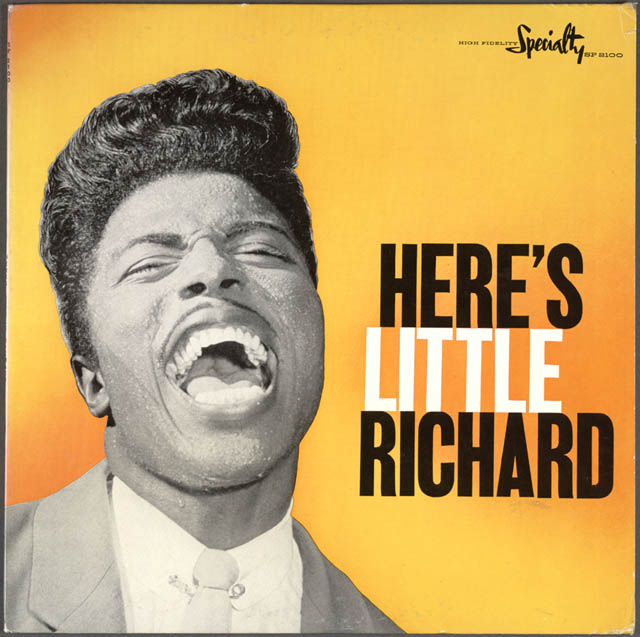 (3) “Long Tall Sally” (1955). Little Richard is one of the music artists with a legitimate claim on the “Father of Rock n’ Roll” title if it weren’t for the fact the presence of so many others in that category suggests that the change was a process movement in music and not a sudden birth in high C section from the rhythm and blues genre. If anything, rock n’ roll came together in a way that united early black and white music folk forms, taking a whole lot from black rhythm and blues, but also borrowing from white country and western too.
We could easily substitute “Tutti Frutti” or “Rip It Up’ here and lose nothing from the idea that Little Richard was a major first contributor to the earliest echoes of rock ‘n roll.
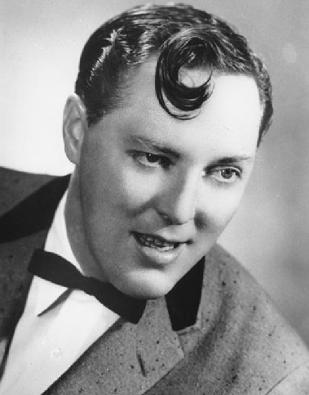
Bill Haley and The Comets hit us big time!
(4) “Rock Around The Clock” (1955). No rock and roll song ever landed harder upon my generation of the 1950s, not even “Blue Suede Shoes.” When a bunch of us first heard it, we had all gone together as a group to the Loews State Theater in downtown Houston to see the highly touted new movie of teenage rebellion called “Blackboard Jungle.” Unknown to us until that moment, the movie started with Bill Haley and the Comets performing this now iconic song for the first time that any of us had ever heard it.
“One! Two! Three O’Clock! Four O’Clock Rock! ~ Five! SIx! Seven O’Clock! EIght O’Clock Rock! ~ Nine! Ten! Eleven O’Clock! Twelve O’Clock Rock! ~ We’re Gonna Rock! Around! The Clock Tonight! …”
What happened next was both amazing and original to the situation. We were all on our feet cheering. And dancing in the aisles. We’ve been dancing and cheering ever since. And “Rock Around the Clock” remains today the same as it was from public birth – The International Anthem of Rock ‘n Roll Joy!
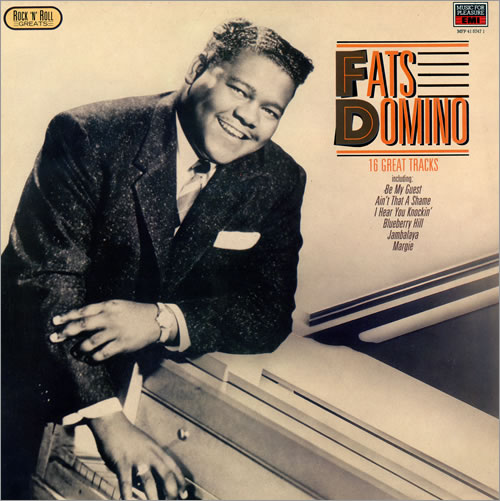
Fats Domino: "Baby, don't you let your dog bite me!"
(5) “I’m In Love Again” (1955). So many other great hits from the music genius of Fats Domino would fit here. This one just happened to hit my teenage ears over the car radio on a night I was driving home from another new venture into falling in love. Unfortunately, it was neither my first nor last trip over the falls of bittersweet pain, but good old Fats did his part that night in helping to write the soundtrack of my early times life.
“Yes, it’s me, and I’m in love again! – Had no lovin’ since you know when! OOH-WEE, BABY! – OOH-OOH-WEE! BABY DON’T YOU LET YOUR DOG BITE ME!”
It wasn’t her dog that bit me back in the day; nor was it the bittersweet music of good old Fats that tore into my heart and soul where women were concerned. I just had some growing up to do about love and what was really possible in a relationship between a man and a woman, including the big bopper lesson that learning about love is a lifetime school.

Carl Perkins
(6) Blue Suede Shoes (1956). Carl Perkins wrote it. Elvis Presley gave it immortality. In the minds of many, it remains as the greatest rock ‘n roll hit of all time. – I remember going to see Carl Perkins perform at the old Sam Houston Coliseum in Houston around this time. The place was packed because of “Blue Suede Shoes” hit and we were literally swept away in the human crush of a packed house when Perkins finally got around to doing his famous number. It was also around this same time period tha Carl’s friend, ELvis, was making and releasing his own version of “Blue Suede Shoes” in a much faster and hipper tempo and style on a record that would carry the hit to other galaxies.
Perkins wrote the song one night after he came home from playing a high school prom and over-hearing a young man telling his date, “Listen, when we’re dancing, please try not to step on my blue suede shoes. OK?” Sometimes good things happen when we are paying attention.
Right Carl?
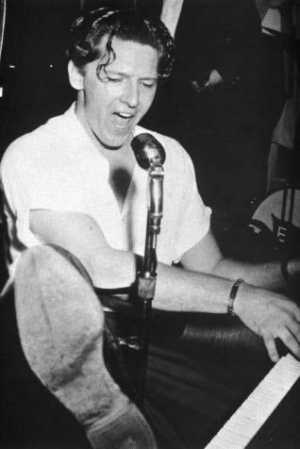
Jerry Lee Lewis
(7) Great Balls of Fire (1956). Substitute “Whole Lotta Shakin’ Goin’ On” or any other favorite Jerry Lee Lewis song here and I have no problem with the change as long as the man and his dawn-stormin’ music makes the list. Jerry Lee was the most insanely talented early contributor to “R&R” from the country/white Protestant gospel culture that produced him.
The life and music of Jerry Lee Lewis left everybody breathless and with a whole lot of shakin’ goin’ on.
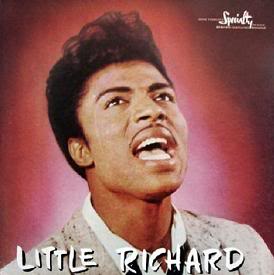 (8) “Good Golly, Miss Molly” (1957). Little Richard returns to the list with a hit that was big enough to impress a 10-year old future President of the United States. Young Bil Clinton of Hope, Arkansas was busy picking up the saxophone and the music of Little Richard around the time this mega-hit came out. He loved it so much that he would one day prevail upon the “Father of Rock n’ Roll” to perform “Good Golly, Miss Molly at a party celebrating his 1993 presidential inauguration while he, the new American President, accompanied “LR” on the sax. (This act would have been big at Jimmy Menutis back in the day.)
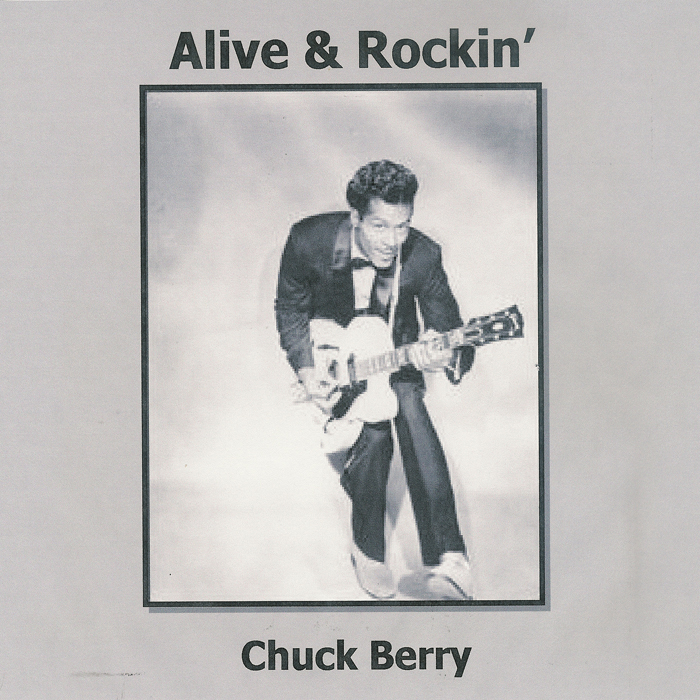 (9) Johnny B. Goode (1957). “Go, Johnny, Go!” The hard-driving lyrics of this classic rock ‘n roll number by Chuck Berry still pound the message of the genre out there at a rate faster than the culture of that time could absorb it. It was about freedom of artistic expression on a level that went way beyond the in-bred marriage of the majority white culture to the values of prudence and control of the arts, two qualities that eventually go beyond directing energy and start choking creativity.
“Long live rock ‘n roll! Deliver us from the days of old” – Chuck Berry.

"Thank you! - Thank you very much!"
(10) “Hound Dog” (1957). By this time in 1957, you could have picked a number of other Elvis Presley hits for this lace in the Top Ten List. I chose “Hound Dog” because I think it represents something of a final victory point in the culture war for rock ‘n roll’s right to survive. as an everyday part of our main culture life. Back in 1954-55, the airways were battling to play rock ‘n roll live over the air on pretty much of a case-by-case basis. Artists like Little Sylvia Vander pool were being banned for “suggestive” lyrics. Sylvia took the ban for a little song called “Fine Love,” in which she sang about “fine love…fine kisses…right here.”
The lyrics to “Hound DOg” were fairly innocuous, but they were being sung by Elvis Presley, and it was now 1957, and rock ‘n roll was here to stay.
Places like the Jimmy Menutis club in Houston helped seal the deal on “R&R” becoming a permanent part of our everyday American lives. Thank you, Jimmy!
Long live rock ‘n roll! And long live Jimmy Menutis and his contributions to American music history!
Also, please comment below. We’d love to hear your own top ten lists too.






 Houston, Baseball, & Other Musings.
 The Pecan Park Eagle
The 1949 Baseball Season: King James Version
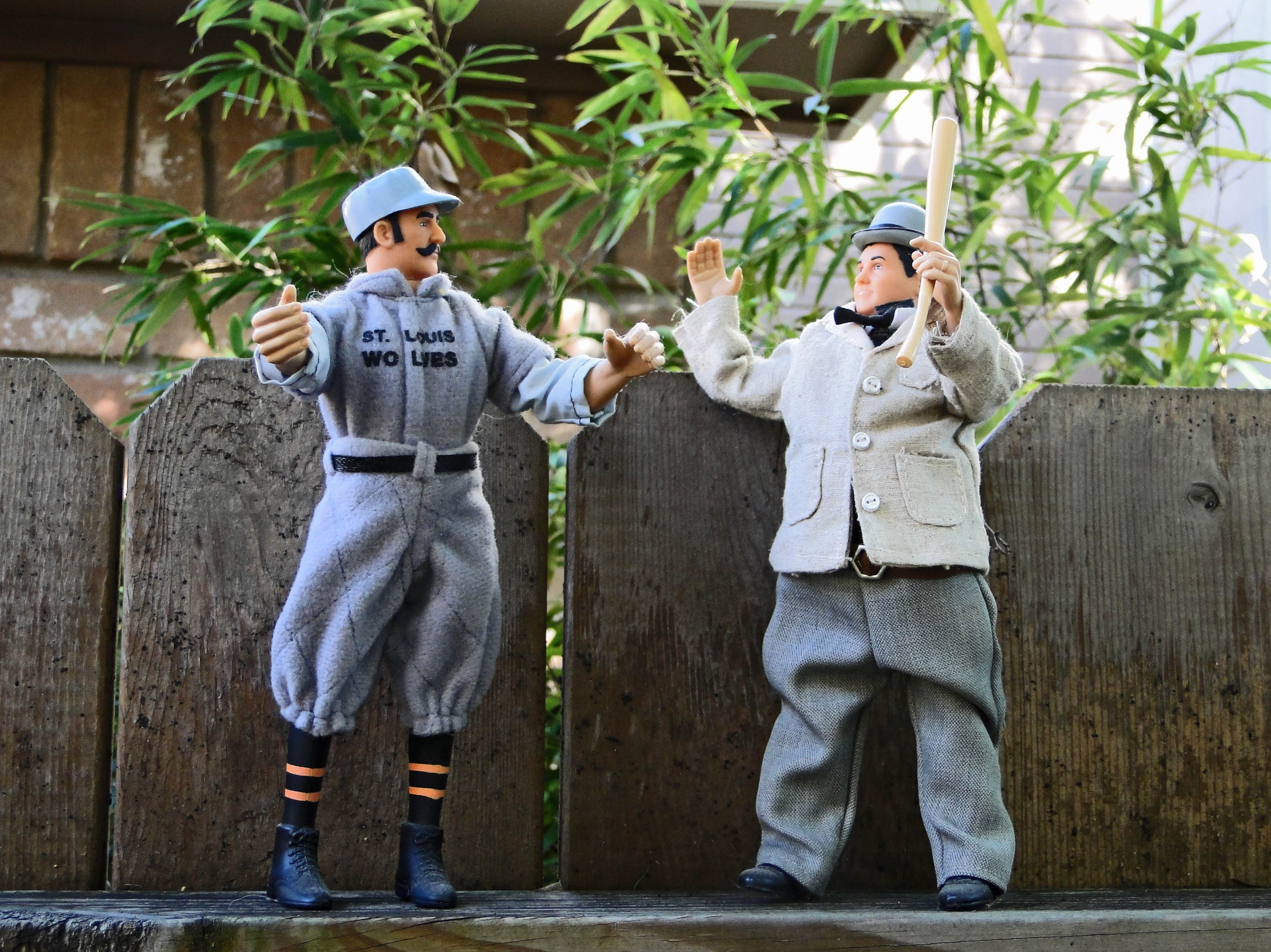
July 9, 2010Time: 1949; Place: A Parallel Universe; Event: Ted Williams & Stan Musial discuss their plans for playing together as teammates with a few other new faces on the roster of the 1949 St. Louis Cardinals.
“If baseball players can go overseas and fight for their country in wartime,” pinko-socialist pundit and labor advocate Henry Wallace shouted to Congress, “the least we can do in Congress is to revoke the reserve clause and give them all the right to choose where they will work as ball players in peacetime!”
And so it was written. In that parallel version of our God-Blessed America, on Flag Day, June 14, 1945, President Harry S. Truman signed into law a bill from Congress that killed the reserve clause and gave unrestricted free agency to professional baseball players.
Not much happened among the old school ball players until March 2,1949, when the Boston Red Sox met the St. Louis Cardinals in an early spring training game played at this universe’s base for the Cardinals in St. Petersburg, Florida. Everything changed that day.
Unsigned by the Red Sox, but working out with the club on his own nickel, pending contract resolution with Boston, slugger Ted Williams and Cardinal great Stan Musial suddenly announced that the man some called “The Thumper” would stage a thirty minute radio show over station KMOX is St. Louis from the Cardinal clubhouse after the game.
The purpose of the broadcast, according to a spokesman for Ted Williams, would be to announce his decision about his plans for the 1949 season. Had Williams worked things out with the Red Sox? Or would he be making plans to play elsewhere, …. as in, perhaps, …. St. Louis, maybe?
The press and all the world was told that they would have to wait for the “decision broadcast” over KMOX that was being beamed to a national audience.
The decision came forth about twenty minutes deep into the radio broadcast. It came on the heels of a seemingly endless stream of “Holy Cow” possibilities expressed over the air by the show’s host and sole monologist, Harry Caray. Listeners were ready for anything, but more Harry opinions.
With a smiling Stan Musial sitting quietly to his left, Ted Williams moved dead-panned closer to the mike that had been shoved in his general direction by Caray. The following is a verbatim account of what happened next:
Harry Caray: “Well. Ted, America’s been holding its collective breath out there. Can you tell us what this business is all about? More exactly, can you tell us what this decision is all about that made it so important that you had to use up my post-game after show time just to do it?”
Ted Williams: “Sorry. Harry, but sometimes things happen in baseball that are even more important that anything you have to say. I’ll make it brief since our time is short. – After much thought, I have decided not to return to the Boston Red Sox for an eighth season. Instead, I will be taking my talents to Missouri to play for the St. Louis Cardinals, along with my friend Stan Musial here, plus George Kell of the Tigers and Warren Spahn of the Braves, who have both also chosen to sign with the Cardinals for the 1949 season. – All three of us new Cards want a World Series ring – and we think we may be able to make a difference here by joining hands with Stan and a bunch of guys that already know how to win the big one.
Harry Caray: “Holy Cow! That’s wonderful, Ted! Are you worried at all about how badly the fans back in Boston may react now, especially in light of the fact that they’ve already lost Spahnie to us from their National League club! Holy Cow!”
Ted Williams: “Spit on ’em, Harry! I gave those GD Boston fans all I had for seven seasons! They ought to be grateful I stayed as long as I did. I also gave my all to the war effort. Now it’s time to think about me and I want a GD World Series ring. I don’t give a flying-flip where I win it – just as long as I win it in my playing lifetime.”
Harry Caray: “Do you think you owe the fans anything, Ted, even an apology for leaving Boston?”
Ted Williams: “I don’t owe the fans a damn thing, Harry! I gave ’em my best – and half the time, they didn’t even appreciate that! Fans don’t get it. We ballplayers play to win for ourselves. We don’t play to win for them – or out of some loyalty to the community. – Hell, if this were about loyalty, I’d still be out there in the PCL playing for my hometown San Diego Padres!”
Harry Caray: “If it’s not about loyalty, Teddy, how do you explain the guy sitting next to you? Around here, the love and loyalty that exists between Stan Musial and the city and fans of St. Louis is a two-way, can’t-pry-it-apart street in every direction! Explain that phenomenon for me, Ted.
Ted Williams: “I won’t even try, trickster, except to say that any guy born in a place named Donut-Hole, PA is capable of doing just about anything. St. Louis is damn lucky to have him – just as they will be doubly lucky to have the both of us and Kell in the same everyday lineup and Spahnie pitching every fourth day. – Now, if you don’t mind, I need to break this off and go grab some shut-eye. I’ve got a big fishing trip planned for tomorrow!”
Harry Caray: “But, Ted, I only want to ….”
Ted Williams: “PATOOEY!!!!” (Ted Williams spits on the floor as he off-handedly shakes Musial’s hand and rises to abruptly take leave of the clubhouse broadcast setting.)
Of course, these events did not unfold in our universe, but they might have had an interesting impact upon the 1949 pennant races and World Series outcomes, had they unfolded. In our reality, the 1949 St. Louis Cardinals finished second to the Brooklyn Dodgers in the National with a 96-58 record. They were only one game back of Brooklyn, who went on from there to lose a seven-game World Series to the New York Yankees in the first year of new Yankee manager Casey Stengel. – Stan Musial hit .338 with 36 homers and a league-leading hit total of 207 for the ’49 Cards.
In our 1949 reality universe, Ted Williams of the Red Sox batted .343 with 43 homers and AL leading totals of 150 runs scored and 159 runs batted in. – Third baseman George Kell of the Tigers led the AL in batting with an average of .343. – Pitcher Warren Spahn of the Braves led the NL with 21 wins and 151 strikeouts.
Hmmm! Do you think, maybe, the 1949 St. Louis Cardinals might have had a chance at the World Series crown had the King James version of the universe unfolded as described in this little fantasy piece? And if they had won it all, would victory have tasted as sweet to the Cardinal fans as any of their previous dramatic victories to this 1949 point in history?
To me, the saddest part of the Lebron James decision was the fact that he never even came close to thanking the fans of Cleveland for their support of him. He talked profusely about how much he gave to Cleveland, but none at all about what Cleveland had given to him.
James was all “me, me, me” and “I gotta do this for me. – I gotta win a championship somewhere!” in his “decision telecast.” He also stated that he didn’t think fans understood how important winning it all was to players.
Maybe not, King James, but maybe the fans of Cleveland really do understand more about loyalty than you do. It’s far deeper than a word you may have tattooed to your chest. It’s a personal decision to care about some goal or commitment to others, or cause, that is much greater in value and far beyond the culmination of your personal satisfactions or desires to be recognized as an NBA champion.
Once upon a time, baseball players like Stan Musial and Jackie Robinson understood what I’m writing here to the “nth” degree. You just happened to be a man of this generation – a player who doesn’t get it and never will.
Believe me or not, LeBron James, if you had decided to stay with Cleveland and then never ever won an NBA ring during your career, your legacy would have been greater than it could ever be now. It doesn’t matter if you win rings at Miami, and then at Chicago, and then at New York, and then in LA.
The question, “Who did you win them for” has already been answered. You won them for yourself; you sure didn’t win them for the fans. The fans didn’t even deserve a word of thanks when you packed your bags and took your “loyalty-tattoed” chest off to South Beach. Are the fans of Miami really supposed to buy into the bull that you are really playing for them? Or are they just supposed to put out the ticket and souvenir money, shut up, and simply be adoringly grateful that you brought your wondrous talents to South Florida?
Good Luck, King James!
Tags:America, comment, culture, LeBron James
Posted in Uncategorized | 3 Comments »