Posts Tagged ‘Baseball’

Baseball’s Mortal Enemy: The Clock.

December 19, 2009

There’s an interesting artcle online this morning about how baseball needs to find ways to shorten the length of games. Writer Stan McNeal takes a crack at what he sees as baseball’s need to shorten games for the sake of maintaining fan interest and the cultivation of new fans among what I call the “get my attention within five seconds or lose me forever” generation that is now still in childhood. Check out “Memo to Selig’s special committee: Speed up the game” at http://www.sportingnews.com for December 19, 2009.

Those of us older fans who grew up with the slower pace of baseball seem to have less trouble with the length of games, but the voice of younger fans seems more intent on speeding up the game, even if it tampers with some of the rules and traditions that have made the game so beautifully different from all others that are governed by the clock. In a very real way, we should read McNeal’s article for the sake of what it says about McNeal as a man of his generation. McNeal is willing to shorten the count in pitching to three balls gets you a walk, and is even willing to accept a foul ball with two strikes as an out.

I pause here to offer these responsible considerations: (1) Is baseball’s biggest enemy really the clock? Or is it people like McNeal and others who seems willing to radically change the game for the sake of bringing everything to a wrap inside two hours? Perhaps it’s older people like me who seem almost completely resistant to the idea of changing the fundamental game? I plead guilty to all charges of resistance. The least important item I take with me  to a game is my wristwatch. I don’t care how long I’m there once I enter the ballpark. It’s the game that holds my interest – and my baseball game plays out on a field of potential eternity. Heck! I’m even OK with the increased use of replay equpment for the sake of “getting it right” on close calls. That being said, I also recognize that the fans of tomorrow aren’t going to hang around for long unless baseball does find a way to narrow the gap that exists between actual games times and shrinking attention spans.

McNeal offers six suggestions for consideration. Here they are, along with my opinions of each:

(1) Forget About Instant Replay. McNeal thinks the problem of “getting it right” would be better served by adding two umpires down the line. To that I say, “Sell that idea to manager Ron Gardenshire of the Minnesota Twins.” I say increase the use of instant replay and damn the clock for the sake of greater accuracy.

(2) Reduce the time between pitches. We don’t need to change the rules. We simply need to have the umpires enforece  the rules that now exist for controlling the tempo of the game through some real control of pitcher/batter behavior between pitches.

(3) Change intentional walks. McNeal offers the old suggestion that intentional walks should occur by a hand motion of the batter to take first. He doesn’t understand that those four pitches the pitcher now must throw outside first are not so automatic and could lead to wild pich and a very different play outcome. I say leave this old idea where it belongs – in the deadhead pile.

(4) Speed up pitching changes. This one has to do with limiting managerial/coaching trips to the mound and putting a clock on how much time a reliever has to reach the mound from the time he’s called into the game. I don’t really like messing with this one because its so much a part of the mental game. If I had to choose, I could go with limiting the mound trips to one per inning and to mound changes from the dugout by hand signal, but I really don’t like this one, nor do I think it’s much of a timesaver. I oppose McNeal’s suggestion that a pitcher coming into the game who doesn’t reach the mound in a prescribed number of seconds shall be forced to start out with a 1 ball, no strikes count. What happens if he’s late for a 3-2 count on a batter with the bases loaded and the winning run on third? Would lateness in this instance result in a “delay-of-game-off” victory for the batting home team?

(5) Limit pickoff attempts. For-ged-a-bout-it!

(6) Somehow, someway, keep the runner at second base from peaking in. Un-b-floppin-leavable!!! McNeal really strains on this one, right down to spelling “peeking in” as though it were “peaking in”, or some kind of introversion of maximum effort. McNeal’s suggestions here are a combo of spurious, unenforceable, uninteresting, and un-baseball like suggestions in their character.

As you can see, my heart is not really engaged in the search for ways to speed up the game. Baseball Commissioner Bud Selig said there would be no “sacred cows” pr0tected from change by his committee to study the issue. To that, all I can say is, maybe we should allow baseball to simply live or die as the beautiful game it already is. If it’s too long an affair to stay engaging to future ADD-conditioned  fans, then they don’t deserve it, anyway. Let ’em twitter their lives away til kingdom come. Baseball is a game that requires more than two thumbs and a mind that’s numb to the beauty of slow-building melodrama.

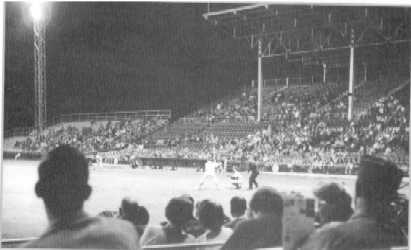
Twas the Night Before Christmas 1951.

December 18, 2009

Twas the Night Before Christmas,

In Buffalo Stadium,

No spring things were growing,

Not a single Caladium.

Still the jock straps were hung,

In the clubhouse with care,

In the faith that come spring,

Fond hopes would forbear.

And the Cardinals would send us,

The guys to full fill ’em,

With pitchers like Dean,

And hitters like “Willem.”

And if we can’t land,

Teddy Ballgame, per usual,

We’ll happily settle,

For a hitter like Musial.

And we’ll dream of the day,

When the big time will come,

And we’re playin’ the Series.

‘Ginst the Yankees or Bums.

National or American,

Won’t matter to most,

But we’ll take the NL,

Like butter on toast.

But meanwhile the madness,

Won’t slow from a bustle,

As long as our leader,

Is Allen H. Russell.

On Witte! On Miggins! On Rubert! On Clark!

On Kazak! On Mizell! On Papai! Fire sparks!

Help us to get through these Off-Season Drearies!

With dreams of next taking that sweet Dixie Series!

Merry Christmas 1951, Houstonians! And watch out for all those super highways that are sprouting up all over town for the sake of saving us all from ourselves. Sure is comforting to know that we are blessed with all these local poiliticians and businessmen/land developers from downtown. Those big rich guys really seem to have our best interests at heart!

The Low Tech Dreams of Christmas Past.

December 15, 2009

Pinball Wizard Tommy had nothing on me when it came to baseball!

Heading toward Christmas in this high tech era of highly sophisticated and extremely realistic sports game toys, I am blown away by their contrast to  the things we used to purchase and improvise as games and means to the same competitive ends back in the late 1940s and early 1950s. Our games required our use, either or both, of those fine old qualities known as imagination and/or skill – and I mean skill that went beyond our dexterity with finger manipulations of a control device attached to a TV, computer, or game box screen.

As most of you older kindred spirits already know, we didn’t have that kind of game set-up help back in the day. We had to imagine what we were doing and we had to visualize all the pictures that now appear graphically on the digital game screen. Our screens were, for the most part, simply rolling through our brains as we escaped into our own little game trips away frm the mundane of everyday reality.

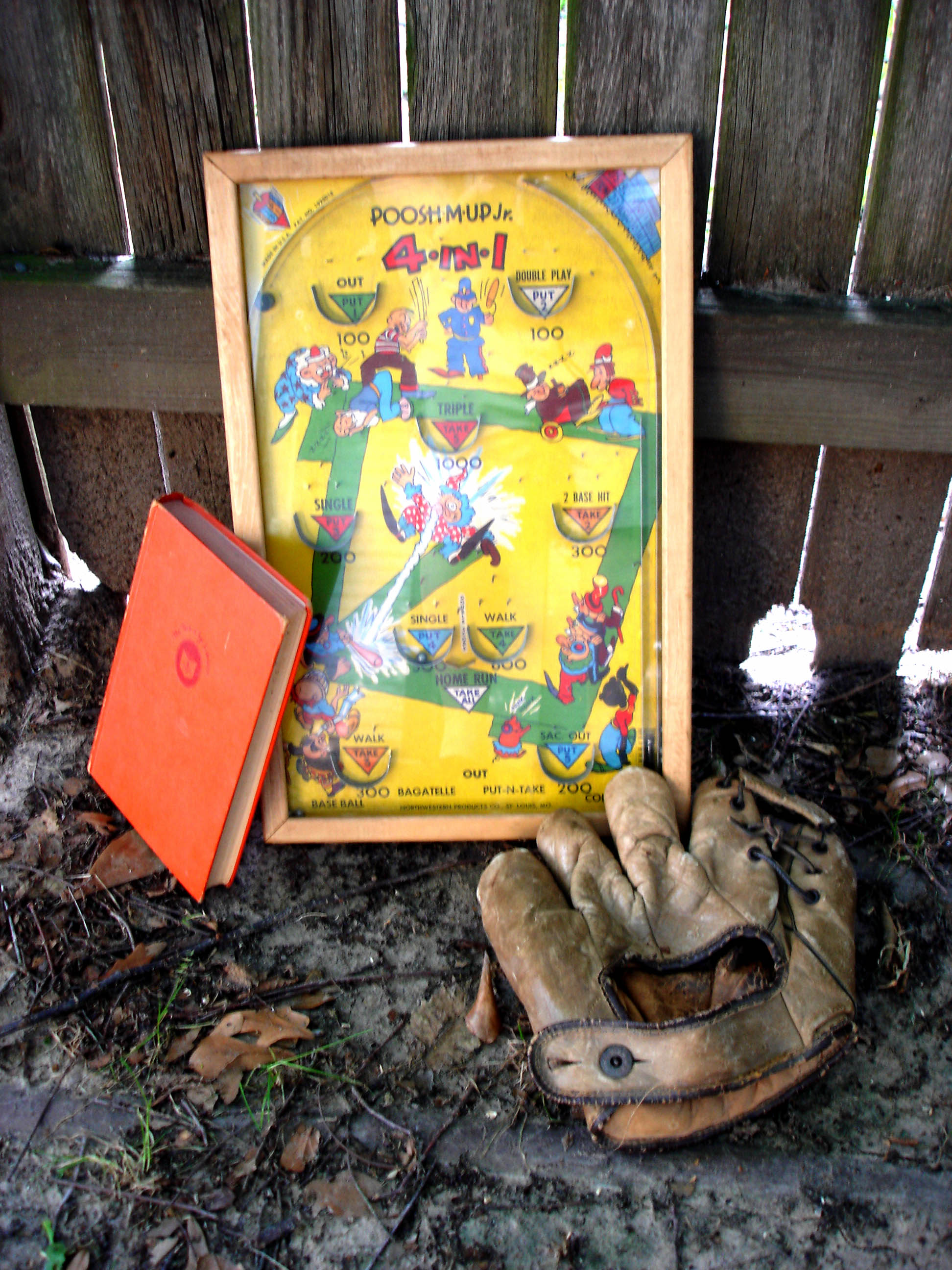
The baseball pinball game shown here is an exact replica of my chldhood buddy from way, way back. My brother found it in a flea market and gave it to me as a Christmas present a few years back. I’m not sure what happened to my original game, but it most likely suffered the same fate as all my other childho0d things. Whenever we stopped using anything back then for very long, our dad quietly just threw these things away without uttering a word to anyone. As a result, I have few things, other than books, that remain from childhood. Dad didn’t dare throw out my books. He knew I always came back to them.

I got pretty skilled at the pinball game. I can still play it pretty well too, but nothing like I did at age 10 to 12. Back then I could almost will that little metal ball into the home run pocket when when I needed it to go there.

Another low tech game held my interest for a short while, but its lack of improvisational opportunity soon put it on the boring shelf. It was called “Foto Electric Football”, a game which allowed you to insert offense and defense pages into an upward shining light box that illuminated how certain plays turned out against certain defenses.

The big game back then was that vibrating football contest by Tudor that came out in 1947. Little metal players lined up and vibrated down a metal field until contact with an enemy player tackled them at the new yard line of progress. It was fun for a while. You could bend the little vibrator reeds under your running backs to make them turn at the line of scrimmage, but that was about it. Sometimes your runner would get turned around and run toward your own goal line for a safety. That sucked. Plus, it was too much of a hassle to keep setting up twenty-two players at the line of scrimmage after each completed play. That being said, it made my Christmas one year as a gift I knew was coming. My anticipation of that game was far greater than the playing of it could ever hope to be. Sort of like marriage.

Finally, a game came along that remains with me to this day in computer form. In 1951, the APBA Game Company opened shop in Lancaster, PA with a card and dice baseball game based upon actual major league teams and players. It was totally structured upon realistuc probabilities in a complex array of actual game situations. You had to bring your own theatre of the mind to get a good picture, but that was never a problem for a lot of us back in the day. We lived in our dreams. Besides, with APBA, the heart of the game was  then, and is now, its dynamic similarity by play outcome to what actually happens in a real baseball game. Because of APBA, I never got lost in the Stratomatic Baseball Game of similar, but less complex probability roots.

APBA was just a high tech game waiting to happen. I’ve been playing its computer version of baseball since the mid-1980s. It’s simply a place I go whenever I need to take a vacation from this little, no-fun, no sense of humor world we’ve created all around us. It’s not my only mental retreat, but it is one of my most enjoyable destinations.

Merry Christmas Dreams, everybody!

Texas and The Babe.

December 13, 2009

Babe Ruth was baseball from the 1920s forward. He still is, if you scratch the surface of things even ever so slightly. And he had all the makings of an unforgettable character from the very start too. His unbelievably gifted joint talent as first a pitcher and then a slugger remains unmatched in the game to this day. Baseball has never known another player who could’ve made it all the way to the Hall of Fame in Cooperstown with either of those singular talents for throwing or slugging the baseball alone, but “The Babe” had them both, and he owned them at just the right moments in baseball history. By now it’s a biographically worn out story. After sparkling in two World Series championship seasons for the Boston Red Sox in 1916 and 1918, Ruth moved over to the New York Yankees in 1920 by way of a devilishly infamous/heavenly fortuitous trade, dependent upon the presence of your Red Sox/Yankees red corpuscles.

Regardless, Babe Ruth got to New York just in time to help America soon forget about/or recover from the terrible blow inflicted upon the game by the Chicago “Black Sox” Scandal of 1919. For those who haven’t heard, eight members of the 1919 White Sox club were expelled forever from baseball after the 1920 season for conspiring to fix the 1919 World Series in favor of the Cincinnati Reds. They were kicked out of the game in spite of the fact that they were never found guilty of such an act by a court of law. It consquentially fell upon the broad shoulders of one George Herman”Babe” Ruth to help fans find positive distraction from the dark side of things – and to do it with his ability to blast a baseball out of the park with a bat. He did it often – and for prolific distances.

During the 1920s and early 1930s, Babe Ruth came to Texas and Houston often in the springtime as a barnstorming member of the New York Yankees. The club played minor league teams and sometimes even squared off against the local Texas college clubs where they toured. My late father often told me the story of how the New York Yankees came to Austin in the spring of 1928 to play the Universty of Texas Longhorns during the time that Dad was a prep school outfielder at St. Edwards there. Somehow the school arranged to get the entire St. Edwards Bronchos team into the game over at UT for seating down the right field line, where Ruth was playing that afternoon against the Longhorns.

Dad long ago forgot the final score, but he implied that it was a heavily crushing “no mercy” margin in favor of the Yankees over the Longhorns. One of these days I may get around to actually checking Dad’s memory against the library line score record of that game, but I have no question about his most vivid recollection of that afternoon. During the game, Babe Ruth had an autographed baseball business set up down the right field line at UT. Ruth had a guy posted in foul territory with a bag full of balls. For five dollars cash, Babe Ruth would run over to the sidelines between batters and sign one of these balls for any fan who was willing to pay. The assistant would then toss it up to purchaser and that lucky fan got to leave with an authentic Babe Ruth signature on a baseball for the price of five dollars.

Of course, my adolescent question of Dad always rose quickly to”Why didn’t you get one?” That always opened the door for Dad to launch into the subject of prep school student poverty and the value of five dollars in 1928. It never even occurred to Dad that getting one of those Ruth signed baseballs was within the realm of possibility. “It would have been like you going to Buff Stadium in the spring and finding out that Stan Musial was signing balls during the game for those who were willing to pay him five hundred dollars for the thing,” Dad said. “Could you have bought one of those Musial balls in 1954 at that rate?”

“No, Dad,” I always answered, “I got the point a long time ago.”

Stiil, the Babe didn’t always come to town just to take people’s money. In 1930, the Yankees were in Houston to play the Buffs at Buff Stadium in single games scheduled for March 29th and March 30th. The Yankes took both games by scores of 17-2 and 6-5. while he was here, Babe Ruth went downtown and gave an address to Houston kid members of the Knothole Gang. The presentation took place at the old City Auditorium on the corner of Lousiana and Texas, on the site of the current Jones Hall building. The full house meeting was sponsored by the Kiwanis Club and a good time was had by all.

Wish we had the text of what “The Babe” actually said that day in 1930 Houston. It would be sort of  interesting to see if Ruth gave any advice to the kids that day that we wasn’t actually living up to in his own real life adult adventures. On the other hand, it really doesn’t matter what Ruth said or didn’t say that long ago day in Houston history. He was Babe Ruth, a guy who led by example on the field – and by the fact that he would even show up on a spring day in 1930 to speak with hundreds of Houston kids for free.

He was Babe Ruth and, for a few hours long ago, he walked among us here in Texas as our flesh and blood, larger than life hero. For those who were around at that time, nothing could detract from the power and magic of those Ruthian moments of joy that they were simply here together in his presence – and in their very own state and home town.

A Short Baseball-For-Fun Quiz.

December 12, 2009

(1) If the great Negro Leaguer Josh Gibson really was the black version of Babe Ruth, and vice versa, what would be a good right-on-target nickname for the white version of Josh Gibson? How about …”The Cracker Jacker!”

(2) When former Astros slugger Jimmy Wynn throws a big celebration weekend, what do they call the small dinner-dance party that highlights festivities? Why, they call it “The Toy Cannon Ball,” of course.

(3) Whenever former Astro phenom Rusty Staub had a really bad night of batting at the Astrodome, he was allowed to leave the ballpark by way of a private exit in an attempt to escape the media. What was this private exit appropriately called? What else could it be? They called it “The Rusty Gate.”

(4)  (And here’s a Harry Kalas favorite): Milwaukee Braves reliever Mel Famous once had a beer right before he was called into a game at the Astrodome in 1965. Pitcher Famous lost his usual pin-point control. He proceeded to issue a four-pitch base-on-balls to Nellie Fox of the Astros that forced in the winning run for Houston in the bottom of the 13th. And what did Fox say about that beer, once he later learned about it? Answer: “Well, I guess that makes it the beer that made Mel Famous walk me!”

That’s it for now. It’s Saturday morning and I’m long on errands and short on good ideas. Hope you each scored perfectly on all four questions. Here’s one more riddle of a football nature, just in case you are doing this one with your girl friend, wife, or best bud and need a tie-breaker. The first three here were mine, but like the more famous Mel Famous line, I can’t take credit/blame for this one, but I sure would’ve been happy to do so, had it first occurred in the slightly less dazzling humor chamber of my old porcupined brain. I think I wrote about this one several days ago, but nothing has changed to alter its veracity by way of another passing NFL weekend:

Question: What’s the difference beween the Houston Texans and a dollar bill?

Answer: You can get four quarters out of a dollar bill.

Have a nice weekend, everybody!

Irvin-Dierker Movie Saved by Sony Hand Camera!

December 11, 2009

Monte Irvin on Fidel Castro’s Failed Tryout: “If we had known he wanted to be a dictator, we would have kept him around and made him an umpire.”

Larry Dierker: “Did I ever have any pitchers who fought to stay in games when I went out there and asked for the ball? Nope. Those guys were all gone by the time I became a manager.”

“Not sure what it is, Monte. When you have a guy like Dave Raymond moderating a thing like this, it just seems to liven things up!:

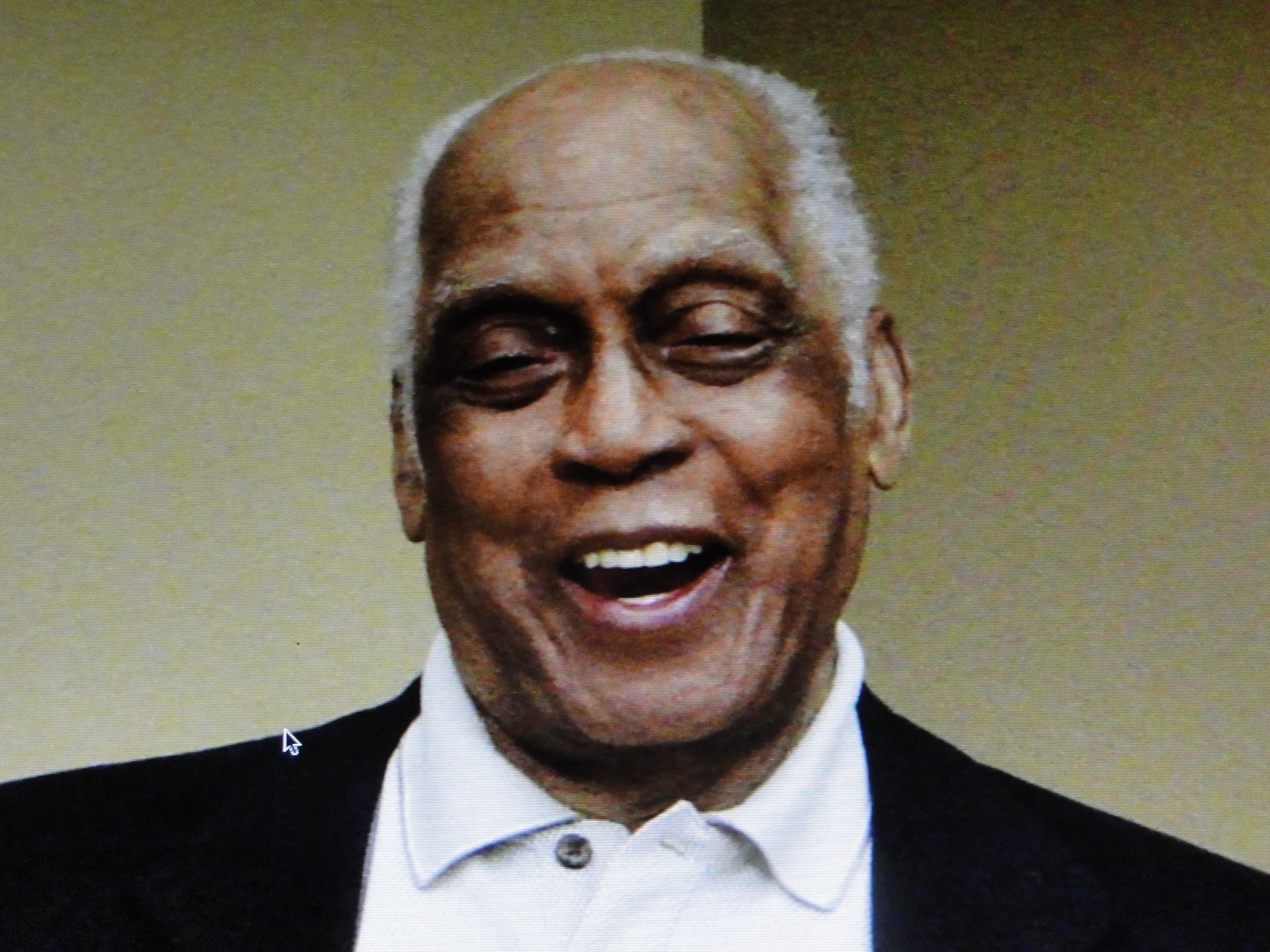
Forgive my liberal translation above of what was being said by the participants in these stills from the DVD movie of Tuesday night’s SABR-sponsored Monte Irvin-Larry Dierker panel discussion on baseball history that many of us attended at Minute Maid Park on 12/09/09.  I simply wanted to use the photos to show all of you who couldn’t be with us some examples of the joyful moments you missed. I also want to let you know that we are lucky to have what we have in the digital movie.

Our plans for a professional coverage of the panel discussion fell apart at the very last moment. We didn’t even have a digital movie camera to do the job ourselves. Late in the afternoon, Bob Dorrill of SABR and I had just about given up on the matter as another lost opportunity to get get the 90-year old Hall of Famer Mone Irvin and Houston Colt .45s/Astros icon Larry Dierker on video record of wht promised to be a landmark evening,

Then we got lucky. I recently bought a new full 100 HD Sony Cybershot hand camera for doing still photo work. It came with its own rechargeable battery, a moviemaker option, and a capacity for capturing as many photos as the user could posssibly load onto a memory stick. Not really knowing if I would ever need it, I went overkill on the memory stick, purchasing one that could hold 16 gigs of recorded visual material. I wasn’t thinking about doing movies, nor had I ever used the moviemaking function until this past Tuesday night.

Man! Am I ever happy with the way this little camera saved the day for us!

I started out, sitting on the front row, to record as much as I could get before the battery went dead, I’m thinking I may be lucky to get 15 to 30 minutes, but was that ever selling this thing short. The panel lasted about two hours and I got the whole thing on digital copy, with adequate sound from the little mike within the camera. I had the power and the storage space by chance to capture the whole thing, a fact I only learned for certain when my adult son Neal came home and helped me upload the thing onto my computer hard drive. (My computer dependency far exceeds my computer geekiness, unfortunately.)

At any rate, the whole thing took up about 10.3 gigs of the 16 gig memory stick. I’m not a pro, but I think I got a fairly steady picture, along with the isometric exercise of my life. Holding that camera in the air without tripod or wall-lean support for the duration of the show was quite challenging.

I don’t how many DVDs it will take to now transfer this material intact into copies from my computer, but we will figure it out, along with a way to make copies available to those who want them. The Irvin, Raymond, and Dierker families will all get copies, along with copies we will make for our SABR and Cooperstown recorded history libraries. If there is a way to post the tape on our SABR website so that people can watch it from there is another option to be explored. Of course, if someone like our own Greg Lucas wanted to use the material for any kind of report he wanted to do for FOX, we will make the data available to him too.

I’m just thrilled that we were able to save a little bit of history that looked for a while as though it was going to be lost. As things turned out, the evening became one of the greatest moments that many of us have ever experienced with living baseball history. Monte Irvin and Larry Dierker are both one-of-a-kinds. And moderator Dave Raymond did a magnificent job of lighting the matches that started the fire of passionate storytelling. Those of you who weren’t there Tuesday night really missed something special.

In the Cool, Cool, Cool of the Evening!

December 9, 2009

On another long ago cool evening at Buff Stadium, dreams lived big!

Sometimes it just takes a memory jog from something someone else says about life in Houston during the 1950s. Well, at last night’s SABR meeting panel at Minute Maid Park  that featured the wise and wonderful 90-year old Hall of Famer Monte Irvin and the simply younger, but also cool as evening  icon of Houston baseball Larry Dierker and erstwhile moderator glue and spark man Dave Raymond, there was a whole lot of soul-deep mind-jogging going on.

As I listened to Monte Irvin, images came forward that I have few words to back up. I recall him being here before in the early 1950s. The New York Giants came through Houston on a spring training ‘storm through Buff Stadium playing the Cleveland Indians. I can still see the black and orange in the Giants’ uniforms, the red and blue colors in the Indians’ uniforms. Also detached, but flowing from the talk of the Negro League days, I again see the Indianapolis Clowns all decked out in blousy flannels with some bright red, white, and blue shining forth in a pre-game exhibition of shadow ball at Buff Stadium. This image too floats from some some early long forgotten until now moment in my early baseball game watching career. I don’t even recall who they played, but the Clowns were unforgettable in this little patchy scene.

After the meeting, I asked Monte Irvin if he remembered a pitcher named Octavio Rubert from his days in Cuba as an outfielder for Almendares. Monte’s eye ignited in apparent joy at the question. “Oh yes,” he said, “Octavio Rubert and I played together and grew to be very close friends.” Irvin laughed at how Rubert used that false left eye of his to keep runners close to first. It was Larry Dierker’s mention only moments earlier of what righthanders do to hold runners on first that made me even think of Rubert. Now my mention of Rubert to Monte Irvin was bringing one of Rubert’s notable traits full circle to how it had landed in my mind in the first place. Octavio Rubert had the ability to to position that false left eye so that it appeared to be watching the runner on first. Monte Irvin added Rubert’s other trait, a ball he threw that simply dropped off a cliff as it reached home plate, one of those hard-to-pass-up, but just about impossible-to-hit pitches. I remember that pitch from Rubert’s Buffs days, as did former Buffs teammate Larry Miggins, who walked up to join us in these late night recollections of Cuban-born Rubert.

It was one of those cool, cool evenings that no one could ever count on having, chockful of new memories and observations about the old days of the Negro League, the fall of the color line, winter baseball in Cuba, how players and the game have changed, and what two great former players have learned that they are so feely willing to share. Dierker talked about his fortuitous striking out of  Willie Mays when he made his major league mound debut at age 18. “I had a pitch that broke left when it reached the plate, but I was so pumped that I threw it way inside. It probably made Willie think he was going to get hit because it came in right at him,” Dierker said. “It caused Mays to freeze and back off, just as the ball then broke left and crossed the plate for a called strike three.”

Monte Irvin spoke of his early admiration for Yankee greats Lou Gehrig and Joe DiMaggio. And, of course, Irvin also spoke of the great catches of Willie Mays, the fluid power of Josh Gibson, and the all-time greatest Negro Leaguer skills of players like Oscar Charleston and Martin Dihigo. Dierker chose Babe Ruth as his greatest player of all time. “There aren’t many people who can become both great hitters and also great pitchers,” Larry explained. “Because he was both, I have to go with the Babe.”

Monte Irvin saved the best story of the evening til nearly the very end: “When I was playing for Almendares in Cuba during the early 50s winter ball season, a young fellow named Fidel Castro tried out with us as a pitcher. He could throw the ball hard, but he was way too wild. He walked too many batters and we had to let him go. Of course, he went from there to the mountains and became a dictator. – As things have turned out, it’s too bad we didn’t know that he wanted to be a dictator. We could’ve kept him with us and made him into an umpire.”

Thanks to Tal Smith from SABR for making our cool, cool evening at Minute Maid Park possible. It turned out to be one of those once-in-a-lifetime nights. I caught the whole thing on digital movie mode with my little hand-held Sony regular camera. If we can determine that I’ve captured something usable, we will try to figure out a way to make it available through SABR for viewing by others. Keep your fingers crossed.

THE TOY CANNON: The Life and Baseball Times of Jimmy Wynn.

December 5, 2009

Hello, everybody! It’s good being back here on the blog site after an absence of about a week. The publication deadline took me away for awhile had everything to do with a project very dear to my heart. Allow me to explain.

About two weeks ago, former Houston Astro slugger Jimmy Wynn and I learned that the book he and I had been working on about his baseball and personal life story had been picked up for publication by McFarland Company, the largest publisher of baseball biographies in the country. The good news simply left me with some last minute manuscript editorial barbering and detail work to perform that took priority over all other projects in the short term. That work wrapped up yesterday when I tromped on out through the snow and FedExed all our submisson materials to the publisher. What a great sense of relief that turned out to be.

The working book title is identical to the title of this blog article, but could change between now and our release date. We missed the McFarland dance card for a spring list release, but “The Toy Cannon” will be available for purchase through bookstores and Internet sites like Amazon.Com some time between July and December 2010. We’re hoping for a publication near the 201o All Star Game.

All I can tell you for now is that working with Jimmy Wynn on his life story turned out to be the labor joy of my life. We were already friends, but this project simply drew us closer. The guy was an amazing ballplayer, alright, but he’s an even more incredible human being. Jimmy doesn’t allow an ounce of ego fat to get in the way of any life lesson he’s needed to learn for the sake of his own survival and spiritual growth. And it will all be right there on the approximate 300 pages of this book to soon be.

Jimmy and I did the book with him telling his story in the first person over numerous hours of taped interview sessions. The story begins in the snow of his Cincinnati childhood and it moves all the way through his sometimes misadventurous big league playing days and finally forward to this incredible moment today in his late-in-life second career as an Astros community services representative and blossoming FOX Network baseball television analyst.

Along the way, Jimmy doesn’t play dodgeball with the consequences that arose from certain personal experiences, nor does he miss the wisdom that only comes strongly from enrollment time in the school of hard knocks. Those lessons carried forward as the invisible binding of  this work. To put it in plain and simple terms:  This book is not just about the yearly stats of “The Toy Cannon;” it is eventually and inevitably about the soaring wisdom and soul of a man named Jimmy Wynn.

As we get closer to knowing the actual release date of the book, I will keep you informed. In the very sweet and lovely meanwhile, I have to say that it’s good to be back in the land of The Pecan Park Eagle. I’ll try not to spam you too much, but I won’t make any promises.

Have a nice weekend – and try not to eat too much as you’re watching all the conference championship NCAA college football games that are unfolding before our sports-weary eyes this very cold Saturday!

Black Friday Sale on Baseball Robots.

November 27, 2009

What if Major League Baseball teams were able to lease replica baseball player robots that were capable of performing at the same level of their namesakes? The only conditions and restrictions on these contracts are these:

1. Contracts must be completed with the PlayerMax Company Manufacturing Firm today, Black Friday, or not opened again for reconsideration again until the Friday after Thanksgiving 2010.

2. By agreement with MLB Licensing and the Players’ Union, player robots are modeled only upon big leaguers who played in the 20th century up to 1960 only.

3. By agreement with the Players’ Union Competition Committee, robots may only be leased per annum at the rate of their highest best year salary earned as humans in the big leagues. Salaries/leasing rates range from $3,000 to $80,000 per year. Leasing teams will pay a fee that is based on the actual player’s salary for the year he performed as you desire him to be programmed for their 2010 clubs. If you want a Babe Ruth robot from 1921, you will have to pay the company what Ruth made in salary for that year.

4. Only one model robot for each actual player is available to the leasing pool. If someone takes a ’21 or ’27 Babe Ruth model, no other club may choose a Babe Ruth robot from any other year. They must select a player model that has yet to be taken in this draft for any year.

5. All leasing opportunities are based inversely on each club’s 2009 record. The worst teams draft first; the best teams draft last. In case of ties, alphabetical order will rule as the tie-breaker on who drafts first.

6. Each MLB club will have four robot draft choices, but with a $100,000 budget ceiling on leasing funds that may be spent on all players chosen.

7. The draft will contain four rounds. Teams that exhaust their budget ceilings  earlier will be out of the draft for the remainder of their choices.

8. Teams that do not use their entire budgets will donate the unused portions to the Players Union Pension Fund, plus (major “harrumph” here), each MLB team will pay $10,000,000 into the Pension Fund each year in exchange for the right to indulge in the robot option.

9. All leasing arrangements are for one year only. No future service options are for sale and no refunds or replacements are allowed for robots that break down after the leasing contracts are signed.

Here’s the draft order for today’s robot picks. How would you pick ’em based on the most obvious needs of each club? If you have any ideas on what the weakest clubs should do, please post them below as comments upon this article.

Black Friday Baseball Fiction Bonus: The more time you spend on this exercise today, the less time you will have for spending money  at the mall.

Robot (1901-1960) Player Draft Order:

1. Washington; 2. Pittsburgh; 3. Baltimore; 4. Cleveland; 5. Kansas City; 6.Arizona; 7. New York Mets; 8. Houston; 9. Oakland; 10. San Diego; 11. Toronto; 12. Cincinnati; 13. Chicago White Sox; 14. Milwaukee; 15. Chicago Cubs; 16. Tampa Bay; 17. Seattle; 18. Detroit; 19. Atlanta; 20. Florida; 21. Minnesota; 22. Texas; 23. San Francisco; 24. St. Louis; 25. Colorado; 26. Philadelphia; 27. Boston; 28. Los Angeles Dodgers; 29. Los Angeles Angels at Anaheim; 30. New York Yankees.

If you were a real MLB general manager, and this cyber-solution were a real way to fill the holes on your club, this robot player draft would now likely loom as the most important business of your off-season administration period.

Hope some of you bedrock fans have fun with the idea. It really will be better for you than a Christmas shopping trip today.

Wasn’t That The Year The Owls Were So Bad?

November 24, 2009

Talking with an Internet friend this morning about the old days, I was reminded again of my late dad and how he took to computers like a duck to water back in the early 1980s. He was about my current age back then, retired, but still full of energy for something to do. I bought him one of the early Apple IIe computers because I thought he might enjoy the banking and writing features. We didn’t have the Internet in 1983, but anything we did get from these early specimens of the coming high tech age were so far far ahead of typewriters and calculators it wasn’t funny.

Somewhat to my surprise, it was the word processor that really lit my dad’s fire. Unencumbered by his barely legible handwriting or the plethora of errors that always plagued dad about typewriters, the word processor freed him to write his memoirs about growing up in a small Texas town in the early 20th century.

Dad’s “book” derived its title from an expression he picked up from former major leaguer and fellow Beeville native Curt Walker. Walker was like an older brother or surrogate father to my dad while he was growing up fatherless back in the early 20th century. In addition to being an off-season undertaker in Beeville, Curt Walker was a man with little time and patience for those among the living who would take up a morning from others just to share personal stories that were so concretely wrapped in uninteresting material that they rivaled paint-drying as an opportunity for stimulation.

Whenever one of these old codgers would get started with a “back in 1915” tale, Curt would simply interject the following as the earliest opportunity: “Wasn’t that the year the owls were so bad?”

According to Dad, that question always worked with the Beeville crowd. Instead of waiting for the deadly story, they would embark upon the newer question: What’s this about an owl invasion? Was 1915 the year it really it happened, or was it some other time and place?. Meanwhile, Curt Walker would be making his way out of the conversation circle and heading elsewhere. Mission accomplished. If the subject ever did return to whatever the old geezer wanted to say, Curt Walker would be long gone from the scene.

“Wasn’t That the Year The Owls Were So Bad?” became the title to my dad’s book of memoirs about life in a small town.