Posts Tagged ‘Baseball’

Martin Dihigo: Virtuoso in a Vacuum.

January 14, 2010

He was born of humble circumstances in Matanzas, Cuba on May 25, 1905. He grew up to be a 6’4″, 190 lb. professional baseball player who, batting and throwing right,  handled all nine field positions with exceptional skill. Most of those who saw him seem to agree that pitcher and second base were his best positions.

Dihigo never had a chance to play in the old white big leagues because of the color line, but he eventually earned his way into the baseball halls of fame of the Dominican Republic, Venezuela, Mexico, Cuba, and Cooperstown by 1977, or by six years after his death at age 66 on May 20, 1971 in Cienfuegos, Cuba.

He was Martin Dihigo. He played baseball so well that stars like Buck Leonard, Johnny Mize, and Monte Irvin hint that he may have been the greatest baseball player that ever lived.

Dihigo was the consummate five-tool, do-it-all guy. He hit for power and average – and “they” say he could run, throw and catch with the best of the rest in the white majors and Negro leagues.

Here’s where it always gets tough when it comes to making an objective case for greatness based upon performance records of Negro leaguers. Record-keeping in the Negro leagues was often spotty and, because of segregation, it’s impossible to use data that shows how Negro leaguers have performed in direct competition with the white major leaguers of that their era over the long season. We are left with the testimonials of others as to their greatness and to the statistics we can find for the sake of drawing our own conclusions.

In the matter of Martin Dihigo, all I know is that I’ve never run across anything in writing that ever came close to describing him as anything less than phenomenal in all phases of the game. I decided to place my trust in these massive anecdotal references and to select Martin Dihigo as my all time third baseman. I only placed him on third base because I had the other bases covered well. Dihigo probably could have made the team at virtually any position. That’s how good these testimonial remarks imply that he was.

Martin Dihigo posted a .307 batting average and a .511 slugging average over the course of his twelve season career in the Negro League. His greatest year as a pitcher, however, came as a 1938 Mexican Leaguer when he won 18, lost 2, and posted a 0.90 earned run average, From the early 1920s through 1950. Martin Dihigo performed in the Negro American League and every baseball league that existed in Latin America, gathering all-star and MVP awards as though they were a bag of sunflower seeds. He may as well have performed in a vacuüm tube. Few observers of any credible power in the white media saw him play and, as we know, there is little moving film material and no electronic tape or digital moving photo record of Negro League action from back in the day.

Fortunately for Martin Dihigo, the few who did see or play with or against Martin Dihigo never forgot what they saw. To them, his eye-witness advocates, we say thank you for telling us all about a guy who may have been the greatest all round baseball player of all time.

A Monte Irvin Baseball Quiz.

January 13, 2010

Monte Irvin, Baseball Hall of Fame, 1973.

This little quiz focuses upon Hall of Famer Monte Irvin as the key to all its answers. If you are a deep water port baseball fan, it will be tough. If you are a casual fan to a non-fan, it will be impossible. Either way, don’t take the test, or yourself, all that seriously. Life isn’t fun for self-important people. And who needs that plague in particular or those boring people in general?

Just have fun with it.

The answers to this quiz are below. I wrote it honor of Hall of Famer Monte Irvin’s appearance and discussion at our December 2009 meeting of SABR, the Society for American Baseball Research. We didn’t get to the quiz until last night at our January 2010 meeting. Unfortunately, I neglected to bring the answer sheet with me, thus causing me to into brain-freeze on a couple of the answers until I got help from some of the members who hung with me long enough to take the test. I think that’s what Wee Willie Shakespeare had in mind when he came up with the phonetic expression, “hoisted upon my petard.”

This petard is a booger if you don’t have the answer sheet handy, but that will not be a problem here. The answers really are listed below. Just try to resist scrolling too fast past the opportunity of giving the quiz your best shot.

Before you take the quiz, please make a note of the built-in clue. Since I originally wrote the quiz to honor Monte Irvin, the answers to the ten questions, in order, are each preceded by the letters of his first and last names: M-O-N-T-E  I-R-V-I-N. These letters each represent the first letters of the last names of each person that is the answer to each specific question.

Got it? Good! Here is the question that applies to each of the ten “Monte Irvin” statements: What is the first and last name of the person we are talking about here? Remember, his last name will start with the bold-typed letter that precedes that particular statement. One more small hint: Each answer will contain the name of a Baseball Hall of Fame member, going all the way back in some cases to the 19th century.

M. He was no Bugs Bunny, but he had a lot of staying power.

O. His quirky batting style only got him into the Hall of Fame.

N. It’s not how fast you throw, but what happens when you do.

T. He was last National Leaguer to hit .400 in one season.

E. In 18 years, he played every field position and hit .303 life.


I. His middle name is Merrill, but call him “Mr. Murder.”

R. “The Hoosier Thunderbolt” won 31 plus, 4 straight years.

V. Reached the HOF with only 197 wins from 1916 to 1935.

I. Invert Route 66 upside down for his MLB career HR total.

N. Won 30 plus 7 times and won 361 games in MLB career.

Scroll down for the answers >>>>

>>>>>>>>>>>>

>>>>>>>>>>>>

>>>>>>>>>>>>

>>>>>>>>>>>>

>>>>>>>>>>>>

>>>>>>>>>>>>

ANSWERS:

M. Rabbit Maranville

O. Mel Ott

N. Phil Niekro

T. Bill Terry

E. Buck Ewing

I. Monte Irvin

R. Amos Rusie

V. Dazzy Vance

I. Monte Irvin

N. Kid Nichols

Monte Irvin Notes: During his eight season MLB career (1949-56), Monte Irvin compiled a career slugging average of .475 and a career batting average of .295. His best season for a high batting average was 1953 when he hit .329. On February 25, 2010, God Willing, Monte Irvin will celebrate his 91st birthday.

Early Happy Birthday # 91, Monte Irvin, and thanks too for all the happy memories you’ve brought to us by your willingness to spend time with our SABR group. As a piece of baseball history, that two-hour DVD we did of you and Larry Dierker with interviwer Dave Raymond at our December 8, 2009 SABR meeting is a treasure that reaches far beyond all of our lifetimes as an item of historical value.

Texas League Birth Came by C Section.

January 12, 2010

The early years of the Texas League of Professional Baseball Clubs were anything but smooth. In fact, it’s even hard to believe that the league that launched the storied history of professional baseball in Houston through the team that finally came to be known as the Houston Buffaloes even survived its first 1888 season of operations. By all contemporary standards and expectations, in fact, we would be forced to write it off as an abysmal failure. except for one thing: Playing somebody somewhere was apparently more important in 1888 than the accuracy of the league standings, the exact composition of the league by teams on any given day, or the statistical accomplishments of each player.

In brief, here’s how the Texas League got started and how its first season of operations played out for history:

In the fall of 1887, the champion St. Louis Browns of the American Association, led by Charlie Comiskey, toured Texas for s series of exhibition games against their traveling companion, the New York Giants of the National League, led by John Montgomery Ward. At the same time, a minor league club from Joplin, Missouri, led by fiery young John J. McCloskey, also invaded Texas to pick up some loose change playing local amateur clubs. Like the boys from Joplin, the Browns and Giants also played more games against local groups than they did against each other.

When the minor league star Joplins finally crossed paths with the major league  Giants in Austin for a series of exhibitions, the passion of the cranks (fans) for these games was hardly lost to the watchful eye of the energetic 25-year old McCloskey. After his Joplins soundly defeated the Giants in the first two games of a schedule three-game series, New York declined to play the last contest. These results caused Austin businessmen to go after McCloskey to start professional baseball in Austin and Texas, something he wanted to do anyway. McCloskey already had appraised that Texas was ready for a professional league of its own. Now he had Texas power and money to back him and he quickly harvested the good contacts he had cultivated around the state on his tour and added to these the names of other influential people supplied by his Austin contacts.

Big John went right to work.

John J. McCloskey of Louisville, Kentucky was a charismatic guy, one that just oozed with passion for the game of baseball. In a way, many people caught the baseball “bug” directly from their 1887 contact with John McCloskey.

A much longer story made short: Instead of returning to Missouri for Christmas, McCloskey’s business in Texas simply segued from playing the game to promoting the start of a new league. For the amazing work he did in a relatively short period of time, John J. McCloskey is remembered today as the Father of the Texas League. By December 15, 1887, McCloskey had pulled together a group of prominent business people from all over the state and the City of New Orleans for a Texas League organizational meeting in Austin.

Houston, Dallas, Austin, and New Orleans were represented in person at the December 15th meeting. San Antonio, Galveston, and Fort Worth were also on board with the idea, even if their people couldn’t get to the meeting. New Orleans pulled out in favor of joining the “closer to home” league forming in the South as the Southern Association. The others held together to form the six-club all Texas city group now forevermore known by charter as The Texas League of Baseball Clubs. Waco also sent a letter of support for the idea to the meeting, but was unable to form a local plan for competition during the league’s proposed first season in 1888. The new league had hoped to start with eight clubs, but had to settle for the six groups that held together. One of those clubs, the Austin group, was really the old Joplin club. McCloskey had simply relocated his established group of young stars to the Texas capital city.

The Texas League started with a fairly organized plan. Salaries were established at $1,000 per season and playing rules were adopted to fit the club into the growing pattern of organized baseball. Ticket prices were set at 25 cents per game and a contract was reached with the A.J. Reach Company of Philadelphia for the production of the official Texas Leagye ball. Umpires (one per game) would be paid $75 plus train fare. The league secretary was approved for a salary of $50 per month for the entire year.

The league secretary needed a pencil and eraser fund. Most of the first year would be spent making and rearranging schedules and trying to keep up with game outcomes that were frequently unreported or not reported accurately. The biggest problem would be the crashing of franchises in mid-stream of the league’s first active season.

Season play started on April 5, 1888. By early June, every club, but Dallas, was in financial trouble and San Antonio was forced to fold. This fatality required a schedule revision to accomodate five teams. The effect was to leave one team idle for three or four days each week as the other four played.

Shortly aftr the San Antonio collapse, Fort Worth also folded its tent as a professional club. They didn’t disband. They simply declared themselves “amateurs” and started playing other local teams in their home area. The Texas League now had to survive as a four-club loop.

Change was far from done. When Austin began to fail, San Antonio rose from the dead and took it over, becoming the first city in baseball history to sponsor two different teams in the same league during the same season. That relocation was quickly followed by the return of New Orleans as a mid-season entry into the pennant race as a brand new fifth team. Any connection between game outcomes and a credible standing of the teams had now been totally removed. The goal now was staying alive as an organization, but how was the Texas League to do that with the plug now pulled on believability?

By September 1888, Houston and Galveston both dropped out of the league for financial reasons. This move prompted New Orleans to quit again rather than continua their trips into Texas to play the two remaining teams.

With no clubs other than Dallas and San Antonio remaining, the Texas League simply stopped playing ball in early October. The Dallas Hams reorganized as the “State Fair and Exposition team” and kept on playing ball against amateur teams at the state fairgrounds. This was back in the pre-Big Tex days at the State Fair, if you recall.

With a record of 55 wins and 27 losses, and a winning percentage of .671, Dallas had the best reported record for 1888, but no official champion was named for that first season, although the Dallas club always felt that it had justly earned it. The Houston Mudcats of 1889 would become the first recognized official champions of the Texas League.

Before we can keep score of anything that matters, we have to survive, and that’s the position that the Texas League faced when they first opened their doors to competition in 1888.

Because Houston, led by S.L. Hain, had been the last group to aign on with an approved plan, they briefly acquired the ignominious initial nickname of “Babies.” By popular demand from all fronts, the Babies quickly renamed themselves as the Houston Red Stockings in 1888. They would become the Mudcats in 1889 and go through Magnolias and Wanderers ovr the early years before finally finding their permanent identity as the Buffs in the first decade of the 20th century.

The 1888 season was zany. For the league founders and everybody else.

Dawson, Blyleven, & The Hall of Fame.

January 7, 2010

Andre Dawson Elected to Baseball Hall of Fame.

It took him nine ballots over nine years to finally get there, but former Montreal Expo/Chicago Cub slugger Andre Dawson finally arrived as a selection for the Baseball Hall of Fame on Wednesday, He collected 420 votes from the 539 eligible voters of the Baseball Writers’ Association for 77.9%, or just over the 75% a candidate needs for selection according to the rules in place.

Coming close with no cigar in 2010 were 13-time nominee and former pitcher Bert Blyleven (400 votes/ 74.3%) and first time candidate and second baseman Robbie Alomar (397 votes/73.7%).

Dawson finished 15 votes over the minimum number of 405 votes he needed this year after falling 44 votes short of the mark in 2009. Blyleven fell 5 votes short of election after picking up 62 new votes this year over his 438 vote total in 2009.

What happened to bump these changes? Did the BWA electoral group  suddenly go through a wholesale change of actual voters who feel that much more positively about Dawson and Blyleven in 2010? Did the passage of another year’s time simply soften certain hearts in the wake of all the other bad news in the world about terrorism, bailouts, Ponzis, and health care? In a way, I can see that happening with some writers. “You know,” I can see some writer saying to himself or herself, “I can’t do much about all the lousy things that are going on in this crummy world, but I can sure do something about Andre Dawson out there twisting in the wind of the Hall of Fame vote all these years! I’m changing my vote in 2010 from no to yes!”

Could happen. There’s a certain “he’s suffered long enough” factor at play with candidates like Andre Dawson. It’s so big, in fact, that it almost dragenetted Bert “When do I get in?” Blyleven into the mix for 2010 as well.

Add to the voting climate the impact of last week’s Veterans’ Committee selection of manager Whitey Herzog and umpire Doug Harvey to the Hall of Fame as a factor affecting the BWA vote of Tuesday. After the Herzog/Harvey announcement, there had to have been some writers who thought: “Well, if they’re going to let those two bozos in the front door this year, there’s no way I can keep passing on Andre Dawson or Bert Blyleven!”

Andre Dawson subscribes to the old “cream rises” theory about his selection. Said Sir Andre, only one day ago: “If you’re a Hall of Famer, eventually you’re going to go in, no matter how long it takes.”

Dawson’s accomplishments as a hard-hitting right-handed outfielder may have entered into the mix of his selection somewhere too. In his twenty-one year career (1976-1996), Dawson had 438 home runs and 1,591 runs batted in. “The Hawk”, as he came to be known, earned the National League Rookie of the Year honors during his first full 1977 season at Montreal. Ten years later in Chicago, Dawson was picked as the NL Most Valuable Player, becoming the first member of a last place club to have earned such an honor. Along with Barry Bonds and Willie Mays, Andre Dawson is one of only three players to have combined 400 home runs and 300 stolen bases into a single career. He also played for Boston and Florida during his career, but he never made it with a club that qualified for the World Series.

Personally speaking, I’m happy to see that Andre Dawson finally satisfied the gauntlet runners who have been postponing his date with Hall of Fame destiny. Don’t bet on Bert Blyleven missing the cut again next year either. His time is finally nearing. Barring the sudden appearance of some Tiger Woods-like event in his personal life, Bert Blyleven will be selected for the Baseball Hall of Fame in 2011 by a comfortable margin.

A Pitch to Remember.

January 6, 2010

"You could've knocked me over with a feather!"

Of all the billions and billions of birds in this world, the unluckiest of these will forever be the seagull that just happened to intersect air space with a Randy Johnson fastball once upon a time on a field, and in a game, now reasonably forgotten as to game day particulars.

What we are likely to remember almost as much on the general impression level is what happened to all the big league pitches he threw in twenty-two years that didn’t bring “death to flying things” nor delay the actual playing of games. These ultrasonic “K” pitches  only delayed and derailed the  individual career hopes and team victory aspirations of whoever found themselves batting against Randy Johnson.

When year in and year out, otherwise superior hitters start playing some games just to keep from getting killed more than anything else, a manager has to know that he’s got a special weapon in his starting rotation when he sends a fellow named Randy Johnson out there to pitch. Several fortunate big league managers, including the Houston Astros own Larry Dierker, got to have that reassuring experience. Aside from J.R. Richard of the Houston Astros in an earlier era of primal batter’s fear, Randy Johnson probably was the scariest pitcher that anyone in the big leagues ever had to face.

Beyond human fear installation and avian assassination, Randy Johnson got positive game outcome results, big time.

Look at his base record. Res ipse loquitur.

The 6’10” lefty Randy Johnson has finished his MLB career (1988-2009) with a record of 303 wins, 166 losses, an ERA of 3.29, and 4,875 strikeouts as a starter for the Montreal Expos, Seattle Mariners, Houston Astros, Arizona Diamondbacks (twice), New York Yankees, and San Francisco Giants.

A surefire first-time selection for the Hall of Fame in five years never walked this tall into the tiny village of Cooperstown, New York.

Baseball 2010: My All Time Starting Lineup.

January 3, 2010

The new year’s arrival inavriably turns people like me to thoughts of spring and to the return of the baseball season. More than that, I’m hastened always to re-evaluate my all time starting nine players, which I’ve learned are not so permanent as fixtures on the field as I once considered them to be.

When I was a kid, somewhere in 1947 to 1948, I received my first book on the greatest baseball team of all tme. WIsh I still had the book or even remembered the author(s), but I wore it out years ago, staring at the words and pictures and treating the writer’s conclusions as pretty much gospel fact.

Gospel fact? Not even close. This book came out right around the time of Jackie Robinson’s first steps over the color line. This all star team had no body of work from blacks as big leaguers to make a case for any of them, and their accomplishments in the Negro Leagues were totally ignored. Of course, there could not have been any room in the inn for any of the great players of any stripe or color who have come along in the sixty years since that book was written.

What I will do today is to present my current all time starting nine players and to provide some brief explanation of why I chose each pick. First up, however, allow me to show you how my “1947” book presented the best nine players of all time some sixty plus years ago. That lineup proceeds from here with each player’s year of selection for induction into the Baseball Hall of Fame included in parentheses next to his name:

Pitcher: Walter Johnson (1936)

Catcher: Bill Dickey (1954)

First Base: Lou Gehrig (1939)

Second Base: Rogers Hornsby (1942)

Third Base: Pie Traynor (1948)

Shortstop: Honus Wagner (1936)

Left Field: Joe DiMaggio (1955)

Center Field: Ty Cobb (1936)

Right Field: Babe Ruth (1936)

Please note: These choices were made a mere eight to nine years past the 1939 opening of the Baseball Hall of Fame and only eleven to twelve years beyond the 1936 first HOF induction class selections. Four of the nine players came from that 1936 first-ever class. Another came from the 1939 class. Two others were HOF members selected in the 1940’s; and two more weren’t even inducted until the 1950’s. Joe DiMaggio, in fact, was still an active player in 1947. He would  not see HOF induction until 1955.

For years, as a kid, I treated these selections as though they were the final say on the subject, but as my ability to question and think for myself improved, I began to question some of the choices and why the book had placed Cobb in center field and the great DiMaggio in left field. In spite of his all-time career .367 batting average domination, I would even come to question the presence of Ty Cobb on my personal lst of the nine greatest players. That evaluation was helped by the emerging mark of black players in the big leagues, particularly of Willie Mays, the greatest five-tool player of all time. No way I could leave Mays off a club at the expense of the cross-handed batting, mean spirit that was Ty Cobb. I wasn’t interested in making my lineup out from a bunch of choir boys, but I preferred leaving off a hate-mongering, probably homicidal superstar when I had a perfectly good superior substitute to put in his place. Through my reading and research over the years, I also came to a greater appreciation for some of the old time Negro Leaguers who never had the chance to play in the mainstream big leagues. As a result, here’s what my all time starting lineup of greatest nine players looks like today:

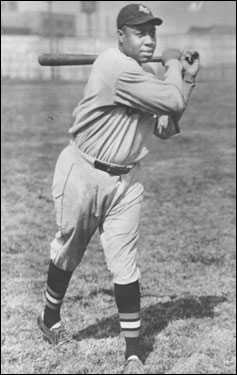
Cool Papa Bell, rf (1974) Satchel Paige once said of Cool Papa’s legendary speed that “he’s the only man I know who can switch off the bedroom light at the door and then get into the bed and under the covers before the room grows dark.” Bell is reputed to have scored from second base on a sacrifice fly and to have covered more outfield ground than any center fielder in history. He was also an outstanding slash and run hitter and base-stealer over his years in the Negro Leagues. In spite of his speed, I still choose to leave center field in the hands of another pretty talented guy and let Cool Papa shrink any threat of a bloop hit to right to almost nothing.

Oscar Charleston, 1b (1976) Regarded by many as the greatest player in Negro League history, Charleston may have also beeen the greatest center fielder of all time in his youth. His career batting average of .348 and slugging power beyond .500 was stunning. Dizzy Dean said he didn’t have a weakness. I’m simply placing Oscar at his veteran position of first base to be sure that I have his bat in the lineup. Again, I’m saving center field for the arguably most dramatic talent to ever play there in all of baseball history.

Babe Ruth, lf (1936) He was “The Bambino”, “The Sultan of Swat”, “The Babe”. Nuf sed.

Josh Gibson, c (1972) Most often referenced as “The Black Babe Ruth,” Josh Gibson probably hit well over 800 home runs during the course of his Negro League career. He didn’t simply hit them often. He hit the kind that seemed to disappear in the sky beyond the stadium wall – ever bit as far or better than any that ever took flight from the bat of the Babe.

Willie Mays, cf (1979) He will always be remembered as that arms and legs player dashing madly to the deepest part of center field at the Polo Grounds in 1954, on his destined way to “The Catch” of s deep drive by Cleveland’s Vic Wertz in the World Series. He also will never be forgotten for his arm, his bat, his legs, and his unbridled power. Hitting .302 lifetime, Willie’s 660 home runs places him 4th on the all time list behind Barry Bonds (762), Hank Aaron (755), and Babe Ruth (714). He lacked DiMaggio’s grace on defense, but he more than made up for it with dramatic athleticism in the field. “Say Hey, Willie! You’re my guy in the central pasture.”

Rogers Hornsby, 2b (1942) With a .358 career batting average and three seasons hitting over .400, “The Rajah” is still considered by many as the greatest righthanded batter of all time. He’s good enough to be my second baseman, even ater all these years.

Martin Dihigo, 3b (1977) “Dihigo was the best all around baseball player I’ve ever seen,” said Baseball Hall of Fame fellow member Buck Leonard. Dihigo could play all nine positions at an excelent level. To appreciate how gifted Dihigo was, in 1938 in the Mexican League his .387 batting average won the batting title and, as a pitcher, he was 18-2 with an 0.90 earned run average. I’ve got Martin at third base because that’s where I need this super-athlete the most.

Honus Wagner, ss (1936) “The Flying Dutchman” and his .327 batting average for 21 years in the big leagues is still my choice at shortstop. Similar to Dihigo as an outstanding athlete, the bowlegged Wagner could most likely have have played any position he chose to try – and played it well. He simply couldn’t get away from shortstop once the Pittsburgh Pirates found out  how well he fit that long term need on their early 20th century clubs. Now he has the job on my club too as one of three men who have survived from that original all star notion of my childhood as members of my own selected group.

Cy Young, p (1937) I’ve been a Christy Mathewson fan over Walter Johnson for years, but when it came right down to making this critical pick, I found I could not pass up the man who holds one of baseball’s least likely-to-ever-be-broken records of 511 career wins. Look! If we’re going to give an award in his name to the two best pitchers each year in the American and National leagues, how could we not pick Cy “I’m That Guy” Young as our all star pitcher of all time?

At any rate, those are my arguable nine picks as I now see things in 2010. They may change again over time and probably will. Unless baseball suddenly dies, the membership in this lineup will never be fixed or cast in bronze forever. Your choices may be a little to greatly different than mine. That’s OK too. All I know for sure is, I’d be happy to take on your different club with my nine guys anytime of the week we can reserve a playing field in the Twilight Zone.
Merry Christmas and Happy Holidays!

December 23, 2009

We live in that home where the buffalo roam!

As we move into Christmas Eve and Christmas Day, this blog will shut down for a couple of days in honor of the season, and also out of respect for the attention I need to be paying to out of town guests. We’ll be back to what passes for normal around here on Saturday, December 26th. In the meanwhile, I’d like to leave all of you dear friends and readers with my best wishes for a Merry Christmas and a most safe, peaceful, and happy holiday season. My stocking-stuffer presents are these few additional “baseball-as-a-metaphor-for-life” thoughts that occur to me on this Christmas Eve eve. Hope you find some of them useful:

(1) The role of love and loyalty in friendship and marriage: They are the double play in life that we cannot win without. Take away either – and nobody survives the troublesome inning that’s coming somewhere down the line in the game.

(2) Sometime in life, usually when we are least expecting it, we are going to be faced with some kind of situation that feels like s squeeze play. We need to play the game of life all the way out with our eyes wide open, our wits totally about us, and with as much mental agility as we can bring to the possibility of a dribbler coming at us down the line with everything we’ve worked for hanging in the night air and depending on how we handle matters at a critical time. We won’t win ’em all. Nobody does. We just have to stay on our toes andd know that we’ve given everything we do our honest best effort.

(3) Much has been written to compare life with the long season of baseball, but there is a big difference that nobody seems to field. In baseball, no matter how tough the schedule is, your opponents line up to play you in serial form, one game at a time, one day at a time. In life, several foes may show up on the same day at the same hour, and you won’t be saved from any of them by a manager who watches your pitch count. You will have to take on your son’s flu, your spouse’s cancer, your own heart attack, the loss of your biggest job, other  problems with your spouse, kids, family, in-laws, and neighbors, your personal addictions, and a dead car battery that keeps you from being on time to a new job interview – and sometimes all on the same day. So how do win?

Sometimes we don’t win, at least, in terms of how we may see winning with our egos on a particular day.

All we can do is try to stay honest with ourselves and throw as hard as we can for as long as we can at the things we can do something about. We can’t do the impossible. Things are what they are. And we can only do what we can do. Nobody ever said it was going to be easy.

Life is not like Baskin & Robbins, with problems coming into our lives and taking a number until we can get to them. Problems in life have a habit of coming in packs. All we can do is get better at learning to recognize which ones we can do something about and spending our energies there.

No Rollerskating Allowed in This Tree!

(4) When all is said and done, few of us who love baseball will ever abandon hope for the kind of redemption that may come our way via the “Grand Slam” in the later innings of either baseball or life. We are basically romanticists at heart and, for many of us too, our cups runneth over with magical thinking about the salvation that cracks into our lives  instantly and majestically off the wood of the bases-loaded long ball. We can always see it again in the minds-eye memory of these great moments from past games – and from these we dream all the more of it happening again, in baseball and in life. For those of us who have known this joyful experience at any level of play, the Grand Slam is always remembered and never forgotten. Never.

(5) Enjoy the love that is always trying to find its way into our lives everyday in so many forms too, folks. Like baseball, true acts of love are forever, and they are coming at us daily in new forms and through old reminders all the time. Like baseball, we just have to remember that true love never goes away.

The Ballad of Eddie Gaedel.

December 22, 2009

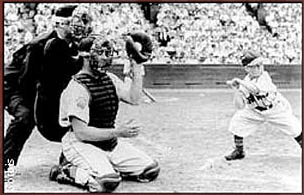
In further deference to the spirit of this off-season, and to the fact that time is short as we run smack dab into Christmas in only three more days, here’s another parody I wrote ten years ago about the time on August 19, 1951 that St. Louis Browns club owner Bill Veeck sent a vertically challenged person (a so-called “midget” back in the pre-PC days) into a game against the Detroit Tigers. It only happened once, but it turned a memory that shall last forever. Here it is again for your last minute Christmas shopping pleasure or displeasure, “The Ballad of Eddie Gaedel”, as sung to the tune of “Rudolph the Red-Nosed Reindeer”:

The Ballad of Eddie Gaedel
(sung to the tune of “Rudolph, The Red-Nosed Reindeer”)
by Bill McCurdy, 1999.

Bill Veeck, the Brownie owner,
Wore some very shiny clothes!
And if you saw his sport shirt,
You would even say, “It glows!”

All of the other owners,
Used to laugh and call him names!
They wouldn’t let poor Bill Veeck,
Join in any owner games!

(chorus)
Then one humid summer day,
Bill Veeck had to – fidget!
Got an idea that stirred his soul,
He decided to sign a – midget!

His name was Eddie Gae-del,
He was only three feet tall!
He never played much baseball,
He was always just too small!

(chorus)
Then one day in Sportsman’s Park,
Eddie went to bat!
Took four balls and walked to first,
Then retired – just-like-that!

Oh, how the purists hated,
Adding little Eddie’s name,
To the big book of records,
“Gaedel” bore a blush of shame!

Now when you look up records,
Look up Eddie’s O.B.P.!
It reads a cool One Thousand,
Safe for all eternity.

Our Christmas All Stars!

December 21, 2009

Because of the thousands who have  come and gone as big league ballplayers since the 19th century, it’s always fun to come up with new all star  teams along infinite theme lines – and what an opportunity we have before us this week as Christmas comes our way. The following is simply my humble offering along those lines.

Larry St. Dierker, Manager, Christmas All Stars

It shouldn’t be hard to figure that most of the players (everyone but starting pitcher Rick Wise) on our Christmas All Star roster didn’t get there on the basis of their on-the-field productions and/or longevity as major league baseball players, but as names that fit the aims of our theme.

Wish I could have found a “Mary” or a “Madonna” somewhere in the mix, but even baseball has failed to travel that liberally varied  a surname lane.

The ones we did sign up all fit fine, and their numbers on the roster, as well as their presences in the starting lineup. are neither the products of accident. There are  two major “numbers” factors built into both the  roster total and the lineup composition that should jump out at you as that obvious, but you may have some other players in mind that you feel deserve to be on the team. If so, please post them below as comments to this article.

Have fun with the data!

Our Twelve Men of Christmas All Stars Roster includes …

P: Rick Wise (1964, 66-82) 188-181, 3.69 ERA

P: Dave Jolly (1953-57) 16-14, 3.77 ERA

P: Al Clauss (1913) 0-1, 4.75 ERA

P: Keith Shepherd (1992-93, 95-96) 2-5, 6.71 ERA

C: Steve Christmas (1983-84, 86) .162, 1 HR

1B: Pop Joy (1884) .215. 0 HR

2B: Casey Wise (1957-60) .174, 3 HR

3B: Mike Lamb (2000-08) .277, 69 HR

SS: Omar Infante (2002-09) .264, 37 HR

LF: Ron Shepherd (1984-86) .167, 2 HR

CF: DeWayne Wise (2000, 02, 04, 06-09) .218, 17 HR

RF: Rick Joseph (1964, 67-70) .243, 13 HR

Our Christmas Morning Game Batting Order is …

Rick Joseph, LF

DeWayne Wise, CF

Mike Lamb, 3B

Omar Infante, SS

Ron Shepherd, LF

Pop Joy, 1B

Casey Wise, 2B

Steve Christmas, C

Rick Wise, P

Have a great Monday before Christmas week! Hope you have your shopping done!

Remembering the St. Louis Browns.

December 20, 2009

Ned Garver won 20 games for a club that lost 102.

A lifetime ago, before there was a major league club in Houston, those of us who grew up here had to pick one of the sixteen existing clubs to follow. We were all first Houston Buffs of the AA Texas League fans, of course, but we weren’t boondocks-dumb to the fact that the best brand of baseball was the variety played in either the National or American leagues, in most cases. We also were ego-loaded to the idea that a club like our ’51 Buffs could most likely take a team like the Pirates, the Senators, the A’s, or the Browns in a best of seven series any day of any October week during that era.

I had two favorite big league clubs, one from each major league. Not surprisingly, the first of mine was the St. Louis Cardinals of the National League. The Cards were the major league parent of our Houston Buffs and they were loaded with former Buffs who had stampeded their ways to the big time through the gates of Buff Stadium. My other club was an American League entry, but it wasn’t one that many fans chose to follow, even from among those people who lived in the city that had been its home since 1902.

How could you not like the only club that ever sent a midget into a real game as a batter?

The St. Louis Browns were simply awful most years. The rest of the time they were downright terrible. Except for their great club of 1922, the one led by Hall of Famer George Sisler to a one-game-short miss of the 1922 American League pennant, the 1944 Browns were the only club in franchise history to win an AL pennant. It wasn’t much to shout about. Any time you have to give an assist to a guy like Adolph Hitler for creating the manpower shortage that opened the door for the Browns to walk into their lone lucky title break its – well, its flat out embarrassing.

The Browns won the 1944  American League title at the wire over the Detroit Tigers and then lost the World Series in six games to their same neighborhood Cardinal rivals.

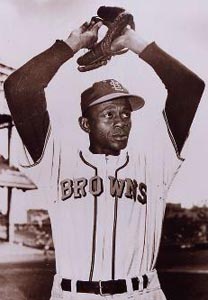
"Never look back. Something might be gaining on you." - Satchel Paige

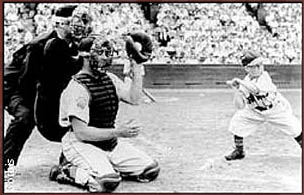
I came aboard as a Browns fan during the 1951 season, mainly because of one man. That was the year that Browns pitcher Ned Garver won twenty games (20-12, 3.73) for a team that finished in last place with a record of 52-102. It was a case of unfortunate underdog misidentification, but my admiration for Garver’s achievement against the odds, plus the presence of the great Satchel Paige on their roster, plus Eddie Gaedel (see photo of midget batter), well, the short of it is simple. These all sucked me into accepting the Browns as my club in the American League.

It was a short-lived romance. After two more seasons in St. Louis (1952-53), the Browns departed the Mississippi River city in favor of a 1954 reincarnation on the east coast as the Baltimore Orioles. It was a move that rang the bell on other franchise relocations to soon come, and I hated it as deeply as though I had grown up with the Browns in St. Louis. As if I need now any help with compiling further reasons to dislike her, the Baltimore mayor who led the Browns transformation to Orioles just happened to have been the father of current House Speaker Nancy Pelosi.

Several years ago, I wrote a parody version of “Casey at the Bat” to express the meter and merit of my sadness over the Browns’ last game in St. Louis. In the nostalgic spirit of the season, and in memory of that long ago 1953 moment in Sportsman’s Park (renamed Busch Stadium), here’s what happened on September 27, 1953 in St. Louis, Missouri:

The Lost Hurrah: September 27, 1953
Chicago White Sox 2 – St. Louis Browns 1.

(A respectful parody of “Casey At The Bat” by Ernest L. Thayer in application to the last game ever played by our beloved Browns.)

by Bill McCurdy (1997)

The outlook wasn’t brilliant for the Brownie nine that day;
They were moving from St. Louis – to a place quite far away,
And all because Bill Veeck had said, “I can’t afford to stay,”
The team was playing their last game – in that fabled Brownie way.

With hopes of winning buried deep – beneath all known dismay,
The Brownies ate their cellar fate, but still charged out to play.
In aim to halt a last hard loss – in a season dead since May,
They sent Pillette out to the mound – to speak their final say.

The White Sox were that last dance foe – at the former Sportsman’s Park,
And our pitcher pulsed the pallor of those few fans in the dark.
To the dank and empty stands they came, – one final, futile time,
To witness their dear Brownies reach – ignominy sublime.

When Mickelson then knocked in Groth – for the first run of the game,
It was to be the last Browns score, – from here to kingdom came.
And all the hopes that fanned once more, – in that third inning spree,
Were briefly blowing in the wind, – but lost eternally.

For over seven innings then, – Dee bleached the White Sox out,
And the Browns were up by one to oh, – when Rivera launched his clout.
That homer tied the score at one, – and then the game ran on.
Until eleven innings played, – the franchise was not gone.

But Minnie’s double won the game – for the lefty, Billy Pierce,
And Dee picked up the last Browns loss; – one hundred times is fierce!
And when Jim Dyck flew out to end – the Browns’ last time at bat,
The SL Browns were here no more, and that was that, – was that!

Oh, somewhere in this favored land, the sun is shining bright;
The band is playing somewhere, and somewhere hearts are light;
And somewhere men are laughing, – and little children shout,
But there’s no joy in Sislerville, – the Brownies have pulled out.