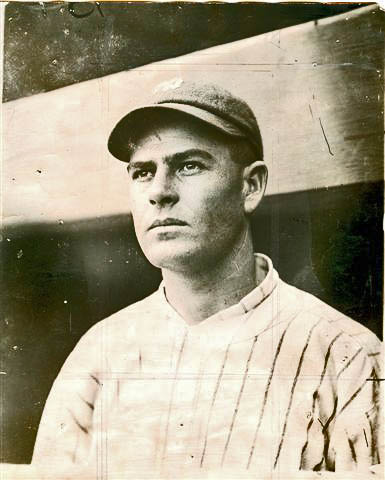
Cool Hand Curt Walker

February 25, 2018

Curt Walker, OF
.304 Career BA
1919-1930

We had not planned to spend the weekend with Curt Walker, but sometimes an everyday writer’s mind works that way. Once it attaches to a subject, the substantive matter simply comes spewing forth, in drips or droves. In Curt’s case, our use of the great Beeville, Texas native outfielder, who was also one of the really good contact hitters of the 1920s MLB scene, came easily to a point I have been wanting to touch upon since our mighty SABR work, “Houston Baseball, The Early Years, 1861-1961” came out in 2014.

In our major history book on Houston’s long and full baseball history, there wasn’t room to cover everything in great detail and Curt Walker’s 1919 time and field accomplishment-limited first professional season with the Houston Buffs was fairly shortened to an appropriately brief caption to a generously large photo of him on page 129.

The caption read as follows: “Curt Walker, who was born and died in Beeville, TX, had lackluster numbers during his year in Houston.”

True. In 1919, Walker batted only .215 (29 for 135) with only six of his hits going for doubles. The other 23 were all singles for the first year man in his 41 games for the Houston Buffs of the Class B Texas League.

The 22-year old Walker (BL/TR) began his first 1919 pro season as an outfielder for the Augusta Dollies of the Class C Sally League, where he batted .278 in 53 games (54 for 194) and a distribution of 39 singles, 11 doubles, 3 triples, and 1 home run. The Cardinals pretty much controlled things at both of Walker’s first year minor league stops so we are fairly safely assuming that they are responsible for the move from Augusta to Houston.

Unfortunately for me, I was beginning my senior year in high school here in Houston when Curt Walker died in Beeville on September 9, 1955. By the time I was old enough to care, my also now late dad had none of the details we now seek on how these changes happened in detail – and how the really big move in the rookie’s first season occurred at all.

My dad and Curt Walker played some town ball together down in Beeville during Curt’s early 1930s retirement years. Dad and Curt were great friends – like much older Curt to my much younger father – brothers close. Dad would have known the details we are about to next share with you about what was so special in the matter of Curt Walker’s rookie pro season. So far, I haven’t been able to find all the answers in Retrosheet, Baseball Almanac, or Baseball Reference. Have not tried The Sporting News, nor have I used them for any other query. Not sure how user friendly they are to folks like us. We shall see.

Here’s the deal. – If you check out Curt Walker’s stats online, you will see that his 1919 rookie season does not go to rot on a South Texas open window for open bottles of “flat Coke.” Curt Walker concludes his first season by going zero for 1 as a member of the New York Yankees on September 17, 1919.

Let me repeat that destination for you relative to the kinds of stats that Curt Walker had been putting up in 1919, especially at Houston. It was not a record that was designed to get anybody up to the roster of the New York “freakin” Yankees, even in 1919 – or maybe even especially in 1919, with this growing devotion to earning one’s way up through gradient levels of farm team experience.

Post-Original Publication Contribution, 2/26/18

Respected contributor Cliff Blau added the following earlier today by comment: “The 9/18/1919 Houston Post reported that Walker was released by Houston when he stopped hitting, then Augusta signed him, eventually selling him to the Yankees.”

Retrosheet was no help with individual game reports for 1919, but Baseballs Almanac and Reference were both helpful in pinning down the fact that Curt Walker went 0 for 1 as a pinch hitter in the bottom of the 9th of the second game in a twin bill loss by the Yankees to the forthcoming 1919 AL Champion Chicago White Sox at the Polo Grounds. The fated date was September 17, 1919.

The blossoming Black Sox took the first game, 2-0. Then they put the crusher on the Yankees in the second game. By the time young Walker was called to pinch hit for pitcher Ernie Shore in the bottom of the 9th, the Yankees were down 11-2 and simply looking for a way to end the day. – But what did Walker do?

Given his later MLB establishment of himself as an excellent contact hitter for average, we had to wonder? Did he avoid the “K” from his very first day?

Luck was with us. I found a copy of the game coverage in the next day’s New York Times, September 18, 1919 sports section. Curt Walker was retired by Bill James of the White Sox on a harmless fly ball to left fielder Nemo Leibold in the 9th inning of Game Two the previous afternoon.

Curt Walker did not strike out. If it were a tryout, however, it was a one-at-bat short one. Walker was back playing at Augusta in 1920. Baseball Reference indicates that Augusta then sold Walker’s contract on July 27, 1920 to the New York Giants for $7,000.

Walker would hit .304 lifetime for his work with the Yankees, Giants, Phillies, and Reds. His .337 mark and 196 hits for the 1923 Phillies would be his best season. In 1926, Curt hit 20 triples – with 2 of them struck in the same inning of a single game for the Reds against the Braves. What are the odds of any batter ever hitting 3 triples in the same inning? – – Right. And I agree.

And thanks for your patience. This article has been overdue from my heart for way too long.
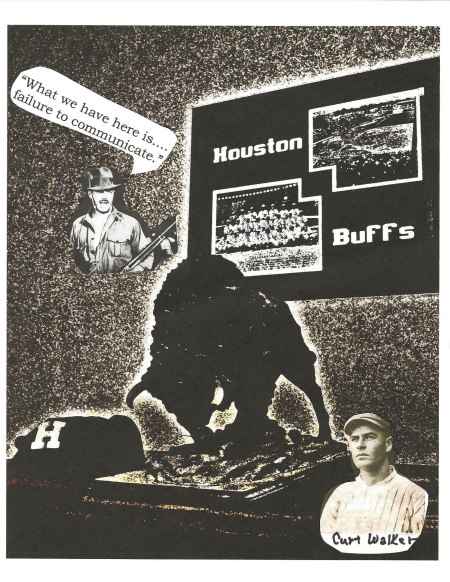
So, how does young Curt Walker get a call to pinch hit for the Yankees near the end of his first less than stellar minor league season?
Res Ipsa Loquitur.

Two For The Road

Curt Walker was sometimes known as “The Undertaker” because of his regular off-season, then forever job. He owned a funeral home in Beeville. He was an undertaker.

One time, Curt walks into the American Cafe in downtown Beeville with Dad and me. He stops inside. Starts listening to a table of ranchers talking about a coyote problem they are all having with their small livestock disappearing. Finally, when they reach a point in which they get stuck on the date of their worst previous coyote issue, Curt, who was standing up, coffee in hand by this time, leans in over the shoulders of a few just long enough to ask, “Wasn’t that the year that the owls were so bad?”

Silence. Followed by chatter resumption. Now the group is debating. What was the year the owls were so bad?

Curt says nothing else. He looks over at my dad and me and smiles. Then he urges us to find a table of our own. I’m in high school now. And I’m feeling like big stuff.

Second story: If at all, this next one is only going to be funny if you can accept my word that Curt Walker was not as uncaring as it may make him sound, but he wasn’t either as thoughtless as it may make him seem. Curt was just one of those kinds of people who would say anything deadpan-faced, if he thought it would generate a distractive stir, or, maybe relieve him from taking serious responsibility for his actions.

Dad and Curt went deer hunting at our Bee County ranch one time. They split up down there to hunt from separate sites. Dad says he heard a lot of shots going off. At the end of the day, Dad had one small buck, but Curt had five!

“Good Lord, Curt,” Dad said. “You are going to be in big trouble if the game warden stops us. Couldn’t you leave some deer for your grandchildren?”

“Why should I?” Curt answered. “My granddaddy didn’t leave me any buffalo!”

Forget humor. It is the bemusement of pathos this second story evokes.

Although Dad and Curt remained friends to the end, it was their last joint hunting trip.


********************
Bill McCurdy

Principal Writer, Editor, Publisher

The Pecan Park Eagle


Is Baseball Now All About the Next HR?

February 24, 2018

Curt Walker, OF, .304 BA
MLB: 1919-1930
Struck out Less Than 5% of the Time

Back in the 1920s, two good old Texas-born and raised outfielders, Ross Youngs and Curt Walker, were two of the best when it came to avoiding strikeouts. In the second half of the 20th century, as the game moved even deeper into the layers of commitment to bomb baseball, two more modern bangers, Reggie Jackson and Mickey Mantle, swung many of the dry bat toasts to nothing but air as a regular outcome consequence of their aims and swinging styles.

The following little K/PA chart easily displays the oceanic career differences that exist between these two different eras of the game. Although, as we all know, there was a guy named Ruth already rewriting the game for today by his own dramatic thunder-crunching of baseballs into the stratosphere.

A K/PA Selective Comparison of Different Style Hitters

K per PA Comparisons K/PA = K / PA
Curt Walker .046 254 5572
Ross Youngs .073 390 5336
Mickey Mantle .173 1710 9907
Reggie Jackson .228 2597 11418

Brief Notes:

Curt Walker (1919-1930) (.304 BA) (64 HR) struck out less than 5% of the time.

Ross Youngs (1917-1926) (.322 BA) (42 HR) held the strike out K down to a little over 7% time experience.

Mickey Mantle (1951-1968) (.298 BA) (536 HR) mourned the loss of his .300 BA at the end.

Reggie Jackson (1967-1987) (.262 BA) ((563 HR): When Reggie wasn’t stirring, he was whiffing.

In General: Curt Walker did some exciting things with the bat during his career. In 1926, he became one of the few to ever hit two triples in one inning. What are the odds of anyone ever getting three triples in one inning? But no matter, what he did was not enough for those who honor greatness. Walker is the only one of our four players here who is not in the Baseball Hall of Fame.

Specific to the Question: Would it hurt the game to have a few more guys in the lineup today who batted more like Walker and Youngs? Or – are we headed toward a time in which the long ball is going to be expected of at least 7 of the 9 hitting players?

And how much has the almost 100-year-old long ball expectation shift contributed to the decline in fundamental skills on balls in play – and an apparent disinterest among some clubs in not working too hard on defensive decision-making and play execution in game situations with runners on base?

Forgive me if I seem to be posting news that’s as fresh as the attack on Pearl Harbor, but maybe Astros manager A.J Hinch already has put in motion a plan that covers greater emphasis on building a team that has to work on developing a deeper understanding of fundamental baseball.

Hinch plans to train several key Astros to play several different positions. That’s great. It will both protect the club against the nettlesome problem of losing a key player to injury during the season – and it automatically forces players to take a sharper refreshing look at the fundamental differences that come into play from one spot to another in key game situations.

Gotta love it.

At any rate, the subject needs to stay fresh, even if it has aged. Once the introspection stops, baseball becomes like the 4th of July. As fans, we just go to the game and wait for the fireworks.

Oh. – Are we already there?


********************

Bill McCurdy

Principal Writer, Editor, Publisher

The Pecan Park Eagle

An Ogden Nash Early Blink On Jose Altuve

February 23, 2018

Jeff Luhnow
General Manager
Houston Astros

Jose Altuve
2nd Base
Houston Astros

Scott Boras
Business Agent
Jose Altuve


An Ogden Nash Early Blink

On The Future of Jose Altuve

Humbly Offered, By Bill McCurdy


Jeff and Scott – their wounds forgot

Sat down to talk – Altuve

Jeff bid small – and Scott smiled tall

As things did not start – groovy


“Oh, don’t you see – he’s Houston’s heart

The guy that fires our engine?”

“Oh, don’t you see – he’s much too smart

To buy that home town binging!”


Late this year – with outcomes near

Perhaps they’ll find – firm reason

As Jose makes clear – the point of his spear

Is it heart – or most dough per season?


********************

Bill McCurdy

Principal Writer, Editor, Publisher

The Pecan Park Eagle
Astros Bring Attitude to Picture Day

February 22, 2018

Gerrit Cole, Pitcher
#45, Houston Astros
——–
Houston Chronicle Photo

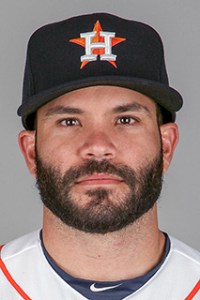
Wednesday was “Picture Day” at the Astros’ West Palm Beach spring training center and the boys showed up to lean a little “come-and-take-it” attitude into just about every photo that’s on display. And that’s a good thing. The veteran stars who were around to take the 2017 first World Series victory in Houston MLB history have earned the right to say loudly to the other 29 clubs that “hey, if you want the 2018 title, you are going to have to take it from us or forget about it.”

Carlos Correa is especially convincing in getting that message across, we think. And good old Evan Gattis naturally looks like a guy who would squash you like a bug, if you tried to take anything from him. (Don’t worry, Evan! We’ll keep your secret. We will do all we can to make sure that no one finds out that the answer to your menacing glare is to keep throwing the ball low and outside each time you have two strikes and you know we have to get the pitch into the zone.)

Check out the ones on display at Chron.com. You may enjoy seeing some of our newest Astros, via both trades and system graduations, in full home Houston gear for the first time.

Here’s the link. We recommend it:

https://www.chron.com/sports/astros/article/The-Astros-were-serving-looks-on-picture-day-12630993.php?ipid=happening

Along with warmer, drier weather – and the soon-to-be-sprouting rush of new spring green life, there’s nothing like the tactile feel, sight, sound, taste, and smell of spring and all that that comes at us with the games starting up again. I miss the aroma of horsehide. It had a tang you just don’t get with cowhide. We had to start actually playing games to keep me from wanting to whiff the baseball every time I picked it up as a kid. After all, if you’re an outfielder, fielding a ball hit into the gap, there’s no time to nostralize the thing. You’ve got to get the ball back in as quick as possible. Taking even a single brush-by whiff on the throw to a cut-off man could be the difference between the batter/runner getting a triple out of a batted ball that should have been held to a double – but for the time lost to ill-advised errant whiffing.

Ah, yes. The elixir of spring training is upon us. If we could just keep the state of mind that this short sweet part of the season creates, we might all live far into a state of near immortality. And, if more of us simply lived longer in relatively good health, maybe people would stop complaining about the games lasting too long.

Who among us really wants the game to end, anyway? Really?


********************

Bill McCurdy

Principal Writer, Editor, Publisher

The Pecan Park Eagle

The Possible SABR Name Change

February 22, 2018

Yesterday I wrote the following as part of my coverage of this past Monday’s February SABR meeting in Houston. The entire column, “Another Dierker Tale Spins SABR”, including the essential additions shown here, is available at the following link:

Another Dierker Tale Spins SABR

Here’s a reiteration of (1) what was was published originally about the name change possibility, followed by (2) the clarifying comment from Jacob Pomrenke of SABR National, and (3) my additional comments – also retro-included in yesterday’s column content and repeated here for broadest coverage. Mr. Pomrenke makes some important clarifications to what is – and is not -under present consideration:

 (1) The original column report.

SABR/SIBR. Bob Dorrill led a brief discussion of the movement in place to change the name of SABR to one which more vividly expresses our organization’s interest in the growth of the game worldwide. Cast me among those who find themselves less than enchanted with a change to “Society for International Baseball Research” (SIBR for belibbering short). I’m strongly on the side that says leave our unchangeable identity alone. We ARE “American Baseball” – no matter where we spread to play in this world. Our original identity is immutable – even as the worldwide love for our American Game continues to grow internationally. This trans-borders migration movement does not obliterate the American roots of our game – nor should we yield to the politically correct idea that “Made in America” as a hashtag should be removed from anything American that works so well anywhere it travels – and just to do so as a matter of deferential cultural modesty.

Please. – We ARE – The Society for American Baseball Research – anywhere the game is played.

(2) Mr. Pomrenke’s E-Mail Response to me today.

Post-Publication Inclusion, 5:30 PM, CST, Wed., Feb. 21, 2018, 46 Hours Post-The Meeting Covered. >

Three hours ago, I heard from Jacob Pomrenke, SABR’s Director of Editorial Content at our national office, with a very important clarification by e-mail. It follows here verbatim:

Hi Bill,

Thanks for this fine recap and all the great photos from the Houston chapter meeting. Just wanted to clarify one quick point in your article, in case there was any confusion:

The suggested name change for the organization that the Board of Directors asked all local chapters to discuss was “Society for the Advancement of Baseball Research” — which still keeps the familiar and beloved acronym, SABR, that we’ve always used. That alternate name was originally suggested by the founders at the very first meeting of SABR back in 1971, but after considerable debate, they voted to use “Society for American Baseball Research” instead. The name change has come up again and again over the past 40+ years and with the tremendous growth in our global membership over the past decade, the Board thought it was a worthy topic to bring up for discussion now.

The phrase you used in your article, “Society for International Baseball Research” (SIBR), has never been suggested, nor is it being considered, as a possible name for our organization.

Thanks,

Jacob

(3) My Response Today to Mr. Pomrenke.

Thanks, Jacob, for that very important clarification. The proposal either wasn’t made clear, or wasn’t heard clearly by me at the meeting, and I reacted to what I heard – with one of those possibilities suggested by someone there whom I now I cannot recall mentioning the “Society for International Baseball Research” possibility.

My apologies are offered with a combination of grief and joy. Grief shrouds the spread of wrong information; joy embraces the relief that the De-Americanization of our game’s identity is not quite as ruthless as I feared it might be.

My first blush reaction is easy to express: I still prefer the name that fully describes our game for what it is and who we are: The “Society for American Baseball Research”.

“Society for Advancement of Baseball Research” remains inoffensive to our comfortable acronym identity, but it promotes the idea that we are here as an organization to research ways to advance the game, either by territorial expansion or the pursuit of superior rule changes – like putting the game on the clock – or putting a runner on 2nd base in the tenth inning for no better reason than ending the game more quickly.

Advancement? I don’t think so. Baseball is not Star Trek – and SABR is not the Good Ship Enterprise, going places where no other game has previously ventured by interference guised as advancement.

Others may disagree, but I’ll take my SABR for what it exactly says it is now.

Thank you, anyway, Jacob for clearing up the misunderstanding.


********************

Bill McCurdy

Principal Writer, Editor, Publisher

The Pecan Park Eagle


Another Dierker Tale Spins SABR

February 21, 2018

Larry Dierker Addresses SABR
February 19, 2018

Larry Dierker. – The guy’s ingenuity, smarts, sense of humor, baseball wisdom, and genuine human ability to care is just incredible. It made another manifesting whole presence appearance again last night in a lead-off talk to the members of his namesake Larry Dierker Chapter of SABR. About 40 people showed up. It was the February 19, 2018 monthly meeting of SABR at our current stomping and Italian food chomping eatery, the Spaghetti Western Ristorante on S. Shepherd in Houston, about two blocks south of the Katy Freeway.

If people remember nothing else, they will remember Dierk’s tongue-in-cheek (we think) suggestion for resolving the hell-or-limbo status question that continues to blank out Pete Rose, the game’s all-time hit king, from a full life in baseball.

The Dierker Rose-Selig Prescription: “Give Pete and former Commissioner Bud Selig each a pair of boxing gloves and let ’em go at for as many rounds as it takes. If Selig wins, Pete has to either go away of shut up forever about not being in the Hall of Fame. If Rose wins, Selig and all other obstacles get out of the way and leave the door open from here to eternity for Pete’s total return to the game.”

“What a great idea,” smiled my listening mind. “I’m putting my dime on Pete to take Bud in less than 1 minute and 30 seconds of the 1st round.”

SABR/SIBR. Bob Dorrill led a brief discussion of the movement in place to change the name of SABR to one which more vividly expresses our organization’s interest in the growth of the game worldwide. Cast me among those who find themselves less than enchanted with a change to “Society for International Baseball Research” (SIBR for belibbering short). I’m strongly on the side that says leave our unchangeable identity alone. We ARE “American Baseball” – no matter where we spread to play in this world. Our original identity is immutable – even as the worldwide love for our American Game continues to grow internationally. This trans-borders migration movement does not obliterate the American roots of our game – nor should we yield to the politically correct idea that “Made in America” as a hashtag should be removed from anything American that works so well anywhere it travels – and just to do so as a matter of deferential cultural modesty.

Please. – We ARE – The Society for American Baseball Research – anywhere the game is played.

*******************

Post-Publication Inclusion, 5:30 PM, CST, Wed., Feb. 21, 2018, 46 Hours Post-The Meeting Covered. >

Three hours ago, I heard from Jacob Pomrenke, SABR’s Director of Editorial Content at our national office, with a very important clarification by e-mail. It follows here verbatim:

Hi Bill,

Thanks for this fine recap and all the great photos from the Houston chapter meeting. Just wanted to clarify one quick point in your article, in case there was any confusion:

The suggested name change for the organization that the Board of Directors asked all local chapters to discuss was “Society for the Advancement of Baseball Research” — which still keeps the familiar and beloved acronym, SABR, that we’ve always used. That alternate name was originally suggested by the founders at the very first meeting of SABR back in 1971, but after considerable debate, they voted to use “Society for American Baseball Research” instead. The name change has come up again and again over the past 40+ years and with the tremendous growth in our global membership over the past decade, the Board thought it was a worthy topic to bring up for discussion now.

The phrase you used in your article, “Society for International Baseball Research” (SIBR), has never been suggested, nor is it being considered, as a possible name for our organization.

Thanks,

Jacob

Thanks, Jacob, for that very important clarification. The proposal either wasn’t made clear, or wasn’t heard clearly by me at the meeting, and I reacted to what I heard – with one of those possibilities suggested by someone there whom I now I cannot recall mentioning the “Society for International Baseball Research” possibility.

My apologies are offered with a combination of grief and joy. Grief shrouds the spread of wrong information; joy embraces the relief that the De-Americanization of our game’s identity is not quite as ruthless as I feared it might be.

My first blush reaction is easy to express: I still prefer the name that fully describes our game for what it is and who we are: The “Society for American Baseball Research”.

“Society for Advancement of Baseball Research” remains inoffensive to our comfortable acronym identity, but it promotes the idea that we are here as an organization to research ways to advance the game, either by territorial expansion or the pursuit of superior rule changes – like putting the game on the clock – or putting a runner on 2nd base in the tenth inning for no better reason than ending the game more quickly.

Advancement? I don’t think so. Baseball is not Star Trek – and SABR is not the Good Ship Enterprise, going places where no other game has previously ventured by interference guised as advancement.

Others may disagree, but I’ll take my SABR for what it exactly says it is now.

Thank you, anyway, Jacob for clearing up the misunderstanding.

I’m also going to run this exchange between us here as tomorrow’s column for the sake of those who don’t see it here as an improbable second read of yesterday’s column on our February SABR meeting in Houston.

********************

Scott Barzilla

Scott Barzilla presided over a feisty discussion of “wins in replacement” as a more meaningful way to discuss the value of players relative to the other players on their team. Best example, by question, which Scott also provided: (1) Were the 1955 Dodgers better because they had Gil Hodges playing first base? Or was Gil Hodges better because of the great players on his team who pulled him up to a higher performing level?

I admit to some 1950s “batting averages were good enough for me” bias to not being fully charmed or in depth informed of how this dynamic of analytics works in baseball over the career distance, but I am able to apply the questions to my experience in the mental health field. (1) I do think my mentors and peers were important to the growth of my own abilities as a therapist over time, but (2) the most important teachers I had were – and will always be – my patients. (3) The harder things get to be, the more you have to grow into what is needed in response to the challenge. (4) And that only happens when you both really care about the results of your work – with an understanding of your own strengths and limits – and with an understanding that you will win some, lose some, and in some cases, be the guy who needs help from the mental health bullpen. And it all sums up far more on the feeling level like the same row that has to be plowed by career baseball hitters and pitchers. I can’t really think of it as something we could have measured better by our own therapeutic team replacement theories. We could have, however, given you a pretty long jargon picture on ways to do things differently in different situations.

Karen Walker
The Astros Scrapbook Lady

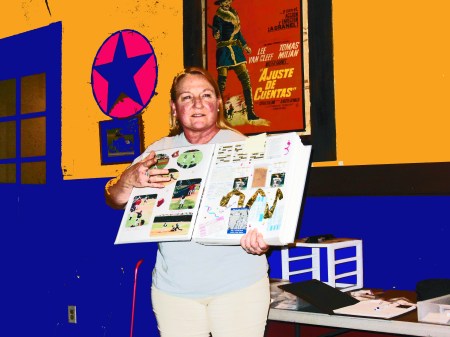
Karen Walker was our last speaker of the evening – and what a refreshment she turned out to be. Karen is well-known to a number of Astros and the off-season followers of the Astro Line radio program as “The Scrapbook Lady.” If something appears in a local Houston publication about the Astros, it has an apparent 90% chance of ending up in one of the many scrapbooks she brought to show us. Karen is a teacher in the Cy Fair School District. If she teaches like she talks Astros baseball, she’s giving those kids a model for the kind of passion they will need to find joy in their own devotion to work, love, and creativity.

She also shares my sentimentality for hallowed ground. Karen has a bottle of dirt from the pitcher’s mound at Minute Maid Park that former manager Phil Garner helped her collect. I have a bottle of dirt from the sandlot home plate area of the Pecan Park Eagle Field in SE Houston from 1950 that Bob Dorrill helped me collect.

Joe Thompson

Our Baseball PhD-to-be, Joe Thompson, served up last night’s Trivia Quiz. Can’t tell you who won because I had to leave while the quiz was still in motion.

A Membership Renewal Reminder. Bob Dorill also reports several local SABR members need to settle up and pay their current annual dues to avoid the loss of goodies and privileges from SABR. Please take of your stuff, guys. We need you.

Bill Brown

ASTROS GAMES NOTICE. Get ready for the TV action from West Palm Beach. The Astros and Nationals will be on the air this Friday and Saturday in their first two games of the Spring Training season. Bill Brown will help doing some of the ST telecasts. We are unsure of his availability for these first two.


**********

Photo Credits. The lead photo of Larry Dierker in lecture gear and the small photo of Bill Brown in the audience were donated to us by Mike McCroskey. The other photos and “art” work are our own Pecan Park Eagle stuff.


********************

Bill McCurdy

Principal Writer, Editor, Publisher

The Pecan Park Eagle
Baseball Reliquary: Black History 2018

February 20, 2018

Friends & Reliquarians:

Greetings from the Baseball Reliquary! We’d like to begin by sharing details regarding two outstanding programs being co-sponsored by the Reliquary this week, in Pasadena and in San Francisco.

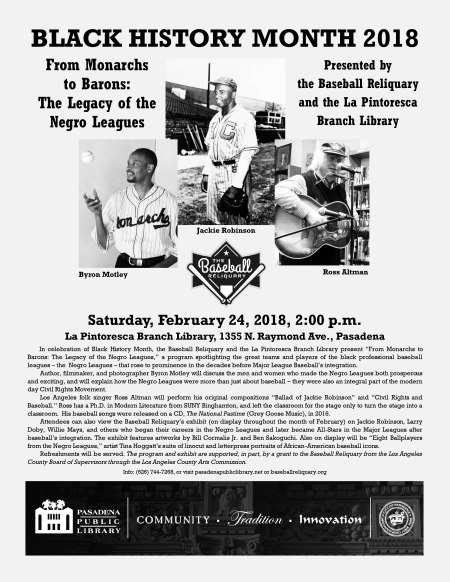
On Saturday, February 24, at 2:00 p.m., in celebration of Black History Month, the Reliquary collaborates with the La Pintoresca Branch Library, 1355 N. Raymond Avenue in Pasadena, to present “From Monarchs to Barons: The Legacy of the Negro Leagues.”  La Pintoresca is a beautiful library built in 1930, and it is located just blocks from Jackie Robinson’s childhood home; in fact, Jackie and his brother Mack frequented this library while growing up in Pasadena.  The Saturday program will feature a lecture/slide presentation on the Negro Leagues by author and historian Byron Motley, whose father Bob Motley was the last surviving umpire in the Negro Leagues.  In addition, one of Los Angeles’s cultural treasures, folk singer Ross Altman, will perform a couple of his baseball songs: “Ballad of Jackie Robinson” and “Civil Rights and Baseball.”  Arrive early to view an exhibit on the Negro Leagues and Jackie Robinson, including artworks by Bill Cormalis Jr., Tina Hoggatt, and Ben Sakoguchi.  A flyer for what should be a very memorable afternoon is attached.

On Wednesday, February 21, at 6:30 p.m., Robert Elias, Professor of Politics and Legal Studies at the University of San Francisco, will present a lecture/slide show entitled “Before Branch Rickey: The Hidden Forces Behind the Breaking of the Color Barrier.”  The program will be held in the Latino/Hispanic Community Room at the San Francisco Main Library, 100 Larkin Street.  While the story of the Branch Rickey-Jackie Robinson collaboration is familiar, Elias believes that it is also incomplete and, in many ways, misleading.  Aside from the ordeal faced by Robinson, Branch Rickey essentially gets all the credit.  In this version of the story, Rickey — motivated by his moral values and Christian beliefs — pursued an isolated and heroic initiative.  Some have questioned Rickey’s motives, arguing that he was as much, or more so, propelled by money: the profit he would realize from a big new set of paying fans and the championships the Dodgers would likely win with Negro League talent.

While not interested in second-guessing Rickey’s motives in his presentation, Elias will argue that rather than a lonely and heroic initiative, the breaking of the color barrier was the result of a long-term social protest movement, where Rickey was only the last piece in the puzzle.  Rickey always denied that he was influenced by others in signing Robinson and he denied credit to the people, groups, and movements that paved the way for his initiative and made it possible.  As Elias will explain, there were particular, political reasons why Rickey did so.  Pieces of the back story and the hidden history of baseball’s integration have been occasionally raised, but on Wednesday, Elias will provide a more comprehensive picture.  His talk will focus on some of the forgotten heroes of baseball’s integration, including Octavius Catto, Thomas Fitzgerald, Moses Fleetwood Walker, Jack Chapman, Wendell Smith, Paul Robeson, Lester Rodney, Bill Veeck, Sam Nahem, Ben Davis, Pete Cacchione, Vito Marcantonio, Isadore Muchnick, and Fiorello LaGuardia.

Arrive early and visit the exhibition, “A Game of Color: The African-American Experience in Baseball,” being presented by the Baseball Reliquary and the Institute for Baseball Studies in the San Francisco Main Library’s sixth-floor Skylight Gallery.  For more information on the program or exhibition, phone the San Francisco Public Library at (415) 557-4400.

Speaking of “A Game of Color,” the exhibition was the subject of an article by Joe Kukura in the February 14 edition of SF Weekly.  Kukura writes, “If you’ve got baseball on the brain, a new historical exhibit at the S.F. Public Library will give you goosebumps with its mind-blowing array of artifacts and historical items from some of baseball’s most significant African-American players and beloved hellraisers.”  We are pleased to share this link to the online version of Kukura’s article:

Baseball Reliquary. Jackie Robinson. Painting by Michael Guccione

http://www.sfweekly.com/culture/pitch-black/

Finally, for this edition of “Baseball Reliquary News & Notes,” we now have an official date for the Shrine of the Eternals Induction Day.  It will be Sunday, July 22, 2018 at the Donald R. Wright Auditorium in the Pasadena Central Library, Pasadena, California.  The festivities will begin at 2:00 p.m.  As usual, the ceremony falls between the Major League Baseball All-Star Game (July 17 at Nationals Park, Washington, D.C.) and the National Baseball Hall of Fame Induction Ceremony (July 29 in Cooperstown, New York).  This summer’s Shrine of the Eternals Induction Day marks the 20th anniversary, with the first ceremony having been held in 1999.  The voting for the Class of 2018 will take place in April, but we wanted to share the date of the induction ceremony now in case anyone wishes to include the festivities in their travel plans for the summer.

Please advise if we can provide any further information or details.

Sincerely,
Terry Cannon
Executive Director/The Baseball Reliquary
Co-Director/Institute for Baseball Studies
www.baseballreliquary.org

e-mail: terymar@earthlink.net
phone: (626) 791-7647

Support from Pecan Park Eagle readers in, nearby, or traveling to the Los Angeles area – are especially appreciated here too. “TBR” comes across as the cat’s meow when it turns to the matter of preserving baseball on an honest, passionate, and artistic plane. We love and support what they are doing.

Sincerely, Bill McCurdy, Publisher, The Pecan Park Eagle

********************

Bill McCurdy

Principal Writer, Editor, Publisher

The Pecan Park Eagle

Bill Gilbert’s HOF Vote Report

February 19, 2018

Bill Gilbert’s Back With a DL-Delayed, But Still Timely Report on the Hall of Fame Vote. Welcome Back, William! And Keep on – Keepin’ On, Please! We all both enjoy and treasure all you do in the name of good baseball history and analysis.

Analyzing the 2018 Hall of Fame Vote

By Bill Gilbert

Normally, I write an analysis of the Hall of Fame election within a couple of days of the announcement but a 19 day hospital stay has put me way behind schedule. The Baseball Writers Association of America elected 4 players to the Hall of Fame this year, Chipper Jones (97.2%), Vladimir Guerrero (92.9%), Jim Thome (89.8%) and Trevor Hoffman (79.9.%). They will join Alan Trammell and Jack Morris, previously elected by the Modern Era Veterans Committee, for induction in July. Jones and Thome were elected in their first year on the ballot, Guerrero in his second year and Hoffman in his third. Edgar Martinez received 70.4% of the vote and appears to be in good position for election in 2019, his 9th year on the ballot.

Roger Clemens and Barry Bonds continue to gain a few votes but the gains were small this year. They now have 57.3% and 56.4% of the votes respectively. They have four more years on the ballot to reach the necessary 75%.

Following is a list of candidates that received votes in the election this year. A total of 422 votes were cast. For the holdovers, vote totals for last year are also shown. Newcomers on the 2018 ballot are shown in bold:

2018 Baseball Hall of Fame Ballot Results

Player Years 2018 V 2018 % 2017 V 2017 % V Diff %
Chipper Jones 1 410 97.2
Vlad Guerrero 2 392 92.9 317 71.7 75 21.2
Jim Thome 1 379 89.8
Trevor Hoffman 3 337 79.9 327 74.0 10 5.9
Edgar Martinez 9 297 70.4 259 58.6 38 11.8
Mike Mussina 5 268 63.5 229 51.8 39 11.7
Roger Clemens 6 242 57.3 239 54.1 3 3.2
Barry Bonds 6 238 56.4 238 53.8 0 2.6
Curt Schilling 6 216 51.2 199 45.0 17 6.2
Omar Vizquel 1 156 37.0
Larry Walker 8 144 34.1 97 21.9 47 12.2
Fred McGriff 9 98 23.2 96 21.7 2 1.5
Manny Rameriz 2 93 22.0 105 23.8 (-12) (-1.8)
Jeff Kent 5 61 14.5 74 16.7 (-13) (-2.2)
Gary Sheffield 4 47 11.1 59 13.3 (-12) (-2.2)
Billy Wagner 3 47 11.1 45 10.2 2 0.9
Scott Rolen 1 43 10.2
Sammy Sosa 6 33 7.8 38 8.6 (-5) (-0.8)
Andruw Jones 1 31 7.3
Jamie Moyer 1 10 2.4
Johann Santana 1 10 2.4
Johnny Damon 1 8 1.9
Hideki Matsui 1 4 0.9
Chris Carpenter 1 2 0.5
Kerry Wood 1 2 0.5
Livan Hernandez 1 1 0.2
Carlos Lee 1 1 0.2

Three newcomers received enough votes (5%) to remain on the ballot, Otto Vizquel (37.0%), Scott Rolen (10.2%) and Andruw Jones (7.3%). Vizquel’s strong showing on his first appearance on the ballot suggests that he will get future consideration. In something of a surprise, two-time Cy Young Award Winner, Johann Santana, received only 2.4% of the vote and will be removed from future ballots.

Eleven of the fifteen holdover candidates received a greater percentage of the votes in 2018 than in 2017. The four that didn’t were Manny Ramirez, Gary Sheffield, Sammy Sosa and Jeff Kent. The first three have been tainted by the PED issue but it’s not clear why Kent, the leading all-time home run hitter among second baseman has failed to gain support.

The following six players were on the ballot but did not receive any votes: Orlando Hudson, Aubrey Huff, Jason Isringhausen, Brad Lidge, Kevin Millwood and Carlos Zambrano.

For the fifth straight year, the writers averaged over eight votes on their ballots (8.4) versus the historical average of 6-7. If this continues, the problem of an overcrowded ballot should gradually be relieved. The change that reduced a player’s time on the ballot from 15 to 10 years will also help. The 2019 class of ballot newcomers will be another strong one including Mariano Rivera, Roy Halladay, Andy Pettitte and Lance Berkman.

Bill Gilbert

2/18/2018


********************

Bill McCurdy

Principal Writer, Editor, Publisher

The Pecan Park Eagle

Maxwell Kates Celebrates Houston Year One

February 19, 2018

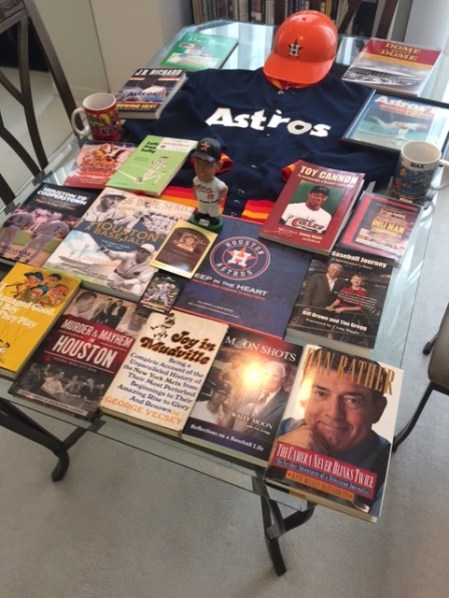
Maxwell Kates’ Collection of Books, Articles, and Other Items  that remind him of his contact with the SABR Larry Dierker Chapter.

Maxwell Kates Writes to The Membership of our SABR Larry Dierker Chapter in Houston. We thought that we would simply beat him to the punch by being the first to express our own high appreciation for his gifting presence in our own lives as members of the even larger baseball community that has thrived in Houston since the mid-19th century.

Max, your thoughtfulness of others bleeds with caring from you for others and their own long paths of hope for baseball’s greatest prize. Somehow, it simply seems part of a larger plan that your physical and conscious spiritual arrival in Houston occurred when it did – in a year that shall be forever remembered too as 2017 – the season in which one of the greatest pitchers in Detroit Tiger history arrived in time to join the Astros as a principal leader in the club’s run over the three most storied franchises in baseball winning history. Down fell the Red Sox, the Yankees, and the Dodgers – as the Houston Astros rolled to their first of what we all hope shall be only the club’s first victory in World Series play.

Keep up the wonderful monthly articles you are now doing for The Pecan Park Eagle too. We love your work and the spirit in which it is done.

Oh yes. In reference to the lead photo above, here is what Maxwell plans to say to us on Facebook tomorrow:

“This is what I plan to post tomorrow (on Facebook).  Everything in this picture is associated with a memory of someone in the Larry Dierker Chapter of Houston.  Tomorrow is the third Monday in February which marks the one year anniversary of my presentation at the Spaghetti Western.  Thank you all for the opportunity and for the memories and see you again on my next visit to Houston.

“Since the Detroit Tigers are going to be awful this year, don’t be surprised to hear me cheer for the Astros to repeat as World Champions in 2018.  Have a good meeting tomorrow for those who plan to attend.  MK.”


********************

Bill McCurdy

Principal Writer, Editor, Publisher

The Pecan Park Eagle
Fantasy Two-Juice Shot to Astros Lineup

February 18, 2018

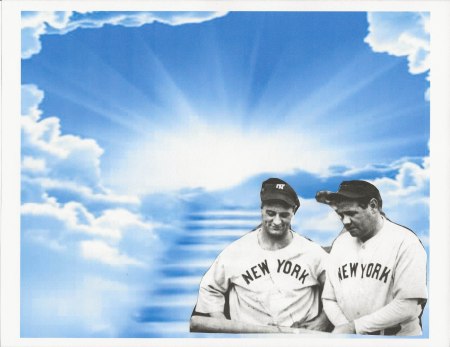
Gehrig: “What do you think, Babe? – Do we go back down there to join the 2018 Astros if we get picked?”
———-
Ruth: “Hell yes, Keed! – We GOTTA go! – These heavenly music organs ain’t got no games that follow them – and we are way too long between every whack I crave, as is! – Just hang with me. – Did I ever hand you a bum steer?”

Hey, Astro Fans!

If you could pick two players from the same previous MLB season team – from anywhere in baseball history – and magically plug them into the Astros Lineup 2018 lineup or pitching rotation at their same level of production for that particular team in that season, which of these combinations would you select? Some of these choices offer more power, others offer higher batting averages, still others offer greater speed, along with one that delivers stronger pitching only – and another that goes 50-50 on batting/pitching.

Feel free to pick your own combos, as long as both players are from the same historic team from the same year and at the level they each performed that particular season.

The Pecan Park Eagle welcomes and encourages your feedback. We’d like to know how you would cash in your pick at the “Baseball Fans’ Make-A-Wish Foundation” if this kind of magic were actually possible. Of course, with the talent in reality that is already signed up, your choices are going to also require you to sit a couple of people that would otherwise be playing a lot more this season without their gify-presence, but not to worry. This one’s all in fun!

THE CHOICES WE HAVE RESEARCHED FOR YOU AS OPTIONS:

1) 1927 Yankees: Babe Ruth, RF (.356, 60 HR, 164 RBI) and Lou Gehrig, 1B (.373, 47 HR, 175 RBI)

2) 1911 Tigers: Ty Cobb, CF (.420, 127 RBI, 83 SB) and Sam Crawford, RF (.378, 115 RBI, 37 SB)

3) 1965 SF Giants: Willie Mays, CF (.317, 52 HR, 112 RBI) and Juan Marichal, P (22-14, 2.13 ERA, 240 K)

4) 1948 Cardinals: Stan Musial, LF (.376, 39 HR, 131 RBI) and Enos Slaughter, RF (.371, 11 HR, 90 RBI)

5) 1963 LA Dodgers: Sandy Koufax, P (25-5, 1.88 ERA, 306 K) and Don Drysdale, P (19-17, 2.63, 251 K)

6) 1972 Cubs: Ron Santo, 3B (.302, 17 HR, 74 RBI) and Billy Williams, LF (.333, 37 HR, and 122 RBI)

7) 1959 M Braves: Eddie Mathews, 3B (.306, 46 HR, 114 RBI) and Hank Aaron, RF (.355, 39 HR, 123 HR)

8) 1961 Yankees: Mickey Mantle, CF (.317, 54 HR, 128 RBI) and Roger Maris (.269, 61* HR, 141 RBI)

9) 1966 Pirates: Roberto Clemente, RF (.317, 29 HR, 119 RBI) and Willie Stargell, LF (.315, 33 HR, 102 RBI)

Pick one of these, find a pair from the same year and team, and let us see your new 2018 Astros Lineup or Rotation, if you are willing to share the joy.

Have Fun! – You too, Jeff Luhnow and A.J. Hinch!


********************

Bill McCurdy

Principal Writer, Editor, Publisher

The Pecan Park Eagle