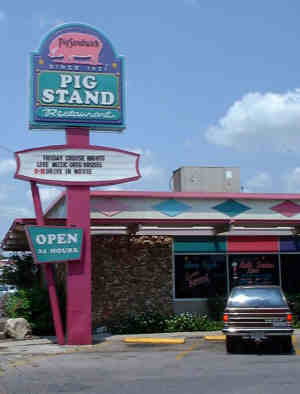
Remembering the Pig Stand.

January 8, 2010

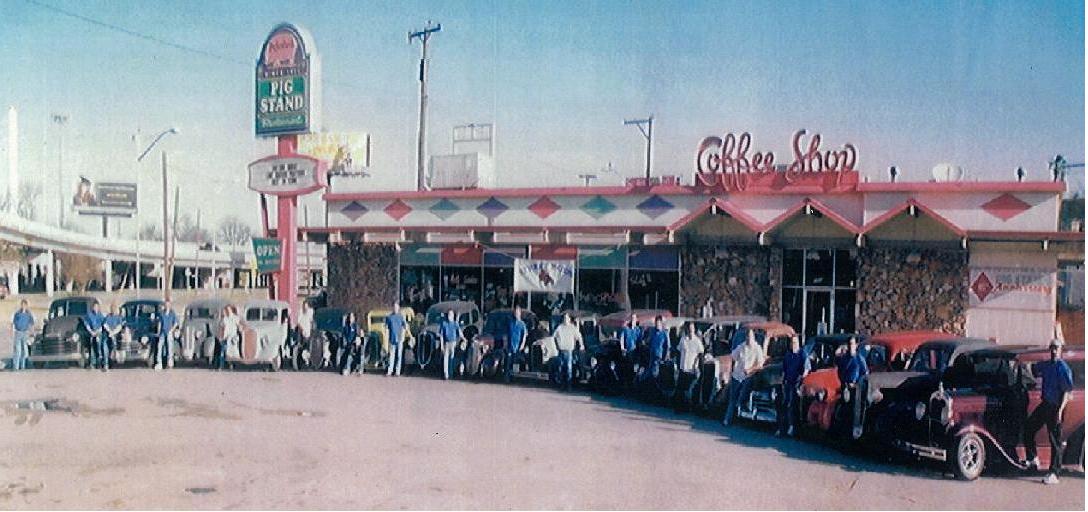
Do you remember the last Pig Stand restaurant, the one that used to operate on Washington Avenue? This Houston Pig Stand  closed its doors forever sometime in the last decade or so. It is now the site of Sawyer Park, which, according to local historian and man-about-town Mike Vance of TV Channel 55,  is now one of the hottest sports bars in the city these days.

The subject came up for me as Mike Vance and I were conversing via e-mail last night on the subject of Houston’s drive in restaurant history. Mike had asked me what I remembered or knew of any burger business that may have have preceded Prince’s in Houston. The local Prince’s Drive In chain opened in 1934.

Well, even I am too young to recall anything prior to 1934. All I could think of was the Pig Stand, even though they were famous for their pig sandwich. I’m not sure they even offered burgers too. As a kid of age five, I remember my parents taking us there to the one on Washington Avenue while we were still living in the Heights. Seems to me there was also a Pig Stand in the Heights itself, but my memory of that possibility may be shaky. I couldn’t even recall the curb service on Washington. My memories are of eating a pig sandwich inside the place.

The Pig Stand holds quite a place in Texas restaurant history, The first one opened in the Dallas area in 1921 as American entrepreneurs scrambled to take advantage of new market needs generated by the growing populariy and presence of the automobile. Places offering “curb service” became the call of the times as Americans travelled further, ate out more, and got lazier about how they dined. It wasn’t long before the Pig Stand chain of the 1920s expanded into San Antonio, Houston, Beaumont, and even into California, on a coast-to-coast expansion of places offering both “drive through” and “curb service” purchase of those “oink-o-licious” pig sandwiches.

The Pig Stand movement reached its big trough days during the 1930s when 130 stores opened all around the country. The chain takes credit for the mass introduction of several food items beyond the star pig sandwich too. These included Texas toast, deep-fried onion rings, and the chicken fried steak sandwich. The Pig Stand stores were among the first to offer fluorescent lighting, neon lights, and air conditioning as well.

Mary’s Pig Stand on Broadway in San Antonio is now the Alamo of them all, staying open in good faith and tribute to a bygone era and a business that once played its part in the eventual destruction of the family home evening meal. I only wish they were closer to home in Houston. Those delicious pig sandwiches were good enough to have  earned a week’s full of condemnation from health specialists like Dr. Oz of daytime television medicine, but they were still sooooooooo soooie-goooie good!

We’d love to have your memories of the Pig Stand here too as comments. Also, if you can think of any burger businesses that were big in Houston prior to Prince’s, please feel free to write about them too.

Dawson, Blyleven, & The Hall of Fame.

January 7, 2010

Andre Dawson Elected to Baseball Hall of Fame.

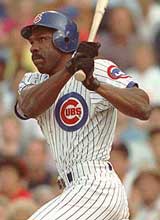
It took him nine ballots over nine years to finally get there, but former Montreal Expo/Chicago Cub slugger Andre Dawson finally arrived as a selection for the Baseball Hall of Fame on Wednesday, He collected 420 votes from the 539 eligible voters of the Baseball Writers’ Association for 77.9%, or just over the 75% a candidate needs for selection according to the rules in place.

Coming close with no cigar in 2010 were 13-time nominee and former pitcher Bert Blyleven (400 votes/ 74.3%) and first time candidate and second baseman Robbie Alomar (397 votes/73.7%).

Dawson finished 15 votes over the minimum number of 405 votes he needed this year after falling 44 votes short of the mark in 2009. Blyleven fell 5 votes short of election after picking up 62 new votes this year over his 438 vote total in 2009.

What happened to bump these changes? Did the BWA electoral group  suddenly go through a wholesale change of actual voters who feel that much more positively about Dawson and Blyleven in 2010? Did the passage of another year’s time simply soften certain hearts in the wake of all the other bad news in the world about terrorism, bailouts, Ponzis, and health care? In a way, I can see that happening with some writers. “You know,” I can see some writer saying to himself or herself, “I can’t do much about all the lousy things that are going on in this crummy world, but I can sure do something about Andre Dawson out there twisting in the wind of the Hall of Fame vote all these years! I’m changing my vote in 2010 from no to yes!”

Could happen. There’s a certain “he’s suffered long enough” factor at play with candidates like Andre Dawson. It’s so big, in fact, that it almost dragenetted Bert “When do I get in?” Blyleven into the mix for 2010 as well.

Add to the voting climate the impact of last week’s Veterans’ Committee selection of manager Whitey Herzog and umpire Doug Harvey to the Hall of Fame as a factor affecting the BWA vote of Tuesday. After the Herzog/Harvey announcement, there had to have been some writers who thought: “Well, if they’re going to let those two bozos in the front door this year, there’s no way I can keep passing on Andre Dawson or Bert Blyleven!”

Andre Dawson subscribes to the old “cream rises” theory about his selection. Said Sir Andre, only one day ago: “If you’re a Hall of Famer, eventually you’re going to go in, no matter how long it takes.”

Dawson’s accomplishments as a hard-hitting right-handed outfielder may have entered into the mix of his selection somewhere too. In his twenty-one year career (1976-1996), Dawson had 438 home runs and 1,591 runs batted in. “The Hawk”, as he came to be known, earned the National League Rookie of the Year honors during his first full 1977 season at Montreal. Ten years later in Chicago, Dawson was picked as the NL Most Valuable Player, becoming the first member of a last place club to have earned such an honor. Along with Barry Bonds and Willie Mays, Andre Dawson is one of only three players to have combined 400 home runs and 300 stolen bases into a single career. He also played for Boston and Florida during his career, but he never made it with a club that qualified for the World Series.

Personally speaking, I’m happy to see that Andre Dawson finally satisfied the gauntlet runners who have been postponing his date with Hall of Fame destiny. Don’t bet on Bert Blyleven missing the cut again next year either. His time is finally nearing. Barring the sudden appearance of some Tiger Woods-like event in his personal life, Bert Blyleven will be selected for the Baseball Hall of Fame in 2011 by a comfortable margin.

A Pitch to Remember.

January 6, 2010

"You could've knocked me over with a feather!"

Of all the billions and billions of birds in this world, the unluckiest of these will forever be the seagull that just happened to intersect air space with a Randy Johnson fastball once upon a time on a field, and in a game, now reasonably forgotten as to game day particulars.

What we are likely to remember almost as much on the general impression level is what happened to all the big league pitches he threw in twenty-two years that didn’t bring “death to flying things” nor delay the actual playing of games. These ultrasonic “K” pitches  only delayed and derailed the  individual career hopes and team victory aspirations of whoever found themselves batting against Randy Johnson.

When year in and year out, otherwise superior hitters start playing some games just to keep from getting killed more than anything else, a manager has to know that he’s got a special weapon in his starting rotation when he sends a fellow named Randy Johnson out there to pitch. Several fortunate big league managers, including the Houston Astros own Larry Dierker, got to have that reassuring experience. Aside from J.R. Richard of the Houston Astros in an earlier era of primal batter’s fear, Randy Johnson probably was the scariest pitcher that anyone in the big leagues ever had to face.

Beyond human fear installation and avian assassination, Randy Johnson got positive game outcome results, big time.

Look at his base record. Res ipse loquitur.

The 6’10” lefty Randy Johnson has finished his MLB career (1988-2009) with a record of 303 wins, 166 losses, an ERA of 3.29, and 4,875 strikeouts as a starter for the Montreal Expos, Seattle Mariners, Houston Astros, Arizona Diamondbacks (twice), New York Yankees, and San Francisco Giants.

A surefire first-time selection for the Hall of Fame in five years never walked this tall into the tiny village of Cooperstown, New York.

Frank Liuzza: Houston Says Goodbye to a Good Man.

January 5, 2010

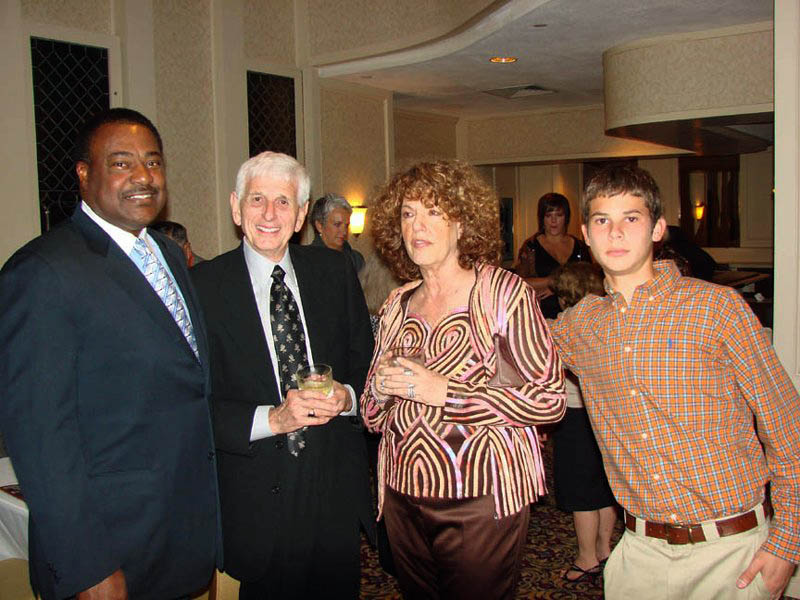
At the 2007 Texas Baseball Hall of Fame Banquet: Former Big Leaguer Don Baylor; Houston Black Buffs Founder Son, Frank Liuzza; Dr. Sue Hepler-Liuzza, Spouse; & Frank Liuzza Grandson, Randall Taliaferro.

Houstonian Frank Liuzza died in St. Luke’s Hospital this past Saturday, January 2, 2010, at the age of 80. With his passing, Houston surrendered one its genuinely caring citizens. Frank was  a man of great integrity, outspoken honesty, and clear passion for life, family, true friendship, the history of this city, the arts, music, and everything that had anything to do with fast cars.

Like his father, John Liuzza, and his uncle, James Liuzza, before him, Frank loved the great game of baseball. He was a fine hitting and fielding lefty first sacker for St. Thomas High School, St. Thomas University, and the University of Texas in the years immediately following the end of world War II. He had hopes for a professional career, but those were dashed by injury and a greater call to military service duty with the U.S. Army during the Korean War. After the war, Frank used his undergraduate degree work in accounting at the University of Houston to embark upon a successful lifetime career as a commercial real estate broker.

In the short late-in-life time I knew Frank Liuzza as a personal friend, and he was just that, a true friend, I learned how driven he was personally by the business life  and everyday living experiences of his Italian immigrant grandfather and family in the Houston fifth ward. Frank had an outstanding head for detail, great respect for the work ethic, total loyalty to the idea of family, and complete love for everyone before him and after him in the Liuzza family bloodline, from grandfather to grandson.

Frank Liuzza and I bonded as friends in 2007 on the wings of circumstances that now still ring like the plotline of a twilight zone story. All you may need to know to more fully appreciate the tale is this fact: All of my adult life, or so it seems, I’ve been looking for documentation on an old Negro League baseball club that once existed here as the “Houston Black Buffs.” All I’d been able find through the early fall of 2007 were a few scattered box scores and game action reports from the Houston newspapers of the 1930s.

Then one day, in the fall of 2007, I received a phone call from a former Tulane University graduate school friend and colleague, Dr. Sue Hepler. We probably had not talked in fifteen to twenty years and our relationship had nothing to do with baseball. Sue had just wanted to reach out and see how I was doing. Even she had no previous idea of how my recent years have become so immersed in the fields of baseball writing and research. We are both mental health field professionals by trade.

When Sue learned of my baseball passion, she said, “You know, Bill, the funny thing is, I’m married to a guy here in Houston whose family once owned a local black baseball team. I think they were called the Houston Black Buffs.”

You could have knocked me over with that proverbial feather.

Dr. Sue Hepler-Liuzza was married to Frank Liuzza, whose father and uncle founded the Houston Monarchs (later known as the Black Buffs) in 1924. The family owned the club through its final straw year of 1954, when Frank Liuzza himself came home from Korea in time to close the books on an era that had ended.

I was Board President of the Texas Baseball Hall of Fame back then. We recognized Frank Liuzza and his family history with the Houston Black Buffs at our November 2007 banquet. And that’s how Frank and I met – and how the history of the Houston Black Buffs came out of the shadows.

I last saw Frank Liuzza in September 2009, when we both went over to TV Channel 55 to record some material for Houston baseball and community history with Mike Vance, one of our local media’s foremost historians. Even though we didn’t see each other often or know each other for long, I will miss Frank Liuzza as the good friend and great Houstonian he truly was.

Footnote: This article was published by The Pecan Park Eagle blog on WordPress.Com on Tuesday, January 5, 2010. It is dedicated, henceforth, to the deserved and lasting memory of Mr. Frank Liuzza and also equivalently to the ongoing, soaring soul of his life partner, Dr. Sue Hepler-Liuzza.

Baseball 2010: My All Time Starting Lineup.

January 3, 2010

The new year’s arrival inavriably turns people like me to thoughts of spring and to the return of the baseball season. More than that, I’m hastened always to re-evaluate my all time starting nine players, which I’ve learned are not so permanent as fixtures on the field as I once considered them to be.

When I was a kid, somewhere in 1947 to 1948, I received my first book on the greatest baseball team of all tme. WIsh I still had the book or even remembered the author(s), but I wore it out years ago, staring at the words and pictures and treating the writer’s conclusions as pretty much gospel fact.

Gospel fact? Not even close. This book came out right around the time of Jackie Robinson’s first steps over the color line. This all star team had no body of work from blacks as big leaguers to make a case for any of them, and their accomplishments in the Negro Leagues were totally ignored. Of course, there could not have been any room in the inn for any of the great players of any stripe or color who have come along in the sixty years since that book was written.

What I will do today is to present my current all time starting nine players and to provide some brief explanation of why I chose each pick. First up, however, allow me to show you how my “1947” book presented the best nine players of all time some sixty plus years ago. That lineup proceeds from here with each player’s year of selection for induction into the Baseball Hall of Fame included in parentheses next to his name:

Pitcher: Walter Johnson (1936)

Catcher: Bill Dickey (1954)

First Base: Lou Gehrig (1939)

Second Base: Rogers Hornsby (1942)

Third Base: Pie Traynor (1948)

Shortstop: Honus Wagner (1936)

Left Field: Joe DiMaggio (1955)

Center Field: Ty Cobb (1936)

Right Field: Babe Ruth (1936)

Please note: These choices were made a mere eight to nine years past the 1939 opening of the Baseball Hall of Fame and only eleven to twelve years beyond the 1936 first HOF induction class selections. Four of the nine players came from that 1936 first-ever class. Another came from the 1939 class. Two others were HOF members selected in the 1940’s; and two more weren’t even inducted until the 1950’s. Joe DiMaggio, in fact, was still an active player in 1947. He would  not see HOF induction until 1955.

For years, as a kid, I treated these selections as though they were the final say on the subject, but as my ability to question and think for myself improved, I began to question some of the choices and why the book had placed Cobb in center field and the great DiMaggio in left field. In spite of his all-time career .367 batting average domination, I would even come to question the presence of Ty Cobb on my personal lst of the nine greatest players. That evaluation was helped by the emerging mark of black players in the big leagues, particularly of Willie Mays, the greatest five-tool player of all time. No way I could leave Mays off a club at the expense of the cross-handed batting, mean spirit that was Ty Cobb. I wasn’t interested in making my lineup out from a bunch of choir boys, but I preferred leaving off a hate-mongering, probably homicidal superstar when I had a perfectly good superior substitute to put in his place. Through my reading and research over the years, I also came to a greater appreciation for some of the old time Negro Leaguers who never had the chance to play in the mainstream big leagues. As a result, here’s what my all time starting lineup of greatest nine players looks like today:

Cool Papa Bell, rf (1974) Satchel Paige once said of Cool Papa’s legendary speed that “he’s the only man I know who can switch off the bedroom light at the door and then get into the bed and under the covers before the room grows dark.” Bell is reputed to have scored from second base on a sacrifice fly and to have covered more outfield ground than any center fielder in history. He was also an outstanding slash and run hitter and base-stealer over his years in the Negro Leagues. In spite of his speed, I still choose to leave center field in the hands of another pretty talented guy and let Cool Papa shrink any threat of a bloop hit to right to almost nothing.

Oscar Charleston, 1b (1976) Regarded by many as the greatest player in Negro League history, Charleston may have also beeen the greatest center fielder of all time in his youth. His career batting average of .348 and slugging power beyond .500 was stunning. Dizzy Dean said he didn’t have a weakness. I’m simply placing Oscar at his veteran position of first base to be sure that I have his bat in the lineup. Again, I’m saving center field for the arguably most dramatic talent to ever play there in all of baseball history.

Babe Ruth, lf (1936) He was “The Bambino”, “The Sultan of Swat”, “The Babe”. Nuf sed.

Josh Gibson, c (1972) Most often referenced as “The Black Babe Ruth,” Josh Gibson probably hit well over 800 home runs during the course of his Negro League career. He didn’t simply hit them often. He hit the kind that seemed to disappear in the sky beyond the stadium wall – ever bit as far or better than any that ever took flight from the bat of the Babe.

Willie Mays, cf (1979) He will always be remembered as that arms and legs player dashing madly to the deepest part of center field at the Polo Grounds in 1954, on his destined way to “The Catch” of s deep drive by Cleveland’s Vic Wertz in the World Series. He also will never be forgotten for his arm, his bat, his legs, and his unbridled power. Hitting .302 lifetime, Willie’s 660 home runs places him 4th on the all time list behind Barry Bonds (762), Hank Aaron (755), and Babe Ruth (714). He lacked DiMaggio’s grace on defense, but he more than made up for it with dramatic athleticism in the field. “Say Hey, Willie! You’re my guy in the central pasture.”

Rogers Hornsby, 2b (1942) With a .358 career batting average and three seasons hitting over .400, “The Rajah” is still considered by many as the greatest righthanded batter of all time. He’s good enough to be my second baseman, even ater all these years.

Martin Dihigo, 3b (1977) “Dihigo was the best all around baseball player I’ve ever seen,” said Baseball Hall of Fame fellow member Buck Leonard. Dihigo could play all nine positions at an excelent level. To appreciate how gifted Dihigo was, in 1938 in the Mexican League his .387 batting average won the batting title and, as a pitcher, he was 18-2 with an 0.90 earned run average. I’ve got Martin at third base because that’s where I need this super-athlete the most.

Honus Wagner, ss (1936) “The Flying Dutchman” and his .327 batting average for 21 years in the big leagues is still my choice at shortstop. Similar to Dihigo as an outstanding athlete, the bowlegged Wagner could most likely have have played any position he chose to try – and played it well. He simply couldn’t get away from shortstop once the Pittsburgh Pirates found out  how well he fit that long term need on their early 20th century clubs. Now he has the job on my club too as one of three men who have survived from that original all star notion of my childhood as members of my own selected group.

Cy Young, p (1937) I’ve been a Christy Mathewson fan over Walter Johnson for years, but when it came right down to making this critical pick, I found I could not pass up the man who holds one of baseball’s least likely-to-ever-be-broken records of 511 career wins. Look! If we’re going to give an award in his name to the two best pitchers each year in the American and National leagues, how could we not pick Cy “I’m That Guy” Young as our all star pitcher of all time?

At any rate, those are my arguable nine picks as I now see things in 2010. They may change again over time and probably will. Unless baseball suddenly dies, the membership in this lineup will never be fixed or cast in bronze forever. Your choices may be a little to greatly different than mine. That’s OK too. All I know for sure is, I’d be happy to take on your different club with my nine guys anytime of the week we can reserve a playing field in the Twilight Zone.
Today.

January 2, 2010

2010: The Dawning of a New Day!

Happy New Year again, Dear Friends,

From smack dab in the middle of today!

At the dawning of 2010, it might be well for us

To spend a few seconds reflecting upon some ancient truths

About promises and resolutions; apologies and regrets:

We cannot capture what is yet to be

With our promises.

We cannot regain what might have been

With our regrets.

We cannot reach tomorrow faster than

The unpromising sun.

Nor can we hold onto yesterday

With our tears.

Life is always, here and now, today,

The place that empowers us with wisdom

From the past, as it prepares us for the future

With a more workable vision of what is to be.

Let us live today, not by how we simply pass the time,

But by how we put ourselves fully, heart and soul,

Each single day we wake up breathing life’s new air,

Into the loving passions of our lives over time.

Can today be enough of life for each of us?

It had better be. It is all we have and it is very large.

Today only seems small when we fail to realize

How truly big it really is.

Today is the universe of our human experience,

Where all things play out on the basis of what

We each do – and fail to do, about the stuff that matters,

Here and now – from today to forever.

Happy New Year, Friends!

December 30, 2009

Happy New Year, Everybody!

New Year’s Eve. It’s the great time in the year to be optimistic about ourselves and the world around us. And why not? Things get done by people who believe in possibility. They are never improved by pessimistic resignation to the idea that there is nothing we can do as individuals to improve our fit in the human condition.

Symbolically, we treat the stroke of midnight on New Year’s Eve as though it were the timegate into a better world – one that simply floated into our lives on the pendulum swing of a clock stroke. It’s here! Happy New Year! And who knows? It may be, if we are willing to live the things we so easily promise on New Year’s Eve. It will be too, if we simply take a greater responsibility for doing the things we can actually do something about, and if we are willing to learn from our mistakes along the way and settle for progress over perfection as the most realistic human result. In small consumable bites, we can get there, if “getting there”  is at all possible, and it will all unfold for us on its own timetable, one day at a time.

Pretty cool stuff.

I’m also blown away this time of the year by all the things that seem to symbolize New Year’s Eve. In words and pictures, here are the major ones that occur to me. I’m sure that others may come to mind for you. Some of my selections only come from my personal experience (see the Marx Brothers below), but most of these icons are fairly universal to our American profile of the day so many people pop open the bubbily:

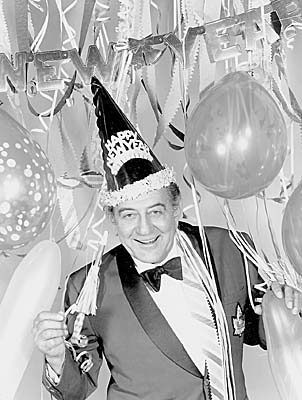
Guy Lombardo was in charge of New Year's Eve from 1929 to 1976.

Guy Lombardo and his Royal Canadiens played a New Year’s Eve gig over the radio from New York hotels from 1929 through 1976. Over the six decades his music touched directly, we pretty much placed the Canadian immigrant in charge of the American New Yeat’s Eve celebration. His rendition of “Auld Lang Syne” remains the one we still hear when the big crystal ball descends at Times Square in the 21st century.

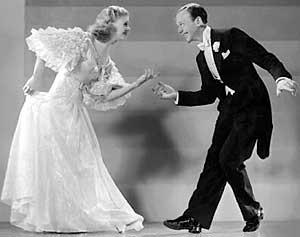
Ginger Rogers & Fred Astaire: "Shall we dance? Shall we ever!"

Ginger Rogers and Fred Astaire are my second big throwback icons from the time we dressed to the nines on New Year’s Eve and danced our way into the new year. We never performed at the the level of those two Hollywood immortals, but our hearts and hopes still soared where our feet couldn’t go.

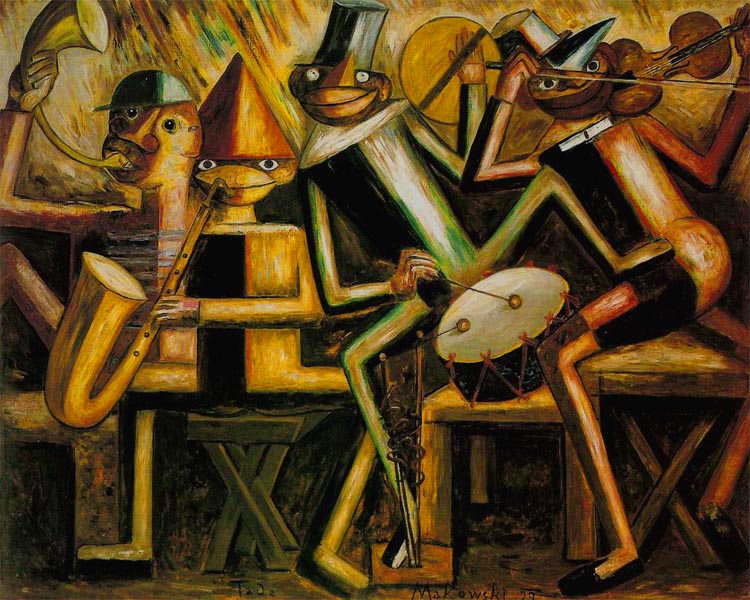
... and all that jazz!

Can’t imagine New Year’s Eve without music. Jazz was king when the big new year’s eve celebration came alive back in the boom days of the rhe “Roarin’ Twenties”, but American classic pop, rock ‘n roll, classic, country & western, rap, and hip hop have all since found their own voices and steps to the art of singing and dancing in the new year.

~ drunk again is now a bigger sin ~

Back in the day, many New Year’s Eve partygoers simply lived to get plastered on that special night. Then they got in their cars and attempted driving home. Some people still go this route, but we’ve gotten better over the years at taking better care of ourselves and others where public drinking is concerned. People over age 30 don’t thoughtllessly throw “falling-down-drunk” parties as they once did – and those who do plan drunk nights for themselves also are better at planning designated driver assignments with othera, or for pre-arranging to stay wherever they plan to party.

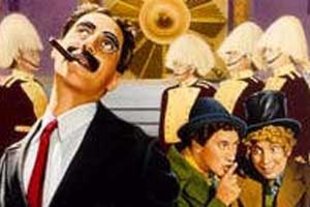
"Last night I shot an elephant in my pajamas. How he got in my pajamas, I'll never know." - Groucho Marx.

The Marx Brothers have long been associated with New Year’s Eve. Perhaps it’s because of all the zany party scenes that pop up in most of their movies from the 1930’s. Maybe it’s just because the boys have a unique talent for making people laugh at the self-importance of all the big egos they disrobe in their consistently anti-authoritarian movie plots. Botom Line: The boys are funny and happy on a day in which funny and happy is exactly what most people want to be.

Even an aging Joe Montana handled the Oilers during his falling apart, ragged last year at QB for the Kansas City Chiefs.

Many people spend New Year’s Eve in rapture over the playing of the last big New Year’s bowl games – or in painful memory of the Houston Oilers. These are the people who need to show more resolve in letting go of past regrets.

Dick Clark counting down another rockin' new year's eve.

He’s today’s Guy Lombardo, Dick Clark sure is, and probably Clark’s bigger than Lombardo because of television and the Internet. We thank God that Mr. Clark is back with us publicly again to bring in 2010 with the dropping of the big new crystal ball in Times Square. We shut-ins, voluntary and otherwise,  especially enjoy it.

"Should auld acquaintaince be forgot, and never brought to mind..."

The singing of auld ang syne is a must on New Year’s Eve. In case you’ve forgotten how it once sounded, here’s how the popular first verse and chorus rings forth in the phonetics of Scottish speech from the 18th century:

Shid ald akwentans bee firgot, an nivir brocht ti mynd? Shid ald akwentans bee firgot, an ald lang syn?

CHORUS:
Fir ald lang syn, ma jo,
fir ald lang syn,
wil tak a cup o kyndnes yet,
fir ald lang syn.
 

"Should auld acquaintance be forgot, and never brought to mind?"

Happy New Year, Everybody! Dance like you know what you’re doing this New Year’s Eve and kiss like you really mean it. If we all make it to midnight tomorrow night, we should first pause for a moment of gratitude and then prepare ourselves to live each coming day of 2010 with as much inner directed purpose as we can bring to the table. None of us are ever guaranteed another sunrise, let alone, another new year. No matter how old or young we are, it’s time to lean forward into tomorrow on the strength of today’s hope – and not to fall back into any old regrets we may still have about the past. Our time is now. It always is.

Every moment is a timegate to change when we wake up to the fact it is.

Happy New Year, Friends!


Oscar Holcombe: The Plastic Man of Houston Politics.

December 29, 2009

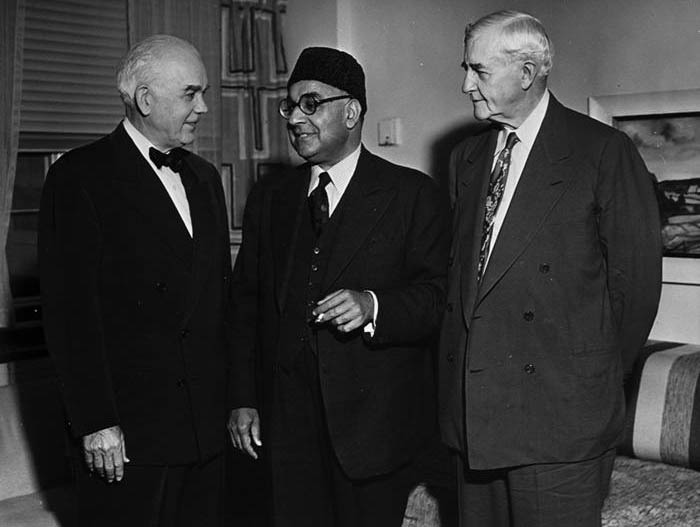
Oscar F. Holcombe was an absolutely amazing Houston politician. Had he lived to celebrate the December 31st birthday that he shares with me and God knows how many others, he would need 121 candles to torch each of his

Houston Mayor Oscar F. Holcombe, Pakistani Prime Minister Ali Khan, & Houston Power Mogul Jesse Jones, 1950.

earthly years. Born in in Mobile, Alabama on December 31, 1888, Holcombe’s family moved to San Antonio when he was very young. After growing up in the Alamo City, Holcombe moved to Houston at age 18 and started making a living in construction. Holcombe married Mary Grey Miller on May 3, 1912. They had one daughter.

By age 26, he had formed the O.F. Holcombe Company as his own construction business. He was on his way to using his business savvy and political contacts as a pathway to riches as one of Houston’s new millionaires.

In 1921, Holcombe entered politics and was elected for his first term as Houston’s mayor. He would end up serving as Houston’s mayor for 22 years, but over 11 non-consecutive terms across four decades. He was the most resilient politican in Houston’s history, adapting to changes in the times and rarely losing his broad appeal in the face of fast growing and changing Houston voter demographics. Holcombe was a soft spoken business-oriented conservative who advocated and believed strongly in the city’s physical expansion of its georgraphic boundaries and in the growth and maintenance  of public services like libraries, adequate sewage, and the development of a superior municipal auditorium for special shows and functions downtown.

Holcombe’s mayoral terms extended from 1921 to 1929; from 1933 to 1937; from 1929 to 1941; from 1947 to 1953; and from 1956 to 1958.

During the early 1960s, Houston renamed the section of Bellaire Boulevard east of Southside Place which runs through the Texas Medical Center, as Holcombe Boulevard. In the late 1980s, the municipality of West University Place also renamed Bellaire Boulevard as Holcombe Boulevard within the space of its jurisdiction.It was a fitting tribute to a man who had personified the Houston boomtown spirit as clearly as it had been drafted by local mover and shaker Jesse Jones. Holcombe was the man to have in office whenever Houston leaders wanted to get some new development deal done and under construction. His actions invited a hoarde of reform candidates along the way, including the late Roy Hofheinz, but people always seemed to come back to Holcombe, even after they threw him out for a term or two.

Was Holcombe dishonest? I can’t say. All I can tell you from what I recall and have since read more about is that he was a superlative politician. Does that help answer the question?

As for sports, Holcombe was was mayor during the time that Buff Stadium was built and opened four miles to the east of downtown Houston in 1928. He fell time-short of being in office when Houston won their battles for major league baseball and football, but I think he supported those goals in general, even if he did not support the personal gain that passed to his old rival Roy Hofheinz through baseball. During the great “bigger is better” era of  Houston shaker thought, Holcombe favored “bigger and wider” as goals that were good for Houston – and quietly profitable for those that did the actual financing and building of growth and expansion.

Oscar F. Holcombe passed away in Houston on June 18, 1968 at the age of 79.

Sherlock Holmes: More and Less.

December 28, 2009

Rathbone & Bruce as Holmes & Watson (1939-46)

Law & Downey as Watson & Holmes (2009)

If you’ve been a fan of Sherlock Holmes any longer than the time that’s now lapsed since Christmas Day, and you’ve also seen the new movie, you will have already duly noted some major differences in the screen personna of the famous detective character as portrayed in this 21st century version by Robert Downey, Jr. in comparison to the earlier Basil Rathbone interpretation.

The similarities and differences between the the Downey and Rathbone versions are elementery.

First the similar: (1) both are brilliant; (2) both are geniuses living in apparent physical chaos at 221b Baker Street in London in the late 19th century; (3) both use the violin to encourage deductive balance and to test certain theories of math; (4) both are totally dedicated to deductive reasoning as the pathway to truth; (5) neither has an apparently real or ongoing close relationship with a significant adult female; and (6) both have a close adult male friend named Dr. John Watson as their partner in crimefighting.

Now for the differences: (1) Rathbone is far more verbal; (2.) Downey is far more physical; (3) Rathbone is far more reserved in the presence of attractive women; (4) Downey is far more open to whatever may be desirable or possible in the presence of attractive women; (5) Rathbone’s friend Watson is little more than a glorified “go-fer” guy than he is an intellectual partner in crimesolving; (6) Downey’s friend Watson covers Holmes’s back mentally and physically at every turn.

Unlike Rathbone’s Watson, played by the bumbling older actor Nigel Bruce, Downey’s Watson, played by age peer Jude Law, is young, virile, physical, and he is recently engaged to be married. You get the impression at first  that Holmes dreads the thought of losing his partner in crimefighting to Watson’s impending marital bliss. Hints of a latent homosexual relationship betwenn Holmes and Watson are fairly well erased as a star-crossed female love reappears through the plot into the life of the world’s greatest detective.

I liked the new movie. I loved the cinematic portrayal of late 19th century London. It’s simply far different from the classic Rathbone versions. The older Holmes placed far more emphasis upon intellectual thought and expression in words. The younger Holmes, typical of the early 21st century zeitgeist, is also very smart, but much more inclined to action and physical force. Downey neither dressed the part nor talked the talk of the classic Rathbone Holmes. Not once does Downey wear the famous hat, smoke the Meershaum, or utter the phrase, “Elementary, my dear Watson.”

One other thing that’s different: if you watch the old Sherlock Holmes at home on DVD, you may watch it in the dark, if you so choose. If you watch the new Sherlock Holmes at the multi-cinemas, you have to watch it under the usual new conditions of constantly light-blinking cell phones sprinkling their way through the dark as younger viewers continue to text their ways through the playing of the movie without regard for any distraction they may be causing to others.

Are we simply becoming lost from the idea of consideration for others? The answer seems elementary.

Bill Yeoman: His Legacy to UH Was Loyalty.

December 27, 2009

When Bill Yeoman took over as the head football coach at the  University of Houston prior to the 1962 season, the Cougars  had j ust wrapped up sixteen years (1946-61) of poor to  mediocre play  at the least distinguished level of NCAA  competition. It was  hoped that the 34-year old former assistant  at Michigan State  would come down to UH and stay long  enough to finally get the  program on the right track. The TV  money in college sports was  next to nothing back then, and t  there was no BCS, of course, but  the major universities, the big  dog conferences, and four major  bowl games (the Rose, Cotton,  Sugar, and Orange) still decided  who played where in any  contests of post-season consequence.

Yeoman brought an impressive resume with him to UH for a    man so young. He layed his 1945 freshman year at Texas A&M  and then transferred to West Point. He played his three college ball eligibility seasons (1946-48) for  Army as a center under  the legendary Earl Blaik.  That ’46 club finsihed the year at 9-0-1 behind dual Heisman trophy winners and All Americans Doc Blanchard (“Mr. Inside”) and Glen Davis (“Mr. Outside”). Yeoman served as captain of the ’48 team during a season in which he achieved his own acclaim as a second team All American center. During his career at Army, Yeoman’s clubs finished with a total record of 22-2-4. Following graduation, Bill Yeoman served four years as an officer in United States Army (1950-53). After the service, Yeoman went to work as an assistant to  football coach Duffy Suagherty (1954-61) for seven years.

I had only been out of UH a couple of years when Yeoman arrived on the UH campus and I was still pretty tied as a young adult alumnus to whatever was going on at the old frat house of Phi Kappa Theta. We were all surprised when a simple phone call invitation to Bill Yeoman to join us for dinner at the animal house was not only accepted, but kept. The guy was just as down to earth and enthusiastic about UH football as could be. We all sensed that UH was in for a different deal from our young new coach. We simply had no idea how big and broad that echo of Yeoman’s loyalty to UH would carry.

After leading the Cougars to a 7-4 record and a win in the Tangerine Bowl during his first (1962) season, Yeoman became the man who led UH to integrate its athletic programs with the  signing of all-everything-world running back Warren McVea of San Antonio on June 11, 1964. During the 1965 season, Yeoman integrated something else quite powerful, introducing the world of college  football to his own invention, the veer offense. By 1965, the Cougars were also now playing in the new Astrodome – and beating name schools like Kentucky and Mississippi with the Yeoman veer attack. Things would never be the same on on old Cullen Boulevard. The Cougars proeeeded to lead the college football nation in total offense for three consecutive seasons from 1966-1968.

Improved play, victories over nationally big name opponents (like the 37-7 pasting of Michigan State in their own house in 1967) soon elevated UH to higher status, better scheduling, and greater positioning for membership in the Southwest Conference. When UH joined the SWC in 1976, it proceeded to celebrate the occasion by knocking off UT in Austin by 30-0 in Darrell Royal’s last year as coach, capturing the SWC crown, and then drubbing Maryland in the Cotton Bowl for a 4th place finish in the final polls.

Under Yeoman, UH went on to win three SWC championships in their first four years, and four SWC crowns altogether. The Cougars also made it to 11 bowl games during Yeoman’s 25 year reign as coach.  Coach Yeoman finished with a UH record of 160 wins, 108 losses, and 8 ties. He stayed on at UH after his retirement as coach following the 1986 season to help promote the university and  its football and other atheltic programs.

Wikipedia reports Bill Yeoman’s post-coaching awards in this way: He “was inducted into the University of Houston Hall of Honor in 1998. He was elected to the College Football Hall of Fame in 2001 and the Texas Sports Hall of Fame in 2003. Also in 2002, Yeoman received the Paul “Bear” Bryant Award Lifetime Achievement Award.Yeoman currently works as a fundraiser and Development Officer in the athletic department of the University of Houston.

Bill Yeoman could have become a wildly rich football man at places like Notre Dame, USC, Alabama, or Texas, but he didn’t go that route. He stayed with the lesser known university that gave him his big break long ago. Those of us who bleed Cougar Red shall be eternally grateful, as we also hope daily that current Cougar mentor Kevin Sumlin proves over time that he is made from the same stuff.