Longest Game in Houston MLB History

March 9, 2015
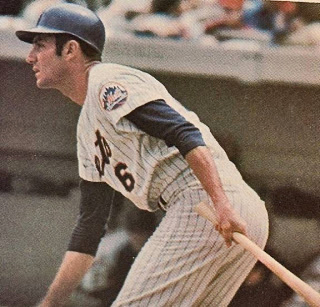
Using his bat for his misplaced glove, AL WEISS, SS of the Mets on 4/15/68, used this body  position to demonstrate his readiness for the ground ball that turned hiim into a human croquet wicket and that allowed a gound ball to slp through him for a 1-0 Astros win the bottom of the 24th.

AL WEISS, SS of the Mets on 4/15/68, made the fatigue error that allowed a ground ball to slip through him with the bases loaded for a 1-0 Astros win in the 24th.


The longest regular season MLB game by innings in Houston history occured at the Astrodome on April 15, 1968. It lasted until the bottom of the 24th. As quoted later by Astros Daily.Com, here’s how writer Vito Stellino of The Sporting News described the final inning for his game retrospective article of April 27, 1968:

Norm Miller was on his own personal 0-for-14 skid when he greeted Mets reliever Les Rohr with a single to right that started the bottom of the 24th. A balk moved him to second and a grounder by Rusty Staub advanced him to third with only one out. Meanwhile, Jim Wynn and John Bateman received intentional walks to load the bases setting the stage for (Bob) Aspromonte. On a 2-and-1 pitch, Aspro sent a sharp roller to Al Weis at shortstop. Whether it was fatigue or anticipating a double play to get out of the jam, Weis didn’t stay down and the ball rolled between his legs into left field as Miller came across the plate to win the game.” – Vito Stellino, The Sporting News, 4/27/68.

The 1968 Astros’ 1-0 bottom of the 24th win over the Mets game took 6 hours and 6 minutes. The record for longest regulation game by time, however, is that Chicago 7- Milwaukee 6 contest of 5/08/84 that you will also find in the following charting of the longest top games by inning. It lasted 8 hours and 6 minutes before it reached the end.

The 1-0 Astros victory over the Mets on 4/15/68 in 24 innings also zoomed to the top of the list as the longest shutout game ever played in MLB history..


BASEBALL ALMANAC
Longest Games / Inning Based Records
Record Lg Teams Innings

Date

Longest Game
By Innings
(20+ Innings)

[Bold=Record Holders]

NL

Brooklyn 1 at Boston 1

26

05-01-1920

NL St. Louis 4 at New York 3 25 09-11-1974
AL Chicago 7 vs. Milwaukee 6 25 05-08-1984
AL Philadelphia 4 at Boston 1 24 09-01-1906
AL Detroit 1 at Philadelphia 1 24 07-21-1945
NL Houston 1 vs. New York 0 24 04-15-1968


For a complete read of the Stellino TSN article, the box score, and a commentary by Astros historian Bob Hulsey on the Astros-Mets 24 inning game from April 15, 1968, click the following link:

http://www.astrosdaily.com/history/19680415/


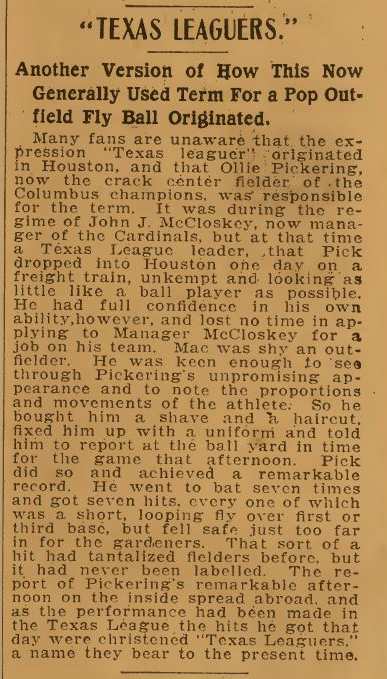
Ollie Pickering and His “Texas Leaguer” Legacy

March 8, 2015
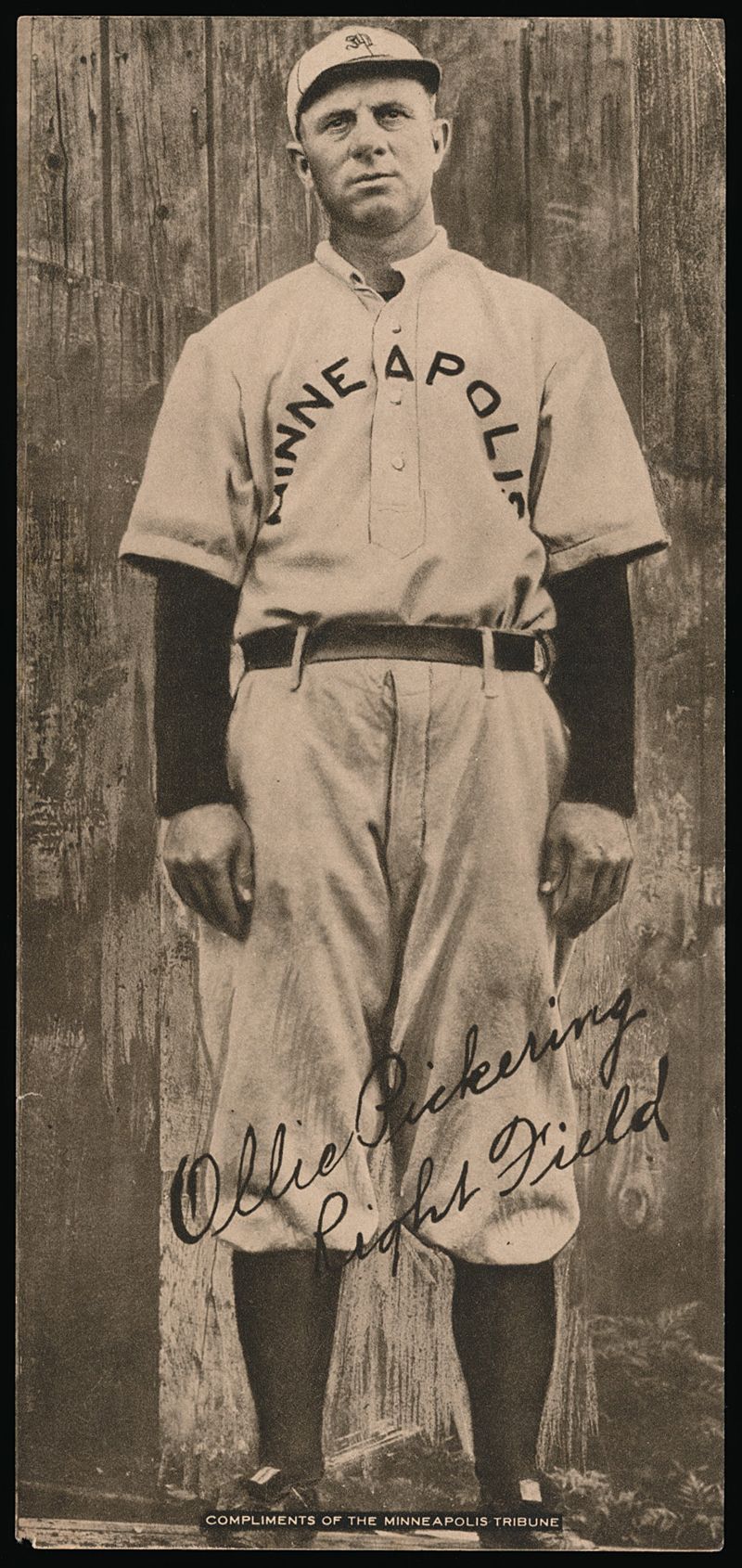
OLLIE PICKERING FATHER OF THE TEXAS LEAGUER

OLLIE PICKERING
FATHER OF THE TEXAS LEAGUER

Ollie Pickering was born April 9, 1870 in Olney, Illinois. He was a 5’11”, 170 lb. center fielder who batted left and threw right. “Pick” began his professional baseball career at the age of 22 with the Houston Mudcats of the Texas League in a trek through the majors and minors that finally concluded at age 52 with the 1922 Paducah Indians. Interesting to note that Pickering could have become famous for a career that was long. Instead, he achieved recognition for hits that were both too long and two short at the same time.

Here’s link to the career record of Ollie Pickering:

http://www.baseball-reference.com/minors/player.cgi?id=picker001oli

Back in 1892, legend has it that a 22-year old ballplayer named Ollie Pickering hopped a freight train to Houston, dropping in on Houston Mudcats Manager John McCloskey on May 21st to apply for a job on his player roster. Pickering’s physique and athletic movements apparently counted far more to McCloskey than his unkempt appearance, and the Houston manager was short an outfielder, anyway, going into a game to be played that same day.

McCloskey picked up Pickering on the spot. He had him cleaned up with a shave and a haircut and provided him with a uniform – and then told him to show up at the ballpark for the game scheduled for that afternoon. Pickering showed up, all right. He went to bat seven times and, each time he did, he softly stroked a looping, dink fly ball  beyond the first base side infielders that then landed before the right fielder could keep it from touching the ground – or else – he hit the same kind of lazy looper just beyond the reach of the third base side infielders that also touched down before the left fielder could catch it. – News of Pickering’s feat spread rapidly to the rest of the country and, because these easy to spot soft sailing singles all look so much alike, and because they took place every time in Pickering’s  seven-single Texas League game in Houston, these seven dwarf hits, and all of the thousands that have since followed them off all the bats of countless others, have became best known forever from that day as “Texas Leaguers”.

Have a peaceful Sunday, everybody – and don’t forget to move your clocks an hour forward.


Thank you, Darrell Pittman, for this article from the April 21, 1906 issue of The Sporting Life.

Thank you, Darrell Pittman, for this relevant article from the April 21, 1906 issue of The Sporting Life.

The Ballad of Billy Wags (An Oldie)

March 7, 2015
The Ballad of Billy Wags By Bill McCurdy November 2003

The Ballad of Billy Wags


The Ballad of Billy Wags (composed in the wake of Astros’ closer Billy Wagner’s trade to the Philadelphia Phillies on November 3, 2003 for Ezequiel Astacio, Taylor Buchholz and Brandon Duckworth. It’s sung to the tune of The Beverly Hillbillies theme.)


By Bill McCurdy (2003)


Come ‘n listen to my story ’bout a man named Billy,

Poor Mountaineer ~ livin’ broke and willy-nilly.

An’ then one day, he was outside throwin’ rocks,

And up came an Astro scout and signed him outta hock!


Astro baseball contract, that is! ~ Pure gold! ~ Texas closer tea!


Well, the next thing ya know, young Bill’s a millionaire

Kin-folks said, ~ “Bill, ~ change yer underwear.”

Said “Houston, Texas is the place yer gonna be,

Ya cain’t go ta Houston smellin’ of our misery!”


Hills, that is! ~ West Virginia muck! ~ Possum soup and Hoover bugs!


So he chunked his dirty clothes, and he took hisself a bath.

Then he looked at his contract and quickly did the math.

“If they pay for throwin’ baseballs like they pay for hurlin’ rocks,

Ah can git a better deal ~ and make out like a fox!”


Multi-years, that is! ~ Millions of bucks! ~ Dadgum shore-fire good-at-the-bank Drayton-Dollars!


Ol’ Billy bought a Houston mansion. ~ Lawdy it was swank.

He did real good at ‘pitchin and he took ’em to the bank.

Next time they signed him up ~ it cost about a jillion bucks,

And then the Astros brung his pay ~ in six great big ole trucks.


“Guaranteed, that is! ~ Don’t matter if ah do or ah don’t! ~ Ah still gits mah pay! ~ It’s in mah contract!”


Well now it’s time to say goodbye to Billy and his kin,

His mouth and big ole contract both have finally done him in.

Next time we see The Sandman he’ll be just plain rich guy Billy,

He’ll be a runnin’ to the pitcher’s mound as a Philadelphia Phillie!


Duck everybody!

Here comes Brandon Duckworth!

And we ain’t got no ballad for his beginnings!


Ya’ll come back now – anyhow!

Houston’s gittin’ more mediocre by the day!


Birds Do It. Bees Do It. Let’s Do It.

March 6, 2015
BEES DO IT! Exception to the Rule: The Boston Bees 1936-1940

BEES DO IT!
Exception to the Rule:
The Boston Bees
1936-1940


Ode To The 2015 Houston Astros

(A hopeful parody, and not a mere parody of that slippery slope that so often devours Houston Hope. If you are familiar with the verse/chorus transitional melodies, this little springtime aspirational expression is  singable to the score from Cole Porter’s classic musical call to action, “Let’s Do It, Let’s Fall in Love”.)

By Bill McCurdy


Birds do it
Bees do it
Orioles from Baltimore with fleas do it
Let’s do it, Astros, LET’S WIN THIS YEAR

Out in the west
All the best do it
Dodgers, Angels, A’s and even Snakes do it
Let’s do it, LET’S WIN THIS YEAR

The Yanks in old Amsterdam do it
Not to mention the Bums
Pirates and Reds do it,
Only Cubs live on crumbs

Some smaller teams
Without means do it
Bochy Giants out on Frisco Bay do it
Let’s do it, LET’S WIN THIS YEAR

Phillies and Twins
In rare sins do it
People say in Boston even beans do it
Let’s do it, LET’S WIN THIS YEAR

Tigers and Mets, ‘gainst all bets do it
Shocks the world every time
Florida fish do it
Then return to their slime.

In the Midwest, Cardinal crests do it
Two birds on a bat says clearly, “Let’s do it”
Let’s do it too, Houston
LET’S WIN THIS YEAR

In shallow shoals
Padre soles do it
D Rays in the privacy of bowls do it
Let’s do it, LET’S WIN THIS YEAR

Now if the birds and the bees and the trees can do it
Time for us to sneeze and squeeze and just plain do it
LET’S DO IT, ASTROS
LET’S WIN THIS YEAR


J.R. Richard Has New Book Coming Out Soon

March 5, 2015

JR-RICHARD

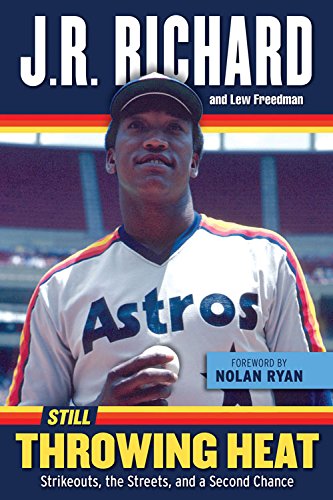
“Still Throwing Heat: Strikeouts, the Streets, and a Second Chance”, an autobiography by J.R. Richard and veteran sports book author Lew Freedman, with a forward by Nolan Ryan is due for release on Amazon, June 1, 2015.

Having only today learned of its coming publication, all we know of its contents are summarized in this marketing blurb from the following link:

http://www.amazon.com/gp/product/1629370991/ref=s9_newr_gw_d0_g14_i3?pf_rd_m=ATVPDKIKX0DER&pf_rd_s=desktop-1&pf_rd_r=00BYQW6T8HYT6W1MHK7H&pf_rd_t=36701&pf_rd_p=1970559082&pf_rd_i=desktop

“A flame-throwing star with the Houston Astros, J. R. Richard was at the top of his profession when he inexplicably began complaining of arm weakness in 1980. Initially scoffed at because he continued approaching 100 mph on the radar gun, everything changed when Richard collapsed while playing catch with a teammate—later diagnosed as a life-threatening stroke. The shocking development ended Richard’s major league career and set off a chain of events that led to the former All-Star being homeless by the mid-1990s. This rapid rise and sudden, tragic fall define the unusual, moving, and inspirational life of a Houston icon who has endured many hardships but has become an admired figure in his adopted hometown. J. R. Richard tells that story now in his own words, including the highs and the lows of his brilliant athletic career, the difficulties that befell him on and off the field, abandonment by those he counted on after his stroke, the despair of losing everything, and his ultimate redemption and giving back to the community.”

(L-R) Bill McCurdy, Johnny Storenski, and J.R. Richard Josephine's Ristorante 2002

(L-R) Bill McCurdy, Johnny Storenski, and J.R. Richard
Josephine’s Ristorante
2002

The Pecan Park Eagle wishes J.R. Richard well for all the success that is possible for his book. We may only hope that his memory of all the factors that contributed to his rise, fall and redemption are as wholly covered as they needed to be. When one has been down a tough road in life, it isn’t ever easy to embrace, own – and then write and publish all that needs to be said. All we can know for sure as readers, old friend, is that you covered the whole truth to the best of your ability – and that none of us will ever know the whole truth of yours – or any other’s life. We are only capable of perceiving what appears to be the truth of another from our direct experience with them – and even that perception is subjective and possibly not true at all.

All I know for sure is that you were one of the greatest and, hands down, certainly the scariest pitchers I ever saw work the mound – and that you most probably could have been another Hall of Fame pitcher in time, had you not encountered the 1980 career-ending, and almost life-ending stroke. As a friend from many years ago, I know you sometimes mistook urges for decisions – and entitlement with love. We just wrote those things off as warts. Everybody’s got some rough spots, right? And today it sounds as though a lot of healing has taken place with your marriage and new calling to the ministry. That’s great. Norma and I are happy for you.

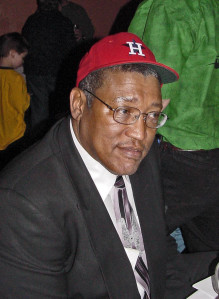
J.R. Richard At a Houston Celebration Of his 2002 Induction Into The Texas Baseball Hall of Fame

J.R. Richard
At a Houston Celebration
Of his 2002 Induction Into
The Texas Baseball Hall of Fame

Oh yeah, two more things I see as true – and I’m reasonably sure that the first is not in your book, even though I saw it happen as one of the most jaw-dropping basketball shots of all time. Do you remember the time you came over to our house with your son for the oxtails that Norma cooked for you? During the dinner waiting period, we all went out to the driveway to shoot some hoops. Then you quickly tired of making close up shots and took the ball through the back gate down the right side of the house and took a side shot from about 50 feet away. It was a high arching heave that had to disappear briefly over an eave in the roof before it came down. – BUT – when it came down, it was nothing but net.

Then you made a decision that was no response to urge. You quit shooting any more baskets. And that was cool. – You did – what Babe Ruth should have done in Pittsburgh back in 1935 when he hit those three home runs. – He should have never picked up another bat again for the rest of his life and retired on the spot. – And I will only hope that you have never taken another basketball shot since 2002.

Yeah, we know that basketball shot story didn’t get in your book, but this perception – one that I share with thousands of Astros fans – surely should have made it, in some way:

In spite of the new Walk of Honor at Minute Maid Park, the Houston Astros still should retire # 50 as a jersey number in your honor!


Who Is the Guy Misidentified as Bob Aspromonte?

March 4, 2015


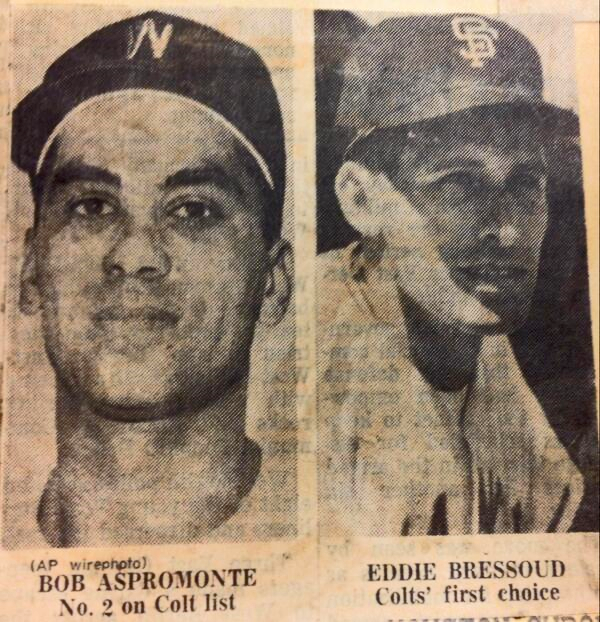
The Pecan Park Eagle received the following photo and note from our friend, Darrell Pittman of Astros Daily two days ago, 3.02.2015::

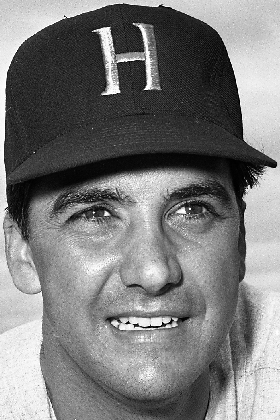
Who is the guy on the left with the "W" on his cap? It is NOT Bob Aspromonte!

Who is the guy on the left with the “W” on his cap? It is NOT Bob Aspromonte!

____________________

I believe this picture was first posted on Twitter by Mike Acosta a year or so back.

 On October 10, 1961, one of the Houston papers posted pictures of Houston’s first two choices in the expansion draft, Eddie Bressoud and Bob Aspromonte, except it showed a different player than Aspro. I’m wondering whose picture it was.

 Of course, Bressoud never appeared in a Houston uniform. The Colt .45s flipped him to Boston for SS Don Buddin on 11.26.1961. Buddin went on to hit the first grand slam in Colt .45s history on 6.10.1962.

~ Darrell Pittman

____________________

In case you don’t know, or need a reminder, here’s a close-up of the real Bob Aspromonte that was taken early in his Houston baseball career:

The REAL Bob Aspromonte ~Early in his Houston Career.

The REAL Bob Aspromonte
~Early in his Houston Career.

So, what do you think? Did the guy with the “W” on his cap that AP tagged as “Bob Aspromonte” really play for the Washington Senators? And did someone at AP or the local Houston newspaper that posted the photo simply get the mystery player confused with Bob Aspromonte because of his dark, less handsome Mediterranean look? Is it that simple?

The real Aspro hailed from Brooklyn and from an Italian-American family.

Please submit your convictions or guesses as material for the Comment Section which follows this column. This is one stone of mystery that we should be able to overturn quickly in our relentless search for the truth.

Please don’t send your responses to The Pecan Park Eagle as e-mails. We want every reader to have the public benefit of what you choose to offer.

Thanks!

The Pecan Park Eagle

______________________________

THIS JUST IN…1 HOUR, 50 MINUTES POST-COLUMN PUBLICATION

THE WINNER …. BY A 1ST ROUND KO …. READER “OLBERMANN”

The misidentified player is NOT Bob Aspromonte … it is…

“It’s his brother KEN Aspromonte.” …. (Reader) OLBERMANN

(SEE COMMENT SECTION AND THE TWO PHOTOS THAT FOLLOW):

KEN AASPROMONTE PLAYED FOR THE WASHINGTON SENATORS FROM 1958 TO 1960

KEN ASPROMONTE PLAYED FOR WASHINGTON FROM 1958 TO 1960

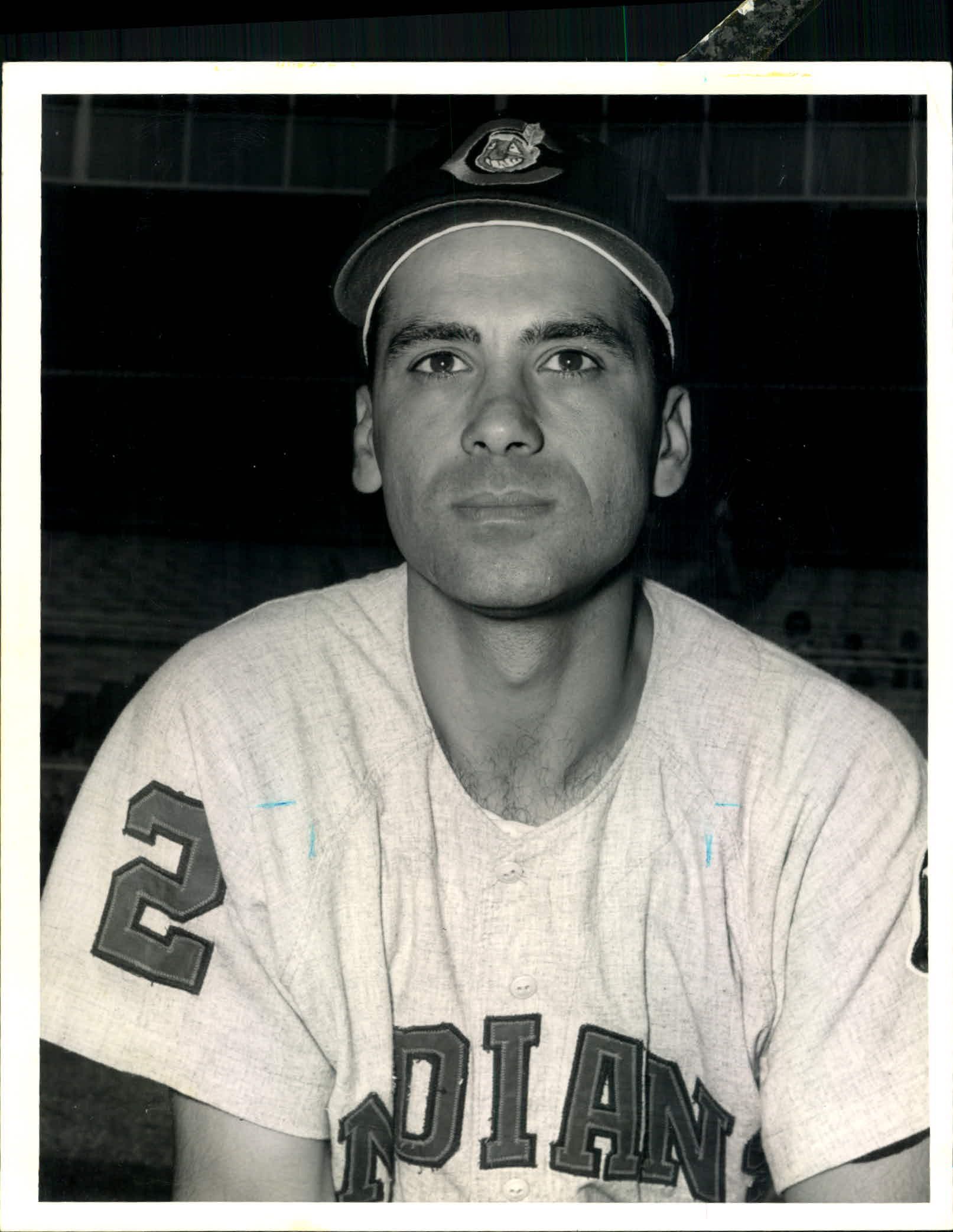
For a better comparison to the miidentified Apromonte brother, here's one of Ken as a Cleveland Indian earlier in his career. - We ar convinced.

For a better comparison to the misidentified Apromonte brother, here’s one of Ken as a Cleveland Indian earlier in his career. – We are convinced.

Chuck Connors: Bullet Notes on “The Rifleman”

March 3, 2015
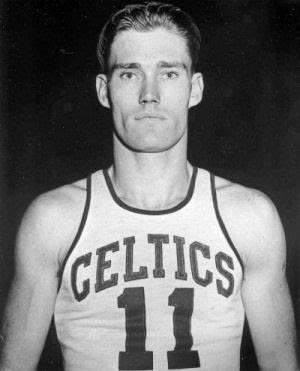
CHUCK CONNORS 1946 ONE OF THE ORIGINAL BOSTON CELTICS

CHUCK CONNORS
1946
ONE OF THE ORIGINAL BOSTON CELTICS


* Technical Point: We know. – Hand guns hold bullets; rifles hold shells. It’s just that “Shell Points on ‘The Rifleman’ ” lacked a certain ring to it as a column title.

Addendum Note: My collegial contributor, Cliff Blau, already has corrected my brain-freeze error on this one point. – See his comment and my response in the Comment section which follows the column. – I do know that shells are for shotguns, not rifles. I simply misspoke. Forgive me as you now read through the rigorously researched points below on the fascinating career trail of former ballplayer and actor Chuck Connors:

* Kevin “Chuck” Connors was born in Brooklyn New York on 04/10/1921.

* Kevin was the second of two children and the only son of Allan and Marcella Connors, immigrants from the Dominion of Newfoundland, now a Canadian province.

* Kevin Connors was raised Roman Catholic and served as an altar boy at the Basilica of Our Lady of Perpetual Help in Brooklyn.
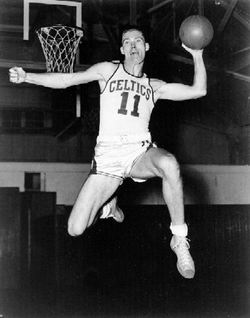
"WATCH OUT FOR THAT FAST BREAK PASS, KEVIN!"

“WATCH OUT FOR THAT FAST BREAK PASS, KEVIN!”

* At full growth, left-handed Kevin had grown into a bright 6’5”, 200 lb. very athlete baseball and basketball player.

* He attended Adelphi Academy on an athletic scholarship. At high school graduation, he had no fewer than 27 college athletic scholarship offers.

* Chuck chose Seton Hall, the future alma mater of Craig Biggio, where he played both basketball and baseball for two years.

* At Seton Hall, Chuck revealed a clue to his ultimate future by winning an elocution contest reciting Vachel Lindsay’s “The Congo”.

* As a Seton Hall first baseman, Connors adopted his nickname “Chuck” from his redundant calls to teammates with the ball to “chuck it to me” because he preferred the nickname to his legal first name Kevin.
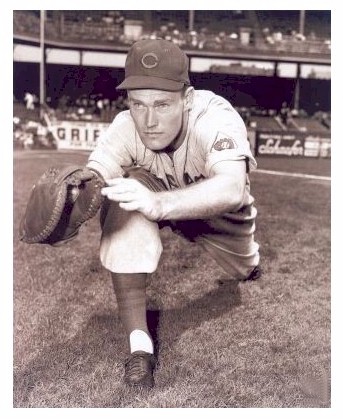
"CHUCK IT TO ME!    CHUCK IT TO ME!"

“CHUCK IT TO ME!
CHUCK IT TO ME!”

* After Chuck Connors left Seton Hall, it is also variously reported that he was drafted by the Chicago Bears of the NFL, but, if he was, it obviously never materialized into anything.

* Baseball Reference notes that Connors first signed to play baseball with the Brooklyn Dodgers in 1940. Except for brief stints of minor league ball in 1940 and 1942, WWII pretty much placed those plans on hold.

* Chuck enlisted in the Army at Fort Knox, Kentucky, and spent most of the war as a tank-warfare instructor at Fort Campbell, Kentucky and later at West Point, New York.

* During his Army service, Connors moonlighted as a professional basketball player, joining the Rochester Royals, helping lead them to the 1946 National Basketball League championship.
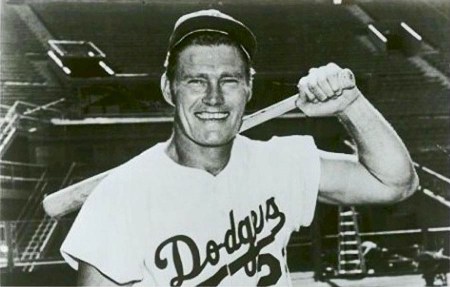
CHUCK CONNORS MADE HIS MLB DEBUT WITH THE BROOKLYN DODGERS MAY 1, 1949

CHUCK CONNORS
MADE HIS MLB DEBUT
WITH THE BROOKLYN DODGERS
MAY 1, 1949

* In 1942, Chuck Connors made his very unofficial movie debut as one of the unaccredited real soldiers used in a backdrop scene shot for the Brian Donlevy war movie, “Wake Island”.

* Following his military discharge in 1946, Chuck joined the newly formed Boston Celtics of the Basketball Association of America as one of their original players.

* Shortly thereafter, Connors left the Celtics for spring training with Major League Baseball’s Brooklyn Dodgers in 1946, but after a minor league baseball assignment in 1946, he was back with the Celtics and basketball in the fall.

* On 11/05/1946, prior to the very first game in Celtics history, Chuck Connors became the first NBA player to shatter a backboard during warm ups prior to the Celtics first game at Boston Arena. His hard dunk shot attempt caught the front of the rim, shattering the wooden backboard that was hardly ready for that kind of violent action. As a result, Connors also gets the credit and blame for causing the first game in Celtics history also to become the first game in NBA history whose starting time had to be delayed about an hour due to his player-inflicted damage to the court of play.
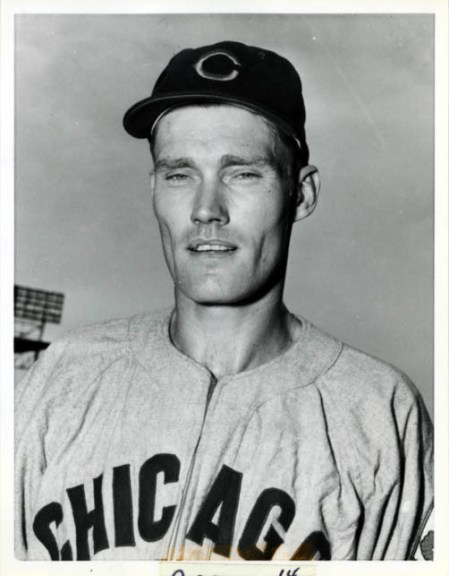
CHUCK CONNORS, 1B 1952 CHICAGO CUBS .236 BA, 2 HR, IN 66 GAMES

CHUCK CONNORS, 1B
1951 CHICAGO CUBS
.239 BA, 2 HR, IN 66 GAMES

* In 1947, Connors played first base for the Dodger AA farm club, the Mobile Bears, and helped the team win the Southern Association pennant.

* In the 1947 Dixie Series, Chuck Connors homered for Mobile at Buff Stadium in Houston in Game One, but the Texas League Champion Houston Buffaloes won the opener, 8-2, and went on to defeat Chuck’s Bears in six.

* After three seasons (1948-50) at AAA Montreal, a span in which Connors averaged over .300 as a full-season batter, he only managed to get in one “0 for 1” late season MLB plate appearance in 1949 with Brooklyn. The Dodgers had a fellow named Gil Hodges entrenched at first base.

* Chuck requested and the Dodgers obliged him with a trade to the Chicago Cubs on 10/10/1950.
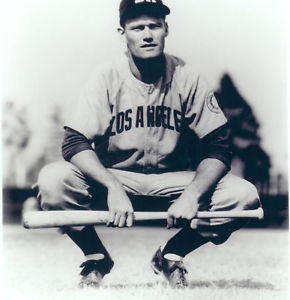
CHUCK CONNORS, 1B LOS ANGELES ANGELS 1951-1952 HIT .322, 25 HR IN '51

CHUCK CONNORS, 1B
LOS ANGELES ANGELS
1951-1952
HIT .321, 22 HR IN 1951

* The Cubs trade proved to be a life-changing event for the multi-talented, always open to testing some new skill guy that was Chuck Connors. The Cubs assigned him to their AAA farm club, the Los Angeles Angels of the Pacific Coast League.

* Connors hit .321 with 22 HR for the Angels in 98 games, earning him a call up to the Cubs in 1951, where he hit only .239 and 2 HR in 66 games.

* Now 31, Chuck hit only .259 with 6 HR in 113 games for the 1952 Angels. Age and performance “suddenly” had moved the baseball future of Kevin “Chuck” Connors from the “prospect list” to the “suspect pile”. It was time to go.
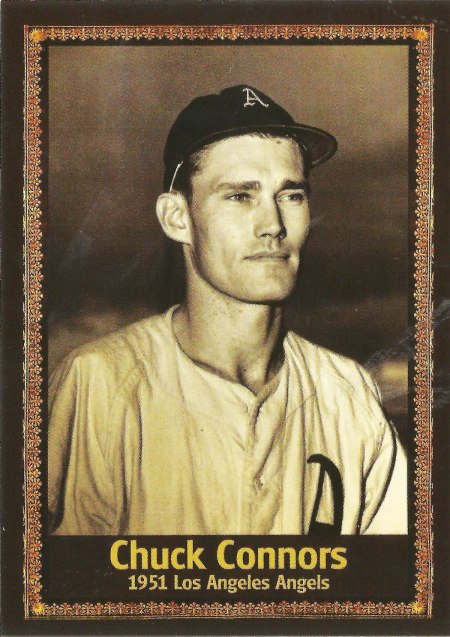
ANOTHER ANGELS PHOTO ~THANKS AGAIN TO ~ DARYL AND ROBERT BLAIR

ANOTHER ANGELS PHOTO
~THANKS AGAIN TO ~
DARYL AND ROBERT BLAIR

* Leaving baseball was no big income loss problem for Chuck Connors. In his two years of hobnobbing in the LA/Hollywood movie culture, his rugged good looks and affable personality had made him a favorite among the Hollywood crowd, starting with the Hollywood baseball fans, but quickly expanding to a much larger social/business circle.

* 1952 would be Connor’s time for the life lesson best known today as “when one door closes, another opens”. It was the end of baseball and the beginning of movie/TV star status for Chuck Connors. He began his official movie career with a bit part in the Spencer Tracy/Kathryn Hepburn classic, “Pat and Mike”.

* From 1952 to 1958, Chuck Connors made 57 movie and TV appearances on the way to a five-season ride as Lucas McCain in the iconic TV western “The Rifleman” (1958-63).
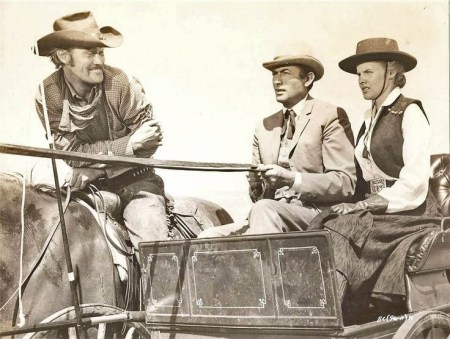
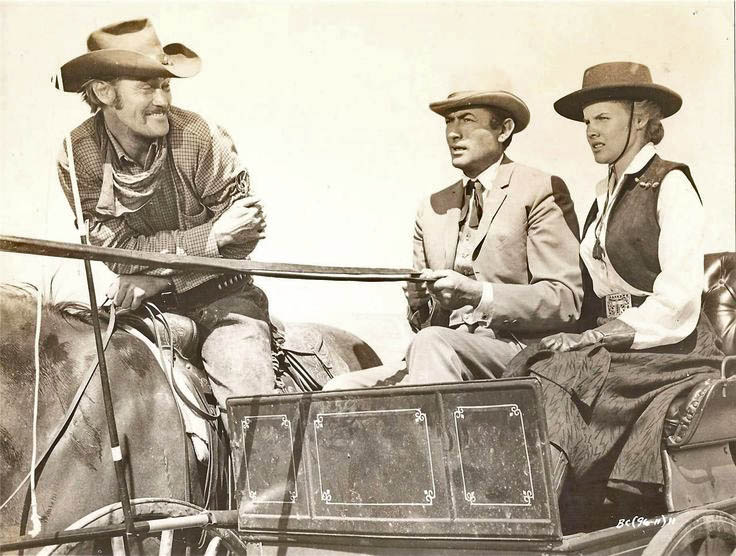
CHUCK CONNORS (L) WAS A COWARDLY BULLY IN "THE BIG COUNTRY" AND IS PUT TO SHAME IN THE END BY GREGORY PECK (CENTER) AND THEN KILLED BY HIS OWN FATHER (BURL IVES) FOR BEING A COWARD.

CHUCK CONNORS (L) WAS A COWARDLY BULLY IN “THE BIG COUNTRY” AND IS PUT TO SHAME IN THE END BY GREGORY PECK (CENTER) AND THEN KILLED BY HIS OWN FATHER (BURL IVES) FOR BEING A COWARD.

* Beyond “The Rifleman”, Chuck Connors made, at least, another sixty movie/TV appearances on his way to a financially comfortable old age, but on that surely came with some rough emotional times along the way.

* As he achieved success, Connors hosted the annual Chuck Connors Charitable Invitational Golf Tournament, through the Chuck Connors Charitable Foundation, at the Canyon Country Club in Palm Springs, California. Proceeds went directly to the Angel View Crippled Children’s Foundation and over $400,000.00 was raised

* Connors was married and divorced three times. He and his first wife had four sons together. He spent the last twelve years as a divorced father, but we have no information on his relationship status with the four adult sons. He did have a significant other woman in his life at the time of his death, Her name was Rose Mary Grumley.
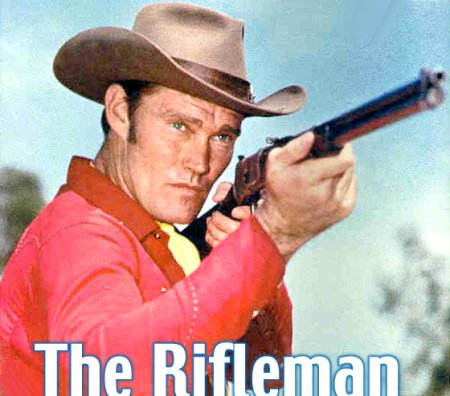
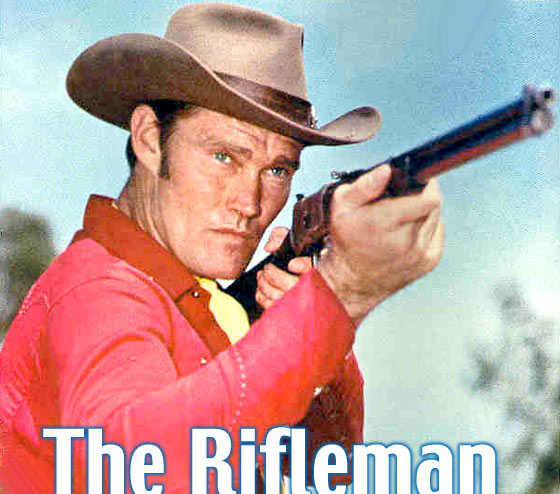
AS "THE RIFLEMAN" (1958-63), CHUCK WAS 180 DEGREES FROM COWARDICE AS THE "STRAIGHT-SHOOTING LUCAS McCain.

AS “THE RIFLEMAN” (1958-63), CHUCK WAS 180 DEGREES FROM COWARDICE AS THE “STRAIGHT-SHOOTING LUCAS McCain.

* Kevin “Chuck” Connors died at the age of 71 in Los Angeles, California on November 10. 1991. He died of pneumonia that had been helped along by lung cancer. Chuck had been a three-packs-a-day Camel smoker from 1940 into the mid-1970s, but he never quit smoking completely because of sporadic binge periods.

* Chuck was interred in the San Fernando Mission Cemetery in Los Angeles.

* Frivolous Chuck Connors “What’s Your Guess” Trivia Question to bring this wagon train of facts to an end: Chuck Connors supposedly was a big fan of Spencer Tracy, the star of the former ballplayers first official movie. BUT … We still must ask: Had Kevin Connors’ first name also been “Spencer”, do you think he might have sought an even earlier change to “Chuck” than he had with “Kevin”?


Goodbye, Minnie, Goodbye

March 2, 2015
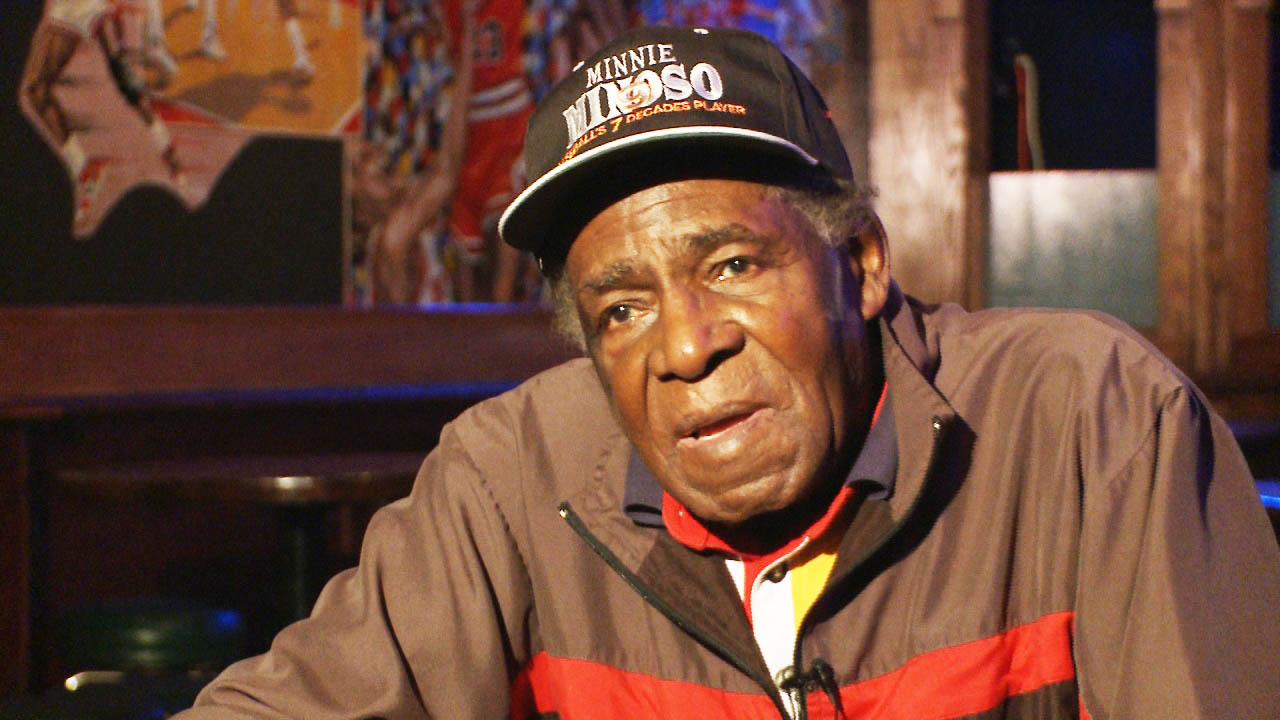
ORESTES “MINNIE” MINOSO Born: November 29, 1925 Died: March 1, 2015

ORESTES “MINNIE” MINOSO
Born: November 29, 1925
Died: March 1, 2015


Sunday, March 1, 2015. Minnie Minoso died today in Chicago at the age of 89 – thus, putting a final end to the wildly playful rumor that Minoso might be able to persuade the new commissioner to allow him another “one time at bat” token appearance with the Chicago White Sox this coming season that would expand his career MLB record to a total of six (6) decades as an active big league player. Minnie previously played for five consecutive decades (1940s, 1950s, 1960s, 1970s, and 1980s), but only the first three of those units were  serious part of his career. Minoso played three games with the White Sox in 1976 and two games again with the Chicago American Leaguers in 1980 – simply to keep the decade streak going. He was 1 for 8 total at the plate in those two extended decades, with the lone single he collected coming in 1976. When he tried to keep it going in 1990, he was refused permission by then MLB Commissioner Fay Vincent, who rebuked the continuation of this practice as a stunt that detracted from the integrity of serious play.

We don’t think that decision by Vincent was a major setback for Minnie Minoso. He wasn’t the kind of guy who would willfully do anything to hurt the reputation of the game. He was just a fiery indomitable spirit from pre-Castro Cuba who nurtured his love for the game in the heart of all those Latin American countries that breed little boys to grow up fire-breathing baseball as either their ultimate – or only – sports dream worth chasing.

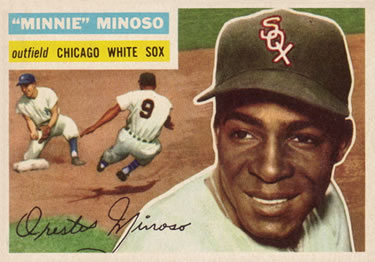
Look out for the landslide of career stories that will now be forthcoming as columns in memoriam in the immediate days ahead. If you are looking to reflect on what Minoso actually did in the 15 serious (1949, 1951-64) and 2 not-so-serious (1976, 1980) years of his MLB career, check out the impressive stats he put together over time on his way to a .298 MLB career batting average. If not everything there is to his story, which they are not, the numbers will serve to help remind you, as it has me, why we have not forgotten the great (BR/TR) left fielder and third baseman. For some of us, he was another premium baseball card hero from our sandlot days – and never one of the cards that ended up as a noise maker in our bicycle spokes.

We shall conclude here with a poem dedicated to both Minnie Minoso and the rest of us. Earlier today, I had a more personal reason to send the same poem to a dying friend, but I have since been informed that he has now slipped into a coma and may never be able to see or hear of it. I almost left it out of this column because of the personal emotions that tie me to the other situation and how they got stirred by the news of his coma. We may almost certainly will never speak again. In fact, even as I write, he may be gone.

That recognition did it for me. The lesson of everyone’s life and death, and that includes Minnie Minoso and my old classmate, who may have left this world on the same day, but their life lessons are also ours. Unless we too already have slipped into comas today, “The Clock of Life” is a poem for all people and all seasons. The sooner we get its meaning, and move on in greater appreciation for each moment we are here to breathe life into today as the only time we ever own, the better.

This one’s  especially for you, Minnie Minoso, and for all we may learn from your life!

Rest in Peace ~ with Love and Peace, Orestes “Minnie” Minoso! And thank you for, once upon a time, making our sandlot dreams as blue as the Houston summer skies once were – when yesterday  was today. These days, we choose to find the even deeper blue skies of our realization that everything that is beautiful, loving, and possible for us is within reach of us in dependence upon the choices we make each day that we are blessed to be here – and without us waiting for the first obstacle-free day to get started with anything we say is important to us. – You understood that truth, Minnie. Otherwise, you never could have made the career mark you left on baseball.

God Bless you too, as in – Now and Forever!

Minoso56

The Clock of Life

By Robert H. Smith


The Clock of life is wound but once,

And no man has the power,

To tell just when the hands will stop,

At late or early hour.


To lose one’s wealth is sad indeed,

To lose one’s health is more,

To lose one’s soul is such a loss,

That no man can restore.


The present only is our own,

So live, love, toil with a will,

Place no faith in “Tomorrow”

For the Clock may then be still.


Larry Dluhy Closes Houston “House of Cards”

March 1, 2015
Larry Dluhy Larry isn't retiring! There's no retiring in baseball collectibles! ~Larry's just taking his talents to the Internet!

Larry Dluhy
Larry isn’t retiring!
There’s no retiring in baseball collectibles!
~Larry’s just taking his talents to the Internet!


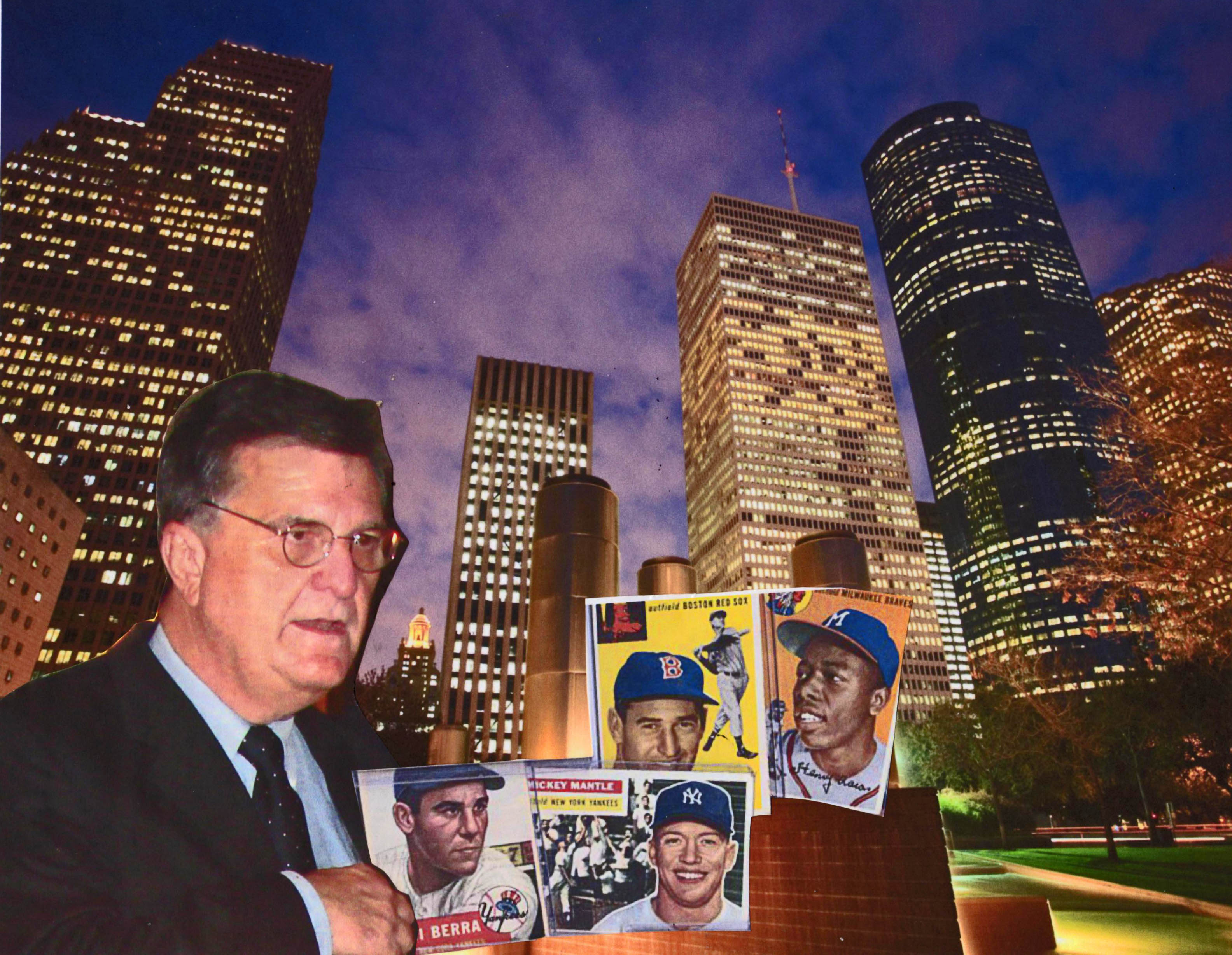
Don’t miss the article by David Barron at Chron.Com about the store-closing of Sports Collectibles in Houston. That business has been a staple in Houston for the past thirty-five years as one of our premier brick and mortar locations for the purchase of old baseball cards and an endless categorical list of other collectible sports artifacts that people seek, both in the name of sentiment and business trading. An old friend and baseball colleague, Larry Dluhy, is the owner, and a nicer fellow hardly ever walked the earth, as far as I’m concerned. Another Houston memorabilia dealer who falls into this same admiration category with me is Tom Kennedy, the baseball-loving guy who almost singlehandedly kept the Houston Sports Museum alive for years at the old Finger Furniture Store location at Cullen and the Gulf Freeway, but we are talking about Larry Dluhy today – and what his Texas store closings mean and do not mean, as we see them – from our catbird seat at The Pecan Park Eagle.

We considered headlines for this column – like the one we used – just to be cute. The reality, as we see it, is not that Larry Dluhy is folding his tent and going away. He’s just going where the collectibles market now lives today – and that’s on E-Bay – or some other cyber-marketing variants of that site. Like almost all other niche market areas of the USA shopper’s frenzy – and maybe the big items are working more this way too – people aren’t wandering around the congested streets of Houston looking for deals in the same old ways. Many of them now are digitally shopping for almost everything.  A guy that opens a “card shop” today is going to die of boredom or bad business waiting on the attack of the old piranha-mentality card shoppers of the past.

It’s a new day. For all of us. For everything.

I will always consider Larry Dluhy to be a friend, a collegial soul in our shared love for the game of baseball and the stuff of its history – and, very importantly, a fellow who, in my dealings with him during the time we both served on the Board of the Texas Baseball Hall of Fame as volunteer members, I remember well.  – Larry Dluhy’s right-spirited, unselfish effort will never be forgotten. – Not by me.

During most of the time he operated his storefront business, Larry’s late wife, Betsy, worked side-by-side with him to make sure their dream of success by working at something they felt passionately about was not just possible, but probable. And so it was to be for these two honest and likeable people – with the right mixture of love, spirit, common sense, energy, and dedication – succeed was what they did – and on so many levels.

When Becky died about five years ago, her services took place in this little chapel down in Fort Bend County. And when it was all over, it was a mixture of every day and very famous people who filed out the little center aisle. Nolan Ryan and J.R. Richard were both there that day, among other notables. As they departed down the chapel aisle, and in no disrespect for Becky, I couldn’t help but gravitate to an invading thought: “When healthy, and younger, walking plainly down this little church aisle at this very moment – comes what is probably the hardest One-Two throwing punch in the history of all baseball starting rotations – and I mean all time – and today – in this simple place –  they and their families are all here to pay a departing tribute – with everyone else – to Betsy Dluhy! – That is love and respect at a very high, but most humble level, dear friends.

Here’s the link to David Barron’s wonderful story:

http://www.houstonchronicle.com/sports/article/A-sports-collectibles-store-becomes-a-part-of-6103944.php#/0

Congratulations and Good Luck, Larry Dluhy!

A few thoughts on our sandlot days baseball card collecting rush to mind. In Pecan Park (1949-1953, esp.) my buddies and I were completely imbedded, or lost,  in the endless, fascinating, and always madly compulsive pursuit of those little cardboard proofs of our delicious childhood memories we all once new as baseball cards – the kind you got almost free – five to a pack – with a nickle purchase of a bubble gum stick whose sugary flavor hardly lasted all of thirty seconds. The cards were life – or bicycle spoke jazz – depending upon our greater needs of the day and who was on the card.

Let me put that last thought more plainly. – The always available cards of the O’Brien brothers, who once almost anonymously played for the Pirates, were the stuff that made our cycle noisemakers perpetually active in the bike spokes. The hardly ever seen cards of Stan Musial, Ted Williams and Mickey Mantle were the Holy Trinity back in the day. We were driven by the crazed spiritual pursuit of them, sometimes even vainly pursuing insider advance information on – how often and when these rarest of figures were set for projected release, by percentage of production per rare card – and by store delivery time and date schedule.

We never learned anything.

Buying all the cards we could get – with all the nickles we could hustle – and always hoping that our purchase would be on the first day on the store shelf of a new shipment – and not the last day of an old stock batch. – We never knew for sure, but that was all we had going for as a strategy. – That was our little version of the roulette wheel. We would have killed for the Internet, the social network and Google back then.

At first, it was all Bowman, with their great artistic facial close-ups. I always preferred Bowman. – They gave life and identity to our Mutual Game of the Day radio heroes that most of us only had seen in one of those heavily pixelated newspaper photos – or in the newsprint styled Sporting News – the kind of photo that showed a player swinging with his eyes closed – regardless of whether he knocked it out of the park or struck out.

Topps, of course, came along and introduced us to action shots. They were cool too. – Every time Yankee shortstop Phil Rizzuto had to leap catch a line drive to keep it from becoming a hit over the radio Game of the Day, he looked in our individual mind’s eye just liked he did on his Topps card. – How cool was that?

The memory of everything – from the taste of the gum itself – to the lingering aroma that found a longtime home within the fibers of the cardboard that supported the images and player information on opposite sides – is all – like yesterday –  even though – for many of us – it was long ago – if not so faraway – that baseball cards were the currency of our once young and much more innocent lives.

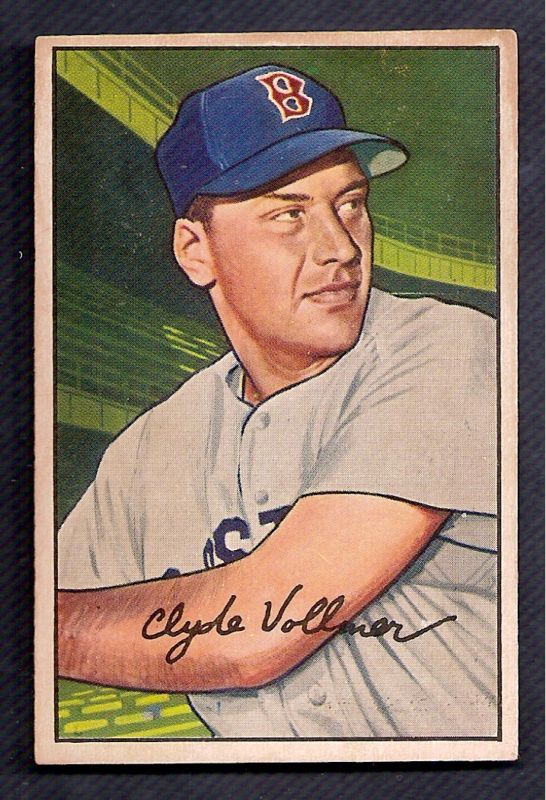
The only card that remains from my sandlot days collection is now preserved in a nice looking small frame. It isn’t Musial. It isn’t Williams. And it sure isn’t Mantle. – Truth is – of all the baseball cards I owned back then, I’m not even sure how this one is the one that survived – other than the fact that it somehow got misplaced in another box of my non-baseball related school materials that we found in a storage container years ago. Maybe I had a potential trade going at school that never worked out.

By chance, the surviving from my sandlot days collection is...  CLYDE VOLLMER.

By chance, the surviving card from my sandlot days collection is…
CLYDE VOLLMER.

Maybe, too, this is the lesson:

What is acquired by chance – only remains by chance.

And, unless I missed an important wisdom stop somewhere, and, in my case, that’s quite possible, I rather think that the just now expressed lesson about chance occurrences is a little bit larger than baseball cards alone.

Have a peaceful Sunday, everybody!


Who Are the Astros’ Top Minor League Prospects?

February 28, 2015
Bill Gilbert is a veteran member of SABR, a respected and exceptional baseball data analyst, and a free lance reporter for The Pecan Park Eagle.

Bill Gilbert is a veteran member of SABR, a respected and exceptional baseball data analyst, and a free lance reporter for The Pecan Park Eagle.

Who Are the 2015 Astros’ Top Minor League Prospects?

By Bill Gilbert

This is the time of year when various organizations involved in scouting develop lists of minor league prospects. Four such projections are from Baseball America, Baseball Prospectus, ESPN and John Sickels. Their lists of the top 10 prospects in the Astros organization are shown below:

BASEBALL AMERICA

# PLAYER AGE POS.
1 Carlos Correa 20 SS
2 Mark Appel 23 RHP
3 Vince Velasquez 23 RHP
4 Michael Feliz 22 RHP
5 Brett Phillips 21 OF
6 Colin Moran 22 3B
7 Teoscar Hernandez 22 OF
8 Josh Hader 21 LHP
9 Lance McCullers 21 RHP
10 Domingo Santana 21 OF


BASEBALL PROSPECTUS

# PLAYER AGE POS.
1 Carlos Correa 20 SS
2 Mark Appel 23 RHP
3 Vince Velasquez 23 RHP
4 Brett Phillips 21 OF
5 Derek Fisher 23 OF
6 Michael Feliz 22 RHP
7 Lance McCullers 21 RHP
8 Domingo Santana 21 OF
9 Colin Moran 22 3B
10 TeoscarHernandez 22 OF


ESPN

# PLAYER AGE POS.
1 Carlos Correa 20 SS
2 Mark Appel 23 RHP
3 Vince Velasquez 23 RHP
4 Colin Moran 22 3B
5 Brett Phillips 21 OF
6 Lance McCullers 21 RHP
7 Michael Feliz 22 RHP
8 Derek Fisher 23 OF
9 Josh Hader 21 LHP
10 J.D. Davis 22 3B


SICKELS

# PLAYER AGE POS.
1 Carlos Correa 20 SS
2 Mark Appel 23 RHP
3 Michael Feliz 22 RHP
4 Vince Velasquez 23 RHP
5 Domingo Santana 21 OF
6 Brett Phillips 21 OF
7 Josh Hader 21 LHP
8 Lance McCullers 21 RHP
9 Derek Fisher 23 OF
10 Teoscar Hernandez 22 OF


Carlos Correa and Mark Appel are clearly the top two Astro prospects. Both were No. 1 overall draft picks. Correa has steadily advanced through the minors, with a batting average of .308, but suffered a broken leg last year and missed half the season. He is reported to be fully recovered now. He should be at Double A in 2015.

Appel’s path has been a little rockier. He was hit hard, playing at Lancaster, in the High Class-A California League last year before doing much better at Double A Corpus Christi and in the Arizona Fall League. In fairness to Appel, Lancaster is considered by many to be the most difficult park in the minors for pitchers because of the constant wind and dry desert air. Appel should get some experience at Triple A in 2015.

Baseball America’s list of the top 100 minor league prospects contains only two Astros, Correa, (No. 4) and Appel (No. 31). Last year there were six. George Springer and Jon Singleton were promoted to the majors, Mike Foltynewicz was traded to Atlanta in the trade for Evan Gattis and Lance McCullers dropped off the top 100 list.

Velasquez is the consensus No. 3 prospect in the Astro organization. He was picked by the Astros in the 2nd round in 2010. However he has struggled with injuries and has pitched only 265 innings in the 5 years he has been in the organization. However, he has been effective when healthy, striking out 10.55 batters per 9 innings in his career. He should be at AA Corpus Christi this year.

Feliz has an arm that has impressed scouts since he signed out of the Dominican Republic in 2009. However, he has reached only the Low Class-A level and needs a breakout season.

Phillips had his breakout season in 2014, batting .310 with 17 home runs and 23 stolen bases in a season divided between Houston’s two Class-A teams. He was Houston’s 6th round draft choice out of high school in 2012. He should reach the Double A level in 2015.

Moran was the 6th player taken overall by the Florida Marlins in 2013. He was traded to the Astros in 2014 and finished the season at Double A Corpus Christi. He has a .297 batting average over 3 stops in his brief career but has not shown much power.

Hernandez has made steady progress through the Astros farm system in his four years since being signed out of the Dominican Republic. He had a strong 2014 season mostly at Lancaster, batting .292 with 21 home runs and 33 stolen bases.

Hader was drafted by Baltimore in the 19th round in 2012 and came to the Astros in the trade for Bud Norris. In 2014, he showed that it was possible for a pitcher to excel at Lancaster with a 9-2 record and an ERA of 2.92 and 9.68 strikeouts per 9 innings. He was named the top pitching prospect in the California League. He should be at Double A Corpus Christi in 2015.

McCullers struggled at Lancaster in 2014 with a 3-6 record and an ERA of 5.47. However, he struck out 10.32 batters per 9 innings.

Santana, the third Dominican on the top 10 list, signed with the Phillies at the age of 16 and was traded to the Astros in the Hunter Pence trade in 2011. His star lost a little luster in 2014 when he was promoted to Houston at mid-season and struck out in 14 0f his 18 plate appearances. However, he had a good year at Triple A batting .296 with 16 home runs despite an alarming total of strikeouts.

The only two players from the 2014 draft that made any of the lists were Derek Fisher, a supplemental first round pick that played in the College World Series for Virginia, and J.D. Davis, a third round pick from Cal State Fullerton. Both played well in short-season leagues. Fisher batted .310 with 17 stolen bases and Davis batted .293 with 13 home runs.

The Astros top prospects are all in the 20-23 age range and Santana is the only one who has played at Triple A. As a result, they are not likely to have an impact in 2015. Appel is the most likely to provide some help in this season. However, if their development continues, several should be ready to contribute in 2016.

If you want to check out these and other prospects, I have a deal for you. For over 20 years, I have spent a week or two checking out the Astros at Spring Training in Kissimmee, Florida both at the games and on the back fields where I first watched players like Jeff Bagwell, Morgan Ensberg and Hunter Pence. However, I won’t be going this year and our Villa at the Sheraton Vistana Resort is available for rent the weeks of March 14-21 and March 22-29 at a discounted price of $1100 per week. It is next door to Disney World and very convenient for attending Astros and Braves home games. The resort has numerous swimming pools and hot tubs, a miniature golf course and two restaurants. The Villa is well-furnished with two bedrooms, two baths, flat screen TVs and a complete kitchen. You can check it out at:

www.vistanatimeshare.com

Let me know if you are interested.

Bill Gilbert

2/26/15.

E-Mail:   bgilbert35@yahoo.com