The Physics of Baseball

December 18, 2015
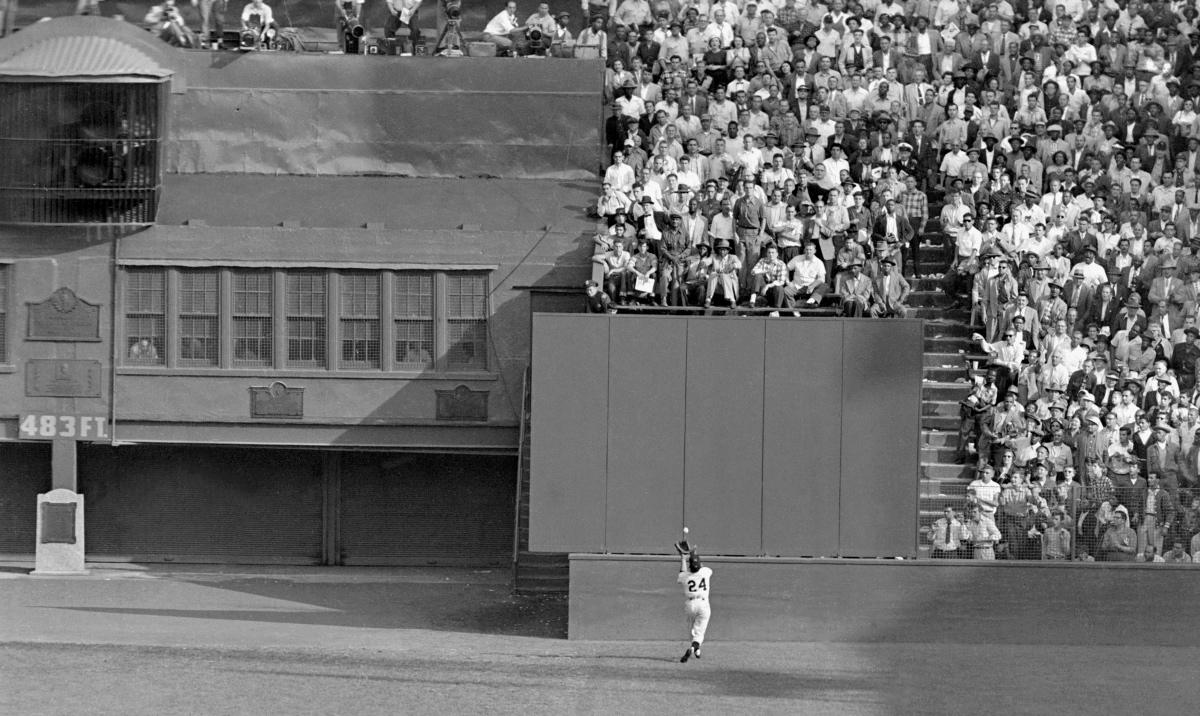
Willie Mays "The Catch" 1954

Willie Mays
“The Catch”
1954


Social historian and research educator George Leonard once expressed it in these paraphrased terms: One cannot begin to research and write the complete history of life on earth until he or she is prepared to start with the Big Bang and then accurately transcribe every physical force and chemical reaction at atom-level change that then has transpired in sequential and aberrant direction levels in the unfolding core process that has continued, so far, to mutate, transform, and continue in apparent conformity to the scientific laws governing evolution on the organic level.

Maybe that’s what National League President and later Commissioner of Baseball Bart Giamatti had in mind for the history of baseball back in 1987 when he asked an old Yale faculty pal and colleague, physicist friend, Dr. Robert K. Adair, to sign on as “Physicist to the National League.” A such, the volunteer mind of Dr. Adair would be asked to take on the “tongue-in-cheek” task of compiling and advising Giamatti on “the elements of baseball that might be best addressed by a physicist.”

Adair took on the fun challenge, but with the serious intent of all researchers worth their salt. He first had to fill in the large blanks of what he didn’t know well enough at the start about the game of baseball and its common mechanical actions on the field. This data was essential to anything he engaged as matters of physics governing the speed and trajectory of batted balls, the movement of thrown pitches, and the effects of wind, humidity, and stadium elevation from sea level upon the flight of batted and thrown baseballs. Gravity, of course, is the factor that makes baseball and the whole game of life possible, but even gravity eases up at higher altitude/thinner air game sites.

The task and the book that resulted became Robert Adair’s magnificent obsession. “The Physics of Baseball” finally reached its first printing in 1990. Fortunately, Bart Giamatti got to read and give his blessing to the first edition, but did not live to see its actual publication. Two other printings followed in 1994 and 2002, with Adair continuously correcting and refining his items of measurement through the third printing.

Although I’ve known of this book for years, I never read it until this week, when I received a Christmas gift copy from friend and colleague Darrell Pittman. Thank you, Darrell! This has been a fun-walk through the scientific stuff that happens. One doesn’t have to be a physicist to understand all of its content, but it does help to have taken a course in physics somewhere along the way.

How much did the alleged curve ball inventor Candy Cummings understand about the physical laws governing force and torque upon a thrown baseball from pitcher to catcher from variable distances of 45′ to 60’6″ when he started using that killer pitch? Probably not much. All he had to remember is what he saw it do the first time – and to recall what he did to the pitch and be able to repeat it a second time.

If you have ever wondered how Willie Mays made “The Catch” on Vic Wertz’s long fly ball to center field at the Polo Grounds in 1954, you may really enjoy this book. What is the science behind any explanation we may offer for “The Catch?” Was it the sound of the ball? Coupled with the first flickering sight of the ball’s flight speed and trajectory? And what was it within Mays’ neurological system and/or experiential history with fly balls that cued him to turn his back and run hard to a specific deep center location? And what allowed Mays to be in just the right, still moving spot – and get his glove up in time to catch the ball as it came down from the sky and descended into his glove over his head as probably the most famous long fly ball out in baseball history?

“The Physics of Baseball” (Third Edition)  by Robert K. Adair, Ph.D. is available in paperback from Amazon.Com, if you are interested.

This whole subject awakens me to how much physics was involved in a poem I wrote almost 47 years ago. Let’s close on that note:

pecan park

Summer Baseball By Bill McCurdy (1969)

Time was when summer meant baseball on a vacant lot,

Chasing a ragged brown horsehide as it zoomed off

As a fungo bat streak across the white heat of the morning sky,

Only to be pursued by a blue-jeaned boy, who just knew, …

He would be there when the ball came down.


From the crack of the bat until the thump in his glove,

The boy knew the baseball like one knows an old friend.

They had met so often on a vacant cty lot before.


Texas Leaguers, Blue Darters, Line Drive Scorchers, Worm Burners, Grass Skinners,

Pop Flies, Sunday Screamers: – It made no singular difference at all to the boy.

He knew that each pursuit would end securely in the web of his Rawlings Playmaker.


No thrill could surpass the loud crack of the bat that signaled to the boy in the field

Of the far chase to come as a result of the music instantly traveling to his ears.

It was the lickety-split quick and sure sound of the long ball firing away a singular alarm:


C-R-A-C-K!


And the boy would race on bare, calloused and sometimes cut-up feet

To a faraway and receding point on the deepest spot of the weed-grass sandlot.


Then, somehow, as though guided by a mysterious inner radar,

The boy would turn his head and look skyward at just the right time,

And at the very moment his old friend, the baseball, was beginning to descend

From that grand eagle-flight ride through the hot and humid Houston summer air.


T-H-U-M-P!


The chase had ended once more in a rightful wedding of ball and glove!

Simple innocence, But it was love, And it was free.


Years later, the boy, now a man, may only dream of one more chance at joy,

One more chance to race the wind, And to follow the flight of his old friend,

Coming down, Coming home.

____________________

NAVY-UH-112715-14

Gil Hodges’ Big Disappearing Moment

December 17, 2015
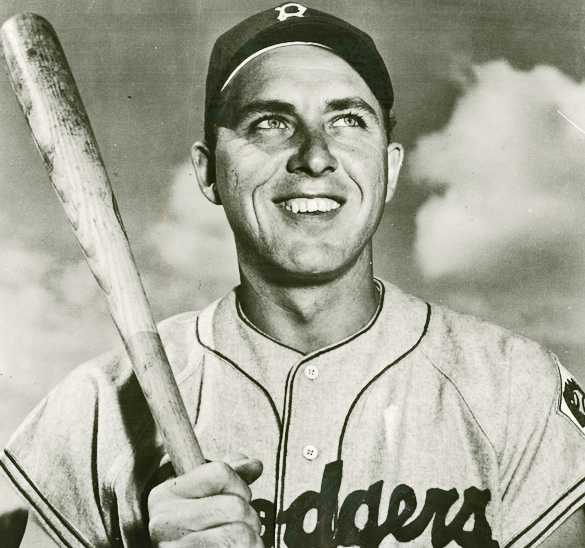
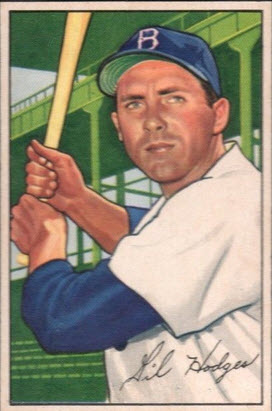
Gil Hodges, 1st Base 1952 Brooklyn Dodgers Gil's 0 for 21 in the '52 World Series helped him disappear on the dark side of the moon once he became eligible for HOF consideration.

Gil Hodges, 1st Base
1952 Brooklyn Dodgers
Gil’s 0 for 21 in the ’52 World Series helped him disappear on the dark side of the moon once he became eligible for HOF consideration.


Sometimes “one special moment” can be the memory of enough voting BBWA writers that gets a player with a good career record into the Baseball Hal of Fame. See Bill Mazeroski for the best example that comes to mind. The guy was an incredible good defensive figure for the Pittsburgh Pirates at second base, but nothing about his everyday performance all the way round, including his hitting, will ever quell the argument that his walk-off HR against the New York Yankees in Game Seven of the 1960 World Series was anything less than the emotionally charged “one special moment” that really opened the door to the great Hall for the fiery team player with good, but not great career numbers for Pittsburgh.

On the other side of the same coin, it may also be argued until the crack of doom that first baseman Gil Hodges should also have been elected to the HOF on the basis of his good, but not great bat work with the Brooklyn Dodgers during their “Boys of Summer” era. The real reason he’s never made it may be the fact that his “special moment” may have been his 0 for 21 (.000 BA) batting performance in Brooklyn’s folding 7-game loss to the New York Yankees in the 1952 World Series. Hodges’ missing bat may have been the difference that allowed the Dodgers to close with two losses at Ebbets Field in a 4-3 Series squeeze by the Yankees. The swelling “0-fer” of his hitting failure at the critical moment for his club in 1952, a failure that left him as the all time worst hitter in play-off baseball history – simply made him, and still makes him, an easy to forget at Hall of Fame voting time, first by the writers –  and now by the veterans’ committee.

Had Gil Hodges gone 1 for 21 – and had that 1 hit have been a walk-off 3-run homer that won the World Series for the Dodgers in Game 7 at Ebbets Field in 1952, is there anyone out there who seriously thinks that Gil Hodges would not have been accorded the same heroic honor wreath that fell upon Mazeroski’s head only eight years later?

Bobby Thomson of the 1951 “Shot Heard Round the World” HR did not have the career record to have earned the Hall of Fame, but one could argue that Hodges did. It just wasn’t meant to be. Take the dark side of the moon route and few ever think of you again.

Here’s a tabular chart of Gil Hodges’ descent into the land of the forgotten as an un-heroic hitter in the 1952 World Series:

GIL HODGES IN THE 1952 WORLD SERIES

WS ’52 Game AB R H RBI W K BA
1 – BRK W, 4-2 3 0 0 0 0 1 .000
2 – NYY W, 7-1 3 0 0 0 1 1 .000
3 – BRK W, 5-3 3 0 0 0 1 0 .000
4 – NYY W, 2-0 2 0 0 0 1 0 .000
5 – BRK, W,, 6-5 3 1 0 0 2 1 .000
6 – NYY W, 3-2 3 0 0 0 0 3 .000
7 – NYY W, 4-2 4 0 0 1 0 0 .000
TOTALS 21 1 0 1 5 6 .000

To examine the 1952 Worls Series box scores yourself, please go to BaseballReference.Com at:

http://www.baseball-reference.com/boxes/BRO/BRO195210070.shtml

In General

My thoughts on Hodges and Mazeroski are ancient, but they were directly kicked again into high gear by a wonderful current article I found this morning at BaseBallAces.Net, a site good for both the evocative and the provocative touches on baseball history. I’ve never met John B. Holway or Gabriel Schechter, the site’s creators, but I feel as though I have known them for a lifetime for over only a very short period of readership time. You may enjoy checking out the column of reference here, “October Mendozans.” It lists the 300 plus worst playoff hitting by Hall of Famers and other high level baseball stars.

http://baseballaces.net/

Have fun!

____________________

Bowman-52-Gil-Hodges

MLB Presents The Astrodome

December 16, 2015

Astrodome-Book-01


MLB Presents The Astrodome

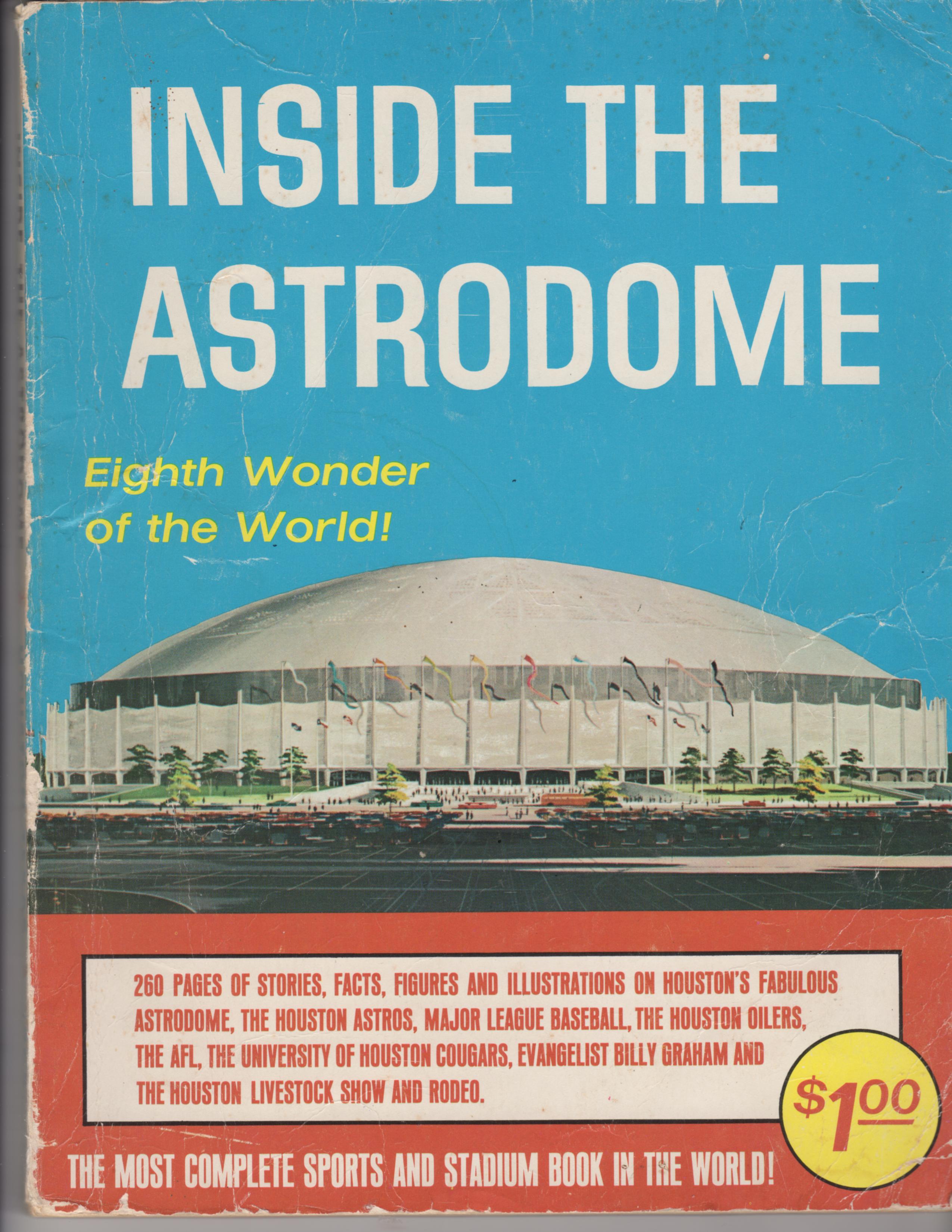
Introduced by Bob Costas and narrated by former UH Cougar and movie actor Dennis Quaid (and brought to my attention for editorial correction here by our good friend Greg Lucas), the one-hour long “MLB Presents the Astrodome” documentary that aired at 8:00 PM on the MLB Network last night came off quite well, covering all the reasons for the Dome’s creation and the milestone events that took place there over the period of its 35-year life as home of the Houston Astros and other major happenings. Dean Hofheinz Mann, the daughter of the late Judge Roy Hofheinz was on board as the primary witness to dome history, but almost everyone else under the Houston sun who had anything to do with the grand old place stopped by to impart their thoughts and feelings for the relatively brief, but highly significant place in Houston history and as an iconic figure in the history of world architecture.

Nolan Ryan spoke simply, but eloquently, in support of the Astrodome’s place in our local history and old clip revealed R.E. “Bob” Smith responding to someone’s early question about the designation of the place as “the eight wonder of the world” by amending that thought to the idea that “we should be recognizing the Astrodome not as the eighth, but as THE wonder of the world. From the players we recall as our early Dome heroes (Jimmy Wynn, Larry Dierker, Bob Aspromonte, Mike Scott, Terry Puhl, Art Howe, and Phil Garner) viewers got to hear the thread of affection for the Dome that runs through them all. Astros historian Mike Acosta contributed his always sound contextual take on what the Dome means to our local history and Tal Smith spoke as one of the principals who put that history in motion. The great Mickey Herskowitz, along with broadcasters Bill Brown, Milo Hamilton,  TV personalities Bob Allen and Dan Rather, among others, chipped in their perceptions of the important Dome years.

Good as it was, the limitations of even a full disclosure documentary on the Astrodome for me is the sudden realization that, unless one already possesses a bond with the Astrodome, even good information on the “old girl” probably will fall short of personalizing that same kind of bond within those who were nor around to have built it within themselves from first hand experience.

Those of us who favor saving the Astrodome need to rally (a) those people who do have the bond – and I’m talking here about the 25,000 to 30,000 people who came to the Astrodome’s 50th birthday party last April 9th and (b) help build a strategy for attracting support from all the others who not have a bond with the Dome, per se, but who do have a passionate bond for historical preservation.

If you are interested, please take a look at the new “Our Astrodome” website that Mike Vance of Houston Arts and Media has started as a program for advancing the cause of preservation for the Astrodome – and ask how you may get involved and help. Here’s the link:

www.ourastrodome.org

Go, All Who Care ~ Let’s Save the Dome! ~ Before It’s Too Late!

____________________

Christmas Spirit Crossings

  1. When the NFL Houston Texans lost star running back Arian Foster again early to injury for the rest of the 2015 season, what Christmas song did Coach Bill O’Brien immediately adopt as his favorite? Answer: “I’ll Have a Blue Christmas Without You.”
  2. A graffiti artist with strong phonetic affinities, recently took a two-word sign on a house he saw and painted two words of his own beneath the first two to better communicate the name of a Christmas song it made him hear. It then read: “FOR LEASE, Navidad.”

____________________

Pecan Park Logo

Bill Gilbert: 2015 MLB Offense Ends Decline

December 15, 2015
Baseball Analyst Bill Gilbert's Final Look at the 2015 Season of the Houston Astros.

Baseball Analyst Bill Gilbert’s Takes a Look at the Offensive Side of the 2015 MLB Season.


Major League Offense Increases in 2015, Ending a Long Decline

By Bill Gilbert

At mid-season, I wrote a report indicating that there were signs that the long decline in offense in the major leagues that began in 2000 was coming to an end. An update at season’s end indicates that the increase in offense is greater than it was at mid-season.

The numbers below illustrate key hitting and pitching statistics for the peak year of 2000 plus 2005 and 2010 followed by each year since 2010.

Year    2000 2005      2010    2011 2012 2013 2014 2015
Hitting


R/G/team 5.14 4.86 4.38 4.28 4.32 4.17 4.07 4.25
BAVG 0.270 0.269 0.257 0.255 0.255 0.253 0.251 0.254
OBP 0.345 0.337 0.325 0.321 0.319 0.318 0.314 0.317
SLG 0.437 0.432 0.403 0.399 0.405 0.396 0.386 0.405
OPS 0.782 0.768 0.728 0.720 0.724 0.714 0.700 0.721
Pitching
ERA 4.77 4.29 4.08 3.94 4.01 3.87 3.74 3.96
WHIP 1.468 1.369 1.347 1.316 1.309 1.300 1.275 1.294
WHIP= walks plus hits per IP

From these figures, it can be seen that the decline in offense continued in all categories in 2014.  However, in 2015, the trend has been reversed. A number of theories have been advanced for the decline in offense since 2000.  Probably the most significant is the greater control over the use of performance enhancing drugs (PEDs).  Other factors are a perceived increase in the size of the strike zone at the low end, the increase in defensive shifting, the arrival of an exceptional group of starting pitchers (Max Scherzer, Clayton Kershaw, Chris Sale, Felix Hernandez, Adam Wainwright, Madison Bumgarner, David Price, Zack Greinke, etc.), the improvement of bullpens with most teams able to send out a series of flame throwing relievers in the late innings and the all or nothing “grip it and rip it” approach taken by many hitters which makes them more vulnerable to good pitching.

Another change since 2000 that has possibly been under-reported is the significant change in walk and strikeout rates:

2000   2005 2010   2011   2012 2013   2014   2015

SO/G/team 6.45 6.30 7.06 7.10 7.50 7.55 7.70 7.57
BB/G/team 3.75 3.13 3.25 3.09 3.03 3.01 2.88 2.83
SO/BB 1.72 2.01 2.17 2.30 2.48 2.51 2.67 2.67

The higher strikeout rate and lower walk rate have both resulted in decreased scoring. The strikeout rate showed a slight decline in 2015 which would tend to increase offensive production.

What has changed in 2015?  The decline may have run its course but a more significant factor may be the arrival in recent years of a number of exceptional young hitters who are beginning to reach the prime of their careers (Mike Trout, Bryce Harper, Giancarlo Stanton, Josh Donaldson, Anthony Rizzo, Kris Bryant, George Springer, Andrew McCutchen, Paul Goldschmidt, Buster Posey, Joc Pederson, Carlos Correa, etc.).

There was talk during the off season last year that some changes, such as lowering the pitching mound, might be appropriate to return more offense to the game.  The evidence in 2015 suggests that any such changes would be premature. With only one data point at this point, it cannot be determined if offense will level out or an upward trend may be beginning.

Bill Gilbert

12/13/15

____________________

baseball-bat-baseball

The Astros Departure of Mark Appel

December 14, 2015
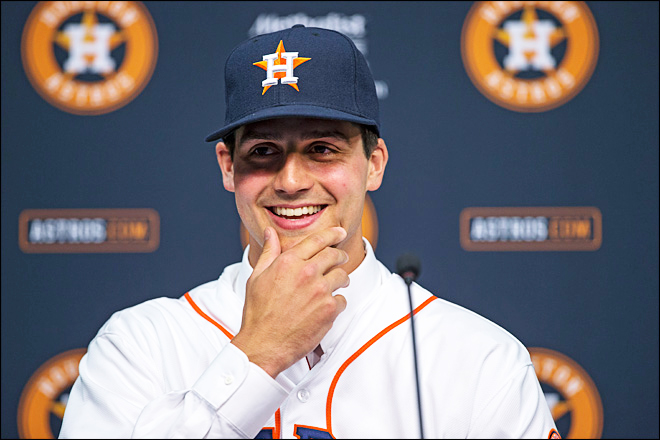
Mark Appel, Pick #1 2013 Amateur Draft

Mark Appel, Pick #1
2013 Amateur Draft


Have you made a big decision that seemed right-as-rain at the moment, but sooner rather than later revealed itself as landmark regret? If not, what planet in the universe are you from?

Well, the autopsies on Stanford pitcher Mark Appel as the first pick of the Houston Astros in the 2013 amateur free agent draft are now rolling in pretty predictably with his late inclusion into a five players for two trade with the Philadelphia Phillies for the purpose of acquiring 25-year old power closer Ken Giles over the weekend and these op/eds will inherently, or specifically, be raising all of the silly, sanguine, sad, and predictable questions that invariably arise from hindsight:

  1. How much stock can a club place in the stats of high school or college ball as indices of future performance at the professional level?
  2. How many really good scouts out there possess the intuitive ability to project a prospect’s future performance based on what they see?
  3. How much is decision-making at the top draft pick level reduced to clubs simply basing their “hopes” on a likable candidate maturing to the level he will need to reach over time with experience and effective coaching?
  4.  How often is disappointment based on the time-discoverable reality that some first picks may already have reached their player growth potential on draft day. These types do not develop further because there really is no dynamic upside beyond where they already are, no matter how teachable they are, or how hard they try.

After the Giles trade, pitcher Mark Appel told one writer that “I can only perform to my God-given ability.” And that statement alone may cover all but two aspects of the truth about Appel. His “God-given ability” may have already peaked on the day the Astros drafted him in 2013. The Astros just didn’t know it.

Had the Astros known, it’s highly unlikely they would have drafted a guy with the first pick, only to include him two years later as a deal-maker addition in a multi-player trade for a highly rated closer.

Had the the Astros also known on draft day 2015, that a kid named Kris Bryant was out there as an alternative to Appel – as one who would be then taken by the Cubs in 2013 and go on to hit .275 and 26 HR in 151 MLB games in 2015, but they didn’t know. Neither did the Cubs.

The larger seminar here goes beyond the unfolding destiny of Marc Appel – or even baseball. The better we get at assessing potential for our own growth, the better our decision-making improves and the lesser we stockpile regrets over “poor” (inadequate) decision-making.

From my own career experience of working with people on issues of growth and change, here is a capsule of words I would use as indicators of potential for change and a high ceiling of performance in some area. None of these qualities are absolute, but they appear too often as change-booster variables to be dismissed. And these are: intelligence, emotional stability, flexibility, the ability to listen, a commitment to learning from experience, and a burning desire to discover and use self-knowledge for self-improvement.

In closing, I am reminded of famous Nolan Ryan scout Red Murff’s story of signing the greater future Hall of Famer from Alvin, Texas. Murff said that he could recognize that young Nolan needed to “fill out” in body weight and muscle growth to become the pitcher he had the potential to be. Murff says he looked at Nolan’s father and saw that the elder Ryan’s rugged muscular build was all else he needed to know about the kid’s potential to sign him for the Mets. – Good work, Red, but I doubt I’d get much argument from you on this closing thought:

Nolan Ryan also possessed all of the “indicators of potential” that I listed earlier.

Good luck to Mark Appel, too! Maybe you will get there in your own time – and maybe we put too much pressure on #1 draft picks to be the human equivalent of energy drinks to our team’s floundering fortunes.

____________________
eagle


Where Do The Current Astros Stand?

December 13, 2015
Costello: "who's on Third for the Astros?" Abbott: "Who's on First?"

Costello: “Who’s on Third for the Astros?”
Abbott: “Who’s on First?”


Where Do The Current Astros Stand …. when it comes to their basic knowledge of the game and their overall club ability to execute in situations which are best served by the combined presence and use of athletic ability, situational knowledge by instruction, game experience wisdom, and the capacity for execution?

By basic knowledge, I mean those distinct areas of offense, defense, and pitching that ultimately determine the success or failure of most championship pursuits. In my estimation, these areas of basic knowledge include all those reasons a half century ago that led to rookies being sent back to the minors for “a little more seasoning” when their MLB play revealed that they needed more playing time to gain wisdom on what they needed to either do or correct about their approaches to certain game situations.

Whereas, none of us might organize any list of these areas of basic knowledge exactly the same, here’s how I see them by offense, defense, pitching, and game intuition (savvy):

Offense

  1. Hitting – knowledge of the strike zone
  2. Ability to make contact with strikes and not swing at balls
  3. Ability to use a batting stance that maximizes the power of one’s personal bat speed
  4. Ability to put the ball in play
  5. Ability to hit for power without excessively striking out
  6. Ability to take and use what the defense gives the batter
  7. Ability to hit safely behind runners, if needed
  8. Ability to run bases with increasing wisdom of pick-off ploys
  9. Ability to work with base coaches on running decisions
  10. Ability to resist pitcher’s attempts to control home plate

Defense

  1. Development of a fielding stance which maximizes range of coverage
  2. Ability to always know the game situation and one’s probable choices before they happen
  3. Basic knowledge about getting in front of balls and one’s glove down on grounders
  4. Knowledge of cut-off strategies and the ones preferred by your manager
  5. Field positioning based upon both game situation and wisdom from game experience about how certain batters seem to hit the ball off certain pitchers – especially in certain situations.
  6. Basic awareness of health hazards that may exist on or near fair play that could either bring injury or prevent a catch for fielders who aren’t sure of a risk in a particular running direction.

Pitching

  1. Basic awareness that pitching is just what Warren Spahn described: “Hitting is timing. Pitching is the art of upsetting that timing on a 100% basis, whenever possible.
  2. The best pitchers are those who continue to learn. Just as the best teachers are those who never stop being students, the best pitchers are those who continue to learn both from their own experience and the observations of others.
  3. As a pitcher learns more about his own particular strengths and weaknesses, he adds tools which further support his strengths – and other tools which help minimize his vulnerabilities.
  4. The greatest of pitching tools are speed, deception, intimidation, and the ability to most often get positive results over time. Some are genetic. Others are developmental. And no tool is guaranteed forever. A lot of young speed ballers fail over time because they either lose their speed, or else, they simply become hittable to smart batters who will almost always catch up to the fast ball pitchers with nothing else going for them.
  5. Speed, variability of speed and ball movement by pitch, pitch location, good pitcher-catcher wisdom and intuition about certain batter weaknesses, and a pitcher’s arm durability, are all principle variables that determine a player’s value on the mound over time.
  6. Pitching is about as Darwinian as things get. Only the strong survive. And the survivors mostly share one common trait. – They are adaptable.

That’s how I see it. Feel free to add your own takes on essential ability.

My own assessment on the abilities of the current roster may change considerably by spring training. GM Jeff Luhnow already has taken steps to acquire the closer we need in Ken Giles and it looks pretty good that he will fid the other starter we need for the rotation before the season begins.

We still are weakened by a batting order that strikes out too much, but letting Chris Carter go was a step in the right direction. I like Colby  Rasmus, but I hope that he works more on cutting down the “K”s and becoming more of a contact hitter. – That’s a wish, not an expectation of faith or even a mild belief.

Third and first base still bother me. Valbuena and Singleton apparently are the default candidates, but they are both on the heavy “K” side – and only Valbuena has shown his ability to hit for power over a full season. Singleton has to show that he can hit anything at all for a full month.

Base running and defensive cut off strategies could sure use some work. I still have two late season memories from key games the Astros lost when the opposition caught Jose Altuve standing innocently off first base for an easy pick. – What’s up with that? And too many memories of runs scoring against the Astros  on poor cut-off man connections.

Catching is hitting weak and quality thin. Hopefully, Stassi can either rise to the occasion and grab this opportunity or quickly move out of the way for a more qualified player to be named later. As for Castro, what’s there to say? – Astros pitchers love him, but so do the opposition’s pitchers. – They get to pitch to him too.


Willard Scott ~ Depart us ~ Please not

December 12, 2015
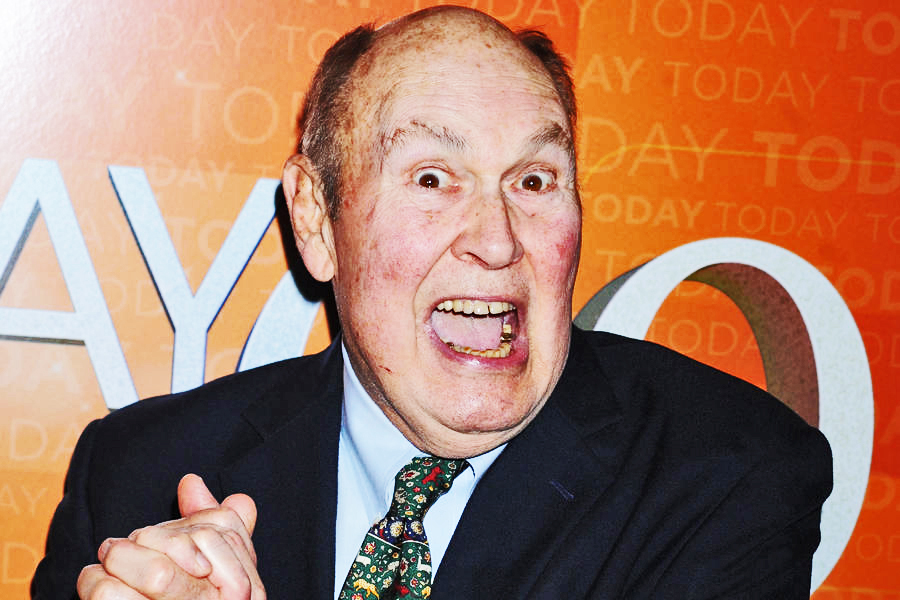
Willard Scott to Retire from NBC After 65 Years. Started as an NBC Page at age 16,

Willard Scott to Retire from NBC After 65 Years.
Started as an NBC Page at age 16,


Willard Scott ~ Depart us ~ Please not

By Bill McCurdy (c) 2015


Willard Scott ~ Depart us ~ Please not,

Your smiling red face still joy-puckers.

If you leave us right now ~ well, My Gosh, Holy Cow,

Who’ll do the shout-outs for Smuckers?


“Johnny B. Good’s ~ a hundred big ones today,

Deep down in that place ~ where the coolest cats play.

He don’t bang the guitar so good ~ now, they say,

His arthritic fingers hold ~ life’s sorry sad sway.”


Ronald McDonald once came ~ to this luminous life,

He found his beef grease breath ~ all through you.

Those who ate the fat food ~ you so happily knifed,

Gave life to the med phrase ~ “Code Blue” you.


You gave 65 years~ to your NBC cheers,

You saw how acts change ~ or dissolve.

You’re walking proof, Willie ~ that TV sells beers,

And that not all survivors ~ evolve.


Hang around, Willard,

March 7, 2034 is your big day on the Smucker’s jelly label.

____________________

eagle-red

Imaginary Christmas Gifts to Certain People

December 11, 2015

Christmas_baseball

Imaginary Christmas Gifts to Certain People

  1. Jeff Luhnow, GM, Houston Astros ~ Gift: A line of credit that would allow him to buy. sell, or trade any of his other 2016 Christmas gifts from any source for ones of similar age, value, and potential for their near and long-term usefulness, cost, and control over time.
  2. Tal Smith, former President, Houston Astros  ~ Gift: A new landscaped back yard with a 30 degree angle ascending rise over the last forty feet of distance to the deepest center portion fence point, The rising turf will also include a 90 feet high flagpole and a gift card to Tal with the following simple inscription: “Dear Tal, we designed and constructed this landscaped hill in your honor. We also made sure that it was not built near any potential revenue streams that might interfere with our present gift intentions at a later time. The honor of naming this hill as you would like it to be remembered is yours.” 
  3. Mike Vance, Founder, Houston Arts and Media ~ Gift: We have to use a magical wish on this one. We wish that all the pats on the back that Mike gets from appreciative others for his numerous contributions to the preservation of Houston and Texas history came with an adhesive $100 bill that stuck to the back of his shirt each time that the slap came down upon his shoulder.
  4. Houston Astros Baseball Fans ~ Gift: A guarantee from club ownership that the elimination of certain high strike out ratio batters from the 2015 roster will not result in the 2016 extra use of AC fans in the MMP cooling system and an increase in the electricity bill that quickly translates into an increase in ticket prices.
  5. Sylvester Turner, Mayoral Candidate, City of Houston Run Off Election Tomorrow, 12/12/2015 ~ Gift: The Pecan Park Eagle casts their vote of support tomorrow for Sylvester Turner. We believe him to be the candidate who cares the most about Houston above the “pot-hole” level and we do think he will pursue all actions in a fiscally responsible manner. Based upon the candidate’s comments in last Friday’s Channel Two debate, Turner also appears to be the only candidate to genuinely care about the practical re-purposing and historic preservation of the Astrodome. If saving one of the world’s iconic architectural structures is your idea of “fiscal irresponsibility,” you probably ought to vote for the pot-hole guy.
  6. The Sugar Land Skeeters ~ Gift: In service to the expanded thematic use of their pesky mascot creature, we suggest that the club initiate another post-season award to any player who both leads the club only in those years in which the same man records the most home runs and strikeouts. The name of this award is suggested to be “The Sugar Land Skeeters Swat or Squat Award.”
  7. The MLB Players Union ~ Gift: With the players demanding more participation in everything baseball decides, how about including decisions about each club’s team uniform wardrobe. Grant them the right to insist upon the inclusion of a sleeveless jersey, ala Ted Kluszewski of the late 1950s Cincinnati Reds, or the 1960 Roberto Clemente Pittsburgh Pirates, which included a long sleeve black undergarment jersey. Tell the players also that they are only rejuggling the same letters in one word in a Second Amendment phrase by now asserting that they, the players,  have a constitutional right “to bare arms!”
  8. Bob Dorrill, SABR Houston Chapter Leader ~ Gift: Bob Dorrill is by nature one of those high energy people with incredible social schools for meeting and learning something about every stranger who crosses his path. He also leaves them smiling – and probably feeling better about themselves. Similar to Will Rogers, Bob Dorrill never meets a stranger he doesn’t want to meet – or so it seems. What gift are we proposing then for Mr. Bob Dorrill? Forget about it. In the case of Mr. Dorrill, he already possesses and lives out the greatest gift there is – and that is – the ego-free giving of oneself in the name of love to something bigger than himself and his personal needs. – Guess you will have to settle for a “Merry Christmas and Thank You from All of Us, Bob!”
  9. The Game of Baseball ~ Our Gift: Let’s continue to give it our true love, then we won’t have to worry about conscious renewals because, as you hopefully already know, true love always goes were it goes. We never own the object of our love, be it our partner, our child, or our passion. We are simply the collective curators of our caring about the object of our affection, caring always about its past, its present, and its future – and to how our caring influences the good or the bad, in this instance, of the game itself. So, in effect, our gift to baseball is the gift that comes back to us too.

What is the legacy of baseball, as we see it? And why is it important to the generations to come? And stop there to reflect. The better we develop our insight into those two areas over our lifetime, the better we shall come to understand what baseball and the baseball sub-culture is already giving to all of us now.

Merry Christmas, Everybody!

____________________

eagle-red

1969: UH Cougars 41 – Florida State 13.

December 10, 2015

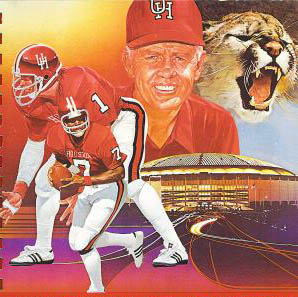
UH-Astrodome

Media rumblings out of Florida State territory today suggest that many of the Seminole fans are underwhelmed by their club’s pairing with our Houston Cougars in the New Year’s Eve morning Peach Bowl, but that’s OK, we Cougar fans sort of understand where they are coming from. We are moving toward a stronger schedule at UH, but that energy by itself won’t stop the nose-thumbing at our season win totals until it happens, but, again, it’s not likely to reach the quality point we want it to be either until we act, play, pay, impress, and earn again our way into one of five power conferences.

UH sports and our fans have paid a big price for the political sandbagging we took from the moves that blocked our transition to the Big 12 Conference after the 1995 final season of the old Southwest Conference, but we have survived and gotten real to what it is going to take to get back to where we once were and still very much belong by merit in collegiate sports, representing Houston, our university, our city, and our community’s first class aims for tomorrow.

Those who underestimate Coach Herman and the 2015 Cougars on the field, or UH in general, are either too young to recall our history with Florida State – or else – too caught up in the dementia of aging to remember our UH history with Florida State on the gridiron – or even more importantly – they haven’t seen the current Cougars play.

UH neither gets nor expects any of its aspirations to be realized by history or entitlement. We expect to earn our way, but without dragging along other people’s wrong ideas or poor memory of what we’ve shown are our capacities over the years.

UH has not played Florida State in 37 years, but their home and away record against the Seminoles in 16 games played between 1960 and 1978 shows the Cougars acquitting themselves very well. The UH edge is canyon-sized on the victory side with the Cougars winning 12, losing only 2, and playing out 2 ties in the pre-overtime days.

This site, which you may enjoy using to find the results in any series record between any two college teams, also shows some other details about the UH-FSU history:

http://football.stassen.com/cgi-bin/records/opp-opp.pl?start=1869&end=2014&team1=FloridaState&team2=Houston

Houston won their most recent game with Florida State, 27-21, on November 30, 1978, bu that too is all there not here.

For now, I’m among those who are delighted with any level of light regard the FSU coaches, team, or fans care to throw the Cougars’ way. We will gladly take all the bulletin board material in the realization that no matter how the game actually turns out, 2015 already is in the books as a successful turn of good fortune for our beloved University of Houston.

Winning the Peach Bowl, if it is to be, would be the icing on the cake for Cougar Nation.

Here’s a table on the 1969 Cougar football season, one of the those years in which we handled Florida State pretty handily. After stumbling at the gate and losing their first two games, the pre-season ranked #7 Cougars rolled up 8 straight wins during the season before rolling Auburn 36-7 in the 1969 Bluebonnet Bowl. Bill Yeoman’s Veer offense was in high gear that year, with sophomore QB Gary Mullins leading the way and WR Elmo Wright keeping the defenses honest with his speed and reception talents. The 1969 Cougars ended the bowl season with a 9-2 record, ranked # 12 in the AP and #14 in the Coaches’ Poll.

1969 Houston Cougars Football Season Results

1969 DATE UH FOE UH RANK SITE TV RESULT GATE
SEP 20 FLORIDA # 7 AWAY L 59-34 53,807
SEP 27 OKLAHOMA STATE AWAY L 24-18 23,500
OCT 04 MISSISSIPPI STATE DOME W 74-0 36,207
OCT 11 ARIZONA AWAY W 34-17 32,800
OCT 18 Open Date
OCT 25 #17 MISSISSIPPI DOME W 25-11 48,049
NOV 01 MIAMI DOME ABC W 38-36 25,498
NOV 08 TULSA AWAY W 47-14 17,750
NOV 15 NORTH CAROLINA ST #18 DOME W 34-13 31,000
NOV 22 WYOMING #19 DOME W 41-14 35,389
NOV 29 FLORIDA STATE #18 DOME W 41-13 36,508
32-Day Pre-Bowl Days
DEC 31 #12 AUBURN #17 DOME HTN W 36-7 55,203
Post-Season #12 AP

Those crowds were pretty good for UH in that era – as was the name-brand of most teams on the Cougar schedule seven years prior to  their first 1976 first season in the SWC. Also note the absence of television support. The game with Miami was their only coverage by ABC and, remember too, that pretty much was all that everyone in the country got back in those pre-ESPN Saturdays in the fall. You simply got to see the more powerful schools more than once – but one game televised on Saturday, if memory serves. And with no social media fracking attention spans back then, the only way other people could learn about your club was through the second-hand tales of those who did attend your team’s games or write about them with varied skill and interest in the sports pages.

Temple@UH 120515 07


Jeff Banister: Another Rediscovered UH Cougar

December 8, 2015
Jeff Banister Former UH Cougar Player Current Texas Rangers Manager CAP EVALUATION: Right Color/Wrong Lettering

JEFF BANISTER
Former UH Cougar Player
Current Texas Rangers Manager
CAP EVALUATION:
Right Color/Wrong Lettering

Writer Evan Drelich did himself proud yesterday with his interview piece with Texas Rangers Manager Jeff Banister, a former UH Cougar baseballer from back in the Southwest Conference days – and a guy whose living connection with the university includes the memory that UH was the place that opened doors for him into the later professional game he still lives; it was the close-to-home campus that allowed Jeff’s parents to come up from nearby Lamarque and watch their son playing college ball; it was the place where he found his young adult sense of belonging in the campus culture; and it was, and it remains, the sacred ground where he met Karen, the love of his life and future wife.

http://blog.chron.com/sportsupdate/2015/12/qa-with-texas-rangers-manager-and-uh-alumnus-jeff-banister/

Drelich makes referential acknowledgement in the interview to the fact that Banister depicts his allegiance with a UH “helmet on the desk” as the symbol of all the those items that we described above as meaningful to the Texas Rangers manager about the placement of UH in his life.

Like every Cougar alumnus I’ve spoken to this fall, Jeff Banister’s attention and excitement by the accomplishments in football under first year coach Tom Herman is high and building. Banister implies that previous commitments will keep him from traveling to see UH play Florida State in the New Year’s Eve late morning Atlanta Peach Bowl, but that he definitely will be watching the “Coogs” on TV that special day.

And another life irony flows through me as I consider what this rediscovery of Jeff Banister to my lost memory of his UH background means to me – and it goes down simply as something this: Just when I thought that there was no way in the world for me to find anything I might like about the 2015 Texas Rangers as an avid Houston Astros fan, along comes this memory-jogging article by Drelich of the Chronicle about their Cougar-clawed leader.

This confirmation of Jeff Banister’s UH Cougar bloodline will not alter any part of my soul commitment as a Houston Astros fan to not be a fan also of the Texas Rangers on any level, but it may help the boys from Arlington to draw a mercy card from me that wasn’t present previously once the Astros totally destroy them in the AL WEST in 2016.

In fact, limited future Rangers mercy is about all I have new to offer as a result of this yesterday-recovered memory of Jeff Banister as a red-blooded member of Cougar Nation.

“Life’s roads are filled with many turns, twists, and dangerous curves. – That’s why it’s so hard to go straight all the time.” ~ Yogi Berra? Probably.

Eat ‘Em Up, Astros!

____________________


EPSON MFP image