Posts Tagged ‘Baseball’

Perfect Game Lost to Imperfect World of Umpires

June 3, 2010

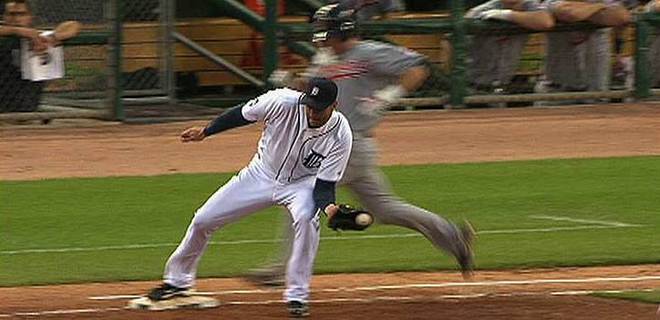
Blown Umpire Call on 27th Batter Costs Detroit Pitcher Galarraga His Perfect Game!

I was piqued the other day when umpire Bill Hohn tossed Astro pitcher Roy Oswalt in the third inning for being frustrated with his postage stamp strike zone. Today I am enraged over the fact that a horrible call by umpire Jim Joyce yesterday on the 27th batter of the game has cost Detroit Tiger pitcher Armando Galarraga his perfect game. With the pitcher himself covering first base on what should have been – indeed was – the last out by way of a grounder on every batter he had faced, Joyce called the runner safe. He would admit his error later upon an examination of the replay after the game, but the perfect game was still lost forever.

The Galarraga perfecto would have been the third such animal in thirty days, the only time that three of these most improbable of all baseball jewels have adorned the neck of our national game in a lone season of play. It would’ve also been only the 21st perfect game in major league history. Now it will simply have to be the shared bad dream of pitcher Galarraga and umpire Joyce, and all others of us who care about these things, from here to kingdom come.

I haven’t been this upset over the outcome of a baseball contest since Game Six of the 1986 National League Championship Series between the New York Mets and the Houston Astros. At least that one turned on managerial decisions and what happened on the field. This one – THIS ONE – turned only on  what one game official saw with his naked brain and eye against what we could have ascertained accurately had instant replay been permissible under the circumstances.

Look! Nobody wants this kind of outcome. Not umpire Joyce. Not pitcher Galarraga. Not the players. And not the fans. As per usual, change will now come to baseball on the heels of disaster. It’s time to make even greater use of instant reply to keep this sort of thing from happening again.

When instant replay was approved a couple of years ago for fair/foul and distance marker calls on home runs, it was done to keep blown perceptual decisions of the umpire’s fallible human eye from wrongly affecting the outcome of games. Shouldn’t we also try to extend that same protection to the integrity of baseball history?

We already know that instant replays do not resolve all questionable calls and that it would be too time-consuming to allow them on every play. Some errors are going to simply continue, especially on the distorted ways the human eye sees the strike zone differently from umpire to umpire. Until we can get to a point of calling balls and strikes by laser ray, I don’t see balls and strikes consistency getting much better,

This thing that happened yesterday, however, is a horse of a different color. Instant replay clearly showed that the 27th batter of the game was OUT by a couple of feet on the grounder play at first base. Had instant replay been allowable under the circumstances, history could have been correctly registered with no shame upon the umpire’s missed observation – and we would not all be sitting around today trying to figure out a way to make anger, remorse, and regret digestible.

What kind of sauce tastes good with a boiled dead rat, anyway?

Here’s what I propose as protection against the repetition of yesterday’s improbable rat boil:

Any time a pitcher enters the ninth inning with a no-hitter going, instant replay should be allowable on any questionable field play affecting safe/out calls. For an umpire’s “safe” call on any runner to be reversed, there must be clear evidence on tape to support an overrule. This condition will continue in the game for as long as the pitcher remains in a position to throw either a no-hitter or perfect game. and will cease as an appeal option as soon as a hit is recorded. Decisions on instant replay reviews will be handled in the same manner as the one in place now for foul/fair balls and home runs.

Do it now, Commissioner Selig. The integrity of the game’s history is on the line.

Curt Walker and the Boys of Beeville

June 2, 2010

Curt Walker, MLB, 1919-30; .304 BA; Struck Out only 254 times in 4,858 official times at bat.

When my dad was growing up in our little Texas birth town of Beeville back in the early part of the 20th century, the city population of this little farm and ranch community was only about 3,000, but they were all mostly people who loved baseball. It showed on the rough playing fields of South Texas too. Beeville sent three players to the major leagues during those early times, all of whom got there with enough staying power to carve out careers in the big time over several seasons.

Two of the these men were pitchers: (1) Melvin “Bert” Gallia, 1912-20, W 66 L 68, ERA 3.14 and (2) Lloyd “Lefty” Brown, 1925, 1928-37, 1940, W 91, L 105, ERA 4.20.

Gallia (1918-20) and Brown (1933) both spent some of their time pitching for the old St. Louis Browns. Gallia was a 17-game winner for the Washington Senators in 1916-17 consecutively. Brown leads the Lou Gehrig victim lst for having given up 4 of the Iron Horse’s career-leading 23 Grand Slam Homers.

Then there was outfielder Curt Walker, who played a major role modeling place in my dad’s life as a young ballplayer. Grandfather McCurdy published, edited, wrote for, and printed the local Beeville Bee, but he died when Dad was only two years old. One result was that Dad grew up needing some other local adult male to look up to – and it turned out to be Curt Walker, who also worked in Beeville during the off-season at his other occupation as one of the town’s leading undertakers.

By the time Dad was old enough to follow Curt Walker as he broke into the big leagues with the 1920 New York Giants, radio had yet to take over as a coast-to-coast medium of mass communication. If you wanted to follow the daily changes in baseball back in that era, you either had to have access to large daily newspapers and be able to check the sports pages for the stories, box scores, and up-to-date standings – or else, you had to do what Dad and other small town people did back then. You had to walk downtown to your weekly newspaper office, or Western Union station, and check for news and box scores as they came streaming live through every little nook and cranny of America. Some of these places, as was the practice of the Beeville Bee and Beeville Picayune, kept chalk board accounts in their Main Street windows that detailed scores, standings, and brief news on what the “Boys of Beeville” were doing on a given summer day.

Dad often described these walks downtown for scores in the late afternoon as the highlight of his summer day as a kid.

For me, Curt Walker would become the reason behind my eventual involvement in the Texas Baseball Hall of Fame. When I attended my first TBHOF induction banquet in Arlington in 1996 and learned that Walker was not a member of the state hall, I began campaigning for his induction. It took five years, but the late Curt Walker finally was inducted into the Texas Baseball Hall of Fame in 2001.

Curt Walker had hung out in the shadows of Texas baseball history for too long. If you will take the time to compare his career marks with fellow Texan contemporary Ross Youngs, an inducted member of the National Baseball Hall of Fame, you will not find a lot of significant difference. Both were deserving players from this state. Walker just got lost by posting his best season batting average of .337 and 196 hits with the 1922 Philadelphia Phillies and then spending most of his big league career (1924-30) in the hinterlands with the Cincinnati Reds.

Curt Walker’s lifetime MLB batting average of .304 and his limited 254 strike outs in 4,858 official times at bat pretty much speak for themselves and his batting ability over time – although he arrived in New York with a scouting tout that even Curt could not fulfill in reality.

When the Giants purchased the contract of Curt Walker from the Augusta Georgians in 1920, they paid $7,000, or ten times what the Tigers paid for Ty Cobb’s services from the same club back in 1905.  Many South Atlantic League veteran observers were saying they felt that Walker was better than Cobb at that stage of his development. Of course, that scouting report turned out to be a major oversell, one that led John McGraw to deal Curt Walker away in 1921 to the Phillies, but he was a steady good ballplayer for years to come – and much better than average. He also was a smart and speedy runner and fielder with a good arm.

Years later, catcher Eddie Taubensee would become the fourth native Beevillian to make it to the big leagues. Also, famous big league hitting coach Rudy Jaramillo, a native of Dallas, but a kid who grew up in Beeville would also rise up to leave their own marks on the game.

Two other things I always note about Walker are these: (1) Curt played 41 games for the Houston Buffs in 1919, his first year in professional baseball; and (2) As a member of the 1926 Reds, Walker tied a major league record that will always be very hard to break. In a game against the Boston Braves, Curt collected two triples in the same inning.

What are the odds against anyone ever hitting three triples in the same inning? I’m guessing they are about equal to Curt Walker’s chances of ever being inducted into the National Baseball Hall of Fame.

Balls and Strikes

June 1, 2010

Good thing Roy Oswalt didn't have a perfect game going into the 9th yesterday!

When Astros starting pitcher Roy Oswalt got tossed by plate umpire Bill Hohn yesterday in the third inning of his game against the Washington Nationals for expressing his frustration over the strike zone, it not only strongly effected the outcome of the contest, but it reawakened all the key arguments over what baseball should do about it:

(1) Make the umpires go to school on what the strike zone is so that calls are made more uniformly. That’s been tried and I’m sure that many umpires would tell you that they still do get together and try to make sure they are all coming from the same page on balls and strikes. Oh yeah? Go see a few games and watch how these guys variously call the strike zone. Either a lot of people are lying or the strike zone is so subject to variable perception that getting all the umps to call it even close to the same way is either highly improbable or probably impossible.

(2) Leave things as they are and let pitchers and batters adjust to the variations in the strike zone as they occur from umpire to umpire. That’s probably what will happen here, but the Oswalt ejection highlights an ongoing problem. Oswalt was ejected for ostensibly baiting umpire Hohn for not calling strikes on the outside corners of the plate. Oswalt says he was just venting his frustration – and what’s wrong with that? If we are going to cut the slack of imperfect human nature and allow umpires to vary the strike zone, can’t we at least allow pitchers to stomp around the mound and mumble to themselves when their equally human frustration spills over? Why do the umpires have to take those actions personally? Are umpires the center of the universe? Are umpires the reason we buy tickets to go see  ballgame? I don’t think so.

As things stand, it’s now up to the umpire to diagnose the intent of the pitcher as he moves around and mumbles. If the umpire chooses to take the pitcher’s actions personally, he then has the power to throw the whole game out of whack by dispatching a club’s ace at any junction in the game or point of time in the season.

What if Oswalt had been tossed in that last game at St. Louis in the 2005 NLCS playoffs? What if Roy Halladay of the Phillies had been ejected with one out to go in his perfect game effort last week? Neither happened, but they could have happened under the current rules.

For now, the umpire has the power to change the history of baseball in any game he chooses by acting on a perceived offense and ejecting a key player. If the cause was protested and found to be poorly administered later, it might help baseball rid itself of a poor official – but that wouldn’t bring back the pennant or a perfect game that may have been lost by the original act of ejection.

So, what’s the alternative?

(3) Laser Tech or Looser Rules on Player Frustration Acts. I really have no idea where we are on the use of laser technology for calling balls and strikes, but if we are anywhere close, I’m all in favor of baseball looking into it. I don’t think it serves the best interests of the game when any club’s ace, especially, is dispatched as Oswalt was yesterday, but neither do I think we are talking about a change that only protects aces in big games. We need a change that protects all pitchers in all games.

More practically, we may have to get a clearer definition of what are acceptable acts of frustration by a pitcher when he is struggling on the mound over the strike zone or for any other reason. Common sense by the umpire points the way here. If a pitcher stomps around and kicks dirt and mumbles something the umpire cannot hear, let him do it. If a pitcher points his finger at the umpire and calls him something like a “Blind SOB” – by all means – throw him out of the game.

Just please, Mr. Umpire, stay away from initiating conversations with the upset pitcher that begin with you walking toward the mound, asking, “What’s that you said?” If you do that, it just tells us fans that you have already decided to toss the pitcher because you can’t handle anything that may be taken as criticism of your umpiring abilities.

Mr. Umpire, as a fan, I don’t go to the ballgame to watch you umpire. I don’t even go to the ballgame to learn your name and, chances are, if you are doing your job well, I never will know your name.

Do you get my drift  here this morning, Mr. Bill Hohn?

Visual Images and Baseball Inspiration.

May 29, 2010

Crank up the Metallica theme, boys! Here comes our closer!

As a kid, I found visual images all over the place in everyday life that I plugged into my sometimes silent, but always present fascination with the game of baseball. I once enjoyed the company of the same young Dominican nun teacher for 6th through 8th grade at St. Christopher’s in Park Place. Sister Reginald wasn’t a professed athlete, or particularly a baseball fan, but she showed an athletic ability in some of her teaching gesticulations that made me conclude that she could have been an effective sidewinder pitcher, had she so chosen to be. Sometimes in class she could bring that right arm around with all the sweeping motion of a vintage Ewell Blackwell in pointing to one of us “boys” as indicted, convicted, and sentenced for disturbing the peaceful goals of parochial school education.

I loved it, even I happened to be the one that day that was drawing the chin whiskers pitch from our hardworking taskmaster teacher. It gave me the opportunity to imagine hitting Sister Reginald’s pitch out of the park.

Yeah, that’s right. They say there’s a thin line between the presence of creative imagination and the mental residence of abject insanity in the minds, hearts, and souls of us too. I tried to keep that in mind from an early age, but I couldn’t help myself. I kept seeing the imagery of human motion as it applied to baseball in just about everything I saw. And nowhere was that more true than at the movies.

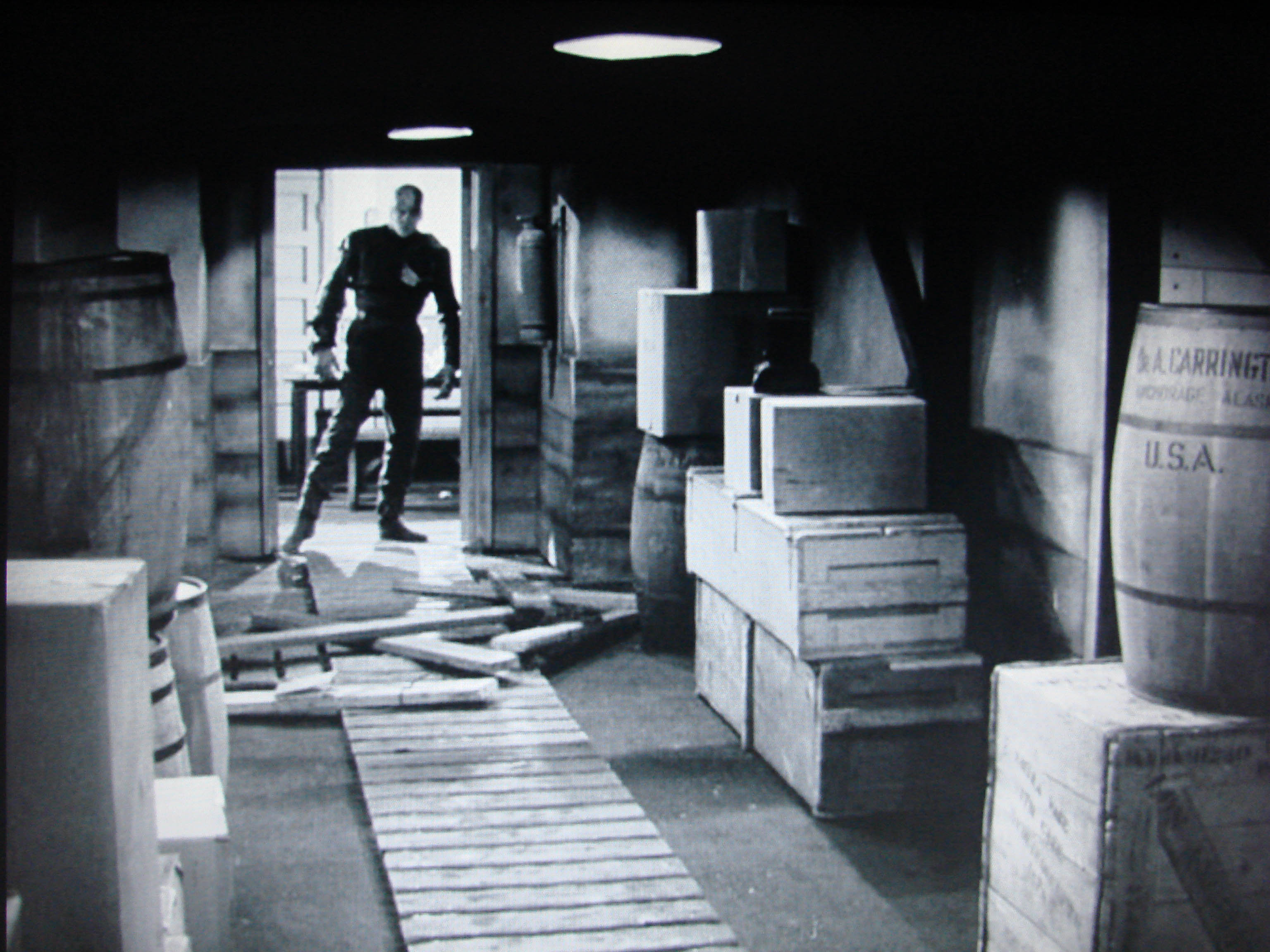
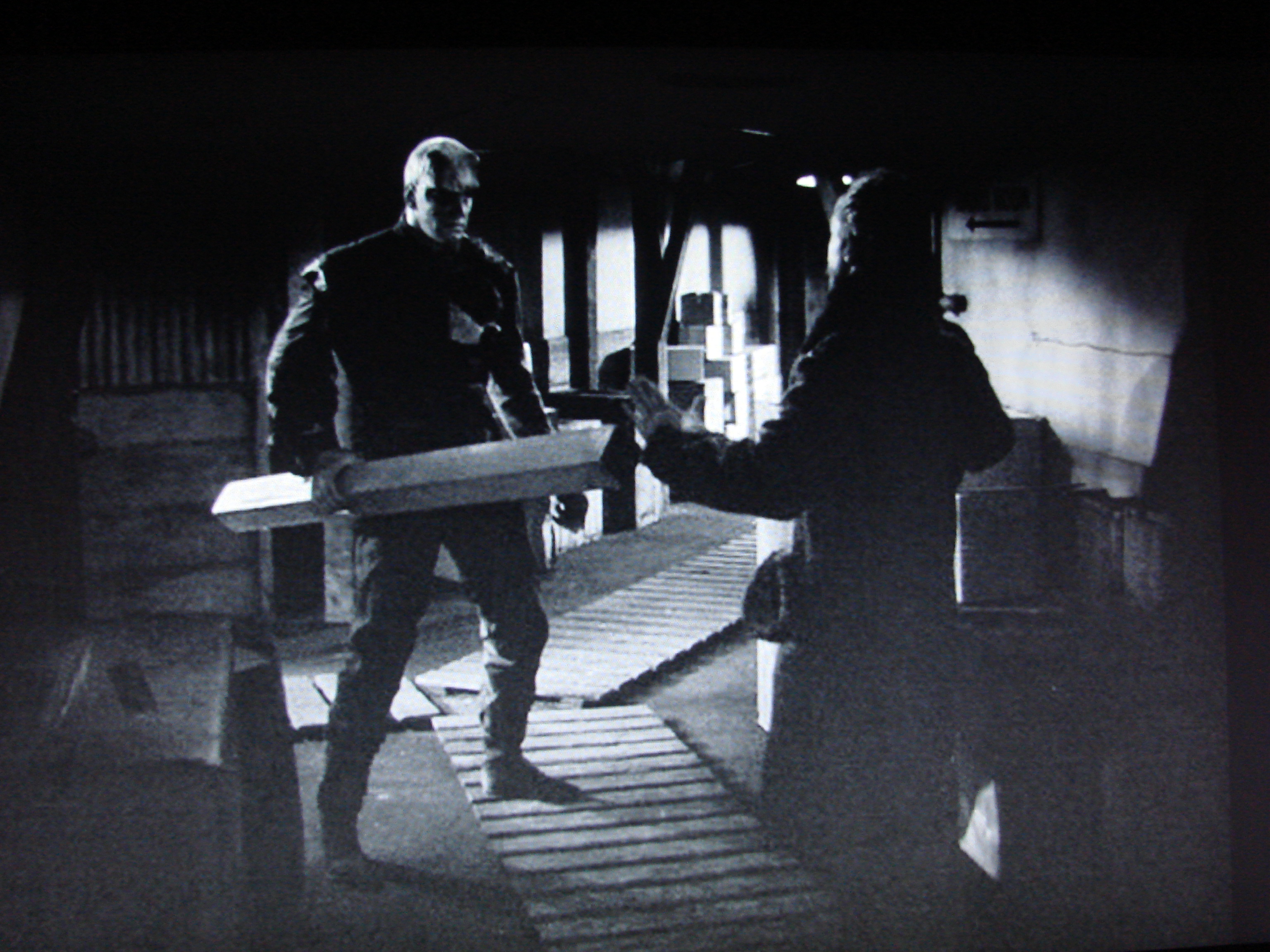
Long before the concept of “closer” became an everyday concept in baseball, I loved the climactic scene from the movie “The Things From Another World” in which “the thing” (James Arness), a vegetative man from another planet, comes through the military outpost door near the North Pole and halts in the doorway. I thought, “Wow! What if he was really an ace relief pitcher for the Buffs coming into put out a Dallas rally in the ninth inning at Buff Stadium? The visitors would be beaten as soon as they saw him standing there!”

As soon as he picked up the lumber, The Thing morphed from Closer to Slugger.

Of course, as the Thing plodded “closer” to the humans in the movie, they threw a big stick of wood at him to force him onto that wooden walking path, a route that was wired for electrification of the mad invader as  he drew nearer. The visual effect on my baseball fantasy of him was that the Freudian presence of the big stick immediately transformed The Thing into a potential slugger with all the pop of a steroids stallion – and all these imagery synapses were firing in my young brain some forty years prior to our common knowledge of HGH and what it could do. I just loved the vision of the Houston  Buffs acquiring a real “Superman,” an unretirable, unbeatable slugger that even the parent Cardinals could not take from us.

Yep, that’s right. I was a rank dreamer – and a Freudian one at that.

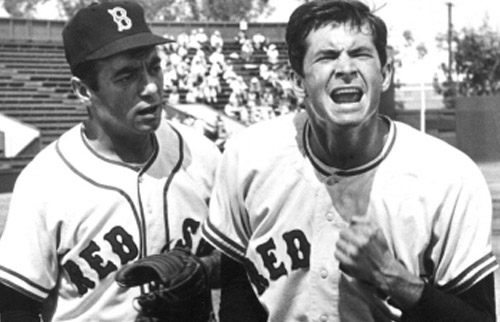
"Why is that every time I throw a ball, I throw it like a girl?" - Anthony Perkins (R) in the movie about Jimmy Piersall, "Fear Strikes Out" (1957).

The imagery issue had another backfiring effect upon me. I had little patience with Hollywood for bad casting of non-athletes as baseball players. They did it a lot – and maybe that speaks more for the fact that actors generally are not athletes – and vice versa. Although, we seem to have a greater supply of athletic actors today than we did back in the 1940s and 1950s.

Anthony Perkins has to be my all time favorite worst athlete/actor  for his 1957 portrayal of Jimmy Piersall in “Fear Strikes Out.” Just for the heck of it, here’s my top ten list of worst athletic portrayals by an actor in a baseball movie. To me, these are the instances of visual failure that are inexcusable to the tastes of any real baseball fans. That being said, I’ve been able to rise above my unhappiness with the playing abilities of all these actors to have enjoyed all the movies on this list. They were about baseball, weren’t they?

Worst Athletic Actors in a Favorite Baseball Movie:

1. Anthony Perkins in “Fear Strikes Out” (1957).

2. Ray Milland in “It Happens Every Spring” (1949).

3. Jimmy Stewart in “The Stratton Story” (1949).

4. Gary Cooper in “Pride of the Yankees” (1942).

5. Dan Dailey in “Pride of St. Louis” (1952).

6. William Bendix in “The Babe Ruth Story” (1948).

7. Ray Liotta in “Field of Dreams (1989).

8. Ronald Reagan in “The Winning Team” (1952).

9. Bruce Bennett in “Angels in the Outfield” (1951).

10. Michael Moriarty in “Bang the Drum Slowly” (1973).

Have a nice Memorial Day weekend, everybody, and watch where you are looking. You never know when something is going to pop into view that reminds you of baseball – even if you happen to be watching an Astros game.

One Photo / Many Questions.

May 28, 2010

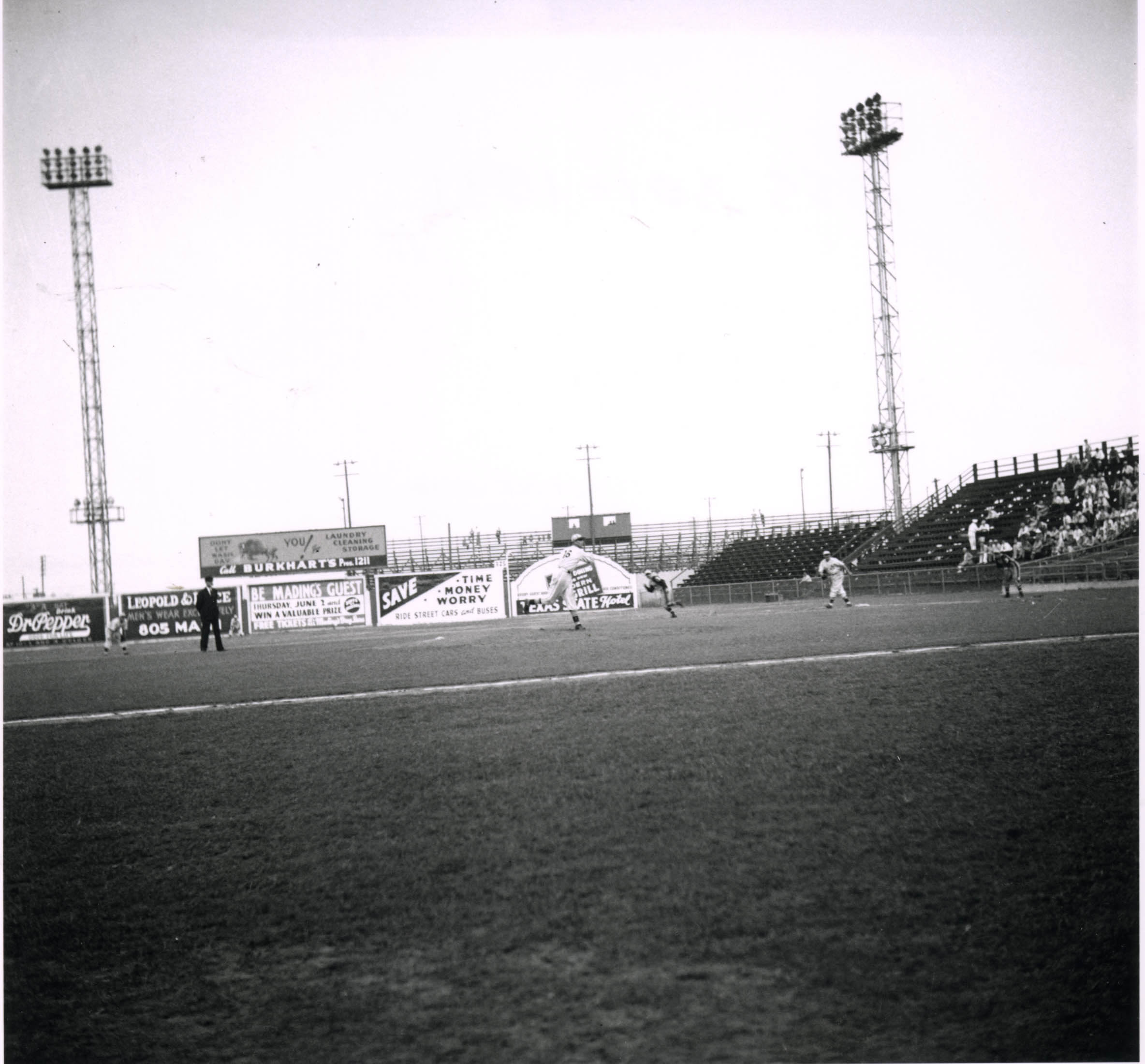
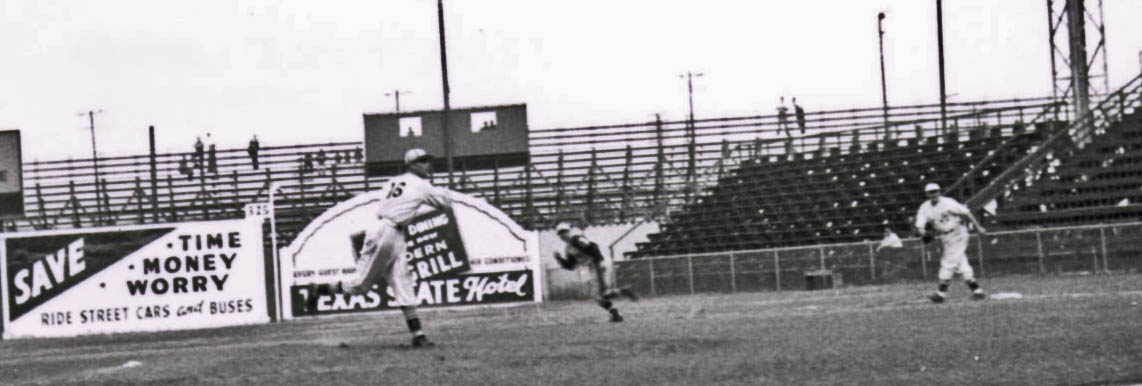
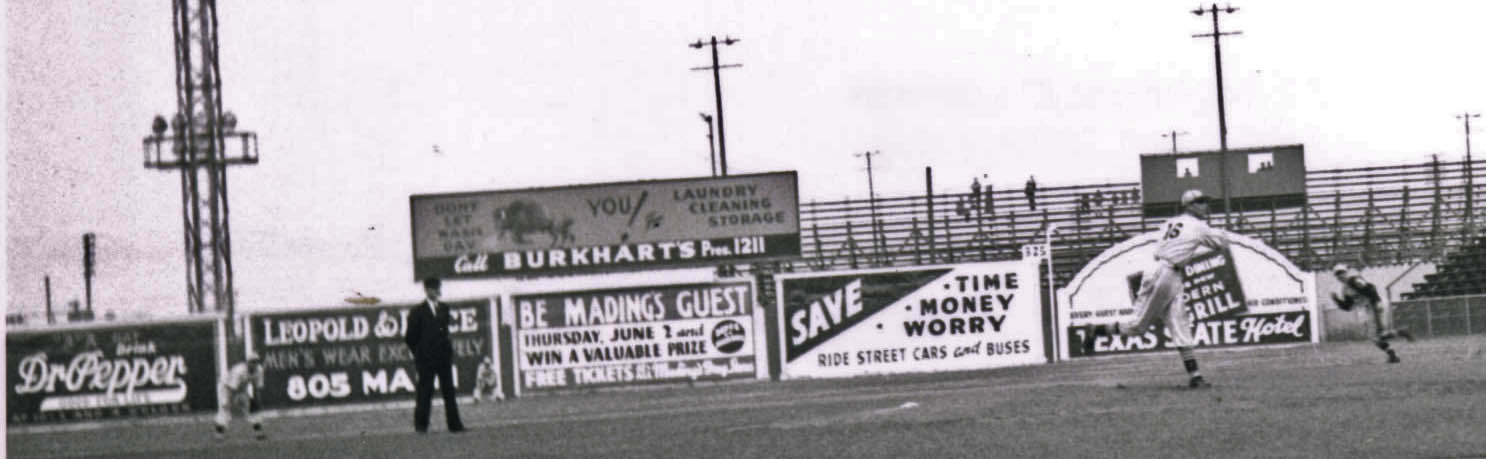
Right Field in Buff Stadium is a place of mystery and curiosity in this photo, starting with the fact that I'm not sure of the exact year it was taken.

Sometimes a photo makes everything obvious. Just as often, a photo may raise more questions than it really answers. The photo shown above is of the latter type. I acquired it some time ago from the very special Texana Collection at the julia Ideson wing of the Houston Public Library. We knew that it was taken in old Buff Stadium in the Houston East End, but that was about the only fact that was clear.

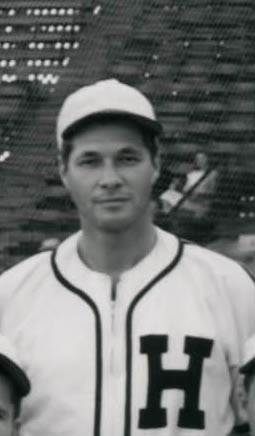
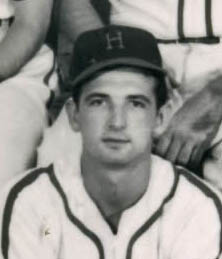
I’m not sure who #15, the pitcher, is but he is a Buff, as best I can see from the old English H that is visible on the left jersey breastplate in another close up of the  unidentified Buffs first baseman. The year of this uniform could have been anywhere from 1938 to 1942 or 1946-47. The ’47 Buffs club preferred the Buff logo on the jersey, but they also used the old English H. I simply cannot find another photo of the 46-47 team wearing the light colored caps with stripes – and a photo I have of the ’41 Buffs shows them wearing dark caps. More research is needed.

The HR-resistant Gulf winds came roaring in over these walls in the Houston summertime.

If you look closely above at the first crop-shot from the main photo, you may be able to see that the distance down the right field line was 325 feet, the same as I remember it from my Buff Stadium kid days (1947-54) and the same as it is now in Minute Maid Park. The major differences between these two ballpark right field lines would be the roof option at MMP and the no choice prevalent winds that blew in and over to left field from right field at Buff Stadium. – Also, you may have trouble seeing it here, but the right field foul pole is barely taller than the “325” distance sign.

I’m not sure about the outfield box area with two windows in this photo. There was no scoreboard function in right field during my Buff Stadium days and the main Press Box are was located on the roof behind home plate. I’m not even sure what those lined stands in right were about. We certainly had no outfield bleachers during my time there either.

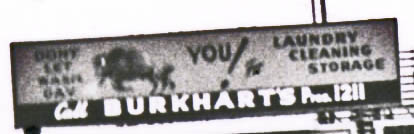
"Don't Let Wash Day Buffalo You!"

That top sign is from Burkhart’s and it’s promoting the idea in words and pictures that you (meaning “you housewives”) should not let wash day make you fear dirty clothes. With Burkhart’s help, they are offering protection from being buffaloed by the challenge.

Left to right above, the signs are also advertising Dr. Pepper, Leopold & Price Men’s Store, A Special Giveaway at Mading’s Drugs, Save Time, Money, and Worry by Riding Street Cars and Buses, and enjoy the comfort of the Texas State Hotel, including their first class modern grill.

Who could ask for anything more?

The sad days of segregated stands existed into the mid-1950s at Buff Stadium. The empty stands at left above were the designated "colored section.".

Segregated seating for black fans at Buff Stadium existed through the 1954 season, the year that first baseman Bob Boyd broke the color line by becoming the first black player to integrate any Houston sports team, amateur or professional, in the City of Houston. Why the so-called “colored section” at the left above is empty in this photo I could not begin to explain. It’s just shameful that even baseball wasn’t big enough to rise up sooner against the formal practice of racial discrimination, but that’s not the way history played out.

As for today, the empty “colored section” is simply one of the curiosities and mysteries that float forward in this single photo of an active past game day in right field at old Buff Stadium.

There are numerous lessons on the loose here in this picture, but not the least of these for all those photographers of history is this one: If you want your photos to capture history, do not expect the picture alone to tell the story. Write down when and where it was taken and leave a few words about who is in it and why it may be important to remember. Otherwise, by taking and leaving the photo alone, you will have over time simply left another visual egg of mystery to scramble the brains of viewers in the future.

Pass the salt and pepper, Mammy! Let’s close with a good clear closeup of that wash day buffalo ad:

"Buffalo Gal, Won't You Come Out Tonight - And Dance by the Light of the Moon?"

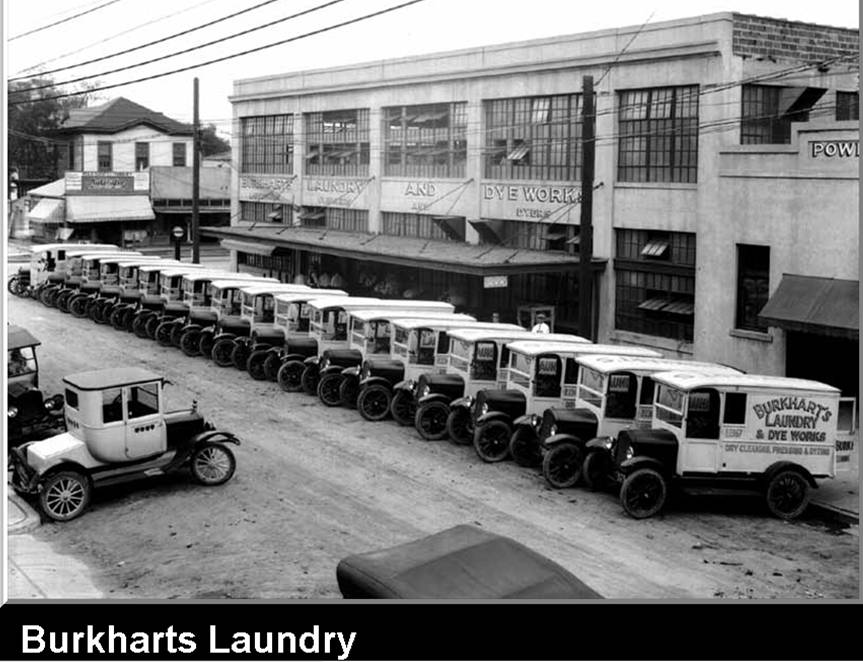
Thanks to a post-publication contribution suggestion from Larry Hajduk, the following photo, compliments of the Story Sloane Gallery, is added to show how Burkhart’s Laundry appeared in 1928. It appears that Burkhart’s had a long ago thriving business helping Houston do its laundry.

Burkhart's Laundry, Houston, compliments of Story Sloane Gallery, http://www.sloanegallery.com

Also, local history sleuth Mike Vance checked in with an important observation that he somehow could not register below as a comment. Mike says the last streetcar in Houston ran in 1940. So, if we are to believe the outfield sign advocating public use 0f Houston’s “street cars,” that does narrow down the year possibilities for this photo considerably. Thanks, Mike Vance. That’s a major help.

Gerry Burmeister: Five Times a Buff!

May 27, 2010

Gerry Burmeister, Catcher, Houston Buffs, 1941, 1946-49.

Gerry Burmeister was already in place as catcher of the Houston Buffs when I first plugged into paying attention to baseball back in 1947. He had joined the Buffs in 1941, returning after World War II to begin a four-season run as the main man with the mask in 1946. For the last three seasons of his Buffs tenure, I couldn’t imagine the day coming when some other guy would hold his spot. Gerry Burmeister was our man – the man who led and took good care of great Buff pitchers like Al Papai, Clarence Beers, Cloyd Boyer, Jack Creel, and Pete Mazar.

Burmeister was another of those talent-rich Cardinals farm hands of the post World War II era that never got so much as a single time at bat in the major leagues, but, as a catcher, he was extremely important to the parent club in bringing along mound talent for National League competition. A catcher with his field accomplishments in 2010 would surely be expecting a direct shot in the big leagues, but, as we always ending saying in some form – that was then and this is now.

The 6’2″, 205 lb. Gerry Burmeister was born on August 11, 1917. He’s been dead for several years now, but I simply do not hand that specific data on hand or accessible at this writing.

In his 13-season minor league career (1937-44, 1956-50), and all but the last year spent in the Cardinal organization, Gerry Burmeister (BR/TR) batted .275 with 66 career home runs. Those were pretty good stats for that era. Heck. They are pretty good production for a catcher from any era, especially one who managed pitchers well and also exercised pretty good control over runaway baserunner wannabes. Burmeister was a winner of the first order as a performer in the higher levels of minor league baseball back in the most popular period of public attention to professional baseball at every level of play.

Gerry Burmeister retired to life in the Houston area following his baseball career and he was a regular at old-timer games and Houston Buff reunions through the remaining period of his life. He was well liked and highly respected by all the former Buffs I know.

Caps are off to your memory this morning. Mr. Burmeister. As a kid who grew up watching you play as I tried to learn all I could about our wonderful game of baseball, I just want to say, “Thanks for the memories!”  And thanks for the lessons too!

Baseball’s Biggest Losers.

May 26, 2010

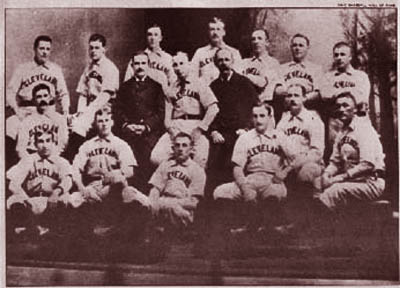
The 1899 Cleveland Spiders Own the Biggest Loser Title for their Worst-Season-Record-Ever mark of 20 wins and 134 losses for a.130 winning percentage and also for their All Time Consecutive Game Losing Streak of 24 Games in a Row.

No, this article isn’t about the 2010 Houston Astros – not yet, anyway. It isn’t even about “losing” as a new social convention. In fact, if we examine the scoreboard of both biblical and scientific history, it doesn’t take long to see that losing has been going on for a very long time. A short look there is all we shall need to confirm that reality:

History’s Scoreboard

Temptation 2 – Adam & Eve 0.

Jealousy 1 – Cain 0. (As a result, Abel moved to the “DL” – the permanent one).

Meteors 25 – Dinosaurs 0.

Sinai Commandment 10 – Golden Calves 1.

Jesus Christ 1 – Original Sin 0.

Lions 48 – Christians 0 (on any given Sunday at the Coliseum in Rome).

Brutus 1 – Caesar 0.

Renaissance 8 – Dark Ages 7.

Darwin 4 – Fundamental Opposition (still evolving).

Baseball 1 – Football 0.

Technology 15 – Intimacy 0.

Present Year 2010 – Time Travel Destination 1927 (The year Ruth hit 60).

There. That pretty much covers the big historical events. Let’s get to baseball. I’m only looking at the worst season records and longest losing single game losing streaks. Otherwise, we could get stuck here all day talking about the St. Louis Browns.

The two big records for all time are held by one of the last clubs to play baseball in the 19th century pre-modern era, the notorious 1899 Cleveland Spiders of the National League.

The 1899 Spiders were so bad that they literally had to finish their season on the road to avoid the wrath of a community that felt betrayed by the club’s ownership – and because other clubs refused to lose money by coming to Cleveland to play before empty houses. What happened to make Cleveland the perfect storm atmosphere for losing 1899 is simple enough to explain.

The Robison brothers who owned the Spiders also bought the St. Louis Browns of the same league and simply renamed them the “Perfectos.”  Then (and here comes the best reason in the world why multiple club ownership is now prohibited) the Robisons poured all their talent into making their St. Louis club a success. The best talent from both rosters was sent to St. Louis; the culls and dregs were sent to Cleveland. The result pulled St. Louis slightly above mediocrity (5th place with a 84-67 mark while Cleveland sank like lead to 12th and last place at 20-134. Along the way, ’99 Spiders also set the single game all-time losing mark of 24 losses in a row. The experience also stomped the itsy-bitsy Spiders into extinction.

Cleveland would emerge with a new team under new ownership in the new American League in 1900, but the Spiders were dead forever. The 1899 Cleveland Spiders may be the only team in baseball history that actually played like an extinct entity while active unplayed games still remained on their schedule.

20th century losing marks received constant heat from clubs like the St. Louis Browns and Washington Senators in the early part of the century, but the two game and season losing marks did not finally register until 1961-62.

The 1961 Philadelphia Phillies made an incredible run at the single game losing mark of the old Spiders, falling one game short of a tie, when they came up with only 23 straight losses from July 26th to August 20th. Their 47-107 season record, however, fell far short of Cleveland’s record for futility.

The 20th century, modern era worst season record sprang forth the following 1962 season in the first year of National League expansion, and it wasn’t our new Houston Colt .45’s who pulled the trigger. “Honors” for amazing ineptitude went tour city’s brotherly new franchise, the New York Mets, who finished in 10th place n the national League in 1962 with a modern worst season record of 40-120, but still a steamy 17 games better than those 1899 Cleveland Spiders.

Mets Manager Casey Stengel was finally moved to ask of his Mets, “Can anybody here play this game?” If you’re a Houston fan, let’s just hope that 2010 Astros manager Brad Mills isn’t moved anytime soon to pose the same question.

Losing is losing – and unlike fine wine, it doesn’t taste better with age.

Quo Vadis, Craig Biggio?

May 25, 2010

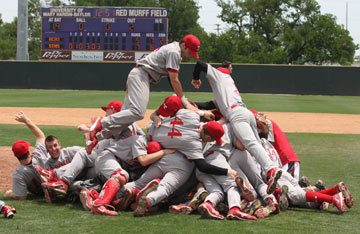
5/15/10: The Craig Biggio-coached St. Thomas Eagles defeated Houston Christian, 7-5, in the finals at Waco to take the 5-A State of Texas TAPPS baseball championship.

It only took Craig Biggio two years to lead the St. Thomas Eagles to a state title in baseball, but he and the boys did it in typical Biggio-Astros style over the 2010 season, weathering a phase of doubt and coming back strong to fare even better than Houston’s professional standard bearers. The Eagles went all the way to the top, winning their 23rd state baseball title in the 110th year of the school’s history.

Biggio got involved in helping out as volunteer assistant coach with St. Thomas football while he was still playing for the Astros after his oldest son Conor Biggio entered the school as a freshman. Conor was followed two years later by younger brother Cavan. What a dream opportunity this all turned out to be for retiring super big leaguer Biggio – a chance to watch and even be involved in the ongoing education of his sons as young men and serious ballplayers.

Biggio accepted employment as the St. Thomas baseball coach on May 18, 2008. Three days short of two years later, on May 15, 2010, Biggio and Company were wrapping up that most special prize in Texas high school competition, a state championship. St. Thomas defeated season-long nemesis Houston Christian, 7-5, in the 5-A TAPPS state baseball championship finals at Waco to bring home that very special prize.

Craig Biggio (4th from right in red jacket) & St. Thomas Good Company!

Our hats go off to Craig Biggio and the gang from old St. Thomas (my old high school too) – along with all the questions that Craig Biggio’s coaching success at this level now adds to all those queries that continue to float around about his future as a major league manager.

After Craig Biggio’s probable first ballot induction into the Hall of Fame in 2013, will he be open to managing in the big leagues? If so, will it have to be a term with the Astros – or will he be open to other offers? – Or will Craig Biggio simply prefer to stay where he is – close to home and family, and close to the handles on his favorite charities and involvement in the Sunshine Kids Foundation? I’m sure that St. Thomas High School wouldn’t mind it either if Biggio decided to stay at the helm of our baseball program at STHS far beyond the years that his sons are enrolled as students. He brings class, positive energy, and success to everything he does.

The final answers to all questions about the future of Craig Biggio rest down the road – and that’s where I think he places them too. As with all the rest of us, his best choices rest firmly in the Hand of God – and in his ongoing discovery of God’s Will for him in this lifetime.

God Bless you too now, Craig Biggio, for all you do to make the Houston community a better place.

Goodbye, Mr. Lima!

May 24, 2010

Jose Lima: He leaves some happy memories and a short record of great accomplishment in baseball..

The news of Jose Lima’s death at age 37 hits all of us who followed his baseball career with equal amounts of shock and sadness. This is one of those times in which the written words of immediate reaction are coming out in all kinds of ways on the mind crank of familiarity.

A fellow who “lived life to the fullest,” Jose Lima walked through each day as a happy man, making everyone around him happy too. At his foremost in the 1999 Astros season, he performed as one of the best starting pitchers in the big leagues, winning 21 games against 10 losses and registering a 3.58 earned run average for his playoff-bound club. He also sold the benefits of delicious Mexican food from Casa Ole restaurants on television commercials with a peppery song, a Latin-moves dance, and a universal happy-face smile thrown in to boot for good measure. It all came together and worked beautifully.

The man had tremendous ability, but like a number of other fine and potentially great pitchers, he also possessed a vulnerable psyche to the prospect of  moving from the spacious Astrodome, the scene of his great 1999 season, to pitching in a new ballpark with a short left field porch with the opening of Enron Field in 2000.

In his last 1999 Astrodome year, Jose Lima (BR/TR) have up 0only 30 home runs in 246.1 innings pitched.In his first 2000 Enron Field year, with the 315-feet away Crawford Boxes looming out there from him down the left field line, Lima surrendered 48 home runs in only 196.1 innings of work.

Now, in fairness, all the homers that Lima gave up in those two season were not hit only at the Astrodome and Enron Field, and all the Enron Field homers were not simply dink-and-drop blows that barely lipped the 315-feet mark. Homers were hit elsewhere – and many of the Enron Field long balls at Enron would have just about cleared the Grand Canyon walls on a north-to-south tim track.

The point was in (or on) Lima’s head. From his first sight of the park that we used to squeeze into as “Enron Field,” Jose Lima was psychologically defeated. He simply could not pitch there. I don’t how many times it happened, but it often worked out that Jose Lima would respond to giving up a critical long ball by surrendering another to the very next man, and sometimes, on the very next pitch.

One time, when the pattern was already established,  my then 15-year old son Neal and I were there for a 2000 Enron Field game when Lima gave up a monster shot to left center. “Just watch out for what happens on the first pitch to the next guy,” I told Neal. “He’s going to hit one out too!”

When it then happened, Neal grabbed me by the arm and asked, “Dad, how did you you know that was going to happen?”

“Just lucky,” I told Neal. Then I went on to explain how many time we had seen Lima just groove a pitch down the middle of the plate after giving up a home run. And that’s what he had done again here. Neal seemed both relieved and distressed to know that one didn’t have to possess psychic abilities to predict a home run off a pitch from Jose Lima during the 2000 season. It happened too often to be wrong a lot – and these weren’t cheap shots either.

By the early part of 2001, as you may recall, Jose Lima was sent dancing back to Detroit, from whence he had come to Houston after the 1996 season. Other than an 8-3 year with the Royals in 2003 and a 13-5 mark with the Dodgers in 2004, Jose Lima would never have another big league season that came even close to his 1999 record year with the Astros.

Somewhere along the way, Jose Lima also organized a Latin rhythm band and installed himself as the lead singer. Unlike Cuba’s Desi Arnaz, however, it wasn’t in the cards for happy Jose Lima of the Dominican Republic to be looking for a Lucille Ball equivalent to help him make the transition to big time success in show business. Besides, as far as we know, Jose had a happy marriage and family life and wasn’t even looking for a Lucy to love. He just loved baseball and he had happy feet for music and dancing,

I met Jose Lima only once at an RBI banquet dinner in 2005. He was as happy that night as I always imagined him to be – and he came dressed in an outfit that seemed to express that upbeat mood. It looked like one of those zoot suits from the 1940s, but what do I know? It probably was just one of those new trendy styles that never reaches the extant attention of people like me.

All I know is that Jose Lima was nice and friendly, with a bright smile, and that he greeted me like a long lost friend. He just made you feel good all over – and right away.

Jose Lima was born on September 30, 1972 in Santiago, Dominican Republic. He died in his sleep in Los Angeles on May 23, 2010 at his home in Los Angeles, California. At the time of his death, Lima was still on board to play winter ball in his native country. He had concluded his 13-season major league career (1994-2006) with a record of 89 wins, 102 losses, and ERA of 5.26 in variable stints with the Tigers, Astros, Royals, Dodgers, and Mets.

The world needs more people like Jose Lima. His death at age 37 comes as a saddening shock and yes, another wake-up-and-smell-the-roses reminder. – Breathe life deep everyday, folks. Nobody has a guarantee on tomorrow. And nobody lives forever.

Bob Clear: The Rest of the Story.

May 23, 2010

Bob Clear wore 17 different club uniforms from 1946-1967.

I had a very interesting comment from a fellow named Mike Ross in response to a brief piece I wrote three days ago on the death of the late Bob Clear. It reminded me again of how much there is to wonder about in the way human energy moves forward, for better and worse, in its play of influence upon others.

So much hinges on whether we give or withhold from others.

As a longtime minor league instructor and bullpen coach for the Angels, Bob Clear was one of the two main voices who suggested that the club take a bad-hitting catcher named Troy Percival and convert him into a relief pitcher. Of course, we know what happened from there. Percival went on to become one of the top closers in the game.

Clear also exerted an enormous amount of influence upon a young catcher in the Angels system. Although this particular player never made it to the big leagues as a player, he learned how to be a teacher of others from another fellow who never played in the big leagues either. Today that young catcher is now middle-aged but quite successful as the manager of the Tampa Bay Rays. According to Mike Ross, Maddon credits the late Bob Clear with being the most important mentor in his baseball life.

It’s a small world, except for one big always-present wild card crazy thing. – The more we become willing to share what we have to give with others, the more our world of connection grows and spreads across the lily pond of human experience on how to improve upon and solve all kinds of human-initiated problems.

Maybe if we had more Bob Clears working in offshore drilling technology we wouldn’t be facing the mess we now have on our hands. Who knows?

All I know for sure is that I just had to bring you this rest of the Bob Clear story. The details of Bob’s later baseball career are beautifully covered in an article about him on Wikipedia. Just Google “Bob Clear” and go there for further details.