Posts Tagged ‘Baseball’

How To Make a Real Baseball

November 1, 2010

our tattered friend

Have you ever wondered how they make major league baseballs?

Bob Dorrill and Pat Callahan, a couple of friends who don’t know each other (I don’t think) both sent me links recently to this fascinating clip prepared by the Discovery Channel on how it’s done. The process is both fascinating and mind-boggling. How they ever get that much uniformity in product output without a mass hospitalization of workers for either blindness or acute psychiatric psychosis is beyond me,

Everything from the preparation of the inner cork, the serial winding of differentially thick threads around each cork center, the adjustment of the wind on each thread to just the right tension level and circumferential size, the precise cutting of the cowhide leather into two perfectly matching covers, the selection of the stitching material, and the hand-stitching of each ball by skilled experts is absolutely astonishing.

I would still be working on the first ball I tried to stitch together last April!

They probably don’t tell these perfection-proud ball cover-stitchers what is probably going to happen to most of these balls, that they are either going to be lost as foul balls on their first pitch in play, or else, thrown out of the game as soon as they hit the ground and pick up a little smudge mark. I would hate to think how that information might reach out and immediately impair the care that is now taken by workers on making sure that each ball is just the right size and weight.

Here’s the link to a brief tape on the process. Watch it and never feel quite so indifferent again  about the sight, weight, and shape of a brand new baseball.

How baseballs are manufactured

As kids on the sandlot, we knew the difference between real baseballs and cheap imitations. The cheap jobs turned flat on one side from their first contact with a bat. By game’s end, the cheapo baseballs  had more tiny flat sides than a fly has eye lenses – and they many-side bounced, rather than rolled, along the ground. Rarely did those balls get a second shot on the sandlot, if we had any other choice at hand.

A lot of times, that other choice for a sandlot game ball was a really good Texas League ball whose cover pretty much resembled the one in today’s picture. Tattered and frayed red seams often were held together as much as possible with black electrical tape because we valued these balls, literally to their cork cores. They stayed round, they rode far off the crack of the bat, and they rolled true – like a real baseball should.

Speaking of baseballs, the season could end tonight, couldn’t it? With the surprising Giants now up by three games to one over the mostly stupefied Rangers, it’s pretty much over now, as is. Texas will have to win three games in a row now to take the World Series and the last two of those improbable victories will have to come in San Francisco for that to happen. And with Lincecum and Cain pitching the next two games for the Giants, what are the odds of a stillborn Ranger miracle now, even with Cliff Lee taking the mound for the Rangers in Game Five at Arlington tonight?

Here’s another way to express my pessimism about the Rangers: The odds of the Texas Rangers now winning the 2010 World Series are now longer than the odds of me ever making a real major league baseball and having it come out round at the right weight and size.

Of course, if you don’t mind a little electrical tape, I can put together a baseball that will get us through today’s game.
 

Astro Shadows on World Series

October 27, 2010

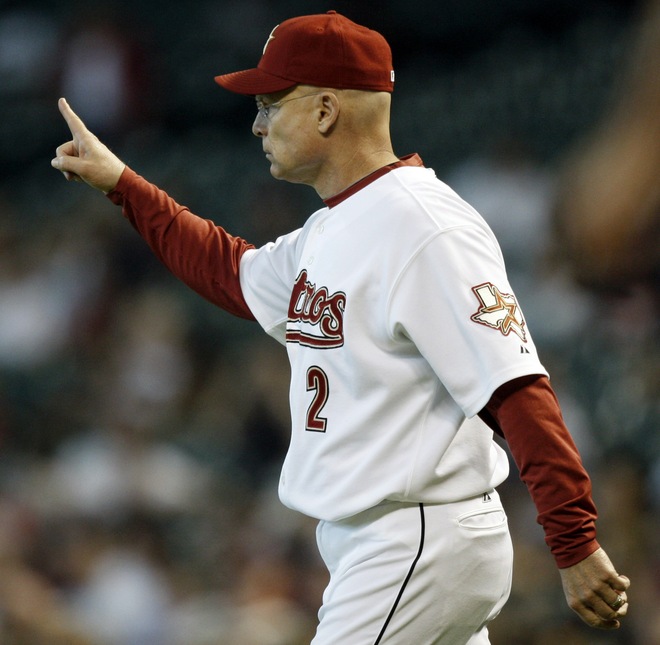
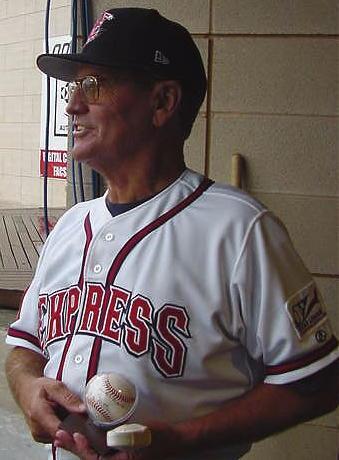
Watch for this profile of Texas bench coach Jackie Moore during the World Series, but don't expect to see the eye glasses of the former Round Rock Manager and Astros bench coach.


We will see a lot of Texas Rangers President Nolan Ryan at the World Series over the next week or so, as we will Rangers bench coach Jackie Moore, Rangers pitching coach Mike Maddux,  and maybe, if help is needed,  of Rangers reliever Darren Oliver. All are ex-Astros who now give their all to the American League champion Texas Rangers. There is another that you most likely won’t see.  Former Astros vice president Rob Matwick also now works in the front office for the Rangers.

Over in the dugout of the San Francisco Giants, the shadow of Astros Past also stretches visibly. Giants manager Bruce Bochy is a “once upon a time” figure as a former Astros catcher (1978-80) and the Giants first baseman, Aubrey Huff, is a more recent Astros player from 2006.

As most of you know, the Astros shadow didn’t start with the two clubs that made it to the Series. When New York lost to Texas, we lost former Astro Lance Berkman of the Yankees. When Philadelphia fell to San Francisco, we gave up former Astro pitching aces Roy Oswalt and Brad Lidge of the Phillies, along with their first base coach, former Astro Davey Lopes.

Going back to the four teams eliminated in the first round of the playoffs, we find that every single one these clubs also had some kind of past Astro connection. I’ll give you the ones that occur to me off the top of my pointed head. There may be others I’m missing:

Cincinnati Reds: First Base Coach Billy Hatcher;

Atlanta Braves: Closer Billy Wagner;

Tampa Bay Rays: Pitching Coach Jim Hickey, Relievers Chad Qualls and Dan Wheeler, and former minor leaguer Ben Zobrist; and,

Minnesota Twins: None. The Twins are the only club I could think of that didn’t have a single obvious front office, coaching, or player connection to the history of the Houston Astros. If you can think of one, or any others I’ve forgotten, or overlooked, please post their names here as a comment on this article and we shall add them to the fold.

Baseball is life. Life is a circle. And player/personnel movement in baseball is a great big circle.

POST SCRIPT: A couple of readers e-mailed me that they had trouble accessing the “Instructions for Life” article the other day because of a WordPress insistence that they provide usernames and passwords. I checked into the problem and learned form WordPress Support that some kind of glitch had randomly caused some of our readers at “TPPE” to be treated as though they were entering a private blog area, where that kind of info is required.

That’s not our deal here. The Pecan Park Eagle is totally public, requiring no username or password from anyone to access the articles. If you have any trouble with this in the future, please let me know immediately. Thanks, Bill McCurdy.

The 1933 Houston Buffs

October 25, 2010

TOP ROW: Fred Ankenman, President; Stan Keyes; Oscar Fuhr; Ed Greer; Bob Kalbitz; Al Fisher; Andy French, Secretary. MIDDLE ROW: George Payne; Jimmy O’Dea; Carey Selph, Manager; Ival Goodman; George Binder; Eddie Hock. FRONT ROW: Mike Cvengros; Bill Beckman; Gene Moore; Ernie Parker; Tommy West.

The 1933 Houston Buffs were an interesting bunch. They are often forgotten for having played only a couple of years beyond the far more famous 1931 Texas League Champion Buffs of Dizzy Dean and Joe Medwick, but their 94-57 record was good enough for a 6.5 game finish in first place ahead of the Galveston Buccaneers.

Unfortunately, the ’33 Buffs quickly buried good memories with a three-game sweeping loss to fourth place San Antonio in the first round of the Shaughnessy Playoffs. The Missions would go on to defeat Galveston, four games to two, for the Texas League title as the ’33 Buffs basically faded into oblivion.

As a style note, the ’33 Buffs ditched the eye-catching buffalo logo that adorned the forehead crown of their 1932 uniform caps and subbed it with one that looks more like the plain “stripes only” cap we presently use for our  19th century vintage base ball team, the Houston Babies.  Although I cannot swear for certain, I’m reasonably sure the cap was dark blue in color with white stripes. “Houston” isn’t totally relegated anonymity here. That  big “H” on the heart-side plate of the jersey is unmistakably there for the only “BIG H” city in the Texas League back then – the one and only Houston Buffaloes.

Fred Ankenman is the featured “suit” in the team photo. Fred served as a Buffs employee from the late teens decade of the 20th century. Fred served as team president of the club from 1925 to 1942.

Playing manager Carey Selph also made the Texas League All Star team as second baseman and shortstop partner George Binder also got picked for the same team honor, as did pitcher Ed “Bear Tracks” Greer. Jimmy O’Dea of the Buffs also made the all star club as one of two catchers selected.

Ed Greer tied with George Darrow of Galveston for most 1933 Texas League season wins at 22. Buff pitcher Mike Cvengros was right behind those guys with 21 wins, also leading the Texas League for the lowest ERA with a 2.43 mark.

Mike Cvengros put in a lot of time as a major leaguer in 1920s, performing for the Pittsburgh Pirates who lost a swept-away World Series to the 1927 New York Yankees. Buffs outfielder Ival Goodman later played for the Cincinnati Reds that lost a World Series to the 1939 New York Yankees, Interestingly, the ’27 and ’39 Yankees are each considered by many as the arguably greatest Yankee teams of all time.

Meanwhile, as we get ready for the 2010 World Series between the San Francisco Giants and the Texas Rangers in a couple of days, it’s simply fun to again look back on baseball history in the hope that what gains on us is a clearer memory of the players who made the game special for us a very long time ago.

Have a nice start to the new week, everybody!

The Ballad of Billy Wagner

October 21, 2010

Billy Wagner: 422 Career Regular Season Saves

Billy Wagner is retiring from the game. The following is intended purely as a good-natured tribute to one of the greatest closers in the history of baseball.

THE BALLAD OF BILLY WAGNER

(sung to the tune of “the Beverly Hillbillies” TV series theme)

Come ‘n listen to my story ’bout a man named Billy,

Poor Mountaineer ~ livin’ broke and willy-nilly.

An’ then one day, he stepped outside to throw some great big rocks,

And up came an Astros scout and signed him outta hock!


Astros baseball contract, that is! ~ Pure gold! ~ Texas closer tea!


Well, the next thing ya know, young Bill’s a millionaire

Kin-folks sed, ~ “Bill, ~ go change yer underwear.”

They sed “Houston, Texas is the place yer gonna be,

And you cain’t go to Houston smellin’ of our misery!”


Hills, that is! ~ West Virginia muck! ~

Possum soup and Hoover bugs!


Billy chunked his dirty clothes, and he took hisself a bath.

Then he looked at his new contract and he quickly did the math.

“If they pay for throwin’ baseballs like they pay for hurlin’ rocks,

Ah can git a better deal ~ and make out like a fox!”


Multi-years, that is! ~ Millions of bucks! ~

Dadgum shore-fire good-at-the-bank MLB TV Dollars!


Ol’ Billy bought a Houston mansion. ~ Lawdy, it was swank.

He did real good at ‘pitchin ~ and he took ’em to the bank.

Next time they signed him up ~ it cost about a jillion bucks,

And then the Astros brung his pay ~ in six great big ole trucks.


“Guaranteed, that is! ~ Don’t matter if ah do or ah don’t! ~

Ah still gits mah pay! ~ No matter what! ~ It’s in mah contract!”


He got traded off to Philly, windin’ up with them old Mets!

Moved to Boston, then Atlanta, for his last few big league pets!

A ton of big Saves later, he’s just ready for a rest!

So let him go in peace, old friends, and please don’t be a pest!


Well now it’s time to say goodbye to Billy and his kin,

His words and big ole contract both done finally did him in.

Next time we see The Sandman he’ll be just plain rich guy Billy,

Thinkin’ back to when his big mouth got him traded off to Phillie!


Duck everybody! ~ Duck big time!

Here comes the guy the Astros traded for Brandon Duckworth!

And we still ain’t got no ballad for that guy’s Houston beginnings!

Has anybody checked out Billy’s 422 Saves total lately?

Is he really walkin’ away from the game with that big-o-bunch?


Oh well, ~ Ya’ll come back now – anyhow! –

And join us in Houston for a little commiseratin’!

We’re startin’ to miss Ole Billy Boy ‘round these parts,

And more and more so by the day!

Hats Off to Jimmy Wynn

October 13, 2010


His Coming of Age in 1960's Takes On Clearer Light.


Congratulations to Houston Colt .45s/Astros Icon Jimmy Wynn! His beautiful autobiography is now available through Amazon, Barnes & Noble, Border’s, McFarland Publishing, and any other national retail distributing source that is available to you and, as someone who was privileged to working with him on “Toy Cannon,” I can only hope you also have a chance to read the story of this fine man’s growth as both a ballplayer and human being during one of the most difficult periods of change in American history.

Bob Hulsey of Astros Daily asked me only yesterday what I had learned about Jimmy Wynn that I didn’t yet already know from the experience of helping him with his autobiography. The answer to that one is easy. It wasn’t so much the details of what happened to him, and these included numerous stories of what went on with the club behind quasi-closed doors. It was all about fresh contact with what it must have been like to walk around in the shoes of Jimmy Wynn, a young gifted black baseball player, coming of age and finding his way through the segregated society that still dominated Houston, Texas, and the South, in general, through the Civil Rights Era of the 1960s.

Some of you are too young to remember, but Houston was still a place in the early 1960s which barred blacks from eating in certain restaurants, attending certain movie theaters, enrolling in schools which also accepted whites, or living in certain neighborhoods.

“Certain” was a buzzword for racial prejudice as a way of life and segregation still cast its ugly face upon our city like a clutching hand from the ignorant past at the same time Houston was attempting to bolt into the future as the home of NASA and a brand new major league baseball team.

At the same time Houston was embarking upon this ambitious and bold future “blast-off,” most local schools, from kindergarten to college, remained segregated. Wrap your minds around the incongruity of that thought for a minute. Then allow your thoughts to come back to young Jimmy Wynn in 1963.

This is the Houston that greeted Jimmy Wynn and other black players as they made their way to the big leagues with the Colt .45s during those earliest of years. Black players couldn’t simply go anywhere they wanted in Houston without running into the ugly wall of racial separation. The bathrooms and drinking fountains were even separated by “white” and “colored” section signs back then.

For many of us whites who grew up with segregation, but who weren’t taught to hate others for the color of their skin, those embarrassing memories of how Houston used to be are ones we’d sooner put away and not think about too often, but that isn’t possible. We have to remember and stay vigilant that nobody, no race or particular religious or facist-based ideological dominated society, ever tries anything like that again.

For people like Jimmy Wynn, who grew up in non-segregated Cincinnati, in the bosom of a loving family that taught him to love, not hate, coming of age as a ballplayer and a young man during one of the great periods of social change in America, especially in the South, was an eye-opener that could have blown him away early, had it not been for the long distance loving support of his father, in particular, and of a manager in Tampa named Hershell Freeman.

In “Toy Cannon,” Jimmy Wynn touches all the bases of his statistical, distance homer, and other field achievement records, but he does something even more. He allows us to walk a little deeper and truer in his own shoes as he comes of age in an era in which the other concomitant pressure on young people trying to make it in the world, especially among young males, was where they stood on the Viet Nam War.

Jimmy Wynn didn’t leave home to fight the battles of Selma, Alabama or Southeast, Asia, but that’s the world he walked into. The issues of the world wouldn’t leave him alone to simply work on becoming a big league baseball player. They even followed him into the clubhouse and directly affected the most important decisions in his life.

“Toy Cannon” is a tighter walk through the life of a talented young northern black man, coming of age in racist Houston. To hear Jimmy tell his story, we almost go through it “as him,” seeing the things we had to learn the hard way – and coming out the other side with a wisdom that only comes to those who are willing to learn from their painful experience.

God Bless You, Jimmy Wynn – for all you so willingly now give of yourself to others!

Post-Season Career Pitching Leaders

October 12, 2010


Andy Pettitte's 19 Post-Season Wins Leads Pack!


The fact that active New York Yankees lead the field in career post-season pitching wins and best earned run average should come as no small surprise. Andy Pettitte’s 19 career wins through today, 10/12/10, is now 4 better than John Smoltz with room to grow as the Yankees wait on the winner of this evening’s game between Tampa Bay and Texas to see who they will be facing in the 2010 ALCS. Either way, Andy is virtually guaranteed a shot at becoming the first “20-game winner” in post-season career total win history.

Except for one contaminating win by Pettitte  as a Houston Astro int 2005 NLDS, Andy’s career win record is all the rest – pure Yankee in its achievement alloy. Some feel that Andy Pettitte may be pitching himself into serious Hall of Fame consideration by his longevity success in the post-season, but it’s hard for me to see how he could get there and pass over several peers and one particular predecessor who built comparable or better records on the season stat career level.

Pettitte has 240 career regular season wins through 2010. Retirees Greg Maddux (355 wins), Roger Clemens (254 ip), Tom Glavine (305 wins), Randy Johnson (303 wins), Tommy John (288 wins), Bert Blyleven (287 wins), Jim Kaat (283 wins), Mike Mussina (270 wins), Jamie Moyer (267 wins), Jim McCormick (265 wins), Gus Weyhing (264 wins), Jack Morris (254 wins), Jack Quinn (247 wins), Dennis Martinez (245 wins), and Jack Powell (245 wins) are the others not currently in the Hall of Fame who have more career regular season wins than Andy Pettitte. (The last time anyone poked him with a stick, Jamie Moyers also remained an active player.)

Making a Hall of Fame case for Andy Pettitte above most of these others would be a long shot in my book. I’m still unhappy that Bert Blyleven has been passed over as long he so far has.

At any rate, the career leaders in post-season wins and lowest post-season ERA are as follows:

CAREER POST SEASON WINS BY INNINGS PITCHED LEADERSHIP BOARD

1. Andy Pettitte (19 wins in 256.0 ip)

2. John Smoltz (15 wins in 209 ip)

3. Tom Glavine (14 wins in 218.1 ip)

4. Roger Clemens (12 wins in 199.0 ip)

5t. Greg Maddux (11 wins in 198.0 ip)

5t. Curt Schilling (11 wins in 133.1 ip)

7t. Whitey Ford (10 wins in 146.0 ip)

7t. Dave Stewart (10 wins in 133.0 ip)

7t. David Wells (10 wins in 125 ip)

10t. Catfish Hunter (9 wins in 132.1 ip)

10t. Orlando Hernandez (9 wins in 106 ip)


Mariano Rivera's 0.72 ERA may fall lower very soon!


CAREER POST-SEASON ERA BY INNINGS PITCHED LEADERSHIP BOARD

1. Mariano Rivera (0.72 ERA in 136.2 ip)

2. Harry Brecheen (0.83 ERA in 32.2 ip)

3. Babe Ruth (0.87 ERA in 31.0 ip)

4. Sherry Smith (0.89 ERA in 30.1 ip)

5. Sandy Koufax (0.95 ERA in 57.0 ip)

6. Christy Mathewson (0.97 ERA in 101.2 ip)

7. Monte Pearson (1.01 ERA in 35.2 ip)

8. Blue Moon Odom (1.13 ERA in 39.2 ip)

9. Eddie Plank (1.32 ERA in 54.2 ip)

10. Bill Hallahan (1.36 ERA in 39.2 ip)

The fact that post-season leadership in both categories is controlled by active members of the current New York Yankee pitching staff should come as no small surprise. The better you are, no more you win, the more chances you get to even see the post-season. I know it doesn’t always work out that way, but it seems to work that way in The Bronx more often than it does anyplace else – and that winning history goes all the way back to Col. Jacob Ruppert, the early 20th century owner of the New York Yankees who put up the money and attitude that made “The House That Ruth Built” even possible in the first place. One of his legacies is that the record books are now crowded in 2010 with the accomplishments of Yankee players over time.

Like ’em or not, the “Damn Yankees” understand championship totals on a whole other higher level from everyone else. While we hold on to the hope for “one in Houston someday,” the Yankees are looking for another one, possibly as early as November 2010.

So, when we look at the individual accomplishments of both Andy Pettitte and Mariano Rivera in the post-season, we are forced to remember too that winners produce championships – and championship teams produce record-breakers and holders.

We don’t have to be as big as New York to succeed in Houston, but our vision and our planning needs to be every ounce and inch as large as the state of mind and action that has placed these two active Yankee pitchers on the leader board as mere by-products of their Yankee team success.

No Choking Time in MLB Playoffs

October 11, 2010

The Major League baseball Playoffs are a good time to put up the “No Choking” signs in each clubhouse and then try to pay attention to them, but it apparently is a little too late for that advisory in 2010.

Cincinnati just left the playoffs Sunday night with their vaunted offense in total meltdown at the hands of their H20 (Halladay, Hamels, & Oswalt) rinse through Philadelphia’s powerful “Big Three” pitching order. It should be noted, however, that the Roy Oswalt member of that deadly pitching trio, along with some negative help from Phils second baseman Chase Utley,  did his own choke job  in Game Two of the series. Fortunately for the Phillies, many of the other Philadelphia players would have no part of a Reds comeback as they came back to defeat Cincy in the only game the Reds showed any familiarity with a bat.

The Minnesota Twins also melted fast in the competition company of the New York Yankees, going down for the count 3-o in games quicker than they could recall for the gazillionth time that they were playing the club that once served as home to Babe Ruth, Lou Gehrig, Joe DiMaggio, and Mickey Mantle.

That 50% pure choke finish in half the NLDS competition games leave the Yankees and Phillies free to rest and refresh as they wait for two other teams to finish their work in the first round, but here’s where choking gets to be something of a shared experience.

In the “we can’t stand the pressure of playing at home series,” the Tampa Bay Rays and Texas Rangers have both now experienced the horrors and joys of this particular phobia. The Rangers stuck the Rays where the sun never shines in those first two games at Tampa. It looked as though the Rangers were going home to a quick finish on their first playoff series in history, but I guess they thought about that sweet finish too much. Once back in Arlington, the Rangers went into their own meltdown, losing twice to Tampa Bay and sending the sunshine series back to Florida. Can the Rangers benefit from this move back to their former position as road warriors? We’ll find out tomorrow.

The fourth series is also an intriguing engagement with choking on both the team and individual player levels. After taking Game One behind the phenomenal pitching of ace starter Tim Lincecum, the Giants untied some late ending rope around the necks of the Atlanta Braves in Game Two and reattached it to themselves just in time to watch a Rick Ankiel home run into McCovey Cove send the series back to Atlanta with everything tied at 1-1 in games won.

Game Three in Atlanta Sunday produced the biggest sputum-producer of the playoff season, so far. Going into the top of the 9th, the Braves led 2-1 and seemed honed in on taking the series lead. Then the Giants started putting together a little base-hit rally that tied the game with two outs at 2-2. That’s when second baseman Brooks Conrad allowed a crisp ground ball to go straight through his legs into right field. Another Giants runs scored and SF now led 3-2, a tally that would hold up for the final score on Mr. Conrad’s (cough! cough!) third error of the day. You had to feel bad for the guy. There’s no place to hide in baseball when that sort of thing happens.

No Smiles on Sunday

Also, we have to be aware these days of HD close-ups of a player in the wake of such an embarrassing moment. Conrad could clearly be seen, shaking his head and uttering what sounded by lip-reading as that famous exclamation of self-frustration – the one that fits the “WTF” initials used by texters to express uncultured dismay or shock.

Better put up those no-choke signs in the clubhouses at Atlanta and Tampa pretty quick, folks. We “ain’t done yet.”

.

Congratulations, Brad Mills!

October 9, 2010


Brad Mills Gets Contract Extension.

Sometimes the good guys do win as baseball managers. When they do, it’s because they have more going for them than a simple reputation for being good guys. They prove by their performance on the field that (1) they know baseball and the array of choices facing every manager in all phases of the game; (2) they know their own strengths and limitations well enough to let need, rather than ego, determine the kinds of people they embrace as coaches to help them get the job done; (3) they have good people skills for dealing with all the various psychological stuff that comes up with the egos of ball players over the course of a season as managerial decisions get made that are bound to always displease somebody; and (4) in the end, they seem to get the most production that is possible out of the material that they been given to manage and direct.

When the 2010 season concluded, I cannot think of a single media reporter who wrote or said that Brad Mills should have gotten better than a 76-86 finish out of this year’s Astros club. Now this morning we read in the Houston Chronicle that the Astros were pleased enough with Brad Mills to have exercised their contractual option on his managerial services for 2012 and extended his contract for an additional year through 2013.

Nuf sed. His bosses like Brad Mills too. That counts for a lot, doesn’t it? When the man who owns the ink that signs your paycheck on a piece of paper that doesn’t include the phrase “another direction”, we have to be as assured as anyone can be in today’s marketplace that we are wanted. And Brad Mills is.

I personally liked Brad Mills’ constancy in dealing with players. He never seemed impulsive, but he did stay open to trying new approaches. He worked his available bullpen material well, but he also gave his starters a chance to pitch extended innings, when they seemed capable of doing so. He didn’t freeze on seeing people as starters, even if they weren’t performing – or as part-time utility guys, even if they seemed to be playing well enough to start. “Matsui out” and “Keppinger in” at second base probably are our best examples of this ability.

Although he may have had little to do in choosing Jeff Bagwell as Sean Berry’s late season replacement as hitting coach, Mills reaped the rewards of Baggie’s presence and influence upon improvement among players like Hunter Pence. Other less secure men might have been too threatened by Baggie as a potential job rival that they might have rendered him useless by the creation of a hostile reception to his joining the staff.

Not Mills. He benefitted from Baggie too. As did the club.

I could go on all day. From what I’ve seen, Brad Mills has the kind of fatherly aura that will allow him to work with the Astros’ younger talent in a teaching capacity. At the same time, he has the respect from his older players that allows him to make tough choices for the betterment of the team. He is not the kind of guy that will cast himself as either an authoritative tyrant nor a weak sister type who avoids conflict at all costs.

Brad Mills has the knowledge and the moxie to get this job done over the long haul. He’s not going to run over anybody to do it, but he will stand firm on what he wants and doesn’t want. All the Astros need to do is keep supplying Mills and his staff with the improved kind of young talent that has the potential for growing into the spiked shoes of a real championship club.

With Brad Mills at the helm, and with our increased attention upon young player development, I really believe that our long-time goal of reaching and winning the World Series is now on target as an accomplishable mission for the Houston Astros.

Former Astros Dot Playoff Rosters

October 8, 2010


Roy Oswalt Heads Former Astro Run in 2010 Playoffs.


The Houston Astros couldn’t get to the 2010 MLB Playoffs collectively, but they are having a pretty good run at it individually – or so it seems. If we allow for their different backgrounds with the club at various times we still may have to assume that some of this widely spread appearance in the playoffs is a matter of the cream rising to the top – and probably some it too is just coincidence and due to the fact that a lot of players from a lot of clubs move around a lot these days.

At any rate, it’s still kind of fun to point out the obvious. Except for Minnesota, every one of the eight playoff clubs has some kind of administrative, coaching, or player connection to previous employeea of the Houston Astros.

Here’s a team-by-team breakdown of what we can see with the naked eye, a little familiarity with the history of the Astros, and a simple website search of current playoff team rosters. Active former Astros on the club’s current roster are shown in parentheses after the club’s name::

Texas Rangers (1)

Darren Oliver, P *

The Rangers have only one former Astro on their roster, but they have a partial owner and club president named Nolan Ryan running their operations. That one rings the bell on The Ballad of the Lost Astro faster than Quasimodo ever chimed a gong. The Rangers also have another former employee named Mike Maddux working as their pitching coach and yet another, Jackie Moore, serving as their bench coach. No telling how many former Astros management people are also now working in Arlington. The list starts with former Astros veep Rob Matwick.

Tampa Bay Rays (2)

Chad Qualls, P

Dan Wheeler, P

Throw in pitching Coach Jim Hickey and former Astros minor league prospect Ben Zobrist who never survived a trade that blocked his opportunity for a cup of coffee with the Astros and the Rays gel into another merry former Houston player home. Oh, and one other little detail could use a beacon of light: Former Astros General Manager Gerry Hunsicker serves as a Vice President and special advisor to the Rays’ current GM.

Hmmm! The Rays are sure making a lot of post-season runs these days. Makes you wonder how helpful Mr. Hunsicker has been to that successful movement by the Rays up the AL standings.

New York Yankees (2)

Lance Berkman, DH

Andy Pettitte, P

Did the former Astros have any bearing on the Yankees’ Game Two win over the Twins? Check your morning newspaper for details. The old puma that the Yankee fans love to ride and taunt as “Fat Elvis” provided 2 runs and 2 RBI on a home run and double that provided all the difference the Yankees would need on the scoreboard while starter “Earnest Andy” held the Twins at bay for the most part and chalked up another post-season win.

Minnesota Twins (0)

The Twins are the most Astros-Free organization now involved in the 2010 MLB post-season play. They also seem to be among those who are feeling the hardest sting from former Astros on their now probable early departure from the World Series chase.

Philadelphia Phillies (2)

Roy Oswalt, P

Brad Lidge, P

Roy starts Game Two against the Reds today. When he joined the Phillies, he brought the oxygen that club needed to start the water (H2O) flowing on their pennant quest. How do you come up with H2O in Philly? Easy. Just add two parts Halladay and Hamels to one part Oswalt and shake, not stir. If hot water results and the ground starts to shake, you just throw in a little Lidge to bring everything back to the waters of peace and calm. (Most of the time, the “L” in Lidge stands for lithium. The rest of the time, it stands for that second value in the W/L column.

Former member of the 1986 Astros, Davy Lopes, serves as first base coach for the Phillies.

Cincinnati Reds (0)

No former Astros fill spots on the Reds’ roster, but another former member of the great 1986 Astros club, Billy Hatcher, is on hand as the first base coach for the Reds.

San Francisco Giants (1)

Aubrey Huff, IB

Giants manager Bruce Bochy also used to catch for the Astros during his playing days.

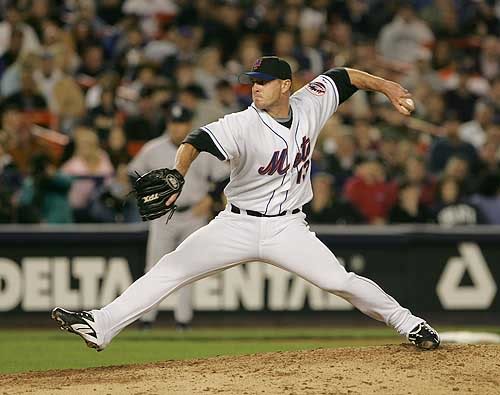
Atlanta Braves (1)

Billy Wagner, P

All the Braves have with them to commemorate former Astros is Billy Wagner, the greatest closer in the club’s history.

In general, every club in the playoffs, except for Minnesota, has some kind of historical connection to the Astros through former players, managers, coaches, owners, or administrators. If I got anything wrong or left anyone out, please post your corrections below as a comment on this column.

I’ll have to admit: As an Astros fan, I really enjoyed watching Lance Berkman have such a lights-out, difference-making game last night against the Twins. Maybe that will shut up hs Yankee fan critics for about 24 hours.

Today I look forward to seeing what Roy Oswalt can do in Game Two versus the Reds.

Go Roy! Go Lance! Go former Astros!

If the Astros can’t be there, at least, make us proud that you once played for the good guys down here in Houston.

* Thanks, Bill Gilbert, for the reminder that Darren Oliver once pitched for the 2004 Astros.

My Biggest Astros Homer, All Time

October 7, 2010

Chris Burke, 10/09/05:Erasing Agony, Embracing Ecstasy.

Of all the big home runs in major league history, every club has at least one that stands alone among all others. Although we could argue that fans of a team like the New York Yankees might have more trouble than most deciding which home run truly stands alone as their club’s finest long ball moment. After all, Babe Ruth to Bucky Dent to Aaron Boone covers a lot of arguable territory.

For this Astros fan, the pick was pretty simple. With no disrespect intended for my good friend Jimmy Wynn, or for Jeff Bagwell, Roman Mejiias, Billy Hatcher, Lance Berkman, Brad Ausmus, or others, I  had to go with the big home run by the little man who almost wasn’t there – and who wasn’t there for long while he was there, and who likely never will be there again – with the Astros or any other big league club.

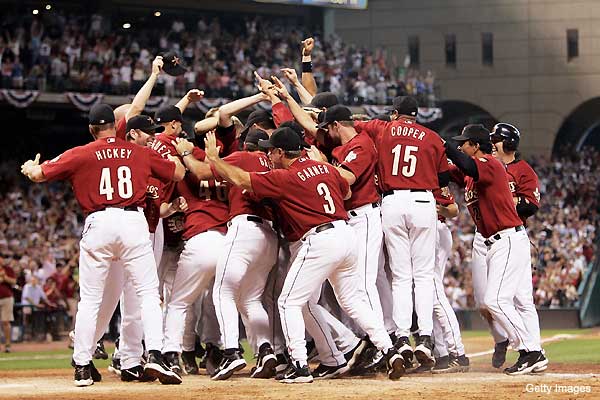
I’m talking about Chris Burke, the little 2005 second baseman for the Astros who hit that solo home run in the bottom of the 18th at Minute Maid Park to give Houston a 7-6 series-deciding win over Atlanta in the NLDS finale, a victory that ultimately propelled the club to its first and only World Series appearance.

When “Little Chris” Burke lifted that fly ball into the Crawford Boxes in left field, the emotionally and physically exhausted home crowd momentarily had to rally against the forces of incredulity that oh so briefly halted the roar of relief that then followed. It was simply hard for us Astros fans to believe that the day that once had seemed so lost had now been so decisively delivered in the name of victory.

But it happened. It really did. And the man whose name we shall always remember in association with that moment of joy is Burke – Chris Burke.

Five years later, Chris Burke is now little more than an after-thought among professional ball players. After a poor offensive season in 2007, the Astros dealt Burke to Arizona, where there, and then at San Diego, he continued to struggle and fall into minor league play. Burke signed a minor league contract with the Reds in the winter of 2009, but then broke a finger came along and took away the 2010 season.

We wish Chris Burke well in whatever he does from here with this thought in mind up front: Whatever happens next, Chris, Astros fans will never forget what you did for the club back on October 9, 2005.

For me, even if others care to argue differently, your bottom of the 18th home run to defeat the Atlanta Braves in the 2005 NLDS was the singularly biggest home run moment in the history of the Houston Astros MLB franchise.