Posts Tagged ‘Baseball’

1986 NLCS Game 6: A Sacher Masoch Revisitation

December 15, 2010

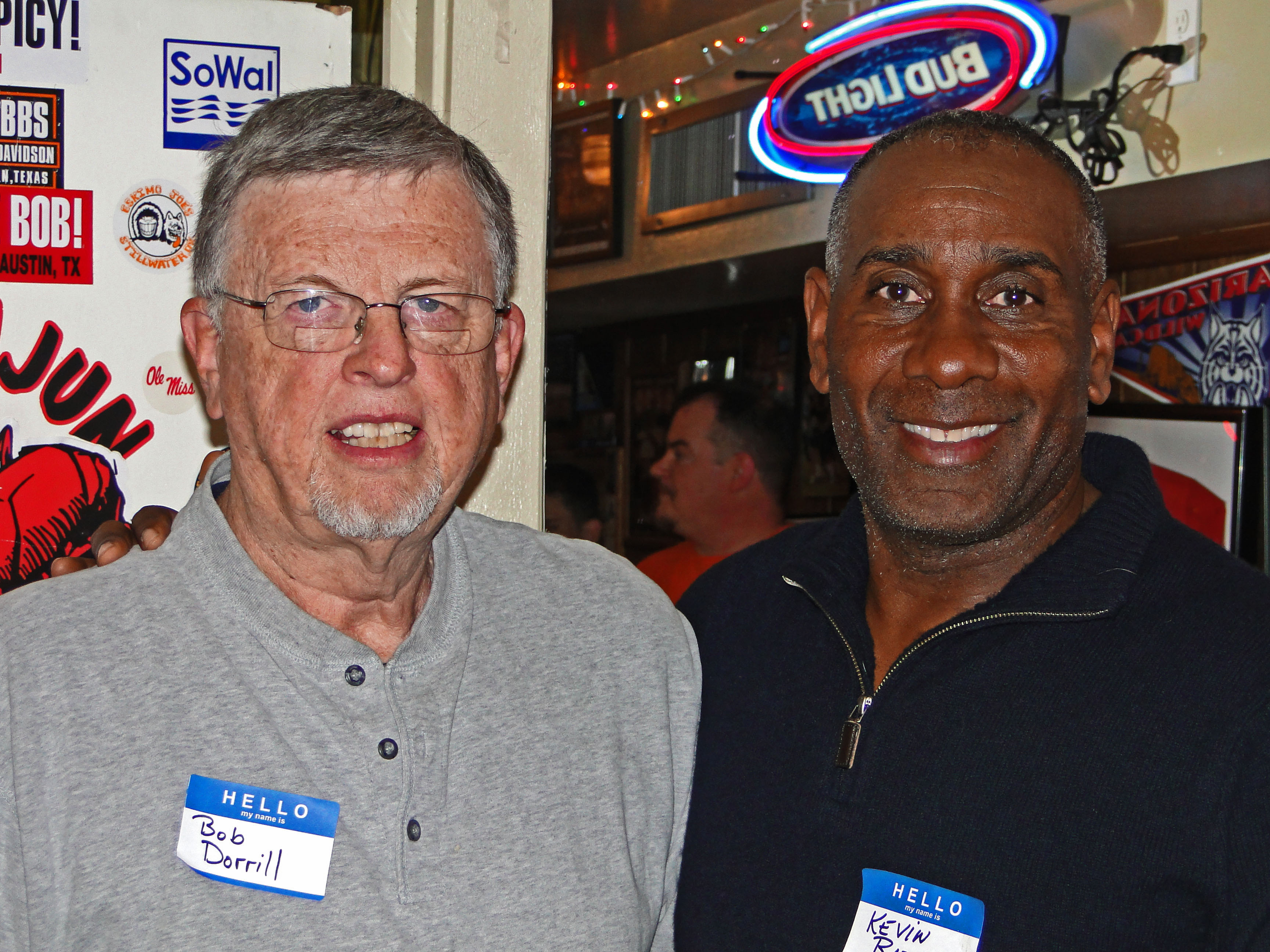
Former Astros Kevin Bass spoke at Houston SABR Meeting on 12/14/10. (The talk took place at the Ragin’ Cajun on Richmond. SABR Leader Bob Dorrill is on left.)

Former Astros Kevin Bass regaled about 25 members attending the December SABR meeting of the Larry Dierker Chapter at the  Ragin’ Cajun restaurant on Richmond last night. He took us all through his career, from his wide-eyed wonderment years as a rookie with the Brewers through his playing days as a seasoned, accomplished veteran. After all that, his first big question of the night (from Mike McCroskey) was: “How did you feel when you struck out to end the 1986 NLCS Series for the Astros in the 16th inning of Game 6 to give the 1986 National pennant to the New York Mets?”

Bass most probably was thinking: “Thanks a lot, fella. No one’s ever put me on the spot about that not so happy moment in my playing days until now.” Kevin Bass handled it fine, never showing any signs that it has remained an open wound. To the contrary, Bass says it was the great learning moment in his playing career. I’ll have to paraphrase what I head him say about striking out swinging on a too low and outside curveball from Mets reliever Jess Orosco to end the game:


Kevin Bass fans to end Game 6 of the 1986 NLCS as a 16-inning, 7-6 loss by the Astros to the Mets in the Astrodome.


“I went up to the plate just sure that I was going to either drive one in the gap to tie the game or hit one out to win it all. p against the crafty old lefty Jesse Orosco, that was a bad time to lose my focus and be out of the moment of what was going on. He killed me with slow outside curves that would have put me on first with a walk, had I not been so dedicated to swinging at whatever came up there. The tying run was on second base, but I couldn’t think out anything. The fact that Jose Cruz was hitting behind me just didn’t even occur to me. It was the stupidest at bat of my career, but it taught me that a batter has to stay grounded in the moment and not get ahead of everything with his own dream about what he alone was going to do.

Kevin Bass may have made the last out in Game 6 of ’86, but he did not lose this game alone. For starters, even Kevin Bass says that Astros manager Hal Lanier seemed to lose his season-long intensity and grip on the club once the Astros reached the Playoffs. According to Bass, Lanier just seemed to accept getting to the Playoffs as good enough as he started making moves that even the players questioned. Bass cited Lanier’s use of lefty Jeff Calhoun late in the game when he had Jimmy Deshaies available in the pen. We will never know if that would have mattered. There is always second-guessing when a club loses a close big game – and some of that second-guessing takes up residence forever.

As you probably recall, lefty Bob Knepper had pitched the Astros into the top of the ninth with a 3-0 lead with the Mets’ leadoff left pest Lynny Dykstra coming to bat. Bass in right and Cruz in left had pulled way back to prevent against extra base hits in the gap. For some inexplicable reason, however, center fielder Billy Hatcher didn’t get the message. He remained in his preferred shallow spot, about 20-25 feet behind second base.

When Dykstra then connected on a high arching fly ball to the right-shaded side of center, everybody who also wasn’t paying attention to Hatcher previously, and that seems to include about everyone in the park, assumed it was going to be the routine fly out it should have been, but wasn’t. Hatcher could not get back on the ball and Dykstra wound up with a leadoff triple.

A single by Mookie WIlson then scored Dykstra and a double by Keith Hernandez plated Wilson. With the Astros now only leading by 3-2, Knepper was done. Remember: the Astros entered this game down 3 games to 2, A win would tie the Series and set up Mike Scott with an opportunity to win it all at home for the Astros. Iron Mike had already won the only games the Astros had taken against the Mets and made them look silly in the process, The last thing the Mets wanted was Game 7 in Houston versus Mike Scott.

Dave Smith replaced Knepper in the 9th, but he promptly walked Gary Carter and Daryl Strawberry to load the bases. Ray Knight then poked a sacrifice fly to score Hernandez and tie the game at 3-3. Smith then struck out Danny Heep, but the Mets had surfaced as alive and kicking, After the Astros went down scoreless in their half, the game moved to xtra innings, tied at 3-3.

Still tied going into the top of the 14th, the Mets plated a go-ahead run when Wally Backman singled in Daryl Strawberry on a pitch from the Astros’ Aurelio Lopez, but that was all they could get when Mookie Wilson struck out with the bases loaded.

With one out in the bottom of the 14th, Billy Hatcher unloaded his now iconic homer to left to tie the game at 4-4 and send it forward into yet further extra stanza of action.

The Mets took the next lead off Lopez and the Astros in the top of the 16th when Strawberry doubled and came home on a single by Knight. That’s when manager Lanier brought in Jeff Calhoun, and not Jimmy DeShaies, to take over the pitching.

Calhoun promptly tossed up two wild pitches, scoring Knight from third on the second one. Backman then walked, moved up to second, and then scored on a single by Dykstra. That was it was the Mets, but they now went into the bottom of the 16th with a 7-4 lead and needing only three more Astro outs to claim the 1986 National League pennant.

Things got exciting again, if only for last fleeting Astro moment.

With one out, Davey Lopes drew a pinch hit walk off Mets reliever Jesse Orosco. He then moved to second on a single by Billy Doran. Billy Hatcher then singled to score Lopes and reduce the Mets’ margin to 7-5.
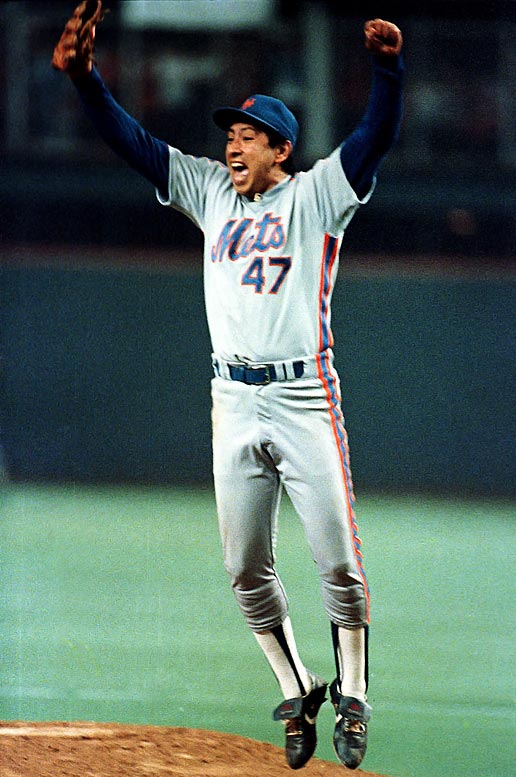
 

Ancient Jess Orosco was often rumored to have served under General Santa Anna at the Battle of San Jacinto. Maybe not, but he did pretty good in the Battle at the Astrodome.


After another out, Glenn Davis singled to score Doran, reducing the Met margin to only 7-6, as he also advanced the tying run by taking second base on the play at the plate. Now comes Kevin Bass to the plate with two outs, the tying run on second, and a chance for Houston heroism on an iconic level.

Not to be.

After fouling off a couple of unhittable low outside curves, Bass looked really bad on the one he missed completely. And the 1986 season for the Astros was over. Done. No more.

Astro players and fans have all since put that cry baby to bed and moved on. Baseball isn’t an easy game, but neither is life. And sometimes happen that don’t seem fair, but they happen anyway. And none of us escape them all, eventually.

As my dear old dad used to say in times of disappointment and bad news, and this line of was unintentionally straight out of the Cole Porter songbook:

“It was just ne of those things.”

We didn’t win in 1980 or 1986, but we came close in 2004 and even reached the Big Top in 2005 before we walked away with “Close, but no cigar!” as our pennant script until the day finally comes when the Houston Astros dance on top of the baseball world.

Thank you, Kevin Bass, for stirring up a lot of memories and for lighting again that eternal flame of hope for something better down the line by staying in touch with what we are doing and not doing in the here and now. Your talk was a reminder that today is where the work of tomorrow gets done.

I’ll stop on my adaptation of a Yogi expression to this point:

“It ain’t over til we start living like it’s over!”


Lou Novikoff: The Mad Russian

December 13, 2010

"When you gotta go, you gotta go!"

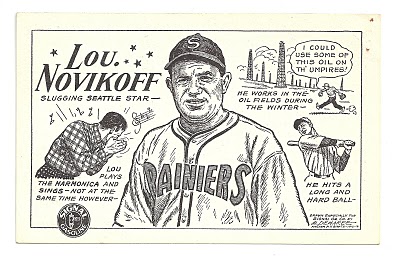
Lou Novikoff. Spontaneous singer in the pre-karioke days. Journeyman professional baseball player. Off-season oil field roughneck. Harmonica player. Russian-American. The Mad Russian. Left fielder Novikoff saw action in ONLY  59 games for the 1949 Houston Buffs. That was the extent of Lou’s Buffs career, but he sure made an impression on us Knothole Gang kids while he was here.

I’ve written earlier about this spunky little short-term outfielder for the 1949 Houston Buffs. To those of us who were Buff Stadium Knothole Gang members, he was one of the friendliest, funniest guys on the team. He seemed to like us kids. That kid-friendly quality always made a difference with us. And hey! Lou Novikoff was one of the few Buff players who would flick an occasional practice ball into our  little campy  cheap-seat section down the far left field line near the home team clubhouse.

Teams didn’t give usable baseballs away quite so freely back in the post World War II era. Club owners back then viewed baseballs that ended up in the hands of fans as lost operational materials – and not as marketing investments in future fan interest.The old St. Louis Browns even hired people to retrieve foul balls and home runs from fans at Sportsman’s Park in St. Louis for future use by the club.

Lou Novikoff was just one of those guys who made us kids feel we mattered. He did it with smiles, nods of the head in our direction, a few baseballs, and an occasional song by voice or harmonica tune from the field. As the left fielder, and like Larry Miggins before and after him, Novikoff was the guy we “Gang” members came closest to during each Buff home game.

Novikoff batted only .230 in 59 games for the '49 Buffs before getting shipped off to Newark, but he hit .337 over 11 seasons as a minor leaguer between 1937-1950.

A right hander all the way, Lou Novikoff stood only 5’10” at a weight of 185 pounds. He was a dubious fielder with a great batting record over eleven seasons in the minors (1937-41, 1945-50). He also hit for a .282 major league average over five years in the big time (1941-44, 1946). Only in 1949, Lou’s next to last seasons with three clubs, including Houston, did his average for the entire season fall overall below .300 for the entire year.

Like a handful of other Houstonians, I will always remember Lou Novikoff most for a bizarre thing that happened to Lou and the Buffs in a close  game against Beaumont, I believe, in the late innings. With the game tied in the top of the eighth (I believe), Beaumont rallied, getting the go-ahead run to third base. It was time for a pitching change and Buffs manager Del Wilber had called a time out to make that move.

At the same time, out in left field, we all see Lou Novikoff running to the side gate near the Knothole Gang that also leads to the Buff clubhouse behind us. It’s obvious that Lou is using the time out for an urgently needed potty run.

Trouble is – Manager Wilber and the umpires don’t seem to realize that Novikoff is now missing in action.  In the Knothole Gang, we can all see that the game i about to resume, but there’s still no sign of Lou coming back from the clubhouse.

“He must have really had to go,” flickered through my mind as some other kid yells at the small open ventilation window in the Buffs clubhouse: “Hurry up, Lou! They’re about to start without you!”

And they were too..

All of  sudden, Lou Novikoff came falling, stumble-running out of the clubhouse, trying to pull up and fasten his pants back on at the same time. He got about as far as the gate when we all heard the crack of the bat and turned to witness a fly ball dropping safely in left field.

The game had resumed without Novikoff in place. What should have been an out turned into a double fielded way late in left by the center fielder. Beaumont got the run that would win them the game. Novikoff got chewed out and replaced by Wilber. This night most likely provided the Buffs with the last straw they needed to ship Novikoff out of town for the rest of the year.

Only one of Houston’s three newspapers covered the story accurately. I think that paper was the Houston Press. The other two must have simply been too embarrassed to write about such a happening in 1949. One simply overlooked the incident; the other wrote it off as in issue resulting from sudden illness to Lou Novikoff.

My own eyes on what I saw and Lou Novikoff’s words in the one paper that covered the full story were good enough for me. When asked why he had left the field during the game, Lou replied, simply: “When you gotta go, you gotta go!”

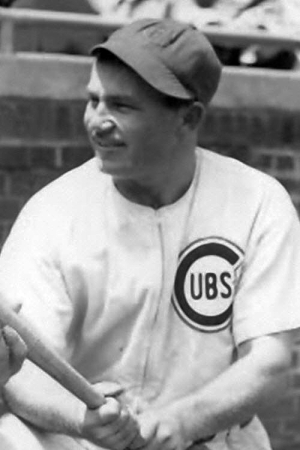
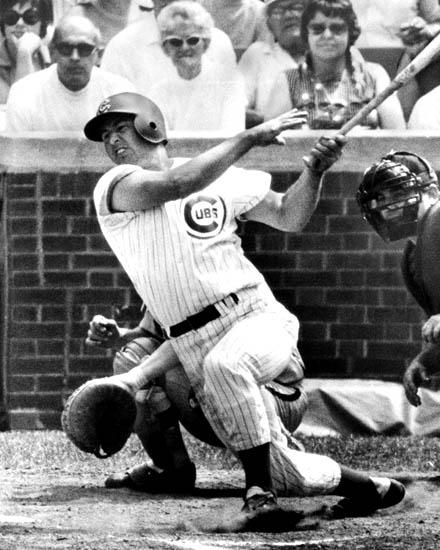
Lou's .300 mark for '42 Cubs was his best MLB full season. Lou Novikoff died in 1970 at the age of 54.

Ode to a Troubled Rookie Pitcher

December 12, 2010

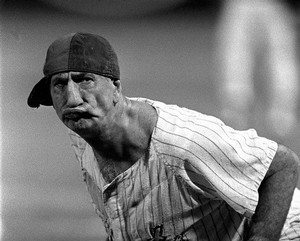
What if Max Patkin: sang advice to a drunk rookie free agent pitcher who showed up stewed for spring training? In my own thinking on things, I imagine it might go something like the following little diddy. (Sung to the melody of "The Christmas Song.")


Baseballs resting – in the morning sun,

Jack Dan dripping – from your nose;

Springtime trial – is your fat in the fire,

You best be grateful – I suppose.


Everybody knows – a turkey – in the starting “ro”,

Helps to make the season slight.

Hungry bats – with their eyes all aglow,

Will find it hard to sleep – tonight.


They know that hits – are on the way;

They’ve loaded lots of hope for big times – on this day;

And every motheroo – is going to try,

To see if they make – your fastball – flat fly.


And so – I’m offering – this simple phrase,

To kids – from one – to ninety-two,

Although it’s been said – many times – many ways,

“SOBER UP, KID – YOU’RE SCREWED.”

Some Hot Stove Ramblings

December 11, 2010

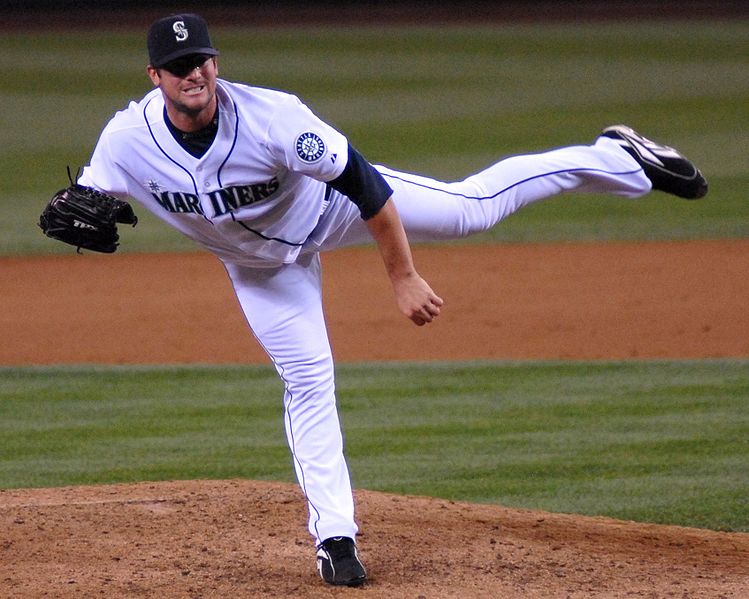
Ryan Rowland-Smith (12-17, 4.57 ERA) (2007-2010)

The trade and free agent signings are not big these days in our little part of the baseball world, but then we did not expect them to be. With the club recovering from other salary misadventures and the franchise now up for sale, Astro fans can pretty much expect things to proceed along this line for the foreseeable future.

The good news is that the club now seems totally dedicated to shoring up its developmental program at the minor league level and it is aggressively working to draft young players who are both good prospects and sign-able free agents. It doesn’t do any good to draft players if they aren’t good prospects or you just can’t sign them, anyway. I don’t have this year’s record handy, but if memory serves, the Astros did well in 2010 by signing most of their young free agent draftees.

Now the Astros come home from the Florida winter meetings by signing lefty Ryan Rowland-Smith as another competitor for the fifth spot in the rotation for 2011. The club also took two pitchers, Aneury Rodriguez and Lance Pendleton, from the winter meeting Rule V draft of minor league players not protected by the 40-man roster,  Those latter two guys will also be likely competitors for the number five-spot in the rotation.Veteran Nelson Figueroa is the holdover favorite to win the job, but we will have to wait through spring training to learn about these other guys.

Besides all that speculation, it’s early. A lot can happen between now and then. Who knows what Ed Wade may be forced to do to make room for that better hitting middle infielder he says he’s looking for.

As for Rowland-Smith, all I know about him is what I’ve very recently read, I’ve never seen him work. Even in this big package, get-all-the-teams-on-tv high-tech era, Seattle remains about as far off my big league radar screen as teams can get, All I know is that the guy has some command issues and that last year he really plummeted, going 1-10 with a stratospheric ERA of 6.75.

Let’s hope the Aussie-born portsider who turns 28 in january is “recoverable” under Astro manager Brad Mills and that “recoverable” is measured at a level that is greater than his 5-3, 3.42 ERA best year of 2008. The Astros need more help than that best season marker suggests is forthcoming. Rowlnd-Smith will need to bring his best game to the final results side of far more than eight decisions in 2011 to be of real help.

Our club motto for 2011 should be a realistic match for the times: Don’t expect the moon by June – or anytime soon! This club is going to be better than 2009 because of the personnel changes that have freed the team to rebuild with lighter expectations on the club’s chances for a quick route back to the World Series moment of 2005.

A World Series isn’t going to happen with Roy Oswalt and Lance Berkman leading the way. Those guys are gone. Forever. They aren’t even coming back for a twilight lap season. If they ever do, take it as a definite sign that the Astros of that moment have converted to a burlesque version of baseball success and that they are then and there no longer serious about winning.

Patience and a passion for baseball, even in leaner times, are going to be key qualities that Astro fans need to have for the foreseeable future. We’ve lived with these traits forever, so, hopefully, we can spring them activation again. If we start seeing our best young players disappearing via trade on a regular basis, as they regularly do in Pittsburgh, then we shall need to pull the cord and get off the baseball bus, but I really don’t see that happening here. And whoever buys the club needs to understand that facet of Astros fandom: We will not settle for a losing ball club indefinitely. We are not Pirate-like fans.

As for the current club, I like Jason Castro at catcher, Brett Wallace at first, Jeff Keppinger at second, Chris Johnson at third, Carlos Lee in left (as the only place left he fits), Gold-Glove winner Michael Bourn in center, and Hunter Pence in right. I also prefer  Clint Barnes or Angel Sanchez at shortstop over Tommy Manzella gets my vote. I’ll take the better bats over the better glove, but no hit route, for now, As for the pitching, I’m content, for now, to let time and spring training sort that out for us. I do wish that something could happen to cure that “Bad Wandy” character that still shows up too often when Senor Rodriguez takes the mound. “Bad Wandy” is the only guy standing in the way of “Good Wandy” earning a contract with more numbers on the salary line.

The winters are long for some of us baseball fans. Unlike Rogers Hornsby, some of us have a little trouble just staring out the window, waiting for spring, We have to talk and write out our hot stove league thoughts and speculations.

Care to join me? Please leave your own questions or thoughts here as a comment on how the 2011 Astros season looks to you, so far. The rest of us would like to hear it.

Baseball’s Biggest Player Contracts to Date

December 10, 2010

Carl Crawford Joins Red Sox in 2011.

Well, we Astro fans  are now officially free to euthanize any illusions we may have held about native son Carl Crawford coming home to give new meaning to the “Crawford Boxes” at Minute Maid Park. Carl has now been recruited by Red Sox General (Manager) Theo Epstein as the latest multi-year contract weapon in his Boston club’s ongoing war against “The Evil Empire.”  The Red Sox already had picked off Adrian Gonzalez from the San Diego Padres talent vineyard prior to adding the big grape that Crawford is – and they did it while General (Manager) Cashen of the New York Yankees had begun his recruitment dance with start pitcher Cliff Lee for a contract, if it happens, that may well alter again the latest top ten list of big spending on baseball talent.

For total dollars committed, Carl Crawford now moves into the # 10 spot because of his new deal with the Red Sox. It’s for seven years and $142 million dollars. If Carl Crawford ever comes home to Houston now as an active player, it’s most likely that he will be 37 years old by the time he’s free to make a twilight deal somewhere, if he wants to keep playing at all. You never know, but it’s much more likely now that Carl Crawford will never play a single game for the Houston Astros. Seven to eight years from now, the Astros will be knee deep in new ownership and, from the way our economy is changing, the world will be such a different place from the one we know now.

Who knows if baseball will continue to pay these obscene salaries to the game’s best players? Will the fan interest in baseball continue to convince advertisers forever  that televised baseball games are the best place for hundreds of key companies to place their advertising dollars? If these dollars ever get pulled away, or peeled back, there won’t be any more A Rod stratosphere contracts because the money simply will not be there to support them.

In the meanwhile, here is how the biggest active multi-year contracts in baseball stack up through today:

Top 10 Money Players (by Team, Start Date) (Years/Total Bucks) (Average $ per Year) *

1. Alex Rodriguez (New York Yankees, 2008) (10 years/$275 M) ($37.5 M per year)

2. Alex Rodriguez (Texas Rangers, 2001) (10 years/$252 M) ($25.2 M per year)

3. Derek Jeter (New York Yankees, 2011) (10 years/$189 M) ($18.9 M per year)

4. Joe Mauer (Minnesota Twins, 2011) (8 years/$184 M) ($23 M per year)

5. Mark Teixeira (New York Yankees, 2009) (8 years/$180 M) ($25.4 M per year)

6. C.C. Sabathia (New York Yankees, 2009) (7 ears/$161 M) ($23 M per year)

7. Manny Ramirez (Boston Red Sox, 2001) (8 years/$160 M) ($20 M per year)

8. Troy Tulowitzki (Colorado Rockies, 2011) (10 years/$157.75 M) ($15.78 M per year)

9. Miguel Cabrera (Detroit Tigers, 2008) (8 years/$152 M) ($19 M per year)

10. Carl Crawford (Boston Red Sox, 2011) (7 years/$142 M) ($10.28 M per year)

* List does not include large one-year contracts to Ryan Howard with the Philadelphia Phillies, Johan Santana with the New York Mets, or Manny Ramirez with the Los Angeles Dodgers.

My question is simply this: Would it really be so bad if baseball suddenly could no longer afford to make their best players of the moment as instantly rich as Saudi-Arabian desert oil princes?

Maybe I’m just old-fashioned and way out of line here, but I didn’t grow up loving baseball because it’s best players were light years richer than the rest of us. I grew up adoring the players who lived pretty much as the rest of us did, but who chose to play baseball because their obvious passion and love of the game publicly also matched their abilities to play it at the highest competitive level. You could just see it ib=n them from the time you reached the ballpark through the last batter in the game.

These guys showed up early, be they star or sub. They all shagged flies. They ran together. They took BP, of course, but they also took infield practice, sometimes even engaging in a little shadow-ball pantomiming and pepper game popping for their own amusement and reflex sharpening.

It was a game. The players loved it. And so did the fans. If the big salaries disappeared, I wouldn’t care if we lost some future Carl Crawford to the NFL as a running back, or some future Randy Johnson to the NBA as a forward, If we can still round up enough talented guys to play the game from the heart, I will still be there as a fan to watch baseball that is also priced right to the circumstances of our changing economy.

Please check in with a comment. What are you own thoughts on the future of big multiple year salaries in baseball?

Gaedel Redux Implodes

December 9, 2010

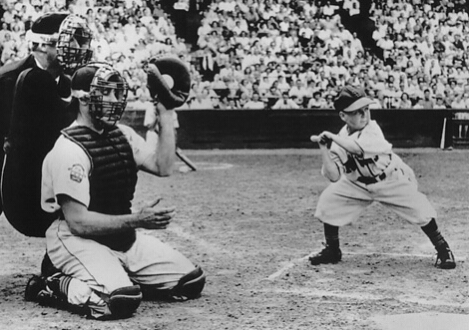
AUGUST 19, 1951, EDDIE GAEDEL BATS; ONCE WAS ENOUGH.

A while back, I wrote a column on Eddie Gaedel, the only midget or dwarf to ever bat in the big leagues. The link to that WordPress piece is:

https://thepecanparkeagle.wordpress.com/2010/04/24/the-ballad-of-eddie-gaedel-2/

Well, it seems this past summer it happened again. Sort of. Some folks up in Missouri ran out of fresh ideas and decided to commemorate Gaedel’s iconic moment by sending a 16-year old dwarf to bat for the Ricer City Rascals in an independent league professional game played in O’Fallon, Missouri against the Oakland County Cruisers.

You can check out the original story, plus pictures, that both cover this event by linking on to the St. Louis Browns Blog Spot and checking out the story as it was reported by St. Louis Browns Fan Club President and Editor in Chief, Bill Rogers. Just scroll down to August 20, 2010 and select the story entitled:

River City Rascals Salute St. Louis Browns Historical Society & Eddie Gaedel Anniversary

The St. Louis Browns BlogSpot link is http://thestlbrowns.blogspot.com

Your visit t0 the site also will be a fine opportunity to check out some of the other historic stories that Bill Rogers and Company have assembled about the old Browns, the same Browns that left St. Louis fifty-six years ago in 1954 to become the Baltimore Orioles. One of the stories even includes the language of haste we know as “breaking news.” You’ve got to believe, at first,  that any news that could be breaking over a half century beyond the funeral of the club must have been keeping in a freezer somewhere. Just read it and come to grips with the fact that even urgency is locked into the perception of the beholder. I’m sure there must be at least one centenarian remaining alive in Boston for whom the news of Babe Ruth’s sale to the New York Yankees still strikes sharply to the quick point of pain.

At any rate, for $25.00 a year, membership in the St. Louis Browns Fan Club is one of the best hidden values in baseball. Give it a look and some thought.

Meanwhile, the abortive attempt to recreate the Eddie Gaedel experience failed in troubled River City. Nick Hagan played the part, and the club even replicated all the moves that the Browns took back in 1951, right down to bringing Hagan out in a cake-shaped container prior to the game.

When the Rascals then came in to take their first at bats in the bottom of the first, “Gaedel” was then announced as the pinch hitter for the first man due up. Here’s where the script changes.

This “Gaedel” (Hagan) was about four inches taller than the original. He also took only four pitches, as did the iconic midget, but three of those were called strikes. Historic justice prevailed. Nick Hagan had to take the long walk back to the dugout as a strikeout victim. He would not tie Gaedel’s career On Base Percentage (OBP) of 1.000 and waltz airily away into the record books with a perfect stat record of his brief achievement.

Terrific. That’s what the folks in River City get for being short on new ideas. Had it worked, we might have been forced to hear about annual walks to vertically challenged batters in the boondock leagues of this country – and maybe even bracing ourselves for the reintroduction of some other far-from-original ideas. How about building a new domed stadium with a roof that cannot be opened, but one that will work as a cookie-cutter venue for sports of all kinds? How about starting a newspaper, one that comes with a sports section and plenty of sports writers?

Ron Santo for the Hall of Fame!

December 8, 2010

Ron Santo Deserves Hall of Fame Induction.

Back in 1960, when the Houston Buffs were playing out their minor league days as a farm club of the Chicago Cubs, a couple of future Hall of Fame quality players passed through here as the team’s left fielder and third baseman,. Their names were Billy Williams and Ron Santo, but only one of them would go on to receive the Hall of Fame induction that both deserved. That one, as you well know, was Billy Williams, who went into the Hall in 1987 after an 18-season career in the big league (1959-1976) in which he batted .290 and collected 426 home runs as a left fielder and first baseman. Williams did not become eligible for consideration until 1982 and then made it in with enough support on the sixth annual ballot in which his name appeared.

In the meanwhile, that other former Buff, third baseman Ron Santo, has been shut out from the honor continuously ever since his own retirement from a 15-season big league career (1960-1974) as a .276 hitter who also bashed 342 home runs in his career. As a fielder, few have ranked with Mr. Santo at third base. As a five-times Gold Glove winner and a nine-times All Star, organized baseball did about all they could do to honor an active player for his prowess on the field. Then he retired and the voters apparently could not see beyond their addictions to the ideas that a player, especially a corner infielder, should have either a near .300 batting average or pulverizing power stats to merit Hall of Fame consideration.

Bunk. Ron Santo handled third base like few before or after him, and that’s especially important when we are talking about the difficult third base spot and its unique requirements for players with rabbit-like foot speed, cat-like reflexes, eagle-like vision, and bear-like arm strength. Throw in the exceptional agility of a ballet dancer with those first-mentioned qualities and you had a third baseman named Ron Santo.The blindness of the voters simply would not let them see in his lifetime beyond that .276 batting average. After all these years of wonderment over his HOF denial, that’s all I can figure.

Now Ron Santo is dead. After years of courageous battle against diabetes and the loss of both legs, we lost the man last week. He died on Thursday, December 2, 2010, at the age of 70.

Whenever it happens, Ron Santo’s posthumous induction into the Hall of Fame will ring a lot more hollow now that’s he’s gone. These kinds of recognition always do when we make some deserving person wait until they die before we honor them properly for what they did in life, but that that’s the way the world seems to operate in many instances and Ron Santo is definitely one of those cases.

C’mon, Baseball, put Ron Santo in the Hall of Fame now. “Better late than never” still holds – and it’s all we’ve got to lean on now in the matter of unfinished business with the late Ron Santo.

Cardinal Berkman: And Other Forgettable Images

December 5, 2010

Cardinal Berkman may distort Astro Memories.

The thought of Jeff Bagwell or Craig Biggio ever donning the uniform of another MLB club, especially the flaming red digs of the St. Louis Cardinals is beyond the pale. Now Lance Berkman comes along and signs with the rival Cardinals and its almost as bad.

Never mind the fact that Lance wanted to come home to Houston after his unfortunate brief stay in The Bronx, but he was turned away at the gate by Ed Wade, the man who now answers the door at Minute Maid Park, this town’s version of the Emerald City in Oz.

“But I want to speak to Drayton,” cried Lance.

“Nobody speaks to Drayton these days, Lance,” answered Wade, “not nobody, no how, no way. – Unless, of course, you are prepared to present a buyer’s offer for the club, the  door to Mr. McLane’s private chambers are now closed to any discussion of all other baseball business.”

Well, in all fairness to all parties, the outcome of Lance Berkman’s recently abortive attempt to come home again wasn’t quite that ludicrous or severe. There simply wasn’t any room on the Astros roster for the aging star under the atmosphere of the current rebuilding program. As General Manager Wade put it somewhere, every at bat the club might give to Berkman now would be one less growth at bat opportunity for newcomer Brett Wallace. The club needs to find out if Wallace is the man at first in the future or not. And the club cannot accomplish that aim by giving away all those at bats to Lance Berkman as he plays out the downside of his career.

Now, does Berkman’s signing by the Cardinals set up this familiar headline script? “MAN’S ONCE-UPON-A-TIME BEST FRIEND COMES HOME AS MAD DOG TO BITE FORMER OWNER!”

You bet it does, but it’s short term, maybe for 2011 only, if Berkman and the Cardinals even get through the entire season together. Age-related injury or a performance level that falls totally off the table could limit or end Berkman’s play in 2011, even though we certainly don’t wish that upon him. Chance are, for a while, at least, a late game at Minute Maid Park may indeed  be lost on a late inning gapper hit by Berkman – or by a left-handed, opposite field pop into the Crawford Boxes by the man with the Jay Leno chin.

It’s part of the game and we shall all survive it – as we did in the past with the return of Rusty Staub as a Montreal Expo, the return of Joe Morgan as a Cincinnati Red, the return of Jimmy Wynn as a Los Angeles Dodger, and the brief  return of Larry Dierker as a St. Louis Cardinal.

Let’s not forget too that there is another returning player visit by a former Astro blue-blood coming up in 2011. This one didn’t happen in 2010 because of the schedule, but it no doubt will happen next season, almost assuredly. And this one could be painful for several years to come.

A picture is worth a thousand words:

Roy Oswalt

Starting Nine for the Houston Natives: A Work in Progress

December 3, 2010

Who should take the field for the Houston Natives?

Latest Change Now Updated Below, 12/04/2010: All one has to do to qualify for this club is be born in Houston. We forgot about Curt Flood, who was born her, but grew up in Oakland, CA. Thanks to the memory of Mike McCroskey, we have now added Flood to the outfield as a replacement for the now departing Steve Henderson, Left Field (11/18/1952) (Jack Yates HS) (.280 BA, 68 HR, 79 SB). I still don’t see even Curt Flood replacing Michael Bourn defensively in center field, but he definitely is an upgrade from Henderson.

============================================

Here’s a project for all of us, but thanks to early contributions of Dr. D. (Will Rhymes at 3B) and Shaun Bejani (Joel Youngblood at 3B) and the partial return of my own earlier absent memory (Craig Reyn0lds at SS), we, at least, now have all nine positions filled.

A lot of good ballplayers have come out of Houston over the years. Maybe it’s time we tried to put together our choices for the best starting lineup of native Houstonians that this city has ever produced. Off the top of my head, I came up with six players that would be my choices, but I had struck struck out on names for three positions until the names of Rhymes, Youngblood, and Reynolds came streaming back into the bright of day.

Can you think of anyone who might be better suited to play any of the nine positions with greater skill and production? It’s not always as easy as it looks – and sometimes we assume that a player is a Houston native when he really isn’t. Wayne Graham would have been a natural thought for 3rd base, but he wasn’t born in Houston. Neither were Roger Clemens or Andy Pettitte. Those famous Houstonians were born in Ohio and Louisiana, respectively.

Some players were either born nearby Houston – or else, they simply became so identified with Houston that we all mostly assumed that the were  born here too. Watty Watkins is a good example. He was a Houstonian, all right. He just wasn’t born here. Others include people like pitcher Josh Beckett, born in Spring, Texas, and fabled Houston high school pitching phenom David Clyde, born out of state,

I don’t have time to research every question that comes to mind to me here, so, I thought some of you might enjoy searching with me for the best lineup of native Houstonians we can put together, The guys I’ve listed are my choices for those spots, but some of you may have other nominees. I considered a few at pitcher, but I chose Red Munger over either Scott Kazmir or Woody Williams because I basically felt that good old Red Munger was better than both of those guys put together.

Send in your comments and let’s see what we can build together. Meanwhile, here’s what I’ve come up with for starters:

Incomplete Starting Lineup for the Houston Natives

(1) George “Red” Munger, Pitcher (10/04/1918) (Sam Houston HS) (77 W-56 L, 3.83 ERA)

(2) Frank Mancuso, Catcher (05/23/1918) (Milby HS) (.241 BA, 5 HR, 2 SB)

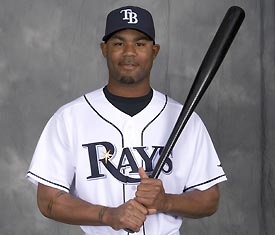
(3) James Loney, First Base (05/07/1984)  (Elkins HS) (.288 BA, 55 HR, 353 RBI)

(4) Will Rhymes, Second Base (04/01/1983) (Lamar HS) (.304, 1 HR, 19 RBI) *

(5) Joel Youngblood, Third Base (08/28/1951) (Austin HS) (.265 BA, 80 HR, 422 RBI)

(6) Craig Reynolds, Shortstop (12/27/1052) (Reagan HS) (.256 BA, 2 HR, 58 SB)

(7) Curt Flood, Left Field (01/18/1938) (Oakland Tech HS, Oakland, CA) (.293 BA, 85 HR, 88 SB)

(8) Michael Bourn, Center Field (12/27/1982) (Nimitz HS) (.263 BA, 11 HR, 173 SB)

(9) Carl Crawford, Right Field (08/05/1981) (Jeff Davis HS) (.296 BA, 104 HR, 409 SB)

Have a nice Friday, everybody – and Happy Houstonian Hunting too!

* Will Rhymes was suggested by Dr. D.

The Skeeters Are Coming to Sugar Land in 2012

December 2, 2010

Artist Rendering: The $40 million, 7,000 seat Sugar Land Stadium set to open in 2012 as the 70-home games per season base of the independent Atlantic League "Skeeters".

It’s official! The new independent league baseball club down in Sugar Land finally has a name that matches our area to a “T”. The Sugar Land Skeeters will begin play in the fairly-new-itself independent Atlantic League in 2012.

The Atlantic League started play in 1998 as direct result of a conflict that popped up within organized baseball. When the New York Mets objected to owner Frank Boulton’s decision in the late 1990s to move his Albany-Colonie Yankees to Long Island because of the former’s claim to their minor league territorial rights in that area, Boulton bolted from organized baseball to form his own small independent circuit and made the move anyway.

From the start, the new Atlantic League was modeled after the old Pacific Coast League. They played more games, they signed a large number of superior ability players, and they dedicated themselves to building small, but first class ballparks for their various clubs. The thirteen year result of this effort now finds the previously all eastern seaboard circuit expanding into the Houston area in 2012 with the start of the new Sugar Land Skeeters operation.

Here’s a brief look at the league membership as it stands with the 2012 inclusion of new clubs here and in Loudoun, Virginia. Each new club is preparing to play a 140-game home and road games schedule in 2012. Sugar Land is the first of four-to-six clubs that will be created to form a new Western Division of the league:

Current Atlantic League franchises

Team Names (Years Founded/Joined League)

Freedom Division

Lancaster (PA) Barnstormers (2003/2005)

Road (no home) Warriors (1998/1998)

Somerset (NJ) Patriots (1998/1998)

York (PA) Revolution (2006/2007)

Liberty Division

Bridgeport (CT) Bluefish (1997/1998)

Camden (NJ) Riversharks (1999/2001)

Long Island (NY) Ducks (1998/2000)

Southern Maryland (MD) Blue Crabs (2006/2008)

Future Teams

Loudoun (VA) Hounds (2010/2012)

Sugar Land (TX) Skeeters (2010/2012)

Sugar Land Stadium. The City of Sugar Land is building the 7,000 seat capacity venue that will house the new baseball club. With an estimated price tag of $40 million, the stadium will not be funded with general fund tax dollars, however, $30 million dollars will instead be paid for with a portion of sales tax revenues that may only be used for economic development purposes. The $10 million dollar balance will come from Opening Day Partners, a Lancaster, Pa.-based ballpark developer that owns and operates several minor league baseball teams, including the new operation in Sugar Land. The stadium will be located on a 21-26 acre tract, northeast of the Highway 6 and Highway 90A intersection.

Field Personnel. The club has yet to sign any players, but players with ig league and high league experience and potential will be in the signing sights of Skeeter scouts. The field manager could end up being someone with a recognizable local name too. Former Astros Terry Puhl and Norm Miller, plus former Astros manager Hal Lanier have all been mentioned as possible managerial candidates.

Astros & Skeeters. The Skeeters are not a threat to the Astros, but they are capable of stoking further interest in professional baseball among people who never drive downtown to see a more expensive major league game. In fact, some of these people may now be stimulated to go see a major league game for the first time as a result of their experience with the Skeeters. It will be up to the Astros to produce a club and and a plan that makes that marketing connection a harvest of attracted new interest in baseball.

The worst thing the Astros might do here would be to treat the new Skeeters club as though it didn’t exist. Who knows? Maybe the Astros will one day have a AAA or AA club operating in some near region like Sugar Land, Katy, or The Woodlands. – It sure would simplify certain player reassignments during the long season, would it not? And, if the Astros happened to own these particular clubs too, it would make for even more lucrative opportunities to treat the home base fan population with an ongoing look at coming attractions.

Those are just my thoughts. All I know for sure while we’re waiting to see if the Sugar Land operation can succeed in the Houston area is that I will be out there to see some games, if they actually do start playing. The lure of night baseball in the small ballpark under open skies is just irresistible – even in the heat of Houston summers – and even with Skeeters on the loose.