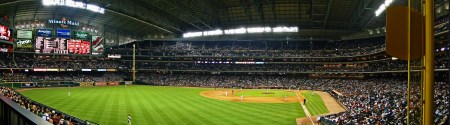
Sweeps ARE sweet – even when the fruits of harvest arrive too late to bake a Word Series level cherry pie! It still tastes good to savor the good times in the middle of a baseball season in Houston that mostly has offered little more than mediocre to bad. We’ll take whatever rain of good fortune that wants to fall our way in the middle of a drought year that has been as dry of long term credibility in winning as I am able to lately remember.
On Labor Day Monday, the Houston Astros completed a long weekend of stunning results against the defending World Champion Philadelphia Phillies by rallying in the bottom of the 7th inning for two runs and a 4-3 victory. It proved to be the fourth straight win over the Phils and a minor, but irritating hitch in the Philly plans to wrap up the National League East as soon as possible. At a time the Phils were falling in four, their primary division rivals, #2 Florida and #3 Atlanta were both falling too – and the Braves were going down for the fifth time in a row, to leave Atlanta 8 games back with 25 games to go. Florida sits at 6 back of the Phils with 25 to go. The Phillies could’ve put both their division rivals on almost total flatline status by sweeping the going-nowhere-in-the-NLC Astros over the weekend, but they did not. The Astros are now in 3rd place in the National League Central, but in spite of the sweet dextrosity of their weekend windfall, they remain 14 games back of the NLC division-leading St. Louis Cardinals with only 25 games to go.
Let’s stay with the sweet for a few minutes longer.
Friday night’s 7-0 bombing of the Phils made the Astros look like a world class winner – with starter Wandy Rodriguez appearing as the second coming of a lefthanded Cy Young – or perhaps, more accurately, a modern day Rube Waddell. Saturday night’s 5-4 two-out walk-off Astros win reminded us why we weren’t that broken up in Houston over the club’s trade of closer Brad Lidge to Philadelphia following the 2007 season. When Kazuo Matsui banged out that that two-out game winning single with the bases loaded in the bottom of the 9th, it just reminded us of our own past heartaches with the affable Mr. Lidge in the close-it-out-or-die role for Houston. Sunday afternoon’s 4-3 rally win allowed us to renew hope in the future of rookie hurler Bud Norris and also in the pulse of Houston hitters to rally late for a second consecutive game. Then Labor Day afternoon’s completion of the four-game sweep, this time by another 4-3 count, took the cake, even if we couldn’t have cherry pie. Back to back doubles in the bottom of the 7th yesterday by Miguel Tejada and Hunter Pence off Phillies reliever Chan Ho Park tied the game at 3-3. When the Astros then loaded the bases off Park, Michael Bourn, the National Leaue stolen bases leader, and the main guy we got for Lidge in the post-2007 trade, stood in there and worked Park for an eight-pitch walk to force in what proved to be the winning run in a second straight 4-3 Astros win over the 2008 champs.
How sweet it is! – And let’s not forget Hunter Pence either! “Mr. Enthusiasm” cranked a key double in yesterday’s game – and he also banged out three home runs in the Phillies series. There’s room to float hope again. We simply must have the patience as fans to go through a little (dirty word next) rebuilding with younger players to turn all this sweet stuff into the ingredients over time that bake into that long awaited cherry pie of a World Series championship. Anything less than a full understanding of that ancient Branch Rickey formula for big league baseball success will eventually burn the Astros at every further shortcut move they attempt to take.
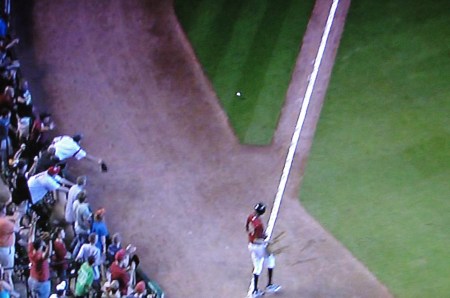
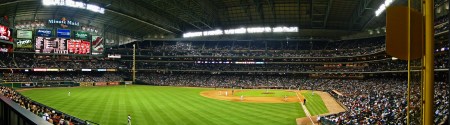
Check out our second photo from Monday on this one. I did see one thing yesterday that slightly rained on my indoors victory parade on Labor Day. A lot of you already know where I’m going with this point because of my constant references to it over the years. That is the inexcusable issue of fans interfering with fair balls hit down the line – or with balls hit to the outfield short of the rail or fences, where some fans reach over the rail or fences and above the field of play to try and catch the ball as a souvenir. Suddenly a long fly ball out becomes a home run. This tempting move happens most often near the left field Crawford Boxes, but it happens in right field too.
Check out the two idiots in the photo trying to get their hands on Pence’s game-tying double in the 7th. As it turned out, they didn’t come close – and Pence did reach 2nd base, anyway, the same place he would’ve been had either fan managed to touch the ball on its clear flight down the right field line as a fair ball. The point is about what fan interference may often give or take away. Sometimes it will result in a player being given a double when he only would’ve had a single, had the fielder been allowed to deal with the ball and without obstruction. At other times, a crazy bounce in the corner may produce a triple that will then be reduced to a double by fan interference.
I say come down hard on these ball-chasing fools. Throw them out of the ballpark. I get why that doesn’t happen, but Mr. McLane would be doing the rest of us a big favor, if he would have them escorted out of the ballpark – even if they did fulfill Mr. McLane’s understandable fears and never come back. There are still quite a few of us who go to the games to watch baseball – not to watch ball chasers, tee shirts being shot into the stands with slingshots, or games of ring toss in the stands between innings. I could better tolerate the attention-span revival games for younger fans, if we could just get rid of the ball-chasing cretins who put themselves into the game by interfering with balls in play.
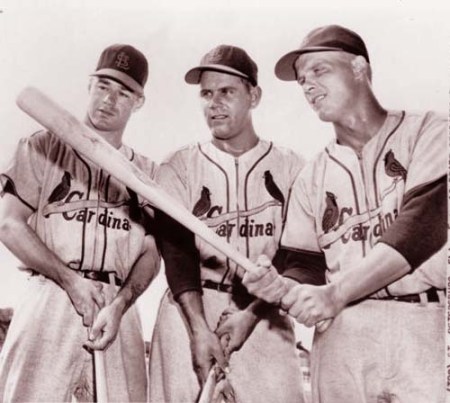 The goal of every young and upcoming Houston Buff from 1923 through 1958 was to play well enough in the Texas League to either move up the following season to AAA ball, or even better, to do so well that that they went straight on up to the roster of the St. Louis Cardinals. I’m bracketing the era as 1923 through 1958 for one simple reason: That’s the time period in Buffs history in which the Cardinals either controlled or owned the futures of all ballplayers who passed through Houston professional baseball.

 The third man, Russell Rac, never got a single time at bat in the big leagues in spite of some pretty good hitting and fielding success with the Buffs in seven of his eleven season (1948-58) all minor league career. He began in Houston in 1948 – and he left as a Buff ten years later with a .312 season average, 12 homers, and 71 runs batted in for 1958. Few, if any, other players spent as many seasons as an active member of the Houston Buffs roster. Russell Rac went back to Galveston and into business from baseball following the 1958 season, where he continues to live in retirement as a man whose heart still belongs to baseball.



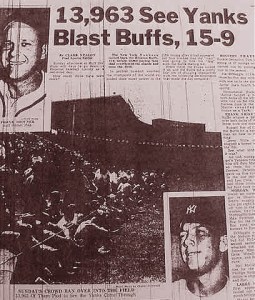 Sunday, April 8, 1951 was the date of the most memorable game I ever watched at old Buff Stadium – and it didn’t even count in the standings. It didn’t have to count, except in the heart of play we witnessed that day – and in the pictures it imprinted upon the minds of the record crowd of 13,963 fans who attended that hot and sunny spring afternoon exhbition game.
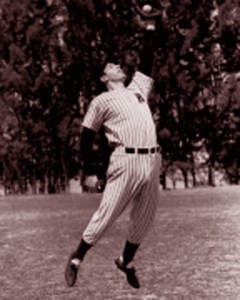 I watched every single nuanced thing DiMaggio did in the field – and I loved it when he had to run over near us for a fly ball. He was close enough for us to hear the ball pop leather on the catch many times. I even thought we made eye contact once.

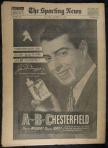
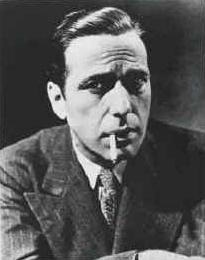 I grew up in a Post World War II era of blue smokey haze. Everything I saw, heard, or breathed vicariously into my lungs from the adults in my life said to me: “Smoking is good! As soon as you’re old enough you’ll be able to light up too!” My dad smoked, but so did most of the other dads and quite a few of the moms in our Pecan Park neighborhood in Houston. At Sunday Mass, it was like a stampede at the end as 75 to 100 men herded toward the front door for a post-spiritual firing up of the old Chesterfield and Camel nicotine incense out front. Hallelujah! None of those mamby-pamby filtered cigarettes were strong enough for my dad’s generation. These were real men who smoked only those short full-tobacco blast sticks fromthe “Big C” companies. And why not? “Seven out of ten doctors preferred and recommended Camels for your smoking pleasure!”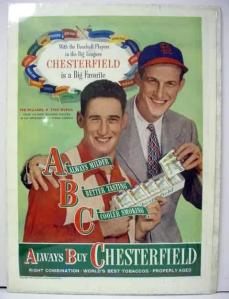
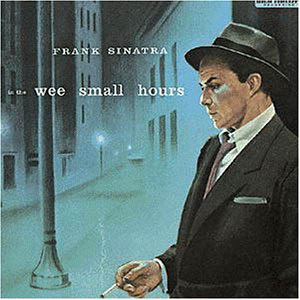
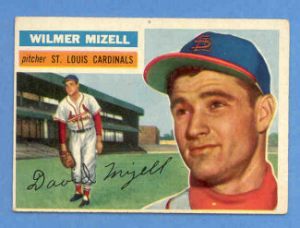 The young man they were already calling Vinegar Bend Mizell arrived in Houston with the Buffs in the spring of 1951, heralded full bore as the lefthanded second coming of Dizzy Dean from twenty years earlier. Buff fans, sportswriters, club president Allen Russell, and the parent team St. Louis Cardinals all hoped the “Lil Abner Look-n-Sound-Alike” would turn out to be everything his growing legend screamed out that he was going to be: a sure-fire and consistent twenty game wins per season superstar and future Hall of Famer. Mizell wasn’t quite the young braggart that Dean had been, but he opened his mouth enough to create words that some writers ran to type as promises for use as future nails, should he fail to deliver.
 Mizell was critical to the success of Houston’s 1951 Texas League pennant drive, posting a 16-14 record that wasn’t altogether his fault on the short side of his wins to losses ratio. The club just had one of those seasons in which they often had trouble giving Mizell the offensive support he needed to take the win. His 1951 Earned Run Average of 1.96 still spoke volumes about his bright future as a prospect.
 I had the good fortune of finally meeting Wilmer David Mizell when we were seated together at the same table at the banquet hall for the Spetember 1995 “Last Round Up of the Houston Buffs.” I had a chance to ask him if the squirrel hunting story were true. “Did you like the story?” Mizell asked me in return?” “Oh yeah! I always loved it!” I told Mizell. “In that case, it was absolutely true!” Mizell shot back with a wink and a smile.
 It happened again. Last night my wife and I went to see what first sounded like it would be a neat sci fi movie. It turned out to be another of those bad-to-the-bone failed chick flicks that is spoken mostly in whispers to the ears of only those females in the audience who still possess the ability to understand hush-spoken words above the torrent of their own broken hearted tears. The only people crying at our Sunday showing in Cinemark Memorial City were me and all others who couldn’t stop thinking of what they had just paid good money to watch.
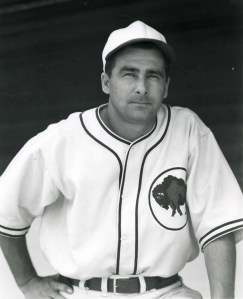 The late Eddie Knoblauch is a classic example of the currently popular axiom that “perception is reality.”Some of his fellow teammates, as well as Dutch Meyer, his manager at Dallas in the early 1950s, seem to think that Eddie had all the ability in the world to have moved on up to the big leagues over the 1938-1955 course of his career, but that he just lacked the will to crank it up to that level. If so, why not? One old teammate, armed by the cloak of anonymity in 1998 Dallas newspaper artile suggested that the money differential between minor leagie and major league pay back in the day simply wasn’t big enough to motivate Eddie Knoblauch.
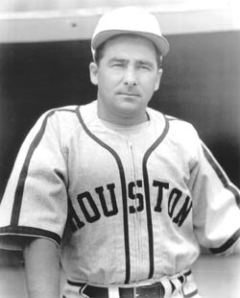 Eddie Knoblauch garnered 391 career doubles and 117 career triples. He also scored 1,420 runs.
 The front of our little house bore no resemblance to the one that now features a long porch across the street-side portion that faces north – nor did we possess or have any need for a museum quality fence across the front yard. – but it was home. From February 1945 to October 1958, from the time I was 7 and just finishing the first grade at Southmayd Elementery until the time I was a 20-year old junior and full-time working student at the University of Houston, “6646 Japonica” Street in Pecan Park, in the Houston East End, just east of the Gulf Freeway off the Griggs Road intersection, was the place where I hung both my baseball cap and my heart. I lived there with two parents who stayed together 58 years in marriage until death took each of them just five weeks apart in 1994.
 Houston, Baseball, & Other Musings.
