Lance Gets His Second Chance

October 18, 2011

Berkman Hit Over .300 for 1st Time Since 2008 This Season.

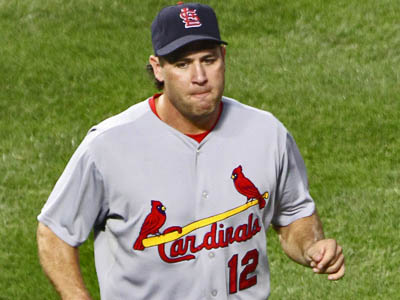
It’s one of those ancient western plot scripts: Local hero loses his magic touch with the six-shooter and has to get out of Dodge to either lose himself completely or find himself again. And that’s pretty much how Lance Berkman rode out of Houston in 2010. For a while there, it looked as though he had locked up his  loss of self in The Bronx Zoo, but he apparently had not gotten the whole picture at season’s end and he took a step back that was based totally upon illusion and delusion.

Lance tried to come back to Houston and make himself available to the Astros again after 2010 at some kind of veteran home boy rate, only to find that there was no longer an extra hitter’s badge hanging on Sheriff Wade’s office wall that the club could spare. It was time to either hang up hope – or else, get out of Dodge for good. Lance chose the latter when the LaRussa Gang up in Missouri let him know that they had a hot plate waiting in their bunk house for an old foe from Texas.

Lance Berkman promptly went out there for St. Louis in 2011, as we all well now know, and put to rest that the idea that his batting gun was done. He hit .301 with 31 homers and 94 RBI, picking up the slack in an early season Albert Pujols down year and also teaming up with the latter year Prince, Matt Holliday, and David Freese as one of the most feared group of hitters in the National League. Now Lance stands on the brink of his second shot at a World Series ring, even if it doesn’t come with the home town Astros who had given him up for dead as a major league slugger.

At this stage in his thirteen season major league career, Lance Berkman rests his case for future contracting on what he’s done this year as proof of his comeback from the injuries that limited in his production in 2010 (.248 BA) and may have also played a part in his 2009 slip (.274 BA). At age 36 going into next season, the evidence from 2011 rests on the side that Berkman has some good production left in him.

His career batting average is now .296. He also has an OBP of .409, 358 home runs, 1,822 career hits, and 1,193 runs batted in. My guess is that he has about three good years left in the tank, if he can avoid injuries, stay in shape, and not lose his legs and bat speed to aging, but that the St. Louis Cardinals will be first in line to make sure he has a decent playing contract, at least, for 2012.

Good luck to Lance Berkman on his 2011 quest for a World Series ring. I, for one among the local many, am just sorry that you had to get out of Dodge to find yourself again. We could have used you here in Houston during the baseball spiritual drought of 2011. To walk out on the streets of our town this year was to get shot at by disappointment from just about every nook and cranny of the Houston professional sports world.

Go Cardinals! Go Berkman!

Who Will Take The World Serious?

October 17, 2011

Time to get World Serious again.


A Pre-World Series Inquiry

1. What’s stronger? Your National League Cardinal roots – or your allegiance to the State of Texas vis-a-vis the Rangers?

2. Who would you be most happy to see picking up a World Series ring? Nolan Ryan? Or Lance Berkman?

3. Can you be a real Houston Astros fan and still pull for a team that makes its home in the Greater Dallas area?

4. Since the Astros are currently as far away from the World Series as Pluto is from the Sun, do you even care who wins this one?

5.Who wins this year and how many games does it go? Get your guesses in before Game One starts on Wednesday?

6. What are the odds that each team will post a Series ERA exceeding 6.00?

7. Who will hit the most individual player Series home runs?

8. Who will pick up the most individual player Series hits?

9. Who will collect the most individual player Series RBI?

10. Who will win the Series MVP Award?

I’m sticking with the big question (#5). I think this Series is going to be a real hit banger on the days that Carpenter doesn’t pitch. Because St. Louis has the home field advantage and the chance to possibly use Carpenter three times,  I’m picking the Cardinals in seven games.

What do you guys think about the Series outcome – or any of the other questions raised here?

Eddie Gaedel Lucky He Never Faced Satchel Paige

October 16, 2011

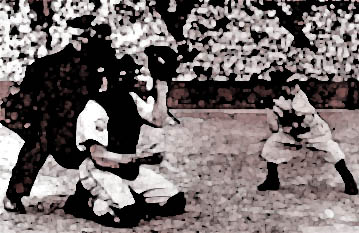
August 19, 1951: Vertically challenged Eddie Gaedel came to bat as a pinch hitter for Frank Saucier of the St. Louis Browns in Sportsman's Park, St. Louis, and drew a four-pitch walk from pitcher Bob Cain of the Detroit Tigers. He was immediately replaced by pinch-runner Jim Delsing and retired from his one-at bat career with an all-time OBP of 1.000.

The great Satchel Paige and the little unknown midget named Eddie Gaedel were teammates for one day on the 1951 St. Louis Browns. Neither man, especially Gaedel, would likely have been there at all, had it not been for club owner Bill Veeck and his PT Barnum level commitment to boosting the anemic gate attraction that was the drubbing wagon that the Browns had become in American League history through this time. By 1951, as a matter of fact, the wobbly wheels of that creaking old boneyard cart were only two years away from falling off forever and the remaining riders taking flight east as orange-breasted Orioles.

Still, the great ones never forget, even if they fail to show up or stay awake for the most secretive off-the-wall stunt ever pulled off in baseball history. For a man who wanted to goose the gate, Bill Veeck had done everything he could to keep the use of his little midget in an actual game a secret until it happened. As much as he might have preferred a big advance ballyhoo that could have attracted a larger crowd, Veeck also knew that too much advance publicity might result in either the Commissioner or the American League coming down to halt the plan before it ever happened.

Veeck settled for the element of surprise – and the hope that it would spawn a new awareness among St. Louis fans, one that would promote the idea that “I had better go see a few Browns games; there’s no telling what I am liable to miss seeing if I don’t go.”

Veeck thought of everything. He had even gotten Gaedel to sign an AL approved player’s contract prior to the day of the game in anticipation of the umpire challenge that was sure to come, which it did, but a presentation of the written document ruled over all short-term arguments by the Tigers when the Browns sent up Eddie Gaedel as a pinch hitter for lead off man Frank Saucier in the bottom of the first inning.

Once play began, the Tiger battery, pitcher Bob Cain and catcher Bob Swift, pretty much handled Gaedel as though they were facing a child by throwing his lob pitches that they hoped would move through the strike zone as such – or an easy to field come-backers to the infield. But Gaedel was no child – and he was batting under mock death threat (we think) from Bill Veeck not to swing at anything. Veeck had actually told Gaedel that he planned to watch his performance with rifle in hand from atop the stadium roof. Veeck had made it clear that he planned to shoot Gaedel if he dared swing at anything.

Eddie Gaedel did not swing at all. He walked his way into baseball history on four pitches and then departed for a pinch runner. Within hours of his triumph, his contract to play baseball was rescinded as a sham, but I’m not really sure how prejudicial the aborting language was against all the vertically challenged people in this world. I just know that he had played his one and only hand into baseball history.

But as we said earlier, the great ones never forget. And Satchel Paige was indeed one of the great ones.

Years later, as reported on page 721 of “Satchel” by Larry Tye, Satchel Paige was engaged in one of his many barnstorming trips to Canada and was pitching in a small town called Kindersley in western Saskatchewan. It was one of those days in which Paige still felt like going a full nine innings, but something happened in the seventh inning that was purely designed to bother Satchel. The manager of the local club opposition put a four-year old boy who stood only three feet tall into the lineup as a pinch hitter.

Hey! At three feet in height, the Canadian kid was a full one foot shorter than Eddie Gaedel.

“Everyone thought that Satch would lob the ball, or perhaps walk him,” remembers Bob Joyce, who was calling the balls and strikes that day. “But he threw three perfect fastballs, knee high, and I had to call the kid out. Imagine the strike zone at 60 feet, 6 inches.”

And while we’re at it, let’s recall all those stories about Satchel Paige’s ability to hit the middle of a gum wrapper paper when he needed a strike. In that kind of situation, there was no way that the great Satchel Paige was going to Eddie Gaedel this little kid to first as a free base runner.

Maybe Satchel wasn’t even at Sportsman’s Park on the day of Eddie Gaedel’s famous plate appearance of August 19, 1951. In fact, I’d like to think he wasn’t. I’d prefer to think that the real Satchel Paige would have mowed down the little kid years later up in Canada, no matter what. Anybody who steps in to hit in the game of baseball should be ready to take on all the consequences of that decision – or said person shouldn’t even be there in the first place.

The Ted Williams-Robert Ryan Movie They Missed

October 15, 2011

Ted Williams Sworn In To Military Service in World War II, plus insert of Ted as a ballplayer, lower left, and two profile inserts of actor Robert Ryan.

Could actor Robert Ryan have played the role of Ted Williams in a bioflick they never made? You betcha! And he would have brought a ton acting skill and athletic ability to the job as well. I don’t really know of Ryan’s athletic background, but that’s my take anyway, based upon what I’ve seen of his movements in westerns and action roles. The guy never looked clumsy as he moved.

I only wish I could have found some younger shots of Ryan that were right usable for this piece. He may look a little old here for the younger Williams, but he could have handled the role just fine in his earlier career.

Unfortunately, and this is really a wholly larger topic, Hollywood doesn’t always pay much attention to physical similarity and athleticism in their casting of baseball title roles. Here’s my short list of the worst baseball star castings in memory, with my least favorite listed at number one:

1. Anthony Perkins as Jimmy Piersall in “Fear Strikes Out.” (1957).

2. Ray Liotta as Shoeless Joe Jackson in “Field of Dreams.” (1989).

3. Ronald Reagan as Grover Cleveland Alexander in “The Winning Team.” (1952).

4. William Bendix as Babe Ruth in “The Babe Ruth Story.” (1948).

5. Frank Lovejoy as Rogers Hornsby in “The Winning Team.” (1952).

6. John Goodman as Babe Ruth in “The Babe.” (1992).

7. Gary Cooper as Lou Gehrig in Pride of the Yankees.” (1942).

8. Ray Milland as fictional pitcher Mike Kelly in “It Happens Every Spring.” (1949). I would have penalized Milland all the way to number one had he been playing a real character. His athletic ability was worse than Perkins’s schlepping, if possible, but this was a wonderful baseball comedy and Milland pulled it off pretty well in spite of himself.

My favorite actin/athletic combos were:

(1) Robert Redford as fictional character Roy Hobbs in “The Natural. (1983).

(2) Tommy Lee Jones as Ty Cobb in “Cobb.” (1994).

(3) Kevin Costner as the fictional Crash Davis in “Bull Durham.” (1988).

(4) Charlie Sheen as the fictional Ricky “Wild Thing” Vaughn in “Major Leagues.” (1989).

(5) Paul Douglas as the fictional Guffy McGovern in “Angels in The Outfield.” (1951).

(6) Robert DiNero as the fictional Bruce Pearson in “Bang The Drum Slowly.” (1973).

(7) Dennis Quaid as Jimmy Morris in “The Rookie.” (2002).

Maybe my off-the-cuff opinions here are fairly typical of baseball fans on one level. I think it’s easier for us to enjoy movie performances by actors in fictional roles. We have some very strong impressions of actual players and we may tend to expect actors to capture them dead on and, at least, look as though they’ve thrown a ball or swung a bat before.

The problem with “Field of Dreams” provides us with our most extreme Hollywood misstep, but thy still didn’t get it. New York actor Ray Liotta was cast in the role of the left-handed batting Shoeless Joe from South Carolina. Liotta is right-handed and can’t even fake a left-handed swing for the movie, so, Director Phil Robinson just allows him to hit right and talk like he’s from Brooklyn.

When he gets the uproar of objection from deep blue baseball fans who see the early release of the movie, how does director Robinson respond? He tells us that we need to remember that the movie is a work of fiction – and that these things happen when we producers make a film. By his silent shrug, he was implicitly saying that we should just accept little misses like this as we suspend our anchorage to reality for the sake of buying into the movie.

Hollywood people just sometimes fail to realize how literal we baseball people can be when it comes to the imagery of our biggest ancient stars.  We sort of like reality. I mean, I went to that movie prepared to accept the premise that dead Hall of Famers and deceased scorned superstars were capable of walking out of a corn field to play the game again. – I just expected them to be real when they got to the playing field.

Sign the Save Our ‘Stros Petition ASAP!

October 14, 2011

RED ALERT! – RED ALERT! – RED ALERT!

Anne Tucker of The Museum of Fine Arts Houston is also a big, big Houston Astros National League fan who has decided to take the bull by the horns for the rest of us similarly minded folk.

Rather than sit around worrying that Commissioner Bud Selig is going to twist new club-owner-in-waiting Jim Crane’s arm into moving the franchise to the American League West as a condition of his approval, Anne Tucker has started an organization that exists solely to make sure that this Selig-bargain never happens.

SaveOurStros.Org speaks for all of us who want to see our Astros remain a member of the National League, no matter who owns the operating rights to the franchise at any given moment in baseball time.

If you click on the link at the bottom of this page, you will see the letter that Anne has most respectfully written to Commissioner Selig to put forth our case for leaving our ‘Stros exactly where they are on the big league baseball map.

All I might have added to the letter was my own strong belief that the American League’s DH rule destroys the true spirit and integrity of the real game, but Anne was wise to leave that part out of the mix. After all, we are dealing with a man who is a strong proponent of things like the DH rule and using the All Star Game outcome determine home field advantage in the World Series. The less we say that sounds off-topic to those kinds of ears, the better.

What follows is Anne Tucker’s appeal to other Astros fans that feel as she does. If you agree with Anne, please sign the petition that is included as part of the package she will be sending to Bud Selig:

To all my baseball friends:

 I am passionately opposed to the Astros being pushed into the American League. I sent a letter to Bud Selig expressing my reasons against the move. Please go on the web-site below and sign the petition that we want to present to Mr. Selig soon. Also, please pass this on to your baseball friends.

 We think the deadline may be the middle of November so do this now. This will not put your email on any list and we are not soliciting money at this time. This is our first step. We are looking into bill boards in Houston if we can do it fast.

 Thanks for you help.

 Anne Tucker

 Click the following link to see Anne’s letter to Bud Selig and the petition that awaits your signature, if you agree with fans like Anne Tucker and yours truly. The Houston Astros are a National League, real baseball franchise with no room for side tracks into the carnival game that contains the (DH) designated hitter.

http://www.saveourstros.org

The Ryan Braun-Brendan Fraser Twins

October 14, 2011

Ryan Braun (larger figure above) of the Milwaukee Brewers might be able to play the role of that dopey anthropologist in the movie Mummy series, but could actor Brendan Fraser (insert) hit and field well enough to play left field for the club from Beerville? All I know is that these guys look enough alike to have been brothers, if not twins. The sudden connection in my mind during the Brewers-Cardinals game seemed worth the late night extra fun blog.

There are just so many facial archetypes out there – and sometimes we even find them among famous people who do slightly to greatly different things.  I’m not suggesting that one other explanation applies to Braun and Fraser, but it was best described in a song title from a few years back.

Do you remember these lyrics:

“Papa was a rollin’ stone. – Wherever he hung his hat was his home.”

Have a nice evening, everybody. I promise to stop writing for the rest of this Greenwich Time calendar day.

Skeeters Baseball Getting More Real by The Day

October 13, 2011

Startex Power Field in Sugar Land is Going Up: They've also added some lighting arc posts since these recent aerials were taken too,

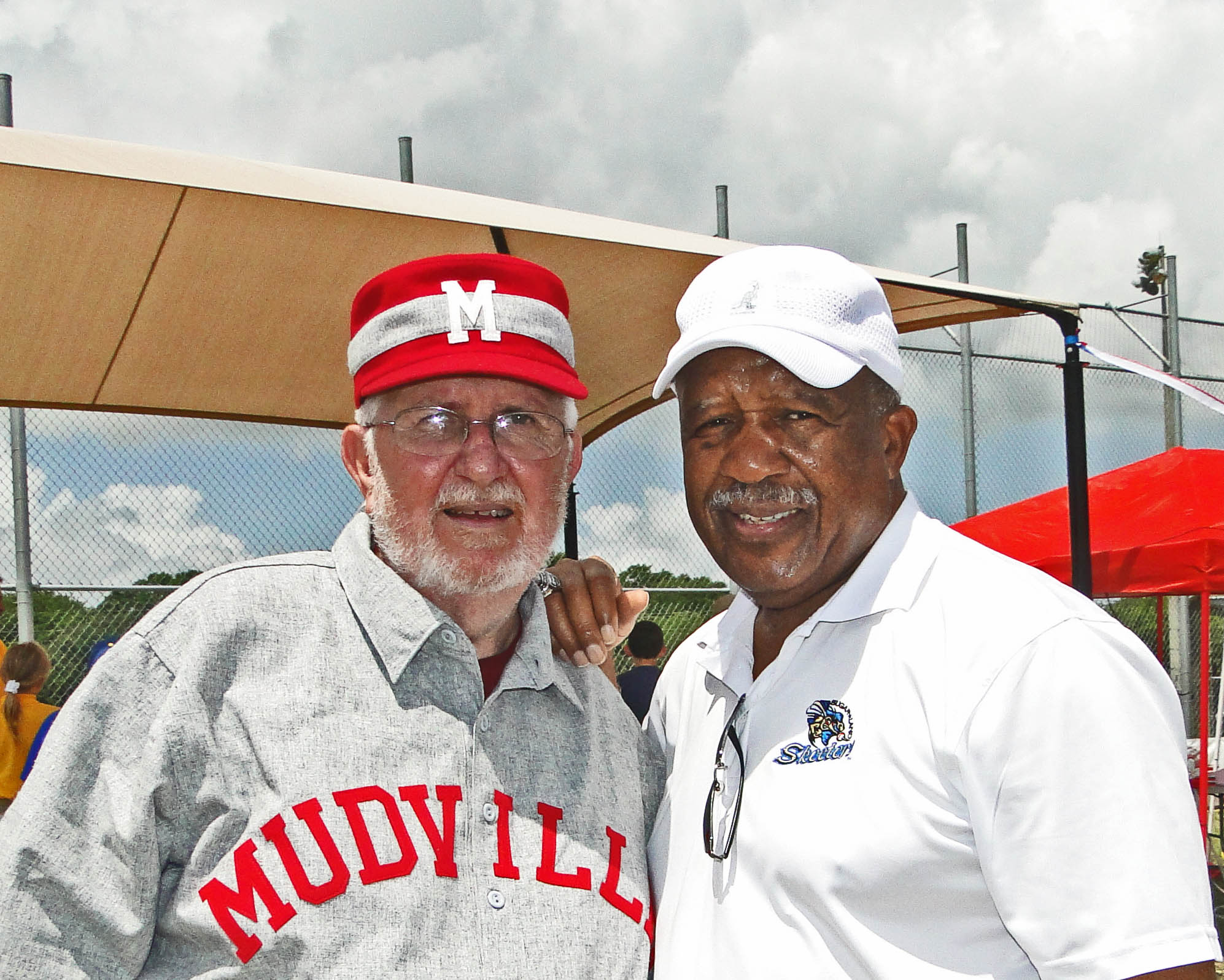
I had a nice call from old friend Deacon Jones a couple of days ago. The Deacon is now involved full-time as a Special Assistant to the President of the brand-spanking new Sugar Land Skeeters Independent Atlantic League Baseball Club that starts play in its own new shiny digs in 2012. We had a local baseball research question to pursue together, along with fellow SABR member Tom Murrah. This is just a great time to be in love with baseball historical research in the greater Houston area. We’ve got more going on these days than you can shake a Babe Ruth big stick at – and we just keep coming up with new ideas and new people who are eager to chase down leads on what was true or false in baseball history – and all the way deep into the 19th century, if that’s how far back the question goes.

For now, at least, the energy of baseball’s local past and future seem to be feeding upon each other. Even as I write, and as you later, but sooner read these words, the muscle of new support for expanding the presence of organized professional baseball in the greater Houston area goes on out in Sugar Land. Startex Power Field, the new home of the independent Atlantic League’s Sugar Land Skeeters is going up on the plains south of the big City of Houston off Highway 59 South near the site of the old Imperial Sugar plant. Sugar Land is getting ready to field a team in 2012 as the newest member of the independent Atlantic League as a representative of the entire Houston community.

Offering good clean family fun, the Skeeters are not here to compete with the major league Houston Astros, but to augment the availability of the game as a spectator option for people who live inside the loop to those who have moved to the hinterlands of suburbia. New interest in the Skeeters can only amplify interest among people who have never previously even dreamed of going downtown to see a big league game. It is a win-win run for both the established MLB club and the new independent league venture.

If you are already an Astros fan, the Skeeters offer a tasteful picture of what the future of baseball may look like – and also a sketch on what minor league ball has always felt like on the intimate fan level. If you are primarily a new fan of the Skeeters, on the other hand, you are about to get an appetite-whetting taste of just how good the game can be played at the major league level (during normal times for the Astros).

The Doc and The Deac

Deacon Jones says that people are buying Skeeter season tickets like hot cakes these days and he advises interested parties to get on the website and take a special look for themselves at both the progress of construction and the offerings to fans that still exist during this early period of prime options on seating and special event arrangements. There is also a whole lot of contact information there on how you can get in touch with Deacon Jones (or just about anyone else who is connected with the Skeeters) by either phone or e-mail. And, hey – a five-minute talk with Deacon will just about make your day, anyway – even if you don’t buy anything.

Here’s the link to the Sugar Land Skeeters website:

http://sugarlandskeeters.com/index.cfm

Baseball is a great game – and one of the big reasons for its greatness is the presence of good people like Deacon Jones. Deacon Jones played the professional game at a high level – and now he represents the game at the highest level of gifting to others. When you speak with Deacon, he gives you the voice and soul of the game from the heart of all the caring that he has put into baseball over the period of his lifetime.

And as the old song goes: “Who could ask for anything more?”

Michael Hogue’s Portrait of Jackie Robinson

October 12, 2011

All good things come to some kind of end. Today’s Michael Hogue Portrait of Jackie Robinson only ends in the sense that it runs the table here on all the figures originally featured in his look at stars of the Negro Leagues in an earlier united presentation in The Dallas Morning News. For the past several weeks, those same stars have been shown here in The Pecan Park Eagle by written permission from Michael Hogue.

Today’s final portrait in this series appropriately features a look at the first man from the Negro Leagues to break the 20th century color line in the big leagues back in 1947, the one and only Jackie Robinson. Robinson broke into the major with the 1947 Brooklyn Dodgers. He played ten years with Brooklyn, batting .311 overall, and helping to lead the Dodgers to seven pennants and their only Brooklyn-based World Series title in 1955.

Jackie Robinson is our “Offering # 14″ and the last feature in this series on this fine Texas artist’s work, Portraits of the Negro Leagues. It has been nothing less than a beautiful trip. – Thank you one more time, Michael Hogue, for allowing The Pecan Park Eagle to further share the beauty and joy of your work with those readers who care about the Negro Leagues and their place in baseball history.

For more on Michael Hogue’s work, check out his website:

http://www.michaelhogue.com

Jackie Robinson, Infielder, Negro Leagues, 1945, Major Leagues, 1947-1956, Baseball Hall of Fame, 1962, Robinson's uniform #42 was retired in honor of his place as the man who broke the color line in 20th century organized baseball.


Jackie Robinson by Michael Hogue of The Dallas Morning News.

“The man who broke the color line in modern baseball began his career in the Negro Leagues.

“Before playing the 1945 season with the Kansas City Monarchs, Robinson was a four-sport star at UCLA, were he excelled in baseball, basketball, track and field, and football.

“Baseball was considered to be his worst sport.”


Duke Keomuka Lives On in Wrestling Book

October 11, 2011

"Everything I know about karate chops and sleep holds, I learned from Duke Keomuka."


As you’ve probably read from me here in the past, Friday Night Wrestling from the City Auditorium in Houston was big back in the late 1949 and early 1950s earliest television era. Tuesday and Friday nights both were the big days for watching TV back then. If you didn’t have a television set, you found a way to worm your welcome into the home of a neighbor who had one on both of those special nights. Tuesdays were the days for watching comedian Milton Berle; Fridays belonged to announcer Paul Boesch and Houston wrestling. Either way, both shows were can’t-miss cultural taste buds on the palates of Houstonians waking up to the joys of passive electronic amusement.

Thanks to friend Harold Jones, I’ve just finished a month of browsing a neat little comprehensive reference book on the actors of professional wrestling by a fellow named Harris M. Lentz III. called the “Biographical Dictionary of Professional Wrestling.” Published by McFarland Company in 2003, this second edition contained information on every wrestler I could think of – plus thousands more that I’d never even heard of outside the Houston and Hollywood television markets.

We were big time back in the days prior to the coming of the coaxial cable and live national TV in Houston from July 1952 forward. Before the cable, we had live wrestling from Houston on Friday nights and kinescope-copy wrestling from Hollywood on another variable evening. It was Hollywood that introduced us to local-boy-made-good Milby High School alumnus Gorgeous George.

My favorite Houston villain was Duke Keomuka. Duke was from Hawaii, but he basked in the recently rising sun of Japan’s fairly recent run in World War II as the “Asian Evil Empire.” Duke fought dirty, even using soap as an eye-rubbing act of irony in his unclean efforts to win at any cost. He also introduced us to some iconic weapons we had not previously seen.

Long before Bruce Lee and Chuck Norris came along to show us these moves on film, Duke Keomuka introduced Houstonians to the “karate chop” blow to the necks and other vulnerable areas of his opposition. Many Houston fans really enjoyed it when Duke later took an All American fist to the face in rageful good guy retaliation. It was all pretty racist back in the day. Asian wrestlers were always “bad guys” in the days that followed the end of World War II because wrestling promoters staged what sold best to the crowds they attracted. In that respect, hispanic wrestlers were always “good guys” and white wrestlers could be either good or bad guys. There weren’t any black wrestlers in Houston during the segregated era of the 1950s. So much for the purity of the good old days. Racism and segregation, plus racial profiling, stank it up pretty bad on many levels.

We kids just weren’t into that crap. We liked what the Duke taught us. Karate chops became an aspirational weapon that we tried to use in the daily struggle for agreement with our peers, but we simply lacked the kill or right will for its successful execution. Using a karate chop in a real fight often led to some pretty banged up fingers in the attempted assailant.

Duke’s other big move was the “sleep hold,” a move that stopped short of strangulation and left an opponent either unconscious or asleep on the canvas or East End sidewalk. It’s a wonder we didn’t kill each other with all the visual information we got from TV wrestling and then tried to use in our daily discourses with each other.

At any rate, since I need to return Harold’s book today, here’s what I learned factually about my all time favorite bad guy, Duke Keomuka:

Duke Keomuka was born in Hawaii as Martin Tanaka in 1921. Over a wrestling career that covered all of the 1950s and most of the 1960s, Keomuka teamed with Danny Savich in 1951 to take the NWA Texas Tag Team Title several times over. DIrty DOn Evans, another of my favorites, was a frequent tag team partner in other title pursuits in the later 1950s. In 1961, zDuke teamed with Sato Keomuka in Cleveland, Ohio to take the U.S. Tag Team Title. Duke took several other team titles with different partners in Florida and elsewhere. His son, Pat Tanaka, also grew up to become another popular wrestler.

In the 1980s, an elder Duke Keomuka became an NWA wrestling promoter in Florida. He died of heart failure in Las Vegas, Nevada on June 30, 1991.

Long live the spirit of the Duke – the inscrutable actor who didn’t really almost choke all those people to death with the infamous sleep hold as he slipped a little melodrama into our daily lives.

If you are an old-time wrestling fan, try to get your hands on a copy of Lentz’s wrestling book. It will keep you awake for hours.


Michael Hogue’s Portrait of Willie Mays

October 10, 2011

The following art and text by Michael Hogue of The Dallas Morning News is reproduced here in The Pecan Park Eagle by written permission from Michael Hogue. Today’s next to final portrait in this series features a look at Willie Mays, the “Say-Hey” kid and arguably greatest center fielder in the history of all baseball, black, white, or whatever. Willie Mays will always be remembered as a Giant, regardless of his final fumbling season as a Met. From New York to San Francisco, he was the A&P oceanic answer to “who was the last and first great man in either central pasture to play this game as a Giant on both of our east-west coasts?” Willie Mays hit 660 career home runs as a major leaguer.

Willie Mays is our “Offering # 13″ in this series and a continuation of this fine Texas artist’s work, Portraits of the Negro Leagues. Today’s subject will leave us with one old Negro Leagues subject to go after today and you may even be able to figure out in advance who that Wednesday, October 12th, subject is going to be. He was a significant gate-crosser from the world of black baseball and into the formerly all white game of so-called organized baseball. – Thank you again, Michael, and for the umpteen hundredth time, for allowing The Pecan Park Eagle to further share the beauty and joy of your work with those readers who care about the Negro Leagues and their place in baseball history.

For more on Michael Hogue’s work, check out his website:

http://www.michaelhogue.com

Willie Mays, Outfielder, Negro Leagues, 1948-49, Major League Baseball, 1951-1973, Baseball Hall of Fame, 1979.


Willie Mays by Michael Hogue of The Dallas Morning News

“(Willie) Mays broke into the (Negro Leagues) ranks at age 16 with (the) Birmingham (Black Barons). He played only on Sundays during the school year. After two seasons, he signed with the majors’ New York Giants.”