Keenum Closing Case on Heisman Run

November 6, 2011

  Look. I get it. – I don’t like it, but I get it.

Andrew Luck of Stanford will most probably win the Heisman Trophy in December as the “individual who deserves designation as the most outstanding college football player in the United States” for this current 2011 season. Luck fits the physical prototype of size and ability that is most favored by the NFL,  he is currently having a very successful year quarterbacking prestigious and undefeated Stanford on the path for perhaps a place in the BCS championship game, and he’s doing it all in the face of top-flight competition as a longtime member of the highly regarded Pac 12 Conference.

If Luck wins, however, it will not be because he actually fulfilled the expressed intentionality of the Heisman award better than any other player in the United States or that no other player had a better statistical year on the collegiate Division 1 level. It will be because of his prior anointment by the media, the pro scouts, and NFL fans as the second coming of Peyton Manning, the Indianapolis Colt Consolation Prize for going 0-16 in 2011, and the next great Moses in some pro team’s future search for a Super Bowl title.

Fair enough, if that’s what the Heisman is now about, but that’s not what their formal language for describing the purpose of the trophy says it’s about. It says exactly what we quoted above. Repeat: The Heisman Trophy is intended for the “individual who deserves designation as the most outstanding college football player in the United States.” It doesn’t say anything about giving it to the player who comes from a prestigious school whose Greek God body and ability reminds everyone of the next great NFL QB.

A few years ago, the Heisman went to a fellow named Earl Campbell from UT and deservedly so. Earl didn’t win simply because he was from UT or the best pro prospect that practically everyone had ever seen. He won because he was best college football player in America by his on-the-field collegiate accomplishments.

On the heels of Campbell came another Texas Heisman winner, Andre Ware of UH, who also won for his collegiate accomplishments. Ware’s runner-up candidate was a young fellow named Emmett Smith from Florida, whose collegiate accomplishments were not nearly as strong as Ware’s, but whose professional upside was considerably greater, to put it mildly. Ware didn’t make it in the pros, but Smith, as we all know, went on to a NFL Hall of Fame career with the Dallas Cowboys.

My point is simple: Based upon the stated purpose of the Heisman Trophy award, Earl Campbell and Andre Ware both deserved to win the Heisman for their collegiate accomplishments. Now we have a situation this year in which the man who best deserves the award for his record-shattering collegiate accomplishments will likely not win because of the anointment of Andrew Luck as the top pick in the NFL draft – and not because his actual accomplishments on the field relative to those of Case Keenum of UH were even close to comparable.

I don’t expect all of you to agree with me, but there can be no argument with the results achieved by Case Keenum on the field. After last night’s 56-13 win over Alabama-Birmingham, Case Keenum now holds five major career offensive marks – and these are records that Andrew Luck does not even come close to matching. Forget that UH does not play the toughest schedule on the block. UH (we) would do so if the BCS hot-shot schools didn’t mostly see us as one of those “everything to lose and nothing to gain” scheduling choices. Thank goodness that schools like UCLA have the guts to give the Cougars a fair shot in combat, but that’s beside the point in this Heisman matter. The Heisman qualifier does not say anything about ruling players out who have achieved in the face of “lesser regarded” by reputation competition.

Case Keenum Finds Peace on Each Record Night.

Here’s the quick breakdown on Case Keenum’s career marks, with each record showing the name and numbers for the previous holder:

Case Keenum’s NCAA Football Records:

(1) Career Touchdown Passes: 141 (Graham Harrell, Texas Tech – 134)

(2) Total Yards Gained: 18,101 (Timmy Chang, Hawaii – 16,910)

(3) Career Touchdowns, Passing & Running: 163 (Dan LeFevour, Central Michigan – 150)

(4) 300+ Yard Games: 34 (Timmy Chang, Hawaii – 33)

(5) Passing Yards: 17,212 (Timmy Chang, Hawaii – 17,072)

If the New York Athletic Club decides to turn the tide and choose the candidate whose accomplishments best fit the requirements of the Heisman, they could do the trophy great honor by picking Case Keenum of the University of Houston. Case is a fine upstanding young man who should also enjoy a nice career in the NFL after this season, no matter what happens from here. Keenum’s head and value system are also on straight. He is a devout Christian gentleman who married his high school sweetheart this past summer. When you see this young couple together, they seem to have the word “always” written in the blue skies over their shoulders. I wouldn’t see there ever being a need to request a return of the Heisman from Case Keenum for any reason.

I’ll admit to some bias in my support of Case Keenum for the Heisman, but I really do think he objectively deserves it based upon his many great accomplishments. Andrew Luck is a good man too – and he will represent the Heisman honorably too, if he is chosen – and – as politics go, I think he will be the pick.

If Luck is chosen, however, I hope the selection committee will also change the language of their award requirements to match their real reasons for making a selection. If the Heisman is really about picking the next number 1 NFL draft choice, just say so – because there’s no way that either the productivity or character of Andrew Luck deserves the Heisman Trophy over Case Keenum.

Name That Football Conference

November 5, 2011

Tom Trimble, Kneeling with Home Plate, plus other members of SABR-based Early Houston Baseball Research Project,

Credit has to go to fellow SABR member Tom Trimble for this idea. In one of our recent online discussions of college football today and the instability of traditional NCAA Division 1 conference alignments, Tom suggested on another link that it might simply be best to reorganize college football into conferences based on some common thread theme. Trimble specified that one group might be called the “Deity Conference” for the sake of, shall we say, ” gracing” the top religious schools in the country. Pick your poisons on that one. For the Deity Conference, how about TCU, SMU, Baylor, Notre Dame, Brigham Young, Wake Forest, and Oral Roberts?

For the beyond-the-Ivy-League based Egghead Conference of schools with very high academic standards who are also attempting and once in a while succeeding at competitive football, how about Stanford, Rice, Tulane, Vanderbilt, Duke, Northwestern, Purdue, and Clemson.

Here’s my favorite idea. I like it because it seems to eliminate the need for the BCS or an expanded playoff system that is more equitable and inclusive of the schools attended by the the growing legions of disgruntled have-notters. This one is so big a thought, however, that we really need to reach beyond the idea of “conference” to properly identify what it is. For the sake of maximizing ideational simplicity and then integrating that base into an actual entity, let’s just call it “The Narcissus Union of Allied Athletic Power Schools.”

The “NUAAPS”  includes only those schools that enter each season with enough money, power, ego, and talent to expect an undefeated season and a national championship every year – and only those who have the gonads to fire any head coach in mid-season who doesn’t seem to get why he was hired in the first place.

The Narcissus Union would include only these Top Ten power schools: Alabama, Florida, LSU, Michigan, Nebraska, Notre Dame, Ohio State, Oklahoma, Texas, and USC (Southern Cal). Anyone who feels they have been unfairly omitted can simply apply to The Union for extended future consideration. Till then, they simply need to join the crowd while the chosen ones either carve up the college football pie into ten fairly cut slices, or else be made available in a winner-takes-all gift-wrapped package at each season’s end.

The benefit to all other colleges and universities is a nice little bottom line booster shot too. While the chosen ten are playing all out for the national championship, everyone else can get back to bringing their admittedly now smaller annual budgets in line with the needs of academic research and student education. It’s a little more difficult selling season tickets to a a double blind drug study than it is season football ducats, but you also save money by not having to build a 100,000 seat drug study fan stadium that also contains luxury boxes.

Moon Shots

November 4, 2011

former Cardinal and Dodger Wally Moon Addresses the Larry Dierker Chapter of SABR on Oct. 11, 2011.

The distance was short – but the fence was so high,

When Wally’s bat kissed them – batted balls said goodbye,

They just called ’em “Moon Shots” – in the sweet bye and bye,

As homers flew fast – from their Coliseum lie.

It was an interesting era, to say the least. After the Brooklyn baseball team moved to the west coast in 1958 and reincarnated themselves as the Los Angeles Dodgers, they played five seasons (1958-1962) in the Los Angeles Coliseum on a playing field that had been configured for track in the 1932 Olympics and then for football, but not for baseball. As a result, the Dodgers ended up with left field distance that ridiculously short and only helped some by the inclusion of a super high net fence that kept most long drives in play and away from the cheap homers they soon would otherwise become.

Everything about that little arrangement began to chance once the Dodgers acquired a young outfielder named Wally Moon from the Cardinals after the 1958 season. The left-handed hitting Moon remembered how he used to wat crumpled tin Pet Milk cans with a stick to any direction he wanted as a kid back in Bay, Arkansas and he was able to convert that neuromuscular memory into the art of hitting a pitched baseball on a high opposite field arch to left field that often enough cleared the high protective protective net. These homers came to be named for Wally Moon as his “moon shots.” Like a golfer chipping out of the sand and up an embankment, Wally Moon had landed in LA in 1959 in time to become the “Master of the Moon Shot” just as the NASA space race with the USSR was really heating up.

It didn’t hurt that much of the music from that time enhanced public consciousness of the “moon shot” reference. One of the most popular songs from that 1950s era was “How High The Moon” by Les Paul and Mary Ford. I can still hear that song playing on the PA system at the Coliseum as Wally Moon rounds the bases on sauntering heels after another moon shot. “Somewhere there’s music, etc., etc. … How high the moon?”

The Moon got pretty high on success in LA. He played for three World Series championship clubs as a Dodger in 1959, 1963, and 1965, a final year which also turned out to be his last season as an active player in professional baseball. Now, at age 81, a still healthy and vibrantly alive Wally Moon has written and published his own autobiographical memoir with Tim Gregg entitled “Moon Shots: Reflections on a Baseball Life.”

Wally Moon attended our early October meeting of the Larry Dierker Chapter of SABR, the Society for American Baseball Research, to discuss his new book and just talk about his priceless lifetime of observations on the game of baseball. He came, and he performed, as a gentleman from the old school – one who valued family, fortitude, commitment, dedication, discipline, honesty, humility, faith, hope, love, and loyalty – and all those other good bonding values and personal traits that shape performance in any field – and he took those things and allowed them to speak out in baseball and his personal life through his actions as the answer to the question – “Who is this guy Wally Moon?”

I’m so grateful that I got to hear Wally speak at that early October meeting because it shaped how I heard his words from the book in my own mind as I read it. I bought the book from Wally that night and he signed it to me with these words:

“To: Bill – a good baseball fan. Enjoy this book and my best wishes to you. – Wally Moon 10-11-11.”

The book I read spoke to me in the same down-to-earth, grounded, but intelligent voice I heard that recent October night in his talk for and with the members of SABR.

Wally Moon was one of my teenage idols as a ballplayer. How could he miss with guys like me? He came up in 1954 with the Cardinals as an outfielder and hit .304 for the St. Louis Cardinals, playing well enough to be named the National League Rookie of the Year. He had played for Texas A&M and gotten his college degree before reaching the big leagues, and that was a big deal to me and my parents, even back then. The game of baseball was not a sport to rob us young guys of our education, if one had both the ability and motivation to get through school – and, I must add, a few of those values and traits that Wally had acquired from his family and DNA. The guy was a role model for the ages back then – and he still is today.

After five seasons with the Cardinals (1954-1958), Wally Moon went to the Los Angeles Dodgers in a trade for Dodger outfielder Gino Cimoli. He didn’t like it much, but he adapted and did well overall over the course of seven seasons (1959-1965) on the coast. Wally Moon also played some first base with the Dodgers, ending his career with a batting average of .289 and 142 total home runs.

Moon Shots is well-written and it covers a lot of detail from Wally’s personal and baseball life. It doesn’t contain the morality crisis that many players face and have to either deal with or avoid in their own stories because Wally Moon’s value system and personal trait profile exists as the polar opposite of that old left field wall in the LA Coliseum. Wally’s character runs long, wide, and deep. He never really had to choose between right and wrong because his sense of the “right thing” is simply so much stronger than anything else out there that tries to oppose it. And I don’t mean that Wally comes across as a “Mr. Goody Two Shoes” either, I mean he is just one of those truly rare, but authentic for-real “good guys.” He doesn’t try to tell other people how to live, but he values the idea that all people need to take correct responsibility for their own actions.Whether they do, or not, is another matter. Wally Moon understands that we all live in an imperfect world that is sometimes unfair.

If we only had a world of more Wally Moons, what a wonderful world it would be. – Add those lyrics to your famous song, Satchmo. Wally Moon deserves the well-deserved mention.

If you haven’t read the book, get your own copy of Moon Shots and decide for yourself. For more information, check it out at Wally’s website.

http://www.wallymoon.com/

Oswalt & Lidge: What Does Free Agency Mean?

November 3, 2011

Roy Oswalt

With the Philadelphia Phillies either declining their options or failing to tender new contract extension offers to former Astros Roy Oswalt and Brad Lidge, both aging pitchers move now to free agency and wide open question about their new worths on the big league level. When you get down to it, “upside” is always the big factor in dealing with the valuation that clubs put on players. All of these people have ability or they wouldn’t even be in the hunt for big league demand and compensation. The fulcrum point on the see saw of decision-making is always where a player is on the slide from prospect to suspect.

Players have an “upside” when clubs still see them as having multiple years of exceptional performance to the level of their demonstrated abilities. They are on the “downside” when some combination of bad years and unavailability due to injury begins to suggest that they are no longer worth the risk of an expensive multi-year deal.

Oswalt and Lidge both seem to have reached the “suspect” stage of present contract considerations. Roy Oswalt will be 35 years old before next season’s end; Brad Lidge will go into the 2012 season at age 35. Both men have experienced arm troubles that have limited their availability to the Phils in recent times – and neither has been able to put up the kinds of results that alone justify big bucks and multiple season guaranties.

On the other hand, look at how the lights-out results of a single late career season can turn everything around. A year ago, Lance Berkman couldn’t even buy an on-the-cheap homecoming one-year deal with the Astros. Now he’s signed with St. Louis, had a great year, batted over .400 in the World Series, will always be remembered as the Cardinal who save the club from their second one-strike-away cliff in Game Six, signed a new $12 million dollars deal with the Cardinals for 2012, and will now be spending the winter walking around Houston with a World Series Championship ring.

Brad Lidge

Charlie Palillo of Radio Station 790-AM made an interesting point last night about Lance. Because of his performance with St. Louis last year, and especially because of his big moments in the World Series, Palillo believes that Lance Berkman will probably always be best remembered by most people as a Cardinal, not as just another career Astro who never quite got there. As much as I hate it, I have to agree with Charlie. Fans remember players best from their moments of great triumph. And sadly in Houston, we are still waiting to build a list that emanates from a World Series victory.

Maybe 2012 will be the season that either Roy Oswalt or Brad Lidge, or both, shall find a place to turn around their own career identities. If they do, it probably will not be in Houston. At their ages, and even playing on the cheap, neither man fits into our Houston plan – whatever that plan may actually be by the time we get the ownership strings untangled.


Dumbest Coaching in College Football History

November 2, 2011

 Some stories are short and sweet. Others are short and sour. This one is the latter if you’re a Baylor Bear fan, but it’s loaded with derisive guffaws for everyone else. I remember thinking to myself when I first learned of it in the Sunday morning next day football game report in the sports pages of the Houston Chronicle: “How can anyone be so stupid?”

Then I remembered the power of greed and its inevitable effect upon the ambition of ego-based human endeavor.

Back in the 1990s, the ever-struggling Baylor University football program hired a fellow named Kevin Steele to lead them out of the wilderness of their growing reputation as a perennial loser. Steele arrived on campus with a determined smile that matched his name as he dropped all the right words on the Baylor populace about his plans for the Bears’ gridiron redemption.

Talk is good. Talk is cheap.

In their second game of Steele’s first season as head coach at Baylor, the Bears led UNLV at home by 24-20 with 12 seconds left in the game. The Bears had the ball on the UNLV one yard line and only needed to take a knee on the next play end the game and seal the victory. UNLV had no time outs remaining and were powerless to do anything that wasn’t handed to them.

Steele decided against taking a knee. He had his offense run the play in pursuit of a TD, hoping, as he later explained, “to create attitude” among his Baylor players.

Well, Steele created attitude all right – even if it was only a reenforcement of the already present “we are losers” football mantle that Baylor folks had been hoping to shed with their new coach’s help.

Baylor fumbled the ball trying to score on the last play of the game at their opponent’s goal line. It was picked by a UNLV speedster defensive back who promptly ran it all the way in reverse for a 99-yard touchdown scamper to end the game as a 27-24 UNLV win.

Kevin Steele lasted four seasons at Baylor (1999-2002), finishing with a record of 9-36 overall and only 1-31 against Big 12 opponents. Too bad for Baylor that they couldn’t have recognized the call in his second game as a harbinger of things to come. Although I suppose contractual factors would have spread out his head coach tenure longer than most Baylor fans would have preferred, the man was just doing what many people do in the face of desperate pressure.

They do something stupid.


Are You Ready for College Football Playoffs?

November 1, 2011

It’s time to talk again about the need for a playoff system in the determination of the champion for Division i NCAA college football. What we have now rewards the elite few schools and conferences who own and control “BCS” status and still falls short of even giving their own limited group of schools much chance of reaching the lone “title game.” Losing a single game almost guarantees that an elite school has blown its chances of ending the season as one of the top two rated schools that get to play in the “BCS College Football Title Game.”

How fair is that? Is it any wonder that all these conference alignments keep shifting? To win the BCS title, a school has to belong to the exclusive club that controls everything and aims it toward the benefit of the most privileged few. As long as that format remains the controlling scenario, there will be only one post-season game annually that means anything to the biggest viewing public. All the others will continue to play out for the alumni of the of the specific schools playing there and the communities of interest behind each game’s sponsorship. Does anyone out there beyond the vested interests mentioned here really recall that Central Florida defeated Georgia, 10-6, in last season’s AutoZone Liberty Bowl?

Yeah, I know. It’s all about money and the bowls protecting their ancient meaningless system, but we don’t have to watch. And I don’t think many of us any longer do. Last year, the BCS Championship Game is the only bowl game I watched, but I’d be hard-pressed this moment to even tell you where it was played, the score, or even who opposed victorious Auburn for the honors. Truth to tell, I think I’ve become more of a multi-tasking TV grazer than a dedicated viewer as I’ve grown older. The TV receiver I watch sits side-by-side with my Internet. And it’s a rare moment when I’m not also writing or researching something as a small part of my consciousness floats across the surface of whatever’s being shown on one of the gazillion new channels we now have coming into our home these days.

Today’s one-game BCS system assures us that conference stability will remain fragile as a few privileged and politically powerful schools have to continually defend against rising schools who beat on the door, demanding attention – and trying to win a battle in the board room that cannot even be played on the gridiron. A playoff system takes the pressure off a school’s conference membership and gives far more schools a chance to win it all through direct competition on the playing fields that now exist as meaningless buck-driven bowl games.

What follows is a summary of the 34 bowl games played last year. With no additions, there’s room now for a BCS-rankings-driven 16, 8, or 4 team playoff system for determining the Division I champion. I prefer the 16-team format, with no concern that the extra games are going to deprive our student athletes of any scholarship attainments they might otherwise achieve. The more qualified schools that have a chance to win, the better, as far as I’m concerned.

Of course, if you prefer leaving the situation to its current elitist mess, just buy into the party line of the big bowls and biggest schools – and leave the bloody dish alone. These folks will tell you: If the small schools can only play well, but do not “travel well.” i.e., If they don’t bring a lot of fans with money to burn into Bowl Game towns, they don’t deserve to be playing for a national championship, no matter how good their kids may be on the field.

We know that money is the big issue here that stands in the way of change, but what do we do about it? If nothing, that’s fine. Just move the game reports to either the “society” or “business” sections of the newspapers and stop reporting college football as a sport. Otherwise, find a way to do the playoffs in a way that rewards the bowls with a greater share of the TV money on those years they draw clubs that don’t “travel well.”  There needs to be a way to formulate a solution that overcomes the resistance to change. Otherwise, you have to play these stupid means-nothing games out in the face of millions of people like me. – And I just don’t make time for meaningless TV games – even when I’m multi-tasking.

What do you guys think? As fans, do we speak up for a better playoff formula? Or do we just leave the sleeping dog of college football alone?

DATE TIME (ET) BOWL GAME LOCATION TV
Dec. 18 2:00 pm New Mexico Bowl
BYU 52, UTEP 24
Albuquerque, NM ESPN
Dec. 18 5:30 pm uDrove Humanitarian Bowl
Northern Illinois 40, Fresno State 17
Boise, ID ESPN
Dec. 18 9:00 pm R & L Carriers New Orleans Bowl
Troy 48, Ohio 21
New Orleans, LA ESPN
Dec. 21 8:00 pm Beef ‘O’ Brady’s St. Petersburg Bowl
Louisville 31, Southern Miss 28
St. Petersburg, FL ESPN
Dec. 22 8:00 pm MAACO Bowl Las Vegas
Boise State 26, Utah 3
Las Vegas, NV ESPN
Dec. 23 8:00 pm San Diego County Credit Union Poinsettia Bowl
San Diego State 35, Navy 14
San Diego, CA ESPN
Dec. 24 8:00 pm Sheraton Hawaii Bowl
Tulsa 62, Hawaii 35
Honolulu, HI ESPN
Dec. 26 8:30 pm Little Caesars Pizza Bowl
Florida International 34, Toledo 32
Detroit, MI ESPN
Dec. 27 5:00 pm AdvoCare V100 Independence Bowl
Air Force 14, Georgia Tech 7
Shreveport, LA ESPN
Dec. 28 6:30 pm Champs Sports Bowl
North Carolina State 23, West Virginia 7
Orlando, FL ESPN
Dec. 28 10:00 pm Insight Bowl
Iowa 27, Missouri 24
Tempe, AZ ESPN
Dec. 29 2:30 pm Military Bowl
Maryland 51, East Carolina 20
Washington, D.C. ESPN
Dec. 29 6:00 pm Texas Bowl
Illinois 38, Baylor 14
Houston, TX ESPN
Dec. 29 9:15 pm Valero Alamo Bowl
Oklahoma State 36, Arizona 10
San Antonio, TX ESPN
Dec. 30 12:00 pm Bell Helicopter Armed Forces Bowl
Army 16, SMU 14
Fort Worth, TX ESPN
Dec. 30 3:15 pm New Era Pinstripe Bowl
Syracuse 36, Kansas State 34
Bronx, NY ESPN
Dec. 30 6:30 pm Franklin American Mortgage Music City Bowl
North Carolina 30, Tennessee 27 (2 OT)
Nashville, TN ESPN
Dec. 30 10:00 pm Bridgepoint Education Holiday Bowl
Washington 19, Nebraska 7
San Diego, CA ESPN
Dec. 31 12:00 pm Meineke Car Care Bowl
South Florida 31, Clemson 26
Charlotte, NC ESPN
Dec. 31 2:00 pm Hyundai Sun Bowl
Notre Dame 33, Miami 17
El Paso, TX CBS
Dec. 31 3:30 pm AutoZone Liberty Bowl
Central Florida 10, Georgia 6
Memphis, TN ESPN
Dec. 31 7:30 pm Chick-fil-A Bowl
Florida State 26, South Carolina 17
Atlanta, GA ESPN
Jan. 1 12:00 pm TicketCity Bowl
Texas Tech 45, Northwestern 38
Dallas, TX ESPNU
Jan. 1 1:00 pm Outback Bowl
Florida 37, Penn State 24
Tampa, FL ABC
Jan. 1 1:00 pm Capital One Bowl
Alabama 49, Michigan State 7
Orlando, FL ESPN
Jan. 1 1:30 pm Progressive Gator Bowl
Mississippi State 52, Michigan 14
Jacksonville, FL ESPN2
Jan. 1 5:00 pm Rose Bowl presented by Vizio
TCU 21, Wisconsin 19
Pasadena, CA ESPN
Jan. 1 8:30 pm Tostitos Fiesta Bowl
Oklahoma 48, Connecticut 20
Glendale, AZ ESPN
Jan. 3 8:30 pm Discover Orange Bowl
Stanford 40, Virginia Tech 12
Miami, FL ESPN
Jan. 4 8:30 pm Allstate Sugar Bowl
Ohio State 31, Arkansas 26
New Orleans, LA ESPN
Jan. 6 8:00 pm GoDaddy.com Bowl
Miami (Ohio) 35, M. Tennessee State 21
Mobile, AL ESPN
Jan. 7 8:00 pm AT&T Cotton Bowl Classic
LSU 41, Texas A&M 24
Arlington, TX FOX
Jan. 8 12:00 pm BBVA Compass Bowl
Pitt 27, Kentucky 10
Birmingham, AL ESPN
Jan. 9 9:00 pm Kraft Fight Hunger Bowl
Nevada 20, Boston College 13
San Francisco, CA ESPN
Jan. 10 8:30 pm Tostitos BCS National Championship Game
Auburn 22, Oregon 19
Glendale, AZ ESPN

Halloween-Inspired Baseball Movie Ideas

October 31, 2011

"What's that you say? I can't quite hear you."

In honor and celebration of this ghoulish celebration day, here’s my list of new baseball movies with icon titles, or variants thereof, borrowed from the horror film genre:. Don’t expect to find any of these titles on movies on Amazon,

(1) Nightmare on Crawford Street. Commissioner Selig finally approves the sale of the Houston Astros to Jim Crane and Company, but only under the condition that the club be moved to the American League West.

(2) Invasion of the Body Snatchers. The Yankees, Red Sox, and Cubs pay separate visits to the home of the Cardinals’ Albert Pujols.

(3) Them. The Boston Red Sox decide to borrow the title first used by the 1954 classic horror flick that told the story of Earth’s invasion by mutant monster ants that had had been spawned by radiation from atomic bomb testing. This time the movie is simply a Boston perspective on the New York Yankees.

(4) The Curse of Frankenstein. The story of how baseball acquired the “designated hitter” rule exception for regular use in the American League.

(5) The Mummy’s Curse. Jamie McCourt, the former Mrs. Frank McCourt, discusses in documentary form her new plans for the 50% interest she still holds as a result of the post divorce settlement with ex-bubbie Frank McCourt in the Los Angeles Dodgers.

(6) Night of the Living Dead. Barry Bonds, Roger Clemens, Mark McGwire, Rafael Palmiero, and Sammy Sosa, get together for a night on the town to discuss their individual chances for induction into the Baseball Hall of Fame  anytime sooner than the temperature hitting 32 degrees fahrenheit in Hades.

(7) The Boogeyman. A biographical dramatization on the life of Baseball Commissioner Bud Selig.

(8) The Exorcist. The story of Theo Epstein’s tenure as General Manager of the Boston Red Sox.

(9) The Exorcist II (in production): The story of Theo Epstein’s new tenure as General Manager of the Chicago Cubs.

(10) The Invisible Man.  In a stage play format movie, the Veterans Committee assembles for their annual review of former Players Association Executive Director Marvin Miller as a candidate for induction into the Baseball Hall of Fame.

Princeton (not LSU) Tigers Are Greatest Ever

October 30, 2011

 We don’t expect this contention to go far without argument. All we’re doing here is reporting the facts as we receive them.

An online group calling itself the College Football Data Warehouse (CFBDW) has named Princeton University as the greatest overall champion in college football history for their 26 total national championships attained since 1869. Here’s how they explain it in Wikipedia:

College Football Data Warehouse (CFBDW) is an online resource and database that has collected and researched information on college football and national championship selections. It provides a comprehensive list of national championship selectors[92][93] and has itself recognized selectors that it has deemed to be the most acceptable throughout history. These include the National Championship Foundation (1869–1882), the Helms Athletic Foundation (1883–1935), the College Football Researchers Association (1919–1935), the Associated Press Poll (1936–present), and the Coaches Poll (1950–present).[7] From its research, it has compiled a list of Recognized National Championships for each season.[94] Some years include recognition of multiple teams for a particular season. Please note that the CFBDW list of Recognized Champions does not confer any additional legitimacy to the titles. In this regard, some universities claim championships not recognized by CFBDW or do not claim championships that are recognized by CFBDW. Please consult the above table of National championship claims by school or individual team articles and websites for possible additional or alternative national championship claims.”

Below is a list of all of the CFBDW recognized national championships from 1869 to present, showing each school from top to bottom on claimed titles, their number of wins, and the years they each won:

Princeton 26 1869, 1870, 1872, 1873, 1874, 1875, 1877, 1878, 1879, 1880, 1881, 1884, 1885, 1886, 1889, 1893, 1896, 1898, 1899, 1903, 1906, 1911, 1920, 1922, 1933, 1935
Yale 18 1874, 1876, 1877, 1880, 1881, 1882, 1883, 1884, 1886, 1887, 1888, 1891, 1892, 1894, 1900, 1907, 1909, 1927
Notre Dame 13 1919, 1924, 1929, 1930, 1943, 1946, 1947, 1949, 1964, 1966, 1973, 1977, 1988
Alabama 12 1925, 1926, 1930, 1934, 1961, 1964, 1965, 1973, 1978, 1979, 1992, 2009
Michigan 11 1901, 1902, 1903, 1904, 1918, 1923, 1932, 1933, 1947, 1948, 1997
USC 10 1928, 1931, 1932, 1962, 1967, 1972, 1974, 1978, 2003, 2004
Pittsburgh 9 1910, 1915, 1916, 1918, 1929, 1931, 1936, 1937, 1976
Harvard 8 1875, 1890, 1898, 1899, 1910, 1912, 1913, 1919
Ohio State 7 1942, 1954, 1957, 1961, 1968, 1970, 2002
Oklahoma 7 1950, 1955, 1956, 1974, 1975, 1985, 2000
Minnesota 6 1934, 1935, 1936, 1940, 1941, 1960
Penn 6 1894, 1895, 1897, 1904, 1907, 1908
Army 5 1914, 1916, 1944, 1945, 1946
Miami 5 1983, 1987, 1989, 1991, 2001
Nebraska 5 1970, 1971, 1994, 1995, 1997
California 4 1920, 1921, 1922, 1937
Georgia Tech 4 1917, 1928, 1952, 1990
Illinois 4 1914, 1919, 1923, 1927
LSU 4 1908, 1958, 2003, 2007
Michigan St 4 1951, 1952, 1965, 1966
Penn State 4 1911, 1912, 1982, 1986
Tennessee 4 1938, 1950, 1951, 1998
Texas 4 1963, 1969, 1970, 2005
Auburn 3 1913, 1957, 2010
Cornell 3 1915, 1921, 1922
Florida 3 1996, 2006, 2008
Lafayette 3 1896, 1921, 1926
FSU 2 1993, 1999
Georgia 2 1942, 1980
Mississippi 2 1960, 1962
Texas A&M 2 1919, 1939
Arkansas 1 1964
Boston College 1 1940
BYU 1 1984
Chicago 1 1905
Clemson 1 1981
Colorado 1 1990
Dartmouth 1 1925
Iowa 1 1958
Maryland 1 1953
SMU 1 1935
Stanford 1 1926
Syracuse 1 1959
TCU 1 1938
UCLA 1 1954
Washington 1 1991


Thank You Again, Dr. Hepler-Liuzza

October 29, 2011

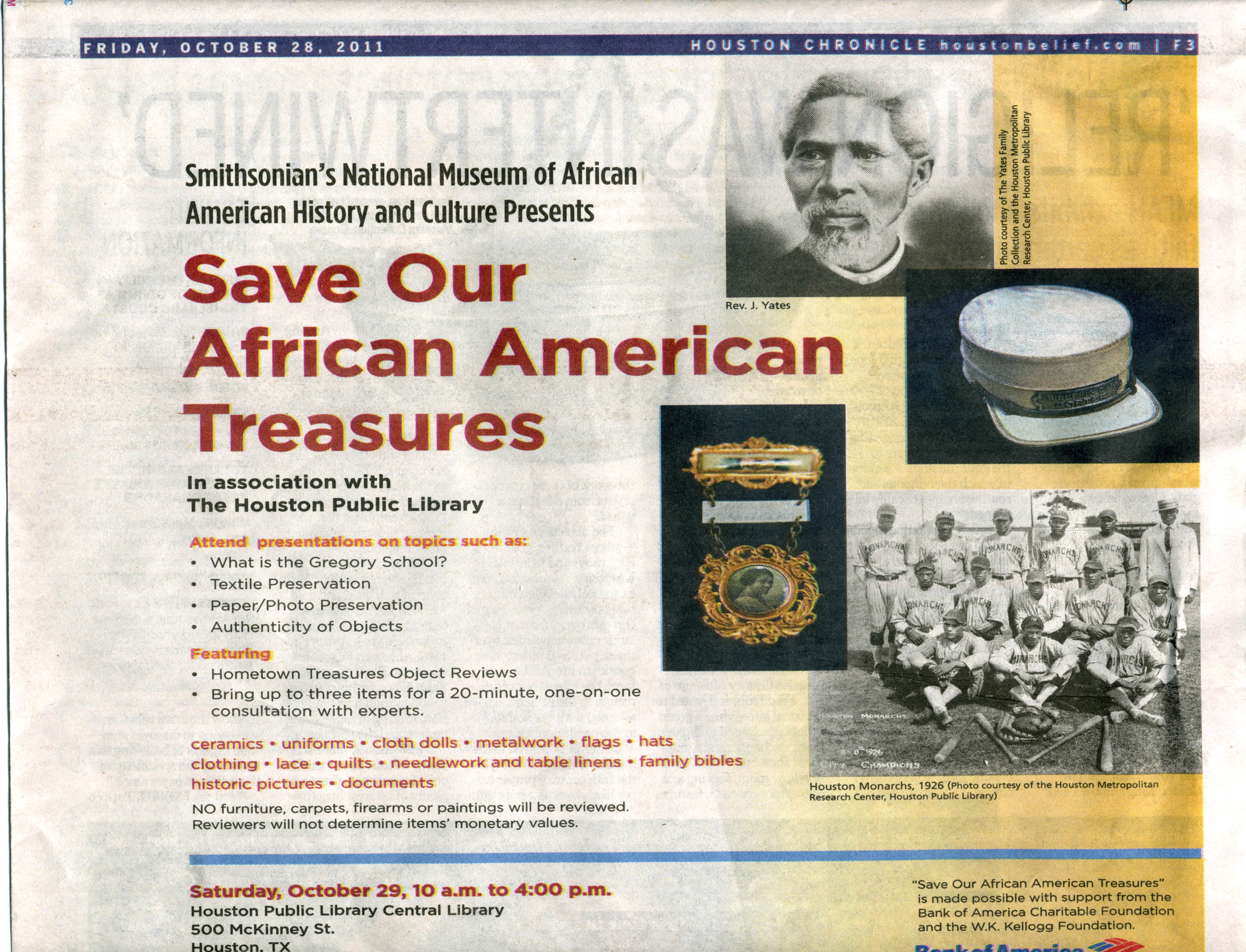
The "Save Our African American Treasures" display at the downtown Houston Public Library is today. Don't mss it, if possible. - Courtesy of the Houston Metropolitan Research Center, Houston Public Library.

An Open Letter to Dr. Sue Hepler-Liuzza

Dear Sue:

Thank you again for making those three priceless photos from black baseball history in Houston available to everyone following the death of your dear husband Frank Liuzza in January 2010. Who would thought that our contact in 2007 to catch up on each other’s lives since graduate school days at Tulane years ago would have led to this unexpected dividend payment to local history.

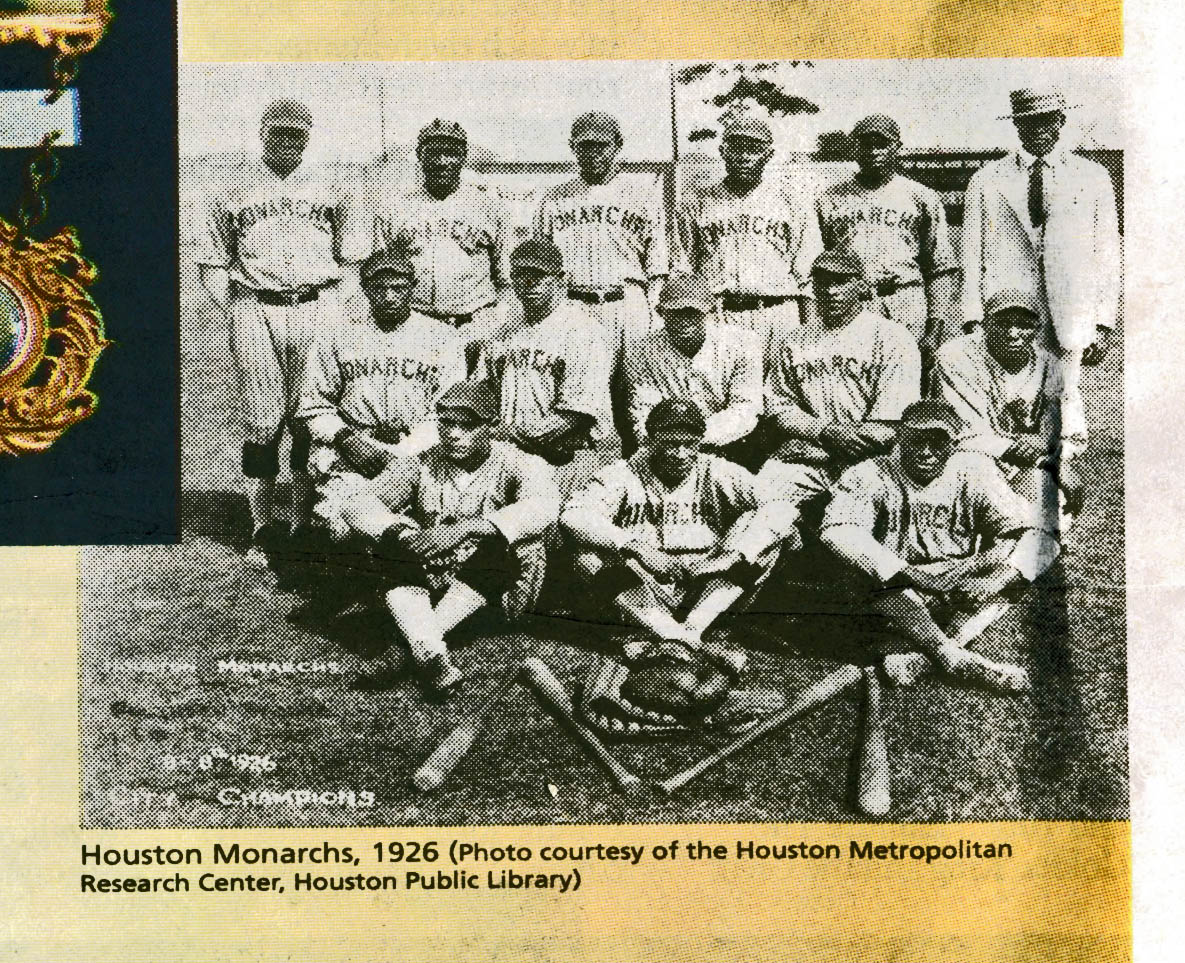
For those who don’t know the story, here’s the gist of it: Sue and I were graduate students together years ago at Tulane in New Orleans. Our relationship had nothing to do with baseball or Houston, but we soon discovered that link in 2007 when I told Sue that I had been searching for material on black baseball in Houston as part of my research. That’s when I learned that Sue was then married to a man named Frank Liuzza and that his dad and uncle, James and John Liuzza, had once founded an owned a black baseball club that was first known as the Houston Monarchs and later the Houston Black Buffs. Frank also owned three photo from that era, including the one featured yesterday in the Houston Chronicle ad for the Smithsonian-sponsored show at the downtown library today, 10/29/11, from 10 AM to 4 PM. It is called, appropriately so, “Save Our African American Treasures.”

The 1926 Houston Monarchs photo - Courtesy of the Houston Metropolitan Research Center, Houston Public Library.

After arranging for Frank Liuzza’s family to be honored at the 2007 Texas Baseball Hall of Fame Banquet in 2007, Frank and I also teamed up to do two separate interviews with Mike Vance at Channel 55 for his Postcards from Texas series in 2009. Then, sadly, Frank Liuzza died of a heart attack just after the first of the year in 2010. By the following summer, Sue had made the decision to donate Frank’s photographic legacy to the Houston Public Library. And that transfer of the materials was arranged in the summer of 2010 with the help of Joel Draut of the HPL and in the company of Mike Vance, then of Channel 55.

In the Smithsonian show we see today, as we did with the recent featuring of these materials in “Houston’s Sporting Life: 1900-1950,” a 2011 book by Mike Vance and a 2011 work of poster art on the “History of Baseball in Houston” (from the late 19th century through the early 1930s) by Randy Foltin, these historical photos bring to life the faces of black baseball during the shameful era of segregation that existed back in the early twentieth century. These same icons will be featured again in the SABR book in progress, “Houston Baseball, The Early Years: 1861-1961.”

Thanks again, Sue, for making a very good thing possible. I like to think that Frank would have been very proud to know the role his family has continued to play in both the making and preservation of Houston history. As for today’s program, if you have items, such as old photos that my be important to African American History, please bring them in for evaluation by the group that’s there today. Discovery and collection is the main goal behind today’s program. And be sure to check out the list of things the experts will not be reviewing before you bring anything down.

People like the Liuzza family have done their parts. As for everyone else, I hope you will find a way to get down to the library before 4 PM today, even if you have no artifacts for review. The Liuzza legacy, among other things, awaits you.

Bill Gilbert’s Observations of the World Series

October 29, 2011

Arlington may be Mudville today, but it could be Joyville again in 2012. - Photo compliments of Lance Carter.

Now that the World Series is in the books with probably the most dramatic Game Six in Seven Game Series history, we all have about forty-eight hours max to linger in denial before we go into our annual withdrawal from the expectation of exciting daily baseball as we move into the fall and winter months and start our universally embraced staring out the windows in our collective wait for spring and the 2012 baseball season. Fans in St. Louis are exempted for a few hours beyond the rest of us as they ride out the joy of another self-inflicted  delusion that winning the World Series is tantamount to finding eternal ecstasy and establishing that anything that feels that good is our guarantee of eternal life beyond the grave.

We gotta believe. And we do. It just helps your faith when your club wins the World Series and you get to dance through the rain of unbridled joy that reinforces the hope that hard work, right behavior, and some kind of eternal scoreboard shall eventually reward us by oiling open the Gates of Heaven, where the baseball fans of St. Louis are living temporarily this morning.

Now it’s on to our annual withdrawal from baseball for the off-season. Friend and fellow SABR member and researcher Lance Carter sent me a reminder of the baseball figure who best describes the heartbreaking relationship that many non-Cardinal fans and the Texas Rangers have with baseball this morning:

“It breaks your heart. It is designed to break your heart. The game begins in the spring, when everything else begins again, and it blossoms in the summer, filling the afternoons and evenings, and then as soon as the chill rains come, it stops and leaves you to face the fall alone.” … A. Bartlett (Bart) Giamatti, late Commissioner of Baseball.

In the end, there is only room for joy in the clubhouse of the one playoff team that doesn’t lose its last game. And this year, that happy club is the St. Louis Cardinals, who twice survived in Game Six from being one pitch away from giving that place of joy over to the Texas Rangers. I have to own the fact that my family loves the Cardinals, second only to the Astros, so we enjoyed watching their comeback from disaster and we also loved watching Lance Berkman finally get the ring that he never would have seen, had he remained an Astro.

Bill Gilbert, Rogers Hornsby Chapter, Society for American Baseball Research.

Former Larry Dierker Chapter leader of SABR (before his retirement move to the Austin area) and good friend Bill Gilbert published some general post World Series notes that I’m sure he won’t mind me sharing with readers here at The Pecan Park Eagle. Bill has a keen analytical eye for everything from the most central to the biggest peripheral when it comes to baseball – and, I’m sure, that sharp and often funny capacity carries over to many other areas of life as well.

Here’s what Bill Gilbert wrote into a broadcast e-mail over night. I shall leave it with you, along with my own wishes to all of you on your own paths of withdrawal from everyday baseball for another year. This much I can guarantee: We shall continue to often talk baseball here through the off-season months.

Now, here’s what Bill Gilbert had to say:

World Series 2011 Observations

 By Bill Gilbert

 (1) The 2011 World Series will be remembered as a great one despite an anti-climactic Game 7.  Before that there were 4 nail-biters plus Albert Pujols epic game and an unforgettable game 6.

(2)  If ever there was a team of destiny, it’s the 2011 St. Louis Cardinals. Future regular season and World Series comebacks will be measured against what the Cardinals did this year.

(3) The only time the Cardinals were ahead in game 6 was at the end.

(4) Game 6 had 6 home runs and 5 errors and the Rangers had 3 pitchers charged with blown saves.  None of their 7 relievers escaped unscathed.

(5) Hunter Pence would have caught the ball that Nelson Cruz should have had on David Freese’s game tying triple.

(6) Where would the Cardinals be without Lance Berkman?  He could possibly join Albert Pujols (and former teammates Craig Biggio and Jeff Bagwell) in the Hall of Fame.

(7) Aside from his 5-hit game, Pujols had only 1 hit in the other 6 games.

(8) I can’t recall seeing so many right-handed batters hit to right field as in the post season this year.

(9) In game 6, Joe Buck talked about Jaime Garcia as a potential pinch-hitter for two innings before he realized Garcia had been the starting pitcher.

(10) Michael Young is a better designated hitter than a first baseman.

(11) Will Ruth Ryan still be this pretty when she is 75?

(12) I thought it was great that no Eastern Division team, including the three biggest spenders were not in the World Series.

(13) In the 17 years of Divisional Play, 10 wild card teams have played in the World Series and the Cardinals are the 5th team to win it.

(14) How drunk do you have to be to get tattoos on your neck?

(15) The state of Texas came within one pitch (twice) of having the best and worst teams in major league baseball this year.

10/28/11

billcgilbert@sbcglobal.net