Buff Biographies: Roy Huff

June 26, 2013
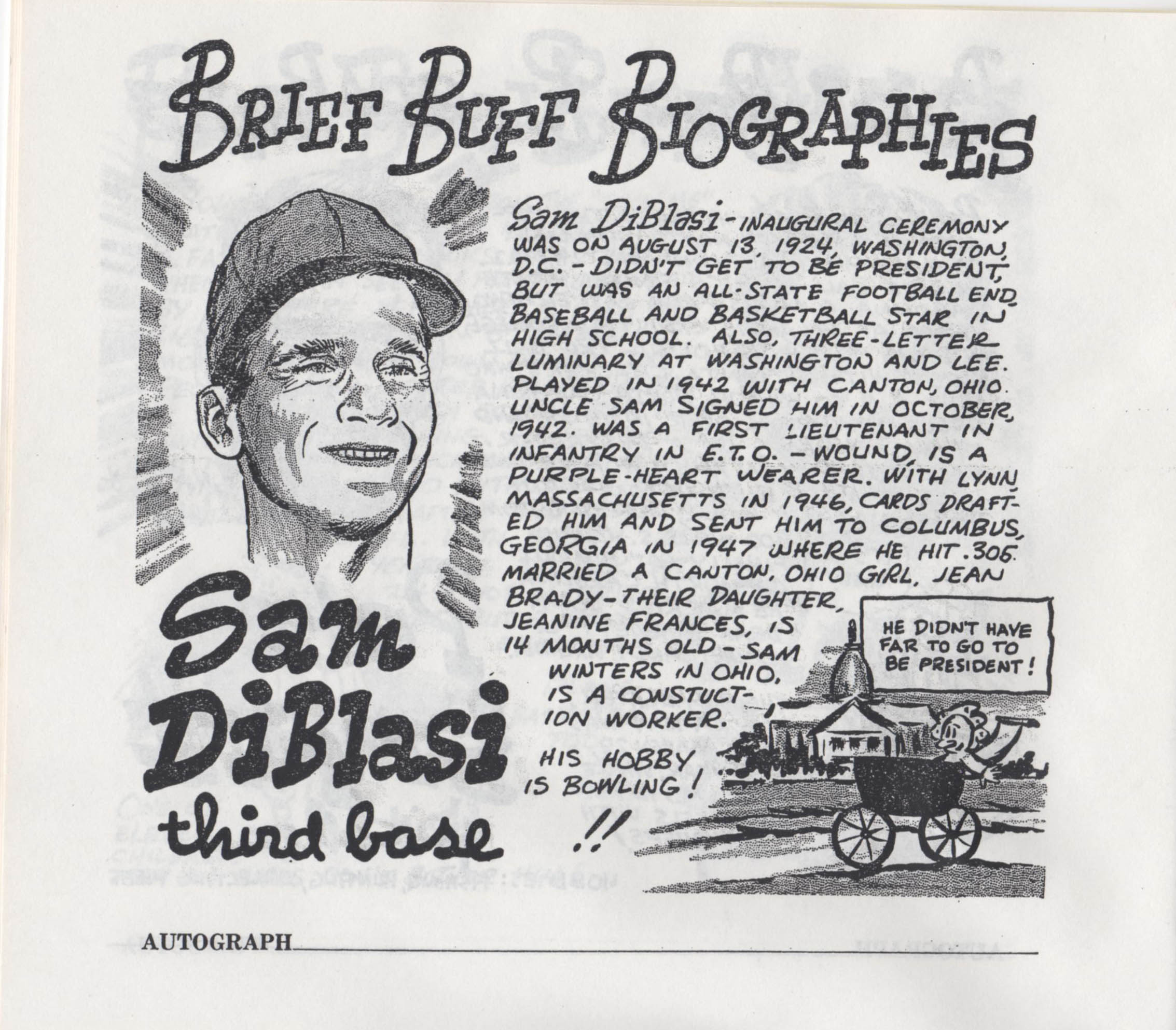
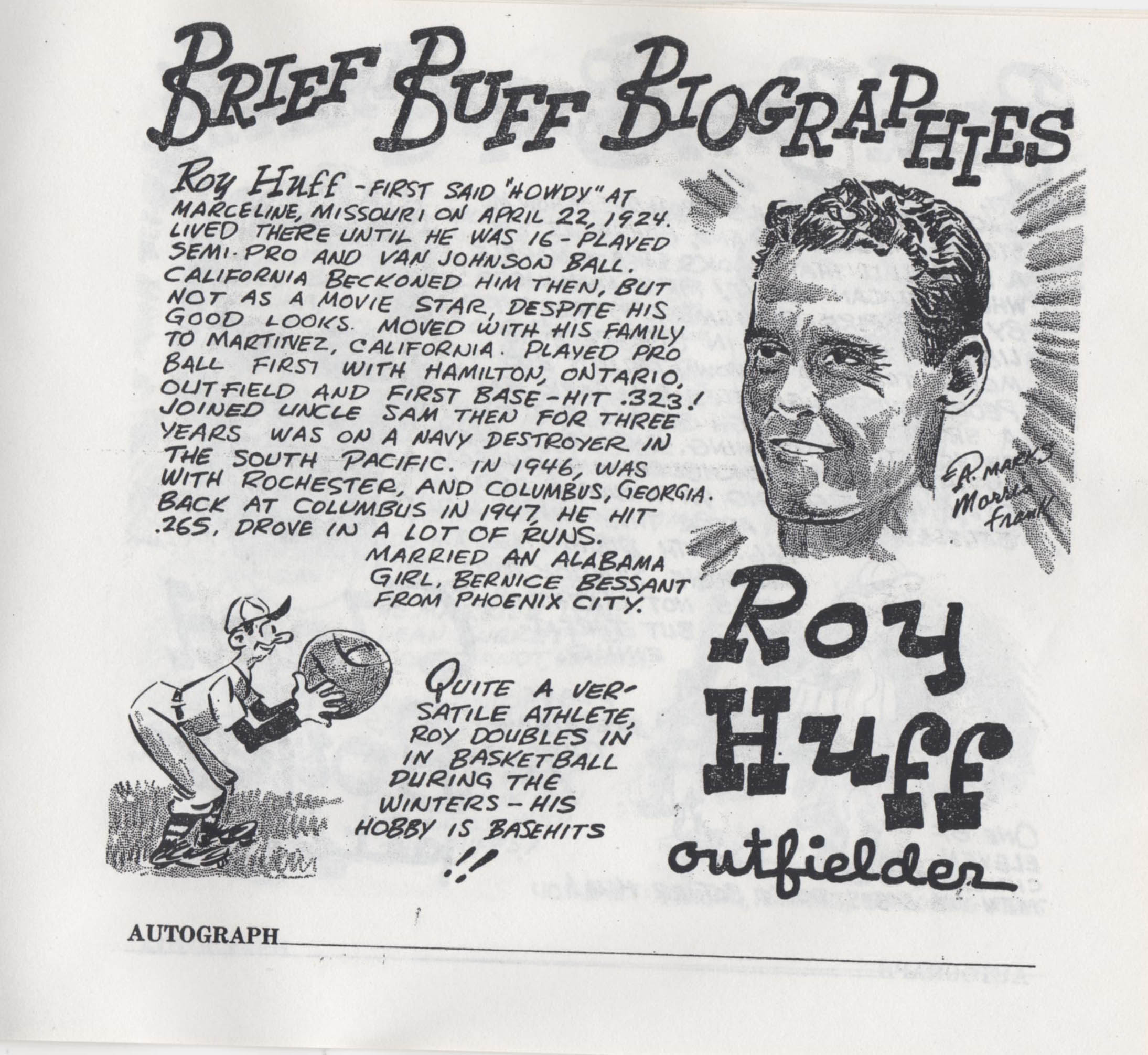
Excerpt from "Your 1948 Houston Buffs, Dixie Champions: Brief Biographies By Morris Frank and Adie Marks (1948).

Excerpt from “Your 1948 Houston Buffs, Dixie Champions: Brief Biographies By Morris Frank and Adie Marks (1948).

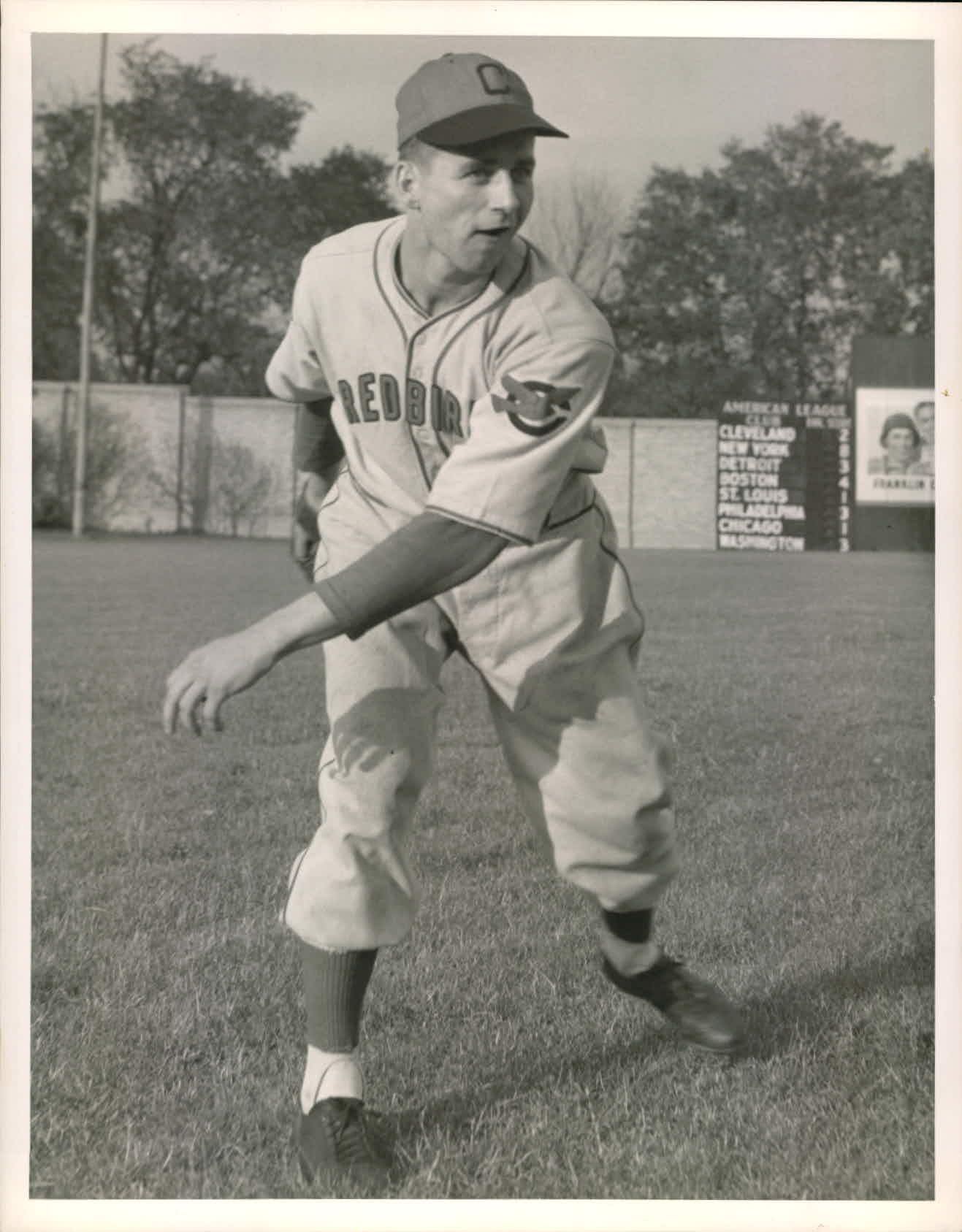
Outfielder/1st Baseman Roy Huff (6’1″, 180 lbs.) (BL/T?) was born on April 22, 1924 in Marceline, Missouri. He lived there until age 16, when the family moved to Martinez, California. The following year, 1941, Roy began a nine season minor league career (1941-42, 1946-52) in which he batted a reasonable .270 with 74 homers. In between, Huff served thee years in the Navy during WWII (1943-45).

In 1948, his only season as a Buff, Roy Huff batted .230 with 3 HR in 252 times at bat for Houston. His best season was 1942 when he batted .320 for Class D Hamilton with 8 HR. His next best season, or maybe his best overall, was 1950 when he hit .302 with 18 HR for Class A Omaha.

Baseball Reference has no recollection of his throwing arm side and neither do I. Sorry to admit it, but beyond a blurry recognition of his name, my personal memories of this ancient Buff named Huff are almost missing from the memory of my second season as a kid baseball fan.

Baseball Reference also lists Roy Huff as alive today at age 89. I tried to verify that conclusion with findagrave.com, but could pull up nothing to show that he may be deceased as of 2013. We shall keep an eye and ear and digital search close at hand for further data on Roy Huff of the 1948 Houston Buffs. For now, he looks simply like another short-term member of the minor league passing parade from long ago.

We still respect him for having given part of his early life to the game we all love. Without the Roy Huffs of this world, there would be no more famous baseball history stories to write.

Thanks for the good, the bad, and the ugly, Roy Huff. None of us would have much to look back upon as baseball were it not for the passionate pursuits of reserve clause era guys like you.

Buff Biographies: Jack Angle

June 25, 2013
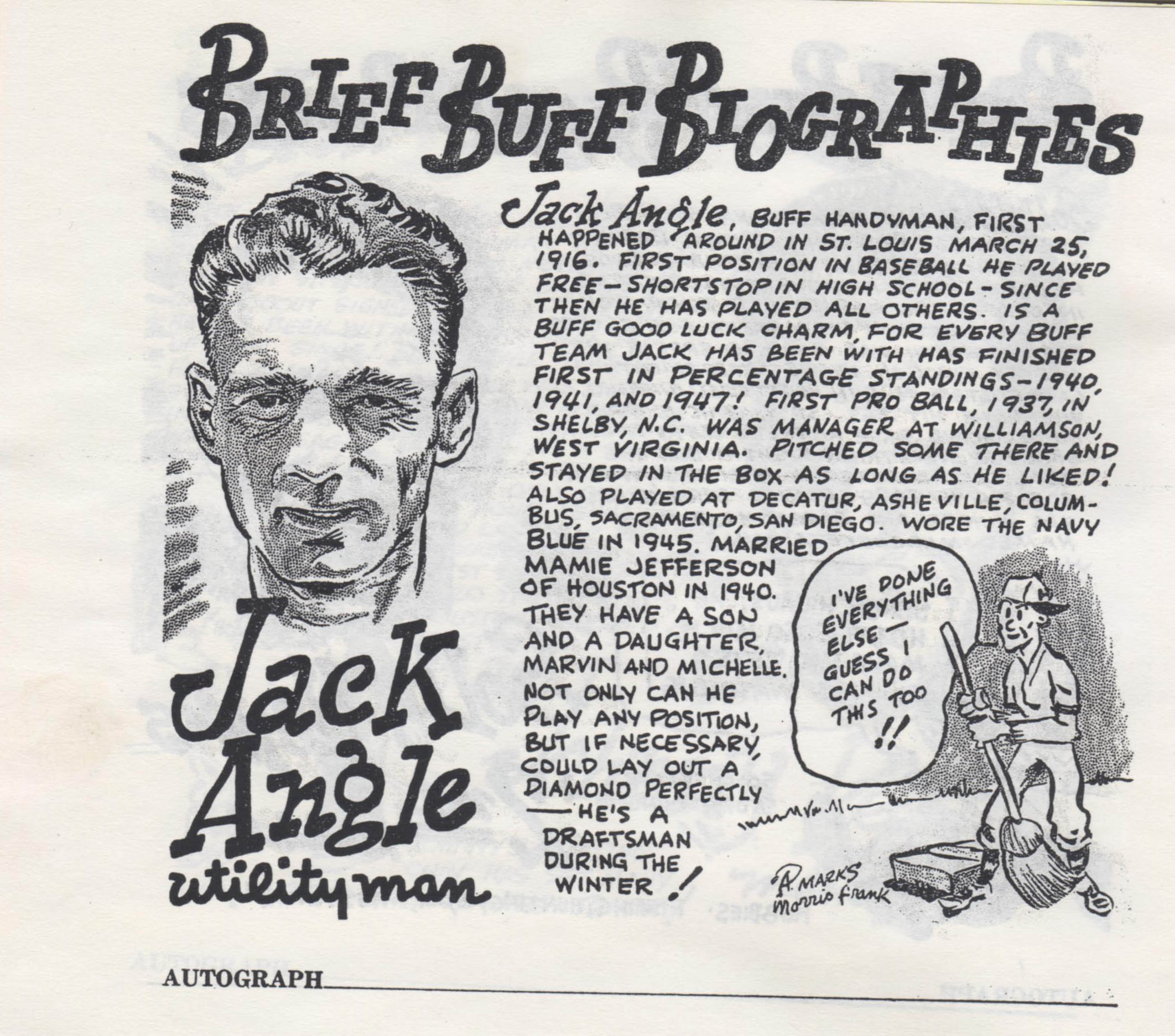
Excerpt from "Your 1948 Houston Buffs, Dixie Champions: Brief Biographies By Morris Frank and Adie Marks (1948).

Excerpt from “Your 1948 Houston Buffs, Dixie Champions: Brief Biographies By Morris Frank and Adie Marks (1948).

Jack-of-all-trades utility man Jack Angle (BR/TR) (5’11”, 167 lbs.) was born on March 25, 1916 in St. Louis, Missouri. He passed away at age 79 on October 21, 1996 in Claremore, Oklahoma and was buried there in the Woodlawn Cemetery.

As a Houston Buff for four seasons (1940, 1941, 1947 and 1948), Angle’s teams each finished first with the best winning percentage in the league over the first thee years of his local tenure. His 1948 tout with the Buffs also proved be the last of his 12 seasons (1936-44, 1946-48) as a minor leaguer in the Cardinals system. Jack batted .270 with 40 HR over the course of his career. His .251 mark with the 1947 Dixie Series champion Buffs was his best local mark, but it wasn’t his bat that made him valuable to Houston. The guy could, and did, play all eight field positions with some degree of competence, confidence, and reliability. That versatility was a tremendous asset to any minor league club back in the days of limited rosters of 19 players.

Jack married a Houston girl that he met in 1940 and also developed an off-season occupational skill as a draftsman that helped him support the children that he and Marie Angle raised together. Those utility guys are always thinking. They are the wizened ones that understand one of life’s most basic truths: The more things I do well, the more my chances of keeping my job or finding new work go up to the max.

Thank you for making Houston one of your career stops, “Jumping Jack” Angle. It’s always easier to jump when you’ve got something in your pocket or in your mind that helps you bounce and rebound.

Right, Jack?


Man of Steel Review: Spoiler Alert

June 24, 2013
While he was growing up on Planet Earth, his adoptive human father tried to keep his special powers secret. "Once the world finds out about you, it's going to change the way everyone sees everything!"

While he was growing up on Planet Earth, his adoptive human father tried to keep his special powers secret. “Once the world finds out about you, it’s going to change the way everyone sees everything!”

SPOILER ALERT!!! If you haven’t seen the new Superman movie, Man of Steel, you may want to pass on reading any further. I cannot think of a way to describe the “prequel” qualities of this film without relating certain information you may not wish to know in advance. On the other hand, if you are a longtime loyal Superman fan, read away. – After all, we always know how this “strange visitor from another planet” fares against “the forces of evil” in the end, don’t we?

Not afraid? – Good! – Let’s get with it!

Man of Steel is not one of those Superman flicks that finds the immigrant Kryptonian grown up and working as a reporter for The Daily Planet within the first ten minutes of rolling film. Man of Steel essentially is the prequel story of how this special being even gets his job at that famous fictional newspaper.

The death of Planet Krypton is treated with more causative information than we’ve ever previously received. Krypton is imminently near the end due to its governmental disregard for personal freedom, its dedicated commitment to genetic breeding of new Kryptonians on a “skills needed”, external-to-the womb agricultural breeding process, and its misuse of energy from the planet’s core that is moving everything to a point of imploding destruction of all life.

The writers’ warnings for Planet Earth are clear and obvious.

Jor-El (Russell Crowe) is the chief Kryptonian scientist who has come to see the beginning of the end. He secretly has bred his own infant son by natural childbirth with his wife, Faora-Ul (Antje Traue) with all the genetic skills. He has also built a rocket ship to take the infant to another planet where survival and protection by another compatible species would allow their child to later interbreed and pass on the best of Krypton to another world in need of less imminent salvation.

The future “Superman” is thus framed here as both the saved one – and the savior of others who need his help. Cal-El/Clark Kent (Dylan Strawberry as a teenager; Henry Cavill as an adult)

General Zod (Michael Shannon) wants to kill the failed governmental leaders for their failure and take over control of all breeding secrets so that he can “save” Krypton by military rule. A bloody encounter with Jor-El in the halls of government results in General Zod learning of the former’s plan to launch into space, but he is too late to stop it. After he and his followers are sentenced to something like a 1000-year freeze in space, the future Superman is launched in the nick of Krypton’s end time. He reaches Earth OK, where, as you undoubtedly know, he is raised by midwestern farmers Jonathan and Martha Kent (Kevin Costner and Diane Lane).

The central theme of Superman’s childhood is the message from his earthly father: “Be careful not to show your powers to others before it is time because the world changes forever once everyone can know your power. Aside from a few near misses on total exposure, Clark Kent as a young man is able to refrain from even trying to save his father in a public situation during a tornado.

After his father dies, Kent stumble around though some manual labor jobs, but he uses his special powers enough to draw attention from reporter Lois Lane (Amy Adams) and editor Perry White (Laurence Fishburne) of The Daily Planet.

Enter the action theme of the movie.

The heat from the explosion of Krypton was enough to thaw out General Zod and his small army of followers. They somehow were able to salvage a space ship with enough intelligence and munitions to follow Superman to Earth in the hope of recovering his genetics program that would allow them to kill all the Earthlings and take over the planet as their new Krypton.

The General Zod threat is Superman’s coming out call – blue tights, red cape, flying, fighting, and all.

The action now moves into 3-D delight gear, rivaling anything ever put out there by Star Wars or Star Trek. Superman finally kills General Zod and all his minions. He explains that the large “S” on his chest is nothing more than a Kryptonian symbol for “good luck”.  That’s when Lois Lane explains to him that “down here on Earth it looks more like an ‘S’ – and ‘S’ in your case, has to stand for ‘Superman’.”

Only in the last scene, nearly two and a half hours into the film, does Superman show up in a suit, tie, hat, and glasses at the Daily Planet.  He is introduced by Editor Perry White as “our new cub reporter, Clark Kent.”

Clark Kent and Lois Lane exchange secretive smiles. This time, Lois knows. She knows that Clark Kent is really Superman. She knows that he plans to help improve the Earth’s gene pool. And she knows that he is interested in her. She also knows that he’s more powerful than a locomotive, but she shows no real concern for the fact that he’s also reputed to be faster than a speeding bullet.

If you’re a Superman fan, it’s a deeper twist on an old theme with plenty of action fireworks. If you’re looking for something from Dostoyevsky or Chekhov, don’t bother.
Buff Biographies: Johnny Bucha

June 23, 2013

Image

The above cartoon is an excerpt from “Your 1948 Houston Buffs, Dixie Champions: Brief Biographies By Morris Frank and Adie Marks (1948).

Catcher Johnny Bucha was one of those former Houston Buffs who did get his major league cup of coffee extended through the entire breakfast club hour. Born in Allentown, Pennsylvania on January 25, 1925, Bucha played 2 games with the 1948 St. Louis Cardinals, 22 games with the 1950 Cards, and 60 games with the 1953 Detroit Tigers, where he also picked up his only big league homer. His batting average for the entire big league foray was .205

Johnny Bucha Detroit Tigers 1953

Johnny Bucha
Detroit Tigers
1953

As a 16-season minor leaguer (1943-49, 1951-52, 1954-60) Johnny Bucha did quite well with the stick, hitting for a career batting average of .289 with 96 home runs. In his lone 1948 season with the Houston Buffs, Johnny Bucha played a back up catcher role, hitting .236 with one homer in only 32 games. Bucha’s best year was 1954 when he batted .331 with 16 homers for two AAA clubs at St. Paul and Buffalo. He had a higher .338 BA earlier for 1944 Allentown, but that was for a wartime Class B club.

As a kid, I remember thinking that Johnny Bucha (BR/TR) (5’11”, 190 LBS.) both looked and acted like a catcher. Maybe the fact that he hardly ever beat any land speed records running out ground balls or stealing bases contributed to the impression.

Johnny Bucha died on April 28, 1996 at Bethlehem, Pennsylvania. He was 71 when he passed.

Rest in Peace, Johnny B!

Buff Biographies: Pete Mazar

June 22, 2013
Excerpt from "Your 1948 Houston Buffs, Dixie Champions: Brief Biographies By Morris Frank and Adie Marks (1948).

Excerpt from “Your 1948 Houston Buffs, Dixie Champions: Brief Biographies By Morris Frank and Adie Marks (1948).

Lefty Pete Mazar Columbus Redbirds 1951

Lefty Pete Mazar
Columbus Redbirds
1951

“Lefty Pete” or “Little Pete” Mazar (BR/TL)) (5’9″, 152 lbs.) of the Houston Buffs came by his two nickname references in the most honest baseball ways. – Besides having some talent for pitching a baseball, he simply was both of those things: a little guy who threw left-handed. Hence, the obvious identifications. Baseball people like to express the straight line obvious whenever possible.

As noted in the 1948 cartoon sketch, Pete Mazar was born in Annandale, New Jersey on February 9, 1921.  Baseball Reference shows Pete Mazar as still living at age 92, but we knew that couldn’t be true from more recent contacts with his now deceased widow, Mrs. Eleanor Mazar. A search by independent researcher Darrell Pittman now confirms that baseball’s Pete Mazar passed away at age 62 on April 1, 1983 in High Bridge, New Jersey, a small town located only a few miles from his place of birth.

http://www.death-record.com/l/105431381/Peter-Mazar

Confirmation also has been obtained that Pete’s widow Eleanor subsequently passed away at age 83 while living near two of their four surviving daughters in LaPorte at Pasadena in the Houston area on January 20, 2006. The other two Mazar girls live away from the State of Texas.

http://www.findagrave.com/cgi-bin/fg.cgi?page=gr&GRid=53420404

As for baseball, we have to chalk up Pete Mazar as another of those talented farm hands from the reserve clause era that never got to throw a single major league pitch because of the piled-up talent glut and the shortage of big league opportunities for making it with only 16 MLB teams and each of them reducing a player’s choices to virtually zero on an every season basis. Being “good” was no guarantee of a major league career; and never playing in the big leagues did not mean that a player wasn’t any good. Pete Mazar was another of those good players who simply never got a big league shot.

Over the course of his 12-season minor league career (1941, 1944-54), Lefty Pete Mazar racked up a pitching record of 100-105 with an ERA of 4.o3. In 5 seasons with the Houston Buffs (1947-51), Pete registered his best season as a pitcher for the 1948 Buffs club, posting a record of 15-10 and an ERA of 2.53.

I remember Mazar as a battler, a guy who would grind it out as long as his manager allowed him to go, and one pitcher who almost seemed to enjoy getting into situations that he then had to escape. The joy in his body language upon an avoided bad inning was as apparent as his obvious dejection in times things did not end well.

Pete Mazar also owns the distinction of being Buff President Allen Russell’s first “baseball crooner” in a line of players that later included such memorable Buffs as outfielders Larry Miggins and Danny Gardella. Russell just loved having talented singing ball players who could do The National Anthem or other music on special occasions. He couldn’t miss with “Frank Sinatra Jersey Boy Mazar”, a guy who could take singing way beyond simply carrying a tune.

Mazar got to do The National Anthem more than once at Buff Stadium, but it’s too bad that Russell wasn’t quite ready to expand these player/crooner concerts to cover subjects like his aversion to rain outs and rain checks. Pete Mazar could have done a great job on “Singing in the Rain”, or even better: “Rain! Rain! Go Away! – Come Again Some Other Day!”

The last time I saw Pete Mazar pitch was in that preseason game the Buffs played against the New York Yankees in early April 1951. He soon after went 2-1 with the ’51 Buffs and earned a move up to AAA Columbus,  never again returning to Houston as a player, though making his home here for several years.

That 1951 Buffs-Yankees game was a signature day for Lefty Pete. The Buffs took an early lead over the Yankees, but Pete got himself into one of those trouble spots. It was not a good time for it. The Yankees had guys named Joe DiMaggio and Yogi Berra in the lineup, plus an 18-year old kid rookie right fielder named Mickey Mantle coming up to bat.

The merciful version is that Pete Mazar got blasted by the 1951 New York Yankees. The heart version is the whole story. – Pete Mazar fought them as hard as he could, for as long as he was allowed, giving it all that he had, – and he still left the game obviously dejected that he had not pitched out of a jam against one of the greatest baseball teams of the mid-20th century.

Thanks for the memories, Pete. And thanks for all the heart and talent that made you the man you were.

Buff Biographies: Herb Moore

June 21, 2013
Excerpt from "Your 1948 Houston Buffs, Dixie Champions: Brief Biographies By Morris Frank and Adie Marks (1948).

Excerpt from “Your 1948 Houston Buffs, Dixie Champions: Brief Biographies By Morris Frank and Adie Marks (1948).

Former Houston Buffs pitcher Herb Moore (BL/TL) (6’0″, 200 lbs.) was born on November 27, 1915 in the town of Crew in Prince George County, Virginia. He died on June 18, 2002 in Chester, Virginia at the age of 86. In the early in-between years of his long life, he worked out his passion for baseball as a steady journeyman minor  league pitcher, mostly in the St. Louis Cardinals farm system, for 12 seasons (1933-38, 1941, 1946-50).

Moore first performed for the Buffs in 1936, starting the season at age 20, using his fair assortment of goodies to post a record of 8-13 with a 4.38 ERA. He returned to the Buffs over a decade later and put up a 5-2, 5.60 ERA mark for the 1947 Texas League and Dixie Series champion Buffs. 1948 was Herb’s final season as a Buff and he managed only a 1-2 mark in 35 innings of work.

1948 was also Herb Moore’s last dance as a career Cardinal far hand. After his closing tango with the ’48 Buffs, Moore pitched two final seasons at thee D ball level and then hung ‘em up. He finished with an all minor league career record of 86-62 and a 3.34 ERA. His two best seasons were 1935 when he was 21-5 with a 2.97 ERA for Class B Asheville and 1946 when he went 15-3 with a 1.44 ERA for Class D Albany.

Moore’s .278 career batting average speaks for his better than average hitting ability, but his .529 BA in 1947 speaks volumes for Herb Moore’s ability to come through in critical game situations and as a pinch hitter. In 17 official at bats for the ’47 Buffs during the regular season, Moore banged out 11 hits, including two triples. He became manager Johnny Keane’s “go-to” guy as a pinch hitter in the ’47 Buffs successful playoff run.

Moore tried a little managing before he completely hung it all up in baseball and retired to his life as a Virginia country squire. He had good baseball stuff, especially with his curve, but he looms in memory as just another of those guys whose skills and ability were not enough in that limited opportunity era to earn him a shot in the big leagues.

Herb Moore just played the game at the level that was available to him because he was a baseball man and for him and thousands of others like Herb Moore, playing the game somewhere was seen as a far better choice than not playing at all.

Thank you, Herb Moore! – Thank you for doing your part to keep the baseball chain of passion alive and growing under the far more difficult circumstances of the reserve clause era.

“New Dome Experience” Plan Sounds Great

June 20, 2013
Harris County Sports and Convention Corporation

Harris County Sports and Convention Corporation

If you have not yet seen the news, check out the front page headline in today’s June 20, 2013 Houston Chronicle for the story by Kiah Collier entitled “A conventional idea for Dome”. The Harris County Sports and Convention Center Corporation is recommending a $194 million dollar proposal that would convert the old Astrodome into a world class major exhibit and activity space that would simply fit right in with how it was intended in the first place. They could even play football there again and also become  a major help to the needs of events like Houston’s annual OTC convention.

Three aspects of the plan are emphasized:

(1) They would remove the 60,000 seats now in place and fill in the one-story underground space to create a street-level exhibit and meeting space. The exterior would be landscaped in attractive greenery.

(2) Potential uses would include swim meets, graduations, community events, football and soccer games, and as a central space for use by the growing Offshore Technology Conference. A 350,000 square foot meeting space leaves the door open for an infinite number of convention uses by groups from all over the country, including the major political parties.

(3) The “transformation” is expected to take 30 months for completion. If the plan gets on the ballot in November 2013 with a funding plan showing the public/private plan for making payment on the project, and this plan is approved, then work could actually be put in place to start by August 2014 and be finished and put into use by the 2017 Super Bowl that Houston will be hosting.

The Astrodome in 2013 ~ with no help ~

The Astrodome in 2013 (Bill McCurdy)
~ with no help ~

The Astrodome in 2017 ~ with planned renovation ~

The Astrodome in 2017 (Harris Co. Sports, et al)
~ with planned renovation ~

They say that this plan is about $80 million dollars cheaper than a similar proposal the same group made last year because of the agreement to bypass restoring the underground level in favor of filling it in.

Let’s see what happens next. At least, we seem to have moved an inch from doing nothing and paying for it to finding an actual cost on a serious good plan for action.

Buff Biographies: Sam DiBlasi

June 19, 2013
Excerpt from "Your 1948 Houston Buffs, Dixie Champions: Brief Biographies By Morris Frank and Adie Marks (1948).

Excerpt from “Your 1948 Houston Buffs, Dixie Champions: Brief Biographies By Morris Frank and Adie Marks (1948).

Sam DiBlasi had one of the better years among those who played for the 3rd place 1948 Houston Buffs. In 132 games as a third baseman, Sam batted .290 with 22 doubles, 10 triples, and 2 homers. His good offensive production was just topside of his career minor league totals over six seasons (1942, 1946-50) of 83 doubles, 39 triples, and 9 homers. 1948 was the athletic Mr. DiBlasi’s only season as a Buff.

Born August 13, 1922 in Washington, DC, the 6’0″, 190 lb. DiBlasi (BR/TR) was a three-sport star and all state end in football before becoming a three sport letterman at Washington and Lee University and embarking upon his pro baseball career in Canton, Ohio in 1942, where he also met his future wife.

World War II took care of the next thee seasons (1943-45) as DiBlasi went off to battle in Europe as a 1st Lieutenant and also earning a Purple Heart for his battle wounds. Sam resumed his baseball career in 1945 after taking up residence in Canton, Ohio as a construction worker.

After 1948, Sam DiBlasi moved from the St. Louis Cardinals to the Brooklyn Dodgers’ farm system and splitting time with the latter’s clubs at AA Fort Worth and AAA Montreal in 1949.

Something happened after 1949, but I lack the immediate resources without further research to know what caused the change and fairly abrupt end to Sam’s baseball career. In spite of the fact that DiBlasi’s batting averages at Fort Worth and Montreal ranged from .260 to .277, he dropped down to Class A Greenville of the Sally League in 1950 as a pitcher. He had pitched five innings for Montreal in 1949 and posted a 1-0 record. He worked in four games for 1950 Greenville and compiled a 3-0 record with a 1.67 ERA.

Then nothing. At age 27, Sam DiBlasi was gone from baseball.

Sounds a lot like an injury-forced retirement after 1950. As I have time, I will try to learn more about what happened. If you know anything about what led to Sam DiBlasi’s early departure from the game, please post it here at The Pecan Park Eagle as a comment on this column. Thank you.

According to a post-column report from Darrell Pittman, Sam DiBlasi passed away at age 81 on August 18, 2003 in Canton Ohio. Here’s additional news of Sam’s post-playing career involvement in baseball:

“Baseball player. He was a pitcher and third baseman with the Brooklynn Dodgers and the Canton Terriers Class AA League. He was a member of the Stark County Baseball Hall of Fame and was past president of Eastern Ohio Basketball and Football Officials Association. He served as an official and television liason for the mid-American conference; was a life member of the Ohio Association of Football Officials. He served as commissioner for the Class A Baseball League from 1967-1977 and was Commissioner for the Federal League for 29 years. Sam was a World War II Army veteran having served in Normandy, Utah Beach, D-Day + 1. Survivors include his wife Donna L (Kitzmiller) DiBlasi; three sons and a daughter.” – http://www.findagrave.com

The Frank/Marks cartoon identified Sam’s wife as Jean; this findagrave reports her name as Donna. Sam either had two wives, or one wife who used two names, or someone simply made an ancient reporting mistake on her name in the first place.

Thanks, Darrell!

Buff Biographies: Russell Rac

June 18, 2013


Buff Logo 12

Russell Rac The Early Years

Russell Rac
The Early Years

Russell Rac (5’11”, 188 lbs.) (BR/TR) was a slugging, speedy, good-natured outfielder for the Houston Buffs intermittently from his very first handful of hitless professional times at bat at age 18 in 1948 to his eleventh and last season as a full-time, .312-hitting 28-year-old Buff in 1958. Rac came by his affinity for Houston quite honestly. He was born in Galveston on June 15, 1930 and grew up a Buffs fan as also honed his playing skills at the Island City’s Ball High School.

Rac played for the Houston Buffs for parts or all of seven seasons out of his eleven years total (1948, 1951-52, 1954-56, and 1958). He batted .289 with 161 HR over the course of his minor league career. Russell never made it to the big leagues with the always talent-heavy St. Louis Cardinals, but that was more due to their abundance than any deficiency in Russell Rac. In today’s market, Russell was the kind of guy who could have played several years in the big leagues.

Two Rac home run feats come to mind: In early April 1951, Russell Rac homered against the New York Yankees in a 15-9 spring training loss by Houston to the Bronx Bombers at Buff Stadium in the waning days of spring training. At age 21, Rac was not the youngest player to homer in that game. An 18-year old kid named Mickey Mantle also hit one out for the Yankees before the day was done. – The other home run story came to me directly from Russell Rac. He once showed me a newspaper account to back up his story, but I couldn’t read the whole thing. It was all in Spanish, but I do understand the word “quatro” as “four”. I saw it in the headlines of the article that Russell pointed out to me.

Russell Rac The Later Years

Russell Rac
The Later Years

The story? One year in South American ball, Russell Rac belted four home runs in a single game!

Russell Rac was one of those compact guys that could really pile some distance into a baseball when he caught it with those quick wrists on the sweet spot. After baseball, Russell Rac remained active in those periodic reunions of the Houston Buffs and he was there with a bells-on spirit for the 1995 Last Roundup  of the Buffs.

Some people never give up on the joy of living life as a celebration. In my experience with him, Russell Rac was one of those people. He also never abandoned his joy for the game of baseball. And like most good old time baseball people, he always seemed to have time for another good baseball story.

Sadly, we lost Russell Rac a couple of years ago. He died on October 11, 2011 at the age of 81.

Keep smiling, Russell. – That’s how most of us will always remember you.


Buff Biographies: Charlie Sproull

June 17, 2013
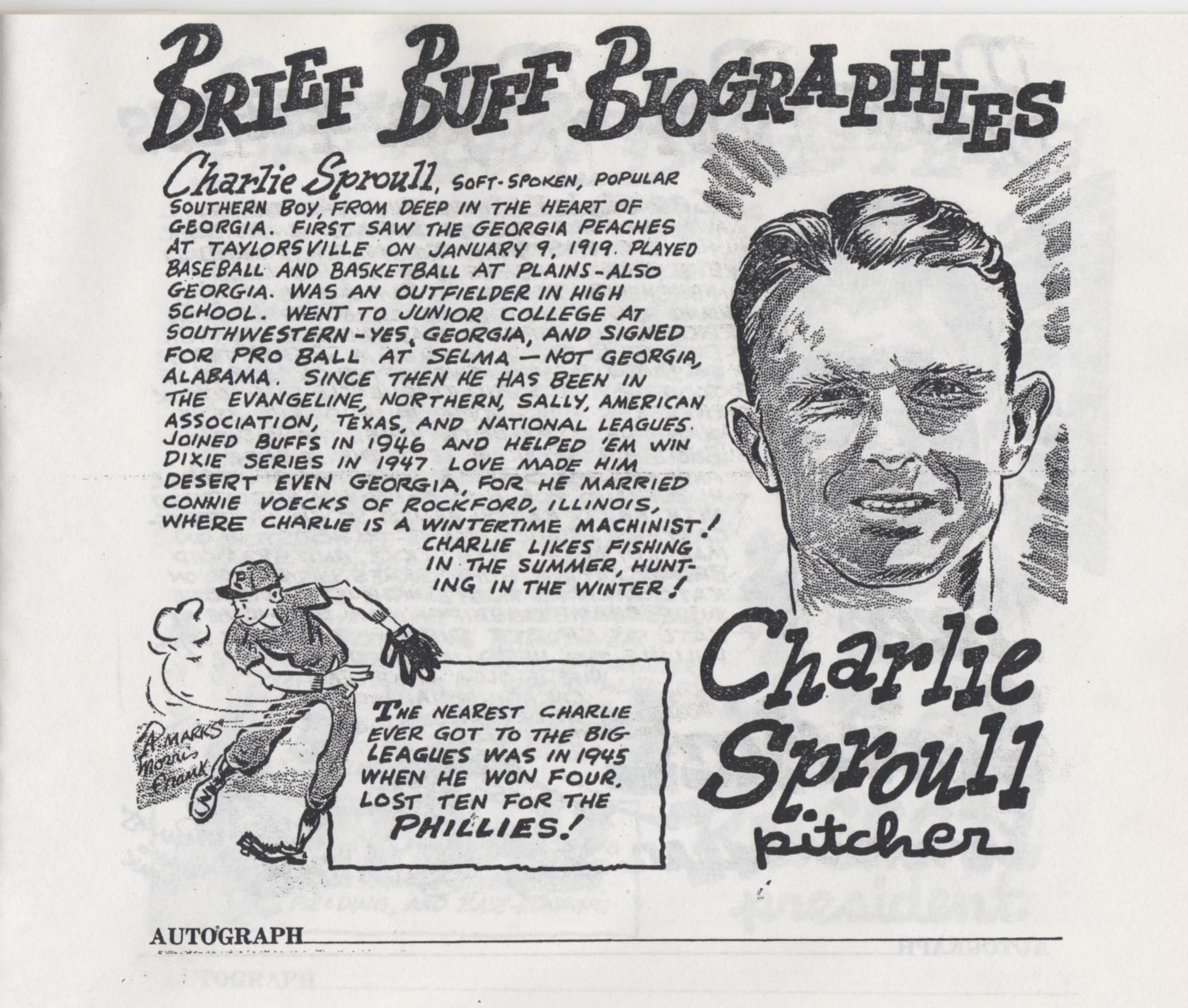
Excerpt from "Your 1948 Houston Buffs, Dixie Champions: Brief Biographies By Morris Frank and Adie Marks (1948).

Excerpt from “Your 1948 Houston Buffs, Dixie Champions: Brief Biographies By Morris Frank and Adie Marks (1948).

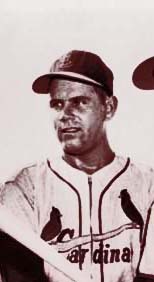
Charlie Sproull

Charlie Sproull

As Frank and Mark point out in their cartoon, former Buffs pitcher Charlie Sproull (6’3″, 185 lbs.) (BR/TR) was born January 9, 1919 in Taylorsville, Georgia. Save for a deal that sent him to Dallas at the very end, his 1946-48 time with the Buffs were a wrap on his 10-year minor league pitching career (1938-44, 1946-48) and a record of 87-96, and a 3.73 ERA, He was out of baseball as an active player at age 29.

Charlie’s big league career took place in 1945 when he won 4 and lost 10 with a 5.94 ERA for the Philadelphia Phillies. In spite of his Georgia Peach tree and culture roots, Sproull married a girl from Rockford, Illinois and made his home there until his death on January 13, 1980 at the age of 61. In his off-seasons, as Frank and Mark also show, Charlie worked as a machinist who liked fishing in the  spring and summer and hunting in the fall and winter.

Charlie Sproull was hardly close to ever having been one of the revered names in Houston Buffs history. He won 1 game for the ’46 club, 5 games for the ’47 team, and a mere 2 games for the ’48 Buffs, but he was made of the stuff that made minor league baseball popular. He was a member of that legion of dreamers who, whether they realized it or not, had to put everything else in life aside while they each chased the chance to one day fly across the summer sky of America’s consciousness as one of the game’s shooting stars.

Charlie Sproull put his baseball dream to bed before he turned 30. Hopefully, he spent the remaining 32 years of his life from there in a loving marriage with the fullest satisfaction of knowing that he had given baseball all he had.

God Rest Your Soul. Charlie Sproull!