Buff Biographies: Pete Bryant

July 5, 2013
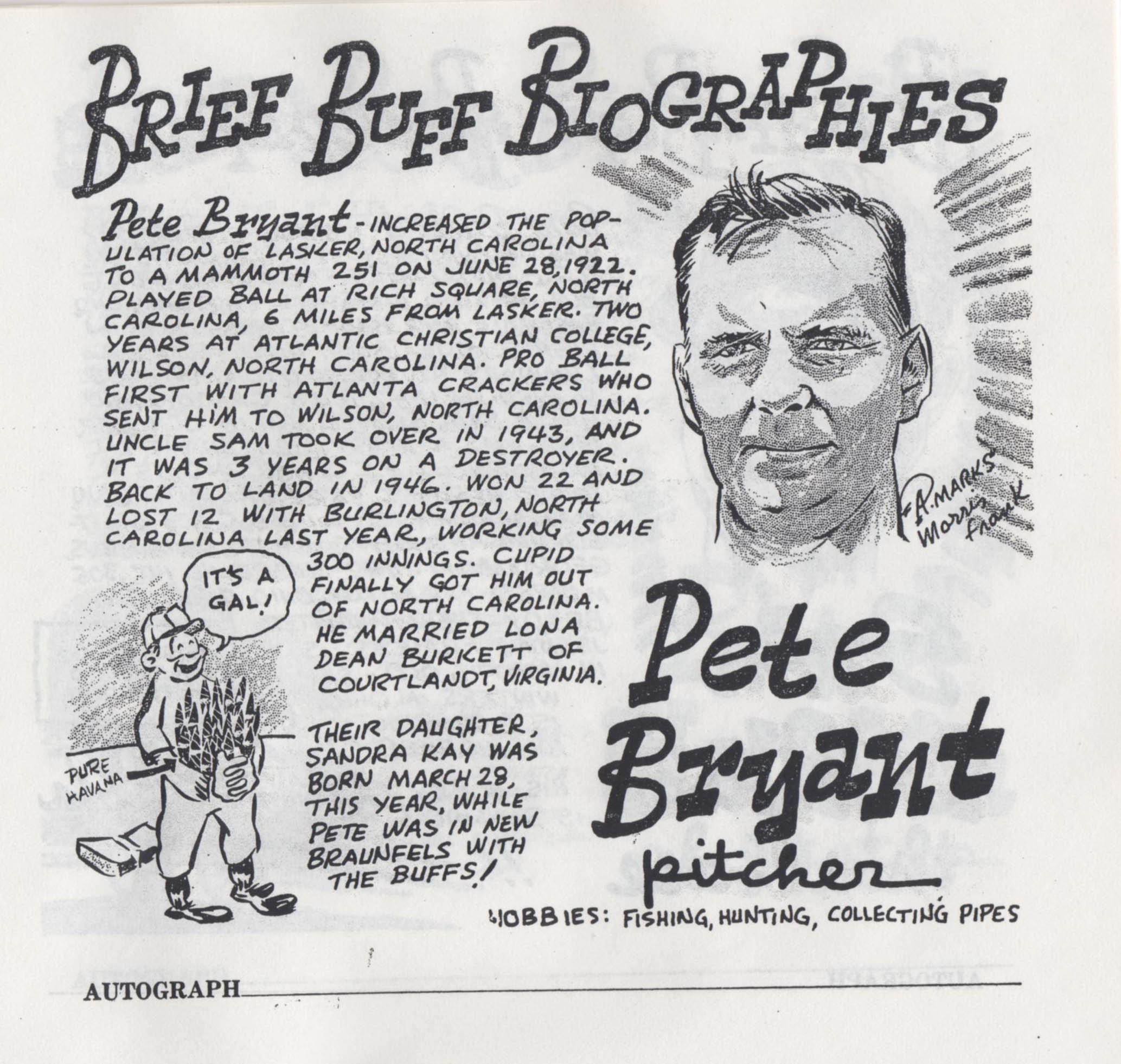
Excerpt from "Your 1948 Houston Buffs, Dixie Champions: Brief Biographies By Morris Frank and Adie Marks (1948).

Excerpt from “Your 1948 Houston Buffs, Dixie Champions: Brief Biographies By Morris Frank and Adie Marks (1948).

26-year old James Thomas “Pete” Bryant (6’1″) (BR/TR) was the third biggest winner on the 1948 Houston Buffs staff with a record of 14-14 and an ERA of 2.89. Over the course of his seven season (1942, 1946-51) all minor league career, Bryant won 103, lost 86. and hung up a nice 3.10 ERA to go with it as a bow. His biggest win season was what him to AA Houston for a year when he went 22-12, 3.33 with the 1947 class C Burlington club. For whatever reason, Pete Bryant dropped down to class A Columbus (GA) to start the 1949 season before jumping up the Cardinal vine for minor unsuccessful runs at AAA Rochester and Columbus (OH) before dropping back down for two nearly identical career finishing years of 17-14 for the 1950-51 Columbus (GA) clubs.

Without further research, we lose track of Pete Bryant after the 1951 season. As a small town North Carolina boy, he may have taken his family back to the east coast after his ball playing days were done, but don’t we know that for sure – or how much he may have remained in touch with baseball – or how he made a living.

Baseball Reference.Com shows James Thomas Bryant still alive at 91, but we have learned from other examples that those shown advanced ages at “BR.C” are sometimes the result of missing confirmation on a player’s death.

We tried running Bryant’s ID through “Find-A-Grave.Com” and did get one James Thomas Bryant from 1922 in North Carolina who died in 1999, but this fellow was born on May 5, 1922 in Spindale, NC.  Our James Thomas “Pete” Bryant was born on June 28, 1922 in Lasker, NC. – No death matches showed up for that name, birthdate, or place of birth.

The mystery of Pete Bryant’s after baseball life and his flirtation with immortality goes on until we get better information. If you know, or if your own research comes up with anything, please post it here as a comment upon this article. Your help in putting together the ten trillion piece puzzle that is baseball history will be appreciated.

Bill Gilbert: Mid-Season Stat Pacers

July 4, 2013

Bill Gilbert 05

Mid-Season Stat Pacers

By

Bill Gilbert

          With most teams reaching the season mid-point by playing their 81st game of theseason last weekend, its time to take a look at players that are on target for the triple milestones of a .300 batting average, 30 home runs and 100 RBIs and pitchers on target for 20 wins, 200 strikeouts and an ERA below 3.00.
          There weren’t as many as I expected.  Five position players and only one pitcher are on-target.
          Hitters
Chris Davis (Baltimore Orioles) (.332-31-80) – Breakout season.
Miguel Cabrera (Detroit Tigers) (.369-25-82) – Going for his 7th.
Paul Goldschmidt (Arizona D’backs) (.303-20-69) – Did it in minors.
Carlos Beltran (St. Louis Cardinals) (.308-19-50) – Hasn’t done it before.
David Ortiz (Boston Red Sox) (.317-16-57) – Last did it in 2007.
          Pitcher
Adam Wainwright (St. Louis Cardinals) (11-5, 114K, 2.22 ERA).

Solving the “Kemosabe” Puzzle

July 4, 2013
A FIERY HORSE WITH THE SPEED OF LIGHT, THE CLOUD OF DUST AND A : HEARTY "HI HO SILVER" -- THE LONE RANGER - RIDES AGAIN!!

A FIERY HORSE WITH THE SPEED OF LIGHT, THE CLOUD OF DUST AND A : HEARTY “HI HO SILVER” — THE LONE RANGER – RIDES AGAIN!!

This is the 4th of July – our day of national independence and the celebration of freedom. What better time could there be to seek freedom from one of those little puzzles that some of us have lived with for seven decades or so.

The puzzle: What the heck does Tonto mean when he addresses The Lone Ranger as “Kemosabe”?

Spoiler Alert! If you haven’t yet seen the new Johnny Depp as Tonto version of “The Lone Ranger” movie, you may want to pass on this column until you have seen the film. What I am about to reveal here isn’t the heart of the movie, but it does reveal how The Lone Ranger and Tonto get together in the first place. So, you be your own judge. Some critics have panned the film, but that’s because they fail to get the humor of Johnny Depp and his slant on things. Plus, I do concede, the Lone Ranger character, as played by Armie Hammer, is pretty much of a rigid, uninspired “dufus” who does fulfill by his actions the reasons why he has earned the title of “kemosabe”.

Dan Reid (John Badge Dale) is the head Texas Ranger in a West Texas area that looks a lot more like Monument Valley in Utah. Reid and his deputy younger brother John Reid (Armie Hammer) and five other Rangers strike out as a posse in search of a dangerous and deranged escaped killer named Butch Cavendish (William Fichtner), but they are bushwhacked and left for dead in a canyon gulch by the bad guy and his henchmen while on their way to the service of justice.

Tonto comes along and finds the seven dead Rangers. He knows Dan Reid from his reputation as a brave, courageous and fair man. He also knows younger brother John Reid from personal experience as a tight-minded, inflexible, 19th century anal-type who plays everything by the book with no wiggle room around the way justice gets handled.

After digging seven parallel graves and placing a body in each, a great white spirit horse (Silver) appears at the foot of John Reid’s still uncovered grave and begins making sounds and foot motions that signal one message to Tonto: “The Great Spirit wants this man returned to life with supernatural powers in his pursuit of justice. Tonto takes the horse and moves him down the row to the uncovered grave of older brother Dan Reid. “I think the Great Spirit has this one in mind for that power,” he tells the great horse. The horse breaks away from Tonto and returns to the grave of John Reid, protesting all the louder.

“OK, OK,” Tonto concedes, Who am I to argue with the Great Spirit that he has the wrong brother in mind here?” Tonto then performs the ritual that he apparently already knows and restores John Reid, this time  to an immortal life, and to a new identity as The Lone Ranger.

The action switches into high gear from there, but only if you have a sense of humor for seeing Tonto in the old TV cop role of grizzled veteran who has to protect his naive rookie partner constantly from getting them both killed.

(Here it comes – the whole purpose of this column.)

Late in the movie, The Lone Ranger finally has to ask: “Tonto, I’ve noticed you often refer to me as “kemosabe” when we speak. Would you mind explaining? – What does “kemosabe” mean?

“It means ‘wrong brother’,” Tonto says – without cracking a smile.

Happy 4th of July!

laba.ws_USA_Independence_Day

Astros in Early July: Only the Weather is Hot

July 3, 2013

ROOTS DSCN

With two games down in July 2013, the score stands a little lopsided:

Tampa Bay Rays 20 – Houston Astros o.

Playing out the string for “reality” in behalf of themselves and the 28 other Houston foes in Major League Baseball, the Rays are averaging 10.0 runs per game this month though July 2nd, while holding the Astros to that most sparse of all average figures, 0.00. Reverse those figures on the pitching side, and Tampa hurlers have an unblemished 0.00 E.R.A against the Astros while Houston hurlers have a ballooning 10.00 E.R.A working against anything positive one might say about their performances.

The Rays (29/80) are batting .366 for July; the Astros ((6/56) are hitting only .107.

The Rays are averaging 14.5 hits per game; the Astros are averaging 3.0 hits per game.

Of the Rays’ 29 hits, 2 were doubles and 3 were home runs. Of the Astros’ 6 hits, all were singles.

One shared positive: Neither club made any errors that count in the box scores for the first two games played on the first two days of July 2013. Some might give the Astros an “E” for showing up to play each scheduled major league game disguised as a major league talented club.

This is a dismal season for fans. Fans who attend most or all of the home games this season are the ones who should qualify for something equivalent to baseball’s version of the Purple Heart. It is downright injurious to the spirit and one’s ongoing interest in the team to go out and watch the kind of baseball this club has played these past two days and for most of the season. It’s just one bad taste of losing piled upon another and, no matter how much you think you understand the long-term rebuilding plan, it’s hard to keep watching this kind of baseball played out on a regular basis.

It’s too bad the Astros and Comcast picked this season to shut out 60% of the fan base from even watching the games on TV. TV is the medium that allows fans to stay connected in digestible doses without feeling as though they are paying through the nose for a potion of poison. If you don’t like the way the Astros plan is unfolding on TV, you can always switch the channel and watch something like “Criminal Minds”. – That’s different, isn’t it?

The missing TV hook is going to cost the Astros some fans who completely lose interest. It’s probably already happened, and, when you add those losses to the numbers who truly will not be back because of the American League move, we are talking about a significant number that is probably still considered by the club as recoverable with an Astros return to contention by 2015.

Don’t count on it, Astros! The behavioral rules of sports fan addiction don’t work that way. If winning, easy-to-watch-on-TV ball returns to the Astros, some fans will renew their Astros addiction; others will have replaced it already with another addictive pursuit; and still others will have moved on to giving themselves by choice to more meaningful uses of their time, resources, and energy.

One more thing: Through the first two days of July, the Houston Astros have now taken over as the team with the worst record in Major League Baseball. The Astros are now 30-54, .357 a full game worse than the Miami Marlins at 30-52. .366.

Bill Gilbert: Astros Show Some Improvement in June

July 2, 2013

Bill Gilbert Reports3

Astros Show Some Improvement in June
By Bill Gilbert
 
            The Astros entered the final weekend of the month of June with a 12-12 record and a chance to have their first winning month in years.  However, they were swept at home by the Los Angeles Angels and finished 12-15 for the month. The month started on a positive note as the Astros won their first three games, completing an unlikely 4-game sweep of the Angels in Anaheim.
 
            Unfortunately, the hot start didn’t last as it was quickly followed by a 6-game losing streak.  A 4-game winning streak put the team at 11-10 on June 22.  Things went downhill from there as the team absorbed consecutive losses by scores of 14-6 and 13-3 and won only one game the rest of the month.
 
            The team had a record of 30-52 at the end of June in a virtual tie with the Miami Marlins at 29-51.
 
            The bright spot for the month was the starting pitching with an ERA of 3.14 for the month.  All 5 starters had an ERA of 3.53 or better, led by Bud Norris at 2.77. Unfortunately, it was a bad month for the bullpen.  Jose Cisnero (0.77 ERA) and Jose Veras (1.64) had strong months but the rest of the bullpen recorded an ERA of 6.70.
 
            The overall ERA for the staff for the season is 4.89, much improved from the figure at the end of May (5.23), but still the highest in the major leagues.
 
            A major disappointment in June was the offense.  In June, the Astros were last in the major leagues in batting average (.212), on-base percentage (.269) and next to last, ahead of only the Yankees, in slugging average (.346) and runs per game (3.33). The only player with a batting average of over .241 was Jose Altuve (.275).  Chris Carter led the club in runs (14), home runs (5), on-base percentage (.357), slugging average (.518) and, of course, strikeouts (34).  However, Carter is no longer on a pace to break the record of 223 strikeouts held by Mark Reynolds.
 
            The Astros four full-season minor league teams continue to do well and the three short-season teams are off to a good start with some of the recent draftees.  No. 1 draft pick, Mark Appel is working out in Florida and should make his professional debut in July.


billcgilbert@sbcglobal.net


Bill Gilbert


July 1, 2013
 

A Mad Dog Night at the Astrodome

July 1, 2013
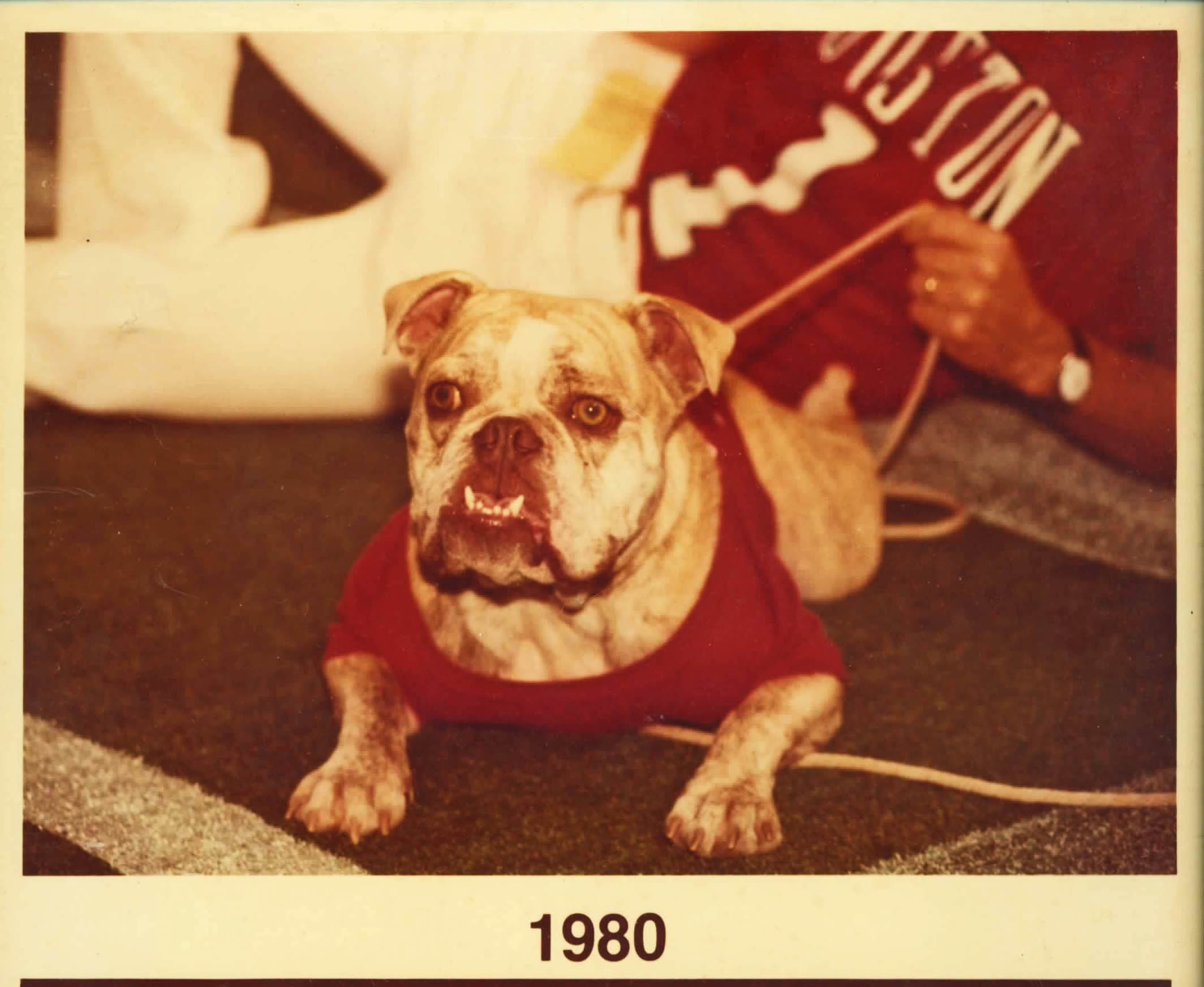
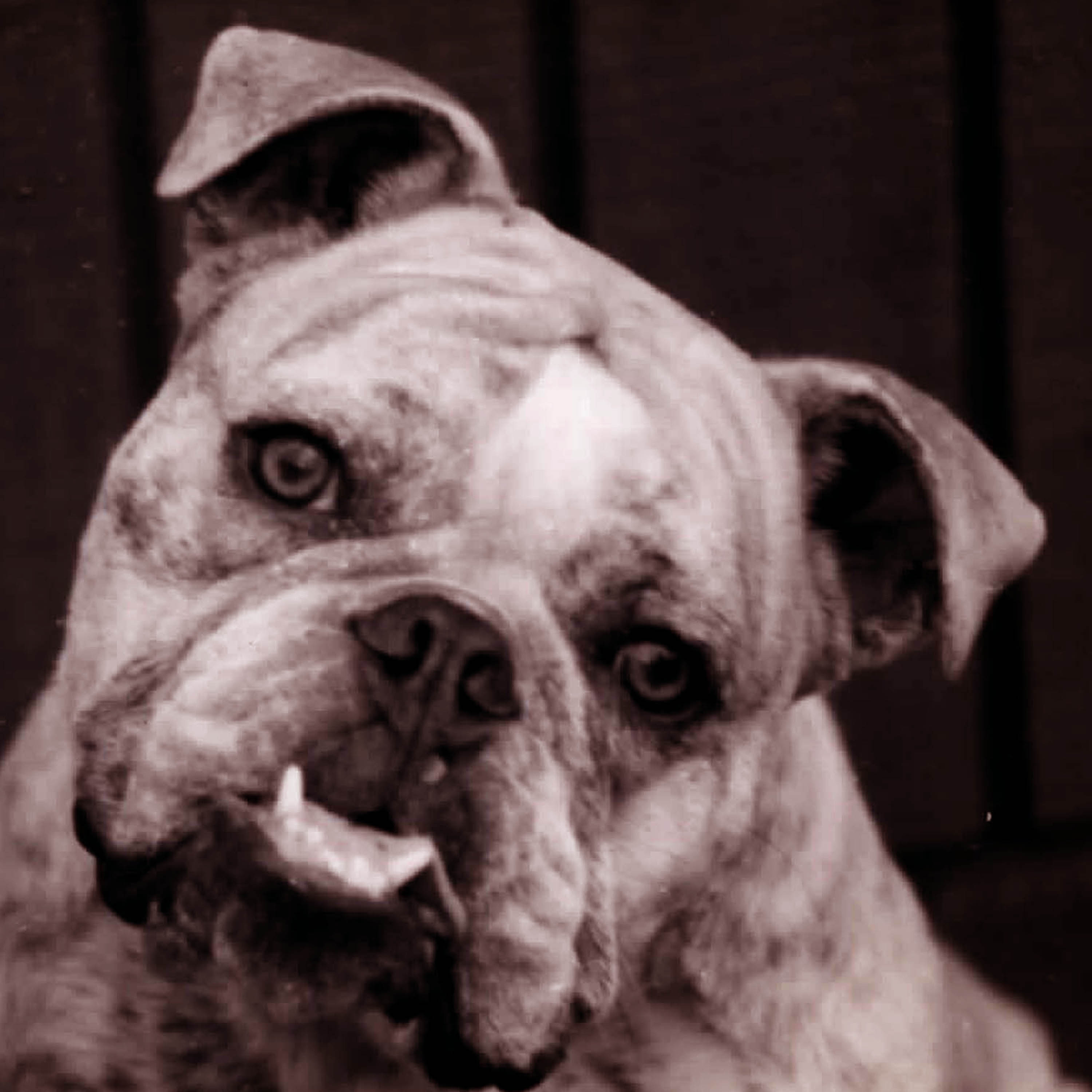
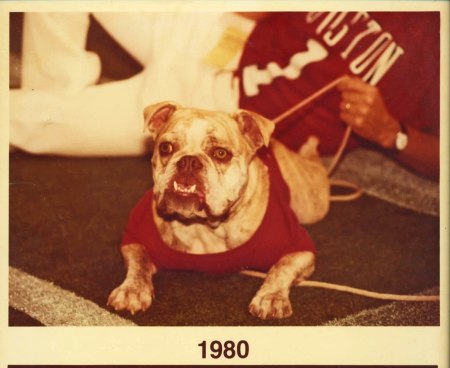
Babe McCurdy was the UH Mad Dog Defense mascot at the Astrodome in 1979-80.

Babe McCurdy was the UH Mad Dog Defense mascot at the Astrodome in 1979-80.

Well, truth to tell, it was actually a tale of two mad dog seasons at the Astrodome in 1979-80 when my late and beloved pet Bulldog Babe McCurdy served as sideline mascot for the University of Houston Cougars football team. Ah, Yes! I remember it well! It was the beginning, albeit, the early beginning, of my wonderfully fun and funny second childhood.

It started in the summer of 1979 when I went out to UH as an alumnus and proposed two actions to the UH athletic department: (1) Retire uniform number 1 and make that game official #1 jersey available only to fans. 1979 was immediately prior to the sale of any university official jersey to any fan group so UH had the chance to both be the first to do so and also take a step toward building a little tradition for once. (2) Allow my bulldog Babe, who came with me to that meeting at UH, to serve as mascot of the team’s “Mad Dog Defense” as we also designed tee shirts for fans along that theme.
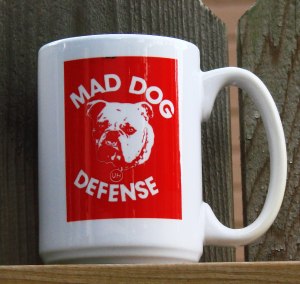
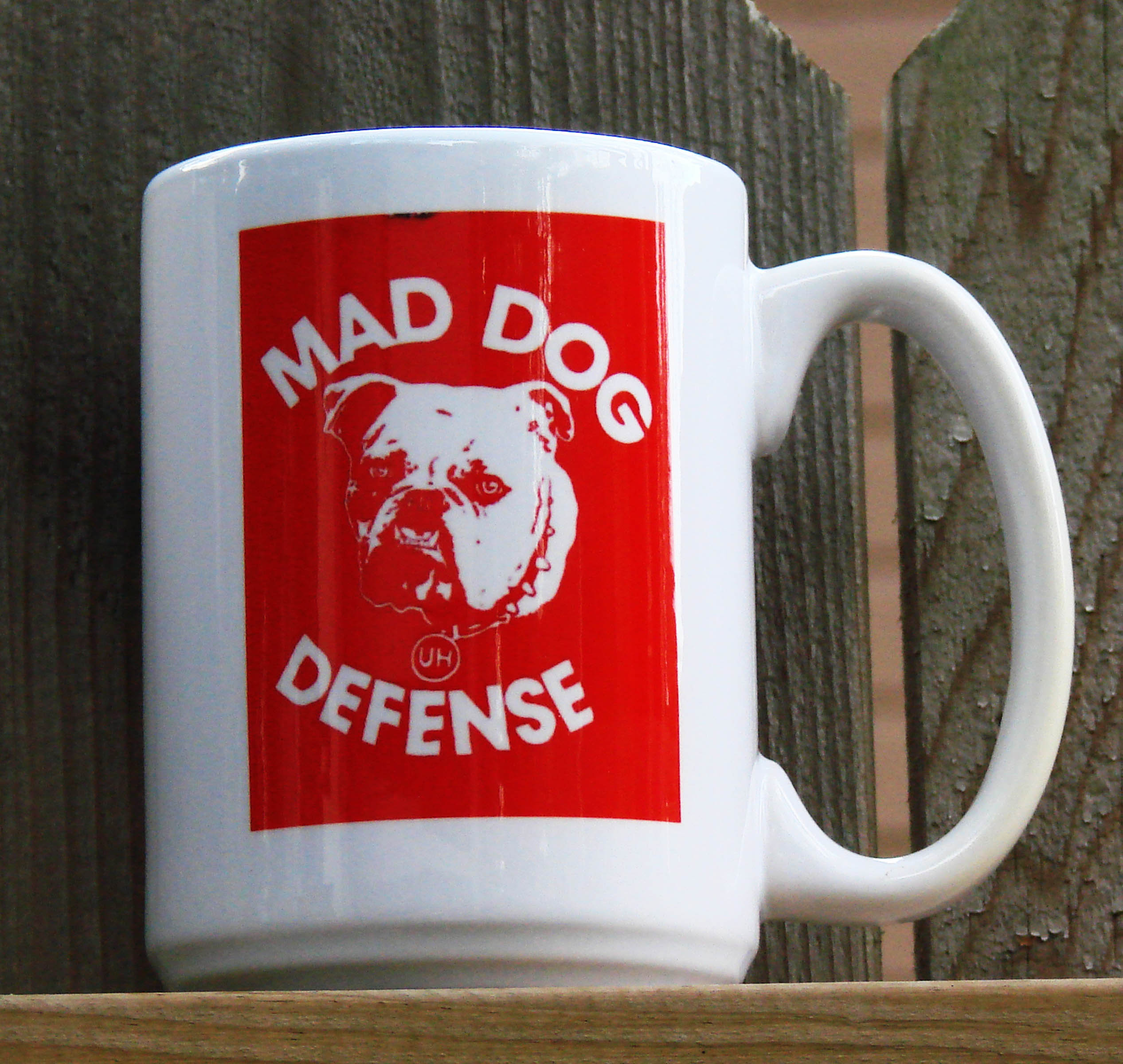
Mad Dog 1979-80 Mug UH jumped on the #1 jersey sale idea like a frog on a June Bug, but they stated they would prefer to delay the actual retirement of the number plan until after the season. They also named Babe to serve as Astrodome sideline mascot right after I gave Babe the command to gently attack their marketing director by grabbing his pants cuff in her teeth.

The growl and the grab were both impressive, revealing the marketing guy’s hidden soprano talent.

Mad Dog Babe and I spent the 1979 Cougar football season at every UH home game. Babe learned to attack little dummies of the opposition’s mascot on the sidelines, ripping them apart by game’s end. We would also sometimes pull off a few half time tricks, ala the San Diego Chicken, and sometimes run onto the field ahead of the UH defense at the game’s start. 1979 was a wildly great year for UH and Babe and I also went to Dallas with the team when we played Nebraska in the January 1, 1980 Cotton Bowl. We even had a room at the downtown Hilton. Babe loved it so much she consented to attacking corn husks in the lobby as the band played the Cougar fight song.

Sleep was impossible that night. People knock on doors all night on New Years Eve. And door knocks just happened to have been one of Babe’s loud bark and growl command signals.

The Cotton Bowl, January 1, 1980: Made Dog Babe McCurdy takes down another Cornhusker!

The Cotton Bowl, January 1, 1980: Made Dog Babe McCurdy takes down another Cornhusker!

At the Nebraska-UH game, Babe destroyed a Cornhusker player model in front of the Husker bench – and then growled away a couple of players who tried to rescue the helpless figure. It was a great day made better by a UH victory at the end and a 4th place finish in the final polls.

1980 was not so great on the field for the Cougars, but Babe and I were back for one more season, regardless. Our highlight time came about on October 11-12, 1980, when it took two calendar days to start and finish the UH game with Texas A&M.

Here’s what happened:
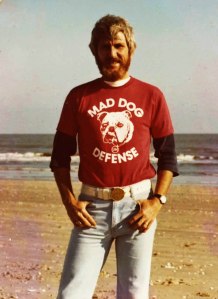
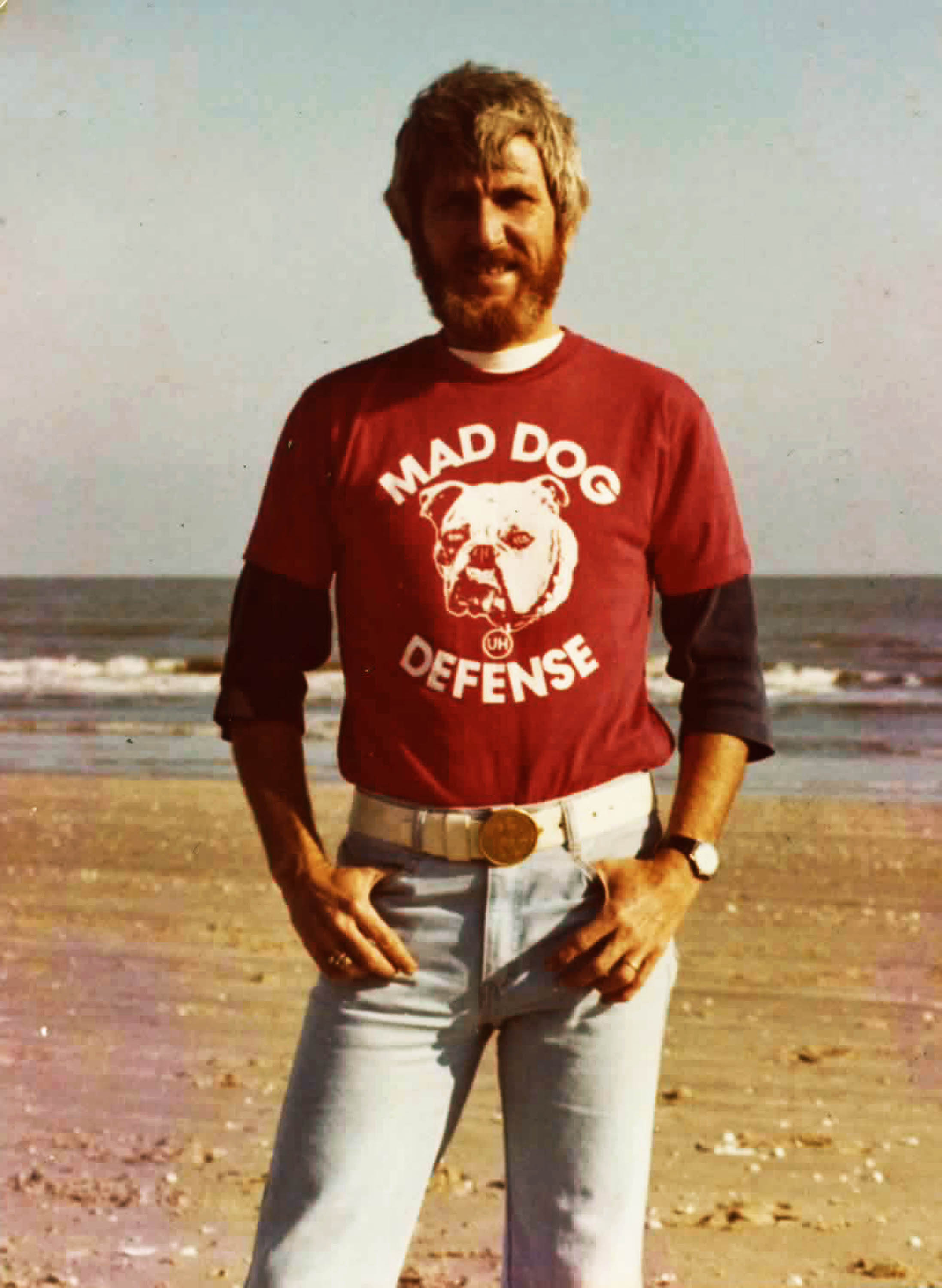
Mad Dog Whisperer at the Beach, Later in the Day, Sunday, October 12, 1980. I had to watch the Astros lose the pennant to the Phillies on TV from Galveston.

Mad Dog Whisperer at the Beach, Later in the Day, Sunday, October 12, 1980. I had to watch the Astros lose the pennant to the Phillies on TV from Galveston.

The need for an NLCS baseball playoff Game 4 between the Houston Astros and Philadelphia Phillies already had pushed back the kick off of the Texas A&M-UH football game until later in the evening. Unfortunately, the Astros missed their chance to take a first NL pennant that night by losing 5-3 to the Phillies in ten long, pitcher-grueling innings that also now pushed the kick off of our football game back to 11:33 PM. (On a sadder note, the Astros would lose Game 5, again in ten, the following day by 8-7 and give over the NL flag to the Phillies in 1980.)

Because the football game crowd was already there well in advance of its possible start due to the need for changing the playing field configuration, we decided that we needed to create some pre-game diversions. I got to dress up in an Astros uniform and pretend to be just another pitcher warming up in the bullpen, as though the baseball game were still going on. When I was ready, I walked in as though I was going to pitch, even though I could only throw to my catcher in front of the Astros dugout. The field crew was busy removing the actual pitching mound. Our routine didn’t draw a lot of attention, but it was still my first new big Walter Mitty Moment of the evening.

Walter Mitty Moment Number Two came way after midnight at half time when I was allowed to attempt and make a 35 yard field goal at the East End Zone. I did it straight on, via Lou “The Toe” Groza, and, of course, I did not have any J.J. Watt types bearing down on me as I lined up and carefully executed my kick.

I still made it. – It was the first and briefly the lone “after midnight” field goal in Astrodome history. That changed in the fourth quarter when David Humphreys of the UH Cougars made the first game-conditions field goal, a 30 yarder with 7:46 left in the game. That’s OK. My technically good effort was still the first – and the longest “after midnight” field goal in Astrodome history by a whopping five yards.

The Cougars beat the Aggies, 17-13, in a game that finally ended at 2:41 AM, Sunday, October 12, 1980.

Babe and I retired from sideline mascot service for UH at the end of the 1980 season, but we sure had a good time while it lasted.

Babe McCurdy, 1979: The Love of My Life. Forever.
Babe McCurdy, 1979: The Love of My Life. Forever.

Buff Biographies: Harry McCurdy

June 30, 2013

Buff Logo 7

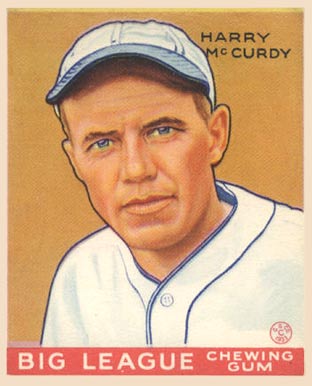
Harry McCurdy 1933Goudey Card It feels as though I’ve known the late Harry McCurdy my whole life. The fact is,  I never even once met him in person, and, in spite of the fact that we regularly got phone calls from people searching for Harry McCurdy at our house while I was growing up in Houston, I was never led to believe that we were related to him as blood family kin.

As an old, but then young Buffs and baseball fan after World War  II, I could only wish that Harry McCurdy was somehow my dad’s much older brother. Born on September 15, 1899, in Stevens Point, Wisconsin, Harry McCurdy (5’11”, 187 lbs.) was born eleven years sooner and half an America earlier than my dad, Bill “Wee Willie” McCurdy, Jr. (5’6″, 140 lbs.). Dad came into this world on December 23, 1910 in Beeville, Texas.

Harry McCurdy grew up to be a big league catcher who batted left and threw right. Wee Willie McCurdy grew up as an outfielder for St. Edwards University Prep School in Austin and various Beeville town ball teams of the 1930s. Opposite Harry, Wee Willie batted right and threw left.

For the rest of their Houston lives, my dad’s role in Harry’s life was educed to simply telling people who called our house looking for Harry McCurdy that “No, this is not THE residence of the Harry McCurdy who serves as Principal of Hogg Junior High School in the Heights. We are the McCurdys, all right, just not that McCurdy. You’ve got the wrong number. – Maybe, you should call Information and ask them.”

As a kid, I often wondered why Dad didn’t just call Information himself and get Harry’s number for the next wrong McCurdy caller, but I guess he didn’t see it as his job to do.

Harry McCurdy was with the Houston Independent School District as an administrator for quite a few years prior to his death in Houston on July 21, 1972 at the age of 72. And I imagine too that he was probably glad to miss some of those complaining parent calls that were aimed at catching him at home away from the shield of staff. After all, how many people call a middle school principal just to chew the fat about baseball?

Harry McCurdy was a smart guy. After graduating from the University of Illinois at Urbana-Champaign in 1922, Harry began a wonderful baseball career that started and ended with seven seasons in the minors (1922, 1924-25, 1929, 1934-36). He spent three seasons with the Houston Buffs (1924-25, 1934), a stint that included his greatest full year of 1925, when he batted .361 with 16 homers in 124 games as a Buffs catcher. His career minor league totals capped at a .314 BA with 29 homers for 489 games over 7 years.

The major league record for Harry McCurdy in 543 games over ten seasons was even more impressive. Harry batted .282 with 9 HR for the St. Louis Cardinals (1922-23), the Chicago White Sox (1926-28), the Philadelphia Phillies (1930-33), and the Cincinnati Reds (1934).

I no longer get calls for Harry McCurdy at my house – and Wee Willie’s no longer here to take them, either, but both of these men remain in my consciousness – and larger than life.

God rest your souls, McCurdy boys!

Sandlot Science

June 29, 2013

Sandlot Science

(1) Play the game barefoot. Take off your shoes after the last day of school going into summer and leave them off, except for those times that you go to church. You will play the game shoeless as a guy named Joe once did and you will develop callouses that are as tough as buffalo hooves by summer’s end. You may get a few broken glass gashes and tin can cuts along the way, but you will be OK.

(2) Protect yourself from mosquitoes. When the mosquito spray truck comes by your field some evenings, rip off your shirt, if you are even wearing one, and run behind it in the chemical fog. Rub that DDT into your chest for even greater protection from the pesky flying skeeters.

(3) Go shirtless in the summer sun. If you’re a girl, just take off as much as you can. The sun’s rays may burn off a few flaky layers of skin, at first, but they will then tan you to some deeper skin tone than you naturally were. The deep tan will fill you with vitamins and protect you from getting sick like those people who avoid our great star’s healing light.

(4) Use your DH to step off the base path distances scientifically. Find someone who clears exactly two feet with each step he takes. Make him serve as your DH. (DH stands for “Designated Hiker”. At game time, go to the area of your sandlot that usually serves as home plate and place a stick in the ground where you think home plate ought to be. (Let’s say it’s usually found near the SE corner of your sandlot.) Then have your DH stand at the stick with a compass and walk 45 steps north and then put another stick at that point as 1st base. Then have the DH turn due west and mark off 2nd base in the same way before heading due south to do 3rd base. Then its walking due east for 45 steps. If the DH has done it right, he should be exactly at the home plate stick at the end of his fourth straight-line walk.

(5) Map out the pitching rubber distance from home plate. Now ask the DH to face due NW from the home plate stick and walk 30 steps in that direction before stopping to add the length of a six-inch pencil or cigar to the NW distance and putting another stick there for the pitching rubber location.

(6) Install the bases and pitching rubber.  Find 5 big rocks or 5 tee shirts and replace the sticks in the ground with these objects as home plate, the three bases, and pitching rubber.

(7) Line out fair territory. As kids, you must only expect this step to work once and very temporarily. Run out strings from home plate to the end of the lot down both the 1st and 3rd base lines. Then carefully sprinkle flour you’ve borrowed from several mothers’ kitchens down both lines of string, all the way to where the street or sidewalk resumes on either side. Only take this step if you are willing to accept from the start that there will be repercussions that could result in the suspension of everyday play.

(8) Electric tape made the sandlot possible. The balls and players of sandlot baseball went on forever. Without adults in our way, we played for as long as daylight and moms allowed. We (and the scuffing concrete streets) literally knocked the cover off the ball, but that was OK. If a ball lost its skin, we just wrapped it in electric tape and the game played on until the day’s last light for continuation tomorrow – on its trek to forever.

(9) Never throw away a cracked bat.  We didn’t. We couldn’t afford to throw them away, but it wasn’t necessary either. We just nailed them together and wrapped the fix-point with electric tape too.

(10) The science of the sandlot boiled down to a simple reality. Good things you love never have to end when you never give up on them. And our earlier Post World War II generation never gave up on sandlot baseball. We just grew up in a world that eventually stole away our sandlot time until some of us got old enough to fight our way back into that frame of mind.

sandlot 02

The Greater Cardinal Sin

June 28, 2013
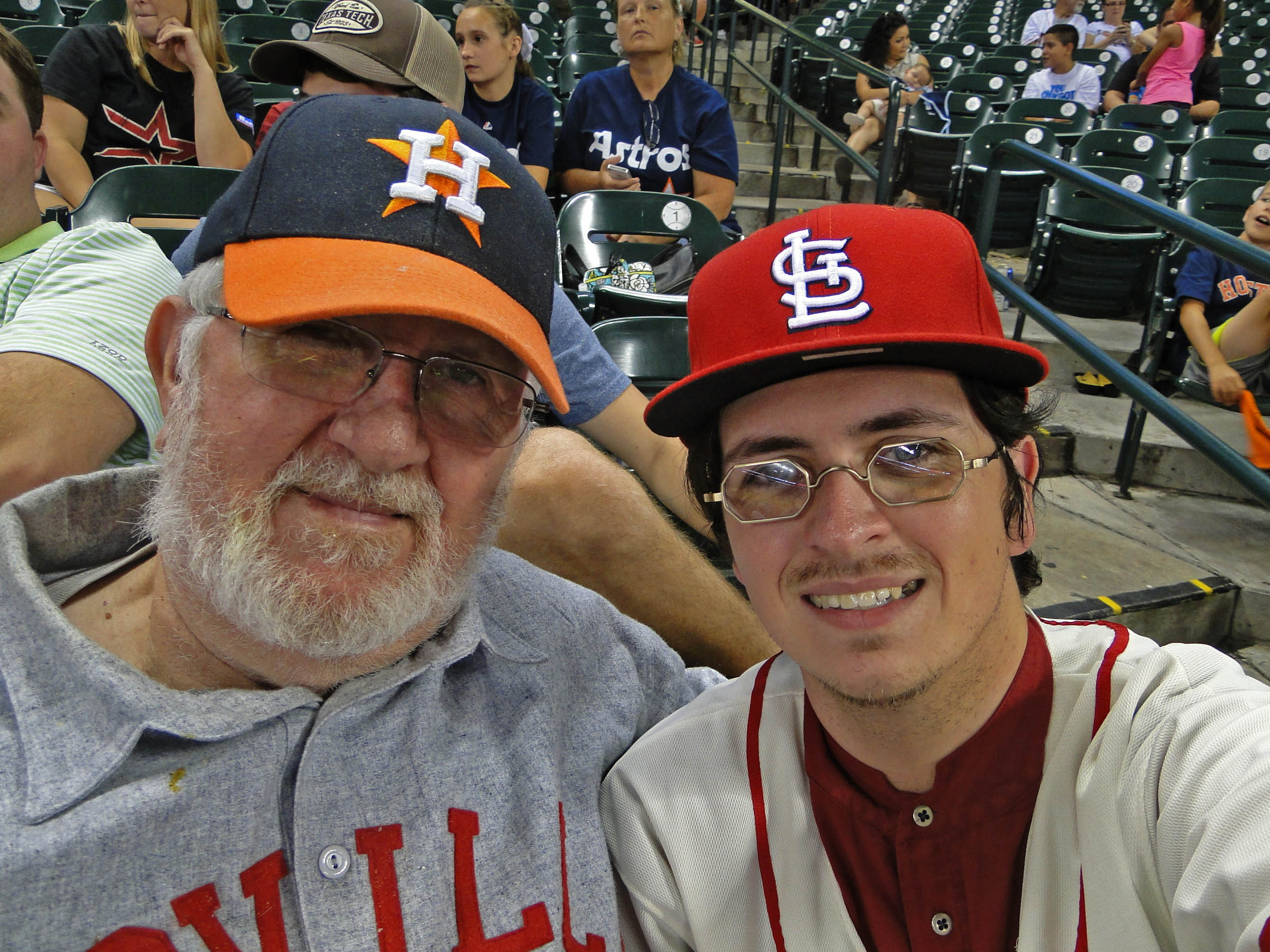
Neal and I saw the Cads whack the Astros, 13-5, on Tuesday night. We should have gone Wednesday and we could have seen the Astros rally to defeat the Cards by 4-3.

My son Neal and I saw the Cardinals whack the Astros, 13-5, on Tuesday night. We should have gone Wednesday and we could have seen the Astros rally to defeat the Cardinals by 4-3.

Which is the greater cardinal sin? Is it remaining loyal to the Houston Astros even though they have now been forced to play baseball in the American League and to abide by the “DH” rule that governs there? Or is the greater cardinal sin to be found upon the souls of those who  abandon the Astros as a result of their involuntary league switch as they also shift their allegiances to other National League teams?

Neal was happy with the 13-5 Tuesday Cardinal drubbing.

Neal was happy with the 13-5 Tuesday Cardinal drubbing.

Yours truly falls into the “Astros Loyalist” category. My son Neal is an adamant defector and now a rabid supporter of the team he always liked secondarily to the Astros as a kid, the St. Louis Cardinals.

“Dad,” Neal says to me, “you’re the one that always taught me that it’s the NL that plays real baseball, not the AL with their stupid DH rule. Now I will no longer go to Astros games at Minute Maid Park, unless its to go with you to watch them get their rears kicked by the Cardinals!

“What happened to you, Dad?” Neal goes on. “How can you abide watching the Astros playing by rules that aren’t even real baseball in the first place? I just don’t get it.”

I’m not sure if I have a good explanation – or even a strong need to explain myself to Neal or anyone else on this point, although I do think Neal gets what I’m now about to say in repetition to each of you here:

I am first of all a Houstonian. Once the Crane purchase came down with the AL move requirement put in place as Commissioner’s Bud Selig’s condition for approval of the deal, I saw my choices as (1) walk away from baseball altogether; (2) do what Neal did, transfer my loyalties to the Cardinals, the MLB team of my youth, along with the now defunct Browns; or (3) deal with the AL move and stay true to my hometown team.

Well, for better or worse, it didn’t take me long to see my only choice. I wasn’t going to give up major league baseball and, unlike my son, I wasn’t capable of simply transferring my loyalty to the Cardinals. I had to stay with my hometown Astros and deal with both the imposed influence of Bud Selig and the coming of DH baseball to Minute Maid Park.

Half way through the 2013 first AL season for Houston, I’ve only seen two games in person and none on television. Our house is among the 60% that doesn’t get Comcast, the only carrier of Astros TV games.

Both of my MMP games have played out over the past eight days: On Thursday, June 20th, I went with a friend to a day game and got to see the Astros down the Brewers, 7-4, on an exciting 10th inning walk-off homer by Carlos Pena. Then Neal and I went to see the Tuesday, June 25th, 13-5 drubbing that the Cardinals put on the Astros earlier this week.

Here’s what I notice: (1) I don’t miss the Astros on TV, but that has to with the fact that they are a losing baseball team, not because they are playing in the AL; (2) the DH doesn’t bother me at all. In fact, I had no sad feelings at all over the fact that we were not going to see the pitchers bat; (3) I suffered no feelings of loss that the DH rule was protecting Astros manager Bo Porter from some big strategy decision with the double switch; and (4) I was more intrigued now with how Porter was deciding when to make a big pitching change without the NL’s built-in pinch-hitter-for-the-pitcher spots in place to make the tough decisions easier for him.

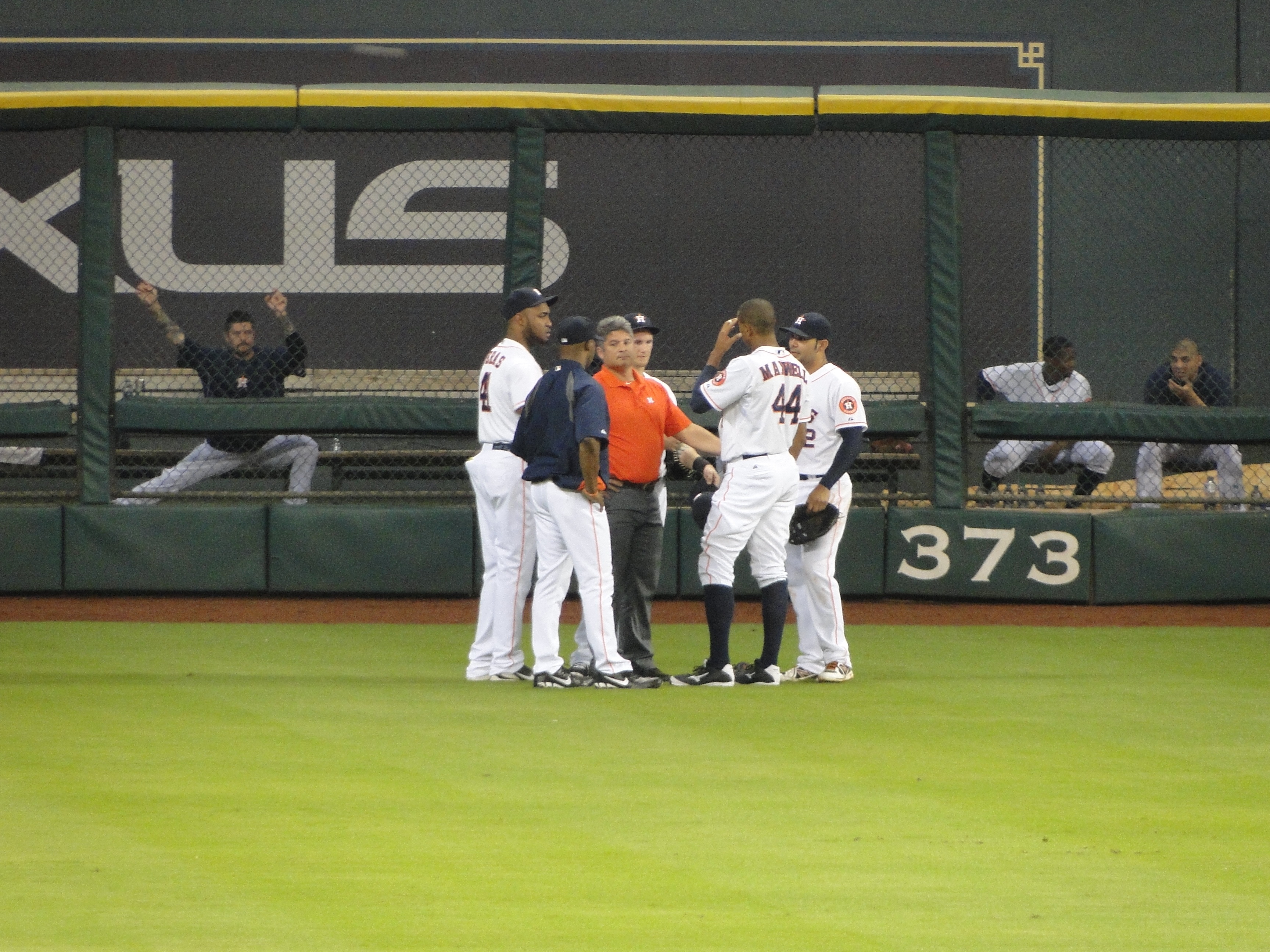
Astros right fielder Justin Maxwell suffered a mild concussion on his failed attempt on a diving miss of a bases loaded triple Tuesday night.

Astros right fielder Justin Maxwell suffered a mild concussion on his failed attempt on a diving miss of a bases loaded triple Tuesday night.

For me, my acceptance of the AL/DH presence in my hometown Astros’ lives comes down to this: I’m 75 years old now and I’ve never seen my Houston Astros win a World Series. Maybe we’ll have better luck in the AL within two to three years. I like manager Bo Porter and I like what GM Jeff Luhnow is doing with the farm system. Now we just need to see owner Jim Crane and President Reid Ryan sign and keep the players we need on the roster long-term to have a winning shot.

I also look forward to regular season games with the Yankees and Red Sox far more than I do regular annual contests with the Brewers and Marlins.

As for cardinal sins here, there really isn’t one in my book. I respect everyone’s right to decide for themselves what they choose to do with the Astros in the AL reality.

Give up MLB baseball. Transfer your loyalties to another NL club. Or work it out and keep watching the Astros.

The choice is yours.

A Pecan Park History Note

June 27, 2013
Pecan Park ... It's a state of mind thing.

Pecan Park … It’s a state of mind thing.

As many of you already know, my passion for the history of the Pecan Park neighborhood in southeast Houston is fueled by the fact that I grew up there from 1945 through 1958, from age 7 to age 20.  As such, I am also a junkie for any news or historical references that show up about my old stomping grounds in the newspaper files of those earlier times.

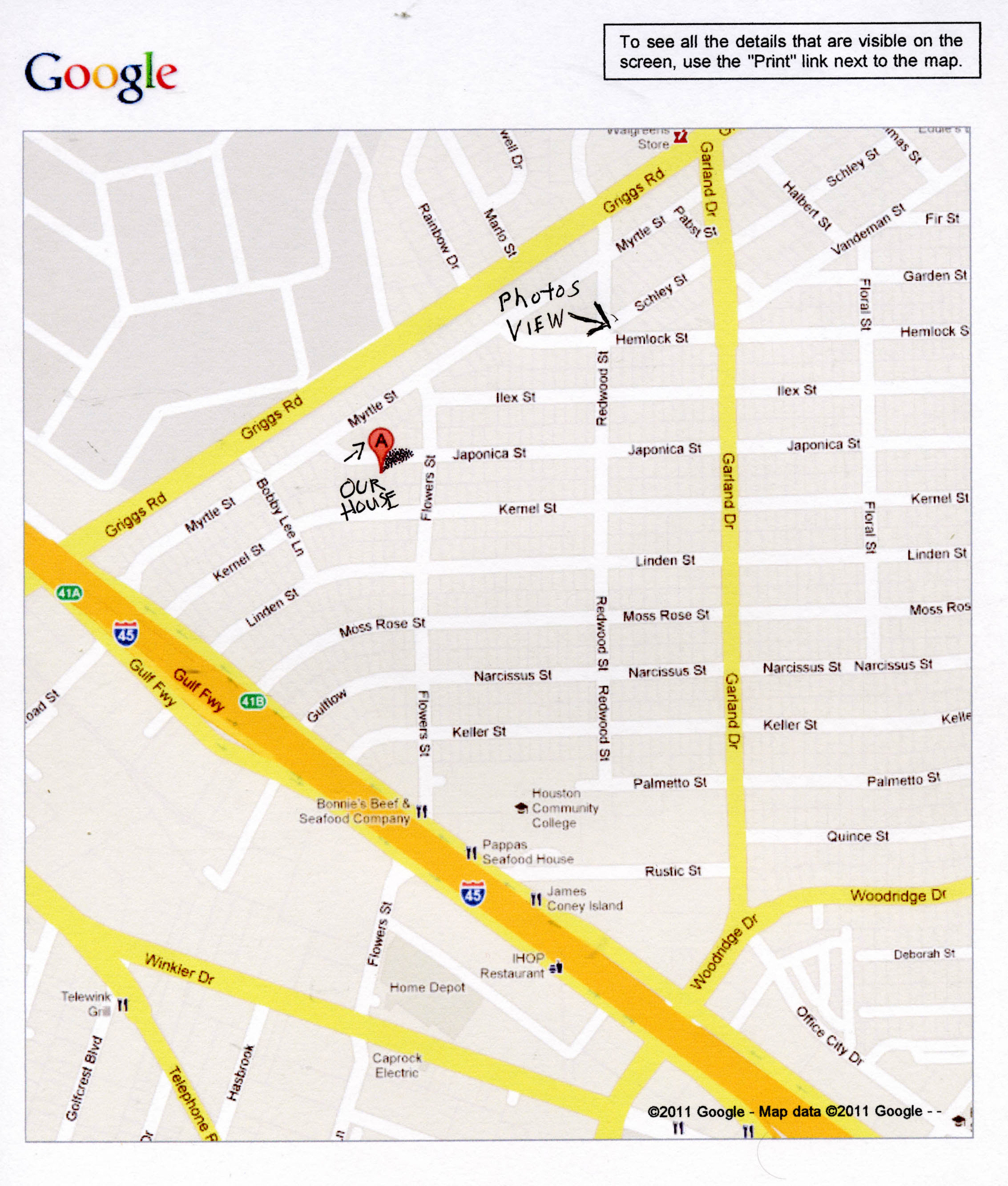
This map provides a little help showing the location of Pecan  Park relative to the I-45 South Gulf Freeway.

This map provides a little help showing the location of Pecan Park relative to the I-45 South Gulf Freeway.

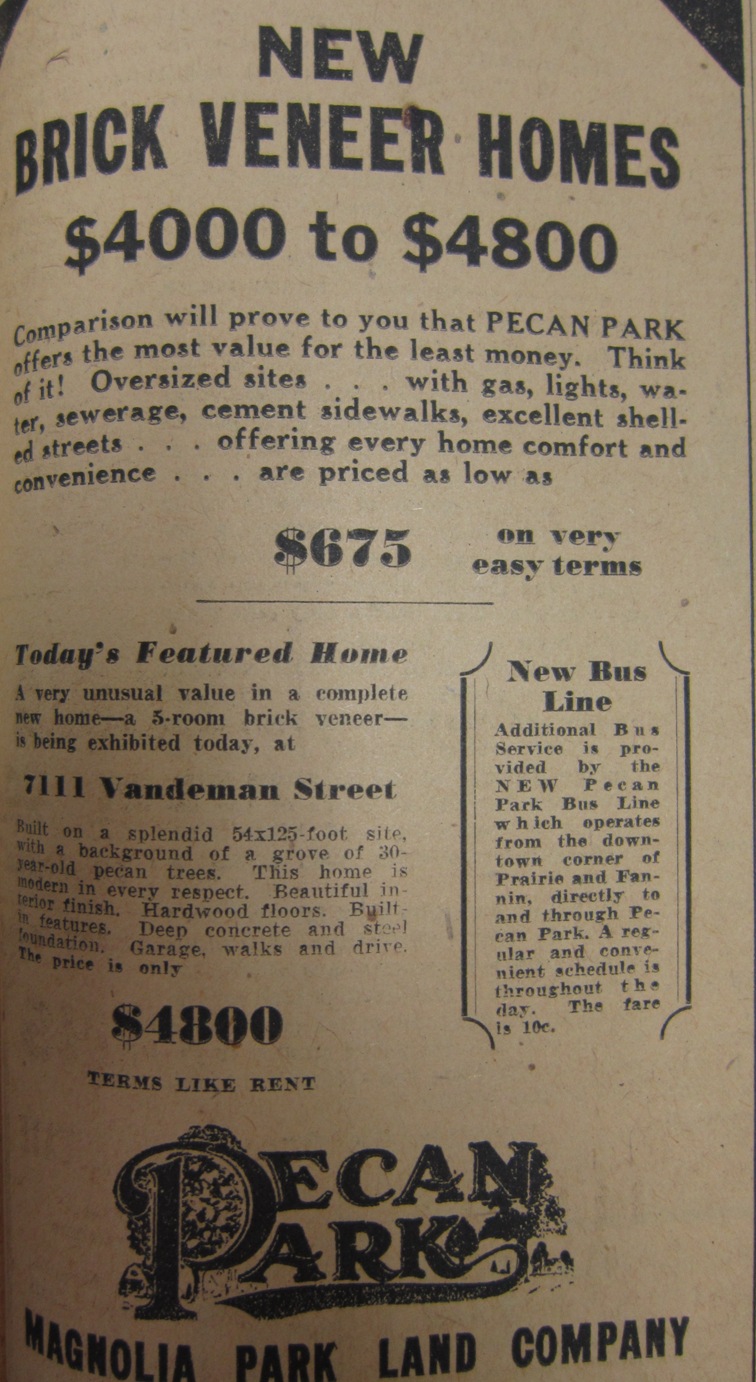
Four days ago, I was rewarded with a gift from friend and SABR colleague buddy Mike Vance. Mike sent me a copy of the following real estate advertisement  from the July 6, 1930 edition of the Houston Post:

hp 6 jul 1930 pecan park sm

Of course, I immediately had to check and see what the property at 7111 Vandeman Street looks like today through the Google Maps street view program. I learned that the property is now the base for a small apartment house project, but the house to its right looks as though it could have been a neighbor to the five-room place advertised in the post.

The housing prices are consistent with what my dad always told me about our own place. He and Mom bought our home at 6646 Japonica in 1945 on a $5,000 mortgage purchase over thirty years. They kept the house as a rental property once they finally moved in 1958, but finally sold it in the early 1970’s. The last time I checked Harris County proper valuations about three yeas ago, our old house was now valued at something in the low $90,000 dollar territory.

Money’s crazy. Inflation is even crazier.

Our Japonica Street place was pretty much standard for Pecan Park homes as far as size and space offerings are concerned. We didn’t have the brick veneer, but we did have real wood siding boards and none of this particle board crap that begins to fall apart in about ten years.

Five rooms included a living room, kitchen, dining room, and two bedrooms. We had one bath, a one-car garage with a manual door, an attic fan for coolness in the summer and a floor furnace for heating in the winter. My dad added a large bedroom after my sister was born in 1949, but we did not begin to have air-conditioning until my folks bought a window unit for the living room in 1957. Attic fans cooled by sucking air though opened screened windows and through the attic. These also brought with them all the various seasonal and full-time smells that hovered outside – and I do mean everything – from the putrid smells of the nearby Champion Paper Company in Pasadena to the rotting figs on the tree outside my bedroom window.

Those wonderful finely crushed gravel roads that the above ad mentions were pretty much gone, converted to cement, by the time we moved into Pecan Park, but Flowers Street was still that way for a while. We used to harvest Flowers Street gravel as land filler in the bowls we used as homes for our pet turtles.

The mostly Hispanic immigrant families that now live in Pecan Park have done a good job keeping the old neighborhood alive in recent years. The family  that now owns our old place, in fact, has greatly improved the property, adding a long sitting-room front porch and converting the garage to some kind of extra inside room.

Everything changes – for either better or worse – or simply because nothing ever stays the same over time – no matter how much we fondly remember what we often think of as “the good old days.” Pecan Park will always be with me in the present because it was always there for me in the past, but it has changed – and so have we all.

I will still collect everything I can find on its history for as long as Pecan Park items keep showing up.