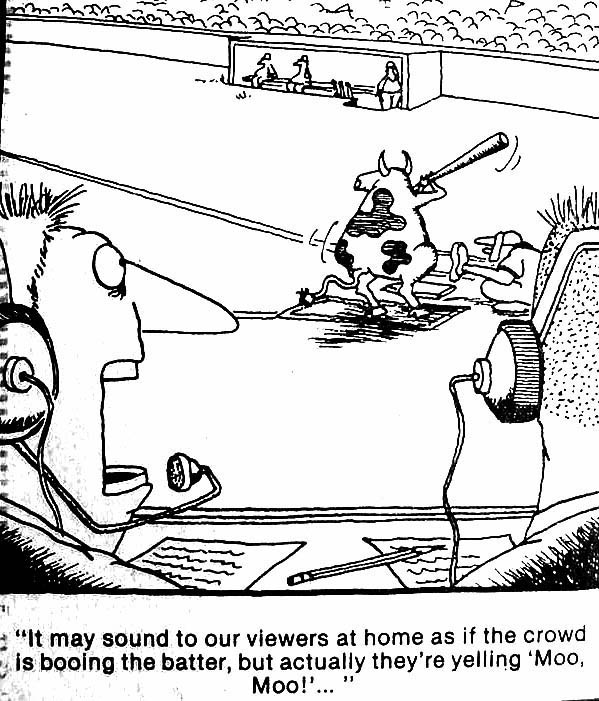
Billy Crystal 1 – Moonlight Graham 0.

November 26, 2013
Billy Crystal Baseball is for Life

Billy Crystal
Baseball is for Life

Five and more than one half years ago, on the day prior to his 60th birthday, comedian Billy Crystal chalked up an official spring training time at bat on a one-day contract with the New York Yankees. The day and date were Thursday, March 13, 2008. The place was Tampa, Florida. The opposition was the Pittsburgh Pirates. The pitcher for the Buccos was the 6’2″. 220-lb. lefty, Paul Maholm.

Crystal’s playing contract was incredible. “It was $4 million dollars for one day on the active roster,” Billy says, “but they only gave me 24 hours to come up with the money.”

Wink! Wink!

As it turns out, New York was playing Pittsburgh on the day of his active player service and the Yankees started Crystal as their DH and their lead-off batter. He even wore a jersey with #60 on the back in honor of his impending next morning turning 60 Friday birthday.

“I was their DH, all right,” Billy now boasts. “I was their Designated Hebrew.”

Billy so jests. Constantly. And with impeccable stance and timing. What else should we expect from one of the genuinely funniest men of all time?

It’s not that he tells a lot of jokes that make him funny. Billy just happens to tell a lot of funny jokes. And he delivers them all in the right way. The funny way.

Billy was a little taken back by the Pirate pitcher’s size, power, and speed.

“Maholm’s first pitch was high and outside for a ball.” Billy says. “I didn’t see it, of course, ” he adds, “but it sounded high and outside.”

Billy swung at the next pitch and laced it down the right field line for what would have been a double, he says, had it stayed fair. If you ever see his foul ball from that day on You Tube, you may reset the actualities here just a tad. Meaning, it didn’t go quite as far as Billy professes – nor was it ever even close to being a fair ball. But it was the only piece of ball that Bill Crystal caught with his bat that magical day. You have to expect it to have befitted Billy’s personal field of dreams moment.

I”m glad it wasn’t fair for a double,” Billy recalls. “That’s the part that scared me the most,” he adds.

“Had it been in there for extra bases,” Billy opines, “I would have had to stop and pee twice before I ever got to second base.”

When Billy Crystal finally struck out on a 3-2 count, the spring training crowd rose to give him a standing “O” for what he had done. He hadn’t merely taken one for himself, but for all of us other Walter Mittys who die to be in there with guys like Eddie Gaedel and Moonlight Graham in all the print and digital encyclopaedia of the baseball world.

Billy Crystal didn’t make it to Baseball Reference.Com either, but he still did the thing that always eluded poor one-game fielding vet Moonlight Graham. It was only Spring Training, but Billy Crystal still got to play in a real game, against a real major league foe. It was every fan’s dream – and Billy Crystal still collects hugs from tearful fans who thank him for crossing the line into reality for all of us others who know in our hearts – our dreams of a major league career live only in our hearts – and in the memories of our sandlot days – when all things were still ahead of us and possible.

Time to stare out the window again. And wait for spring.


Colt .45 Biographies: Joey Amalfitano

November 25, 2013

img094

When I heard over the radio that the new Houston Colt .45’s of the National League had taken infielder  Joey Amalfitano as their 38th pick in the October 10, 1961 franchise expansion draft, I remember my first reaction as one burrowed deep in stereotypical phonetics about New York gangsters, Little Italy, Little Caesar, Brooklyn, the Mafia, and television theaters about tough New York kids living in the tenements of disputed street gang territory. – And this was a decade prior to “The Godfather” – back in the days we had to come up with someone other than Robert DiNero or Al Pacino as the face of our “typical New York character.”

Los Angeles Dodger infielder Bob Aspromonte, of course, already had been picked as Houston’s 3rd selection. Bob not only had the Italian surname; he actually hailed from Brooklyn. It’s just that the first name “Joey” rings truer to these ears as a street-wise “paisano” than “Bob’ does.

Somebody finally made him an offer he couldn't refuse.

Somebody finally made him an offer he couldn’t refuse.

Amalfitano was drafted from San Francisco Giants as a guy who originally had signed with their New York predecessors in 1954, four years prior to the franchise’s  transfer to the City By the Sea, but he wasn’t even a New York, having been born in San Pedro, California on January 23, 1934. Raised in that area, Joey had played baseball and graduated from St. Anthony High School in Long Beach, California, before continuing to play as a student at Loyola Maramount University in Los Angeles. When Amalfitano signed with the New York Giants at age 20 on February 2, 1954 as a bonus baby – meaning that he had to be kept on the major league roster to remain protected from future claims by other clubs as a minor leaguer, should he have been signed and immediately assigned to the roster of a Giants farm club.

Joey Amalfitano made his major league game debut on May 2, 1954, but his bonus baby ride that season was little a pines-rubber. Joey made the least of it, going 0 for 5 – and striking out in 4 of those 5 attempts.  He followed with a .227 mark in 1955 in 26 games for the 1955 Giants before getting assigned to the minors in 1956. His versatility at 3rd and 2nd base had been outweighed by a weak bat.

Amalfitano’s improved bat in the minors from 1956 to 1959, including a career best .308 for AAA Toronto in 1959 eventually bought him some more MLB attention. The now San Francisco Giants had released Amalfitano on December 5, 1958, but they drafted him back from Toronto in the November 30, 1959 rule draft in light of his banner offensive year. He then registered two fairly good offensive seasons with the Giants in 1960-61 prior to his post-season ’61 expansion draft by Houston.

In his one season with the original 1962 Houston Colt .45’s, Joey Amalfitano played predominately in 117 games as a 2nd baseman, but he batted only .237 with 1 home run. On November 30, 1962, Houston traded Joey Amalfitano back to San Francisco in exchange for pitcher Dick LeMay and outfielder Manny Mota. (Unfortunately for Houston, they could not hold onto the great future pinch hitter Mota, but would trade him instead prior to the 1963 season for a human strikeout machine named Howie Goss, an outfielder they acquired from Pittsburgh.)

As a personality. Amalfitano always impressed me as  hustling good guy. From that standpoint, and long before anyone here ever fully realized in time what the Colts were getting for him in the Mota deal,  many of us hated to see him go. But go, he did – and he was gone from active play for Houston forever.

Joey saw limited action with the 1963 Giants and was then released and signed by the Chicago Cubs for four more limited seasons of bench duty (1964-67).

Joey Amalfitano retired at age 33 after his July 2, 1967 season release by the Cubs with a career MLB batting average of .234 with 9 home runs. His six minor league seasons (1956-59, 1063, 1966) produced career marks at that lower rung level of a .286 BA and 25 HR.

After several years as an MLB bench coach, Joey Amalfitano managed the Chicago Cubs for almost three full seasons from 1979 to 1981. His career managerial record finished at 182 wins, 245 losses, and a W% of .426.

Joey Amalfitano, age 79, now lives in retirement, but how was he able to finally shut it down? Somebody, perhaps Father Time, himself, must have finally made him an offer he couldn’t refuse.

1916: Georgia Tech 222 – Cumberland 0

November 24, 2013
Gentry Dugat and Cumberland lost to Georgia Tech, 222-0, on October 7, 1916.

Gentry Dugat and Cumberland lost to Georgia Tech, 222-0, on October 7, 1916.

21-year old Gentry Dugat of Beeville, Texas was one of the 16 student recruits from tiny Cumberland College in Lebanon, Tennessee that got on the train for the ride to Atlanta and an October 7, 1916 game the school had just scheduled with mighty Georgia Tech. In a day of far more informal scheduling, cash-strapped Cumberland could not have declined the offer. – Georgia Tech was going to pay the little one-year law school $500.00 to show up and play against the John Heisman coached Yellow Jackets.

Heisman? Yes, that Heisman – the one that college football eventually named their big best player door prize and door stop award, the Heisman Trophy, in honor of his surname. Heisman and Georgia Tech were a powerful force in 1916 and they were looking for the era-equivalent scheduling of something like yesterday’s Idaho@Florida State contest for an easy win as their reward for putting out all that big cash to a school like Cumberland. The visitors had no misunderstanding about their chances, but they probably made the mistake of assuming that reality on the field would also be served with a side-dish of mercy.  On that last count, Cumberland misunderstood the darker side of GT Coach Heisman’s more sinister side. Heisman was out to prove that running up the score on a hapless opponent was no big deal.

The coach for Cumberland, law student Butch McQueen, had a much more basic goal – and that was to find 16 players with arms, legs, and vision who could take the field and survive the period of competition. McQueen also hoped to pick up some extra players from Vanderbilt when the team’s train passed through Nashville. That didn’t happen. Vandy was saving its best for a game on their own schedule.

Gentry Dugat was apparently typical of the Cumberland recruits when it came to any close look at his football playing resume.

“I played once in high school and once in prep school,” Dugat said. “But they promised me the first Pullman ride of my life and a chance to visit the home of my idol, Henry Grady [the editor of the Atlanta Constitution].” (SI Vault – See link to full article for all specific historical data extracted for this column.)

The game itself is one of legend. The link below describes the general background of how it exploded into a record-setting 222-0 victory for Georgia Tech as well as any I’ve ever read. On the oral side, I’ve heard several variations of the same story and all from the same person. Gentry Dugat was an older friend of my dad in Beeville and, when we went to my birthplace on family visits during my childhood, I would sometimes tag along with my father on Saturday morning trips downtown for coffee at the American Cafe on Washington, Beeville’s main street. When we would run into Gentry Dugat, he would sometimes join us for coffee  so that he could talk with Dad. The subject of the Georgia Tech-Cumberland game came up more than once. I guess that’s where Gentry spent a lot of his energy. Dugat was widely regarded as a journalist, speaker, and historian during his lifetime, but some people, perhaps, my dad was among them, kept rewinding Gentry to the events of October 7, 1916.

One thing’s for sure – I read it again here – Gentry Dugat took great exception with anyone who dared call the Cumberland bunch a band of cowards for their behavior during the massacre. “We may have been unskilled and badly beaten,” says Gentry Dugat, “but we were not yellow.”

Gentry Dugat passed away in 1966 at the age of 70. He was buried in Mineral, north of Beeville, as one of the brightest, funniest characters to have ever achieved his own slice of American sports ignominy.

Hope you enjoy the SI Vault article also for it’s slightly lesser known look at some of the darker personality traits of the now revered John Heisman, who also coached briefly at Rice.

http://sportsillustrated.cnn.com/vault/article/magazine/MAG1073271/3/index.htm

1995: UH Beats Rice in Final SWC Game

November 23, 2013
"Breakin' Up is Hard to Do" (unless you're talking about collegiate athletic conferences.  It's easy to break old ties at the college level, but it's very hard to replace the losses with something solid in the long term because - the long term no longer exists.

“Breakin’ Up is Hard to Do” (unless you’re talking about collegiate athletic conferences. It’s easy to break old ties at the college level, but it’s very hard to replace the losses with something solid in the long term because – the long term no longer exists.) – just how it looks to the Pecan Park Eagle.

COUGARS BEAT OWLS IN FINAL SWC GAME

HOUSTON (AP) – The once-glorious Southwest Conference closed its 81-year history in exciting fashion Saturday.

Houston scored 15 fourth-quarter points, then saw Rice miss a 38-yard field goal with 12 seconds left to give the Cougars an 18-17 victory.

In a game over-shadowed by Texas’ 16-6 victory over No. 16 Texas A&M – jokingly referred to as the last SWC game that mattered – the Owls and Cougars played the league’s true finale.

Only 28,400 people bothered coming to the 70.000-seat Rice Stadium and they were treated to plenty of hoopla.

There was the “Last SWC Coin Toss” featuring at least one notable representative from all current league teams except Texas A&M and one from former member Arkansas.

And there was a(n) unusual half-time show during which Rice’s all-time team was honored before the school’s band took over. They spelled out “SWC” then shuffled around to spell out “WAC” in honor of the school’s new conference.

The show closed with people dressed as school mascots serving as pallbearers for the SWC, followed by a fat lady singing.

After the game ended, the scoreboard went blank. Then Dick Hudson of Katy, a fan drawn at random from about 1,800 entries, flipped a switch and the entire stadium went dark at 7:10 p.m.

It turned out to be a decent show on the field, too, after three lackluster quarters.

Rice (2-8-1, 1-6) led 17-3 going into the fourth quarter behind two short touchdown runs by Jamey Whitlock.

Quarterback Chuck Clements began the Houston (2-9, 2-5) rally by hitting Damion Johnson on a 20 yard touchdown pass with 6:36 to play. Then, with 1:19 left, Clements lobbed a pass down the right sideline that Larkay James ran under for a 43-yard touchdown.

Now down 17-16, the Cougars went for two. Clements scrambled right, then saw Johnson breaking away from single coverage in the middle of the end zone. Clements threw the ball to Johnson’s right and he caught it to give Houston its first lead of the game.

Rice wasn’t done. Quarterback Raphael Tillman, mostly a runner, completed three passes for 43 yards and tthe Cougars were penalized 15 yards for a personal foul, putting the Owls at the Houston 18.

Rice took a loss of three yards to stop the clock and prepare for the a field goal by Mike Ruff, who had hit a 35-yarder in the first quarter.

(As stated earlier, kicker Ruff missed the 38-yard field goal attempt with 12 seconds to go and the Houston Cougars had won the last Southwest Conference game in history over the Rice Owls by a final score of 18-17.)

~ Brazosport Facts, Sunday, December 3, 1995, Page 16.

November 22, 1963: Blowin’ in the Wind

November 22, 2013
At one point, we stopped 'neath a soft street light and just hugged. An old couple (probably about my age now) passed us as we stood there. "Keep it up, young people," the lady said. "You are now our hope for the future."

At one point, we stopped ‘neath a soft street light and just hugged. An old couple (probably about my age now) passed us as we stood there. “Keep it up, young people,” the lady said. “You are now our hope for the future.”

Fifty years ago today, on another Friday, some fifty Novembers back in time, I was a 25-year-old second-year graduate school Psychiatric Social Work student at Tulane University in New Orleans. I lived adjacent to the Tulane campus on Willow Street, across the street from the old Tulane Stadium that used to host the early Sugar Bowl contests. I also shared a university-owned and managed garage apartment with another graduate student. We split the $36.00 per month rent and got by as best we could without getting too much in each others way. It wasn’t easy.

For one thing, the apartment was a small, one-bedroom, one-bath place with two single beds and poor space for books or study for even one person.

For another, it had a drafty floor that served as a portal for carbon monoxide every time the managerial house tenants moved their car in or out of the garage. We had to leave the windows up all the time to protect ourselves from the potential for asphyxiation.

Then there was “Bully”, the management’s pet bulldog. Bully patrolled the fenced back yard that separated the house and driveway fence gate from the garage and entry door to our apartment stairs.

Bully was a great property watch dog who only seemed interested in sinking his formidable teeth into all people who were not his master – and that included my roommate Doug and me. To get into the apartment without getting attacked, we learned to approach the fence gate with our door keys ready and two sticks of about a foot in length. After a little gate rattle to get his attention, in case Bully was sleeping when you arrived, you pulled out one of the sticks and held it high for his eye-widening inspection.

“Hey, Bully? Do you want this stick?”

Bully inevitably reacted with excitement. No longer barking, he would quickly re-position his body in the direction he knew you would soon throw the stick – to the deep, far-side of the back yard. And he would look back at you with all the anticipatory focus of a Hall-of-Fame bound NFL wide-out.

It worked every time. If you had good speed, and you threw the stick far enough, you could make it inside the apartment stairwell door before Bully got back. He just never figured it out. And, of course, the second stick was there to get you off the grounds again. We called those sticks our “Wile E. Coyote Acme Bulldog Escape Kit”.

At any rate, the stick strategy got me off the grounds again about 11:00 AM, CST, on Friday, November 22, 1963. It started as a typical day, one that we all most probably would have forgotten by now, had it not been for what was about to come. It was a light Friday for me. A couple of small study groups scheduled for my morning had been cancelled. All I had to is grab a quick lunch somewhere and then do a 1-5 PM at my internship base, the Out-Patient Alcoholism Clinic on Chartres Street in the French Quarter.

I was in a good mood on the morning of November 22, 1963. I even found a good parking space down on Esplanade, the northern boundary street of the quarter. I didn’t even mind the several block walk south on Chartres to the Alcoholism Clinic. It would give me a chance to work off the cheeseburger I grabbed for lunch at the little mom and pop store on Claiborne as I was driving in. I had a 1.5 hour long group session to conduct and then three individual patients to see before we went into what I hoped would be a chance to rest from academia and catch up on my baseball reading.

My thoughts walking down Chartres were scattered and frivolous. “Why am I going down here to fight alcoholism in the French Quarter?” I thought. “Sometimes that feels about as hopeful as a fireman carrying a glass of water to battle the great Chicago Fire.”

The first intrusions of reality appeared as I walked past Harry’s Bar on Chartres about 12:50 PM. Inside, I could see through the window as I passed that Harry already had the television set on. He didn’t always do that at this time of day. The words on the screen read as “A Special Report from CBS.”

“Wonder what that’s about?” I thought, as I picked up my pace, but only because I was starting to run late.

When I got to the clinic, I got the news that changed the world for all of us. Everyone, patients and staff, were huddled around our small portable radio at the reception desk. For the next hour or so, we all hung in space, waiting for the answer to everyone’s first question: Was President Kennedy alive or dead?

We got the word in waves of declining hope from Walter Cronkite – with these two final separate statements sealing our shock for the grief that was to come in buckets:

1) “We just have a report from our correspondent Dan Rather in Dallas, that he has confirmed President Kennedy is dead.

2) “From Dallas, Texas, the flash, apparently official: (reading AP flash) “President Kennedy died at 1 p.m. Central Standard Time.” (glancing up at clock) 2 o’clock Eastern Standard Time, some 38 minutes ago.

After that came the weekend of shock and anger, grief and tumble.

One patient showed up late for group that Friday and had to be told that JFK had been assassinated.

“Does this mean that our group session is going to be cancelled?” she asked. “I had a lot of things I needed to talk about.”

I couldn’t wait to get out of there and go home. I wanted to go back to Texas and see my girl friend and be with my family.

Another surprise awaited. And it came in layers too.

When I got to the gate, I suddenly decided that I was tired of living in fear of Bully. Bully wasn’t a monster. Whoever killed JFK was a monster.

Besides, if Bully sometimes looked like a wide receiver to me, it must be because he sees me as his quarterback. – And I never heard of a wide receiver who would turn on his QB for getting him the ball.

I threw the stick for Bully and then stepped inside the gate and waited from a squatting position. When Bully reached the stick, he picked it up, then turned and dropped it, expecting his usual chase of me to the garage apartment door. But then – when he saw me in the yard, inside the gate and calling to him, he picked up the stick again and brought it to me. After three or four more tosses, I hugged Bully and he kissed me – and we walked together to the door. We were friends forevermore after that moment.

Then I went inside and stared up at my next surprise. There was Sandy, my girl friend from UH. She had flown over from Houston to surprise me – only to learn about the death of JFK from the pilot while they were still en route.

We just hugged and cried together for the longest time. We both had been “Kennedy Kid” supporters during his 1960 campaign – and we had attended his meeting in Houston with protestant ministers over the concern of same that a vote for Kennedy was a vote for the Pope.

That night we went back to a subdued French Quarter, where Sandy and I had once shared a table and drink with jazz trumpet icon Al Hirt at his club and even once together had about a ten minute private conversation with Tennessee Williams at the Napoleon House bar on Chartres. As a musician and marvelous student of history and literature, Sandy could talk to anybody and leave them with something they had been missing, even if they were already big and famous.

Friday night, 11/22/63, was the most somber, sober night in my experience with the French Quarter. Oh yeah, there were plenty of falling down drunks that bleak wet evening, but those were the same folks who were going to do it, anyway. They didn’t need the death of a beloved American president to get there.

After dinner, we walked around the Quarter hand in hand for what seemed like forever. We needed the quiet and the closeness. And we got it even more when a light rain started up, producing enough water to make the streets glisten and reflective of various colored lights from the glow of open Quarter bars and businesses. Bluesy horns danced through the night air, hitting notes and melodies that came close to matching the depth of this day’s spiritual abyss.

At one point, we stopped ‘neath a soft street light and just hugged. An old couple (probably about my age now) passed us as we stood there. “Keep it up, young people,” the lady said. “You are now our hope for the future.”

Forgive me. I can’t go to that fatal day – and that time through the funeral – without feeling sad again.

After Sandy flew back to Houston, I drove home to Texas through the night to be there in time for the funeral on television. I picked up a radio station in Baton Rouge that played one song, over and over again, for as long as I could get it through Beaumont. It was Bob Dylan’s masterpiece and my soundtrack for what happened to America, fifty years ago today – in about three hours from this writing:

JFK 02

How many roads most a man walk down
Before you call him a man ?
How many seas must a white dove sail
Before she sleeps in the sand ?
Yes, how many times must the cannon balls fly
Before they’re forever banned ?
The answer my friend is blowin’ in the wind
The answer is blowin’ in the wind.

Yes, how many years can a mountain exist
Before it’s washed to the sea ?
Yes, how many years can some people exist
Before they’re allowed to be free ?
Yes, how many times can a man turn his head
Pretending he just doesn’t see ?
The answer my friend is blowin’ in the wind
The answer is blowin’ in the wind.

Yes, how many times must a man look up
Before he can see the sky ?
Yes, how many ears must one man have
Before he can hear people cry ?
Yes, how many deaths will it take till he knows
That too many people have died ?
The answer my friend is blowin’ in the wind
The answer is blowin’ in the wind.

~ Bob Dylan

June 3, 1932: Gehrig’s 4 HR Game

November 21, 2013
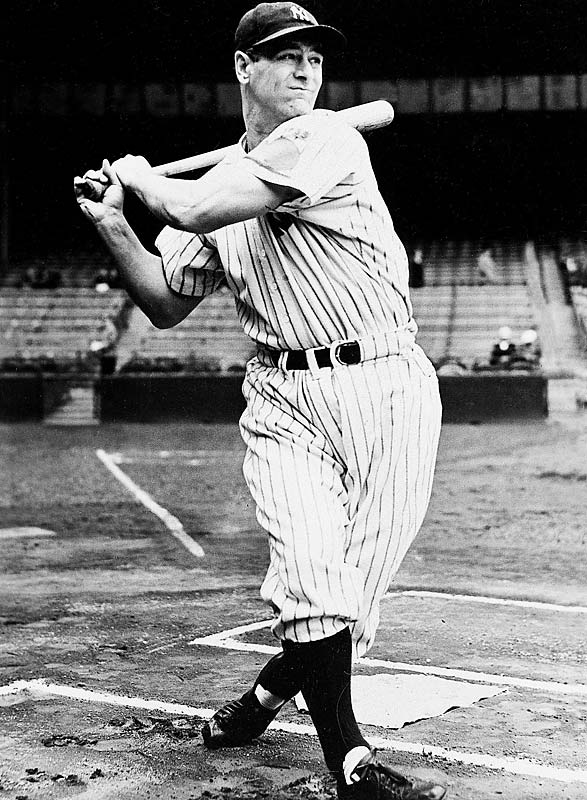
LOU GEHRIG June 3, 1932 4 HR in One Game!

LOU GEHRIG
June 3, 1932
4 HR in One Game!

On June 3, 1932, Lou Gehrig became the first man in 36 years to hit 4 home runs in a single game – and only the third man in MLB history to do it at all. Robert Lowe was the first big leaguer to do it (1994) and Ed Delahanty was the man prior to Gehrig. Lowe’s 4 homers were also consecutive; Delahanty’s were not, but they also came in a single game.

Since Gehrig, 13 MLB batters have pulled the 4-homers-in one-game trick and these include Chuck Klein (1936); Pat Seerey (1948); Gil Hodges (1950); Joe Adcock (1954); Rocky Colavito (1959); Willie Mays (1961); Mike Schmidt (1976); Bob Horner (1986); Mark Whiten (1993); Mike Cameron (2002); Shawn Green (2002); Carlos Delgado (2003); and Josh Hamilton (2012).

As most of you know, Lou Gehrig could never catch a total attention break to his performances on the field due to his years of career play in the formidable shadows of teammate Babe Ruth, but even his big home run day had to take second billing to the fact that iconic manager John McGraw had chosen this same date to announce his retirement as the almost forever manager of the New York Giants.

McGraw and successor Bill Terry got the bold type headlines all around the country for Muggsy’s retirement and his managerial replacement by Bill Terry. Gehrig took the smaller, thinner, lesser page-positioned second banana bold type for his 4 consecutive home runs in one game against the Athletics in Philadelphia.

So, with a little help from another Baseball Almanac box score, here’s how one Associated Press story covered Gehrig’s feat in the Hamilton (OH) Daily News on June 4, 1932, Page 6:

********************

Gehrig’s Four Homers in One Game Tie National Loop Record

TERRY’S APPOINTMENT AS GIANTS PILOT SURPRISES BASEBALL MEN

SLUGGING YANKS GAIN 50 BASES IN 20 TO 13 WIN

**********

NEW YORKERS ALSO EQUAL MARK FOR MOST HOME RUNS IN SINGLE GAME

**********

By Gayle Talbot, Associated Press Sportswriter

Lou Gehrig, long accustomed to play(ing) second  fiddle to the one and only Babe Ruth, today has carved himself a place in baseball’s permanent record, the result of a home run spree never equaled by his illustrious teammate, or by any other batsman in the last 38 years.

The Yankee first baseman yesterday crashed four consecutive home runs at Shibe Park as his team beat the Philadelphia Athletics, 20 to 13.

Only once before had the feat been equaled. Robert Lowe, of the Boston Nationals, of 1894, did it. Ed Delahanty of Philadelphia hit four in one game in 1896, but only three were consecutive.

Gehrig’s record was not the only one to fall in the wild melee. The Yankees filed up a total of 50 bases on 23 hits and the two clubs had a combined couple of 77 bases. The Yanks also equaled the big league record for home runs in a game, with seven. Jimmy Foxx hit his nineteenth home run for the A’s; Babe Ruth his fifteenth. ….

~ Gayle Talbot, Associated Press, Hamilton (OH) Daily News, June 6, 1932, Page 6.

********************

The following box score appears below though the courtesy of Baseball Almanac.Com ~

4 Home Runs in 1 Game
by Lou GehrigLou GehrigJune 3, 1932 at Shibe Park
Hitting & Fielding Notes
New York Yankees
Name Pos AB R H RBI
Earle Combs cf 5 2 3 1
Jack Saltzgaver 2b 4 1 1 1
Babe Ruth lf 5 2 2 1
   Myril Hoag lf 0 1 0 0
Lou Gehrig 1b 6 4 4 6
Ben Chapman rf 5 3 2 1
Bill Dickey c 4 2 2 1
Tony Lazzeri 3b 6 3 5 6
Frankie Crosetti ss 6 1 2 2
Johnny Allen p 2 0 0 0
   Gordon Rhodes p 1 0 1 0
   Jumbo Brown p 1 0 0 0
   Lefty Gomez p 1 1 1 0
Totals 46 20 23 19
Philadelphia Athletics
Name Pos AB R H RBI
Max Bishop 2b 4 2 2 0
Doc Cramer cf 5 1 1 3
   c-Oscar Roettger ph 1 0 0 0
Bing Miller lf 0 0 0 0
Mickey Cochrane c 5 1 1 2
   d-Dib Williams ph 1 0 0 0
   Al Simmons lf-cf 4 2 0 0
Jimmie Foxx 1b 3 3 2 1
Ed Coleman rf 6 2 2 3
Eric McNair ss 5 1 3 0
Jimmy Dykes 3b 4 1 1 0
George Earnshaw p 2 0 0 0
   a-Mule Haas ph 1 0 1 0
   Roy Mahaffey p 0 0 0 0
   Rube Walberg p 0 0 0 0
   Lew Krausse p 0 0 0 0
   b-Ed Madjeski ph 1 0 0 0
   Eddie Rommel p 0 0 0 0
Totals 42 13 13 9

a: Single for Earnshaw in 5th inning.
b: Reached on error for Krausse in 8th inning.
c: Flied out for Cramer in 8th inning.
d: Batted for Cochrane in 9th inning.

Double Plays: Cochrane-McNair, Bishop-Foxx, Coleman-Cochrane.
Errors: Ruth, Gehrig, Crosetti 2, Allen, Earnshaw.
Doubles
: Ruth, Lazzeri, Coleman, McNair.
Home Runs: Combs, Ruth, Gehrig 4, Lazzeri, Cochrane, Foxx.
Left on Base: New York 6, Philadelphia 11.
Stolen Base: Lazzeri.
Triples: Chapman, Lazzeri, Bishop, Cramer, Foxx.

Line Score
Team 1 2 3 4 5 6 7 8 9 R H E

New York

2 0 0 2 3 2 3 2 6 20 23 5

Philadelphia

2 0 0 6 0 2 0 2 1 13 13 1
Pitching Notes
New York Yankees
Name IP H R ER BB SO
Johnny Allen 3.2 7 8 4 5 2
   Gordon Rhodes 1.1 1 2 2 2 0
   Jumbo Brown 2.0 3 2 1 1 0
   Lefty Gomez 2.0 2 1 1 0 1
Philadelphia Athletics
Name IP H R ER BB SO
George Earnshaw 5.0 8 7 6 2 8
   Roy Mahaffey 1.0 6 4 4 0 0
   Rube Walberg 1.0 2 1 1 1 1
   Lew Krausse 1.0 4 2 2 0 0
   Eddie Rommel 1.0 3 6 6 3 0

Losing Pitcher: Mahaffey.
Wild Pitch
: Rhodes.
Winning Pitcher: Gomez.

Game Notes
Attendance: 7,300.
Length of Game: 2:55.
Umpires: HP: Harry Geisel, 1B: Bill McGowan, 3B: Charles Van Graflan.

The St. Louis Browns Historical Society

November 20, 2013
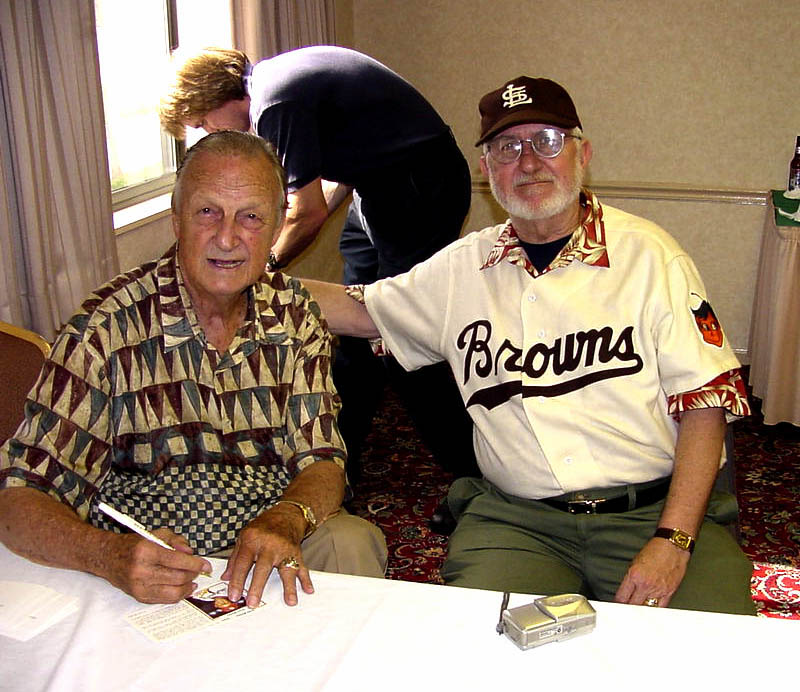
Stan the Man with Bill the Fan St. Louis, 2003

Stan the Man with Bill the Fan
St. Louis, 2003

The St. Louis Browns Historical Society and Fan Club was established in St. Louis back in the early 1980s by history professor/writer/fan Bill Borst and a few other ancient pelicans of St. Louis baseball history. Over the years, it grew into an annual dinner and greet-and-meet for former Browns players and their surviving fans from the 1902-1953 period in which the Browns existed as the winners of one WWII-aided pennant in 1944 and a coal bin full of last place finishes in the American League.

In the end, even the Barnum and Bailey mind of final owner Bill Veeck could not spare the Browns from themselves. Midget batters didn’t work. “Fan Manager Night” didn’t work. And even having a 20-game winner like Ned Garver pitch for them in a 102-team loss, last-place 1951 season didn’t work. The Browns were doomed in their  heart-to-heart competition with their National League neighbor and ballpark tenant, the St. Louis Cardinals. The Browns didn’t have anybody close to the talent of the Cardinals’ great Stan Musial, but who did, back in the day? Even if they ever came close to raising or acquiring a great one, the Browns could not have kept him. They had to survive by second division loser club economics – meaning simply, that any talent of any great merit had to be sold to the Yankees or one of the other elite rich clubs just to pay the bills that their low attendance gates were not supporting.

We made quite a few of these annual functions in St. Louis between 1996 and 2007. I started going with good friend and former Browns first baseman Jerry Witte through the long period of our work on his autobiography, “A Kid From St. Louis” (2003) and I still maintain my annual membership in support of the organization, even though it’s been six years since my last trip to St. Louis. I had friends in St. Louis prior to my involvement with the Browns, but my affinity for the city and its stock of knowledgeable baseball fans simply exploded like hydrogen once St. Louis locked in as an annual destination.

Ned Garver loves teasing the large crowds that continue to show up for these walks through the time-warp back into the 1940s and 1950s. Once he began his dinner talk from the podium with this statement and question: “It’s great to see the large crowd of supporters who’ve shown up tonight to spend time with us former Browns. – Where were you when we were actually playing baseball in St. Louis?”

Garver also loved to brag on Browns fans in his dinner speeches: “Our fans never booed us players. They wouldn’t dare. We outnumbered them.”

As the old song goes, “now the days dwindle down to a precious few.” And I can only count the good times that I had with some of the game’s and world’s greatest people.

My two favorite moments were these: “Getting on an empty elevator at the hotel in St. Louis to go to an afternoon players reception in 1996. Then quickly catching the door for one other passenger who wanted on. It was Stan Musial. And all of a dad gum sudden, I’m like a dumbfounded kid, trapped in an elevator with my all-time biggest living baseball hero. I didn’t want to do the crazy, “Oh Boy! I’m your biggest fan, Mr. Musial” thing. But neither did I want to seem distant and unaware of who he was. – What to do?”

For the two-floor ride, I said nothing. Then, as we were getting out of the elevator, I extended my hand and said something cooler, like, “Mr. Musial, I’m Bill McCurdy from Houston. I think we’re headed to the same place, but I can’t tell you how thrilled I am to meet you.” Musial thanked me and we then just small-talked our way to the door where he was quickly swallowed up by smiles, cheers, hugs, and applause. We got to talk a little later on – and upon four or five occasions over the years to come, we talked some more, like old friends and neighbors. Stan was so humble and decent to all of us baseball nobodies. Watching him talk with people was like seeing my parents talk with the kinds of down-to-earth neighbors we had when I was growing up in the Pecan Park section of southeast Houston after World War II. Nobody was pretending to be bigger than anyone else.

My other big moment came in a later year when I just happened to catch Don Larsen sitting in the hotel lobby and he spent the better part of an hour taking me along with him on a personal trip through his perfect game in the 1956 World Series. I felt like a beneficiary in some kind of “Make-A-Wish” program for aging baseball fans. Larsen was wonderful. I asked him what was going through his mind on that last called strike three pitch to Dale Mitchell to nail it all down in the 9th as he released the ball from his hand.

“That’s funny,” Larsen smiled, as he answered. “No one’s ever quite asked me about it like that.”

He pondered, but very briefly.

“I just thought, ‘Here goes nothing!’,” he said.

And nothing it was. Plenty of nothings for the former Brown as he found his way into baseball history as a New York Yankee.

Today the ranks of the surviving former members of the St. Louis Brown have shrunk to these twenty-four. Here they are, from oldest to youngest, with their birth dates and projected ages for 2013:

1)   Chuck Stevens, 07/10/18 (95)

2)   Tom Jordan, 09/05/19 (94)

3)   Dick Starr, 03/02/21 (92)

4)   George Elder 03/10/21 (92)

5)   Neil Berry, 01/11/22 (91)

6)   Johnny Hetki, 05/12/22 (91)

7)   Jim Rivera 07/22/22 (91)

8)   Don Lenhardt, 10/04/22 (91)

9)   Don Lund, 05/18/23 (90)

10)                   Tom Wright, 09/22/23 (90)

11)                   Billy DeMars, 08/26/25 (88)

12)                   Ned Garver, 12/25/25 (88)

13)                   Frank Saucier, 05/28/26 (87)

14)                   Johnny Groth, 07/23/26 (87)

15)                   Al Naples, (8/29/26) (87)

16)                   Ed Mickelson 09/09/26 (87)

17)                    Don Johnson, 11/12/26 (87)

18)                   Roy Sievers, 11/18/26 (87)

19)                   Hal Hudson, 05/04/27 (86)

20)                   Billy Hunter, 06/04/28 (85)

21)                   Joe DeMaestri, 12/09/28 (85)

22)                   Bud Thomas, 03/10/29 (84)

23)                   Don Larsen, 08/07/29 (84)

24)                   J.W. Porter, 01/17/33 (80)

All things end in time, but the older Browns are holding on pretty good. After all, it’s been over 60 years since any of them played in that last season of 1953. By 1954, some were destined also to become original members of the first Baltimore Orioles club.

If you are interested in learning more about the St. Louis Browns or their supportive society beyond the little I’ve been able to share with you here, please check out their website:

http://www.thestlbrowns.com/

And have a great “hump day”!

George Carlin on Baseball and Football

November 19, 2013
As Tom Hunter so accurately pointed out in his comment on yesterday’s column, the late and great comedian George Carlin once wrote and performed the funniest routine ever to explain the differences between baseball and football. Now, courtesy of its re-print in BASEBALL ALMANAC.COM. here it is again:


http://www.baseball-almanac.com/humor7.shtml

 
Baseball and Football

George Carlin

by George Carlin
Baseball is different from any other sport, very different. For instance, in most sports you score points or goals; in baseball you score runs. In most sports the ball, or object, is put in play by the offensive team; in baseball the defensive team puts the ball in play, and only the defense is allowed to touch the ball. In fact, in baseball if an offensive player touches the ball intentionally, he’s out; sometimes unintentionally, he’s out. Also: in football, basketball, soccer, volleyball, and all sports played with a ball, you score with the ball and in baseball the ball prevents you from scoring. In most sports, the team is run by a coach; in baseball the team is run by a manager. And only in baseball does the manager or coach wear the same clothing the players do. If you’d ever seen John Madden in his Oakland Raiders uniform, you’d know the reason for this custom. Now, I’ve mentioned football. Baseball & football are the two most popular spectator sports in this country. And as such, it seems they ought to be able to tell us something about ourselves and our values .I enjoy comparing baseball and football:Baseball is a nineteenth-century pastoral game.
Football is a twentieth-century technological struggle.

Baseball is played on a diamond, in a park.The baseball park!
Football is played on a gridiron, in a stadium, sometimes called Soldier Field or War Memorial Stadium.

Baseball begins in the spring, the season of new life.
Football begins in the fall, when everything’s dying.

In football you wear a helmet.
In baseball you wear a cap.

Football is concerned with downs – what down is it?
Baseball is concerned with ups – who’s up?

In football you receive a penalty.
In baseball you make an error.

In football the specialist comes in to kick.
In baseball the specialist comes in to relieve somebody.

Football has hitting, clipping, spearing, piling on, personal fouls, late hitting and unnecessary roughness.
Baseball has the sacrifice.

Football is played in any kind of weather: rain, snow, sleet, hail, fog…
In baseball, if it rains, we don’t go out to play.

Baseball has the seventh inning stretch.
Football has the two minute warning.

Baseball has no time limit: we don’t know when it’s gonna end – might have extra innings.
Football is rigidly timed, and it will end even if we’ve got to go to sudden death.

In baseball, during the game, in the stands, there’s kind of a picnic feeling; emotions may run high or low, but there’s not too much unpleasantness.
In football, during the game in the stands, you can be sure that at least twenty-seven times you’re capable of taking the life of a fellow human being.

And finally, the objectives of the two games are completely different:

In football the object is for the quarterback, also known as the field general, to be on target with his aerial assault, riddling the defense by hitting his receivers with deadly accuracy in spite of the blitz, even if he has to use shotgun. With short bullet passes and long bombs, he marches his troops into enemy territory, balancing this aerial assault with a sustained ground attack that punches holes in the forward wall of the enemy’s defensive line.

In baseball the object is to go home! And to be safe! – I hope I’ll be safe at home!

Football Ain’t Baseball

November 18, 2013
Reliant Stadium November 17, 2013 Raiders 28 - Texans 23

Reliant Stadium
November 17, 2013
Raiders 28 – Texans 23

Football “ain’t” baseball. No kidding?

Here are the basic differences in the two sports at the top professional levels:

1) The MLB regular season plays out over 162 games. The NFL regular season is 16 games long.

2) Each NFL game is the equivalent in importance to about 10 MLB games.

3) By the time an NFL team plays 4 games, it has completed 25% of the whole regular season.

4) If an NFL team loses 8 games in a row, it has accomplished the equivalent of something that’s never happened in MLB – an 80 game losing streak.

5) If an MLB team loses 8 games in a row, fans wonder if the team will get to 10 – and then they wonder how many other times the team may do another double-digit losing streak in the same season.

6) Most MLB managers usually do not get fired for simply losing 8 games in a row.

7) Most NFL coaches who lose 8 games in a row on the heels of compiling a near .500 win percentage record over 6 years probably should be – fired, that is.

8) The Houston Astros are a baseball team that is now losing for the sake of re-building a club that is stocked with winning players in their prime.

9) The Houston Texans are a football team that is now losing because they have held onto an inadequate veteran quarterback and a shortage of talent depth for a too conservative offensive scheme that could only work with a QB like Case Keenum, some loosening of the reins on the QB’s freedom to audible change based on his particular abilities, the presence of a serious running game, and greater depth in all positions, but especially in the areas of adequate pass protection.

10) In baseball rebuilding, you don’t fire guys like Astros GM Jeff Luhnow or manager Bo Porter anytime soon, if ever. In baseball, it’s time for Mr. McNair to consider firing Texans Coach Gary Kubiak and also to take a real hard look at Texans GM Rick Smith. I had not slid all the way into the Texans leadership questions until yesterday, when I was there to witness Kubiak replace new QB Keenum with everybody’s face of the failed past, Matt Schaub.

Schaub was greeted with a waterfall of boos. Then he promptly went out and demonstrated exactly why they were deserved. In three shots from the red zone over the last quarter plus change part of the game, all Schaub could do from three trips closed to the goal was set up two field goals and an argument with the great Andre Johnson on where the latter should have been on a failed fourth down pass in the last gasping minute of the game.

Kubiak later explained that he put Schaub in because he didn’t think it was fair to ask of rookie Keenum what he was about to ask of the more experienced Schaub for the sake of winning.

Forget that B.S. – Keenum is the guy who hit Graham on a remarkable 42 yard TD pass in the first half that Schaub never could have pulled off. – And Keenum is the guy who has hit Andre Johnson for his only 5 TDs of 2013 season over the previous two games after the great one got “nuthin, but nuthin” from Schaub over all of the earlier season.

Kubiak said he put Schaub in the game for the sake of winning.

Oh really? – Win what? Had the Texans won, they would have risen to 3-7 with no playoff chances. So they lost – and dropped to 2-8 – with no playoff chances.

Yesterday, and the rest of the season, is the time to find out all the team can learn about Case Keenum. You can’t learn without playing. It is not the time to put in a guy who has no face in the club’s future for the sake of winning a meaningless game that Case Keenum had a better chance of chasing.

As for as I’m concerned, it’s time for the Texans to back up the truck on Gary Kubiak – and start over.

As for the Reliant Stadium experience from the boondocks section seats, I can now scratch that one off my bucket list. My first live Texans game included paying $75 each for three “just outside the Pearly Gates” seats on the aisle from one end zone row and a four block walk in the mid-day heat from a $20 parking lot. I must have risen 50 times in the game to let people in and out on beer and bathroom runs. Then I basically watched the game on the big screen – and not the much harder to see live action.

Shoot! – I can watch the game in HD at home without ever once being asked to get up so somebody can walk past me.

November 17. 2013: Two former presidents under one one roof still couldn't save the Texans.

November 17. 2013: Two former presidents under one one roof still couldn’t save the Texans.

C’mon baseball season! – You’ve already been gone too long!

Happy Sunday, Everybody!

November 17, 2013
Sometimes poetry is one word, like: "CRUUUUUUUUZ!"

Sometimes poetry is one word, like: “CRUUUUUUUUZ!”

Superstar

Twinkle, Twinkle, Super Star!

Each time you hit, the balls go far!

Wish you may!  Wish you might!

Pass the test ~ that makes it right!

**********

Day and Night (may be sung to the intro and chorus verse of “Night and Day”)

Like the tick, tick, tick of a time bomb,

As the big game shadows fall;

Like the cold sweat strain on the pitcher,

When his hope sails over the wall;

Like the splash, splash, splash of the rain drops,

On a ten-run enemy third;

It isn’t hard ~ to hear your pleading ~ to the rainbow bird:

“Come on, rain, ~ blot out the sun!

We’re down here ten to goose, – and that ain’t no fun!

If you’ll just do this for me ~ and save us from this infamy,

We’ll think of you – night and day!”

**********

Frosty the ‘Roids Man

Frosty the ‘Roids Man – Was a jolly happy soul
With a corncob pipe and a button nose – And two eyes made out of coal

Frosty the ‘Roids Man – Is a fairy tale they say
He was made of snow – But we all now know – How he came to life one day

There must have been some magic in – That needle that they found
For when they shot it in his butt – He began to dance around

Frosty the ‘Roids Man – Was alive as he could be
And the experts say – He could pitch and play – Way beyond poor you and me

Frosty the ‘Roids Man – Knew the news was hot that day
So he said let’s run – And we’ll have some fun – Right before I melt away

Down to his lawyer – With a vial in his hand
Talking here and there  – All around what’s fair – Saying “catch me if you can”

He led us down the streets of town – Right to the Balco shop
And he only paused a moment when – He heard them holler “Cop”

Frosty the ‘Roids Man – Had to hurry on his way
But he waved goodbye – Saying ” Don’t you cry – I’ll be in The Hall some day”

**********

Have a nice laid back Sunday, everybody!