June 10, 1962: Heat Fells Fans in Houston

November 16, 2013
Welcome to Summer in Houston!

Welcome to Summer in Houston!

The day after their 13-1 shellacking of the Dodgers at Colt Stadium, the Colt .45s and everyone else walked into an even bigger adversary at a daylight doubleheader with the Dodgers at the same locale. This time, the Sunday sun and humidity were even more brutal than the Saturday version, sending dozens into treatment for heat prostration, taking out an umpire, and causing hot and sweat-wringing weight loss among the many listless players on the field. The Los Angeles Dodgers took both games from the Houston Colt .45s by scores of 9-3 and 9-7, but the real winners that day included everyone who came out of the furnace alive and still moving.

Here’s how the day was reported by an Associated Press story in the June 11, 1962 edition of the Corpus Christi Times:

********************

While Dodgers Show Class, Heat Shows Dome Vital

Houston (AP) – The Houston Colts demonstrated, unintentionally, the benefits of their proposed domed stadium while losing both ends of their first home doubleheader to the Los Angeles Dodgers yesterday.

The Harris County emergency corps treated 78 people for heat prostration as 33,145 – 30,027 of them paid – fans jammed into the multi-colored temporary Colt Stadium to see the league-leading Dodgers win, 9-3 and 9-7.

JOCKO CONLON, the second base umpire, had to leave after the fourth inning of the first game because of the heat.

Don Drysdale, a 216-pounder, gave up 12 pounds of weight to the 90 degree temperature, but his six-hit performance was backed by a 17-hit Dodger assault on six Houston pitchers in the first game.

Joe Moeller jumped to a 9-1 led in the second game, but the Dodger righthander ran into a bases loaded home run by Don Buddin, Colt Shortstop, and he had to call in Ron Perranoski to preserve the victory.

Harris County is building an air-conditioned stadium with a permanent plastic dome as the home of the Colts. Excavation work is nearing completion. Fans sitting on the top row yesterday could see, across the parking area, the huge hole — 725 feet wide and 26 feet deep.

Financial problems have delayed the opening of the multipurpose structure, however, until 1964, at the earliest. Original estimates called for a $15 million (dollar) expenditure, but county officials learned last month the structure will cost more. They now are trying to determine just how much more and where the additional funds can be found. 

Several hundred fans had to be turned away yesterday as Houston had its first capacity crowd. The 30,027 paid shoved official attendance for the first 31 home dates to 502,308, a 16,203 average that is well above the 11,000 pre-season forecast of Colt owners.

Drysdale has reason to remember June 10. He won his tenth victory against three defeats. In six previous seasons with the Dodgers, the earliest Drysdale won his tenth game was on July 11, in 1959.

While Drysdale lost 12 pounds, Houston sustained an injury that could hurt.

Roman Mejias, the right fielder who has hit 16 home runs, injured his right arm while leaping for John Roseboro’s double in the eighth inning of the first game.

The 30-year old Cuban got a single in the first game to hit safely in 16 consecutive games but was held hitless by Moeller and Perranoski (in Game Two).

“I couldn’t even use the arm in the second game today,” he said.

The arm was to be examined today.

~ Corpus Christi Times, Monday, June 11, 1962, Page 17.

********************

June 10, 1962/Game One:

Baseball Almanac Box ScoresLos Angeles Dodgers 9, Houston Colt .45s 3
Game played on Sunday, June 10, 1962 at Colt Stadium
Los Angeles Dodgers ab   r   h rbi
Wills ss 6 2 2 0
Gilliam 2b,3b 6 1 2 0
Davis W. cf 6 2 4 1
Davis T. lf 6 2 2 2
Fairly 1b,rf 6 1 4 4
  Walls rf 0 0 0 0
Moon rf 1 0 0 0
  Howard ph,rf 2 0 0 0
  Harkness 1b 0 0 0 0
Roseboro c 3 1 2 0
Spencer 3b 2 0 0 0
  Snider ph 0 0 0 1
  Burright pr,2b 1 0 0 0
Drysdale p 4 0 1 1
Totals 43 9 17 9
Houston Colt .45s ab   r   h rbi
Spangler lf 4 0 0 0
Amalfitano 2b 3 0 0 0
  Tiefenauer p 0 0 0 0
  Browne ph 1 0 0 0
  Witt p 0 0 0 0
Mejias rf 4 1 1 0
  Pendleton rf 0 0 0 0
Larker 1b 3 0 1 0
Warwick cf 4 0 0 0
Ranew c 4 1 2 1
Aspromonte 3b 4 1 1 2
Lillis ss 3 0 1 0
Golden p 0 0 0 0
  Stone p 0 0 0 0
  Giusti p 1 0 0 0
  Anderson p 0 0 0 0
  Goodman ph,2b 1 0 0 0
Totals 32 3 6 3
Los Angeles 0 0 3 3 2 0 0 1 0 9 17 1
Houston 0 2 0 0 0 0 1 0 0 3 6 0
  Los Angeles Dodgers IP H R ER BB SO
Drysdale  W (10-3) 9.0 6 3 3 1 3
Totals
9.0
6
3
3
1
3
  Houston Colt .45s IP H R ER BB SO
Golden  L (3-4) 2.1 6 3 3 1 2
  Stone 0.0 0 0 0 2 0
  Giusti 1.0 4 3 3 1 0
  Anderson 2.2 4 2 2 1 0
  Tiefenauer 2.0 2 1 1 1 2
  Witt 1.0 1 0 0 0 0
Totals
9.0
17
9
9
6
4

E–Wills (13).  DP–Los Angeles 1.  PB–Ranew 2 (9).  2B–Los Angeles Fairly (4,off Anderson); Roseboro (6,off Tiefenauer); W Davis (5,off Witt).  3B–Los Angeles Fairly (6,off Golden).  HR–Houston Aspromonte (5,2nd inning off Drysdale 1 on, 2 out).  SH–Drysdale (2,off Anderson).  IBB–Roseboro (3,by Golden).  Team LOB–14.  HBP–Larker (4,by Drysdale).  Team–4.  SB–Fairly (1,2nd base off Golden/Ranew); Wills (34,2nd base off Anderson/Ranew).  HBP–Drysdale (4,Larker).  IBB–Golden (1,Roseboro).  U–Ken Burkhart, Chris Pelekoudas, Frank Walsh.  T–2:45.

Game played on Sunday, June 10, 1962 at Colt Stadium
Baseball Almanac Box Score | Printer Friendly Box Scores

June 10, 1962/Game Two:

Baseball Almanac Box ScoresLos Angeles Dodgers 9, Houston Colt .45s 7
Game played on Sunday, June 10, 1962 at Colt Stadium
Los Angeles Dodgers ab   r   h rbi
Davis W. cf 3 2 0 0
Walls 1b 4 0 1 1
  Harkness ph,1b 1 0 0 0
Davis T. lf 3 1 0 1
Howard rf 4 0 0 0
  Fairly rf 1 0 0 0
Spencer ss 5 1 2 0
  Roseboro c 0 0 0 0
Carey 3b 4 2 1 1
Burright 2b 2 1 0 0
Sherry c 4 1 2 4
  Wills ss 0 0 0 0
Moeller p 3 1 1 0
  Perranoski p 1 0 0 0
Totals 35 9 7 7
Houston Colt .45s ab   r   h rbi
Spangler lf 2 0 0 1
  Witt p 0 0 0 0
  Giusti p 0 0 0 0
  Busby ph 0 1 0 0
Goodman 2b 4 0 1 0
  Amalfitano ph 1 0 1 0
Mejias rf 5 0 0 1
Browne 1b 4 1 0 0
Warwick cf 4 1 1 1
Smith c 5 0 1 0
Aspromonte 3b 3 2 1 0
Buddin ss 2 1 1 4
Woodeshick p 1 0 0 0
  Pendleton ph,lf 3 1 2 0
Totals 34 7 8 7
Los Angeles 0 1 0 0 2 6 0 0 0 9 7 2
Houston 0 0 0 0 1 4 0 0 2 7 8 3
  Los Angeles Dodgers IP H R ER BB SO
Moeller  W (5-4) 5.2 5 5 5 4 3
  Perranoski  SV (7) 3.1 3 2 1 3 1
Totals
9.0
8
7
6
7
4
  Houston Colt .45s IP H R ER BB SO
Woodeshick  L (2-4) 5.0 4 3 3 3 2
  Witt 0.2 3 6 4 2 1
  Giusti 3.1 0 0 0 0 3
Totals
9.0
7
9
7
5
6

E–Burright (7), Perranoski (1), Goodman (7), Buddin 2 (6).  DP–Los Angeles 1.  2B–Los Angeles Spencer (2,off Witt), Houston Pendleton (8,off Perranoski).  3B–Los Angeles Carey (1,off Witt), Houston Goodman (1,off Moeller).  HR–Los Angeles N Sherry (1,6th inning off Witt 2 on, 0 out), Houston Buddin (2,6th inning off Moeller 3 on, 2 out).  SF–T Davis (2,off Woodeshick); Spangler (1,off Moeller); Warwick (2,off Perranoski).  HBP–W Davis (2,by Woodeshick).  Team LOB–6.  Team–9.  SB–W Davis (14,2nd base off Witt/Smith).  WP–Moeller (8), Woodeshick (3).  HBP–Woodeshick (2,W Davis).  U–Chris Pelekoudas, Frank Walsh, Ken Burkhart.  T–3:03.  A–30,027.

Game played on Sunday, June 10, 1962 at Colt Stadium
Baseball Almanac Box Score | Printer Friendly Box Scores

1962: Roof Falls in on Dodgers, 13-1

November 15, 2013
Colt Stadium in Houston 1962-1965 We called it "The Skillet" for good reason.

Colt Stadium in Houston
1962-1964
We called it “The Skillet” for good reason.

Back on June 9, 1962, a younger, more fully feathered, less afternoon nap sleepy Pecan Park Eagle went out to the then new Colt Stadium on OST @ Fannin to watch a mid-day Saturday afternoon game between the Los Angeles Dodgers and our home town Houston Colt .45s. It was a bright sunshiny day and the Eagle wore his usual baseball cap as protection from the conditions of the place that was his destination during this hatless Kennedy era of unprotected male heads. Colt Stadium had no roof and the Houston summer sun was a real brain broiler without any protection.

It was one of those Saturdays in which the Eagle would be convinced that the elements would help take down the less acclimated Dodgers and also help send about a dozen capless Houston fans to the nearby Texas Medical Center for observation of heat stroke symptoms. I cannot today connect all the dots, but I’m sure that someone like long-time Colts/Astros executive icon Tal Smith could do so quickly to show how the summer heat in Houston resulted in a successful petition by Houston in favor of Sunday night baseball locally. The transition apparently worked so well that soon after the Houston exception, MLB expanded the Sunday Night Baseball concept to all major league cities.

The change probably saved some lives and made Sunday night baseball more pleasant an option for cities that had no Astrodome to protect them. And the MLB cities that had no air-conditioned domed stadium at their disposal back in the 1960s was a pretty high figure.

If you can read between the lines of this west coast report on a game played between  the Dodgers and Colt .45s on June 9, 1962, you should get some feel for the heat index that actually helped our expansion club that day.

Roof Falls on Dodgers, 13-1

by George Lederer of the Long Beach Independent Press Telegram, Sunday, June 10, 1962.

I.P.T. Staff Writer

It.s a good thing Houston does not yet have its domed stadium because the roof fell on the Dodgers Saturday (afternoon).

No one was injured, however, in the Colts’ 13-1 avalanche because the Giants managed ti lose their fourth in a row to keep intact the Dodgers’ one-half game lead. No one, however, was injured in the Colts’ 13-1 avalanche because the Giants managed to lose their fourth in a row to keep intact the Dodgers’ one-half game lead.

(According to the Weather Bureau, it was only 88 degrees with a humidity registry at a mere 84% on June 9, 1965, but fans were still dropping like flies in the bright uncovered sun at Colt Stadium. We didn’t call that baptismal baseball ground in Houston “The Skillet” without cause. And the heat attack casualty list among fans would only grow larger for mid-day weekend games once the temp and moisture counts approached 100 on deeper summer days.)

The Dodgers’ worst beating of the year cannot be blamed on the heat or the humidity. It was just the humility that was in evidence as the Dodgers trudged into the clubhouse with only their fourth loss in 14 games on this trip.

Bob Bruce tossed a seven-hitter and outlasted three Dodger pitchers while the Colts ran up their largest score and exploded for eight runs in the fifth, their record inning.

Every Colt starter except Bob Lillis drove in a run and only Bob Bruce failed to hit or score. The Colts amassed 13 hits, including 2-run homers by Carl Warwick, Roman Mejias, and Bob Aspromonte.

Starter Stan Williams trailed only 3-1 until a walk to Joe Amalfitano and Mejias’ 16th homer launched the 13-run fifth inning. Aspromonte homered in the same round against Ed Roebuck, who also yielded triples to Merritt Ranew and Al Spangler.

Warwick hit a two-run homer in the opening inning after Norm Larker had singled home the Colts’ first run. It was No. 4 for Warwick and his third against Dodger aces (Stan) Williams, Sandy Koufax, and Don Drysdale.

Williams (6-2) was charged with his first loss since April 16 when the Giants slaughtered the Dodgers for the previous record loss. The Dodgers had won seven in a row from the Colts after losing the series opener here.

Williams was charged with six runs, Roebuck with five and Phil Ortega with two in a mop-up role. (Dodger) Manager Walt Alston threw in the towel after the fifth inning when he rescued Maury Wills, Jim Gilliam, and John Roseboro for much-needed rests. (There’s that temp/humidity cocktail again. By the end of the fifth, about a half-dozen capless-era fans had collapsed and been taken away for medical treatment and further observation.)

At that, two of the replacements did as well as the varsity. Daryl Spencer and Lee Walls each contributed a single.

(Bob) Bruce was deprived of a shutout when Tommy Davis homered to start the second inning. It was No. 11 for Tommy, who regained the lead from Willie Davis.

(Don) Drysdale (9-4) and Joe Moeller (4-4) oppose Jim Golden (3-3) and Hal Woodeschick (2-3) in a doubleheader that concludes the series this (Sunday) afternoon.

~ THE LONG BEACH INDEPENDENCE PRESS TELEGRAM, JUNE 10, 1962.

Baseball Almanac Box ScoresLos Angeles Dodgers 1, Houston Colt .45s 13
Game played on Saturday, June 9, 1962 at Colt Stadium
Los Angeles Dodgers ab   r   h rbi
Wills ss 3 0 1 0
  Spencer ss 1 0 1 0
Gilliam 3b 2 0 1 0
  Walls 3b 1 0 1 0
Davis W. cf 3 0 0 0
Davis T. lf 4 1 1 1
Fairly 1b 4 0 0 0
Moon rf 4 0 2 0
Roseboro c 1 0 0 0
  Camilli c 2 0 0 0
Burright 2b 4 0 0 0
Williams p 2 0 0 0
  Roebuck p 0 0 0 0
  Ortega p 1 0 0 0
  Howard ph 1 0 0 0
Totals 33 1 7 1
Houston Colt .45s ab   r   h rbi
Spangler lf 6 1 1 1
Amalfitano 2b 3 3 2 1
Mejias rf 4 1 1 3
  Pendleton rf 0 0 0 0
Larker 1b 4 2 1 1
  Buddin ss 0 0 0 0
Warwick cf 5 2 2 2
  Busby cf 0 0 0 0
Ranew c 5 2 2 2
Aspromonte 3b 4 1 1 2
Lillis ss 3 1 2 0
  Browne 1b 1 0 1 0
Bruce p 4 0 0 1
Totals 39 13 13 13
Los Angeles 0 1 0 0 0 0 0 0 0 1 7 2
Houston 3 0 0 0 8 0 1 1 x 13 13 0
  Los Angeles Dodgers IP H R ER BB SO
Williams  L (6-2) 4.0 4 6 6 5 5
  Roebuck 0.1 4 5 4 0 0
  Ortega 3.2 5 2 2 2 0
Totals
8.0
13
13
12
7
5
  Houston Colt .45s IP H R ER BB SO
Bruce  W (4-1) 9.0 7 1 1 3 4
Totals
9.0
7
1
1
3
4

E–Wills (12), T Davis (6).  DP–Houston 1.  3B–Houston Ranew (7,off Roebuck); Spangler (3,off Roebuck); Amalfitano (2,off Ortega).  HR–Los Angeles T Davis (11,2nd inning off Bruce 0 on, 0 out), Houston Warwick (4,1st inning off Williams 1 on, 2 out); Mejias (16,5th inning off Williams 1 on, 0 out); Aspromonte (4,5th inning off Roebuck 1 on, 0 out).  Team LOB–8.  Team–9.  SB–Roseboro (3,2nd base off Bruce/Ranew); Wills (33,2nd base off Bruce/Ranew); Amalfitano (2,2nd base off Williams/Roseboro).  U-HP–Frank Walsh, 1B–Ken Burkhart, 2B–Chris Pelekoudas, 3B–Jocko Conlan.  T–2:47.  A–11,908.

Game played on Saturday, June 9, 1962 at Colt Stadium
Baseball Almanac Box Score | Printer Friendly Box Scores

1963: Spahn’s Run at Two MLB Records

November 14, 2013
Warren Spahn

Warren Spahn

Back on June 28, 1963, in the 17th season of his 21-year big league career, 42-year old future HOF pitcher Warren Spahn took another  giant step in the direction of tying one MLB pitching record and moving forward in hot pursuit of another.

The records of importance in pursuit were these: (1) Most 20-win seasons in a single career; the current record at mid-season 1963 was held by Christy Mathewson and Grover Alexander at 13 seasons each; and (2) Passing Christy Mathewson and Grover Alexander eventually for 3rd place in career wins at 373, the place where those same two deceased greats were still tied.

Spahn’s 1-0 shutout of the Los Angeles Dodgers on June 28, 1963 was the 11th win for him on the year.

Spahn would finish the 1963 season with a record of 23-7, with a 2.60 ERA, tying Mathewson and Alexander for the most 20-win seasons at 13 each. Over even more time, he would fall short of the other goal. After finishing 1963 with a total of 343 wins, the almost ageless Spahn would pitch another four seasons beyond his 42nd birthday, but he would win only 6, 7, 4, and 3 more wins for a 20-win sub-total that boosted his final career grand total to 363 wins – and 10 wins shy of the Christy and Grover totals. 363 wins were still a mighty feat by the biggest lefty winner in MLB history – Warren Edward Spahn.

Warren Spahn was inducted into the Hall of Fame in 1973. He passed away at age 82 on November 24, 2003.

Here’s the box score of Spahn’s 1-0 shutout against Don Drysdale and the Los Angeles Dodgers on June 28, 1963. Curiously, it was Spahn’s first on-the-road win over any Dodger team since 1948:


Milwaukee Braves 1, Los Angeles Dodgers 0
Game played on Friday, June 28, 1963 at Dodger Stadium
Milwaukee Braves ab   r   h rbi
Maye lf 4 1 2 0
Mathews 3b 3 0 0 0
Aaron rf 4 0 2 0
Torre c 3 0 2 1
Jones cf 3 0 1 0
  Dillard cf 1 0 0 0
Bolling 2b 4 0 0 0
Larker 1b 4 0 0 0
Menke ss 4 0 0 0
Spahn p 3 0 0 0
Totals 33 1 7 1
Los Angeles Dodgers ab   r   h rbi
Wills 3b,ss 4 0 1 0
Gilliam 2b,3b 4 0 1 0
Davis W. cf 3 0 0 0
Davis T. lf 3 0 0 0
Howard rf 3 0 1 0
  Oliver pr,2b 0 0 0 0
Fairly 1b 2 0 0 0
Camilli c 3 0 0 0
Tracewski ss 2 0 0 0
  Walls ph,rf 1 0 0 0
Drysdale p 2 0 0 0
  Skowron ph 1 0 0 0
Totals 28 0 3 0
Milwaukee 1 0 0 0 0 0 0 0 0 1 7 1
Los Angeles 0 0 0 0 0 0 0 0 0 0 3 1
  Milwaukee Braves IP H R ER BB SO
Spahn  W (11-3) 9.0 3 0 0 0 2
Totals
9.0
3
0
0
0
2
  Los Angeles Dodgers IP H R ER BB SO
Drysdale  L (9-9) 9.0 7 1 1 1 7
Totals
9.0
7
1
1
1
7

E–Bolling (7), Wills (12).  DP–Milwaukee 1.  2B–Milwaukee Torre (8,off Drysdale).  3B–Milwaukee H Aaron (2,off Drysdale).  SF–Torre (3,off Drysdale).  Team LOB–7.  SH–Fairly (9,off Spahn).  Team–2.  CS–Wills (8,2nd base by Spahn/Torre).  U-HP–Ed Vargo, 1B–Doug Harvey, 2B–Lee Weyer, 3B–Al Barlick.  T–2:02.  A–44,894.

Game played on Friday, June 28, 1963 at Dodger Stadium
Baseball Almanac Box Score | Printer Friendly Box Scores

SW Texas League: Almost an OK Corral Finish

November 13, 2013
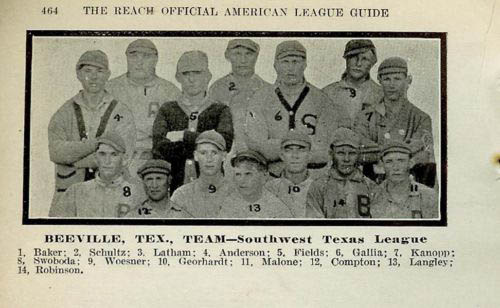
The 1911 Beeville club won the pennant by forfeiture.

The 1911 Beeville club won the pennant by forfeiture.

In the second year of its brief two-season life, the six-team Class D Southwest Texas League included the Bay City Rice Eaters, the Beeville Orange Growers (managed by future UT baseball great Billy Disch for most of the final part of the season), the Brownsville Brownies, the Corpus Christi Pelicans, the Laredo Bermudas, and the Victoria Rosebuds.

The league was sunk by the weight of its inability to control local gambling and violent fan behavior toward umpires and members of the visiting clubs. As a fitting result, Beeville was finally awarded the league championship when Bay City refused to travel there to play the Orange Growers in the championship series.

In the August 26, 1911 edition of the Victoria Advocate, here’s how one city’s press explained their own Rosebud team’s early withdrawal from the league prior to the end of the season:

********************

ONE AFRAID AND OTHER GLAD OF IT

Bay City does not want to play Beeville for the championship pf the Southwest Texas League, and Beeville seems to be glad of it, for the Orange Growers do not appear to be making any determined effort to meet the Rice Eaters. It is rumored here that both clubs will disband today.

There is some misunderstanding as to the ownership of the silver loving cup that J.K. Greer, a prominent jeweler of this city, gave Brownsville last year (1910) for winning the pennant, as will be noted from the following dispatch from Brownsville:

**********

“President Dickinson of the Southwest Texas League today sent for the silver cup won by the Brownies last year.

“The local management is of  the opinion the cup became the property of Brownsville on its winning last year, and the matter is under investigation.”

**********

Victoria withdrew from the Southwest Texas League because it had good reason to believe its finances were being mismanaged.

Because the president of the league was prejudiced against Victoria and plainly showed by his own action and that of the umpires, that he would do all in  his power to prevent Victoria from winning the pennant.

Because of the prejudice, which often asserted itself in the worst forms of rowdyism, that existed in most of the other towns against the Rosebuds as a result of their winning ability last year and through fear of them this year.

These, briefly stated, are the reasons why Victoria withdrew from the league, and they are plain and sufficient. …

Now to enlarge upon them:

Each club was required to post $500 with the president of the league as a guarantee that it would remain in the league. Instead of that, most of this money was used by the president to pay the salaries of the defunct Corpus Christi Club, which action did not become known to the rest of the other clubs, except Victoria, until long after it had been taken. The president also used this money in other ways he had no right to, and at the time the Victoria team was disbanded, there was less than $500 of Victoria’s $500 left in the treasury, so the president himself is alleged to have reported.

Most of the umpires were scouts and, in order to help the records of players they wanted to sell, they would give them the benefit of their decisions whenever there was any possible chance to do so. If it were a pitcher they had their eyes on, the batters would be struck out almost in rotation. If it were some other player, he would be allowed to take his base on balls before he would be permitted to strike out; in running the bases he would be safe a block if caught out by a mile and if he himself should touch a baserunner who was safe a mile, he would be out a block. The Advocate is proud to say that no Victoria players were favored in such a manner, but it can name several who were.

After a player on another team had thrown the (game) balls away, and the team had refused to play further, the umpire forfeited a game played with Corpus Christi to Victoria, and upon making his decision the umpire had to be escorted off the field by an officer because of the threatening attitude of the Corpus Christi players. In the face of all this, the president refused to let the forfeit to stand, and made Victoria play the game over. And only one of the offending players received any punishment, and he was let off with a slight fine.

(The Advocate continues its tirade against the unfair league in the article, never citing a single incident that might have been provoked by the angelic Victoria Rosebuds. The “bottom line” here actually seems to fall about two-thirds of the way through this editorial diatribe when the Advocate reviles from the idea that their Victoria team has been accused, in so many words, of cowardice – and that came pretty close to a “quick draw gun fight on Main Street back in 19th century parts of rural southwest and west Texas. Here’s the load-em-up paragraph that could have played out like an old western movie, but did not, as far as we know:)

Because Victoria had the decency to withdraw from such a disgraceful organization, the newspapers in other towns over the circuit refer to it as a “quitter” and to the team as the “Yellow Rosebuds.”

… Victoria Advocate, August 26, 1911, Page 1

********************

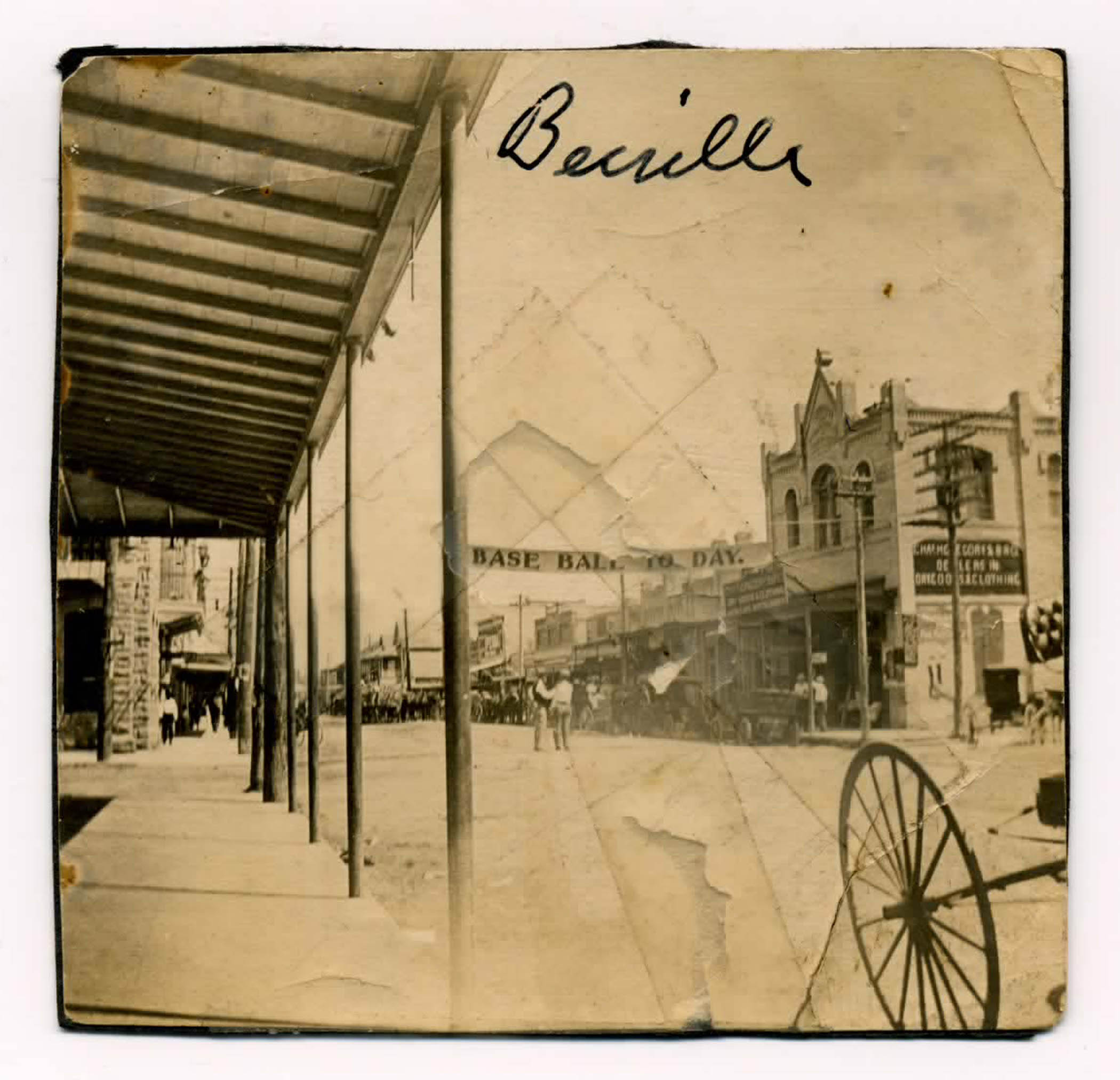
Downtown Beeville on Game Day still looked like a good place for gun fight in 1911, if one was needed.

Downtown Beeville on Game Day still looked like a good place for gun fight in 1911, if one was needed. Beeville’s never been short of its share in the distribution of the good, the bad, and the ugly demographics.

Say – who are you calling yellow, you dirty ornery skunk?

Joe Vance Was an Early Two-Sport Guy

November 12, 2013
Joe Vance: The Pitcher was also a Running Back.

Joe Vance: The Pitcher was also a Running Back.

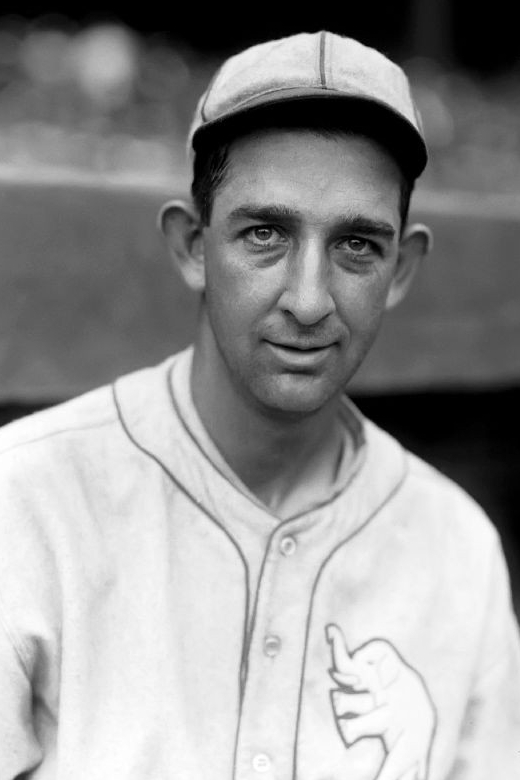
Joe Vance (BR/TR) (6’1″, 180 lbs.) was a pretty fair country pitcher, although there is no indication that he shared the bloodline that produced the Hall of Fame pitcher we know as Dazzy Vance. He was still a good one at the minor league level. He posted a 3-2, 5.81 MLB mark with the White Sox in 1935 and the Yankees in 1937-38.

Born September 16, 1905 in Devine, Texas, Vance was one of the early multiple sport professional athletes. He played in 11 games for the 1931 NFL Brooklyn Dodgers as a running back, starting in 4 games and scoring 2 season/career TDs. He either got hurt or got wise to the possibility that the impact of football could shorten his baseball career, so he quit football after one season.

Most of Vance’s career was spent in the minors. After 13 seasons in the minors (1930-42), Joe Vance finished with a pitching record at that level of 108-101, 3.53 ERA.

Joe’s best ERA season was at Dallas in 1934 when he went 11-7 with an earned run average of 2.24, His best season for wins was 1937 at Kansas City in which he won 17, lost 9, and put up an ERA of 4.28.

Vance, Joe

Joe Vance must have been fairly fleet-of-foot too. When he died in Austin on July 4, 1978 at the age of 72, and as you may see on his marker, Joe Vance claims to hold the record for the fastest time in running all the bases and touching home with a lapsed time of only 13 seconds.

Rest in Peace, Joe Vance. You did enough to be remembered by the baseball community for all the best reasons in the world. And these in-the-game accomplishments are more important than establishing a baseball base running niche record.

1924: Bagwell Clouts Home Run for 7-6 win

November 11, 2013
Bill Bagwell Galveston Sand Crabs 1924

Bill Bagwell
Galveston Sand Crabs
1924

No, it wasn’t our 21st century Jeff Bagwell. Even our mighty, beleaguered and often old-playing Jeff wasn’t ancient enough to have played a heroic role in a game that graced the coastal green of Galveston’s Gulfview Park back on September 3, 1924.  It was late in the season of the Galveston Sand Crabs. They were playing their last year as members of the Texas League and it was one of those games that the baseball gods sometimes anoint as a special time for goats and heroes to stand out above all others.

Bill Bagwell (BL/TL) played right field for the Galveston Sand Crabs in 1924, but he had done fairly well in short duty with the Boston Braves and he would do so again for the 125 Philadelphia A’s. He would hit .364 over nine seasons as a minor leaguer during select years that fell between 1920 and 1930.

Tuesday, September 3, 1924 just happened to be one of those golden memory days.

Pitchers Leo Moon of the Sand Crabs and Eddie Matteson of the Beaumont Exporters had been battling each other all day, and they were dragging a 6-6 tie into the bottom of the ninth, with Bagwell due up first for the crustaceans. It was hero vs. goat label assignment time. Bill Bagwell lifted a lusty fly ball to right field that just kept on going over the fence for what we now so readily call a “walk off” homer with none on and none out in the bottom of the ninth for a 7-6 Galveston home town win.

Hero: Bagwell. Goat: Matteson.

The Crabs were heading for a listless 7th place finish in the 1924 Texas League season, but the Bagwell home run apparently lifted a few Galvestonian spirits for the day, at least. The Galveston Daily News used the exact headline we used here in the column title as their game report headline: “BAGWELL CLOUTS HOME RUN FOR 7-6 WIN”.

As an amusing surprise, the game was handled that day by a couple of surprise/emergency umpires. When the two league-assigned officials did not show up, “Eddie Burns, the purveyor of cold drinks and hot peanuts, agreed to hand out decisions of the sacks while (Ice Man) Gates, whose regular occupation is selling ice, called the balls and strikes.” The pair drew high praise for the superior quality of their work.

We can almost hear their calls today as they echo to us from the halls of history: “Peanuts! Ice and Water! Balls and Strikes.”

Have a great week everybody. Here’s the box score and game data, as it also appeared in the September 4, 1924 edition of the Galveston Evening News:

BEAUMONT POS AB R H PO A E
Rabbitt CF 5 0 1 2 1 1
Stansberry SS 5 1 2 2 4 1
Ostergard RF 5 1 2 0 1 0
Kearns 1B 3 1 0 14 0 0
Taylor LF 5 1 3 2 0 0
Burns C 5 1 3 2 0 0
Lothes 2B 3 1 2 2 1 0
Behrens 3B 4 0 0 0 5 1
Matteson P 5 0 1 0 3 1
TOTALS 40 6 14 24 * 15 4
GALVESTON POS AB R H PO A E
Hurt 2B 4 1 1 1 0 0
Brown 3B 5 2 2 0 0 0
Whiteman LF 5 1 2 1 1 2
Bagwell RF 5 2 3 4 2 0
Burkett SS 4 1 2 3 2 0
Perussina CF 3 0 0 7 0 1
Mueller 1B 4 0 1 7 0 0
Schroyer C 4 0 1 4 1 0
Moon P 4 0 3 0 2 0
TOTALS 38 7 15 27 8 3
Game Time: 1 H 45 M
  • NONE OUT WHEN WINNING RUN SCORED.

LINE SCORE for Beaumont @ Galveston, September 3, 1924:

TEAMS 1 2 3 4 5 6 7 8 9 ~ Total
Beaumont 3 0 0 0 2 0 1 0 0 ~ 6
Galveston 2 2 0 0 1 0 1 0 1 ~ 7

GAME SUMMARY:

2BH: BURKETT; 3BH: STANSBURY; HR: LOTHES, BAGWELL; SB: RABBITT; SH: HURT, LOTHES; SO BY MOON: 4; SO BY MATTESON: 2; BB OFF MOON: 4; BB OFF MATTESON: 1; LOB: BEAUMONT 12, GALVESTON 9; WP: MOON; WIN TO: MOON; LOSS TO: MATTESON; TIME OF GAME: 1 HOUR, 45 MINUTES; UMPIRES: GATES AND BURNS; ATTENDANCE: UNREPORTED.

Regarding That Miggins-Musial Dugout Photo

November 10, 2013
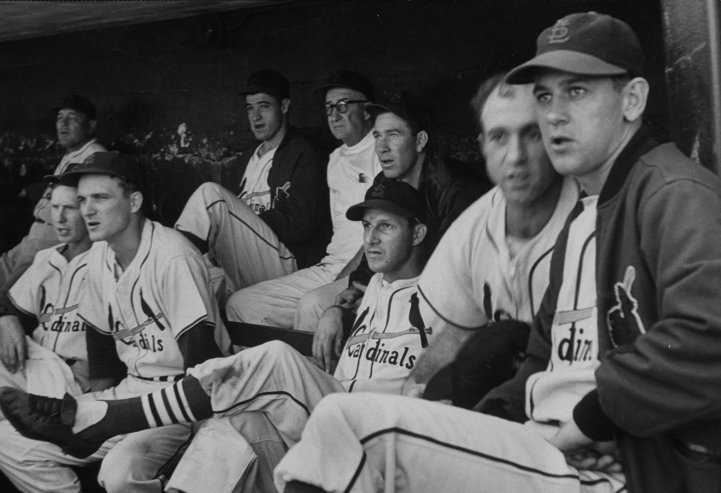
Who's in this picture with Larry Miggins? Guess now because most of the answers are revealed in the following narrative.

Who’s in this picture with Larry Miggins? Guess now because most of the answers are revealed in the following narrative.

That wonderful Cardinals dugout photo that we used yesterday in the Miggins MLB HR story yesterday is a new find for many of us. I had never seen it until one of the adult Miggins sons, Neil Miggins, e-mailed it to me on 10/30/13. The Miggins family also had only discovered it when they found it among photos in a recent Time magazine pictorial on the great Stan Musial.

Can you imagine how that must have felt? To be perusing your way through one of America’s last iconic magazine periodicals and – hold 0n – oh my gosh – there’s Dad – and he’s sitting right there in the dugout as a young man in a Cardinals uniform – leaning intently forward into his look upon the field – and he’s also sitting between two Hall of Fame members – Stan Musial and Red Schoendienst!

Who else is in the photo? Here are the names of all, but two:

Far right: That’s pitcher Joe Presko in the Cardinals jacket and cap. A balding third baseman Tommy Glaviano appears to be whispering into Joe’s ear.

Directly behind Larry Miggins: That’s Solly Hemus.

People you (should) already recognize: That’s Stan Musial, sitting to the immediate left of Miggins; Red Schoendienst is seated to Larry’s immediate right.

To the right of Solly Hemus in the second row: I can’t recall the name of the doctor/trainer in white to Solly’s immediate right, but that’s pitcher Vinegar Bend Mizell in the warm up jacket seated to the “Doc’s” immediate right. I also don’t recognize that hard-to-see face down the row from Mizell’s right.

Let us know how you did with a comment below. And if you think you know the identities of our two unidentified people, please enlighten us here too.

And have a peaceful, laid back Sunday!

Larry Miggins’ Two Big League Homers

November 9, 2013
1952 St. Louis Cardinals: That's Larry Miggins sitting between Stan Musial and Red Schoendienst. How many other Cardinal players do you recognize?

1952 St. Louis Cardinals: That’s Larry Miggins leaning forward and sitting between Stan Musial and Red Schoendienst. How many other Cardinal players do you recognize?

You fellow members of the Larry Dierker Chapter of SABR (The Society for American Baseball Research) know of local baseball legend Larry Miggins as the tall and eloquent Irishman who is also one of the regulars at our monthly chapter meetings in downtown Houston. For those of you who do not know him, Larry is a former Houston Buff and St. Louis Cardinal – and one of the men who played in Jackie Robinson’s first organized baseball games when Jackie began as a member of the 1946 Montreal Royals. Miggins played third base for the Jersey Giants that fine April day.

“Robinson should have remembered me – and also been grateful for the fact I was there that day,” Miggins will tell you. “Because my manager was making me play deep, I managed to kick in two infield bunt base hits to his first day totals on the road to Brooklyn.”

Miggins had one “oh for one” time at bat with the Cardinals in 1948 and then returned for 42 games as an outfielder for the 1952 St. Louis NL club. That was it for Miggins and the majors, but remember too, these were the days of the reserve clause, when the Cardinals controlled some of the best talent available to the entire 16-club big league scene.  If you got a chance at all at the big club, at all, and many did not, you had to almost play like a future Hall of Famer in the big club short-term to stick – and Larry didn’t get that done. He batted only .229 in 42 games and 96 official times at bat in 1952 and, also like all the others bound to one club back then with no other in-the-field options, Larry never got another shot at the big leagues.

But while he was there, Larry Miggins also hit two homers off two of the greatest players in the game. One of them would even go on to the Hall of Fame as one of the greatest, most durable lefties of all time. And, as so often is the case with Mr. Miggins, there was a story behind each classic homer.


Miggins HR # 1: May 13, 1952/ Brooklyn Dodgers 14 – St. Louis Cardinals 8 / @ Ebbets Field in Brooklyn / Miggins hits a 2-run HR off right hander Preacher Roe in the 4th inning.

The story here belongs to baseball broadcasting icon Vin Scully. Scully and Miggins were high school classmates in New York City when Vin predicted to Larry: “One of these days, you are going to be making your debut in the big leagues and I’m going to be there to call the shot on your first big league home run. When Miggins came to bat against Preacher Roe, Vin Scully was just breaking in as the junior announcer on Dodgers radio broadcasts and he happened to be at the mike when Larry came to bat in the fourth. Unfortunately, we do not have a transcript of Scully’s call on Miggins’ home run, but wouldn’t it have been wonderful to hear now, if we did.


Baseball Almanac Box Score: SL Cardinals 8, Brooklyn Dodgers 14
Game played on Tuesday, May 13, 1952 at Ebbets Field
St. Louis Cardinals ab   r   h rbi
Stanky 2b 5 1 1 0
Hemus ss 4 0 1 0
Lowrey rf 4 1 0 0
Musial 1b 5 3 3 4
Schoendienst 3b 5 1 3 0
Westlake cf 5 1 2 2
Miggins lf 5 1 1 2
Rice D. c 3 0 2 0
Presko p 1 0 0 0
  Schmidt p 0 0 0 0
  Yuhas p 1 0 0 0
  Werle p 0 0 0 0
  Rice H. ph 1 0 0 0
  Boyer p 0 0 0 0
  Slaughter ph 1 0 0 0
  Bokelmann p 0 0 0 0
Totals 40 8 13 8
Brooklyn Dodgers ab   r   h rbi
Reese ss 4 2 1 1
Cox 3b 5 3 2 1
Robinson 2b 4 2 1 0
Campanella c 5 1 3 2
Pafko lf 4 2 1 2
Snider cf 4 1 2 3
Hodges 1b 4 1 2 3
Furillo rf 4 0 0 0
Roe p 2 0 0 0
  Wade p 3 2 2 1
Totals 39 14 14 13
St. Louis 0 0 0 4 0 0 2 0 2 8 13 1
Brooklyn 0 2 4 0 4 1 0 3 x 14 14 1
  St. Louis Cardinals IP H R ER BB SO
Presko  L(1-2) 2.0 5 5 5 2 1
  Schmidt 0.2 1 1 1 3 1
  Yuhas 2.0 3 4 4 4 2
  Werle 0.1 1 0 0 0 0
  Boyer 2.0 1 1 1 1 1
  Bokelmann 1.0 3 3 3 1 0
Totals
8.0
14
14
14
11
5
  Brooklyn Dodgers IP H R ER BB SO
Roe 3.0 7 4 4 2 1
  Wade  W(1-1) 6.0 6 4 2 1 6
Totals
9.0
13
8
6
3
7

E–Boyer (1), Cox (2).  DP–Brooklyn 1. Robinson-Reese-Hodges.  2B–St. Louis Schoendienst (7,off Roe); Westlake (3,off Roe), Brooklyn Snider (4,off Presko); Wade (2,off Bokelmann).  3B–St. Louis Hemus (1,off Roe).  HR–St. Louis Miggins (1,4th inning off Roe 1 on 0 out); Musial 2 (4,7th inning off Wade 1 on 2 out,9th inning off Wade 1 on 0 out), Brooklyn Hodges (3,2nd inning off Presko 1 on 0 out); Wade (1,6th inning off Boyer 0 on 1 out).  Team LOB–8.  IBB–Hodges (1,by Yuhas).  Team–12.  SB–Pafko (1,2nd base off Werle/D. Rice); Campanella (3,2nd base off Bokelmann/D. Rice); Cox (2,Home off Bokelmann/D. Rice); Pafko (1,2nd base off Werle/D. Rice); Campanella (3,2nd base off Bokelmann/D. Rice); Cox (2,Home off Bokelmann/D. Rice).  U-HP–Artie Gore, 1B–Bill Stewart, 2B–Augie Guglielmo, 3B–Jocko Conlan.  T–3:20.  A–4,951.

Game played on Tuesday, May 13, 1952 at Ebbets Field
Baseball Almanac Box Score | Printer Friendly Box Scores

Miggins HR # 2: September 19, 1952/ St. Louis Cardinals 8 – Boston Braves 6 / @ Braves Field in Boston / Miggins hits a 2-run HR off left hander Warren Spahn in the 6th inning.

In a game the Cardinals went on to win, 8-6, Larry Miggins’ 2-run shot in the 6th tied the score at 3-3.

Many years later, Miggins and Spahn met again when both signed up to play in an Oldtimers’ Game at the Astrodome in Houston. Larry didn’t really know Spahn, but he could resist approaching the great Hall of Famer to see if he even remembered him from the 1952 season.

“Remember you?” Spahn briskly reiterated Miggins’ question. “Of course, I remember you. You were the rookie that hit that curve I left hanging over the plate in late September. Cost me the game. You don’t forget stuff like that.”

Baseball Almanac Box Score: SL Cardinals 8, Boston Braves 6
Game played on Tuesday, September 16, 1952 at Braves Field
St. Louis Cardinals ab   r   h rbi
Hemus ss 4 3 3 3
Schoendienst 2b 3 1 2 0
Musial 1b 5 1 3 3
Slaughter rf 5 0 1 0
Lowrey cf 2 1 0 0
Miggins lf 4 1 1 2
  Chambers p 0 0 0 0
  Yuhas p 1 0 0 0
  Brazle p 0 0 0 0
Glaviano 3b 2 0 0 0
  Rice H. ph,lf 1 0 0 0
Rice D. c 5 0 0 0
Mizell p 2 0 0 0
  Miller p 0 0 0 0
  Stanky ph 1 0 1 0
  Stallcup pr 0 1 0 0
  Benson 3b 2 0 0 0
Totals 37 8 11 8
Boston Braves ab   r   h rbi
Jethroe cf 4 2 0 0
Logan ss 4 1 1 1
Mathews 3b 4 1 2 0
Cooper c 4 1 1 2
Gordon lf 4 1 1 1
Torgeson 1b 5 0 1 1
Sisti rf 2 0 1 1
  Daniels ph,rf 2 0 0 0
Dittmer 2b 4 0 1 0
Spahn p 1 0 0 0
  Jester p 0 0 0 0
  Cusick ph 1 0 0 0
  Chipman p 0 0 0 0
  Burris ph 1 0 0 0
  Cole p 0 0 0 0
Totals 36 6 8 6
St. Louis 1 0 0 0 0 2 4 1 0 8 11 3
Boston 0 0 0 3 0 1 1 0 1 6 8 1
  St. Louis Cardinals IP H R ER BB SO
Mizell 5.1 7 4 4 4 4
  Miller  W(6-2) 0.2 0 0 0 0 1
  Chambers 0.1 1 1 0 0 0
  Yuhas 2.1 0 1 0 2 2
  Brazle  SV(15) 0.1 0 0 0 0 0
Totals
9.0
8
6
4
6
7
  Boston Braves IP H R ER BB SO
Spahn  L(14-17) 6.0 9 7 7 4 4
  Jester 1.0 0 0 0 2 1
  Chipman 1.0 2 1 1 2 0
  Cole 1.0 0 0 0 0 1
Totals
9.0
11
8
8
8
6

E–H. Rice (4), Benson 2 (4), Sisti (16).  DP–St. Louis 2. Hemus-Schoendienst-Musial, Hemus-Schoendienst-Musial, Boston 1. Jethroe-Torgeson.  PB–D. Rice (7).  2B–Boston Dittmer (7,off Mizell); Gordon (20,off Mizell).  HR–St. Louis Miggins (2,6th inning off Spahn 1 on 1 out); Hemus 2 (14,7th inning off Spahn 1 on 0 out,8th inning off Chipman 0 on 1 out); Musial (18,7th inning off Spahn 1 on 0 out).  Team LOB–10.  Team–9.  SB–Lowrey (3,2nd base off Jester/Cooper).  U-HP–Augie Donatelli, 1B–Lee Ballanfant, 2B–Al Barlick, 3B–Tom Gorman.

Game played on Tuesday, September 16, 1952 at Braves Field


Thank God for Larry Miggins.

Larry Miggins Former Big Leaguer and Active SABR Member

Larry Miggins
Former Big Leaguer and Active SABR Member

Larry Miggins is one of God’s major league contributions to the human race and a storied life in baseball history on many levels. In closing today, for example, there was the time he showed up early for baseball practice as a freshman student athlete at the University of Pittsburgh. No one else was there, but this old man with a ball and glove and it was still too cool to just stand around and wait for the others. The old man flipped the ball to Miggins and the two played catch as they awaited the rest of the team and staff.

The old man turned out to be Honus Wagner, who was there as a volunteer coaching assistant, apparently for no greater reason than the fact he was a baseball man and wanted to do what he could to help the kids learn to play and love the game too.

And now that special young man, Larry Miggins, is an active member of our Larry Dierker SABR Chapter in Houston.

How many other SABR chapters have a member who not only homered off Preacher Roe and Warren Spahn, but also, more than once, played catch with Honus Wagner?

Not too many, I would think.

Houston Baseball Fans of 50 Years Ago: The More Things Change, The More They Remain The Same

November 8, 2013

A MOO

Back on July 11, 1963, Galveston Tribune sports staff reporter Chuck Pickard collected these fan opinions into one column on the needs of the Houston Colt .45s in their second year of MLB life. Much of what the fans sa0d back then may sound familiar today.

Fifty years later, the more things change, the more they remain the same.

Enjoy!

********************

Better Days Await Colts

By

Chuck Pickard, News-Tribune Sports Staff, Galveston Tribune, July 11, 1963

Although Houston is floundering around in the Depths of the National League this season, better things are ahead for the Colt .45s in the next five years.

At least this was the opinion gleaned in an interview with 12 Galvestonians Wednesday.

Leading off the interview was J.W. BROWN, manager of Walgreen Drugs.

For the first pitch, Brown was asked to pinpoint the main reason for the decrease in Houston’s attendance this season.

“There was more general public interest in the Colts last season,” the druggist answered. “There were a lot of fans went to games last season just out of curiosity. This year the Colts are having to depend more on the dyed-in-the-wool fan.”

The next batter was ARNOLD NEFF, manager of the Style Mart clothes store. Neff, who has been a baseball fan all his life, has viewed four games in Colt Stadium this season and he hopes to see every team in the league play at least once this year.

Domed Stadium Will Help

As for the future, Neff feels Houston will eventually become one of the top drawing teams in the National League. “The dome stadium will attract people from all over the country,” he said.

RON LUKER, a salesman at Skain’s Sporting Goods, thinks the Colts’ inability to win on the road is putting a crimp in home attendance.

“Another thing that hurts the gate is the Colts’ failure to put together a winning streak,” Luker said. He still feels Houston’s home attendance will reach the 850,000 mark.

Hitting cleanup in the interview was young MIKE LUQUETTE, a member of the Ball High football team.

Although he will quickly tell you football is his favorite sport, Luquette is happy he lives near major league baseball. The Ball High gridder has attended only one Colt game this summer, but he hopes to see more, time permitting.

GILBERT MENDIOLA, a parking lot attendant, hated to see Houston trade away Roman Mejias to the Red Sox. Mendiola has seen two games this season and is a regular listener on radio.

Barbers SAM and CHARLES PISTONE are avid Colt backers, but they both feel Houston is killing its gate, especially in the outlying areas, by blacking out major league telecasts on the weekend.

Sam thinks Mejias would have turned the tide in some of the one-run defeat suffered by Houston this season. Brother Charles calls Dick Farrell “one of the best pitchers in the league.”

I.C. JONES, a Texaco Service Station owner, hasn’t seen the Colts play this year, but he hopes to make at least one game on their next homestand. He wants to see the Mets. “Maybe Houston can win then,” smiled Jones.

ALEX BALFOUR, a fireman who has followed Houston baseball dating back to the days of Joe Medwick and Dizzy Dean, thinks the Colts need more depth before they can move up in the standings.

Should Televise Home Games

FAYNE NEWBURN thinks attendance at Colt games would improve if the team would televise its home games.

“Just look what TV did for bowling,” remarked Newburn, a desk clerk at the Jean Lafitte Hotel. “There’s no reason TV couldn’t do the same for baseball.”

MRS. G. BROOKS doesn’t let working as a cashier at the Martini Theater keep her from hearing Colt games. She had her portable radio tuned to every play of Houston’s 2-0 victory over Pittsburgh Wednesday night.

Mrs. Brooks is another who objects to the blackout of major league games in Galveston. “This is stamping out baseball interest on the island,” she claims. “Now we don’t see American League teams at all.”

GENE MARINELLI was the last to take his swings, and the Galveston barber predicts better things for the Colts.

“Houston has had a lot of bad luck on the road, but with a few breaks turning their way the Colts should start winning,” Marinelli said.

The Colts made a prophet of Marinelli by beating Pittsburgh.

********************

In 1963 and 2013, hope springs eternal.

Last Call for the Dome’s First Pitch

November 7, 2013

Long before the apparently last pitch for the Astrodome on November 5, 2013, the first pitch for the now shaky life expectancy of the 8th Wonder came down the 60’6″ baseball game toll road on April 9, 1965. It was the first game ever played at the Astrodome and the brand new Houston newly named Astros were there to entertain the visiting New York Yankees in a pre-season exhibition contest. The right-handed Turk Farrell had taken the mound for the Astros amid the first loud indoor baseball park roar had just approached crescendo as Mickey Mantle of the Yankees stepped up to the plate, eager and ready to become the first batter in Astrodome history.

As we continue our mourning for the impending loss of Houston’s Eiffel Tower-class icon, here’s how the brilliantly descriptive, talented, and sadly-for-us, long deceased Wells Twombly described this first-Astrodome-pitch event in his April 10, 1965 column for the Houston Chronicle:

EPSON MFP image

That’s it. As unsensational and ordinary and clairvoyantly symbolic it may have been for most of the Astros’ future in the Dome, it was done. The first pitch in Astrodome history had been delivered.

Happy late week adventures, everyone. If you have a favorite public or personal moment in Astrodome history, please think about sharing it with the rest of us here as a comment on this column.

Thank you,

The Pecan Park Eagle