Icon Appreciation: St. Louis vs. Houston

April 7, 2015
Which came first? .... The Chicken?

Which came first?
…. The Chicken?

.... Or The Egg? Better yet .... which will be around forever?

…. Or The Egg?
Better yet …. which will be around forever?

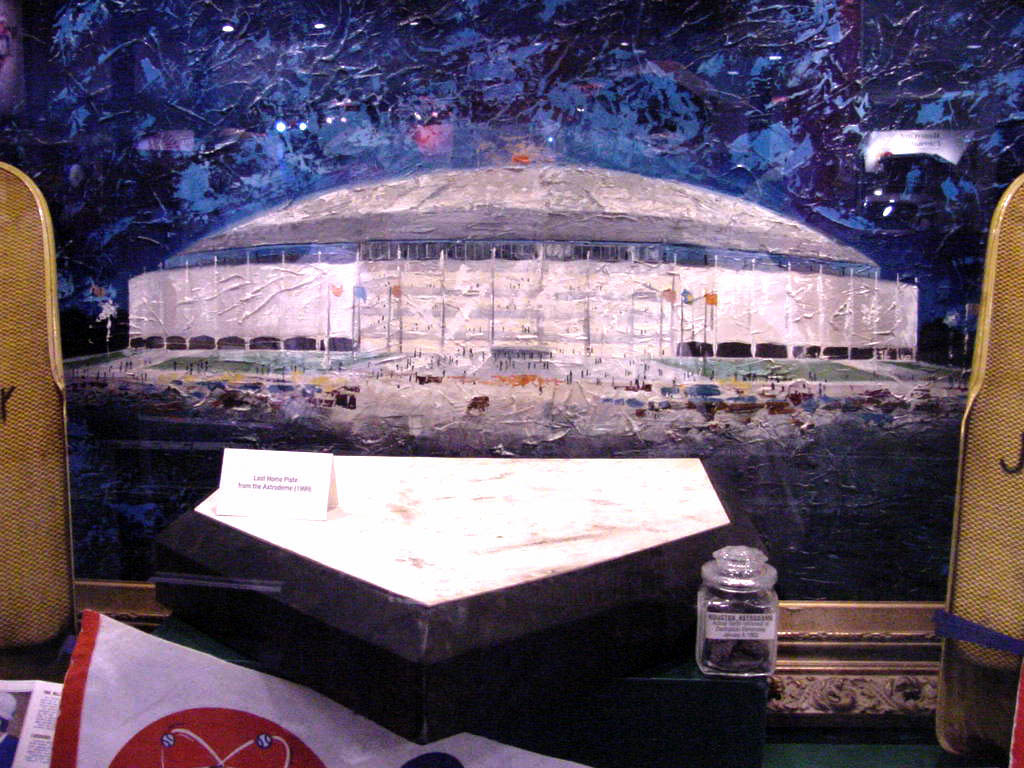
By their separate actions, which place apparently appreciates the iconic structures of their two respective cities the better, St. Louis or Houston?

Ralph Bivins, editor of Realty News Report, is a past president of the National Association of Real Estate Editors. and the author of an op-ed article this week for his own journal that unequivocally shows St. Louis in the better light while dutifully chastising the wealthy Houstonians – whom we often reference here as the local tycoons “With deep pockets and short arms” who never seem to show up when we locally rouse and raise the question, once again, – “What are we going to do with the Astrodome that is both a fitting and workable usage plan for preserving our Houston icon – and one of the world’s great modern templates of stadium architecture?”

http://houston.culturemap.com/news/real-estate/04-06-15-st-louis-absolutely-shames-houston-on-the-astrodome-with-unabashed-big-money-love-of-its-own-historic-icon/

Bivins goes straight to some bottom line evidence stretching back to the early 1960s in favor, so far, of St. Louis:

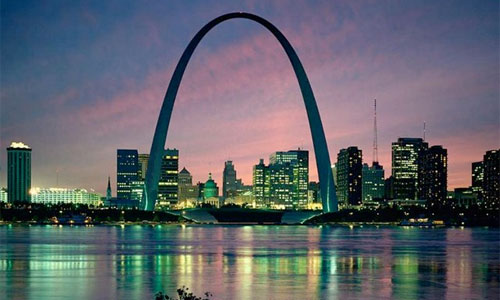
“While  St. Louis labored for its Arch, Houston was building its Dome. Both were unprecedented feats of engineering and construction know-how. The builders attempted things that had never been done before and erected remarkable structures.

“St. Louis is stepping (up) to the plate — now spending $380 million to keep its 1965 masterpiece a vital part of the community.

“If St. Louis can raise that much money, why can’t Houston come up with $242 million?

“It’s time for the leadership of Houston to lead. Whether it’s Rich Kinder, Ric Campo, Gerald Hines or some of our elected officials, Houston has great leaders who can mobilize this city. A great task lies ahead. May our leaders step forward now on behalf of the Astrodome’s future.

“The Astrodome can be transformed into something grander than it ever has been. Let’s dream big . . .  again.”

Thank you for stepping up to plate, Mr. Bivins, and becoming the latest writer to swing for the fences in behalf of Houston’s “Eighth Wonder of the World”.  The Pecan Park Eagle has been a long-time supporter of converting the Astrodome into the greatest collection of museums on local history anywhere – while interspersing fun places t0 dine, be entertained, or shop for items that are appropriate to the general theme of the venue’s new, more far-reaching and meaningful purpose – one that can serve the educational needs of school educational tours throughout the year.

And we still prefer an idea on that level to notions that an indoor park for people who are willing to pay for parking at ten bucks a car is a cheaper way to go.

Hope to see a lot of you this Thursday night at the 6:00-8:00 pm , April 9, 2015 celebration of the 50th anniversary of the Astrodome’s first baseball game. Admission and parking are both free and we may all get a chance to actually go inside the Dome on this special occasion. Stay tuned to the Houston Chronicle and other media on where to enter and what you may wish to bring. Most of the evening will be spent outside on the north side of the Dome and we are being told that, if you shall want a place to sit, you should bring a light, easy-to-carry folding chair.

We will be sitting with the folks at the SABR (Society for American Baseball Research) artifact presentation table.

Regards, Bill McCurdy, The Pecan Park Eagle.


Chronicle Gets It Wrong on West End Park

April 6, 2015
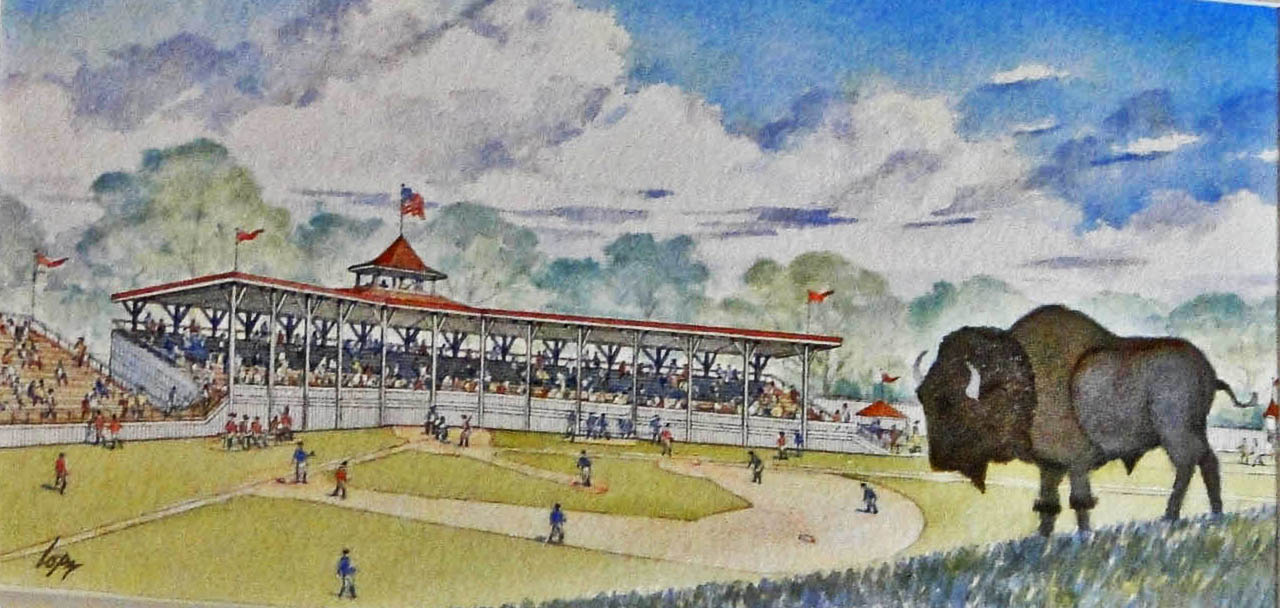
Travis Street Park,in an artistic rendering of how it appeared  in 1896 was the original home for professional baseball in Houston from 1888 forward. The buffalo in the foreground is an artistic allusion to the team's new and growing identity as Houston's team from 1896 forward. ~ Artwork by Patrick Lopez

Travis Street Park,in an artistic rendering of how it appeared in 1896 was the original home for professional baseball in Houston from 1888 forward. The buffalo in the foreground is an artistic allusion to the team’s new and growing identity as Houston’s team from 1896 forward.
~ Artwork by Patrick Lopez

Was West End Park the original home of professional baseball in Houston? – Nope! It’s just not yet so plainly understood as it needs to be as – WRONG!

In an otherwise fine homage to the Astrodome on the eve of its 50th anniversary as an indoor venue for baseball – one that began as front page Easter Sunday news that set its pace against a large pictorial backdrop of the Dome’s catacombed sky looking up from the field through a concentric web of beamed together glass panels – writer Andrew Danby got one frequently misunderstand historical fact “wrong” along the way.

No big deal – except that now the misinformation is set in permanent print for a ream of lazily researched terms papers on the Astrodome by students from the year 2065 – on the occasion of the Astrodome’s 100th anniversary.

When our Larry Dierker Houston Chapter of SABR (The Society for American Baseball Research) took on the rather challenging task of researching the comprehensive history of baseball in Houston in 2011, we already knew for certain that the first “Houston Base Ball Club” was formed in 1861 – and that there are other timeline and historical facts to support the probability that the 1836 founders of Houston from the northeast section of the country already knew the game of “base ball” when they came to these hallowed banks of the Buffalo Bayou on the wings of Texas’ victory at San Jacinto on April 21, 1836.

What we soon learned in 2011, thanks to the fine independent research work of Mike Vance of HAM, with some coincidental assistance from Darrell Pittman of Astros Daily, was that Houston’s first “base ball” professional club venue – the one used by the “Houston Babies” when they began their first 1888 season of existence as the club that would later come to be known years later as the “Houston Buffaloes” was NOT West End Park – but a field built at the corner of Travis and McGowan that back then was identified variously over the years, but fairly often referenced as “the Travis Street Park”.

West End Park – once located downtown in the area across the street from historic Antioch Baptist Church – in the same general area that is now consumed by Allen Center – did not open or become the second major Houston professional baseball venue until 1905 – when stands were constructed that year, and professional play began on a field previously used for amateur baseball games. By public contest, the name selected for the new venue was “West End Park.”

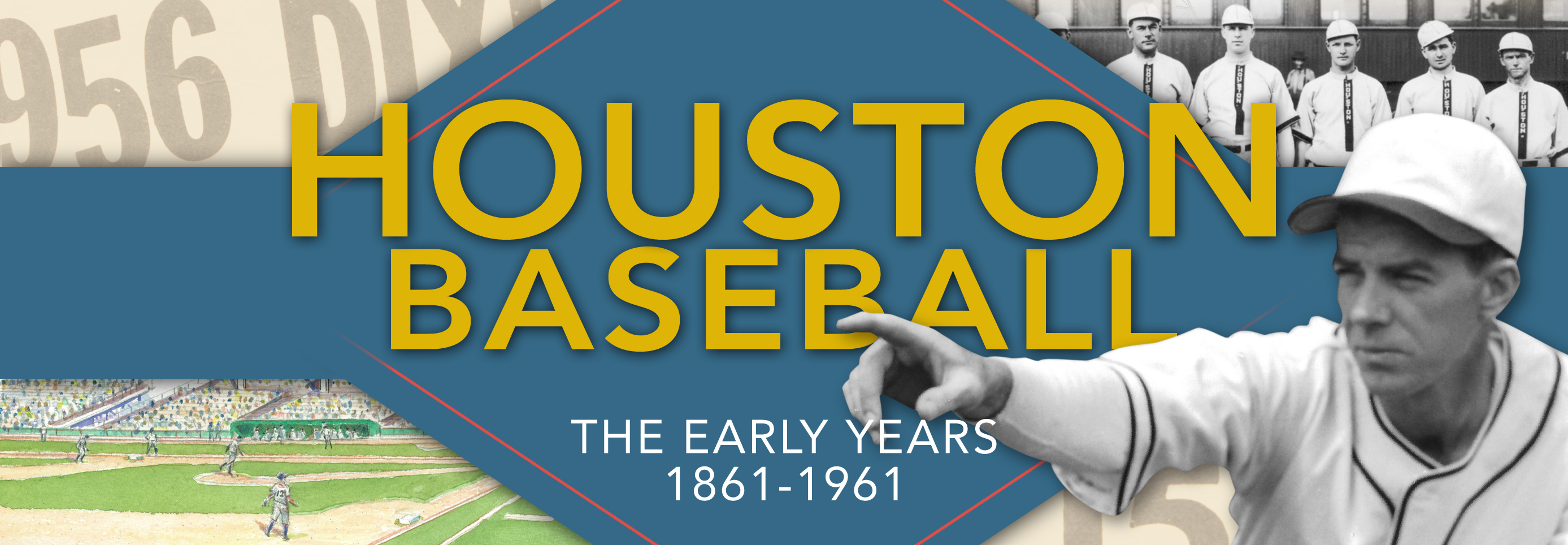
Mr. Danby simply fell into the misconception that most of us held before the truth in this matter came to light in our 2014, 368-page comprehensive research work, “Houston Baseball: The Early Years, 1861-1961”, when he wrote, as published on Page 20A of the Easter Sunday, April 5, 2015, edition of the Houston Chronicles these erroneous words: “Professional baseball in Houston started on the west side of downtown (at West Side Park).”

We forgive you this time, Mr. Danby. Maybe this error could have been avoided last year – had we been able to get the Houston Chronicle to review our research book as a legacy contribution to Houston history and then published their findings for the whole world to see that something had taken place in Houston that no other community group of research professionals has done anywhere else as a non-profit contribution to local baseball history.

"Houston Baseball: The Early Years, 1861-1961" (See ordering information at the closing of this article.)

“Houston Baseball: The Early Years, 1861-1961”
(See ordering information at the closing of this article.)

For all of you who want your own copy of the only whole truth about our local baseball legacy,  “Houston Baseball: The Early Years, 1861-1961”, it is available in Houston at your nearest Barnes and Noble location, through Amazon.Com, or through special direst orders with our SABR Chapter representative, Mr. Bob Dorrill.

To reach Bob Dorrill for s special price on this beautifully expressed factual history of Houston baseball in words, pictures and art, simply e-mail him at bdorrill@aol.com

Bob Dorrill may also be reached by cell phone during the daytime at 281.630.7151.

Bill Gilbert: Houston Astros in 2015?

April 5, 2015
Bill Gilbert is a veteran member of SABR, a respected and exceptional baseball data analyst, and a free lance reporter for The Pecan Park Eagle.

Bill Gilbert is a veteran member of SABR, a respected and exceptional baseball data analyst, and a free lance reporter for The Pecan Park Eagle. Today, Bill provides us with his view on how things appear to shake out for the Houston Astros in the 2015 AL Season.

What’s in Store for the Houston Astros in 2015?

By Bill Gilbert

  Expectations for the Astros in 2015 are higher than they have been in several years.  In 2014, the Astros broke a 3-year streak of last place finishes with over 100 losses by recording a 19 game improvement, finishing with a record of 70-92.  Not great but a clear step in the right direction, especially since they finally finished ahead of the Texas Rangers.  This, together with the emergence of Jose Altuve as a star and the anticipated breakout season from George Springer, has led to greater optimism in 2015, which is warranted, but some problems remain.
                While the Astros were below the major league average in virtually every category in 2014, the biggest deficiency was the bullpen.  This problem was addressed with the signing of free agent pitchers, Luke Gregerson, Pat Neshek and Joe Thatcher, who should provide a big improvement in relief pitching.  A similar move that was made last year didn’t work out when veteran relievers, Matt Albers and Jesse Crain were signed but both missed essentially the whole season with injuries.
                Astro starting pitching was essentially league average in 2014, due to breakout seasons by Dallas Keuchel and Collin McHugh.  However, the rest of the rotation was inconsistent.  The Astros did not do anything significant to strengthen the rotation in the off season and it may be unrealistic to expect Keuchel and McHugh to repeat their success in 2015 since neither has yet built a track record.  Two newcomers to the rotation are veteran journeyman, Roberto Hernandez who hasn’t had significant success since he was Fausto Carmona in 2007 and rookie Asher Wojciechowski who has not appeared in a major league game.  Some promising pitchers are in the pipeline but they are not likely to have an impact in 2015.  Lack of depth in starting pitching at the major league level could be the team’s major limitation.
                The Astros have an interesting offense.  They were fourth in the major leagues in home runs last year but were second in the majors in striking out, although at a lower level than their major league record of 1535 in 2013.  With the addition of Evan Gattis and Colby Rasmus and a full season from Springer, they should be in a good position to shatter the previous record despite the presence of one of the hardest players in the league to strike out in Altuve.
                The Astros should again be among the major league leaders in home runs but the key will be having men on base when they are hit.  The team’s low on-base percentage of .309 resulted in only 3.88 runs per game, below the major league average of 4.07.
\
                Defensively, the Astros were slightly below average and should be about the same this year.  New additions, third baseman, Luis Valbuena, shortstop, Jed Lowrie and outfielders Evan Gattis and Colby Rasmus are not noted for their defense.
                Putting it all together, it is tempting to think the Astros could reach .500 for the first time since 2008 but they may not have enough starting pitching to get there.  A more realistic forecast might be 79-83, a 9 game improvement over last year. They should be able to maintain their position ahead of the Texas Rangers.
Bill Gilbert
4/4/2015
"I love taking all for my brightest hopes for our Houston Astros with we to Opening Day every year, but I'm not putting all my eggs into the 2015 season bucket. - In fact, I will settle for the sunny side up of .500 ball this year. - 82-80 seems about right. Is that asking for too much - or am I simply expecting too little?" ~ A SABR-Toothed Easter Bunny

“I love taking all of my brightest hopes for our Houston Astros with we to Opening Day every year, but I’m not putting all my eggs into the 2015 season basket. – In fact, I will settle for the sunny side up of .500 ball this year. – 82-80 seems about right to me. – Is that asking for too much – or am I simply expecting too little?”
~ A SABR-Toothed Easter Bunny

Baseball Is ~ Hope Springing Eternal

April 4, 2015
"You Gotta Have Heart ... Miles and Miles and Miles of Heart!"

“You Gotta Have Heart …
Miles and Miles and Miles of Heart!”


In all consideration of baseball’s organic connection to life itself, it is impossible to tread again upon that tie without laying the foundation of all else that follows. And that broad base simply happens to be everything that stirs our lust for a life well lived – from the inside out – in all we do – from the soul-investing moment of our very first breath to our last quiet or loud exhalation. The trinity of love, faith, and hope governs all – free of the lesser ambitions of the human ego for acquisition and power – and fastened solidly to the idea of giving all that we genuinely are – back to life – with the tools we possess as individuals that came to us from life – regardless of the name we assign to our creator.

For those of us who are Christian – and these ideas do not apply exclusively to Christians – or even to deistic believers alone – this Easter weekend is a great time to share these thoughts anyway – and how the trinity of our three greatest energy forces in life apply to the game that so many of us Americans especially love. And there it is. No honest talk of baseball can move far without acknowledging that our forever first force in life – in marriage, family, friendship, creativity or baseball – is always “love”.

We are born on the wings of love. Love is also what comes to us when we meet our true soul mate – and love is what remains with the survivor of that union – when one partner dies before the other. And love is what still lives within the person who either never met – or feels they lost their soul mate to abandonment or immaturity. Love is never absent – but it is often hard to see or accept when life is going tough. – Sometimes, we simply mistake the absence of immediate consolation in our lives as the absence of love, but that is not the case. – Love never dies – or goes away. – We complexly go away or get lost from it.

If love never dies, then maybe we need to open our hearts to the understanding that life neither – ever dies – and that we simply need to look for “forever” in the place it always lives – in the only time zone that is not governed by the clocks – in a place called the present – the here and now – and the here and now – is eternal – the only time zone that is real.

The present never goes away. – We simply go away from it. – The more we are able to remain in the here and now – untethered to resentment and regret about the past – and free of expectation, fear or doubt about the future – the easier it is for us to find the strike zone with whatever we happen to be pitching – or conversely, hitting. I’ve always believed that Yogi Berra’s famous answer to the question, “What do you think about when you’re hitting, Yogi?” was based upon his instinctual awareness that “thinking” is what drives us out of the “here and now” – and that thinking in the moment of hitting is what destroys the present-focus we need to embrace to have any good chance of hitting a baseball coming at us in the mid-90s.

Remember what Yogi said? “I don’t think nothing. I can’t hit and think at the same time” – or something akin to that paraphrase.

Stay in the here and now to hear this next statement (Then think about it all you want): Faith in a power greater than ourselves is what gets us wherever we may be trying to go. The 1927 New York Yankees won 110 games. – They also lost 44 games. – By all accounts, however, they were one of the greatest teams of the early twentieth century – maybe of all time. – Do I really need to mention the names of the guys who played for that team to this readership? – I didn’t think so.

The point here is – the ’27 Yankees were a club with great individual ability – but also one that believed in themselves as a team. They didn’t take the field expecting to win – but they carried with them the belief that winning was always possible – anytime they took the field. Again, the power of the present moment is also the residence of “faith”. – Faith is inherent to the moment that a pitcher working in the “here and now” mind-state releases a rising inside fastball – that the ball is on its way to sending a message to the batter about his distance from the plate.

As for baseball played without faith, the old St. Louis Browns are but a single example of what happens to perpetual “losers” in the area of faith. – Faith does require results that justify restoration – once a team starts losing at a dynastic pace. A few of the old surviving Browns that I have known in my lifetime (men who shall remain nameless here in respect for their ancient wishes) admitted to me long ago that things reached a point where the only question that came up daily was “I wonder how we are going to lose today?” (I never had a chance to discuss this same phenomenon with any members of the 2012-2013 Houston Astros.)

And the last leg of our three-point stool in the “here and now” is hope. The importance of Hope in baseball- spells itself out in the “Damn Yankees” song “Heart” – “You gotta have hope – Mustn’t sit around and mope! – Oh, it’s fine to be a genius, of course – but keep that old horse – before the cart! – First – you gotta have heart!”

And “Heart” is a good name for this rediscovery of “forever” as always existing only in the present moment. “Heart” is the place where Love, Faith, and Hope all flourish forever in the here and now – as the place for joyful focused accomplishment in baseball – and in everyday life. In the end, “Heart” is the name that embraces everything I’m trying to share with each of you today.

We don’t really “gotta have heart”. – We’ve already got it. – We simply have to let our own paths of passion flow into the use of our hearts in giving of ourselves to life in ways of our own choosing – and sometimes – in response to issues in life that call out to us – if we only have ears to hear the invitation.

Happy Easter Weekend, Friends – even if you are just waiting on the Easter Bunny!

Darwin Would Have Loved Baseball

April 3, 2015
Don Zimmer was a baseball man who lived his whole life hungry for the game he loved. Here's the cue for us all. - If you want to have some fun in life, spend it with people who really enjoy being who they are. The fallout lessons are wonderful.

Don Zimmer was a baseball man who lived his whole life hungry for the game he loved. Here’s the cue for us all. – If you want to have fun in life, spend it with people who truly enjoy being who they are. The fallout lessons are wonderful.

The thing I always hated the most about the “DH” was the fact that it seemed to change one of the natural laws of baseball. Just as the sun always rises in the east, the pitcher always bats for himself. Baseball isn’t one of those games that we made up last summer and are still refining. It’s been around a long time, like the earth itself, and players have been adapting to its conditions over time or perishing for their inabilities to do so for as long as most of us can remember. Baseball, in effect, is the purest example of Darwinian thought that creatures either adapt to the laws of chemistry and physics governing this world – or else, they fade away as a surviving species. We are not here today in large numbers in a place called Houston, for example, because God or nature suddenly reversed the laws governing our Houston August heat. – We are here because some of our smarter members invented affordable home and car air-conditioning, the adjustment condition that made full-time life in Houston tolerable for most people who didn’t grow up here.

The real laws governing baseball are more like the laws of nature than any other sport. Our best players aren’t always the most able, or even the most intelligent. Most of those who survive as ten-year, .265 MLB hitters are there because of their adaptability – and our sport even has some masters at the cockroach level of adaptability when it comes to finding ways to survive as ballplayers that some club will want at any given time of that player’s still usable ability capacity as a either a player or mentor.

Look at all the guys like Earl Weaver, Sparky Anderson, Tony LaRussa, and Bobby Cox, for example. – Those guys had so much to give that each made it to the Hall of Fame, but those guys truly were gifted. The real cockroach-level adaptables  are not Hall of Famers, per se. They are just the street smart, adaptable, and, usually, quite likeable baseball people. The limited player and thinker Don Zimmer, for example, may have been the biggest cockroach of all time. Look at all the benches he occupied – and look at all the uniforms that Zimmer wore during his lifetime. He even prided himself at never making a penny of doing anything for a living outside of playing, coaching, or managing in the game.

And what are the qualities that set apart these “baseball cockroaches” from all others. It’s not enough to simply say that they are all survivors. I say it’s more like this: baseball is their food – and they are always hungry. If they want a job in the game with a certain club – and the door is closed and turning others away – they will simply wait until dark and scramble under the clubhouse door’s crawl-space to find a place on the bench. Then, if things work out, they will be smiling at the manager’s side when the awards and new contracts are passed out. – If not, and things go south on the field, and some media types turn the light on to that condition, they also will be the first to take note and be slithering their way out the same crawlspace they came in – and faster than anyone may need to call Orkin – but always popping up elsewhere once the dust clears – and none the worse for wear – in successful search of their next meal.

Having now read the current interview in the Wall Street Journal with new Baseball Commissioner Rob Manfred, I was taken favorably with his reflective perspective on the need for caution with any action imposing radical change upon the almost scientific antiquity of the rules that govern baseball. That is exactly why I am now less concerned that he would step in and try to impose a rule which would restrict or prohibit a defense from pulling a shift on a talented, but stupidly stubborn pull hitter. The cockroach pull hitters will punish defenses that try to impose a shift upon them – even if the most talented, prideful pull hitters continue to wing outs into the net that awaits them. To the prideful, the shift defenses almost seem to be taunting them: “Hey, mister! Please don’t hit the ball into this briar patch! Our gloves aren’t too good and you just might hurt us if you hit the ball  too hard!”

http://www.wsj.com/articles/a-q-a-with-baseballs-new-commissioner-1427991663?mod=WSJ_hpp_sections_sports

Four balls is a walk. Three strikes is an out. Three outs ends a time at bat for each team. Visitors bat first, Each team gets nine innings to bat, if needed, to try and get more runs than the other team. Whoever has the most runs at the end of nine innings, wins the game. If the game is tied after nine, you keep playing extra innings until an inning occurs that finds one team leading the other. When that happens, the team with the most runs is the winner. – Nine men per team, each playing a different position, but setting themselves up on the field where their manager thinks they will do the most good under the circumstances, Each man bats in an order that does not change – unless a substitution is made. Once you leave the game, you can’t go back. Just give it your best while you’re n there. Play the game as though your heart was in it. Don’t spit on artificial surfaces, if you can help it. And don’t step off the mound or away from the plate just to tug at your underwear.

And, even if some of us are getting used to the DH since the Astros went over to the AL, write the Commissioner if you can think of any way to get rid of it. After all, it was an aberration of the natural conditions governing baseball. And write him anyway. He also needs to kill that stupid rule that awards home team advantage in the World Series to the league that wins the All Star Game. As in life, no team should be awarded an advantage that they didn’t earn directly for themselves.

Entitlement and baseball are like oil and water. – Remember that one?

And have a great and joyful Good Friday, everyone – even if you are only waiting on the Easter Bunny.

Easter Addendum: If we have to have the “DH”, I like the suggestion that Larry Dierker made to me by e-mail, but both of his ideas here have great merit:

“Two more things: in baseball you can’t emphasize your best offensive players as in other sports. Each hitter must wait his turn and have a greater or lesser chance to produce depending on the base/out situation.

“As far as the DH, how about you can hit for the pitcher anytime you want but must not use that hitter thereafter in the game. Would make for a lot of tough decisions by the manager early in the game. Union would protest because it would eliminate a high salary. Give them a 26th roster spot in return. The way managers use pitchers these days, they need it.”

~ Larry Dierker
Lost in Time: What’s an “Unaccepted Chance”?

April 2, 2015
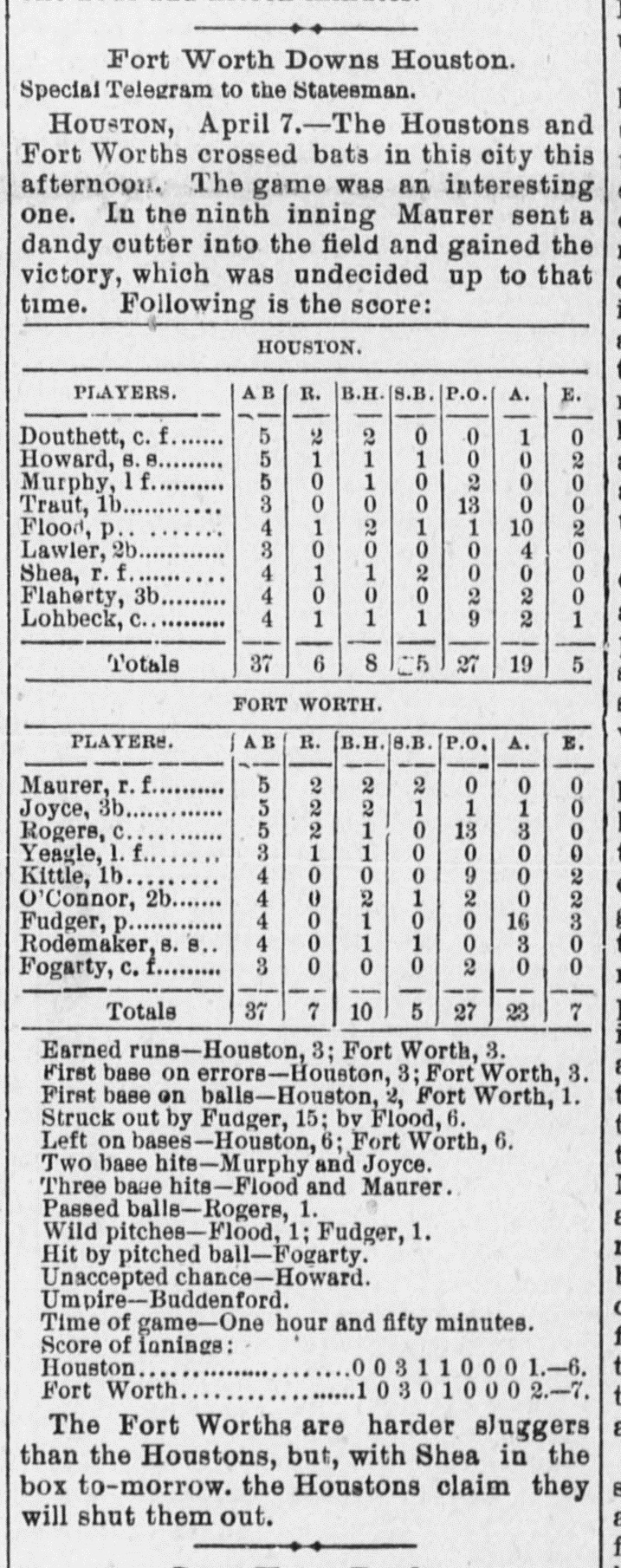
Box Score From the April 19, 1888 Edition of the Austin American-Statesman

Box Score From the April 19, 1888 Edition of the Austin American-Statesman for a Game Played by Houston and Fort Worth.

Friend and research colleague Darrell Pittman sent me this question overnight – along with the above featured 19h century box score: “What is an ‘unaccepted’ chance?” Hmmm! If you examine the details of the ancient game account, please note that Howard, the Houston shortstop, is credited with an “Unaccepted chance”.

My answer is the ever popular “damifino”! Although the question does leave ample room for considerable room for non-serious conjecture:

(1) For one thing, and this is the first thought that jumps out at me, why is the Austin American Statesmen waiting until April 19, 1888 – almost two weeks – to publish a game account and box score for a game played on April 7, 1888? – Was the esteemed capitol city newspaper making up for an earlier “unaccepted chance” to publish this story in a timely fashion?

(2) We note that Houston took a one-run lead in the top of the 9th, but that Fort Work fought back for a two-run rally that gave them a 7-6 victory in the bottom half of the last regularly scheduled game inning. – Is it possible that Fort Worth scored their winning run from third base after a batter struck a slow rolling grounder to short that Howard didn’t even bother to throw because he saw that he had no chance to get the runner – and that the official scorekeeper invented “unaccepted chance” as a credit on the play as opposed to either scoring it a “fielder’s choice” or an “infield single” by the Fort Worth batter?

(3) Is it possible that Houston shortstop Howard had the annoying habit of spitting tobacco on his manager’s shoe prior to his every time at bat for good luck – and that the team’s peerless leader had threatened Howard with an immediate benching, if he did it again? And when it did happen again in the top of the 9th, Howard batted anyway, and that his manager said nothing – passing on his “unaccepted chance” to bench Howard for cause for the sake of getting his often timely bat to the plate in a game critical situation, – and that the scorer – who was sitting behind the Houston bench the whole game to witness the entire building transaction – then erred in crediting the “unaccepted chance” to Howard rather than assign it to his manager – where it truly belonged.

(4) We have no real idea what an “unaccepted chance” once was, but it sounds like an archaic expression for fielder’s choice. If you know, please enlighten the rest of us in the comment section which follows this column.

Thank you! – The Pecan Park Eagle.

We leave you this Thursday morning with our own “accepted chance” to post our Question of the Day – based upon certain current news events in our Houston area:

Question of the Day:

Under what circumstances is the word “alright” worth $45,000 per use – up to three utterances per scheduled event?

Answer:

When the word “alright” is used by actor Matthew McConaughey as the commencement speaker to the Spring 2015 graduating class from the University of Houston.

No More Columns Today – April Fool!

April 1, 2015
japan01

Except this material is no “April Fool’s Day Joke”. – It’s the real deal. The Japanese love baseball so much that it also drives their television marketing of goods and services.

Paul Rogers, the author of works on Tris Speaker, Eddie Robinson, and many other subjects, along with being the former Dean and still teaching Professor of Law at SMU, sent me this one from YouTube this morning. Please turn on your sound and give it the two minutes it deserves as testimony to how much the Japanese love, revere, and “get” what the flow and movement of baseball is about to all of us. I’m certainly no Deacon Jones-level hitting coach, but to me, some of the ladies in this TV fantasy foray seem to have rudimentary batting forms that are worthy of MLB prospects.

https://www.youtube.com/watch?v=ag4OziaRtj4

No fooling. Enjoy. Simply enjoy.

Thanks, Paul – and since you are also on our Pecan Park Eagle column mailing list, here’s a good thing coming back to you on the same day you released this little butterfly of Japanese baseball joy in Dallas.

It really made my day.

japan02

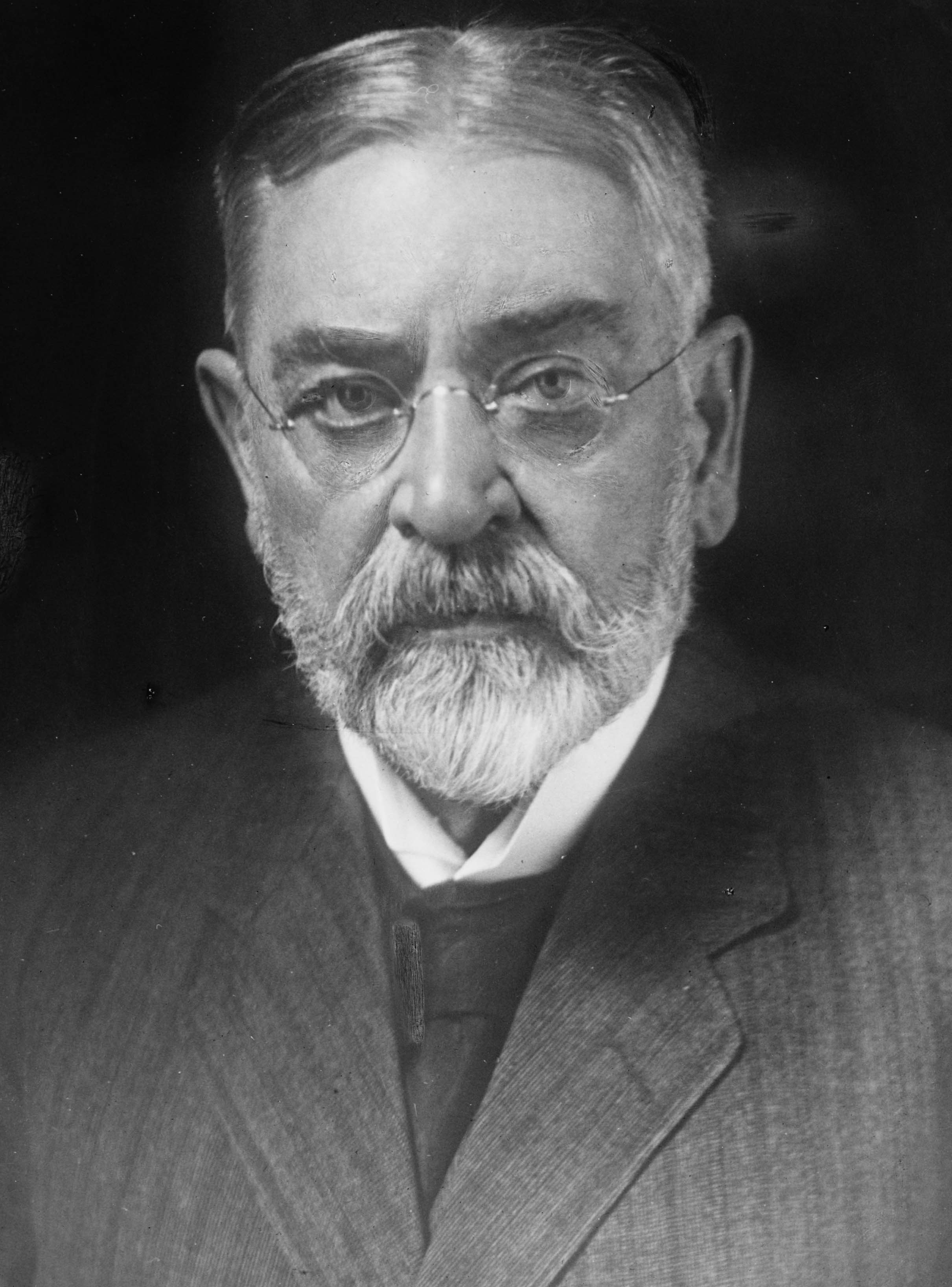
Lincoln’s Granddaughter Marries Baseball “Freak”

April 1, 2015
ROBERT TODD LINCOLN ~ DIDN'T RAISE HIS DAUGHTER TO MARRY A BASEBALL "FREAK".

ROBERT TODD LINCOLN
~ DIDN’T RAISE HIS DAUGHTER TO MARRY A BASEBALL “FREAK”.

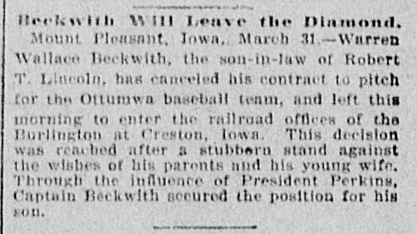
Back in the late 1890s, a young struggling and poor “ballplayer” named Warren Beckwith managed to marry into the descendant family of Abraham Lincoln by capturing the heart of the late president’s granddaughter and son Robert Todd Lincoln’s daughter, Jessie – and apparently over the strong objections of the girl’s parents, and reported by the “shocked” media of the time without the use of her first name in published accounts. It was the Victorian era – and class snobbishness dictated the feelings of some American news writers and, by conjecture, the parents of the girl that she deserved a more “prominent” life partner.

Interesting point of view, isn’t it, that it only took one generation and an incredible change in the status of the Lincoln family apparently to elevate Honest Abe’s family from “log cabin humility” to lofty self-aggrandizement in American society in their everyday views of the everyday ordinary man.

Or, perhaps, it was not really all that simple. It seems that young Beckwith, who was age 24 in early 1898, decided to seize upon his notoriety and advertise himself as a “freak” for the sake of making his place on the roster of his prospective Class D ball club in Ottumwa, Iowa more attractive to his potential employer’s designs on attracting crowds to their games.

“Freak”? – We weren’t able to find among any of the handful of stories from those times that there was any other basis for the claim offered by Beckwith at the time – and there was no reference to any two-headed or four-armed players in the game during that era. We only know that even Beckwith’s mother came forth in embarrassment to persuade the Ottumwa club to release her son for all the shame her son’s behavior was bringing to both the Lincoln and Beckwith families. It was the Victorian Era, remember, and some things were not even talked about, let alone put into news print back in that day, so we may never know the whole truth – unless someone among our readership knows more about the situation that we can discern in a morning of Internet research. – And, thanks again, to friend Darrell Pittman for alerting us to this strange case.

As Baseball Reference.com shows, Ma Beckwith’s objections and her son’s apparent lack of playing ability seemed to have proved more than enough to block Warren Beckwith from playing for Ottumwa in 1898, but he did end up on the roster of Sacramento in 1899. In fact, for the entire time that Baseball.Reference gives Warren Beckwith credit for roster status on five teams between 1895-1899, he is only shown as playing in 8 games for Sacramento in 1899 – but with no reportable field results for that year – or any other in his intriguing brief run at professional baseball.

Here are two references to the Beckwith case:

http://newspaperarchive.com/us/iowa/cedar-rapids/cedar-rapids-evening-gazette/1898/04-04/page-4?tag=warren+beckwith+robert+lincoln&rtserp=tags/warren-beckwith-robert-lincoln?ndt=ex&pd=4&pm=4&py=1898

http://chroniclingamerica.loc.gov/lccn/sn86071197/1898-04-03/ed-1/seq-11/

Here’s all that Baseball Reference has on the baseball career of Warren Beckwith:

http://www.baseball-reference.com/minors/player.cgi?id=beckwi001war

With no further information available to us on short search notice, we may only assume that his marriage to the partially anonymous granddaughter of Abraham Lincoln came to no long-term good end, but that’s nothing more than prejudicial assumption, based upon what is reported in the newspapers about how the couple started out – and we may be dead wrong to jump to that conclusion. Warren Beckwith lived to age 81 before dying in La Jolla, California in 1955. Maybe he and the former “Miss Lincoln” found a way to beat the odds and “lived happily ever after”.

Here’s a passage from Robert Todd Lincoln’s Wikipedia biography that suggests that there was some continuity in the marriage of his daughter “Jessie” to Warren Beckwith:

Of Robert’s children, Jessie Harlan Lincoln Beckwith (1875–1948) had two children, Mary Lincoln Beckwith (“Peggy” 1898–1975) and Robert (“Bud”) Todd Lincoln Beckwith (1904–1985), neither of whom had children of their own. Robert’s other daughter, Mary Todd Lincoln (“Mamie”) (1869–1938) married Charles Bradley Isham in 1891. They had one son, Lincoln Isham (1892–1971). Lincoln Isham married Leahalma Correa in 1919, but died without children.

The last person known to be of direct Lincoln lineage, Robert’s grandson “Bud” Beckwith, died in 1985.[54]

The link to that entire entry is as follows:

http://en.wikipedia.org/wiki/Robert_Todd_Lincoln

Have a great Wednesday, everybody and remember this happy thought – this time next week, we will be two days deep into the official Major League Baseball season!

_____________________

Thursday, 04/02/15, Update from Darrell Pittman:

Houston Post April 5, 1898

Houston Post
April 5, 1898

Our Top Ten New Baseball Metaphors

March 31, 2015
"Say What??? - We used all the pitchers in the All Star Game and now have to end the game as a tie??? - I've got it!!! My Acme Baseball Consultants have advised me that all will be well, if we make the winner of all future All Star Games the factor that deteremines league home adantage in the World Series!!!"

“Say What??? – We used all the pitchers in the All Star Game and now have to end the thing as a tie??? – I’ve got it!!! My Acme Baseball Consultants have advised me that all will be well, if we make the winner of all future All Star Games the factor that determines league home team advantage in the World Series!!!”

Here’s our Pecan Park Eagle List of New Baseball Metaphors (Except for the Stockholm Syndrome, which likely isn’t familiar to all, they are each fairly easy to see – and “Stockholm Syndrome”, – and maybe “Autistic Savants” are both worth a trip to Google. The ten items themselves are simply people, behaviors, and conditions that are rooted in the heart of the game and the hearts of the fans of our great game):

No. Baseball Items Corresponding Metaphors
10 Chicago Cubs Anthem “I Can’t Get No – Satisfaction”
9 Bo Porter’s Chances as Astros Manager Japanese Kamikaze Pilot
8 Road Uniform Colors in the 1930s 50 Shades of Grey
7 Designated Hitters Freddie the Freeloader, Inc.
6 Babe Ruth Autographed Ball Collectors Crack Cocaine Addicts
5 Alex Rodriguez The Strutting Male Peacock
4 1909 Honus Wagner Card Collectors “Goldfinger” Types
3 Compulsive Game Scorekeepers Autistic Savants (“Rain Man”)
2 Red Sox Fan Conversion to Yankee Fan Stockholm Syndrome Victim
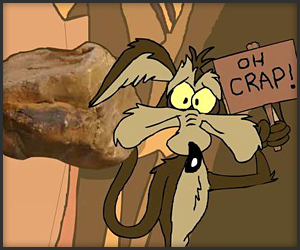
1 Bud Selig as Commissioner Wile E. Coyote

Fred Hartman: Last Buff Stadium Hurrah

March 30, 2015
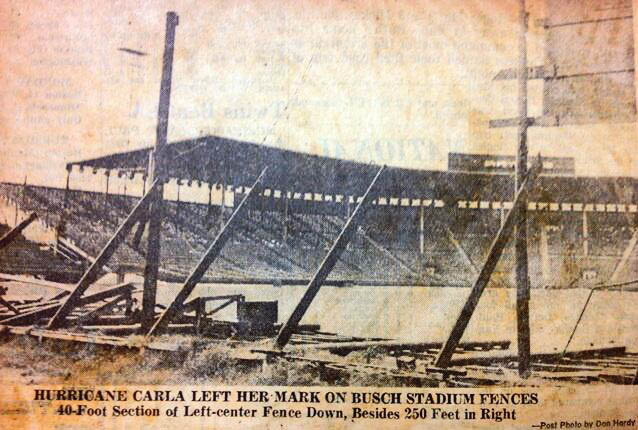
September 11, 1961: Hurricane Carla left both a physical and metaphorical message on the future of Busch-Buff Stadium in Houston. Ten days later, the Buffs played their last game ever at the quickly repaired park.

September 11, 1961: Hurricane Carla left both a physical and metaphorical message on the future of Busch-Buff Stadium in Houston. Ten days later, the Buffs played their last game ever at the quickly repaired park.

Defeated Buffs Bow Out

By Fred Hartman

Houston (AP) – Twenty-one years ago at the end of the 1940 season, the Baytown Oilers were fighting for the Houston Post semi-pro tournament championship.

They fought their way into the semi-finals, and promoters of the tournament stupidly forced the Oilers to have to win three games in one day to win the title.

They won the first two in brilliant fashion. Then their weary muscles failed them, and they fell apart in the finale.

It was a sad things to see – just as sad as the complete fall apart of the Houston Buffs Thursday night as they were shellacked, 11-4, by the Louisville Colonels.

It was a historical defeat for it came in the last game of minor league professional baseball ever to be played at Busch (formerly Buff) Stadium. (Last Game Date: Thursday, September 21, 1961.) Next spring, the fledgeling Houston Colts will begin play on a new south end field (Colt Stadium) in the National League.

Busch-Buff Stadium has been the scene of some great events, and now they are gone.

It was at home plate that Dizzy Dean and his bride were married. It was (from) there that Joe Medwick used to rattle the boards as 1961 first baseman Pidge Browne has been doing. It was (from) there that Carey Selph battled to the death as a great inspirational star. It was (from) there that Bill Hallahan’s southpaw plans won him big league opportunities. It was (from) there that Kenny Boyer began his climb to fame.

And all that is left is (are the) memories and the ignomiing (sp) (ignominy) of the final game when the Buffs, trying too hard, fell apart. How else, for instance, can you explain the seven errors, five by hustling shortstop J.C. Hartman. (?)

Jack Waters Hit the Last Home Run in the Last Time at Bat in the Last Inning of the Last Game Ever Played by the Houston Buffs, also in their Last Game at Busch-Buff Stadium on 9/21/1961. The Buffs still lost to the Louisville Colonels, 11-4, in Game 6 of the American Association Championship Series.

Jack Waters Hit the Last Home Run in the Last Time at Bat in the Last Inning of the Last Game Ever Played by the Houston Buffs, also in their Last Game at Busch-Buff Stadium on 9/21/1961.
The Buffs still lost to the Louisville Colonels, 11-4, in Game 6 of the American Association Championship Series.

 If you want one lingering memory of better things, Mrs. Calabash, wherever you are,  you can always remember the home run stroked by Jack Waters with a Buff aboard and the homelings behind, 11-2.

In Jerry Witte fashion, Waters hit a circuit clout far above the left field wall.  It soared high and far, and Jack took only three steps from home plate before he knew he had the big one. He trotted around the bases with feeble applause of only the faithful who there at the end. 

And the last record play was a brilliant one. Jim Campbell slashed a hard hit ball through the box. The Colonels second baseman had been edging that way. He made a great play on the ball, and an even greater throw to first to beat the Buffs catcher by a step.

Thus did Buff Stadium – we never did like the Busch appellation – stumble in(to) the past on a sour note that never could replace the sweeter moments that victory and sensational plays had produced in the 33 years since the opener in the summer of 1928.

Baytown is now a live and highly expectant major league suburb. It couldn’t have happened until that final out wrote finish Thursday night.

~ Fred Hartman, Baytown Sun, Friday, September 22, 1961, Page 7.