AL Changed Schedule for Gehrig at 1st AS Game

July 13, 2015
Lou Gehrig, 1939 Six Years Earlier, AL President WIll Harridge Saved Gehrig's Run at the Consecutive Games Played MLB Record.

Lou Gehrig, 1939
Six Years Earlier, AL President WIll Harridge Saved Gehrig’s Run at the Consecutive Games Played MLB Record.

As we all know, our coast-to-coast Major League Baseball alignment of 30 clubs was all made possible by the jet-propelled commercial aircraft. Today we simply take for granted that all stars playing in games for their regular clubs on the previous Sunday will have no problems being on the field in Cincinnati two days later for a Tuesday evening All Star Game.

Things weren’t that simple in the summer of 1933, the year of the first All Star Game. The game was scheduled for Thursday afternoon, July 6, 1933, at Comiskey Park in Chicago, but no prior attention had gone into the planning of the regular season schedule to accommodate a super-star game that had been promoted into existence by Chicago sportswriter Arch Ward without any thought as to how that was going to effect the teams and their all star players who already were scheduled to play regular season games for the 16-clubs that comprised the big leagues in those days from upper east coast of Boston to the midwestern city of St. Louis. It wasn’t a problem in every instance, but it was enough to merit attention as a problem.

Without any change, the games scheduled for Wednesday, July 5, 1933 were going to require all star member clubs in cities far away from Chicago to play those games without one or more their best players. Most of those “All Stars” were going to need that July 5th time to travel by train to Chicago.

The biggest rationale for making some schedule change came to the attention of AL President Will Harridge. The New York Yankees were scheduled to play a game in Washington against the Senators on July 5th. That meant that the Yankees All Stars would have to miss that game and use July 5th for train travel to Chicago.

Lou Gehrig’s run at Everett Scott’s consecutive games played record of 1,307 was just a little shy at this point, but the fly of interest in baseball circles suddenly crash-landed in the soup of the AL standing pat on this matter. Without any change to the New York @ Washington game scheduled for July 5, 1933, Gehrig’s growing reputation as “The Iron Horse” was likely to fall as a victim to his July 5th ride on a regular “iron horse” ride to Chicago.

Will Harridge took action to avoid that unintended consequence of the first All Star Game. The AL President postponed the scheduled NY game in Washington of July 5th to a time to be determined later. Gehrig and his other Yankee All Star mates, including the great Babe Ruth, would be free to travel without causing an end to Gehrig’s games-played run until 1939.

A few other pre and post All Star event regular season games had to be rescheduled to accommodate other players and clubs, but that’s simply how things were done back in 1933. It’s hard to imagine that kind of SNAFU coming up in MLB today. Today the MLB schedule makers stumble over deeper, less controllable holes – like, how do you place a Central Time zone club in a division in which most of the other clubs are located in the Pacific Time zone – and then create a mostly night game schedule of games that will be so attractive that the Central Time zone fans will want to stay awake during the week and watch their clubs play games on television that start at 9:00 PM?

This information and further notes on the 1933 first MLB All Star Game are available in a nice article by Todd Radom for The Sporting News at the following link:

http://www.sportingnews.com/mlb/story/2015-07-06/mlb-all-star-game-lou-gehrig-consecutive-games-played-streak-alive-new-york-yankees-1933

______________________________

THE PECAN PARK EAGLE
THE PECAN PARK EAGLE

Only Winners Have Slumps

July 12, 2015

“You gotta have heart!
Miles and miles and miles of heart!
When the odds are saying,
“You’ll never win,
That’s when the grin should start.”
~ “HEART”, FROM “DAMN YANKEES”

On the Sunday morning prior to the All Star Game break, we must wait until this afternoon’s games are played, Houston @ Tampa Bay and LA Angels @ Seattle, to know for certain which club goes into the big summer recess as the technical leader of the AL West. Today, thanks only to the Angels’ stubbed toe defeat Saturday at Seattle, the Astros (49-41, .544) hold a half game lead over the Angels (47-40, .540). For several hours Saturday afternoon, the Astros had relinquished their division lead for the first time since the early in the season by percentage points after a 3-1 loss to the Rays before the Angels gave it back later in the evening with a 5-0 loss to the Mariners out on the west coast.

The good news is – only winners have slumps. The bad news Astros of 2011 through 2014 lost games at the same rate as their 2015 brethren, but those weren’t slumps, or departures from the norm of a good club. Those recently bad year losing streaks by the Astros happened because they each were bad clubs. Losing was their norm.

Losing is not the norm for the “good club” evaluation that most people who know baseball place upon the 2015 Astros, but that advantage could change over the course of the long season. Those who remember the 1979 NL West season will get that point immediately. The Astros led the Reds in the NL West in 1979 by something like 10 games on the Fourth of July, but ended up losing the division title to Cincinnati by 1.5 games. They were still a “good” team. They simply weren’t good enough – or lucky enough – to win out at season’s end.

We are among those who appreciate what Astros GM Jeff Luhnow has done in rebuilding the farm system into something that has made this “good team” progress to contender status for the Astros in 2015. We also like the intelligent and even-handed way Astros manager A.J. Hinch has guided the 2015 Astros, even through – make that “especially” through the current slump. Hinch could not help the bad luck of losing George Springer to injury immediately prior to this current nightmarish road trip – and the earlier long-time loss of Jeff Lowrie – nor could he have done anything about the lesser time injury losses of Rasmus, Marisnick, Altuve, and Qualls, plus a few others. He’s simply had to adjust, but he could only have done so had the Astros not had some stock at the higher minor league levels to call up into service.

There are some specific things about this good club that make dealing with this slump more difficult. Prior to this road trip, the Astros were winning on offense with the long ball from several guys who still couldn’t hit .200 They have needed, but have not had, enough guys with high OBPs to win without the long ball. The club has also continued to need, at least, one more superior starter, and the current, still-improved bullpen has not been as lights-out reliable as they need to be.

We also have that psychological factor going that always seems to come with no certain handles for change. The glum depressed faces in the Astros dugout are discouraging. Astros batters appear listless and lacking in confidence when they come to the plate. Like most everyone else, we keep hoping that someone will breakthrough with a crisp and strategic hit that will light the fire for others. How about a game-winning hit from someone like Jon Singleton. “Come on, John, get a big hit and kill two birds with one stone. – Convince others on the club that, if you an do do it, they can too. – And convince yourself that you really can do what others seems to think you can do – and be a good MLB hitter.

We are not micro managers here, but we hope that Manager Hinch finds a way to get Jeff Lowrie back in the lineup, asap, upon his return. If Singleton and Carter cannot show as hitters, first base seems to be a good spot for Lowrie, unless Valbuena could shift to first and allow Lowrie to take over at third.

A little shift in luck to the good side too would help. Hard smashes by struggling hitters that elude glove capture, and line drives that kick up chalk down the lines, rather than landing an inch foul, with the bases loaded while the outfielders are shifted the other way would also goose the dugout endorphins and adrenaline as well.

Who knows? Maybe the Astros will get it kick-started today! Even if they don’t, it’s still a long season. And this is the first year in a long while that hope in Houston and the All Star Break arrived in our town at the same time.

_____________________________


THE PECAN PARK EAGLE

THE PECAN PARK EAGLE


Another Call to Vintage Ball

July 11, 2015

“Rule’ in the Houston Babies as lovers of the 1860 base ball game!

This is a Good Time to Organize Your Own Vintage Base Ball Club.

Because of the long hot summers we endure in Houston, our local vintage base ball clubs have been moving more and more to a split season independent scheduling of games in the spring and fall. If only two more clubs could choose to form now, we would have enough teams to justify a round robin schedule of three separate Saturday games between four teams, or even expand it to a six game schedule if all clubs agreed and play it for the fall championship – and our first official local championship.

If you have any interest in baseball and discovering again the greatest fun you had with baseball since your sandlot days, please get in to ouch with Bob Dorrill by e-mail and we will do all we are able to help you organize your plans for a club that both plays and dresses for the 1860 rules that once governed the game.

A Brief Local History.

The Houston Babies are now in their seventh year of reincarnation. Starting in 2008, the heavily SABER-loaded, but not exclusively SABR rostered vintage base ball club came into being in honor of the first professional base ball team in Houston, the 1888 Houston Babies of the brand new Texas League. Yours truly served as the club’s original, and still titular-status General Manager. Bob Dorrill was, and still, is the Babies’ Field Manager and the real driving force and operational General Manager  behind the sustainable health and success of the Babies’ modern history. Behind Bob Dorrill’s leadership role as the leader of the Larry Dierker Chapter of SABR, his coordination of the publication needs of the first and only ancient history book on baseball in Houston, his planning for the 2014 National Convention of SABR in Houston, his work for the “Save the Astrodome” group, his involvement with the Houston Astros as a season-ticket holder, his voluntary service activities through his church, and, last, but not least, his devotion of time to family, we think Bob sleeps about four hours a night – and still wakes up with a smile and a handshake for all who deserve it.

We’ve also said this before. – The man is retired. He had to be retired. Otherwise, he could not have had the time he needs to accomplish what’s really important to a passionate pursuit of life.

That being said, the Houston Babies of 2008 got started playing several games against the already established Montgomery County/Lone Star College Saw Dogs. Over the years since then, the opposition first expanded to include clubs from Boerne, Texas, the Boerne White Sox and Tusculum Freethinkers, and the Richmond Giants. It did not take us far into our new page of vintage base ball history on a local basis to discover that scheduling games would suffer some of the same problems suffered by the early base ball clubs of the 19th centuries. The Saw Dogs and Giants both blossomed and faded – and the still very active Boerne clubs were simply too far away to schedule on a frequent basis. – And we mean no fault to Boerne on that score. Located near San Antonio, the Boerne White Sox have been willing travelers to the Houston area for vintage games on several occasions. Our Babies, on the other hand, have never traveled farther than Sealy, Texas to play a game.

Our good friends, the Katy Combine, sparked into lively and friendly-fierce competitive existence by Tom and Dave Flores & Company, came into being about four years ago and have been our regular running mates and gentlemanly foes at tourneys and festivals played everywhere from the Combine’s home field at Katy, to the spring festival games in Sealy, to the vacant lot next to the Galvez Hotel at the beach in Galveston, to the other celebrations at the George Ranch State Park near Sugar Land, to Constellation Field, home of the professional Sugar Land Skeeters. Weather permitting, we also are hoping to expand play into the Hempstead, Texas area in the foreseeable future.

We could not have made this progress without the active help of the Katy Combine. They are wonderful competitors and worthy adversaries who have more often than we care to remember – handed our Babies club its tail on a silver platter. The Combine and the Babies, for now, also are the only solvent ongoing vintage base ball clubs in the greater Houston area.

We refuse to give up what we know is true. If we can reach those of all ages who do have some actual ability to play the modern game, that they are going to love vintage baseball. It truly is a spiritual rejuvenation for older players and a great bonding experience for younger players. Our Babies club, for example, ranges in age from late adolescence to mid seventies.

If you can still play, the experience will go beyond making your day. It is life itself again in full bloom.

We need some focus on growth of this really rewarding exercise/hobby. In our brief experience, we have learned that vintage base ball, played without gloves by the 1860 rules, is about the closest thing we have to a time machine for recreating the joy of sandlot baseball from childhood. We’ve also learned from our real time experience with the Houston summer heat, that vintage base ball game best enjoyed on Saturdays in the early spring and late fall.

Back in 2012, vintage base ball and our Houston Babies received some nice coverage by Channel 13, but we weren’t prepared then to follow up the tout with a plan for reaching others. Now we seem to have reached a point in which a marketing plan of some broad input and support will be needed to keep things rolling toward a situation of easier, more interesting schedule-making. Otherwise, some of us are concerned for the sport’s ongoing future. If vintage ball fails to take hold and grow in Houston, it will not be for want of the joy it brings, but because we failed to get enough support behind the activity to make it attractive to others on a broader scale.

The George Ranch State Park, south of Sugar Land, is our favorite setting for the pastoral atmosphere it lends to the 1860 base ball rules game.

The George Ranch State Park, south of Sugar Land, is our favorite setting for the pastoral atmosphere it lends to the 1860 base ball rules game.

A Proposal.

Here’s a brief staring point suggestion, one we’ve mentioned in an earlier column on this same subject: If we could get two more active vintage ball clubs going in our area, we could have our then four clubs play each other on three Saturdays in the spring and again, another three Saturdays in the fall. At the end of those six games, the two clubs with the best overall records could play on a seventh total of all Saturdays for the championship – one that would be followed by the awarding of championship and runner-up trophys – and a league celebration party.

Here’s one of many links that explains the rules of 1860 base ball:

http://www.shoelessjoejackson.org/vintage-games-rules-and-terms.php

If think you may be interested in organizing or playing for a vintage baseball club in the Houston area … contact Bob Dorrill for further information at BDorrill@aol.com

Is the Decline in MLB Offense Over?

July 10, 2015
SABR Researcher and Frequent Columnist for The Pecan Park Eagle Bill Gilbert looks at the decline in MLB offense.

SABR Researcher and Frequent Columnist for The Pecan Park Eagle Bill Gilbert looks at the decline in MLB offense.

Is the Decline in Major League Baseball Offense Over?

By Bill Gilbert

Offensive production in major league baseball has been steadily declining since it peaked in 2000. It appears that it may have reached a low point in 2014. At the midpoint of the 2015 season, offense is showing a slight increase over last year.

The numbers below illustrate key hitting and pitching statistics for the peak year of 2000 and the last three years. The 2015 figures are for the first half of the season:

HITTING STATS   2000   2013   2014   2015
Runs per Game 5.14 4.17 4.07 4.11
Batting Average .270 .253 .251 .253
On-Base Percentage .345 .318 .314 .314
Slugging Average .437 .396 .386 .396
On-Base + Slugging .782 .714 .700 .710
PITCHING STATS   2000   2013   2014   2015
Earned Run Average 4.76 3.86 3.74 3.82
Walks & Hits per IP 1.468 1.300 1.275 1.279

From these figures, it can be seen that the decline in offense continued in all categories in 2014. However, in 2015, the trend has either stopped or been reversed.

Another indicator of offensive performance is the number of players who are on target to combine hitting for both average and power to achieve a .300 batting average, 30 home runs and 100 RBIs. In 2014, only two players achieved all three (Victor Martinez and Jose Abreu) but at midseason, neither are on target to repeat in 2015. However, four others are on target (.300-15-50) and nine others are close (.290-13-45). Figures are for games through July 5.

ON TARGET   BA-HR-RBI   COMMENT
Bryce Harper .347-25-60 Breakthrough   season
Nelson Cruz .304-21-50 Started very strong
Paul Goldschmidt .348-20-67 Strong MVP candidate
Miguel Cabrera .350-15-54 Derailed by injury
CLOSE
  BA-HR-RBI COMMENT
Mike Trout .299-21-45 Has never made all three
Josh Donaldson .296-19-56 Does everything well
Manny Machado .299-17-46 Coming on strong
Adrian Gonzalez .291-15-50 Mister Consistency
Anthony Rizzo .292-15-45 Emerging star
Adam Lind .298-14-51 Flies under radar
Buster Posey .304-14-57 Building HOF career
Prince Fielder .347-13-50 Strong surgery comeback
Stephen Vogt .290-13-53 Oakland’s best hitter

A number of theories have been advanced for the decline in offense since 2000. Probably the most significant is the greater control over the use of performance enhancing drugs (PEDs). Other factors are a perceived increase in the size of the strike zone at the low end, the arrival of an exceptional group of starting pitchers (Max Scherzer, Clayton Kershaw, Chris Sale, Felix Hernandez, Adam Wainwright, Madison Bumgarner, David Price, Zack Greinke, etc.), the improvement of bullpens with most teams able to send out a series of flame throwing relievers in the late innings and the all or nothing “grip it and rip it” approach taken by many hitters which makes them more vulnerable to good pitching.

Another change since 2000 that has possibly been under-reported is the significant change in walk and strikeout rates:

RELEVANT STATS   2000   2013   2014   2015
Strikeouts per Game per Team 6.45 7.55 7.70 7.57
Walks per Game per Team 3.75 3.01 2.88 2.83
Strikeout to Walk Ratio 1.72 2.51 2.67 2.67

The higher strikeout rate and lower walk rate have both resulted in decreased scoring.

What has changed in 2015? The decline may have run its course but a more significant factor may be the arrival in recent years of a number of exceptional young hitters who are beginning to reach the prime of their careers (Mike Trout, Bryce Harper, Giancarlo Stanton, Josh Donaldson, Anthony Rizzo, Kris Bryant, George Springer, Andrew McCutchen, Paul Goldschmidt, Buster Posey, Joc Pederson, etc.).

There was talk during the off season that some changes, such as lowering the pitching mound, might be appropriate to return more offense to the game. The evidence so far in 2015 suggests that such changes would be premature.

Bill Gilbert

billcgilbert@sbcglobal.net

7/9/2015

Is Pop Music Our Lowest Common Denominator?

July 9, 2015

“What do you mean, ‘Its all about that base, ’bout that base, – no treble’? I have no idea what you are talking about.”
-George Gershwin

Pop music is often described as our American culture’s lowest common denominator of awareness, especially as our interests pertain to our conscious pursuit of love. Assuming that to be true, if it is, what does that say about where we are going as a culture when we examine the large changes in pop music that have occurred in the last sixty years?

Here are two songs we might use to frame the difference. We could have selected hundreds of other examples, but two will do for a one-column look at the question. Our first selection dates back to a 1957 recorded publication. The other comes straight out of our 2014 timeline back yard. And here are the lyrics of each. If you care to hear both, they are each available at YouTube by performing an artist and song title search:

When I Fall in Love (1957)

Writers: Ming Zhou Huang, Victor Young,

Edward Heyman and Gerald Mosby

Performer: Nat King Cole

When I fall in love, it will be – forever
Or I’ll never fall – in love
In a restless world like this is
Love is ended – before it’s begun
And too many moonlight kisses
Seem to cool – in the warmth – of the sun

When I give my heart, it will be – completely
Or I’ll never give – my heart
And the moment – I can feel that,

You feel that – way too
Is when I fall in love – with you

____________________


Love Me Harder (2014)

Writer: Ariana Grande
Performer: Arianna Grande

Tell me something I need to know
Then take my breath and never let it go
If you just let me invade your space
I’ll take the pleasure, take it with the pain

And if in the moment I bite my lip
Baby, in that moment you’ll know this is
Something bigger than us and beyond bliss
Give me a reason to believe it

‘Cause if you want to keep me, you gotta, gotta, gotta, gotta, got to love me harder
And if you really need me, you gotta, gotta, gotta, gotta, got to love me harder
Baby, love me harder
Ooh, ooh, ooh, oooh,
Love me, love me, love me,
Ooh, ooh, ooh, oooh,
Harder, harder, harder

____________________

Where are we going, indeed? And I don’t mean to simply drop the old “world coming to an end” bomb that older generations tend to drop on anything that appears to be, or is, a radical change from how things were “back in the day”. Heck. Our 1950s generation caught a lot of judgment and dismissal for our new pledge of allegiance beyond Elvis Presley to Chuck Berry, Fats Domino, Little Richard and Rock and Roll over Nat Cole, Frank Sinatra, Tony Bennett all of their beautiful romantic love ballads. In effect, we chose the beat over the sweet.

Today’s music is far more visceral and graphic – and sweet and cute little Ariana Grande, even though she presses all the right tactile buttons on the idea of proving love by appeals to some guy that he should “love her harder”, she still hardly goes anywhere too far down the tract of debasing and objectifying women, love and sex in general, but she’s on that same road – and that’s my take on what most new 21st century song material seems to be about. By not so subtle implication, Ariana is right in there with the “kiss or do something else tactile to find out if you are in love” crowd.

To me, the greatest distractions to true love we can produce are all those ideas that simply combine to profile love as an itch that can be scratched and found through either an Internet dating service, a speed dating program, or a casual roll in the hay.

Fact is, any loneliness itch that can be eliminated with a quick love scratch has about a 99% greater chance of growing as a repetitive compulsion to keep trying the same things that don’t work – and each time expecting a different result. And, if that sounds like that popular contemporary definition of “insanity” we’ve all now heard, it is no coincidence that it appears again here in this article.

Now, if you ask me whether I think today’s pop music is better than say, George Gershwin, Cole Porter, Louis Armstrong, Frank Sinatra, Bob Dylan, The Beatles, B.B. King, Duke Ellington, Billie Holiday, or The Four Freshmen, please save yourself the trouble of even bothering to ask.

As for today’s music, I wouldn’t even know for sure what little Ariana was trying to say, had I not the advantage of a Google lyric search.

____________________

THE PECAN PARK EAGLE

THE PECAN PARK EAGLE

Rick Bush for SABR Dierker Chapter R.O.Y.

July 9, 2015
May 19, 2015: Rick Bush (foreground) with baseball legend Larry Miggins at the SABR gathering in Sugar Land. Courtesy of The Skeeters.

May 19, 2015: Rick Bush (foreground) with baseball legend Larry Miggins at the SABR gathering in Sugar Land. Courtesy of The Skeeters.

Although we still haven’t been able to get him to one of our monthly meetings of the Larry Dierker Chapter of SABR at the Spaghetti Western Restaurant in Houston, first year member Rick C. Bush, a local college English professor, did make it to our SABR meeting at Constellation Field in Sugar Land earlier this year.  He also has been an active participant here in The Pecan Park Eagle website community of souls who regularly and actively offers their thoughts and soulful responses to whatever happens to be our column topic of the day. My only face-to-face contact with Rick was at the Sugar Land gathering prior to a Skeeters game. I already liked him and his thinking process before we met and those affinities only grew stronger after our personal meeting.

Today those attributions brought the tea kettle of our admiration for the man as a researcher/writer to a steady whistle point with the receipt of of this late Wednesday afternoon e-mail:

______________________________

7/08/2015: E-mail from Rick Bush to Bill McCurdy at The Pecan Park Eagle ~

Bill,

Since you were the encourager that put me over the top as far as joining SABR was concerned (I wouldn’t listen to my wife alone, though I should know better), I thought I’d pass along the link to my (Craig) Biggio biography which was posted to the SABR site today.

Here it is: http://sabr.org/bioproj/person/f4d29cc8#

Hope you think it’s worthy of Biggio. It was difficult for me not to write it as a fan of his; fortunately, nobody has anything negative to say about the man, which made my task a bit easier.

As an interesting side note, I have a former Sunshine Kid, who knows Biggio well, in one of my summer classes and he now pitches for my alma mater, Texas Tech (he’s just taking some basics with us in the summer).

______________________________

Do yourself a favor, readers. Use the link supplied by Rick Bush to check out the fine homage he has written for Craig Biggio, our first pure Houston Astros career player to be selected for  induction into the Hall of Fame at Cooperstown next month as one of four members of the 2015 induction class. The other inductees are short-term 1998 Astros pitcher Randy Johnson, plus two other great pitchers, Pedro Martinez and John Smoltz.

Rick is too laid back modest to have blown his own horn loudly in this matter, but I will most certainly take it upon myself to do it for him, because his genuine modesty is precisely what makes his piece on Biggio appealing. Good research and writing do not have to be served with a dash of writer arrogance.

Congratulations, Rick! If we decide to establish a local SABR Chapter “Rookie of The Year” Award,  I will nominate you for the 2015 honor. In the meanwhile, we, hereby, name you as the 2015 winner of “The Pecan Park Eagle Writer of the Year” award. If we ever get around to funding this honor, we of The Eagle shall make sure you receive an appropriate trophy or plaque that speaks to the physical world of this honor, In the meanwhile, this writing award in spirit should take up no more room than your average air guitar.

May God Bless You – plus your further good research and writing,

______________________________
Your tribute to Craig Biggio awakens the Spirit of the Pecan Park Eagle, as described in the poem I wrote of it back in 1993:
THE PECAN PARK EAGLE

THE PECAN PARK EAGLE

Oh, would that the warm winds of spring might call us,

One more time, awakening our souls in green renewal

To that visceral awareness of hope and possibility.


To soar once more in spirit, like the Pecan Park Eagle,

High above the billowing clouds of a summer morning,

In flight destiny – to all that is bright and beautiful.

~ excerpt from “The Pecan Park Eagle” by Bill McCurdy, 1993.

____________________

ppebaseball7

Some Great to Interesting Ballpark Signs

July 8, 2015
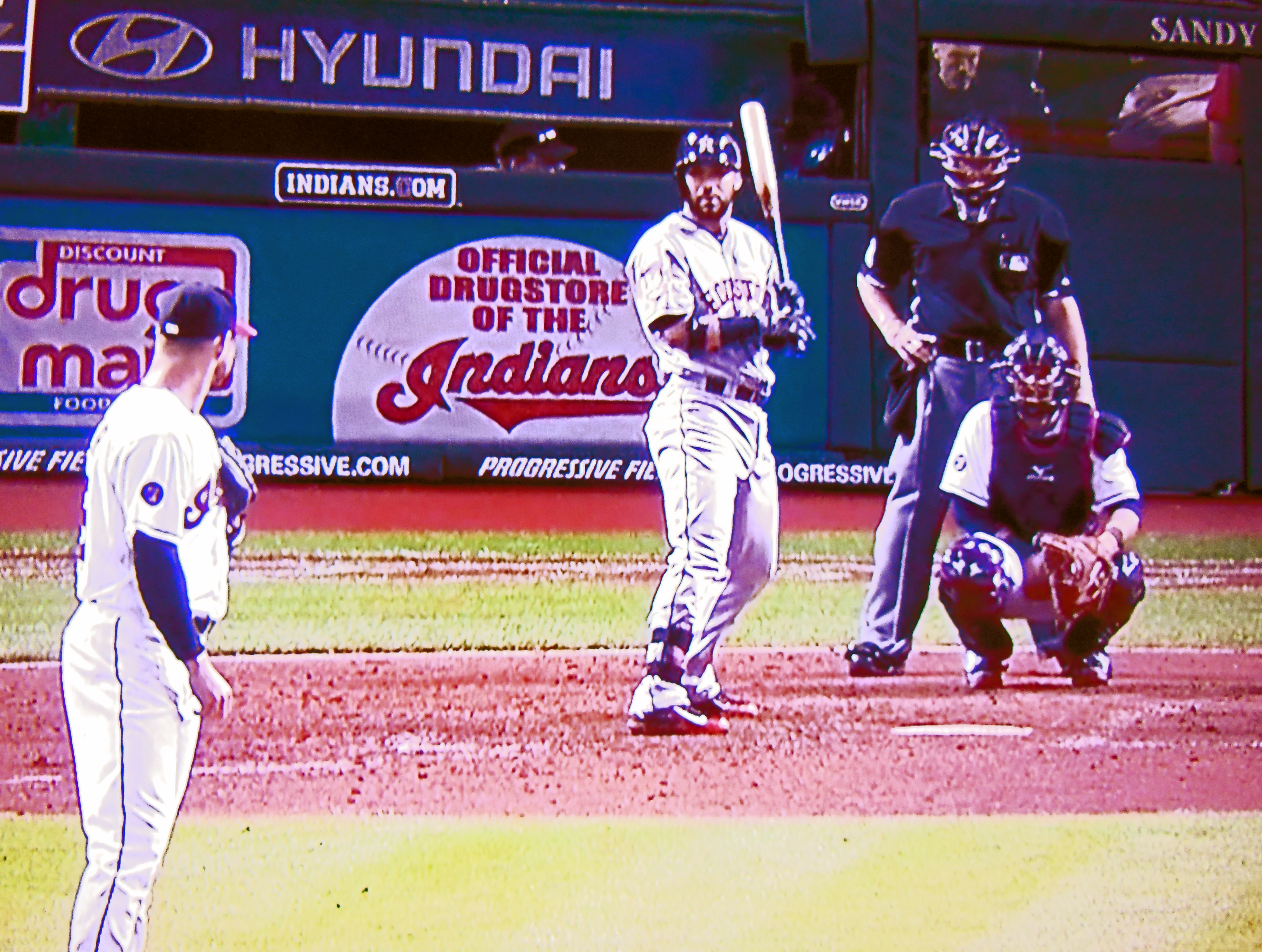
If the Indians have their own drugstore, how come their power numbers aren't much better? And why are they sunk in the ALC with a losing record?

If the Indians have their own drugstore, how come their power numbers aren’t much better? And why are they sunk in the ALC with a losing record?

Better yet - if you're not sure which is most important to you - your baby or a foul ball - please either leave your baby at home or just watch the games on cable TV.

Better yet – if you’re not sure which is most important to you – your baby or a foul ball – please either leave your baby at home or just watch the games on cable TV.

Unless this is your first

Unless this is your first “rodeo”, do you really need a sign to tell you that sometimes balls leave the field of play and could possibly hit you in the head? Why do you think so many kids bring their gloves?

Yep, if you ark too close to me fields of play, especially at city parks in the space behind backstops, you may  need be careful trying to drive hoe through a broken windshield.

Yep, if you park too close to the field of play, especially at city parks in the space behind backstops, you may need to be careful trying to drive home through a broken windshield.

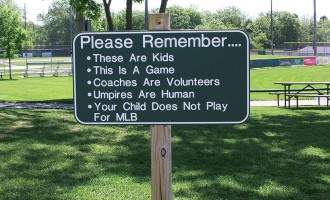
People who put their kids into youth baseball should remember all these items, especially, the last one on the list.

People who put their kids into youth baseball programs should remember all these items, especially, the last one on the list.

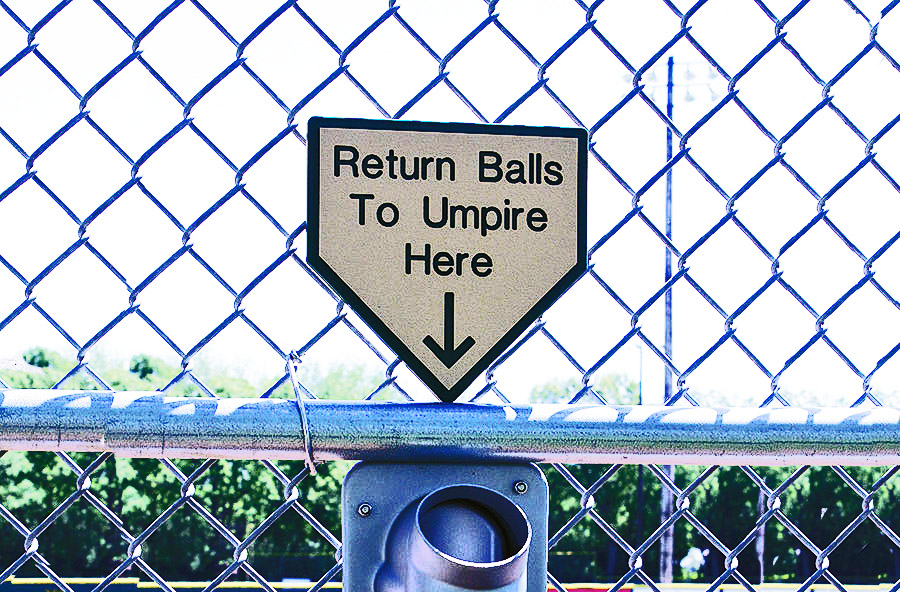
This one must have been taken at either Budget Baseball Field or some early spring training site operated by the old St. Louis Browns.

This one must have been taken at either Budget Baseball Field or some early spring training site operated by the old St. Louis Browns.

The Abe Stark

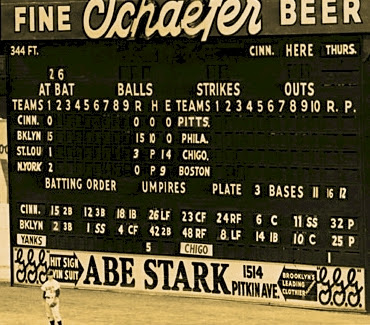
The Abe Stark “HIT SIGN – WIN SUIT” AD at the bottom of the scoreboard in Ebbets Field was a pretty safe tease. You had to hit the sign on the fly at a height most balls were caught.

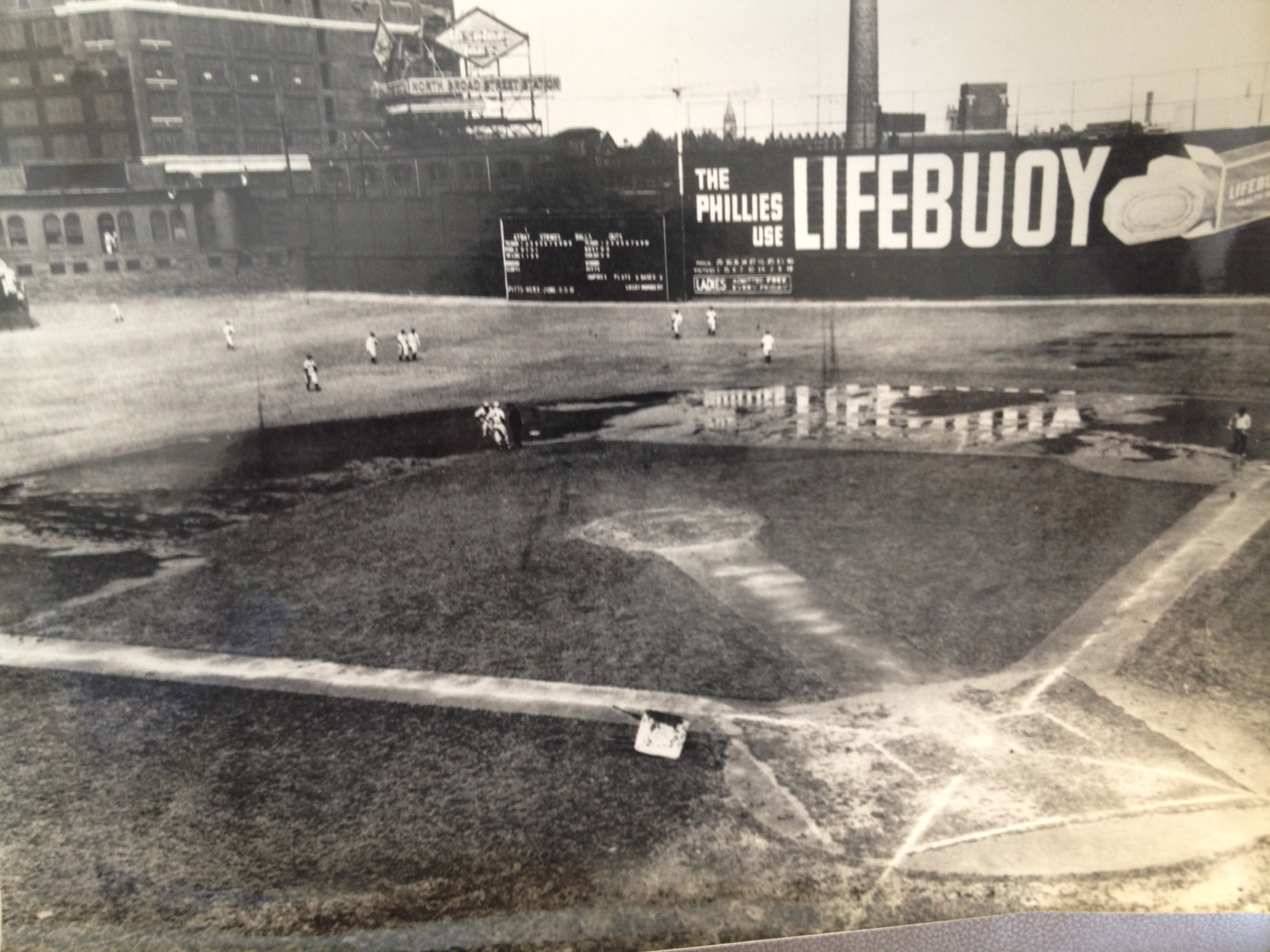
“The Phillies Use Lifebuoy”, but an unhappy fan got into Baker Bowl and added the following thought in the blank space beneath those words. He wrote, “…and they still stink!”

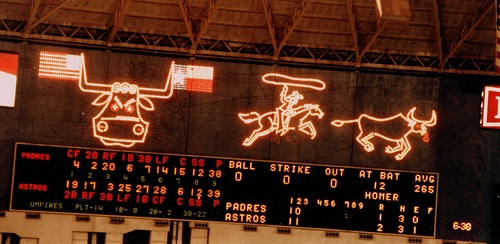
Back in 1965, the Astrodome Scoreboard was just a sign. - It was the sign of our times and our hope for many bright tomorrows!

Back in 1965, the Astrodome Scoreboard was not just a sign. – For young Houstonians, It was the sign of our times and our hopes for many bright tomorrows!

______________________________

THE PECAN PARK EAGLE
THE PECAN PARK EAGLE
AN A ROD-JETER-CORREA COMPARISON

July 7, 2015
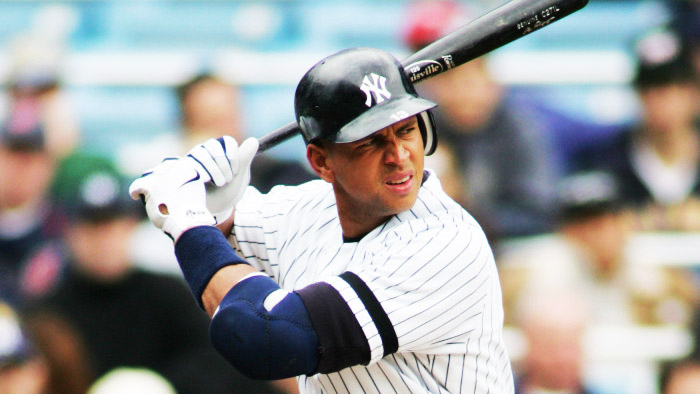
Alex Rodriguez

Alex Rodriguez

DEREK JETER

DEREK JETER

CARLOS CORREA

CARLOS CORREA

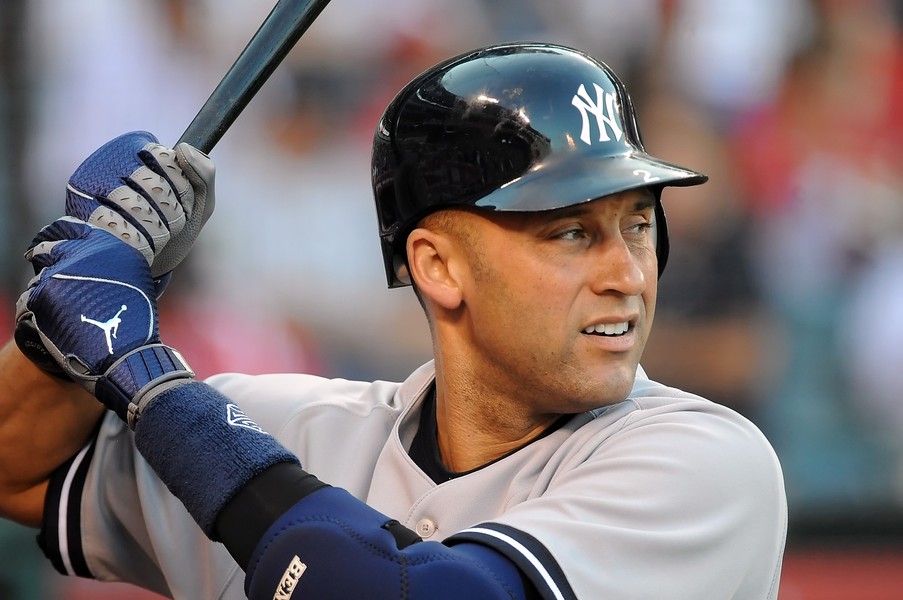
For all who need to hear it said, I agree with you, if you contend that we need far more performance information on Carlos Correa before any kind of statistical comparison to a couple of Hall of Fame numbers guys like Alex Rodriguez and Derek Jeter could be taken with any serious validity, but …. if you have been closely watching the 20-year old Houston Astros rookie shortstop in his first 26 games, through July 6, 2015, you would have be nuts not to see his potential for greatness on offense and defense. Add to the positives his coolness and maturity in dealing with this sudden mass exposure to great expectations, and you get the impression that the young man from Puerto Rico is not going to need an extensive stay in some kind of maturity microwave program at a “rehab center” to grab hold of the wheel on this rarest of opportunities in sports. Unless he gets hurt, God forbid, I will be willing to bet, even though it’s early, that Carlos Correa is now performing at a level of superior play that is only the start of a long road to  greatness in the world of baseball.

Granted, the smartest MLB pitchers will compile a book on Correa, but I really think the kid possesses both the intelligence, the ability, and the coaching help he may need to make his own adjustments and turn the tables on the book.

The following two charts are compiled from data developed at Baseball Reference.Com. Through all games of July 6, 2015, each shows the dynamic projection of how everything that each of three players (Alex Rodriguez, Derek Jeter, and Carlos Correa) have done over the course of their MLB careers and how this data would average out over the shorter run of a 162-game season. Correa’s projections, of course, are coming from career data compiled through only 26 games, but it is still fun to look at his potentials for similarity and difference from both A Rod and Jeter. Because of his limited experience, Correa’s projected total of “0” triples for a typical 162-game season are due to the fact that, so far, he actually has yet to stroke his first three base hit. And this kind of projected picture for one full season is only based upon what a player actually has done.

If this were a real season product we were examining with Correa, and we were the Astros, we would certainly want to see the young man cut down on his strikeouts next season, if possible.

As Greg Lucas so nicely pointed out yesterday, it is a lot easier to compare Correa to Rodriquez than Jeter. Based on the data alone, A Rod and Correa are the power hitters, but Correa hits for a better average. Jeter hits for a better average than either A Rod or Correa, but his advantage over Correa is not significant.

Correa is the tallest at 6’4″ and 210 pounds. Then comes Jeter at 6’3″ and lightest in weight at 195. A Rod is last in height at 6’2″, but heaviest in weight at 225.

PROJECTED 162-GAME PERFORMANCE BASED UPON CAREER STATS TO-DATE, 7/06/2015

PLAYER AB R H 2B 3B HR RBI
A ROD 618 120 185 33 2 41 123
JETER 660 113 204 32 4 15 77
CORREA 698 112 212 56 0 44 118
PLAYER SB BB SO BA OBP SLG
A ROD 20 79 131 .299 .384 .557
JETER 21 64 109 .310 .377 .440
CORREA 31 31 150 .304 .333 .571

Tabular Data developed and published by Baseball Reference.Com.

______________________________

eagle

1921: Lively Ball, Homers Appall – Small Ball Fans

July 7, 2015
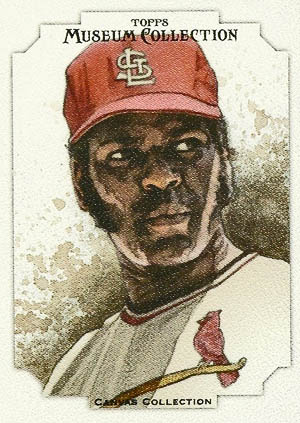
There wasn't any talk of lively ball back in 1968 when Bob Gibson took the mound for the Cardinals.

There wasn’t any talk of the lively ball back in 1968 when Bob Gibson took the mound for the St. Louis Cardinals.

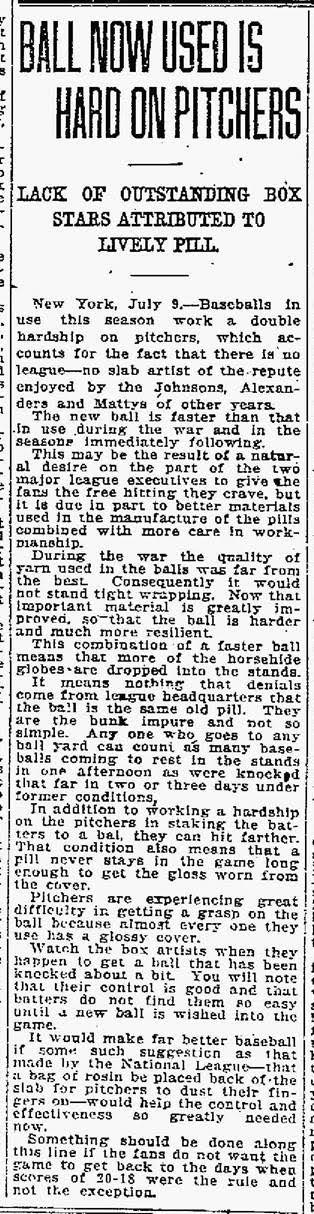
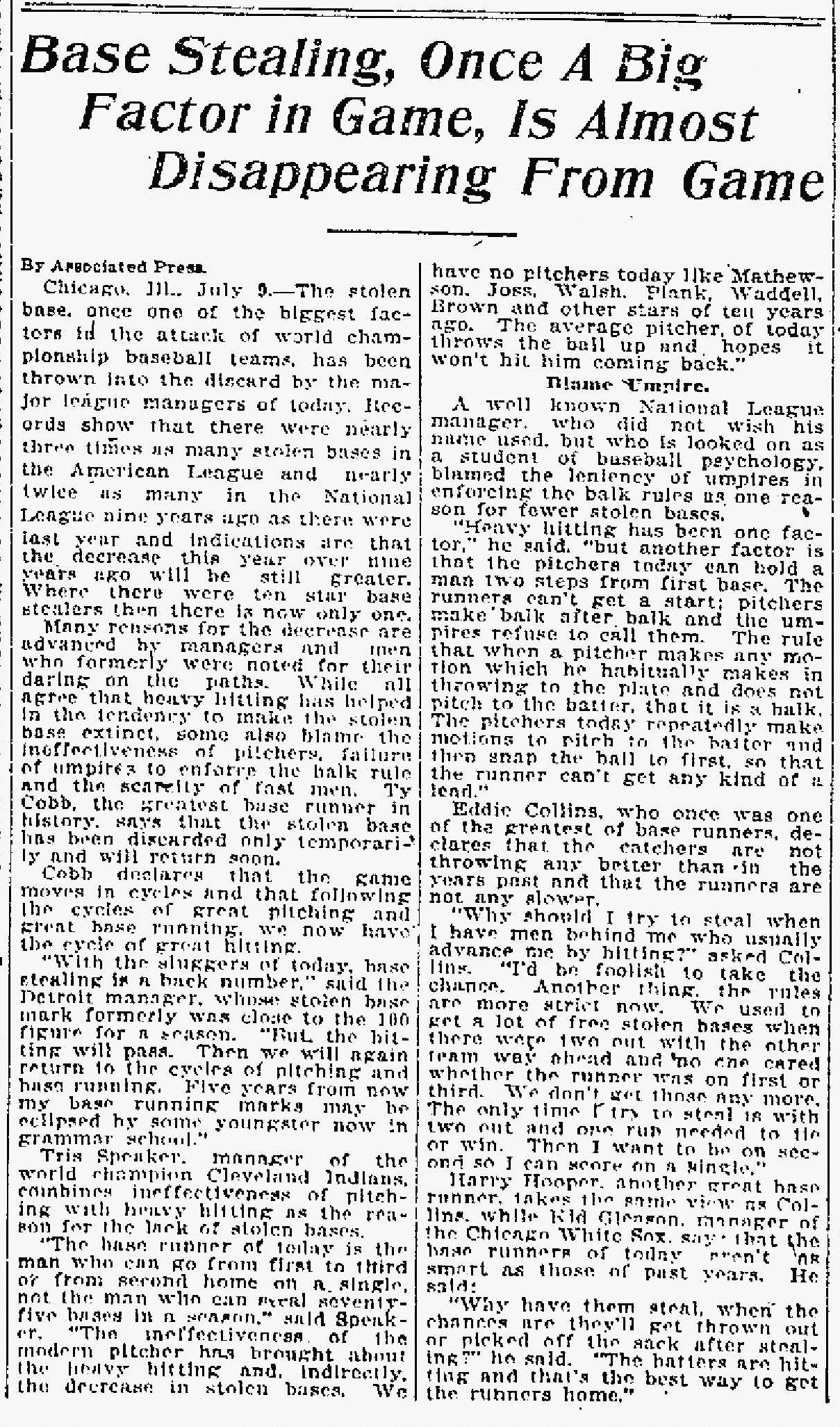
These two articles from the 1921 Galveston Daily News speak in detail to today’s column headline. Babe Ruth, home runs, power hitting in general and the ban upon things pitchers from the dead ball era were allowed to do to baseballs, plus the increased use of new balls whenever a ball-in-play became scarred and more amenable to a pitcher’s special grip needs. etc. – these were all contributing to bigger scores, worse pitching stats and far less base running. – The get-on-base-and-wait-for-a-home-run era that later became synonymous with the managerial style of Earl Weaver’s tenure at Baltimore actually had been brought about some fifty years before old irascible Earl even came to the helm of the Orioles.

Like the Chicken Littles of 1930 who fretted over the super lively ball that ballooned offensive stats that year, and later, those of 1968 who seemed to curse the death of all offense, some writers of the early 1920s also were having trouble with changes in the game that seemed to be killing baseball as they felt it should always be played – one with dominant itching, defense, low scoring, and a lot of strategic base running.

Hope you can read these two articles from 1921. They fail to cover the biggest reason why MLB was happy to look the other way from straight answers about the new lively ball, as they often do on things that seem to help fill the gate, whether its legal or ethical, etc., as long as the game is putting butts in the seats of their ballparks, they denied that there was such a thing a new lively ball. Home runs were a crowd pleaser, as Babe Ruth and Company did their part in helping baseball move hard, fast and away for the 1919 Black Sox Scandal as quickly as possible.

Read the two articles – and let The Pecan Park Eagle know what you think of what they seem to be saying.

You may have to enlarge your screen to read these articles. Our apologies.

Galveston Daily New July 7, 2015 Contributed by Darrell Pittman

Galveston Daily New
July 7, 1921
Contributed by Darrell Pittman

Galveston Daily News July 10, 1921 Contributed by Darrell Pittman

Galveston Daily News
July 10, 1921
Contributed by Darrell Pittman

______________________________

eagle

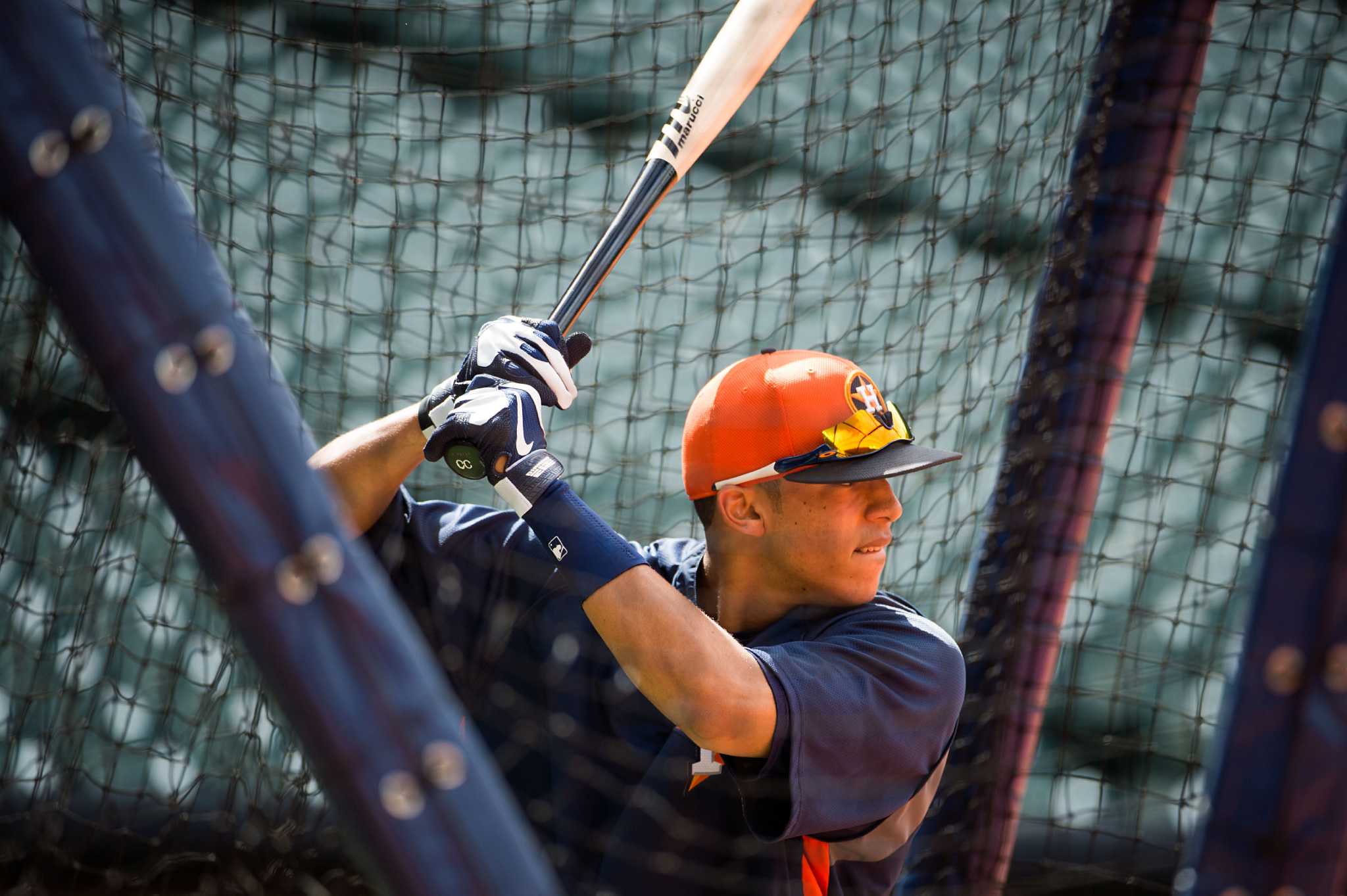
Jeter and Correa, An Early Comparison

July 6, 2015
DEREK JETER 1995-2004 HOF CANDIDATE

DEREK JETER
1995-2014
HOF CANDIDATE

Derek Sanderson Jeter  … Born: June 26, 1974 … MLB Debut: June 27, 1995 … Age at 1st Game: 21 Years, 1 Day

Position: Shortstop
Bats: Right, Throws: Right
Height: 6′ 3″, Weight: 195 lb.

Derek Jeter Hitting Stats
G AB R H 2B 3B HR GRSL RBI BB IBB SO SH SF HBP GIDP AVG OBP SLG
1995 21 Yankees 15 48 5 12 4 1 0 0 7 3 0 11 0 0 0 0 .250 .294 .375
CARLOS CORREA 2015 MLB DEBUT R.O.Y. CANDDATE

CARLOS CORREA
2015 MLB DEBUT
R.O.Y. CANDIDATE

Carlos Javier Correa … Born: September 22, 1994 … MLB Debut: June 8, 2015 … Age at 1st Game: 20 Years, 9 Months. 14 Days

Position: Shortstop
Bats: Right, Throws: Right
Height: 6′ 4″, Weight: 210 lb.

Carlos Correa Hitting Stats (Through Games of July 5, 2015)
Yr Age Team G AB R H 2B 3B HR GRSL RBI BB IBB SO SH SF HBP GIDP AVG OBP SLG
2015 21 Astros 24 108 16 34 9 0 7 0 19 4 0 23 0 0 0 3 .315 .339 .593