Archive for the ‘Uncategorized’ Category

Home Runs: They Ain’t What They Used To Be

June 11, 2016

home-run

From the Knickerbocker Rules Change Timeline at Baseball Almanac, we have selected only those identifiable rules that we felt have made the most direct impact on the production of home runs. One could argue that almost every rules change has either a substantive indirect or oblique impact on the production of home runs, but we weren’t aiming to use baseball to prove that old philosophical truth about changing the angle, location, or presence of an individual stick in a pile of “pick-up-sticks”. – Remember that one? It say: any one change, changes all.

Here’s the link to the Baseball Almanac Rules Change Timeline: http://www.baseball-almanac.com/rulechng.shtml

And here are the rule changes on the list that we think fit our arguably direct impact list. We are sure that all the rules governing how pitchers threw the ball, banning foreign substance pitches, and changing mound heights could be added, but they would head us in the “pick-up-sticks” waste of time direction. We are interested in the most obvious factors. The five we found on the BA list fit the requirements of our search, even if they fail to answer all our questions:

  1. 1893: Pitching distance increased from 50 feet to 60 feet 6 inches. The 60 feet 6 inch pitching distance has been the standard for measuring variation in annual home run production since 1893. That a big constant factor, no matter how many other intervening variables have come along to effect production since that time.
  2. 1910: The cork center was added to the official baseball. Prior to the introduction of the cork center, the so-called “Dead Ball Era” game was dominated by Punch-and-Judy hitters who understood that hefty swings most often produced short high fly ball outs.
  3. 1920: The batter was given credit for a home run in the last of the ninth inning if the winning run was on base when the ball was hit out of the field. This one change only answered one of the three rules changes we thought we would find in a complete timeline, but it is very important. Prior to 1920, a batter who hit a ball over the fence in the bottom of the 9th only got credit for a home run if his contact with the plate in scoring occurred as a run that was no more than the winning run. If his team had the bases loaded when he hit the ball out, but his team only needed a single run in the bottom of the inning to win the game, he would not be given credit for a Grand Slam home run. He would have been given credit only for a single because all his club needed for the win was the runner scoring from third base. – Bad rule. Great change. (More on the two unanswered rules changes after we cover the final two important factors from the list.)
  4.  1925: The minimum home-run distance was set at 250 feet. A fairly clear impact factor. Short fences invite cheap homers. Oppositely, the cavernous fence distances of many 19th century dead ball era parks pretty much limited home runs to those inside-the-park rollers that managed to sneak between the outfielders on a distant bounce to the hinterlands.
  5. 1959: Regulations were set up for minimum boundaries for all new parks, 325-400-325 feet. Makes sense, but how then did Minute Maid Park (ne: Enron Field) get approval for the construction of a field that contained a 315 feet field fence distance from home plate in the year 2000? Maybe that’s common knowledge to many of you, but it isn’t to me. If you do know, please supply the rest of us with the answer via public comment at this column.

The other two home run rules questions that were not answered in the timeline were these:

  1. Abolition of the bouncing ball home run over the fence. Until some point in the 1920s or 1930s, balls that bounced over the fence were not considered to be “ground rule doubles”, they were counted as home runs. When did that change? And did it require a formal rules change – or was it accomplishable by some reinterpretation of the existing rule? If you know the answer, please comment here too.
  2. The foul line home run call. Today the foul poles, when they aren’t selling chicken, are constructed with that little attached metal webbing on the interior fair side to aid the umpires in separating the close home runs from the long foul balls. All the batted ball has to do to be counted as a homer – is to cross that foul pole on the fair side to register in the books as a home run. It wasn’t always so. As late as 1918, umpires followed the flight of the baseball as far their eyes could see – or sometimes, because of an horizon blocked by the stadium on very long batted balls, they conjecturally had to assume from their last glimpses of it, where the ball was going to land. – In other words, it didn’t matter if the ball passed the foul pole in fair territory. – It had to land in fair territory – somewhere out there on the road from home to infinity. If the umpire judged it did not, it was just a monumentally long distance foul ball. – Babe Ruth apparently lost a few homers in his early Red Sox days because of that interpretation. Balls hit down the line have a physical spin tendency to float await from fair territory down both lines. – Again, that changed, but it is not noted as a rules change. Same questions again: Is that an omission from the list? – Or was it changed by some formal change in the fair/foul interpretation of homers hit down the lines? Same request: If you know, please comment.

Of course, wood bats – as opposed to metal alloy bats – is a major factor in home run productions. We personally would prefer to see metal bats eliminated from amateur baseball use because of the distortion effect that metal bat power stats have upon prospect evaluations and, even more importantly, the adaptation issues that the change to wooden bats places upon young professional players is one of those extra things that could be removed from the list of unavoidable tests that all players go through at the start of their professional careers. Of course, the politics of big money and the political market power of those who make metal alloy bats will never allow that to happen.

At any rate, those are all the rules and major questions that arise for us about the most direct reasons we have more home runs today. Like all research questions in baseball, one can hardly ever expect to answer any single question without discovering or raising several others. Our bigger, faster, stronger 21st century sluggers would have had trouble hitting home runs under the conditions that existed in baseball back in 1876.

The Obvious Bottom Line: Home runs are no longer the freakish different-creature rarity they were in the 19th century. In the 21st century, anybody in the lineup may deliver one at any time. The question is larger. Has baseball simply become the “hit or sit” HR/K outcome for 90% of the batters in the game? If so, we think, it does not bode well for the once beautiful game that was so much more than interesting when players knew and could execute the fundamentals of situational hitting, base running, and defensive teamwork.

Maybe it’s just a problem that some of us greybeards mostly share. I also like George Gershwin, Louis Armstrong, and Cole Porter much more than I do any of today’s so-called music geniuses. And I prefer a 1951 Olds to any of the new look-alike oval motor jewels. I’ll also take Ernest Hemingway over J.K. Rowling and put me down for character driven movies over special effect crash and burn car chase films – any day, all day, all the time, for as long as we can come up with new ways to say “forever”.

Have a nice weekend, everybody!

____________________

eagle-0range
Bill McCurdy

Publisher, Editor, Writer

The Pecan Park Eagle

Houston, Texas



Morti Died Today

June 7, 2016
MORTI McCURDY Born: February 3, 2004 Died: June 7, 2016 "GOD IS LOVE"

MORTI McCURDY
Born: February 16, 2004
Died: June 7, 2016
“GOD IS LOVE”


Morti died today. At exactly 10:45 AM, Tuesday, June 7, 2016, in the office of Dr. Marshall Ewald at the Kirkwood-Memorial Animal Clinic in west Houston.

Euthanasia became unavoidable once the bone cancer made it totally impossible for Morti to walk, eat, or even stay awake for long.

My son, Casey McCurdy, and I took Morti to his appointment together. I could not have handled it alone. Casey and Morti, as were my wife Norma and Morti, almost inseparable. Norma had to work and could not be with us this morning, but she also was mom and Morti’s chief nurse to the very last minute of her availability before leaving for the hospital and the needs of humans.

My last goodbye to Morti occurred in the moments prior to Dr. Ewald’s arrival in the treatment room. Morti’s eyes and mine met for the last time of so many familiar face-to-face occasions over the past twelve years. For the first time , however, I was aware of seeing the reflection of my 0wn face in both his eyes, as we kissed our goodbyes. It comforted me. Morti remains in our heart forever now through our memories of his playful little life – through his craving for and unlimited capacity for giving affection – and through the essence of him as true love itself in bounding barking, romping, furry to fuzzy form. It’s how he earned his eternal nickname in our house as – “the world’s tallest caterpillar.”

GRADUATION DAY PetSmart School August 2016

GRADUATION DAY
PetSmart School
August 2004

Morti, my beloved youngest son, in life, you were always the personification of joy, the everything vital, sweet, beautiful, sensitive, and yet strong little guy – and to very end, everything that this whole world needs to be – was to be more like you. Even the bone cancer could not defeat your strong heart, the damn disease had carried you to a point in which you might have lived on in a coma for weeks – or even months – because your powerful heart could not be defeated by the cancer alone. Maybe we should have named you for former Rockets Coach Rudy Tomjanovich. “Never underestimate the heart of a champion” fits you, Morti, as completely as it once fit our local, but world famous basketball championship coach, Mr. T.

Goodbye for now, Morti McCurdy! Today your soul flies on to wherever canine spirits next go, once their careers as loving human heart healers is done. For me, personally, the envisioned course is that same one taken across the summer skies of Houston by the Pecan Park Eagle, so many years ago, from my poem of the same name. In honor of the faith and hope that we shall be together again someday, I say goodbye for now  to you – you little winged dog soul specter – as you now streak the wild blue yonder as a spirit that fills the memories of my Houston summer sky on this day, from here to forever  – with love, faith, and hope – if only in my mind’s eye, heart, and soul you do fly – at this very moment in time –  over the biggest rainbow that awaits us all.

In closing for now, please allow me to humbly add this additional lifting air to the place beneath your wings. After all, you did the same for us – for over the twelve years we spent in your loving company. We are still with you in loving spirit, sweet Morti, and we always will be:

“To soar once more in spirit, like the Pecan Park Eagle,

High above the billowing clouds of a summer morning,

In flight destiny – to all that is bright and beautiful.”

~ excerpt, The Pecan Park Eagle by Bill McCurdy (1992)


Morti's Living Grave site Houston, Texas

Morti’s New Living Grave site
At Home, Houston, Texas

Blue Sky Forever! 74

shooting_star_23

Morti Romps In Greener Pastures Now.

Morti Romps In Greener Pastures Now.

____________________

eagle-0range
Bill McCurdy

Publisher, Editor, Writer

The Pecan Park Eagle

Houston, Texas

If Leo Gorcey Wrote for Chronicle Sports

June 6, 2016
Houston Chronicle June 5, 2016

Houston Chronicle
June 5, 2016


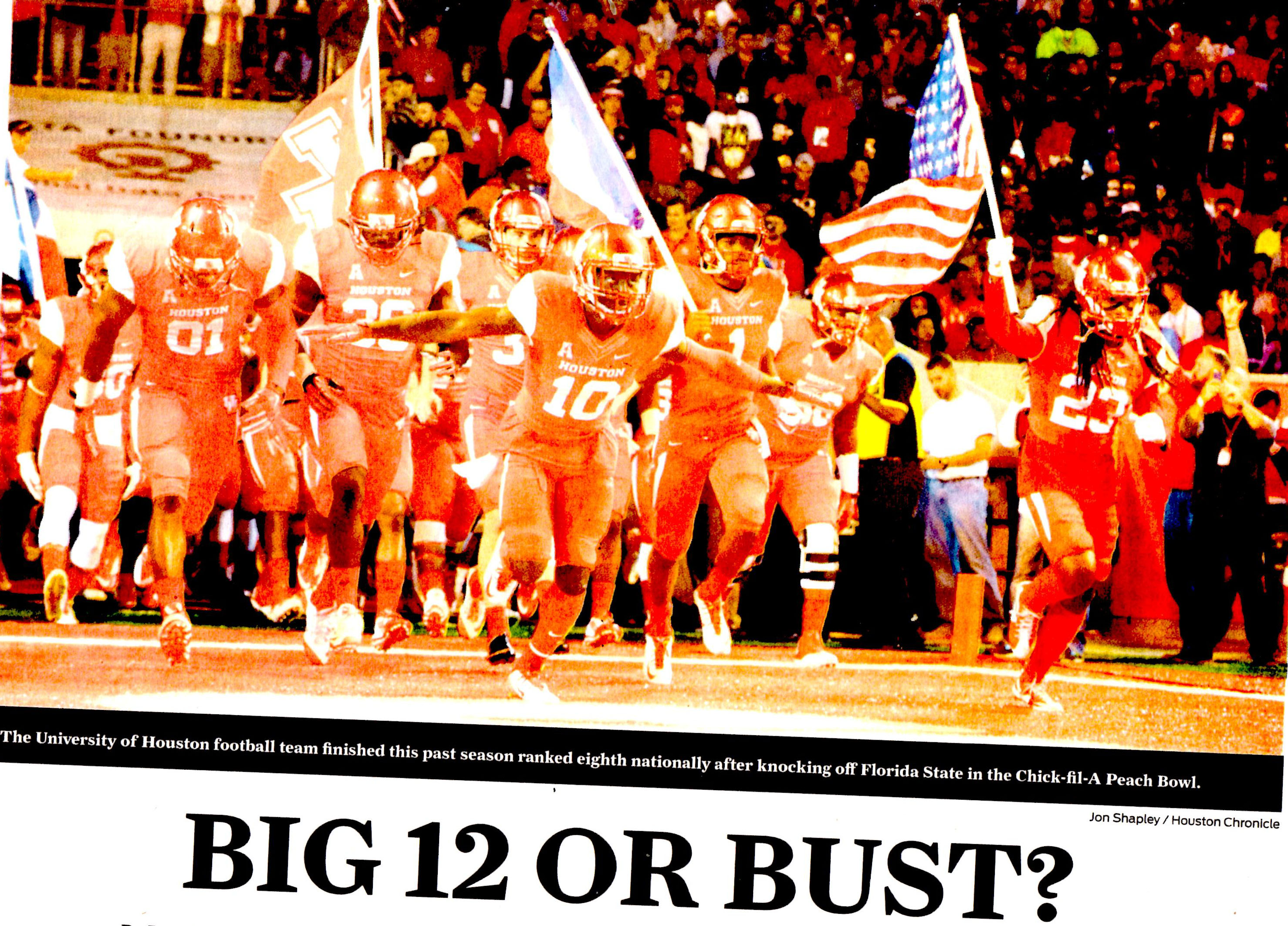
If Leo Gorcey wrote for Houston Chronicle Sports, Joseph Duarte’s lead Sunday article on the Big 12’s (UT’s) avoidance of UH in their second formal way (the first occurred twenty years ago, when the Big 8 expanded to the Big 12) – and how it might have read, had actor Leo Gorcey, as Slip Mahoney of the Bowery Boys, had written the story – is as follows:

BIG 12 OR BUST?

By Slip Mahoney, Houston Chronicle Sports

Leo Gorcey aka Slip Mahoney

Leo Gorcey
aka Slip Mahoney

IRVING TX – The scene likely exploded something like this: In meeting rooms at a Key Biscayne, Fla. resort last week, presidents and athletic supporters from a handful of schools kept ears on business revolving the American Athletic Conference and three eyes glued to cellphones (whatever those are) for any mouthful of news regarding Big 12 expression. – What they ran into was Big 12 contraction by inaction. – UT, OU, and the Big 12 Commiserator say they want more data before they give in to the delusion of sharing their now annual $304 million a year per school take from the TV bucks coming in to the ten remaining member schools. – And who can maim them? – If you was UT, especially, would you really want to risk a regurgitation of what happened that time the fair-minded, but sadly now departed Darrell Royal risked welcoming the Cougars to the SWC back in the 1970s? And this time, it could be a double-hater – with UH and BYU coming in as two Mr. Hydes and no Dr. Jekyll! – Losing games and money at the same time ain’t no referential constipation on the throne.

UH and the other Big 12 hopefuls may need to sweeten the soup pot by arousing from the reality that they are not dealing with the Salvation Army or Goodwill when they reproach the Big 2 (Big 12) for a piece of their perspicacious pie. When you hang out with greedy folks, the disease gets to be a little bit pretentiously ubiquitous, protruding its way into the hearts of all who enter that “members only” room and extending also from there to include those who get invited to join the club. (Hey! I got one of those words right, didn’t I? – I think I did.)

Have a nice week, but let’s try to keep our all-the-way-around delusional outlooks in perspicacity.

GO UH! GO UT! GO OU! GO BIG 12! – Let’s battle it out for Number One in College Football in a union of craven amenities! – There is still precocious time for all of us college football fans to put our interspersed neediness on the line together for a holy bombastic sport that simply incarcerates and then incinerates amateurism.

____________________

eagle-0range
Bill McCurdy

Publisher, Editor, Writer

The Pecan Park Eagle

Houston, Texas
https://bill37mccurdy.com/


Bill Gilbert’s Astros May Report, Part II

June 6, 2016
Here's Part II, the main body of analyst Bill Gilbert's Houston Astros Report for May 2016.

Here’s Part II, the main body of analyst Bill Gilbert’s Houston Astros Report for May 2016. – “You Gotta Have Hope!”


Part I of Analyst Bill Gilbert’s May 2016 Report was published here in The Eagle on June 3rd: (Click Link to Review)

Bill Gilbert: Astros Finish Strong in May

Part II, published today in the space that follows, on June 5th, concludes this hopeful account. Stay tuned for Bill’s next report on what could be a make-or-break month of June for the, Astros. It will be published here at The Eagle around, or a couple of days after, July 1st.Let’s hope for the hum of possibility to have moved up the scale of probability as well by then.

~ The Pecan Park Eagle

____________________

Astros Show Some Life in Late May

By Bill Gilbert


After treading water for most of May with a 10-11 record, The Houston Astros came to life by winning 7 of 8 games for the rest of the month. The streak was kicked off by a 3-game sweep in Houston against the Baltimore Orioles when the Astro pitchers struck out a record 52 batters in a 3-game series. The turnaround coincided with the movement of George Springer to the lead off position on May 24 where he has performed extremely well. The surge still has the Astros looking up at the rest of the Division, especially the Texas Rangers who have swept all six games with the Astros this year and are 7.5 games ahead of them.

Offensively, the team made some improvement in May but the season batting average is only .236 which ranks 24th among the 30 major league clubs. The Astros rank 8th in home runs and third in stolen bases but lead the majors in striking out with an average of 9.77 per game, even without Chris Carter. The Astros scored 4.6 runs per game in May, a significant improvement over 3.5 in April.

Pitching improved significantly with an ERA of 3.81 in May versus 4.97 in April. Opposing teams scored an average of 4.2 runs per game in May. Astro pitchers struck out 267 batters in the month, ranking third in the major leagues.

Individually, several players had good months. Jose Altuve batted .345 and continues to lead the major leagues in stolen bases. Springer batted .296 and both he and Altuve had on-base percentages over .400 and slugging averages over .500 as did Jason Castro who had his best month in over two years. Luis Valbuena’s power returned as he batted .259 with six home runs, second only to Springer’s eight. Unfortunately, none of the other position players batted over .240 including Carlos Correa at .239 and Colby Rasmus at .194. Carlos Gomez continues to have problems, batting only .136 before going on the disabled list with a rib injury.

Doug Fister was the team’s best starting pitcher in May as the Astros won all six of the games he started and he, along with Collin McHugh and rookie reliever Michael Feliz each posted three wins. After performing poorly in April, Feliz recorded 26 strikeouts and only one walk in his 16 2/3 innings in May. He could be considered for a spot in the starting rotation later in the season. Luke Gregerson recorded nine saves in May but he whiffed on three other opportunities. Will Harris did not allow a run in his thirteen relief appearances. Of the 14 pitchers used by the Astros in May, Dallas Keuchel had the worst ERA at 6.63, but he did have a good outing in his final start of the month.

In 2015, the Astros organization had an exceptional minor league season with their teams having the best overall record in the minor leagues while several of their players emerged as top prospects. However, it is not happening in 2016. Of the four full-season minor league clubs, only Class Double-A Corpus Christi has a winning record and the overall record is 99-104. A number of their most promising players are having disappointing seasons and eleven prospects were lost last year in the disappointing trades for Scott Kazmir, Gomez and Ken Giles. The three domestic short season farm clubs will start up in June and will be staffed largely with players obtained in the upcoming amateur draft.

The Astros can still get into contention if they continue to play the way they finished the month of May. The key in June will be the 4-game series with the Rangers in Arlington beginning June 6.


Bill Gilbert

billcgilbert@sbcglobal.net

6/4/16

____________________

eagle-0range
Bill McCurdy

Publisher, Editor, Writer

The Pecan Park Eagle

Houston, Texas

https://bill37mccurdy.com/


The Greg Lucas Challenge

June 6, 2016
Greg Lucas Texas Baseball Hall of Fame 1994

Greg Lucas
Texas Baseball Hall of Fame
1994


A couple of hours ago this Sunday afternoon, The Pecan Park Eagle received the following challenge from friend, fellow SABR member,  and Texas Baseball Hall of Fame broadcaster, Greg Lucas:

“Here is your next project. – The thing is…not only do you have to write current lyrics that fit, but you have to sing them as well. Attached is the instrumental background for “Houston Loves The Astros” (It turned out to be an instrumental version of ‘Deep in the Heart of Texas’) with none of the specific lyrics from the ’60s or ’70s when it was written.  So go to it.  I am expecting a masterpiece!” – Greg Lucas.

Well, forget the masterpiece accolade. The challenge was another matter. I enjoy these. I just don’t do them unless my playful heart and the company of certain muses gather within me at the same time. I also never do them maliciously. I just believe that satire and parody are two of our twin weapons in the never-ending battle against ego inflation or taking ourselves, or anything we do in life, quite so seriously.

Here are my two versions of the parody. Version #1 is the one that came straight out of the chute. Version #2 is simply a slightly more positive arrangement of thoughts and words. If you prefer either, or either over the other, please let me know which version you like. My choice is the first one. And remember, both versions are written for use to the tune of “Deep in The Heart of Texas.”

As for singing it too, I don’t do “You Tube”.

As for the “sublimation” of this exchange between two friends on a lots-of-time-on-our-hands Sunday afternoon, chalk my side of it up to watching too many Bowery Boys movies on weekends. As Slip Mahoney might put it, such a condition often leads me into protrusions of subject matter that really don’t. … Matter, that is.

____________________

Version #1 Houston Loves The Astros (The One I stand behind)

By Bill McCurdy


No flag in sight

That is our plight

CLAP – CLAP – CLAP- CLAP

We’re called the – HOUSTON ASTROS!


We can’t soar high

On humble pie

CLAP – CLAP – CLAP- CLAP

Just being – HOUSTON ASTROS!


From Dome’s Day Boom

To Downtown Gloom

CLAP – CLAP – CLAP- CLAP

We’ve been the – HOUSTON ASTROS!


Remindful of

No bat! – No glove!

CLAP – CLAP – CLAP- CLAP

We are the – HOUSTON ASTROS!


To know just why

We sob and sigh

CLAP – CLAP – CLAP- CLAP

Come see the – HOUSTON ASTROS!


No rabbit’s rush

No big crowd push

CLAP – CLAP – CLAP- CLAP

To buy an – ASTROS TICKET!


If we should sail

Our ship and fail

CLAP – CLAP – CLAP- CLAP

Just grab your nose – and PICK IT!


It’s still base ball

We’re your town’s all

CLAP – CLAP – CLAP- CLAP

Love us – your HOUSTON ASTROS!

________________________________________

Version #2 Houston Loves The Astros (Mildly More Positive)

By Bill McCurdy

Our stars all fight

To your delight

CLAP – CLAP – CLAP- CLAP

We’re called the – HOUSTON ASTROS!


We soar so high

‘Cross Texas’ sky

CLAP – CLAP – CLAP- CLAP

Just being – HOUSTON ASTROS!


From Dome’s Day Boom

To Tal’s Hill Room

CLAP – CLAP – CLAP- CLAP

We’ve been the – HOUSTON ASTROS!


Remindful of

With bat! – And glove!

CLAP – CLAP – CLAP- CLAP

We are the – HOUSTON ASTROS!


To know just why

Our joy piles high

CLAP – CLAP – CLAP- CLAP

Come see the – HOUSTON ASTROS!


The rabbits rush

The big crowds push

CLAP – CLAP – CLAP- CLAP

To buy an – ASTROS TICKET!


When our ships sail

And sometimes fail

CLAP – CLAP – CLAP- CLAP

Just grab your nose – and PICK IT!


We’re real base ball

We’re your town’s all

CLAP – CLAP – CLAP- CLAP

Love us – your HOUSTON ASTROS!


____________________

eagle-0range
Bill McCurdy

Publisher, Editor, Writer

The Pecan Park Eagle

Houston, Texas

https://bill37mccurdy.com/

Rainy Day and Bowery Boy Malaprops

June 5, 2016

bowery


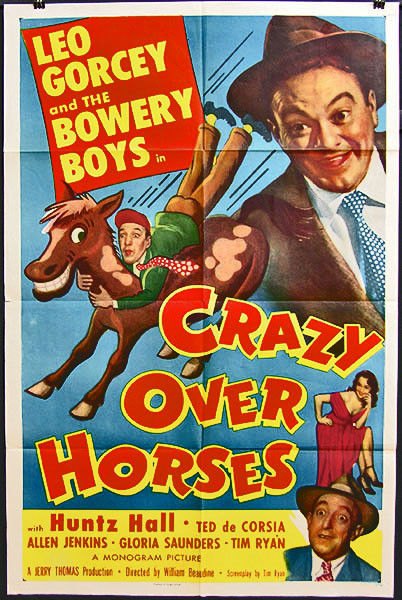
The Turner Classic Movie Channel on Direct TV (Channel 256 in Houston) has made it possible most Saturday mornings to renew one of my Pecan Park kid day trips to the old Avalon Theater for a little more than hour each weekend. That’s the time that TCM likes to show us one of the old Bowery Boy movies from the 1940s and 1950s that many of us sufficiently wizened ones first saw at the weekly double feature that was popular back then. I love it. One Bowery Boys movie is better than nothing,

As kids, we didn’t really “get” the joke behind most of Leo Gorcey’s ongoing misuses of the English language as the leader of the Bowery Boys. To us, his “Slip Mahoney” character just seemed to know a lot of big words that were beyond our 6-10 year old comprehension. We thought it was funny when “Slip” got mad at the stupidity of his Huntz Hall sidekick “Sach” – always showing his unhappiness by removing his hat and slapping Sach on top of his goofy head. We were easy to please.

Here are simply a sample of some Gorcey language malaprops from this morning’s Bowery Boys movie, “Crazy Over Horses”:

In “Crazy Over Horses”, the Bowery Boys act as the collection agents for Louie Dumbrowsky, the sweet old guy who owns “Louie’s Sweet Shop” down in the Bowery. Louie was owed $200 he had loaned to a fellow named Flynn that was now two years overdue in 1951.

  1. As Slip and Sach arrive at Flynn’s business door, Slip reminds Sach that “we ain’t going to let no sob stories deteriorate us from our point of attack.”
  2. Once inside, Slip firmly informs debtor Flynn that “as certified collection agents for Mr. Dumbrowsky, “we are willing to disintegrate” the terms of settlement.
  3. Eying Flynn’s beautiful young adult daughter for the first time, Slip offers his opinion of the girl: “Very demolishing!
  4. At a later point, Slip wants Sach to keep quiet about something, but it comes out as: “I told you once to shut up and now I’m going to re-irrigate my point.”
  5. Slip: “Pardon my diminuendo.”
  6. Slip: “We’ve got a lot of loose ends left that need to be dissipated.”
  7. Slip: “We’ve got a score we need to extemporaneously settle with dem horse-thieving crooks.”
  8. Slip: “I got a plan for getting even with those crooks. Maybe I need to regurgitate the details to you guys again.”
  9. Slip (making dinner speech at the movie’s happy ending with a toast to “My Girl”, their winning horse in the big race): “Partners, and guest of honor, we are gathered here tonight to inebriate each and every one of you for the untiring efforts that you each put forth in bringing this case to a successful delusion. We have gone through thick and thin together and, once more, we have submerged victorious.”

The Bowery Boys. Simpler times. Simple movie struggles between good and evil. With the lovable good guys always winning with a closing laugh at the abrupt “The End” sign as the dark screen that quickly faded to black at the end of each Saturday double feature, with serial and cartoon, all now delivered for 9 cents admission and 15 cents for popcorn and a coke. If our joy back then was a childhood delusion, it was a real fun-run for us simple taste post-WWII sandlotters. After we got home, it was time to go submerge ourselves again in another game of sandlot ball before the sun went down. Then we could regurgitate the whole thing again the following Saturday. Yes. No question. A kid’s joy can be the greatest inebriator that any of us will ever consume or inhale. And little did we know then – what we all learn well over time – if we live that long. – Many things in life just don’t get better with age. We must either finally seek our joy in wisdom – or suffer from our refusal to do so. Like it or not, egos of the world, that’s just the way it works.

Have a joy-inebriating weekend everybody!

____________________

eagle-0range
Bill McCurdy

Publisher, Editor, Writer

The Pecan Park Eagle

Houston, Texas

https://bill37mccurdy.com/

Who Hurt Branca Most? + R.I.P., Muhammad Ali!

June 4, 2016

ralph branca


Here’s an interesting piece we found in a United Press column by Oscar Fraley. The version we located appears on Page 11 of the Charleston (SC) Daily Mail and is dated April 3, 1953:

Branca’s “Ailments” Believed Result of Thomson’s Homer

By OSCAR FRALEY

New York (AP) (April 3, 1953) – After a year and a half, Ralph Branca still is walking in the shadows.

Big Ralph, you’ll remember, threw the home run ball to Bobby Thomson which cost the Brooklyn Dodgers the 1951 National League pennant. Never since has he been the pitcher he was before.

Ailment, some real and others believed to be imaginary, have made him a very infrequent starter. Now, as another season gets under way, he was supposed to prove himself this time out, but is bothered by a “bad back.”

The validity of the injury undoubtedly is questioned by Manager Chuck Dressen. The little leader of the Dodgers has taken no pains to conceal his disdain at Branca’s continued reluctance to fire the ball at the plate.  His unspoken indictment is that Branca in his mind always will be throwing that fatal home run ball every time he steps to the mound, thus accounting for an unconscious unwillingness to pitch.

Dressen could be right.

For you knew, when you saw Branca immediately after Thomson’s home run blast that October day in 1951, that here was a man crushed completely. Branca is six feet, three inches tall and weighs 220 pounds but he sat in stunned silence in the Dodger dressing room, too shocked even to sob.

He had lost the first game of that exciting three-game playoff when Thomson touched him for a home run. But the Dodgers got even the next day and the first Thomson homer was forgotten.

Then, in the third and deciding game, Don Newcombe was leading the Giants, 4-2, when he weakened in the ninth and put two men on. The second guessers have debated (ever) since as to why Dressen didn’t summon Clem Labine, who had won the second game handily. Dressen looked bad later when he shifted the burden by saying the bull pen coach told him that Branca was “ready.”

Branca came in (Bottom of 9th, Game 3, October 3, 1951 Playoff Series, Polo Grounds) fired one pitch past Thomson, and then the raw-boned Scot belted the ball high through the afternoon gloom and into the stands. It was the ball game – and the pennant.

It may have been the end of Branca, too.

Because last year those injuries, some of them said to be imaginary, began to plague Branca. Always before, Ralph had been a workhorse. He had worked as many as 280 innings one season and, in 1951, had been in 204.

But last season (1952) he worked only 61 innings. He complained bitterly that he wasn’t given enough work but Dressen retorted sharply that he was used as much as his “ailments” permitted.

____________________

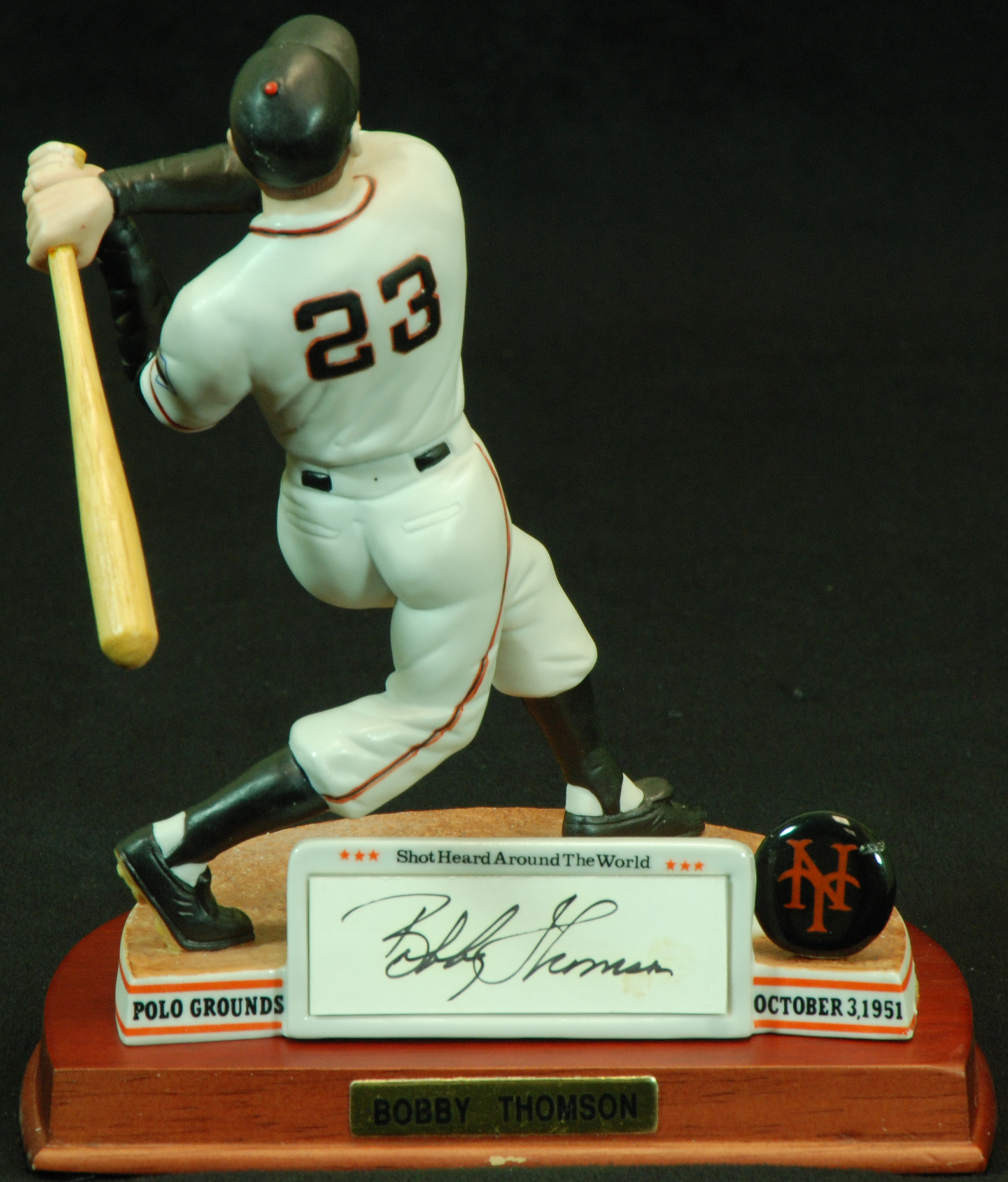
bobby thomson

History documents that Ralph Branca was a 13-game regular season game winner in that 1951 Thomson Homer season. It also notes that Branca would only win 12 more regular season games for the remaining four seasons he pitched in the big leagues after 1951.

It was a different time and place in our culture. Today we recognize “PTSD” (Post-Traumatic Stress Disorder) in human beings that go way beyond the horrendous shock of military combat. Back in the day that Fraley wrote this piece, injury to the physical body was viewed as “real” and injuries to the mind were still considered as “imaginary” as Fraley’s column notes. Some people in sports still see things that way, but fortunately for former Astros pitcher Brad Lidge, that wasn’t the case in 2005 when the Albert Pujols home run in the NLCS forced the club to play another game with the Cardinals before they claimed their first and only Houston pennant in history to date. Maybe he wouldn’t have been effected long-term, anyway, as was Branca. PTSD is not a one-size fits all diagnosis that fits everyone the same. PTSD includes those emotional traumas that we never quite get over, but do learn to process better before it either leads to serious mental illness or early death.

Charlie Dressen was never a favorite of mine, anyway, but his ignorance by public comment alone speaks loudly, if only referentially, as to how he perceived Branca. Whatever Branca experienced mentally, even if the stress converted to lower back pain the following season, it was not by any application of the word – “imaginary” – that it happened. Anyone who has ever experienced back pain from stress will immediately understand my reference here. I saw more stress-induced back pain in my half century “day-job” than I will ever take the time to calculate. Most of the time, people who came to see me did not bring a light bag of minor setbacks to my office. They brought stuff that was way up there on the Branca Scale of Real Life Disappointments and a whole range of symptoms that go with that trauma.

The card shows that Ralph Branca and Bobby Thompson worked together in later years was probably the most healing thing that the former Dodger did for himself. Instead of it being a winner/loser moment, their recollections of one of baseball’s greatest moments brought down a shower of respectful celebrity every bit upon Ralph as it did upon Bobby. Both were bookends on everything that was important in that moment – and it would not have happened had Branca not been called in to pitch. He might have won a few more games post-1951 than he actually did – and then quietly retired as one of those good players that hardly remembers today.

Not so fast on the getaway, Ralph Branca!

There are millions of fans on this planet who can more easily identify with the survivor of disappointment than they can find in the man fired “the shot fired ’round the world.”

Most people live quietly, never stirring the imaginations of others by the things they do. And what Branca and Thomson did together – was the stuff that dreams are made of. Each is famous because of the other, the super visibility of the context in which they acted, and the feeling of connection they each generate with the souls of others, – and maybe, especially, the souls of those who remember where they were and what they were doing at 3:58 PM on the afternoon of October 3, 1951.

____________________

Postscript:

How many of you knew that Ralph Branca already had given up a home run to Bobby Thomson in the Dodgers’ first game loss in the three-game 1951 special playoff series? And how many of you would have used Branca in Game Three, when Game Two winner Clem Labine was also ready and available?

Who do you think thought the most in 1952 about the Thomson homer whenever they met up with each other in the clubhouse? – Ralph Branca? – Or Charlie Dressen?

____________________

This Just in … Late Last night in Phoenix

Ali

Rest In Peace, Muhammad Ali!

Yesterday, June 3, 2016, in Phoenix AZ, the great Muhammad Ali passed away at age 74 from breathing complications spawned by his 30-year longest fight with Parkinson’s disease. One of Ali’s memorable fights in the ring took place at the Astrodome in 1966 against our local Houston hopeful, the also wonderful, and also now deceased fighter, Cleveland “The Big Cat” Williams.

Here’s a link to the column we wrote about the Ali-Williams fight for The Pecan Park Eagle back on April 8, 2010:

Cleveland “The Big Cat” Williams.

Rest In Peace, Muhammad Ali! Way beyond boxing, your heart and soul now belong to the Ages – among the other great human beings of your time.

____________________

eagle-0range
Bill McCurdy

Publisher, Editor, Writer

The Pecan Park Eagle

Houston, Texas
https://bill37mccurdy.com/


Bill Gilbert: Astros Finish Strong in May

June 3, 2016
Veteran SABR Analyst Bill Gilbert checks in with his Report on the Astros in May 2016.

Veteran SABR Analyst Bill Gilbert checks in with his Monthly Report on the Houston Astros in May 2016. Thanks, Bill!


Astros Finish Strong in May

By Bill Gilbert

The Houston Astros finally showed some life in late May. The following two tables show how Astros pitching fared in May 2016. They each are rank ordered from best to worst ERA for each of the fourteen players who took the mound for the club in May 2016. If anything, this May data does show some support for the old adage: Where there’s life, there’s hope.

Table One: Houston Astros Pitching in May 2016, Rank Ordered from Lowest to Highest Individual ERAs for 14 Pitchers

RK PITCHER ERA W L G GS SV SVO AVG
1 Harris 0.00 0 0 13 0 0 0 .156
2 Feliz 0.54 3 1 10 0 0 0 .074
3 Sipp 1.74 0 1 11 0 1 2 .222
4 Neshek 1.93 2 0 11 0 0 0 .152
5t Feldman 2.84 2 1 9 0 0 1 .275
5t Fister 2.84 3 0 6 6 0 0 .234
7 McHugh 3.83 3 1 6 6 0 0 .258
8 Giles 3.97 0 0 0 0 1 2 .209
9 Gregerson 4.02 0 1 16 0 9 12 .237
10 Devenski 4.05 0 1 5 3 0 0 .233
11 McCullers 4.79 2 1 4 4 0 0 .244
12 Fiers 5.47 1 2 5 4 0 0 .294
13 Fields 5.68 0 0 5 0 0 0 .370
14 Keuchel 6.63 1 3 6 6 0 0 .291


Table Two: Houston Astros Pitching in May 2016, Rank Ordered from Lowest to Highest Individual ERAs for 14 Pitchers

RK PLAYER ERA IP H R ER HR BB SO WHIP
1 Harris 0.00 12.2 7 0 0 0 3 15 0.79
2 Feliz 0.54 16.2 4 1 1 0 1 26 0.30
3 Sipp 1.74 10.1 8 2 2 1 1 10 0.87
4 Neshek 1.93 9.1 5 2 2 1 4 8 0.96
5t Feldman 2.84 12.2 14 5 4 1 1 13 1.18
5t Fister 2.84 38.0 33 14 12 4 11 25 1.16
7 McHugh 3.83 40.0 40 17 17 6 9 39 1.23
8 Giles 3.97 11.1 9 5 5 0 5 14 1.24
9 Gregerson 4.02 15.2 14 7 7 0 4 19 1.15
10 Devenski 4.05 20.0 17 9 9 1 7 16 1.20
11 McCullers 4.79 20.2 19 11 11 1 16 28 1.69
12 Fiers 5.47 26.1 32 16 16 3 6 16 1.44
13 Fields 5.68 6.1 10 6 4 1 1 7 1.74
14 Keuchel 6.63 36.2 43 27 27 7 13 31 1.53

Bill Gilbert

billcgilbert@sbcglobal.net

____________________

Please Note: Bill Gilbert emailed me post-publication of this column to explain that the balance of his full report beyond pitching data for May 2016 will be coming some time in the next week as the completion of his report for May 2016. Thank you, readers. – And thank you too, Bill Gilbert – The Pecan Park Eagle

____________________

eagle-0range
Bill McCurdy

Publisher, Editor, Writer

The Pecan Park Eagle

Houston, Texas

https://bill37mccurdy.com/

1911: Cy Young Closes Career on a Sigh

June 2, 2016
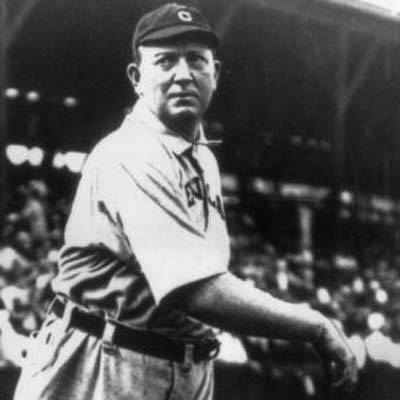
Cy Young was release by Cleveland on 8/15/1911. - Had he come too fat to field his position? (Photo by Photo File/Getty Images)

Cy Young was released by Cleveland on 8/15/1911. – Had he come too fat to field his position?
(Photo by Photo File/Getty Images)

It wasn’t pretty. It came late. It was about gate attraction. Not talent. Not pennant possibility. And it happened to 44-year old Cy Young in Brooklyn on October 6, 1911 as the ignominious last time he would pitch for anybody in the big leagues after at the end of a 22-year MLB career that began in 1890. With his first step in the 19th century era and his last miss-step in the 20th century modern era, it all unraveled for the biggest winner in baseball history that fated moment on a Bugs Bunny-like cartoon conga line of nine hitters. All Cy Young would have to show for his worst day ever was a string of nine straight surrendered hits and his 316th and final career loss.

Pitching in Brooklyn for the Boston Rustlers of the National League after being released by Cleveland of the American League on August 15, 1911 for being “too fat to field his position,” Cy had managed to go 4-4 in the 10 mound trips prior to his 11th start and 5th loss for the “Rustlers”, but this last one was an embarrassing pip, as they used to say.  It “was a sad ending for the great all-time hurler. Cy was clobbered in this game. He was left in until the Dodgers had scored 11 runs, seven crossing the plate in the seventh inning.”

http://research.sabr.org/journals/cy-youngs-final-fling

The “last eight batters of Young’s career combined to hit a triple, four singles, and three doubles.”

Unsurprisingly, the biggest winner in MLB history did not immediately interpret his 44 years of age, his final 1911 performance in Brooklyn, or the cruel whispers about his weight earlier at Cleveland as the final verdict on his career. At least, he made no public comment to that effect. He even went to spring training with the 1912 Boston Nationals, riding the bench for quite a while before coming finally to the conclusion that he was done. In words that were remindful of Bill Veeck’s half century later explanation to pitcher Ned Garver why he could not have a raise, Young apparently pretty much figured out on his own that the Rustlers were bad enough to find the cellar without his current ability to help. And so he retired without a return to the the big league mound.

Baseball people would hardly remember how he actually went out. They would be too pre-occupied with the fact that Cy Young’s 511 career wins would live to outshine every other pitcher’s win totals, before or since  – and probably for all time.

https://en.wikipedia.org/wiki/Cy_Young

____________________

eagle-0range
Bill McCurdy

Publisher, Editor, Writer

The Pecan Park Eagle

Houston, Texas

https://bill37mccurdy.com/

Astros Not Probable, Based on June 1st Spot

June 1, 2016
Sometimes a Statistical Chart or Table is like a birthday cake. It comes with green candles, but they never light up with much hope.

Sometimes a Statistical Chart or Table is like a birthday cake. It comes with green candles, but they never light up with much hope.


In early May, The Pecan Park Eagle took the position that the Astros needed to be at least a 5.00 club and no more than 5 games back of the ALW front-runner to be in the later hunt for red-hot October. They didn’t make it, in spite of the 4-game win streak and encouraging signs of offensive awakening they concluded by the end of May. We would love to see them prove us wrong, but a  look at the following tabular chart throws a bucket of cold water on the probability of a miracle finish in 2016. Things are always “possible” until later in the year, oc course,  we finally use up that last “magic number” of measurement charts our mathematical elimination, but the difference between a .001 possibility and a .999 probability should be obvious to the most disinterested mathematical mind.

There was never anything pontifical about our “pull to even, only 5 games backby June 1st” qualifier on this race. It is simply our way of saying that it’s easier to come back if you aren’t so far behind at the start of summer. It didn’t happen for the Astros. They are 5 games under .500 in spite of their current game win streak – and they are 7 to 7.5 games behind the two front-runners. The Astros have to catch them both – and also not get pulled back by the two other struggling ALW clubs. Hopefully, a look at the table makes this picture a little clearer, even if we, as Astros fans, don’t like what we see or find any candles to light on this cake:

American League West. June 1, 2016

ALW, 6/01/16 W L PCT. GB GLTP ALW 2016 W L PCT. GB HOU
RANGERS 31 21 .596 110 RANGERS 96.55 65.45 .596 1
MARINERS 30 21 .586 0.5 111 MARINERS 94.93 66.07 .586 3
ANGELS 24 28 .462 7.0 110 ANGELS 74.84 87.16 .462 23
ASTROS 24 29 .453 7.5 109 ASTROS 98 64 .605 *
ATHLETICS 24 29 .453 7.5 109 ATHLETICS 73.39 88.61 .453 25


  • At 5 games below .500 on June 1st, and 7 games back of the Rangers and 7.5 games back of the Mariners, and presuming that either or both of these clubs possess the ability to play the rest of the season at their current winning percentage rates, the Astros will have to play at a winning rate of .679 per cent in their final 109 games left to play (GLTP ) to edge out both front runners, presuming that neither of them plays at an even better winning rate in their own final GLTP (Games. Left To Play).

The table shows both the standings today, June 1, 2016, plus, what they will be at season’s end, if the four other clubs play the rest of the year at their current winning percentage levels. To that same right display of how the four foes would finish by W/L records over 162 games – and how the Astros would have to play .679 ball by winning of their remaining 109 games to win the division with an overall record of .605. It also shows the approximate games behind the Astros the other 4 ALW clubs would finish back of the Astros by continuing to play at their current winning percentage rates while the Astros drove their winning percentile mark at .679 .

Again, a great Astros comeback is still possible, but not highly probable, unless both the Rangers and Mariners crash – and neither the Angels nor the A’s come up with a red hot winning streak of their own – one that allows either club to exceed, from June 1 to season’s end, at a winning percentage rate that is higher than the winning percentages they already have achieved from Opening Day through May 31.

Have a nice day digesting that little chunk of reality! 🙂

Correction: I have my own reality to chew upon. I made an earlier error in calculating the percentage of games the Astros will need to win to take the division crown outright. The correct figures have now been plugged in after I caught my own mistake by rechecking the math. A division crown is still remotely probable, a not-s0-easy easy wild card spot is more probable, but the numbers in reality are not ridiculously improbable – if the Astros continue to build on this 4-game streak and can handle the job of overtaking two front-runners under the circumstances described originally.

Please forgive my initial math mistake. – I mistakenly calculated the Astros’ essential winning percentage the rest of the way by dividing the 98 total wins they need, using the 109 games they have left to play as the denominator. – Ouch! That made it seem that the Astros would need to play .899 ball from here on to the end to have a chance. – Not so fast.

That error failed to take into account that the Astros already have 24 wins in the bag through all games played by May 31. The Astros need only 74 more new wins to achieve the 98 total wins required from their 109 remaining games from June 1 to Season’s end.

A 74-35 record in their unplayed 109 games from June 1 to Season’s end translates into a winning percentage of .679.  – A 98-64 record for the entire Astros 2016 season translates into a season winning winning percentage of .605. And that .605 mark would be enough for the Astros to pass the Rangers or the Mariners for the ALW division championship, as long as neither exceeds their established w% rates through May 31 over the rest of the season.

Obviously, the Astros will also have a a better shot at one of the wild card spots too, if they are able to achieve at a 98-win season rate.

My apologies for the earlier miscalculation.

____________________

eagle-0range
Bill McCurdy

Publisher, Editor, Writer

The Pecan Park Eagle

Houston, Texas

https://bill37mccurdy.com/