Archive for the ‘Uncategorized’ Category

Happy Thanksgiving, Everybody!

November 25, 2009

Things aren’t exactly slow around my house as we move into the Wednesday Eve of Thanksgiving Day. Publication deadlines (elsewhere), some commitments at the office, and relatives arriving from out-of-town this afternoon have me up to my neck in all the things I’m also grateful to have in my life. And that’s what I want to reflect on briefly as we all all head into our national day of dedicated gratitude.

Let me put it this way: Thank God for life; thank God for love; thank God for friends and family; thank God for the passionate hearts we were all given to rise above our basic survival joys and give ourselves to the attainment of something larger than our selfish personal gain alone; and thank God for giving us the tools to go to work on whatever it is we need to help build. Finally, thank God for giving us the basic wisdom from the pain of our experiences to find our true paths and, as importantly, thank God for giving us the courage to travel our individually dedicated ways, no matter what.

Happy Thanksgiving, Everybody!

Wasn’t That The Year The Owls Were So Bad?

November 24, 2009

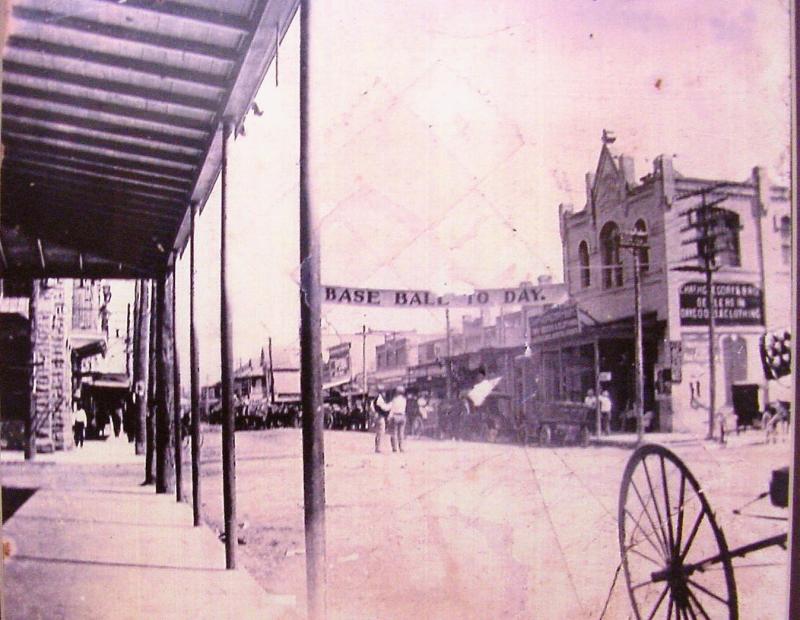
Talking with an Internet friend this morning about the old days, I was reminded again of my late dad and how he took to computers like a duck to water back in the early 1980s. He was about my current age back then, retired, but still full of energy for something to do. I bought him one of the early Apple IIe computers because I thought he might enjoy the banking and writing features. We didn’t have the Internet in 1983, but anything we did get from these early specimens of the coming high tech age were so far far ahead of typewriters and calculators it wasn’t funny.

Somewhat to my surprise, it was the word processor that really lit my dad’s fire. Unencumbered by his barely legible handwriting or the plethora of errors that always plagued dad about typewriters, the word processor freed him to write his memoirs about growing up in a small Texas town in the early 20th century.

Dad’s “book” derived its title from an expression he picked up from former major leaguer and fellow Beeville native Curt Walker. Walker was like an older brother or surrogate father to my dad while he was growing up fatherless back in the early 20th century. In addition to being an off-season undertaker in Beeville, Curt Walker was a man with little time and patience for those among the living who would take up a morning from others just to share personal stories that were so concretely wrapped in uninteresting material that they rivaled paint-drying as an opportunity for stimulation.

Whenever one of these old codgers would get started with a “back in 1915” tale, Curt would simply interject the following as the earliest opportunity: “Wasn’t that the year the owls were so bad?”

According to Dad, that question always worked with the Beeville crowd. Instead of waiting for the deadly story, they would embark upon the newer question: What’s this about an owl invasion? Was 1915 the year it really it happened, or was it some other time and place?. Meanwhile, Curt Walker would be making his way out of the conversation circle and heading elsewhere. Mission accomplished. If the subject ever did return to whatever the old geezer wanted to say, Curt Walker would be long gone from the scene.

“Wasn’t That the Year The Owls Were So Bad?” became the title to my dad’s book of memoirs about life in a small town.

Why Was The Sandlot So Joyful?

November 23, 2009

Our Eagle Field (1950) is Now Called Japonica Park.

The Pecan Park Eagles were real. Back in 1950, we played on an East End site in our neighborhood that we called Eagle Field. We played other places too, but this was our turf, our home field, our hatchery for every baseball dream that any of us ever knew. We had no lights at this sacred ground, but we didn’t need them. At a time in our young lives when summers meant we owned the place from from dawn to dusk, we didn’t need night baseball. Besides, night time was Houston Buffs time, a time for all of us to either be at Buff Stadium in the Knothole Gang, or else, to be listening tight to Loel Passe broadcasting the games over AM radio station KTHT, 790 on the dial.

What none of us knew back there in those innocent days of our young lives seems simple now. No matter what any us accomplished from there, some things would never get any better than they already were back in the summers of 1947 through 1952. Those years, especially the summer of 1950, were the seasons of the Pecan Park Eagles, and Eagle Field is where we all yielded our hearts and best playing efforts to the game of sandlot baseball. Nothing ever, in any form, yielded more pure joy to any of us than those treasured moments in the sun that we Eagles shared with each other on that hallowed turf.

Unfettered by normal adult responsibilities and the kind of cultural cynicism that now seems to ooze from every loose seam in the talking heads media, and also from every social network site on the Internet, we simply lived out the days of 1950 living in the moment of acting out our grandest dreams on a field that was tailor made by God for bare-feet running, heavy sweat bat-swinging, and rag-tag ball catching with hand-me-down gloves on a makeshift diamond that just happened to be available to us at the place where Japonica bleeds into Myrtle Street, one block over from Griggs Road and about two blocks east on Griggs from the Gulf Freeway.

The old place is still there in 2009, but it’s sadly now cluttered with playground equipment that we would’ve hated and probably destroyed sixty years ago. These things would only get in the way of a good game. Sadly too, today’s kids of my old neighborhood don’t seem to need that good game as once we did. They also don’t seem to either need the playground swings, etc., that the City of Houston has so thoughtfully constructed for them. I usually check out the old place about once a year – and I’ve never seen a kid playing there anytime I’ve driven by my oldest and strongest early haunt.

Driving slowly past Eagle Field, I sometimes stop and walk out upon it again, just to note all the landmarks that still remind me of what it was like to play ball there. The telephone pole in deep center field appears to be the same one that was in place all those many decades ago. There’s a big mixed breed dog in Mrs. McGee’s fenced backyard that now barks at me as though it would eat me alive if it could. I can still look over to the front porch of Randy Hunt’s old house. It seems that my presence on the “The Lot” (it’s other name) would bring Randy bounding out the front door to join me with a ball and glove, as it once did, but that never happens these days.

I never leave the place without saying something to Eagle Field like, “Goodbye, old friend, until next time!”

If I really have to explain why my personal sandlot was so joyful, I guess I can’t do it. Just know that some loves never end. And this was my big one.

The Phold of ’64!

November 22, 2009

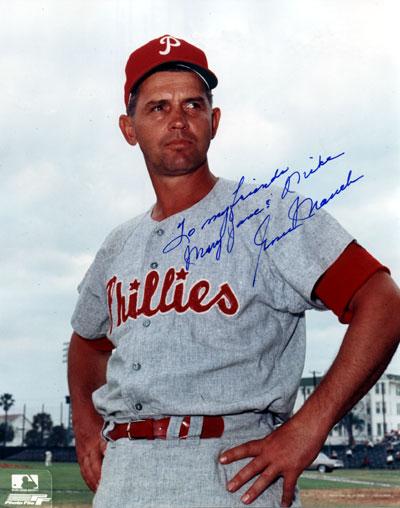
It’s not a new story. It’s also not one that those us who were around in those days will ever forget. The 1964 Philadelphia Phillies had the world on a string late in the season. With 12 games to go, they held a 6 1/2 game lead over the St. Louis Cardinals and the Cincinnati Reds and they were moving into a seven-game home stand that surely would allow them to finish the job and prepare for the World Series, most probably against the New York Yankees. It was to be the year that the Phillies got back at the Yankees for that four-game sweep in the 1950 World Series.

It was not to be. Something happened to turn destiny on its tail and send it the other way, shooting up the halls of heartache in eastern Pennsylvania and forever altering the course of baseball history.

The easiest, incomplete way to summarize it is simple. Manager Gene Mauch made a fatal decision going into the seven-game home stand to basically go with a two-man rotation the rest of the way. As a result, starters Jim Bunning and Chris Short got the nod to start 7 of the next 10 games, 6 of which resulted in starts on 2 days rest. The Phillies lost all ten games while the Cardinals and Reds both heated up.

The Phillies finally won their last two games of the season, but that only left them tied with Cincinnati for 2nd place. Philly fans had hoped for more. Didn’t happen. The Cardinals won on the last day of 1964, giving them a one-game championship advantage over Philadelphia and Cincinnati.

The “Philadelphia Phold” was complete. The New York Yankees-Philadelphia Phillies World Series Reunion would have to wait until 2009 while the ’64 St. Louis Cardinals renewed their 1926-1928, 1942-1943 World Series rivalry with the Bronx Bombers.

Because of The Phold, the Cardinals had a chance to beat the Yankees in a thrilling seven-game Series in 1964. The Cardinals win cost Yogi Berra his job as manager of the Yankees and handed it to Johnny Keane, the manager of the Miracle Cards, who himself was in line to be fired by St. Louis until his club pulled this incredible comeback and capture of the 1964 World Series Championship.

Who can ever know how far The Phold rippled? Maybe if the Phillies had made it to the 1964 World Series and lost to the Yankees, just maybe it would have been good enough for Mickey Mantle to retire then in contentment, sparing himself and the rest of us  those four extra final seasons (1965-68) that tore his career average down below .300 and exposed him to living decay as a ballplayer in the field.

Maybe this. Maybe that.

And who knows how the absence of The Phold might have affected the future careers of Yogi Berra, Johnny Keane, and Gene Mauch differently? When a team blows a 6 1/2 game lead with 12 games left to play, it simply changes everything for everybody for all time.

What’s impossible to recapture here is how it felt daily to watch this steady slide into ignominy that the Phillies made so desperately. Short of writing a whole book that awakens all the five senses, including special horror movie sound effects on the subject, the best a writer can hope for in this short space is to show you how the Phold Phound Philly over that dark period through a daily look at changes in the standings:

9/20/64: The Phillies (90-60) led the Cardinals (83-66) & the Reds (83-66) by 6.5 games with 12 games to go for the Phillies.

9/21/64: Reds 1 – Phillies 0; Cardinals idle.

Phillies (90-61) led the Reds (84-66)  by 5.5 games & the Cardinals (83-66) by 6 with 11 games to go for the Phillies.

9/22/64: Reds 9 – Phillies 2; Cardinals 2 – Mets 0.

Phillies (90-62) led the Reds (85-66) by 4.5 games & the Cardinals (84-66) by 5 games with 10 games to go for the Phillies.

9/23/64: Reds 6 – Phillies 4; Mets 2 – Cardinals 1.

Phillies (90-63) led the Reds (86-66) by 3.5 games & the Cardinals (84-67) by 5 games with 9 games to go for the Phillies.

9/24/64: Braves 5 – Phillies 3; Cardinals 4-4 – Pirates 2-0; Reds idle.

Phillies (90-64) led the Reds (86-66) by 3 games & the Cardinals (86-67) by 3.5 games with 8 games to go for the Phillies.

9/25/64: Braves 7 – Phillies 5; Reds 3-4 – Mets 0-1; Cardinals 5 – Pirates 3.

Phillies (90-65) led the Reds (88-66) by 1.5 games & the Cardinals (87-67) by 2.5 games with 7 games to go for the Phillies.

9/26/64: Braves 6 – Phillies 4; Reds 6 – Mets 1; Cardinals 6 – Pirates 3.

Phillies (90-66) led the Reds (89-66) by 0.5 games & the Cardinals (88-67) by 1.5 games with 6 games to go for the Phillies.

9/27/64: Braves 14 – Phillies 8; Reds 9-3 – Mets 1-1; Cardinals 5 – Pirates 0.

Reds (91-66) now led the Phillies (90-67) by 1 game & the Cardinals (89-67) by 1.5 games with 5 games to go for the Phillies.

9/28/64: Reds idle; Cardinals 5 – Phillies 1.

Reds (91-66) now led the Cardinals (90-67) by 1 game & the Phillies (90-68) by 1.5 games with 4 games to go for the Phillies.

9/29/64: Pirates 2 – Reds 0; Cardinals 4 – Phillies 2.

Cardinals (91-67) & the Reds (91-67) are now tied for 1st; the Phillies (90-69) now trail by 1.5 games with 3 games to go.

9/30/64: Cardinals 8 – Phillies 5; Pirates 1 – Reds 0.

Cardinals (92-67) now led the Reds (91-68) by 1 game & the Phillies (90-70) by 2.5 games with 2 games to go for the Phillies.

10/01/64: Cardinals & Phillies idle; Reds 5 – Pirates 4.

Cardinals (92-67) now led the Reds (92-68) by 1 game & the Phillies (90-70) by 2.5 games with 2 games to go for the Phillies.

10/02/64: Mets 1 – Cardinals 0; Phillies 4 – Reds 3.

Cardinals (92-68) now led the Reds (92-69) by 0.5 games & the Phillies (91-70) by 1.5 games with 1 game to go for the Phillies.

10/03/64: Mets 15 – Cardinals 5; Reds & Phillies idle.

Cardinals (92-69) now tied with the Reds (92-69) for 1st; the Phillies (91-70) are 1 game back with 1 game to go for all three contending clubs.

10/04/64: Cardinals 11 – Mets 5; Phillies 10 – Reds 0.

Cardinals (93-69) win the NL pennant by 1 game over the Reds (92-70) and Phillies (92-70).

The Phillies came back with a death rattle run in their last two games, but it was far too little and way too late. Forty-five years later, 1964 still hangs in my mind as the most exciting pennant race in personal memory. Some of you will understand exactly what I’m saying here, as will those fans outside Philadelphia who didn’t cut their throats in funereal sympathy for the Phillies.
My Native Texan College Team!

November 21, 2009

Texas Baseball History Goes Way, Way Back!

Lone Stars of the Diamond, like most good reference books, is a work that lingers. I couldn’t resist having a minor run this morning at organizing my all-time native Texan team of former college players. In the short run, all I could do was come up with a roster I wouldn’t mind taking to spring training for the sake of allowing performance to whittle things down from there – with one major exception. If Tris Speaker goes 0 for 50 in spring training, he will still be my starting center fielder on Opening Day.

If you’re wondering where Roger Clemens is because you don’t know any better, he’s missing, of course, because he wasn’t born in Texas. He was born in Ohio. Otherwise, had he been a native Texan, Roger Clemens would have been my Opening Day starting pitcher, no matter what.

Here’s the spring training roster, with all of these guys showing up in their primes. Brad Mills should be so lucky, but that’s not how these kinds of all star teams work. We fans can put this kind team together and not be impeded by reality. If we were, I’d hate to consider what this team would cost us at today’s market values:

C – Matt Batts, Baylor; Chris Snyder, Houston; Jason LaRue, Dallas Baptist

1B – Lance Berkman, Rice; Norm Cash, Sul Ross; Eddie Robinson, Paris JC

2b – Davey Johnson, Texas A&M; Chuck Knoblauch, Texas A&M; Debs Garms, Howard Payne

3b – Grady Hatton, Texas; Max Alvis, Texas; Pinky Higgins, Texas

SS – Spike Owen, Texas; Roger Metzger, St. Edward’s; Ben Zobrist, Dallas Baptist; Topper Rigney, Texas A&M

LF – Don Baylor, Blinn JC; Bibb Falk, Texas; Ox Eckhardt, Texas; Steve Henderson, Prairie View A&M; Jose Cruz, Jr., Rice; Glenn Wilson, Sam Houston State; Aubrey Huff, Miami

CF – Tris Speaker, Texas Wesleyan; Curt Walker, Southwestern; Michael Bourn, Houston; Max West, North Texas; Jim Busby, TCU

RF – Beau Bell, Texas A&M; Ernie Koy, Texas; Keith Moreland, Texas; Carl Warwick, TCU; Hunter Pence, UT Arlington

P  –  John Lackey, UT-Arlington

P –  Doug Drabek, Houston

P –  Woody Williams, Houston

P – Burt Hooton, Texas

P – Tex Carleton, TCU

P – Bert Gallia, St. Mary’s

P – Murray Wall, Texas

P – Dou Rau, Texas A&M

P – Huston Street, Texas

P – Greg Swindell, Texas

P – Bill Henry, Houston

P – Calvin Schiraldi, Texas

P – Joel Horlen, Oklahoma State

P – Dennis Cook, Texas

P – Tex Hughson, Texas

P – Kip Wells, Baylor

P – Ryan Wagner, Houston

Have a great weekend, everybody!

Lone Stars of the Diamond

November 20, 2009

One of the all-time most interesting books on Texas baseball history was published in 2007 by Halcyon Press here in Houston. “Lone Stars of the Diamond” by  David King and Chuck Pickard was a landmark documentation of every native Texan who had ever played a single smidgeon second in the big leagues through the 2006 season. There may have some minor additions over the past three uncovered years (2007-09), but not enough to detract from this reference work’s historical value to bedrock students of the game’s past. The book is still available from

Amazon. Com for $24.95, plus tax and shipping, if you’re interested.

The book tracks every native Texan since the first one made it to the big leagues in 1895. Needless to say by name, the two fellows pictured at the the top of this article stand together, alone above all others, as the two greatest native Texan ballplayers in big league history. One is renowned as the greatest right-handed hitter in all of baseball history; the other is remembered as the greatest center-fielder of his time and the all-time leader in doubles. Both men managed teams to World Series wins and each is enshrined in the Hall of Fame at Cooperstown.

This book goes far beyond Rogers Hornsby and Tris Speaker in its treatment of the facts about native Texan roots and accomplishments. It’s so factual, in fact (which is what a reference book is supposed to be), that it could’ve been written in years past by Sergeants Joe Friday and Frank Smith from the old TV show, “Dragnet.”

If you want to know who else reached the Hall of Fame besides Hornsby and Speaker, it’s in there. If you want to know the leaders in a wide range of statistical categories, it’s in there. If you want to know who and how many major leaguers were born in your Texas home town, it’s in there. If you want to know about the great native Texan Negro Leaguers, that’s tight, one more time, it’s in there.

I am walking proof that there’s no way to come even close to knowing all that much about the history of baseball. There’s just too much to absorb from a clear factual standpoint – and that’s why we need the kinds of help we get from people like David King and Chuck Pickard.

I did find one error that I need to address under the list of native Texan big leaguers by city of birth. My birth home town of Beeville is responsible for four native Texan big leaguers. Three of them (Bert Gallia, Curt Walker, and Lloyd Brown) all played in the early part of the 20th century. The fourth (Eddie Taubensee) was a former Houston Astro from the latter part of the 20th century. The “Lone Stars” list also includes Beau Bell as hailing from Beeville, which he didn’t. Beau Bell actually was born in Bellville, Texas. For all I know, his family may have even founded the place before they lost credit as Bellville in “Lone Stars” for their only native son.

(Wait a minute. I think I know what some of you are are thinking and the answer is “No, Ernie Koy was not born in Bellville, the town that became his well-known home through most of his life. Ernie Koy was born down the road at Sealy – which did receive proper credit for him as a birthplace son in “Lone Stars.”)

Mssrs. King and Pickard are to be forgiven here for this minor mistake. The “sounds-the-same” and “looks alike” confusion between Beeville and Bellville is historical. My grandfather, who owned and ran the Beeville Bee back in the 19th century, used to complain in print about receiving mail that was actually intended for the Bellville, Texas newspaper editor. “Beeville and Bellville need to get together and find a way to decide which town changes its name,” Grandfather Will McCurdy wrote back in 1888. “Unless the cities do get together and change one of the town names, people far into the future will still be confusing the two places with each other long after we are all gone.”

The erroneous listing of Beau Bell as a native of Beeville just proves one more time that Grandfather McCurdy was right. It’s still a matter too slight to detract from all the important hard work that went into the making of “Lone Stars.” I have no stake in the matter, but I highly recommend this work to those of you who are members of SABR and also to anyone else who is even slightly interested in the nuts and bolts of Texas baseball history.

Ed Mickelson: Minor League All Star!

November 19, 2009

Mickelson Got the Last RBI in St. Louis Browns History.

Today at 83, Ed Mickelson is a silver-haired Cary Grant type living out his happy life in St. Louis, Missouri. Yesterday at 27, he collected the last run batted in recorded in St. Louis Browns history. He did it in a 2-1 losing cause against the Chicago White Sox on the last day of the 1953 season at old Sportsman’s Park. I wrote a parody to commemorate the event, once upon a time.  That signature RBI wasn’t the only thing that Ed ever did in baseball, but it is the thing he wants to be remembered for having done as a member of the Browns’ far from legendary last club on earth back in 1953. The next season, the franchise moved to Baltimore and hatched upon the scene as the Orioles.

In 2007, Ed Mickelson personally wrote his own story and published it through McFarland’s.  Still available through Amazon, the Mickelson biography is entitled “Out of the Park: Memoir of a Minor League Baseball All Star.” It’s well written and a good read, detailing Mickelson’s eleven season career (1947-57). He started with Decatur and ended up with Portland, achieving a lifetime minor league batting average of .316 and 108 home runs in 1,089 minor league games played. Ed even went 3 for 9 as a Houston Buff in 1952 before being reassigned by the parent Cardinals club to Rochester.

Mickelson also played 18 games total in the major leagues for the 1950 St. Louis Cardinals, the 1953 St. Louis Browns, and the 1957 Chicago Cubs. That record RBI single that scored Johnny Groth from second base in 1953 also was one of only three RBI that Ed managed in his brief major league career. His MLB average of .089 helps to explain his limited action beyond the minor leagues.

Ed Mickelson is one of the nicest people you could ever meet. He’s a bright guy who looks the part of his current role as an aging gracefully first baseman. The BR/TR, 6’3″ and still lanky guy could not better look the part if he tried.

Mickelson compiled a number of honors for his minor league play over the years, but that’s the stuff of Ed’s story in the book. Just one peek here: Ed Mickelson is also notably proud of the fact that he got his first major league hit in the form of a single off the great Warren Spahn back in 1950. I definitely remember Ed’s short 1952 stay with the Buffs too, but the Cardinals didn’t leave him here long enough to do that sad Buff team much good.

In honor of Ed Mickelson’s last RBI in St. Louis Browns history, here’s that parody I wrote years ago in all their honors:

The Lost Hurrah: September 27, 1953
Chicago White Sox 2 – St. Louis Browns 1.

(A respectful parody of “Casey At The Bat” by Ernest L. Thayer in application to the last game ever played by our beloved St. Louis Browns.)

by Bill McCurdy (1997)

The outlook wasn’t brilliant for the Brownie nine that day;
They were moving from St. Louis – to a place quite far away,
And all because Bill Veeck had said, “I can’t afford to stay,”
The team was playing their last game – in that fabled Brownie way.

With hopes of winning buried deep – beneath all known dismay,
The Brownies ate their cellar fate, but still charged out to play.
In aim to halt a last hard loss – in a season dead since May,
They sent Pillette out to the mound – to speak their final say.

The White Sox were that last dance foe – at the former Sportsman’s Park,
And our pitcher pulsed the pallor of those few fans in the dark.
To the dank and empty stands they came, – one final, futile time,
To witness their dear Brownies reach – ignominy sublime.

When Mickelson then knocked in Groth – for the first run of the game,
It was to be the last Browns score, – from here to kingdom came.
And all the hopes that fanned once more, – in that third inning spree,
Were briefly blowing in the wind, – but lost eternally.

For over seven innings then, – Dee bleached the White Sox out,
And the Browns were up by one to oh, – when Rivera launched his clout.
That homer tied the score at one, – and then the game ran on.
Until eleven innings played, – the franchise was not gone.

But Minnie’s double won the game – for the lefty, Billy Pierce,
And Dee picked up the last Browns loss; – one hundred times is fierce!
And when Jim Dyck flew out to end – the Browns’ last time at bat,
The SL Browns were here no more, and that was that, – was that!

Oh, somewhere in this favored land, the sun is shining bright;

The band is playing somewhere, and somewhere hearts are light;

And somewhere men are laughing, – and little children shout,

But there’s no joy in Sislerville, – the Brownies have pulled out.

Speaking of Fingers…

November 18, 2009

"Have a Nice Day, Buffalo Bills!"

What was Bud Adams thinking last Sunday in Nashville?

His NFL club, the Tennessee Titans, had just dispatched the visiting Buffalo Bills, 41-17, for their third win in a row and all looked well for America’s favorite hillbilly team. Why oh why then did the 86-year old Budman suddenly feel the need to rise from his suite box seat and issue the visiting Bills the universally unpleasant one-finger salute goodbye, serially, and with both hands?

NFL Commissioner Roger Goodell just happened to be present in Nashville for the game and had spent most of his time on Sunday watching it with Adams from his private suite box on the upper level of the stadium. Goodell had left Adams in the 4th quarter to smooze a little time away with fans before game’s end. He did not see the actual salute performance, but he sure got a load of the images made available to him later from some fan in the lower deck’s cell phone camera.

As a result of all these circumstances, Commissioner Goodell quickly levied a fine upon Titans owner Bud Adams of $250,000. Wow! That works out to a quarter million dollars, or, breaking it down, $125,000 a finger! The fine also derived an apology from Adams to everyone in the conceivably offended universe as he waxed away also on the notion that his actions were among those that never should have happened in the first place.

Gee whiz! You think so, Bud? ‘Cause if you do, that’s a monumental piece of insight all onto itself! It never should have happened in the first place, but what the heck. You’re only 86 years old, going on 87. You’ve got plenty of time to reckon with the basic questions that face us all on the spiritual plane. May as well get cranked with anger and spite in the meanwhile and either curse or one-finger salute someone else’s football team for losing to or beating up on your own club while there’s still plenty of time to waste.

The one-finger salute is a lot like drinking too much. In fact, those two human events often go hand-in-hand down the aisle of violent promise. They are things some people do to punctuate both the thrill of victory and the agony of defeat in the face of some identified enemy. Even though they seem to be very different actions, one arising from celebration and the other emanating from consternation, they are really the same thing – and they each are expressions of violence. One salute says “take this for what I did to you” and the other says “take this for what you did to me.” Both are put forth like bulletin board material to further inspire the anger and desire for revenge that will dominate our next meeting on the field of battle or play.

Sometimes the one-finger salute comes in the form of a few more muscles being put into play then the few it takes to raise the big digit on either hand. Bud Adams knows about that kind of salute too. Back in the mid-1990s, when the city refused to finance Adams’ plan for a new stadium downtown to house his Houston Oilers, Bud gave us all a much more painful version of the one-finger salute. He took his NFL team out of Houston and turned them into the Tennessee Titans.

Keep that in mind when the Titans come to town next Monday night to play our Houston Texans, folks. – It’s time to salute Bud and the boys again.

"When you're smilin' - when you're smilin' - the whole world smiles at you!"

Houston Buffs: Ted Wilks.

November 17, 2009

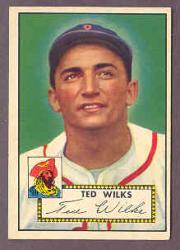
Right hander Ted Wilks broke into baseball with the 1938 Houston Buffs. His 3-5 record with an ERA of  2.74. He pitched well enough that rookie season to earn a promotion that same year to Rochester, where he posted a 4-2 mark with an ERA of 3.94. A subtle difference in how he was used at Houston and Rochester was nothing less than a career harbinger on things to come. Here in Houston, Ted was primarily a starting pitcher; at Rochester, Wilks saw most of his mound action in relief.

The following three seasons saw Ted Wilks back in Houston for more seasoning. He went 14-15 with a 2.60 ERA in 1939; 13-10 with a 2.51 ERA in 1940; and 20-10 with a 2.50 ERA for the 1941 Buffs. All three Buff clubs (1939-41) finished in first place; the ’40 club also won the league pennant playoffs; and Ted Wilks was a big part of that Buff era of success.

After going 12-9, 2.41, for the ’42 Columbus Redbirds and 16-8, 2.66, for the same club in ’43, Ted Wilks finally joined the big club in St. Louis in time to help the 1944 Cardinals take another world Series crown with the streetcar series win over the same hometown Brown of the American League. Wilks was used pretty evenly in 1944 as a starter and reliever (21/15), going 17-4 with another sub-three ERA of 2.64 on the season.

In his eight seasons as a Cardinal (1944-51), Ted Wilks won 54 games against only 20 losses, posting a sub-three ERA on three separate occasions. It was early during this period that he moved from split duty as a starter-reliever to recognition and exclusive use as one of the top relief pitchers in the game.

On June 15, 1951, the Cardinals traded Ted Wilks, Bill Howerton, Howie Pollet, Joe Garagiola, and Dick Cole to the Pittsburgh Pirates in exchange for pitcher Cliff Chambers and outfielder Wally Westlake.

Wilks went 8-10 in two seasons with the Pirates (1951-52) before he was again dealt away, this time  to the Cleveland Indians on August 18, 1952, along with shortstop George Strickland for infielder Johnny (General Hospital) Berardino, minor league pitcher Charlie Sipple, and $50,000 cash. By this time, Wilks was was pretty much out of gas for major league ball. He posted no decisions in his two partial seasons with Cleveland (1952-53) and he finished his major league career working only 15 1/3 innings in the American League city.

Ted Wilks finished his total career working four poor seasons of minor league ball (1953-55: Indianapolis; 1956: Austin) before retiring for good. He finished up with a career minor league record of 91-65, 2.70 for 10 seasons – and a career major league record of 59-30, 3.26. Ted wilks posted 46 saves as a major leaguer. The “save” stat for his minor league work is not readily available.

Like a number of ballplayers whose careers passed through Houston, upstate New Yorker Ted Wilks adopted Houston as his post-career home town. He died here in Houston in 1989 at the age of 73 and he is buried in the East End at Forest Park Cemetery on Lawndale. His final resting place is only two miles from where he first took the mound as a Houston Buff in 1938.

Rest in Peace, Prince Ted, but stay ready to come into the game whenever old St. Peter dials your number.

Houston Buffs: Danny Murtaugh.

November 16, 2009
20090830pg_murtaugh_330

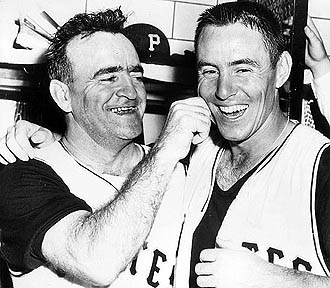
Murtaugh (L) & Mazeroski were all smiles after Game 7 in 1960!

Danny Murtaugh started out his baseball career as a tough-nosed 20-year old infielder from Chester, PA for the 1937 Cambridge Cardinals of the Class D Eastern Shore league. He batted .297 in his rookie season, following that year with a .312 mark in his second round with the ’39 Cambridge club in the St. Louis Cardinals farm system. He played shortstop his first season; second base his second year. At 5’9″ and 165 pounds, Danny had the right body type and low center of gravity for a middle infielder. More importantly, he had the right kind of aggressive attitude as a critical playmaker.
After batting .255 and .326 in a split-season performance for Columbus and Rochester in 1939, Murtaugh joined the 1940 Texas League Champion Houston Buffs of the Texas League. This time around, Danny played third base, batting .299. The following season, Danny Murtaugh returned to the 1941 Buffs as a second baseman and batted .317 in 69 games. His performance was good enough to get him dealt to Philadelphia (NL), where Danny broke into the big leagues with as a “good field, seldom hit” second baseman (.219) who also reached base often enough to lead the National League in stolen bases with 18.
Murtaugh then improved steadily with the Phils, batting .241 in 1942 and .273 in 1943. Military service got the call in 1944-45. Danny returned in 1946, but, after a handful of at bats with the Phils, he was dealt back to the Cardinals and assigned again to Rochester. This time he excelled, hitting .322 over the road of a whole season.
Dealt next to Boston (NL) in the off-season, Danny again picked up a hand scoop of at bats with the Braves before he was assigned to AAA Milwaukee, where he again did well, batting a “Punch and Judy” .302 in 119 games.
Then Danny Murtaugh acquired his lasting identity. He was dealt to the Pittsburgh Pirates, where he played second base for four seasons (1948-51). In the two seasons he played over 100 games for the Pirates, Murtaugh batted .290 in 1948 and .294 in 1950. He finished his nine major league season career in 1951 with a total batting average of .254 and a strong reputation for tough, heads up baseball savvy.
Danny Murtaugh’s ability earned him a four-year assignment by the Pirates as a minor league manager for New Orleans (1952-54) and Charleston (1955). He continued to play ball a little in 1952-53, wrapping up his nine season, 901-game minor league career with an impressive .297 batting average.
Danny Murtaugh began the memorable phase of his career when he took over as manager of the Pittsburgh Pirates in 1957. For eight consecutive years (1957-64), Danny Murtaugh steadied the Pirates and led them in 1960 to their first pennant since 1927 and first World Series title since 1925. Who among us fans with blood flowing in our veins will ever forget Bill Mazeroski’s dramatic and iconic home run that gave the Pirates a freak-out, walk off victory over the New York Yankees in extra innings at Forbes Field in Game Seven back in 1960?
Pittsburgh’s administration never forgot the moment either. They brought Danny Murtaugh back three additional times as manager in 1967, in 1970-71, and one more time in 1973-76. He guided the Pirates to a second World Series title on his watch in 1971.
I’ve never read anything from anyone in the Pittsburgh organization back in those days that ever reflected badly on Danny Murtaugh as a manager. He really comes across as a never-give-up winner who believed in the value of solid fundamentally sound baseball and the importance of players psychologically leaning into the game with an attitude toward winning as the only acceptable outcome. It was the same attitude that some of us in Houston got to see in person through one of his former players who became a manager here and elsewhere. In his own quiet way, Bill Virdon exuded that same winning Murtaugh attitude. One doesn’t have to be a loudmouth screamer to be totally dedicated to winning.
Sadly, we lost Danny Murtaugh early. He passed away at his home in Chester, PA in 1976 at age 59. Happily, Danny spent most of his last year on earth doing the thing he did best: managing the Pittsburgh Pirates.