Archive for the ‘Uncategorized’ Category

The Ballad of Eddie Gaedel.

December 22, 2009

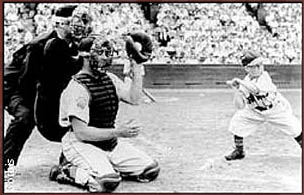
In further deference to the spirit of this off-season, and to the fact that time is short as we run smack dab into Christmas in only three more days, here’s another parody I wrote ten years ago about the time on August 19, 1951 that St. Louis Browns club owner Bill Veeck sent a vertically challenged person (a so-called “midget” back in the pre-PC days) into a game against the Detroit Tigers. It only happened once, but it turned a memory that shall last forever. Here it is again for your last minute Christmas shopping pleasure or displeasure, “The Ballad of Eddie Gaedel”, as sung to the tune of “Rudolph the Red-Nosed Reindeer”:

The Ballad of Eddie Gaedel
(sung to the tune of “Rudolph, The Red-Nosed Reindeer”)
by Bill McCurdy, 1999.

Bill Veeck, the Brownie owner,
Wore some very shiny clothes!
And if you saw his sport shirt,
You would even say, “It glows!”

All of the other owners,
Used to laugh and call him names!
They wouldn’t let poor Bill Veeck,
Join in any owner games!

(chorus)
Then one humid summer day,
Bill Veeck had to – fidget!
Got an idea that stirred his soul,
He decided to sign a – midget!

His name was Eddie Gae-del,
He was only three feet tall!
He never played much baseball,
He was always just too small!

(chorus)
Then one day in Sportsman’s Park,
Eddie went to bat!
Took four balls and walked to first,
Then retired – just-like-that!

Oh, how the purists hated,
Adding little Eddie’s name,
To the big book of records,
“Gaedel” bore a blush of shame!

Now when you look up records,
Look up Eddie’s O.B.P.!
It reads a cool One Thousand,
Safe for all eternity.

Our Christmas All Stars!

December 21, 2009

Because of the thousands who have  come and gone as big league ballplayers since the 19th century, it’s always fun to come up with new all star  teams along infinite theme lines – and what an opportunity we have before us this week as Christmas comes our way. The following is simply my humble offering along those lines.

Larry St. Dierker, Manager, Christmas All Stars

It shouldn’t be hard to figure that most of the players (everyone but starting pitcher Rick Wise) on our Christmas All Star roster didn’t get there on the basis of their on-the-field productions and/or longevity as major league baseball players, but as names that fit the aims of our theme.

Wish I could have found a “Mary” or a “Madonna” somewhere in the mix, but even baseball has failed to travel that liberally varied  a surname lane.

The ones we did sign up all fit fine, and their numbers on the roster, as well as their presences in the starting lineup. are neither the products of accident. There are  two major “numbers” factors built into both the  roster total and the lineup composition that should jump out at you as that obvious, but you may have some other players in mind that you feel deserve to be on the team. If so, please post them below as comments to this article.

Have fun with the data!

Our Twelve Men of Christmas All Stars Roster includes …

P: Rick Wise (1964, 66-82) 188-181, 3.69 ERA

P: Dave Jolly (1953-57) 16-14, 3.77 ERA

P: Al Clauss (1913) 0-1, 4.75 ERA

P: Keith Shepherd (1992-93, 95-96) 2-5, 6.71 ERA

C: Steve Christmas (1983-84, 86) .162, 1 HR

1B: Pop Joy (1884) .215. 0 HR

2B: Casey Wise (1957-60) .174, 3 HR

3B: Mike Lamb (2000-08) .277, 69 HR

SS: Omar Infante (2002-09) .264, 37 HR

LF: Ron Shepherd (1984-86) .167, 2 HR

CF: DeWayne Wise (2000, 02, 04, 06-09) .218, 17 HR

RF: Rick Joseph (1964, 67-70) .243, 13 HR

Our Christmas Morning Game Batting Order is …

Rick Joseph, LF

DeWayne Wise, CF

Mike Lamb, 3B

Omar Infante, SS

Ron Shepherd, LF

Pop Joy, 1B

Casey Wise, 2B

Steve Christmas, C

Rick Wise, P

Have a great Monday before Christmas week! Hope you have your shopping done!

Remembering the St. Louis Browns.

December 20, 2009

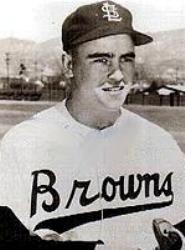
Ned Garver won 20 games for a club that lost 102.

A lifetime ago, before there was a major league club in Houston, those of us who grew up here had to pick one of the sixteen existing clubs to follow. We were all first Houston Buffs of the AA Texas League fans, of course, but we weren’t boondocks-dumb to the fact that the best brand of baseball was the variety played in either the National or American leagues, in most cases. We also were ego-loaded to the idea that a club like our ’51 Buffs could most likely take a team like the Pirates, the Senators, the A’s, or the Browns in a best of seven series any day of any October week during that era.

I had two favorite big league clubs, one from each major league. Not surprisingly, the first of mine was the St. Louis Cardinals of the National League. The Cards were the major league parent of our Houston Buffs and they were loaded with former Buffs who had stampeded their ways to the big time through the gates of Buff Stadium. My other club was an American League entry, but it wasn’t one that many fans chose to follow, even from among those people who lived in the city that had been its home since 1902.
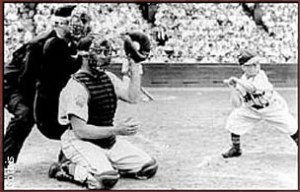
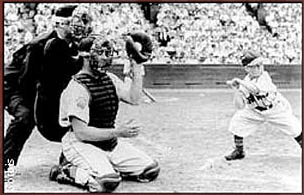
How could you not like the only club that ever sent a midget into a real game as a batter?

The St. Louis Browns were simply awful most years. The rest of the time they were downright terrible. Except for their great club of 1922, the one led by Hall of Famer George Sisler to a one-game-short miss of the 1922 American League pennant, the 1944 Browns were the only club in franchise history to win an AL pennant. It wasn’t much to shout about. Any time you have to give an assist to a guy like Adolph Hitler for creating the manpower shortage that opened the door for the Browns to walk into their lone lucky title break its – well, its flat out embarrassing.

The Browns won the 1944  American League title at the wire over the Detroit Tigers and then lost the World Series in six games to their same neighborhood Cardinal rivals.
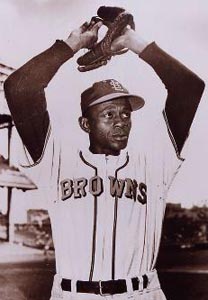
"Never look back. Something might be gaining on you." - Satchel Paige

I came aboard as a Browns fan during the 1951 season, mainly because of one man. That was the year that Browns pitcher Ned Garver won twenty games (20-12, 3.73) for a team that finished in last place with a record of 52-102. It was a case of unfortunate underdog misidentification, but my admiration for Garver’s achievement against the odds, plus the presence of the great Satchel Paige on their roster, plus Eddie Gaedel (see photo of midget batter), well, the short of it is simple. These all sucked me into accepting the Browns as my club in the American League.

It was a short-lived romance. After two more seasons in St. Louis (1952-53), the Browns departed the Mississippi River city in favor of a 1954 reincarnation on the east coast as the Baltimore Orioles. It was a move that rang the bell on other franchise relocations to soon come, and I hated it as deeply as though I had grown up with the Browns in St. Louis. As if I need now any help with compiling further reasons to dislike her, the Baltimore mayor who led the Browns transformation to Orioles just happened to have been the father of current House Speaker Nancy Pelosi.

Several years ago, I wrote a parody version of “Casey at the Bat” to express the meter and merit of my sadness over the Browns’ last game in St. Louis. In the nostalgic spirit of the season, and in memory of that long ago 1953 moment in Sportsman’s Park (renamed Busch Stadium), here’s what happened on September 27, 1953 in St. Louis, Missouri:

The Lost Hurrah: September 27, 1953
Chicago White Sox 2 – St. Louis Browns 1.

(A respectful parody of “Casey At The Bat” by Ernest L. Thayer in application to the last game ever played by our beloved Browns.)

by Bill McCurdy (1997)

The outlook wasn’t brilliant for the Brownie nine that day;
They were moving from St. Louis – to a place quite far away,
And all because Bill Veeck had said, “I can’t afford to stay,”
The team was playing their last game – in that fabled Brownie way.

With hopes of winning buried deep – beneath all known dismay,
The Brownies ate their cellar fate, but still charged out to play.
In aim to halt a last hard loss – in a season dead since May,
They sent Pillette out to the mound – to speak their final say.

The White Sox were that last dance foe – at the former Sportsman’s Park,
And our pitcher pulsed the pallor of those few fans in the dark.
To the dank and empty stands they came, – one final, futile time,
To witness their dear Brownies reach – ignominy sublime.

When Mickelson then knocked in Groth – for the first run of the game,
It was to be the last Browns score, – from here to kingdom came.
And all the hopes that fanned once more, – in that third inning spree,
Were briefly blowing in the wind, – but lost eternally.

For over seven innings then, – Dee bleached the White Sox out,
And the Browns were up by one to oh, – when Rivera launched his clout.
That homer tied the score at one, – and then the game ran on.
Until eleven innings played, – the franchise was not gone.

But Minnie’s double won the game – for the lefty, Billy Pierce,
And Dee picked up the last Browns loss; – one hundred times is fierce!
And when Jim Dyck flew out to end – the Browns’ last time at bat,
The SL Browns were here no more, and that was that, – was that!

Oh, somewhere in this favored land, the sun is shining bright;
The band is playing somewhere, and somewhere hearts are light;
And somewhere men are laughing, – and little children shout,
But there’s no joy in Sislerville, – the Brownies have pulled out.
Baseball’s Mortal Enemy: The Clock.

December 19, 2009

There’s an interesting artcle online this morning about how baseball needs to find ways to shorten the length of games. Writer Stan McNeal takes a crack at what he sees as baseball’s need to shorten games for the sake of maintaining fan interest and the cultivation of new fans among what I call the “get my attention within five seconds or lose me forever” generation that is now still in childhood. Check out “Memo to Selig’s special committee: Speed up the game” at http://www.sportingnews.com for December 19, 2009.

Those of us older fans who grew up with the slower pace of baseball seem to have less trouble with the length of games, but the voice of younger fans seems more intent on speeding up the game, even if it tampers with some of the rules and traditions that have made the game so beautifully different from all others that are governed by the clock. In a very real way, we should read McNeal’s article for the sake of what it says about McNeal as a man of his generation. McNeal is willing to shorten the count in pitching to three balls gets you a walk, and is even willing to accept a foul ball with two strikes as an out.

I pause here to offer these responsible considerations: (1) Is baseball’s biggest enemy really the clock? Or is it people like McNeal and others who seems willing to radically change the game for the sake of bringing everything to a wrap inside two hours? Perhaps it’s older people like me who seem almost completely resistant to the idea of changing the fundamental game? I plead guilty to all charges of resistance. The least important item I take with me  to a game is my wristwatch. I don’t care how long I’m there once I enter the ballpark. It’s the game that holds my interest – and my baseball game plays out on a field of potential eternity. Heck! I’m even OK with the increased use of replay equpment for the sake of “getting it right” on close calls. That being said, I also recognize that the fans of tomorrow aren’t going to hang around for long unless baseball does find a way to narrow the gap that exists between actual games times and shrinking attention spans.

McNeal offers six suggestions for consideration. Here they are, along with my opinions of each:

(1) Forget About Instant Replay. McNeal thinks the problem of “getting it right” would be better served by adding two umpires down the line. To that I say, “Sell that idea to manager Ron Gardenshire of the Minnesota Twins.” I say increase the use of instant replay and damn the clock for the sake of greater accuracy.

(2) Reduce the time between pitches. We don’t need to change the rules. We simply need to have the umpires enforece  the rules that now exist for controlling the tempo of the game through some real control of pitcher/batter behavior between pitches.

(3) Change intentional walks. McNeal offers the old suggestion that intentional walks should occur by a hand motion of the batter to take first. He doesn’t understand that those four pitches the pitcher now must throw outside first are not so automatic and could lead to wild pich and a very different play outcome. I say leave this old idea where it belongs – in the deadhead pile.

(4) Speed up pitching changes. This one has to do with limiting managerial/coaching trips to the mound and putting a clock on how much time a reliever has to reach the mound from the time he’s called into the game. I don’t really like messing with this one because its so much a part of the mental game. If I had to choose, I could go with limiting the mound trips to one per inning and to mound changes from the dugout by hand signal, but I really don’t like this one, nor do I think it’s much of a timesaver. I oppose McNeal’s suggestion that a pitcher coming into the game who doesn’t reach the mound in a prescribed number of seconds shall be forced to start out with a 1 ball, no strikes count. What happens if he’s late for a 3-2 count on a batter with the bases loaded and the winning run on third? Would lateness in this instance result in a “delay-of-game-off” victory for the batting home team?

(5) Limit pickoff attempts. For-ged-a-bout-it!

(6) Somehow, someway, keep the runner at second base from peaking in. Un-b-floppin-leavable!!! McNeal really strains on this one, right down to spelling “peeking in” as though it were “peaking in”, or some kind of introversion of maximum effort. McNeal’s suggestions here are a combo of spurious, unenforceable, uninteresting, and un-baseball like suggestions in their character.

As you can see, my heart is not really engaged in the search for ways to speed up the game. Baseball Commissioner Bud Selig said there would be no “sacred cows” pr0tected from change by his committee to study the issue. To that, all I can say is, maybe we should allow baseball to simply live or die as the beautiful game it already is. If it’s too long an affair to stay engaging to future ADD-conditioned  fans, then they don’t deserve it, anyway. Let ’em twitter their lives away til kingdom come. Baseball is a game that requires more than two thumbs and a mind that’s numb to the beauty of slow-building melodrama.

Twas the Night Before Christmas 1951.

December 18, 2009

Twas the Night Before Christmas,

In Buffalo Stadium,

No spring things were growing,

Not a single Caladium.

Still the jock straps were hung,

In the clubhouse with care,

In the faith that come spring,

Fond hopes would forbear.

And the Cardinals would send us,

The guys to full fill ’em,

With pitchers like Dean,

And hitters like “Willem.”

And if we can’t land,

Teddy Ballgame, per usual,

We’ll happily settle,

For a hitter like Musial.

And we’ll dream of the day,

When the big time will come,

And we’re playin’ the Series.

‘Ginst the Yankees or Bums.

National or American,

Won’t matter to most,

But we’ll take the NL,

Like butter on toast.

But meanwhile the madness,

Won’t slow from a bustle,

As long as our leader,

Is Allen H. Russell.

On Witte! On Miggins! On Rubert! On Clark!

On Kazak! On Mizell! On Papai! Fire sparks!

Help us to get through these Off-Season Drearies!

With dreams of next taking that sweet Dixie Series!

Merry Christmas 1951, Houstonians! And watch out for all those super highways that are sprouting up all over town for the sake of saving us all from ourselves. Sure is comforting to know that we are blessed with all these local poiliticians and businessmen/land developers from downtown. Those big rich guys really seem to have our best interests at heart!

Radio Days, Part Two.

December 17, 2009

Yesterday’s little trip into our electronicly audible past brought forth a lot of private e-mails and some public commentary on all of your early memories of our very much shared radio days. Today it might help put a temporary cap on the subject to just list some of the actors, characters, and sponsors that were the backbone of this whole wonderful experience back in the day. As much s possible, I will try to list these items here in some crude alphabetical order, but I can’t promise anything. Please feel free to comment and add to the lst in the comment section that follows:

Abbott and Costello, Fred Allen, Gracie Allen, The Original Amateur Hour with Major Bowles, Amos and Andy, Gene Autry, Jack Benny, Bobby Benson and the B-Bar-B Riders, Edgar Bergen, Boston Blackie, The Bickersons, Les Brown and His Band of Reknown, George Burns, Eddie Cantor, Cato, Jerry Cologna, Perry Como, Bing Crosby, Dennis Day, Cecil B. DeMille and the Lux Radio Theatre, Jimmy Durante, Fibber McGee and Molly, Gangbusters, Arthur Godfrey, Mr. District Attorney, The Great Gildersleve, The Green Hornet, announcer Bill Goodwin, Sterling Holloway, Bob Hope, Clem Kaddidlehopper, Danny Kaye, Sky King, Edward R. Murrow, Let’s Pretend, The Happy Gang of Buster Brown, Lifebuoy Soap, Life with Luigi, Charley McCarthy, Smilin’ Ed McConnell, The Mean Widdle Kid, Captain Midnight, Tom Mix, Digger O’Dell, Ovaltine, Oxydol, Joe Penner, Ma Perkins, Porcyurcorkis, The Quiz Kids, The Lone Ranger, Inner Sanctum and Host Raymond, Eddie “Rochester” Anderson, The Shadow, Frank Sinatra, Red Skelton, Baby Snooks,  The Sixty-Four Dollar Question, Mortimer Snerd, Superman, Danny Thomas, announcer John Scott Trotter, announcer Harry Von Zell, Wheaties (Breakfast of Champions), The Whistler, announcer Don Wilson, and “Thanks for the Memories,” and – “Goodnight, Mrs. Kalibash, wherever you are!”

As I leave you with the lyrics to the Lifebuoy Soap radio commercial jingle, all I can add is that It’s been a fun trip.

“Singin’ in the bathtub, singin’ for joy,

Livin’ the life of – Lifebuoy!

Can’t stop singin’ – because I know,

That Lifebuoy really stops ………..

B ……. OOOOOOOOOOOOOOOO!”

Radio Days.

December 16, 2009

Once upon a time, long before television came along and eventualy helped radio drift into the hands of the talk show jerks who now rattle on endlessly about sports and politics while we are trapped in our cars, the old home radio really was the great theater of the mind that some of us older folk remember it to be, Now we’ve given up that medium for what? Some guy rattling on for forty-five minutes about why Gary Kubiak should be fired as head coach of the Houston Texans? Or some other cool sports jerk calling our town “H Town” because he thinks that phrase sounds cooler to the national audience than the proud and simply powerful name of “Houston”? Or turning your ear and mind over to those radio personalities who want to ladle your brain with the thought that the world is coming to an end unless you buy into what they are selling at the 100% level?

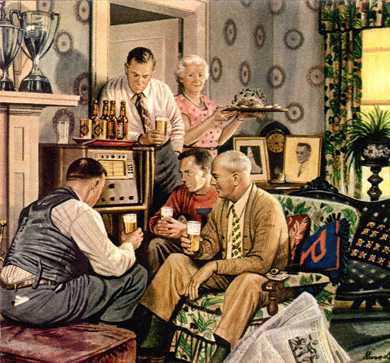
Please. Minds be still. Click off the clamor of late 2009 car radios and find peace in recollections of a more pleasant time. I think they call them the good old days because time works pretty much like a colander. It sifts out anything watery and distasteful, the stuff we don’t want, and it allows us to keep only what is delicious. And for all of the 1930s and most of the 1940s, home radio was the greatest cafe in the world for everything that was delicious in the forms of drama, comedy, horror, or adventure.

Return with me now to those thrilling days of yesteryear’s home radio. “The Lone Ranger rides again!” I cannot begin to contain all I could write into a single blog, but what I will try to do here is share with you my personal recollections, as they come back to me spontaneously in bits and pieces. If you’re old enough, some of these recollections will be as familiar to you as sliced bread and peanut butter and jelly for lunch on a hot Houston summer day, but you will also have your own memories too. Today I really encourage you to add whatever strikes you too as comments on this article. Home Radio was our once precious and shared adventure, and it lives on to this very moment in the souls of everything we still value and pursue.

OK, here we go. …

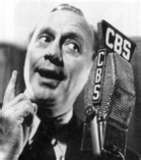
A door opens, followed by the clattering sound of so many items hitting the floor. It’s Fibber McGee’s closet. Do you remember Fibber McGee & Molly? They used to live on Wistful Vista. … There’s a guy standing still at the street corner near the McGee house. He’s being held up at gunpoint by another man. All’s quiet until the man with the gun repeats something he’s apparently said before to Jack Benny, the silent man with his hands in the air. “I said, ‘Your money or your life!” the guman shouts. “I’m thinking! I’m thinking!!” Benny answers. …. Around the corner, from a second floor open window on the street side of the Mystic Knights of the Sea Lodge Hall, we can see two men talking. One of the men is wearing a medical examination light on his forehead, apparently getting ready to perform some kind of optometric exam of the other. They are so close we can hear their conversation. “Kingfish,” says the rotund sort of apprehensive-looking patient in this scene, Andy Brown, “I never knew that you had any training to be an eye doctor!” “Oh yes, Andy,” says the Kingfish. “Why only this morning I removed a Cadillac from a man’s eyes!” …. Moving further down the street, we see that a crowd has gathered. They are gazing up  and pointing skyward at a red and blue object as it streaks across the city skies. “LOOK! UP IN THE SKY! …. IT’S A BIRD! … IT’S A PLANE! … NO, IT’S SUPERMAN!” …. Superman? Where is that absent-minded reporter Clark Kent when you really need him to cover a big story? …. It’s almost lunch time. We duck into a little grill and bar that seems like a good place to catch a cool one and a cold cut sandwich and chips. A baggy-faced man in a white shirt, green bow tie, and a bartender’s apron is leaning on the bar and chompimg on a big cigar as he answers a ringing phone. “Duffy’s Tavern, where the elite mete to eat. Archie the Manager speaking; Duffy ain’t here!” …. After a couple of Grand Prize beers and ham and cheese special, we walk further down the main drag. Turning into a nearby heavily wooded neighborhood, we are all of a sudden confronted with the coming of a monster thunder and rainstorm. We have no choice, but to beat a quick path to the nearest doorway of a most mysterious mansion. As we knock on the massive front door, it slowly creaks open, apparently of its own accord, but creaking all the way. The door opens into a pool of blackest darkness. We are stopped in our tracks and then stunned by a low-sounding voice that first only speaks to us from from the pitch black. “Good afternoon, I’m your host Raymond.” Then the body behind the forboding voice steps forward into the flickering light, and we find ourselves staring into the menacing white eyes of a tall thin man dressed all in black. “Welcome to Inner Sanctum!” the man says as his smiling voice breaks into a maniacal cackle of insane laughter. “Feet don’t fail us now,” we shout as we hightail it out of there, in spite of the storm. … Stopping off at a dry cleaner to literally get our clothes dried, we meet a man there who just came in to pick up his suit. He’s arranging to pick it up on credit until Saturday. The guy’s name is Joe Penner. He looks pretty disconsolate, even though the dry cleaning man let him have the suit on the cuff. “What’s the matter, Mr. Penner?” we couldn’t help but ask as he walked out the front door. “Same old thing,” Joe answers. “I was going to the horse track today, but my wife found my paycheck and blew all our money on the rent!” … Now late in the day, it’s getting close to the time we must go back to the future. Just enough time left to take in the last musical set of the Pappy Lee O’Daniel Light Crust Doughboy Band  in person as they finish up their live broadcast at the radio station. It was great to hear again that great closing musical  entreatment of the fans for support:

“If you like our songs and you think their fine, sit right down and drop a line, the Light Crust Doughboys of Burrough’s Mill!”

That’s it for now. Hope you enjoyed this little trip half as much I did, folks. And please add your own radio recollections in the comment section below this article.

The Low Tech Dreams of Christmas Past.

December 15, 2009

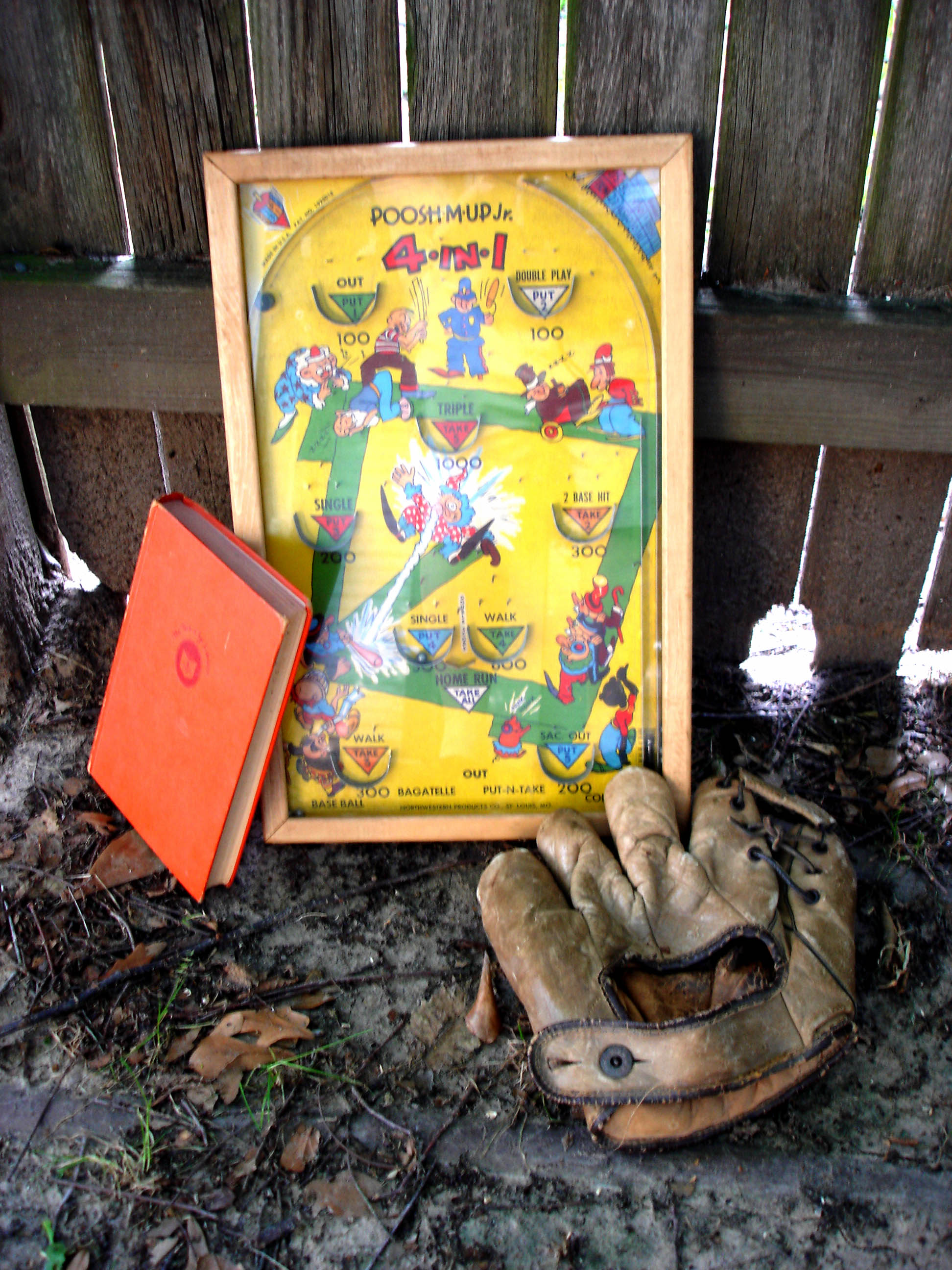
Pinball Wizard Tommy had nothing on me when it came to baseball!

Heading toward Christmas in this high tech era of highly sophisticated and extremely realistic sports game toys, I am blown away by their contrast to  the things we used to purchase and improvise as games and means to the same competitive ends back in the late 1940s and early 1950s. Our games required our use, either or both, of those fine old qualities known as imagination and/or skill – and I mean skill that went beyond our dexterity with finger manipulations of a control device attached to a TV, computer, or game box screen.

As most of you older kindred spirits already know, we didn’t have that kind of game set-up help back in the day. We had to imagine what we were doing and we had to visualize all the pictures that now appear graphically on the digital game screen. Our screens were, for the most part, simply rolling through our brains as we escaped into our own little game trips away frm the mundane of everyday reality.

The baseball pinball game shown here is an exact replica of my chldhood buddy from way, way back. My brother found it in a flea market and gave it to me as a Christmas present a few years back. I’m not sure what happened to my original game, but it most likely suffered the same fate as all my other childho0d things. Whenever we stopped using anything back then for very long, our dad quietly just threw these things away without uttering a word to anyone. As a result, I have few things, other than books, that remain from childhood. Dad didn’t dare throw out my books. He knew I always came back to them.

I got pretty skilled at the pinball game. I can still play it pretty well too, but nothing like I did at age 10 to 12. Back then I could almost will that little metal ball into the home run pocket when when I needed it to go there.

Another low tech game held my interest for a short while, but its lack of improvisational opportunity soon put it on the boring shelf. It was called “Foto Electric Football”, a game which allowed you to insert offense and defense pages into an upward shining light box that illuminated how certain plays turned out against certain defenses.

The big game back then was that vibrating football contest by Tudor that came out in 1947. Little metal players lined up and vibrated down a metal field until contact with an enemy player tackled them at the new yard line of progress. It was fun for a while. You could bend the little vibrator reeds under your running backs to make them turn at the line of scrimmage, but that was about it. Sometimes your runner would get turned around and run toward your own goal line for a safety. That sucked. Plus, it was too much of a hassle to keep setting up twenty-two players at the line of scrimmage after each completed play. That being said, it made my Christmas one year as a gift I knew was coming. My anticipation of that game was far greater than the playing of it could ever hope to be. Sort of like marriage.

Finally, a game came along that remains with me to this day in computer form. In 1951, the APBA Game Company opened shop in Lancaster, PA with a card and dice baseball game based upon actual major league teams and players. It was totally structured upon realistuc probabilities in a complex array of actual game situations. You had to bring your own theatre of the mind to get a good picture, but that was never a problem for a lot of us back in the day. We lived in our dreams. Besides, with APBA, the heart of the game was  then, and is now, its dynamic similarity by play outcome to what actually happens in a real baseball game. Because of APBA, I never got lost in the Stratomatic Baseball Game of similar, but less complex probability roots.

APBA was just a high tech game waiting to happen. I’ve been playing its computer version of baseball since the mid-1980s. It’s simply a place I go whenever I need to take a vacation from this little, no-fun, no sense of humor world we’ve created all around us. It’s not my only mental retreat, but it is one of my most enjoyable destinations.

Merry Christmas Dreams, everybody!

Getting Around Houston Prior to 1952.

December 14, 2009

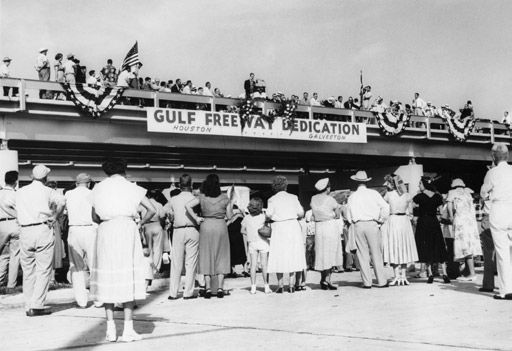
Prior to it;s August 1952 Opening, Houstonians referred to this answer to all our local travel problems as "The Super Highway"!

Our hopes didn’t fly for long, but there was a brief time in the late summer of 1952 that Houstonians thought that we had solved our local transportation problems for all time.  Under construction since 1948, the Gulf Freeway opened in August 1952 as the four-lane (two each way) clear shot passage from downtown Houston as a fifty-mile bullet car path to Galveston Island. All we had to do was to climb into our cars, enter the freeway, push the petal to the metal, and zoom on down to the Gulf of Mexico without ever stopping for a single traffic light.

It seemed too good to be true. Getting around this city of 490,000 souls without traffic would soon enough be an issue of the past in 1952. Of course, the fact that Jesse Jones and the Lamar Hotel “Good Ole Rich Boys Developers Club” had already bought up most of the land between Houston and Galveston and other boondocks places that could be turned into new housing subdivisions never occurred to most of us as the real motivation behind the construction of the Gulf, Southwest, Katy, Eastex, North, and Baytown freeways that soon enough spiderwebbed Houston like a form of concrete Kudzu vines. By 1965, we were hopelessly tied to freeways and the use of personal automobiles in this town. For a city as spread out as we had become, nothing les than the personal automobile could give many Houstonians the flexibility they needed to travel around and do business. Those who could’ve been served by trains to stationary work places were kept on the freeways too as the Texas Department of Transportation moved in to buy up usable rail lines and take them out in favor of freeway expansions like the recently completed I-10 route west into Katy.

The Gulf Freeway in 1956 wasn't wide enough to handle what was coming.

This past summer, I was coming back from an appointment far out the Gulf Freeway during the rush hour hour when I ran into a totally stopped up block of traffic in the old Gulfgate Mall area next door ro my old Pecan Park neighborhood. I thought, “Why not?”

I got off the freeway at Woodridge and took Redwood to Griggs, Griggs to 75th, 75th to Lawndale, Lawndale to Telephone, Telephone to Leeland, and Leeland to downtown. The whole detour took me no more than 15-20 minutes, just as it did in the old days prior to freeways. Then it dawned on me. We didn’t really have traffic jams back in the days prior to August 1952, but we did have a lot of really very   inconvenient red lights that today seem to run just fine with proper timing. We were sold on freeways as a route that wouldn’t stop us. We just didn’t understand that our impending glut of the freeways with increasingly necessary additional cars would stop us dead in our tacks without any red lights on our freeways. By the time I reached downtown using the old way, I could’ve still been siting out there on I-1o and Telephone via the freeway.

Oh well, what’s done is done. I’m just left thinking about all the old travel routes we once used to fan into our neighborhoods from downtown prior to the freeways. To travel east, you took Navigation, Harrisburg, or Leeland. To head south, you wanted Almeda or South Main. To head west, you had many choices, starting with Buffalo Drive (now Allen Parkway) to Shepherd and from Shpehred north and south to the western paths of Westheimer, Alabama, Richmond, Bissonnet (used to be Richmond Road), Memorial, Washington, Hempstead Highway, and Old Katy Road. To go north, the most obvious route was North Main, but you could also take Houston Avenue, Heights Boulevard, Fulton, Jensen, or Irvington as other options among the most travelled routes.

Regardless of your direction from town in 1950, you could be home inside of a one to eight mile trip. It was pretty simple stuff, this travelling, til we committed to the freeways. Now we’re back and looking for ways to living closer to work downtown so we don’t have to use the freeways we once built to escape the same scene we seek to recapture today.

Our problem is not the freeways. Our problem is that we once bit into the idea that freeways were our answer. Now we can’t make them go away. For one thing, we are hooked on having to using them. For another, the freeways have too much money and power behind them now to ever disappear.

Have a nice week, everybody!

Texas and The Babe.

December 13, 2009

Babe Ruth was baseball from the 1920s forward. He still is, if you scratch the surface of things even ever so slightly. And he had all the makings of an unforgettable character from the very start too. His unbelievably gifted joint talent as first a pitcher and then a slugger remains unmatched in the game to this day. Baseball has never known another player who could’ve made it all the way to the Hall of Fame in Cooperstown with either of those singular talents for throwing or slugging the baseball alone, but “The Babe” had them both, and he owned them at just the right moments in baseball history. By now it’s a biographically worn out story. After sparkling in two World Series championship seasons for the Boston Red Sox in 1916 and 1918, Ruth moved over to the New York Yankees in 1920 by way of a devilishly infamous/heavenly fortuitous trade, dependent upon the presence of your Red Sox/Yankees red corpuscles.

Regardless, Babe Ruth got to New York just in time to help America soon forget about/or recover from the terrible blow inflicted upon the game by the Chicago “Black Sox” Scandal of 1919. For those who haven’t heard, eight members of the 1919 White Sox club were expelled forever from baseball after the 1920 season for conspiring to fix the 1919 World Series in favor of the Cincinnati Reds. They were kicked out of the game in spite of the fact that they were never found guilty of such an act by a court of law. It consquentially fell upon the broad shoulders of one George Herman”Babe” Ruth to help fans find positive distraction from the dark side of things – and to do it with his ability to blast a baseball out of the park with a bat. He did it often – and for prolific distances.

During the 1920s and early 1930s, Babe Ruth came to Texas and Houston often in the springtime as a barnstorming member of the New York Yankees. The club played minor league teams and sometimes even squared off against the local Texas college clubs where they toured. My late father often told me the story of how the New York Yankees came to Austin in the spring of 1928 to play the Universty of Texas Longhorns during the time that Dad was a prep school outfielder at St. Edwards there. Somehow the school arranged to get the entire St. Edwards Bronchos team into the game over at UT for seating down the right field line, where Ruth was playing that afternoon against the Longhorns.

Dad long ago forgot the final score, but he implied that it was a heavily crushing “no mercy” margin in favor of the Yankees over the Longhorns. One of these days I may get around to actually checking Dad’s memory against the library line score record of that game, but I have no question about his most vivid recollection of that afternoon. During the game, Babe Ruth had an autographed baseball business set up down the right field line at UT. Ruth had a guy posted in foul territory with a bag full of balls. For five dollars cash, Babe Ruth would run over to the sidelines between batters and sign one of these balls for any fan who was willing to pay. The assistant would then toss it up to purchaser and that lucky fan got to leave with an authentic Babe Ruth signature on a baseball for the price of five dollars.

Of course, my adolescent question of Dad always rose quickly to”Why didn’t you get one?” That always opened the door for Dad to launch into the subject of prep school student poverty and the value of five dollars in 1928. It never even occurred to Dad that getting one of those Ruth signed baseballs was within the realm of possibility. “It would have been like you going to Buff Stadium in the spring and finding out that Stan Musial was signing balls during the game for those who were willing to pay him five hundred dollars for the thing,” Dad said. “Could you have bought one of those Musial balls in 1954 at that rate?”

“No, Dad,” I always answered, “I got the point a long time ago.”

Stiil, the Babe didn’t always come to town just to take people’s money. In 1930, the Yankees were in Houston to play the Buffs at Buff Stadium in single games scheduled for March 29th and March 30th. The Yankes took both games by scores of 17-2 and 6-5. while he was here, Babe Ruth went downtown and gave an address to Houston kid members of the Knothole Gang. The presentation took place at the old City Auditorium on the corner of Lousiana and Texas, on the site of the current Jones Hall building. The full house meeting was sponsored by the Kiwanis Club and a good time was had by all.

Wish we had the text of what “The Babe” actually said that day in 1930 Houston. It would be sort of  interesting to see if Ruth gave any advice to the kids that day that we wasn’t actually living up to in his own real life adult adventures. On the other hand, it really doesn’t matter what Ruth said or didn’t say that long ago day in Houston history. He was Babe Ruth, a guy who led by example on the field – and by the fact that he would even show up on a spring day in 1930 to speak with hundreds of Houston kids for free.

He was Babe Ruth and, for a few hours long ago, he walked among us here in Texas as our flesh and blood, larger than life hero. For those who were around at that time, nothing could detract from the power and magic of those Ruthian moments of joy that they were simply here together in his presence – and in their very own state and home town.