Archive for the ‘Uncategorized’ Category

Some Memorial Day Thoughts

May 31, 2010

Long Live the USA! And Long Live the Memory of Those Who Died for Our Country!

Memorial Day 2010. The Indy 500. Baseball Season. The Beginning of Summer. Bar B Que. Which will we remember the most? Or maybe I shouldn’t ask. Bar B Que is an American craving. Maybe it’s simply more important for us to continue giving and receiving all those messages that remind us of what Memorial Day is supposed to mean to our American way of life each year.

We need to remember all the brave men and women who have  surrendered their lives for our country. We need to remember them everyday – but especially on this day – Memorial Day of 2010 and forever.

Happy Memorial Day, Everybody! When you you sink a salivating bite into some Bar B Que today. Just remember who made it all possible, but also remember the even more important items on our plates that their brave actions have secured for us as no other nation has ever enjoyed them:

Freedom of Thought and Movement, Respect for Human Rights, Scientific Advancement, Creative Artistry, Literature, and Athletic Accomplishment, yes, these and all other worthy expenditures of human energy are all the fruits that grow best in the constitutional sunlight of an open society – but these qualities, alone or together, don’t come without a price. Without the supreme sacrifices our military people have paid from the start, no one else in America has pockets deep enough to pick up the tab on what it’s all worth to the rest of us.

Pour that thought on your Bar B Que today too, folks. It’ll taste better. I guarantee it.

Remembering Uncle Carroll.

May 30, 2010

Reprinted here from the blog article I wrote on ChronCom.Com last Memorial Day, May 23, 2009.

Uncle Carroll & Aunt Florence on Lake Hamilton outside Hot Springs, Arkansas from 1946-1955.

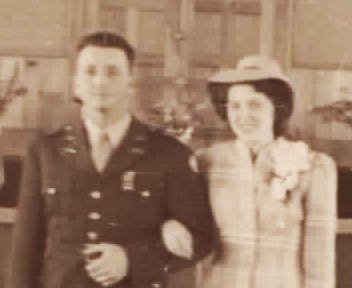
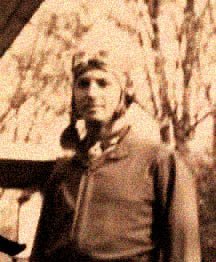
Major Carroll Houston Teas (1917-1964) was a man of his time. When World War II came to the USA, he joined the service in San Antonio and went straight into training at Kelly Field with the Army Air Corps. Before shipping out to the Pacific theater as a military cargo pilot, he married his high school sweetheart, the forever lovely Florence MacPherson.

Uncle Carroll Teas & Aunt Florence married during world War II, before he shopped out to the South Pacific with the US Army Air Corps..

Uncle Carroll was my mother’s little brother. He and Aunt Florence were special to me during my young life in ways I’ll never be able to put into adequate words.

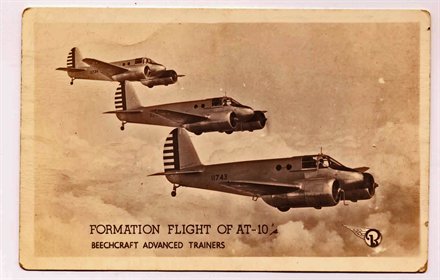
During World War II, Uncle Carroll flew logistic flghts of supplies all up and down the various South Pacific island chains. After the war, he used to regale me with stories of all the things they learned to do to keep from getting shot down by Japanese Zeroes over the open seas. One time, he told me, they were so badly outnumbered by Japanese figter planes that they had to fly blind within the clouds for many miles, just to keep from being taken down as an easy target. Many other times, they had to fly above or below the cloud banks to disguise themselves from Japanese fighter planes flying in the opposite direction.

“Off we go – into the wild blue yonder, flying high – into the sun.”

The Japanese also hid in blind cloudbank flight. The dangers of so doing on both sides are obvious, but that option beat the near certainty of getting shot down by faster aircraft in open skies.

I used to have a pair of pilot wings that Uncle Carroll sent me during World War II. Wish I had been a more careful saver of something that is now even more important to me, but I wasn’t. I used to pin those wings on my tee shirt before going out to play sandlot baseball and, somewhere on the playing fields of Houston, that’s where I gave it up.

After safely serving nearly the entire war in combat, Uncle Carroll finally ran into something that stopped him in ways that rapid-fire ammunition failed to do. He contracted polio while stationed in New Guinea. Oh, he came home to America alive in 1945, but he came home paralyzed for life. The only question was: Would he regain any use of his body – or would he be forced to live out his life in an iron lung?

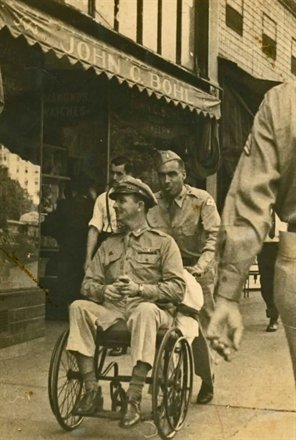
Uncle Carroll and a buddy on the streets of San Antonio – right after coming home from World War II.

Coming home, I didn’t really see Uncle Carroll at all during the early months of his struggle with polio. The army sent him up to Hot Springs, Arkansas, where they treated a lot of polio cases back then with the aid of hot springs baths and swimming. Prior to his illness, Uncle Carroll was always a powerful, athletic person. He was a hard-hitting third baseman for the Brackenridge High School Eagles in San Antonio back in the mid-1930s and he wasn’t the kind of guy to give up in the face of adversity. That core value, in fact, is the lesson he always tried to instill in me at every chance he was yet to have. I can see him even now doing his most to make the best of a bad situation in his time of greatest personal crisis.

With Aunt Florence always by his side, Uncle Carroll fought back and regained full use of his body from the waist up. With special attachments to his car, he was able to drive again. Although still wheelchair bound for life, Uncle Carroll and Aunt Florence bought a home on Lake Hamilton in Hot Springs, where he resumed his life as a fisherman and hunter. His Chris Craft lake boat was his other kind of new mechanical mobility – but he also could still swim like a fish in the water with the use of his legs in spite of their failure to him on shore.

Uncle Carroll continued working for the Army in Hot Springs as an accountant after the war, but he also started his own freshwater fishing lure company, selling lures that he designed himself. During the winter months, he added “avid duck hunter” to his resume.

We lost Uncle Carroll to a coronary in 1964. It was one of the three saddest days in my life, along with those two crushing others, when I said goodbye to Mom and and then Dad.

The two things I’ve always tried to remember from Uncle Carroll will only die for me when I do: (1) Do the things in life you are willing to put your whole heart into; and (2) Never give up on what is really important to you.

It’s Memorial Day again and my thoughts go immediately to my Uncle Carroll Teas. He didn’t die in World War II, as is the group intended for core honor on Memoral Day, but he gave up his life, his health, and his future there for the sake of his country, as did millions of others. There’s simply no way this holiday ever passes without me thinking of him with love and gratitude. My hope here today too is that your thoughts also turn to the special American veteran in your own lives who once, or currently, have placed his or her life on the line for the defense of us all. Let’s do it again each day, and especially on our next Veterans Day!

“We’ll fly on – in fame – or down – in flame – Nothing can stop the Army Air Corps!”

Have a peaceful and blessed Memorial Day, everybody – and let’s all try to remember all the men and women of American military service who gave up their lives and health for the sake of this wonderful place we call the USA!.

Visual Images and Baseball Inspiration.

May 29, 2010

Crank up the Metallica theme, boys! Here comes our closer!

As a kid, I found visual images all over the place in everyday life that I plugged into my sometimes silent, but always present fascination with the game of baseball. I once enjoyed the company of the same young Dominican nun teacher for 6th through 8th grade at St. Christopher’s in Park Place. Sister Reginald wasn’t a professed athlete, or particularly a baseball fan, but she showed an athletic ability in some of her teaching gesticulations that made me conclude that she could have been an effective sidewinder pitcher, had she so chosen to be. Sometimes in class she could bring that right arm around with all the sweeping motion of a vintage Ewell Blackwell in pointing to one of us “boys” as indicted, convicted, and sentenced for disturbing the peaceful goals of parochial school education.

I loved it, even I happened to be the one that day that was drawing the chin whiskers pitch from our hardworking taskmaster teacher. It gave me the opportunity to imagine hitting Sister Reginald’s pitch out of the park.

Yeah, that’s right. They say there’s a thin line between the presence of creative imagination and the mental residence of abject insanity in the minds, hearts, and souls of us too. I tried to keep that in mind from an early age, but I couldn’t help myself. I kept seeing the imagery of human motion as it applied to baseball in just about everything I saw. And nowhere was that more true than at the movies.

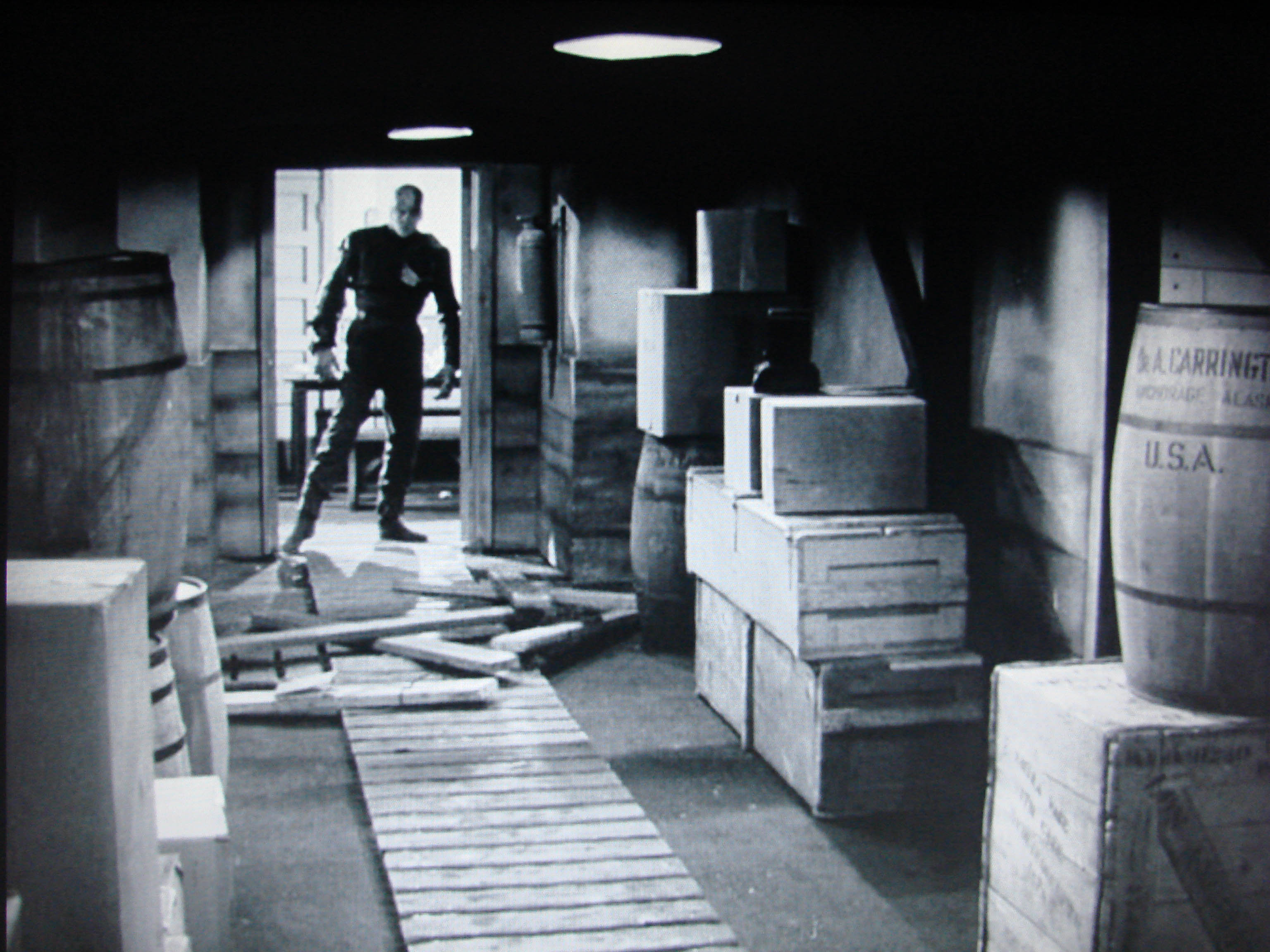
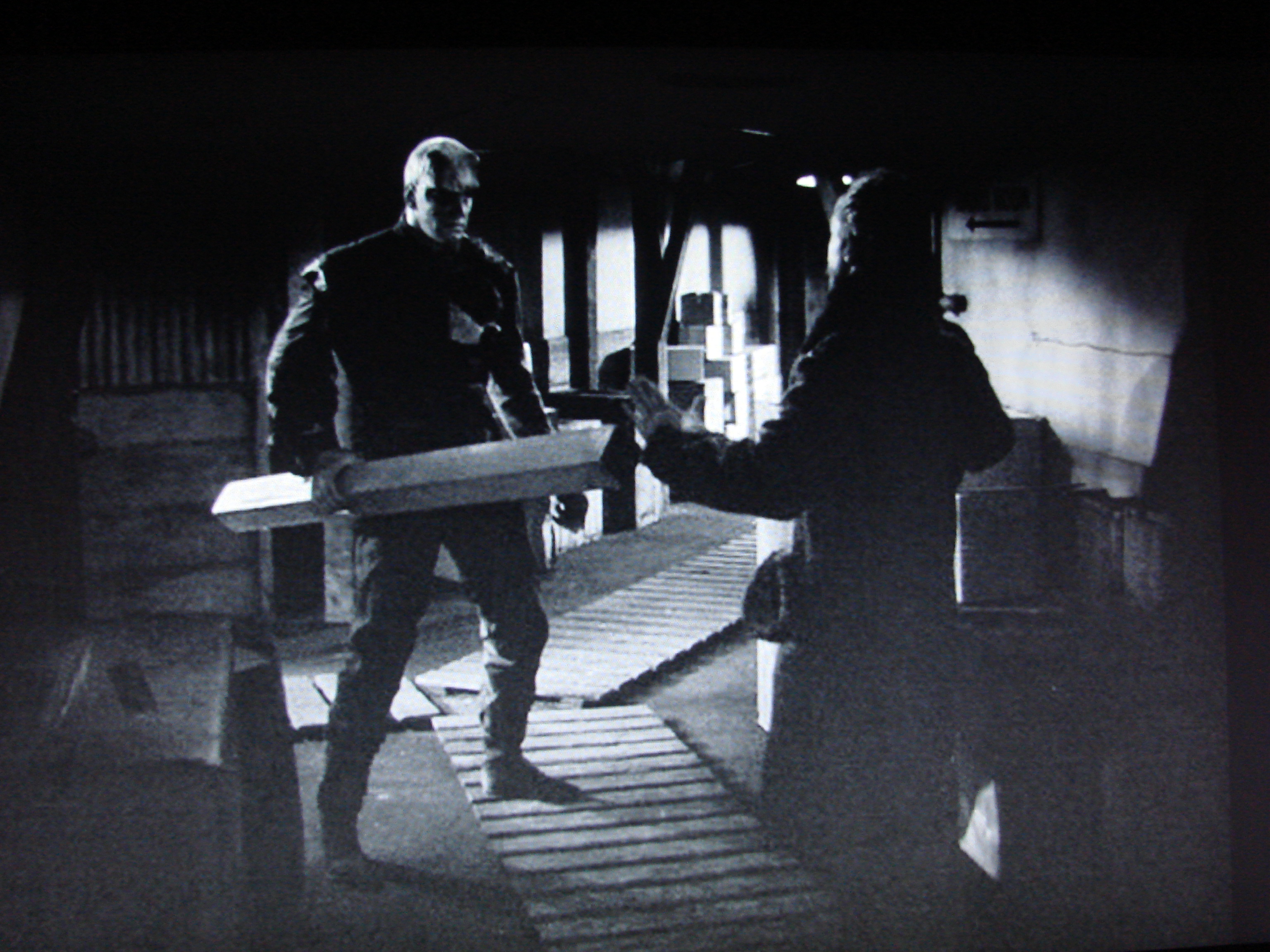
Long before the concept of “closer” became an everyday concept in baseball, I loved the climactic scene from the movie “The Things From Another World” in which “the thing” (James Arness), a vegetative man from another planet, comes through the military outpost door near the North Pole and halts in the doorway. I thought, “Wow! What if he was really an ace relief pitcher for the Buffs coming into put out a Dallas rally in the ninth inning at Buff Stadium? The visitors would be beaten as soon as they saw him standing there!”

As soon as he picked up the lumber, The Thing morphed from Closer to Slugger.

Of course, as the Thing plodded “closer” to the humans in the movie, they threw a big stick of wood at him to force him onto that wooden walking path, a route that was wired for electrification of the mad invader as  he drew nearer. The visual effect on my baseball fantasy of him was that the Freudian presence of the big stick immediately transformed The Thing into a potential slugger with all the pop of a steroids stallion – and all these imagery synapses were firing in my young brain some forty years prior to our common knowledge of HGH and what it could do. I just loved the vision of the Houston  Buffs acquiring a real “Superman,” an unretirable, unbeatable slugger that even the parent Cardinals could not take from us.

Yep, that’s right. I was a rank dreamer – and a Freudian one at that.

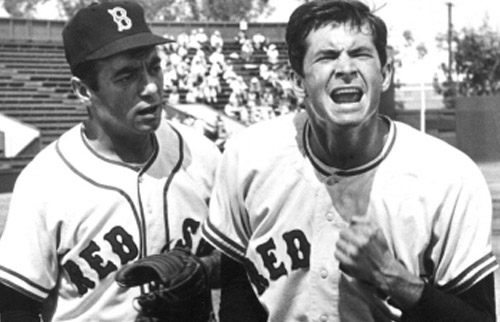
"Why is that every time I throw a ball, I throw it like a girl?" - Anthony Perkins (R) in the movie about Jimmy Piersall, "Fear Strikes Out" (1957).

The imagery issue had another backfiring effect upon me. I had little patience with Hollywood for bad casting of non-athletes as baseball players. They did it a lot – and maybe that speaks more for the fact that actors generally are not athletes – and vice versa. Although, we seem to have a greater supply of athletic actors today than we did back in the 1940s and 1950s.

Anthony Perkins has to be my all time favorite worst athlete/actor  for his 1957 portrayal of Jimmy Piersall in “Fear Strikes Out.” Just for the heck of it, here’s my top ten list of worst athletic portrayals by an actor in a baseball movie. To me, these are the instances of visual failure that are inexcusable to the tastes of any real baseball fans. That being said, I’ve been able to rise above my unhappiness with the playing abilities of all these actors to have enjoyed all the movies on this list. They were about baseball, weren’t they?

Worst Athletic Actors in a Favorite Baseball Movie:

1. Anthony Perkins in “Fear Strikes Out” (1957).

2. Ray Milland in “It Happens Every Spring” (1949).

3. Jimmy Stewart in “The Stratton Story” (1949).

4. Gary Cooper in “Pride of the Yankees” (1942).

5. Dan Dailey in “Pride of St. Louis” (1952).

6. William Bendix in “The Babe Ruth Story” (1948).

7. Ray Liotta in “Field of Dreams (1989).

8. Ronald Reagan in “The Winning Team” (1952).

9. Bruce Bennett in “Angels in the Outfield” (1951).

10. Michael Moriarty in “Bang the Drum Slowly” (1973).

Have a nice Memorial Day weekend, everybody, and watch where you are looking. You never know when something is going to pop into view that reminds you of baseball – even if you happen to be watching an Astros game.

One Photo / Many Questions.

May 28, 2010

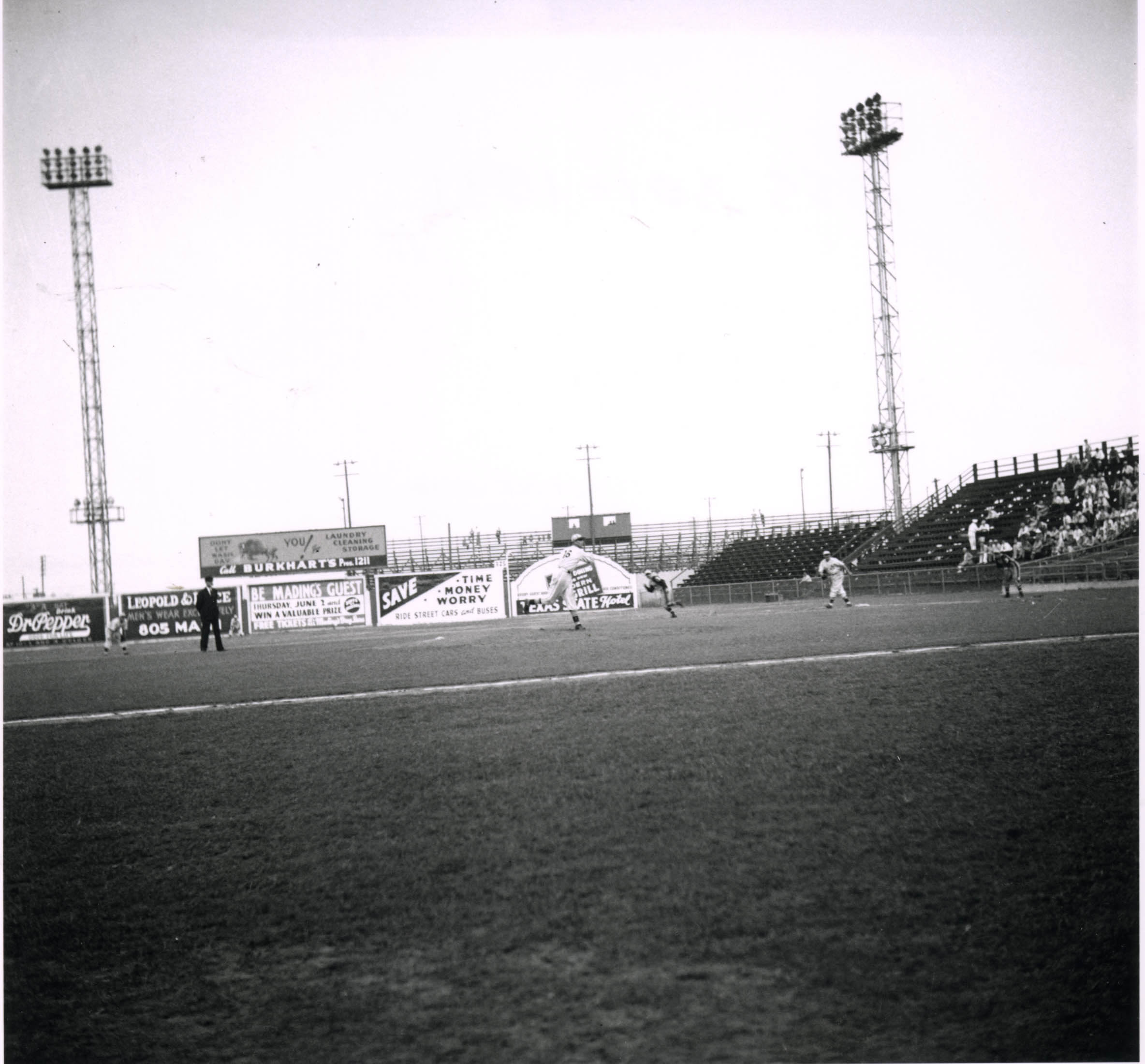
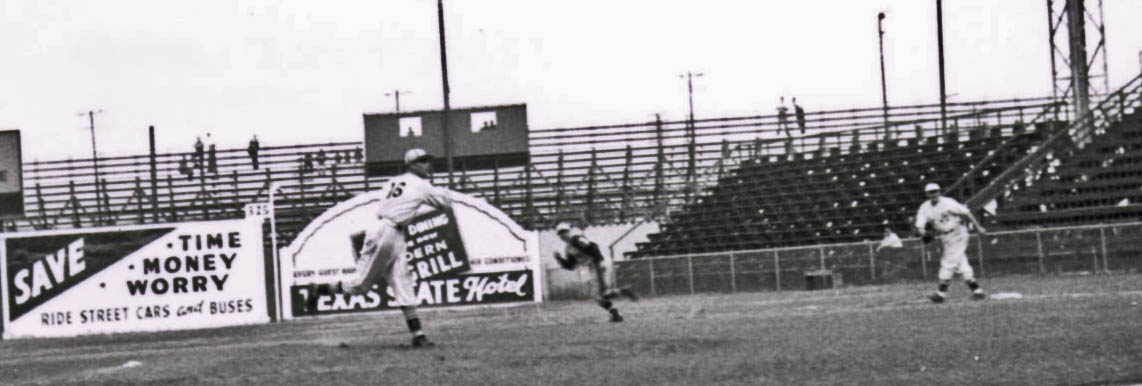
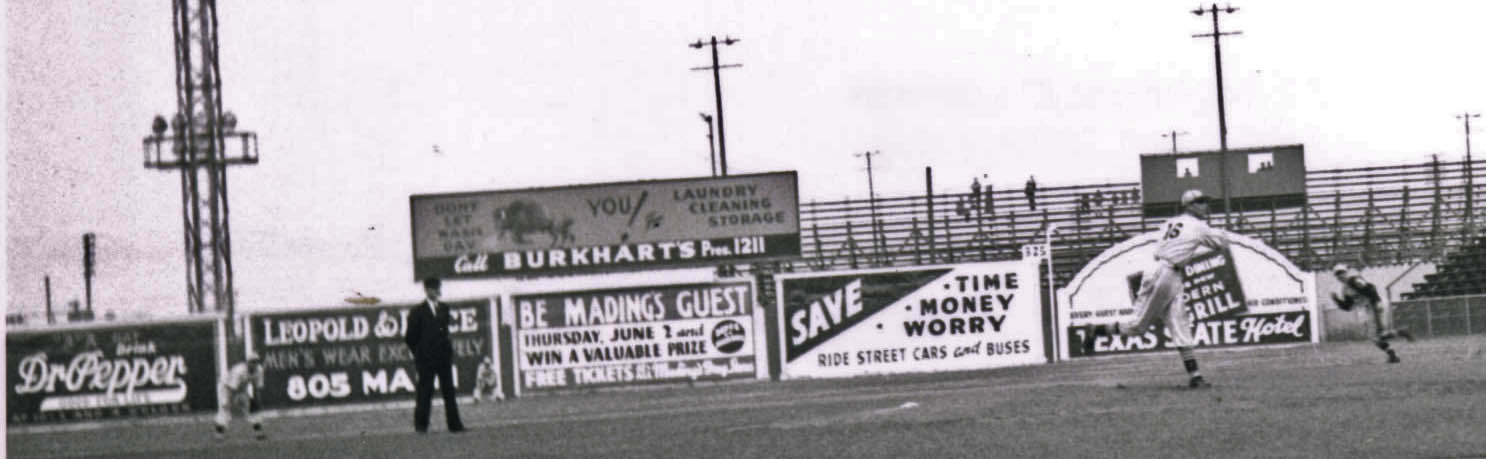
Right Field in Buff Stadium is a place of mystery and curiosity in this photo, starting with the fact that I'm not sure of the exact year it was taken.

Sometimes a photo makes everything obvious. Just as often, a photo may raise more questions than it really answers. The photo shown above is of the latter type. I acquired it some time ago from the very special Texana Collection at the julia Ideson wing of the Houston Public Library. We knew that it was taken in old Buff Stadium in the Houston East End, but that was about the only fact that was clear.

I’m not sure who #15, the pitcher, is but he is a Buff, as best I can see from the old English H that is visible on the left jersey breastplate in another close up of the  unidentified Buffs first baseman. The year of this uniform could have been anywhere from 1938 to 1942 or 1946-47. The ’47 Buffs club preferred the Buff logo on the jersey, but they also used the old English H. I simply cannot find another photo of the 46-47 team wearing the light colored caps with stripes – and a photo I have of the ’41 Buffs shows them wearing dark caps. More research is needed.

The HR-resistant Gulf winds came roaring in over these walls in the Houston summertime.

If you look closely above at the first crop-shot from the main photo, you may be able to see that the distance down the right field line was 325 feet, the same as I remember it from my Buff Stadium kid days (1947-54) and the same as it is now in Minute Maid Park. The major differences between these two ballpark right field lines would be the roof option at MMP and the no choice prevalent winds that blew in and over to left field from right field at Buff Stadium. – Also, you may have trouble seeing it here, but the right field foul pole is barely taller than the “325” distance sign.

I’m not sure about the outfield box area with two windows in this photo. There was no scoreboard function in right field during my Buff Stadium days and the main Press Box are was located on the roof behind home plate. I’m not even sure what those lined stands in right were about. We certainly had no outfield bleachers during my time there either.

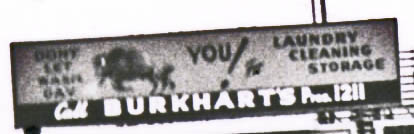
"Don't Let Wash Day Buffalo You!"

That top sign is from Burkhart’s and it’s promoting the idea in words and pictures that you (meaning “you housewives”) should not let wash day make you fear dirty clothes. With Burkhart’s help, they are offering protection from being buffaloed by the challenge.

Left to right above, the signs are also advertising Dr. Pepper, Leopold & Price Men’s Store, A Special Giveaway at Mading’s Drugs, Save Time, Money, and Worry by Riding Street Cars and Buses, and enjoy the comfort of the Texas State Hotel, including their first class modern grill.

Who could ask for anything more?

The sad days of segregated stands existed into the mid-1950s at Buff Stadium. The empty stands at left above were the designated "colored section.".

Segregated seating for black fans at Buff Stadium existed through the 1954 season, the year that first baseman Bob Boyd broke the color line by becoming the first black player to integrate any Houston sports team, amateur or professional, in the City of Houston. Why the so-called “colored section” at the left above is empty in this photo I could not begin to explain. It’s just shameful that even baseball wasn’t big enough to rise up sooner against the formal practice of racial discrimination, but that’s not the way history played out.

As for today, the empty “colored section” is simply one of the curiosities and mysteries that float forward in this single photo of an active past game day in right field at old Buff Stadium.

There are numerous lessons on the loose here in this picture, but not the least of these for all those photographers of history is this one: If you want your photos to capture history, do not expect the picture alone to tell the story. Write down when and where it was taken and leave a few words about who is in it and why it may be important to remember. Otherwise, by taking and leaving the photo alone, you will have over time simply left another visual egg of mystery to scramble the brains of viewers in the future.

Pass the salt and pepper, Mammy! Let’s close with a good clear closeup of that wash day buffalo ad:

"Buffalo Gal, Won't You Come Out Tonight - And Dance by the Light of the Moon?"

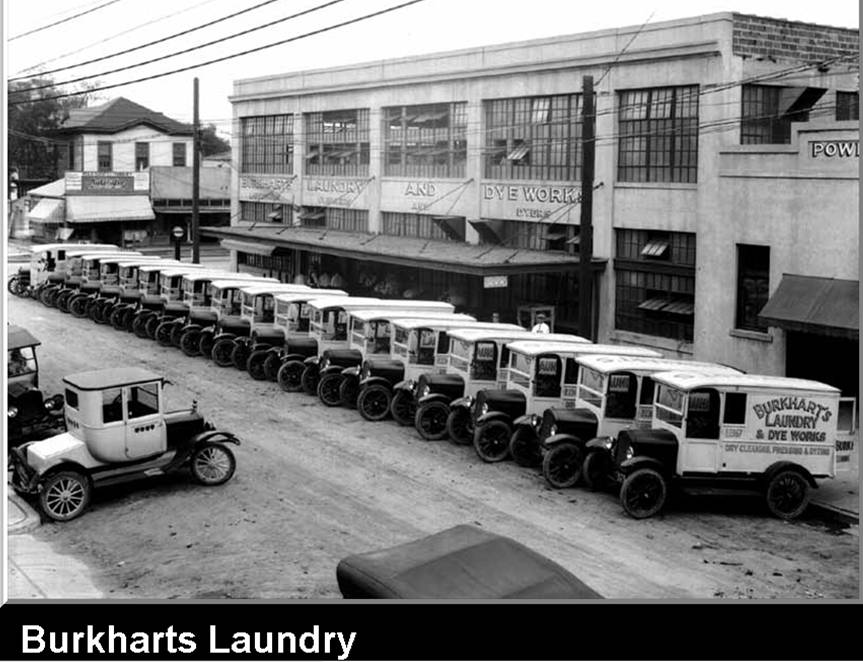
Thanks to a post-publication contribution suggestion from Larry Hajduk, the following photo, compliments of the Story Sloane Gallery, is added to show how Burkhart’s Laundry appeared in 1928. It appears that Burkhart’s had a long ago thriving business helping Houston do its laundry.

Burkhart's Laundry, Houston, compliments of Story Sloane Gallery, http://www.sloanegallery.com

Also, local history sleuth Mike Vance checked in with an important observation that he somehow could not register below as a comment. Mike says the last streetcar in Houston ran in 1940. So, if we are to believe the outfield sign advocating public use 0f Houston’s “street cars,” that does narrow down the year possibilities for this photo considerably. Thanks, Mike Vance. That’s a major help.

Gerry Burmeister: Five Times a Buff!

May 27, 2010

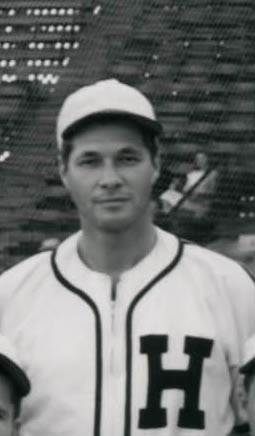
Gerry Burmeister, Catcher, Houston Buffs, 1941, 1946-49.

Gerry Burmeister was already in place as catcher of the Houston Buffs when I first plugged into paying attention to baseball back in 1947. He had joined the Buffs in 1941, returning after World War II to begin a four-season run as the main man with the mask in 1946. For the last three seasons of his Buffs tenure, I couldn’t imagine the day coming when some other guy would hold his spot. Gerry Burmeister was our man – the man who led and took good care of great Buff pitchers like Al Papai, Clarence Beers, Cloyd Boyer, Jack Creel, and Pete Mazar.

Burmeister was another of those talent-rich Cardinals farm hands of the post World War II era that never got so much as a single time at bat in the major leagues, but, as a catcher, he was extremely important to the parent club in bringing along mound talent for National League competition. A catcher with his field accomplishments in 2010 would surely be expecting a direct shot in the big leagues, but, as we always ending saying in some form – that was then and this is now.

The 6’2″, 205 lb. Gerry Burmeister was born on August 11, 1917. He’s been dead for several years now, but I simply do not hand that specific data on hand or accessible at this writing.

In his 13-season minor league career (1937-44, 1956-50), and all but the last year spent in the Cardinal organization, Gerry Burmeister (BR/TR) batted .275 with 66 career home runs. Those were pretty good stats for that era. Heck. They are pretty good production for a catcher from any era, especially one who managed pitchers well and also exercised pretty good control over runaway baserunner wannabes. Burmeister was a winner of the first order as a performer in the higher levels of minor league baseball back in the most popular period of public attention to professional baseball at every level of play.

Gerry Burmeister retired to life in the Houston area following his baseball career and he was a regular at old-timer games and Houston Buff reunions through the remaining period of his life. He was well liked and highly respected by all the former Buffs I know.

Caps are off to your memory this morning. Mr. Burmeister. As a kid who grew up watching you play as I tried to learn all I could about our wonderful game of baseball, I just want to say, “Thanks for the memories!”  And thanks for the lessons too!

Baseball’s Biggest Losers.

May 26, 2010

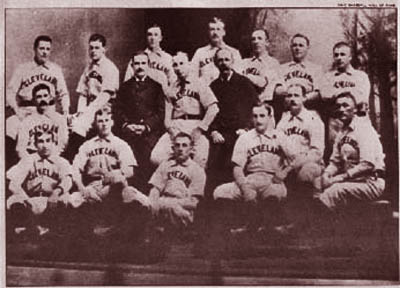
The 1899 Cleveland Spiders Own the Biggest Loser Title for their Worst-Season-Record-Ever mark of 20 wins and 134 losses for a.130 winning percentage and also for their All Time Consecutive Game Losing Streak of 24 Games in a Row.

No, this article isn’t about the 2010 Houston Astros – not yet, anyway. It isn’t even about “losing” as a new social convention. In fact, if we examine the scoreboard of both biblical and scientific history, it doesn’t take long to see that losing has been going on for a very long time. A short look there is all we shall need to confirm that reality:

History’s Scoreboard

Temptation 2 – Adam & Eve 0.

Jealousy 1 – Cain 0. (As a result, Abel moved to the “DL” – the permanent one).

Meteors 25 – Dinosaurs 0.

Sinai Commandment 10 – Golden Calves 1.

Jesus Christ 1 – Original Sin 0.

Lions 48 – Christians 0 (on any given Sunday at the Coliseum in Rome).

Brutus 1 – Caesar 0.

Renaissance 8 – Dark Ages 7.

Darwin 4 – Fundamental Opposition (still evolving).

Baseball 1 – Football 0.

Technology 15 – Intimacy 0.

Present Year 2010 – Time Travel Destination 1927 (The year Ruth hit 60).

There. That pretty much covers the big historical events. Let’s get to baseball. I’m only looking at the worst season records and longest losing single game losing streaks. Otherwise, we could get stuck here all day talking about the St. Louis Browns.

The two big records for all time are held by one of the last clubs to play baseball in the 19th century pre-modern era, the notorious 1899 Cleveland Spiders of the National League.

The 1899 Spiders were so bad that they literally had to finish their season on the road to avoid the wrath of a community that felt betrayed by the club’s ownership – and because other clubs refused to lose money by coming to Cleveland to play before empty houses. What happened to make Cleveland the perfect storm atmosphere for losing 1899 is simple enough to explain.

The Robison brothers who owned the Spiders also bought the St. Louis Browns of the same league and simply renamed them the “Perfectos.”  Then (and here comes the best reason in the world why multiple club ownership is now prohibited) the Robisons poured all their talent into making their St. Louis club a success. The best talent from both rosters was sent to St. Louis; the culls and dregs were sent to Cleveland. The result pulled St. Louis slightly above mediocrity (5th place with a 84-67 mark while Cleveland sank like lead to 12th and last place at 20-134. Along the way, ’99 Spiders also set the single game all-time losing mark of 24 losses in a row. The experience also stomped the itsy-bitsy Spiders into extinction.

Cleveland would emerge with a new team under new ownership in the new American League in 1900, but the Spiders were dead forever. The 1899 Cleveland Spiders may be the only team in baseball history that actually played like an extinct entity while active unplayed games still remained on their schedule.

20th century losing marks received constant heat from clubs like the St. Louis Browns and Washington Senators in the early part of the century, but the two game and season losing marks did not finally register until 1961-62.

The 1961 Philadelphia Phillies made an incredible run at the single game losing mark of the old Spiders, falling one game short of a tie, when they came up with only 23 straight losses from July 26th to August 20th. Their 47-107 season record, however, fell far short of Cleveland’s record for futility.

The 20th century, modern era worst season record sprang forth the following 1962 season in the first year of National League expansion, and it wasn’t our new Houston Colt .45’s who pulled the trigger. “Honors” for amazing ineptitude went tour city’s brotherly new franchise, the New York Mets, who finished in 10th place n the national League in 1962 with a modern worst season record of 40-120, but still a steamy 17 games better than those 1899 Cleveland Spiders.

Mets Manager Casey Stengel was finally moved to ask of his Mets, “Can anybody here play this game?” If you’re a Houston fan, let’s just hope that 2010 Astros manager Brad Mills isn’t moved anytime soon to pose the same question.

Losing is losing – and unlike fine wine, it doesn’t taste better with age.

Quo Vadis, Craig Biggio?

May 25, 2010

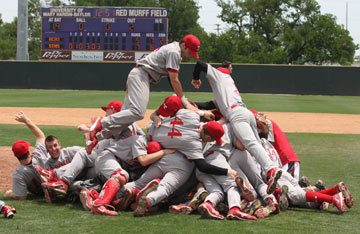
5/15/10: The Craig Biggio-coached St. Thomas Eagles defeated Houston Christian, 7-5, in the finals at Waco to take the 5-A State of Texas TAPPS baseball championship.

It only took Craig Biggio two years to lead the St. Thomas Eagles to a state title in baseball, but he and the boys did it in typical Biggio-Astros style over the 2010 season, weathering a phase of doubt and coming back strong to fare even better than Houston’s professional standard bearers. The Eagles went all the way to the top, winning their 23rd state baseball title in the 110th year of the school’s history.

Biggio got involved in helping out as volunteer assistant coach with St. Thomas football while he was still playing for the Astros after his oldest son Conor Biggio entered the school as a freshman. Conor was followed two years later by younger brother Cavan. What a dream opportunity this all turned out to be for retiring super big leaguer Biggio – a chance to watch and even be involved in the ongoing education of his sons as young men and serious ballplayers.

Biggio accepted employment as the St. Thomas baseball coach on May 18, 2008. Three days short of two years later, on May 15, 2010, Biggio and Company were wrapping up that most special prize in Texas high school competition, a state championship. St. Thomas defeated season-long nemesis Houston Christian, 7-5, in the 5-A TAPPS state baseball championship finals at Waco to bring home that very special prize.

Craig Biggio (4th from right in red jacket) & St. Thomas Good Company!

Our hats go off to Craig Biggio and the gang from old St. Thomas (my old high school too) – along with all the questions that Craig Biggio’s coaching success at this level now adds to all those queries that continue to float around about his future as a major league manager.

After Craig Biggio’s probable first ballot induction into the Hall of Fame in 2013, will he be open to managing in the big leagues? If so, will it have to be a term with the Astros – or will he be open to other offers? – Or will Craig Biggio simply prefer to stay where he is – close to home and family, and close to the handles on his favorite charities and involvement in the Sunshine Kids Foundation? I’m sure that St. Thomas High School wouldn’t mind it either if Biggio decided to stay at the helm of our baseball program at STHS far beyond the years that his sons are enrolled as students. He brings class, positive energy, and success to everything he does.

The final answers to all questions about the future of Craig Biggio rest down the road – and that’s where I think he places them too. As with all the rest of us, his best choices rest firmly in the Hand of God – and in his ongoing discovery of God’s Will for him in this lifetime.

God Bless you too now, Craig Biggio, for all you do to make the Houston community a better place.

Goodbye, Mr. Lima!

May 24, 2010

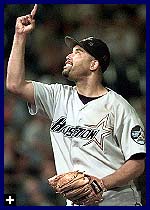
Jose Lima: He leaves some happy memories and a short record of great accomplishment in baseball..

The news of Jose Lima’s death at age 37 hits all of us who followed his baseball career with equal amounts of shock and sadness. This is one of those times in which the written words of immediate reaction are coming out in all kinds of ways on the mind crank of familiarity.

A fellow who “lived life to the fullest,” Jose Lima walked through each day as a happy man, making everyone around him happy too. At his foremost in the 1999 Astros season, he performed as one of the best starting pitchers in the big leagues, winning 21 games against 10 losses and registering a 3.58 earned run average for his playoff-bound club. He also sold the benefits of delicious Mexican food from Casa Ole restaurants on television commercials with a peppery song, a Latin-moves dance, and a universal happy-face smile thrown in to boot for good measure. It all came together and worked beautifully.

The man had tremendous ability, but like a number of other fine and potentially great pitchers, he also possessed a vulnerable psyche to the prospect of  moving from the spacious Astrodome, the scene of his great 1999 season, to pitching in a new ballpark with a short left field porch with the opening of Enron Field in 2000.

In his last 1999 Astrodome year, Jose Lima (BR/TR) have up 0only 30 home runs in 246.1 innings pitched.In his first 2000 Enron Field year, with the 315-feet away Crawford Boxes looming out there from him down the left field line, Lima surrendered 48 home runs in only 196.1 innings of work.

Now, in fairness, all the homers that Lima gave up in those two season were not hit only at the Astrodome and Enron Field, and all the Enron Field homers were not simply dink-and-drop blows that barely lipped the 315-feet mark. Homers were hit elsewhere – and many of the Enron Field long balls at Enron would have just about cleared the Grand Canyon walls on a north-to-south tim track.

The point was in (or on) Lima’s head. From his first sight of the park that we used to squeeze into as “Enron Field,” Jose Lima was psychologically defeated. He simply could not pitch there. I don’t how many times it happened, but it often worked out that Jose Lima would respond to giving up a critical long ball by surrendering another to the very next man, and sometimes, on the very next pitch.

One time, when the pattern was already established,  my then 15-year old son Neal and I were there for a 2000 Enron Field game when Lima gave up a monster shot to left center. “Just watch out for what happens on the first pitch to the next guy,” I told Neal. “He’s going to hit one out too!”

When it then happened, Neal grabbed me by the arm and asked, “Dad, how did you you know that was going to happen?”

“Just lucky,” I told Neal. Then I went on to explain how many time we had seen Lima just groove a pitch down the middle of the plate after giving up a home run. And that’s what he had done again here. Neal seemed both relieved and distressed to know that one didn’t have to possess psychic abilities to predict a home run off a pitch from Jose Lima during the 2000 season. It happened too often to be wrong a lot – and these weren’t cheap shots either.

By the early part of 2001, as you may recall, Jose Lima was sent dancing back to Detroit, from whence he had come to Houston after the 1996 season. Other than an 8-3 year with the Royals in 2003 and a 13-5 mark with the Dodgers in 2004, Jose Lima would never have another big league season that came even close to his 1999 record year with the Astros.

Somewhere along the way, Jose Lima also organized a Latin rhythm band and installed himself as the lead singer. Unlike Cuba’s Desi Arnaz, however, it wasn’t in the cards for happy Jose Lima of the Dominican Republic to be looking for a Lucille Ball equivalent to help him make the transition to big time success in show business. Besides, as far as we know, Jose had a happy marriage and family life and wasn’t even looking for a Lucy to love. He just loved baseball and he had happy feet for music and dancing,

I met Jose Lima only once at an RBI banquet dinner in 2005. He was as happy that night as I always imagined him to be – and he came dressed in an outfit that seemed to express that upbeat mood. It looked like one of those zoot suits from the 1940s, but what do I know? It probably was just one of those new trendy styles that never reaches the extant attention of people like me.

All I know is that Jose Lima was nice and friendly, with a bright smile, and that he greeted me like a long lost friend. He just made you feel good all over – and right away.

Jose Lima was born on September 30, 1972 in Santiago, Dominican Republic. He died in his sleep in Los Angeles on May 23, 2010 at his home in Los Angeles, California. At the time of his death, Lima was still on board to play winter ball in his native country. He had concluded his 13-season major league career (1994-2006) with a record of 89 wins, 102 losses, and ERA of 5.26 in variable stints with the Tigers, Astros, Royals, Dodgers, and Mets.

The world needs more people like Jose Lima. His death at age 37 comes as a saddening shock and yes, another wake-up-and-smell-the-roses reminder. – Breathe life deep everyday, folks. Nobody has a guarantee on tomorrow. And nobody lives forever.

Bob Clear: The Rest of the Story.

May 23, 2010

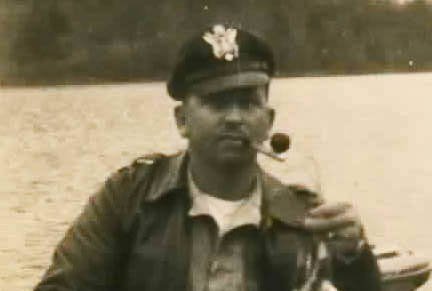
Bob Clear wore 17 different club uniforms from 1946-1967.

I had a very interesting comment from a fellow named Mike Ross in response to a brief piece I wrote three days ago on the death of the late Bob Clear. It reminded me again of how much there is to wonder about in the way human energy moves forward, for better and worse, in its play of influence upon others.

So much hinges on whether we give or withhold from others.

As a longtime minor league instructor and bullpen coach for the Angels, Bob Clear was one of the two main voices who suggested that the club take a bad-hitting catcher named Troy Percival and convert him into a relief pitcher. Of course, we know what happened from there. Percival went on to become one of the top closers in the game.

Clear also exerted an enormous amount of influence upon a young catcher in the Angels system. Although this particular player never made it to the big leagues as a player, he learned how to be a teacher of others from another fellow who never played in the big leagues either. Today that young catcher is now middle-aged but quite successful as the manager of the Tampa Bay Rays. According to Mike Ross, Maddon credits the late Bob Clear with being the most important mentor in his baseball life.

It’s a small world, except for one big always-present wild card crazy thing. – The more we become willing to share what we have to give with others, the more our world of connection grows and spreads across the lily pond of human experience on how to improve upon and solve all kinds of human-initiated problems.

Maybe if we had more Bob Clears working in offshore drilling technology we wouldn’t be facing the mess we now have on our hands. Who knows?

All I know for sure is that I just had to bring you this rest of the Bob Clear story. The details of Bob’s later baseball career are beautifully covered in an article about him on Wikipedia. Just Google “Bob Clear” and go there for further details.

The Trouble with Oswalt’s Trade Request.

May 22, 2010

Astros Ace Roy Oswalt Turns 33 on Aug. 29th.

If you look at the wall he’s been up against over the past couple of years, but especially this season, you can’t blame Roy Oswalt for wanting out of his situation with the Houston Astros. Everybody remotely close to things here in Houston and how these things work in baseball can see his point – but also the trouble the Astros are going to have fulfilling his request.

In his 9 games pitched in 2010, Oswalt has pitched well enough to have been 9-0 with a club that can both hit and protect late inning leads. With an ERA of 2.66 and a WHIP score of 1.066, Roy has done the same job this year that he’s done 7  times in his first 8 seasons (2001-08) of putting at least 14 wins in the success column for each of those seasons. This year, as you no doubt already know, he’s off to a 2-6 record that threatens to end up worse than his 8-6 fall in the injury-filled year that was 2009. The victories that eluded Oswalt in 2009 were largely due to his own inability to pitch deep and the pen’s inability to hold narrow leads. In 2010, the problem has been the almost total failure of the offense to give Roy any run support.

Now that Oswalt has finally had enough to shout “get me out of here,” it isn’t hard to see how that might be best for the player and a club that needs total rebuilding. On the surface, it says, “Hey, let’s move Roy to a club where he has a chance of winning and maybe reaching another World Series while the Astros accept  some good prospects in return that will help the team begin to paint a clearer picture of the future.

The troubles facing Astros General Manger Ed Wade in this matter hit fast and hard:

(1) Roy Oswalt turns 33 on August 29th and he now has a back injury history that has never been fully resolved. (2) Oswalt is owed 31 million over the next two seasons with a 2 million dollar buyout for the 2012 season. (3) Only a select group of teams have a great chance at the World Series over the next three years, but do those clubs both want to deal and have anything to offer that makes it really worthwhile to the Astros? (4) Are there any qualified clubs out there who want to trade a couple of good young prospects for a 33-year old ace with back trouble history and a heavy salary baggage that comes with him, even if the Astros agree to absorb some of it?

If any of us had the answers here, we could probably be of benefit to Ed Wade, but things don’t work that way. The fact is, Ed Wade may not be able to do anything constructive with Oswalt’s request. In that case, only two choices will remain and neither smacks as good news.

If General Manager Wade can’t move Oswalt in a deal that will at least help the Astros too, he will be forced to (1) appeal to Oswalt’s sense of pride and professionalism for making the best of it here as an Astro, while trying to quell any backlash from teammates; or (2) making a giveaway/salary dump deal just to get Roy out of Dodge because of the morale issue he could become for some of the others.

Jerry Witte & Roy Oswalt, 2001.

I have liked Roy Oswalt from his rookie season and I wish that things had never come down to this kind of situation. The rookie 2001 version of Roy was so nice and respectful to my old friend, the late Jerry Witte, on that night in August that great old former Houston slugger got to throw out the first pitch and Roy Oswalt served as his “catcher.”

“Young man,” Jerry asked of young Roy, “where did you learn to pitch like you do?” “My daddy taught me, sir,” Oswalt said.

“Well, you just keep up the good work,” Jerry added. “You’re a credit to your daddy and you’re going to be big credit to the game of baseball.”

Jerry Witte was right about Roy Oswalt. When I think about Roy and how he so respectfully helped Jerry that night in his one and only trip to the new downtown ballpark, even standing with him through the National Anthem, I hate the thought of knowing that the young gentleman from Weir, Mississippi will soon be moving on.

I know. Business is business. But Astro fans are going to miss Roy Oswalt once he’s gone. At least he’s not leaving over money. He’s leaving, or wants to leave, so he can have a taste of winning the big one again. No matter who the Astros may get for him, it will be our loss, the fans’ loss.

The status of Jeff Bagwell and Craig Biggio as career Astros is about to grow even larger as a baseball rarity.