Archive for the ‘Uncategorized’ Category

A Houston That Might’ve Been

December 14, 2010

Without cars, Houston might've grown no wider than today"s "Inside the Loop" area.

The problems of mass transportation in Houston are virtually unsolvable unless we finally get it into our collective heads that they are almost absolutely necessary. I say almost because the alternatives to mass transit will always be out there: (1) We can continue to live large portions of our working days stuck in our 0ne-person-per-car traffic jams, covering long distances each on our drive-ins from hinterlands; or, (2) Others of us can find ways to contain our lives in one of those constantly developing smaller sections of Greater Houston and simply only venture beyond our personal world gates when we absolutely have to go elsewhere.

Houston didn’t have to develop along these lines, but it almost had no choice. As one of the newer developing major cities of this country that sprung up west of the Mississippi River, Houston quickly got caught up in America’s eco-political addiction and sale of the spontaneous combustion engine to “We, The People” during the early decades of the 20th century.

What a campaign that was. It must have been as tough as it is for drug dealers when they try to sell crack cocaine to street addicts. The people wanted their own wheels – and these came in stages. First the forces behind the gas-powered engine sold communities on the bus as a superior mode of transportation than the train or street care because it wasn’t contained to a fixed route. Once approved, rail tracks were pulled up so that there was no going back. Then the campaign shifted from busses to cars. “Why wait on the bus when you can plan your own trip with a personal automobile”

They Ford and Chevy salesmen forgot to tell us what will happen once a quarter million of us started planning the same trip to work every day at the same time on the same old two-lane street to downtown. By the 1940s, in Houston and elsewhere, we were getting the message that “super highways,” or so-called “freeways,” were needed to solve the problem of traffic jams.

Houston got its first superhighway in 1948 with the opening of the Gulf Freeway. It solved very few needs for long and it has been in a state of continuous updating ever since, as it apparently always will be. It’s just the nature of the beast. The driving dynamic is the constant growth of a population in which all new members also want to drive their own personal autos alone each day over streets that never get wider on their own,

The problem with mass transportation in Houston now, whether it’s by bus or train, is, “Who is going to use it?” The other driving force against useful public transit is the growing fear of people that  their lives may be in greater danger from random acts of violence as passengers on public vehicles.

I don’t know what the answer is. Maybe there isn’t one. In fact, one of our larger problems in America today may be the naive belief that every problem we create has a solution that simply needs to be located at a later date. Oh really? Is that what we are counting on in the matters of our huge national debt and the big tab of that bill that’s now owned by China?

As for the smaller matter of “the Houston that might have been,” had we not grown up with the personal auto, my guess is that the actual city today would only cover a land area that is roughly, if not perfectly, comparable to the space within our present 610 Loop. It would be without a loop, or any other freeway, of course, but it would have rail service to all of its not-so-distant-from-downtown points.

Houston North would run no further north than Crosstimbers, just north of the present day 610 Loop.

Houston West would end at the far western side of Memorial Park, pretty much along the trail of our current 610 Loop and heading south along Post Oak Road to South Main.

Houston South would trail along the area that is currently 610 Loop, south of Reliant Stadium and the Astrodome. (Parts of Houston West and South would be cut out by the cities of Bellaire, West University Place, and Southside Place.

Houston East would also take a raggedy-patch route as far southeast as Park Place, up Old Galveston Road to Broadway, north to Harrisburg, and over the Ship Channel to take in Denver Harbor, and on north to present day Loop 610 North, give or take few blocks, here and there.

Downtown Houston would have remained the heart of local business activity and retail marketing, and it would have grown as the hub of Houston’s mass transit rail system, cultural and sporting events, and entertainment district. With a few exceptions. like the present growth of our cultural, sporting, and museum venues in and near downtown today, it would have been a very different Houston from the one we actually built – had it not been for the automobile.

We can’t know if the rail system version of Houston would’ve been better for us because we don’t know how we would have grown up personally had we not fallen in love with the idea of the personal car so many years ago.

Our love affair with the automobile may have caused some problems with traffic and the environment that have no real solutions to them in a world that continues to depend on freeways and oil-based fuel. Our hope has to be that it has also sparked the scientific genius we shall need to work our way out of the problems that come with our dependency on cars  – and that we are not stuck with a fatal attraction to something that eventually wipes out our “precious” way of life.

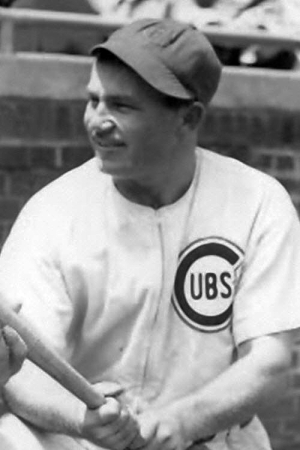
Lou Novikoff: The Mad Russian

December 13, 2010

"When you gotta go, you gotta go!"

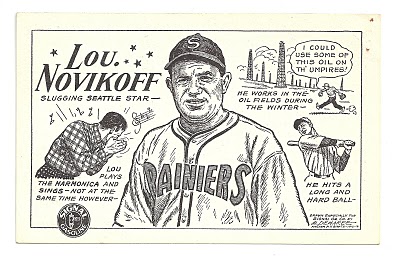
Lou Novikoff. Spontaneous singer in the pre-karioke days. Journeyman professional baseball player. Off-season oil field roughneck. Harmonica player. Russian-American. The Mad Russian. Left fielder Novikoff saw action in ONLY  59 games for the 1949 Houston Buffs. That was the extent of Lou’s Buffs career, but he sure made an impression on us Knothole Gang kids while he was here.

I’ve written earlier about this spunky little short-term outfielder for the 1949 Houston Buffs. To those of us who were Buff Stadium Knothole Gang members, he was one of the friendliest, funniest guys on the team. He seemed to like us kids. That kid-friendly quality always made a difference with us. And hey! Lou Novikoff was one of the few Buff players who would flick an occasional practice ball into our  little campy  cheap-seat section down the far left field line near the home team clubhouse.

Teams didn’t give usable baseballs away quite so freely back in the post World War II era. Club owners back then viewed baseballs that ended up in the hands of fans as lost operational materials – and not as marketing investments in future fan interest.The old St. Louis Browns even hired people to retrieve foul balls and home runs from fans at Sportsman’s Park in St. Louis for future use by the club.

Lou Novikoff was just one of those guys who made us kids feel we mattered. He did it with smiles, nods of the head in our direction, a few baseballs, and an occasional song by voice or harmonica tune from the field. As the left fielder, and like Larry Miggins before and after him, Novikoff was the guy we “Gang” members came closest to during each Buff home game.

Novikoff batted only .230 in 59 games for the '49 Buffs before getting shipped off to Newark, but he hit .337 over 11 seasons as a minor leaguer between 1937-1950.

A right hander all the way, Lou Novikoff stood only 5’10” at a weight of 185 pounds. He was a dubious fielder with a great batting record over eleven seasons in the minors (1937-41, 1945-50). He also hit for a .282 major league average over five years in the big time (1941-44, 1946). Only in 1949, Lou’s next to last seasons with three clubs, including Houston, did his average for the entire season fall overall below .300 for the entire year.

Like a handful of other Houstonians, I will always remember Lou Novikoff most for a bizarre thing that happened to Lou and the Buffs in a close  game against Beaumont, I believe, in the late innings. With the game tied in the top of the eighth (I believe), Beaumont rallied, getting the go-ahead run to third base. It was time for a pitching change and Buffs manager Del Wilber had called a time out to make that move.

At the same time, out in left field, we all see Lou Novikoff running to the side gate near the Knothole Gang that also leads to the Buff clubhouse behind us. It’s obvious that Lou is using the time out for an urgently needed potty run.

Trouble is – Manager Wilber and the umpires don’t seem to realize that Novikoff is now missing in action.  In the Knothole Gang, we can all see that the game i about to resume, but there’s still no sign of Lou coming back from the clubhouse.

“He must have really had to go,” flickered through my mind as some other kid yells at the small open ventilation window in the Buffs clubhouse: “Hurry up, Lou! They’re about to start without you!”

And they were too..

All of  sudden, Lou Novikoff came falling, stumble-running out of the clubhouse, trying to pull up and fasten his pants back on at the same time. He got about as far as the gate when we all heard the crack of the bat and turned to witness a fly ball dropping safely in left field.

The game had resumed without Novikoff in place. What should have been an out turned into a double fielded way late in left by the center fielder. Beaumont got the run that would win them the game. Novikoff got chewed out and replaced by Wilber. This night most likely provided the Buffs with the last straw they needed to ship Novikoff out of town for the rest of the year.

Only one of Houston’s three newspapers covered the story accurately. I think that paper was the Houston Press. The other two must have simply been too embarrassed to write about such a happening in 1949. One simply overlooked the incident; the other wrote it off as in issue resulting from sudden illness to Lou Novikoff.

My own eyes on what I saw and Lou Novikoff’s words in the one paper that covered the full story were good enough for me. When asked why he had left the field during the game, Lou replied, simply: “When you gotta go, you gotta go!”

Lou's .300 mark for '42 Cubs was his best MLB full season. Lou Novikoff died in 1970 at the age of 54.

Ode to a Troubled Rookie Pitcher

December 12, 2010

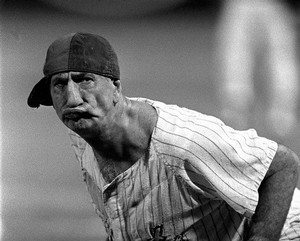
What if Max Patkin: sang advice to a drunk rookie free agent pitcher who showed up stewed for spring training? In my own thinking on things, I imagine it might go something like the following little diddy. (Sung to the melody of "The Christmas Song.")


Baseballs resting – in the morning sun,

Jack Dan dripping – from your nose;

Springtime trial – is your fat in the fire,

You best be grateful – I suppose.


Everybody knows – a turkey – in the starting “ro”,

Helps to make the season slight.

Hungry bats – with their eyes all aglow,

Will find it hard to sleep – tonight.


They know that hits – are on the way;

They’ve loaded lots of hope for big times – on this day;

And every motheroo – is going to try,

To see if they make – your fastball – flat fly.


And so – I’m offering – this simple phrase,

To kids – from one – to ninety-two,

Although it’s been said – many times – many ways,

“SOBER UP, KID – YOU’RE SCREWED.”

Some Hot Stove Ramblings

December 11, 2010

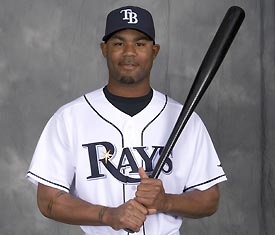
Ryan Rowland-Smith (12-17, 4.57 ERA) (2007-2010)

The trade and free agent signings are not big these days in our little part of the baseball world, but then we did not expect them to be. With the club recovering from other salary misadventures and the franchise now up for sale, Astro fans can pretty much expect things to proceed along this line for the foreseeable future.

The good news is that the club now seems totally dedicated to shoring up its developmental program at the minor league level and it is aggressively working to draft young players who are both good prospects and sign-able free agents. It doesn’t do any good to draft players if they aren’t good prospects or you just can’t sign them, anyway. I don’t have this year’s record handy, but if memory serves, the Astros did well in 2010 by signing most of their young free agent draftees.

Now the Astros come home from the Florida winter meetings by signing lefty Ryan Rowland-Smith as another competitor for the fifth spot in the rotation for 2011. The club also took two pitchers, Aneury Rodriguez and Lance Pendleton, from the winter meeting Rule V draft of minor league players not protected by the 40-man roster,  Those latter two guys will also be likely competitors for the number five-spot in the rotation.Veteran Nelson Figueroa is the holdover favorite to win the job, but we will have to wait through spring training to learn about these other guys.

Besides all that speculation, it’s early. A lot can happen between now and then. Who knows what Ed Wade may be forced to do to make room for that better hitting middle infielder he says he’s looking for.

As for Rowland-Smith, all I know about him is what I’ve very recently read, I’ve never seen him work. Even in this big package, get-all-the-teams-on-tv high-tech era, Seattle remains about as far off my big league radar screen as teams can get, All I know is that the guy has some command issues and that last year he really plummeted, going 1-10 with a stratospheric ERA of 6.75.

Let’s hope the Aussie-born portsider who turns 28 in january is “recoverable” under Astro manager Brad Mills and that “recoverable” is measured at a level that is greater than his 5-3, 3.42 ERA best year of 2008. The Astros need more help than that best season marker suggests is forthcoming. Rowlnd-Smith will need to bring his best game to the final results side of far more than eight decisions in 2011 to be of real help.

Our club motto for 2011 should be a realistic match for the times: Don’t expect the moon by June – or anytime soon! This club is going to be better than 2009 because of the personnel changes that have freed the team to rebuild with lighter expectations on the club’s chances for a quick route back to the World Series moment of 2005.

A World Series isn’t going to happen with Roy Oswalt and Lance Berkman leading the way. Those guys are gone. Forever. They aren’t even coming back for a twilight lap season. If they ever do, take it as a definite sign that the Astros of that moment have converted to a burlesque version of baseball success and that they are then and there no longer serious about winning.

Patience and a passion for baseball, even in leaner times, are going to be key qualities that Astro fans need to have for the foreseeable future. We’ve lived with these traits forever, so, hopefully, we can spring them activation again. If we start seeing our best young players disappearing via trade on a regular basis, as they regularly do in Pittsburgh, then we shall need to pull the cord and get off the baseball bus, but I really don’t see that happening here. And whoever buys the club needs to understand that facet of Astros fandom: We will not settle for a losing ball club indefinitely. We are not Pirate-like fans.

As for the current club, I like Jason Castro at catcher, Brett Wallace at first, Jeff Keppinger at second, Chris Johnson at third, Carlos Lee in left (as the only place left he fits), Gold-Glove winner Michael Bourn in center, and Hunter Pence in right. I also prefer  Clint Barnes or Angel Sanchez at shortstop over Tommy Manzella gets my vote. I’ll take the better bats over the better glove, but no hit route, for now, As for the pitching, I’m content, for now, to let time and spring training sort that out for us. I do wish that something could happen to cure that “Bad Wandy” character that still shows up too often when Senor Rodriguez takes the mound. “Bad Wandy” is the only guy standing in the way of “Good Wandy” earning a contract with more numbers on the salary line.

The winters are long for some of us baseball fans. Unlike Rogers Hornsby, some of us have a little trouble just staring out the window, waiting for spring, We have to talk and write out our hot stove league thoughts and speculations.

Care to join me? Please leave your own questions or thoughts here as a comment on how the 2011 Astros season looks to you, so far. The rest of us would like to hear it.

Baseball’s Biggest Player Contracts to Date

December 10, 2010

Carl Crawford Joins Red Sox in 2011.

Well, we Astro fans  are now officially free to euthanize any illusions we may have held about native son Carl Crawford coming home to give new meaning to the “Crawford Boxes” at Minute Maid Park. Carl has now been recruited by Red Sox General (Manager) Theo Epstein as the latest multi-year contract weapon in his Boston club’s ongoing war against “The Evil Empire.”  The Red Sox already had picked off Adrian Gonzalez from the San Diego Padres talent vineyard prior to adding the big grape that Crawford is – and they did it while General (Manager) Cashen of the New York Yankees had begun his recruitment dance with start pitcher Cliff Lee for a contract, if it happens, that may well alter again the latest top ten list of big spending on baseball talent.

For total dollars committed, Carl Crawford now moves into the # 10 spot because of his new deal with the Red Sox. It’s for seven years and $142 million dollars. If Carl Crawford ever comes home to Houston now as an active player, it’s most likely that he will be 37 years old by the time he’s free to make a twilight deal somewhere, if he wants to keep playing at all. You never know, but it’s much more likely now that Carl Crawford will never play a single game for the Houston Astros. Seven to eight years from now, the Astros will be knee deep in new ownership and, from the way our economy is changing, the world will be such a different place from the one we know now.

Who knows if baseball will continue to pay these obscene salaries to the game’s best players? Will the fan interest in baseball continue to convince advertisers forever  that televised baseball games are the best place for hundreds of key companies to place their advertising dollars? If these dollars ever get pulled away, or peeled back, there won’t be any more A Rod stratosphere contracts because the money simply will not be there to support them.

In the meanwhile, here is how the biggest active multi-year contracts in baseball stack up through today:

Top 10 Money Players (by Team, Start Date) (Years/Total Bucks) (Average $ per Year) *

1. Alex Rodriguez (New York Yankees, 2008) (10 years/$275 M) ($37.5 M per year)

2. Alex Rodriguez (Texas Rangers, 2001) (10 years/$252 M) ($25.2 M per year)

3. Derek Jeter (New York Yankees, 2011) (10 years/$189 M) ($18.9 M per year)

4. Joe Mauer (Minnesota Twins, 2011) (8 years/$184 M) ($23 M per year)

5. Mark Teixeira (New York Yankees, 2009) (8 years/$180 M) ($25.4 M per year)

6. C.C. Sabathia (New York Yankees, 2009) (7 ears/$161 M) ($23 M per year)

7. Manny Ramirez (Boston Red Sox, 2001) (8 years/$160 M) ($20 M per year)

8. Troy Tulowitzki (Colorado Rockies, 2011) (10 years/$157.75 M) ($15.78 M per year)

9. Miguel Cabrera (Detroit Tigers, 2008) (8 years/$152 M) ($19 M per year)

10. Carl Crawford (Boston Red Sox, 2011) (7 years/$142 M) ($10.28 M per year)

* List does not include large one-year contracts to Ryan Howard with the Philadelphia Phillies, Johan Santana with the New York Mets, or Manny Ramirez with the Los Angeles Dodgers.

My question is simply this: Would it really be so bad if baseball suddenly could no longer afford to make their best players of the moment as instantly rich as Saudi-Arabian desert oil princes?

Maybe I’m just old-fashioned and way out of line here, but I didn’t grow up loving baseball because it’s best players were light years richer than the rest of us. I grew up adoring the players who lived pretty much as the rest of us did, but who chose to play baseball because their obvious passion and love of the game publicly also matched their abilities to play it at the highest competitive level. You could just see it ib=n them from the time you reached the ballpark through the last batter in the game.

These guys showed up early, be they star or sub. They all shagged flies. They ran together. They took BP, of course, but they also took infield practice, sometimes even engaging in a little shadow-ball pantomiming and pepper game popping for their own amusement and reflex sharpening.

It was a game. The players loved it. And so did the fans. If the big salaries disappeared, I wouldn’t care if we lost some future Carl Crawford to the NFL as a running back, or some future Randy Johnson to the NBA as a forward, If we can still round up enough talented guys to play the game from the heart, I will still be there as a fan to watch baseball that is also priced right to the circumstances of our changing economy.

Please check in with a comment. What are you own thoughts on the future of big multiple year salaries in baseball?

Gaedel Redux Implodes

December 9, 2010

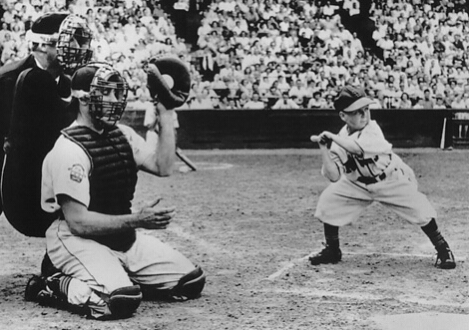
AUGUST 19, 1951, EDDIE GAEDEL BATS; ONCE WAS ENOUGH.

A while back, I wrote a column on Eddie Gaedel, the only midget or dwarf to ever bat in the big leagues. The link to that WordPress piece is:

https://thepecanparkeagle.wordpress.com/2010/04/24/the-ballad-of-eddie-gaedel-2/

Well, it seems this past summer it happened again. Sort of. Some folks up in Missouri ran out of fresh ideas and decided to commemorate Gaedel’s iconic moment by sending a 16-year old dwarf to bat for the Ricer City Rascals in an independent league professional game played in O’Fallon, Missouri against the Oakland County Cruisers.

You can check out the original story, plus pictures, that both cover this event by linking on to the St. Louis Browns Blog Spot and checking out the story as it was reported by St. Louis Browns Fan Club President and Editor in Chief, Bill Rogers. Just scroll down to August 20, 2010 and select the story entitled:

River City Rascals Salute St. Louis Browns Historical Society & Eddie Gaedel Anniversary

The St. Louis Browns BlogSpot link is http://thestlbrowns.blogspot.com

Your visit t0 the site also will be a fine opportunity to check out some of the other historic stories that Bill Rogers and Company have assembled about the old Browns, the same Browns that left St. Louis fifty-six years ago in 1954 to become the Baltimore Orioles. One of the stories even includes the language of haste we know as “breaking news.” You’ve got to believe, at first,  that any news that could be breaking over a half century beyond the funeral of the club must have been keeping in a freezer somewhere. Just read it and come to grips with the fact that even urgency is locked into the perception of the beholder. I’m sure there must be at least one centenarian remaining alive in Boston for whom the news of Babe Ruth’s sale to the New York Yankees still strikes sharply to the quick point of pain.

At any rate, for $25.00 a year, membership in the St. Louis Browns Fan Club is one of the best hidden values in baseball. Give it a look and some thought.

Meanwhile, the abortive attempt to recreate the Eddie Gaedel experience failed in troubled River City. Nick Hagan played the part, and the club even replicated all the moves that the Browns took back in 1951, right down to bringing Hagan out in a cake-shaped container prior to the game.

When the Rascals then came in to take their first at bats in the bottom of the first, “Gaedel” was then announced as the pinch hitter for the first man due up. Here’s where the script changes.

This “Gaedel” (Hagan) was about four inches taller than the original. He also took only four pitches, as did the iconic midget, but three of those were called strikes. Historic justice prevailed. Nick Hagan had to take the long walk back to the dugout as a strikeout victim. He would not tie Gaedel’s career On Base Percentage (OBP) of 1.000 and waltz airily away into the record books with a perfect stat record of his brief achievement.

Terrific. That’s what the folks in River City get for being short on new ideas. Had it worked, we might have been forced to hear about annual walks to vertically challenged batters in the boondock leagues of this country – and maybe even bracing ourselves for the reintroduction of some other far-from-original ideas. How about building a new domed stadium with a roof that cannot be opened, but one that will work as a cookie-cutter venue for sports of all kinds? How about starting a newspaper, one that comes with a sports section and plenty of sports writers?

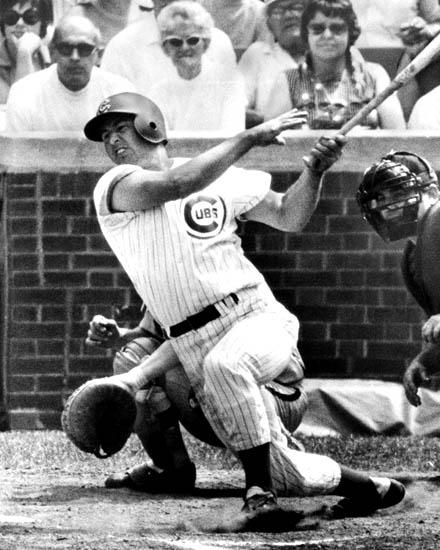
Ron Santo for the Hall of Fame!

December 8, 2010

Ron Santo Deserves Hall of Fame Induction.

Back in 1960, when the Houston Buffs were playing out their minor league days as a farm club of the Chicago Cubs, a couple of future Hall of Fame quality players passed through here as the team’s left fielder and third baseman,. Their names were Billy Williams and Ron Santo, but only one of them would go on to receive the Hall of Fame induction that both deserved. That one, as you well know, was Billy Williams, who went into the Hall in 1987 after an 18-season career in the big league (1959-1976) in which he batted .290 and collected 426 home runs as a left fielder and first baseman. Williams did not become eligible for consideration until 1982 and then made it in with enough support on the sixth annual ballot in which his name appeared.

In the meanwhile, that other former Buff, third baseman Ron Santo, has been shut out from the honor continuously ever since his own retirement from a 15-season big league career (1960-1974) as a .276 hitter who also bashed 342 home runs in his career. As a fielder, few have ranked with Mr. Santo at third base. As a five-times Gold Glove winner and a nine-times All Star, organized baseball did about all they could do to honor an active player for his prowess on the field. Then he retired and the voters apparently could not see beyond their addictions to the ideas that a player, especially a corner infielder, should have either a near .300 batting average or pulverizing power stats to merit Hall of Fame consideration.

Bunk. Ron Santo handled third base like few before or after him, and that’s especially important when we are talking about the difficult third base spot and its unique requirements for players with rabbit-like foot speed, cat-like reflexes, eagle-like vision, and bear-like arm strength. Throw in the exceptional agility of a ballet dancer with those first-mentioned qualities and you had a third baseman named Ron Santo.The blindness of the voters simply would not let them see in his lifetime beyond that .276 batting average. After all these years of wonderment over his HOF denial, that’s all I can figure.

Now Ron Santo is dead. After years of courageous battle against diabetes and the loss of both legs, we lost the man last week. He died on Thursday, December 2, 2010, at the age of 70.

Whenever it happens, Ron Santo’s posthumous induction into the Hall of Fame will ring a lot more hollow now that’s he’s gone. These kinds of recognition always do when we make some deserving person wait until they die before we honor them properly for what they did in life, but that that’s the way the world seems to operate in many instances and Ron Santo is definitely one of those cases.

C’mon, Baseball, put Ron Santo in the Hall of Fame now. “Better late than never” still holds – and it’s all we’ve got to lean on now in the matter of unfinished business with the late Ron Santo.

Who is the Biggest Icon in Houston Major Sports History?

December 7, 2010

Who was Houston's biggest and brightest major sports star?

This morning I yield to a long-time urge – and that is to ask each of you this simple question. – Who do you think has been Houston’s biggest star over the years among all the great athletes who have passed through our city to play professional baseball, football, or men’s basketball for one of our local teams, plus any who may have boxed professionally as Houstonians?

There’s no poll included here. If you want to cast a vote, you need to leave a comment in the section that follows this column, even if it’s just to type the name of your choice. You are free and encouraged, of course, to write as much as you want on why you support this particular person.

Candidates from hockey, soccer, collegiate sports, wrestling, auto racing, and the Houston Comets women’s team have not been encouraged for inclusion in this query because of the basic supposition that none of these sports had or have wide enough community appeal to be considered that important to a wide segment of all Houston sports fans.

That being said, you remain free to cast support for an athlete from one of the minor, or more restrictively popular sports. Just keep in mind the question here before you as you do: Here it’s about who has been the biggest star for most Houstonians – not just to you or a smaller group of local fans.

My remarks on the question raised by this column are just our start. The subject will not be covered until enough of you write the answer in the comment section below – and please invite your friends to do so too. And remember also. Even if you have seen a name recorded here many times over, your opinion still counts too. Go ahead and write in their name again.

Notice that I have not stated a single name that’s out there as a specific candidate. I think we all know the handful of superstar people who are most deserving of this honor.

So, round up the usual suspects and let the voting/commenting begin!

Our Hermann Park/Rice Legacy

December 6, 2010

This iconic statue of General Sam Houston has marked the entrance to Houston's Hermann Park since 1925. It was designed and constructed by Italian-born Texas sculptor Enrico Filberto Cerracchio for $75,000 in post World War I dollars.

A legacy is only as valuable as the care it receives from its recipients. So far, the 1914 gift of land for a park and medical center south of downtown Houston by early local philanthropist George H. Hermann seems to be surviving as valuable to the City of Houston beyond anyone’s earliest 20th century dreams.

Were it not for the 445-acre donation of land by Hermann, and the adjacent earlier donation of acreage and endowment funds to the contiguous west of the park for the start of Rice (Institute) University in 1912 from funds donated by another local giver, William Marsh Rice, the southern exposure of this city’s non-zoned real estate might have grown as nothing more than a hodge-podge of homes, business, and billboards, the way much of our city grew until we awoke from what we were doing. That kind of force for conservancy wasn’t necessary south and immediately west of General’s Sam’s statue. The gifts of Messrs. Hermann and Rice had set a legacy in motion that the people of 20th century Houston had gratefully accepted, developed, and improved.

The Texas Medical Center south of Hermann Park is now the arguably finest in the world. The art, civic, and science museum district immediately north of Hermann Park is now one of the finest in the nation, if not the entire world – and these all flow further north through the reviving mid-town redeveloping residential area and into the traditional downtown/uptown (depending on your point of view) business district that also now preserves classic structures like the iconic Gulf and Esperson Buildings, the ancient LaCarafe Building on Market Square, while also serving as the promotional environment for the growth of the classical performing arts, major league baseball, and professional basketball. Throw in downtown also as the home of the central branch in one of the finest library collections and systems in the nation.

Houston values culture. Houston has class. And the seeds of it all may have been the early donations of two men named Hermann and Rice. These gifts to the people just seemed to set in motion an appetite and an attitude about learning, preservation, beauty, and accomplishment that permeates the air of our community to this very early dawn in the 21st century.

The future of Houston is right over there, just beyond the dawn. All we have to do to make our best future most likely is to lean into tomorrow by living fully today and in total respect for the many personal and community gifts of our storied local past.

How long has it been since you’ve visited the zoo, attended a concert at Hermann Park, checked out the Science Museum, visited the Houston Museum of Fine Arts or one its many local exposition cousins, or simply taken a continuing education class through the Rice University Adult Studies program?

Well, maybe it’s time you did something along those lines. We keep the legacy alive through our personal participation in whatever’s available. And we’ve got a lot of worthwhile stuff filling our cups of opportunity to the brim here in Houston. It’s up to each of us to either use it or lose it.


.

Cardinal Berkman: And Other Forgettable Images

December 5, 2010

Cardinal Berkman may distort Astro Memories.

The thought of Jeff Bagwell or Craig Biggio ever donning the uniform of another MLB club, especially the flaming red digs of the St. Louis Cardinals is beyond the pale. Now Lance Berkman comes along and signs with the rival Cardinals and its almost as bad.

Never mind the fact that Lance wanted to come home to Houston after his unfortunate brief stay in The Bronx, but he was turned away at the gate by Ed Wade, the man who now answers the door at Minute Maid Park, this town’s version of the Emerald City in Oz.

“But I want to speak to Drayton,” cried Lance.

“Nobody speaks to Drayton these days, Lance,” answered Wade, “not nobody, no how, no way. – Unless, of course, you are prepared to present a buyer’s offer for the club, the  door to Mr. McLane’s private chambers are now closed to any discussion of all other baseball business.”

Well, in all fairness to all parties, the outcome of Lance Berkman’s recently abortive attempt to come home again wasn’t quite that ludicrous or severe. There simply wasn’t any room on the Astros roster for the aging star under the atmosphere of the current rebuilding program. As General Manager Wade put it somewhere, every at bat the club might give to Berkman now would be one less growth at bat opportunity for newcomer Brett Wallace. The club needs to find out if Wallace is the man at first in the future or not. And the club cannot accomplish that aim by giving away all those at bats to Lance Berkman as he plays out the downside of his career.

Now, does Berkman’s signing by the Cardinals set up this familiar headline script? “MAN’S ONCE-UPON-A-TIME BEST FRIEND COMES HOME AS MAD DOG TO BITE FORMER OWNER!”

You bet it does, but it’s short term, maybe for 2011 only, if Berkman and the Cardinals even get through the entire season together. Age-related injury or a performance level that falls totally off the table could limit or end Berkman’s play in 2011, even though we certainly don’t wish that upon him. Chance are, for a while, at least, a late game at Minute Maid Park may indeed  be lost on a late inning gapper hit by Berkman – or by a left-handed, opposite field pop into the Crawford Boxes by the man with the Jay Leno chin.

It’s part of the game and we shall all survive it – as we did in the past with the return of Rusty Staub as a Montreal Expo, the return of Joe Morgan as a Cincinnati Red, the return of Jimmy Wynn as a Los Angeles Dodger, and the brief  return of Larry Dierker as a St. Louis Cardinal.

Let’s not forget too that there is another returning player visit by a former Astro blue-blood coming up in 2011. This one didn’t happen in 2010 because of the schedule, but it no doubt will happen next season, almost assuredly. And this one could be painful for several years to come.

A picture is worth a thousand words:

Roy Oswalt