Archive for the ‘Uncategorized’ Category

Lost Kid Freedom in America

January 14, 2011

"Run, everybody, fast as you can! And don't forget your nickel; it's the ice cream man!"

You don’t hear a lot of ice cream trucks cruising the neighborhoods these days at 5 MPH while that little child-alluring melody plays on like a mobile music box. Kids aren’t as free in street bunches these days – and ice cream isn’t free at five cents a pop either. The whole business plan of the ice cream man just does not make the sense in 2011 that it once did back in 1948 – when you could buy something tasty for a nickel – and we kids of that earlier era were free to explore our world – away from adult supervision – and without fear for our lives from countless predators.

I wrote the other day about how most of us walked away from home each Saturday to our neighborhood theater kid movies. We would be away from home for three to four hours at the mercy of a kinder world without fear for our safety – and some of us even started this pattern at age five.

It was the same freedom that left us open to sandlot baseball and other sports; working out our own quarrels with words and fist, if necessary, and all the while developing a confidence for moving forth into the larger world on our own.
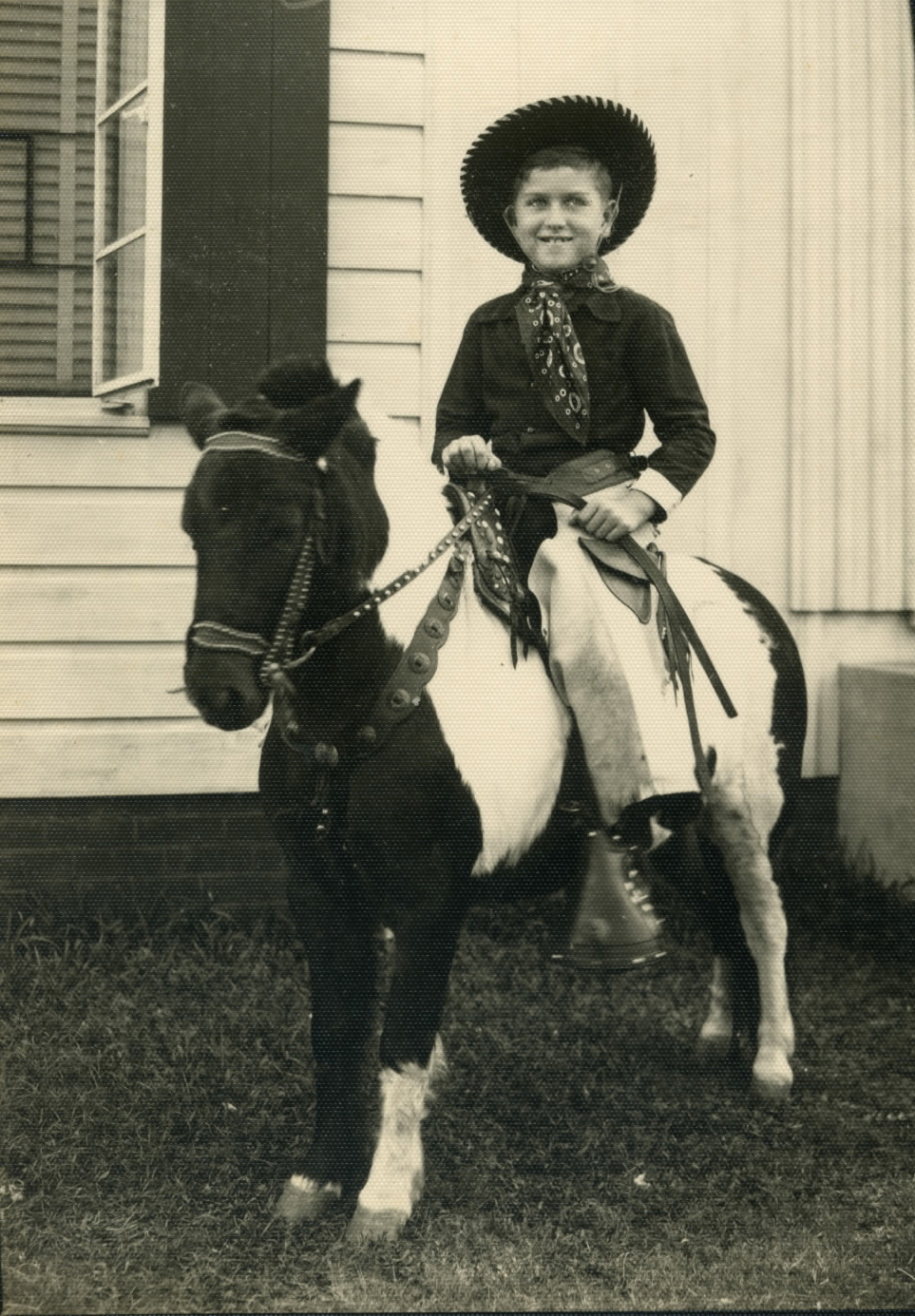
Aug. 1946: Pecan Park Cowboy

Remember those guys with the Shetland ponies that came through the neighborhood selling “cowboy/cowgirl in the saddle” photos back in the day? Almost everyone from our ancient era has one like mine (to the left).

That industry went away too with practically all other non-scam businesses that once sold items door-to-door. Again, the killers of business on this level were primarily fear and distrust of dealing with a stranger who is trying to sell us something on our own vulnerable doorsteps.

Kids today either live within the protective bubble of 24/7 adult supervision – or else, they roam independently on the bubble of scary and dangerous exposures to the threats of our current world.

It’s a crying shame that kids today have largely lost the chance to safely explore the world on their own, but that is what has happened – and the causes are far too complex for a singular explanation.

From my half century of work with kids and families, I will offer one observation about one factor that I think kicks strongly into the mix. It may not be the whole thing, but it plays its part.

Compared to our post World War II generation, young people today often seem to think far less about the long-term consequences of their actions. If I’m right, is that change being reenforced by our adult protectiveness of them? Are kids failing to get the handle on their own responsibility for the decisions they make and the actions they take?

Let’s take it to this extreme: Do some kids who rape or shoot others operate as though there is a re-set button on life? (Just push the button and start over. In electronic death and damage, there really is no long-term consequence.)

Make of these thoughts what you will. The subject is too big for a single column. It just starts with a loss of childhood freedom. Then it begs the question: Is what we are doing now simply making matters worse?

What do you think?

Top Ten Sidekicks in Baseball

January 13, 2011

Roy Rogers & Gabby Hayes (R) were saddle-up hero & sidekick buddies.

“Sidekicks” have always been the glue that made movie western, mystery, and comedy heros stick in the minds of film-watchers. Roy Rogers had his Gabby Hayes; Sherlock Holmes had his Dr. Watson; and Abbott and Costello, well, they both had each other. The net effect for all is that every fictional serial movie story always contains an attractive central hero-sidekick relationship in some form.

Yesterday the MSN Internet Search Site published their Top Ten List of the Greatest Sidekicks of All Time. Their choices ll derived from movies, television, radio, and (ever-s0-slightly) literature, but they were a fun exercise, even if you disagreed, as did I, with all their choices and their relative placement in order to each other:

MSN List of Top Ten  Sidekicks-Principals:

10. Chewbacca – Han Solo (from the movie “Star Wars”)

9. Kato – The Green Hornet (from radio, tv, & the movies)

8. Garth Algar – Wayne Campbell (from the “Wayne’s World” skit on Saturday Night Live, TV)

7. Tattoo – Mr. Roarke (from “Fantasy Island”, TV)

6. Dr. John Watson – Sherlock Holmes (from movies and literature)

5. Ethel Mertz – Lucy Ricardo (from TV’s “I Love Lucy”)

4. Robin – Batman (from comic books, radio, tv, and movies)

3. Ed Norton – Ralph Kramden (from TV’s “The Honeymooners”)

2. Deputy Barney Fife – Sheriff Andy Taylor (from TV’s “The Andy Griffith Show”)

1. Tonto – The Lone Ranger (from radio, tv, and the movies)

Billy Martin & Mickey Mantle: Who's sidekicking who?

I thought it would be kind of fun to open up this whole idea of sidekicks to pairings that go beyond simple human relationships and to come up with a list of My Top Ten Favorite Sidekick Pairings in Baseball. My list includes some flat out human matches, but it also takes in a few chemicals, substances, and conditions that are sometimes the sine qua non on total experience in one thing or another.

What I’m talking about should clear up as we go through the list:

10. Lou Gehrig – Babe Ruth. Great as he was, Lou Gehrig signed with the wrong club at the wrong time to be its leading man or major hero. As a junior teammate of The Bambino, Lou Gehrig was destined to do all of his great things from the sidekick seat in this Hall 0f Fame bound cycle.

9. Red Schoendienst – Stan Musial. Even his late career trade to Milwaukee failed to get the old redhead completely out of The Man’s shadow.

8. Billy Martin – Mickey Mantle. Who’s sidekicking who – or whom? Maybe I should have thrown in Whitey Ford and made it a three-way question.

7. Jack Daniels – Paul Waner. Paul Waner drank a lot, but he also hit safely a lot. He rounded first, heading for second, many a time with old Jack breath filling the air along his warpath. Paul Waner was not the only big league star that ever side-kicked his way into live action with assistance from Jack Daniels. He’s just the first guy that comes to my mind when I think of great players who succeeded in spite of themselves.

6. Peanuts – Cracker Jack. One sidekicks the other and they are both ballpark reasons why we fans don’t care if we ever get back.

5. Slippery Elm – Burleigh Grimes. As one of the spitball pitchers who got grandfathered into a lifetime pass on the new prohibitions against the use of saliva and other foreign substances on a baseball, I’ve always pictured Grimes walking to the mound with a pocketful of Slippery Elm bark and ready to snap at any young umpire who checked him out: “I’m Burleigh Grimes and I can do what I damn well please. Now just move along. I’ve got a ballgame to pitch.”

4. Mustard – Hot Dogs. (See #6 above. Mustard and hot dogs travel on the same level, They just aren’t mentioned in the game’s anthem.)

3. Change of Pace – Fastball. “Because, Mr. Fastball, you are absolutely nothing to fear without me!” – Change of Pace.

2. Absorbine Jr. – Athlete’s Foot. This one stands as an historic tribute to the kinds of clubhouse showers we had back in the day.

1. Bud Abbott & Lou Costello – Baseball. Who’s on First? These two funny guys became baseball’s ultimate sidekicks with their famous routine. They are priceless and ageless through their landmark contribution and they most likely will be the first voices you hear on your first visit inside the Hall of Fame Museum in Cooperstown, NY.

Have a great Thursday, everybody!

Good Old APBA Baseball

January 12, 2011


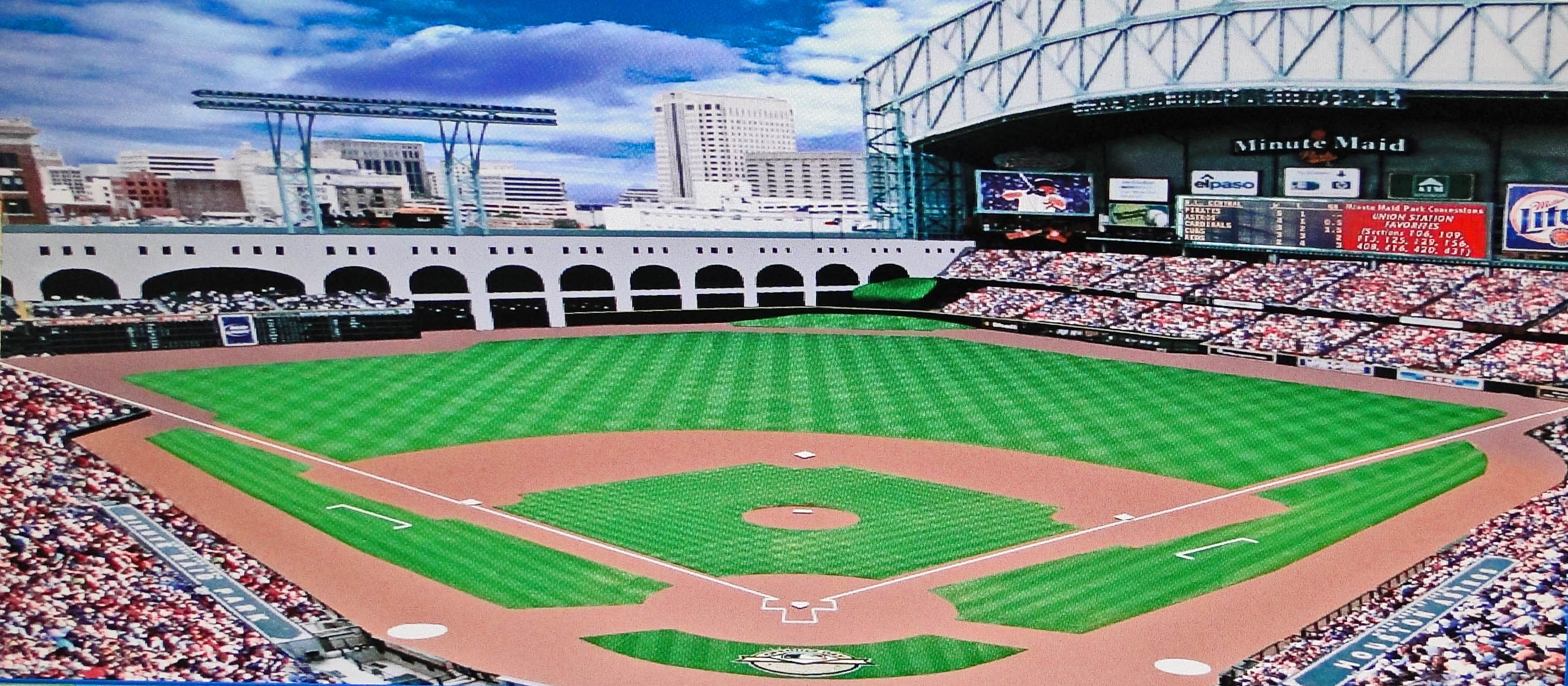
The APBA Baseball View of Minute Maid Park.


APBA Baseball has been around as a board game since 1951. I bought my first game set from the company in June 1953. I know that to be true because APBA  still has a record of my purchase by mail from our home in Pecan Park. I was 15 years old and still quite involved in anything that pulled me closer to baseball on a 24/7 basis.

Hey! I’m still that way! I never got over it, I suppose, except for the enjoyable, but testosterone-driven dating experience of my middle to later adolescent and young adult years – and all the time and energy I spent working my way through three college degrees and getting started in private practice. Whenever I settled down to life domestically and professionally, I always came back to baseball – and in whatever forms it may have been available to me as a player, fan, reader, researcher, and writer.

APBA Baseball was always a part of the flow. As one of the game’s earliest, most consistently realistic baseball results games, I was able to play the old dice and board deciphering codes to replay whole major league seasons and arrive at outcomes in the standings and individual hitting, pitching, and fielding accomplishments that were statistically in line with whatever happened to the same teams and players in reality.

APBA developed football, hockey, and golf versions of their game over the years, but these held no interest for me – nor did the simpler game of Strat-o-Matic Baseball. In APBA, I trusted. It was all I needed. No more. And no less.

Sometime in the late 1980s, APBA made the quantum leap into computerizing their game. I never played the board and dice version again.

Today I have ballpark settings for every park in the big leagues that APBA manufactures, a number of season disks for some of the greatest seasons in baseball history, and one player disk that contains the data for every major league player from 1876 through 1996. (APBA stopped making this disk once they woke up to the fact that it was hurting sales of the season disks. WIth APBA’s draft and wizard features, it’s pretty easy to put together whole seasons, make up your own players, and even pit your homeboy Pecan Park Eagles club into a desperate World Series contest against the 1927 New York Yankees.

I prefer to play the straight real-team match-ups. In a recent replay I did of the 2005 World Series, I started with a rested Roy Oswalt pitching for the Astros in the cool night opener in Chicago. The Astros ended up winning the Series in seven games in a match that was far more alive, interesting, and satisfying to us Houston fans than the reality contest was back then.

In APBA, players are effected by injury and fatigue, as well as their handling by different style managers. Ballparks are home run friendly and alien, depending on where you play – and games without roofs can be effected by wind and rain out threats.

After each play, a great written narrative tells you what happened on the play. If you are playing the game as an active manager, you may have to make decisions about what batters do, or how fielders play, but games are never turned over to your personal dexterity as the determining factor in play outcomes. Players ar noted on the field and on the bases by a name-line, but there is no visual animation. The action part of the game has to take place in your own brain as you witness an outcome that is credible to what’s probable in reality.

Here’s a link to information on the APBA computer baseball game. There are many other sources available with a few Googles:

http://apba.stores.yahoo.net/miasprapbafo.html

APBA Baseball beats the heck out of Rogers Hornsby’s prescription for winter: “Stare out the window and wait for spring training.” Of course, old Rajah would never have played APBA on the computer. He’d be worried about it hurting his batting eye.

The Stupor Bowl – And Other Bad Ideas

January 11, 2011

If you "Win Ten" - where do wear #11?

After going into the Seattle Seahawks yesterday as sort of a built-in bad idea in pro sports (a losing-record team advancing to the playoffs as a first week home team), my mind immediately wandered into new and old, and mostly borrowed ideas we might introduce into our national bag of athletic cornucopia.

(1) Shorter, Better NBA Basketball Games. My cousin Jim Hunt spoke for a lot of fans a few years ago when he expressed his boredom with the NBA. “I can’t take it anymore,” Jim said. “Just watching each club shoot the lights out on their separate ways to 100 points and a game that would come down to whatever happened on the last play takes too much watching to hold my attention that long. My suggestion to the NBA is this simple: Shorten all games to two minutes of time and give each team 100 points from the start. Then play the only part of the game that most of us care to watch in the first place anyway as the whole enchilada and then move the crowd on by playing a number of double, triple, and quadruple headers on the same night under the new rules. That works for me – unless I get bored again.”

Maybe Cousin Jim has a bad idea. Maybe not.

(2) Winter MLB Season Mimics NFL Here’s another one that I like. Kill the baseball off-season by playing a 16-game, once-a-week contests schedule that mimics the NFL self-important emphasis on each game. Restrict the rosters to 14 players (8 starters, 1 extra catcher, 1 extra infielder, and 1 extra outfielder), plus 1 starting pitcher and 2 “back-up” pitchers.) Now the pitcher and each game take on all the same importance as an NFL QB and each regular contest in the NFL year.

By special arrangement between the NFL and MLB, allow each NFL team to sponsor and sign their own 14-player rosters and play the same weekly schedule as the Houston Baseball Texans, the Dallas Baseball Cowboys, etc, – following the same path and formula of NFL Football to a one-game MLB-NFL Baseball Super Bowl to be played on the Saturday preceding the Super Bowl.

Lame as it may be, I’ll take the blame for this one. It simply spilled over in my mind from years of watching the NFL and wishing that each game was baseball, instead. Then, one day, it dawned on me. With a little playful insanity put into motion, maybe we could make that happen, but would two organizational groups management groups and two different sport player unions support it? Maybe. There ought to be enough television, gate, and marketing money in the pot to make it appealing to somebody.

(3) The Stupor Bowl. By comparison to the two established sports culture rippers presented in our first two ideas, this one is simply a mild attempt to enlarge upon the NFL’s “on any given Sunday” tout that any club in the league is capable of beating any other – at least, once in a blue moon.

How about a game designed to check the truth of that expression? Every year, on the Sunday following the Super Bowl, let’s say we put the Super Bowl winner up against the one team in the league with the absolute worst record by some gradient formula in case of W-L record ties. Could the NFL’s established “best club” put their more celebrated victory, injury, and weariness behind them long enough to take on and defeat the rested “worst club” in the league? I don’t know, but it certainly beats the Pro Bowl as a game with appeal.

Call it the “Stupor Bowl” and let’s find out.

Seattle Sink-Hawks Suggest Need for Change

January 10, 2011

Seahawks Won NFC West with 7-9 losing Record.

Given the horrific events that unfolded in Tucson over the weekend, I almost feel guilty giving time and space here to an issue that absolutely trivializes any list of priorities that are most important to our American culture at this moment in time. I only go on with it in the belief that our need for relief from life’s uglier faces through sports is more important to our ongoing purge of personal and cultural demons than it is powerful as the creator of new mind-monsters through sports.

We could spend a month of Sundays on the previous thought, but let’s escape the opportunity and go straight to the trivial.

The NFL has beaten MLB and the NBA to the punch with this one, although I will not be surprised to learn that it has happened previously in professional basketball, given their all-encompassing playoff structure. I just have no knowledge of it happening elsewhere, until now.

The NFL finally has produced a “reward for losers” plan through the 7-9 Seattle Seahawks playoff ascendance as champions of the NFC Central Division and a first round home-based playoff game against a 10-6 Wild Card and reigning Super Bowl Champion New Orleans Saints.

The Seahawks jumped on the opportunity like scavengers of dead fish on a rocky North American coastline, picking the Saints apart and moving on to a chance for a .500 season record with a second round playoff victory this coming weekend over the Bears in Chicago.

The question lingers: Do the Seahawks even deserve to be involved in the 2011 NFL Playoffs?

According to the current rules, they certainly do. They won their division – and there’s nothing in the rules that states that a club has to have a winning record. They simply have to be better than the other teams in their group. The Seahawks did all that was asked of them. Then they got to play a first round game against a wild card club with a superior record and they beat them fair and square.

What should the NFL do, if anything?

(1) Nothing. Let it be. The worst that could happen from here is that a losing team goes on against all odds on the road and wins their way to the Super Bowl and then pulls a supreme “Rocky” string and wins the big one too. America loves “Rocky” – and champions who end up winning even though they can no longer see how out of either eye.

(2) Change the Rules a Little Bit. Deny division winners with losing records to play any home games, unless the wild card team they are facing has a worse record. In this instance, that one rule change would have haf transferred the Seahawks-Saints game to New Orleans and the possibility of a different outcome with the Cajun “Who Dat?” crowd on hand.

(3) Change the Rules a Whole Lot. Remove the playoff spot from division winners who fail to finish the regular season with at least a .500 record. Transfer that sp0t to the next open non-divison winner with the best winning record that has yet to have won one of the other two wild card spots. In these unusual years, go with three wild cards, including the one that replaced the “loser division” representative.

That’s almost it on this one for me.

In the end, it’s still much adieu about nothing. And its far easier to contemplate than the latest crushing blow to civility in America that has now been inflicted upon all of us over the weekend in Arizona. I’m really getting fed up with all the small-minded people whose “perception is reality” grasps upon our current stream of socioeconomic fate includes shooting innocent people in service to some psychotic cause that only they each embrace in their twisted individual, but Internet political spam-fed minds.

Go Seattle. Go Rocky.

My Negro League All Stars

January 9, 2011

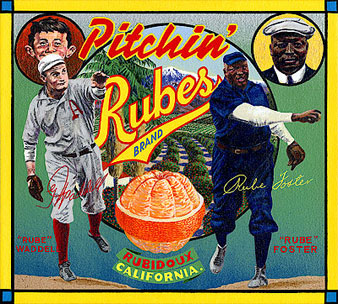
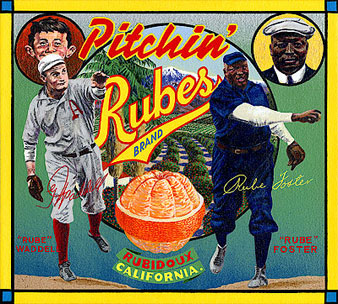
Back in the early 20th century, two Rubes, one black and one white, hit the winter barnstorming trail on their own terms, and mostly in the west, where white America was less bothered by the mixture of races. Note the images behind pitchers Rube Waddell and Rube Foster. The Waddell image is the same one that was later used to characterize the “Mad Magazine” comic book.” As the founder of the 1920 Negro National League, Rube Foster stands tall and alone as my all time favorite Negro League executive.

In picking my starting nine players from the old Negro Leagues, I worked with two simple parameters: (1) I restricted my choices to only those former Negro Leaguers who never made it, or had a chance to make it to the major leagues of organized baseball due to segregation; and (2) I made my selections from those players who also have since been inducted into the Baseball Hall of Fame at Cooperstown. As a result, I found that, with the exceptions of Hank Aaron and Willie Mays, and only perhaps, I would not have picked any differently without these restrictions. And, from what I’ve read, I would not have taken Satchel Paige over Smoky Joe Williams as my starting pitcher.

At any rate, here are my choices, by position. For a thumbnail on their career strengths and accomplishments, check out the Hall of Fame website link for further facts and commentary:

http://baseballhall.org/hall-famers/members/bios

My Negro League Starting Nine All Stars

Smoky Joe Williams, Pitcher

Josh Gibson, Catcher

Oscar Charleston, First Base

Martin Dihigo, Second Base

Judy Johnson, Third Base

Willie Wells, Shortstop

Turkey Stearnes, Left Field

Pete Hill, Center Field

Cool Papa Bell, Right Field

Notes: Most players from the Negro League era possessed and developed great versatility at several positions. It was a survival thing. The more you did, the longer you lasted. Some, however, went far beyond the call to greater utility into a rarefied territory of all around playing genius. The greatest of these greats was most likely a Cuban fellow named Martin Dihigo, now regarded by many historians as possibly the greatest player of all time. I put him on second base because he had to go somewhere for the sake of making sure this lineup contained all my choices for the best team I could put on the field, given the self-imposed restrictions I first place upon my selections. I also ended up with an outfield of speedy guys with strong arms who could all play center field well and easily handle the spots down each line.

Have a nice Sunday, everybody!


Steroid Sanctimony Bleeding on Bagwell

January 8, 2011

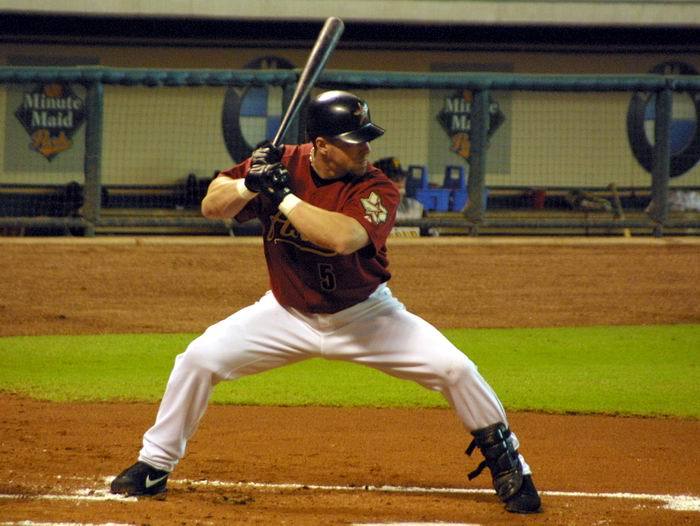
Jeff Bagwell May Have Muscled Way Out of Cooperstown.

I was disappointed that Jeff Bagwell got only 41.7% of the BBWA first ballot vote for the Hall of Fame. After all,  Jeff arrived for eligible voter consideration as the only first baseman in history with over 400 home runs and 200 stolen bases on his career resume. Maybe that’s not good enough for a first try admissions ticket, but he also did a few other things that should have drawn him objectively closer to the 75% that all candidates need for induction into baseball’s temple of highest honor. He also had an adjusted OPS rating of 130 or higher over 12 consecutive seasons. Bagwell and Lou Gehrig are the only first basemen in history to pull that off. Bagwell also stood alone as the only first baseman ever to produce a 30 homer, 30 stolen base season too – and he did that one twice. Thrown in the fact that he also put up six consecutive seasons of at least 30 homers, 100 RBIs and 100 runs scored and, for his career, that he drove in more than 1,500 runs and scored more than 1,500 runs.

Based on his honest, measurable numbers of meaningful baseball accomplishment, Jeff Bagwell deserved more votes than he got on his first HOF ballot. I have tried in the days that have passed to put this result aside as OK and not too ominous an omen for the future. Then I read an online article by Bernie Miklasz, a sports columnist for the St. Louis Post-Dispatch. I suggest you read it too:

http://www.stltoday.com/sports/columns/bernie-miklaus/article_166ca6ea-6369-56ce-8b4d-dca2ba7d2eff.html

Miklasz makes some great points about the hypocrisy  of our baseball writer culture. Now, without admission, conviction, or clear evidence, the muscular achievers of the so-called steroid era are being shut out of the HOF for moral reasons (the HOF’s integrity clause) by the same group of people who cheered a few of them (notably McGwire) as the resurrection of baseball back in the late 1990s. Miklasz also duly notes that the HOF apparently was able in past years to overlook offenses of racism, vis-a-vis segregation, and past other drug abuse issues, (amphetamines, for example), to clear the way for induction of players who in other ways “may have” violated the so-called integrity clause.

Now comes Jeff Bagwell, unaccused by the Mitchell Commission or the peer likes of any Jose Canseco types – and what does he get? Here’s what 58.3% of the eligible voters of the Baseball Writers of America gave him: (1) Suspicion. (2) Conviction on Suspicion: The man’s never staged his own trial to clear himself. Plus, he had muscles at a time when having muscles was bad. (3) Inaction to Take: What do we do? How about nothing! Until Bagwell, or somebody, clears his name, let’s just sit back and treat Bagwell and a few others as though they never did anything of note in their baseball careers. Let Jeff Bagwell serve as the poster boy for all the great players to come that shall also be stained by  factors of physical, associative, or cultural inference in the shadows of the steroid era. Treat them as though they never existed.

If that happens, I say, “let there be a pox upon the houses of all voters who handle Jeff Bagwell and others in this manner.”

Mike Tyson’s Surprising First Love

January 7, 2011

Mike Tyson Set to Do Animal Planet Show on Pigeon-Raising.

Hobbies and first loves don’t always match the public personalities we assign to celebrities. Word’s out now that former crunching heavyweight champion boxer Mike Tyson is now getting ready to do a series of shows for the Animal Planet TV network on his first love interest, the art of pigeon-raising.

Tyson strongly disclaims that his childhood investment in pigeons was ever a hobby. ‘This ain’t no hobby,” Tyson protested yesterday  at the Television Critics Association’s winter meeting. ”It’s a cultural thing.”

Growing up in a tough Brooklyn neighborhood, Mike Tyson first became interested in the ubiquitous city-bird cave dwellers through his daily contact with the birds that swarmed around his apartment building. As an ancient pigeon-watcher myself, I was impressed to learn of Mike’s early ability to appreciate the individual differences that separate one pigeon from another. His comparisons of pigeons to people were “right on” in the Internet article I read a few moments ago. And they were hardly befitting the image of a man we all once saw as a general human bone crusher who viewed all other boxers as simply vertical human beings awaiting their deliverance by force to a horizontal plane.

Here’s the article link: http://msn.foxsports.com/boxing/story/Mike-Tyson-shares-love-of-pigeons-in-new-Animal-Planet-show-010611

Tyson says he’s looking for  couple of “dominant personalities” among his new pool of pigeons. He wants to breed his new personal group from their strength, I suppose. I’d like to know more about Tyson means here. Are the two dominant ones simply another way of saying that he will tae the last male and female standing – and build from there?

a red-eyed handsome man

I personally never got into raising any birds beyond parakeets as a kid, but I became very aware of the individual birds that lived in the various parts of Houston that I visited on a fairly regular basis. It took no special skill. You simply had to see and recall what was all around you.

From what I saw, Mike Tyson is right. Pigeons are much like people in their differences from each other. They differ in size, color, and personality. Only certain archetypical behaviors and traits unite them as one discernible specifies. In that regard, that back and forth, herky-jerky head movement is simply a biological pattern that pigeons share with all gait-walking avian creatures. Hopping birds neither have the head bop nor do they need it.

Houston pigeons (and I’m presuming here that our local varieties are not too different from those that live in New Orleans, for example) tend to be homebodies. They hang around certain limited areas of town, leaving other, more distant spaces to other families, broods, and or gangs.

Back in the 1950-ish times of multiple Prince’s Drive In locations around town, we had a few distinct birds working for the crumbs that fell (or were thrown from) car trays at each separate locations. Over time, I became convinced that the birds working Prince’s on SOuth Main at OST came to recognize my ’51 Olds as one of those cars that spilled or discarded food with great abundance. I seemed to draw a crowd as quickly as I got there.

And when I got there, there they would be: “Mr. Chocolate Wing” and “Miss Vanilla Head” (among others) would bop out there to greet me and start that familiar cooing sound – their endless cry for food. Now where do they go, now that we’ve boarded up those old easy food stops?

Easy answers: The birds go wherever we go. Pigeons now patrol our new fast food joints and grocery stores, living in those convenient crawl spaces that we have built into our freeway system for their convenience.

But are the birds a potential health hazard? Yes, but probably no more so now than ever, and certainly not as dangerous as horses once were when dried horse manure from dirt streets floated into all our lungs.

One thing you don’t want to do is live too close to a pigeon roost. When I worked for Tulane University a few thousand years ago, a flock of pigeons moved into my apartment building and set up a nest right outside my bedroom window. Before I even knew what had hit me, I was struck with an infestation of pigeon mites that were hell to feel as they crawled all over my body and even harder to exterminate. Getting the birds to go away and stay away was job one for the relief of all residents in the building.

Almost needless to say, any lingering childhood desires of my own to raise pigeons died completely in New Orleans.

Join Us for SABR Day in America on January 29

January 6, 2011

Larry Dierker SABR Chapter Leader Bob Dorrill (L) and former Houston Astros Manager Phil Garner are all smiles after a past monthly program meeting in Houston.

What is SABR?

SABR is an acronym (pronounced “saber”) for the Society for American Baseball Research. The non-profit, baseball-fun-dedicated organization was established in August 1971 in Cooperstown, NY by a fellow named Bob Davids of Washington, DC.  The Society’s mission is to foster the research and dissemination of the history and record of baseball in a way that honors accuracy and celebrates the game publicly.

Over the years, SABR has expanded all over the United States and into some American cell communities in foreign nations. Some members are dedicated to the development of better statistical methods for evaluating baseball achievement, but most members are simply deep blue fans of the sport’s narrative history and the annual pennant races.

You don’t have to be a stat-head or expert on anything to become a member. You simply need to possess a love for the game and a desire to hang out with people who share your interest in the sport.

What does SABR membership cost?

The annual membership fee for SABR is $65.00 person, however, people under age 30 and over age 65 pay only $45.00 per person. Cheaper rates are available for multi-year membership plans and a full detail on “how to join” is available online through SABR’s national headquarters in Cleveland, Ohio at http://www.sabr.org/sabr.cfm?a=cms,c,67,35 People interested in joining through the Larry Dierker Chapter in Houston may prefer to make contact with our local chapter leader, Bob Dorrill, by e-mail at BDorrill@aol.com – or simply call Bob at 281.361.7874.

What do SABR members get for the money?

Beyond baseball friendship opportunities and local programs that money absolutely cannot buy, SABR members get incredible support for any baseball research or writing they may care to undertake, plus free annual copies of SABR’s own research products and a chance to immerse themselves in baseball at the SABR annual national convention that is held every summer in a major American city. This year, the SABR convention is set for July 6-10 in Long Beach, CA.

The Larry Dierker Chapter in Houston gives member for a monthly speaker’s/light Dutch treat evening meal meeting with baseball people like Larry Dierker, and other former Astros like Jimmy Wynn, Norm Miller, Phil Garner, Kevin Bass, Chris Sampson, etc. The local chapter also includes Jimmy Wynn, Hall of Famer Monte Irvin of the old New York Giants, and Larry Miggins of the iconic Houston Buffs.

What is SABR Day in America on January 29?

SABR Day in America is an annual day in which SABR chapters all across the country meet on the same day to try and get the word out to the rest of you about SABR and how it may help you build an even fuller experience with your love of baseball. You don’t have to be an expert or ever take on anything in the way of formal research to join. All you need is a desire to get closer to the game. – Getting closer to the game is one thing that will happen for every person who joins SABR.

If you would like to know more, simply contact SABR or our local representative, Bob Dorrill – or – simply show up at our Houston Chapter meeting on Saturday, January 29th, from 2:00 PM to 4:00 PM at the Houston Sports Museum on the Gulf Freeway (I-10 S) at Cullen Blvd. inside the Finger Furniture Store.

Mr. Rodney Finger of Finger’s and Mr. Tom Kennedy, HSM Curator, are our hosts that day – in the same museum that Rodney’s grandfather established back in the 1960s in honor of the fact that the store now sits on the site of what was once the ground that held Houston’s famous “Buff Stadium from 1928 to 1961.

Larry Dierker, Jimmy Wynn, Larry Miggins, and Monte Irvin will all be there for SABR Day so please join us. Come and immerse your soul in all things baseball. You will be among kindred spirits and welcomed with open arms. Don’t let this day slip by on some dryer pursuit when it could be one of the most fulfilling, important days of your life. All you have to do is show up.

Showing up. It’s half of what life’s fulfillment is all about.

Will Bagwell Grab HOF Brass Ring on First Try?

January 5, 2011

Bert Blyleven Likely to Finally Make it in 2011.

Jeff Bagwell (449 HR, among other things) gets his first shot at the Baseball Hall of Fame today. Bert Blyleven (287 Wins) probably finally gets his 75% vote total for election. And a whole lot of other arguably worthwhile candidates arrive for their first or umpteenth ballot check off from writers who may either hoist them to the Hall of Fame or leave them dangling in cruel suspension for years over everything from  questions of performance deservedness to the taint of suspicion about their use of steroids as active players.

In 2010, Mark McGwire (128 votes/23.7%) appeared on the ballot as the poster boy for steroid reputational delay of support. It’s likely that Big Mac will be joined in 2011 by Rafael Palmeiero and that these two men will be joined in limbo someday by Barry Bonds and Roger Clemens when both of these great ones also finally become eligible for consideration. It’s simply the dirty-business issue that won’t go away – and the stain of implicit blame could spread even broader, depending on voter memories of “Popeye-like” muscles that suddenly disappeared again in some players once their playing careers were all said and done.

Here’s how the ballot of top candidates looks as we await the results to be announced today. It’s likely that Bert Blyleven will finally make it through the golden door, but we will know for sure about that guess at 1:00 PM. Roberto Alomar could also make it in this time.  A player has to garner 75% of the vote total  for HOF election – and that is never as easy as it first looks. I’ve included the vote totals and percentage that each top candidate on the ballot in 2010 received. The list of new candidates follows in alphabetical order:

Returning Player Candidates (2010 Vote Totals/Vote %):

Andre Dawson (420/77.9%) – elected in 2010

Bert Blyleven (400/74.2%)

Roberto Alomar (397/73.7%)

Jack Morris (282/52.3%)

Other Leading Candidates in 2011:

Along with Jeff Bagwell, Fred McGriff, Barry Larkin, Edgar Martinez, Don Mattingly, Dale Murphy, John Olerud, Lee Smith, Alan Trammell, and Larry Walker, among other notables, are also on the 2011 ballot for consideration.

Good luck to Jeff Bagwell on his first try!