Archive for the ‘Baseball’ Category

The Tragedy of Addiction: Sammy Stewart

March 9, 2018

On September 1, 1978, Baltimore Orioles pitcher Sammy Stewart set the MLB rookie mark by striking out 7 batters in a row in one game as a pitcher facing the Chicago White Sox.

Over the past half century, plus some single digit years, time span of my chosen career as a psychotherapist, I have been asked many times: What’s the difference between dangerous compulsions and addictions? The older book answer always was that “compulsion” is the psychological basis for repetitive destructive behavior, whereas, “addiction” is the physiological bond that ties the individual to the craving for particular substances or activities.

Today, with only a little more than five months left on the clock before my complete and final retirement from private practice at the end of the day, Friday, August 31, 2018, I prefer to describe the differences in these terms:

“Compulsion” is anything we do, seek, or avoid because we think we have no choice. Chances are, we do. We simply will not allow ourselves to see the alternatives because we “fear” changing our ways – or we think we will feel “guilty” for the disappointment that our change will cause us – or  others close to us.

“Addiction” is the harder stuff of physical craving. Whatever it is, if we are now addicted to it, we no longer have any choice but to seek its satisfaction at whatever cost to self or others that now rolls from it. The physical addiction must be halted, over hours or days, or however long it takes, by restraint from access to the source that feeds it. Then we have to see if there’s enough person left to work the long hard walk to sober recovery with all the help we can muster.

It isn’t easy – for anybody involved in the treatment process because we are all, patient and treatment team members alike, in a slightly different way, taking up arms against the force behind every Gothic villain you ever read about in literature.

Addiction is the appetite that uses the human body to get what it wants at any cost it requires.

I’m saying all these things today in the hope that you will keep them in mind before you read the following link to the tragic story of Sammy Stewart and his death from addiction. The odds were against him finding religion or recovery on his own. And Sammy Stewart was a guy who had made greater contact with powerful people who may have wanted to help him. Didn’t happen. Usually doesn’t. The cold wild eyes of addiction see a well-intentioned do-gooder coming at them from a mile away.

Addiction. So sad. Now all we have to is bury a fellow who was once the young pitcher from Baltimore that struck out a rookie record seven batters in a row during his first 1978 major league game against the White Sox.

Addiction. It is the cancer of mental illness.

Addiction. Wish we could get some powerful people behind programs that might save a few more Sammy Stewarts than we now do.

Sammy’s Death. Sammy could have died far more horribly, given his history with drugs. He was fortunate. He died at home, suffering from heart disease, but clean and sober, with the wife who loved, and at peace with God in terms that made biblical sense to him.

Our heart prayer go out to his still grieving widow and friends. Sammy apparently brought more good to life than he probably will ever get credit for too.

Addiction: https://www.nytimes.com/2018/03/06/obituaries/sammy-stewart-pitcher-whose-life-took-a-downturn-dies-at-63.html

*******************

Thank you, Rob Sangster, for bringing the death of Sammy Stewart to my attention.

********************

Bill McCurdy

Principal Writer, Editor, Publisher

The Pecan Park Eagle

First Game of the Houston Babies: 1888

March 8, 2018

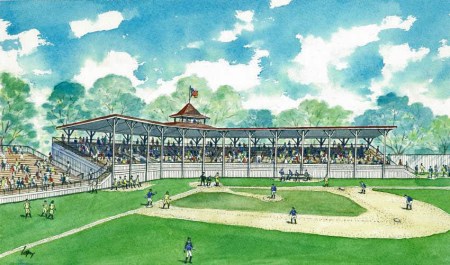
Fair Grounds Base Ball Park
Site of Houston’s 1st organized professional baseball game.
March 6, 1888

Houston Daily Post

Wednesday Morning

March 7, 1888:

WERE NOT SHUT OUT

THE GAME AT BASE BALL PARK YESTERDAY.

Cincinnati Giants Cross Bats With Houston

But Fail to Shut Out the Babies.

How the Locals Showed Up in Their First Game.

A large crowd was at the Base Ball Park yesterday afternoon to witness the maiden game of the Houston club as pitied the Giant Reds, of Cincinnati. The grounds were in a miserable condition which will account for the large score. The players occasionally had to look around in the little lakes which dotted the grounds, to find the ball. The game was commenced at 3:30 o’clock with the visitors at the bat, and Flood in the box for the locals. He was held by Lohbeck. Flood’s speed surprised the Giants, but owing to a sore finger he could not control his balls or get in any of his deceptive curves. Lohbeck showed up rather weak behind the bat. He appeared to be too stiff to handle Flood’s uncertain delivery, but he worked hard and won the favor of the crowd by his honest industry; and when he limbers up in legs and arms so that he can reach second from home plate he will doubtless prove a strong back stop. Craig covered first in brilliant style, and the throwing of Horan from short to first was admirable. He also made some pretty stops. Dougherty (Flaherty in left is correct) and Dauthett (in center) made some brilliant catches. Howard held down second very well. But, like every other man in the team, (all) appeared to be stiff. All of them were off on pick-up. Vogel covered right very well.

In Detail

First Inning – Nicol hit safe for first and went to third on (a) wild pitch of Flood to first/ McThee’s two-bagger over center brought in Nicol. Fennelly struck out and McThee scored on Lohbeck’s pass ball. Riley bruised the air three times and retired. Kappel hit to Horan and was thrown at first, retiring the side. Howard hit to McThee and was thrown out at first. Dougherty (Dauthett is correct here) and Flaherty both struck out and retired the side.

Second Inning – Horan made a brilliant stop at short and threw out Keenan at first. Tebeau couldn’t find Flood’s ball and so retired. Carpenter was struck by the ball and took his base, and advanced to third on Lohbeck’s pass ball. Sirad hit safe and brought in Carpenter. Nice hit to Horan and was thrown out at first. Side retired.

Murphy went out on (a) fly tap to Riley. Vogel hit to Sirad and was thrown out at first. Flood waited to see where the ball was going and was thrown out at first by Carpenter, thus retiring the side.

Third Inning – McThee hit to Howard and was thrown out at first. Fennelly fell a victim to Horan’s unerring throw to first. Riley was given his base on being struck with the ball, went to third on a pass ball and scored on Murphy’s fumble of Kaflle’s easy tap. Keenan’s safe hit brought in Kaflle, and Tebeau retired, the side trying to find Flood’s balls. Craig took his base on balls; stole second. Lohbeck flied out to Nicol. Howard sent a corker over short and scored on Douthett’s two-bagger to left. Flaherty was thrown out at first and retired the side.

Fourth – Carpenter hit safe, stole second. Seran flied out to Dauthett. Nicol hit safe and brought in Carpenter, took second on Flood’s wild throw to first stole third and scored on (a) pass ball. Fennelly hit to Flood and was thrown out on first. Murphy flied out to Tebeau Vogel hit safe. Flood was thrown out at first and Craig followed suit.

Fifth – Riley reached first on Howard’s error, and stole second. Kappel took two bases on Dauthett’s misjudgment of his pretty fly. Carpenter was thrown out at first by Craig, who left his base to field the ball. Serad flied out to Vogel. Lohbeck was given base on being hit, but was caught trying to steal second. Horan struck out and Dauthett flied out to Kappel.

In the sixth inning the locals indulged in a series of errors, and the reporter closed his book. At the close of the ninth inning the score stood 22 to 3 in favor of the visitors. This tabular score will show who did the work:

(First Game Box Score for the Original Houston Babies

From the Game They Lost to Cincinnati on March 6, 1888

by the score of 22-3 and as it was reported in the Houston

Daily Post the following day, March 7, 1888.

Here’s the previously described ‘Tabular Score’)

HOUSTON AB R H PO A E
Howard, 2b 4 1 1 1 1 2
Dauthett, cf 4 0 3 3 0 1
Flaherty, lf 4 0 0 1 0 0
Murphy, 3b 4 0 0 2 0 2
Vogel, rf 4 0 1 1 0 0
Flood, p 4 0 0 1 10 6
Craig, 1b 3 1 0 11 1 0
Lohbeck, c 3 0 0 7 4 2
Horan, ss 2 1 1 0 1 1
TOTALS 32 3 6 27 16 14
CINCINNATI AB R H PO A E
Nicol, rf 7 4 3 1 0 0
McThee, 2b 7 4 4 2 4 0
Fennelly, ss 6 1 1 0 0 1
Riley, 1b 6 3 1 13 0 0
Kappel, cf 6 3 1 1 0 0
Keenan, c 6 2 4 8 2 0
Tebeau, lf 5 1 1 1 0 0
Carpenter, 3b 6 3 3 1 1 0
Serad, p 6 1 2 0 9 2
TOTALS 55 22 20 27 16 3

 Summary

 Runs Earned – Cincinnati 8 – Houston 2

Base on Balls – Cincinnati 4 – Houston 2

Struck Out – Flood 7 – Serad 5

Left on Base – Cincinnati 7 – Houston 4

Two Base Hits – McThee 2, 4 players (Kappel, Serad, Dauthett, Horan), 1 each

Three Base Hit – Fennelly

Pass Balls – Lohbeck 6, Keenan 1

Wild Pitches – Flood 3

Stolen Bases – Howard, Dauthett, Craig (1 each), Cincinnati 8

Umpire – Kid Baldwin

Time of Game: 1 hour and 45 minutes

********************

Eagle Notes

Thanks again to Darrell Pittman for sending this material to us. I haven’t seen this game report in years. Back then we didn’t even know that the ball park involved was the one that came to be known by several identifiers, including “The Travis Street Ball Park” as depicted in the wonderful Patrick Lopez watercolor shown today as our lead in print. The park site today is all commercial, but an historical plaque marks its site at Travis and McGowan, south of downtown, where it is officially remembered as the Fair Grounds Base Ball Park. Mike Vance deserves all the credit in the world for the discovery and confirmation of this site’s significance and for all the progress that’s been made in plaque-marking our city’s important baseball history sites.

Thanks, Mike.

I hope you were not too confused by my attempts to clarify that the original Post writer who did this story twice used the name “Dougherty” when his attentions turned toward two actual players in this first game. Apparently the names “Dauthett” and “Flaherty” – the two actual first game players effected – were sufficiently close enough in sound or sight to ignite a 19th century neurological association slip in the writer’s brain that was strong enough to confuse his account over time – beyond the turning of two additional new centuries.

I don’t know who Dougherty was. Maybe he was another player that had nothing to do with this game – or even the 1888 season. Or maybe he was a landlord or a bill collector in the Daily Post writer’s daily life at the time Houston played this humble start to its first season and also as a charter member of the original Texas League. The Cincinnati Red Stockings, not Giants, were a big league club, passing through town and looking for some practice games against minor league foes. And the Houston Babies were easy pickings on March 6, 1888 against a club like Cincy.

Note too. The “Babies” nickname was not used in this first Texas League pre-season game story. The Babies had to be nursed into its acceptance over time.

********************

Bill McCurdy

Principal Writer, Editor, Publisher

The Pecan Park Eagle

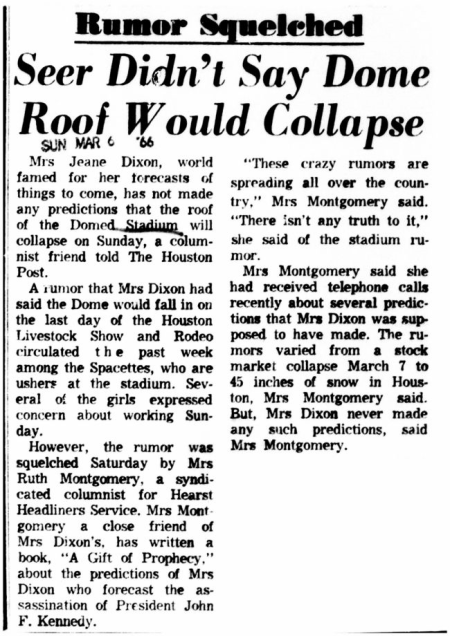
1966: Dome Collapse Prediction Squelched

March 7, 2018

Today’s story is remindful of that neon psychic-for-hire sign that still burned for a while at night at that otherwise pretty much abandoned strip mall on Highway 6 west of Houston years ago. It had a question mark built into it too, as memory serves. The irony in this instance is fairly obvious as the only question that deserves a chuckle-muffled smiling answer: If the psychic-in-residence at the Highway 6 mall is really any good at making predictions, how come they didn’t see this business site failure coming?

The main story today was fed to The Pecan Park Eagle by frequent contributor Darrell Pittman from a March 6, 1966 story from the Houston Post that had been resurrected in more recent times by J.R. Gonzalez for his Bayou City History series in the Houston Chronicle. And this one is all about squelching rumors that a big national psychic had predicted city’s still new Astrodome was on the way to having its roof cave in on a certain date.

Put that one in the “didn’t happen” box as you also stay open to this possibility: Maybe Mrs. Jeanne Dixon – or one of her disciples – devolved into the same hard times psychic that was still working the Highway 6 area in more recent times.

Come on, 2018 season! – Hurry up and get here!

********************

Bill McCurdy

Principal Writer, Editor, Publisher

The Pecan Park Eagle

The Dodgers Photography of Rich Kee

March 6, 2018

For our TPPE readers everywhere, especially those of you in the Greater Los Angeles area and other parts of Southern California.

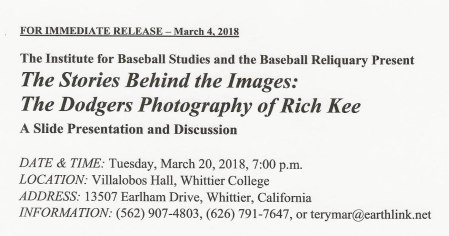
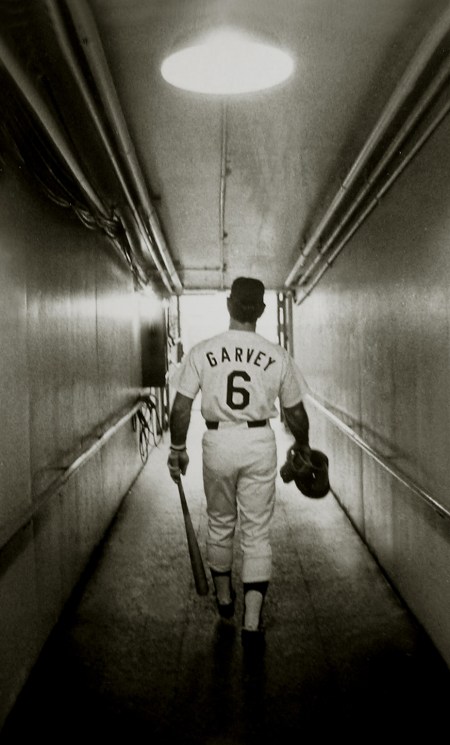
Who says “the best things in life are free”? We do. As does anyone else with any familiarity with the beautiful photographic work of longtime Dodgers photographer Rich Kee. You are invited to attend for free next week as Rich Kee presents and narrates a slide presentation at Whittier College. Try to be there, if at all possible. The details follow from here, in words and pictures.

– Bill McCurdy, Publisher, The Pecan Park Eagle and Member, the Baseball Reliquary.

********************

The Institute for Baseball Studies and the baseball Reliquary present “The Stories Behind the Images: The Dodgers Photography of Rich Kee,” a slide presentation and discussion by the man who had the good fortune to serves as the Los Angeles Dodgers team photographer in the 1970s and ’80s, on Tuesday March 20, 2018 at 7:00 p.m. at Villalobos Hall, 13507 Earlham Drive, Whittier, California, on the campus of Whittier College. The event is open to the public and free of charge. Light refreshments will be served.


Ron Cey (Photography by Rich Kee)


In addition to recent work, Rich Kee, a graduate of the prestigious Brooks Instititute of Photography, will share a selection of his iconic images and stpries from two decades that were highlighted by the transition from Walter Alston to Tommy Lasorda, a record-setting infield, Fernandomania, and a World Series championship in 1981. Rich Kee will be introduced by former baseball executive Fred Claire, who served as the Dodgers’ general manager from 1987 to 1998.


Steve Garvey (Photography by Rich Kee)

“The Stories Behind the Images: The Dodgers Photography of Rich Kee” is made possible, in part, by a grant to the Baseball Reliquary from the Los Angeles County Board of Supervisors through the Los Angeles County Arts Commission.

For further information, phone (626) 791-7647 or e-mail terymar@earth link.net. For directions and parking, phone (562) 907-4803.

********************

Bill McCurdy

Principal Writer, Editor, Publisher

The Pecan Park Eagle


Baseball Concerns in 1962

March 5, 2018

“When I was 24, it was a VERY good year!”
~ Bill McCurdy, The Pecan Park Eagle

Puzzling Questions Face Baseball Chiefs

By The Associated Press

(Sarasota Herald Tribune, Page 42, March 11, 1962)

Baseball faces up to some big questions in 1962.

Can the downward trend in attendance be checked?

Can the quality of play be maintained despite the dilution in talent caused by adding two new clubs in the National League on top of the two added in 1961 in the American League?

Does professional football seriously threaten to displace baseball as the national pastime?

Can the minor leagues be saved, and stabilized, so as to provide a training ground for major league players?

These questions have sparked some deep, serious thinking in high baseball places.

Attendance Problems

The attendance problem looks to be the most critical. Last year there was a close, thrilling race in the National League but attendance dropped from the 1960 figure of 10,684,963 to 8,731,502.

Until the last month there was an unexpectedly good race in the American League between the New York Yankees and the Detroit Tigers, plus the excitement of the (1961) Mickey Mantle-Roger Maris home run duel. Attendance rose from the 1960 figure of 9,226,526 to 10,163,916 – but 1,860,233 of this came from the new clubs at Los Angeles and Minneapolis-St. Paul.

Even counting the new clubs the total attendance of the two leagues fell 5 per cent and not counting them it fell 15 per cent.

Night Ball  

For the last 15 years (1946-1961) attendance in each league has ranged around 9,000,000, with half of this credited to night ball. This is a static condition in a rapidly expanding national population. That isn’t healthy either.

Meanwhile minor league attendance has withered away until now it is a question of heavy subsidization by the major leagues to maintain the minor league training ground so necessary for the development of major league stars.

Some baseball men think all the attendance problem needs is a fair break in the spring weather plus rousing races in both leagues. Undoubtedly either or both would help.

But in the long run baseball is bucking the trend away from spectator sports and towards participation sports such as golf, fishing, hunting, bowling, and the like.

Better, brighter stadiums with ample parking facilities would undoubtedly help. Such as are now available in Milwaukee, Minneapolis-St. Paul, Washington, San Francisco, and Los Angeles, and under construction in New York and Houston.

But a good stadium cost $15 million and up, and baseball can’t afford it. Public generosity must be relied on, instead, and there is a limit to this.

Professional football has been able to utilize television to build up interest but baseball has not been so fortunate. Away-from-home games of football teams are televised, allowing the teams to follow them, and then home games are blocked out, creating ticket demand.

It has not been possible to create such a productive pattern in baseball. For instance, because the New York market is so rich that high television fees can be paid, all home games of the New York Yankees are televised, and this will be the case with the New York Mets as well. Some, but no all away-from-home games are brought back to New York TV screens. Due to spirited bidding, the revenue to the Mets will exceed $1 million. This can make up for a lot of empty seats.

Few Games 

Most other clubs televise only a few games during the season, plus, of course, the “game of the week” of the networks.

Despite a certain envy of football for making such good use of television, and having an unlimited pool of talent developed by the colleges, baseball can afford to be tolerant of fast growing football.

But what if professional football decided to cut down on exhibition games and start its season extra early, say in mid-August, instead of September. That could create a real tussle for the entertainment dollar.

Baseball’s final problem is the minor league situation. Everyone recognizes that these must be maintained as a training ground. College baseball does not do the job in producing talent that college football does. The eventual hope is for a realignment on geographical lines, elimination of the weakest attendance cities, and sufficient subsidization by the majors to keep afloat.

********************

Eagle Notes. Assuming them to be basically well stated for 1962, what went further wrong with them, around them, and through them ever since over the past 56 years is worth, at least, a dozen books by some of baseball’s deepest thinkers.

Our ideas about where they got it gradiently wrong in 1962 include these:

Talent Dilution wasn’t coming to baseball from their own expansion. It was coming from all the athletes, including for the first time, opportunities for American blacks to play in the MLB who were rapidly choosing the NFL and NBA more often in preference to the years of working their ways to the big leagues through the farm club system. College was the way to go for athletes desiring a faster shot at the money being offered them by the NFL.

TV Marketing savvy by the NFL may have been underestimated by MLB back in 1962. The game of football was far more photogenic on the TV small screen and the NFL seemed to understand that their much fewer regular season games (14 or 16 in football on Sundays to 162 for baseball all week) also made it easier to market the NFL package then it did the harder-to-show TV baseball game from the hinterlands on an August Wednesday afternoon. When a sport plays far fewer games, mostly on Sundays, it’s simply easier to sell the value of each game.

The Digital Age. None of us really saw in 1962 how home computers, the Internet, and all the tentacles of the new digital social media were going to turn all our lives inside out by 2018. 95% of us didn’t even know such a day was coming.

New Pricey Single Game Tickets. Based upon a sharp increase in prices for individual 2018 game tickets in Houston, it’s going to be interesting to see if even the World Champions can build and hold a large enough TV fan base to include some who will still buy individual game tickets upon occasion to make those price increases worth the loss they now invite.

Wait for Spring. The only totally wrong baseball people referenced in this 1962 report are those who thought “a fair break in the spring weather plus rousing races in both leagues” was all that was needed.


********************

Bill McCurdy

Principal Writer, Editor, Publisher

The Pecan Park Eagle


Houston’s True 1st MLB Game

March 4, 2018

Old News is New Again
March 10, 1962
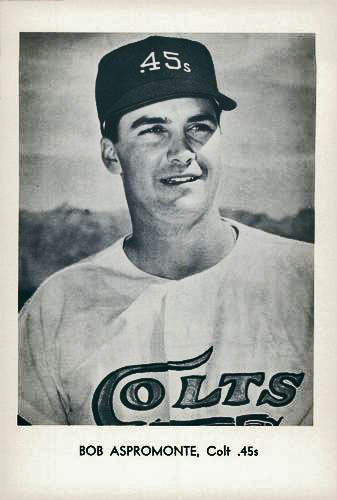
“Aspro” Scores 1st Run in Houston MLB History


Bud Shrake: Texas Firsts in California

Publication Source: Dallas Morning News

Publication Date: March 11, 1962

Palm Springs, California (March 10, 1962) –

For history, it should be recorded that the first pitch ever thrown to a batter for a major league team from Texas was a ball outside. The pitch was thrown by Eli Grba of the Los Angeles Angels and the man who let it go past was Houston Colt .45 center fielder Al Heist. Promptly, Heist let a few more pitches go past and struck out without swinging his bat. That was the beginning.

It would have been difficult to find a finer setting for all those historic events that happened Saturday afternoon. The scene was a ball park called the Polo Grounds in Palm Springs. Mountains rose all around and off to the left the peaks were crested by snow. There had been a sandstorm out on the desert earlier in the day but by the afternoon the sky had cleared to a soft blue and it was bright and cool.

Palm Springs is sort of what Taos, N.M. would be if you put it in Preston Hollow and turned the job over to a Mexican architect. The climate and the gold courses and the nearness to Los Angeles and the fashionableness of desert living naturally attract a lot of celebrities and a lot of money. Charles Ferrell used to be the mayor.

The Celebrity Hour

Saturday, three celebrities were involved in the ceremony before Houston’s – or maybe we should say Texas’ – first big league exhibition game.

Gene Autry spoke and told the fans and the radio and television audience that he’s a native Texan. He’s also an owner of the Angels who train here in Palm Springs.

A couple of high school majorettes danced with baseball bats and sang “They Walk Like an Angel Walks”. The high school band played “The Eyes of Texas” and the Colts, including Dick Farrell who lives in Pennsylvania, put their hats over their hearts.

Then Tony Martin sang “The Star Spangled Banner” accompanied by the band. At least, he tried to sing it. Made a bunch of us envious wretches wonder how a nice girl like Cyd Charisse could go for a guy who doesn’t know the words to “The Star Spangled Banner”.

Suddenly, from right field, (TV actor) Gene Barry came riding in on a bicycle. You know Gene Barry – Bat Masterson? He rode up to the mound, dismounted, and threw the traditional first pitch, with Tony Martin as the catcher.

Barry tried hard. His shirt tail came out. He threw three pitches, and the third one was close to the plate, and it was a big deal. Barry threw it like your wife would if she were in the back yard playing catch (with you), except that none of her pitches bounced.

The First Look

Meanwhile, hidden in the dugout, Houston manager Harry Craft was wondering exactly what he would see when his club went out on the field for the first time. It was only an exhibition game, but Harry recognized the significance of being Texas’ original big league manager.

“It’s pretty confusing,” he said. “Of course, we’ve studied these guys in camp. We’ve paid a lot of individual attention to them. The thing that has really pleased me has been their cooperation.

“They’ve worked harder than they did in any other camps. I don’t mean the other clubs don’t work hard enough. But we had more work to do. And there hasn’t been much griping at all.”

The Colts obviously aren’t going to threaten for the National League pennant. As one Houston writer said, “We’re 10 (feet) deep in mediocrity.”

“But I hope we can put together a sold defensive club,” said Craft. “If we can hold scores down we’ve always got a chance for that key base hit that can win a game.”

The time arrived and the Colts went out to put up some history.

The first pitch ever thrown by a big leaguer representing Texas was a strike. Pitcher was Bob Bruce. The first run was scored by third baseman Bob Aspromonte on a wild throw by Angel second baseman Marlan Coughtry. The first run scored against the Colts was scored by Leon Wagner, who dashed home on a 5?? foot double to center by huge Steve Bilko.

The history kept getting thicker. First Houston Double Play was Bob Lillis to Don Buddin to Norm Larker (4-6-3), on a ground ball to second by former Dallas-Fort Worth catcher Bob Rodgers. It’s only a modest achievement, of course, but I (Bud Shrake) was the first man to miss the team bus and also the first man to trip on the dugout steps.

(The last sentence in the Shrake column is not clearly legible, but his tongue-in-cheek point is abundantly clear from the decipherable parts of it. Paraphrasing the writer: “I mention these minor things because it wouldn’t have seemed right to mark the specifics of this notable day in Texas baseball history without giving Dallas-Forth Worth a few pieces of it.)

********************

We do not have home access to the Houston papers for 3/11/1962, but we would expect them to have much more on the first ST game. The sample of AP and UPI short articles we did find were far too incomplete and poorly written, but these historical facts are important and are reported here as excerpts from several of these sources: The home team Angels won the game, 7-3, Bob Bruce started for Houston, but Hal Woodeshick took the loss in relief. Eli Grba started for LA, but Johnny James picked up the win in relief.

We do not have the box score for this actual first game, but here’s the score, one missing most detail facts of interest:

March 10, 1962 1 2 3 4 5 6 7 8 9 R H E
Houston Colt. 45s 0 0 1 0 2 0 0 0 0 3 7 1
Los Angeles Angels 0 2 0 3 2 0 0 0 X 7 8 3

 Batteries

 Houston

 Bob Bruce, Hal Woodeshick (L), Manuel Montejo, Bob Tiefenauer and Merritt Ranew.

 ———-

Los Angeles

 Eli Grba, Johnny James (W), Tom Morgan and Bob Rodgers, Ed Sadowski.

————

Another Irony. As he would again, one month later, in the first official game that counted, Bob Aspromonte was busy at the dress rehearsal game, establishing some “firsts” for himself in the game history books. Now we know that Apro scored the first run in franchise history, whether you start counting at March 1 or April 10 of 1962. We are reasonably sure that his RBI double in the Angels early game is the first RBI and probably the first double and possibly the first club hit in all franchise history, but we really need to see a more detailed record of what happened and hen did it happen to journey further down that road.

Again, as I’ve often said, thank you, Darrell Pittman, for awakening our attention to the fact that this landmark first season game may have been, until today’s groundbreaking search began by all of us for more information, the most neglected big moment in the club’s early history and – what do you know – it was also their first rattle out of the box as the Houston “big league anythings.”


********************

Bill McCurdy

Principal Writer, Editor, Publisher

The Pecan Park Eagle


TOUR DE SABR: TWELVE SABR CONVENTIONS ROLLED INTO ONE (Part I: 2001 to 2007) By Maxwell Kates

March 3, 2018

TOUR DE SABR: TWELVE SABR CONVENTIONS ROLLED INTO ONE

(Part I: 2001 to 2007)

By Maxwell Kates

SABR 48 Is Going to Pittsburgh in 2018.
Rick Reuschel wore #48 for the Pittsburgh Pirates in the 1980s.

It happens every summer. Several hundred people dressed in baseball caps, jerseys and Hawaiian shirts invade a hotel in a major league city for four or five days when the home team is in town. Their professions, backgrounds, and areas of interest may vary but they all are united by one common ground – devotion to research the history and statistics of their favourite sport. This phenomenon is, of course, the annual SABR convention.

Since its humble beginnings, when it drew 16 charter members to Cooperstown in 1971, the convention has grown to a delegation of over 800 last summer at the Grand Central Hyatt in New York. The 2018 SABR convention, or SABR 48, is set to take place in Pittsburgh, Pennsylvania, from June 20 to 24. The highlights include a Pirates game, the ‘Day at the Ballpark’ feature, and, no doubt, some focus on Roberto Clemente. Perhaps some Pecan Park Eagle subscribers plan to attend. What are you to expect at a SABR convention? What you are about to read are a series of highlights, one from each of the twelve conventions I attended. The end result will give the impression of one composite SABR convention. Part II will appear sometime in April, but for now, here is Part I, beginning in Milwaukee in 2001 and continuing through St. Louis in 2007:
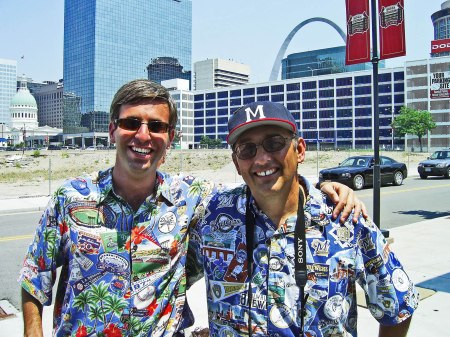
Column author Maxwell Kates and Rick Schabowski at Busch Stadium in St. Louis, 2007.
– Photo by R. Buege

SABR 31 – Milwaukee 2001 – Keynote Addresses

My first convention was SABR 31 held in Milwaukee back in July 2001. Since it was the first, everything stood out – the presentations, the vendor’s room, games in both Milwaukee and Chicago, and the trivia contests. The keynote address in Milwaukee was delivered by an automobile dealer named Allan Huber Selig. The owner of the Brewers was in his ninth year moonlighting as the commissioner of baseball. The Basic Agreement was set to expire at the end of 2001 and the impending labour situation was the focus of many questions that followed Selig’s speech. He deflected every question asking by not providing a straight answer.

Finally, a diminutive man wearing a bowler hat and rainbow suspenders raced into the banquet hall looking very much like Danny DeVito on “Taxi.” Screaming at the top of his lungs, he asked “Hey Bud! Is Pete Rose gonna get in the Hall of Fame?”
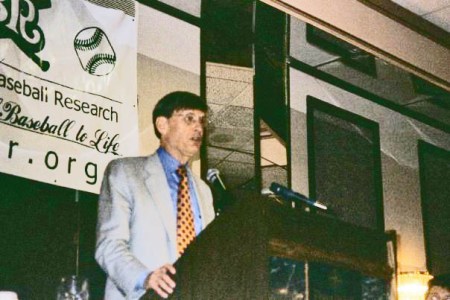
Bud Selig speaks at SABR 31 in Milwaukee, 2001
– Photo by T. Zocco

“I don’t know,” Selig answered, “ask Larry Dierker.”

SABR 32 – Boston 2002 – Research Presentations

What would SABR conventions be without research presentations? Some of the presentations I attended in Boston included the following:

“The 1987 Showdown Series” by Mayo Smith Society members David Raglin and Mark Pattison, “Changing Trends in Hall of Fame Voting” by Bill Gilbert, “Songs of Baseball” by Jeff Campbell (featuring “Ichiro” to the tune of “Figaro”), and “Early Italian Major Leaguers from San Francisco” by Larry Baldassaro.

Baldassaro, a Massachusetts native who taught Italian Studies at the University of Wisconsin-Milwaukee, included his lecture as the basis for a chapter in “Beyond DiMaggio,” which he wrote in 2011.
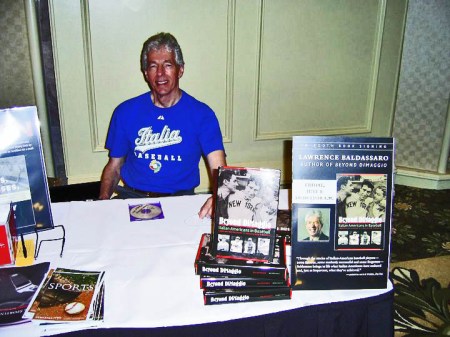
SABR 32, Larry Baldassaro: In 2011, nine years after he spoke about Italian American players from San Francisco, his magnum opus entitled “Beyond DiMaggio” became available for sale.
– Photo by M. Kates

Most memorable for me was Don Zminda’s “South Side Hit Men,” a slide show about the 1977 Chicago White Sox. On a shoestring budget, the Sox under Bill Veeck contended for most of the season despite menial fielding and pedestrian pitching. Don gave an encore presentation at the SABR convention last summer in New York for the 40th anniversary of the South Side Hitmen.

SABR 34 – Cincinnati 2004 – Baseball Games

SABR members sat in the right field ‘sun deck’ at Great American Ballpark as the hometown Cincinnati Reds hosted the St. Louis Cardinals on July 16, 2004. Paul Wilson was the starting pitcher for the Reds, facing Houston native Woody Williams for the Cardinals. It was Barry Larkin’s retirement year and he was penciled in as the starting shortstop. The Reds took a 4-0 lead when Wily Mo Pena hit a three run homer in the bottom of the 1st. St. Louis chipped away, scoring their first run in the 4th when Albert Pujols reached home on an RBI double by Jim Edmonds. An RBI single by Pujols made the score 4-2. An insurance run, a solo homer by Jason LaRue was insufficient to stave off the Redbirds. A three-run homer in the 8th by Marlon Anderson made the score 7-5 for the Cardinals.

In the bottom of the 9th, with Jason LaRue batting, I can recall speaking to Mark Rhoads, a high school student from Connecticut, who had given a research paper on 1860s baseball in the Nutmeg State. Next thing I knew, LaRue cracked the ball which appeared to have taken a trajectory aimed straight at our heads. I said “Never mind that, Mark, watch this.” A sure home run ended its improbable journey when Jim Edmonds leaped over the fence to snag the ball squarely in his glove. Sports Center had its highlight that evening and I saw it with my own eyes.

Caption #1: “Diamond Jim” Edmonds makes a phenomenal catch in right field in Cincinnati, July 16, 2004.
Caption #2: Jim Edmunds, doing again what he so often did to break the hearts of Cardinal foes and their fans.

The next day, after Marvin Miller spoke, a few innings remained in the Reds game. So I went to watch…from a vantage point on the Roebling Bridge. As both riverbanks of the Ohio are claimed by Kentucky, I was technically watching a baseball game played in one state while standing in another.

SABR 35 – Toronto 2005 – Lasting Friendships

For a convention hosted by my adopted hometown, what actually stands out was meeting a new friend who traveled from the Golden State. His name was Paul Hirsch and he was a journalist by trade who ran his own public relations firm. Born in Brooklyn in 1957 and raised in Orange County, Paul and his family lived in Danville, California, about an hour east of Oakland. Paul grew up a Dodgers fan and in 1974, worked as a batboy for the California Angels. Seeing Paul became a highlight of every convention and one winter, I even went to visit him in California. He and I attended a San Jose Sharks’ hockey game with his two children. Paul owned a baseball outfit for every club and wore the colours of the home team at each game he attended. He and I attended games together in Seattle, Pittsburgh, Baltimore, and in his own backyard, Anaheim. He fiercely believed that Walter O’Malley did what was right for his family by moving the Dodgers from Brooklyn and argued accordingly an article he wrote for in the 2011 SABR convention magazine.

Sadly, Paul lost his battle with cancer in San Diego in 2014, age 56.
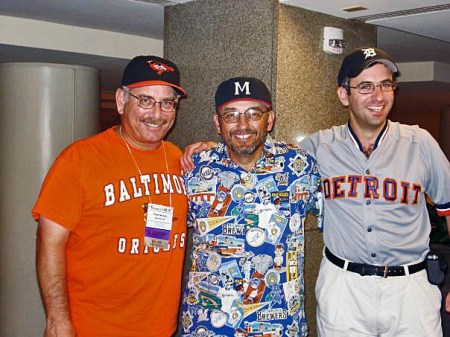
Paul Hirsch, Rick Schabowski, and Maxwell Kates in the lobby of the JW Marriott Hotel in Washington, July 31, 2009.

SABR 36 – Seattle 2006 – Player Panel

One of the highlights of any SABR convention is the opportunity to ask retired players about their careers while listening to them relive stories both on and off the field. At the 2006 convention in Seattle, Jim Caple moderated a panel featuring four members of the ill-fated 1969 Pilots. After they moved to Milwaukee, the Pilots were forever immortalized when one of their players, Jim Bouton, wrote his tell-all diary of the 1969 season entitled “Ball Four.” Exceptionally controversial when published, it was the only baseball book named to the New York Public Library’s “Books of the Century Selection” some thirty years later.

Joining Bouton on the podium were the intellectually inclined outfielder Steve Hovley, enigmatic relief pitcher Mike Marshall, and veteran backup catcher Jim Pagliaroni. Pags and Marshall were both native Michiganders. As a Detroit Tigers fan, naturally I asked what inspiration they had on each player’s career. This was long before cue cards became the norm at SABR conventions.
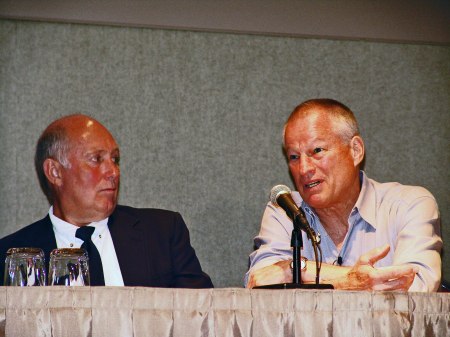
Pitchers Mike Marshall and Jim Bouton were teammates on both the Pilots and also briefly in 1970, each were  on the roster of the Astros.

One young girl asked Bouton if he could sing “the song.” She didn’t identify which song she had in mind, just “the song.” Bouton knew exactly which one. It was a parody of Tom Lehrer’s “Proud to be a Soldier” whose lyrics were included in “Ball Four.”   With Bill’s permission, I’d like to conclude my memories of Seattle by reciting a bowdlerized version of its final stanza:

Harry Walker is the one who manages this crew

He doesn’t like it when we eat and fight and something else

But when we win our game each day

Then what on earth can Harry say?

It makes a fellow proud to be an Astro!


Ask Larry Dierker about that one, too. He wrote “Proud to Be An Astro”!

SABR 37 – St. Louis 2007 – Ballpark Tours

Although New York wasn’t one of them, many conventions included in their curriculum a tour of the home ballpark. The first day of the 2007 convention in St. Louis featured a tour of the Busch Stadium. Opened one season prior, the new venue already hosted a World Championship when the Cardinals defeated the Tigers the previous October.

We toured the concourse, went on the field, and sat in the Cardinals dugout. The Busch Stadium tour also included a visit to the International Bowling Hall of Fame next door. Those who wanted to bowl could take advantage of a free game included in the admission.

While in the dugout, someone asked the question, “What happens when it rains at Busch Stadium?” The woman leading the tour answered, “Don’t worry, it never rains at our games.”

Busch Stadium III, SABR Group Game, St. Louis, 2007.
Top of the fifth, two out, and the skies opened.

Oh no?

But if it didn’t, where’s the sketch?

Tune in next month to finish the sketch.

– Maxwell Kates

Independent Contributor

To

The Pecan Park Eagle


********************
Bill McCurdy

Principal Writer, Editor, Publisher

The Pecan Park Eagle
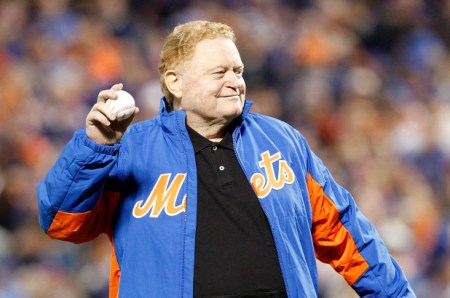
Prayers for Rusty Staub Please

March 3, 2018

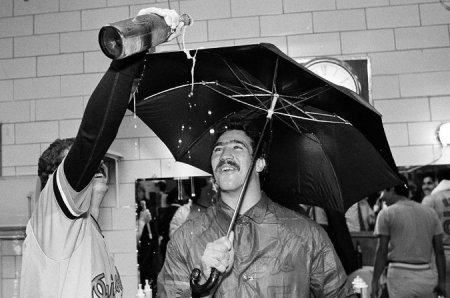
Rusty Staub
At Age 70 in 2015

Thank you, Darrell Pittman for this unhappy report on the critical health of former Colt .45/Astro, Expo, Met, Tiger, and Ranger Rusty Staub. Rusty’s now in a West Palm Beach, Florida hospital with kidney failure and he is not responding to dialysis. All we have, so far, is this link to a brief story that accompanied Darrell’s sad news e-mail.

https://nypost.com/2018/03/02/friends-ask-for-prayers-for-mets-icon-rusty-staub/

Please keep Rusty in your prayers and most positive thoughts as you digest this news in personal terms and respond in your own preferred ways.

Hang in there, Rusty, and God Bless you! You are in my specific prayers from this point forward and I feel sure that our one tiny fan voice is little more than a sparkle of light from a single drip of healing water in the giant wave of love and support from all places for your recovery that is now about to roll onto the spiritual beach that now harbors your precious life among the rest us.

Love. Forever. True.


********************

Bill McCurdy

Principal Writer, Editor, Publisher

The Pecan Park Eagle
Ah, Yes! We Remember It Well, Sort Of!

March 2, 2018

“It was a great game, even if didn’t all happen on the same day.”

 “Houston must have cooled off after winning their first 3 because SABR convention 44 alum Hall Smith cooled off, too. I see he went 4 for 11 (.363) with a home run, a double and 4 rbi’s in our first 3 games. Pretty impressive.

 “Also, in yesterday’s write-up you mention the 4th of July. I would like to see you do a write-up of the Colt 45’s/Dodger July 4th double header when Koufax and Drysdale started for the Dodgers. I remember that I was in Bolivar and came in for the game. It was standing room only if you can believe that. Open stadium, July 4th in Houston and the place was packed! Hot! I think i sat in an aisle on the first base side. I believe that was our biggest major league crowd prior to the opening of the Dome.”

~ Mike McCroskey, Comment at The “Spoiler Alert, et al” column, 2/28/18.

Mike, our Houston Colt .45s did play a DH on the 4th of July 1962, but it was in a double loss to the Pittsburgh Pirates at Colt Stadium by scores of 7-0 and 4-3. The next season, the Colts would play another home DH on July 4th. this time taking both games against the Cincinnati Reds, 5-2 and 6-2.

The Intimidation Effect: When you played in the National League back then, even a single game against the Dodgers, it felt as though your club was always up against Koufax and Drysdale on the same day, even if neither of them was sat to pitch. Stories of their most recent domination games preceded them at each site the club visited next. Mediocre batters talk, but they don’t always listen. Sometimes the silence we see among the lesser light hitters is not listening at all. It’s the mask of imagination. i.e., As in,”I wonder how I’m going to do against a guy who threw near 100 mph and struck out 15 in his last outing?”

Maybe Dodger manager Walt Alston could have allowed Koufax and Drysdale to both go out, one at a time,  and throw five highly visible warm up pitches prior to each game they weren’t expected to pitch at all. We doubt if it would have helped batter thinking, but we do sense that it could have stirred the pot of imagination all the more.

Our Response. We are pleased to say that we know ardent Astros fan Mike McCroskey. A more likeable and passionately funny fan is impossible to find. And I have no doubt that the fiery part of his memory about leaving Bolivar on that long ago day in 1962 is accurate. It just happened a little earlier than the 4th of July – and – even though it came with all the exciting rarity of an early times SRO baseball crowd in Houston, we are pretty darn sure we combed our way through the records of Baseball Almanac and nailed down when it actually happened.

First get a grip on what this simple table we just formed is telling us. It isn’t really complicated, but these first two columns are used here to simplify how our table works.

First of all, it features only those 1962-64 Colt .45 home games in which either Sandy Koufax (SK) or Don Drysdale (DD) participated as pitchers for the Los Angeles Dodgers against the Colts in Houston from 1962 through 1964.

The far left column shows the linear dates of each such appearance from 1962 through 1964, with the two players identified in column two as either SK or DD and by the number of innings pitched in the game played on that date.

The next three columns show how the number of earn runs surrendered, the number of hits given up, and the number of strikeouts (K) recorded.

The last three columns to the left show by team initials, the winning team and score under “GAME W” – the pitching records to date for whichever great LAD pitcher (SK or DD) was involved in Colt Stadium home games from 1962 to 1964 through that date in the count – and the game attendance for that particular contest during the three-year pre-Astrodome MLB Houston start-up period for Houston.

DATE SK-DD/IP ER H K GAME W PITCH R GATE
05/08/62 SK/5.2 2 7 8 LAD, 9-6 SK, 0-0 17,483
05/10/62 DD/9.0 2 3 5 LAD, 6-2 DD, 1-0 15,076

The Summary Records of Koufax and Drysdale at Colt Stadium, 1962-1964:

DATE SK-DD/IP ER H K GAME W PITCH R GATE
05/08/62 SK/5.2 2 7 8 LAD, 9-6 SK, 0-0 17,483
05/10/62 DD/9.0 2 3 5 LAD, 6-2 DD, 1-0 15,076
06/08/62 SK/5.1 2 2 6 LAD, 4-3 SK, 0-0 15,877
06/10/62 DD/9.0 3
 6  3 LAD 9-3
 DD, 2-0
30,027*
04/13/63 DD/9.0 1 5 8 LAD, 3-1 DD, 3-0 15,164
04/14/63 SK/5.1 4 6 4 HOU, 5-4 SK, 0-1 10,180
06/03/63 DD/7.0 2 7 13 HOU, 2-1 DD, 3-1 15,659
06/05/63 SK/9.0 1 8 8 LAD, 5-1 SK, 1-1 15,365
08/02/63 DD/6.0 4 9 2 HOU, 4-1 DD, 3-2 13,054
08/03/63 SK/9.0 0 3 4 LAD, 2-0 SK, 2-1 25,473
04/27/64 DD/9.0 0 6 5 LAD, 6-0 DD, 4-2 14,751
07/09/64 DD/6.1 2 5 7 HOU, 6-5 DD, 4-2 12,428
07/10/64 SK/5.1 2 5 8 LAD, 4-3 SK, 3-1 27,990
09/27.64 DD/10.0 0 3 6 HOU, 1-0 (12) DD, 4-2 6,246

* Most probably, the McCroskey game of memory as the 4th of July is the one noted in the chart as the DH played on Sunday, June 10, 1962. Drysdale pitched Game One on that long hot Houston Sunday afternoon; pitchers other than Koufax handled the Game Two LA sweep. It was the only game in 1962 against LA that came close to the 33,000 Colt Stadium capacity. I was at the Saturday, June 9, 1962 single game the previous day in which close to a dozen people were transported to nearby hospitals for serious heat reactions.

Thanks, Mike, too for getting me onto the business of looking more closely at how well Koufax (3-1) and Drysdale (3-2) did against us in Houston during the three years our guys played in Colt Stadium. Those future Hall of Famers were pretty good, weren’t they?


********************

Bill McCurdy

Principal Writer, Editor, Publisher

The Pecan Park Eagle



Relativity Patterns in MLB Game Attendance

March 1, 2018

9:00 AM, Friday the 13th
April 1962
**********
“I am by heritage a Jew, by citizenship a Swiss, and by makeup a human being, and only a human being, without any special attachment to any state or national entity whatsoever. That being said, ‘Go Colts! – Win the rest of your games!’ “
~ Albert Einstein

Relativity Patterns in MLB Game Attendance: A Singular Example

A brand new Colts fan named Bea Bright
Who traveled much faster than light.
She saw a game one day,
In a relative way,
And came back the previous night.
—Anonymous 2*

A Self-Explanatory Table:

Bea Bright’s Long Ago Timeline

On Attendance at Her 1st Two Games

Cal. Date Trip # Foe Results
04/11/62 # 2 Cubs Colts W, 2-0
04/12/62 # 1 Cubs Colts W, 2-0

* An excerpt developed by Anonymous 1 in this Einsteinian theoretical form;

Anonymous 1, whoever that may be, deserves all the credit for our application:

There was a young lady named Bright
Who traveled much faster than light.
She set out one day,
In a relative way,
And came back the previous night.
—Anonymous 1

Availability: The entire book, Relativity Patterns in MLB Game Attendance, will be available through Amazon Prime, but only when that wonderful service can guarantee delivery 24 hours prior to the date of each relative purchase order.

Goodnight, All! Have a great week, everybody, no matter what day, before or after the fact, you say goodnight to when you  turnout the bedside light.


********************

Bill McCurdy

Principal Writer, Editor, Publisher

The Pecan Park Eagle