Archive for the ‘Baseball’ Category

It’s Still the Same Old Story: Dome Sky ’65

March 25, 2018

Walt Bond of the Astros, left, awaits his turn in the batting cage during the club’s first workout in the club’s new domed stadium. Manager Lum Harris, right, and scout Larry Smith inspect the plant. (UPI Telephoto)

Astrodome Trouble

Thrown and Batted Balls Act Okeh, But Flies Are Problems

Houston – AP – The Houston Astros agree (that) a thrown and batted ball behaves in the $31.6 million dollar Harris County Domed Stadium about like it does outdoors.

But catching it can present a problem.

The Astros tested the multi-purp0se Stadium for the first time in force Wednesday with batting practice and an intra-squad game.

Sun Reflection

During the afternoon batting practice most of the Astros had trouble catching pop and fly balls as the sun penetrated the dome and reflected against the bright center field seats.

Another intra-squad game is scheduled this afternoon as the Astros want to familiarize themselves as much as possible with their new home before they introduce they introduce indoor major league baseball with a six-game Friday to Monday exhibition to league opening schedule.

Houston and the New York Yankees open the stadium Friday night and the Astros play Baltimore Saturday afternoon and Sunday night and the Yankees again Saturday night and Sunday afternoon. Houston and Philadelphia play the (NL) league opener on Monday night.

1st Houston MLB Game Foes in Astrodome, April 1965

Visitors   Fri Apr 09   Sat Apr 10   Sun Apr 11   Mon Apr 12
Day Game No Game Orioles Yankees No Game
Night Game Yankees Yankees Orioles Phillies *

* NL Season Opener for Astros

Trouble Tracking Ball
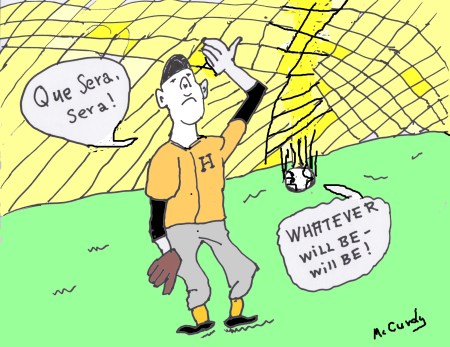
During the batting practice, the players had trouble tracking the ball against the grillwork of the skylights and girders of the roof.

General Manager Paul Richards, and Field Manager Luman Harris both said they felt that the matter could be settled without difficulty.

Richards said that the lights would be turned on for the intra-squad game this afternoon.

“I think it will be all right,” he said.

Harris termed it a minor problem and added:

“If everyone had been wearing sunglasses, there would have been no problem.”

After noticing several veterans, such as Nellie Fox, now a coach, misjudge the ball several times, Richards asked newsmen:

“How many day games do we have?”

He was told there will be 21 games, 18 starting at 1:30 p.m., CST, and three at 3:15 p.m. CST.

“I didn’t realize it was that many,” he said.

Only four day games were played in the temporary (Colt) stadium last year because of the heat.

“You are going to have to watch it close at this time (4:30 p.m.) of day,” he said.

Club officials has said it may be necessary to keep the arc lights on even during afternoon games.

Many of the Astros wandered around the new stadium like it was a museum.

Catcher Ron Brand called it “fantastic”, but he added “it may be hard to catch a fly ball.”

“Any outfielder who catches  fly ball should get a $50 dollar raise,” recommended pitcher Ken Johnson.
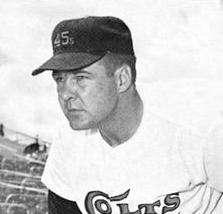
Hal Woodeshick

“Does your curve ball really break, Woody?” someone asked pitcher Hal Woodeshick.

“I don’t know,” answered the honest southpaw. “I ain’t got a curve ball.”

… an AP article from the Sacramento Bee, April 8, 1965, another wonderful contribution to The Pecan Park Eagle by our good baseball friend, Darrell Pittman. – Thanks again, Darrell. Without the 1965 AP article you sent us, this column would not have been possible.

********************

TPPE Notes: It may always be the same old story to those of us with ancient roots to Houston Baseball, but there’s a whole world out there, including some who live among us on the Texas Gulf Coast who could stand to learn more about how those first ball sight issues let inadvertently to commercial and cultural changes that made the historic significance of the Astrodome even more important to the world than it might otherwise have become. Keep your eyes open over the next year or two. One of our best local baseball writers is working on a new contribution to the Astrodome story.


********************
Bill McCurdy

Principal Writer, Editor, Publisher

The Pecan Park Eagle


Bill Gilbert: 2017 Offensive Productivity

March 24, 2018

Who Were the Most Productive Offensive Players in 2017?

By Bill Gilbert

With the 2018 baseball season starting next week this is a good time to take a look back at who were the most productive players in 2017.

Numerous methods have been devised to measure offensive performance. The most common are batting average, on-base percentage and slugging average. Since none of these averages provides a complete picture by itself, a more comprehensive measure of offensive performance is useful. Such a measure would include the following elements:

  1. The ability to get on base.
  2. The ability to hit with power.
  3. The ability to add value through baserunning.

The first two elements are measured by on-base percentage and slugging average. A measure of offensive performance, which encompasses both as well as baserunning achievements, is Bases per Plate Appearance (BPA). This measure accounts for the net bases accumulated by a player per plate appearance. It is calculated as follows:

BPA = (TB + BB + HB + SB – CS – GIDP) / (AB + BB + HB + SF)

Where: BPA = Bases per Plate Appearance

TB   = Total Bases

BB   = Bases on Balls

HB   = Hit by Pitch

SB   = Stolen Bases

CS   = Caught Stealing

GIDP = Grounded into Double Plays

AB   = At Bats

SF   = Sacrifice Flies

The numerator accounts for all of the bases accumulated by a player, reduced by the number of times he is caught stealing or erases another runner by grounding into a double play. The denominator accounts for the plate appearances when the player is trying to generate bases for himself. Sacrifice hits are not included as plate appearances, since they represent the successful execution of the batter’s attempts to advance another runner.

BPA Table, 2013-2017

YEAR BPA .550 .600
2003 .461 42 15
2004 .468 33 18
2005 .456 34 13
2006 .470 46 14
2007 .463 34 15
2008 .458 41 11
2009 .461 42 16
2010 .446 19 7
2011 .442 25 7
2012 .447 12 5
2013 .440 14 3
2014 .426 9 4
2015 .440 20 6
2016 .456 23 7
2017 .466 36 12

Offensive production peaked in 2000 before declining in the early years of this century. BPA declined significantly from .481 in 2000 to .426 in 2014 before significant upticks in the last three years.

In the 1990s, there were 14 individual .700 BPA seasons. In the eight year period from 2000 to 2007, there were 18. The highest BPA in the 1990s was recorded by Mark McGwire in 1998 (.799). Barry Bonds shattered that with .907 in 2001, the highest figure ever recorded, topping Babe Ruth’s best two years (1920 and 1921). Bonds followed that with .869 in 2002, .818 in 2003 and .882 in 2004. There had not been any hitters with a BPA of .700 since 2007 until Mike Trout did it in 2017.

 The .700 BPA seasons in 2000-2017 are listed below:

Player   (Team & Year)     BPA

Barry Bonds (San Francisco 2001) .907

Barry Bonds (San Francisco 2004) .882

Barry Bonds (San Francisco 2002) .869

Barry Bonds (San Francisco 2003) .818

Sammy Sosa (Chicago Cubs 2001) .758

Barry Bonds (San Francisco 2000) .745

Jim Thome (Cleveland 2002) .728

Manny Ramiriz (Cleveland 2000) .726

Todd Helton (Colorado 2000) .720

Mike Trout (LA Angels 2017) .718

Luis Gonzalez (Arizona 2001) .713

Todd Helton (Colorado 2001) .709

Carlos Delgado (Toronto 2000) .707

Larry Walker (Colorado 2001) .707

Jason Giambi (Oakland 2000) .706

Travis Hafner (Cleveland 2006) .703

Alex Rodriguez (NY Yankees 2007) .702

Jason Giambi (Oakland 2001) .700

Ryan Howard (Philadelphia 2006) .700

The yearly leaders since 1992 are as follows:

1992 Bonds     .734

1993 Bonds     .740

1994 Bagwell  .768

1995 Belle        .692

1996 McGwire .765

1997 Walker  .770

1998 McGwire .799

1999 McGwire   .735

2000 Bonds  .745

2001 Bonds  .907

2002 Bonds .869

2003 Bonds .818

2004 Bonds .882

2005 D. Lee .699

2006 Hafner   .703

2007 A. Rodriguez .702

2008 Pujols   .685

2009 Pujols   .696

2010 Bautista .671

2011 Bautista .681

2012 Trout .665

2013 C. Davis .670

2014 Trout .623

2015 Harper .694

2016 Trout .681

2017 Trout .718

The benchmark for an outstanding individual season is .600. Following is a list of the twelve players with enough plate appearances to qualify for the batting title and with a BPA of .600 in 2017. The list is topped by Mike Trout of the Los Angeles Angels with a BPA of .718, the fourth time he has finished in front. He has had a BPA over .600 in all five years that he has played a full season.

Bases per Plate Appearance (BPA) of .600+ in 2017

————————————————-

No. of 2017-2016 .600+ Player

BPA   BPA LG Seasons Comments            _________

# Player 2017 BPA 2016 BPA LG .600+ Years Comments
1 Mike Trout .718 .656 AL 6 On Top Again.
2 Aaron Judge .681 .274 AL 1 Do it again?
3 G. Stanton .659 .533 AL 4 Should thrive as NYY.
4 Joey Votto .641 .606 NL 6 Also 6th OBP Lead.
5 C. Blackmon .640 .597 NL 1 Breakout season.
6 Cody Bellinger .631 —- NL 1 Set NL rookie HR mark.
7 F. Freeman .630 .616 NL 2 Best season yet in 2017.
8 P. Goldschmidt .625 .587 NL 2 The D-Backs Do-it-all.
9. Joey Gallo .613 .333 AL 1 Home Run or Bust!
10. Jose Rameriz .612 .509 AL 1 Fast Lane Superstar!
11. Jose Altuve .601 .576 AL 1 First time over .600.
12. Kris Bryant .600 .611 NL 2 Already a ROY & MVP.

The increase in the number of players with a .600 BPA from 7 to 12 reflects the increase in overall offense in 2017. Near misses were Zack Cosart (598), Justin Upton (595) and Anthony Rendon (595).

Three players had a BPA over .600 in 2016 but failed to reach it in 2017.

No. of

2016   2017     .600+

   Player           BPA  BPA LG Seasons Comments            

1 David Ortiz     .631 —-  A   6   Retired on top.

  1. Daniel Murphy   .612   .560   N   1  Fell short of 2016 career year.
  2. Josh Donaldson .609 .617 A  2   Not enough plate appearances to qualify.

Two active players have a BPA of .600 for their careers:

2017         Career

Player            Age            BPA           BPA   Comments

————-      —     —-       —- —————————

Mike Trout           25      .718       .648   Leader by far.

Joey Votto           33    .641       .603   No sign of decline yet.

Another list of interest is of players with a BPA of over .600 in 2017 who did not have enough plate appearances (502) to qualify for the batting title.

Player           Age BPA   PA   Comments

————— —  —- —   ————————–

Rhys Hoskins     24 .684 212   Mid-season rookie sensation

J.D. Martinez   29 .679 489 Spectacular in Arizona.

Matt Olson     23 .667 216   Hit 47 homers between majors and minors in 2017.

Bryce Harper     24 .622 492   Has never reached 100 RBIs.

Josh Donaldson   31 .617 496   Consistently productive.

Martinez, Harper and Donaldson fell just short of the 502 plate appearances needed to qualify.

Looking at the other end of the spectrum, five players who earned enough playing time to qualify for the batting title had a BPA less than .400 in 2017. This list has shrunk each year from 25 players in 2014 to only five in 2017 reflecting the increase in offense.

Player         Age   BPA Team    Comments                                                                                                     ————–   —  — —-     ———————

Albert Pujols   35 .385 Angels   On .600 BPA list eight times.

Dansby Swanson 23 .381 Braves  Sophomore slump

Alex Gordon     33 .380 Royals   Where did the offense go?

Jose Peraza     23 .375 Reds     Has trouble getting on base.

Alcides Escobar 30 .347 Royals  No stranger to this list.

Four players had a batting average over .300, an on-base average over .400, a slugging percentage over .500 and bases per plate appearance over .600 in 2017.

Player             BAVG       OBA       SLG       BPA      OPS

Mike Trout         .306     .442     .629     .718    1.071

Joey Votto          .320      .454     .578     .641     1.032

Freddie Freeman      .307     .403     .586     .630     .989

Jose Altuve      .346     .410     .547      .601       .948

Trout and Votto have these numbers for their careers.

Mike Trout–Career   .306     .410     .566     .648       .976

Joey Votto-Career   .313     .428     .541     .603       .967

Trout did not lead counting categories like home runs and RBIs because he missed 48 games with an injury. However, he led the American League in important rate stats like OBA, SLG, OPS and BPA, He was clearly the best offensive and all-around player in the Major Leagues in 2017.

Bill Gilbert

3/23/18

Source of statistics used in this report is the “Lee Sinins 2018 Complete Baseball Encyclopedia”.


*******************

Bill McCurdy

Principal Writer, Editor, Publisher

The Pecan Park Eagle

Worm Burners and The Wheel of Destiny

March 23, 2018

Worm Burners: In baseball, these are hard batted balls that come slamming back through the infield with such low even force that they hardly bounce, if at all, and they are moving rapidly through the upper root-level of grass and sod at a base adjoining point with such high frictionally ignited energy that they actually heat the temperature of the subsurface areas to the level that may be needed to sunburn the backs of any worms that may be fatefully wiggling by just below them in the same time and space arena of efficacious configuration as one more example of how the interactive wheel of destiny rarely sleeps in any baseball game worth playing or watching. At least the worms get it, even when our game governing officials do not.

Post-Definition Comment: Baseball may someday shorten a few games by starting extra innings with a second base runner, but that will only cheapen the game, not destiny. – Destiny deprived simply invites a fate to things that would not otherwise be possible on merit. And the ones we invite at the expense of destiny’s preference for the options of competitive play in high drama shall be sacrificed for the quicker pace of boredom by the fateful outcome to the runner who had no earned right to second base in the first place. Even if that runner scores as the subsequent result of a good old-fashioned worm burner, the game will never be the same again.

*******************

Bill McCurdy

Principal Writer, Editor, Publisher

The Pecan Park Eagle


New Baseball’s West Coast Expansion Books

March 22, 2018

The Institute for Baseball Studies, the Baseball Reliquary, and the Historical Society of Southern California Present Major League Baseball Moves West. This announcement also appears with the full membership support of The Pecan Park Eagle:

A Discussion and Book Signing
DATE & TIME: Wednesday, April 4, 2018, 7:00 p.m.
LOCATION: Villalobos Hall, Whittier College
ADDRESS: 13507 Earlham Drive, Whittier, California

INFORMATION: (562) 907-4803, (626) 791-7647, or terymar@earthlink.net

It’s been six decades since Major League Baseball arrived in California, opening the door for a wide range of professional sports entertainment up and down the Pacific Coast. Andy McCue, author of Mover & Shaker: Walter O’Malley, the Dodgers & Baseball’s Westward Expansion, and Robert Garratt, author of Home Team: The Turbulent History of the San Francisco Giants, team up to discuss the franchise moves, the consequences, and how the teams have become embedded in their communities, on Wednesday, April 4, 2018 at 7:00 p.m. at Villalobos Hall, 13507 Earlham Drive, Whittier, California, on the campus of Whittier College. The event, which is open to the public and free of charge, is co-sponsored by the Institute for Baseball Studies, the Baseball Reliquary, and the Historical Society of Southern California. Light refreshments will be served. A major area of discussion will be the history of the team’s stadiums, with O’Malley’s initial struggle to get Dodger Stadium built followed by years of success and iconic status for the ballpark. In San Francisco, where the city-owned model was followed in the spirit of its times, Candlestick Park became a chilly boondoggle which led to two bouts of brinksmanship to keep the team in the Bay Area. The eventual construction of AT&T Park led to success on and off the field and strong ties to its fans.

Andy McCue is a retired newspaper reporter. Mover & Shaker won the Seymour Medal for 2015’s best book of baseball history or biography from the Society for American Baseball Research. Garratt, whose Home Team was nominated for the Seymour Medal this past year, is a Professor Emeritus of English and Humanities at the University of Puget Sound. A book signing with Andy McCue and Robert Garratt will follow the presentation.

Books will be available for purchase.

“Major League Baseball Moves West” is made possible, in part, by a grant to the Baseball Reliquary from the Los Angeles County Board of Supervisors through the Los Angeles County Arts Commission. Further information: (562) 907-4803 or (626) 791-7647.

The Pecan Park Eagle extends its encouragement to readers who either live in the LA area or will be traveling to SoCal over that upcoming April 4th date to try and make it to an event that immediately takes on weight as a legendary memorial to the history of baseball on the west coast.

Regards,

Bill McCurdy, Publisher

The Pecan Park Eagle and

Baseball Reliquary Member

********************

Bill McCurdy

Principal Writer, Editor, Publisher

The Pecan Park Eagle

It Was a SABR Meeting Cloudbuster

March 20, 2018

 It Was a SABR Meeting Cloudbuster

Bob Dorrill
Guest Columnist


By Bob Dorrill, SABR Guest Columnist

Anne Keene
March 19, 2018
__________
Photo by Mike McCroskey

Last night – in front of a capacity crowd at the Spaghetti Western Restaurant in Houston – author and SABR member Anne Keene of Austin, TX regaled Larry Dierker Chapter of SABR members with the story and background on her soon to be released book – “The Cloudbuster Nine”.

The audience devoured every word as Anne took us back to the 1940’s and the days of the “90 Day Wonders” – where American military fighter pilot cadets trained at the University of North Carolina in Chapel Hill to earn their wings on their various ways to soaring as combat participants in World War Two.

Anne’s dad, Jim Raugh, had served as the batboy for the 1943 baseball team on the base that had held in its lineup cadets like Ted Williams, Johnny Pesky and Johnny Sain. The players also took a liking to Jim, who later became a college All American and professional player himself. They took him with them on dozens of trips to entertain factory workers, service members, and even to the big war-bond exhibition with Babe Ruth at Yankee Stadium. Raugh was able to observe them closely, collect many photographs and related materials of this important period.

Others who matriculated through the flight school in Chapel Hill included George H. W. Bush, who learned survival skills there that served him well when his plane was later shot down, Gerald Ford, Ronald Reagan, John Glenn and Paul (Bear) Bryant – simply to name a few.

SABR, March 19, 2018
___________________
Photo by Mike McCroskey

 Through a scrapbook her dad left behind, Anne learned much more about a time in her father’s life she was totally unaware of and decided to locate the children of many of the famous aviators to learn their stories. She also interviewed other WWII baseball veterans, like Dr. Bobby Brown and Eddie Robinson, and decided she had to write a book to commemorate the full dedication and determination of these American heroes.

“The Cloudbuster Nine” will be available in local bookstores on May 1st, but this much else we already know from her appearance in Houston last night. Keene’s new book was recently reviewed and credited by “Newsday” as one of the best new published baseball books of 2018.

There wasn’t an empty seat in the house.

See there. If your appetite for baseball in Houston is also gold-cap deep, you could have burrowed even deeper into the woodwork of total baseball immersion by being at SABR last night.

For further information on how you too may join in the fun of our Larry Dierker Houston Chapter of SABR, please check out the recent column by Bill McCurdy, Publisher of the The Pecan Park Eagle. It will be all you need to know about the quickest way to change your baseball-craving life all for the better in the simplest, most direct way possible:

https://bill37mccurdy.com/2018/03/12/our-houston-sgt-pepper/


Longtime respected Houston writer and historian Tom Kennedy (center, foreground, silver hair and blue-stripe shirt) was in the crowd.
Welcome, Tom!
____________________
Photo by Mike McCroskey

********************

Bill McCurdy

Principal Writer, Editor, Publisher

The Pecan Park Eagle


Sitting Prettier: Altuve Deal

March 18, 2018

“Sitting Prettier”
_____
Jose Altuve’s new contract numbers have added character to his smile.

Since “Sitting Pretty” of earlier this week, the Houston Astros and superstar mighty mouse second base star and batting champion Jose Altuve have agreed to some crooked numbers on a five-year extension of his present contract through the 2004 season. The deal comes down to about a $32.2 million dollar average annual salary for each of the seasons covered in Altuve’s 2020-2024 work beyond the present two already locked in years covering 2018-2019.

Hallelujah!  At least we can now all get some sleep in Houston and keep setting up the rest of the team we shall need to keep up these newfound championship ways in motion as our dynasty-building commitment.

What next?

How about getting the 2018 season started, asap? The televised version of the 2018 home and away season is looking more attractive by each passing day – and by each new “dynamic pricing” explanation for the increase in ticket prices.

We get it. It’s going to take a lot of dough to pay for the kind of baseball we fans say we want to see on a regular basis.

So be it. Let’s do it right. Or not even try. If that means some of us will not be able to attend as many games as we once did, so be it. But let’s do all we can to support the recruitment of new fans who can help by their attendance in person.

Otherwise, let’s not feign surprise if performance by the Astros over time falls as a result of fan abandonment reaction to higher ticket prices. As we all should understand from our tenures as students of Life’s Led Zeppelin School of Economics.

Lead balloons never get off the ground.

But what we have in Houston is no lead balloon. It’s real. It’s rough. It’s ready to go. And it’s already proven it can win – and with more winning players signing up this season than ever before to the task of taking another Houston Astros club to a second consecutive World Series championship.

It’s up to the Houston baseball community – from the ownership to the players to the hard-core embedded fans and all of the welcomed newcomers – to figure out the new match required here between ticket cost and demand and get it done. We deserve it.

Maybe the Astros can figure out a way for fans to earn ticket purchase credit by their measurable contributions to an effort called something like “Houston Astros Tickets Strong”.

Play with the idea, Astros. Come up with something. Maybe attendance by game and season could be goals that pay off in a price break for fans who contribute measurably to each.

Think about it. Take action. And let’s get it done.

Now that would be “Sitting Prettiest!”


********************

Bill McCurdy

Principal Writer, Editor, Publisher

The Pecan Park Eagle
Baseball’s Three Generation Families

March 17, 2018

“Loved that Stance!”


The Baseball Family TreeGrandfather, Father & Son Major Leaguers

Courtesy of Baseball Almanac.com

Grandfather Father Son(s) Order

Gus Bell
1950 – 1964

Buddy Bell
1972 – 1989

David Bell
1995 – 2006
2.
Mike Bell
2000 – 2000

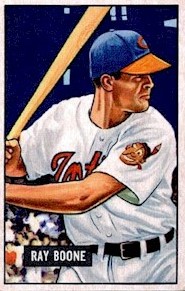
Ray Boone
1948 – 1960

Bob Boone
1972 – 1990

Bret Boone
1992 – 2005
1.
Aaron Boone
1997 – 2009

Joe Coleman
1942 – 1955

Joe Coleman
1965 – 1979

Casey Coleman
2010 – Active
4.
Sammy Hairston
1951 – 1951
Jerry Hairston
1973 – 1989
Jerry Hairston, Jr.
1998 – 2013
3.
Scott Hairston
2004 – Active
Grandfather Father Son(s) Order
Grandfather, Father & Son Major Leaguers

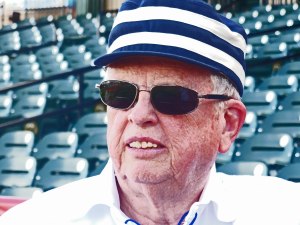
There have only been four of them, but these families have left their own rare and special mark upon baseball history. Of all the thousands who, at least, have either magically Moonlight Grahamed their ways into a single official game box score since the late 19th century – or were simply struck out once as pinch hitters on the same day they were informed of their assignment to Wilkes-Barre, we also have these four families whose DNA/baseball culture mixes were strong enough to produce three direct descendant  big leaguers in a row.

Most of us know of the two most royal ones on our Baseball Almanac list. The Boones and the Bells have been lighting up the headlines quite literally now for generations. The Boones have made the latest noise this current off-season with the announcement that Aaron Boone is taking over as the new manager of the New York Yankees.

The rest of the Boones and all the Bells ring the same. And that’s loudly. It’s hard to find many dark corners of history since the post WWII Era in which none of their names arise. And they’ve each gone father, son, and two grandsons each in the wake they’ve left in the big sea of hindsight. Mike Bell’s 19-game total MLB career was pretty much a bust, but, hey. the man got there as did his brother, his father, and his grandfather – and none of them were busts. Plus, we do not have open access to news of injury or personal issues that may have halted the youngest Bell so early in the game.

The Coleman family pulls the steady cord when you look at their achievement records. If you go to Baseball Reference .com to research them, you may even see that steadiness in the eyes of each their photos. They were – all three of them – right-handed pitchers with steady records over several seasons. Grandfather Joe worked 1o years between 1942 and 1955, going 52-46, 4.38 as an all American Leaguer. Son Joe was 142-135, 3.70 over 15 seasons (1964-1979). Grandson Casey Coleman (2010-2012, 2014) was 8-13, 5.25 in four seasons. We don’t know if his recent absence from MLB is injury or performance related. Or maybe the family DNA battery simply ran out.

The Hairston family appearance here seems more fluky. At age 31, Sammy Hairston joined the Chicago White Sox on July 21, 1951 a one of the players coming over from the Negro Leagues in the years that followed Jackie Robinson. Hairston was there through August 26, 1951 and 2 for 5 as his total MLB record. If you hve to come late and leave early, may as well take a .400 BA with you on the waves good bye. And here’s fluky. If Sammy doesn’t get that whisky shot glance that summer, he and his family are not on this list today. Then comes Sammy’s son Jerry with a long career (1973-1989), followed by the direct grandsons of Sammy, – Jerry, Jr. (1998-2013) and Scott (204-Active).

Other families, like the early 20th century Delahantys, may have produced more direct family members as MLB siblings, but these four families, so far, are the first to do three joined direct descendant generations.

And who knows? Maybe one or more of these four families will make it four generations too.


********************

Bill McCurdy

Principal Writer, Editor, Publisher

The Pecan Park Eagle
 

Sitting Pretty

March 14, 2018

“Sitting Pretty”

The 21st Century 2nd Baseman Induction Field

Of the five men already inducted into the Baseball Hall of Fame as 21st Century second basemen inductees, only Craig Biggio of the Astros (2015) achieved any recognition for good work at another position. The rest were pretty much pure blood pivot men up the middle on the old phantom tag plays that once begrudgingly and gratefully filled our scorecards. Biggio go moved from an All Star start early as catcher in the hope that the move up the middle. It must have worked. He got to play twenty years with one club, got to play in a World Series, and then went into the HOF full sail in the early years of his retirement.

Roberto Alomar (2011) served as the career co-spur to Biggio during their shared competitive careers and, indeed, he reached the HOF four years earlier than his Astros rival, with offensive stats that were slightly crisper, but not so much crunchier than the ones on Craig’ List for being the little tough guy who could take an HBP like few others, while also doing all he could to help kids with special issues of serious childhood disease. Alomar, on the other hand, would go into the Hall remembered by many as the guy who spat upon an umpire for rendering a decision he didn’t like.

Bill Mazeroski (2001) and Joe Gordon (2009) were both mid- 20th century players, but they were not forgotten by the Veteran’s Committee when it came time for each to either go-in or begone from the Hall of Fame honor candidate list. All though the arguments probably shall continue that playing hard and dramatically against the Yankees may have saved this honor for each man, especially for Mazeroski, the counter point defense always still flies that both guys were always better than their overall stats confirmed. Count us in that court on this question.

Maz played with a fire that had no quit in it. Gordon was cold steel strong – both for and against the Yankees – and he was an important cog in the 1948 World Series Championship year of the Cleveland Indians. As for Mazeroski’s contributions to the 1960 Game Seven Pittsburgh Pirates win over the Yankees, it requires no telling. If you have a baseball memory, all you have to do as a kid is grow up anywhere near Pittsburgh. You should know about Mazeroski before you finish the first grade. That is, assuming it wasn’t already covered in kindergarten.

During that long march for Cub fan generations across the desert of despair (1909-2015), one place that hope survived was always in the presence of some special player who came along to inspire. No one ever did that better, with more lift, than Ernie Banks, but 2nd sacker Ryne Sandberg (HOF 2005) did a pretty good job on the Moses Trail himself with this own precious skill for handling the fans’ hopes with honor and respect. He was a HOF guy in the making from the very start. He simply didn’t have the company he needed to do what the 2016 Cubs finally did when they finally gathered the right kind of troops and got it done.

Now here comes Jose Altuve, with a 7-season career in tow that now includes 3 league batting titles, a World Series victory, and all kinds of honors for all the things he’s done so well on the field – and with an average-per-season set of stats that mainly outshines his five older second base companions who already belong to the Hall of Fame.

The following table is constructed from the “162 Game Average Data Line” that rests at the bottom of each first offensive career chart for each batter listed in the Baseball Reference.com presentation data. It shows what each of the 21st century inductees and Senor Altuve have done, if it could be displayed by the kind of season it would produce for each man if all his actual data were averaged over the number of seasons he has currently played. At age 27, and only 7 years down on what could be a long and most fruitful career, Altuve has a good chance of improving his comparison to the other set of five fixed average seasons that are listed for the HOF players shown with him here today.

There is other data we could have added, but beyond the variables we’ve chosen to use with our good old “BA” stat, the view of things gets a little harder to read easily at the scope our publication prints. So, we’ve kept it simple for the display:

Five 21st Century-HOF-Called Keystoners and One To Be

# 2nd Basemen AB R H 2B 3B HR RBI BB SO BA
1 Jose Altuve 652 93 206 40 4 14 66 44 76 .316
2 Roberto Alomar 618 103 185 34 5 14 77 70 78 .300
3 Ryne Sandberg 628 99 179 30 6 21 79 57 94 .285
4 Craig Biggio 618 105 174 38 3 17 67 66 100 .281
5 Joe Gordon 590 95 158 27 5 26 101 79 73 .268
6 Bill Mazeroski 581 58 151 22 5 10 64 33 53 .260

Our only big question in Houston is about the whereabouts of it all. Will Jose Altuve be another full career Houston Astro for the entire trip? Or will he be able to resist the Yankee/Red Sox/Dodger rush that we all know is coming, somewhere down the line?


********************

Bill McCurdy

Principal Writer, Editor, Publisher

The Pecan Park Eagle
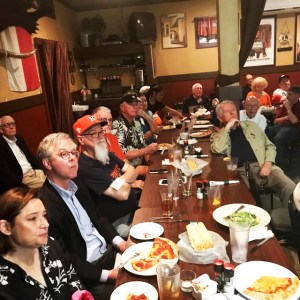


Our Houston Sgt Pepper

March 12, 2018

“We’re Larry Dierker’s Hous-ton SA-BR Band!
We-hope-you-will-en-joy-the-show!”


We’re Larry Dierker’s Hous-ton SA-BR Band!

We-hope-you-will-en-joy-the-show!

We’re Larry Dierker’s One-and-Only Astros Mostly brand!

Join us and watch the summers flow!


We’re Larry Dierker’s only,

Larry Dierker’s only,

Larry Dierker’s only,

…. SABR Band!


It’s wonderful to see you!

We’re glad you can be here!

Baseball-puzzles-are-a-lot-more-fun,

With the answers all-so-near!


So give our Bob Dorrill – a call!

Find out – it hardly costs at all!

Little less – if you’re young or old!

And the fun is always hot – not cold!


Act now – and let us take you to!

The smile to heal all baseball tears!

LARRY DIERKER’S – HOUSTON HEARTS – AND SABR BAND!


********************

ABOUT SABR

Asking members what SABR means to each of them is a little like that ancient philosophical question: “What happens when you ask a dozen blind men what an elephant feels like?” Of course, it depends upon what they each have been grabbing and holding onto over the years. It feels much bigger to those who have been moving around the gargantuan beast over time, but it’s still big enough to handle the needs of the one-spot grabbers too.

SABR stands for the “Society for American Baseball Research.” It formed in 1971, attracting the brain spectrum of people interested in baseball as both a great measurable sport and a serious cultural root in this country’s growth. The SABR members today fall into three distinct groups. As “blind men”, they may be only interested in the math generated by the game as it pertains to past performance comparisons or to the future analytic predictions of what it will take to build a championship ball club. Or they may be way to the other side, knee-deep in the poetic evolution of baseball as “the stuff and literature that baseball dreams are made of”. Or – believe it or not – they are the double dominant brain hemisphere people who enjoy the game for both the bite of its numbers and its story-generating power.

47 years into the mix, the gradient brain preferences of the average SABR member appear about as mixed as you might expect them to be – and with the growing realization among SABR people too that the common water table of interest between any two members is most often quickly discovered between any two members who both open their mouths to share with each other their common treks to the organization.

Today SABR has chapters world-wide. The USA locations usually are dedicated by chapter name to some former player of importance to the area. Houston has a great identity fit in Larry Dierker, the former great Houston pitcher and media guy, before going on to becoming the big winning manager in four of five early playoff series from 1997 through 2001. Today Larry Dierker is our guy on the masthead of baseball and life courage credit – and everything we could want in our own “Sgt. Pepper” leader of our Houston Chapter band. Active in our monthly SABR meetings, Larry also is a frequent presenter.

One more log on the fire for those who don’t know of it. Larry Dierker broke into the big leagues by starting a game against the San Francisco Giants at old Colt Stadium on his 18th birthday, September 22, 1964. The club was still known as the Colt .45s in that third and final year before the Astrodome opening.

Larry didn’t win that day, but he struck out the legendary Willie Mays the first time he faced him in the big leagues – and on his 18th birthday no less! Enough said.

We are – The Larry Dierker Chapter of SABR.

The annual dues for SABR are $65. If you are under 30, or over 65, your dues are $45. Cheaper rates are available for 3-year memberships, if you prefer.

A number of printed publications will come to you annually for no charge. The only thing you miss by not going to our monthly meetings is the chance to meet and hear directly from people like Larry Dierker, Jimmy Wynn, Tal Smith, Bill Brown, Greg Lucas, former Houston Buff slugger Larry Miggins, and, over time, practically every other living former Houston Astro and other former big leaguer who lives in our area.

One more thing. You do not have to be a baseball expert to fit in. We are a body of baseball fans, men and women who love the game because of how the game continues to touch our lives.

For more information about our monthly meetings in the St. Thomas High School area of town, please contact our Larry Dierker Chapter Director, Mr. Bob Dorrill. It you are willing to open the door on the best time in your life, Bob Dorrill will help you get it started today.

Just don’t procrastinate. If you had joined us this time last year, you too could have been there as we wished A.J. Hinch good luck in 2017!

Bob Dorrill Contact #s:

phone: 281-361-7874

email: bdorrill@aol.com


********************

Bill McCurdy

Principal Writer, Editor, Publisher

The Pecan Park Eagle


Pick It: Shorter Games or Better Calls?

March 10, 2018

Today I love watching MLB games and knowing that the outcome is not going to be decided by a phantom-tag-of-second double play that cannot be challenged. Same goes for other calls like fair-foul, ground trap-glove catch, and which arrived as first at first – the fielder’s throw – or the runner’s foot?

The multi-camera angles, the HD picture quality, the ability to discern what actually happened on appeal are enough to silence almost all of the dissenting losers in these appellate decisions, barring the few Billy Martins and Earl Weavers who would still kick dirt on the shoes of God, were “He/She” the chief umpire for the day. Even the umpires get it. Technology is here to help them because they are human – and capable of human error. Technology is not there to criticize or condemn them for imperfection.

If you watch this first example in the linked YouTube video from different angles, the more you see that the Braves runner from third who is called safe at home on an infield throw to the catcher actually was tagged out a good two feet prior to reaching the plate. The run counts. And the home town Braves defeat the Pirates, 4-3.

In this game from an earlier season, there is no appeal. Bucs manager Clint Hurdle is practically apoplectic in rage over the call, but there is nothing to do but go home, with the winners even being among those who know they have been gifted, as will the home plate umpire quietly agree, once he gets to see the tape free of Hurdle’s hot breath on his neck.

All the umpire saw in real time was the runner evading the catcher. Even though the catcher was all over the runner like a controlling mother-in-law, the umpire simply could not see it. Maybe his mother-in-law had made the trip to Atlanta with him and his wife – and the umpire just needed to see somebody who was safe.

But seriously, folks….

Today I think this play could have been appealed and reversed, forcing the game to another inning of play in the search for a fair finish. As, indeed, it should be with any play in baseball that can be reversed, short of ball and strike calls. Even that one may meet up with its own laser technology someday. Or it may remain the one sweet area of totally human error risk in officiating. Protesting ball and strike calls on a runaway basis could ruin the game on several levels.

Besides (wink.wink), how could we play this game if we take away all of the umpires’ different strike zones. A laser call key that called them all the same would take away a manager’s ability to plan certain starters around their abilities to match the umpire’s usual strike zone.

Anyway, hope you enjoy these YouTube clips as much as we did.


********************

Bill McCurdy

Principal Writer, Editor, Publisher

The Pecan Park Eagle