Archive for 2013

Will Biggio Make It Next Time?

May 30, 2013
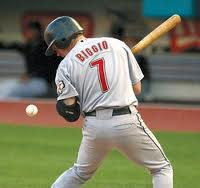
This also happened 284 other times during the 20-season Astros career of the great Craig Biggio.

This also happened 284 other times during the 20-season Astros career of the great Craig Biggio.

In 2013, 569 BBWAA writers held the credentials for voting in the annual selection of inductees into the Baseball Hall of Fame. For selection, an eligible party had to receive a minimum of 75% approval in the voting process for induction. For a voting population of 569, that translated to an eligible party getting a minimum of 427 votes of approval (75.3%).

For eligible parties who fell short of induction in the vote, Craig Biggio finished at the top of the heap with 388 votes (68.2%) – or 39 votes short of the 427 total votes he needed for election on his first eligible ballot. It also means that 181 votes (31.%) of the 569 total were withheld from Biggio in 2013 for one of four basic reasons: (1) the voter did not think that Biggio was deserving; (2) the voter does not think that anyone deserves a first ballot ticket to Cooperstown; (3) the voter views Biggio’s numbers as merely the product of longevity and not the fruits of greatness; or (4) the voter was not paying close attention and did not notice Biggio’s name on the ballot.

What about the 2014 ballot? Will Craig Biggio make it to the Hall of Fame then?

Here’s where “next year” always gets interesting for candidates like Biggio, assuming that he is like all previous retired players in the sense that he is now powerless to improve upon the same career numbers that the voters examined “this year”. – If this voting process were totally a logical matter, one would have to ask: If the career numbers for Biggio haven’t changed in the past year, why should the voting numbers change at all?

The answer’s obvious. – The voting culture in baseball is not all that logical or tied to any one standard of what represents greatness.

So, if Biggio loses votes rom the 388 writers who supported him in 2013, it says what? That those voters have had a change of heart, for whatever reason, on his deservedness for the HOF? That being said, at any rate, it is unlikely that Biggio will lose any of his 388 writer votes from this year, unless they are either dead or physically unable to vote by next year.

No, the big question next year is – how many of those 181 hold-back votes this year were firm negations of Biggio or simply a show of “no hands” from those same kind of writers that didn’t vote for Babe Ruth or Hank Aaron on their first ballots.

All Biggio has to do is hold his 388 “yea” votes from 2013 and add 39 more next time and he goes into the HOF in 2014. I think he will get them next time, if something in the meanwhile doesn’t blow through the world of baseball like the Spanish Flu did to the whole planet back in 1918 to depress the urge and desire for accolading anyone new.

I keep thinking of Biggio’s 3,060 hits – and his twenty seasons as an Astro – and of the fact he was both an All Star catcher and second baseman – and of Craig Biggio and Jeff Bagwell as the “Icons in Bronze” at Minute Maid Park – and of his 285 HBP’s – and of his work with the Sunshine Kids – and of the data reality that only one of the other comparable twenty men who have already made it to “The Hall” as second basemen even came close to amassing – his 668 career doubles total. The great Napoleon Lajoie finished with 657 doubles, eleven shy of the Biggio mark.

Galveston County News Coverage of Vintage Ball

May 29, 2013
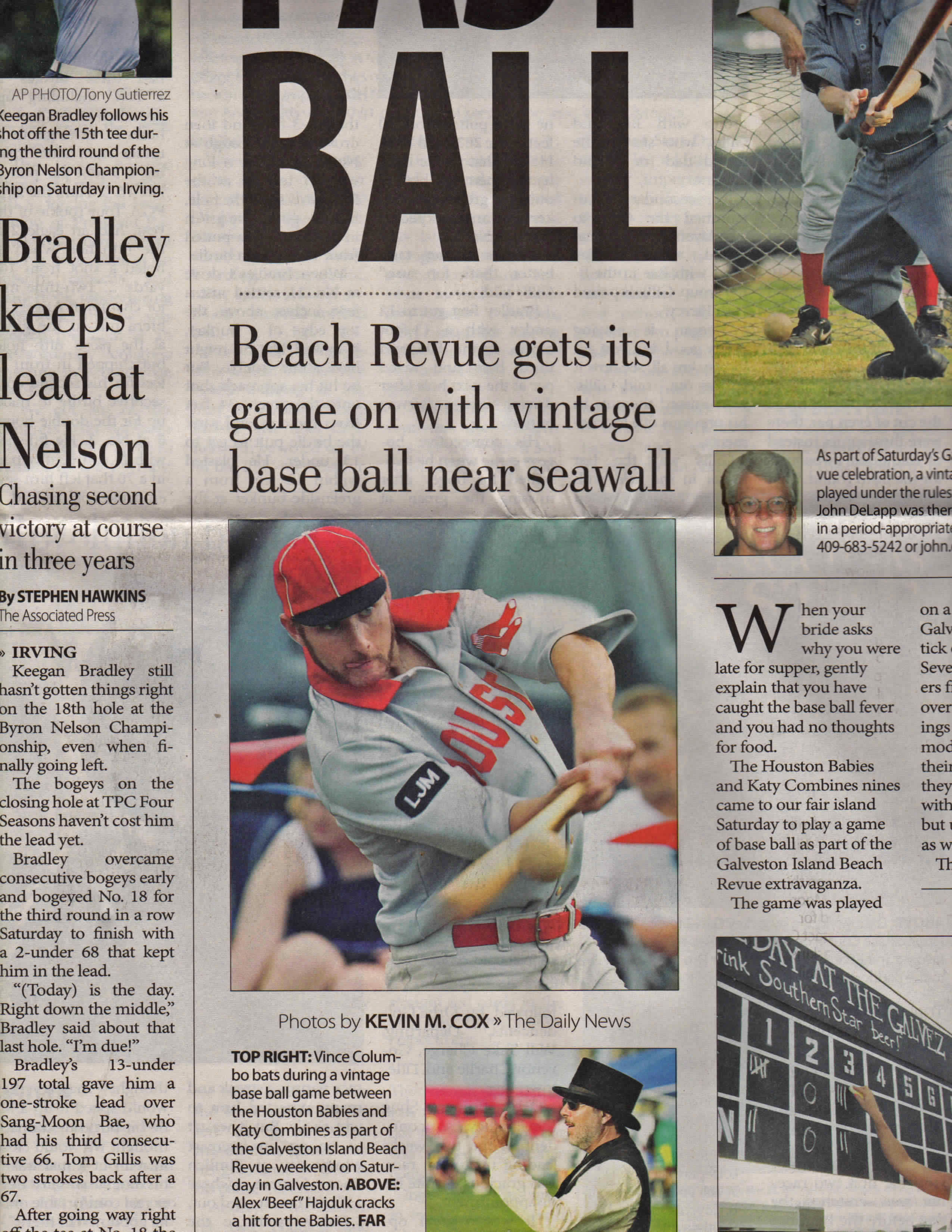
The Daily News gave front page note to the first page Sports Section story on the vintage game in the upper right hand corner. Robbie Martin of the red-vested Babies and Vince Columbo of the ghostly gray Combine are the poster boys for a new story that gets precedence over results from The Preakness on this same date.

The Daily News gave front page note to the first page Sports Section story on the vintage game in the upper right hand corner. Robbie Martin of the red-vested Babies and Vince Columbo of the ghostly gray Combine are the poster boys for a new story that gets precedence over results from The Preakness on this same date. Callie Mulkey, the 5th place contestant in the bathing suit competition, still got front page coverage over all others on the front page the next day. – How does that work?

On Sunday, May 19. 2013, the Galveston County Daily News gave the Houston Babies and the Katy Combine some monster coverage for their appearance at the Island City Beach Revue and Bathing Beauty Competition the previous day – and they did it for the two clubs’ journey to the Gulf for some good old-fashioned vintage base ball on the seawall drive section that goes right past the playing grounds at the iconic Hotel Galvez.

The Babies and the Combine played out a titanic struggle by the sea, one that only ended after the Houston Babies rallied from an 11-4 deficit at one point to make up a final three-run differential in their last time up to tie the Katy Combine at 14-14 and call it a good place to stop in the presence of fading sunlight.

Alex Hajduk tees off for the Babies. That's Tom Flores of the Combine in the lower section. Tom gave it up for all by serving as the game's "Blind Tom" (umpire).

Alex Hajduk tees off for the Babies. That’s Tom Flores of the Combine in the lower section. Tom gave it up for all by serving as the game’s “Blind Tom” (umpire).

Writer John DeLapp and photographer Kevin M. Cox are responsible for the fine coverage in both words and images, doing a good job of capturing the excitement of the crowd and challenges of the game played on a field that was really too small for the game. As a result, colossal drives to the roof of the two-story parking garage next door were contained by agreement as ground rule singles. Power hitting Babies guy Alex Hajduk jacked three Ruthian swats to the parking lot roof. In fact, that’s one of them shown leaving his bat in the photo featured above on Page One of the Sports Section.

PAST BALL is PLAY BALL. The Astros got a higher placement but our vintage game got the larger headline. That's Vince "The Viper" Columbo of the Combine connecting as Babies catcher Robby Martin looks on with great interest and anticipation.

PAST BALL is PLAY BALL. The Astros got a higher placement but our vintage game got the larger headline. That’s Vince “The Viper” Columbo of the Combine connecting as Babies catcher Robby Martin looks on with great interest and anticipation.

“PAST BALL” IS “PLAY BALL!” Those two words say it all as the best summary on vintage base ball. It is a game that is played in happiness, a game that is both competitive and yet, still joyful – the closest experience to all day sandlot baseball that most of us once knew as kids, a contest taken seriously without grown up rules and interference. We all always understood these two facts: “Three strikes and you’re out. Three outs and the other team bats.” Grasping that much, you get to play a game you love with people you value as brothers and sisters of the baseball soul. – Who could want or ask for anything more, except for a cool breeze every now and then and plenty of water, as long as it didn’t fall from the sky on game day?

That Saturday in Galveston was wonderful. I’ve got a feeling that the next time we travel to the Island, there’s a good chance that we shall run into a new/old club – via the resurrection of the Galveston Sand Crabs.

All of us who do anything to bring vintage base ball to life in the Greater Houston Area want to thank John DeLapp and Kevin M. Cox, the Galveston County News, and the planners of the Beach Revue Weekend for bringing vintage base ball to life on the Island that special weekend. Let’s do it again sometime – and let’s get those Sand Crabs in motion again while the iron of passionate interest is hot!

Have a nice hump day, everybody!

Houston: 1st Class? Or No Class?

May 28, 2013
Astrowomb Late 1964 Early 1965

Astrowomb
Late 1964
Early 1965

On Memorial Day, I concluded my column with this unrelated note on a new article about the Astrodome:

… and while we’re at it, let’s also “Remember the Astrodome” beyond today and into all the tomorrows that shall ever be. A writer named Jere Longman has written one of the best articles we’ve ever seen this morning on why the grand old girl of Houston’s place in architectural history should be spared the ignominy of the wrecking ball. We also want to thank friends Tal Smith and Darrell Pittman for alerting The Pecan Park Eagle to the story. The Astrodome truly is – Houston’s Eiffel Tower.

Check it out:

http://www.nytimes.com/2013/05/27/sports/houstons-astrodome-may-be-dirty-and-dated-but-it-is-irreplaceable.html?_r=1&

Longman’s essay makes the case for saving the Astrodome better than any other I’ve seen to date. The author makes the case for how important the venue was to his family in childhood when they made those special trips from Louisiana to Houston for the experience of watching air-conditioned baseball indoors, but he also builds on the special place that the Astrodome holds in architectural history.

Quoting James Glassman, a Houston preservationist, Longman calls the Astrodome “the city’s Eiffel Tower” and the “physical manifestation of Houston’s soul.”  He adds that New York could afford to tear down old Yankee Stadium, according to Glassman, because the Big Apple had hundreds of other signature landmarks. Not Houston. No matter how shabby it now appears in the darkness of abandonment from useful purpose, the Astrodome bears a patina of importance to the history of architecture that the shiny presence of its Reliant Stadium nearby neighbor shall never carry, even if it gets another three Super Bowl awards over the next forty years.

The value of the Astrodome is in what it represents in Houston to the history and forever unfolding future of architecture in this whole world. You don’t take the wrecking ball to the Eiffel Tower equivalent on our hallowed Texas coastal prairie.

The Astrodome must be redeveloped in service to some new purpose. There is no other viable option. Anything less, demolition or the degrading continuation of subsidized abandonment, is unacceptable.

How we answer this question now is then a referendum on Houston as either a world class or no class city. There are no intermediate categories. Restore this grand old girl to some useful new purpose and we are world-class. Tear it down, or continue to subsidize decay, and we are rightfully deserving of the “no class” designation.

Houston did not rise in the world by being a “sit-on-its-rump” do nothing city when it came to economic development through the port, oil, medical, and aerospace industries. And thousands became monetarily rich in the process. Now its time for those who have “done well” to rise above their “make-more-parking-spaces-of-it” mentalities and apply that vision and wealth to the matter of saving the Astrodome for its historical and ongoing value to the world.

If you are going to spend your time, effort, and money for anything worthwhile, folks, please do something this important for history. Save the Astrodome now – and spare the City of Houston the no-can-do/ no class assignation we shall both earn and deserve should we fail in this matter.

Now please go back to the link to Jere Longman’s article from the New York Times and read it again.

Please. Before it really is too late.

Uncle Carroll! Thinking of You and Tyler too!

May 27, 2013
It's Memorial Day, the official day that should really be everyday - the day we recall in honor all those who have given their lives in service to the defense of our country.

It’s Memorial Day, the official day that should really be everyday – the day we recall in honor, all those who have given their lives in service to the defense of our country.

Happy Memorial Day, Everybody!

I can’t express my thoughts any better than I did a few years ago. Here’s a link to the memoir I wrote about my late uncle from World War II, Major Carroll Houston Teas, United State Army Air Corps, Pacific Theater.

https://thepecanparkeagle.wordpress.com/2010/05/30/remembering-uncle-carroll/

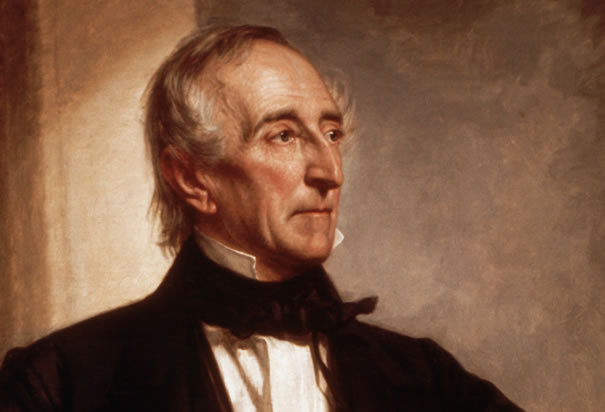
And Tyler too! ... John Tyler, born in 1790 to later serve as 10th President of the United States has two grandsons who are still living.

And Tyler too! … John Tyler, born in 1790 to later serve as 10th President of the United States, has two grandsons who are both still living.

Like me, you may have read or heard the incredible story sometime in the past year that our 10th president, John Tyler, who was born in 1790, still has two living grandsons. Writer Dan Amira wrote an article for the Daily Intelligencer exactly a year ago on May 27, 2012.  Like many things lately, the light was a little late reaching this still eager mind with the tired eyes, but it arrived – and it landed with excited amusement for me over this incredibly improbable news.

http://nymag.com/daily/intelligencer/2012/01/president-tyler-grandson-alive.html

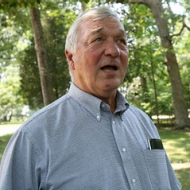
Harrison Tyler, 2006 Grandson of John Tyler

Harrison Tyler, 2006
Grandson of John Tyler

It’s all in the article, but here’s the easiest line to follow on how it matches up for Harrison Tyler, the grandson interviewed by Amira for his column report:

(1) President John Tyler was born in 1790, back in George Washington’s first term.

(2) Tyler’s son, the one who became the father of Harrison Tyler was not born until 1853, when the aging former 10th President was already age 63,

(3) That prolific son of the old president did not become father to Harrison Tyler until 1928, when the mn was already 75 years of age.

(4) Harrison Tyler is now 84 and will turn 85 before 2013 is done. He lives at the Sherwood Forest Plantation in Virginia that once belonged to his grandfather, President John Tyler. This time last year, he was still playing tennis.

The article does not reveal if Mr. Harrison Tyler has plans for having any more children of his own.

… and while we’re at it, let’s also “Remember the Astrodome” beyond today and into all the tomorrows that shall ever be. A writer named named Jere Longman has written one of the best articles we’ve ever seen this morning on why the grand old girl of Houston’s place in architectural history should be spared the ignominy of the wrecking ball. We also want to thank friends Tal Smith and Darrell Pittman for alerting The Pecan Park Eagle to the story. The Astrodome truly is – Houston’s Eiffel Tower.

Check it out:

http://www.nytimes.com/2013/05/27/sports/houstons-astrodome-may-be-dirty-and-dated-but-it-is-irreplaceable.html?_r=1&

Buff Biographies: Gerry Burmeister

May 26, 2013
Excerpt from "Your 1948 Houston Buffs, Dixie Champions: Brief Biographies By Morris Frank and Adie Marks (1948).

Excerpt from “Your 1948 Houston Buffs, Dixie Champions: Brief Biographies By Morris Frank and Adie Marks (1948).

Gerry Burmeister (BR/TR) (6’2″, 210 lbs,) was almost everything we always used to think a catcher should be. He was a good career hitter for average, as his .275 BA over 13 seasons (1937-44, 1946-50) showed, but his 66 HR over the long all-minor league haul also revealed his lack of power. He was slow afoot, but his strong throwing arm and mature leadership on defense guided both the Buff pitchers and field defense over the course of 5 seasons (1941, 1946-49) in the Bayou City. Burmeister played one more season after he left Houston and moved up to AAA Syracuse in the Cincinnati farm system after being dealt away by the Cardinals, and that was it. At age 32,  he retired and went back to his now permanent married life home in Houston as just one more pretty fair ballplayer of the reserve clause era. In spite of what it says in the Frank/Marks 1948 sketch above,  Gerry never got that proverbial cup of java in a big league game for so much as even a modest Moonlight Graham or Buddy Hancken one-inning in the field with no trips to the plate major league appearance. It simply didn’t happen.

Burmeister’s signature career stop was with the Houston Buffs, and Gerry’s ‘s best season as a Buff was 1948, when he hit .267 with 8 HR. Gerry did get into 93 games for the 1947 Dixie Series Champion Buffs, but he batted only .210 with a single homer that big team year.

Gerry Burmeister died about 20-25 years ago, but I am unable to confirm his specific date of death at this writing. He’s not showing up in the vital statistics records on-line for Harris County, Texas and I have no data of him passing away elsewhere. If any of you Ancestry.Com whiz kids know how to get it, please post the DOD as a comment on this article. For whatever help it may be, Gerald William Burmeister was born on August 11, 1917 in Harmony, Minnesota and I’m fairly sure he died in the Greater Houston area.

Baseball Reference.Com also mistakenly lists Burmeister as still alive at age 95:

http://www.baseball-reference.com/minors/player.cgi?id=burmei001ger

Happy 57th, STHS Class of 1956!

May 25, 2013
Yesterday, When We Were Young.

Yesterday, When We Were Young.

Dear Fellow Classmates of St. Thomas High School, 1956,

Unless I missed the date by a day or two, it was 57 years ago today, on May 25, 1956, that all of us, and more than a few now of our departed brothers, all graduated from dear old St. Thomas High School to live our lives and grow and love and test our dreams and survive heartbreak and come out the other side stronger for having come through each learning crisis long enough to have harvested all its lessons.

Time bends strangely into irony, with events seeming, more and more, long ago and only yesterday, in the same flash point of recollection.

Fifty-Seven Years! Where has the time gone, friends?

So long ago ~ so near at hand,

It’s not for us ~ to understand,

The dreams that lived ~ the loves that clung,

To us, last night – when we were young.

Happy Memorial Day, Fellow Eagles!

Hope to see all of you again soon!

Love and Peace to all of you now ~ and to all others who understand the harvest of this experience over time,

As Always ~ Regards ~ Bill McCurdy

Buff Biographies: Before Loel Passe

May 25, 2013
Excerpt from "Your 1948 Houston Buffs, Dixie Champions: Brief Biographies By Morris Frank and Adie Marks (1948).

Excerpt from “Your 1948 Houston Buffs, Dixie Champions: Brief Biographies By Morris Frank and Adie Marks (1948).

Lee Hedrick may have received the most publicity of any man who ever served as a play-by-play radio man for the old minor league Houston Buffalos. And he got it when Morris Frank and Adie Marks included him in their 1948 “Brief Buff Biographies” autograph book.

Too bad we don’t know more about early 20th century electronic media coverage of baseball than we do.

There remains a need for further research on the radio station involvement and play-by-play announcing history of Houston Buffs Baseball from 1925 forward. KPRC-AM went on the air in Houston on May 9, 1925 as the oldest surviving commercial radio station in Houston. Another short-lived Houston station, WCAK, existed as early as 1923. The probability that baseball first reached Houston homes via the airways of either WCAK or KPRC hovers at 100%, and even prior to the Buffs move into the new Buff Stadium three years later.

We do know that Bruce Layer of KPRC handled the play-by-play on the first radio game from Buff Stadium on Opening Day of the very first season in the new venue, April 11, 1928, however, further work is needed on the name(s) of those who took over from there. The same Houston Post-Dispatch article that told us of Layer’s splash on that special day also made it implicitly clear that he was simply doing Opening Day 1928 that one time for the sake of going into the books as the first radio game announcer from Buff Stadium. As sports director of host station KPRC, it was Bruce Layer’s prerogative, and he took it as a record that he wanted for himself. The names of those who took over from there were not listed.

Things stay fuzzy from 1928 through 1942 as to which stations and what announcers handled the radio for Buffs games. When the Texas League resumed in 1946, following the three-year shutdown for World War II, some station and announcer must have handled the games, but the same “which” and “what” queries still apply to that first season of the post-war era.

We do know that Lee Hedrick of KATL-AM did the play-by-play for the 1947 Dixie Series champion Buffs and that he continued to broadcast Buff games, at least, through 1950, the first season for Loel Passe at KTHT-AM. I’m not positive that 1950 was the only year for more than one radio station broadcast, but that’s how I remember it. Further work in that area is also needed.

Loel Passe was the lone word in Houston radio game broadcasting after 1950, or when Lee Hedrick actually departed, but Gene Elston did reach town in time to work with Loel in 1961, the last season of minor league baseball in Houston.

Television broadcasts began over KLEE-TV in 1949 with Guy Savage as the first announcer. When the same station became KPRC-TV in 1950, Dick Gottlieb worked himself in as the TV play-by-play man, staying long enough to be the man on duty in 1951 when a mentally disturbed drinking fan shot himself to death on TV during a Buffs game.

Other names come to mind as TV voices from the 1950s Buff games, but in no particular order  – or in complete form. These include: Bruce Layer (again), former big leaguer Gus Mancuso, and KPRC radio guys like Lee Gordon. There were others.

The bottom line? Far more research is needed.

The Beeville Bee

May 24, 2013
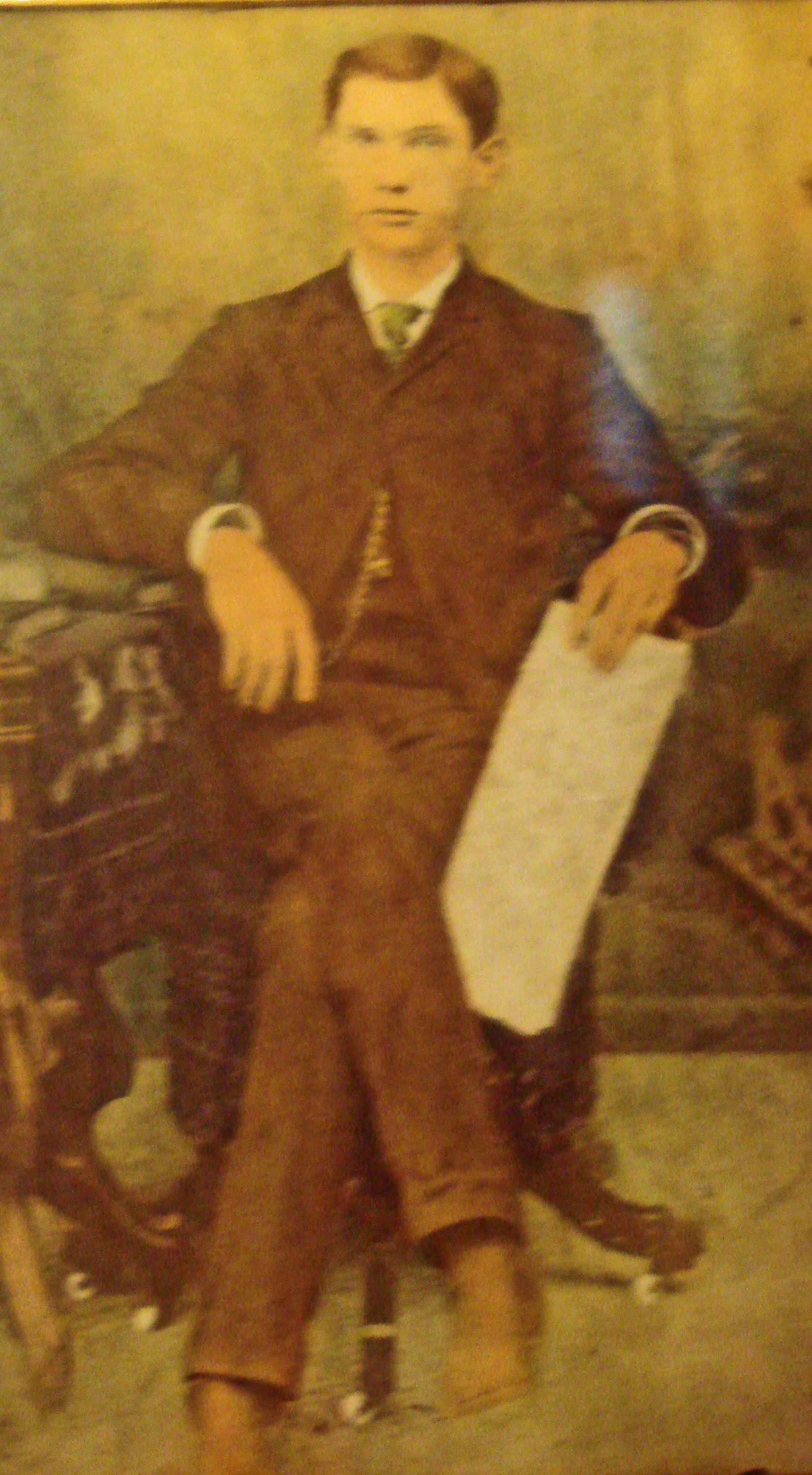
The Beeville Bee, Beeville, Texas, Founded in 1886 by W.O. McCurdy, Age 20.

The Beeville Bee, Beeville, Texas, Founded in 1886 by W.O. McCurdy, Age 20.

W.O. McCurdy Publisher & Editor The Beeville, Bee Beeville, Texas

W.O. McCurdy
Publisher & Editor
The Beeville, Bee
Beeville, Texas

I never met my grandfather. He died of tuberculosis at age 47 in a San Antonio hospital in 1913, about 24 and one-half years prior to my birth in 1937. Santa Rosa Hospital was the same place where Hall of Fame pitcher Rube Waddell would also die, just about a year later at age 37.

My grandfather’s name was William Oscar McCurdy. My father and I were both named for him. He came to Texas from Mississippi in 1886 at the age of 20 and, with a lot of street smarts, hustle, and 19th century “buzz energy”, he single-handedly started The Beeville Bee, a newspaper that still exists today as the consolidated Beeville Bee-Picayune.

What a challenge that must have been. Starting out with a simple George Washington hand press in a reasonably rented loft above a barn, grandfather started cranking out a twice weekly paper while serving also as the Bee’s reporter, writer, editor, printer, publisher, subscription salesman, and circulation director.

He brought with him a classic home education by an itinerant “professor” who lived with the family back home for several years as he home-schooled the McCurdy children in exchange for room and board. He was a classicist, teaching math, science, and literary classics on top of the basic three “R’s” from about age six forward. So, after nine years of same, grandfather graduated himself and moved to Texas in search of his own purpose in the world. After four years of apprenticeship in Victoria, he landed in Beeville and started scraping for his place in the sun as a gentleman of the press.

What a challenge that must have been. Prior to the coming of the telegraph to Beeville in about 1887, the Bee had to reply upon the stories that grandfather could either cover or editorialize about on his own, the “write-ups” of local “doings” that people mailed in, and what the industry back then called patent news stories that the paper received by mail of national events that came in blocks of type that were already in print form.

Even in his early 20’s, grandfather was on top of the fact that “timeliness” was important to anything that went to print, important even in the slow backwater currents of a place like Beeville. In the spring of 1887, some readers in Port Lavaca sent Editor McCurdy a “write-up” of their “Christmas doings”, even though it would mean going to print now only days prior to Easter. Grandfather rejected the story, using part of the freed space to explain his reasons in the following way: “Our local contributors to the Bee need to keep in mind this simple fact: The hoary hand of time has quite a different effect upon local news than it does on homemade wildcat whisky or wine. It doesn’t get better with age.”

When Beeville finally got the telegraph on the heels of the S.A.A.P. railroad that now made a local stop on its way in town, media man McCurdy was in seventh heaven. “Now Beeville is in contact with the outside world,” wrote Editor McCurdy.

Sometimes Editor McCurdy got in a little Dutch trouble with his local readers. When the State of Texas was trying to decide where to build another large state insane asylum, grandfather editorialized this appeal in behalf of Beeville: “If the State of Texas is looking for a geographic locale that will save taxpayers a lot of money on the business of moving lunatics from their homes to the nearest nut house, Beeville would be the perfect site for the new state insane asylum.”

In trying to attract more of the industrious immigrants from Germany that came to Texas in the late 1880’s, Editor McCurdy wrote a long piece which extolled the hard-working, organized nature of German character that made them attractive to the City of Beeville as welcome new neighbors. Then he concluded with … “just because the Germans are also known to sometimes get drunk, miss church, and spend the day playing ball on Sundays, it is not our place to judge them harshly.”

On May 3, 1889, Grandfather McCurdy penned an editorial for the Beeville Bee that probably best summarizes his ideas on what the public expected of their newspaper people back in his day:

“The Mason (TX) News wants an editor who can read, write, and argue politics, and, at the same time, be religious, funny, scientific, and historic as well; write to please everybody; know everything without being told; always have something good to say about everybody else; live on wind; and make more money than enemies. For such a man, a good opening will be made in the graveyard.”

Go back to sleep, Grandfather. You apparently did your part – and did it very well. I could never talk with grandmother about you as a kid and young man without walking away wishing that we could have enjoyed, at least, one conscious day with each other. I had to age a little more to wake up  to the fact that I had been wasting my time and energy on that wistful lamentation. You’ve been with me every day of my life.

Does 2017 Super Bowl Force Dome Action?

May 23, 2013
Once Upon a Time, she was was known to one and all as the Eighth Wonder of the World.

Once Upon a Time, she was known to one and all as the Eighth Wonder of the World.

OK. let’s see here. Houston just got awarded the 2017 Super Bowl – and the decision comes in the middle of renewed hot air talk about various futures for that all but abandoned structure to the 1000 feet-immediate east of Reliant Stadium, the home again host of the projected 51st NFL championship game. That other structure, of course, is today a mere ghost of what it once proudly represented itself to be as “The Astrodome: Eighth Wonder of the World.”

Wonder no more.

For developers, the Astrodome today is little more than an ugly spot on the landscape that needs to be torn down as room for a larger Reliant Complex parking lot. For preservationists, the Dome is a place of significant history to both the City of Houston and the world of architecture. They argue that the place needs to be converted to another purpose, but a myriad of their ideas all share a common foundation. They come to light without the massive funding that will be required to get their various plans off the ground. Hence, the earlier “hot air” reference.

Many long-time Houstonians grew up going to Astros and Oilers games at the Astrodome. They feel sad and sentimental about the decline of the old place, often expressing baleful wishes that something needs to be done to save the world’s first domed multi-purpose sports and major event center from the wrecking ball. Unfortunately, the most passionate preservationists seldom have the money needed to do anything personally about expensive problems like the Astrodome.

Two or three months ago, the word was out that Houston might have to tear the Astrodome down and turn it into that parking lot just to have a chance at getting the 2017 Super Bowl award. So, if that were true, what does it say that the Old Folks Dome still sits to the east, blocking the sunrise over Reliant every morning, even though Houston got the Super Bowl bid, anyway?

Was some kind of deal about the Dome reached that we don’t know about? Even if it was not, does the coming Super Bowl now put pressure upon Harris County to make a decision and actually find the money for either the restoration or demolition of the Astrodome by 2017?

What do you think? Will the 2017 Super Bowl force local action on the future of the Astrodome? Or will it just be sitting darkly there, pretty much as it appears in this photo, no business as usual, when the 2017 Super Bowl comes to town?

Please post your ideas here as comments on this story.

Buff Biographies: Jack Creel

May 22, 2013
Jack Creel's best wins season with the Houston came in 1949 when he was 16-10, 3.39 for a 7th place club.

Jack Creel’s best wins season with the Houston came in 1949 when he was 16-10, 3.39 for a 7th place club.

Pitcher Jack Creel enjoyed a 179-157, 3.37 ERA record over 15 seasons (1938-44, 1946-53) in the minor leagues. In his one season with the big league 1945 St. Louis Cardinals, Creel went 5-4 with a 4.14 ERA. Unfortunately, an arm injury stopped Creel in 1945 and he never returned to major league play.

Jack Creel’s story was a familiar one for pitchers during the 16 MLB club, reserve clause era of professional baseball. With so few openings at the top, pitchers often threw as hard or as well as they could, for as long as they could do so without complaint. “Minor” twinges in the arm were most often ignored in deference to the code of manliness, but also in fear of being passed over by some other pitcher who played the game without “complaining”.

Former Buffs outfielder, the late Jim Basso, used to put it this way for ball players in general from that day and time: “We were afraid to take time off for injuries. We were afraid of taking the time off and then coming back to find some other guy using our locker and wearing our jock strap. We just played until we couldn’t play.” For pitcher’s of Basso’s post-World War II period, his advice meant “pitch until your arm fell off and then they dragged a one-armed man from the mound and sent him back to the minors to get well doing the same things that got him hurt in the first place in the bigs.”

Sports medicine wasn’t all that great back in the day either. Pitchers relied a lot on liniments and corrective surgeries were often suspect acts of guesswork that often made things worse. After 1945, Jack Creel was 8-11, 4.19 for the AAA Columbus Redbirds before returning to Houston and posting a 14-10, 2.63 mark for the 1947 TL and Dixie Series Champion Houston Buffs. Creel had some kind of arm surgery during the 1947-48 winter and then followed that step with a 12-10, 3.52 record for the 1948 Buffs. By this time, he was 31 years old and well out of range for another shot in the prospect-rich Cardinals farm system.

Jack Creel pitched five seasons (1942, 1946-49, 1952) for the Houston Buffs, posting an overall record here of  61 wins and 47 defeats. When he was on, the native of Buda, Texas and cousin of big league hurler Tex Hughson was a hard-throwing strikeout artist who sat batters down with a wish that the game was already over.  And he was a good man, just limited in accomplishment by the knowledge, conditions, and expectations of his time in the game. He rode in the boat with everyone else, however, and with much company on the “disappointed outcome” side of things. It was simply the way things were.

Jack Creel died in Houston in 2002 at the age of 86.