Posts Tagged ‘Houston Buffs’

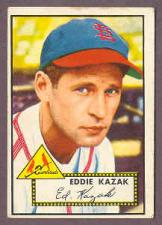
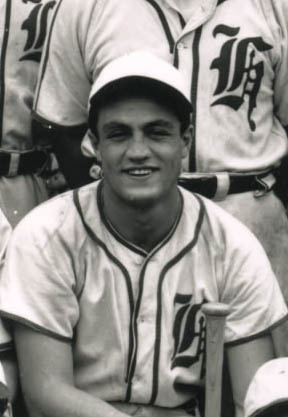
Gerry Burmeister: Five Times a Buff!

May 27, 2010

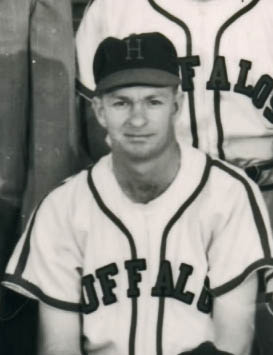
Gerry Burmeister, Catcher, Houston Buffs, 1941, 1946-49.

Gerry Burmeister was already in place as catcher of the Houston Buffs when I first plugged into paying attention to baseball back in 1947. He had joined the Buffs in 1941, returning after World War II to begin a four-season run as the main man with the mask in 1946. For the last three seasons of his Buffs tenure, I couldn’t imagine the day coming when some other guy would hold his spot. Gerry Burmeister was our man – the man who led and took good care of great Buff pitchers like Al Papai, Clarence Beers, Cloyd Boyer, Jack Creel, and Pete Mazar.

Burmeister was another of those talent-rich Cardinals farm hands of the post World War II era that never got so much as a single time at bat in the major leagues, but, as a catcher, he was extremely important to the parent club in bringing along mound talent for National League competition. A catcher with his field accomplishments in 2010 would surely be expecting a direct shot in the big leagues, but, as we always ending saying in some form – that was then and this is now.

The 6’2″, 205 lb. Gerry Burmeister was born on August 11, 1917. He’s been dead for several years now, but I simply do not hand that specific data on hand or accessible at this writing.

In his 13-season minor league career (1937-44, 1956-50), and all but the last year spent in the Cardinal organization, Gerry Burmeister (BR/TR) batted .275 with 66 career home runs. Those were pretty good stats for that era. Heck. They are pretty good production for a catcher from any era, especially one who managed pitchers well and also exercised pretty good control over runaway baserunner wannabes. Burmeister was a winner of the first order as a performer in the higher levels of minor league baseball back in the most popular period of public attention to professional baseball at every level of play.

Gerry Burmeister retired to life in the Houston area following his baseball career and he was a regular at old-timer games and Houston Buff reunions through the remaining period of his life. He was well liked and highly respected by all the former Buffs I know.

Caps are off to your memory this morning. Mr. Burmeister. As a kid who grew up watching you play as I tried to learn all I could about our wonderful game of baseball, I just want to say, “Thanks for the memories!”  And thanks for the lessons too!

Bob Clear: The Rest of the Story.

May 23, 2010

Bob Clear wore 17 different club uniforms from 1946-1967.

I had a very interesting comment from a fellow named Mike Ross in response to a brief piece I wrote three days ago on the death of the late Bob Clear. It reminded me again of how much there is to wonder about in the way human energy moves forward, for better and worse, in its play of influence upon others.

So much hinges on whether we give or withhold from others.

As a longtime minor league instructor and bullpen coach for the Angels, Bob Clear was one of the two main voices who suggested that the club take a bad-hitting catcher named Troy Percival and convert him into a relief pitcher. Of course, we know what happened from there. Percival went on to become one of the top closers in the game.

Clear also exerted an enormous amount of influence upon a young catcher in the Angels system. Although this particular player never made it to the big leagues as a player, he learned how to be a teacher of others from another fellow who never played in the big leagues either. Today that young catcher is now middle-aged but quite successful as the manager of the Tampa Bay Rays. According to Mike Ross, Maddon credits the late Bob Clear with being the most important mentor in his baseball life.

It’s a small world, except for one big always-present wild card crazy thing. – The more we become willing to share what we have to give with others, the more our world of connection grows and spreads across the lily pond of human experience on how to improve upon and solve all kinds of human-initiated problems.

Maybe if we had more Bob Clears working in offshore drilling technology we wouldn’t be facing the mess we now have on our hands. Who knows?

All I know for sure is that I just had to bring you this rest of the Bob Clear story. The details of Bob’s later baseball career are beautifully covered in an article about him on Wikipedia. Just Google “Bob Clear” and go there for further details.

Roy Broome’s Unforgettable Homer!

May 21, 2010

In 1951, Houston Buff Roy Broome hit a monster opposite field HR to right field at Buff Stadium. Anyone who saw it leave the planet could not possibly forget it.

For better or worse, how many big league ballplayers are remembered mostly for that one thing they did that changed the course of baseball history? Bobby Thomson (New York Giants, 1951) and Bill Buckner (Boston Red Sox, 1986) jump immediately to mind. Others abound.

Move the same question to career minor leaguers and you have to reshape the consequence end of it too. At least, for me, you do. I can’t think of any single act by a career minor leaguer that both totally shaped the way fans see him and also altered the course of baseball history, but I can sure call to mind a former Houston Buff who surely framed the way five to six thousand people at Buff Stadium on a summer night in 1951 remembered him forever.

The guy I have in mind is the late Roy Broome (BR/TR) (5’11”, 160 lbs.), an eleven-season minor leaguer, mainly in the Cardinal system from 1940-42 and 1946-53. Broome hit pretty well as a minor leaguer, finishing with a .290 career batting average. He only hit 89 career home runs in 5,419 official times at bat and he managed only 2 long balls for the 1951 Buffs in his short, 41-game, 157-times at bat tour as a Buff hitter.

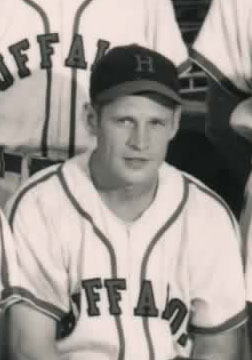
Roy Broome was a 1951 Buff long enough to do two memorable things: (1) he was here long enough to be included in the official Buffs team photo; and (2) while he was here, he hit one of the longest, most surprising opposite field home runs in Houston Buffs history.

Time has erased everything else about that game moment in my mind except for the act itself. That much of it, I’ll never forget, as my dad and I watched from the first base grandstands. I don’t recall the opposing team or the game situation, or even the impact of the home run on the game itself, I simply remember what I saw. and that the game was played at night. Because right-handed batter Broome hit the home run to right field, I’ve often imagined over the years that it was cracked off some power pitcher like Bob Turley of the San Antonio Missions, but I don’t know that. One of these days I need to research the specifics of this event at the library. After all, he only hit two of them as a Buff – and it would be interesting to read whatever Clark Nealon or others said about it.

On a typical summer night at Buff Stadium, the wind blowing in and across from right field was not friendly to aspiring home runs. “Broome’s Blow” rose above the obstacle.

The mighty blow from Roy Broome’s bat took off on a Ruthian high arch toward the far right field wall, reaching an apex almost instantly and then gently floating above the low to the ground winds, riding them like a surfer takes on the big waves of Oahu’s eastern shores. It danced on the winds as a small speck of white and then it just seemed to vanish in the high-in-the-sky darkness beyond the right field wall. It must have come down some 500-600 feet away on the other side of Cullen, too far back into the world beyond baseball for us to track it by the light of the Buff Stadium arc lamps.

The reaction of fans to “Broome’s Blow” was not your typical fairly immediate cheer. The resounding crack of the bat and startling visual that I just so inadequately tried to describe here had a hushing effect upon all of us. I’m sure any camera focused upon us fans in that moment would have revealed a sea-face of dropping jaws and startled bug eyes. We were all too amazed to express much of anything. Add to it the fact that none of us expected anything like this from little Roy Broome – and to the opposite field, no less. By the time Broome had rounded third base, head for home, Buff fans had risen to their feet to applaud him what he had just done. As I recall, a smiling, blushing Roy Broome was then called upon by the continuation of that applause to make a couple or three curtain doffs of the cap from the Buffs dugout too as teammates slapped his back and playfully kidded him.

Broome was hitting .268 for the Buffs when he was soon promoted after this event to AAA Columbus of the American Association. We Houston fans hated to see him go. Unfortunately, Roy Broome turned out to be another talented Cardinal prospect who never got to see the light of day in the big leagues.

Roy Wilson Broome was born on February 17, 1921 in Norwood, North Carolina. He died on October 11, 1993 in Gastonia, North Carolina.

Thank you, Roy, for once upon a time in 1951 being that blind hog that Darrell Royal of UT used to talk about. You found your acorn in the woods as a Houston Buff. It didn’t change baseball history, but it left a lot of us with an awesome lifetime memory.

In Memoriam: The Late Bob Clear.

May 20, 2010

Former Houston Buff Pitcher Bob Clear Passed Away on April 6, 2010 at Age 82.

I only this morning learned that former Houston Buff pitcher Bob Clear (1951-53) passed away on April 6th at his home in California. He was 82 years old.

Bob Clear (BR/TR) (5’9″, 170 lbs.) never was a guy fans confused with the second coming of Dizzy Dean. He was never little more than a short-time, fill-in spot starter/reliever on the 1951 Texas League championship Buffs club and a regular low performing guy with the not-so-hot Buff teams of 1952 and 1953, but he was a hard worker who got by on guile and an ability to mix and locate his pitches.

Bob never made it up to the big club Cardinals during those pitcher loaded farm stock years, but he managed to ping out a pretty fair record for himself over 16 seasons in the minors (1946, 1948-61, 1967). Overall he won 162, lost 115, and posted a 3.72 career earned run average.

As a Houston Buff, Bob Clear was 1-2, 8.13 in only nine games in 1951. In 1952, Clear was 9-12, 3.45 – and 4-6, 3.35 in 1953 – and all together, not a lot to write home about.

Clear experienced his best season in baseball the year following his last 1953 Buffs year. Moving up to the 1954 AAA Omaha Cardinals, Bob recorded a 20-11 season with a 2.93 ERA. The showing still failed to earn his shot with the ’55 St. Louis club and his record for that season at Omaha slipped back to 1-10 and 4.42 in partial time service. Clear may have been injured in 1955, but I have no way to check that out at this writing.

For his career, Bob Clear posted two additional 20-plus win seasons (at Class C- level each time) for 1957 Douglas and 1960 Grand Forks. Clear’s career had a chance to end quietly in 1961 with a 4-5, 5.05 final season, but he came back on a two-game lark in 1967 at age 39 to go 1-0 with a 1.64 ERA in two relief jobs for Class A Clinton.

After 1967, Bob Clear never played another inning. He eventually retired to civilian life and lived out his final days in Rancho Palos Verdes, California.

Bob Clear was born on December 14, 1927 in Denver, Colorado. He gave his early productive life to baseball and he played three seasons for our Houston Buffs. That’s enough resume to make it into my memory bank.

Time flies. The last time I saw Bob Clear he was the same age and about the same size as my 25-year old son Neal is now. (Yep, my kid’s only 25. I was a late bloomer in several areas.)

Now I suddenly learn from an Internet data site on minor league baseball that young Bob Clear has recently died at age 82. Where has the time gone – for Bob Clear – and all the rest of us too, for that matter? We really don’t have a long time to be here, do we?

The death of anyone I’ve ever known always makes me think of that old poem by some anonymous author. It begins with this line: “The clock of life is wound but once and no one has the power, to know just when the hands will stop, at late or early hour.”

My positive thoughts and prayers go out to the Bob Clear family this morning.

Long live our memory of the Houston Buffs. All of them.

Hal Epps: The Mayor of Center Field.

May 12, 2010

Mr. Mayor Himself, Hal Epps!

During their 1947 Texas League and Dixie Series championship season, they called Hal Epps by a nickname that fit well with his ability ti patrol the deep central pasture at Buff Stadium. Hal Epps was known as “The Mayor of Center Field’ for the speed, agility, arm, and intelligence he brought to the job as center fielder for the Houston Buffs.

Epps also was no slouch on offense in 1947. He batted .302 in 136 games, banging out 24 doubles, 15 triples, and 6 homers along the way. “Clutch” could have been his middle name, Time and again, Epps supplied the key hit in a late inning Buffs rally. He was the guy that you wanted at the top of the order and the fellow you wanted in center when it was time to take the field.

Beyond watching my dad play, Hal Epps was the first outfielder that ever drew my attention in the summer of 1947. I was nine years old and watching Buffs baseball for the first time in my life. I wasn’t analyzing anything back then. All I knew is that I wanted the Buffs to win and that Hal Epps seemed to be a big part of helping the Buffs reach that outcome, Right after second baseman Solly Hemus, my first Buffs hero in 1947, Hal Epps rode into my mind and imagination next as the great rescuer of hope for victory. As a kid, Solly Hemus and Hal Epps were the guys I wanted to se coming to the plate more than any others when the Buffs really needed a run to get back into a game. Funny thing is – that wasn’t a hard crush to embrace. Those were the same Buff players that most grown ups wanted to see in the clutch as well.

Hal Epps (BL/TL) was born in Athens, Georgia on March 26, 1914. He played a 15-season minor league career (1934-43, 1947-49, 1950-52) and a 4-season major league career with the St. Louis Cardinals (1938, 1940), St. Louis Browns (1943-44), and Philadelphia Athletics (1944). Epps batted .300 as a  minor leaguer and .253 as a big leaguer. His defense was always impeccably strong. He simply didn’t hit well enough (or lucky enough, often enough) to get more opportunity in the big leagues during that very talent-crowded, totally owner-controlled era of the reserve clause.

Hal Epps had a long, scattered-over-time history with the Buffs, playing for the club in 1936-39, 1941-42, and  1947-49. Following his retirement from baseball after the 1952 season, Hal settled in Houston and lived out his life quietly from there as a steel worker, raising his family and being the good dad and father that we all aspire to be, He cared nothing for the spotlight or making speeches – and he held on to a kind of shyness about public appearances or utterances for the rest of his days.

I didn’t get to meet Hal Epps, one of my first two Buff baseball heroes,  until the September 1995 Last Round Up of the Houston Buffs. He was quiet, friendly, and reserved, but very real. Everything about the soft-speaking gentleman said, and without words, “this is who I really am. I’m just grateful to have lived out my life as i did with no regrets.”

Who among us could ever really ask for anything more? And how many of us actually pass into our sunset years with that kind of honest settlement with ourselves that fully in place? If we come close to the peace of an aging Hal Epps, we are most fortunate. Crowds made Hal nervous, but he was happy with himself and how he had lived his life. And he loved the game of baseball to the end.

Hal Epps passed away in Houston at the age of 90 on August 25, 2004 and he was buried in a military service held at the National Cemetery on Veterans Memorial Highway as a result of his honorable military service in World War II. By the way he lived his life and played the game of baseball, Hal Epps left this world as a distinguished example of how one member of the “Greatest Generation” walked those values of integrity and loyalty without even trying.

That is just who he was. I simply was blessed to have crossed his path on a golden late summer Sunday in 1995.

The 1931 Dixie Series: Houston v. Birmingham.

May 1, 2010

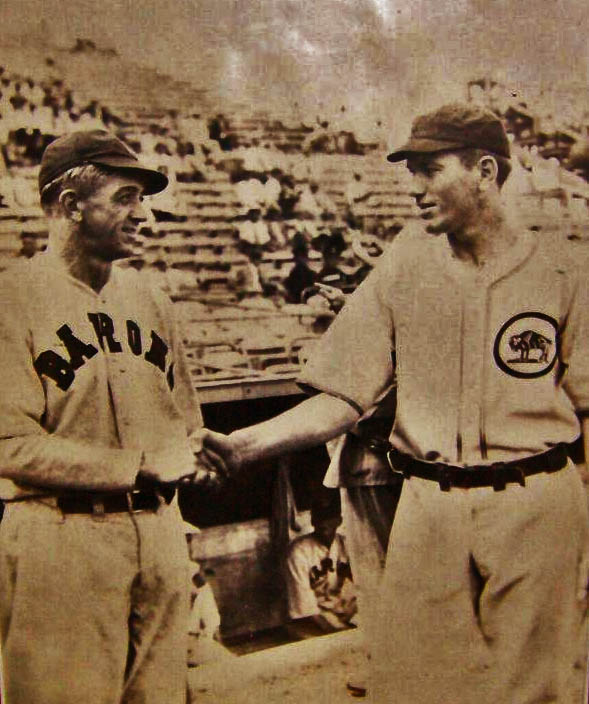
Ray Caldwell (age 43) of the Barons faced Dizzy Dean (age 21) of the Buffs in Game One.

The 1931 Texas League Champion Houston Buffs (108-51, .679) were supposed to walk all over the Southern Association Champion Birmingham Barons (97-55, .638) in the Dixie Series, but it did not happen. Led by rising star hurler, the 21-year old Dizzy Dean (26-10, 1.57) and the slugging young outfielder and next great future Gas House Gangster Joe Medwick (.305, 19 HR), the Buffs were on the tab as heavy favorites to take it all, but this would be another of those Aesop examples of the race going to the wiser over the swift.

Game One: 9/16/1931. Rickwood Field, Birmingham, Alabama: Barons 1 – Buffs 0.

43-year old Ray Caldwell (19-7, 3.45) wins a pitcher’s duel with Dizzy Dean. Barons lead the Series, 1 game to 0.

Game Two: 9/17/1931. Rickwood Field, Birmingham, Alabama: Buffs 3 – Barons 0.

Because Tex Carleton (20-7, 1.90) is injured and unable to play, the Buffs are allowed to borrow 25-year old Dick McCabe (23-7, 1.97) from Texas League rival Fort Worth as Carleton’s replacement for the Dixie Series. McCabe promptly shuts out the Barons to square the Series at 1-1. (The quality of mercy overflowed back in those days, I guess. Can you imagine last year’s 2009 Yankees allowing the Phillies to borrow Valverde from Houston, had Lidge been injured and unable to play in the World Series?)

Game Three: 9/19/1931. Buff Stadium, Houston, Texas: Buffs 1 – Barons 0.

The Buffs shut out the Barons again behind 42-year old George Washington Payne (23-23, 2.75) to take a 2-1 led in Series games won.

Game Four: 9/20/1931. Buff Stadium, Houston Texas: Buffs 2 – Barons 0.

Dizzy Dean comes back with a vengeance, His shutout of the Barons takes the Buffs to  3-1 Series lead and an over-confident cliff of hoping they will finish the Series at home the next day.

Game Five: 9/21/1931. Buff Stadium, Houston, Texas: Barons 3 – Buffs 1.

Clay Touchstone (15-11, 4.76) saves the day for Birmingham as the Barons win to force the Series back to Alabama with a 3-2 Houston lead, but with “Mr. Mo” now shifting back to the Southern Association boys.

Game Six: 9/23/1931. Rickwood Field, Birmingham, Alabama: Barons 14 – Buffs 10.

The Barons rack four Buff pitchers for 23 hits to even the Series and set up one final winner-take-all game featuring Dizzy Dean going up against 35-year old Bob Hasty (21-13. 3.67). The 3-3 Tie in the Series has Buff fans back home pulling their hair. Their major consolations are that Dean is pitching the deciding contest and that Game Seven will be played at home in Buff Stadium.

Game Seven: 9/25/1931, Buff Stadium, Houston, Texas: Barons 6 – Buffs 3.

Dizzy Dean strikes out five in the first two innings, but he cannot hold onto his dominance of the Barons. By the end of eight innings, the Barons led by 3-2. The visitors add three more runs in the top of the ninth, even though it’s not all on Dean. Two of the runs are unearned, but they still add up to a 6-2 Birmingham lead with the Buffs coming up for a final time at bat. – Once the Buffs push across a run with one out in the bottom of the ninth, Barons manager Clyde Milan pulls Hasty for an unnamed save opportunity that he hands to old warrior Ray Caldwell. Buffs manager Joe Schultz plays the hand he owns, sending Joe Medwick and Homer Peel out to face the old run-stopper. – Medwick fans and Peel slips easily into a 4-3 ground out to end the game and the Series.

Houston and Buff Stadium are stunned into silence. The Birmingham Barons go home to Alabama as the 1931 Dixie Series Champions.

Like a legion of other Buff fans, my (Grand) Papa Willis Teas was very unhappy with the outcome of the 1931 Dixie Series.

My Mom’s family lived in the Heights in 1931. My maternal grandfather Willis Teas, the man we all called “Papa”, was very unhappy with the Buffs loss, but he also liked to later use this story as an example of how we can never take anything for granted in life. The Buffs may have won this Series in their own minds in advance, but they didn’t then go out and win it on the field, according to Papa.

These also were the early years of the Great Depression, when some even harder lessons about taking things for granted were raining down on Papa and lot of other folks caught up in the great economic and agricultural dust storm. I think Papa saw that comparison too. He just didn’t talk with me about it in the years that followed. I wasn’t even around in 1931 – and I was still too little to learn much of anything about economics during Papa’s lifetime.

The lesson for me came down to this statement by Papa: “Don’t count your chickens before they hatch, even if you have Dizzy Dean sitting on the eggs.”

A Houston Buffs Souvenir Mitt Mystery.

April 29, 2010

The Souvenir Buffs Mitt is About 5″ Tall. When was it sold at Buff Stadium?

Yesterday an acquaintance got in touch with me about a souvenir Houston Buffs catcher’s mitt he had just acquired from another collector. This person is a solid Houston Buffs and City of Houston history fan, but he wishes to remain anonymous in this matter that he now shares with everybody else. The question we both have is: When, if ever, was this little (pictured above) item sold at Buff Stadium?  My own guesses are only speculative.

I never saw anything along the line of souvenir gloves for sale at Buff Stadium during the Post World II Era. I recall a few miniature bats and pennants for sale, but I never acquired anything like that as a kid. We weren’t thinking about souvenirs when we went to Buff Stadium back in my day and it’s just as well. Remember what I’ve written here many times over. We played in the sandlot with baseballs held together by electrical tape. There was no money for thinking about souvenirs.

Besides, the style of the glove looks older to me, like something from the early 30s. That sort of works against the idea that souvenirs could have been very appealing to the average Buffs Baseball fans of Houston during the Great Depression Era, but who knows? Maybe they were. We simply lack the proof that this item ever sold at Buff Stadium during any period, in spite of what it says broad as all daylight on the souvenir glove itself. I personally believe that it was once a Buff Stadium souvenir. I just can’t prove it.

Fred Ankenman served as President of the Houston Buffs from 1925 through 1942, the beginning of the World War II Texas League shutdown. Allen Russell took over as President of the Buffs in 1946 and served through 1952. I’m fairly convinced that the souvenir glove in question sold at Buff Stadium somewhere during one of these two periods. It’s too antiquated to have sold beyond the Russell Era – and it’s simply a little impractical to think it sold earlier at West End Park. Buff Stadium didn’t open until 1928.

The back side of the souvenir glove appears to have once been stuck to something.

My friend and I both observed that the marketing decision to actually write the word “souvenir” on the mitt seems a little primitive and unsophisticated by today’s marketing standards, but a lot of items could be judged that way in comparison to the promotion of uniform replica and game-authentic sale of ballpark material in 2010. We have to remember that game replica jerseys and caps have only been around as sales items to fans since the early 1980s. (We sold an authentic game jersey to fans at the University of Houston in 1979, but that’s a much longer story about what probably was the first sale of game-style apparel items to the general  public in America.)

The buffalo figure is remindful of the logo used during the late 20s and early 30s.

If you ever saw this featured Buffs item for sale at Buff Stadium, or if you have any of your own theories on when it might have appeared there, please post them below as comments on this article. Like so many other artifacts of baseball history, the Houston Buffs souvenir mitt comes to light raising more questions than it answers.

Hopefully, it will someday find its way into proper public exhibition and not just get stuck in someone else’s attic or closet for another sixty or seventy years.

Jim Basso: The Old Man and The Baseball Sea.

April 18, 2010

Jim Basso, Houston Buffs, 1946-48.

Jim Basso lived as the personification of the career minor leaguer back in the pre and post World II years. He loved baseball, he played the outfield well, he hit with some punch, he didn’t really have much education or a lot of skills that gave him a good or passionate alternative to the game, and he always dreamed of breaking into the big leagues with some team, somewhere along the way by just hanging in there long enough, showing up every spring, whether he was hurt or not, and giving it his best, no matter where he was playing.

The big leagues never happened for Jim Basso. Sadly, he went to his grave, forever regretting the fact that he never got so much as a single time at bat with any big league club in a regular season game.

“It would’ve meant a  lot to me,” Jim once told me. “Just to know that I had gotten into into the big record book as one of the few players who made it to the big leagues would’ve meant everything to me.”

It wasn’t meant to be, but it surely wasn’t because Jim Basso didn’t have the tools or performance record to at leat earn a trial in the bigs. He simply played in the era of great major league club exclusivity. With only sixteen total big league clubs in both major leagues until expansion started in 1961, Jim Basso belongs to a large, not-so-exclusive legion of lost opportunity. A lot of ball players who would at least get a playing look today never even got there back then. With the reserve clause governing all player movements prior to free agency, a lot of players also missed the majors because the parent club either couldn’t find roster room or didn’t want certain players from falling into the hands of their big league rivals. We will never know for sure how many players actually had their MLB careers denied by a parent club that may have been hoarding talent in the minors in self-defense.

James Sebastian (Jim) Basso (BR/TR, 6’0″, 185 Lbs.) was born in Omaha, Nebraska on October 5, 1919. Signing with the St. Louis Cardinals, but eventually winding his way into the systems of the Reds, Braves, and White Sox, Basso compiled a 13-season minor league record (1941, 1946-57) and a three-season stint as a member of the Houston Buffs (1946-48). Jimmy didn’t even get into a game from the roster of the ’48 Buffs before he was dealt away, but he stayed long enough to make the Houston area and his place in Pearland a permanent residence beyond baseball.

Jim Basso was a pretty fair country hitter. His career batting average was .297 with a slugging average of .464. He racked up 1,815 total hits that included 335 doubles, 57 triples, and 191 home runs. Wow! Do you think a guy with Basso’s stats might have gotten an AB or two in the big leagues somewhere in 2010?

For better, but mostly worse, Jim Basso played hurt.

“You had to play hurt back then,” Jim often said. “If you took a day off to nurse an injury back in my day, you knew that you just might wake up the next morning to find somebody else wearing your jock strap. You couldn’t let that happen. You had to play, even if it made things worse on your injury.”

Jim Basso also played a few winters in Cuba during his career. He even managed to meet Ernest Hemingway when the great American writer invited Basso and some of his teammates over to the house for drinks in the evening.

One day, late in Jim’s life, I drove out to Pearland with former Buff Jerry Witte to visit. During our stay, Jim said he wanted to show me his workshop in the garage so we walked out in the back to see the place in the detached building that held it all. It was quite nice, but the summer heat had turned the place into a boiler room.

It was then that I looked over to a work shelf and spied a single book in place. Since it was a book, I had to walk over and see what it was.

It turned out to be a first edition copy of “The Old Man and the Sea” and it had been personally autographed “To my good friends, Jim and Connie Basso! Affectionately, Ernest Hemingway.”

Ernest Hemingway & Jim Basso in Cuba, 1952, (center); unidentified ballplayers on flanks.

“Jim,” I cried out a little too school marmishly. “You’ve got to get this book inside and out of this light and heat right away!”

“Yeah?” Jim asked.

Yeah!” I affirmed.

Once I explained the problem, Jim jumped on it himself. He picked up the book and took it inside. Then he told me the story of how he and his wife Connie had met Hemingway in Cuba, and how he and his fellow ball players had enjoyed drinking and talking baseball with the great author in the Cuban evenings at Hemingway’s home.

Jim Basso passed away on May 21, 1999 in Pearland, Texas at the age of 79. He took with him so many good stories, a heart of gold, an unending passion for the game of baseball, and that awful nobody-could-take-it-from-him regret that he never got that time at bat in the majors.

Since the Hemingway book discovery, I’ve thought of Jim Basso as the living baseball symbol of the old fisherman in Hemingway’s book. For many years, Jim Basso went down to the Sea of Baseball every morning, always hoping to catch the big fish of big league opportunity. He never even hooked his dream monster, but he never gave up. It was not within his heart to do so. He kept going back to the sea each day for as long as he could. And then he went home each night to sleep. And to dream again of the lions. And to wake up later and read the box scores in the newspapers. And to learn the  latest stories of the great DiMaggio.

Goodnight, Jim Basso, wherever you may now be. To those of us who knew and loved you, you will always be one of our major leaguers. No matter what.
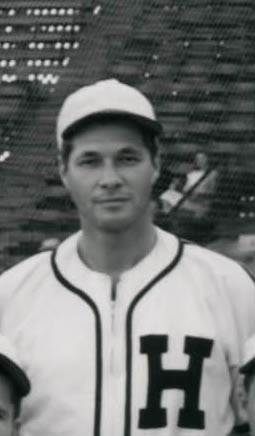
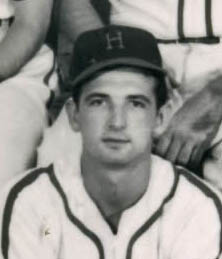
Eddie Kazak, 3B, ’42-’51 Houston Buffs.

March 30, 2010

Eddie Kazak, 3B, '42, '51 Buffs

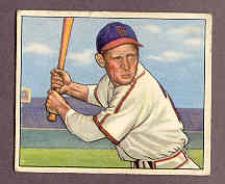
He came here young and left here old. In between his two years of service as a third baseman for the 1942 and 1951 Houston Buffs, Eddie Kazak (6’0″, 175 lbs., BR/TR) of Steubenville, Ohio carved out a pretty fair mostly minor league career for himself in the St. Louis Cardinal system. Born July 18, 1920, Kazak began his first tour with the ’42 Buffs at age 21; he was 32 with three seasons of major league experience at St. Louis behind him by the time he returned to the Lone Star State.

I remember Eddie Kazak as a far superior hitter and fielder at third base than Tommy Glaviano, our column subject yesterday. He was slashing, line drive hitting without a lot of home run power, but the kind of guy that Buff fans trusted in those pinch moments when Kazak came to bat.

Eddie Kazak hit .304 with 13 homers and a slugging average of .474 in 104 games for the ’51 Buffs. His offensive numbers earned him a late season call up to the parents Cardinals. In 1942, Eddie batted only .257 with 5 HR for the Buffs. In 17 seasons as a minor leaguer (1940-42, 1946-60), Eddie Kazak batted pretty darn well. He registered a batting average of .307 with 153 home runs and  slugging average of .445. His best minor league season came after his last gasp as an MLB prospect when he batted .344 with 104 RBI, 19 HR, and a slugging average of .532 for the 1954 Beaumont Exporters as a farm club property of the Chicago Cubs.

Kazak’s major league numbers offensively were adequate to less than inspiring. In five seasons and 238 games (all but the last 13 games were spent with the Cardinals; the final quiet MLB hurrah for Eddie came as a Cincinnati Red), Eddie Kazak batted .273 with 11 HR 71 RBI, and a slug(gish)ging average of .383.

In 1949, Eddie helped compound the Cardinal frustration in their search for an adequate replacement for Whitey Kurowski at third base by chipping in 19 errors in 258 total chances at the hot corner. Tommy Glaviano, the other former Buff Cardinal third base suspect/prospect contributed another 19 errors in 267 total chances that same 1949 season. Cardinal ownership and the fans were tearing their hearts out in frustration – and Ken Boyer, who wasn’t even on the radar screen in 1949, wouldn’t get there as a solution until 1955.

Eddie Kazak was a fun-loving buddy of first baseman Jerry Witte while the two played together on the 1951 Buffs Texas League championship club and it’s easy to see why. They shared a Polish Catholic background and they both grew up in blue-collar families in northern cities. Witte hailed from the St. Louis area. Both men liked working with their hands and both loved hunting.

“We didn’t have much time to hunt and it was the off-season for hunting when we played for the Buffs,” Jerry Witte used to say, “but we made life pretty miserable for the turtles of Sims Bayou near Kazak’s place.” The two Buffs used to quell their appetites for shooting by taking aim with a .22 caliber rifle at turtle heads that surfaced on the Sims Bayou in the Houston’s East End. Back in the day, most people around here didn’t see this little recreation as cruelty to animals. In fact, for two Polish guys who liked to hunt, it was just “something to do.”

Eddie Kazak remained in Texas after his baseball career concluded. He died in Austin, Texas on December 15, 1999 at the age of 79.

Tommy Glaviano, 3B, 1947 Houston Buffs.

March 29, 2010

Tommy Glaviano, 3B, 1947 Houston Buffs

Tommy Glaviano may not have been the greatest stick and glove man who ever rounded the bend, but he held down the third base job pretty well for the 1947 Texas League-Dixie Series Champion Houston Buffs. On his way up for a brief career with parent St. Louis Cardinals, the 23-year old Glaviano batted .245 with 13 home runs and a .405 slugging average for the ’47 Buffs.

Tommy Glaviano (BR/TR) was born in Sacramento, California on October 26, 1923. At 5’9″ and 175 lbs, Tommy wasn’t exactly big enough to offer a wall of protection against slashing grounders and twisting cannon ball shot liners, but he was fast enough to have earned the nickname “Rabbit” for his speed and reflexive quickness. Tommy’s errors often came on the mental part of the throw that had to follow the great stop, but he wasn’t the first third baseman to suffer from that issue.

After signing with the Cardinals as a very young free agent, Glaviano broke in as a 17-year old 53-game rookie for the 1941 Class C Fresno club, batting .253 with 1 HR. The following full season, Tommy batted a combined .223 with Fresno and another Class C Cardinal farm team at Springfield, Ohio, where he played for future Hall of Fame manager Walt Alston.

1943-45 took Tommy Glaviano into the service of his country in World II. He returned to baseball in 1946, again on assignment to Fresno. This time it would be for an appointment with his greatest year in baseball, bar none. In 1946, Glaviano batted .338 in 126 games. He collected 29 doubles, 13 triples, and 22 home runs for a lights-out slugging average of .616 on the season.

A season like that at age 22 is enough to buy you at least a cup of coffee in the big leagues on the road ahead, even in the players-controlled-like-cattle era of the reserve clause and heavy club investment by some in their farm systems. In spite of Tommy’s down and disappointing statistical dive with the ’47 Buffs, he would get his run at the majors after an improving year with AAA Columbus, Ohio of the American Association in 1948. Glaviano batted .285 for Columbus, collecting 17 doubles, 7 triples, and 18 homers that bounced his slugging average up to .30 on the season.

Tommy Glaviano began a five season (1949-53) big league career the following spring. He never quite found the brass ring. In fact, he missed it by a country mile. In his five seasons (four with the Cardinals and one with the Philadelphia Phillies), Tommy Glaviano batted .257 in 1,008 official times at bat. He recorded 55 career doubles, 6 triples, 24 triples and a sluggish .395 slugging average.

After 1953, Glaviano played for two more full seasons (1954-55) and a doughnut-dunk at San Antonio in 1957, finishing with an eight-season minor league career batting average of .257 (same as majors) with 69 homers.

Tommy Glaviano passed away in retirement at his home in Sacramento on January 19, 2004. He was 80 years old. Tommy may not have lived up to his hoped-for potential, but he was old school. His death was another loss to our living remembrance of that golden earlier era in the game’s history. It will be up to the rest of us who also remember to make sure that Tommy and his baseball pals are never forgotten.

Long Live the Houston Buffs. Long Live the memory of the game.