Posts Tagged ‘Houston Buff Biographies’

Buff Biographies: Remy LeBlanc

June 13, 2013
Excerpt from "Your 1948 Houston Buffs, Dixie Champions: Brief Biographies By Morris Frank and Adie Marks (1948).

Excerpt from “Your 1948 Houston Buffs, Dixie Champions: Brief Biographies By Morris Frank and Adie Marks (1948)

Remy LeBlanc was a Cajun outfielder who hailed from the heart of Cajun country. Born in New Iberia, Louisiana on March 7, 1925, “The Flying Frenchman” ended up playing out a minor league baseball career that may have helped his speed in the game, but had nothing to do with using wings that could fly him to the more rarefied air of the big leagues. Like thousands of others who played with him, before, him, and after him, Remy LeBlanc of the 1948 Houston Buffs was still looking for his highest level of joy and productivity in the game.

In baseball, the limits on “up” are determined by a player’s personal gravity.

Ascension wouldn’t last for Remy LeBlanc in Houston. LeBlanc hit .235 with only 2 homers in 43 games as an extra outfielder for the AA level 1948 Buffs. The parent club St. Louis Cardinals then sold Remy’s contract to the C level club they owned in his hometown of New Iberia. Home cooked boiled crawfish and gumbo apparently were just what good old Dr. Foucheaux ordered. Remy remained at home for the next three seasons. LeBlanc hit 14 HR and .261 starting with New Iberia in 1949; 24 HR with a .291 BA in 1950; and 42 HR with a .298 tab in 1951. The following year, he moved up to Class B ball at Wichita Falls on a sale to the Boston Braves organization. In that 1952 season, he crashed 30 HR with a .291 BA.

In 1953, LeBlanc found his ceiling and gravity again when the Braves sold him to San Diego of Open Class (AAA) San Diego Padres. A .143 BA with only a single homer in 30 games earned Remy a trip to Paris (Paris, Texas). LeBlanc played for the Class B Paris/Greenville/Bryan club for the rest of 1953, batting .295 with 5 homers in 49 games.

Remy LeBlanc went home to play for New Iberia in 1954. It was his last season as a professional ballplayer, but it was also his best. He hit 42 homers and batted .319 in 140 games. At age 29, Remy Leblanc hung ’em up. It was time to play life more laid back and let the zydeco drift through his Cajun soul. 1954 was a season to celebrate for the rest of his life.

In 10 minor league seasons (1942, 1946-54), outfielder Remy Leblanc (6’2″, 175 lbs.) (BR/TR) batted .287 with 180 HR. He died in January of 1986 at the age of 60.
Buff Biographies: Johnny Grodzicki

June 12, 2013
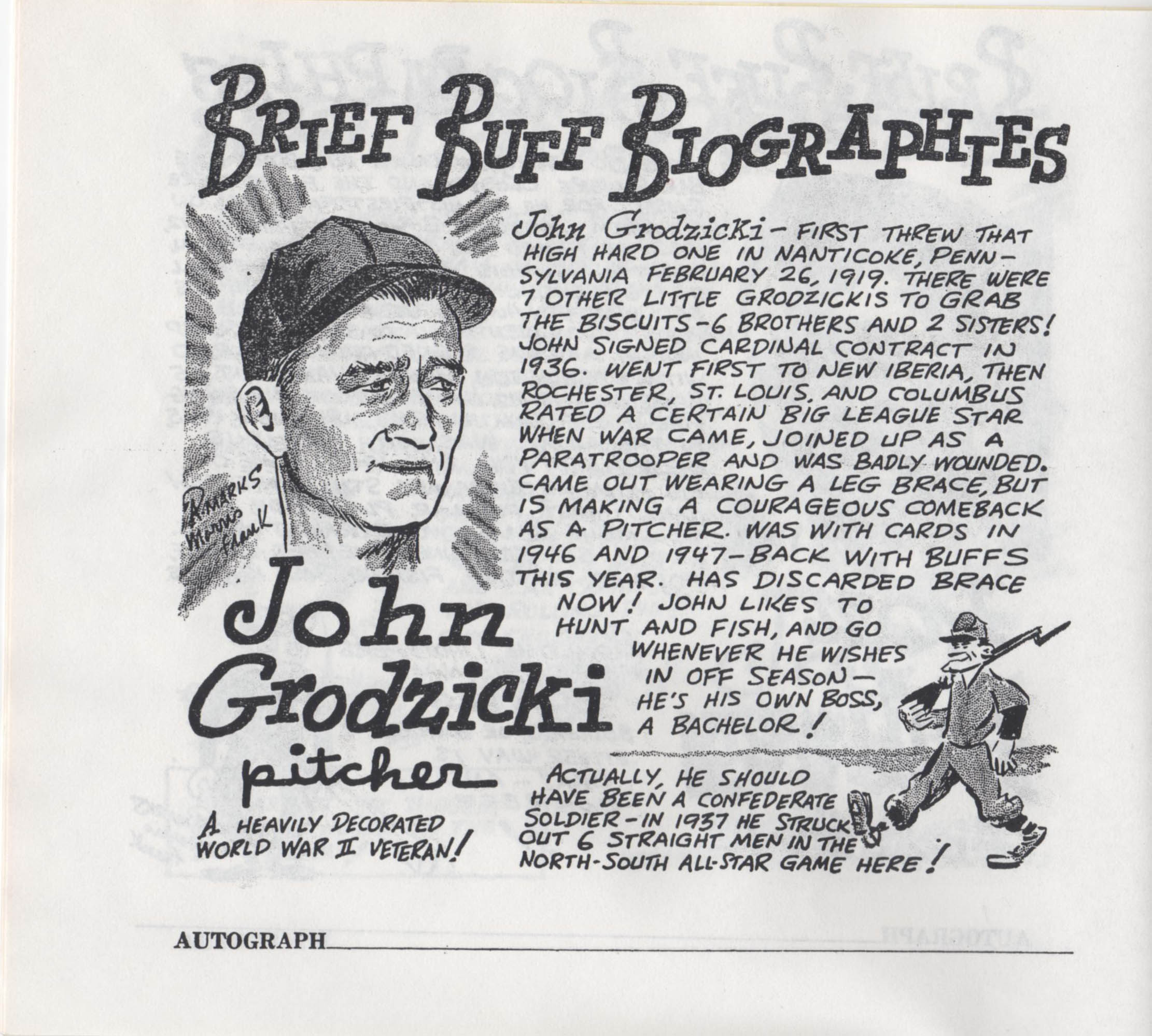
Excerpt from "Your 1948 Houston Buffs, Dixie Champions: Brief Biographies By Morris Frank and Adie Marks (1948).

Excerpt from “Your 1948 Houston Buffs, Dixie Champions: Brief Biographies By Morris Frank and Adie Marks (1948).

Johnny Grodzicki is one of those “might have been” stories that overflow the narrative file on individual careers. He also was a pitcher, and he could have been one the legion who lost their baseball futures after a sudden blip or twang in the arm following an average game or warm up pitch, but that sad mystery  was not his story.

Johnny Grodzicki was a Wold War II casualty.

Six years (1936-41) into his all Cardinal farm club minor league career, Johnny Grodzicki went into the Army for four years of service (1942-45) as a member of the 17th Airborne Division.  In combat in Germany on March 29, 1945, Grodzicki sustained shrapnel wounds to both legs. He was awarded a Purple Heart. He also required surgery and extensive rehabilitation to resume his baseball career after the war’s end.

Due to age and injury, Grodzicki no longer had it as an MLB prospect when he came back to Houston as a 1948 Buff, but he was still good enough to register a 6-5 mark and a 2.05 ERA that year in the Texas League.

Grodzicki’s entire playing career was spent with the Cardinal organization. He was a Buff for whole or partial spots of five seasons (1936-38, 1948-49). His best Buffs season was 1937 when he went 18-11 with a 2.88 ERA. Over his eleven minor league seasons (1936-41, 1948-52), and spanning from age 19 to age 35, Johnny Grodzicki compiled a total minor league record of 108-63, 3.65. In 24 games over three seasons as a Cardinal (1941, 1946-47), Grodzicki was 2-2 with a 4.43 ERA.

After his playing days were done, Johnny spent the rest of his working life as a coach and scout for both the Cardinals and others. He passed away on May 2, 1998 as t the age of 81.

Buff Biographies: Bud Hardin

June 8, 2013
Excerpt from "Your 1948 Houston Buffs, Dixie Champions: Brief Biographies By Morris Frank and Adie Marks (1948).

Excerpt from “Your 1948 Houston Buffs, Dixie Champions: Brief Biographies By Morris Frank and Adie Marks (1948).

If you like your MLB coffee served fast, hot, and one time only, you must be walking in the company of former  Houston Buffs shortstop Bud Hardin. The three-season (1948-50) Buffs infielder picked up one single in seven times at bat for the 1952 Chicago Cubs for a .143 career big league batting average and a small fissure spot on the wall of North Side Chicago baseball failure that is now 105 years old and still counting in 2013.

Bud Hardin’s 13-season minor league career (1942, 1946-57) resulted in a minor league career batting average of .253 and 15 home runs. After baseball, Hardin settled in Ranch Santa Fe, California where he died in 1997 at the age of 75.

As a kid, I remember Bud Hardin as a quiet kind of guy who always seemed to have time for a smile, a wave, or a head nod of acknowledgement for those of us in the Knothole Gang as he was coming out of the Houston clubhouse to take the field at old Buff Stadium. That kindness was never mistaken by us kids as ability. We never dared tell the Buffs shortstop that even the Knothole Gang held no great hope for victory whenever Bud Hardin came to bat in a crucial late inning game situation.We only cheered for results. We never cheered out of expectation until we saw a Buff player prove he could get the job done, but that never happened for Bud Hardin during his time here in Houston.

Too bad. Bud Hardin was a nice guy of considerable bravery. On the front lines in Italy during World War II, Bud earned a Purple Heart for his combat injuries. And that says far more about the man than his long-term batting skills ever did. I also like to remember too whenever the subject is a player’s particular skill deficiencies: Bud Hardin was far better than a few million others of us who only wished for the chances he got in baseball. At least, he played professional baseball. At least, he got to the big leagues, even if it were – only for a cup of coffee.

God rest your soul, friendly Bud! I appreciate you even more today than I ever could have as a kid.

Buff Biographies: Solly Hemus

June 7, 2013
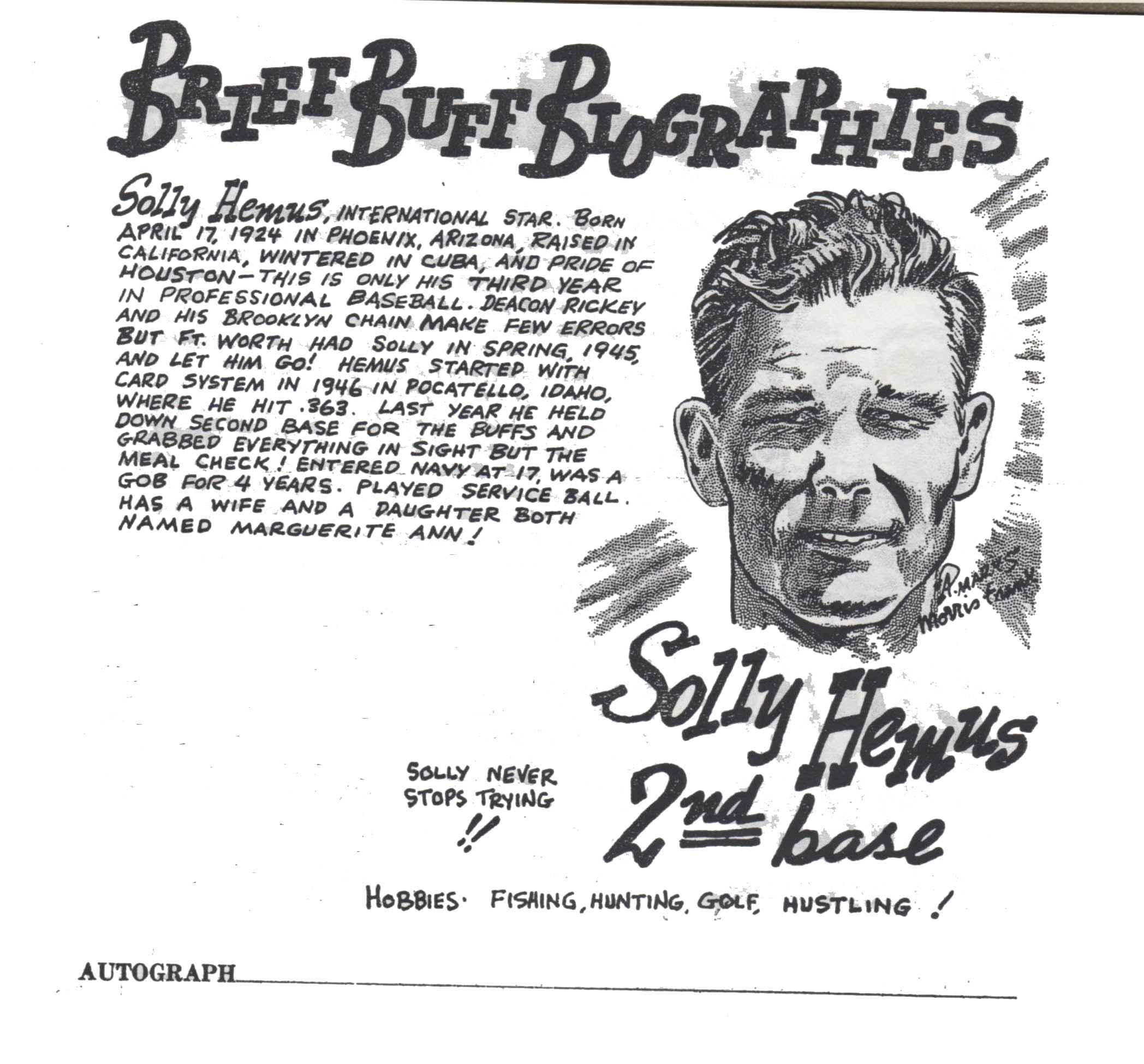
Excerpt from "Your 1948 Houston Buffs, Dixie Champions: Brief Biographies By Morris Frank and Adie Marks (1948).

Excerpt from “Your 1948 Houston Buffs, Dixie Champions: Brief Biographies By Morris Frank and Adie Marks (1948).

From the time I first saw him play during my original season of watching the Houston Buffs at old Buff Stadium in 1947, Solly Hemus was my star, my first baseball hero. He just seemed to be the guy that got everything going on offense and defense.  He played the game of baseball with a fire in his belly and a relentless hustle for whatever edge he could find. Houston writers and fans called him “the little pepper pot”  as a tip of the cap to both his game time personality and his diminutive, but wiry physique. At 5’9″ and 165 lbs,, Hemus was all muscle and momentum, leaning into action as a force to be reckoned with.

As a second baseman for the 1947 Buffs, Hemus batted .277 with 0 home runs in 140 games as a key table setting hitter in the lead off spot. After the ’47 Buffs won both the Texas League pennant and the Dixie Series crown, Solly played two more seasons with the Buffs (1948-49) and one more year at Columbus, Ohio (1950) before heading up to his eleven-season MLB playing career with the St. Louis Cardinals (1951-56, 1959) and Philadelphia Phillies (1956-58) as a key shortstop and utility infielder. Prior to coming to Houston, by the way, Solly had broken into professional baseball at Class C Pocatello in 1946 with a .363 average in 120 games. He would again surpass the .300 level in minor league ball with a .328 average for the 1949 Buffs in 109 games. Solly’s highest full season MLB average would be the .304 he posted in 124 games for the 1954 Cardinals.

Solly led the National League in runs scored with 105 in 1952. He also developed a little more pop in his bat, slugging 15 HR in 1952 and 14 HR in 1953. Whereas, Hemus only hit 16 homers in 5 minor league seasons, he ended up with 55 long balls in the majors.

Solly Hemus finished his MLB career with a batting average of .273.

Solly took over as manager of the Cardinals prior to the 1959 season, but the club finished 7th. In 1960, the Hemus-led Redbirds rose to 3rd place, but a struggle for a spot in the first division the next year led to a stumble over the word “irony” for Solly in 1961. He was replaced during that 1961 season by his old Buffs mentor at Houston, Johnny Keane, as manager of the Cardinals.

After a little time with the expansion franchise New York Mets as a coach in the early 1960s, Solly Hemus turned his considerable smarts and energies to the development of his oil exploration company. Hemus Limited became quite successful as Solly moved onto a very special place of honor and respect in the entire Houston community for his giving low profile and private  support of so many worthy causes.

Today, at age 90, Solly Hemus is still my hero.

Buff Biographies: Gerry Burmeister

May 26, 2013
Excerpt from "Your 1948 Houston Buffs, Dixie Champions: Brief Biographies By Morris Frank and Adie Marks (1948).

Excerpt from “Your 1948 Houston Buffs, Dixie Champions: Brief Biographies By Morris Frank and Adie Marks (1948).

Gerry Burmeister (BR/TR) (6’2″, 210 lbs,) was almost everything we always used to think a catcher should be. He was a good career hitter for average, as his .275 BA over 13 seasons (1937-44, 1946-50) showed, but his 66 HR over the long all-minor league haul also revealed his lack of power. He was slow afoot, but his strong throwing arm and mature leadership on defense guided both the Buff pitchers and field defense over the course of 5 seasons (1941, 1946-49) in the Bayou City. Burmeister played one more season after he left Houston and moved up to AAA Syracuse in the Cincinnati farm system after being dealt away by the Cardinals, and that was it. At age 32,  he retired and went back to his now permanent married life home in Houston as just one more pretty fair ballplayer of the reserve clause era. In spite of what it says in the Frank/Marks 1948 sketch above,  Gerry never got that proverbial cup of java in a big league game for so much as even a modest Moonlight Graham or Buddy Hancken one-inning in the field with no trips to the plate major league appearance. It simply didn’t happen.

Burmeister’s signature career stop was with the Houston Buffs, and Gerry’s ‘s best season as a Buff was 1948, when he hit .267 with 8 HR. Gerry did get into 93 games for the 1947 Dixie Series Champion Buffs, but he batted only .210 with a single homer that big team year.

Gerry Burmeister died about 20-25 years ago, but I am unable to confirm his specific date of death at this writing. He’s not showing up in the vital statistics records on-line for Harris County, Texas and I have no data of him passing away elsewhere. If any of you Ancestry.Com whiz kids know how to get it, please post the DOD as a comment on this article. For whatever help it may be, Gerald William Burmeister was born on August 11, 1917 in Harmony, Minnesota and I’m fairly sure he died in the Greater Houston area.

Baseball Reference.Com also mistakenly lists Burmeister as still alive at age 95:

http://www.baseball-reference.com/minors/player.cgi?id=burmei001ger