 The Ist Annual Knuckle Ball, a full dress benefit banquet established by the Joe Niekro Foundation to raise money for aneurysm research at Methodist Hospital in Houston, took place as scheduled on Friday night, July 31st, at Minute Maid Park. The gala dinner featured both a silent auction that filled the entire Union Station rotunda – and a live auction conducted by Stephen Lewis during the dinner itself.
With Hall of Famer Joe Morgan serving as master of ceremonies, the attending guest list read like the Who’s Who of baseball – and with a pretty good taste of some big lights in the sports of football, basketball, and soccer making roll call too. For an effort started by a great boost of energy and intelligence from Joe’s daughter, Natalie Niekro, the program unfolded as an equal tribute to both Joe ad Natalie. It took all of the Niekro family intelligence and determination, clicking on all cylinders, to come off as well as it did – and it came off very, very well.
In addition to Joe Morgan, other Baseball Hall of Famers on hand included Joe’s brother Phil Niekro, of course, Sparky Anderson, Bob Feller, Robin Roberts, and Ozzie Smith. (Forgive me if I left anyone out.) The list of famous former Houston Astros was equally impressive, but here’s where I know I’m going to miss some names. There were just too many former Colt .45’s and Astros circulating among the crowd of several hundred people who came on this special night for absolute certainty here, but this is my humble list of countable people: Kevin Bass, Dave Bergman, Enos Cabell, Larry Dierker, Phil Garner, Ed Herrmann, Art Howe, Craig Reynolds, Joe Sambito, Mike Scott, Bill Virdon, Carl Warwick, and Jimmy Wynn. And that Astros list is expanded importantly too by the additions of Owner/CEO Drayton McLane, Baseball President Tal Smith, Business President Pam Gardner, General Manager Ed Wade, and longtime loyal Astros employee Judy Veno. Longtime media folks like Kenny Hand and Gina Gaston of Channel 13 were also present, as were Jo Russell, the widow of former Buffs President Allen Russell, Larry Dluhy of the Texas Baseball Hall of Fame, and spiritual writer and teacher Marie Wynn. Other sport icons in attendance inluded former Houston Rocket and Basketball Hall of Famer Elvin Hayes, former Houston Rocket star Mario Elle, former Houston Oiler quarterback Dan Pastorini, and former Oiler quarterback Oliver Luck, who now also happens to be President of the Houston Dynamo, the city’s first serious venture into the world of professional soccer. Former Pirate-Tiger Jim Foor and his terrrific wife Sandy Foor were also present to make everything shine all the more. Jim and Sandy have both logged time as playing members of our Houston Babies vintage base ball club as charter members of the 21st century edition of Houston’s 1888 original pro club. Other Babies players in attendance included Jimmy Disch, Scott Disch, Matt Moak, Logan Greer, and yours truly, Bill McCurdy, the Babies General Manager. – Satch and Lynn Davidson also were on hand. Satch Davidson is a former National League umpire and a member of the Texas Baseball Hall of Fame; Lynn Davidson, of course, is the well-known and respected Houston pet bereavement professional.
The reception began officially at 6:36 PM. The past normal time start was done to (1) highlight Joe Niekro’s uniform number as an Astro; and (2) to also make the point that it is now past time, via Joe’s decesased status, to consider retiring his Houston uniform number 36 from all service use by any future Astros. Among all his many accomplishments in baseball, Joe Niekro has held onto one very special record in Houston MLB franchise history. – With 144 wins in Houston, Joe Niekro has the most career victories as a Houston big league pitcher – and he has held that record since 1985, when he passed Larry Dierker for that distinction. Dierker remains second to Niekro in career Houston wins with 137, but current Astro ace Roy Oswalt (with 135 wins) is on course to pass both Dierker and Niekro sometime in the 2010 season, barring, heaven forbid, any further complications that may linger into 2010 from his current disk troubles. One thing this likely means is that Joe Niekro most probably will have surrendered a great Houston record next season – but only after holding onto it for a quarter century (1985-2010).
Thousands of us ancient fans of both Joe Niekro and the Astros think it’s high time now to honor the man for all he has meant and continues to mean to this franchise and the quality of life in Houston. The Joe Niekro Foundation and the Knuckle Ball stand tall as living proof of the Nielro family commitment to Houston. Let’s retire # 36 at Minute Maid Park in Joe Niekro’s honor during the time, or coincidant with the time, that current pitching star Roy Oswalt closes in and becomes the new record-holder next season. Such a ceremony at MMP will pack the house – and rightly so. I cannot think of another move the Astros could make in this area that would be more deservedly supported by the fans. As a man of performace and character, no one else out there on the cusp of receiving this special club action of honor holds even a small candle to Joe Niekro as an equally deserving recipient. – That grail belongs to Joe Niekro. – So, let’s give it to him – and by no later than 2010, please. It’s the intelligent, tuned-in, right thing to do.
Til then, the music plays on, – and there were all kinds of musically soaring spirits going on at Friday night’s electric Knuckle Ball. The Houston Astros are to be congratulated for lending their magnificent facilities to the cause as the most fitting venue for this banquet celebration of Joe Niekro’s life. Everything that everyone saw and experienced on the broad ban of things worked out beautifully. Special applause goes out to Drayton McLane in this regard too. The man’s support of things that are good for Houston fly too far beneath the radar. It is time that people started recognizing that we have a club owner in Houston who shows his caring for happens in this community in ways that count. I’ll start the line here by saying, “Thank you, Drayton! You are, without a doubt, the good man that your daddy raised you to be – and we appreciate you! The Knuckle Ball could not have succeeded on its high level this first year, and under these economic conditions, had it not been for you and your people. – Houston thanks you!”
The evening program following the reception began with a delicious meal and a heartwarmig welcome and explanation from Natalie Niekro about how the Joe Niekro Foundation and the Knuckle Ball came to be as a “Pitch for Life” against the sudden silent killer that is aneurysm. Natalie was followed by one of her dad’s former Astros teammates, Enos Cabell, who spoke of what it meant personally to have known Joe Niekro as a fellow player and friend.
I shared a table with several wonderfully knowledgeable Houston people, including Hal Finberg and Marc Melcher of the Global Wealth Management, Merrill Lynch team. Hal kept us posted at the banquet on the Astros@Cardinals scores from St. Louis, and Marc shared some interesting news of the Heritage Society’s plans to stage a major show next year on the history of baseball in Houston. Marc Melcher serves on their board. Hmmm! I wonder if I know of anyone who might enjoy getting involved in that project? – Now, how in the world did Marc and I happen to find ourselves seated next to each other by “accident?”
The old age jokes were flying high in my neighborhood on Friday night. Jim Foor enjoyed introducing me as the original and only General Manager of the Houston Babies. – The Babies played their first game on March 6, 1888! – Later on, Dave Bergman and Ed Herrmann stopped by to speak with me as we were waiting on our cars in the valet parking pickup line. They each wanted to tell me how much they enjoyed my poem about Joe Niekro, but Ed Herrmann acted as though he didn’t expect to be remembered. “I remember you, Ed,” I said. “You were a catcher.” Herrmann got this stunned look on his face as I said these words, but before either of us could speak again, former first baseman Bergman chirped in with, “See there, Ed! I told you if you just came with me tonight that we’d eventually run into somebody who was old enough to remember you!”
What great fun we all had – and all for a worthy cause too!
Music at the end of the evening’s program was provided by Grammy Award Country Music Artist Collin Raye.
My role on this magic Friday was to recite a poem that I had written about Joe Niekro and the new Knuckle Ball purpose. I was there by special invitation from Ms. Niekro. Although I did not read the title on Friday night, I’m calling this piece “A Pitch for Life Against Sudden Death.” I’m just happy that I was able to get through my recitation without tongue-tripping over my own material before this once-in-a-lifetime audience. Here’s the copy – without the spoken voice breaks and pauses that breathe it completely into life:
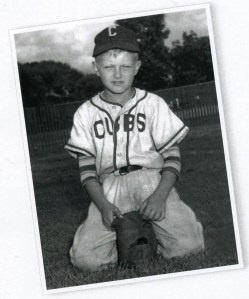 Born in Martins Ferry – in the fall of ’44, Joe and Brother Phil – were the knuckler’s paramour! – They wound their way through baseball, vexing hitters all the same – From Mendoza’s line to Da Vinci’s circle, the knuckler was to blame!
A batter couldn’t hit a pitch that floated, dipped, and dove. – He simply left his hopes stillborn, back on the old hot stove. – The Niekros didn’t waver; their pitches danced and sang. – They stung their foes with K’s and woes; the victory bell they rang!
Three-hundred Eighteen wins for Phil; Two Twenty-One for Joe! – Phil found his way to Cooperstown; Joe’s glory came too, you know! – In 2005, Joe Niekro, – for his Astros heart, so game, – Was proudly too inducted by the Texas Hall of Fame!
And when we lost sweet Joseph – in October of ’06, – There were no words to heal the shock of a loss that so transfixed, – Our attention to the cause of loss – aneurysm was its name, – And wiping out that assassin is the Knuckle Ball’s lone game!
And as we think of Joseph now – as we surely always will, – We shall always think of him and Phil – and all they did to thrill, – The hearts of baseball fantasy – that rode the knuckler wave, – One as a loyal Astro – the other as a mighty Brave!
And as we say hello again to a baseball summer night, – We shall not see a sky with stars that does not soon invite, – All our fondest memories of the knuckler – and the man, – Ascending all around us! – Count the diamonds, if you can!
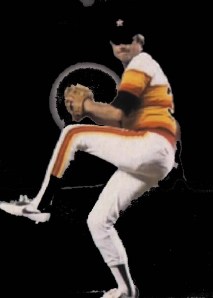 Go forth, Joeseph Niekro, through the heavens afar! – Throw your tantalizing knuckler, so we’ll know where you are! – And, on some summer night soon, across a sky, black as tar, – We shall find you fluttering wobblers, striking out a shooting star!
And every time we find you again, our prayer shall be simple, but true: – “Lead us in the Knuckle Ball pitch, Joe, for an answer to aneurysm too!” – The silent monster must be slain; the resident villain must be banned! – We shall not rest until the day – there are cures for the evil at hand!
So, go forth for us all, Joe Niekro, through the infinite heavens afar! – Throw your tantalizing knuckler again, so we’ll know where you are! – And on some summer night soon, across a sky pitch-black as tar, – We shall find you fluttering wobblers, striking out a shooting star!
We can do it with your help, Joe! – You’re pitching in the Bigger League now!
 Aaron Pointer (Batted Right/Threw Right; Outfield) has to be one of the best examples of how life sometimes arms certain people with talents that could take them in several varied directions, but all the while, these opportunities are rising and falling constantly with how the individual makes and uses the decisions he or she finally decides to take responsibility for putting into motion.
 Aaron Pointer batted .402 in 93 games for Salisbury (132 hit for 329 at bats) in 1961 for 19 doubles, 14 triples, and 7 home runs. By breaking the /400 mark, Pointer became the last professional baseball player to exceed that magic mark over a full summer of play. (Rookie League and Mexican League marks are not considered as data on this achievement trail.) At season’s end, Pointer was called up to the 1961 AAA Houston Buffs in time to also hit .375 ( 3 for 8 ) in four games.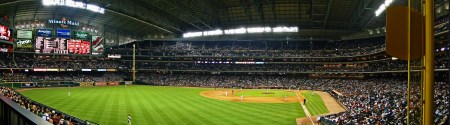


 We just returned last night from a two-day train trip to Lake Charles, but that’s a story for another day. This morning I want to tell you about another ex-Cardinal and former Buff pitcher who also just happened to be a good friend. His name was George “Red” Munger, a name that won’t be lost to the memories of anyone who was around during all those 1940s years of great Cardinal teams. Red Munger just happened to be a big part of that success. The native Houstonian and lifelong East Ender was smack dab in the middle of that zenith era in Cardinal history, even though he lost all of 1945 and most of the championship 1946 season to military service. Red still managed to return in time to make his own contributions to the Cardinals’ victory over the Boston Red Sox in the 1946 World Series.
 achieved some great, but unsurprising success in service baseball. He was just too good for the competition he faced at that rank amateur level. Once Red obtained his second lieutenant’s commission and was assigned to developing the baseball program at his base in Germany, he just stopped playing in favor of full time teaching. He even said that he had no heart for pitching or hitting against competitors who were too young, too green, and too unable to compete against him.
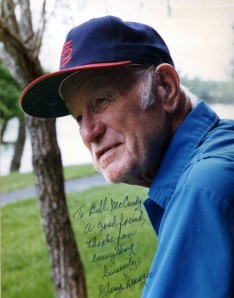 After baseball, Red Munger worked as a minor league pitching coach and also as a private investigator for the Pinkerton agency. He later developed diabetes and passed away from us on July 23, 1996 at age 77. I took that last picture of him in the 1946 Cardinals replica cap on a visit to his home, about two weeks before he died. Red gave me that cap that he wore in the picture at left on the same day. I have treasured it ever since.
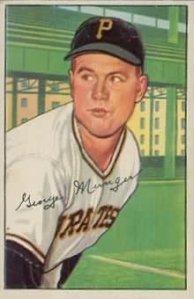 Red Munger enjoyed watching position players with strong arms and then imagining how effective they might be as pitchers. His favorite subject that last summer of 1996 was Ken Caminiti – and this was long before all the disclosures about Ken’s mind-altering and performace-enhancing drug abuse. Red Munger just liked the man as a gifted athlete. Caminiti fit the bill on what Red Munger was looking for in pitching potential. “Give me a guy with a strong arm and I can probably teach him the other things he needs to know about pitching. I can’t teach a guy how to have a strong arm – and as far as I can see, no one else can do that either beyond telling him to work out and hope for the best. As far as I’m concerned in the matter of good arms, you’ve either got one or you don’t.”
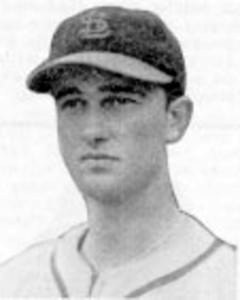 From the late 1920s through the early 1950s, the St. Louis Cardinals operated a farm system that pretty much resembled the good and growing business of a fabled Hempstead, Texas watermelon grower. – Everything they harvested came out tasting sweet – with very little hassle from unwanted seeds.
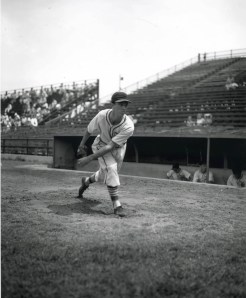 Back with Houston in 1941, the now 20-year old lefty showed that he had little left to prove in the minor leagues, even at his still tender age. In 1941, Pollet posted a 20-3 record for the Buffs and a league leading ERA of only 1.16. In all of Texas League history through 2008, only Walt Dickson’s 1.06 ERA, also posted with Houston back in 1916, beats the 1941 mark of Howie Pollet. Pollet also led the Texas League in strikeouts in 1941 with 151. The Buffs again won the Texas League straightaway race, this time by 16.5 games, but they lost in the first round of the playoffs for the Texas League pennant.
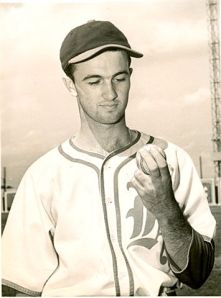 After baseball, Howie Pollet returned to his adopted home of Houston and went into the insurance business with his former Buffs and Cardinals manager, Eddie Dyer. He even returned to baseball one year to serve as pitching coach for the Houston Astros. He was only age 53 when he died of cancer in 1974. Sometimes the good guys who arrive early also make an early exit. Baseball and Houston were the poorer from the early passing of the great Howie Pollet, but we’re glad we had him while we did.
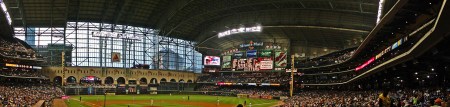
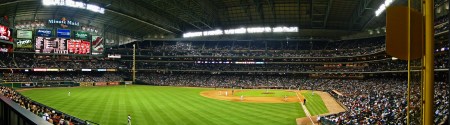
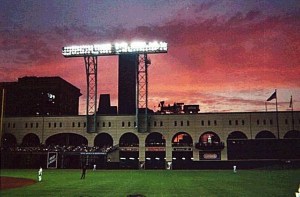 Ten seasons deep into its life as a baseball venue, the place that began as Enron Field at Union Station before its reputationally redemptive transformation into Astros Park, and then Minute Maid Park, is alive and well – and building surface patina by the layers-worth on its quirkiness as yet another one-of–a-kind home to Houston baseball. That tradition of uniqueness in Houston is steeped in the six major parks that have served as home to our professional baseball warriors since 1888.
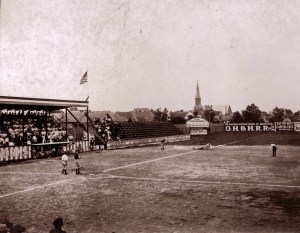 2) West End Park (1907-1927). For twenty-one seasons, for sure, the 2,500 seat wooden grandstand ballpark near downtown served as the home of the Houston Buffaloes of the Texas League. Rookie Buffs center fielder Tris Speaker helped cristen the place in 1907 with some dazzling play in the cavernous outfield while also leading the Texas League in hitting that year with a .314 batting average. During this same two-decade period, a young man from Austin named Fred Ankenman gradually took over running the Buffalo stampede into local hearts as chief executive under local ownership and later as President under the club’s ownership from the early 1920s by the major league St. Louis Cardinals. West End Park was a nice place, but it was never big enough to house the future plans of the fellow that ran the Cardinal operation – a fellow named Branch Rickey, the man who served as the genius of minor league farm team design and hands-on micromanager of all moves pertaining to Cardinals baseball. After the Cards won their first World Series over the New York Yankees in 1926, Rickey and Ankenman acquired a parcel of land on the rail lines that flowed east from downtown Houston. They built a $400,000 jewel of a ballpark on what was then called St. Bernard Avenue. That street later was renamed as Cullen Boulevard. The ballpark they built there was christened as Buffalo Stadium on April 11. 1928. Ironically, Union Station, at the corner of Texas and Crawford, was one of the principle places that fans caught the trains and street cars for transportation in the afternoons to Buffalo Stadium on game days.
 3) Buffalo/Buff Stadium (1928-1952); Busch Stadium (1953-1961). Subtract the three lost years in which the Texas League was closed down during World War II (1943-45) and “Buff Stadium” was home to Houston baseball for 31 active seasons from 1928 to 1961. I’m, of course, absorbing those few final seasons in which the place was technically renamed as “Busch Stadium” into that figure. Most of us diehard Buff fans never accepted that name change in the first place.
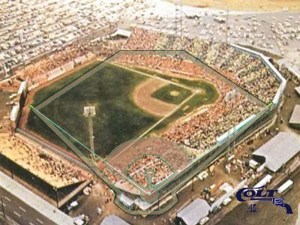 4) Colt Stadium (1962-64). It was never intended as anything more than service as a temporary home for Houston’sn new major league club, the Colt .45’s – and it’s just as well. The place that many of fans called “The Skillet” was tough enough during the work week night games, when Houston’s vampire squad mosquitoes feasted upon this congregation of human flesh and blood, but it was worse than Dante’s Inferno on weekends under the direct fiery blaze of the sun. With no overhead protection, and with the surrounding parking cement reflecting all that heat back up into the humidor-like confines of Colt Stadium, people dropped like flies at daytime weekend games. For those conditions, the short-lived Colt Stadium earned a place in baseball history. It forced the ball club to seek permission for night baseball on Sundays, something that had been unheard of previously due to all the blue law notions about the role of baseball on the Lord’s Day, anyway. Attedance at Sunday night games in Houston was so improved that it led to other clubs playing games at that night time slot also. It wasn’t long before televised Sunday Night Baseball became a fixture among the viewing habits of fans.
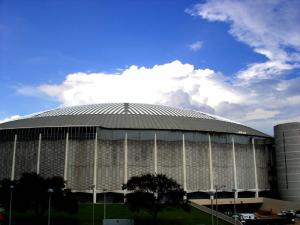 5) The Astrodome (1965-1999). Judge Roy Hofheinz dubbed it as ” the eighth wonder of the world” once he renamed the Harris County Domed Stadium as “The Astrodome” – the new home of the newly renamed Houston Astros. Looking back now, I have to admit to something that I think almost all of us experienced back then in those more innocent and far less jaded days of big change. – The idea of a domed stadium just blew us all away. We could not imagine any ballpark that could be built to protect the game from weather – that wouldn’t also interfere with the flight of most high-arching fly balls.
 Minute Maid Park is a monument to baseball uniqueness among all other sports. As many fine writers have pointed out, ad nauseum, baseball isn’t controlled by the clock. Theoretically, a game could go on from here to eternity, if the score remains tied at the end of each full inning. It also doesn’t play out on an even gridiron, as does football. Baseball plays out on whatever field fits the reality of the community it serves – and you cannot blame your losses on the field of battle – unless you are just a loser looking for another easy excuse for your own failures.
 Houston, Baseball, & Other Musings.
 The Pecan Park Eagle