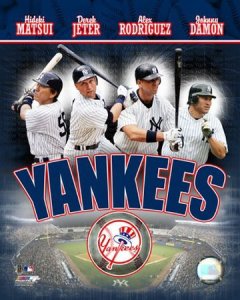
 Speaking of the Yankees, the “27th Heaven” version gets their ticker tape parade down Broadway today as the rest of go through baseball withdrawal until spring.
Andy Pettitte, Derek Jeter, and Jorge Posada appeared together on David Letterman’s Show last night, giving the host a chance to lay one in there on Andy for going back to Houston for a while (2004-06). “Andy,” Letterman said, “I believe you left New York for a while to go home and work in a Dairy Queen. Isn’t that right?” Everyone, even Andy, had a big laugh over that line, but then he answered, still sort of sheepishly: “That’s right, Dave, but at least while I was back there at the Dairy Queen, I got to go to another World Series.”
See there? That’s exactly one of the points I was hoping to make yesterday, all rolled up in a single object lesson: Our Houston Astros’ National League pennant of 2005 may have just been a big night at the Dairy Queen for big celebrities like David Letterman and Andy Pettitte, but it was a pretty big deal to those of us Houston rubes who waited nearly a half century to see it happen here for even once. Now the tally stretches even further through 2009. In 48 seasons of major league play (1962-2009), our Houston Colt .45s/Astros have made it to only one World Series. We’re still looking for our first World Series win – or even a game victory. The White Sox shut us out four games to none in 2005, remember?
The New York Yankees, on the other hand, got to the World Series for the first time in 1921, during their 18th opportunity of the games even being played. They lost that first one to the New York Giants, and again the next year to the same club. Once the Yankees tweeked the Giants, 4-2, in the 1923 World Series for their first win on the big stage, things started to change. A rosary of rarely broken dynasties was being beaded for the future.
Four Years Later: The 1927 and 1928 Yankees put together back-to-back WS wins on the heels of a 1926 WS loss to the Cardinals. Ruth and Gehrig were the leaders of the pack.
Four Years Later: The 1932 Yankees return to win again as Babe Ruth calls his shot against the Cubs in Chicago.
Four Years Later: Starting in 1936, the first real dynasty begins behind Joe DiMaggio as New York wins four World Series titles in a row (1936-39).
Two Years Later: The Yankees take their first World Series title over the Brooklyn Dodgers in 1941, but then fall in the 1942 classic to the St. Louis Cardinals.
Two Years Later: The Yankees avenge their loss of the previous year, defeating the Cardinals in the 1943 games.
Four Years Later: The 1947 Yankees return to take another Series win over the Dodgers.
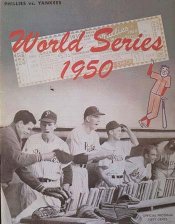
Two Years Later: The Stengel Dynasty hits town. The Yankees reel off five World Series titles in a row, from 1949-1953.
Three Years Later: After losing to the Dodgers in 1955, the Yankees return the universe to normal by recapturing the World Series championship from the Dodgers in 1956.
Two Years Later: The Yankees recapture the 1958 World Series from the Milwaukee Braves after losing it to the same club in 1957.
Three Years Later: The 1961 Maris-Mantle club blasts its way past the 1961 Reds after losing in seven to Bill Mazeroski and the Pirates in 1960. The Yankees also win again over the 1962 San Francisco Giants.
Fifteen Years Later: The 1977-78 Yankees pull out of the second longest dry hole in their modern World Series history, defeating the Los Angeles Dodgers twice in back-to-back fashion. During this period, the Yankees had lost World Series contests in 1963, 1964, and 1976,
Eighteen Years Later: The big gulch finally ends when the 1996 Yankees beat the Atlanta Braves, four games to two. Along this neck of the journey, the Yanks made only one other World Series appearance, losing to the 1981 LA Dodgers in six.
Two Years Later: The Torre Boys return for three straight crowns over the 1998 Padres, the 1999 Braves, and the 2000 Mets.
Nine Years Later: The Yankees take the Phillies in six games as the world returns to normal, and fairly loaded in favor of the studs from New York City. This particular dry spell is marked by Yankee losses in the 2001 World Series to Arizona, and again in 2003 to Florida.
The whole point here again is numbers. Not only have the Yankees been to forty World Series and won twenty-seven, they don’t have to wait as long as most other teams to get another chance.
Wait? Long lines? No way! Once they got there that first time in 1921, 18 years has been tops on the dry spell run for the Yankees. Compare that to the Chicago Cubs. Their wait in line has now reached 102 years!
 above turning me inside out. I still am hoping to get this article done before I crash again. It will keep if I don’t, but it will be more timely to get it done now, while the World Series is still going on.
 My grandfather was a small town newspaper man. He founded and ran the Beeville (TX) Bee back in 1886 until his death in 1913. When he started, he counted a lot upon readers sending in local news to fill in some column space, but he also never gave up his eye for the fact that anything that wasn’t timely wasn’t news.
 Iconic General Manager Branch Rickey of the St. Louis Cardinals had a three-pronged plan for helping himself. (1) He had a deal with club owner Sam Breadon. He got to keep a percentage of the net profits on the club’s operations, which meant, of course, that the less he paid out in personnel salaries, the more he got to keep for himself, as long as the club kept on winning. (2) He counted on the reserve clause and a loaded pipeline of talented players in the farm team system, players with no choice in baseball beyond the Cardinals, to keep him supplied with game-winning material. (3) He needed a few key people in the organization who were capable of doing more than one essential task at one time for the lowest salary he could work out with them for the price of a single employee’s salary.



 Alex Schmelter (above) received the MVP from his grandad, Babies Manager Bob Dorrill, as Grandma Peggy Dorrill looked on over his right shoulder. Also in the photo, left to right, are Kathleen and Larry Miggins, the former Cardinal and Buff, Babies General Manager Bill McCurdy, plus Bob “Double Duty” Blair and his wife, our Babies scorekeeper, Brigitte Blair.


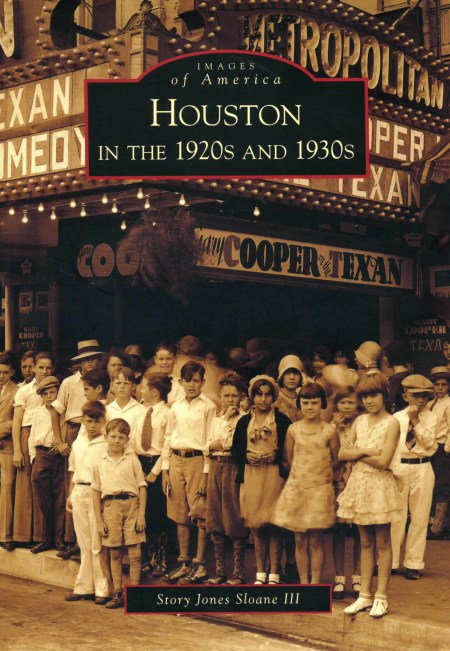 Some of you know about the Sloane Family. Their photographc gallery at 7616 Fondren in Houston has been offering the visual history of early 20th century Houston for quite a few years through singular prints and now – Story Sloane III has put together, in words and pictures, and through Arcadia Publishing Company, one of the finest quick views of life in Houston during the 1920s and 1930s that’s ever been produced.
 Willard Brown was one of those older, out-of-the-shadows players who glanced his way through organized baseball during the early days of its desegregation. He got there in time to leave one very indelible mark, but not early enough to use all of his abilities in their prime form, and not late enough to find any real place for himself in the major leagues among a more receptive crowd of accepting white teammates. No indeed. An older Willard Brown got there playing for a team that still overflowed in 1947 with some old school white racists.
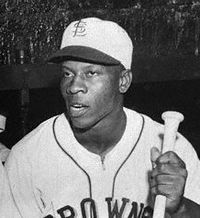 hitting .179 in 21 games with the Browns, Willard Brown left the big leagues and returned to the familiar confines of his more comfortable life among the Monarchs in Kansas City. That winter of 47-48, Brown went to Puerto Rico and batted .432 with 27 homers and 86 RBI in only 60 games, earning for himself yet another nickname as Ese Hombre or – “That Man”.
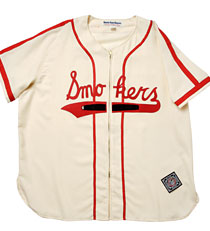 Among all the great controversial names ever assigned to minor league baseball clubs, I have to go with the Tampa Smokers as my all time favorite venture into the future of political incorrectness. Of course, it came about in the early twentieth century, during the era in which Tampa, Florida was reknowned for its cigar products, but that kind of explanation probably cuts little ice with the 2009 Surgeon General or his/her legion of anti-smoking lobbies. As a puritanical culture, we still aren’t that forgiving of people found guilty of past addictions, even those that once held their ground as the social norm. I was a smoker for a long, long time, and although I wouldn’t recommend it today to any young person that wants to save his or her lungs, I never became one of those holier-than-thou ex-smokers who enjoyed either beating-up-on or lauding-my-abstinence-over those folks who still smoke. Anyone who really ever went through breaking the tobacco habit, I think, will not soon forget what it was like to be trapped there. It was the toughest bad habit that I ever had to break, bar none, and I didn’t get out early, easy, or without God’s Help. That’s how I see it, anyway.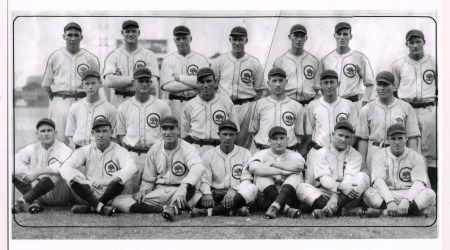
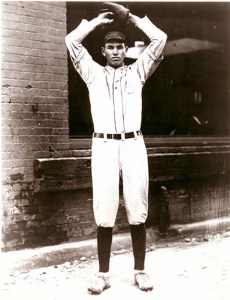 Dizzy Dean (age 21, BR/TR, 26-10, 1.53 ERA): Dizzy was brilliant and Houston loved him. His 26 wins and 303 strikeouts led the Texas League in 1931 and his 1.53 ERA tied him with Whitlow Wyatt of Beaumont for the lowest mark in the league.
 Houston, Baseball, & Other Musings.
 The Pecan Park Eagle