Posts Tagged ‘History’

All Time Big College Football Champs

October 19, 2010

"Run, UH, Run! - You've got a lot of ground to cover to ever catch the big guys on this list!"

When you think about it for five seconds, is it really a big surprise as to which schools are in the running for a national championship in big-time college football every season? Just follow the scent of money, alumni power, and the support of the broadcasting networks, advertisers, and other marketing forces of the American body politic and it all comes out in rolling tides of gator chomps and horns that hook ’em.

The following group is a top ten school list of those universities that won the most national football championships from pollsters since 1901. If we were to start this list from the first awards of national recognition from 1869 forward, the leader-board would also contain a tinge of Ivy League, but we chose to ignore that earlier era here for the sake of keeping this list more in contact with the reality of how the college game is played today.

Here’ what we found:

Big School College Football Championships (1901-2009):

(1) Alabama – 13

(2t) Michigan – 11

(2t) Notre Dame – 11

(2t) USC – 11

(5) Pittsburgh – 9

(6t) Ohio State – 7

(6t) Oklahoma – 7

(8t) Michigan State – 6

(8t) Minnesota – 6

(8t) Tennessee – 6

Two Others of Local Interest …

LSU – 4 (1908, 1958, 2003, 2007)

Texas – 4 (1963, 1969, 1970, 2005)

The whole article on past championships going back to 1869 is very interesting. Simply cut and paste the following link to your address live and check it out. …

http://en.wikipedia.org/wiki/NCAA_Division_I_FBS_National_Football_Championship

If we go back to include schools that mainly did their trophy-winning in the 19th century, Princeton (28) and Yale (27) rise to the top of the heap above all others. These Ivy League schools are disqualified here for having used true student athletes to rack up all the honors from those earlier era, very misinformed pollsters as to what is really important in life, especially to the extent that honesty and integrity should have anything to do with intercollegiate athletic competition.

Valian’s Pizza is Back!

October 16, 2010


Hmmm! Hmmm! Good!

BAD NEWS UPDATE, 8/14/2017. Raia’s went out of business about three years ago and their fair (but not quite as good) rendition of the original Valian’s Pizza went with them. No explanation for the shutdown. Their business traffic, at least, looked good, but you never know. Sorry to have to share disappointment here, but life is like that sometimes, isn’t it?

********************

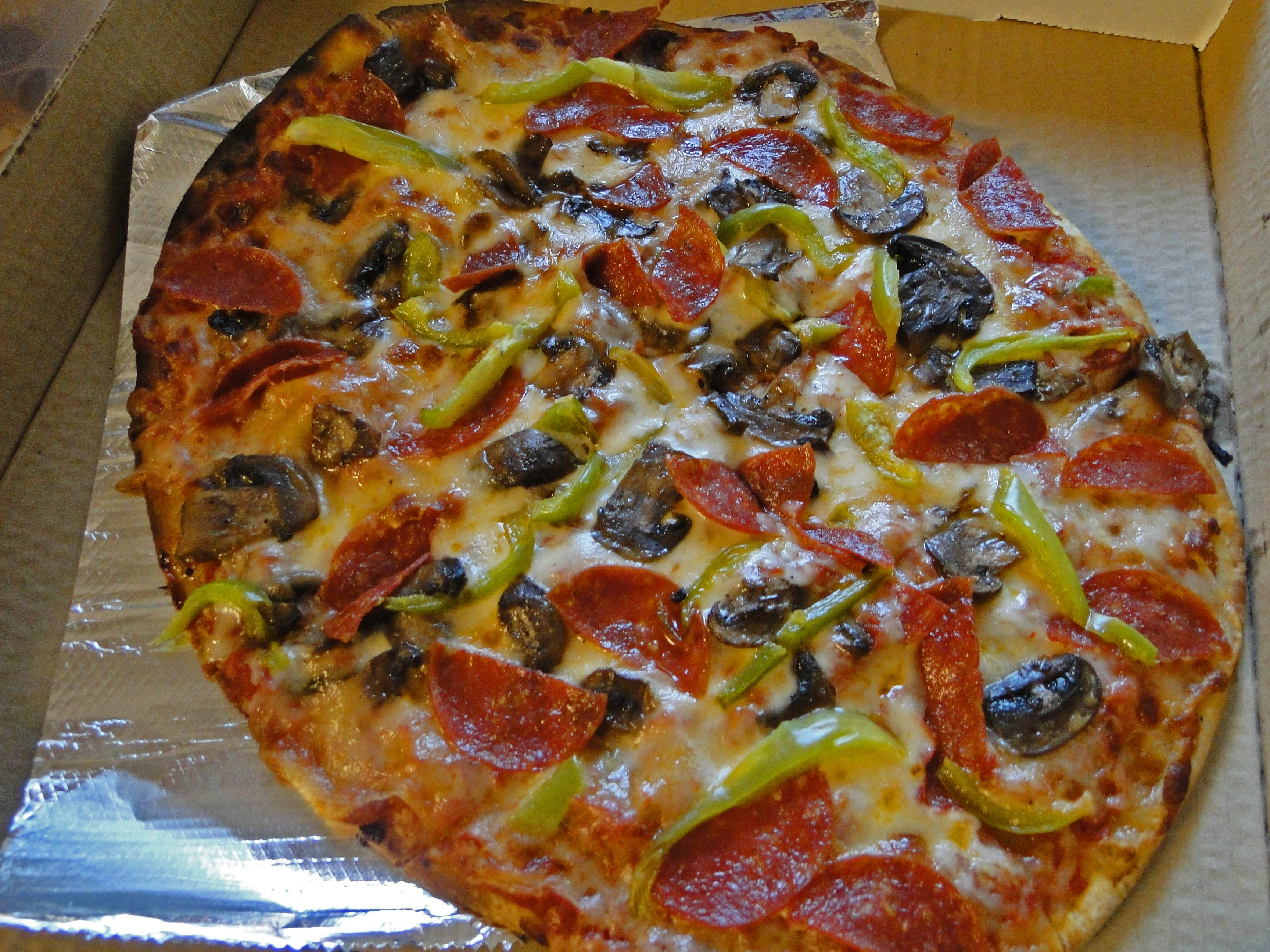
Do you recognize anything special in what you are looking at in the above pictured pizza box? Well, if you could suddenly inhale the aromas wafting in the air, and gently trial-taste the brick-oven cooked blending of cheeses, pepperoni slices, mushrooms, green peppers, marinara sauce, and unmistakably deliciously light golden brown thin crust, you would recognize that you have just bitten into something many of us remember in Houston from long ago as a Valian’s Deluxe Pizza.

That’s right, their back! All this time we’ve spent here at The Pecan Park Eagle over the past few months bemoaning the demise of Valian’s, a form of the old treasured pizza has been available to us all the time. It simply wasn’t promoted well enough for the word to get out.

Well, we’ll try to fix that little information hole today.

A week ago Friday, I was driving to an alumni luncheon at St. Thomas High School with Delbert “D.D.” Stewart, an old classmate and even older friend. As we drove south on Durham, near the Shepherd-Washington intersection, I just happened to mention our broadly shared regret that Valian’s Pizza no longer existed.

“Oh, but it does,” D.D. interjected. “There’s a place very near here on Washington Avenue that serves it on their menu as ‘Valian’s Pizza.’ It’s a place called Raia’s Italian Market.”

 

It’s at 4500 Washington, a block east of Shepherd on the north side of the street with ample parking in the back of the building.


I wasn’t able to check out my friend’s tip until yesterday. He had not been there personally and I had to discover for myself if it were really true. I knew that only my taste buds could answer that one.

I finished early at my office yesterday. It was about eleven in the morning. By choice, my days at work aren’t too grueling anymore so I decided to just drive over to this Raia’s place and see for myself what kind of pizza they were offering in the name of Valian’s the Great. The owner of the deli market, a fellow named Luke Raia, wasn’t around, but I learned from his store manager that the clean-looking little deli place had been open in this beautiful new storefront building since the summer of 2008.

I checked out the take-out menu since I don’t enjoy dining alone in public, and because I wanted to take home some goodies to the family anyway. There it was in the pizza section of choices, advertised clearly in a misspelled form of the famous family surname as “Valien’s Deluxe.” A whole pizza is available in one generous size for the going price of nine dollars.

The young store manager had no clue about the misspelling of “Valian’s” as “Valien’s”, but he did know that their offering of that product came from the fact that store owner Luke Raia had been a friend of the Valian family and that he had had obtained their recipe for pizza for use in his new restaurant prior to their 2008 opening.

I put aside my personal amazement over the two years deep misspelling of Valian’s on the menu and ordered a couple of pies to go. I told the young store manager that, if his product turned out to be the real thing, to get ready for the Internet article I intended to write about it. His pizza business was getting ready to really add a few mushrooms. On top of their already very active luncheon deli and evening dinner business, Raia’s was about to plug into a very large market of people who have been figuratively dying for the taste of a good old Valian’s Pizza for way too long.


Raia’s Dining Room: For their service hours, check them out at http://www.RaiasItalian.com


Folks, I took my Raia’s-Valian’s/Valien’s Deluxe Pizza home and tried it. Verdict: It’s the real thing. Except for a slight difference that I think is due to the fact these particular meats and cheeses most probably are not coming from the same suppliers that once served the original Valian’s store, this pizza is as good as pizza gets. And the great thin crust is unmistakably Valian’s all the way.

My 25-year old son Neal tried this Valian’s Pizza last night for the first time in his life. After a lifetime of listening to me speak of the original, he couldn’t wait to give it a try. I couldn’t wait to watch.

After he took one bite, I watched Neal’s eyes roll back. A few moments of careful chewing were gradually followed by a one-word response:

“WOW!”

He paused a few moments before adding, “So this is what pizza is supposed to taste like?”


The other food choices at Raia’s look delicious too, friends!


Folks, I don’t know Luke Raia, and I have no investment in his business, but I do know this much. He’s done the history of local foods proud by preserving and offering Valian’s Pizza on his menu. For that reason alone, he deserves our initial support. I also have a hunch that we shall find other food reasons for going back.

Thanks for saving Valian’s Pizza, Luke. Can you now do something about the spelling of the family name on the menu? Unless the family name was really “Valien” and they misspelled it as “Valian’s” on the neon sign that once fronted their South Main restaurant, the menu spelling error deserves correction.

Have a great weekend, everybody! And happy food choices too!

If you make it to Raia’s for the Valian’s Pizza, please post your own reviews here as comments on this article. I’d really like to hear what the rest of you think.

Hats Off to Jimmy Wynn

October 13, 2010


His Coming of Age in 1960's Takes On Clearer Light.


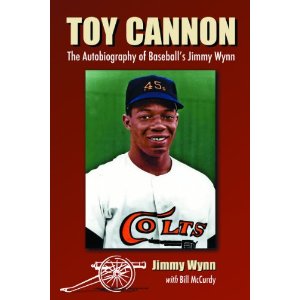
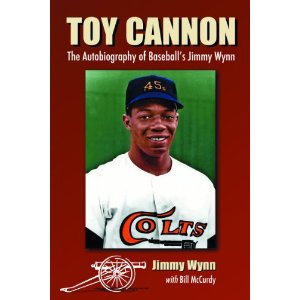
Congratulations to Houston Colt .45s/Astros Icon Jimmy Wynn! His beautiful autobiography is now available through Amazon, Barnes & Noble, Border’s, McFarland Publishing, and any other national retail distributing source that is available to you and, as someone who was privileged to working with him on “Toy Cannon,” I can only hope you also have a chance to read the story of this fine man’s growth as both a ballplayer and human being during one of the most difficult periods of change in American history.

Bob Hulsey of Astros Daily asked me only yesterday what I had learned about Jimmy Wynn that I didn’t yet already know from the experience of helping him with his autobiography. The answer to that one is easy. It wasn’t so much the details of what happened to him, and these included numerous stories of what went on with the club behind quasi-closed doors. It was all about fresh contact with what it must have been like to walk around in the shoes of Jimmy Wynn, a young gifted black baseball player, coming of age and finding his way through the segregated society that still dominated Houston, Texas, and the South, in general, through the Civil Rights Era of the 1960s.

Some of you are too young to remember, but Houston was still a place in the early 1960s which barred blacks from eating in certain restaurants, attending certain movie theaters, enrolling in schools which also accepted whites, or living in certain neighborhoods.

“Certain” was a buzzword for racial prejudice as a way of life and segregation still cast its ugly face upon our city like a clutching hand from the ignorant past at the same time Houston was attempting to bolt into the future as the home of NASA and a brand new major league baseball team.

At the same time Houston was embarking upon this ambitious and bold future “blast-off,” most local schools, from kindergarten to college, remained segregated. Wrap your minds around the incongruity of that thought for a minute. Then allow your thoughts to come back to young Jimmy Wynn in 1963.

This is the Houston that greeted Jimmy Wynn and other black players as they made their way to the big leagues with the Colt .45s during those earliest of years. Black players couldn’t simply go anywhere they wanted in Houston without running into the ugly wall of racial separation. The bathrooms and drinking fountains were even separated by “white” and “colored” section signs back then.

For many of us whites who grew up with segregation, but who weren’t taught to hate others for the color of their skin, those embarrassing memories of how Houston used to be are ones we’d sooner put away and not think about too often, but that isn’t possible. We have to remember and stay vigilant that nobody, no race or particular religious or facist-based ideological dominated society, ever tries anything like that again.

For people like Jimmy Wynn, who grew up in non-segregated Cincinnati, in the bosom of a loving family that taught him to love, not hate, coming of age as a ballplayer and a young man during one of the great periods of social change in America, especially in the South, was an eye-opener that could have blown him away early, had it not been for the long distance loving support of his father, in particular, and of a manager in Tampa named Hershell Freeman.

In “Toy Cannon,” Jimmy Wynn touches all the bases of his statistical, distance homer, and other field achievement records, but he does something even more. He allows us to walk a little deeper and truer in his own shoes as he comes of age in an era in which the other concomitant pressure on young people trying to make it in the world, especially among young males, was where they stood on the Viet Nam War.

Jimmy Wynn didn’t leave home to fight the battles of Selma, Alabama or Southeast, Asia, but that’s the world he walked into. The issues of the world wouldn’t leave him alone to simply work on becoming a big league baseball player. They even followed him into the clubhouse and directly affected the most important decisions in his life.

“Toy Cannon” is a tighter walk through the life of a talented young northern black man, coming of age in racist Houston. To hear Jimmy tell his story, we almost go through it “as him,” seeing the things we had to learn the hard way – and coming out the other side with a wisdom that only comes to those who are willing to learn from their painful experience.

God Bless You, Jimmy Wynn – for all you so willingly now give of yourself to others!

My Biggest Astros Homer, All Time

October 7, 2010

Chris Burke, 10/09/05:Erasing Agony, Embracing Ecstasy.

Of all the big home runs in major league history, every club has at least one that stands alone among all others. Although we could argue that fans of a team like the New York Yankees might have more trouble than most deciding which home run truly stands alone as their club’s finest long ball moment. After all, Babe Ruth to Bucky Dent to Aaron Boone covers a lot of arguable territory.

For this Astros fan, the pick was pretty simple. With no disrespect intended for my good friend Jimmy Wynn, or for Jeff Bagwell, Roman Mejiias, Billy Hatcher, Lance Berkman, Brad Ausmus, or others, I  had to go with the big home run by the little man who almost wasn’t there – and who wasn’t there for long while he was there, and who likely never will be there again – with the Astros or any other big league club.

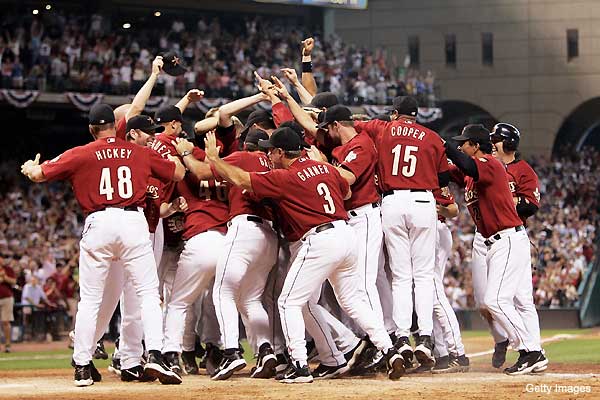
I’m talking about Chris Burke, the little 2005 second baseman for the Astros who hit that solo home run in the bottom of the 18th at Minute Maid Park to give Houston a 7-6 series-deciding win over Atlanta in the NLDS finale, a victory that ultimately propelled the club to its first and only World Series appearance.

When “Little Chris” Burke lifted that fly ball into the Crawford Boxes in left field, the emotionally and physically exhausted home crowd momentarily had to rally against the forces of incredulity that oh so briefly halted the roar of relief that then followed. It was simply hard for us Astros fans to believe that the day that once had seemed so lost had now been so decisively delivered in the name of victory.

But it happened. It really did. And the man whose name we shall always remember in association with that moment of joy is Burke – Chris Burke.

Five years later, Chris Burke is now little more than an after-thought among professional ball players. After a poor offensive season in 2007, the Astros dealt Burke to Arizona, where there, and then at San Diego, he continued to struggle and fall into minor league play. Burke signed a minor league contract with the Reds in the winter of 2009, but then broke a finger came along and took away the 2010 season.

We wish Chris Burke well in whatever he does from here with this thought in mind up front: Whatever happens next, Chris, Astros fans will never forget what you did for the club back on October 9, 2005.

For me, even if others care to argue differently, your bottom of the 18th home run to defeat the Atlanta Braves in the 2005 NLDS was the singularly biggest home run moment in the history of the Houston Astros MLB franchise.


Nominees for the Astros Hall of Honor

October 5, 2010

Who belongs in the Houston Astros Hall of Honor?

This past Friday night, Oct. 1st, the Houston Astros kicked off their celebration of the upcoming 50th anniversary of the franchise in 2012 by naming their five major players for each of the five involved decades. I’m not sure how they came about these choices, but they certainly didn’t miss the inclusion of five players whose names belong on any Astros Wall of Honor. Jimmy Wynn got the nod as the player of the 1960s; Jose Cruz represented the 1970s; Nolan Ryan carried the flag for the 1980s; Jeff Bagwell was the man named for the 1990s; and Craig Biggio and his march to 3,000 hits picked off the first decade of the 21st century for his work over the first seven years of it.

I have no trouble with these selections, but I acknowledge that there are others out there asking what happened to guys like Larry Dierker, Joe Niekro, and Mike Scott? What happened to each of them and others is that you can only pick a single name for player of the decade, unless you change it to players of the decade. With one pick, several get left out.

I’ll try to fix that here by going for two names per decade, but that will still leave room for some unhappy faces out there, I’m sure:

1960s: Jimmy Wynn & Larry Dierker

1970s: Jose Cruz & Joe Niekro

1980s: Nolan Ryan & Mike Scott

1990s: Jeff Bagwell & Craig Biggio

2000s: Roy Oswalt & Lance Berkman

There. That feels better to me. Does it feel any better to you?

The next thing I’d offer is a few off-the-top-of-my-head suggestions for membership as the original class of the Houston  Astros Hall of Honor, starting with the name of the place from the outset. I am no longer officially connected to the Texas Baseball Hall of Fame, but I left with the retirement title of “president emeritus” for my seven years total time served and a little practical experience with the travails of what accompanies the process of bestowing honor upon others for their achievements.

You run into a few egos that possess all the resilience of an unrefrigerated tomato. These types need to be handled with care or not touched at all. And that mindful advisory leads straight to the thought that the Astros are choosing well to name their planned special place as the Astros Hall of Honor, rather than their Hall of Fame.

Anyone may attain fame for the most notorious of reasons. Honor is something that only enfolds around those who earn and deserve it for their performances in a given field of action.

When I think of an Astros Hall of Honor, and the candidates for that first class of inductees, I think of these names without hesitation. Any names that evoke hesitation can wait until next year as the Astros thresh out their standards for what shall determine their selection process. I may miss someone along the way because this sort of thing can never be a one-person job. Please feel free to add the names of anyone else you feel, as a fan, has earned the right to be so honored by the Astros. The Astros will end up doing this thing their own way, but it doesn’t cost us anything but our time to make suggestions here, while the door is still open.

Here are my Colt .45/Astro nominees. Please note that, with the arguable exception of Nolan Ryan, I do not include players whose signature achievements occurred elsewhere:

Larry Dierker, Jimmy Wynn, Bob Aspromonte, Don Wilson, Jose Cruz, Joe Niekro, Glenn Davis, Billy Doran, Art Howe, Phil Garner, Bill Virdon, Billy Hatcher, Bob Knepper, J.R. Richard, Roger Metzger, Dave Smith, Nolan Ryan, Mike Scott, Alan Ashby, Terry Puhl, Cesar Cedeno, Craig Reynolds, Bob Watson, Kevin Bass, Enos Cabell, Doug Rader, Jeff Bagwell, Craig Biggio, Billy Wagner, Brad Ausmus, Lance Berkman, Roy Oswalt, and President Tal Smith.

If you care to eliminate any of my picks or add some of your own please leave a reply comment to this thread. The question is: Who should the Astros reward with “Hall of Honor” induction for their career or singular accomplishments as members of this franchise. I only selected one non-player for the honor, but I cannot imagine this hall even existing without him. Tal Smith has been a force within the franchise from 1962 almost continuously forward.

Now – let’s hear it from you too!

2010 Astros Baseball: A Glorious End

October 4, 2010

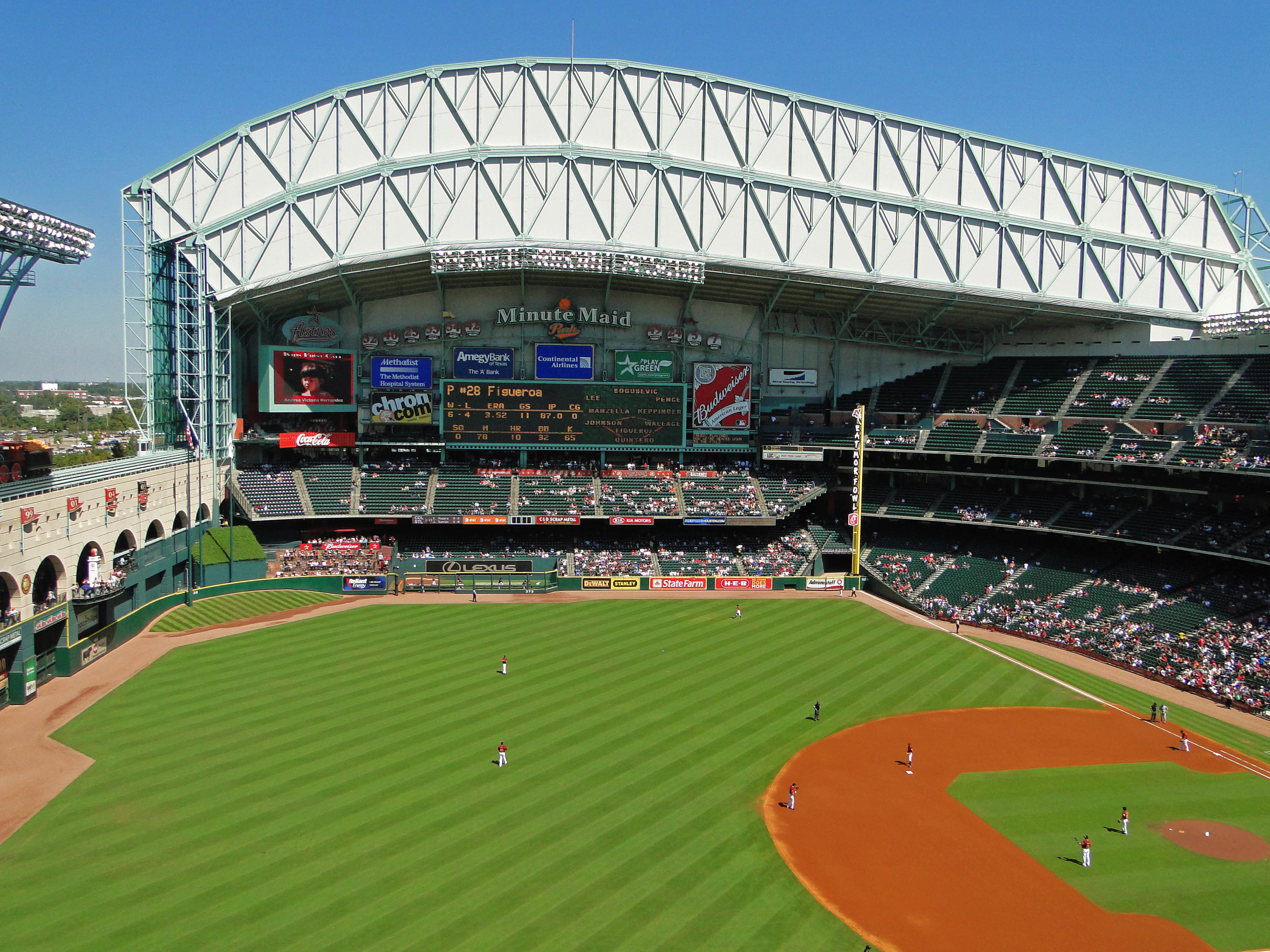
Minute Maid Park, Houston: Sunday, October 3, 2010.

The weather was nothing short of glorious. On a day in which the Astros and the Chicago Cubs had little left to play for beyond a fourth place finish in the NL Central and a quick-game getaway for tired players heading home, our Houston nine took the standings prize as the Junior Bears chalked up 102 for their latest tally in years on “how long it’s been” since the Windy City North Siders have won a World Series. (It should be 103 failures since their last World Series win, but the name of fairness dictates that even we cannot hold the Cubs responsible for what happened to baseball in 1994.)

Does the number “1908” even ring a bell? You bet it does. In Chicago’s northern environs, “1908” rings bells that gong louder and much longer than the ones Quasimodo once manned in Paris. There’s another number identified as “1945” that rings almost as loud and few others, like “1969” and “1984” that also ping out some painful sound vibrations as well.

It is finished. Eight teams live on to compete in the 2010 playoffs while everyone else, Cubs and Astros included, goes home. And who remains? Round up the usual suspects. Everyone but the Rangers, Reds, and Giants are fairly regular attendees at these annual shindigs. Meanwhile, our locals simply put the positive wraps on a lost season that also saw two icons, Roy Oswalt and Lance Berkman, move on to a couple of the playoff party clubs. Counting the blessings of 4th place over 5th, and placing considerable hope faith in youth, the future, and the assembly judgment of General Manager Ed Wade, the Astros now move on to the job of rebuilding, restructuring, reconstructing, redirecting, or reloading (pick a “re” word that’s acceptable to your tolerance palate for the truth) their roster to the challenges of returning to the winning side of major league baseball.

Several things came off neatly in the Astros’ 4-0 finale victory of the 2010 season over the Cubs. For one, the ancient Nelson Figueroa again pitched like a keeper, working six shutout innings while giving up only six hits while walking only two ad striking out eight. All of that production on 103 pitches raised Figgy’s final record to 7-4 and lowered his season ERA to 3.29. If that doesn’t help him qualify s a legitimate candidate for the number five slot in the starting rotation next spring, I don’t know what will.

Carlos Lee also went two for three, including a third-inning, cork-popping 24th home run deep into the Crawford Boxes. Carlos has another year, plus a club option on one additional season, with a buyout penalty on the team for a refusal. Finding a fielding/hitting left fielder for 2011 while letting Carlos play out his string at first with Brett Wallace as the intern may make even more sense in days to come, unless Wallace suddenly jumps up as a great hitter. We shall see.

Brett Wallace did finally get his first and only triple of the season to lead off the fourth inning. It took a weird bounce off the wall in left center and a safe call on Wallace’s slide to pick up what probably will be one of his rarest hitting experiences, but he got it for the books that last forever.

Brian Bogusevic didn’t exactly distinguish himself positively on the offensive side Sunday. Starting in center and finishing in left, “Bogie” picked this last showcasing day of the season to earn a “Golden Sombrero” by striking out in each of his four trips to the plate. Ouch! Maybe he was affected by that foot injury that he will now face through surgery. Who knows? I’m sure Brian would prefer any alternative answer to the “I can’t hit major league pitching” conclusion that often comes to rookies who earn that amber alienation of affection award for disastrous batting.

Tommy Manzella attempted to break out of his growing “almost as good a hitter and fielder as Adam Everett” comparisons by going two for two with two RBI and a walk and an error-free day in the field. I still prefer Angel Sanchez for his more consistent bat and steady fielding, even if his range is more limited.

The Astros finished at 76-86, a game ahead of the 5th place Cubs and a game behind the 3rd place Brewers. More importantly, the boys finished 15 games back of the 1st place Reds. That’s a lot of ground to make up in 2011, but for one thing: I’ll bet you almost any of us could go back over the 2010 season, game by game, and find 15 winnable game losses that would have put the Astros right there, had the outcomes been reversed. Such an exercise wouldn’t change the truth, but it could shed a little more light on what the 2010 Astros lacked in detail that ended up keeping the club from being a winner.

I believe this much about that sort of detailed research: Sometimes the details simply confirm the general impressions we are forming about a club’s hitting, fielding, team speed, pitching, and game decision- making. At other times, the closer game-by-game specific look at a season may show us some things we may be either missing or glossing over in our surface level evaluations.

The keys to this kind of research are these, I think: (1) Go into the exercise with a clear idea of what you are looking for; but (2) Be open to seeing what you weren’t looking for. History is always a teacher, even when it’s only available in this year’s game accounts and box scores.

Have a nice Monday, everybody, and remember: For Astros fans and others in our position, the Hot Stove League is now officially in session.

Forgive Us Our Press Passes, But Thank God for Mickey!

October 2, 2010

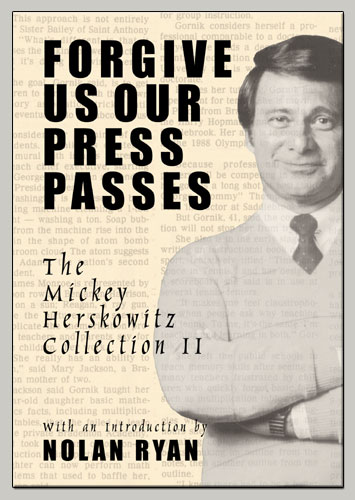
Published in 2008: Available at Amazon.Com.

Last night the Houston Media Wall of Honor took on another name in special pre-game ceremony at Minute Maid Park. Local members of the Fourth Estate inducted Houston’s iconic sportswriter, Mickey Herskowitz, into the fold of those who have done this community special service as communicators of news in all its many forms.

Mickey Herskowitz was, and still is, the best. When it comes to writing about sports, and as they alway said about James Bond for other talents, nobody does it better. Houston, indeed, should be proud of this native son and early life cub reporter on the Houston Buffs baseball and Southwest Conference football. He grew up to be the man whose late 1950s articles on this city’s deservedness for major league baseball played their own quiet role in Houston landing a National League franchise that we first knew as the Colt .45s back in 1962.

Mickey covered it all, becoming a nationally celebrated biographer for famous people as diverse as Mickey Mantle and Bette Davis. (Imagine the interview possibilities and problems Mickey might have encountered had he gotten those two figures in the same room for s a single interview back in the day. I would imagine that might have been one “opportunity” that even Mickey might have passed over, if at all possible.)

“Forgive s Our Press Passes: The Mickey Herskowitz Collection II” is a classic collection of Mickey’s work on sports stories from several different areas that will only bring you reading joy, should you choose to acquire a copy. It’s available through Amzon.Com.

Mickey Herskowitz’s daily work with the Houston Post and Chronicle is where most of us got to know him some fifty years ago, but don’t let the passage of time fool you into thinking we are simply talking about a past figure here. Mickey Herskowitz is now a full-time journalism professor at Sam Houston State University. He makes a weekly trek up to Huntsville from his home in the northern Houston hinterlands to teach and then returns home each weekend.

Those lucky SHSU kids! I just hope that some of them are wise enough to appreciate how they’ve been blessed!

Mickey Herskowitz is an inducted member of the Texas baseball Hall of Fame (1997) and he also received the TBHOF’s Jimmy Wynn Toy Cannon Award in 2006.

Speaking of Jimmy Wynn, congratulations to “The Toy Cannon” too for the honor he deservedly received from the Houston Astros, also prior to last night’s Cubs@Astros game. In naming their “Player of the Decade” winners over the half century of their existence, Houston picked Jimmy Wynn as their Player of the 1960s. Jose Cruz was named for the 1970s, Nolan Ryan for the 1980s, Jeff Bagwell for the 1990s, and Craig Biggio for the first decade of the 21st century.

Nice picking, Astros! None of us cold have done it any better!

Back to Mickey for a moment. In case you don’t know, the Baseball Hall of Fame makes an annual award to a single writer that has contributed much to baseball. It’s called the J. Taylor Spink Award in honor of the former publisher of the old Sporting News.

Mickey Herskowitz has never won this award, but a lot us think this omission is an unforgivable, but still correctible passover. If you are interested in supporting Mickey Herskowitz for this honor by the National Baseball Hall of Fame in Cooperstown, please get in touch with the man who is taking charge of the campaign in Mickey’s favor. His name is James Anderson and his e-mail address is jamesaa1946@yahoo.com> Mickey did not request this help, nor is he participating in lobbying for himself. The whole idea began and carries through from Mr. Anderson, an enormous Houston and Astros fan.

Publication Date is This Friday, Oct. 8th!

Speaking of books, here’s a reminder. “Toy Cannon” is available for purchase now through Amazon.Com too. This wonderful story of Jimmy Wynn’s life and baseball career is officially available this coming Friday, October 8th.

Have a great weekend, everybody. And let’s hope the Astros can turn back the Cubs in their titanic battle for fourth place in the national League Central.

Great Article on 1954 Dixie Series

October 1, 2010

The 1954 Texas League Champion Houston Buffs

If you belong to SABR, you’ve probably seen “The 1954 Dixie Series,” a fine article on that contest between the champions of the Texas League, the Houston Buffs, and the champions of the Southern Association, the Atlanta Crackers.

Kenneth R. Fenster researched and wrote the article for the 2010 edition of  “The National Pastime” as one of the featured stories for the collection entitled, “Baseball in the Peach State.” Fenster’s work and all the others beutifully shone the spotlight on the history of baseball in Georgia as part of SABR’s 40th anniversary convention and celebration in Atlanta this past summer.

For those of you who don’t know, SABR is an acronym for an organization that a number of his support as members because of its commitment to the accurate recording and preservation of baseball history. The letters stand for The Society for American Baseball Research. If you think you might like to join us, check out the website at http://www.sabr.org/

I won’t attempt to summarize Fenster’s fine work here. You need to read it for yourselves to fully appreciate the full rush of Atlanta’s great comeback and the gravity of Houston’s great fall in that Series.

All I will say is that the ’54 Buffs took my heart with them in that collapse. My three favorite players that year were an earlier version of the “Killer B’s” – 1st Baseman Bob Boyd (.321 BA, 7 HR, 63 RBI), 3rd Baseman Ken Boyer (.319 BA, 21 HR, 116 RBI), shortstop Don Blasingame (.315 BA, 5 HR, 53 RBI) and right fielder Willard Brown (.314 BA, 35 HR, 120 RBI). Brown got a lot of numbers with Dallas before coming over to Houston, but he proved to be the big difference-maker for Houston in the stretch. The best pitchers for the ’54 Buffs included WIllard Schmidt (18-5, 3.69 ERA), Hisel Patrick (10-3, 3.77 ERA), Luis Arroyo (8-3, 2.35 ERA), and Hugh Sooter (14-13, 3.28 ERA).

The Buffs had everything they need to go all the way. They just didn’t get there. Up 3 games to 1 over Atlanta in the 1954 Dixie Series, the Buffs crumbled. They lost three games in a row, allowing the Crackers to take the rush and the glory of the unbelievable comeback into their own treasure chest of great historical memories.

Have you figured out by now why I haven’t written about the 1954 Dixie Series through today? If not, then anything else I’ve written, am writing, or will write on Houston baseball isn’t likely to make any sense either.

Stan Musial: Great from the Git-Go

September 30, 2010

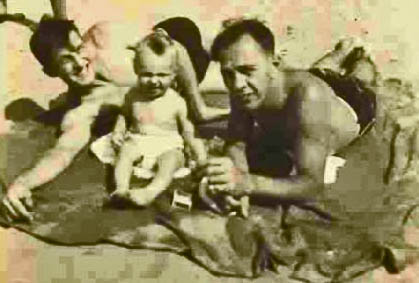
Stan Musial (L) relaxes at beach with friends during spring training 1942.

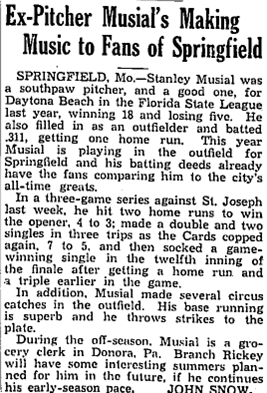
How times have changed. Back in the winter of 1940-41, a young pitcher for the St. Louis Cardinals celebrated a Class D season pitching record of 18-8 and a batting average of .311 by going home to his little birthplace in the country at season’s end to stock and sack groceries at a local food store. Of course, he did. The kid was only 20 years old and much in need of that off-season job income.

That kid quickly grew to be the man – Stan “The Man” Musial, one of the greatest examples of a great pitching prospect forced by early arm injury and an even louder talking bat into make the conversion from the mound to everyday action as a position player.

From 1941 forward through 1963, the corkscrew hunching lefty would torment National League pitching with a hitting barrage that would easily carry him on a no-brainer path to the Baseball Hall of Fame. In 22 big league seasons, Musial would win 7 NL batting titles and hit .331 for his career with 3,630 total MLB hits, 725 doubles, 177 triples, 425 home runs, 1,951 runs batted in, and 6 slugging average titles. We could go on and on, but the picture on Musial is already clear. He was a great producer from the very start of his career.

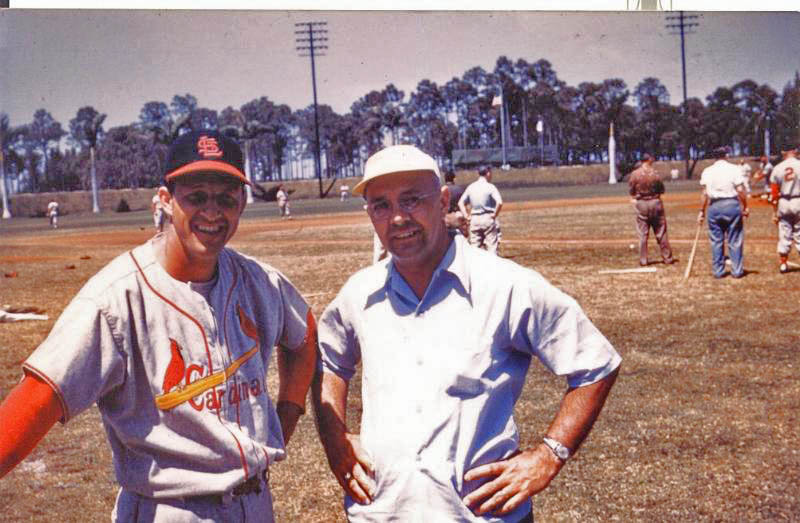
Stan Musial with Chuck Schmidt at spring training 1954.

In his 22 MLB seasons, Musial hit over .300 on 17 occasions. He won 3 MVP awards. He played in 4 World Series. And he played in 24 All Star Games. His 1969 induction into the Hall of Fame was anti-climatic to a foregone conclusion. The guy belonged nowhere short of baseball’s top rung of greatest hitters – and his outfield and first base play in the field was not too shabby either.

Two factors fail to show up clearly in most straight statistical looks at the career of Stan Musial, but much of the man’s true character and early ability leaks out in the above article I received yesterday from Bill Rogers, a St. Louis Browns friend in St. Louis. The little column from Springfield, Missouri back in 1941 speaks to  how good “The Man’s” hitting was from early on – and the little comment about his off-season job in Donora, PA as a grocery clerk speaks humbly for his lack of ego about these God-given abilities. The man just got up each morning and went out and did what he needed to do – and what he was capable of doing – and that included stocking grocery shelves because he needed the money as well as knocking the covers off baseballs because he had the ability to do so.

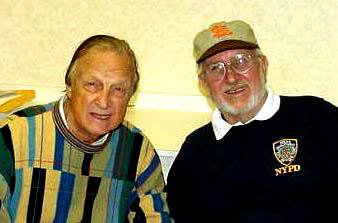
Stan Musial and Yours Truly, St. Louis, 2002.

I was privileged to meet Stan Musial back in 1996 when I attended an annual banquet in St. Louis honoring former members of the old St. Louis Browns. I’ve since seen him several additional times at these same functions, although they are no longer being planned on the same level. Time and the loss in great numbers of the old Browns has changed everything except for the inevitable conclusion that finally falls upon all human endeavor. But it was fun while it lasted.

That first time I met Musial was dumbfounding. I was alone on an elevator in the banquet hotel, heading for a fan afternoon reception for the old Browns. All of a sudden, the door opens on a floor and a man enters to join me as the only other rider.

Here I am. Little Billy McCurdy from the Houston End. A guy who lives to find a rare Stan Musial baseball card. Now. Here I am again. Grown up and older Bill McCurdy. Riding alone on an elevator with my greatest baseball childhood hero – and I can’t even speak. I don’t want to put “The Man” through one of those Goofy-like, “Gawrsh, you’re Stan Musial, aren’t you?” moments that I’m sure he’s been through a gazillion times. But I also don’t want to seem stupid or disrespectful by ignoring him totally.

As the elevator door opens on our reception floor destination, I settle for a smiling nod and eye contact statement of “Hi, Stan!” It felt OK. And I later got a photo with him, plus his autograph on a baseball. By this time, everybody was doing it.

Over the years that followed, I learned that Stan Musial was as nice and down-to-earth friendly as anyone could be. Whether he actually remembered me from year to year, I can’t say, but he always behaved as though he did. He was as friendly toward me as my old Polish-ancestry baseball coach at St. Christopher’s back in the early 1950s. I will always remember his kindness as much as I do his greatness.

If you pray, keep Stan Musial in your prayers from here on. He turns 88 on November 21st, but he’s in frail health these days. When we lose him, we’re not getting another like him. They aren’t making any more Stan Musials in the 21st century.

Have a nice day too. It’s good to be back. I can’t guarantee I’ll be writing another daily blog for a while, but I will give what I do write here my best shot, as time and energy allows.

“Toy Cannon” Publication Date is Oct. 8

September 25, 2010

“Toy Cannon: The Autobiography of Baseball’s Jimmy Wynn” by Jimmy Wynn with Bill McCurdy is scheduled for release by McFarland Publishing Company on October 8, 2010. The book is available now for pre-order copies, or on Kindle, through Amazon.Com, Barnes & Noble, and all other national retail outlets. No schedule has yet been established, but Jimmy Wynn will be available locally in Houston and elsewhere this fall for book signings at a variety of retail outlets that will be carrying this very honest and full life story of a great Houston Colt .45/Astro icon.

When Jimmy asked me to work with him as a supportive co-author on this project, back on Father’s Day 2008, I was equally thrilled and humbled by the invitation. The story had to be Jimmy’s, told in Jimmy’s words, but it had to deal with all the significant events of his life, not merely his many accomplishments on the field. That was the task we embraced together. In the process, Jimmy Wynn’s wisdom from his personal experience came pouring through on tape.

As we are hoping you will see for yourselves, Jimmy Wynn proved up to the task. Told in the first person point of view, Jimmy takes us through what his life was like growing up in Cincinnati, how he came to be signed by his hometown Reds, how he quickly came over to the new Colt .45s in a minor deal, how he survived his initiation into the big time at the hands of “The Dalton Gang”, Turk Farrell and Jim Owens, and how he fared in the hands of managers in Houston like Harry Walker and Leo Durocher.

Specifically, Jimmy also gives us a good long look at some of the life lessons that came for him the hard way through marriage and life on the road back in the “old days”, along with a strong eye witness view on what it was like to be there as a player during the salad days of the Astrodome, playing with guys like Joe Morgan, Don Wilson, Larry Dierker, Cesar Cedeno, and others.

The story also covers Jimmy’s personal account of the 1967 home run race he barely lost to Hank Aaron in 1967 and his personal view on the major long balls he hit in Cincinnati and Pittsburgh, plus a very powerfully moving story of his last home run in the major leagues. That one is not as well known, but it needs to be. It came in Yankee Stadium on Opening Day, 1977. We’ll save the rest. The story is Jimmy’s to tell.

There are too many people to thank here for the fine production we think this book will prove to be over time, but we thank everyone appropriately in the book. We especially do wish to thank our friend Mickey Herskowitz here, both for his support and advice, and his fact-check reading of the manuscript, plus the wonderful Sumner Hunnewell for his design and development of the important Index feature, along with some significant help of his own on fact-ckecking. Finally, and more than a little, we also want to thank the entire staff of McFarland Publishing for transforming the editorial and production phases of “The Toy Cannon” into a process for making the book a sharper, more clearly told story.

If you are interested, here’s a link to the Amazon information page on ordering. Jimmy Wynn and I will be grateful to any support you care to give our project.

http://www.amazon.com/Toy-Cannon-Autobiography-Baseballs-Jimmy/dp/0786458569/ref=sr_1_1?s=gateway&ie=UTF8&qid=1285410514&sr=8-1

Thank you.