Posts Tagged ‘culture’

Old Houston Car Dealers

November 11, 2010

“take the wheel…make a deal…on a beautiful Rocket Oldsmobile”

Important Notice: This column thread is closed from further reader comment at this site, as of February 12, 2018, due to a volume of interest that exceeds our particular aims at The Pecan Park Eagle. We are appreciative, however, of the apparent high interest in a site that is designed to keep this ball rolling.

Reader John Landeche has created a new site at Facebook for everyone who wants to stay in touch as connected members of this new “Old Houston Car Dealers” location on FB.

We do NOT have the link. For further information, contact John Landeche at his e-mail address, jlandexp3@yahoo.com

Thank you all for support here. And please know that we will do all we can to help the group connect at their new base.

Regards,

Bill McCurdy, Publisher

The Pecan Park Eagle

Most to all of the Houston car dealers that I shall mention here are long gone. I’m presuming they all are, but with the caveat that one or two may still exist on a low-advertising budget during an era in my life which finds me less involved with car dealers than I ever was as a kid and young man.

I grew up with cars and car dealers because cars were my my dad;s business. Dad had a Dodge-Plymouth dealership in Beeville, Texas back in the 1930s. In fact, when Dad opened his doors there in 1936, he was briefly recognized as the youngest car dealer in the United States at age 25.

World War II ended our family-run dealership and we moved to Houston on my fifth birthday, December 31, 1942, spending our first Houston night at the old Big Chief Motel on South Main and celebrating New Year’s Eve with burgers at the Prince’s Drive Inn at the South Main/OST “Y” connection of those two old city roads.

Dad spent World War II working as a welder at the Brown’s Shipyard and then went to work as manager of the parts department for the Jess Allen Chrysler-Plymouth dealership near the Broadway/Harrisburg “L” link in 1946. He later held the same job for Bill Lee Motors, a Studebaker dealership on Lawndale, east of 75th, from 1950 to 1958. 1958 is also the year that my parents and siblings moved back to Beeville so Dad could go back into business for himself. I stayed here because I was already into my junior year at the University of Houston by then – and because I had been raised as a Houstonian. I didn’t have to leave town to go home. Home was here.

An off-the-top-of-my-head list of Houston car dealers that are no more includes Jack Roach Ford, Sam Montgomery Oldsmobile, Earl McMillan Ford, Jess Allen Plymouth-Chrysler, Bill Lee (Studebaker) Motors, Art Grindle Motors (I forget what he sold), and so many more that now escape easy memory, and they all sold American cars: Ford, Lincoln, Mercury, Chevrolet, Oldsmobile, Pontiac, Buick, GMC, Cadillac, Hudson, Nash, Kaiser, Fraser, Chrysler, Plymouth, and Dodge.

There were other American cars and far more now-lost dealerships in Houston that I can no longer quickly recall, but they were once here. And they were real. And they basically drove Houston and fired the horsepower of our mid-20th century American economy. Then along came VW, Renault, Fiat, and Toyota – like so many soldiers from the Trojan Horse belly of our new Post WWII world economy – and it was all but over soon for the dominance of Detroit in the American new car world.

Because of my partiality to Oldsmobile, or maybe “just anyway,” I do still easily remember the jingle that Sam Montgomery used to attract new customers by radio. Sung a cappella by a men’s barbershop quartet, the Sam Montgomery Oldsmobile pitch went like this:

“Go to Sam Montgomery, and climb behind a Rocket!

You will find what’s right for you!

A car to fit your pocket!

Take the wheel, make a deal, of a beautiful Rocket Oldsmobile!

Better talk to Sam! – Sam the Rocket Man!

Talk to Sam Montgomery today!

(He’s in the Village!)

Talk to Sam Montgomery – TODAY!”

… Have a nice Thursday, everybody! If you remember the names of the many other now vanished Houston car dealerships that I have so easily forgotten, please post them below as additions to this piece.
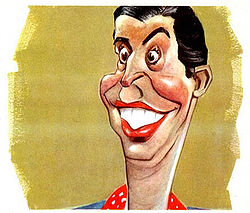
Milton Berle: Mr. Television

November 10, 2010

Milton Berle (by Sam Berman, 1947)

When my parents bought our first television set in 1950, Houston was only into its second year with the magical new medium and we had very choices with only one station in town. KPRC-TV was it. You could either watch Channel 2 or turn the thing off and listen to the radio. And there wasn’t much interest in radio in Houston back in 1950.

On top of these limitations, we had no coaxial cable connection to the great TV media centers of New York and Los Angeles in 1950, and, of course, there were no satellites available to beam those places or the farther world into our homes back then. Everything we watched came only in shades of black and white from live local studio programming, film, and kinescope. – Kinescope was a low quality film the networks took of their television pictures whenever they broadcasted shows they wanted to syndicate to other areas.

So, the networks like NBC filmed a live program broadcast from New York right off the television pictures of it. Then they put these “kinescope” copies in the mail to places like Houston and Dallas, usually for re-broadcast at the same time the following week.

All of the preceding information is simply background to the story of what happened in Houston and all over America on Tuesday nights from 8:00 PM to 9:00 PM back in 1950. In most places, it came a week late on kinescope, but we didn’t know any better quality, anyway. We were just glad to be receiving an animated picture that actually did something. We didn’t even seem to mind (for a while) that we had no other viewing choices – or that live pictures in “living color” might be more pleasing on the eye. For the time being back then, we had what we wanted, and especially so on Tuesday nights.

It was 8:00 PM Tuesday night, time for the Texaco Star Theater, starring Mr. Television, the one and only Milton Berle.

Milton Berle was one sight joke falling upon another, a lot of goofy expressions, pratfalls, cheap laughs from his favorite stunner, starting the show and doing skits in Lady Gaga-like dresses. Geez! When I think back upon it now, it’s almost embarrassing to recall what we thought was “funny” back in 1950, simply because we saw Milton Berle do it.

Berle was a master too of the “pesky fly” joke. A “pesky fly” joke is one that resembles the pattern of such a pest: Once a fly gets in the house, it won’t go away and can’t be killed. It just keeps coming back and landing with irritating regularity.

Berle’s biggest pesky fly was the “make up” joke. It began with a skit in which the characters complained about their make up. Each time they said those words, a goofy-looking dressing room helper would run on the stage yelling “Maaaaake Upppppp”  and hit the person in the face with a giant fully loaded powder puff.

The studio and home audiences roared. The joke became a pesky fly. From that point forward, you never knew when the guy with the giant powder puff was coming back to whack Berle or one his guests for having uttered the magic words, “make up.”

The show lasted from 1948 to 1956. It changed names in 1953, when Buick took over sponsorship, but that’s OK. Milton Berle was the show, not Texaco.

It all changed as all things do. When more networks, stations, and other kinds of comedy became more widely available, Milton Berle lost his grip on the title he earned as Mr. Television, but he was big in his day and he served as the reason that neighbors without TV sets piled into the houses of those who did at eight o’clock on Tuesday evenings to hear, “The Texaco Star Theater Starring Milton Berle Is On The Air!”

I’ll close with a tribute to the show’s opener. Since they long ago drilled this jingle into my brain, the least I can do is pass it on to you. I only wish I had a way to pass on the tune as well. Just imagine something strident and banal as the jingle melody..

The Texaco Star Theater always began with a chorus line of Texaco gas station attendants marching in file upon the stage and then facing the audience in a smiling single line to sing this song:

“Oh, we’re the men of Texaco
We work from Maine to Mexico
There’s nothing like this Texaco of ours!

“Our show is very powerful
We’ll wow you with an hour full
Of howls from a shower full of stars.

“We’re the merry Texaco men
Tonight we may be showmen
Tomorrow we’ll be servicing your cars!

“We wipe your pipe
We pump your gas
We jack your back
We scrub your glass

“So join the ranks of those who know
And fill your tanks with Texaco

“Fire Chief, fill up with Fire Chief, You will smile at the pile of new miles you will add

“Sky Chief, fill up with Sky Chief
You’ll find that Texaco’s the finest friend your car has ever had

“…And now, ladies and gentlemen… America’s number one television star… MILTON BERLE!…”

ADDENDUM: Thanks to Sam Quintero, here’s a link to see and hear how the Merry Texaco Men opened the show and introduced Milton Berle. Berle’s entry also confirms my Lady Gaga-like memory of his typical attire.

http://www.youtube.com/watch?v=mTofvqEJyxU

Valian’s Pizza Update

October 28, 2010

Honest Raia Family Wants Whole Truth Known.

We’ve written quite a bit lately about the rediscovery of Valian’s Pizza at Raia’s Italian Market at 4500 Washington Avenue. Many of us have since been to Raia’s more than once to sample the rich goodness of the thin crust and rich marinara and cheeses that together make up the arguably greatest tasting pizza of all time. I’ve even taken Richard Coselli, the fellow who served as the UH student chairman of Frontier Fiesta back in 1957 when Valian’s Pizza was first introduced at our big annual campus show, to try the Raia version with me.

Richard Coselli’s taste buds agreed with mine. The Raia version, indeed, is enough like the original to be accorded the status of Valian’s Pizza Reincarnated, even if there existed for both of us a slight variation in taste due to some changes in herbs, spices, or meat products now available in comparison to a half century ago.

Now it seems that we have jumped to a wrong conclusion on how the item described by the Raia family on their menu as “Valien’s DeLuxe” pizza came about. It turns out that this beautiful restoration of an all time Houston culinary favorite was not the result of some ancient family friendship between the Valian and Raia families and a handing-off of the former’s famous pizza recipe in the name of friendship for the sake of posterity.

That story was the urban legend that I hooked onto when my friend first told me. And, since my friend had never been to Raia’s, that was also the legend that he had hooked onto from someone else. My error was then going to Raia’s to try the pizza and then writing about the experience without checking out the truth of the story about its origins directly with the cafe’s owners, Luke and Kathy Raia.

I still haven’t met the Raia couple, but I have heard from Kathy Raia a couple of times by e-mail. Give me an “F” in investigative journalism this time, folks, but I wasn’t on assignment, looking for a deception that never existed in the first place. The Raia place just reeks with good taste and integrity.

My willingness to accept the story I first heard about how the pizza started at Raia’s, nevertheless, has only reenforced the urban legend version of a delicious replication that deserves the Valian’s pizza comparison in its own right.

An e-mail I received from Kathy Raia last night explains the whole misunderstanding:

Date: Wed, 27 Oct 2010 16:46:36 -0500
Subject: Re: Raia’s
From: raia.italian.market@gmail.com
To: houston_buff@hotmail.com

Mr. McCurdy, we appreciate your blog about how good our Valien’s pizza is but we don’t want to create any false impressions.  The store manager you talked to is our son. He knew that my husband went to Valian’s when he was younger. We have never had a relationship with the Valian family nor received any recipes from them.
We named this pizza after one of the pizzas we used to order at Valian’s. This pizza was put on our menu as a tribute to the first restaurant in which my husband was introduced to a pizza.
If you would like to clarify this on your blog, we would appreciate it because we have been getting a lot of phone calls and emails.  My husband has had to expain that we didn’t know the Valian family and this pizza is not their recipe.  We just enjoyed going there.
Please come in again and say hi to my husband so y’all can reminisce about Valian’s.
Thanks, Kathy Raia

And thank you for that clarification, Kathy. You and Luke still deserve Valian’s Pizza status and credit with your tribute recipe version of one of the greatest and most uniquely delicious foods ever produced by a Houston family.

Long live Valian’s! Long live Raia’s!


All Time Big College Football Champs

October 19, 2010

"Run, UH, Run! - You've got a lot of ground to cover to ever catch the big guys on this list!"

When you think about it for five seconds, is it really a big surprise as to which schools are in the running for a national championship in big-time college football every season? Just follow the scent of money, alumni power, and the support of the broadcasting networks, advertisers, and other marketing forces of the American body politic and it all comes out in rolling tides of gator chomps and horns that hook ’em.

The following group is a top ten school list of those universities that won the most national football championships from pollsters since 1901. If we were to start this list from the first awards of national recognition from 1869 forward, the leader-board would also contain a tinge of Ivy League, but we chose to ignore that earlier era here for the sake of keeping this list more in contact with the reality of how the college game is played today.

Here’ what we found:

Big School College Football Championships (1901-2009):

(1) Alabama – 13

(2t) Michigan – 11

(2t) Notre Dame – 11

(2t) USC – 11

(5) Pittsburgh – 9

(6t) Ohio State – 7

(6t) Oklahoma – 7

(8t) Michigan State – 6

(8t) Minnesota – 6

(8t) Tennessee – 6

Two Others of Local Interest …

LSU – 4 (1908, 1958, 2003, 2007)

Texas – 4 (1963, 1969, 1970, 2005)

The whole article on past championships going back to 1869 is very interesting. Simply cut and paste the following link to your address live and check it out. …

http://en.wikipedia.org/wiki/NCAA_Division_I_FBS_National_Football_Championship

If we go back to include schools that mainly did their trophy-winning in the 19th century, Princeton (28) and Yale (27) rise to the top of the heap above all others. These Ivy League schools are disqualified here for having used true student athletes to rack up all the honors from those earlier era, very misinformed pollsters as to what is really important in life, especially to the extent that honesty and integrity should have anything to do with intercollegiate athletic competition.

Alma Mater Fidelity

October 10, 2010


Freshman David Piland Gets "Baptism Under Fire" at QB for UH.


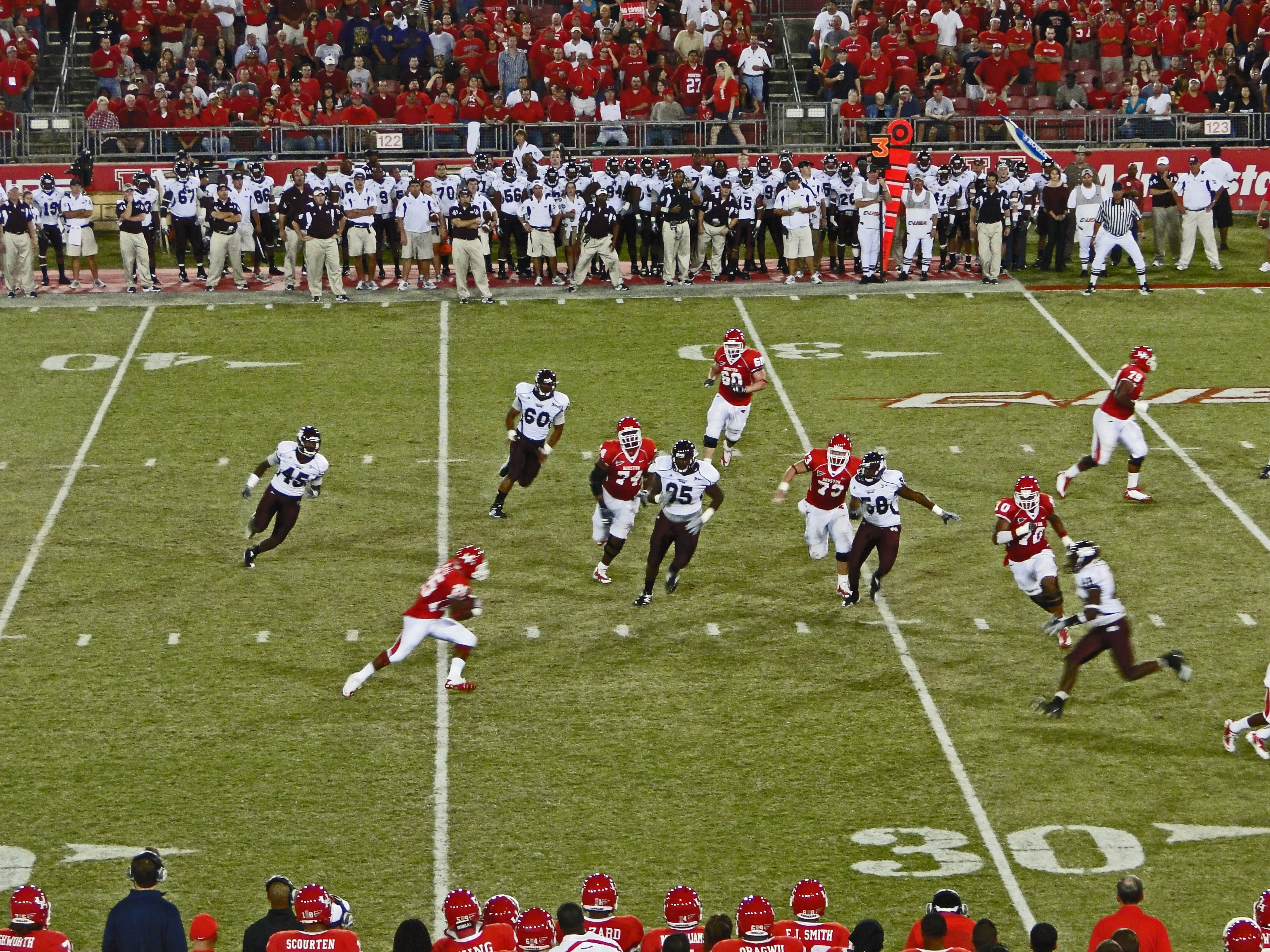
The Houston Cougars ended their 18-game home winning streak last night before 32,067 fans at Robertson Stadium by falling decisively to the bigger, faster, more experienced  and hungrier Mississippi State Bulldogs, 47-24.

UH Coach Kevin Sumlin continued his search for a successor to the ill-fated and career-finished hopes of former star Case Keenum by inserting his other true freshman QB prospect into the game in the form of young David Piland. Piland did OK, but his two TD passes were more than off-set by two interceptions, one of which led to a fatal touchdown run back near the halftime mark that left the Cougars in a 33-10 hole at the mid-game break.

The other freshman QB, Terrance Broadway, got in the game long enough near the end to throw a 17-yard TD pass to Isaiah Sweeney with 4:36 to go, preventing the game from become the most lopsided loss in Coach Sumlin’s three-year history at UH.

We Cougars took the disappointment in stride and moved on. After case Keenum went down forever as a UH Cougar in the UCLA game of Sept. 18th, none of us were really surprised by last night’s outcome. Few clubs at the college level are deep enough to survive the loss of their only superstar with any hopes of the season playing out as the final realization of their  once great expectations.And UH is no different from the rest in that regard.

For UH, major victory on the gridiron remains more of a hope and a distant memory than it is an actual realization. UH’s 37-7 win over Michigan State at East Lansing in 1967, that 30-0 shutout of UT at Austin in 1976, and the 17-14 thumping of Nebraska in the 1980 Cotton Bowl jump to mind, but none of those wins happened recently and all were against big name teams that aren’t likely hot to play the UH Cougars again anytime soon.


A few UH plays worked well early against MSU last night.


Today’s piece isn’t really about last night’s game, or even about becoming a team that is perfect enough to to win a national championship or stay in the hunt for one at any cost, every year, including especially the cost of young futures that sometimes get thrown into the fires of  ambition fanned by the universities and their wealthy alumni.

Today’s question is simply: Why be loyal at all to the universities that gave so many of us a good start in life? And, more complexly, why celebrate that loyalty by throwing so much of our support into paying for the athletic programs, especially the lucrative football and basketball programs?

From a money standpoint, the first question speaks for itself and the second virtually answers itself. We are indebted to the university as one of the great givers in our lives. We are loyal to our university’s sports teams because of the complex identity we share with the university and all others who gone there as we did and who have also come out into the world as Cougars, Longhorns, Aggies, Owls, and the like. We carry it even further by incorporating the colors, emblems, hand-signs, and slogans of our group into a ritual show of affiliation by our mode of dress and behavior.

Has anyone ever heard the guy whose luxury care horn plays “The Eyes of Texas?”

Look! I’m not going egghead on you this morning, but for me, it works something like this. I can’t really speak for anyone else: (1) I not only did my undergraduate work at UH, but I also grew up only two miles from the campus. UH always was, and always will be, part of who I think I am – a kid from the East End of Houston who caught an early  break and worked his way into a slightly larger world of possibility and opportunity through a door-opener on higher education. And that open-door, as long as I was willing to both work at my studies and also support myself by working at whatever honest student job I could find, was the University of Houston.

(2) My affiliation with UH’s athletic programs was an easy fit for me. Sports are a way of defining our successes and failures in measurable terms that often are blurred or simply expunged from everyday life matters due to certain politically correct factions that would prefer we behave as though “winning does not matter.” Of course, winning matters. If it didn’t matter, we wouldn’t have all these companies, including NASDAQ, manufacturing scoreboards and all the other kinds of scorekeeping equipment.

(3) I say the scoreboards are for measuring progress, not perfection. If they are merely measurements of perfection, than all college sports fans are doomed to the disappointment that Alabama suffered yesterday because of their 35-21 loss to South Carolina. Perfection says: “So what if you won the national championship last year? You didn’t win yesterday! And that makes you imperfect and, de facto, no good!”

By my standards, the UH loss to Mississippi State last night was simply a toll both on the road to progress, just part of the price of getting better as the team searches for somebody who has a chance of growing into Case Keenum’s shoes at Quarterback. Our UH goal is always, “in time” (our longtime university motto) to get better. – We show improvement by learning from everything that turns out painful on the road to progress – just as we hope to learn from our disappointments in everyday life.

(4) We watch college sports also because they are fun to watch. It’s not much fun watching researchers working on a new health care vaccine, or math theory., but I also believe that our dedication to pure progress includes financial donations to our universities and their academic programs to the extent that we can afford to do so.


"All Hail to Thee, Our Houston - University!"


(5) Alma Mater. Always Faithful. Everything hinges on the important ongoing relationship of fidelity and trust between a university and its alumni. Both should be conscious of the need to take care of each other by mutual effort – and not be turning the entire reciprocal act of mutual caring into another wasteful play of institutional entitlement.

The only entitlement here belongs to the students. Students are entitled to the best academic opportunity the university can provide them without any exploitation of the student’s funds or talent resources,

At any rate, that’s how I see my relationship to my alma mater, the University of Houston. Last night’s football loss to MSU was simply another painful toe-stumper on the road to progress with larger goals and accomplishments for us all in the wider, deeper scheme of things to come.

Have a happy 10-10-10, everybody!

Time After Time

September 13, 2010

Stephen Hawking

Physicist Stephen Hawking says that time travel is theoretically possible in light of Einstein’s work.

http://www.msnbc.msn.com/id/39152254/ns/technology_and_science-space/?gt1=43001

If it happens. here’s my first flight plan:

Destination: September 30, 1927: Yankee Stadium. The Bronx. Time Arrival: 9:00 AM works for me. I have some other things to see and do before the main event. Need: Game Tickets. Should be no problem. Use 1927 currency only. Event: You’re kidding, right? Travel Restrictions: (1) Tell no one from your own time zone where you are going; (2) dress appropriately to the projected expectations of your destination populace; (3) tell no one where you’re from; (4) Stay away from the track and other OTB stores; (5) no stock or bond transactions; (6) offer no predictions to the locals; (7) do not try to fix or redirect the future; and (8) never stay longer than 24 hours  before returning to your own time base. Staying anywhere longer than 24 hours increases the risk of increased affinity for the locals and a potential meltdown of your commitment to the travel restriction rules.

Question: If these terms of time travel are acceptable to you, where do you want to go for 24 hours to another space on the time travel continuum?

That’s it for me, for now. Can’t really say where I’m going, but I’ll be back soon. Have a nice balance of time in September 2010.

Coming Up for Air

September 12, 2010

Sacred Soil from Home Plate Area of Eagle Field, 1950.

Hello, Friends. My apologies for the little hiatus going on here, but the past two weeks have been hung up with two impossible-to-ignore facts of life. The first involved a writing project. The second was a flu-like virus that leveled me from head to heels for about a week. I am still recovering at my own pace.

It’s not over. I am about to make the road trip of my lifetime, one that will continue to take me away from my home-sweet-home Pecan Park Eagle site for about two more weeks, more or less. Our son Neal, our Hounds of Baskerville-like canines, our security system, and our good neighborhood nosey friends are guarding the castle for us, 24/7, while Norma and I drop out of sight for a little journey we’ve been ready to take for years.

More on that later.

Meanwhile, that little magic bottle in the photo is my short subject topic of the day.

The bottle is filled with soil that I dug up from the former home plate area of our sandlot heaven in Pecan Park, the place we kids renamed “Eagle Field” over a half century ago. I found the little frog figure nearby as I was digging up the dirt and just glued it on the bottle for the ride later on. It seemed appropriate. The old Eagle Field site was located so near the Japonica-Kernel Alley wide spot that we also named “Frogtown” for its once prolific population of Houston Toads.

Oh, that tarnished silver relic that’s draped over the bottle of magic dust? I found it in an old storage box recently. That’s my ID bracelet from that earlier period. It was designed to be there on me as a way of identifying my earthly remains in case any of our McCarthy Era sandlot games were unexpectedly rained out by an atomic bombing of Houston on some surprising summer afternoon. A number of us wore such items back then.

Thank God that atomic bomb thing never happened.

At any rate, all’s well now. Baseball is forever. And though I’m not, it appears, for now, I’m going to live, a while longer, after all. And the Astros youth and pitching competence crew and the mellow even-steven Mr. Mills all seem destined to floating hope for a near .500 season in spite of all our early club disasters and some sad farewells in 2010 to Roy Oswalt and Lance Berkman.

Look for further word from this little corner in about a fortnight. And while we’re all waiting for the World Series and the long pause into the the 2011 baseball season to show up again as the off-season, say a little prayer for some cool autumn weather.

We could all use the refreshment.

Papa Started Out as a Cowboy

August 31, 2010

Papa Teas in his daily radio news and solitaire card station.

It’s important to remember the people we came from. At least, it is to me. And today I just have a few thoughts about one of my grandfathers, my mom’s dad – the ne “Papa” who lived in my life from the time I first opened my eyes.

Of my two grandfathers, one was always a writer and businessman. The other started out as cowboy before branching out as a jack of all trades in the lumber business, other product sales, and finally as a bureaucratic manager for the Works Progress Administration during the New Deal Era.

I never knew my Grandfather McCurdy, except for what I could know of him through his writings for the little newspaper he started and owned through his death in 1913. The Beeville Bee got its start from Will McCurdy back in May 1886 as the first newspaper in the little Texas town of Beeville, some fifty miles north of Corpus Christi.

Grandfather Willis Teas, or “Papa”, as we called him, was in my kid life forever.  He died of a stroke at age 72 in September 1955, just as I was starting my senior year in high school here in Houston. Papa had lived with us for  a while in the early 1950s, but, by the time of his death, he was continuing his retirement and living in his real home town of Floresville, Texas.

Grandmother Teas, whom we called Mama, died in 1944, I think, and Papa had lived alone in a rental first floor duplex on Hammond Avenue in San Antonio before coming to live with us for a while in 1950.

Papa Teas

Papa’s place would have made a great stage set for a play about a good man growing old. Had he been alive today, he would’ve had a computer screen sitting in front of him and been spared all the card shuffling he did daily playing solitaire. Although I have a hard time seeing Papa on Facebook, I’m sure he would have found that site too by now.

As it was, Papa’s Place centered on the right side of a little breakfast cove, where there was plenty of space for cards, coffee, pipe tobacco, ash tray, and radio news.

Papa had been pretty strict as a parent to my mom and uncles, but he was a softy in the matter o f his grandkids. Nevertheless, we still respected his strict veneer and somewhat stand-offish manner at first when we came to visit. When I was a really small kid, in the last days of World War II, I also sometimes had trouble understanding the words that Papa used.

Once, while watching Papa play cards and waiting for him to say something, I noticed that every now and then he would glance my way and then back to his hand of cards, Finally, he spoke, but I heard him say the following: “I just heard on the news that we dropped a lot of bums on Nazi Germany yesterday.”

Bums? Falling from the sky? The picture of a lot of hoboes bouncing all over the German countryside was almost too much for my kid’s brain.

“What’s so funny?” Papa asked.

When I tried to explain, he smiled too, but then he made the mistake of trying to straighten me out. “No, Billy,” he said, now leaning toward me as he spoke, “I’m talking about bums that contain explosives, the kind that blow up when they hit the ground,”

More laughter. Our conversation devolved into something like an Abbott and Costello “Who’s On First?” routine without the audience laughs and big Hollywood contract. I’m not sure we ever got it straight. He talked funny. I heard funny. It was funny. To us, at least.

Papa also always had one of those popular calendars of that day that showed a bunch of monkeys sitting around a table playing cards. “Don’t monkey with cheap roofs!” was the company’s calendar sales motto.

Papa’s place was always too dark. And it always reeked with the aroma of sweet pipe smoke. That part never bothered me, unfortunately. I could have benefitted from a little childhood allergy to tobacco smoke. Instead, I eventually got sucked into years of nicotine addiction, before my incredible late life recovery from same. I don’t blame Papa or my dad for my nicotine habituation, I think we just had it our DNA and life style patterns.

Sometimes Papa would take the train to Houston and we would pick him up at Union Station, the current site of Minute Maid Park. I remember once walking from the train platform with Papa toward the big station lobby and looking up at what seemed to me as the very high roof of Union Station. It was high enough to prompt this Q&A exchange between Papa Teas and little kid me:

Billy: “Papa, would it kill you if you fell off that very high roof?”

Papa: “The fall itself wouldn’t kill you, Billy, but that sudden stop by the sidewalk would pretty much do you in.”

We both had to laugh at that one.

Once he moved into our little house with us, Papa never felt comfortable. He missed his card-playing, pipe-smoking, coffee-drinking, news-listening station in San Antonio. By the time it all got worked out for him to live in his own little rental cottage in Floresville, near other family, he was much happier to see us, but on a less constant basis.

I still love you, Papa. As we approach the 55th anniversary of your death next month, I’ll be thinking of you even more than usual, and wishing we could talk some baseball again – even if you were a diehard San Antonio Missions fan and I was a true-blue  Houston Buffs man,

Hope you all have someone like my Papa to remember in the name of love. Those special people never really go away, do they?

Houston: Where Hope Floats

August 22, 2010

Allen Parkway, 1960.

Allen Parkway, 2010.

You Houstonians already know these facts. Allen Parkway is a short, but important traffic artery leading into downtown Houston from the west at Shepherd Drive and ending 2.3 miles later at the I-45 section that skirts the immediate west bank of the tall buildings at Sam Houston Park near City Hall.

Through the 1950s, this busy, winding travel path to the south bank of Buffalo Bayou was known as Buffalo Drive. The name was changed to clear up confusion with another road in Houston near West University Place that is still called Buffalo Speedway. The name selected for the true bayou partner street fell quickly to “Allen Parkway” in honor of John Kirby Allen and Augustus Chapman Allen, the founders of Houston.

The towers of the 1960 vista are basically now covered by the monsters of the second. Houston has grown so much in the past fifty years – and it hasn’t been all physical. Thanks to the prevailing culture of can-do energy and adaptability, the city has survived wars, a number of economic crises, and important changes in the old culture that kept Houston spiritually small back in the days of racial segregation.

Houston was founded as an inland port and railroad transportation center. It grew as a rice, cotton, and cattle town. Then it leapt into prominence as the oil capital of the world. Now it builds on its still important energy center status as a growing international community manning an ever-diversifying economy in the world marketplace.

At the same time Houston changes, the forces that support our community’s memory and preservation of the area’s history are growing stronger by the day. It is important we adapt and change to both our needs for spiritual growth and the demands of the changing marketplace, but it is also important that we don’t give up connection to where we’ve come from. Our city’s history also contains some discriminatory values and practices in its past that we never want to forget or repeat. We will not forget those either.

For the city to embrace hope, there has to be hope and opportunity here for all law-abiding citizens.

As you’ve probably figured out by now, if you’ve been reading my columns for long, I’m a 100% Houston guy. This city has owned my heart forever and always will. We may not always be right, but we never stop working to get it right for the greater good of Houston, whatever that turns out to be..

Now, if we could just figure a way to dome the city for air conditioning in August each year, I might start believing that we could actually turn this town into the garden spot of the world. Have a nice Sunday, folks. I’m on my way to the take out service at Pappasito’s now. Nobody else around here wants to leave the house.

Early Houston TV Programs & Personalities

August 21, 2010

Bunny Orsak: Channel 13’s “Kitirik” mascot from 1954 to 1971.

Thinking for long on the subject of Houston’s early TV years brings to mind a ton of pleasant memories and so many unforgettable personalities. I’m going more for volume than explication this morning. with a look back at what’s still with me off the top of my pointed head by way of a Saturday morning notion of how each fits together by group association.

Here’s what I’ve come up with. Please feel free to add your favorites and all the others I’ve forgotten in the comment section of this column:

Local Station Caricature Figures: Kitirik of Channel 13, Milk Drop Mo, Cadet Don, Jock Mahoney.

Early Station Singers and Musicians: Howard Hartman, Marietta Marek, Don Estes, Johnny Royal, Paul Schmidt and the Tune Schmidts, Curly Fox, and Miss Texas Ruby.

Dick Gottlieb

1950s Station Announcers, News People, and Personalities: Dick Gottlieb, Lee Gordon, Bob Dundas, Bob Marek, Guy Savage, Paul Boesch, Pat Flaherty, John Wiessinger, Gus Mancuso, Lloyd Gregory, Bruce Layer, Jack Hamm (artist), Joy Mladenka, Page Thompson, and Jane Christopher.

1960s People: Carl Mann, Sid Lasher, Gene Elston, Loel Passe, Dave Ward, Dan Rather, Anita Martini, Larry Rasco, Doug Johnson, Bill Ennis, Bill Worrell, and Dan Rather.

Early Kiddie Shows: Crusader Rabbit, Mr. I. Magination, Mr. Wizard, Smilin’ Ed McConnell, Buster Brown,  Kukla, Fran, and Ollie, Howdy Doody, Mr. Rogers, Captain Midnight, Sky King, Batman, and Superman.

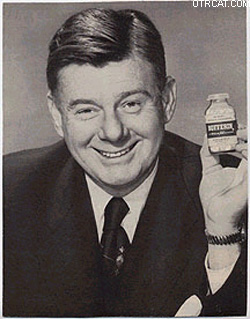
Arthur Godfrey, Hawking Aspirin.

Early Variety and Game Shows: The Texaco Star Theatre with Milton Berle, Arthur Godfrey Time, The Gary Moore Show, Stop the Music, Toast of the Town/Ed Sullivan, The $64,000 Question, Beat The Clock, Name That Tune, Who Do You Trust?, Twenty Grand, I’ve Got A Secret, What’s My Line?,  The Tonight Show with Steve Allen, George Gobel, The Jackie Gleason Show, and Password.

Early Sitcoms: My Little Margie, The Life of Riley, I Married Joan, Leave it to Beaver, Ozzie and Harriet, Amos ‘n Andy, The Addams Family, and Mr. Peepers,

Early Westerns: Gunsmoke, Cheyenne, Paladin, Wyatt Earp, The Lone Ranger, Wagon Train, Sugarfoot, Grizzly Adams, The Rifleman, The Cisco Kid, Roy Rogers, and Gene Autry.

Early Drama/Adventure/Cop Shows: Dangerous Assignment with Brian Donlevy, Boston Blackie, I Led Three Lives, One Man’s Family, Playhouse Ninety, Studio One, Dragnet, Route 66, Outer Limits, and The Twilight Zone.

Sports: Major League and Houston Buffs Baseball, plus one game of College Football every Saturday and a Red Grange telecast of the Chicago Bears or Cardinals from the NFL every Sunday – and it was all there for us on that tiny little fuzzy black and white TV screen with the visible horizontal separator lines running all across the picture, but so what? What did we know back then about the greater possibilities that lay ahead for us down the technological advancement line in years to come? Based on the “nothing” we had prior to TV, we thought we had died and gone to Heaven!

Family Famous Last TV-Related Words from Our Mom Back in 1952: “Hey, kids, why don’t we all sit down and watch ’em blow up that atomic bomb out in Nevada before you leave for school today?”