Posts Tagged ‘Baseball’

It’s Hard to WIn A Horse Race if They Call You “No-Neck”

June 17, 2010

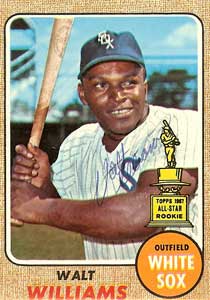
Colt .45 Signee Walt “No-Neck” Williams Had His Best Years with the Chicago White Sox.

Fortunately for outfielder Walt Williams (BR/TR), he was a ballplayer, and not a race horse. It would have been very hard for him to have won many photo finishes without a lot more visible evidence on him of that universal head-connecting body part we call the neck. As it was, the club that originally signed him to his ten season major league career, the Houston Cot .45s, didn’t stick their necks out for Walt Williams all that far as a baseball player either. After Williams went 0 for 9 in ten games for the 1964 Colt .45s (the name that preceded “Astros” for Houston’s new major league club from 1962-64), Houston dealt, sold, or traded away Walt Williams for the proverbial bag of balls and a couple of spring training fast food restaurant discount coupons.

William resurfaced in the big leagues as an outfielder for the 1967 Chicago White Sox, where he spent the next six seasons (1967-72) enjoying  his two best seasons in the game. In 1969, Walt batted .304 in 135 games. Then, after a one-year slip back into mediocrity, Williams came back to hit .294 for the 1971 Pale Hose.

Walt Williams would also hit .289 in 104 games for the 1973 Cleveland Indians and then finish a        two-year run with the New York Yankees by crunching out a .282 BA mark in 82 games for the 1975 Bronx Bombers. 1975 would stand as No-Neck’s last season in the big leagues. He left the game with a career batting average of .270 in 842 games, including 106 doubles, 11 triples, and 33 home runs.
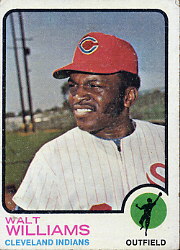
No-Neck Williams got all of his MLB hits as an American Leaguer.

After the big leagues, Williams played a couple of extra years in Japan for the Nippon Ham Fighters in 1976-77 before hanging up his cleats for good. He left te game honorably with a strong reputation as a good defensive player too. Walt made only 19 errors in 565 games on defense, finishing his MLB stats on that side of the ball with a fielding percentage of .981.

Williams received his “No-Neck” nickname during his start with the Colt .45s due to his short framed muscular body. At 5’6″ and 190 pounds, Williams appeared to have no neck. His head seemed to be directly connected to a barrel-chest that was quickly propelled around the field on very short motorized legs. It was not a pretty picture, but the results were pretty good.

Williams also seemed to like his “No-Neck” moniker and he figuratively bathed in fan friendliness wherever he played. The Brownwood, Texas native was a natural moving work of positive action in behalf of major league baseball. If more players behaved toward fans as Walt Williams did, the big leagues could save a lot of the money they now spend on marketing, public relations, and lawyers. Walt Williams was a true ambassador of baseball. I just selfishly wish he cold have spent his career here in Houston.

It simply wasn’t meant to be.

Walt Williams had some pretty memorable games as a hitter over the years. In game for the White Sox on May 21, 1970, Walt slammed out five hits (a double and 4 singles) in a 22-13 Chicago slugfest win over the Boston Red Sox at Fenway Park. He also scored 5 runs and drove in 2 more in that one.

Walt also reached the 4-hits-per-game mark 5 times in major league career. No hitter is that lucky that often. No-Neck Williams could flat-out put the wood on that little white, round sucker.

Williams’s last hurrah in the sunlight of baseball glory came in 1989 when he played for the St. Lucie Legends of the ill-fated Senior Professional Baseball Association. Today he is a 66-year old retired baseball player who is best remembered for the body part he apparently forgot to bring to the game.

The man had no neck. Just a lot of talent for winning baseball.

The Kid Who Struck Out 27 in One Game

June 14, 2010

Ron Necciai of the Bristol Twins: The Man with 27 K's and a No-No on May 13, 1952.

All of the current ballyhoo over Washington Nationals rookie phenom pitcher Stephen Strasberg just stirs the memory of a kid who still stands for some of us as the guy who arrived in the bigs with the biggest hype of all time – and I’m not talking about David Clyde of the 1973 Texas Rangers.

I’m talking about Ron Necciai (pronounced Net-shy) of the 1952 Pittsburgh Pirates, who broke in to the majors with his first start on August 10, 1952 at the tender age of barely 20. To get there, all Ron had to do was perform a feat that no other pitcher in the history of baseball had pulled off until he squeezed the trigger in a 7-0 winning game no-hitter pitched for the Class D Appalachian League Bristol Twins over  the Welch Miners on May 13, 1952, when Necciai was still only age 19.

Necciai’s gem against the miners tallied 27 strikeouts over nine frames, including one batter who reached first base on a passed ball in the ninth inning. That miscue was covered by a fourth strikeout in the ninth to go along with the 23 other men he had fanned on the night. One earlier other out was recorded on a ground ball play to first in the second inning. One other Welch batter put the ball into play in the ninth, reaching first on an error before Necciai breezed one more guy to seal the shutout no-hitter. Two other Welch batters reached base during the game on a walk and hit batsman, but nobody got a hit or even came close. With blazing speed and a curve that broke like the proverbial pitch that falls off a table, the 6’5″, 185 pound Ron Necciai had pitched his way into the relatively media-quiet cobweb of sports reporting in 1952, Can you imagine what Necciai’s life could have been like had the world had Twitter, Facebook, and blogs back in 1952?

Ron Necciai’s roll didn’t stop with the sensational game against Welch. His very next time out saw him strike out 24 in a two-hitter win. By the time he got the call up to the talent-challenged Pirates during that same 1952 season, he had struck out 109 hitters in 43 innings with Bristol, and then posted a Class B Carolina Legaue-high 172 strikeouts in 126 innings at Burlington-Graham.

The trouble brewing for Necciai, however, was part health and part culture. Ron suffered from ulcers, even at that early age, and the tension and stress began to take its toll upon him. He was working on a torn rotator cuff with the way he threw those hard to hit fast ones in the minors and there was no one around in the Pirate system who was any different than the rest of the baseball system at that time. Back then, if you had a guy who could throw that hard and that effectively, most clubs just allowed the apparent genie in the bottle to keep on blowing smoke for as long as he was able.

True to the the tempo of that age, that’s just what the Pirates did.They allowed Ron Necciai to simply blow his arm away. By the time he was called up to make his major league debut on August 10, 1952, he was pretty much done before he had any fun. In the 54.2 Pirate innings that Ron Necciai worked between his call up date and his final major league appearance on September 28, 1952, he compiled what turned out be his career major league record of 1 win, 6 losses, a 7.08 earned run average, and only 31 strikeouts.

The army drafted Necciai after the 1952 season due to the Korean Conflict, but his bleeding ulcer condition made short work of his military career. By the time spring training rolled around again, the rotator cuff tear pretty much had ended any chance that Ron Necciai had for a comeback, although I’m not sure when or if the injury was ever actually accurately diagnosed during the time frame that Ron kept trying to play. We do know that Ron Necciai kept trying to make something work out until he finally gave up in 1955.

Ron Necciai went into the sporting goods business after his baseball future collapsed around him, but the man married, had a nice family, and an apparently happy and successful life from there, simply accepting his baseball injury as “just one of those things” that happened. Five days from now, on June 18, 2010, Ron Necciai and his family will be celebrating his 78th birthday at the old fireballer’s home in Gallatin, Pennsylvania.

Happy Birthday, Ron Necciai – and thanks for the wonderful memories of a guy who, had he played during a more enlightened medical era, might have made it all the way to the big Hall with a little different twist on the dial of destiny. It just wasn’t meant to be.

The Pecan Park Eagle Revisited

June 13, 2010

The Pecan Park Eagle: Ode To An Old Baseball Cover I Found While Playing Catch with My 8 Year Old Son Neal In An Abandoned School Yard in 1993

Tattered friend, I found you again,

Laying flat in a field of yesterday’s hope.

Your resting place? An abandoned schoolyard.

When parents move away, the children go too.

How long have you been here,

Strangling in the entanglement of your grassy grave,

Bleaching your brown-ness in the summer sun,

Freezing your frailness in the ice of winter?

How long, old friend, how long?

Your magical essence exploded from you long ago.

God only knows when.

Perhaps, it was the result of one last grand slam.

One last grand slam, a solitary cherishment,

Now remembered only by the doer of that distant past deed.

Only the executioner long remembers the little triumphs.

The rest of the world never knows, or else, soon forgets.

I recovered you today from your ancient tomb,

From your place near the crunching sound of my footsteps.

I pulled you from your enmeshment in the dying July grass,

And I wanted to take you home with me.

Oh, would that the warm winds of spring might call us,

One more time, awakening our souls in green renewal

To that visceral awareness of hope and possibility.

To soar once more in spirit, like the Pecan Park Eagle,

High above the billowing clouds of a summer morning,

In flight destiny – to all that is bright and beautiful.

There is a special consolation in this melancholy reunion.

Because you once held a larger world within you,

I found a larger world in me.

Come home with me, my friend,

… Come home.

… Bill McCurdy, July 4, 1993.

Another Lost Summer Love

June 12, 2010

Back in the summer of 1954, you got a lot of sweet-tasting love for 15 cents a slice.

Watermelon stands. They used to be everywhere once summer embedded its way into Houston for another four or five months, depending on the early or late availability of sizzler-breaking northers in the early or late fall, but we didn’t mind so much. We were old school Houstonians, the generation that grew up without home or car air conditioning and the everyday expectation that the opportunity to live sweat-free was guaranteed by the Bill of Rights.

We didn’t mind it so much because we didn’t know any better, but also because we had some great reprieves from the everyday heat and humidity that otherwise dominated the three school-recess months of June, July, and August that we kids and teens viewed as summer. And the funny thing is – some of these things involved sweating – and we knew that going in.

I always thought of these things as items on my summer fun, run, and love list because they all had a lot to do with each. They were all fun; they each required us to either run or do them on the run; and they were all things we did in the name of, the taste of, or the pursuit of – what else? A thing called Love.

The list was endless, considerably shared by Houston teens, but still individualized, as well, and it often included such items as playing baseball or running over to Buff Stadium to catch a Buffs game; fighting off the mosquitoes on date trips to one of our numerous drive-in movie theatres to catch the latest sci fi or rock-n-roll rip-off flicks; cruising Prince’s, Stuart’s, and any of the many other drive-in coke and burger stores; swimming at one of our also many public pools; heading to the beach in Galveston; catching the roller coaster and carnival (win-a-stuffed-bear) games at Playland Park on South Main; doing the big time downtown movie scene of the Metropolitan, Loews State, or Majestic when you needed to impress a date; hitting the suburban movies when impressions weren’t all that important; going to the drive-in movies (as mentioned earlier) when you were more interested in date reactions over the need to make impressions; playing miniature golf; just driving around and burning up all that cheap gas that sometimes went on sale for eighteen cents a gallon during price wars; bagging groceries and throwing newspapers to float the money we needed for our mostly innocent acts of summer love; and maybe even catching some Friday night wrestling, bowling, or midget auto racing as a break from our usual fare.

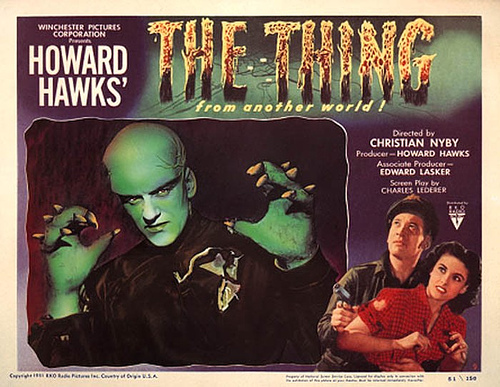
James Arness played the green vegetable alien terror in the classic movie “The Thing.” The film became a regular feature at drive-in movies during the 1950s, where James Arness then exerted more influence on teen couples going steady than Elvis ever dreamed of having.

The last of these now mostly lost summer fun runs were the watermelon stands that used to pop up all over in June and stay with us through Labor Day. My particular favorite was one we had on that little corner in the East End where Griggs Road, Lawndale, and Evergreen all still come together.

The place came with a tent-like top and open sides that caught the Gulf breeze, when there was one, and the melon came ice cold and always sweet – and straight from the famous melon fields of Hempstead, Texas, Ample sitting room was available on wooden benches at redwood tables. And the melon came at you with pre-purchase sweetness sampling for ten to fifteen cents a slice. Just add a beautiful brunette girl friend with a soft voice, fiery brown eyes, and a certain haunting smile – and the melon tasted out of this world.

I still miss the old watermelon stand, but the memory lingers on in quiet compensation for the fact that some of the sweet things we find early in life don’t stay late, except as treasured memories that sometimes find a way to dance in our dreams of happily recalled once-upon-a-times.

For me, baseball has been the one early love of my life that I never had to give up or alter in some way due to changes in my own need for emotional growth. Once baseball and I found each other back in 1947, we never let go. Never had to. All other things have either grown, mutated, or gone away, but not so the game of baseball.

“It’s still the same old story, a fight for love and glory, a case of do or die. The fundamental things apply, as times goes by.”

From then to now, the melon stand call of baseball is the same: – “PLAY BALL!”

And may you enjoy your own summer love recollections full tilt, without regret. Life’s too short for anything less than lessons, adjustments, and even happier, fuller celebrations of the human spirit.

1928: That Wonderful 1st Year at Buff Stadium

June 11, 2010

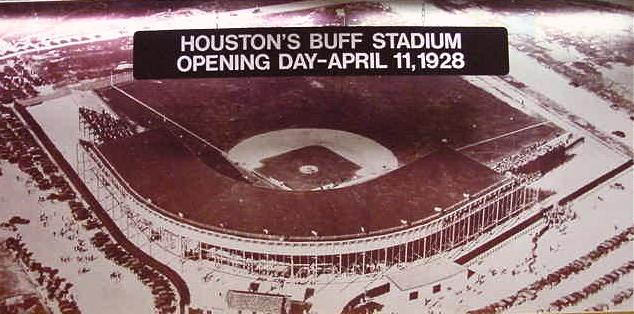
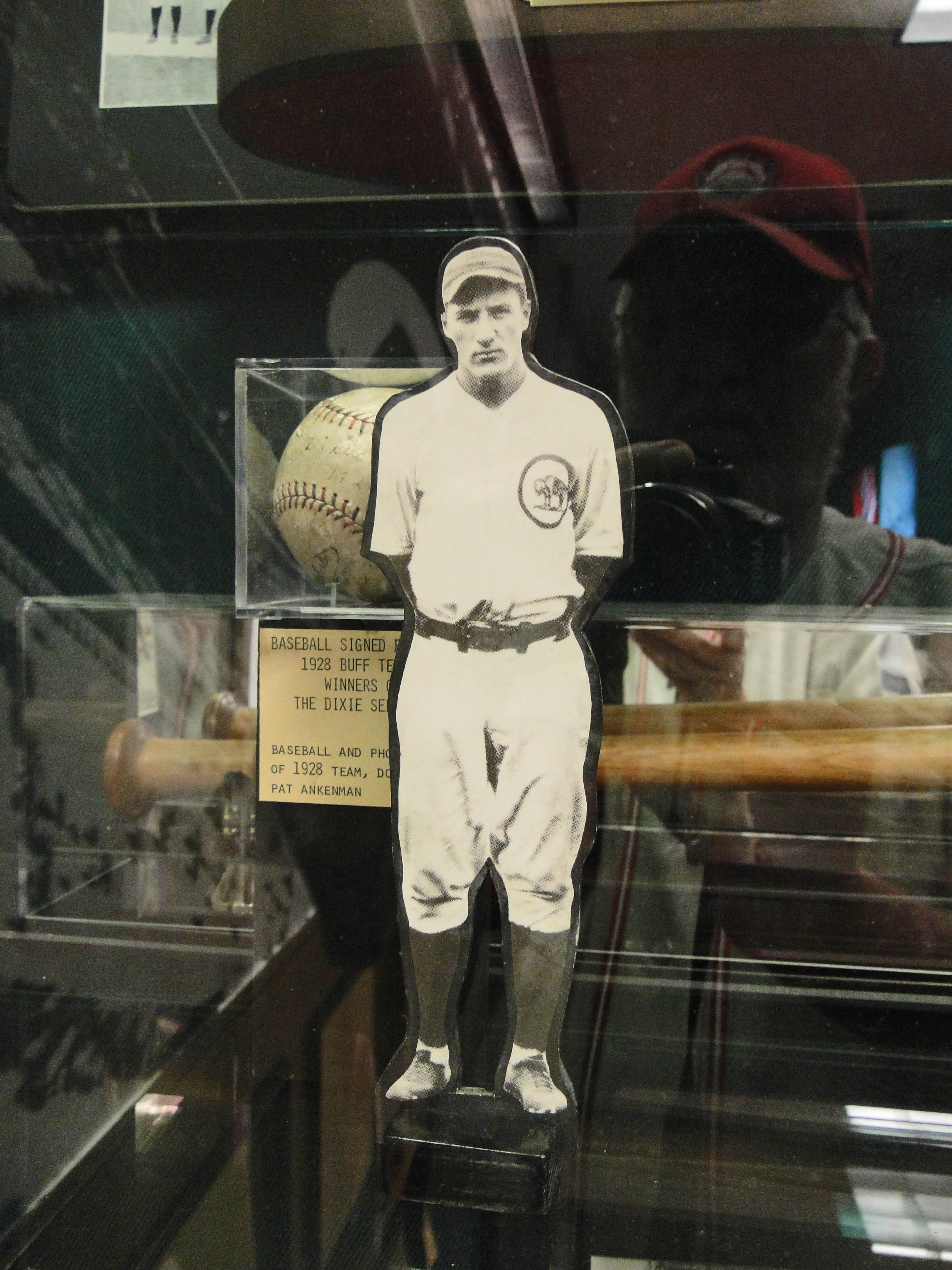
On its first Opening Day, visiting Baseball Commissioner Kenesaw Mountain Landis anointed Buffalo Stadium as the finest new minor league ballpark in America.

The new Buff Stadium of 1928 was great enough to serve as the home of our minor league Houston Buffaloes from the late 1920s all the way through the last picture show of 1961. Except for the World War II years (1943-45) in which the entire Texas League shutdown due to the talent drain from all the baseball players on combat duty, the Buffs played out the large balance of their minor league history at Buff Stadium from 1928 through 1961. Their previous home, from 1907 through 1927, had been at West End Park, off Smith on Andrews Street.

1928 wasn’t simply a year for new ballparks. General Manger Branch Rickey of the parent club St. Louis Cardinals had poured a ton of talent into the Buffs roster as it began competition in its new bright and shiny digs in the near East End on St. Bernard Avenue (now Cullen Boulevard).

Red Worthington, Left Field, 1928 Houston Buffs

Left fielder Red Worthington led the club in hitting in 1928 with 211 hits that were good enough for a .352 season batting average that ranked him up there with the league leaders.

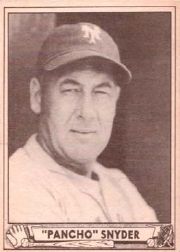
The club had two qualities in general that are basic to strong championship clubs. The 1928 Buff had hitting and pitching. In addition to Worthington, catcher/playing manager Frank “Pancho” Snyder banged out 177 hits for a .329 batting average; second baseman Cary Selph crunched out 198 safeties for a .312 mark; center fielder George “Watty” Watkins also hit safely 177 times for a .306 tab; and right fielder Ray Powell slid over the magic mark at .302 as the fifth full-season .300 batter in the starting lineup. Worthington’s 211 hit total led the Texas League in 1928.

Field Manager Snyder also managed one of the best minor league starting rotations ever assembled.

In deference to all that Dizzy Dean and the great 1931 Buffs accomplished, the 1928 Houston team even matched then surpassed that club’s accomplishments. With four twenty-games or more winners performing as the steel-fortified starting rotation, there wasn’t much doubt from early on that the 1928 Buffs definitely were the team to beat in the Texas League. Jim Lindsey (25-10, 3.49) led the Texas League in wins; WIld Bill Hallahan (23-12, 2,23, 244 K) led the league with the lowest ERA and the most strike outs (Ks). Ken Penner (20-8. 3.47) and Frank Barnes (20-9, 2.95) rounded out winner’s row on the Houston mound.

The Buffs and the Wichita Falls Spudders finished in a dead heat with records of 101-53 at season’s end, but the Buff then won a best three of five playoff series by 3 games to 1 over the Spudders to finish the season as Texas League champions with a playoff-game incorporated final 1928 record of 104-54.

The 1928 Houston Buffs went on to defeat the Birmingham Barons in the Dixie Series, four games to two, to reign supreme as the best club on the two blocks of southern and southwestern soil that were better known as the Southern Association and the Texas League. As you may also recall, the 1931 Buffs of Dizzy Dean would also go up against the boys from Birmingham in the Dixie Series, but the much more ballyhooed later Dean-Buffs would lose to the Barons, four games to three.

Because baseball greatness has always been measured more by where you finished than it has been by how you did while getting there, I have to go with the 1928 Houston Buffs, the first club to play in their wonderful namesake ballpark, as the greatest Buff team of all time. Of the four Houston Buff teams to win the Dixie Series (1928, 1947, 1956, & 1957), that first Buff club was the best all the way in my book. They did it all season with hitting and pitching. They had it together in full force when they needed a playoff victory to wrap up the league pennant. And they finished off the best team of the Southern Association in a manner befitting champions of a universe bigger than their own back yard when it really counted on a larger stage.

Long live the memory of the 1928 Houston Buffs. Through 2010, the Buffs remain our city’s greatest example of winning baseball. That could change in the future, of course, but it remains in the hands of the Houston Astros now to rewrite any history of this city’s greatest past championship moments in baseball.
The Buffs have done all they can for history. They finished their part of the job 49 years ago.

Stand for Stan!

June 10, 2010

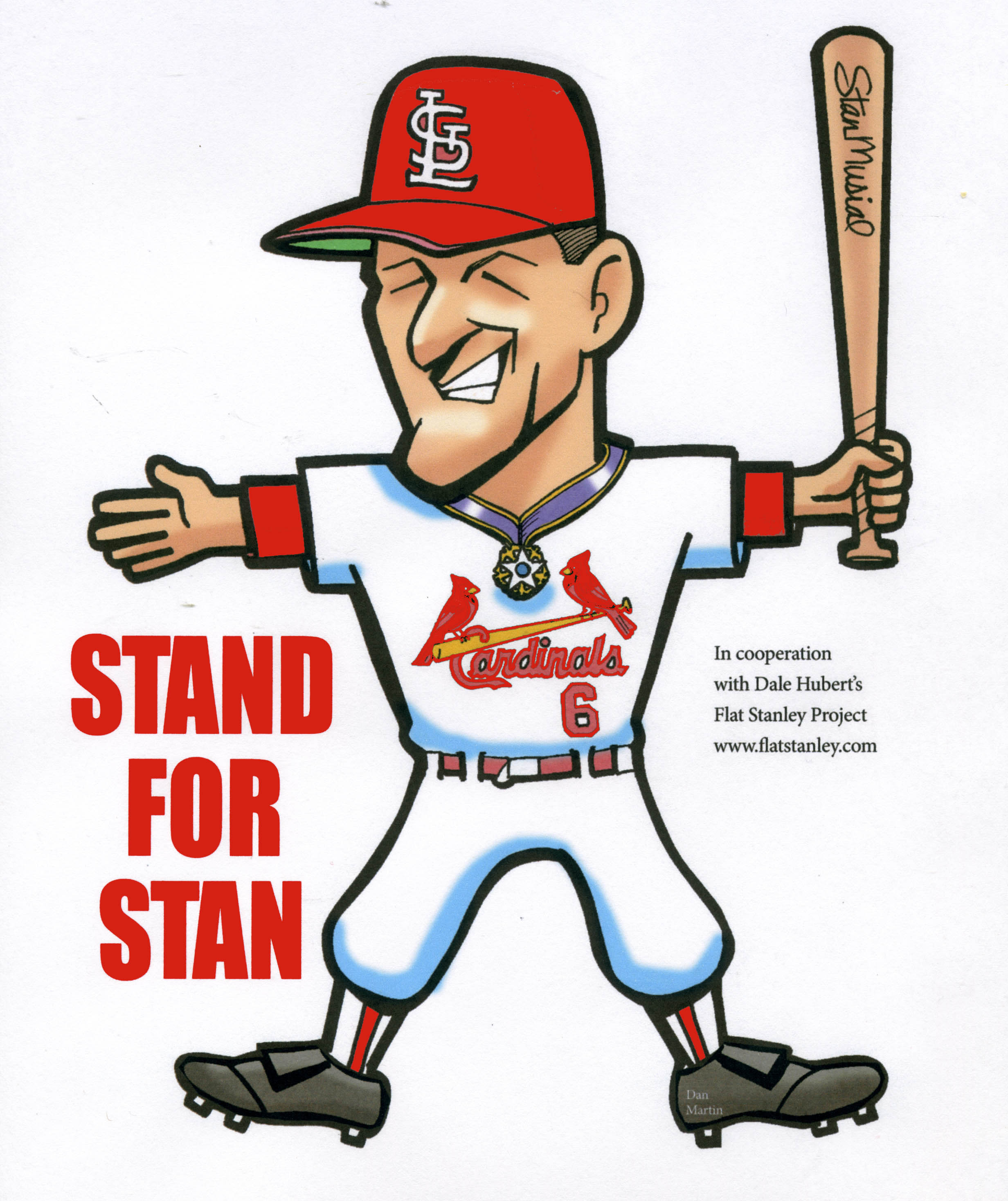
Back Stan Musial for the Medal of Freedom Award!

St. Louis people and the St. Louis Cardinals have organized a campaign that many others of us could stand to support just as well. “Stand for Stan” is all about getting President Obama to recognize the great Hall of Fame former Cardinal Stan Musial for all of his off-the-field financial and quiet service contributions over the years to so many worthy causes of aid to people, especially to children. The whole effort is best summarized in this open letter from Cardinal President William O. DeWitt, Jr.  to President Barack Obama:

Dear Mr. President:

On behalf of the St. Louis Cardinals, I would like to strongly endorse Stan Musial for the Presidential Medal of Freedom to honor his lifetime of achievement and service.

Not only is Stan Musial one of the greatest players to play the game of baseball, he is also an extraordinary American deserving of the nation’s highest civilian honor. Attached you will find a document that we have prepared that thoroughly makes the case for why Stan Musial is deserving of a Medal of Freedom, as well as support letters from both our United States Senators and the Governor of Missouri. In the coming days, you should also be receiving additional support letters from various members of our regional Congressional delegation.

Stan Musial’s baseball accomplishments are legendary. Stan compiled a .331 lifetime batting average, with 3,630 hits, 475 home runs, and 1,951 RBIs during his twenty-two seasons with the St. Louis Cardinals. Stan held 17 Major-League records, 29 National League records and nine All-Star Game records at the time of his retirement in 1963. Stan is one of only three players to amass over 6,000 total bases in his career (the other two are Hank Aaron and Willie Mays). During his entire playing career, including 3,026 regular-season, 23 World Series and 24 All-Star Games, Stan was never ejected from a game by an umpire – a mark of his great sportsmanship and self-discipline.

While Stan’s baseball accomplishments are enough to make him worthy of joining his contemporary baseball Medal of Freedom winners Joe DiMaggio and Ted Williams, his off the field heroics over a lifetime make him especially deserving.

Stan served in the Navy during World War II, was chairman of President Lyndon Johnson’s Presidents’ Council on Physical Fitness from 1964 to 1967, acted as an unofficial emissary to Poland and for generations he has quietly donated his money and his time to thousands of charitable and community causes, particularly those dealing with children.

Throughout his life, Stan has never sought recognition for his good works. His happiness comes from doing the right thing and bringing joy to others. While Stan does not know of our efforts to nominate him for this honor, we respectfully request your consideration as Stan has been a true role model – exemplifying the humility, grace and generosity we so desperately need to see in our American sports heroes. Thank you for your thoughtful consideration of this request.

Sincerely,

William O. DeWitt Jr.

For years I was an annual attendee of the St. Louis Browns Historical Society's banquets in St. Louis and got to see Stan Musial there on several occasions. He was as gentle and friendly to us ordinary people as he was to his pals on the old Browns clubs.

Stan Musial possessed a modest self-effacing sense of humor about the things he did for others, never bringing them up on his own except to make light of his actual contributions. Over the years, Stan did a lot for older people in nursing homes, but he used these real morale-boosting services to the elderly to make fun of himself. Here’s what I mean:

Stan played the harmonica. He even organized his own harmonica trio to go with him as performers at nursing homes in the St. Louis area.

“We all loved playing the harmonica,” Stan said. “Unfortunately for the older people and other shut-ins, we decided to take our talents out on them,” he added with a great big Musial smile.

“On these musical occasions at the nursing homes,” Stan said, “the staff would usually gather the residents in a large room; line ’em up in chairs and wheel chairs in front of us; and let us play”

“That was fine with us,” Stan added, “except I had this habit of closing my eyes while I played. I just got so involved in my music that I wanted to just close my eyes while we were performing and just hear the sounds myself.”

“The old folks cured me of that habit,” Stan concluded. “One time we finished a long number and I then opened my eyes to see if I could conclude from the people’s expressions if they liked our music.”

“They all had their eyes closed.”

If you were a fan of Stan Musial years ago, check out the “Stand for Stan” campaign and sign the petition of support for presidential action on the Medal of Freedom Award. I can’t think of any other previously overlooked person from the world of baseball that is more deserving. Besides, if the great Ted Williams and Joe DiMaggio were both deserving of this signature award, which they were, so is fellow Hall of famer and military service veteran Stan Musial.

Here’s the link. Simply copy, cut, and paste it to your address line – or else, go to Cardinals.Com at MLB.Com for further information on the Stand for Stan campaign.:

http://stlouis.cardinals.mlb.com/stl/fan_forum/standforstan_index.jsp?partnerId=ed-3661971-141530142

Have a nice day, folks, and remember too: You don’t have to be a Cardinal fan to be a Stan Musial admirer. When it came down to who this man really was as an exceptional player, an outstanding  person, and a genuine American spirit, the man from Donora, Pennsylvania was right up there with the very best, just quiet on the need for public recognition that some others campaign to receive.

Stand for Stan. –  It’s time that America duly and fully honored the Quiet Man of Baseball.

SABR MEETS AT HOUSTON SPORTS MUSEUM

June 9, 2010

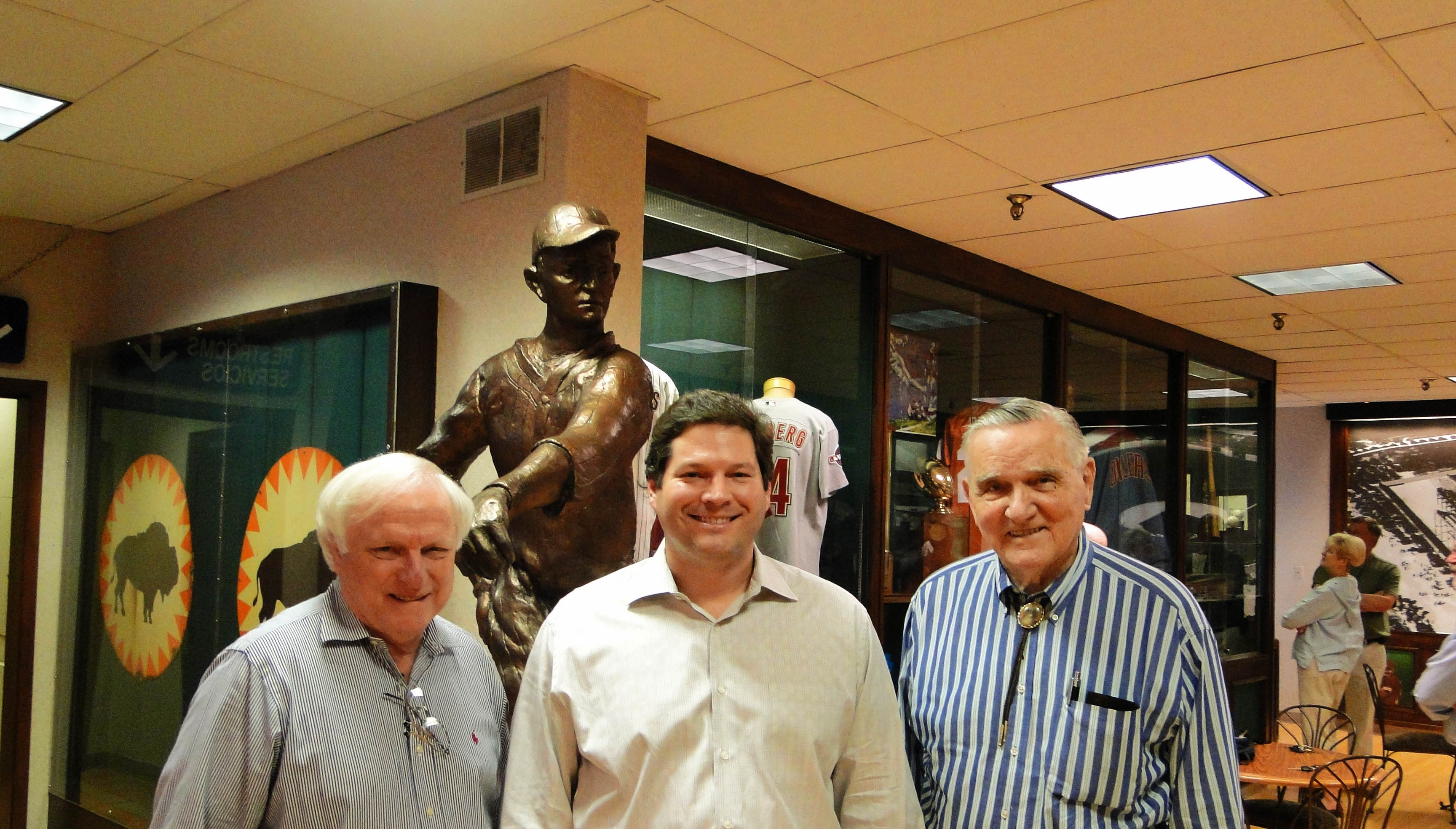
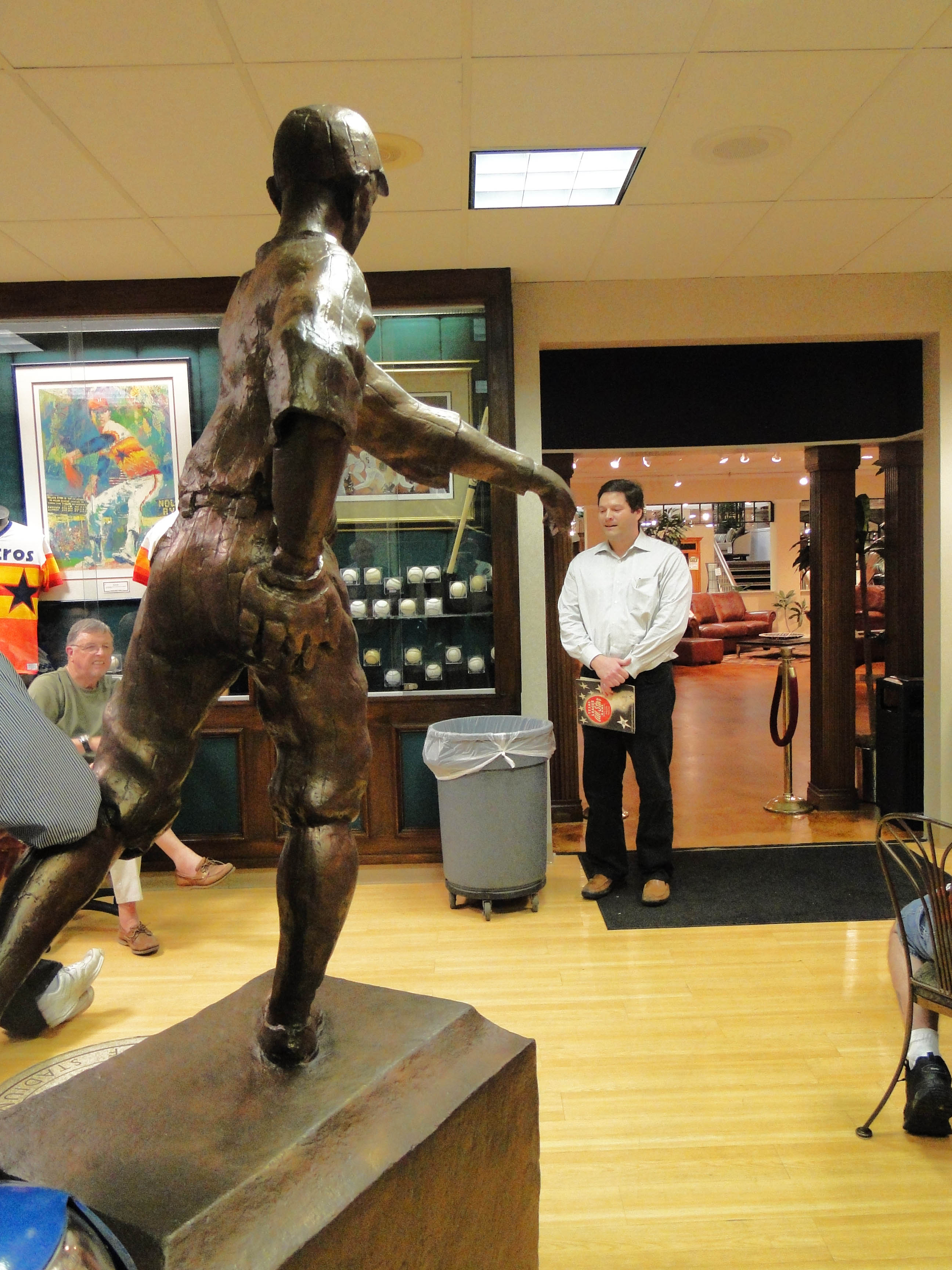
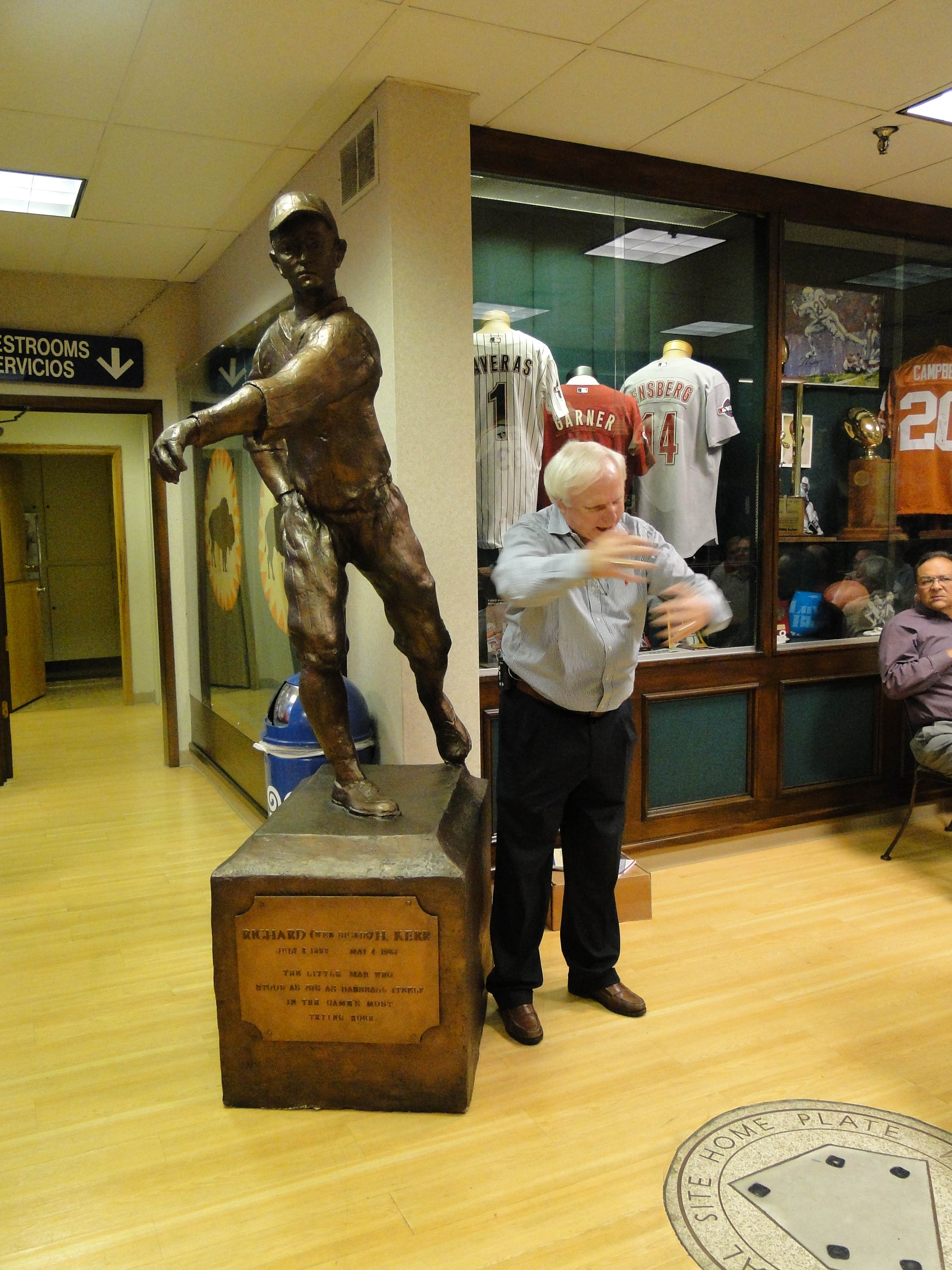
HOUSTON SPORTS MUSEUM: Curator Tom Kennedy, Owner/Sponsor Rodney Finger; & Former Buff Larry Miggins, June 9, 2010. Behind these men is the statue of Dickie Kerr, the little Chicago White Sox rookie who won 13 games and both his starts in the 1919 World Series.

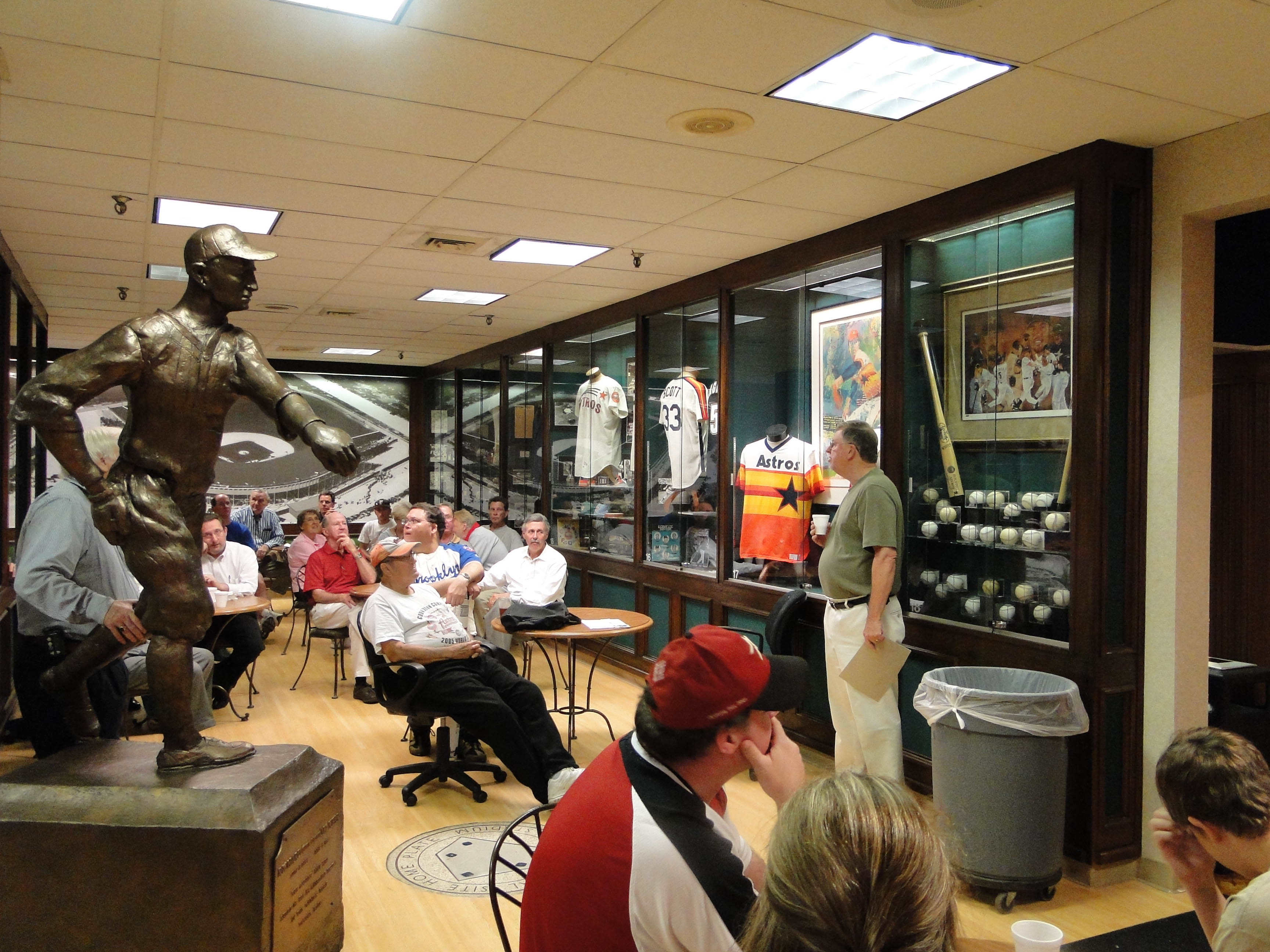
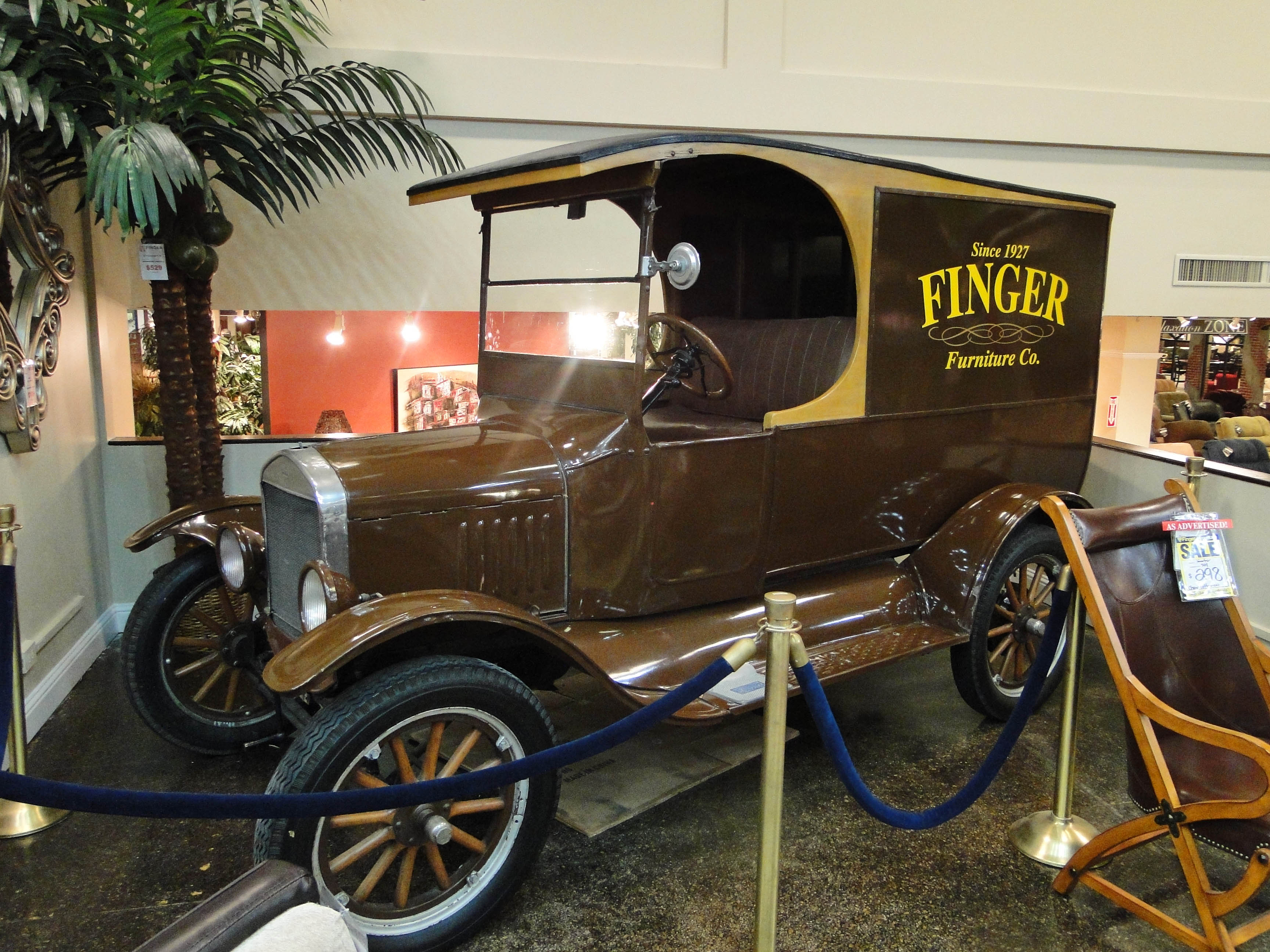
For the first time ever, the Larry Dierker Chapter of SABR (the Society for American Baseball Research) held one of its monthly meetings at the newly renovated and reopened Houston Sports Museum inside the also new again Finger Furniture store on the Gulf Freeway at Cullen. Museum Owner/Sponsor Rodney Finger treated our presence there last night, June 8th, with all the gracious kindness of a five-star host. We are especially  grateful to Mr. Finger for his hospitality. As is the trademark of the Finger family, doing things first-class comes naturally to their involvement. It was so with the delicious fajita dinner that Mr. Finger served us. It is true with the newly renovated work on the museum. And it is true with the furniture store that is up and running again. All those many generations of the family know how to get things right.

The Finger famly legacy is their involvement and caring for the City of Houston and their efforts over the years to help preserve what is important about our town’s history.

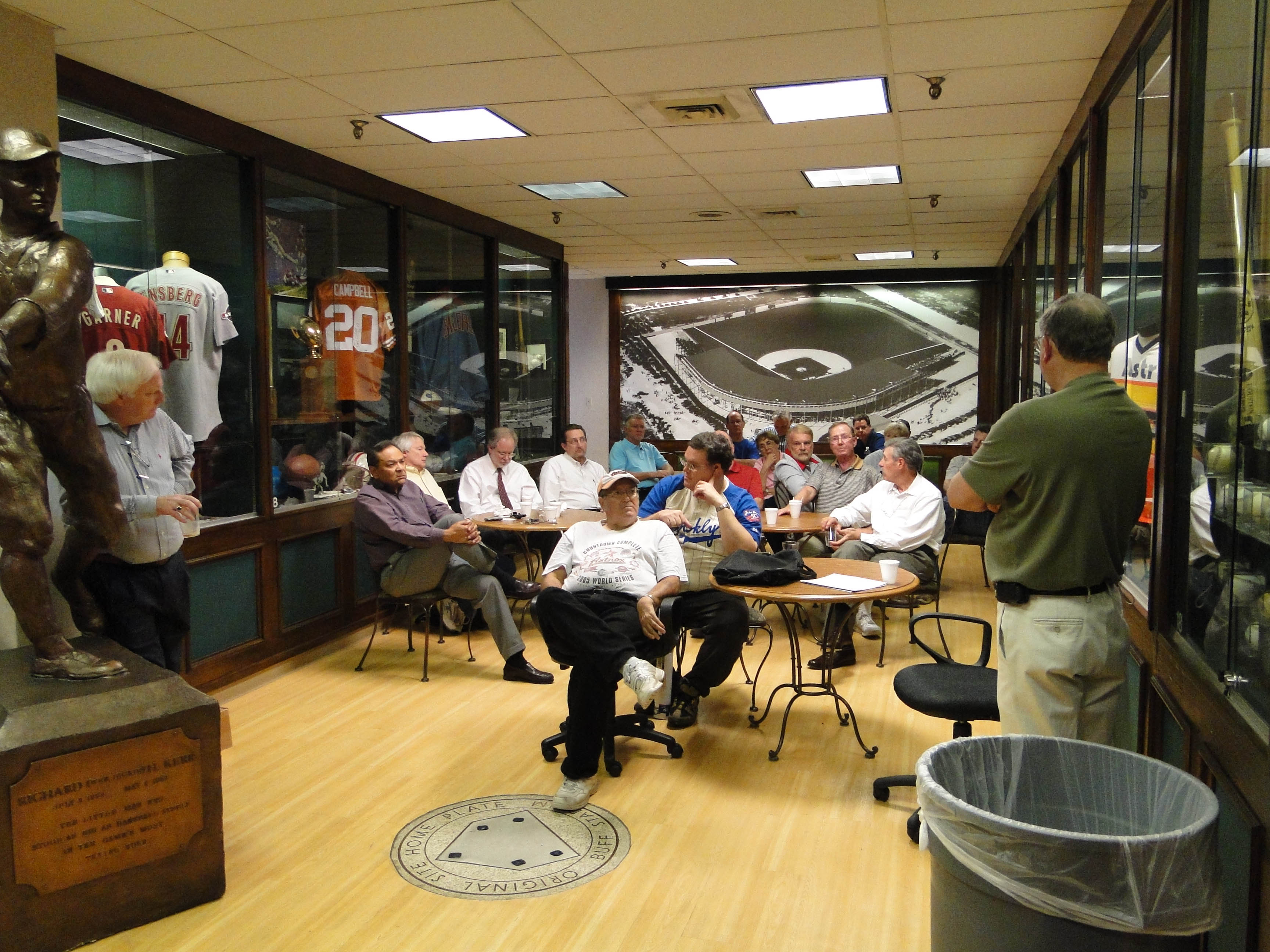
Rodney Finger addresses the 37 people who attended the June 8th SABR meeting, The “found again” statue of DIckie Kerr seems to be handing the ball to Rodney Finger to say what is on his mind as SABR Chapter Leader Bob Dprrill listens up in the lower left corner.

Rodney Finger spoke from the heart when he delivered his reasons for wanting to make the museum come alive again, For those of you who don’t know, the Houston Sports Museum was started by by Rodney’s late grandfather, Sammy Finger, in the mid 1960s as a way of memorializing the fact that this particular store location had been built on the former site of Buff Stadium, the home of our once proud minor league club, the Houston Buffs, from 1928 through 1961. That venerable old ballpark was abandoned after Houston entered the baseball major leagues in 1962 after nearly being destroyed the previous years by the 1961 coming of Hurricane Carla. When the wrecking ball came, the Finger family was there through Sammy to purchase the property and to do what they could to preserve the history of what had come before them on this hallowed baseball ground. The Houston Baseball Museum was born from that family love for the game and their city. And now it lives again in a restyled presentation of materials that are nothing less than authentic artifacts of Houstoon baseball history.

Dickie Kerr lived out his latter years as a Houstonian in a house located only blocks away from Buff Stadium. Kerr’s heroics in the 1919 World Series were the bright side of an otherwise tarnished fix attempt by arguably all of the eight White Sox players later banned from baseball for their parts in a scheme that delivered the World Series title to the Cincinnati Reds.

Tom Kennedy, Curator, Houston Sports Museum

Much of the museum credit here goes to curator Tom Kennedy, the former Houston Post writer and long-time Houston-based baseball item collector. Kennedy has taken the Rodney Finger commitment to keeping alive the legacy of his grandfather and done all that’s good and possible to make it happen. Tom has put his historical knowledge to work in partnership with just about everyone else in this community that he deemed as helpful to come up with a brilliant use of limited space that tracks the history of professional baseball and early professional football in Houston. There is even a one-page complete history of Houston minor league baseball for every year the game was played as a minor league enterprise  from 1888 through 1961.

Future plans include an ongoing rotation of some items that will always keep what’s on display fresh to the viewing public’s eye. To the extent that refreshing change is possible consistently over time, this one promises to have it.

Kennedy has plans to bring in a group of several well known former players for the June 19th formal Grand Opening of the museum. The facility is open now during normal store hours, but you will want to make the Grand Opening too, if possible. It will be a chance to see and get autographs from some of your all time favorite Houston players and sports personalities.

Bob Dorrill addresses the crowd during our regular meeting. A lively discussion was in place on the blown perfect game call in Detroit last week.

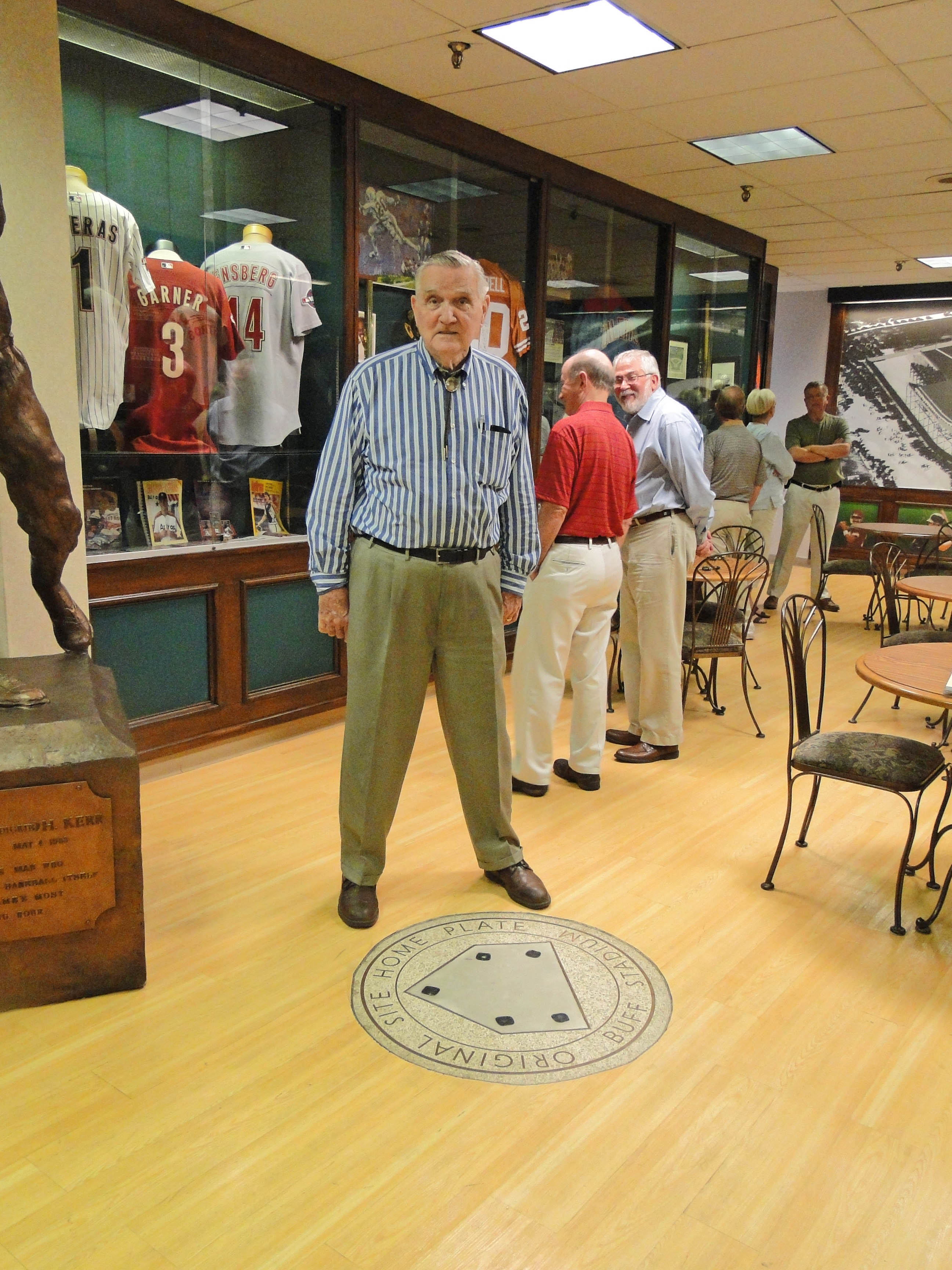
The last time Larry Miggins took a batting position on this spot was 1954 when he hit a home run to beat the San Antonio Missions on his last swing of the stick for the Houston Buffs.

“In behalf of all the artifacts here at the Houston Sports Museum, we’d like to thank all you SABR members who came to see us last night. We’ll look for the rest of you Houstonians to drop by anytime, but for sure on our Grand Opening this coming June 19th!” – Old Buff Figure in Photo.

37 members & guests of SABR enjoyed the evening program & Finger family hospitality.

Curator Kennedy’s words came forth with great animation of genuine caring..

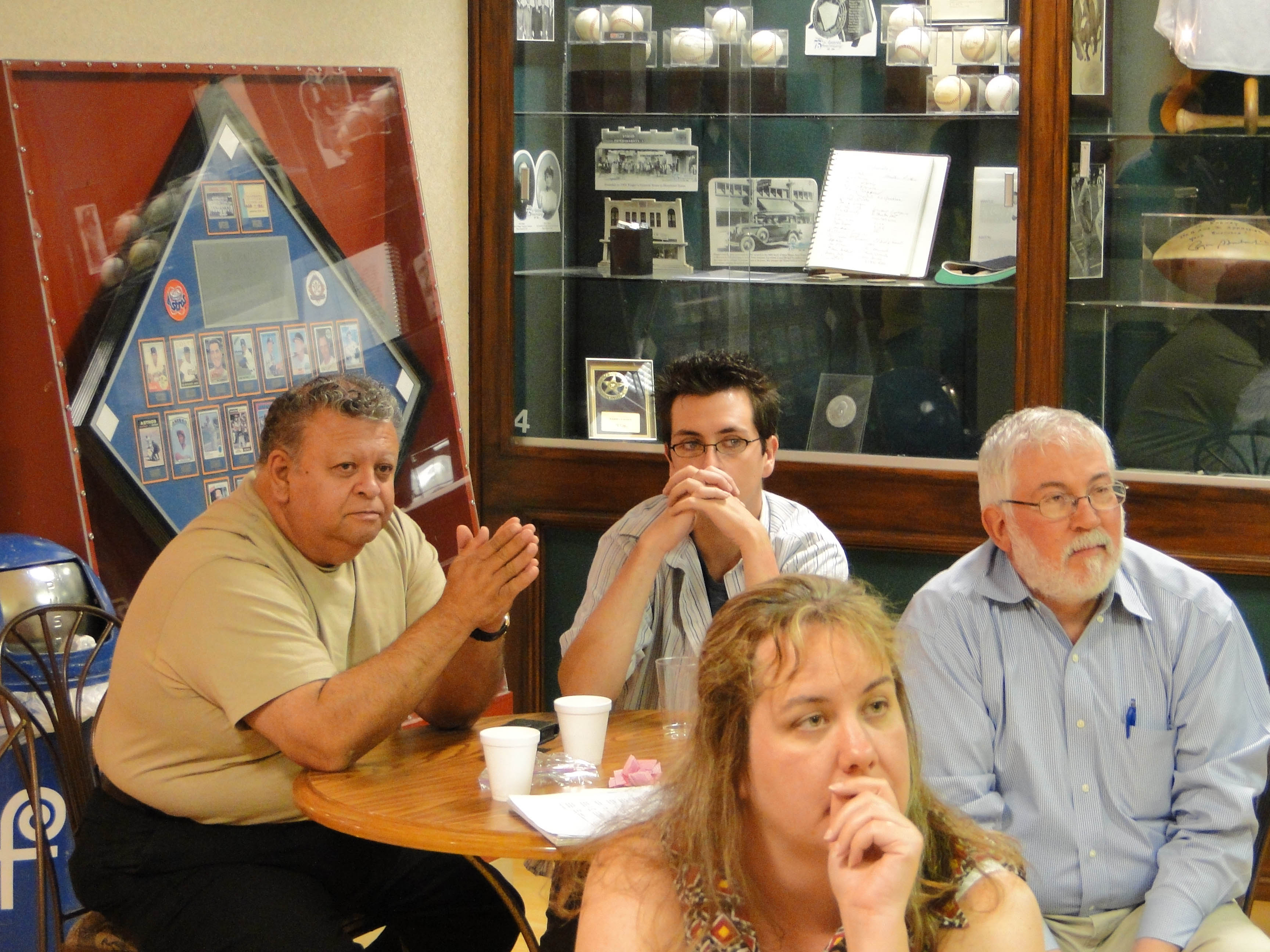
The SABR crowd hung attentively on Tom’s every word.

If you paid attention to some of the materials in the exhibit area, you were swept away with the feeling that even the figures of history were listening to what was happening at the Houston Sports Museum on this special night. This photo features former Houston Buff telecaster Guy Savage, young Buff Larry Miggins, & former big leaguer Gus Mancuso.

Finger’s is ready to deliver the goods again, Houston – and we’re talking loudly and voluntarily here about furniture and local baseball history. I cannot speak for SABR; I can only speak for myself in this matter. Finger’s has my support. Next time I need furniture, they are going to be the first place I look and buy, if they’re anywhere in the ballpark on price. If anyone else out there wants my support for their commercial enterprises, let them first go out and do as much as the Finger family does on a daily basis for the preservation of Houston area history.

What else can I say? Go see the new Houston Sports Museum. It’s the only worthwhile display on the years-deep history of Houston baseball that you will find in our area – and it is well worth your time.

Also, and I’m not paid to say this: Think first about meeting your furniture needs at Finger’s on the Gulf Freeway. If we want the museum to remain alive forever, and  on this special spot, the store has to succeed too. And you can’t move the museum elsewhere and succeed on the same level. It’s already sitting on the only actual site for Buff Stadium that will ever be.

Have a nice Wednesday, everybody!

Arch Baseball Exhibit Held Over

June 8, 2010

Baseball Gateway to West Exhibit at St. Louis Arch Held Over through 2010.

The highly successful and attractive baseball exhibit in St. Louis that opened in the Mound City prior to the 2009 All Star Game has been held over for most of 2010 by popular demand. “Baseball’s Gateway to the West” display will continue at the Jefferson National Arch on the Mississippi River through October 31, 2010, sponsored for s second year as a collaborative effort of the St. Louis Cardinals Museum and Hall of Fame in conjunction with the National Park Service at the St. Louis Arch.

If you are planning to be in the St. Louis area on vacation or business between now and Halloween, you owe it to yourself to take in the show. Under the careful guidance of St. Louis Cardinals curator Paula Homan, the exhibit is packed with authentic one-of-a-kind items that are associated with the western expansion of baseball to the hinterlands of all western regions of the country. Three of my own loans to the show all came from items given to me by one of the foremost former Buffs, the late Jerry Witte. These include (1) a home plate from Jerry Witte’s last 1952 season of play at Buff (Busch) Stadium in Houston. I accepted the gift years ago after asking the donor to sign it “Jerry Witte” for the sake of history; (2) A 1951 Houston Buffs Scorecard; and (3) a 1951 Texas League All Star Game Program from the contest played at Buff Stadium that year. All of these items and others from my personal collection of over sixty years will someday be donated to an appropriate museum that can guarantee their protection and appropriate display in perpetuity. As to where that place is, I’m still looking. For now, at least, three of them are doing just fine as artifactual greeters to the thousands of fans still streaming through the Arch.

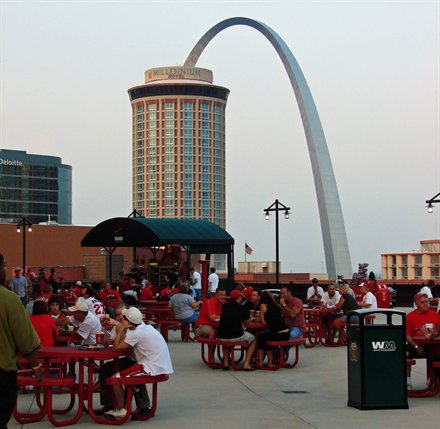
The Arch is only a few blocks away from Busch Stadium III in downtown St. Louis.

If you’ve never been to St. Louis, you owe it to yourself to visit one of America’s great baseball cities before you die. The place simply reeks with baseball history and people who are capable of talking about same – and there few places finer for watching a game than Busch Stadium III. I prefer the intimacy of Minute Maid Park in Houston, but the vistas of the Arch and downtown St. Louis from the open-feeling Busch venue can’t be beat. Unlike MMP, however, where it’s possible to walk completely around the field of play on the first concourse without taking your eyes off the field, Busch is chopped up into sections that prevent visitors from doing the same in St. Louis.

Either way, both places are about baseball, and the cities of St. Louis and Houston shall be forever joined in baseball history as members of the same family tree. As a top farm club of the Cardinals for the better part of nearly four decades, the Houston Buffs will always be more than just a little bit “St. Louis” like in their baseball bloodlines. Former Buff greats Dizzy Dean, Pepper Martin, Joe “Ducky” Medwick, George “Red” Munger, Howie Pollet, Eddie Dyer, Johnny Keane,  Solly Hemus, Wilmer “Vinegar Bend”  Mizell,  and Ken Boyer are all former Buffs who passed through the Bayou City on their ways to the City of the Mound.

Baseball ties are forever. It’s best we try to remember them with the honor they each deserve. The Arch program is run by people who understand that old-fashioned notion. Give them your support this summer. Check out the show in St. Louis.

Baseball Cord Travels Far & Wide

June 5, 2010

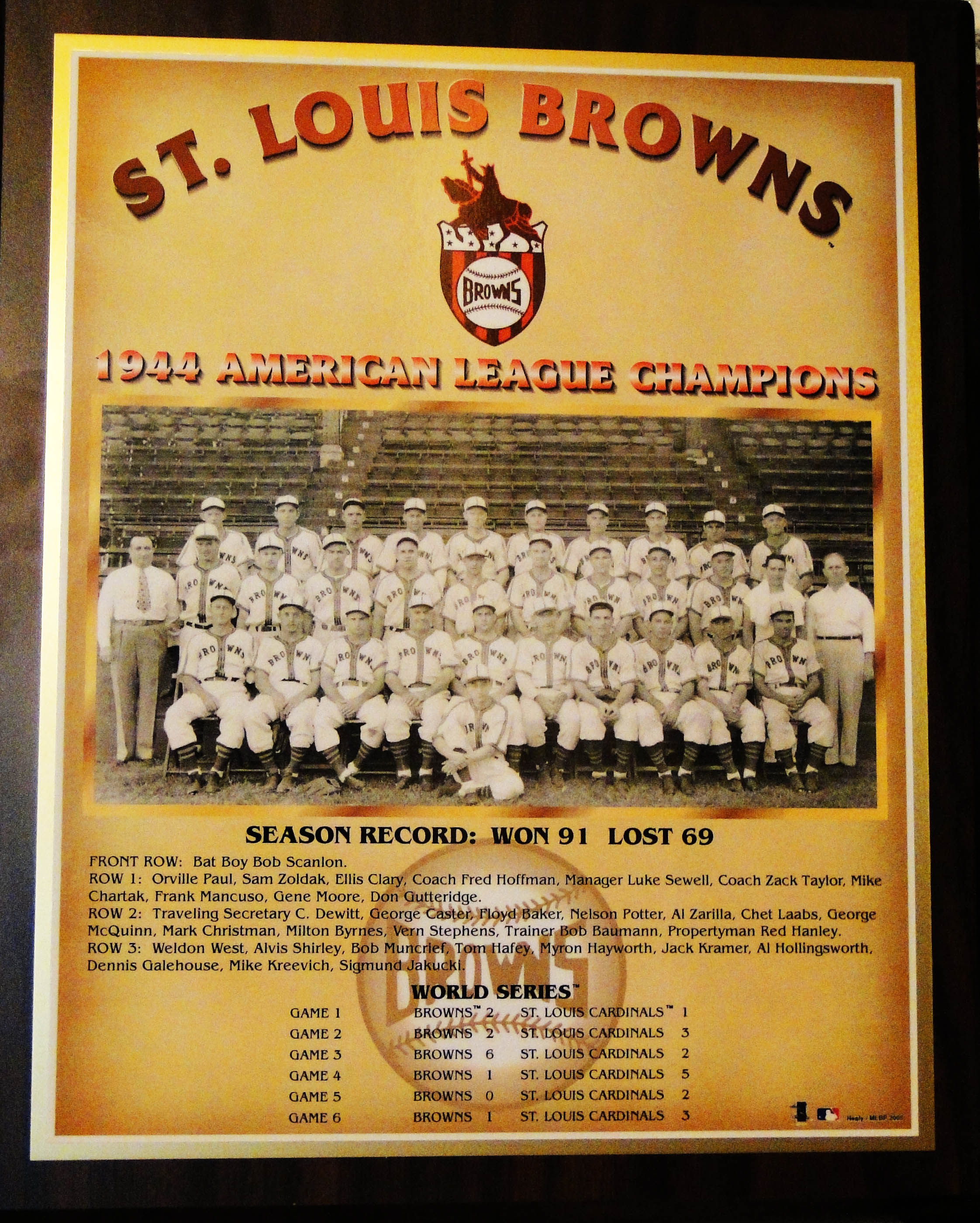
I received this beautifully framed photo narrative of the 1944 St. Louis Browns yesterday as a gift from Ron Pawlik, a buddy I played ball with back in 1951, but only yesterday caught up with again for only the second time in the past year.

Yesterday I attended an alumni luncheon at St. Thomas High School in Houston where, I must note, the natives are quite happy with their still new baseball coach, Craig Biggio. Just in case you haven’t heard, and in only his second season at the helm, Coach Biggio has now led the fighting Eagles to a state high school baseball championship. We can only hope that Craig stays a while before he heeds the big league call to manage somewhere.

Something else happened yesterday to powerfully remind me of how far-reaching the cord of baseball has traveled in my life. Out of the blue, but not really, I ran into Ron Pawlik, a buddy of mine from St. Christopher’s Parochial School in Park Place. Ron was a year ahead of me in school, but we played in the same outfield together one year for the 1951 ever-rambling St. Christopher Travelers. I had seen Pawlik at last year’s alumni luncheon for the first time since 1997, when we held a reunion at old St. Chris, and before that time, I had not seen Ron since his graduation from St. Thomas in 1955.

The short of it is the fact that he gave me that beautiful framed Browns piece displayed here. Ron had been reading some of blog articles over the past year and had become aware of my affinity for the old Browns. I was both shocked and appreciative of his generosity. I really like the Browns piece on ts own merit, but also because it simply helps drive to the surface the realizations I’m trying to express this quiet Saturday morning.

Like a lot of you, the long  cord of baseball has been with me forever, often serving as the X factor in whether or not I became friends with, or worked things out with, other human beings that came into my life over time. Once I knew that someone liked baseball, and was sure they understood not to call runs points, umpires referees, or managers coaches, we could overcome just about all other obstacles to working out the parameters of our everyday life relationship.

When I was a kid, growing up in the Houston East End, we were all Houston Buff fans. of course, and almost 100% of the adults I knew were St. Louis Cardinal fans when it came down to supporting a favorite major league club. I too became a Cardinal fan as a result. They were the parent club of my local Buffs – and their roster was loaded with all the Buffs who played good enough to get there.

My admiration for pitcher Ned Garver converted me into a St. Louis Browns fan in 1951, but I now think that change was helped by my need as a kid to rebel against the Cardinal blanket that totally  surrounded me. Besides, I didn’t totally abandon my support for the Cards. I just added the hapless Browns as my underdog battling American League club.

By the time I reached St. Thomas High School, I was assigned to a home room that was run by a Basilian priest scholastic named “Mr. Klem.”

Aha! Now there’s a major clue as to the ongoing presence of the baseball cord. Mr. Klem turned out to be the nephew of Hall of Fame umpire Bill Klem, a real baseball guy, and a fan of the New York Giants, his home state club. I had never met a Giants fan previously, but Mr. Klem seemed to be as knowledgeable of baseball as all the Cardinal people I grew up knowing. It made me think that maybe Giants fans weren’t all that bad after all. Besides, Mr. Klem seemed pretty high on his club’s young center fielder, Willie Mays, and of course, 1952 was the year that followed the 1951 Shot Heard Round the World. During Mr. Klem’s religion classes on miracles in our daily lives, we got to hear a lot about Bobby Thomson as a primary example of same.

For some unfortunate reason, I never dated any women that really cared for, or knew much about, baseball. I did have a Freudian theory professor in graduate school at Tulane whose brilliance was matched, and  somewhat neutralized by her thick German accent and the upside down Nazi-way she held her lighted cigarette during lectures. I couldn’t find the baseball rope or Freudian string on this period in my life, but I survived.

“You vill learn zee theories of Herr Freud und you vill not be deceived by all zee sick patients who unconsciously or sociopathicly wish to manipulate you, zee doctor, unto seeing zem as honest und trustworthy!”

I survived Dr. Gestapo and the concerted efforts of the formal education process I had embarked upon to change the way I thought, talked, wrote, and viewed life in general, If I was of any help to people who sought me out as clients over my years of practice as a professional counselor, it was because of what I had learned from baseball and from growing up in Pecan Park – and not from some cold burial in the theoretical alien-spirited offerings of Tulane University.

A good friend of mine in New Orleans, a fellow named Donald M. Marquis of Goshen, Indiana, wrote one of the seminal books on the history of jazz in 1979. That book, which is now being made into a movie, is called “The Search for Buddy Bolden,”  and it took Don Marquis seventeen years of focused research and investigation into the life of jazz’s first trumpet man before it was finally done.

Where did Don Marquis acquire his patience for the job? Easy. He was a Cleveland Indians fan. If you want something done that takes a ton of patience, hire an Indians fan.

One of my best friends in graduate school at Tulane was Sue Elster-Hepler-Liuzza. Sue was easy to like. She’s a north side Chicago girl who loves the Cubs and, of course, hates the White Sox. I was a little shocked, but not really surprised earlier this week when Sue told me that she never even stepped foot on the South Side until well into her adult years. She also explained that she is typical of many North Siders. They want nothing to do with the South Side or the White Sox. Unfortunately, this knot n Sue’s baseball rope came at a cost. She never got to see the original Comiskey Park in person. By the time she went there, it had been torn down.

My own baseball rope on life trucks on, flaring lessons all the way: (1) The days of our lives are like the games on the schedule of the long baseball season. You win some. You lose some. And you take each day one at a time and go on from there. (2) Whatever you’re doing, keep your eye on the ball. A few of the pitchers we face in everyday life may try to throw a few emery balls at us. (3) Pick a project team of people you know you can trust – and go into combat with them. There aren’t many things you can do out there well alone without help and you probably will need to rely upon people who know their jobs and your expectations of them – ones who will also cover your backside honestly, but still be strong enough to hit you with the truth when you need that feedback most. (4) keep your word. (5) take responsibility for your “E”s, learn from them, and move on. (6) Look for some kind of joy in all you do. (7) Never give up on anything that’s really important to you.

That’s enough for now. And thanks again, Ron Pawlik. And thanks to you too, great wondrously flexible cord of baseball. You keep popping up to remind me where my real education came from in the first place. The Pawlik gift is simply another life reminder:

(8) Loyalty and real friendship are forever.

Commissioner Selig Blows the Bigger Call

June 4, 2010

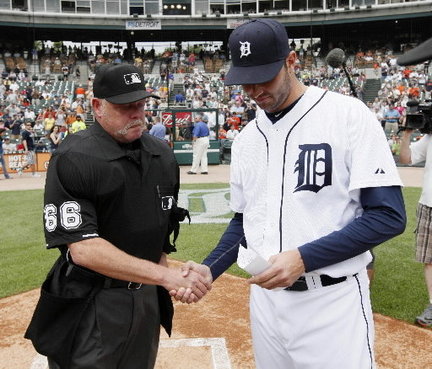
On the Day After the Perfect Game Blown Call, Umpire Jim Joyce joins Pitcher Armando Galarraga at home plate to enter the Tiger's Thursday lineup and take their places together in history as two joined-at-the-soul-hips "Heartbreak Kids."

Cleveland Manager Manny Acta is among those who think that Commissioner Bud Selig did the right thing by refusing to reverse the blown call by umpire Jim Joyce that blew the perfect game of Detroit pitcher Armando Galarraga on the 27th and potentially final out of Wednesday’s perfect game effort against the Indians. “If he had done something like that, he would have opened a whole can of worms,” said Acta. “If you change that, then the next thing we’d want him to do is change the play before that one.”

Acta had to be engaging in hyperbole in this instance. Does anyone remember the play before the big one at first base? And the one before that one was the Willie Mays-like catch by the center fielder. Does anyone really want to reverse that call?

As I told a friend of mine last night, I fully respect his support for the idea of leaving things as they stand in protection of the “sanctity” of baseball history, but that I no longer feel married to that point of view in situations where an obvious uncontested wrong call could be corrected for the sanctity of  getting things rights for the record in baseball history.

Galarraga’s perfect game would have been the third in a month, but only the 21st in a history of baseball that goes back to 1869. How big is that? No one is arguing in favor of the original “safe” call that even umpire Joyce admirably now admits was a blown call. Unless Bud Selig had been willing to use his power “for the greater good of baseball” to make it right by reversing the call and ending the game on that play as the 3-1 put out it actually was, that record is now lost forever.

Please note: I would not support the reversal had the game continued from Joyce’s blown call and turned into an Indians’ victory, but that did not happen. The very next batter was retired to end the game as a Detroit win, the result that would have followed from the perfect game victory. I also would not have supported reversing the call if the safe/out verdict by instant replay had been in question – or if umpire Joyce had stuck steadfastly to his original call. Under either of those circumstances, or by reversing a Cleveland victory, we would have been tampering with history in ways that go far beyond correcting an obvious wrong.

Twenty years ago, I would not have even entertained this idea, but I’ve changed, for better or worse. Today I think getting the truth right, especially when it frees people from unwarranted pain, is far more important than standing on ceremony. As things now stand, two people, pitcher Galarraga and umpire Joyce are going to be forced to live with the full brunt of an untruth (the runner was safe for a “hit”) that alters each of their lives forever.

No one on earth can take away the pain that Wednesday’s game will be forever spoiled by what actually happened, but Commissioner Bud Selig does have the power to right a wrong that will especially punish the diligent conscience of umpire Joyce forever, if he does not.

The criminal justice system is fairer. If the courts send a man to prison for a crime he didn’t commit and that fact is later proven to be the case, what do they do? They let him out. They don’t just stand on the idea that “well, we’d like to let the man out, but sending him to prison already has happened so we’ll just have to leave him there,” nor do they buy into Acta’s implied concern that “we can’t free a single innocent man. If we let one free person out of jail, then all the wrongly imprisoned will want out too.”

Do the right thing in a timely way. Restore Armando Galarraga as the owner of baseball history’s 21st perfect game and free two men from a lifetime balance of pain over an outcome that could have been reversed for a greater good that far surpasses one man’s loss of a badly earned infield single.

Next up? Don’t wait for a clearer warning, baseball. Get your act together on how you want to use technology in the near future (as in – as soon as possible) to help avoid this sort of thing without slowing the game into a pool of total molasses.