Posts Tagged ‘Baseball’

Politically Incorrect MLB Nicknames

July 28, 2010

My late dad and I used to go back and forth by US MAIL, sharing thoughts on whatever had become the latest hot topic symbol of contested political incorrectness in everyday life. It didn’t take us long to come around to sports team mascots since that jumped up quickly as a hot button for a lot of easily offended folks. We also took a little perverse pride in belonging to the only ethnic group in the world that wasn’t offended by Notre Dame University’s long ago decision to bless their athletic teams with the “Fightin’ Irish” moniker. Can you think of a single other ethnic group that would let this pugilistic assignation float on safe waters in today’s social climate?

Native Americans quickly jumped on the “we’re offended” soap box and who could blame them for the NFL’s “Redskins?” That one even gets to me, but not so “Seminoles” or just plain “Indians.” Of course, we still have Redskins and Seminoles today, but far fewer Indians. Stanford University even went so far as a switch from all the Indians of this continent to a single Cardinal as its new mascot choice.  I’ve always assumed that brainy Stanford simply jumped to the logical conclusion that a single bird, and not the whole species, would not have much of an oppositional constiuency,

Here are my current thoughts on politically incorrect major league baseball team nicknames in 2010 and the groups that each offends. Let’s start with the most obvious and work our way out from there:

(1) Atlanta Braves & (2) Cleveland Indians: Native American groups of all descriptions;

(3) St. Louis Cardinals & (4) San Diego Padres: Non-Catholic Believers & Athiests;

,(5) Cincinnati Reds: Capitalists Opposed to Communism in All Forms & FOX News;

(6) Los Angeles Angels: Believers who don’t believe in Angels & atheists;

(7) Houston Astros: Flat Earth Society, Creationists, & Foes of the Big Bang Theory;

(8) Colorado Rockies: Flat Earth Society;

(9) Washington Nationals: The America Without Borders Immigration Movement;

(10) Milwaukee Brewers: The American Carrie Nation Temperance Movement;

(11) Chicago Cubs, (12) Philadelphia Phillies, (13) Florida Marlins, (14) Arizona Diamondbacks, (15) Toronto Blue Jays, (16) Baltimore Orioles, and (17) Detroit Tigers: PETA & the ASPCA;

(18) Texas Rangers: One Group – The State of Texas Cattle Rustling and State Insurance Board;

(19) Kansas City Royals: The American Commoner and Everyday Average Joe Society;

(20) San Francisco Giants: Society for Equally Anonymous Treatment of Vertically Enhanced Americans;

(21) Minnesota Twins: Planned Parenthood & the Zero Population Growth Group;

(22) New York Yankees & (23) New York Mets: East Coast Society for the Protection of Urban Residents Living Between the Hudson & East rivers from Prejudicial Attitudes that May Otherwise Condemn Them, One and All, as Damn Whatchamacallits;

(24) Boston Red Sox & (25) Chicago White Sox: American Open Toe Sandal Manufacturers;

(26) Pittsburgh Pirates: Johnny Depp and the Pirates of the Caribbean movie copyright group because of the team’s failure to live up to their name over the past two decades; the movie people fear that the Pittsburgh version is giving pirates everywhere a bad name;

(27) Los Angeles Dodgers: The FBI and the IRS.  Federal officials clam that Dodger players and Dodger fans are prone to avoid registrations for the draft and miss timely payment of federal taxes due;

(28) Oakland Athletics: United Couch Potato League;

(29) Tampa Bay Rays: The American Dermatology Society; and,

(30) Seattle Mariners: How could anyone be offended by anything that floats, especially if it’s a sea cruise or simply a plain old good idea? If you have anything against Mariners – or if you are politically offended by any of our current MLB team nicknames for reasons we may have missed above, let us hear your own objections in the comment section that follows this subject.

Meanwhile, have a politically correct hump day, everybody!

Whoops! Can I say hump day?
Buff Stuff in Short Supply

July 27, 2010

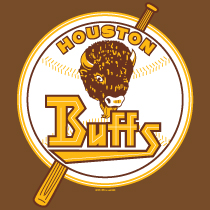
Ebbets Field Flannels Credits This Logo & Color Scheme to the 1959 Buffs.

I get a number of questions about the availability of replica caps and jerseys for the old minor league Houston Buffs that are available for sale to fans who want to help keep the flame of their memory alive. Sad to say, the retail access to these items has never been worse than it is now. I’m hopeful things won’t stay this way, but the prolonged damage to the economy from the recession seems to have cut deeply into certain manufactured collectible items.

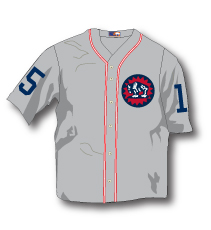
Back on the first of the year, the wonderful Cooperstown Cap Company went out of business for all kinds of financial reasons, but that hit removed our source for Houston Buff caps from 1912, 1951, and 1954. The other big source, Ebbets Field Flannels, still offers a road game jersey from 1932, but they apparently have discontinued making the 1932 cap that goes with that fine replica of the wool flannel uniform shirt.

1932 Houston Buffs Jersey by Ebbets Field Flannels is Available for $185.

I’m not sure what happened to the cap that was available through “EFF” at about $28, but I no longer find it and numerous others among the choices listed on their website. My guess is that they would probably make one for you, if you really wanted one. They do a lot of custom work.

For a better look at the 1932 jersey logo, here it is. The colors differ, but this logo follows the sunburst orange and brown buffalo silhouette figures on the eighty 36″ medallions that once rimmed the exterior walls of the ballpark. The logo featured here for 1932 came out only four years after Buff Stadium opened on April 11, 1928:

1932 Houston Buffs Logo; it appears on the heart side of the Ebbets Field jersey.

For further information, here’s the Ebbets Field Flannels link to their two “Buff” for sale items:

http://www.ebbets.com/product/HoustonBuffs1959T/TShirts

From the T shirt link, you will be able move easily to an enlargement of the 1959 Buff T Shirt they are now selling (sizes S to XXL) for $18 and also click over to order details on the 1932 jersey. Speaking of such, here’s how that advertised T Shirt looks in full view:

Nice T Shirt, but the '59 Buffs never dressed out in the colors of the old St. Louis Browns.

Well, technically speaking, the old St. Louis Browns wore combos of the brown depicted in the T Shirt with orange trim, but this rendition comes close enough to invite the comparison. It’s still a nice shirt, but the ’59 Buffs dressed out exactly in the colors and uniform style of their new parent club by working agreement, the Chicago Cubs, in 1959. That put the Buffs into blue pin strips, blue trim, and bright blue caps – not brown with yellow trim.

One interesting feature of the ’59 logo that Ebbets Field used here is the little optical joke that it plays on you by the way two features come together, unintentionally, I feel sure. First we have the bat, lancing the circle as the arrow pierces the heart of most Valentines.  Then we have the script-tail of the word “Buffs” coming off the stylized point where the business end of the bat departs the circle. Look at these features together, carefully, at the bat exit point. Do you also see the feature of the apparent broken bat?

This would have been a great boken-bat logo for the 1949, 1950, or 1952 Houston Buffs clubs, just to name a few our more disappointing seasons from back then. That being said, I most probably will still order one of these “new” T Shirts. I love the buffalo.

Heck. I love the Houston Buffs. I just look forward to the day we have more choices again, but that’s the status of things for now. You may find something out there in broken size lots on caps and jerseys at Internet stores like “Dugout Memories” and the like. Just Google and you shall find the Buff gear sellers.

Have a great Tuesday and keep your heads above the frogs today, if you live in Houston. There’s a 70% chance of heavy rain in our area.

Stupid Human Tricks, Etc.

July 25, 2010

Dumb softball rule homers for Canadian defense!

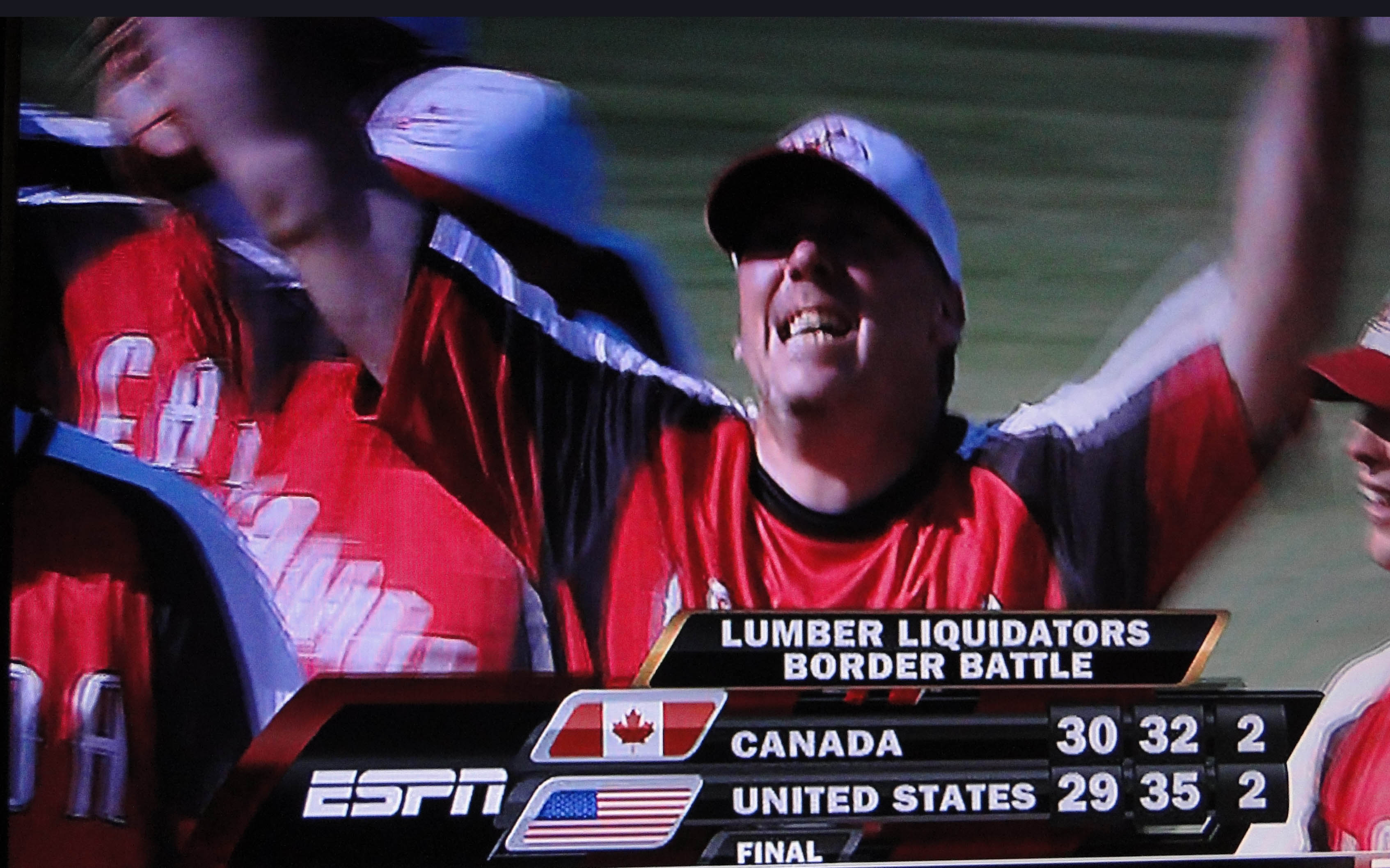
Much Adieu About Nothing: A Slo-Pitch Softball Border Battle. While TV channel surfing between Saturday chores and commitments, I came across this slugfest slo-pitch softball game on ESPN.

(Did I note a hint of redundancy in that sentence?)

The teams called themselves Canada and the United States – and they tabbed the game as the “Border Battle” in spite of the fact the contest was being played in Oklahoma City.

The visiting “Canada” team won, 30-29, but it’s how they won that made me want to throw up all over the Einsteins that came up with the brilliant rules that guided the ordinarily improbable joy from the Canadians in the field over what was actually happening off the bats of the USA team.

The USA came to bat in the bottom of the 7th and last inning trailing, 30-25. A comeback was highly possible, as long as the Americans didn’t stumble on a very big special rule that the organizers of this game had introduced into play.

The rule? Once a team hits ten home runs over the fence, all future balls hit over the fence fair from that point are no longer home runs, but dead play outs that keep all runners on the bases they currently occupy.

Going to the bottom of the last chance for the home team USA, both clubs already had exhausted their 10-HR limits. For the USA to come back, they were going to have to place hit like crazy and drive liners into the alleys – and that’s exactly what they did. With nobody out, the USA quickly plated four runs and placed runners on first and third. All they needed was another dink hit to tie and maybe a gapper to win.

The next two swings did the USA in. Two USA batters in a row hit monster shots over the wall for what would have been the winning 3-run homer, either time, in regular baseball or softball, but not in this screwy league. These late blasts were simply dead play outs under the special rule – and the runners had to hold.

What a sight that was! Here were two Canadian outfielders – both jumping for joy that each ball went over the fence behind them.

The last out for the USA came on an athletic force play at second base by the Canadians, but so what? The illusion that this game had much connection to baseball already had been destroyed.

The brain trust behind these unnatural limiting rules on home runs obviously were trying to keep the final scores of their games out of the 70-69 final score range, but 30-29 is hardly much improvement due to the dead-homer rule, is it? Besides, they should have known that once you make a rule that converts homers into outs under certain circumstances that you are creating the same problem for players that we humans have had with the Ten Commandments since Moses brought them down to us on stone tablets from Mount Sinai:

Once you make a rule against doing something, that now forbidden act becomes the hardest thing to avoid! (Right, Eve?)

Both of those USA batters that hit the homer-outs in the club’s last time up tried hard not to do it, but they did it anyway. Like the guy who wasn’t interested in the woman next door until he found out she was married and then, right away, he fell heavily into coveting, the two USA batters experienced something like this thought right before they each swung with all their might: “I’m not supposed to do this!”

Then they each did it anyway. They smacked the balls out of the park for hope-killer outs.

I guess the only saving grace for the players is that ESPN picked up the beer tab on the beverages that they had to hold off drinking until after the show was over. Or maybe they just drank out of camera-shot during the game.

Unless it’s going to get you in trouble, hit one out of the park today, folks!


Old Timer Games at the Dome

July 24, 2010

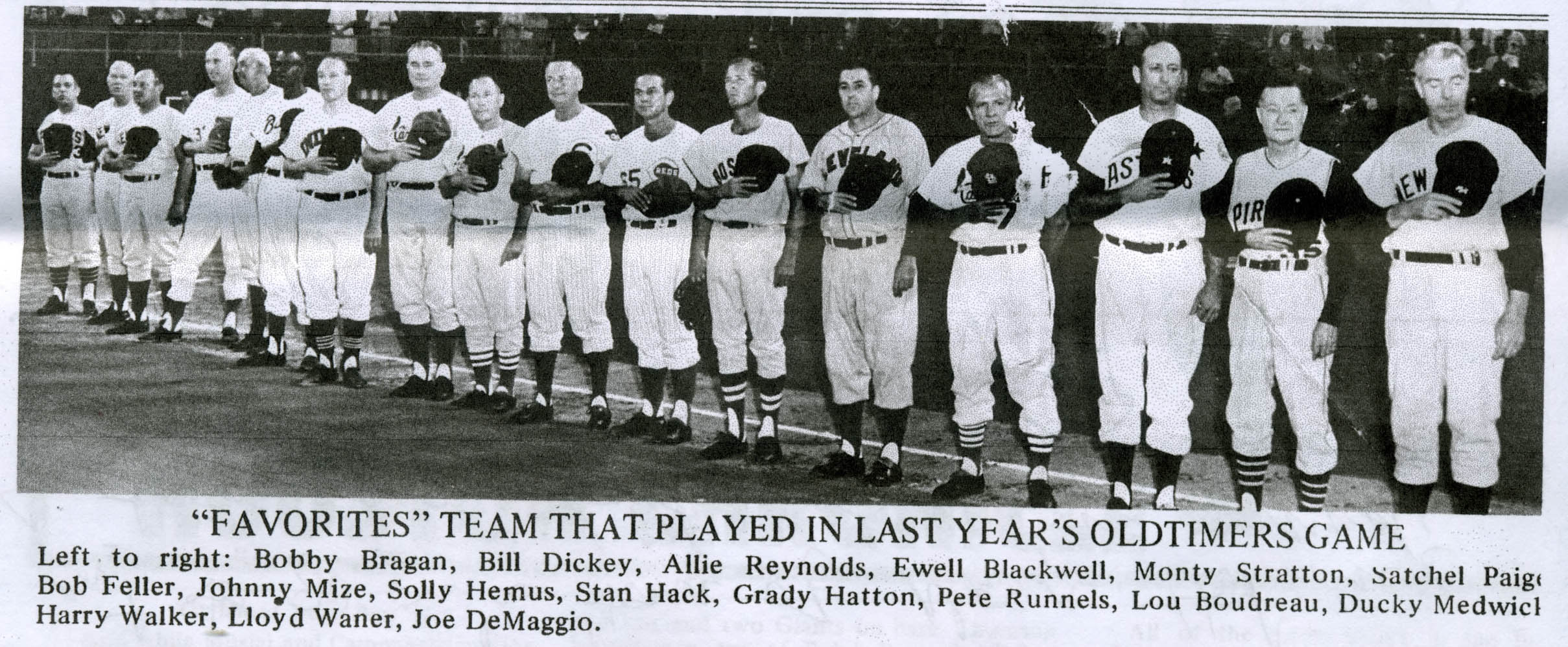
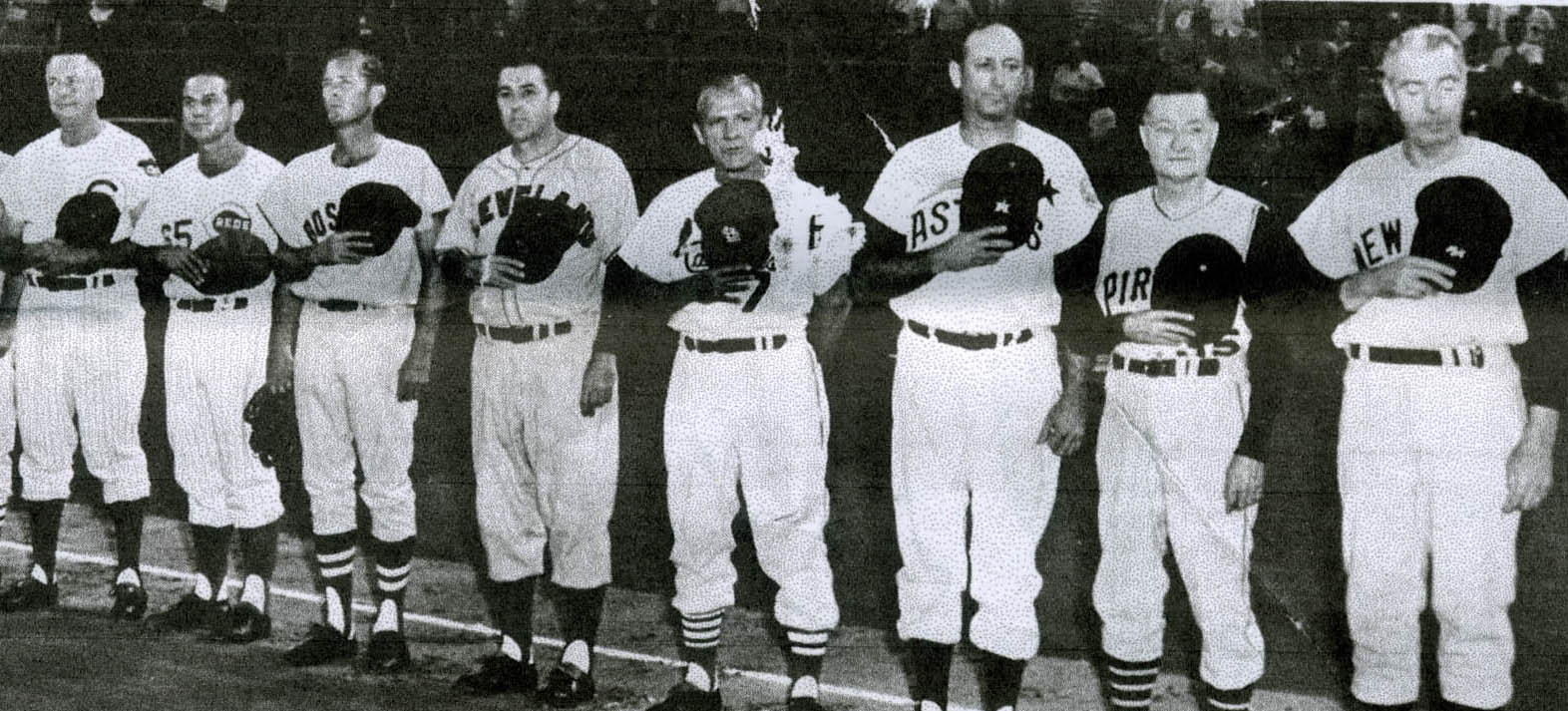
All Time Greats at Dome in ’68 included Satchel Paige & Joe DiMaggio.

Thanks to Larry Joe Miggins, the son of former Buff and Cardinal Larry Miggins, I received this wonderful material on the All Star Games they used to play in the Astrodome during the reign of Judge Roy Hofheinz as Guiding Light of the Houston Astros. The Judge treated his invitees in first class order, honoring the old Buffs equivalently to all those national Hall of Famers during the short time they all convened in the Astrodome for a little fun on the diamond for a few fun innings of recreated greatness.

I’m sorry the above group line makes it so hard to recognize all the great stars that suited up for the 1968 game, so allow me to coast-to-coast their identities from left to tight in slightly larger type. Right here in Houston in 1968, we had Bobby Bragan, Bill Dickey, Allie Reynolds, Ewell Blackwell, Monty Stratton, Satchel Paige, Bob Feller, Johnny Mize, Solly Hemus, Stan Hack, Grady Hatton, Pete Runnels, Lou Boudreau, Ducky Medwick, Harry Walker, Lloyd Waner, and Joe DiMaggio.

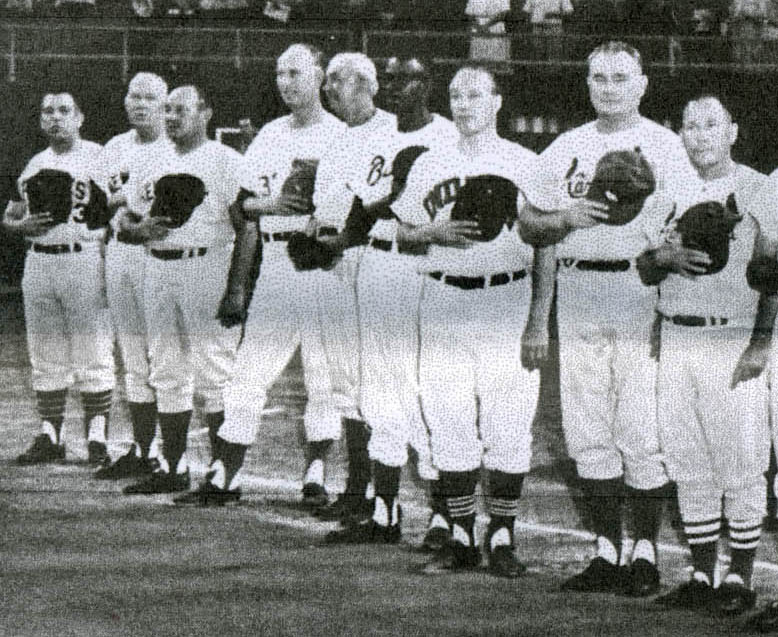
Let’s make recognition a little simpler. Here is the panorama, now broken into two cropped sections. left to right, as follows:

Left Side: Bobby Bragan, Bill Dickey, Allie Reynolds, Ewell Blackwell, Monty Stratton, Satchel Paige, Bob Feller, Johnny Mize, & Solly Hemus.

Right Side: Stan Hack, Grady Hatton, Pete Runnels, Lou Boudreau, Ducky Medwick, Harry Walker, Lloyd Waner, & Joe DiMagggio.

All of them legends, and most of them Hall of Famers, were right here on the field level of the Astrodome, competing again on a celebratory level for no greater reason than their love of the game and an ancient desire to stay connected to what happens on the field .

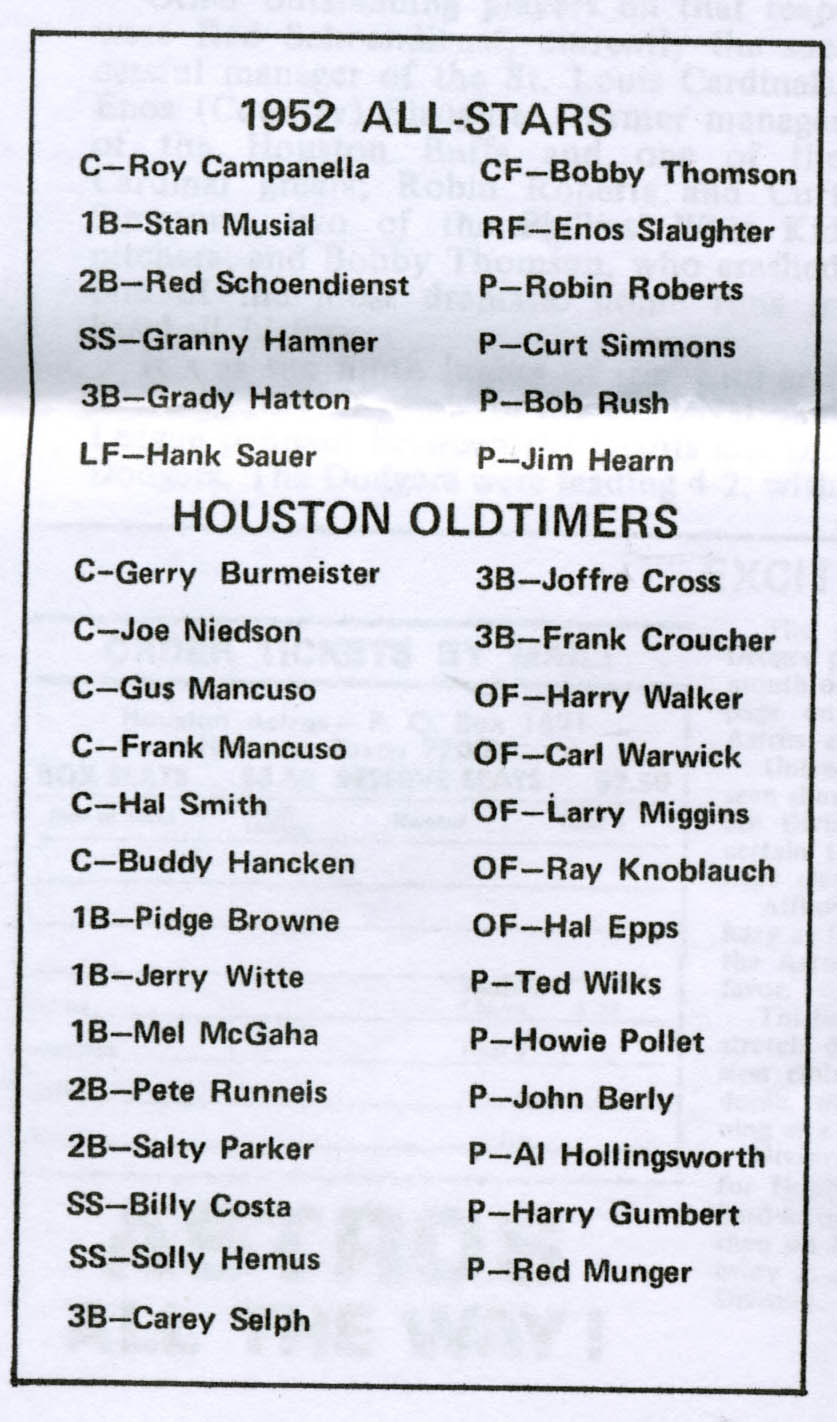
How do you top that 1968 lineup? Well, maybe you don’t, but the 1969 Astrodome All Star Old-Timers’ Game wasn’t exactly chopped liver. In a game that pitted the Houston Old-Timers against MLB Stars from the 1952 National League All Star Team, Stan Musial and Roy Campanella shone pretty bright in their own realms. Here’s how those rosters appeared on the front page of Old-Timers’ Day, a September 1, 1969 publication of the Houston Sports Association:

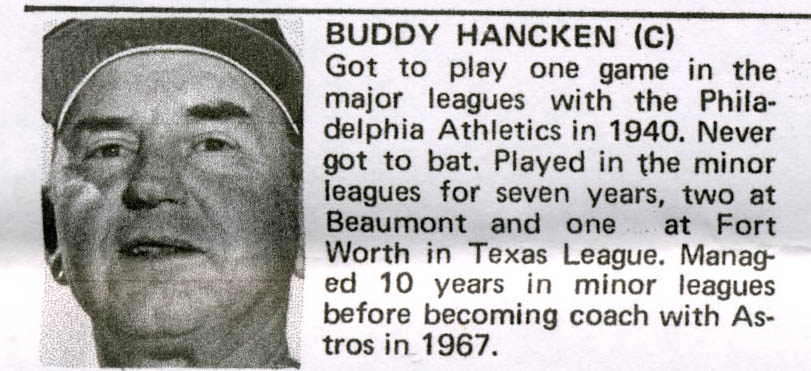
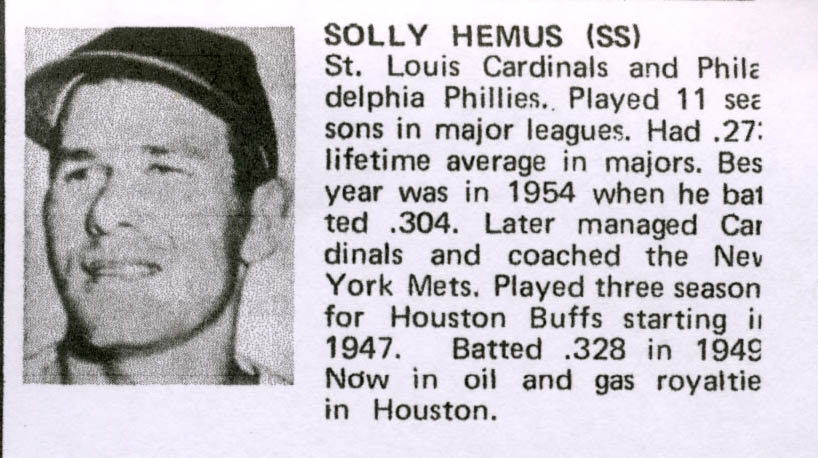
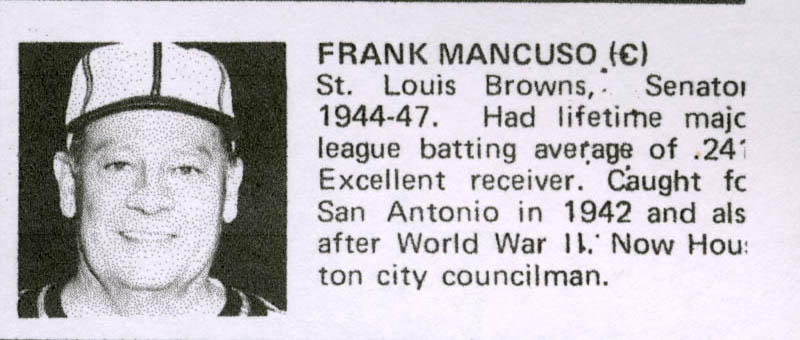
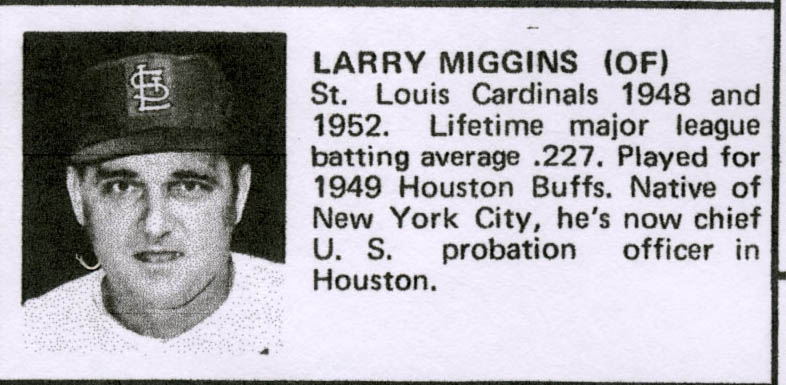
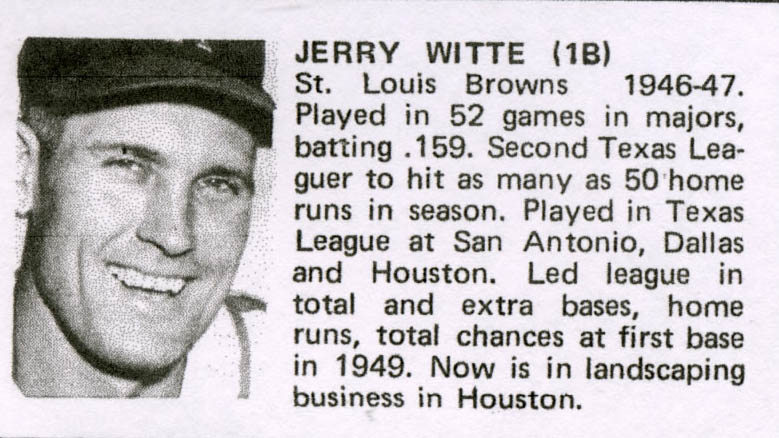
What a great party that must have been for all those wonderful ballplayers of the greatest generation. I feel privileged to have known and been close friends with a number of the men on the Houston Old- Timers roster – and I wouldn’t trade the time I’ve spent with men like Jerry Witte, Red Munger, Larry Miggins, Frank Mancuso, Solly Hemus, and Buddy Hancken for anything in the world.

Here are a few of the photos and captions for Buddy Hancken, Solly Hemus, Frank Mancuso, Larry Miggins, and Jerry Witte. Unfortunately, the advertising article failed to provide a photo block for Red Munger and several others. Even more sadly, Solly Hemus and Larry Miggins are two of the dwindling survivors in 2010 of that roster from 1969. Please note too, that some of the information below was not copied completely for undistorted reprinting and in some cases it also was not totally accurate. Consult the Minor League Player Data file at Baseball Reference.Com for a a complete picture on the careers of each man featured here:

I’m not sure how either of these games from 1968-69 played out on the Astroturf, nor am I sure how many games were played totally. I just know that they went on long enough for Astro youngsters like Jimmy Wynn to get his fill of autographs from former stars like the great Dizzy Dean:

Jimmy Wynn Gets Dizzy Dean’s Autograph, About 1968. 

Larry Miggins reports that he went 5 for 5 overall in all Old-Timers games at the Dome, which is a pretty good average for any man’s league.

Jerry Witte once told me that Roy Campanella remembered him as a post World War II opponent in the American Association during the 1948 short time that their paths crossed as players for Louisville and St. Paul. “I remember you from Louisville,” Campy told Jerry when they met again at the 1959 Astrodome Old Timers Game.. “You were the guy who always came to the plate stomping bugs in the dirt with the business side of his bat.”

Wow! No wonder Campanella made it to the Hall of Fame. Any catcher with his talent, and there weren’t that many, who could also be that mindful of the little characteristics of a hitter he saw so long ago and not that often is bound to have been a special talent.

The 1969 Dome game also was special in light of the fact that two of its players, Roy Campanella and Stan Musial, had only weeks earlier been inducted into the Baseball Hall of Fame at Cooperstown.

I don’t know why we no longer have Old-Timer Games in Houston, but I would imagine that two factors are strongly in play as to why not: (1) liability for personal injuries to ancient warriors is probably more expensive these days, and (2) I don’t think today’s older players care as much about getting out there on the field again as their earlier counterparts once did.

Who knows? Maybe I’m wrong.

Just in case, here’s my starting lineup of former Astros whom I think could still get out there and play three to five innings – as long as they didn’t have to do it again in the same season:

2010 ASTRO OLD-TIMERS

Terry Puhl, rf

Craig Biggio, 2b

Jose Cruz, lf

Jeff Bagwell, 1b

Art Howe, 3b

Kevin Bass, cf

Phil Garner, 2b

Alan Ashby, c

Craig Reynolds, ss *

Doug Drabek, p

* I first suggested Roger Metzger for shortstop, but then, early in the day, Tom Murrah reminded me that I had forgotten an even younger, more available former Astro in Houston resident Craig Reynolds. I agreed so strongly that I made the change here.

Who would you add to the roster or delete from these starters? And please post your comments below. If you are a former Astro player, please feel free to add or delete yourself too. Maybe we can come up with a group that’s so viable we get an Old-Timers Game booked at Minute Maid Park next season.

Nobody’s Perfect, But …

July 22, 2010

His Error in '21 Series Killed the Yankees.

Fair or not, most people today remember Bill Buckner for the ball that rolled between his legs in the 1986 World Series while he was playing first base for the Boston Red Sox. The error in Game Six allowed the New York Mets to win Game Six and then take the Series in Game Seven after all hope had seen lost. I’d be willing to bet that many people remember the Buckner play incorrectly as the last the play of the Series too, but that’s how the brain rearranges disaster over time.  It always cartoons it to a worse degree.

“My drunk husband not only left me without any money, doctor, but he punched out my cat and ran over my mother as he was backing out of the driveway at fifty miles an hour! – Well, maybe it wasn’t quite all that bad, nor all his fault, but that’s how it still feels to me.”

Bill Buckner wasn’t the first man in baseball to have his whole career tagged with a single disappointing play, nor is he likely to be the last. In fact, life itself plays out that way. It doesn’t matter how much good you’ve done, if you do something outrageously negative or scandalous, and it comes to light, as these things most often do, that is what the world is going to remember about you when your name comes up. Got that one, Mel Gibson?

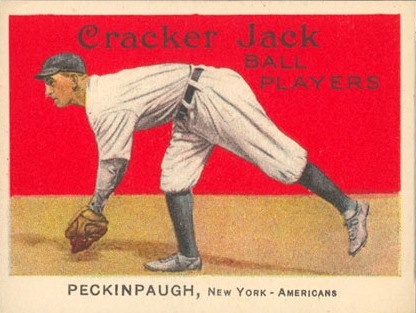
Early 2oth century shortstop Roger Peckinpaugh had one of those Bucknerian moments in the 1921 World Series as a player for the New York Yankees. It was the first Yankee trip to a World Series and the Babe Ruth-led club had faced off against the more established Giants of feisty manager John McGraw in the first great “Battle of New York” for supremacy in the baseball world.

The best five games won of nine series had been a tough fight. An injury and elbow infection to Babe Ruth had mostly robbed the Yankees of their greatest weapon and the Giants’ superior pitching depth was beginning to turn the tide.

Since both clubs still shared the Polo Grounds as a home field in 1921, all they did each was trade dugouts and home team advantage status on a daily basis – with no off-days for unnecessary travel.

The Yankees started as the visitors, but quickly rocked the Giants by taking the first two game by the identical scores of 3-0. Carl Mays went the distance in Game One, surrendering only five hits, but 22-year old rookie Waite Hoyt matched that dominance of the McGraws in Game Two, giving up on only two hits.

The Yankees led the Series, two games to none.

Games Three saw the Giants explode like a baseball bomb against Yankee hurler Bob Shawkey and his no-relief bullpen buddies as they pounded out 20 hits in a 13-5 romp, following a quick recovery from an early Yankee lead of 4-0. Fred Toney started for the Giants, but yielded early to Jesse Barnes for the coast to victory. As  a Local side note, Franks “Pancho” Snyder went 4 for 5 in this game as the Giants’ catcher, Seven years later, Snyder would manage the 1928 Houston Buffs to the Texas League and Dixie Series championships in the first year of Buff Stadium.

Phil Douglas pitched the Giants even in Game Four, 4-2. Carl Mays started again for the Yankees because manager Miller Huggins had little confidence in his starters beyond Mays and Hoyt. Mays, the same guy who accidentally killed Cleveland shortstop Ray Chapman in 1920 with an inside pitch, had a another good game, but the three runs he gave up in the eighth did him in.

After four game, the Series was tied at two wins each for the Yankees and Giants.

Game Five saw Waite Hoyt come back and take his second victory over the Giants and their starter, Art Nehf. The Giants only run was unearned, giving Hoyt an 18-inning ERA of 0.00 and the Yankees a 3-2 Series lead.

And then the worm turned.

With Babe Ruth now out with a life-threatening elbow infection in those pre-antibiotic “good old days,”  Jesse Barnes relieved starter Fred Toney for the Giants again and pitched the McGraws to an 8-5 win over the Yankees and lefty Harry Harper and Company. The Series again was tied at 3-3.

Carl Mays of the Yankees squared off again against Phil Douglas of the Giants in Game Seven. Both men pitched beautifully, but clumsy thinking in the field and a seventh inning error in the field by Yankee second baseman Aaron Ward gave the Giants an unearned run that stood up as the deciding tally in a 2-1 Giants victory. The Giants now led for the first time in games, 4-3, and needed only one more win to take it all.

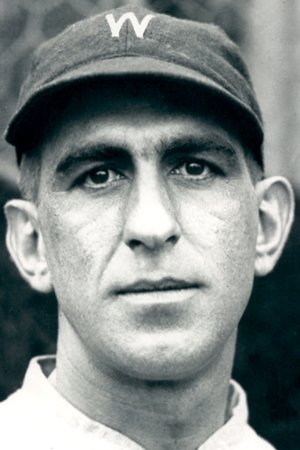
Roger Peckinpaugh Made It Back to the Series with Washington in 1924-25.

The “visiting” Giants sent Art Nehf out there in Game Eight to face Waite Hoyt and the “home team” Yankees in Game Eight and, once more, both men pitched beautifully in each going the distance. Nehf gave up six hits; Hoyt only 4. Neither man surrendered an earned run, but Hoyt suffered the loss when a first inning error by Yankee shortstop Roger Peckinpaugh allowed a tally that held up as the only run of the game.

The Giants won the 1921 World Series, 5 games to 3. Pitcher Waite Hoyt tied Christy Mathewson’s 1905 record for a 0.00 ERA over 27 innings pitched, but mistakes in the field kept him from sharing Deep Six’s victory lap.

Hoyt must share the blame, even though much of history prefers to put it all on Peckinpaugh.

Hoyt had started Game Eight by walking Dave Bancroft and Ross Youngs. Then, with two outs,  George Kelly hit a routine grounder to shortstop Peckinpaugh for what should have been an easy third out play. As things work out sometimes, Roger muffed it. The ball deflected through his legs into short left field. Then, according to several media witnesses, Peckinpaugh appeared to nonchalantly track it down for a play at the plate that came far too late to get the speeding Bancroft, who had been running from second.

It was only one run in the top of the first, but it held up as the one score in the game and the deciding blow in the World Series.

Peckinpaugh was inconsolable at game’s end over his mistake, perhaps, making it even easier for the press and Yankee fans to pile it all on his back. Shortly thereafter, the Yankees dealt him away to the Red Sox with others in exchange for shortstop Everett Scott and others. Peckinpaugh later got another shot at the Giants as a member of  the 1924 Washington Nationals and this time he played for the winners of a seven-game series. The following season, Peckinpaugh’s 1925 Nats lost a seven-game series to the Pittsburgh Pirates.

What goes around, comes around. Continuously. Roger Peckinpaugh finally made peace with himself over Game Eight of the ’21 World Series. There’s redemption and peace for Bill Buckner too somewhere down the line – and maybe it’s already happened on some quieter plane that none of us could even know about. I certainly hope it has. I always liked Buckner.

On another plane of its importance to baseball history, and for a most worthwhile read on the times and  significance of the 1921 baseball season, pick up a copy of “1921: The Yankees, The Giants, & The Battle for Baseball Supremacy in New York” by Lyle Spatz and Steve Steinberg.

If you care about history, I don’t think you’ll be disappointed.

Carlos at the Bat

July 21, 2010

Carlos at the Bat

The Outlook wasn’t brilliant for the Astros nine that day:
 The team sat next to Pittsburgh, with but two months left to play. 
And then when Michael died at first, and Hunter did the same, a sickly silence fell upon the patrons of the game.

A straggling few got up to go in deep and dark despair. The rest clung to that hope which springs eternal in the human breast;
 they thought, if only Carlos could get but a whack at that – we’d put up even money, now, with Carlos at the bat.

But  Lance preceded Carlos, as did the new guy, Chris, and the former mimed Mendoza and the rookie just might miss. 
So upon that stricken multitude grim melancholy sat, for there seemed but little chance of Carlos getting to the bat.

But Lance let drive a single, to the wonderment of all,
 and Johnson, the surprise-one, tore the cover off the ball;
 and when the dust had lifted, and the fans saw what occurred,
 there was Johnson safe at second and old Berkman hugging third.

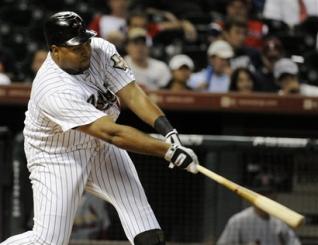
Then from 5,000 throats and more there rose a lusty yell; it rumbled through the downtown streets, it rattled Michael Dell; it knocked upon the Crawford Box and recoiled El Caballo, for Carlos, mighty Carlos, was advancing near the bayou.

There was ease in Carlos’ manner as he stepped into his place; there was pride in Carlos’ bearing and a smile on Carlos’ face. 
And when, responding to the cheers, he lightly doffed his hat,
 no stranger in the crowd could doubt – ’twas Carlos at the bat.

Ten thousand eyes were on him as he rubbed his hands with dirt;
 ten thousand thumbs all tweeted when he wiped them on his shirt.
 Then while the writhing pitcher ground the ball into his hip,
 defiance gleamed in Carlos’ eye, a sneer curled Carlos’ lip.

And now the leather-covered sphere came hurtling through the air,
 and Carlos stood a-watching it in haughty grandeur there. 
Close by the sturdy batsman the ball unheeded sped.
 “No mas por favor,” said Carlos. “Strike one,” the umpire said.

From the grandstands, sparse of people, there rose up a tinny roar, like the beating of the human-wave on a bored, pathetic shore. “Pinch him! Pinch the umpire!” shouted an oddball in the stands;
 and its likely he’d a-pinched him had not Carlos raised his hand.

With a smile of Christian charity great Carlos’ visage shone; he stilled the rising tumult; he bade the game go on;
 he signaled to the pitcher, and once more the spheroid flew; but Carlos gave no “si si,” and the umpire said, “Strike two.”

“Fraud!” cried the maddened hundreds, and the echo whispered fraud; but one carefree look from Carlos and the audience was awed.
 They saw his face grow flat and cold, they saw his muscles sag, and they knew that Carlos would not drop his bat, a bunt to merely drag.

The fire is gone from Carlos’ lips, his jaw is falling slack; he pounds his bat with nonchalance, as if a fly to smack. And now the pitcher holds the ball, and now he lets it go. And now the air is gently stirred by the force of Carlos’ blow.

Oh, somewhere in this favored land the sun is shining bright;
 the band is playing somewhere, and somewhere hearts are light, and somewhere fans are laughing, and somewhere children shout; but there is no joy in Houston – El Caballo has struck out.

Baseball’s Most Unbreakable Records

July 20, 2010

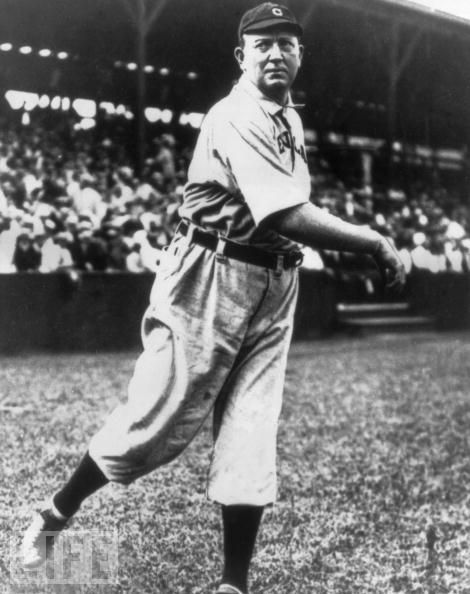
Cy Young: 511 Career Wins

What is baseball’s most unbreakable modern record?

In the interest of arguable fair ground, you have to right away discount the zany heights statistical records of 19th century players who took the field to a very different kind of game back then. Old Hoss Radbourn of the 1884 Providence Grays stands gritty and clear as the best example here. Pitcher Radbourn won 59 games in 1884. Think we’ll ever see the likes of that accomplishment again?

Here are my candidates for the most unbreakable records in modern baseball. I heartily invite you to join in with your own choices in the comment sections that follows this column.

My List of Unbreakable Major Modern Baseball Records (Please note that I’m staying away from the arcane or impossible to verify personal marks of players who may not change their underwear all season if they think the digs they are wearing every day serve as the source of some newfound good luck.):

(1) Cy Young’s 511 Career Wins. Cy’s total wins stagger the imagination. Compiling his total during the iron-man era of 1890-1911, it isn’t likely that any modern pitcher will ever again come close to the Young 511 total. Twenty wins for twenty years straight in the 21st century would still leave a pitcher about 111 wins short of tying the record and, these days, it isn’t likely that a great pitcher making today’s money would ever want to pitch long enough and often enough to challenge Cy.

(2) Napoleon Lajoie’s .426 Batting Average in 1901. Ted Williams was the last man to hit over .400 when he posted a .406 mark in 1941. That was 69 years ago and few have come close to .400 since. It’s conceivable to me that another great hitter may come along and hit .400, but topping Lajoie’s .426 all time highest modern era batting average seems highly improbable. Maybe a young Ichiro could have given it a a good run, but we’ll never know. (NOTE: I originally treated the birth of the Modern Era as 1903, the first year of the World Series, because that is the way I’ve thought of it since I was a kid. SABR friend Mark Wernick writes in to remind me of the technicality that the Modern Era is now considered to be 1900, the first year of the American League. Maybe it’s always been that way. I simply never thought of it as beginning until the NL/AL started competing against each other. The difference here is that 1903 makes Rogers Hornsby’s .424 from 1924 the all time one season high BA, whereas, 1900 turns the honor over to Nap Lajoie and his .426 BA from 1901. I can live with passing the baton to Lajoie. Now it’s even more improbable that this record wll ever be broken.)

(3) Cal Ripken’s 2,632 Consecutive Game Playing Streak. I can’t see anyone coming along with the talent, health, drive, and luck to break Cal’s Iron Man record for consecutive games played. Besides, the game has moved even further away from the idea of iron-men performances since Ripken’s retirement – making it even less probable of it ever happening again.

(4) Joe DiMaggio’s 56-Game Hitting Streak. Except for a few other great contact hitters like Willie Keeler, George Sisler, Ty Cobb, and Pete Rose, all of whom made it into the 40-game territory, most of the others conk out in the late 20’s or early 30’s. One other difference: The pitchers in DiMaggio’s day saw the streak as a manhood challenge and wouldn’t dare pitch around him. Except for a few guys today like Roy Oswalt and Carlos Zambrano, most 21st century pitchers and a number of their managers would most likely walk a guy four times if he reached 55 games and it still made more sense to the object of winning to walk him rather than face him.

At any rate, without stretching or straining the point too thin, those are the four records in Major League Baseball that I think are the safest from breakage any time soon, if ever, and expressed here in the order I feel represents safest to least safe.

In general, I think they are all about as safe and certain as death and taxes. What do you think? Maybe I missed something that ought to be added to the list.

The Post WWII Baseball Trinity

July 19, 2010

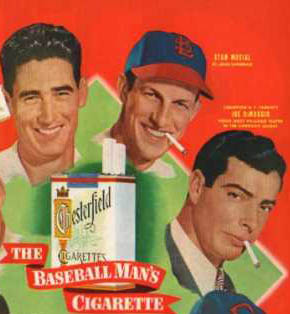
(L>R) Ted WIlliams, Stan Musial, Joe DiMaggio (It took a cigarette ad to bring baseball's "Big Three" together).

In the years following World War II, Ted Williams of the Boston Red Sox, Stan Musial of the St. Louis Cardinals, and Joe DiMaggio of the New York Yankees were baseball’s unholy trinity of swat. Of course, they were unholy. They were neither the three natures of God in One Divine Being, nor were they clean of endorsement money from the tobacco industry. Of course again too, cigarette smoking was not the cultural sin in the 1940s and 1950s that it was later to become. Ted, Stan, and Joe were just normal American males as cigarette users, although DiMaggio may have been the only one who chain-smoked through games. The stories of him ducking into the clubhouse tunnel from the dugout between innings at Yankee Stadium are the stuff of legend by now.

All I know is – I had to use the attached crop from an old Chesterfield ad to get the three great ones of my childhood aspiration years in one photo. If they ever made a photograph together, and I’m sure they did, it was too obvious an attention-grabber to miss. No self-respecting news-hound of that era’s All Star Games could have allowed that photo opportunity to have passed every year they were there together – and that was just about every season they all shared in common. I just could not find the expected photo of all three guys smiling and waving bats over their hitting shoulders in one tight pictorial.

I thought it would be interesting to take a brief broad ban look this morning at how The Big Three’s statistical accomplishments and honors compared over the years. Let’s start with tenures of service and batting averages.

Joe DiMaggio started earliest, finished earliest, and played the least time in the big leagues. DiMaggio broke into the majors in 1936, missed three years, 1943-45, due to World War II, and then finished his 13-season career (1936-42, 1946-51).

Ted Williams reached the majors second in 1939. Technically, Williams played 19 seasons in the big leagues, but he also lost 1942-45 fully to World War II and all but 43 games total of the 1952-53 seasons to a second tour as a fighter pilot in Korea. Williams concluded his career (1939-42, 1946-60) with a home run in his last time at bat.

Stan Musial started last and played for the longest tenure of time. Musial’s 22-season career (1941-44, 1946-63) cost him only the 1945 season to military service.

For their careers, Ted Williams batted .344, Stan Musial batted .331, and Joe DiMaggio batted .325. Not a shabby tab for any single outfield that might have had both the good fortune and the bucks to have afforded all three. – Williams, of course, was the only one to ever hit over .400 (.406 in 1941) and Joe D. is the only man (period) to have ever hit in 56 consecutive games (also in 1941). All Musial could do was lead the three-man pack in batting championships with 7 National League titles (1943, 46, 48, 50, 51, 52, & 57). Williams finished a close second with 6 American League titles (1941, 42, 47. 48, 57, & 58). Joe DiMaggio won only two American League batting titles in 1939-40.

All three guys could hit for power, but only Stan Musial never led his league in home runs. Williams took 4 HR crowns in the AL with 37 in 1941, 36 in 1942, 32 in 1947, & 43 in 1949. Joe DiMaggio took a couple of crowns, early and late. Joe D. won the AL title with 36 HR in 1937 and again in 1948 with 39. For their careers, Williams struck 521 homers; Musial blasted 475; and Joe DiMaggio hit 361.

On the most runs batted in side, Williams won 4 times (1939, 42, 47, & 49); DiMaggio won 2 times (1941-48); and Musial also won twice (1948, 56). Joe D’s 1941 total of 125 rbi to Ted’s 120 cost Williams the triple crown that year. Williams is the only triple crown winner in the group. Ted took the big trifecta two times, winning the triple crown in 1942 and 1947.

Oddly, Ted Williams failed to win the AL MVP award in his .406 BA 1941 season or in either of his 1942 or 1947 triple crown years. Writers gave the MVP nod in 1941 and 1947 to Joe DiMaggio. Joe Gordon of the Yankees received the award over Ted Williams in 1942. Go figure.

MVP totals include 3 for DiMaggio (AL: 1939, 41, & 47); 3 for Musial (NL: 1943, 46, & 48); and 2 for Williams (AL: 1946 & 49).

World Series Experience. All three stars played only for their original teams: DiMaggio played  for the Yankees; Williams for the Red Sox; and Musial for the Cardinals. DiMaggio, of course, got to play for the most World Series winners. Joe D. played for 10 winners  in 11 World Series tries (1936, 37, 38, 39, 41, 42, 43, 47, 49, 50, & 51). Joe’s 1942 Yankee loss to the Cardinals was his only disappointment. Stan Musial played on World Series winners in 1942, 44, & 46, losing only in 1943 to the Yankees. Ted Williams got into only a single World Series that his Red Sox lost to the Cardinals in 1946.

DiMaggio played for World Series winners in 1950-51 and then retired. Williams and Musial labored for the all of the 50’s and into the early 60’s, winning nothing more with their teams. Even the greatest stars cannot do it alone.

Williams and Musial both hit from the left side; DiMaggio from the right. The two American Leaguers from California (Williams and DiMaggio) were egoists of the first order; one was just louder than the other. The other guy (Musial) was as humble, nice, and down-to-earth as the people who raised him in the coal country of western Pennsylvania, but so what? All three were baseball greats of the first order.

I personally like Ted Williams as the greatest hitter of the era, Joe DiMaggio as the greatest fielder of his time; and Stan Musial as the greatest all around player from that period of the greatest generation. That was the 1940’s.

The 1950’s weren’t about these three guys. By the mid-50’s, the discussions of the greatest player had shifted to Mickey Mantle, Willie Mays, or Duke Snider – with Hank Aaron, Roberto Clemente, and Al Kaline all showing up soon enough with their own support for recognition.

Keeping those latter guys from the 50’s separate from the mix, what do you guys think of Teddy Ballgame, the Yankee Clipper, and Stan the Man? Who among them was the greatest in your opinion?

1980: Astros take Playoff with Dodgers, 7-1

July 17, 2010

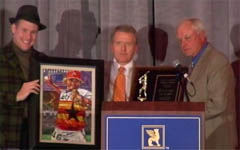
Texas Baseball Hall of Fame Induction, 2005: Artist Opie Otterstad, Presenter Greg Lucas, Inductee Joe Niekro.

The date was October 6, 1980. By tailspinning into a three game sweep loss to the Los Angeles Dodgers on the West Coast, the Houston Astros found themselves facing the same club to break a dead heat tie for first place in the National League West. The winner would advance to play the Philadelphia Phillies for the National League pennant. The loser would go home to a winter of discontent that overflowed with thoughts of what might have been. Whomever advanced and then lost to the Phillies might surely do the same from a steeper cliff, but today the business was about winning the opportunity to simply try.

By an earlier coin flip, LA had won the right to be the home team n the event that the Astros and Dodgers ended up in a tie and needed a playoff. Their LA win on coin flip for the special one-game playoff site was convenient to staging since the Astros were already in town, still trying to recover from dropping a three-game series that left them in a 92-70 identical finish with the Dodgers, anyway, but that didn’t make the game any easier as a proposition for the staggering club from Houston. Down hearts came out of the woodwork with their predictions for our Astros’ full demise, but there was no giving up in us hard-core fans, or in manager Bill Virdon, or in the Astros themselves.

Astros manager picked Joe Niekro (19-12) to pitch the biggest game in franchise history. Niekro would be opposed by Dodger manager Tommy Lasorda’s selection, Dave Goltz (7-10). By league rules, stats from the special playoff game would be included in the regular season team and individual records of each club. Therefore, the stakes for Knucksie Niekro of Houston were even higher. Houston’s first division championship, a shot at the World Series, and a second straight 20-win season were all riding on what he did on the mound this special day.

Houston got on the board early. In the top of the 1st, Terry Puhl reached first base on a leadoff E-4 by Davy Lopes and then advanced to third on a single by Enos Cabell. With Joe Morgan batting, Cabell then stole second to amp the Astros threat into a “runners at second and third with nobody out” situation.

After Morgan fanned, Jose Cruz appeared to reach on a fielder’s choice, but the play at the plate was muffed by the Dodger catcher Joe Ferguson, allowing Puhl to score. With Cabell now on third and Cuz on first with one out, Houston led, 1-0.

Cabell then scored on a Cesar Cedeno ground out to make it Houston, 2-0, but that would be it for the first stanza. An Art Howe single would move Cruz to third, but Dodger starter Dave Goltz would pitch his way out of further harm.

Joe Niekro didn't just throw the ball. He fluttered wobblers by the dozens.

After Joe Niekro retired the Dodgers in order over the first two innings, the Astros added two more runs in the top of the third to increase their lead to 4-0. They got those tallies with the old “Here’s Howe” recipe. After Cesar Cedeno singled and stole second, Art Howe went deep to push the comfort zone a little softer for pitcher Niekro, but nobody was taking anything for granted – not after the standings earthquake the Astros went through in their final series of the season.

After Niekro again stopped the Dodgers in the third, the Astros added a final touch with three more runs in the top of the fourth. After Puhl reached on a bunt single and steal of second, Cabell and Morgan walked to load the bases. Puhl then scored on a sacrifice fly by Jose Cruz – and Cabell-Morgan both tallied on a 2-rbi single by Art Howe. Four rib-eyes? Here’s Howe! Going to the bottom of the 4th, it was Houston 7 – Los Angeles 0.

The Dodgers broke up the shutout in the bottom of the 4th when Dusty Baker singled, moved to second on an error of Steve Garvey’s batted ball by Astros third baseman Enos Cabell. Baker then scored on another single by Dodger center fielder Rick Monday, but that would be it and far from enough in the Dodger cause on this special day in Astros history.The Dodgers threatened again by loading the bases in the 6th, but Niekro shut the door on any further scoring. From there, Joe went into overdrive, giving up only one more hit over the last three innings, a two-out single in the 9th, but that would be all and it for the doomed Dodgers.

Joe Niekro (20-12) had pitched the Houston Astros to a 7-1, 6-hit, 2 walks, 6 strikeouts, no earned runs complete game stop on the Los Angeles Dodgers, advancing the Houston Astros to their very first regular playoff appearance in the NLCS. In the scheme of things, Joe Niekro had won the most important game in franchise history to-date and he also had become the first pitcher in Astros history to mark twenty-win seasons for two years in a row.

What else does the guy need to do deserve having his number 36 retired by the Astros? Nothing. He already did it – a long, long time ago. He simply needs to be duly recognized by the retirement of his number 36,

Roy Oswalt takes the mound tomorrow, Sunday, July 18th, with a better than fat chance of tying Joe Niekro for the most franchise pitching wins at 144. If the rotation holds and Roy isn’t traded earlier than the July 31st deadline, Oswalt will get two additional starts at home to either tie or break the Niekro 144 mark against the Reds July 24th and then against the Brewers on July 30th.

Now is the time to act. When something is the right thing to do, now is always the time for action. We just need to hear from the one person in this world who can make it happen as it should – and that man is Drayton McLane, Jr. So far, he’s batting 1.000 on the number retirements he’s called into history and this one is just as obvious. It just fell in the cracks during the John McMullen Astros ownership years and now needs to be restored to the light of its proper place of honor in franchise history.

If you support the hope that the Astros will see fit to retire Joe Niekro’s #36 now, please go to the primary column on that subject and post your strong opinion there. Here’s the link you need to get there.

https://thepecanparkeagle.wordpress.com/2010/07/13/its-time-to-retire-joe-niekros-astros-36/

Mighty Superstition

July 16, 2010

Hope he's not a pinch hitter with the game and his job riding on what happens this time up..

Those of us who grew up in the baseball sub-culture don’t hold a copyright on superstitions. We simply invented most of them.

Who do you think came up with the two basic superstitions about stepping on long white lines on the ground? Depending on their point of view, a player, and especially a pitcher, may decided that it’s bad luck to step on the white foul line when he’s running, walking, or jogging to his position on the field. On the same team, another guy my believe that it’s bad luck not to step on the line. Other teammates may be working with “white line ideas” that are variants on each touch/don’t touch thought – ideas that they are too embarrassed or superstitious to even share with their best friends.  Example: You have to avoid the line while taking the field, but step on it when you come back to the dugout. Mind-boggling.

The rally cap is supposed to also "turn the game around."

The rally cap is a fairly new collective superstition in baseball. A variant on the old “cross-your-finger-for-good-luck” behavior, players are hoping that the reversal of their caps will also result in a reversal of fortune on the field when their club is trailing in the later innings. Whatever works.

I’m not sure if Hall of Fame shortstop Rabbit Maranville ever personally carried any rabbit’s feet for good luck, but I’m willing to bet you that he had plenty of teammates over his long multi-team career that felt lucky to have a guy with a name like rabbit joining their lineups. Superstition runs silent and deep in baseball. It exists at levels that don’t get talked about openly in baseball.

"You've just been traded to Pittsburgh!"

Sometimes you can’t take a road trip somewhere without running into a sign that suggests good or bad luck. Other times you just have to pass through certain days that are associated with bad luck, notably Friday 13th, but I knew a guy once who was convinced that nothing good could ever possibly happen on the “29th” of any month. He also felt that players should avoid wearing the number “29” at all costs. If a relief pitcher wearing #29 came in and gave up a grand slam, he would just say something like, “What did you expect?” and move on. If the same pitcher got his club out of the jam with a two-out “K” and the bases loaded, he would simply shrug and say, “he was lucky that time.” There is no arguing with the “BIG S!” When superstition exists, it rules. And reason goes on permanent holiday in the area covered by the superstitious belief.

Malevolent Superstitions

The mala ojo, or evil eye, may be more prevalent in baseball countries that also practice voodoo, but that doesn’t mean that players would not try to use it an American-based baseball game. The evil eye is simply based on the superstitious idea that ill fortune can be transmitted from one person to another through a powerfully evil look that has been charged with all kinds of bad wishes. It is nothing to play around with and, as far as I’m concerned, it does all its harm to the would-be sender. Negativity always finds a way to fall back on the sender. You don’t have to be an historian of Captain Marvel comic books to get how that works, but it helps. SHAZAM!

Maligned from the Middle Ages

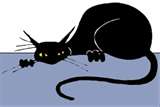
In this so-called enlightened 21st century, it may be time to put aside the enemies of reason that have haunted society from the dawn of civilization and tortured everyday life for black cats since the Middle Ages. Just don’t count on it happening over night. And don’t jump to any conclusions that it’s gone when people stop admitting that is still has a home in the game of baseball. Superstition is also more of  an old-fashioned word for a form of obsessive-compulsive behavior – and those skins of human affinity are long, strong, and powerful.

This subject is like the game of baseball. Theoretically, it could go on forever. I’ll take rain check on coming back to it at any time, as long as it’s not the 29th of the month. (Just kidding.) For toady, I’d like to comment on a couple of superstitions that haunt our Houston Astros. These are superstitions that some feel may explain our difficulties in reaching and winning the World Series

Just remember. I do not believe in either of these ideas, but some people do:

(1)  The Apache Junction Curse. Because the franchise originally trained in Apache Junction, Arizona at the base of the Superstition mountains, some people feel that the Houston club fell victim to the same curse that befell prospectors who came to this area in the 19th century searching for the gold they hoped to find in the famous “Lost Dutchman’s Mine.” Because the region had been cursed by the Apaches for the disturbance to their scared mountains, seekers would be pulled to the area as though drawn by an invisible magnet. – They would seek, but they would not find! CONCLUSION: The curse rubbed off on the Astros in their 48-year fruitless search for a World Series championship.

(2) The Astrodome Indian Burial Grounds Curse: Similar to the Apache Junction idea, the belief behind this one is that the Astrodome was built on land that once served as a Karankawa or Comanche Indian Burial Ground. I remember discussing this theory with former Astros pitcher Vern Ruble back in the early 1980s, when we were all still recovering from that tough loss in the NLCS to the Phillies at the “Dome. Vern had not heard the legend previously, but his eyes lit up when I told him about it. “That’s it,” Ruhle exclaimed, “That’s got to be it! Otherwise, there is no other good way to explain how we lost to the Phillies in 1980!”

Superstition is mighty, allright. It’s just sometimes mighty wrong.

Beyond superstition, don’t forget to weigh in on the “Retire Joe Niekro’s # 36 Discussion.” Please write your thoughts on the matter in the comment space beyond the following article:

https://thepecanparkeagle.wordpress.com/2010/07/13/its-time-to-retire-joe-niekros-astros-36/