Bill Gilbert: April 2017 Astros Report

May 3, 2017

Long time invaluable SABR analyst and guest columnist for The Pecan Park Eagle checks in today with his post-April, first monthly report on how the 2017 season is playing out for our Houston Astros.  Thanks to the club’s new big rally dynamic, the first two games of May aren’t looking too bad either.


What a Difference a Year Makes

By Bill Gilbert

billcgilbert@sbcglobal.net

In 2016, the Houston Astros posted a record of 7-17 in April, from which they never fully recovered, finishing at 84-78, missing the playoffs by 5 games. In April 2017, the Astros were 16-9 and in first place in the American League West Division, 3 games ahead of the second place Los Angeles Angels. The 16 wins are the most in the American League and only the Washington Nationals with 17 wins in the National League East Division have more.

While the Astros have not done anything spectacular, they have played very consistently and rank in the top half in most important batting and pitching categories. It is a different team than what we have seen in recent years. For the last several seasons, Astros batters have ranked near the top of the 30 major league teams in home runs, stolen bases and strikeouts but near the bottom in batting average and on-base percentage. In 2017, it is pretty much the opposite. They rank 12th among major league teams in home runs, 14th in stolen bases and 24th in striking out.

On the other hand, the Astros rank second in batting average at .272 behind only the Washington Nationals at .295 and well above the MLB average of .247. On-base percentage is similar with the Astros ranking third at .340 compared to the MLB average of .317. Last year, the team batting average was .247 and the on-base percentage was .319. Their OPS (on base plus slugging average) is .765, fifth in MLB and second in the American League, behind only the New York Yankees.

In their 25 games, the team has averaged 4.48 runs per game while holding opponents to 3.56 runs per game. In 2016, the figures were 4.50 and 4.33. The runs scored were expected to be higher with the addition of several players to the offense in the off-season, so there is room for improvement.

Both the starting and relief pitching have been considerably better than the MLB average. Overall, the staff ranks third in ERA at 3.38 vs. the MLB average of 4.08. The starters ERA is 3.63 vs. the MLB average of 4.06 and the relievers are at 2.91 vs. the MLB average of 4.20.

Much of the improvement is due to the outstanding performance of Dallas Keuchel who is pitching even better than he did in his Cy Young year of 2015. All six of Keuchel’s starts in April were quality starts with a record of 5-0 and an ERA of 1.21. One of the keys if the Astros are to succeed in 2017 is a return to health and success of their two top pitchers, Keuchel and Lance McCullers Jr. Keuchel has been better than expected and McCullers is healthy but has been inconsistent with 3 good starts and 2 bad ones and an ERA of 4.34. The remainder of the rotation, Charlie Morton (4.50 ERA), Joe Musgrove (4.88) and Mike Fiers (5.12) have been up and down. With Collin McHugh still out with arm problems, the Astros are likely to need an upgrade in the rotation at some point.

The bullpen is deep and strong, led by Ken Giles who has converted all 6 of his save opportunities and Chris Devenski with a 2.16 ERA and 2 walks and 32 strikeouts. Lefthander, Tony Sipp after a bad year in 2016, continues to struggle with an ERA of 5.79 in 8 appearances.

On the offensive side, Jose Altuve had a bad first week before coming on strong with a streak of 12 straight times on base to raise his batting average to .326. Leadoff man, George Springer, leads the club with 7 home runs including 4 in the first inning but is hitting only .230. Carlos Correa has started slowly, batting only .233 in April but Yuli Gurriel and Evan Gattis both hit over.320 and the four newcomers the Astros brought in to strengthen the offense had productive months.

A big test for the Astros will come at the beginning of May with a four-game series in Houston with the Texas Rangers, a team that has beaten them repeatedly in the last few years. Another essential in Houston’s chances of success this year is the need to win more games against the Rangers. Unfortunately, Keuchel’s turn in the rotation will not come up in the Ranger series.

5/2/17

____________________


Bill McCurdy

Publisher, Editor, Writer

The Pecan Park Eagle


AL West, May Day 2016 to May Day 2017

May 2, 2017

AL WEST STANDINGS Through Games of May 1, 2017

2017 AL WEST W L PCT. GB STRK L 10 HOME ROAD
ASTROS 17 9 .654 W 2 6-4 10-5 7-4
ANGELS 14 13 .519 3.5 W 1 7-3 9-4 5-9
ATHLETICS 11 14 .440 5,5 L 1 4-6 7-6 4-8
MARINERS 11 15 .423 6.0 L 2 4-6 6-3 5-12
RANGERS 11 15 .423 6.0 L 2 5-5 8-8 3-7

AL WEST STANDINGS Through Games of May 1, 2016

2016 AL WEST W L PCT. GB
RANGERS 14 11 .560
MARINERS 13 11 .542 0.5
ATHLETICS 13 13 .500 1.5
ANGELS 12 13 .480 2.0
ASTROS 8 17 .320 6.0

It’s a short and early comparative look, but if you are an Astros fan, it is, indeed, a much prettier picture in 2017 than it was last at the same calendar date last season.

This season, through all games of May 1st, the Astros are in first place, a full 6 games ahead of the AL West fifth and last place Rangers. Last year, the situation was reversed to the same difference – but in ugliness. The Rangers were in first place through the games of May 1, 2016 – and the Astros were in fifth and last place – a full six games back of the “Monsters of the Metroplex.”

Last night’s 7th inning smash and grab Astros win over the Rangers at Minute Maid Park was their first game of the season against the hefty dudes from North Texas. Last year the Astros would go win-less against the Rangers until their ninth meeting – and their continuing inability to beat the Rangers worked out to be the biggest schedule asset horse that Texas would mount – and we sort of do mean mount – as the Rangers rolled on to another AL West crown. They couldn’t have done it without all the help they got from our Space Oddity boys.

“Space Oddity” is simply an ancient holdover term that several of us in Houston used back in 1968, when that camp legendary movie, “2001: A Space Odyssey” hit the movie theaters. For us, it was an easy fit for our “still going nowhere soon” club during the fourth season of our do-over identity as the Houston “Astros.” By that time, we were still asking ourselves: “What is an Astro, anyway?”

We weren’t stupid. – We did get the need for the name change when Judge Hofheinz decided to juice up the new flying saucer field identity of the covered park that, almost suddenly, finally had landed in our back yard. We were just having a little trouble flowing hot blood for a team that never had threatened reaching a World Series  through 1968 – one that was now named for some kind of space rock – or mineral material from another galaxy. With a Colt .45, at least, we could all pretty much envision the damage that those little jewels were capable of making. After all, we were Houstonians.

Back to the main subject. – The 2017 Astros are looking good, but not invulnerable. Nobody ever is.

Dallas Keuchel is looking more and more like Cy Young again. Five of out 17 teams wins are due to Dallas. The rest are due to success by marginal starters, strong late inning closers, and a batting order that has no real weak spots.

If Jose Altuve doesn’t win the AL batting crown again, it may be because teammate Yuli Gurriel beats him to it. That guy has a terrific batting eye and bat control, He can hit ’em him and wide – and he can hit ’em low and in. And he can spray ’em, pull ’em, and hit ’em where they ain’t.

Brian McCann is a jewel – all the way around – and a great clutch hitter. And Reddick and Aoki were great signs. Thank you, GM Luhnow, for realizing that the cure to a 3-player dead spot at the bottom part of of the batting order is to get rid of it and to replace those three sports with several guys who can hit no matter where you put them.

Mr. Springer is what the great Mr. Springer is. – Mr. Correa is still super too, but needs to work on correcting the way pitchers are getting him as a swinging out on outside pitches in strategic hitting situations.

Would love to see Carlos Beltran break out in a rash of strategic and power hits. – Also keep it up, Evan Gaddis and Jake Marisnick, and “see the ball, see the ball,” Mr. Bregman.

Marwin Gonzalez? Just keep being who you are. Your presence gives manager Hinch more choices than he could ever have without you.

Mr. McCullers needs to start pitching on the road as he does at home. Either that, or else, he just starts pitching only at home – and then prepares to start negotiating his next contract at 50% what it would be worth, if he could also pitch on the road.

Would like to see Colin McHugh come back with a live arm, but that may not happen. Somewhere down the line, we may have to acquire or raise some starting pitcher help that’s not present on the current roster.

Those are my notes. What do you guys and gals see?

____________________


Bill McCurdy

Publisher, Editor, Writer

The Pecan Park Eagle
A Change in the Buffalo Bayou Bike Trail

May 2, 2017


A Quiet Change in the Buffalo Bayou Hike & Bike Trail

When I was in the cardiologist’s office last week to go through some testing, I enjoyed the waiting room company of a few fellow travelers on what passes for elderly health care routine in 2017. I got to spend some time there with a young fellow of about 65 who seemed to be in great shape, and also a fellow, who once  he warmed up to the idea, was able o share with me that he averages about 8,000 bike riding miles a month – and most of these are wracked up on the dangerous harem-scar-um car traffic streets of Houston.

“Have you got something against the idea of living to age 70,” I wanted to ask, but did not. It would have sounded too smart-assy, even for me.

Instead, I asked, “Well, what about the big plan for that hike and bike trail that will someday (soon?) make it possible for riders who are physically up to it on the west side to bike all the way into work downtown along Buffalo Bayou from the Hershey Park area beyond Eldridge?”

“That one’s now quietly off the books,” my health-day buddy disclosed. “The idea didn’t go over well with our neighbors in River Oaks.”

They apparently didn’t like the idea that bad guys could then disguise themselves as harmless good guys in walking, running, and biking mode – and then burgle their bad motive noses down the new trail behind the now more vulnerable back sides of their houses and descend upon their community peace of mind like too many locusts in so many ways. In other words, the people of River Oaks along the bayou would then be exposing themselves to an avoidable risk that offered no great appeal on the plus side.

The people of River Oaks – and possibly other specific neighborhoods along Buffalo Bayou also may simply have done what people with both power and great wealth can do. They quietly killed the continuous “all the way” trail plan in ways that only money and power can do.

And who can blame them, if they did force this unverified change? In this world today, security issues need to be taken into account with everything we plan and build into a city the size of our Houston. It just so happens that the people who live along the banks of Buffalo Bayou near downtown already have the clout and the culture smarts for getting something like this done.

I tried deciphering change from the plans outlined for Buffalo Bayou Park, but these words and illustrations at the site only deal with the activity plan for the area west of downtown, from Shepherd Drive on the far west side to Bagby on the far east side to the plan.

Click to access Trail-Map-October-2016.pdf

I do think that the increased use of bikes in Houston by those who are able to use them would help relieve our auto traffic snarl, but that we need to find effective ways for making separate bike routes available in ways that also take into account the security issues that are created by and for biker users in the process of making those changes.

Hopefully, the expiration date on Houston’s developer mentality that we are the city which simply builds and destroys – without regard for consequences or history – is coming up soon. We already are living with the fruit of human disregard for others that is the legacy of those self-centered souls who got rich at the expense of the way everyday people who are the heart of Houston live our lives.

___________________


Bill McCurdy

Publisher, Editor, Writer

The Pecan Park Eagle
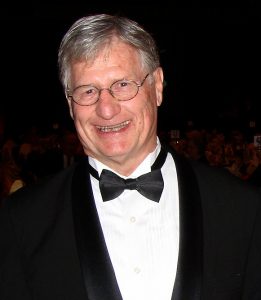
July 4th 1902 at St. Mary’s in Baltimore

May 1, 2017

Babe Ruth, Middle, Back Row
In a much later year at St. Mary’s from his 1902 start.

____________________

July 4, 1902: At. St. Mary’s Industrial School for Boys

Baltimore, Maryland

“At St. Mary’s Industrial School for Boys, music and outdoor sports enlivened the day. The celebration began at 9 A.M. with a medley of national airs by the school band. The St. Mary’s Stars defeated the Severns at baseball by a score of 14 to 18, and in the afternoon the Stars defeated the Connells by a score of 17 to 16. Refreshments were served in the afternoon and there was a display of fireworks at night.”

~ The Baltimore Sun, July 5, 1902.

____________________

George Herman Ruth was only 7-years old when his father delivered him to St. Mary’s  on June 13, 1902, but his big-for-his-age physical size didn’t keep him from crying over the fact that he now was about to be separated from his saloon-keeper father, essentially, forever. Whether he arrived early enough at St. Mary’s to have played in either of the two 4th of July 1902 games referenced so generally in the aforementioned Baltimore Sun short piece isn’t easily checked further tonight, but, as we all know by now – when he did – that it would start to move him toward the biggest change that his life – and the game of baseball would ever see.

If July 4, 1902 really and truly were Babe Ruth’s first breakout doubleheader game day in childhood, wouldn’t you have loved to have worm-holed your way back in time to watch that one? And I would have been most happy to have joined you too.

____________________


Bill McCurdy

Publisher, Editor, Writer

The Pecan Park Eagle

Houston, Texas

Old Friend Inducted into STHS Sports HOF

April 30, 2017

Richard Patrick “Dick” Kirtley
St. Thomas HS Sports Hall of Fame
Inducted April 29, 2017


Last night, Saturday, April 29, 2017, one of my best friends through high school and college at UH was inducted into the St. Thomas High School Sports Hall of Fame at a dinner held at the 4500 Memorial Drive @ Shepherd Drive campus on Houston’s near west side.

Dick Kirtley was my closest friend on so many levels because we both shared a fiery interest in both sports and writing, although his accomplishments in football far exceeded anything I ever did in baseball. Dick was a three-season letterman at St. Thomas, playing both ways on the line from 1954-56 – and then topping that off by earning All State honors in his senior year. He also played basketball and ran track in high school, while also connecting with me as a sports writer for the St. Thomas Eagle. Dick and I ended up playing a lot of tennis together at UH as members of the Phi Kappa Theta fraternity, while also finding time to write comedy sketches together – one based upon silent movie melodramas made it into our big time stream of student performances at the Cullen Auditorium, but all the others played as skits we composed for various fraternity functions throughout the school year.

And this extracurricular writing stuff was taking place on top of the fact that he was also a full-time science major student attending UH on scholarship as a two-way lineman (1959-61) after starting his collegiate career playing freshman ball and one varsity season (1957-58) on scholarship playing football at Texas A&M under legendary football coach Bear Bryant. When Bryant left A&M for Alabama, Kirtley elected to transfer to UH. And that turned out to be great for the Cougars and those of us from the St. Thomas Eagle tree who welcomed our reunion with his company at UH. Kirtley then played three seasons at UH (1969-61) under Coach Hal Lahar – and just missing the start of the 25-year Bill Yeoman dynasty that started in 1962.

The hard thing about last night was missing the physical presence of our old friend, even though the spirit of Dick Kirtley filled the room as I accepted this honor in his behalf at the request of my also great friend, Laura Kirtley, Dick’s widow.

You see, three weeks prior to the induction ceremony, on April 8th, Dick Kirtley came home near noon after his usual Saturday morning workout. He had lunch with his wife of nearly 50 years, Laura. Then went into their den for a nap.

He never woke up. He died in his sleep from still undetermined causes. Heart attack was ruled out and the most likely cause was an undetectable aneurysm that had not shown up on any of his recent extensive testing.

About last night. – It was a night for both sadness and joy.

Not to be neglectful of the other worthy inductees, here is the entire list of inductees into the St. Thomas High School Sports Hall of Fame, in the order of their presentation. Dick Kirtley was the only deceased inductee. That’s not how it was planned, but sadly, that’s how it worked out:

Dick Kirtley ’57
John Braniff ’59
John Pizzitola ’62
Tom Brown’65
Rick Azios ’69
Dan Newman ’75
Rick Apolskis ’85

Fly High, Old Eagles! Fly High!

Laura Kirtley and her adult children, Ryan and Kristen, wanted me to have this framed photo that had been hanging in my friend Dick Kirtley’s study for decades. I remembered it immediately and could not restrain the tears. It commemorates an elaborate skit that Dick Kirtley and I wrote for a big end-0f-summer Hawaiian Party that our Phi Kappa Theta fraternity staged way back on August 28, 1960. It featured, of course, our favorite comedy team to parody, Laurel and Hardy.

__________

The inscription on the Laurel & Hardy photo reads as follows:

Scene from “LAUREL & HARDY MEET FRANKENSTEIN IN THE HAWAIIAN ISLANDS” as performed here by BILL McCURDY & DICK KIRTLEY (hands on chest) at the Phi Kappa Theta animal house August 28, 1960. The show ran for one night only, but 21 years later, Kirtley is still asking his friend, “Why don’t you do something to help me?”

__________

Laurel and Hardy already had crept into our minds earlier, while Kirtley and I teamed to play doubles tennis in tourney play. When I’d make a mistake that cost us a point or advantage, Dick’s question for me invariably came back to “why don’t you so something to help me?” On the other hand, when Mr. Kirtley flubbed-the-dub on a play that put us in a hole, it left the door wide open for me to come back with Mr. Hardy’s most famous exclamation of frustration:

“Well, here’s another fine mess you’ve gotten us into!”

Damn I miss my old friend this morning. Letting go of the people we love is without question the hardest loss that any of us shall ever suffer.

Have a great Sunday with your own special people today, friends. And never take their presence for granted.

Love is the best appetizer for joy when it’s served actively.

____________________


Bill McCurdy

Publisher, Editor, Writer

The Pecan Park Eagle
Houston, Texas

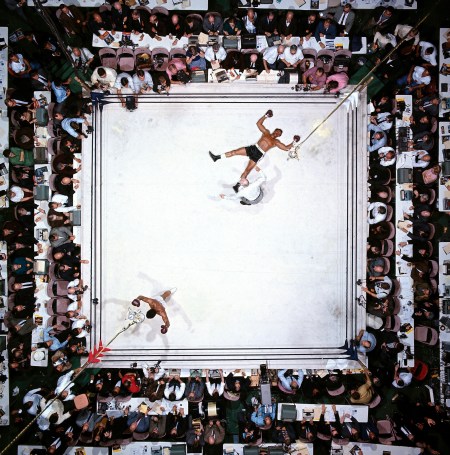
The 1966 Ali-WIlliams Fight at the Dome

April 29, 2017

Muhammad Ali (lower left)
Cleveland Williams (Upper Right)
Whose actually up – and actually down – depends on your perspective – or whether or not you saw the fight. If you saw the fight, you will need no further help to know the answer.


The Galveston News, P 2-B

Tuesday, November 15, 1966

Clay’s Fist Are Loud Too

By A.C. Becker Jr., Staff Writer


Muhammad Ali or Cassius Marcellus Clay II, take your pick, can afford to have a big mouth. He’s got the tools, a pair of granite fists, to back up his mouthings.

Ali needed just seven minutes and eight seconds – less than three full rounds – to prove his point Monday night in clobbering Cleveland (Big Cat) Williams in Houston’s Astrodome.

A crowd of 35,406 bought pasteboards ranging from $50 down to $5 to see Clay successfully defend his world heavyweight championship for the seventh time since taking it from Sonny Liston on Feb. 25, 1965.

It was Ali’s fifth title defense this year and it stretched his pro ring career to 27 straight victories.

CLAY BLASTED Williams out of the heavyweight picture in 1:08 of the third round. It was then that a merciful referee saw fit to put an end to the blood letting and  declare Ali the winner on a TKO.

About all that can be said for Williams is (1) he showed up, (2) he got in the first punch, a light one, and (3) he left the ring under his own power.

And the only reason he left the ring under his own power was due to the mercy of the referee. Had the ref not stopped the fight, Williams probably would have been carried out on his back. That’s how badly he was beaten.

THE ONLY round in which Williams wasn’t jolted half senseless was the first. In that heat, Clay saw fit to dance rapidly around the ring, often dropping his guard completely as to invite Williams to close quarters.

It was toward the end of that round that Clay got in some punches that clearly indicated the night would be short.

The tempo turned in the second round. Clay continued his round-the-ring dancing and Williams made his big mistake. He attempted to close in, but in doing so Clay slammed him with a sledgehammer right that started a nose bleed.

THE CAT straightened up, dropping his cover. Clay charged in with a barrage of rights and lefts to the head and Williams hit the canvas.

The Cat quickly bounded back to his feet, but he had to take the mandatory nine count. Now a little reluctant to pursue Clay so closely, Williams started a back-peddling game. Against Clay’s superior speed and footwork, the move was useless.

Clay closed in and again hammered Williams with  rights and lefts to the head. And the Big Cat hit the deck again for another nine-count.

THIS TIME Williams was even slower. He tried to stay out of Clay’s reach but couldn’t. Again (came) those bam-bam rights and lefts, and Williams hit the canvas again.

This time he was saved by the bell.

When he returned to his corner, blood was streaming freely from his nose, mouth, and several cuts on his face. It was obvious The Cat wasn’t going to be around much longer.

Clay waded right into Williams starting the third round. He quickly dropped Williams to the canvas for another nine count.

The dazed Williams struggled to his feet, as the referee pushed Clay away, signaling to stop the fight.

ALTHOUGH THE Cat plans to continue boxing, he is no longer a heavyweight contender. Mohammad Ali Cassius Clay proved that in the Astrodome Monday night.

At best the fight can be described as a bad mis-match. Clay had too much speed, ring savvy and block buster punches in either fist. Williams just showed up.

Williams got in the fist punch of the fight. It did no damage. He landed a few other blows as the bout continued, but it was obvious that none hurt the champion.

The crowd was far short of the anticipated 50,000. It was, however, strong pro-Williams. The Cat got a thunderous ovation when he entered the ring.

The chorus of boos was just as loud when Clay stepped into the ring.

At the end, of course, wild screaming from Clay supporters drowned out everyone.

____________________

Footnote: On March 6, 1964, Nation of Islam leader Elijah Muhammad announced that the new heavyweight champion of the world would no longer be known as Cassius Clay. “This Clay name has no meaning,” he said in a radio address. “Muhammad Ali is what I will give him as long as he believes in Allah and follows me.” In spite of Ali’s immediate acceptance of the religious terms placed upon his change of names. and his immediate desire to be recognized as Muhammad Ali, he never took steps to legally change his name. It took several years for many writers to start calling Ali by the name he adopted.

____________________


Bill McCurdy

Publisher, Editor, Writer

The Pecan Park Eagle
Houston, Texas


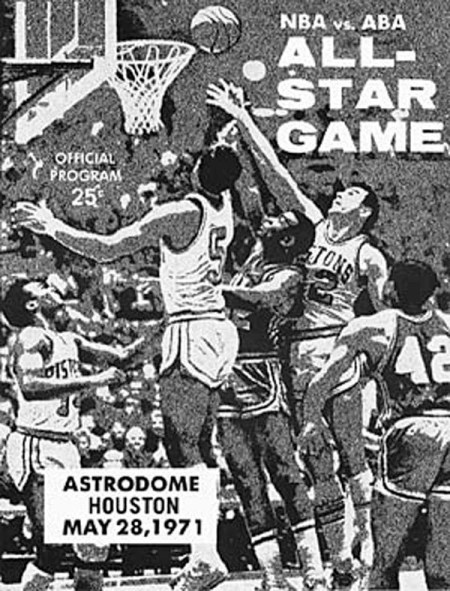
1971: NBA-ABA Players Plan All Star Game

April 27, 2017

Back in 1971, the rival established NBA and the upstart ABA would not discuss interactive play, so, the players took matters into their own hands, even planning an All Star Game between players from the two basketball leagues at the Astrodome for Friday, May 28, 1971.

In a column by writer Bobby Risinger of the Baytown Sun 0n Tuesday, May 25, 1971, Astrodome Publicity Director Wayne Chandler offered his own thoughts on the unofficial, outlaw-feeling game that some players from the two leagues had put together for three days later in American Sport’s still new and most glamorous venue for big deals. Remember. The Astrodome had been the site of college basketball’s so-called Game of the Century back on January 20, 1968, when UH’s 71-89 victory over UCLA sort of inadvertently-on-purpose captured the eyes of the TV-chained audience that quickly jumped upon more opportunities soon after for watching other big collegiate level round ball games in prime time.

Could lightning strike again – especially between two loosely assembled clubs of teams with no known local support for the NBA brand among ticket-buying fans in the Houston market?

____________________

Risinger wrote ….

There are many reasons why the all-star game scheduled for Friday could be a first class flop. There are just as many reasons it could be a success.

In the first place, the club owners disapprove of the players forming a committee and agreeing to play such a game. But the czars of the game are making no effort to defuse the operation, nor are they helping to make the spectacle successful.

“From what I have heard unofficially,” said Wayne Chandler, Astrodome publicity director, “the owners will not raise a hand to help. But on the other hand, they are not trying to prevent the game from being played.”

Further notable quotes from Chandler ….

“This is the first the players have ever tried to put on a major spectacle. This is a case of the players promoting the players and they want more than anything for it to work.”

“Usually it’s the owners promoting the players, but this time it’s the players doing it all.”

“I’m sure the ABA wants to show it can play with the other league. And I’m sure the NBA doesn’t want to lose this game.”

The Apparent NBA Team Owners Psychology at Play ….

The NBA team owners apparently couldn’t block the game, so they took the only sane position available to them. They would sit back and hope to salvage some to all of the credit for it working out to their own desires while using their absence of approval as the Teflon route away from any failure that might well ensue as blame that lands in a wide splatter band upon anyone suspected of helping or approving the original game idea. (What a novel idea. Wonder why some of our politicians in Washington never thought of such a “constructive” weasel strategy for dealing with all the serious issues now facing our country on every foreign and domestic level?)

The Game Outcome ….

NBA 125 – ABA 120. Behind 26 points by Walt Frazier, the NBA took the 5/28/1971 basketball All Star Game from the ABA and their high scorer, Rick Barry, whose 20 points were the only other 20+ individual total for both teams. The Astrodome crowd was a tepid total of 16,364 fans, nothing like the 50,000 plus collegiate game fans that showed up for the UH-UCLA game in 1968. One intended connection between the two games did not occur. Lew Alcindor (whom we best remember today as Kareem Abdul Jabbar) did not play for the NBA Stars in the game because of injury. Alcindor of UCLA and Elvin Hayes of UH had been the two driving stars of the 1968 Astrodome “Game of the Century.” Elvin Hayes, the other big star from 1968 did play for the NBA, tying two others with 17 points as the second highest scorer for the NBA in the 1971 game.

A good close game and fair national coverage seemed to have earned a plus score for the poorly formed game, in spite of its low ticket sale to live customers. Remember also that 1971 was prior to the time of the Rockets moving their home from San Diego to Houston. The same bad gate in an NBA franchise city would have registered much higher on the blame and failure scale.

Peace and Unity ….

It didn’t happen over night. The ABA would continue for another half decade, until August 5, 1976. That’s the day the National Basketball Association (NBA) merged with its rival, the American Basketball Association (ABA), and took on the ABA’s four most successful franchises: the Denver Nuggets, the Indiana Pacers, the New York (later New Jersey) Nets and the San Antonio Spurs. The Virginia Squires, one of the three dissolving ABA clubs, went bankrupt prior to the merger and received a small financial franchise buy-out sum. as total compensation The Kentucky Colonels settled for a much larger total buyout sum of $3.2 million dollars.

The third and last dissolving ABA franchise, the St. Louis Spirits negotiated a spiritually inspired arrangement. The Spirits negotiated a buyout lump sum of only $2.2 million dollars, but were also able to add on a 1/7 interest payment from all the four merging ABA clubs annually on their future incomes from television in perpetuity. To date, the former Spirits club owners have received more than $168 million dollars from the NBA. The NBA’s periodic attempts to buy them out of the merger deal are invariably, but nicely refused, presumably with a Cheshire Cat smile about five miles wide .

St. Louis Spirits Residual TV Money Income To Date ….

By the way, in case you are wondering, here’ s the math ….

$ 168,000,000 times a 1/7th  share (0.14285714286 %)

= $ 25,428,571.43 ….

an aggregate sum that is an ongoing, building thing, from here to eternity.

I guess it simply shows how little the professional sports industry still understood in the mind-1970s about how valuable their TV revenues were going to be to the total future revenue picture.

____________________


Bill McCurdy

Publisher, Editor, Writer

The Pecan Park Eagle

Houston, Texas

Astrodome Physics Questions

April 27, 2017

When the Astrodome played as a full house, nobody had any trouble hearing the auditory blast of the big scoreboard show.


Houston Chronicle
April 27, 1967


When the Astrodome scoreboard goes off before a crowd of only 12,225 fans, does it really make a sound, or not? And does the body of that small fan group genuinely roar as reported in audible support of what they allegedly hear, or are they simply miming the physical motions of great sound exertion in silent protest and mockery of their dear Astros’ poor play on this first-of-its-kind field of dreams?


____________________

Thanks to Darrell Pittman for sending me the Houston Chronicle “Scoreboard Is Too Rusty” item. It inspired the birth of this modest little “if a tree falls in the forest” parody.

Sometimes I have to write parodies to clear the mind barnacles of other wasted time in thought that gets in the way of writing freely. Thanks again for your patience, everybody.


Bill McCurdy

Publisher, Editor, Writer

The Pecan Park Eagle

Houston, Texas

Mickey Mantle’s Heartbroken Valedictory

April 26, 2017

Retiring Mickey Mantle (L) and Yankees Manager Ralph Houk
Associated Press Coverage of Mantle’s Retirement Conference
As It Appeared in The Joplin (MO) Globe
Sunday, March 2, 1969


MICKEY CALLS IT A CAREER WITH YANKEES

Slugger Retires After 18 Seasons

Fort Lauderdale, Fla. (AP) – Mickey Mantle, at a loss for words, announced his retirement from baseball Saturday before a packed news conference at the New York Yankees’ spring training hotel.

Mike Burke, president of the Yankees, introduced Mantle to reporters, saying that the veteran star “had reached a firm conclusion, and I think its best he tell it to you himself.”

Then Mantle, dressed in a dark blue turtleneck, light blue slacks and checked sports jacket, stepped to the rostrum. But instead of saying anything, Mickey said, “I’m open for questions.”

The first one, of course, was what had he decided.

“I’m not going to play baseball anymore; that’s all I know,” he said slowly. “I can’t play anymore. I don’t hit the ball anymore when I need to. I can’t steal when I need to, I can’t score from second when I need to.”

Mantle said he had talked his situation over with Ralph Houk, manager of the Yankees, Friday night and Burke Saturday morning. “We decided this would be best for me and for the club,” said Mantle, who most of his 18-year career, was one of the most feared sluggers in baseball.

Mantle said he reached the decision after talking with both Houk and Burke.

“Ralph said if he was me, and at this point he wasn’t wasn’t sure what to do, he’d probably call it off right now and that’s what I’m doing,” the outfielder turned first baseman said.

Mantle said his outside business interests, which include a chain of country kitchens and clothing stores, also helped him reach a decision.

“I have to appear at all the kitchen openings and there are about 45 sold right now,” he explained.

Mantle said he had no current plans to remain with the Yankee organization. “But Mike told me if I ever wanted a job, it was available.”

Mantle said he was disappointed he was not a lifetime .300 hitter. He finished at .298.”But I’m very proud of my 18 World Series homers,” he added.

Mantle said his wife was very happy with his decision.

“She’s been asking me to quit for three years,” Mickey related. “I’m planning to get out to the ball park now and then, but I won’t put on a uniform.”

In a prepared text, Mantle said:

“I never wanted to embarrass myself on the field or hurt the club in any way or give the fans anything less than they are entitled to expect from me. I’m not sure I can play well enough to satisfy myself.

“Last fall I still thought I might play another year if I felt well enough in spring training. As the months passed I felt more sure in my own mind that now was the time to end my career as a ballplayer.”

Houk said: “We all know Mantle would have played on any ball team I managed as long as he wanted to and I think we all know that the game is losing a super star.”

Burke said Mantle’s future with the Yankee organization “would depend solely on how much time he has to give. Right now we have left it that he will have a relationship with us and we will have a relationship with him.”

Burke’s prepared statement said:

“This is a sad but inevitable day. We are losing a truly magnificent Yankee and baseball will sorely miss this one of a kind athlete.

“We would have liked him to play another season, of course. Ralph (Houk) and Lee (MacPhail) and I all thought he could make an important contribution on the field and to the spirit of our young club. But we also felt very firmly that this was Mickey’s decision to make and that we must be sympathetic to his situation.”

Asked if the Yankees would retire No. 7, Burke said “Yes.”

Mantle came up to the Yankees in 1951 – the same year another center fielder, Willie Mays, arrived in New York with the Giants. The Oklahoman’s freshman year wasn’t nearly as successful as the ones that followed. He batted just .267 in 96 games and spent half the season in the minors.

But his 13 home runs and 65 runs batted in were the clue to the latent power that Mantle possessed. It was a power that would eventually make him one of the most feared hitters in baseball.

It was in the 1951 World Series against Mays and the Giants that Mantle suffered his first serious knee injury. He tripped over a drainage opening in the Yankee Stadium outfield in the second game had to be carried off the field in a stretcher.

But Mantle came back in 1952, replacing Joe DiMaggio, who had retired, and batting .311 with 23 home runs and 87 RBI. He had nine more .300 seasons, including five straight from 1954 through 1958.

His raw power sent home runs soaring record distances and when he powered one off Washington’s Chuck Stobbs in 1955, an ambitious press agent measured it at 565 feet. That was the start of the tape measure home run.

Mantle won the triple crown in 1956, batting .353 with 52 homers and 130 RBI. He was named the American League’s Most Valuable Player that season and again the next year when he raised his average to .365. He also won the MVP award in 1962.

In 1961, he staged an exciting battle with teammate Roger Maris for the home run crown. Maris finished with 61 that year and Mantle had 54, the highest single season total of his career.

He finished his career with 536 home runs – third on the all time list behind Babe Ruth and Mays. He had 1,509 runs batted in and a .298 career average which was pulled down by .245 and .237 figures in his last two years.

Mantle played in 2,401 games as a Yankee – more than any man in the club’s history. But he never played an entire season. The closest he came was in 1960 and 1961 when he missed just one game each year.

His legs were always tender and, after 16 seasons as an outfielder, Mantle was moved to first base in 1967 in an effort to remove the stress on his legs. He played 144 games in each of the last two seasons – more than any he had managed in any year since 1961.

Mantle played in 12 World Series with the Yankees and holds Series records with 18 home runs, 42 runs scored, 40 runs batted in, 123 total bases, 26 long (extra base) hits, 43 walks, and 54 strikeouts.

He also played in 16 All Star games.

~ AP, The Joplin Globe, Sunday, March 2, 1969, Section C, Page 1.

____________________


Bill McCurdy

Publisher, Editor, Writer

The Pecan Park Eagle
Houston, Texas

Mantle’s Regretful Career Finish

April 25, 2017

When Mickey Mantle retired after the 1968 season, he was very unhappy that his final season batting average of .237 had dropped his career batting average from .302 to .298. And who could blame him for the dent he put on the Hall of Fame body of his full 18 season (1951-1968) career?

Mickey Mantle’s 1968 season was one of four (1965-68) too many. Had he retired after the 1964 season and The Yankees’ heartbreaking loss to the Cardinals in the World Series, he would have left his injury-riddled 14-season career with an overall batting average of .309 and 454 home runs – and still have been a deserving elected member of the Hall of Fame today. (Mantle would have retired with 2,016 hits in 6,533 official times at bat, had he retired after 1964. He also would have lost only 82 HR from his career total of 536 through 1968. He would have surrender only 82 homers from his 1968 actual finish, had he retired after 1964.)

The four seasons of 1965 through 1968 were the epochal start of the great fall from grace years for the New York Yankees and meteoric Mickey was arguably the bleakest burned out light in their embarrassing descent.  That being said, I’ve only got one thing left to say before I continue. None of us are, or ever were, Mickey Mantle. And for sure, I’m not. We don’t know as fans what it was like to hobble around in the down years that followed the brilliant times he did enjoy earlier – and The Mick was never free from quirky injury or pain, even then. – And, even if we’ve had our own bad experience with alcohol and poor life style choices, we still don’t know what it was like to have mixed those jokers into a deck that also included being saddled with the expectations of being a baseball star at the same time we were enduring the combinations of physical, emotional, and chemical pains that come with being there for anyone, no matter how good they are, who dares to follow in the paths of Babe Ruth, Lou Gehrig, and Joe DiMaggio – even if the guys around you are not quite as great as the supporting casts of the original and earlier versions of “Murderers’ Row”.

Mickey, we hardly knew your pain. The most you ever said to us about the statistical decline from 1965 through 1968 was paraphrasically something along these lines: “If I hadn’t played that last 1968 season, I could’ve, at least, kept my lifetime, plus .300 batting average.

That’s so true, Mick, as this simple little chart shows. Had you not played in 1968, you could have retired with a lifetime .302 batting average and 518 career home runs over 17 (1951-1967) seasons.

Thru At Bats Hits BA HR
  1967 7667 2312 .302 518
  1968 8102 2415 .298 536
– 1968 – 435 – 103 -.004 – 18

Mantle’s 1968 season also had little long-term effect upon his final standing among the career home run leaders either. By playing to his true end in 1968, his 18 homers that season allowed Mantle (536 HR) to pass Ted Williams (521 HR) and Jimmie Fox (524 HR) for 3rd place on the all time list behind Babe Ruth (714) and Willie Mays (660). Today, in 2017, it hardly matters. Mickey Mantle, to this point in the booming days of Earl Weaver-minded baseball, has now slipped to place # 22 on the all-time career home run list.

That’s OK with me. If Jeff Bagwell is good enough for the Hall of Fame with 449 HR on top of his painful injuries – and he for damn sure is – Mickey Mantle is the poster boy super star for that kind of against-all-odds naturally great athlete. His .298 final batting average means nothing to me. It simply did despairing things to the guy who saw .300 as one of the bottom line baseball measurements on greatness.

Alas! Woulda, Coulda, Shoulda doesn’t work for the great ones either.

If only Mickey Mantle had not stepped on that watering grate in the 1951 World Series, he woulda have set base running and phenomenal catch records that coulda turned our amazing baseball memories upside down.

If only Mickey Mantle had gotten some early help with his drinking and bad decision-making, like he shoulda, he might have been the greatest ballplayer of all time by the numbers record of his accomplishments.

Forget about it. Woulda, Coulda, Shoulda ideas are where Mickey Mantle comes closer to being like the rest of us than we shall ever be by the power of the baseball gods to turn back the clock and make any of us like him.

Neither is going to happen. Things are the way they are.

And here’s where we hoi pa loi come together with the great public people of this world. The more we learn to live with what is, in the here and now, changing what he can change, and leaving the rest of the ego stuff that requires either politics or the finessing and control of others to some aspiring end , the easier it is to live with whatever the .298 batting average disappointments in our own lives happen to be. And this philosophy even takes in people like baseball field managers.

As a baseball field manager, all you can really do is be yourself out there in trying to build a working relationship with your players. All you can do in the end, however, is make out the lineups and do the personnel changes that seem to be needed during the game. The rest is up to the players. And you will be the better manager, we think, if you stay focused on what you can do – and not what the players must do to help you keep your job. There’s no doubt about one thing, however. Casey Stengel said it best when he acknowledged that he only became a “genius” as a manager once he took over the stable of talent that lined the roster of the New York Yankees. As the later older manager of the New York Mets, Stengel was returned to beyond worse results than even those he had known during his 1930s career managerial jobs with the Boston Braves or Brooklyn Dodgers. Of the hapless 1962 New York Mets, Casey was finally reduced to asking of his losing record team, a question that’s no doubt come up unspoken by many other managers of bad clubs: “Can anybody here play this game?”

The 1951 New York Yankees were a force.

Mickey Mantle, as the 13-year old kid who remembers you from that 1951 spring training game in which you and DiMaggio and the rest of the Yankees came to town and beat up on my Houston Buffs at Buff Stadium that hot early April Sunday afternoon, I shall remain your fan for as long as I have a forever to recall such things. I still think that you, Willie Mays, Stan Musial, and Roberto Clemente were the four greatest players I ever saw play. You are my “Four Horsemen of the Baseball Affirmation” and I wouldn’t put an order on any of you as the greatest. You were each wonderfully great in your own very specific ways.

Forget .298. It is only the thorn of unresolved regret in the mind of one great player who played, at least, one season too long.

____________________


Bill McCurdy

Publisher, Editor, Writer

The Pecan Park Eagle

Houston, Texas