Old Stadiums and Egos: Both Are Tough Nuts

December 4, 2017

The Pontiac Silverdome
The roof already was down, but the walls would not fall.


Not a Mere Gold Line Stand. In Pontiac, Michigan over the weekend, they made an attempt  to implode the old home of the NFL Detroit Lions, The Pontiac Silverdome, but little happened. A series of powerful explosions went off as planned, but, when they had finished, the old stadium just stood there, not even teetering. Maybe they mistakenly used explosives when they intended to use “implosives”, but, whatever, we have a hunch that a Lions fan named “Tom Corey” posted the best possible explanation from his experience as a Lions fan in recent years in social media. “Even the stadium is afraid to cross the goal line.”

And maybe Corey’s words can hang in the air in Houston as a comfort to Texans fans in the event that some vandal terrorist decides to try and blow up a perfectly beautiful NRG Stadium. The attempt would most likely be either fumbled away or intercepted before it even got close to the end zone.


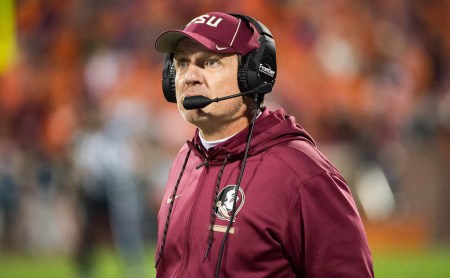
New Texas A&M Football Coach Jimbo Fisher
Changes for 2018:
Jersey Color: About the Same
Jersey Lettering: Now says A&M
Money Color: Much Greener


Can $75 million dollars buy the major championship in your sport of interest? It can if you are club owner Jim Crane and the thousands of fans who can still afford to see live games at Minute Maid Park in Houston to watch the MLB Astros because Jose Altuve and friends already have delivered on that championship in 2017 with good chances of repeating, at least once, either this year or sometime soon. It doesn’t look quite so “easy” for Jimbo Fisher, who just signed a 10-year guaranteed $76 million dollar salary to win at least one national championship at the highest rung of college football as Head Coach of Texas A&M.

The Fisher hiring doesn’t look so good. It was fueled by the compulsive decision to get rid of the former coach, Kevin Sumlin, and to replace him with a coach that matched the value and decor of their still new A&M gazillion dollar renovation of Kyle Field. As the disappointing 2017 wore down, the panic level increased and the availability of candidates that could offer a national championship from their resumes for credibility sake had boiled down to one man, Jimbo Fisher of the Florida State Seminoles.

Compulsion kicked in full blast. And remember, compulsion occurs in all of us when we begin to behave as though we really have no other choice. When that compulsion falls over the minds of a relatively few rich and powerful men who are used to buying their way to just about everything else they want in life, the door swings wide open for a vast expenditure of money being paid out that emotionally may even feel as though the national championship is in tow and only now awaiting a certain due date.

All we have to do is sign Jimbo Fisher.

And that’s the bunk.

Jimbo Fisher is no guarantee of a national college football title. He’s Jimbo Fisher, a guy who won the national title once at FSU in 2013, but under very different circumstances of recruiting and support. FSU was a pressure job too, but Fisher wasn’t getting this kind of money as the advance payment on winning a national title “or else”.

Right now you couldn’t even get good probability odds on A&M’s chances of winning anytime soon. Their new coach needs time for building relations with the kinds of Texas high school coaches he will need to access the very best uncommitted athletes across the state, staff building, current player and recruiting needs assessment, making the Aggie good old boys looking over his shoulders happy, while trying to build some kind of connection to the more everyday Aggie fans and students.

Ease up, Aggies. Give Jimbo Fisher a chance to get his feet firmly down on this good old Texas earth before you start pre-ordering his College Station statue.

Meanwhile, departing Coach Kevin Sumlin gets to walk away with the $10.5 million dollars that Texas A&M has paid him “not” to coach the last two 2018-19 seasons of his contract. He just walks away. To only do what he pleases. No news stories to read about alumni that hate your guts. And no press conferences with cub reporters hoping to rile you with questions like, “Coach Sumlin, would you care to comment on why the Aggies do so well against Louisiana-Monroe, but can’t seem to ever beat LSU?”

Which deal would you rather have? The one that goes with Jimbo Fisher’s $75 mil? Or the untethering deal that went to Kevin Sumlin for $10.5 mil?


********************

Bill McCurdy

Principal Writer, Editor, Publisher

The Pecan Park Eagle

Yearbook Glimpse Into Astros 1982 Season

December 4, 2017

Yearbook Offers Glimpse Into Astros 1982 Season

By Maxwell Kates


“GETCHA YEEEEEAHBOOKS!”
– Maxwell Kates


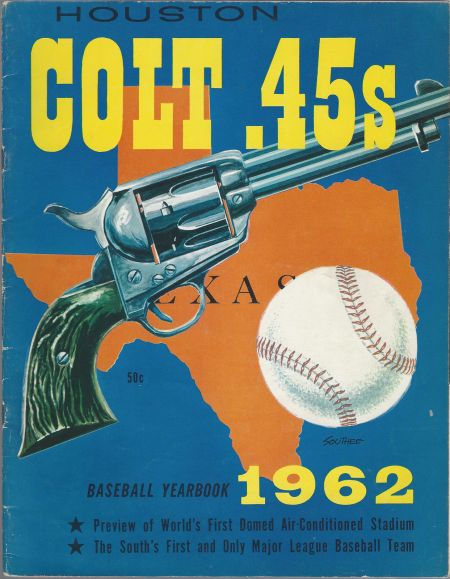
Houston Colt .45s 1962 Yearbook


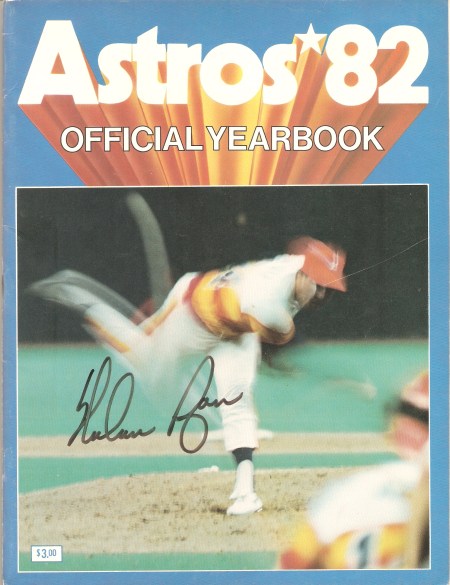
The vendor’s cry is a familiar one at venues throughout the major leagues like Fenway Park in Boston but for most of the Astros’ history, not in Houston. Although the Colt .45s engaged Jay Publishing Inc. to publish a yearbook in its expansion season of 1962, the publication was not repeated in 1963. When the yearbook returned in 1964, it was combined with the media guide in a pocket-sized booklet. The Houston Sports Association in 1965 published “Inside the Astrodome” which served as a yearbook for both the Astros and the Houston Oilers of the American Football League. Astrodome yearbooks were issued again in 1966, 1968, and 1972, but with sparse content about the Astros themselves. Although the photo albums issued by the Astros in the late 1970s are considered equivalent to yearbooks by many collectors, the next dedicated yearbook released by the Astros would have to wait until 1982.


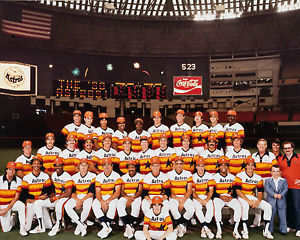
Houston Astros 1980 Team Photo


Baseball in Houston was riding high in the early 1980s. After finishing in second place in the National League West with a record of 89-73 in 1979, the Astros went 93-70 to win their division title in 1980. For an encore, they won the ‘second half’ in the strike-shortened 1981 campaign. Fans attending Astros games became accustomed to large crowds to watch their team clad in an updated look to their rainbow uniforms. Half the crowd chanted “Houston!” during a rally while the other half responded with “Astros!” “Luv ya, orange!” soon replaced the Oilers’ “Luv ya, blue!” as a scoreboard slogan. The Houston Sports Association even commissioned local songwriter Mack Hayes to pen “Go Go Astros,” a team song in the ‘urban cowboy’ style that was popular at that time.


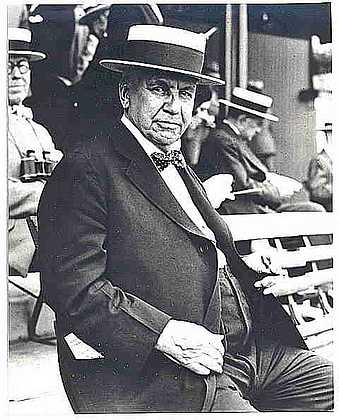
Harry M. Stevens
Ballpark Concessions Magnate


Following three successful seasons on the field, the Astros decided to reintroduce their yearbook in coordination with the 20th anniversary of the franchise. The club engaged Harry M. Stevens Inc. of New York to publish the 64 page magazine-size publication in full colour. Stevens’ contributions to baseball are worth noting. A British immigrant born in Derbyshire in 1856, Stevens founded the concession enterprise that bore his name in 1887. He designed the first modern baseball program, marketing it with a popular phrase he coined, “you can’t tell the players without a scorecard!” On a cold day at the Polo Grounds in 1901, Stevens decided to replace the sale of ice cream with dachshund sausages. When staff ran out of wax paper, he ordered the purchase of buns from a local bakery, and a culinary staple at baseball games was born. A cartoonist recording the event, unfamiliar with the spelling of ‘dachshund,’ decided instead to label it a ‘hot dog.’ Although Stevens died in 1934, the company that bore his name survived him by more than sixty years.


Houston Astros 1982 Yearbook


The title was “Astros ’82 Official Yearbook” and Nolan Ryan graced the cover. And why not? The Ryan Express had just completed a banner year in 1981, posting a record of 11-5 with 140 strikeouts while leading the junior circuit with a 1.69 ERA. On September 26 before a nationally televised audience on NBC, Ryan no-hit the Los Angeles Dodgers at the Astrodome, the fifth of his career. Besides which, Ryan was from nearby Alvin. Why not try to market the new yearbook by selling a Texas hero to a Houston crowd?


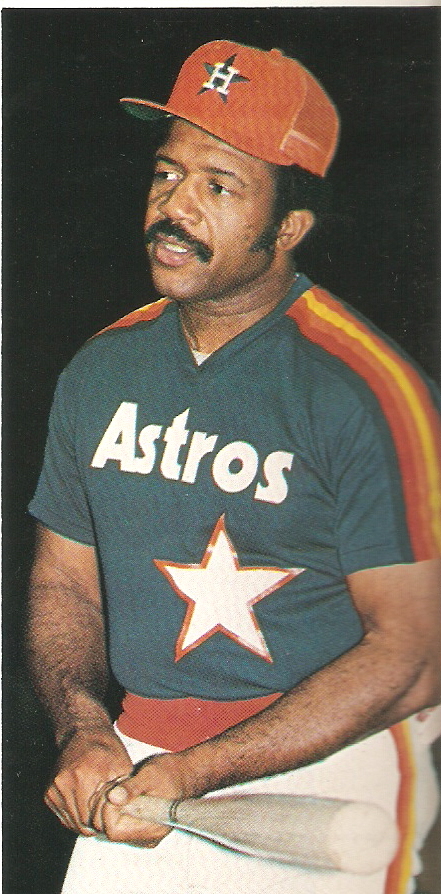
Deacon Jones
Houston Astros Coaching Staff, 1976-82


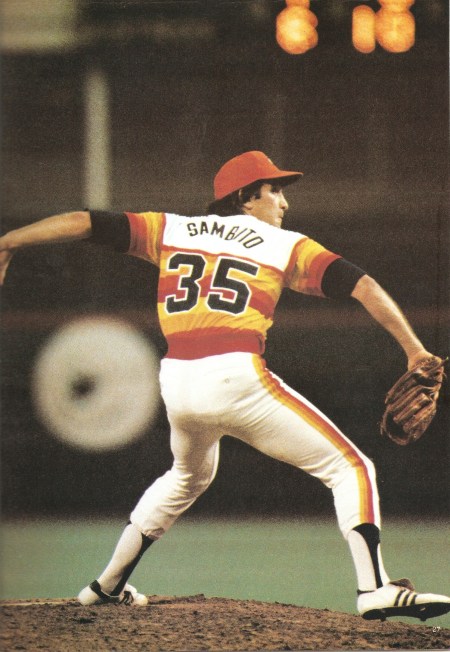
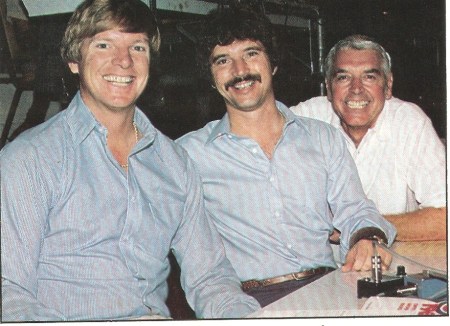
Manager Bill Virdon and all his coaches are profiled in the yearbook, as are owner John McMullen, general manager Al Rosen, and Bob Kennedy and Donald Davidson from the front office. The entire Opening Day 1982 roster is treated to photographs, biographies, and statistics supported by graphic designs evocative of the times. Besides Ryan, the pitching staff included Bob Knepper, Joe Niekro, Vern Ruhle, Joe Sambito, and future Hall of Famer Don Sutton.


Joe Niekro
-They didn’t call him Knuksie for no reason.


The yearbook featured a special double spread about the Astrodome, along with an article celebrating the first two decades of the franchise. You could order tickets by teletype – no website – the most expensive seats cost only $10.00, and there were even two twi-night doubleheaders built into the schedule. Among the events chronicled in the club’s history are Ken Johnson’s losing no-hitter in 1964, the first game at the Astrodome, the 24 inning marathon in 1968, and the emergence of star players such as Joe Morgan.


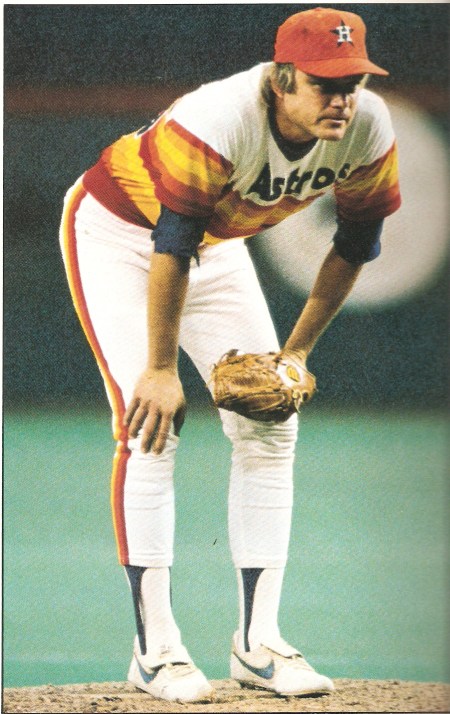
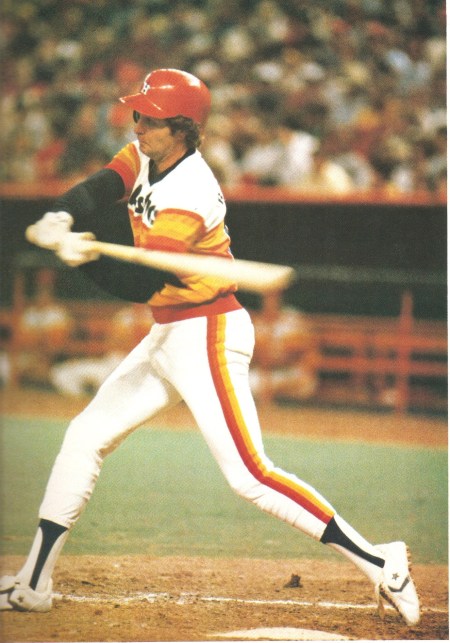
Phil Garner
Garner managed the Astros to their first World Series in 2005.


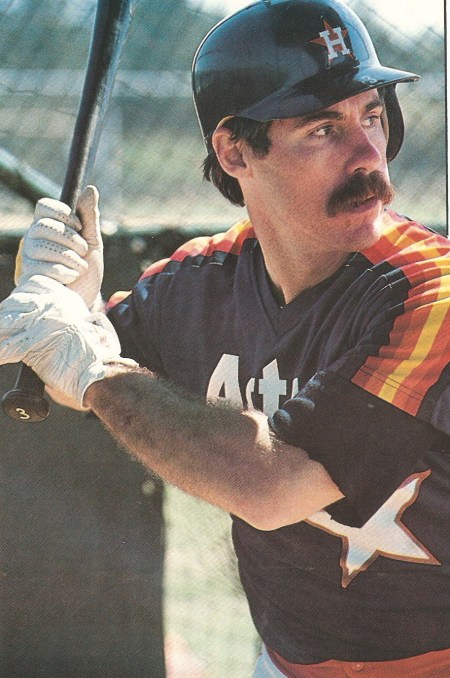
Position players are profiled in the second half of the yearbook. Among the stars featured in the Astros’ everyday lineup included Jose Cruz, Terry Puhl, new acquisition Ray Knight (an All-Star in ’82), local product Craig Reynolds, and future Astros managers Art Howe and Phil Garner. Prospects are profiled towards the end of the yearbook; players “to keep a watch on” included Billy Smith, Gordie Pladson, Bert Roberge, and Scott Loucks. A page is dedicated towards broadcasters Larry Dierker, DeWayne Staats, and Gene Elston, while the yearbook concludes with synopses of the playoff series in 1980 and 1981.


Ray Knight
During his brief Astro time, Knight was an All Star in 1982.


Alas, while Houston fans might have been “breathing orange fire” in 1982, the fervour in the stands did not translate to success on the field. The Astros flopped to a fifth place, 77-85 finish, twelve games behind the Atlanta Braves. Slow getting out of the gate, the Astros never recovered from an 8-12 April. Excluding Ray Knight (.294), none of the starting eight batted as high as .280. Most of the rotation pitched well although Bob Knepper posted disappointing numbers (5-15, 4.45 ERA) after earning an All-Star berth the year before. Joe Sambito was lost for most of the season due to Tommy John surgery, while J. R. Richard, recovering from a stroke suffered two years before, remained on the disabled list for the entire 1982 season – and had two more years on his contract yet. By the end of the season, Don Sutton was pitching in the World Series for Milwaukee, Bill Virdon was managing in Montreal, and the Astros had adopted an austere stance towards player development, dooming the franchise to mediocrity until winning its next division title in 1986.


Joe Sambito
Relief Italian Style!!


Not surprisingly, the Astros’ 1982 yearbook was not a commercial success. According to Houston-area hobbyist Chuck Swanlund, this was attributed to several factors. One was the level of play on the field. Per-game attendance had dropped by more than 5,000 as the Astros averaged 19,241 clicks of the turnstile for each home game. Fans were less likely to spend their discretionary income at Astros games as the Houston area felt the adverse affects of an oil shock that crippled the local economy. The yearbook cost $3.00. While the figure was not unreasonable (the Red Sox charged $3.50 for their 1982 yearbook), for fans used to spending $1.00 on a program, the yearbook was deemed an unnecessary expenditure. Finally, although most of the 1982 yearbooks were issued in massive quantities, the Astros printed a far more limited run.


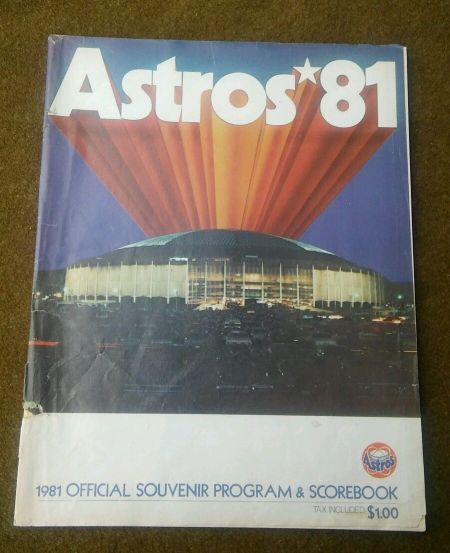
Houston Astros 1981 Program


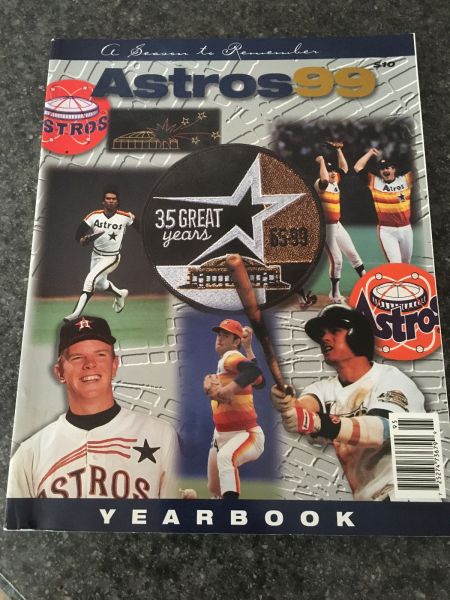
The yearbook was discontinued in 1983 and would not return to the Astros’ concessions for nearly a decade. Even then, the yearbook was issued only sporadically – including the memorable “35 Great Years” edition of 1999 – before becoming a permanent fixture at Minute Maid Park in 2003. Since 2009, the Astros have incorporated their yearbook as a section of the June edition of Gameday Magazine, including the 2017 season.


Houston Astros 1999 Yearbook


If you own a 1982 Astros yearbook, there is a good chance that you have enquired about its value. According to Kurt Backhaus, a vendor at Sports Fest ’98 in Philadelphia, the yearbook was difficult to find at that time, even in Houston. He was selling a copy for $50.00 and was the only vendor to bring one to the show. As was discussed at a memorabilia panel during the 2004 SABR Convention in Cincinnati, the advent of the Internet and eBay suggests that, excluding autographed items, what was once considered rare has become significantly less rare. Baseball card stores and shows of yesteryear have given way to the collector selling the inventory in his attic or basement. Consequently, the market has been flooded with memorabilia no longer understood to be scarce. There are four copies of the 1982 yearbook on eBay at this writing, ranging in price from $12.79 to $31.50. A rule of thumb to evaluate sports memorabilia, the principle of conservatism dictates that the lowest cost at which a product is sold suggests the most accurate value.


Craig Reynolds was a great “local boy makes good” story as an Astro.


One quarter century after the yearbook had been published, I was travelling in the Czech Republic when I received a letter from home, “The mailman wants to understand how you know Nolan Ryan.” The short answer is that I do not know Nolan Ryan. Cliff Clavin was delivering a parcel from the Nolan Ryan Foundation containing a copy of the 1982 Astros yearbook signed by Big Tex himself. All autographed items are accompanied by a hologram and a certificate of authenticity. Nolan Ryan continues to sign autographs several times a year in exchange for a donation to his Foundation, which is based in Round Rock, Texas.


The 1982 Houston Astros Broadcast Team. Larry Dierker, DeWayne Staats, and Gene Elston prepare for a broadcast between the Astros and the Chicago Cubs.


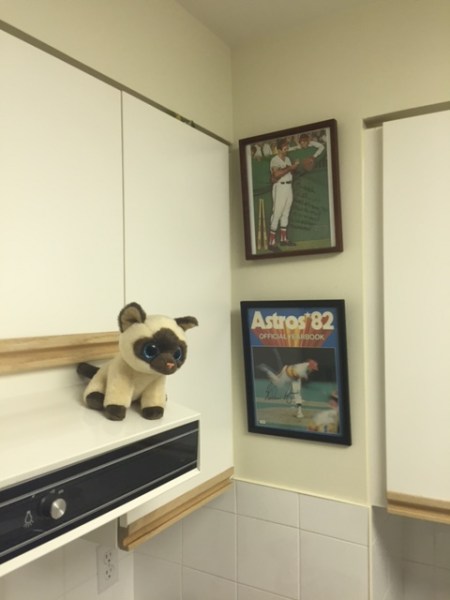
Baseball yearbooks offer a snapshot into the team, the players, and even the advertising of the time. The 1982 Astros yearbook offers a look back at the history of National League baseball in Houston while profiling each member of the contemporary club. The team failed to live up to its preseason expectations, particularly after reaching the postseason in the two previous years. Although the magazine was eschewed by Astrodome spectators at the time, it has become a popular collectible some 35 years later. I know exactly where my copy of the 1982 Astros yearbook is located.


Kates’ Copy of the Astros ’82 Yearbook Material Framed on the Kates Kitchen Wall.


Maxwell Kates


Thank you, Maxwell Kates, for another entertaining article.

– Bill McCurdy, Publisher, The Pecan Park Eagle


********************

Bill McCurdy

Principal Writer, Editor, Publisher

The Pecan Park Eagle

One Last Dance, At Least, For Now

December 3, 2017


Casey (R) and Dad
My mental pictures are better than my digital selfies.

Neurologically, what’s going on now with us Astros fans is a good thing and a 180 degree turn from our disappointing negative season closure moments in 1980, 1986, 1998, 2004, 2005, and even 2015. All these latter times were about the pursuit of joy ending in despair. 2017 is about our trust in hope concluding in a state of ecstasy that seemingly had no end.

Both outcomes are predictable. Disappointment gives birth to despair. Fulfillment brings life to joy. And both were fed by the original expectation. The greater the expectation is, the more the human mind shifts into critical gear. And it is no longer winning alone that matters, but how you win, and by how much, and how often you win. And once winning becomes the expectation based on results, there is no joy left in the act of winning itself.

One has to wonder. When the New York Yankees won their 5th World Series in a row in 1953, how many Yankee fans still felt joy or anything resembling the surprise of joy that has swept up Houston in the past first month of the Astros 2017 season reign as World Series Champions? On the other hand, how about the Brooklyn Dodger fans of that same five-year era? The Dodgers lost three of those five World Series matches with the Yankees in 1949, 1952, and 1953. How could those fans, or their Dodger players, have escaped the negative neuropathic mapping by all previous experience between the two clubs, dating back to their first World Series meeting in 1941?

They didn’t, and yet, the Dodgers would come back in 1955 and win the only World Series they would ever take from the Yankees during their long original franchise mooring in Brooklyn.

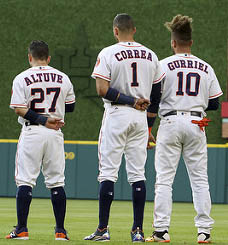
My beloved son, Casey, made it home to Houston from his work on the road out of Springfield, Missouri as an 18-wheeler driver in time to watch games Six and Seven with me at home on TV. Casey, Norma, and I were all on our feet in the bottom of the 9th of Game Seven when Charlie Morton coaxed that little grounder from Corey Seager that Jose Altuve fielded and threw to Yuli Gurriel at 1st to end the game, win the Series, and start the rumbling joy that continues to play strongly through me this very morning. The play itself is now burned into the tracks of my most vivid life moments, even though it is only about five seconds long.

It just keeps playing and playing and playing in a little visual corner of my brain. It doesn’t get in the way. It just makes me happy.

Right next to it rests the other quick sensory clip that went into the neuro-bank that same night. All three of us raising both fists to the sky, shouting loudly, now dancing together in a circle, now hugging and dancing, and now my son Casey is grabbing my shoulders and speaking joyously in my face:

“This is why I came home, Dad! After all these years! After all the Astros have been through! After all we’ve been though, like so many other Astro fans, there was no way in the world I could miss being here with you at this very moment! And we didn’t miss it. The Astros are now the World Series Champions! And we got to see it together!”

And we shall continue to see it together forever, Casey, for as long as the little movie version of that moment continues to play lyrically in our heads. First with Jose and Yuli. Then with you and me and Mom:

Dancing the night away.

********************

Bill McCurdy

Principal Writer, Editor, Publisher

The Pecan Park Eagle

Contemporary Baseball’s Sadder Lexicon

December 3, 2017
Baseball’s Sad Lexicon

:These are the saddest of possible words:

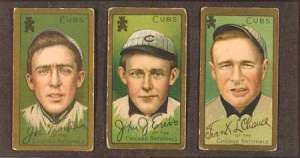
“Tinker to Evers to Chance.”
Trio of bear cubs, and fleeter than birds,
Tinker and Evers and Chance.
Ruthlessly pricking our gonfalon[a] bubble,
Making a Giant hit into a double[b] –
Words that are heavy with nothing but trouble:
“Tinker to Evers to Chance.”


Contemporary Baseball’s Sadder Lexicon

:These are the saddest of possibly sadder words:

“Watch out when you tinker with chance.”
Our trio of Astros, ignored, far unduly,
Carlos and Jose’ – and sweet smiling Yuli.
Will come at you hard with the double play truly,
Making you think – at a glance,
What we hereby twice tell you – so coolly:
“Watch out when you tinker with chance.”

********************

Bill McCurdy

Principal Writer, Editor, Publisher

The Pecan Park Eagle

A Favorite “Under 6′ in Height” Batting Order

December 1, 2017

“Hit ‘Em Where They Ain’t!”
– Wee Willie Keeler

One of the refreshing sidebar notes that fell from the lips of broadcasters more often than once during the 2017 World Series was the fact that a talented player did not have to be a physical behemoth to succeed quite wildly in the game of baseball. It kept coming up because the dynamic, but diminutive  Jose Altuve kept producing reasons on the field for reminding the world of this fact about the game that also plays out more like great theater and literature than any other physical sport in the world.

Want to do a little analysis of Shakespeare? Research and write a dramatic review of Games Two and Five and watch what falls into your awareness. No one else can seriously do this for us. We have to do it for ourselves to reap the harvest, but you already know the pitch and flow of really great baseball when so much is on the line. If you are an Astros fan, this 2017 World Series probably was a first for you under these states of tension. I know, there was that previous white-out by the White Sox in 2005, but that Series contained about as much suspense as a game in Alaska that plays out between the Seals and the Eskimos every winter.

The Houston-LA encounter contained every element of great drama. The pre-game jitters, the moments of fright, the turning points of momentum, the sudden game-bursting stopper and starter plays, the bombs of the bat that evened and settled all, and the rival of hope in a team that simply would not give up until both the battle and the war was won. And that club was “Houston Strong.”

At any rate, this morning I went searching my memory and Baseball Almanac for the stats of little guys that could fill out an AL starting lineup with Jose Altuve. My only requirement was that they each had to be “six feet under” – that is, for the sake of greater clarity – “under six feet in height” – just the kind of guys that the  talking sports heads are now promoting by Altuve’s incredible example in 2017 on baseball’s biggest field of dreams.

Here’s what I came up with through a very light mental swat at the cobwebs hiding the faces of a few hundred baseball cards that still exist in my mind:

A FAVORITE “SIX FEET UNDER” (In Height) LINEUP

POS PLAYER HEIGHT CLUB YEAR BA HR
DH Hack Wilson 5’06” Cubs 1930 .356 56
C Yogi Berra 5’08” Yankees 1950 .322 28
1B George Sisler 5’11” Browns 1920 .407 19
2B Jose Altuve 5”06” Astros 2017 .346 24
3B George Kell 5’09” Tigers 1850 .340 08
SS Phil Rizzuto 5’06” Yankees 1950 .324 07
LF Wee Willie Keeler 5’04 Orioles 1897 .407 00
CF Jimmy Wynn 5’09” Astros 1969 .269 33
RF Mel Ott 5’09” Giants 1929 .328 42
PITCHER HEIGHT CLUB YEAR W L
LHP Bobby Shantz 5’6” Athletics 1952 24 07

OUR PROBABLE STARTING LINEUP

  • Wee Willie Keeler, LF
  • George Sisler, 1B
  • Jose Altuve, 2B
  • Hack Wilson, DH
  • Mel Ott, RF
  • Jimmy Wynn, CF
  • Yogi Berra, C
  • George Kell, 3B
  • Phil Rizzuto, SS

Wow! If Jose Altuve keeps playing at his current rate of progress – and we can find a way to resurrect and/or rehab the rest of these core players to their career-best levels, I’m willing to bet that Mssrs. Luhnow and Hinch could find a way to work most of them onto the roster of the 2018 Astros. What a bang-up kind of year next season could also turn out to be, if that were possible. And it would be interesting to see if any of the old timers could fight their way into the starting Astros lineup too. I don’t see Carlos Correa yielding to Phil Rizzuto at shortstop, but I do think Hack Wilson could wrestle the “DH” job away from Evan Gattis.

Love to hear your own thoughts on how many of these “six feet under” team guys could make the roster or starting lineup of the 2018 Houston Astros. And don’t forget lefty pitcher Bobby Shantz. We could use a “good” lefty – and Shantz just happens to be the same guy who threw the first pitch in Houston franchise history back in the maiden big league season opener of 1962. If you care to add the 5’11” Craig Biggio and the 5’07” Joe Morgan to the “Under Six Feet”roster too, that will be more than all right with me.

Have a great evening.


********************

Bill McCurdy

Principal Writer, Editor, Publisher

The Pecan Park Eagle

Biggio is #13 on the All Time AB List

November 30, 2017

“Old hitters never die,
They just bang away!”


Biggio is #13 on the All Time AB List

If you are an exceptional position player, one who is a great contact hitter, and also one who stays healthy over time, compiling a large total of official time at bat is one career statistic that you shall be assured of racking up on a high digit basis.

In the history of baseball, only 27 players in MLB history have reached and surpassed the five digit figure of 10,000 official at bats and only Craig Biggio, so far, represents the Houston Astros on that countable side of the ledger.

With 10,876 official times at bat beside his name – and also as an “Only Astros” career (1988-2007) player – Craig Biggio checks in at the # 13 spot on the all time list.

If you care to check out the complete list of earnest baseball souls – or meditate through the other fanciful record comparisons at Baseball Almanac, you may wish to click the following link and dedicate the rest of the day to that little hungry fugue into the baseball research project germination room that you shall find there:

http://www.baseball-almanac.com/hitting/hiatbat1.shtml

Here’s the part of the table that applies to Mr. Biggio’s participation in the all time “at bats” list:

At-Bats / All Time Leaders Excerpt

‘Top 1,000’ Source: Baseball Almanac.Com

Pete Rose 14,053 1
Hank Aaron 12,364 2
Carl Yastrzemski 11,988 3
Cal Ripken, Jr. 11,551 4
Ty Cobb 11,434 5
Eddie Murray 11,336 6
Derek Jeter 11,195 7
Robin Yount 11,008 8
Dave Winfield 11,003 9
Stan Musial 10,972 10
Rickey Henderson 10,961 11
Willie Mays 10,881 12
Craig Biggio 10,876 13

Again, here are a few questions that sometimes help, if you are looking for a research topic to write about or discuss.

1) Is there anything in the page on screen that simply jumps out and shouts, “Hey! Here I am! Research and write about me?”

2) Are some of the other names on the list pulling you to write about something with them that you  haven’t already read elsewhere, many times over?

3) Beyond his exceptional ability, stamina, and career health, what does Craig Biggio’s 10,876 times at bat and 13th spot on the all time list say to us about Craig Biggio?

And, I guess that last question about Biggio contains an answer that applies to just about every name on these “all timer” lists. Every one of these Hall of Fame quality players cared enough about baseball to give the game “a commitment of effort over time with positive results.” Every player on this list, no matter how they differed by personality and social compatibility, was a man who gave himself to the game of baseball in his own unique way.

Think of Craig Biggio’s accomplishment here in this light. Of the few dozen handfuls over 15,000 that have played declared and rated major league baseball since 1871, only an identified single dozen players have played the game at this highest level and achieved a greater number of times at bat than Biggio’s 10,876 official trips to the plate. And, like Biggio, all but 2 of the 12 players with higher At Bat totals are inducted members of the Baseball Hall of Fame. At Bats Leader Pete Rose, of course, remains outside the HOF for reasons tied to his ban from the game for gambling on baseball during his career. AB List #7 man, Derek Jeter,  is still too newly retired from active playing status to be on the ballot for deserved induction into the Hall.

Greatness and longevity. Craig Biggio had both. And that’s what he gave us as a twenty-year member of the Houston Astros.


********************

Bill McCurdy

Principal Writer, Editor, Publisher

The Pecan Park Eagle


How Will Astros Spend Their World Series Dough?

November 29, 2017

Had the Astros again been reassembled to learn together that they were getting $438,902 each for having won the World Series, this scene would have been pretty easy to repeat, even in street clothes.


SABR colleague and friend, Tony Cavender, first reported this news to The Pecan Park Eagle on Tuesday, 11/28/2071. Tony’s words on the subject introduce this topic as well as possible:

“In case you wanted to know what your 2017 World Series Champions, Houston Astros players, coaches and staff will receive see the attached article from this afternoon’s Houston Business Journal or see the summary below:

https://mail.google.com/mail/u/0/#inbox/16004b83009aac65?projector=1

“The value of a full postseason share on the World Series champion Houston Astros was worth a record $438,902 this year.

“The previous mark was $388,606 for the 2014 San Francisco Giants. A full share declined to $370,069 for the 2015 Kansas City Royals and $368,872 for the 2016 Chicago Cubs.

“Major League Baseball said Monday the players’ pool was a record $84.5 million, up from $76.6 million last year and $69.9 million in 2015.

“Houston split $30.4 million into 60 full shares, 9.23 partial shares and four cash awards. Last year’s Cubs had 66 full shares, 8.7 partial shares and four cash awards.

“A full share on the Los Angeles Dodgers, who lost the Series in seven games, was worth $259,722. That was down from $261,805 for last year’s Cleveland Indians and $300,758 for the 2015 New York Mets, a record for a World Series loser.”

– Tony Cavender, 11/28/71.

Wow! That’s a major windfall of flying green federal paper! Even some of the best paid people on the planet might choose to float down the Impulse River of No Return, given this possible one-time shot at a record $438,902 mad money run of all World Series mad money runs to date.

We “got to thinking.” What if some Astros recipients found purposeful or symbolic ways to spend the World Series winners’ money more uniquely than the predictable super car purchases that surely are bound to soon unfold? By putting our own imaginations to work on the winds of whimsical possibility, here’s what we came up with as possibilities for a number of our better known people. And again, who knows? Maybe some of these conjurings will not be that far from the truth.

OK, there may be more car buys than we predict here, but maybe they won’t all be the kinds of cars an owner could not dream of leaving anywhere, unless it came accompanied with an armed security force to keep it safe while the owner was having dinner, or whatever, nearby, but out of watchful eye sight.

In the interest of brevity, our guesses are contained in this summary table:

How Some Astros May Spend their World Series Checks for $438,902:

# ASTRO WORLD SERIES WINNERS MONEY PLAN
1 JOSE ALTUVE Buys Finger Nail Clippers / Career Supply.
2 JEFF LUHNOW Orders Crystal Ball as Plan B.
3 MARWIN GONZALEZ Opens Marwin’s Diversified Investments
4 JUSTIN VERLANDER Buys Stuff for Larger Family Home.
5 CARLOS CORREA Down Payment on Larger Family Home.
6 KEN GILES Winter in Meditation Retreat Ashram.
7 GEORGE SPRINGER Down Payment on Trampoline Co.
8 JOSH REDDICK Gets “See Ball, Hit Ball” Tatoo
9 ALEX BREGMAN Starts “Out-at-Home” Security Co.
10 YULI GURRIEL Seed Money / Carrot Top Hair Stylists.
11 A.J. HINCH Opens “Earnestly Yours” Flowers.
12 EVAN GATTIS Buys 5% Interest in “Hungry Man” Dinners.
13 Almost All Others Buy Biggest Bad Ass Cars Out There


Note: In spite of the relativity factor that inflates the number of dollars that now get paid for everything, It’s  a little hard to wrap a whole mind around the fact that bench players and unused relievers today are getting so much more than Babe Ruth, Christy Mathewson, or, hey, even Don Larsen got in 1956 for throwing a perfect game in the World Series.

Guess I’ll just cloak my tired brain in some good new millineal wisdom and move on.

“It is what it is.”


********************

Addendum: Jewish Big League Baseball Players

November 28, 2017

Thank You, Maxwell Kates,
For a Job Well Done!


Addendum: Jewish Big League Baseball Players

(A Fairly Exhaustive List from Wikipedia)

My bad. The Wikipedia List first missed Norm Miller and I then compounded the mistake by not checking his absence at data entry. Thanks to good friend Ken Katzen and his friend, Alan Aronowitz, our egregious Houston omission has now been noted and corrected here. Alan Aronowitz also later filled another hole with the addition of Larry Rothschild to the list.

On the heels of that wonderful article on Jewish Houston MLB Franchise personnel that Maxwell Kates now has written for very recent publication in The Pecan Park Eagle, we wish to offer this list of confirmed former and current major league baseball players. Have fun making out your own full roster and starting lineup. Whatever you individually decide, you should be ready to play for the pennant in the era and league of your own choosing.

The link to “Top 10 Astros Batting Averages By Season” by Maxwell Kates is:

Top 10 Astros Batting Averages By Season

If you care to check out individual season and career stats, try Baseball Reference.com

https://www.baseball-reference.com/

Have fun!


********************

Bill McCurdy

Principal Writer, Editor, Publisher

The Pecan Park Eagle

Top 10 Astros Batting Averages By Season

November 28, 2017

Jeff Bagwell
Even the Dent 0f 1994
Couldn’t Completely Tarnish
His .368 Season Batting Average


The Top Ten Houston Astros Batting Averages By Season

# YEAR ASTRO GAMES AT BATS HITS BA
1 1994 Jeff Bagwell 110 400 147 .368
2 2000 Moises Alou 126 454 161 .355
3 2017 Jose Altuve 153 590 204 .346
4 2014 Jose Altuve 158 660 225 .341
5 2016 Jose Altuve 161 640 216 .338
6 1995 Derek Bell 112 452 151 .334
7 1967 Rusty Staub 149 546 182 .333
8 2001 Moises Alou 136 513 170 .331
2001 Lance Berkman 156 577 191 .331
10 1998 Craig Biggio 160 646 210 .325
1999 Carl Everett 123 464 151 .325

Bold + Italic = MLB-best

Bold = League-best

By

Bill McCurdy and Darrell Pittman

1994 will always be the year of lost opportunity and sound reason among the management and labor forces that attempt to govern the beautiful game. It was also the career year for hitting by a budding young future Hall of Famer named Jeff Bagwell.

When the failure among battling forces to find middle ground shut down the season short of completion and cancelled the World Series, 1994 would become the first year since 1904 that no champion of baseball would be determined – and the first modern time date in which there would be no formal batting champion declared for either league or the big leagues in whole.

Bagwell’s .368 for 110 games would simply be left to fly forever through the ill winds of one of baseball’s lowest chapters in history.

By 2000, Moises Alou’s .355 over 126 games looks mighty handsome to this day. It simply wasn’t lofty enough to surpass the .372 that Todd Helton of the Colorado Rockies put up that same year to top every batter from both big leagues.

Then comes Jose Altuve, whose three batting titles produced averages that easily grabbed the 3,4, and 5 spots on the Astros’ 2017 version of their all time Top Ten Highest Season Batting Average List.

One is left with the impression that the name of “Jose Altuve” is only getting started in finding its place on this distinguished list of all time Astro hitters for average. And, oh yes, there are several other positive stat categories just waiting to be filled by the feats of the little guy who just may turn out to be one of the greatest players in MLB history.

The second five places on today’s Astros Top Ten Season BA list are filled with iconic names in our Houston franchise history.

Who among us will forget the blousy uniformed, mustachioed, sometime cranky, but sharp-hitting guy that was Derek Bell?

How about early franchise figure of hope, the redheaded and hefty Rusty Staub? Rusty might have had a long and historic career in Houston, but we had a General Manager named Spec Richardson back in those days – and Spec suffered from an incurable case of compulsive change-itis. When Spec made a trade, he really wasn’t looking for a better player in the deal as long as the guy he got in return had a different face.

That GM disease cost the Astros some notable players. Rusty Staub and Joe Morgan jump immediately to mind.

Moises Alou, a guy that some of us thought of quietly as “The Stinger” for his ability to suddenly swoop into a game and sting the opposition with whatever crippling hit it took to dismantle a foe’s advantage and then redirect momentum to the Astros, is there again. In his relatively brief Astros career, Alou still owns two spots on this list.

The last three spots are filled by the other two major “Killer Bees” (Berkman and Biggio), the other pure Astros Hall of Famer (Mr. Biggio again). And the irascible Baseball version of “Halloween’s” Michael Meyers, the scary Carl Everett.

Not bad for the Hall of History at Houston’s new Castle of World Series Champions.


********************

Bill McCurdy

Principal Writer, Editor, Publisher

The Pecan Park Eagle


Jewish Astros Leave Mark on Local History

November 26, 2017

Introduction

Morris Frank

Dear Loyal Readers of The Pecan Park Eagle: Prepare yourselves for a special scholarly and entertaining review of our franchise history with Jewish players and personnel of the Houston Colt .45s and Astros. One of our wonderful contributing researcher/writers, Maxwell Kates of Toronto, Canada has just knocked one way out of the park with this first earnest paper on the contributions of Jewish people to Houston’s new status as 2017 World Series Champions.

We don’t have to go back too far to tap into the most recent major Jewish Astros player contribution to our winning ways either. Alex Bregman’s walk-off single in the arguably greatest thriller game in World Series history, Game Five at MMP this year, is as far we need look.

During the 1940s and 1950s, the late Morris Frank was a sports writer, the PA announcer for Houston Buff Texas League baseball games, and the boondocks humorist quality MC for every baseball banquet and function that local minds could find a reason to conjure. For reasons of affinity to both baseball and Judaism, you would’ve heard from Morris by nightfall, Maxwell!

In the absence of Morris Frank, you will just have to settle for the rest of us saying, “Thank you, Maxwell Kates, for an excellent job well done.”

Sincerely,

Bill McCurdy

Publisher and Editor,

The Pecan Park Eagle

********************


JEWISH ASTROS LEAVE THEIR MARK ON FRANCHISE HISTORY

By Maxwell Kates

PROLOGUE
Maxwell Kates
Baseball Writer


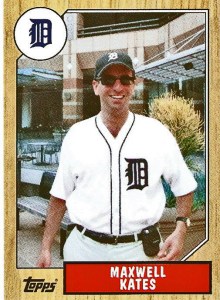
Maxwell Kates’ interest in baseball players who share his religious heritage dates back to a chance meeting with Brooklyn Dodgers’ outfielder Cal Abrams at a strip mall in Coral Springs, Florida. Growing up, he thought his was the only family whose heirlooms included a ‘Jewish collection’ of baseball cards…that is, until he joined SABR. At the 2002 convention in Boston, Maxwell even attended a brunch with 15 baseball ‘mavens’ to debate which players warranted inclusion in a forthcoming Jewish baseball card set. Two years later, in 2004, he wrote “Of Horsehides and Hexagrams: Baseball as a Vehicle for American Jewish Culture” for The National Pastime. Maxwell also developed his article into a lecture to be delivered at the Limmud Conference at York University, also in 2004. In honour of Alex Bregman’s contributions to the 2017 World Series championship, he has reformatted “Of Horsehides and Hexagrams” with a new title to chronicle the contribution of Jewish players and personnel to the evolution of major league baseball in Houston.

Cal Abrams
Outfielder

Note: In the story that follows, the years in parentheses reflect the time span that each player played for Houston

Right now, it’s a great time to be Alex Bregman.

Alex Bregman
Having a 2017 World Series Happy Moment

In the epic Game 5 of the 2017 World Series between the Houston Astros and the Los Angeles Dodgers, it was Bregman whose swing of the bat ended a 10th inning stalemate in the bottom at Minute Maid Park. At 1:38 am Eastern time (12:38 Central), Bregman sliced a single off Kenley Jansen to score Derek Fisher and push the Astros ahead 13-12. Playing in all seven World Series games, Bregman drove in five runs – including a solo home run in Game 4 – while making spectacular defensive plays at the hot corner.

Alex Bregman is also the latest of many players of the Jewish faith to suit up for the Astros. Being Jewish myself, I have long taken an interest in the accomplishments of my co-religionists on the baseball diamond. This essay will chronicle the lives and career highlights of Jewish players and other personalities who have contributed to the history of the Houston Astros.
Jews in Baseball Lithograph

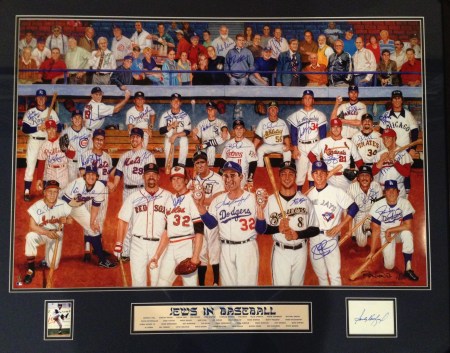
Before beginning, it is worth asking the question, “Who is a Jew?” As I described in “Of Horsehides and Hexagrams,” “if rabbis and Talmudic scholars could not arrive at a consensus 3,000 years ago…how could baseball collectors agree today?” The Union of Orthodox Rabbis defines a Jew as (a) anyone born to a Jewish mother or (b) any convert to Judaism. More liberal denominations include the progeny of interfaith couples regardless of which parent is Jewish. But what if the mother was Jewish but the player chose his father’s religion? What if only the father was Jewish and after the parents divorced, the mother raised him exclusively in her Christian faith? What if a player was born to two Jewish parents but has decided independently to practise a different religion? Every one of these scenarios describes the religious identities of different Astros players.

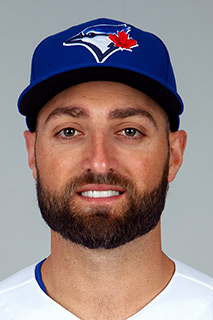
 

Kevin Pillar

Another question is worth asking and that is “Why is this important?” In other words, in 2017, why are we even discussing a player’s religion? There is a reason and it has nothing to do with anti-Semitism. Rather, although there are between 13 and 16 million Jews in the world, depending on whose statistics are used, the figure seems considerably smaller given internal divisions along religious, political, and ethnic lines. Differences of opinion on the interpretation of liturgical texts, the observation of the Sabbath, and secular political issues have spliced many communities, while as New York lawyer and author Douglas Lyons once noted, “[it seems] no two Jews observe the same rules of keeping Kosher.” According to a classic joke, when a man was asked how he would spend his time alone on a desert island, he replied “I’ll build two synagogues – but I wouldn’t be caught dead in one of them!”

Full-length kneeling shot of Detroit Tigers Hank Greenberg. 1942
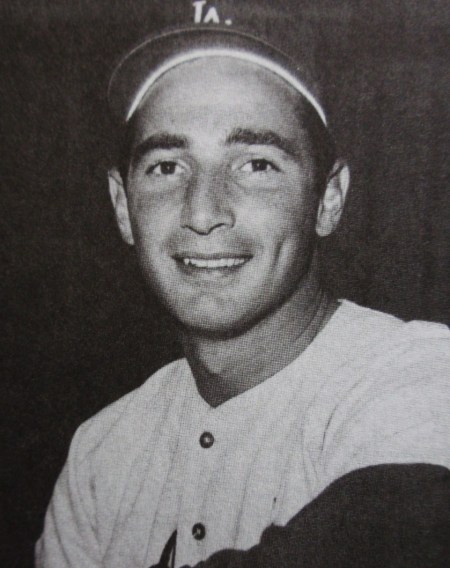
 

Sandy Koufax
“The One and Only”

Meanwhile, sports and entertainment have served to unite rather than divide. Although the American Jewish community has produced more basketball players on a professional level, it was baseball that served as their secular cornerstone. The zenith in Jewish immigration to the United States took place between the assassination of Czar Alexander II in 1881 and the adoption of the Johnson-Reed Act in 1924. During this period, the two most popular sports in the United States were baseball and boxing. In the 1930s, a Jewish baseball hero emerged in Hank Greenberg. Playing most of his career in the shadow of Henry Ford and Father Charles Coughlin in Detroit, Greenberg’s rookie year of 1933 also coincided with Adolf Hitler’s rise to power in Nazi Germany. Suburban flight during the postwar era meant the stickball games of inner city neighbourhoods like the Lower East Side of New York were now transposed to sandlot games in bedroom communities. Until the playoff system expanded in 1969, it was common for the Jewish High Holy Days to coincide with the World Series. Most Jewish sports fans, even the most ardent supporter of the New York Yankees, could identify Sandy Koufax as a cultural icon. As baseball cards became an adult hobby in the 1970s, the phenomenon of the ‘Jewish collection’ began to emerge in many families. According to Vancouver-based hobbyist Ernest ‘Kit’ Krieger, the only ethnic identities to specifically collect baseball cards of players from their culture are Cubans and Jews (1).
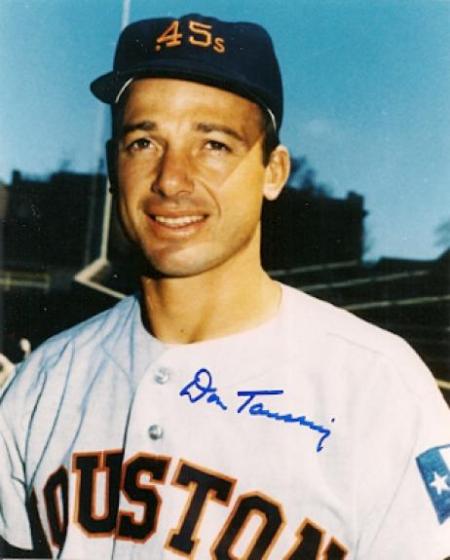
Don Taussig


Randy Cardinal

It was a cousin from the New York branch of Krieger’s family who became the first Jewish player in Houston major league history. In 1961, the Colt .45’s selected outfielder Don Taussig (1962) in the expansion draft from the St. Louis Cardinals. Injuries limited Taussig to 27 plate appearances as he batted .200 with one home run. Other Jewish members of the Colt .45’s included pitchers Randy Cardinal (1963) and Larry Yellen (1963-1964), along with catcher Steve Hertz (1964). Yellen was the intended starting pitcher on September 27, 1963 when the Colts fielded an all-rookie lineup, but a higher power interfered – his mother.

Steve Hertz
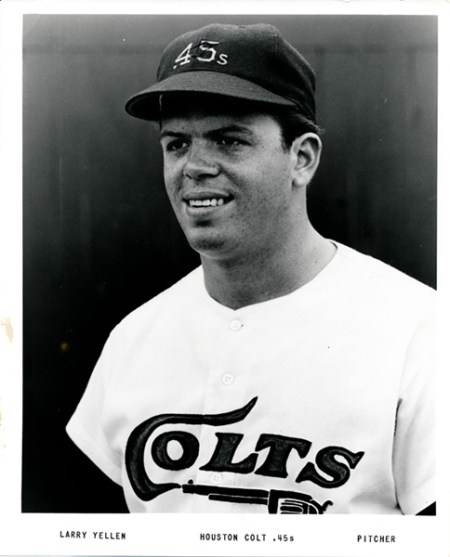
Larry Yellen

“When my mom read in the New York Times that I was going to pitch on Yom Kippur, she called to ask me how I could disgrace the family.” Some forty years later, in 2004, Hertz and Yellen reunited at the launch of the Jewish Major Leaguers baseball card set, in New York.
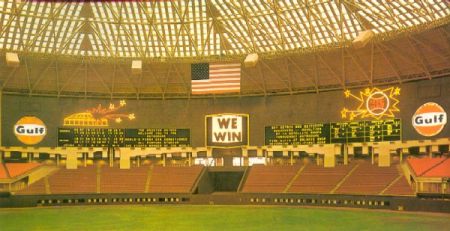
Home Run Spectacular
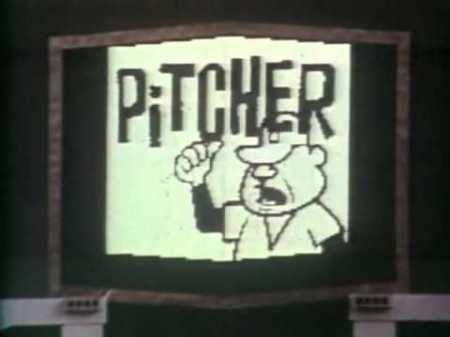
Pitcher to the Shower

The Colt .45’s moved into the new Harris County Domed Stadium in 1965; the venue became the Astrodome, the tenants, the Astros. Appointed to oversee the operation of the state of the art electronic scoreboard was a young naval officer from New Jersey named Tony Siegle. As he remembers, there were very few Jews working in major league baseball at the time:
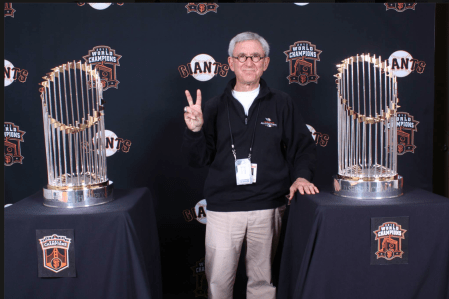
Tony Siegle with the San Francisco Giants, 2013

“Baseball was known as the ‘Irish mafia’ as most baseball executives were Irish (MacPhail, Giles, McHale and so forth). Even in my minute capacity, I was the only Jew…in the Astros’ hierarchy. When I told [my dad] of my new post, he asked if I were inside the scoreboard hanging numbers. I told him this one was different.”

Barry Latman
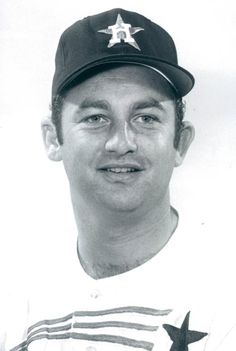
Larry Sherry

Prior to the 1966 season, the Astros purchased the contract of pitcher Barry Latman (1966-1967) from the Angels. Despite a disappointing 2-7 record, the Los Angeles native posted an impressive 2.71 earned run average in his first season in a Houston uniform. Latman’s former Fairfax High School classmate, Larry Sherry (1967), soon joined him in the bullpen. Meanwhile, a third Jewish Angeleno was patrolling the outfield for the Astros. His name was Norm Miller (1965-1973) and on April 15, 1968, he scored the winning run against the Mets to end a 24 inning shutout, the longest in major league history. The following year, he enjoyed his most successful year with the Astros, hitting 21 doubles and four triples while batting .264 in the cavernous Astrodome.

Norm Miller, 1970 Topps Card
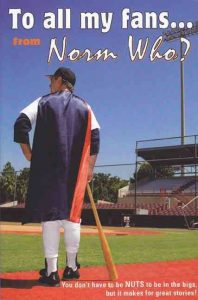
To All My Fans
By Norm Miller

Late in the 1969 season, Miller paradoxically refused to play on Yom Kippur after previously disavowing organized religion. As his teammate Jim Bouton elaborated in Ball Four, “I play on [the first day of Rosh Hashanah] and go 0-for-4 against Niekro and the next day I go 0-for-5, and that’s it. I’ll never play on a Jewish holiday again!” Miller recently described to journalist Dan Epstein the significance of having three Jewish players on the Astros in 1967:

“I’m sure I instigated a lot of stuff. I probably told people that if they needed their money handled, we were the three guys who could do it…we were vicious human beings back then; and when one of your teammates ripped you, you felt accepted.” Miller also admits that he believes he was hindered by “a degree of anti-Semitism” before a back injury forced him to retire from baseball at age 29. He later pitched batting practise for the Astros and worked in the team’s front office.


Bo Belinsky, 1967
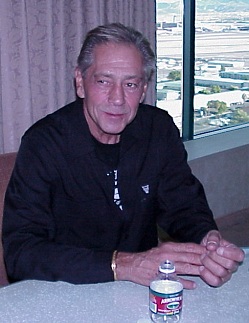


Whether or not there was a fourth Jewish player on the 1967 Astros remains a matter of dispute. When asked about Bo Belinsky, Norm Miller replied, “It depends on who he was talking to, I guess. Okay, so we only had three and a half Jews on our team!” That Belinsky was born to a Russian Jewish mother and a Polish Catholic father are accepted facts. A larger than life character, he held out for more money in spring training of his rookie year and was as well known for his ability with a pool cue as his pitching arm (2). Despite a lifetime record of 28-51 with a 4.10 ERA over eight seasons, Belinsky no-hit the Baltimore Orioles as a rookie on May 5, 1962. He identified as a Christian and when he died in 2001, age 64, he was given a Pentecostal Christian funeral. Many older sources considered Belinsky to have been Jewish. More modern texts such as the McFarland series by Burton and Benita Boxerman do not include him. Although I tend to agree with the Boxermans, I am reminded of a debate with my father about the identity of Leo Bloom. He retorted my claim about the protagonist in James Joyce’s Ulysses with “Bloom might not have considered himself Jewish – but other people did!”
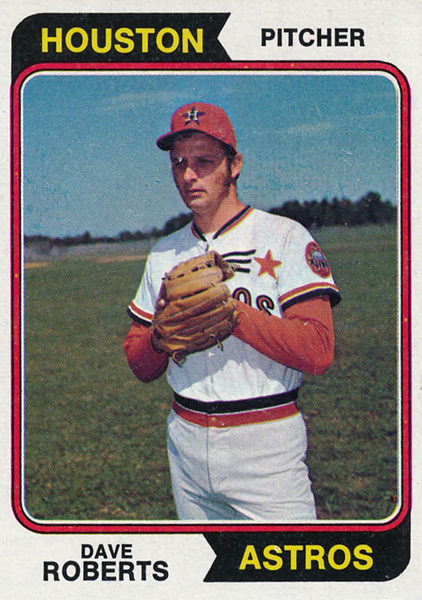
Dave Roberts
 

Dan Warthen, 1978

Two additional Astros pitchers in the 1970s have frequently been misidentified as Jewish. One is Dave Roberts (1972-1975). A durable starter acquired from the San Diego Padres, Roberts’ best season with the Astros was 1973 in which he won 17 games including six shutouts, with a 2.85 ERA. Roberts’ original name was David Arthur Roth, born to a Jewish father and a Christian mother. After his parents divorced and his mother remarried a man name Roberts, Dave was raised Christian. According to biographer Gregory H. Wolf, Roberts was a devout Christian. Throughout his 13 year major league career, serving as chapel leader, seeking advice from his priest, and was nominated more than once for the Danny Thompson Award for upstanding Christian character.
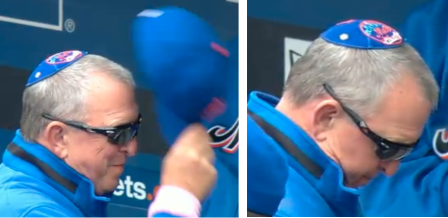
Dan Warthen, 2010, Mets Kippah

Meanwhile, Dan Warthen (1978) has also been misidentified as Jewish. Warthen’s potential claim to Judaism was brought to a head in 2010 when as pitching coach for the Mets, was seen wearing a kippah on television when he briefly removed his cap. Ron Kaplan examined the question in a column of Kaplan’s Korner. According to Mets’ vice president of media relations, Jay Horwitz, Warthen’s wife is Jewish but he is not. It turns out the kippot were gifts to Ike Davis from a rabbi and Warthen “was simply trying one on.” Former Astros pitcher Jim Bouton (1969-1970) married Paula Kurman in 1978; although he raised his stepchildren with Paula’s Jewish faith, the author of “Ball Four” never himself converted.  On the other hand, Skip Jutze (1973-1976), who caught the Astros for several seasons in the 1970s, did convert to Judaism.

Skip Jutz
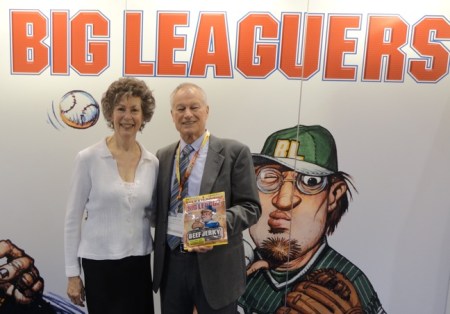
Paula Kurman and Jim Bouton

One of the more memorable moments during the Astrodome era involving a Jewish player took place in an exhibition game on July 19, 1973. Prior to the game in which the Astros hosted the Detroit Tigers, manager Leo Durocher announced that “Jerry Lewis will play first base and hit leadoff in my lineup.” Yes, that Jerry Lewis. The 47 year old comedian was anything but a nutty professor in Astros double knits, drawing a walk before rapping a single off Mike Strahler to contribute towards a 10-7 Houston victory. Later that evening, Lewis attended a dinner party while still wearing his jersey number 9. As he told Sports Illustrated, “you’ll need a meat cleaver to get this off me.”
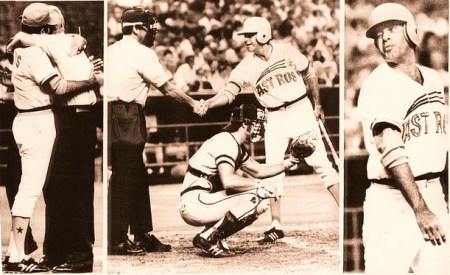
Jerry Lewis
In his brief fun tenure as an Astro

Contributions to major league baseball in Houston by Jews were not limited to achievements on the diamond. The first general manager for the Colt .45’s was Gabe Paul, signed by the yet-unnamed Houston franchise in 1960. Tal Smith remembers working for Paul before the general manager’s departure for Cleveland in April 1961:

Original Astros GM Gabe Paul
Served a very short term before leaving. His term was remindful of an old Groucho Marx movie song:
“Hello. I Must Be Going”

“I have to thank Gabe for giving me the opportunity to start my baseball career and then he provided me with an opportunity to come to Houston which was obviously unique with an expansion franchise…I actually worked for Gabe with Cincinnati, Houston, and the Yankees and I stayed in touch with him until his passing [in 1998].”
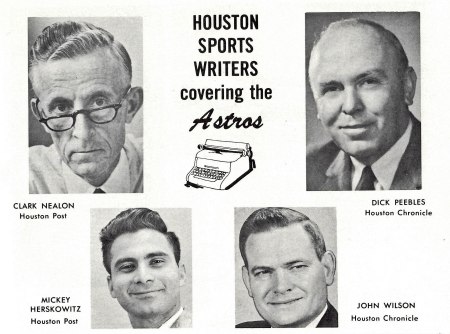
 

Mickey Herskowitz, 1965

Mickey Herskowitz, 2014

Among the reporters covering the team in the early years were Morris Frank for the Houston Chronicle and Mickey Herskowitz for the Houston Post. After Roy Hofheinz suffered his debilitating stroke in 1970, he delegated oversight of the Astros first to Reuben Askenase and then to Sidney Shlenker. After a nine year exodus in Philadelphia and Milwaukee, Tony Siegle returned to the Astros in 1979 as assistant to Tal Smith, by now the general manager. No longer operating a scoreboard or hosting guided tours of the Astrodome, Siegle’s new duties included “negotiating contracts, waivers, and dealing with agents.” A year later, Al Rosen was hired as the general manager.
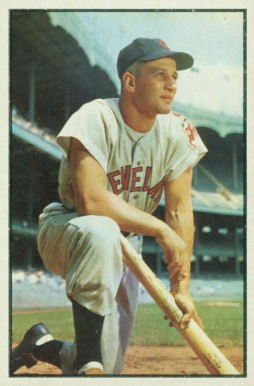
Al Rosen, 1953


Born in Spartanburg, South Carolina in 1924, Rosen played 3rd base for the Cleveland Indians from 1947 to 1956. The four-time All-Star hit 37 home runs for the Tribe in 1950 while still qualifying as a rookie. In 1953, Rosen won the American League Most Valuable Player; he led the junior circuit with 43 home runs and 145 RBI while narrowly missing the Triple Crown – his .336 batting average was one point shy of Mickey Vernon’s .337. Never one to shy away from his religious heritage, Rosen sought to earn his legacy as “one Jewish kid every Jew in the world could be proud of.” His experience as an investment advisor in Cleveland provided him with the financial capital to augment George Steinbrenner’s purchase of the New York Yankees in 1973. Rosen became team President in 1978 and a year later, fellow Yankees investor John McMullen bought the Astros from Roy Hofheinz’ creditors.

Al Rosen, 1982

Rosen was given the dubious task to replace the popular Smith as general manager. The fans, media, and even McMullen’s partners were upset at the decision while Tony Siegle even remarked that “General Santa Ana received a friendlier welcome [in Houston].” Rosen wasted no time to tinker with the roster of the defending National League West champions. He signed Don Sutton to a free agent contract to replace an ailing J. R. Richard in the starting rotation while dispatching Enos Cabell, Ken Forsch and Joaquin Andujar in trades, respectively, for Bob Knepper, Dickie Thon, and Tony Scott. In 1981, the Astros won the second-half National League West title before losing to the Division series to the Los Angeles Dodgers (the Dodgers had not heard the last of the Astros). A year later, with the second most expensive team in the National League, the Astros plummeted to fifth place. Amid the after effects of an oil shock on the local economy in Houston, Rosen adopted an austere stance against free agent signings. After three years in the middle of the pack, the Astros decided to part ways with Rosen in 1985. He served seven years as general manager of the San Francisco Giants and passed away in 2015, age 91.

One of the more evasive aspects of researching this assignment was to determine a religious identity for Andres Reiner. The Venezuelan businessman established the Astros’ Venezuelan Baseball Academy in 1989. In his seventeen years with the Astros, he signed several players who excelled on the major league level, including Johan Santana. Reiner, who passed away in 2016, was born in Budapest in 1935 and fled with his family to Venezuela in the 1940s. Considering the timing that his family left Europe and that Reiner is a rather common Jewish name in Hungary, the question was asked whether Andres was Jewish.

According to Milton Jamail’s Venezuelan Bust, Baseball Boom, Reiner did indeed flee Hungary with his family, but they departed Europe in 1946 to flee the Communists rather than the Nazis. While 1946 was a watershed year for immigration into Venezuela, only 600 Jews immigrated to the South American nation. Research leads with the University of Texas at Austin, the Tampa Bay Rays, articles about Reiner, his Venezuelan obituary, and even an interview with Budapest-born Andrew Reiner from Toronto all proved to be evasive in identifying his religion.

Finally, SABR member Rory Costello was able to contact Venezuelan journalist Alfonso Tusa, who informed us that while “other families named Reiner were registered as Jewish,” Tusa had “no direct evidence about Andres.” Therefore it is reasonable to conclude that it was unlikely Andres Reiner had been Jewish.


Frank Charles


Jason Hirsh
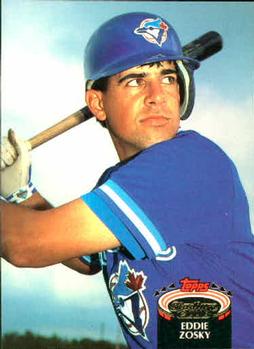
 

Eddie Zosky

The participation of Jewish major leaguers reached its nadir in the 1980s. After the White Sox designated Mark Gilbert for assignment in 1985, three years would pass before one of his co-religionists would return to the big leagues (3). In the 1990s, meanwhile, Shawn Green and Mike Lieberthal were two of over a dozen Jewish players to break into the majors. The first Jewish Astros in nearly a quarter century were both promoted from AAA New Orleans late in the 2000 season, catcher Frank Charles and infielder Eddie Zosky. Measuring a gargantuan 6’8″, Jason Hirsh (2006) went 3-4 with a 6.04 ERA in nine starts for the Astros before he was sent to the Colorado Rockies in an offseason trade. Utility infielder David Newhan (2008) ended his eight year big league career with the Astros, batting .260 in 104 official at-bats. He was nicknamed “Son of Scribe,” as he is the son of Los Angeles sportswriter Ross Newhan. The younger Newhan identifies as a ‘Messianic Jew,’ which most Jewish denominations understand to mean a form of Christianity.

Columbia Space Shuttle Patch

In 2003, the Astros became the only major league baseball team to wear an Israeli flag on their uniforms.   On February 1, the Space Shuttle Columbia disintegrated upon re-entering the Earth’s atmosphere, killing all seven astronauts aboard. One of the astronauts to lose his life was Ilan Ramon, the first Israeli in space. As a tribute to the fallen astronauts, the Astros wore the official patch of STS-107 on the sleeve of their uniforms. The patch lists the surnames of all seven astronauts, along with an Israeli flag beside Ramon’s name.
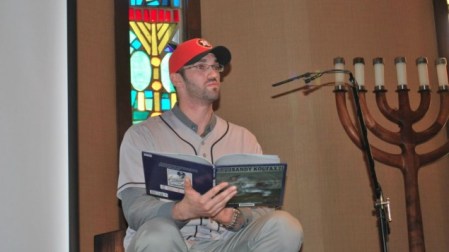
Josh Zeid
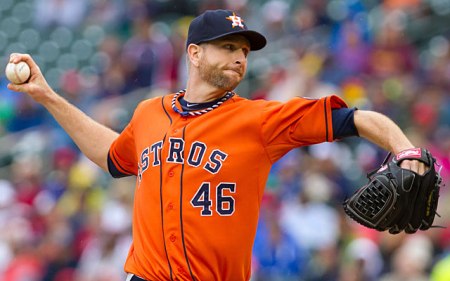
 

Scott Feldman

Besides Alex Bergman, there were Jewish players on the Astros in the 2010s. In 48 appearances, Josh Zeid (2013-2014) posted a record of 0-1 with a 5.21 ERA. Seen in the above noted photograph, Zeid is reading a children’s book about Sandy Koufax to students at the Shlenker School in Houston (4). Nine years after breaking in with the 2005 Texas Rangers, Scott Feldman (2014-2016) signed a three year, $30 million contract. The Astros’ 2014 opening day starter, he posted a record of 8-12 while setting a personal best 3.74 ERA. One of Feldman’s eight wins was a three-hit shutout of the Texas Rangers on August 30. His success on the field earned him as the cover illustration on the Astros’ 2015 yearbook. In July 2016, Feldman was traded to the Toronto Blue Jays.

Brad Ausmus, 1997
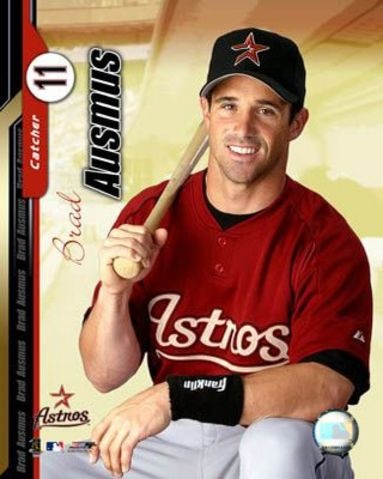
 

Brad Ausmus, 2001

Now you as the reader may wonder, “When is he going to write about Brad Ausmus?” As a Detroit Tigers fan, I am tempted to answer “Who?” Ausmus (1997-1998, 2001-2008) was born in New Haven, Connecticut in 1969, to a Jewish mother and a Protestant father. As he told Brad A. Greenberg of the Los Angeles-based Jewish Journal, “I wasn’t raised with the Jewish religion, so in that sense I really don’t have much feeling towards it.” Ausmus admits that being a role model to a young generation of Jews has influenced retrospection towards his matrilineal heritage as “a sense of pride,” adding that “if you can have a positive impact on a kid, I’m all for it.”

After breaking in with the Padres in 1993, Ausmus spent parts of four seasons in San Diego and Detroit before he was traded to the Astros in 1996. He batted .266 in 1997 while ejecting 44% of potential base stealers while coordinating a starting rotation of Mike Hampton, Darryl Kile, Jose Lima, and Shane Reynolds. Tal Smith considered Ausmus’ presence behind the plate to be “invaluable,” deserving “a lot of credit for our success,” and likening him to “another manager on the field.”

Meanwhile, the Astros won their first division title in 11 years. Ausmus won Gold Gloves in the first two seasons in his second tour of duty with the Astros, even fielding a stellar .997 in 2001. Of his catching abilities, pitcher Octavio Dotel lauded Ausmus as “a great catcher,” adding that “if he feels 100% I should thow a pitch, then I will go with him.”

Brad Ausmus, 2005


Brad Ausmus, 2008

Ausmus and his Houston teammates enjoyed one of their most memorable seasons in the major leagues in 2005 as the Astros won their only National League pennant. The Dartmouth graduate led all catchers with 66 hits after the All-Star break, while drawing more bases on balls during the regular season than strikeouts (51 to 48). Meanwhile, on September 18, he surpassed Alan Ashby having caught the most games in Astros history. Although he hit only three home runs in the regular season, don’t tell that to the Atlanta Braves and their bullpen.

The Braves took a 2-1 lead in the National League Championship Series. An Atlanta victory in Game 4 signified elimination for the Astros, a result that seemed imminent after the Braves took a 5-0 lead. Trailing 6-5, the Astros sent Brad Ausmus to bat with two outs in the bottom of the 9th. Facing Kyle Farnsworth, Ausmus pulled a ball which barely cleared the left field fence at Minute Maid Park. It was ruled a home run; bedlam ensued as the Astros and Braves were tied. That’s when both clubs suddenly forgot how to produce runs. An additional nine innings would pass before Chris Burke’s home run gave the Astros a 7-6 victory.

“We had gone 18 innings,” Ausmus told Bill Brown and Mike Acosta. “We were starting to get extremely tired. We wanted the game to end. Rocket comes out of the bullpen and goes three innings…so that was one of those games for the ages.” The consummate team player, Ausmus played all 18 innings, catching 15 and playing three at first base. Tal Smith, having worked for the Astros franchise for over 35 years, described the blast as “one of the greatest hits in franchise history.”

Brad Ausmus, 2013, with
Shimon Peres and Daniel Shapiro


Brad Ausmus, 2015, with
Lance Berkman and Craig Biggio

Ausmus remained with the Astros until 2008. Amazingly, for someone who caught over 1,900 games, he never spent a day on the disabled list through the 2008 season. After two years with the Dodgers, Ausmus retired as a player in 2010. He managed the Israeli national baseball team in 2013 and then spent the next four years piloting the Tigers. The Astros’ decision to hire Joe Espada to replace Alex Cora as their bench coach ended any speculation of Ausmus’ imminent return to Houston.

Alex Bregman, 2016 Futures Game

The Astros selected Alex Bregman as the second overall draft choice in June 2015. His meteoric rise through the minor leagues included stops in Quad Cities, Lancaster, Corpus Christi, and finally Fresno. Fans received a glimpse of Bregman’s offensive abilities when he was a home run short of hitting for the cycle at the 2016 Futures Game in San Diego. As Bregman told Bill Brown, “I feel like I’m (close to) accomplishing one of my goals, and that was to get to the big leagues this year.”

Bregman would not have to wait long, as he was recalled to Houston on July 25. As the Astros hosted the Yankees at Minute Maid Park, the 3rd baseman made “some dazzling plays” and “came up about three feet short of a grand slam.” He batted .264 in 201 official at-bats for the remainder of the season. Meanwhile, batting .306 with 20 home runs and 61 RBI between Corpus Christi and Fresno, Bregman won USA Today’s Minor League Player of the Year Award for 2016. There would be no second cup of coffee for this Bregman – he was in the majors to stay (5).
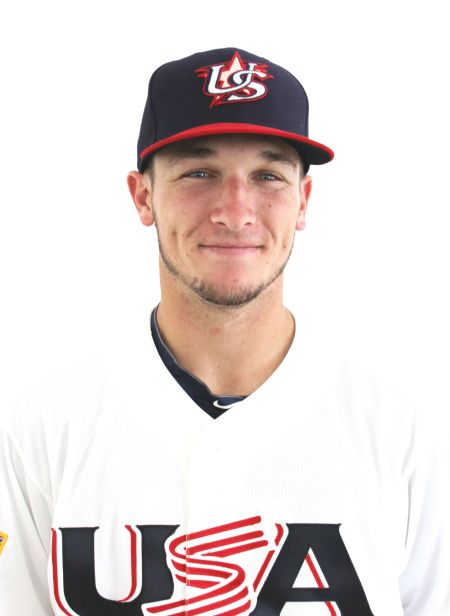
Alex Bregman, 2017 Team USA

Even before the World Series, the legend of Alex Bregman was growing in 2017. Before the regular season, he earned a gold medal as a member of Team USA in the World Baseball Classic. Bregman’s 19 home runs and 71 RBI include a grand slam off Masahiro Tanaka at Yankee Stadium. Not simply a one-dimensional threat, Bregman batted .284 with 39 doubles, 5 triples, and 17 stolen bases, while leading American League 3rd basemen with a .970 fielding percentage.

HOUSTON, TX – OCTOBER 30: Alex Bregman #2 of the Houston Astros celebrates after hitting a game-winning single during the tenth inning against the Los Angeles Dodgers in game five of the 2017 World Series at Minute Maid Park on October 30, 2017 in Houston, Texas. (Photo by Tom Pennington/Getty Images)

An important hallmark in religious and secular Jewish families alike is passing on traditions from one generation to the next. As Suzanne Fields, also known as Alex Bregman’s great aunt, chronicled in the Washington Times, the 3rd baseman is the fourth generation in his family with a connection to baseball. Suzanne’s father, the late Bo Bregman, was a Russian immigrant who was a standout catcher in Washington’s amateur leagues in the early 20th century. Bo’s son Stanley was a lawyer retained by the Griffith family who owned the original Washington Senators. Meanwhile, Stanley’s son Sam, now an Albuquerque lawyer, played baseball at the University of New Mexico. In Suzanne’s words, “my father didn’t live long enough to know Alex but he would have popped his vest buttons if he had seen Alex step up to the plate for his first World Series at-bat.” In other words, ‘my great grandson, the ballplayer.’
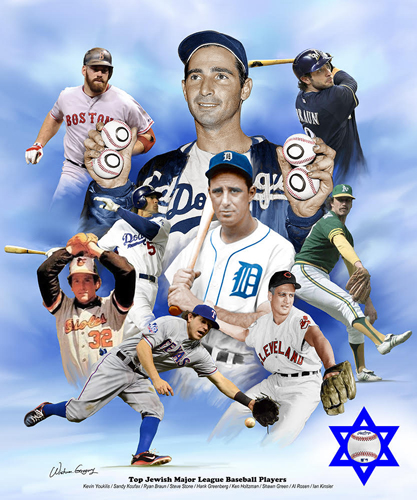
Top Jewish Major League Baseball Players

To paraphrase Morley Torgov in his coming of age novel, The Outside Chance of Maximilian Glick, “where there is oxygen, there are Jews.” Both on and off the field, Jews have contributed to major league baseball in Houston from expansion franchise to World Series champions. Perhaps the most significant exploits were by Alex Bregman last month during the seven game series over the Los Angeles Dodgers. Great things are predicted for the 3rd baseman whose next birthday shall only be his 24th. Astros fans of all backgrounds no doubt will hope to continue to see Bregman in a Houston uniform for years to come.

NOTES

(1)            Krieger himself had an unusual tie to professional baseball. On the final day of the 1968 season,

the 19 year old was the starting pitcher for the Vancouver Mounties of the Pacific Coast League.

(2)            I will leave further details of Belinsky’s well-documented personal life to other writers.

(3)            Gilbert, who lasted one week in the major leagues, later found greater success in a different field.

In 2015 he was named the United States ambassador to New Zealand.

(4)            The Shlenker School was indeed named after Sidney Shlenker’s family. Sidney served as team

President of the Astros from 1975 to 1976.

(5)            An unrelated Bregman family in Toronto owned a coffee chain called The Second Cup for years.


BIBLIOGRAPHY

Berger, Ralph. “Al Rosen” in Pitching to the Pennant: The 1954 Cleveland Indians, Joseph Wancho, ed.

Lincoln, NE: University of Nebraska Press, 2014.

Bouton, Jim and Leonard Schecter. Ball Four. New York: Dell Publishing Co., 1971.

Bowman, Bob. “My Friend Morris” in The Pecan Park Eagle: June 2, 2011.

Boxerman, Burton and Benita. Jews and Baseball: Volume 2, The Post-Greenberg Years (1949-2008).

Jefferson, NC: McFarland & Company Inc., 2010.

Brown, Bill. Breathing Orange Fire: Jose Altuve. Houston: Bill Brown, 2016.

Brown, Bill and Mike Acosta. Deep in the Heart: Blazing a Trail from Expansion to World Series.

Houston: Bright Sky Press, 2013.

Dempsey, Patrick. Testimony and Fading Memory in the Holocaust, Peter Anthony Draigh, ed. Oxford:

  1. A. Draigh Publishing, 2001.

Epstein, Dan. “Norm Miller Q&: Memorable Moments and Encounter with Anti-Semitism” in Jewish

Baseball Museum: April 26, 2016.

Ehrlich, M. Avrum. Encyclopedia of the Jewish Diaspora: Origins, Experiences, and Culture, Vol. 2.

Santa Barbara, CA: ABC-CLIO LLC, 2009.

Fields, Suzanne. “Tis the Season for Baseball Dreams” in The Washington Times: November 1, 2017.

Goldstein, Richard. “Bo Belinsky, 64, the Playboy Pitcher Dies” in The New York Times: November 27,

2001.

Greenberg, Brad. “The New Jew in Dodger Blue” in Jewish Journal: May 22, 2009.

Holmes, Dan. “Comedian Jerry Lewis Once Got a Hit Against the Tigers in the Astrodome” in Detroit

Athletic Club: November 24, 2014.

Horvitz, Peter J. and Joachim Horvitz. The Big Book of Jewish Baseball. New York: S.P.I. Books

Publishing, 2001.

Jamail, Milton H. Venezuelan Bust, Baseball Boom: Andres Reiner and Scouting on the New Frontier.

Lincoln, NE: University of Nebraska Press, 2008.

Kahn, Roger. The Passionate People: What It Means to be a Jew in America. New York: William Morrow

Inc., 1968.

Kaplan, Ron. “Alex Bregman Becomes the First Jewish Player to Hit a World Series Walk-Off” in The

Times of Israel: October 30, 2017.

Kaplan, Ron. “Is Dan Warthen Keeping His Judaism Under His Cap?” in Kaplan’s Korner on Jews and

Sports: May 12, 2010.

Kates, Maxwell. “Catching Rainbows and Calling Stars: Alan Ashby and the Houston Astros in The

National Pastime: Baseball in the Space Age, Cecilia Tan, ed. Phoenix: The Society for

American Baseball Research, 2014.

Kates, Maxwell. “Of Horsehides and Hexagrams: Baseball as a Vehicle for American Jewish Culture” in

The National Pastime, Volume 24. Cleveland: The Society for American Baseball Research,             2004.

Kates, Maxwell. “What was the Only Time an Israeli Flag Appeared on a Major League Baseball Team’s

Uniform?” in Shuleinu, Irving Osterer, ed. Ottawa: Congregation Machzikei Hadas, October

2016.

Lucas, Greg. Houston to Cooperstown: The Houston Astros’ Bagwell & Biggio Years. Indianapolis: Blue

River Press, 2017.

McCurdy, Bill. “1973: Jerry Lewis Gets a Hit as an Astro” in The Pecan Park Eagle: November 27, 2013.

McCurdy, Bill. “R.I.P. ‘Former Astro’ Jerry Lewis” in The Pecan Park Eagle: August 21, 2017.

Miller, Norm. To All My Fans…from Norm Who? Houston: Double Play Productions, 2009.

Oney, Steve. “Fallen Angel” in Los Angeles Magazine: July 1, 2005.

Reed, Robert. A Six-Gun Salute: An Illustrated History of the Houston Colt .45’s. Houston: Lone Star

Books, 1999.

Rosten, Leo. The Joys of Yiddish. New York: McGraw-Hill Inc., 1968.

Ryan, Mike and Shannon Bill. 1982 Official Astros Yearbook. New York: Harry M. Stevens Inc., 1982.

Torgov, Morley. The Outside Chance of Maximilian Glick. Toronto: Key Porter Books Inc., 1982.

Wolf, Gregory H. “Dave Roberts” in When Pops Led the Family: The 1979 Pittsburgh Pirates, Bill Nowlin

and Gregory H. Wolf, eds. Phoenix: Society for American Baseball Research Inc., 2016.

ACKNOWLEDGMENTS

Martin Abramowitz, Mike Acosta, Ray Anselmo, Geoff Becker, Benita Boxerman, Burton Boxerman, Bill Brown, Mindy Bullion, Rory Costello, Harold Freeman, Henry A. Green, Howard Kaiman, Ron Kaplan, Neil Keller, Kit Krieger, Maxwell Lapides, Lew Lipset, Greg Lucas, Doug Lyons, Bill McCurdy, Norm Miller, Ross Newhan, Irving Osterer, Andrew Reiner, Peter Sevitt, Tony Siegle, Tal Smith, John Thorn, Alfonso Tusa Campos, Mark Wernick

Special thanks to Rory Costello and Tal Smith for their help with the research of this paper.


********************
Bill McCurdy

Principal Writer, Editor, Publisher

The Pecan Park Eagle