Game 2 Astros Loss: The Critical Call

March 31, 2018

6th Inning
Astros @ Rangers
March 30, 2018
***********
Odor getting off his wild throw as Altuve slides into 2nd.

No. This doesn’t mean we are going to try and cover every season game of the 2018 Houston Astros season. We simply could not allow this clear point to pass without mention. What happened in Game 2 of that first series at Texas is part of the stuff that makes baseball the superior thinking game that it is. Sometimes you don’t have much time to think, if you are a baseball field manager, but if you have your head in the game, and you know the rules, speaking up in time may become the difference between winning or losing for your team.

It happened Friday night. And the credit, however begrudgingly its extended, has to be handed to Rangers field manager  Jeff Banister and/or his staff. What Banister did in the top of the 6th inning, with his club leading, 3-1, nobody out, and Jose Altuve running at first, was the critical play that both changed the score in the Rangers’ favor and halted the rally that could have propelled the Astros into a lead that would have only grown larger from there.

It did not. And here’s why.

The top of the 6th started on a funky note for the home field Rangers. Jose lead off by dropping a dying quail liner to right field off right handed reliever Chris Martin that right fielder Nomar Mazzara lazily played into a trapped base hit, a result confirmed by a video review that did not find any secret catch to dispel the effect of poor fielding energy.

OK. Momentum is now up for the Astros. Altuve has reached the beach. The rest of the troops should soon follow.

And it almost worked that way. At first.

Altuve on 1st. Nobody out. Right handed reliever Martin pitching for the Rangers.

Carlos Correa strikes out.

Altuve on 1st. One out. Right handed reliever Martin pitching for the Rangers.

Alex Bregman slaps a ball up the middle. Shortstop Elvis Andrus grabs it behind second base and flips it to second baseman Odor on an attempted foot tag and throw to first for a double play. Altuve is sliding into second beneath when Odor gets his throw off to first, but he immediately regains his running posture and appears to be a couple of steps beyond second by the time Odor gets off his throw to first.

The throw is wild and goes into the Rangers’ first base side dugout. Bregman is safe at first and is awarded second. Since Altuve appears to be beyond second when the throw occurs, he is waved in to score. (If you look at the featured slide picture here, it’s hard to see how anyoe thought that Altuve was beyond second base when Odor released his wild throw.)

Regardless, for a brief uncontested moment, the score is now 3-2, Rangers, with the Astros now sitting on the tying run at second and one out. It didn’t last long.

Rangers manager Banister protests the call. But what for?

As it turned out, Altuve was safe at second base, but he was not beyond the bag when Odor unleashed his wild throw to the dugout. As a result, Altuve was recalled from the dugout to be a base runner at 3rd. The run he scored, of course, was taken off the board.

Protest settlement situation: Astros still trail the Rangers 3-1 in the top of the 6th. They have runners on 2nd and 3rd with only one out.

The Astros still have all the opportunity in the world, but how much momentum is left in the tank as a result of the protest result?

Marwin Gonzalez walks to load the bases for the Astros, still with only one out and Texas up by 3-1.

Evan Gattis strikes out swinging. It remains a 3-1 Astros game in the top of the 6th. The Astros still have the bases loaded, but now there are two outs.

The Rangers bring in lefty Alex Claudio to pitch against lefty Derek Fisher of the Astros.

The Astros counter by bringing in right handed J.D. Davis as a pinch hitter for Fisher.

Davis strikes out swinging to retire the side. End of challenge.

The Rangers go on to score two more, winning the game, 5-1.

Mama said there’d be days like this. And we have to guess she also meant that they even are going to happen to World Champions too. Congratulations to Rangers manager Banister for picking the right time to protest, even if we Astros fans don’t care for the outcome in this instance. It’s part of what makes baseball the fun game that it is.

Yes. Baseball’s both a fun and a funny game. You learn that early. And you also have to learn that all the funny things that happen to you in this game don’t necessarily make you laugh.

The Top of the 6th just qualifies as one of those critical moments that changed the outcome of the game.

********************

Bill McCurdy

Principal Writer, Editor, Publisher

The Pecan Park Eagle


Hello, Astros / Goodbye, Rusty

March 30, 2018

Second Year in a Row
George Springer Homers to Start Season
March 29, 2018

Uh Oh! The 2018 Astros AL Baseball Season is off to a slow start.

Last year, lead-off hitter George Springer got the Astros 2017 World Series Championship AL Baseball Season off to a flying start by homering on the first pitch of the season. This year, it took him three pitches to accomplish the same feat against Cole Hammels of the Texas Rangers.

We jest. That’s OK. This 2018 team is better than last year’s great club if they can play their remaining 161 regular season games on the field as well as they appear prepared to do it on paper. Get that done with people like George Springer and Carlos Correa supporting the game’s greatest player, Jose Altuve, on the field, and with heavenly humming pitchers like Justin Verlander and Dallas Keuchel tilling the mound – and our Houston chances for a repeated World Series victory in 2018 correctly go from possible, to probable, to almost certain – barring the appearance of nasty fate.

Here at The Pecan Park Eagle, we’ve got the Astros down for a 108-54 record in 2018 and a whatever-it-takes AL roll over the Yankees and other base league playoff pretenders on their way to dumping the Dodgers or whomever else survives as NL contender in the World Series.

That being said, we must add: We’ve been to the rodeo of paper expectations before and had to learn that nobody gets anything until they actually win it on the field, one day at a time, in the face of little and long present issues of injury and reliable availability.

So much too depends on the man in charge. We had this trust twice before – first with Bill Virdon and again with Larry Dierker. And now we have it again with A.J. Hinch.

It’s there, man. If you pay attention at all to the dugout interaction during games between Hinch, his staff, and his players – you can see it and sense it in every other way that’s available to you. These guys are confident. In themselves. And in each other. And in their leaders, they will do all they can to do all that is possible. No trust is lost. And no energy is wasted on distrust.

That 4-1 Astros win over the Rangers on Opening Day 2018 was a nice start, but now it’s a new day. Time for a new day run at being the best team on the field this Good Friday.

And, one more time. Rest in Peace, Rusty Staub!

Rest in Peace
Rusty Staub
Died March 29, 2018
Age 73

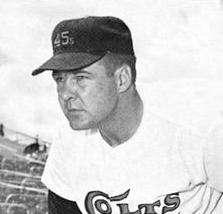
It was 1963 when the 19-year old Rusty Staub joined the Houston Colt .45s after one season with the Durham Bulls of the Carolina League in 1962. I was familiar with Staub’s early skill from the time he was finishing play at Jesuit High School in New Orleans, but never got to see him actually play until his rookie MLB year. I started my masters level graduate school work at Tulane in September 1961, after Rusty already had finished his amateur play and signed at age 17 to play for our new NL expansion club.

Everyone I knew at the time was very excited about Rusty Staub as a candidate for stardom when he arrived in Houston, and, like most of those others, I shared in the disappointment when GM Spec Richardson traded him away in that media / commissioner bungled trade to Montreal.

All Staub did after leaving Houston was play about another thousand years while becoming along the way, one of the best pinch hitters and biggest charitable benefactors that the game has ever known.

Thank you, Rusty Staub, for being such an important, if wrongly assessed part of our early Houston MLB history.

We appreciate you because – there will never be another you.


Plus Previous TPPE Column Link:

Prayers for Rusty Staub Please

********************

Bill McCurdy

Principal Writer, Editor, Publisher

The Pecan Park Eagle


Rusty Staub Has Died

March 29, 2018

This painful note from our SABR brother, Paul Rogers, and the link to the story of his demise say as well as possible:

“Rusty Staub – “Le Grand Orange” – passed away late last night at 73 after a long hospital stay. Oldsters will remember him as an 18 year-old phenom with the then brand new Houston Colt .45s. Here is the New York Times obituary which aptly describes his career and considerable charitable activities:”

https://www.nytimes.com/2018/03/29/obituaries/rusty-staub-dead-baseball.html

Also included here is the link to the recent column we wrote about his hospitalization:

Prayers for Rusty Staub Please

Rest in Peace, Rusty Staub.

There will never be another you.

********************

Bill McCurdy

Principal Writer, Editor, Publisher

The Pecan Park Eagle

Mover & Shaker: Walter O’Malley

March 29, 2018

Do you remember why the Dodgers and Giants left Brooklyn and Manhattan after the 1957 NL season and moved to Los Angeles and San Francisco?

It didn’t have to do with fans so much, except for one thing, it did have everything to do with where the fans were now living by this time. Like so many other American families in this era, baseball fans were moving to the boondocks for a shot at more home space at cheaper prices at the expense of a big bump in the cost of daily travel to work in the cities that still served as homes to their favorite baseball teams.

The work-home commute was no big deal for Dodger and Giant fans. The East was built around a great commuter rail system that could take mostly working fathers to and from their new homes in New Jersey and Connecticut to work and back without a problem.

The problem was – how did the bulk of these diehard Dodger and Giant fans remain active patrons of their clubs, especially of the Dodgers in Brooklyn, when there was no great commuter service to Ebbets Field by rail – and only limited, expensive car space for parking, if a fan planned to drive in for a game he may have earlier in life been able to reach on foot?

I prefer to believe the following: Dodger owner Walter O’Malley worked his tail off trying to get the City of New York to help him build a new ball park in Brooklyn near a major commuter train depot – and he also sought help from the city in building this park – with plans for upgrades that even included a domed stadium design. It would have been tailor-made as a plan for retaining all the Dodgers fans that now lived in New Jersey.

It didn’t happen. For whatever political and economic factors that called the hand, the legendary NYC planning genius, Robert Moses, effectively always found a way to block all of the Dodger requests. The next thing we all knew was that the Dodgers and Giants were departing the New York area to begin the 1958 season as the Los Angeles Dodgers and the San Francisco Giants.

Owners Walter O’Malley of the Dodgers and Horace Stoneham of the Giants were breaking from the pack to become the first MLB colonizers of the long-regarded and richly coveted West Coast territory. With the growth of television baseball coverage and the newly available presence of commercial jet plane travel, it would now be possible to schedule and play a regular season of baseball without expanding the time gates on the regular season to any big extent.

What we may never know for sure.

O’Malley’s West Coast Plan B may always have been his actual Plan A. Had Moses of NYC continued to work with O’Malley in a more giving way on the “new ballpark for the Dodgers” proposal, we’ll never know if O’Malley would have found ways to reject each try for the sake of justifying his refusal of each offer in favor of the West Coast baseball version of Sutter’s Mill.

Can’t wait to read “Movers & Shakers” by Andy McCue.

Hopefully, this new work will clarify the end game intentions of what really happened in one of the most significant structural alignment changes in baseball history.

God Willing, this subject will be revisited soon.


********************

Bill McCurdy

Principal Writer, Editor, Publisher

The Pecan Park Eagle

A Problem Facing the Astros Culture

March 28, 2018

Houston Astros Manager Lum Harris
In Company of Astronauts
Gus Grissom and John Young
Opening Day, April 12, 1965

Lexington (KY) Leader, April 9, 1965:

Destiny  and Fate

Destiny is the weight we attach to the eventual fulfillment of our fondest aspirations. Fate is what we get along the way when we do not, or cannot, control the intervening events, conditions and factors, large and small, that determine the time-measurable success or failure of human endeavor.

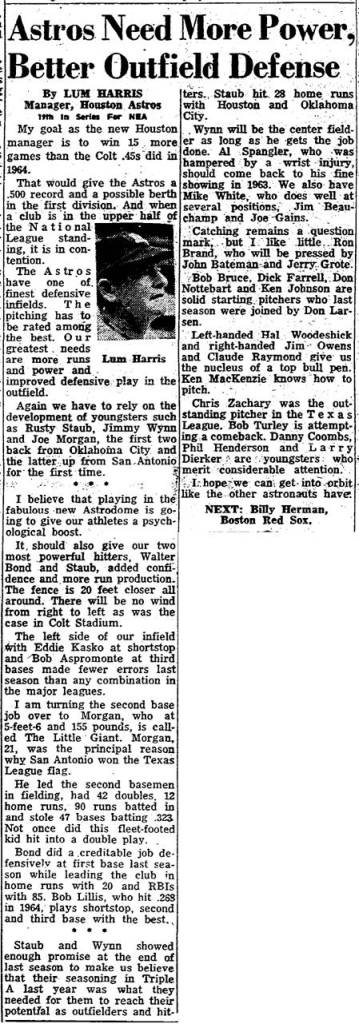
“My goal as the new Houston manager of the Houston Astros is to win 15 more games than the Colt .45s did in 1964,” said Luman Harris 19th in a special pre-season managerial series of articles for NEA that went to print on April 9, 1965 in the Lexington (KY) Leader.

As things would turn out, the 1965 name and stadium-new Astros would be fated to winning one less game in 1965 than they had in 1964, in spite of their new future-oriented space identity, and regardless of their new and only-one-of-its-kind digs in the world’s only indoor-covered and air-conditioned baseball park.

In keeping with the hoped-for progress goal for 1965, Manager Harris’s expressed number, had it been achieved, would’ve propelled the Astros to 81-81, their first non-losing season, and a good shot at a first division NL finish. As fate dealt it out, however, the ’65 Astros would finish with one less win in 1965. At 65-97, the Astros were good enough only for a 9th place spot above the last place New York Mets at 50-112.

Elements of a Baseball Franchise Culture

1) an ownership that truly embraces the idea that winning the World Series is their shared destiny with the community;

2) an ownership that puts its money where its mouth is, but does not use the threat of leaving to get what they want from the community;

2) a fan base that can both afford and will support an occasionally unreasonable attempt at securing destiny;

3) a baseball community that interfaces the owners and fans with the realty that they must work together;

4) bright minds who plan franchise growth through player development and free agent signings;

5) positive support from local government entities;

6) the presence of “winning” on the field in some early brief form, even if its flag is borne by the successful play of only one or two signature players, or the discernible presence of a team’s ongoing strong element, like pitching or defense;

7) a sense of fan pride or emotional attachment to the club’s mascot identity or ballpark facility;

8) a commitment by the team to giving back to the community in areas of ongoing or crisis need;

9) some kind of annual program that opens the door for the team and its fans to get together and celebrate their commitment to each other and the community at large;

10) a range of flexibility on the acceptance of fan cost increase as an expected result of destiny achievement and the salaries that will be required to keep success churning on the field;

11) a change in the franchise’s external image to other talented ballplayers who now see the first time and most recent World Series winners as potential destiny stops for them as well.

And the element list could go on and on, covering even larger and smaller points. In the ongoing, always shifting process, as the franchise’s baseball culture is put in motion, for better or worse, in service to the destiny of the game in that club’s area of concern.

So, what is culture, anyway?

Culture is the social system we learn from. It’s like the way we once grew up so differently, depending upon the lessons of our own little neighborhoods. Not all the elements we’ve referenced here are going to fit into the particular caricature of our own big league club culture – nor will they appear in a specific order.

Destiny Attained Opens Door to Destiny Defended

What we do see in the featured newspaper article that appears atop this column are the aspirant wishes of a new manager for greater winning, stronger hitting, and better defense. Understandably too. We went through all those early years with him and all other managers from our Astros’ earliest times. Better players. More wins. Ah, yes. We remember it well.

Now that destiny has been achieved, the goal simply expands to destiny-defend,

Our Houston Baseball Culture Grew

Unlike earlier ownerships in Florida and Arizona, Houston did not “buy” their way to a World Series trophy that could not be defended on a long-time basis by the same expensive talent. But now the Houston baseball culture has to deal with the fact that property values around Minute Maid Park are driving the cost of parking to games of the World Series Champion Houston Astros through the roof.

A Present Challenge to the Houston Baseball Culture

Two problems were ignored when Harris County, the City of Houston, and the Houston Astros made the decision in the late 20th century to build a new covered ballpark downtown that was just for baseball:

1) There was no long term plan put into place for the Astrodome; and,

2) There was no attempt to secure and control pricing of other commercial properties around the new ballpark that would keep independent property owners from using the club’s downtown success as an opportunity for profiteering at levels that could make the cost of a downtown game something that only the wealthiest fans could afford.

Now it’s 2018. The Houston Astros are the World Series Champions. And finding ways to curtail independent property owners around the downtown ballpark from making the family of four game trip cost too expensive for the average income dedicated Astros fans should be a priority problem to solve.


********************

Bill McCurdy

Principal Writer, Editor, Publisher

The Pecan Park Eagle

M Kates: 12 SABR Conventions, Part II

March 27, 2018

TOUR DE SABR: TWELVE SABR CONVENTIONS ROLLED INTO ONE

(Part II: 2008 to 2017)

By Maxwell Kates
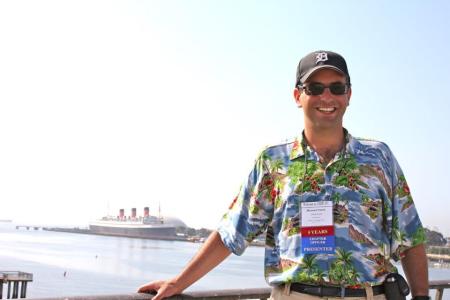
Maxwell Kates in Los Angeles

When we left off, we listened to a Louie DiPalma doppelganger spar with the Commissioner of baseball, relived the unlikely pennant drive of the 1977 Chicago White Sox, watched the Cincinnati Reds play in Ohio while standing in Kentucky, sang along with Jim Bouton, and lived to tell the tale of an ‘inhuman rain delay’ in St. Louis. On to Part II…

SABR 38 – Cleveland 2008 – The Vendor’s Room

Cleveland had one of the more memorable vendors’ rooms of the conventions I attended. Doak Ewing from Chicago sold audio cassettes of baseball broadcasts while Dick Miller from Cincinnati sold vintage baseball books, many of which were autographed. Meanwhile, Andy Rubin of Baltimore Chop offered a more contemporary selection of books. Different publishers had tables as well, including Maple Street Press, who had released “Sock It To ‘Em, Tigers” about the 1968 World Series champions the previous winter.

Noticeably absent from the vendor’s room was Bob Koehler. The retired teacher from Wisconsin was a mainstay at vendors’ rooms in the past. His collection included yearbooks, media guides, team publications, along with other books. If you bought something from Bob, he would tell you to “Give it a good home!”

Bob’s table was symbolically empty. He had died the previous April, age 67.

SABR 38: Bob Koehler

SABR 39 – Washington 2009 – Secular Pursuits

One of the advantages of changing cities every year is the opportunity to visit local tourist attractions that have nothing to do with baseball. I call these “secular pursuits” in the context of a SABR convention. In Washington, there were many opportunities to explore beyond the friendly confines of the J.W. Marriott Hotel. On Thursday evening, I took a walk on the Mall where young actors were re-enacting a Civil War battle in full regalia. On Saturday, my friend Bill Levenson and I went to the Smithsonian Zoo (we saw pandas) and to FedEx Field in Landover, Maryland to watch Paul McCartney perform in concert.

After the convention was over, Rick Schabowski from Milwaukee and I did our own walking tour of the Mall, stopping at several monuments including Lincoln, Washington, Jefferson, World War II, Korea, and Vietnam. It was a humid day, as Washington in August tends to be, and by 4:00 we realized that we had not eaten lunch. That’s when we stumbled upon Loeb’s Deli. They were about to close for the day but after we told them of our excursion in the Washington heat, they agreed to make us each a sandwich.

The next morning, the first words out of Rick’s mouth were “Loeb’s! Loeb’s!”

SABR 39: Nationals Game

SABR 41 – Los Angeles 2011 – Local Baseball History

The host committee of the SABR convention in Los Angeles organized a fantastic tour of five erstwhile baseball sites scattered all across the Southland. A quintet of Angelenos led by Al Parnis prepared history lessons on the five stadiums, each of them taught on location.

We departed the Long Beach Hilton at the crack of dawn Saturday for an industrial park in suburban Vernon, California. There was a time when Maier Park stood here. It was the home of the Vernon Tigers of the Pacific Coast League from 1909 to 1925. One of the Tigers’ investors was Buster Keaton. Next stop was the site of Wrigley Field, now a city park where a Mexican-American festival was in progress. Both the Angels of the Pacific Coast League and the American League called Wrigley home. Baseball is still played on a sandlot in the park but the magnificent edifice that Steve Bilko built is gone.

SABR 41: Ballpark Tour

After Wrigley, we travelled to the site of Washington Park, located in a parking lot around the corner from the Los Angeles Coliseum. From 1958 to 1961, the Dodgers called this Summer Olympics stadium home while the park at Chavez Ravine was under construction. The last stop of the morning was Gilmore Field, home of the Hollywood Stars from 1939 to 1957. After the ballpark was razed, CBS built its Television City on site. Among the televisions shows to have been filmed here, “All in the Family” and “The Price is Right.” Both Canter’s Deli and the Farmer’s Market were only steps away, keeping in mind that nobody in Los Angeles walks.

At one stage of the tour, Danny Kaye’s “The D-O-D-G-E-R-S Song” played over the loudspeaker on the bus. Three SABR members who shall remain nameless memorized every word, singing it at the top of their lungs. At another stage, it was announced that a rookie went 0-for-3 in his big league debut for the Angels the night before. His name, Mike Trout.

SABR 44 – Houston 2014 – Intangibles

What to write about Houston, knowing that a good complement of The Pecan Park Eagle’s readership attended this particular convention? That’s where intangibles come in. These are the events at any convention that could never have been planned and that you will never see in a program.

About a month before the convention, I attended a screening of “Deli Man” in Toronto. The film chronicled the decline of the delicatessen as a culinary genre. It also focused on the life and career of David ‘Ziggy’ Gruber, a New Yorker who moved to Houston to open a delicatessen called Kenny and Ziggy’s. I e-mailed a longtime friend in Houston about the proximity of the delicatessen from the Royal Sonesta Hotel where the convention took place. His name is Mark Wernick. Considering that Mark and I share a similar ethnocultural background, it stands to reason that we both grew up in delis. Here is my recollection of the conversation that ensued.

SABR 44: Mark Wernick

Me: Wonder how expensive a cab ride it would be to travel to Kenny and Ziggy’s from the hotel?

Mark: Well you know, Houston’s a big place. In fact, all of Israel could fit inside Harris County. Could be an expensive trip just for a sandwich.”

Me: Do you think it would be $100.00?

Mark: Could be. And then you’d have to get back. Tell you what. Why don’t you give me the $100.00 and I’ll drive you there from the convention.

I had a feeling this was Mark’s sense of humour at work. On my first day of the convention, I went for a walk around the hotel looking for a place to eat. Good thing I didn’t take Mark up on his offer – Kenny and Ziggy’s was located right behind the hotel!

Hold on, I have to include one more story because it’s Houston. My cab ride back to IAH was shared with Damian Begley from the New York chapter of SABR. Damian regaled us with stories about the broadcast industry in the Big Apple while discussing his favourite songs growing up in the 1960s. With his Bronx affectation and his Irish brogue, we could have been listening to Regis Philbin!
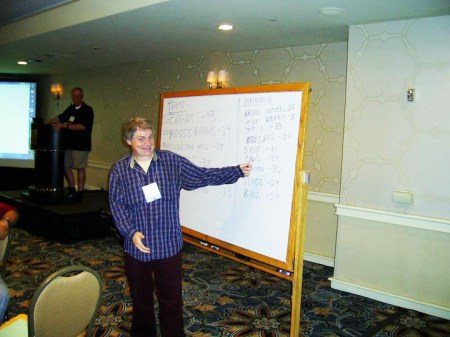
SABR 44: Damian Begley

SABR 46 – Miami 2016 – Meeting Childhood Heroes

The centre piece of the 2016 convention in Miami was a feature at Marlins Park. Hours before the game between the Marlins and the St. Louis Cardinals, SABR hosted “A Day at the Ballpark” with Barry Bloom. Guests of the program included Don Mattingly, Barry Bonds, Andre Dawson, and stadium engineer Claude Delorme. Also as part of the afternoon, Marlins broadcaster Eduardo Perez interviewed his father, Tony Perez.

Growing up a Montreal Expos fan in Ottawa, Andre Dawson was one of my favourite players. I still remember the game I attended on Father’s Day versus the Cubs. With two runners on and nobody out, the Hawk strode to the plate. My own father advised me to “watch this guy – he’s the best player in baseball.” He cranked the first pitch he saw past the centre field bleachers for a three run home run.

Barry (Bloom, not Bonds) advised me that since the players were on the field and we were in the stands, our chances to meet them were slim. Still, I had an idea. I got on the first bus to the ballpark and sat as close to the front as possible. When Dawson was finished his interview, I scribbled something on my business card and gave it to a stadium attendant. My instructions were to give the card with my scribbles to Dawson. When Dawson asked the attendant who gave him the card, he pointed in my direction. The ordinarily taciturn Dawson looked at me, offered an energetic thumbs up, and smiled.

SABR 46: Andre Dawson

POSTSCRIPT

Why go to SABR conventions? To recap, here are eleven reasons:

  1. Keynote Speeches (SABR 31 – Milwaukee 2001)
  2. Research Presentations (SABR 32 – Boston 2002)
  3. Baseball Games (SABR 34 – Cincinnati 2004)
  4. Lasting Friendships (SABR 35 – Toronto 2005)
  5. Player Panels (SABR 36 – Seattle 2006)
  6. Ballpark Tours (SABR 37 – St. Louis 2007)
  7. The Vendor’s Room (SABR 38 – Cleveland 2008)
  8. Secular Tourism (SABR 39 – Washington 2009)
  9. Local Baseball History (SABR 41 – Los Angeles 2011)
  10. Intangibles (SABR 44 – Houston 2014)
  11. Meeting Childhood Heroes (SABR 46 – Miami 2016)

Now it’s time to bring it all home, saving New York City for last.

SABR 47 – New York 2017 – Bringing It All Home
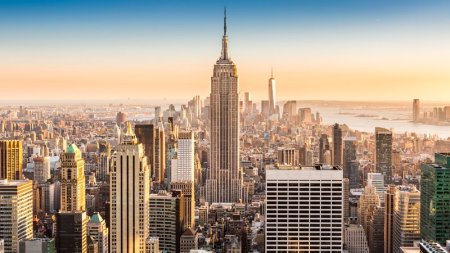
SABR 47: New York

One of the main speakers at the 2017 SABR convention was once again Jim Bouton. The author of “Ball Four” and other baseball books had an entire panel in his honour. Moderated by John Thorn, the panel also included authors Marty Appel, Mark Armour, Mitchell Nathanson, and Bouton’s wife, Paula Kurman. That day, Tyler Kepner wrote in his New York Times column that Bouton had been suffering from a rare form of dementia for the previous five years. Part of the objective of the panel was to raise awareness for the illness.

By now, SABR was in its fourth year of insisting that questions at panels are submitted on cue cards. I submitted a question that did not pass this selection process. After the presentation was over, I went to Bouton, determined to ask him my question. As it were, hundreds of SABR members had the same idea I did, mobbing the Yankees old timer with autograph requests (and there was no car window for him to slam). It was obvious to anyone watching the scenario that it was overwhelming for Bouton.

Fortunately, I had a strategy. Before the panel, I spent enough time talking to Paula so that she would recognize me in a crowd of SABR bulldogs. When she spotted me, she pointed and bellowed, “Excuse me, everyone, this gentleman was next.” You don’t tug the mask off the old Lone Ranger and you don’t mess around with Paula. . I approached Bouton to inform him that “Larry sends his regards. Some friends and I had dinner with him last February in Houston.” I didn’t mention any last names, only identifying the person as ‘Larry.’ Then I asked Bouton if he remembered “the song.” Without skipping a beat, he went right to business.

“Harry Walker is the one who manages this crew

He doesn’t like it when we eat and fight and…something else

But when we win our game each day

What…on earth…can Harry say?

It makes a fellow proud to be an Astro!”

SABR 47: Jim Bouton

To “all yinz” who attend SABR 48, have a great time in the ‘Burgh. You won’t see me there but for those of you living in the Houston area, don’t be surprised to see me closer to home before calendar year 2018 draws to a close.


********************

finis.

job well done.

the pecan park eagle.


********************
Bill McCurdy

Principal Writer, Editor, Publisher

The Pecan Park Eagle


Goodness! Gracious! Great Balls of Orange!

March 26, 2018

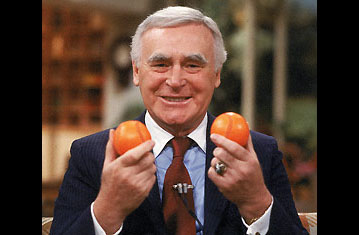
Charlie Finley Displays His Orange Balls

~ FRIDAY, APRIL 9, 1965 ~

Kansas City’s Finley “Saves” the Astrodome

CHICAGO – (UPI) –

Charles O. Finley turned into a rescue force for Houston’s Astrodome today.

He disclosed that his supply of orange baseballs were being shipped air express to the Houston Astros , after it was discovered yesterday that it’s almost impossible to see fly balls in the multi-million dollar Astrodome.

Finley had the orange balls made as an experiment over the past two years, but they have not won approval from either the American or National leagues.

~ Evansville (IN) Press, April 9, 1965

********************

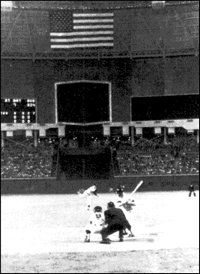
April 9, 1965: Mantle waits on a pitch from Turk Farrell. Later in the game, he would take Farrell deep for the first HR in Astrodome history.

HOUSTON CHRISTENS DOME

By Curt Block

UPI Sports Writer

That  $31.6 million domed Colossus, Harris County Domed Stadium, home of the Houston Astros, has every wrinkle in the book plus a few that need to be ironed out.

The stadium is absolutely ideal for night baseball and the Astros were never better than last night when they delighted a partisan crowd of 47,876 that included President and Mrs. Johnson, with a 12-inning, 2-1 victory over the American League Champion New York Yankees.

6th inning: Mantle waits on the pitch from Farrell that will be the first HR in Dome history.

Many in attendance were gazing toward the President’s box or gaping at the luxurious interior of the of the six level structure in the sixth inning when Mickey Mantle unloaded a blast that landed on top of the center field wall 406 feet from home plate for New York’s only run. (Unmentioned here, Mantle’s blast was the first home run in Astrodome history.)

Houston tied the score in their half of the (sixth) inning on an unearned run and won in the twelfth when pinch hitter Nellie Fox delivered Jimmy Wynn with a single.

The Astros played error-less ball while the Yanks committed three miscues.

Curt Block, UPI Sports Writer, El Paso Herald Post, April 10, 1965, Page 17.

********************

Great Balls of Orange.

It’s doubtful that Charlie Finley’s orange balls got any serious consideration as a solution to the massive sight-line problem for batted baseballs in the Astrodome during its 1965 original form. Problems of efficacy do not mix well for maverick club owners who get on the outs with both the Commissioner and the swamp of powerful owners who dislike those newbie folk who think they have an equally valued vote on things.

It’s still fun to imagine how differently the business of the game might have developed since 1965 had the original issue with day games been one that could have been solved with a simple switch to orange baseballs.

A tempest in a teapot rarely starts a house fire.


TPPE Note: Thanks to Darrell Pittman for the Charlie Finley article.

********************

Bill McCurdy

Principal Writer, Editor, Publisher

The Pecan Park Eagle


It’s Still the Same Old Story: Dome Sky ’65

March 25, 2018

Walt Bond of the Astros, left, awaits his turn in the batting cage during the club’s first workout in the club’s new domed stadium. Manager Lum Harris, right, and scout Larry Smith inspect the plant. (UPI Telephoto)

Astrodome Trouble

Thrown and Batted Balls Act Okeh, But Flies Are Problems

Houston – AP – The Houston Astros agree (that) a thrown and batted ball behaves in the $31.6 million dollar Harris County Domed Stadium about like it does outdoors.

But catching it can present a problem.

The Astros tested the multi-purp0se Stadium for the first time in force Wednesday with batting practice and an intra-squad game.

Sun Reflection

During the afternoon batting practice most of the Astros had trouble catching pop and fly balls as the sun penetrated the dome and reflected against the bright center field seats.

Another intra-squad game is scheduled this afternoon as the Astros want to familiarize themselves as much as possible with their new home before they introduce they introduce indoor major league baseball with a six-game Friday to Monday exhibition to league opening schedule.

Houston and the New York Yankees open the stadium Friday night and the Astros play Baltimore Saturday afternoon and Sunday night and the Yankees again Saturday night and Sunday afternoon. Houston and Philadelphia play the (NL) league opener on Monday night.

1st Houston MLB Game Foes in Astrodome, April 1965

Visitors   Fri Apr 09   Sat Apr 10   Sun Apr 11   Mon Apr 12
Day Game No Game Orioles Yankees No Game
Night Game Yankees Yankees Orioles Phillies *

* NL Season Opener for Astros

Trouble Tracking Ball

During the batting practice, the players had trouble tracking the ball against the grillwork of the skylights and girders of the roof.

General Manager Paul Richards, and Field Manager Luman Harris both said they felt that the matter could be settled without difficulty.

Richards said that the lights would be turned on for the intra-squad game this afternoon.

“I think it will be all right,” he said.

Harris termed it a minor problem and added:

“If everyone had been wearing sunglasses, there would have been no problem.”

After noticing several veterans, such as Nellie Fox, now a coach, misjudge the ball several times, Richards asked newsmen:

“How many day games do we have?”

He was told there will be 21 games, 18 starting at 1:30 p.m., CST, and three at 3:15 p.m. CST.

“I didn’t realize it was that many,” he said.

Only four day games were played in the temporary (Colt) stadium last year because of the heat.

“You are going to have to watch it close at this time (4:30 p.m.) of day,” he said.

Club officials has said it may be necessary to keep the arc lights on even during afternoon games.

Many of the Astros wandered around the new stadium like it was a museum.

Catcher Ron Brand called it “fantastic”, but he added “it may be hard to catch a fly ball.”

“Any outfielder who catches  fly ball should get a $50 dollar raise,” recommended pitcher Ken Johnson.

Hal Woodeshick

“Does your curve ball really break, Woody?” someone asked pitcher Hal Woodeshick.

“I don’t know,” answered the honest southpaw. “I ain’t got a curve ball.”

… an AP article from the Sacramento Bee, April 8, 1965, another wonderful contribution to The Pecan Park Eagle by our good baseball friend, Darrell Pittman. – Thanks again, Darrell. Without the 1965 AP article you sent us, this column would not have been possible.

********************

TPPE Notes: It may always be the same old story to those of us with ancient roots to Houston Baseball, but there’s a whole world out there, including some who live among us on the Texas Gulf Coast who could stand to learn more about how those first ball sight issues let inadvertently to commercial and cultural changes that made the historic significance of the Astrodome even more important to the world than it might otherwise have become. Keep your eyes open over the next year or two. One of our best local baseball writers is working on a new contribution to the Astrodome story.


********************

Bill McCurdy

Principal Writer, Editor, Publisher

The Pecan Park Eagle


Bill Gilbert: 2017 Offensive Productivity

March 24, 2018

Who Were the Most Productive Offensive Players in 2017?

By Bill Gilbert

With the 2018 baseball season starting next week this is a good time to take a look back at who were the most productive players in 2017.

Numerous methods have been devised to measure offensive performance. The most common are batting average, on-base percentage and slugging average. Since none of these averages provides a complete picture by itself, a more comprehensive measure of offensive performance is useful. Such a measure would include the following elements:

  1. The ability to get on base.
  2. The ability to hit with power.
  3. The ability to add value through baserunning.

The first two elements are measured by on-base percentage and slugging average. A measure of offensive performance, which encompasses both as well as baserunning achievements, is Bases per Plate Appearance (BPA). This measure accounts for the net bases accumulated by a player per plate appearance. It is calculated as follows:

BPA = (TB + BB + HB + SB – CS – GIDP) / (AB + BB + HB + SF)

Where: BPA = Bases per Plate Appearance

TB   = Total Bases

BB   = Bases on Balls

HB   = Hit by Pitch

SB   = Stolen Bases

CS   = Caught Stealing

GIDP = Grounded into Double Plays

AB   = At Bats

SF   = Sacrifice Flies

The numerator accounts for all of the bases accumulated by a player, reduced by the number of times he is caught stealing or erases another runner by grounding into a double play. The denominator accounts for the plate appearances when the player is trying to generate bases for himself. Sacrifice hits are not included as plate appearances, since they represent the successful execution of the batter’s attempts to advance another runner.

BPA Table, 2013-2017

YEAR BPA .550 .600
2003 .461 42 15
2004 .468 33 18
2005 .456 34 13
2006 .470 46 14
2007 .463 34 15
2008 .458 41 11
2009 .461 42 16
2010 .446 19 7
2011 .442 25 7
2012 .447 12 5
2013 .440 14 3
2014 .426 9 4
2015 .440 20 6
2016 .456 23 7
2017 .466 36 12

Offensive production peaked in 2000 before declining in the early years of this century. BPA declined significantly from .481 in 2000 to .426 in 2014 before significant upticks in the last three years.

In the 1990s, there were 14 individual .700 BPA seasons. In the eight year period from 2000 to 2007, there were 18. The highest BPA in the 1990s was recorded by Mark McGwire in 1998 (.799). Barry Bonds shattered that with .907 in 2001, the highest figure ever recorded, topping Babe Ruth’s best two years (1920 and 1921). Bonds followed that with .869 in 2002, .818 in 2003 and .882 in 2004. There had not been any hitters with a BPA of .700 since 2007 until Mike Trout did it in 2017.

 The .700 BPA seasons in 2000-2017 are listed below:

Player   (Team & Year)     BPA

Barry Bonds (San Francisco 2001) .907

Barry Bonds (San Francisco 2004) .882

Barry Bonds (San Francisco 2002) .869

Barry Bonds (San Francisco 2003) .818

Sammy Sosa (Chicago Cubs 2001) .758

Barry Bonds (San Francisco 2000) .745

Jim Thome (Cleveland 2002) .728

Manny Ramiriz (Cleveland 2000) .726

Todd Helton (Colorado 2000) .720

Mike Trout (LA Angels 2017) .718

Luis Gonzalez (Arizona 2001) .713

Todd Helton (Colorado 2001) .709

Carlos Delgado (Toronto 2000) .707

Larry Walker (Colorado 2001) .707

Jason Giambi (Oakland 2000) .706

Travis Hafner (Cleveland 2006) .703

Alex Rodriguez (NY Yankees 2007) .702

Jason Giambi (Oakland 2001) .700

Ryan Howard (Philadelphia 2006) .700

The yearly leaders since 1992 are as follows:

1992 Bonds     .734

1993 Bonds     .740

1994 Bagwell  .768

1995 Belle        .692

1996 McGwire .765

1997 Walker  .770

1998 McGwire .799

1999 McGwire   .735

2000 Bonds  .745

2001 Bonds  .907

2002 Bonds .869

2003 Bonds .818

2004 Bonds .882

2005 D. Lee .699

2006 Hafner   .703

2007 A. Rodriguez .702

2008 Pujols   .685

2009 Pujols   .696

2010 Bautista .671

2011 Bautista .681

2012 Trout .665

2013 C. Davis .670

2014 Trout .623

2015 Harper .694

2016 Trout .681

2017 Trout .718

The benchmark for an outstanding individual season is .600. Following is a list of the twelve players with enough plate appearances to qualify for the batting title and with a BPA of .600 in 2017. The list is topped by Mike Trout of the Los Angeles Angels with a BPA of .718, the fourth time he has finished in front. He has had a BPA over .600 in all five years that he has played a full season.

Bases per Plate Appearance (BPA) of .600+ in 2017

————————————————-

No. of 2017-2016 .600+ Player

BPA   BPA LG Seasons Comments            _________

# Player 2017 BPA 2016 BPA LG .600+ Years Comments
1 Mike Trout .718 .656 AL 6 On Top Again.
2 Aaron Judge .681 .274 AL 1 Do it again?
3 G. Stanton .659 .533 AL 4 Should thrive as NYY.
4 Joey Votto .641 .606 NL 6 Also 6th OBP Lead.
5 C. Blackmon .640 .597 NL 1 Breakout season.
6 Cody Bellinger .631 —- NL 1 Set NL rookie HR mark.
7 F. Freeman .630 .616 NL 2 Best season yet in 2017.
8 P. Goldschmidt .625 .587 NL 2 The D-Backs Do-it-all.
9. Joey Gallo .613 .333 AL 1 Home Run or Bust!
10. Jose Rameriz .612 .509 AL 1 Fast Lane Superstar!
11. Jose Altuve .601 .576 AL 1 First time over .600.
12. Kris Bryant .600 .611 NL 2 Already a ROY & MVP.

The increase in the number of players with a .600 BPA from 7 to 12 reflects the increase in overall offense in 2017. Near misses were Zack Cosart (598), Justin Upton (595) and Anthony Rendon (595).

Three players had a BPA over .600 in 2016 but failed to reach it in 2017.

No. of

2016   2017     .600+

   Player           BPA  BPA LG Seasons Comments            

1 David Ortiz     .631 —-  A   6   Retired on top.

  1. Daniel Murphy   .612   .560   N   1  Fell short of 2016 career year.
  2. Josh Donaldson .609 .617 A  2   Not enough plate appearances to qualify.

Two active players have a BPA of .600 for their careers:

2017         Career

Player            Age            BPA           BPA   Comments

————-      —     —-       —- —————————

Mike Trout           25      .718       .648   Leader by far.

Joey Votto           33    .641       .603   No sign of decline yet.

Another list of interest is of players with a BPA of over .600 in 2017 who did not have enough plate appearances (502) to qualify for the batting title.

Player           Age BPA   PA   Comments

————— —  —- —   ————————–

Rhys Hoskins     24 .684 212   Mid-season rookie sensation

J.D. Martinez   29 .679 489 Spectacular in Arizona.

Matt Olson     23 .667 216   Hit 47 homers between majors and minors in 2017.

Bryce Harper     24 .622 492   Has never reached 100 RBIs.

Josh Donaldson   31 .617 496   Consistently productive.

Martinez, Harper and Donaldson fell just short of the 502 plate appearances needed to qualify.

Looking at the other end of the spectrum, five players who earned enough playing time to qualify for the batting title had a BPA less than .400 in 2017. This list has shrunk each year from 25 players in 2014 to only five in 2017 reflecting the increase in offense.

Player         Age   BPA Team    Comments                                                                                                     ————–   —  — —-     ———————

Albert Pujols   35 .385 Angels   On .600 BPA list eight times.

Dansby Swanson 23 .381 Braves  Sophomore slump

Alex Gordon     33 .380 Royals   Where did the offense go?

Jose Peraza     23 .375 Reds     Has trouble getting on base.

Alcides Escobar 30 .347 Royals  No stranger to this list.

Four players had a batting average over .300, an on-base average over .400, a slugging percentage over .500 and bases per plate appearance over .600 in 2017.

Player             BAVG       OBA       SLG       BPA      OPS

Mike Trout         .306     .442     .629     .718    1.071

Joey Votto          .320      .454     .578     .641     1.032

Freddie Freeman      .307     .403     .586     .630     .989

Jose Altuve      .346     .410     .547      .601       .948

Trout and Votto have these numbers for their careers.

Mike Trout–Career   .306     .410     .566     .648       .976

Joey Votto-Career   .313     .428     .541     .603       .967

Trout did not lead counting categories like home runs and RBIs because he missed 48 games with an injury. However, he led the American League in important rate stats like OBA, SLG, OPS and BPA, He was clearly the best offensive and all-around player in the Major Leagues in 2017.

Bill Gilbert

3/23/18

Source of statistics used in this report is the “Lee Sinins 2018 Complete Baseball Encyclopedia”.


*******************

Bill McCurdy

Principal Writer, Editor, Publisher

The Pecan Park Eagle
Worm Burners and The Wheel of Destiny

March 23, 2018

Worm Burners: In baseball, these are hard batted balls that come slamming back through the infield with such low even force that they hardly bounce, if at all, and they are moving rapidly through the upper root-level of grass and sod at a base adjoining point with such high frictionally ignited energy that they actually heat the temperature of the subsurface areas to the level that may be needed to sunburn the backs of any worms that may be fatefully wiggling by just below them in the same time and space arena of efficacious configuration as one more example of how the interactive wheel of destiny rarely sleeps in any baseball game worth playing or watching. At least the worms get it, even when our game governing officials do not.

Post-Definition Comment: Baseball may someday shorten a few games by starting extra innings with a second base runner, but that will only cheapen the game, not destiny. – Destiny deprived simply invites a fate to things that would not otherwise be possible on merit. And the ones we invite at the expense of destiny’s preference for the options of competitive play in high drama shall be sacrificed for the quicker pace of boredom by the fateful outcome to the runner who had no earned right to second base in the first place. Even if that runner scores as the subsequent result of a good old-fashioned worm burner, the game will never be the same again.

*******************

Bill McCurdy

Principal Writer, Editor, Publisher

The Pecan Park Eagle