The Yankees Are the Fast Lane!

November 6, 2009

babe & lou Speaking of the Yankees, the “27th Heaven” version gets their ticker tape parade down Broadway today as the rest of go through baseball withdrawal until spring.

Andy Pettitte, Derek Jeter, and Jorge Posada appeared together on David Letterman’s Show last night, giving the host a chance to lay one in there on Andy for going back to Houston for a while (2004-06). “Andy,” Letterman said, “I believe you left New York for a while to go home and work in a Dairy Queen. Isn’t that right?” Everyone, even Andy,  had a big laugh over that line, but then he answered, still sort of sheepishly: “That’s right, Dave, but at least while I was back there at the Dairy Queen, I got to go to another World Series.”

See there? That’s exactly one of the points I was hoping to make yesterday, all rolled up in a single object lesson: Our Houston Astros’ National League pennant of 2005 may have just been a big night at the Dairy Queen for big celebrities like David Letterman and Andy Pettitte, but it was a pretty big deal to those of us Houston rubes who waited nearly a half century to see it happen here for even once. Now the tally stretches even further through 2009. In 48 seasons of major league play (1962-2009), our Houston Colt .45s/Astros have made it to only one World Series. We’re still looking for our first World Series win – or even a game victory. The White Sox shut us out four games to none in 2005, remember?

The New York Yankees, on the other hand, got to the World Series for the first time in 1921, during their 18th opportunity of the games even being played. They lost that first one to the New York Giants, and again the next year to the same club. Once the Yankees tweeked the Giants, 4-2, in the 1923 World Series for their first  win on the big stage, things started to change. A rosary of rarely broken dynasties was being beaded for the future.

Four Years Later: The 1927 and 1928 Yankees put together back-to-back WS wins on the heels of a 1926 WS loss to the Cardinals. Ruth and Gehrig were the leaders of the pack.

Four Years Later: The 1932 Yankees return to win again as Babe Ruth calls his shot against the Cubs in Chicago.

Four Years Later: Starting in 1936, the first real dynasty begins behind Joe DiMaggio as New York wins four World Series titles in a row (1936-39).

Two Years Later: The Yankees take their first World Series title over the Brooklyn Dodgers in 1941, but then fall in the 1942 classic to the St. Louis Cardinals.

Two Years Later: The Yankees avenge their loss of the previous year, defeating the Cardinals in the 1943 games.

Four Years Later: The 1947 Yankees return to take another Series win over the Dodgers.

Two Years Later: The Stengel Dynasty hits town. The Yankees reel off five World Series titles in a row, from 1949-1953.

Three Years Later: After losing to the Dodgers in 1955, the Yankees return the universe to normal by recapturing the World Series championship from the Dodgers in 1956.

Two Years Later: The Yankees recapture the 1958 World Series from the Milwaukee Braves after losing it to the same club in 1957.

Three Years Later: The 1961 Maris-Mantle club blasts its way past the 1961 Reds after losing in seven to Bill Mazeroski and the Pirates in 1960. The Yankees also win again over the 1962 San Francisco Giants.

Fifteen Years Later: The 1977-78 Yankees pull out of the second  longest dry hole in their modern World Series history, defeating the Los Angeles Dodgers twice in back-to-back fashion. During this period, the Yankees had lost World Series contests in 1963, 1964, and 1976,

Eighteen Years Later: The big gulch finally ends when the 1996 Yankees beat the Atlanta Braves, four games to two. Along this neck of the journey, the Yanks made only one other World Series appearance, losing to the 1981 LA Dodgers in six.

Two Years Later: The Torre Boys return for three straight crowns over the 1998 Padres, the 1999 Braves, and the 2000 Mets.

Nine Years Later: The Yankees take the Phillies in six games as the world returns to normal, and fairly loaded in favor of the studs from New York City. This particular dry spell is marked by Yankee losses in the 2001 World Series to Arizona, and again in 2003 to Florida.

The whole point here again is numbers. Not only have the Yankees been to forty World Series and won twenty-seven, they don’t have to wait as long as most other teams to get another chance.

Wait? Long lines? No way! Once they got there that first time in 1921, 18 years has been tops on the dry spell run for the Yankees. Compare that to the Chicago Cubs. Their wait in line has now reached 102 years!
Why Many Fans Hate the Yankees!

November 5, 2009
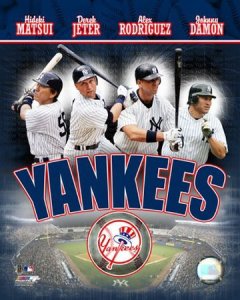
New-York-Yankees-Photograph-C12793347

The 27th Yankee Champions!

It’s part New York arrogance; part New York power; part listening to Frank Sinatra singing “New York, New York” after every Yankee home win; part watching Rudy Guiliani wearing that “NYFD/PD” cap to all the big games in honor of his own memory; part George Steinbrenner looking down from his suite with his arms folded under a grim quick-to-lash-out face; and frankly, it’s just a big part numbers. The reasons why many fans simply hate the Yankees is a subject we could hang with all day and still have plenty left open to talk about tomorrow.

The numbers side of it is big enough for us today as a toasty subject. Let’s consider a few takes on that side of things:

(1) The Yankees have now won 27 of their 40 World Series appearances.

(2) With 10 World Series wins, the St. Louis Cardinals are the only other club even in double digits.

(3) In the 105 World Series played since 1903. the Yankees have played in .38% of these events, winning .26% of all World Series played.

The numbers just go on from there to a point of total numbness. The Yankees are smart baseball people. They spend the most money on salaries and, possibly also on player development. They have the biggest ancillary system of other revenue streams from regional broadcasting and merchandise sales. They can afford adding any player they really want who becomes eligible to them through free agency. They produce the largest group of players who later become eligible for induction into the Hall of Fame at Cooperstown simply on the force of their sheer numbers with quality,

I don’t see another  franchise ever overcoming the place that the New York Yankees have established for themselves in baseball. And that call is right in there with the prediction that we”l never see  a second moon in the sky. It’s so obvious. Anyone else who wins the World Series has to do it in spite of the Yankees. They will not get there by overcoming the Yankees for very long.

Some things in life aren’t fair. They just are the way they are. The New York Yankees fit that description to a tee. Hate ’em if you choose. Beat ’em only if you try really smart and hard – and also happen to get lucky every once in a while.

Congratulations from Houston, New York. We”ll see you down the road one of these days. And we won’t roll over or run away when you come into sight. You’ll get our best Astros shot!

Dick Sisler’s Legacy.

November 4, 2009

For a couple of days now,  I’ve been battling a virus that has done everything justaYGrYANJ above turning me inside out. I still am hoping to get this article done before  I crash again. It will keep if I don’t, but it will be more timely to get it done now, while the World Series is still going on.
Two days ago, I made the kind of error in a story that I never used to make. I wrote that the Philadelphia Phillies reached the 1950 World Series in a playoff victory over the Brooklyn Dodgers on a late inning home run by Del Ennis.

Whoa! I was so wrong about something I usually know so well. And I should know it well. I was 12 years old and taking in baseball with all five senses back in those days. I even heard the big game played out on the radio because the last day of the season fell on a Sunday, October 1, 1950.

I guess I had a senior moment. We all make mistakes, but I probably never will recover from the aspect of my perfectionism that says, “Yeah, Bill, we all make mistakes, but that’s one you shouldn’t have made.”

I’m also interested in learning why we make certain mistakes. In this case, it’s pretty easy: When you get to be 72, don’t always trust your memory!

Enough said. Let’s get down to the business of historical rectification about a very important game played 59 years ago.

The big game had all the excitement of a playoff. It wasn’t. It was the last game of the season. The game was decided by a late inning home run, but it really wasn’t the Phillies long ball man, Del Ennis, who hit it. It was first baseman Dick Sisler, the son of the great Hall of Famer, George Sisler of the old St. Louis Browns, who lit his way into baseball history by slamming a 3-run homer in the top of the 10th that carried the Phils to their second National League pennant.

It was a season in 1950 that baseball genuinely relished back in the pre-playoff era. Back in those days, two runaway champions in both leagues made for a boring few weeks near the end of the season. Fans were just waiting for the season to end so the World Series could start.

Not so in 1950. The Yankees took a close pennant race over the Tigers, Red Sox and Indians in the American League. The National League race came down as a race to the wire between Philadelphia and Brooklyn.

A little background helps the story build-up here.

In 1950, the Phillies were coming off a run of 29 losing seasons in 30 between 1918 and 1948. After going 81-73 in 1949, they entered the ’50 season with bright hopes as the “Whiz Kids,” a nickname that flew off the page from their average player age of 26.

On September 20, 1950, the Phillies had a 7 1/2 game lead over the Dodgers. The the Phils proceeded to lose 7 of their next 9 as they went into Brooklyn for a final two games on September 30-Oct 1. Their lead over the Dodgers had shrunk to 2 games. A Dodger sweep could tie them with the Phils for 1st place and force a best 2 wins of 3 games playoff series for the NL pennant.

The Dodgers were pumped. The Phillies were exhausted. When the Dodgers won the Saturday game, 7-3, Brooklynites were salivating for more of that red Philly blood. The moment was electric – and a groundswell of Phillies fans trekked up  to Flatbush, both sensing their team’s need for support, and also  hoping to score a ticket for the big game. Most couldn’t find a ticket into the packed 32,000 capacity ballpark, but they hung around the streets, anyway, listening to the game on their radios.

The stage was set for melodrama – and the kind of baseball we will not see again due to changes in pitching philosophy over the past half century. The great Don Newcombe took the mound for Brooklyn in a face off against  future Hall of Famer Robin Roberts of Philadelphia. As you may have guessed, these guys dominated the day. Going into the bottom of the 9th at Ebbets Field, the score stood tied and tight at 1-1.

Cal Abrams led off the bottom of the 9th for Brooklyn. He reached 1st on a 3-2 pitch walk and then advanced to 2nd on a single to left center by Pee Wee Reese. Uh Oh! Here comes Duke Snider!

The Phillies played in, looking for a sacrifice bunt from the Duke under these circumstances, but the Duke fooled ’em. He lined a base hit to  center as Abrams took off, rounding 3rd and heading for home with the potential winning run. Because he was playing shallow, Ashburn made a perfect pick up and throw to the plate, where catcher Stan Lopata nailed Abrams for the 1st out, and preventing Abrams from scoring the pennant-winning run.

On the play at the plate, Reese raced to 3rd and Snider took 2nd, With the double play now off, the Phillies remained in the deep dew. The winning run was now on 3rd with only one out and Jackie Robinson was coming to the plate.

Roberts walked Robinson, loading the bases and setting up the double play.

Carl Furillo then hit a harmless pop fly to 1st baseman Eddie Waitkus for the 2nd out, but that still left room for Gil Hodges to play the assassin’s role as the next batter.

Hodges unloaded one, sending a deep fly ball to right center. Del Ennis pulled it in near the scoreboard for the 3rd out, sending the game into extra innings.

Pitcher Robin Roberts was the first scheduled batter in the top of the 10th. Are the Phils thinking pinch hitter? No way. Roberts bats and lines a single to left.

Eddie Waitkus failed to sacrifice Roberts to 2nd, but then he reached on a Texas Leaguer to center, with Roberts stopping at 2nd. The Phils had two men on with nobody out.

Ashburn tried to move the runners with a sacrifice bunt, but he pushed it too hard. Newcombe was able to make the play at 3rd, forcing Roberts. The Phils still had men on 1st and 2nd, with one out, and lefty Dick Sisler coming to the plate. On a 1-2 pitch, Sisler got good late wood on a fastball that took off for the opposite left field wall. The ball kept going as home crowd voices watched in startled shock. It landed in the left field stands for a home run and the Phillies were suddenly going crazy. They now led the Dodgers, 4-1!

The Phillies scored no more, but neither did the Dodgers. Robin Roberts went out and put them down quietly in the bottom of the 10th and the Phiilies were back in the World Series for the first time in 35 years, and for only the second time in their history.

Dick Sisler was the batting hero that day. No question about it.

Dick Sisler recorded only 55 home runs in his eight year major league career, but one of those blasts will be remembered forever, even by those of us who sometimes forget. My apologies, Mr. Sisler. I doubt I’ll ever forget you again.

1950: THE 1ST YANKEES-PHILLIES SERIES.

November 2, 2009

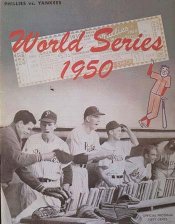
1950wsprogram My grandfather was a small town newspaper man. He founded and ran the Beeville (TX) Bee back in 1886 until his death in 1913. When he started, he counted a lot upon readers sending in local news to fill in some column space, but he also never gave up his eye for the fact that anything that wasn’t timely wasn’t news.

Back in 1889, when Grandfather Will McCurdy was only 23, some readers in Port Lavaca sent him a write-up on their Christmas celebration. Trouble was, Grandfather Will received the story only two weeks prior to the following Easter Sunday. It led Grandfather to the obvious conclusion that “old new was not news.” All he could do was try to explain to his contributor/consumer readers why the article would not appear.

“The Bee is sad to report,” Will McCurdy wrote, “that the story of how Port Lavaca celebrated Christmas will not appear on the pages of our little weekly newspaper. Although we appreciate the effort, we need our contributors down in Port Lavaca to keep in mind this fact: The hoary hand of time has quite a different effect upon local news than it does upon wildcat whiskey. – Local news does not get better with age.”

With my grandfather’s advisory in my mind, I thought I’d better get about my intended business of writing a short story on the first 1950  Yankees-Phillies World Series before the current New York bullies make history out of the 2009 Phils. Down three games to one now, the Phillies face the tall order of needing to defeat the Yankees three games straight to fulfill their hopes for a second straight World Series crown. That isn’t likely now, especially with the last two games, if needed, coming in New York. Of course, if the Yankees win tonight in Philly, it’s all over.

In 1950, the New York Yankees and the Philadelphia Phillies met for the fist time in the World Series. Back then it was the Yankees seeking their second World Series win in a row and their 13th World Series victory in 17 total appearances. For the ’50 Phillies. it was then a search for their first World Series victory in only their second appearance in baseball’s big show. The 1915 Phillies lost their only previous World Series in five games to Babe Ruth and the Boston Red Sox.

Robin Roberts 2

Robin Roberts: One of Several Future Hall of Famets in the 1950 World Series.

In 1950, Eddie Sawyer was in his third season as manager of the Phillies. A guy named Casey Stengel was in his second full season as manager of the Yankees.

Because Roberts had pitched in three of the last five games of the regular season, he was unavailable for the Series opener on October 4th at Shibe Park in Philadelphia. Sawyer surprised the baseball world by starting 33-year old relief ace Jim Konstanty in the Series opener against Stengel’s choice, 31-year old ace right hander Vic Raschi (21-8, 4.00). Konstanty had appeared in 74 games in 1950, but only in relief, on his way to 22 saves in a tight-inning stopper role – and long before baseball ever used the term closer.

Game One: NY 1 – PHI 0 (Shibe Park, 10/04/50). Konstanty did OK, but Raschi did great, giving up only 2 singles in a 9-inning complete game pitching victory. Konstanty worked 8 innings, giving up the only run of the ball game in the top of the 4th. After Bobby Brown doubled to lead off the 4th, he moved to 3rd and then came home on flies by Hank Bauer and Gerry Coleman.

Yankees led the Series, 1-0.

Game Two: NY 2 – PHI 1 (Shibe Park, 10/05/50). 31-year old right handed Allie Reynolds (16-12, 3.74)  of the Yankees squared off against 24 year-pld  righty Robin Roberts (20-11, 3,02) of the Phillies. Both men each pitched complete games in a 10-inning contest that ultimately was decided by a solo shot homer off the bat of the great Joe DiMaggio.

Yankees led the Series, 2-0.

Game Three: NY 3 – PHI 2 (Yankee Stadium, 10/06/50. Please note too the absence of a travel day off as the 1950 world Series moved the short distance from Philadelphia to New York. Also note what you cannot see. All these games were played in the daytime –  and they were played during an era in which no one had even heard the phrase, pitch count). Game 3 shaped up as a battle between two lefty “wheez kids” as 35-year old Ken Heintzleman (3-9, 4.09) took the mound for Philadelphia against 32-year old Eddie Lopat (18-8, 3.47).  Old man Heintzleman did pretty well until late in the day. He had a 2-1 lead over Lopat and the Yankees, but he got into trouble after two outs in the bottom of the 8th by walking the next three batters he faced. The usually sure-handed shortstop Granny Hamner then booted a routine grounder off the bat of Bobby Brown to let the tying run score. The Yankees got no more, but Heintzleman was gone as the Phillies seemed to deflate over New York pulling into a 2-2 tie.

In the bottom of the ninth, and with reliever Russ Meyer now pitching for the Phils, Gene Woodling scored from 2nd base on a single by Gerry Coleman to end the game and put the death rattle on Philadelphia hope. Meyer took the loss for Philly; Tom Ferrick got the win in relief of Lopat.

Yankees led the Series, 3-0.

Game 4: NY 5 – PHI 2 (Yankee Stadium, 10/07/50). 24-year old right handed Bob Miller (11-6, 3.57) carried one last Phillies shot to the mound against 21-year Yankee rookie sensation lefty Whitey Ford (9-1, 2.81.) New York jumped Miller for two runs in the first, driving him from the mound after only one out in favor of Jim Konstanty. Mr. K. settled things down, but Mr. Ford blanked the Phils for most of the day. A home run by Yogi Berra and a triple by Bobby Brown in the 5th tallied three more NY runs, effectively icing the game at 5-0.   Ford ran into a little trouble in the 9th, giving up 2 runs that led to his removal with two outs in favor of Allie Reynolds. Reynold struck out Stan Lopata with two men on base to end the game and the Series.

Yankees won the 1950 World Series, 4 games to 0, over the Phillies.

If the Yankees also win the 2009 World Series, their overall record will be 27 World Series championships in 40 World Series appearances. If that becomes the case, the Phillies will drop to 2 World Series titles in 7 World Series tries.


My Eight Great Favorite “BOO” Movies!

October 31, 2009
kevin-mccarthy2

BODY SNATCHERS STAR NOW AGE 95!

HAPPY HALLOWEEN!

In celebration of our annual fright day, and in recognition of the fact that I really have no better ideas cranking up this fine fall Saturday morning, here’s a list of my eight all time favorite fright flicks:

(8) Abbott and Costello Meet Frankenstein (1948). Not all that scary, but very funny for its time. The great comedy team takes on Frankenstein, Dracula, and the Wolfman – and comes out alive.

Favorite Lines:

Lawrence Talbot: “Every night the full moon rises, I turn into a wolf!”

Lou Costello: “Don’t worry about it, Mr. Talbot. That same thing happens to about a million other guys!”

(7) Dracula (1931). Hard to beat the classic Bela Lugosi portrayal of the living dead man from Transylvannia whose restlessness at home leads him to England, where life really sucks!

Favorite Line:

Renfield (at dinner): “Aren’t you drinking?”

Count Dracula: “I never drink ……. wine.”

(6) King Kong (1931). Big money attracts big ape to New York, where he undergoes a major fall. Until he met Kate Hudson, it was sort of the Alex Rodriguez Story.

Favorite Line:

Policeman (examining dead ape)” “Well, Denham, it looks like the aeroplanes got him!”

Carl Denham (ape tour promoter): “It wasn’t the aeroplanes. … ‘Twas beauty that killed the beast!”

(5) Night of the Living Dead (1968). Zombies rise from the grave and go on a flesh-easting binge.

Favorite Line:

(Male Companion to Lead Character Barbra in Cemetery): “They’re coming to get you, Barbra!”

(4) Young Frankenstein (1974). Grandson of infamous doctor returns to his family’s native soil to complete his ancestor’s work on the restoration of new life in a human body parts chop shop.

Favorite Line:

Young Dr. Frankenstein to porter at rail stop: “Pardon me, boy, is this the Transylvannia Station?”

(3.) Frankenstein (1931). The original treatment of Mary Shelley’s classic tale, starring Boris Karloff as the monster.

Favorite Line:

Dr. Frankenstein (upon noting that his restoration subject has slightly moved): “It’s alive! …. It’s alive! … It’s alive!”

(2.) The Blob (1958). Long before national healthcare, an amorphous red blob substance from outer space attempts to devour the world.

Favorite Line:

Police Chief (after the blob has been frozen into a still living, but harmless inert state): “We’ll drop it someplace where it will stay frozen, someplace like the north pole.”

Steve McQueen, teenage hero: (Are you listening Al Gore?): “Let’s hope the north pole never does thaw out!”

(1) Invasion of the Body Snatchers. Seed pods fall from outer space and start transforming human life into a race of people with no emotion about anything they day. As Dr. Miles Bennell, actor Kevin McCarthy takes on this menace in a desperate attempt to save the world.

Favorite Line:

Dr. Bennell to girl friend Becky: “If we are going to escape, we can’t show any emotion of any kind as we walk down the street. Otherwise, they’ll recognize us as a threat and do us in (something along those lines, anyway)!”

Becky (should’ve answered): “Miles, if we can pull this off, do you think we can get jobs workng for the government?”

BOOOO! AND HAVE A GREAT TRICK OR TREAT DAY!

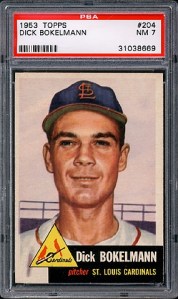
Houston Buffs: “Boke Knucklemann”

October 30, 2009
53Topps204Bokelmann

AKA (TO ME) AS BOKE KNUCKLEMANN!

Dick Bokelmann was Boke Knucklemann! When I was a kid, I tried writing fictional action stories and I always used real people as models for my heroes and main characters. That’s how former Buffs pitcher Dick Bokelmann got to be “Boke Knucklemann.” It happened during the red hot Houston Buffs championship season of 1951. Even though I only wrote for my eyes only, I somehow picked up on the idea that a writer couldn’t use an actual name of a real person in his writings, but that changing the name enough to capture the model’s identity without using his actual name made it OK.

Like his real life namesake, Knucklemann pitched for the Buffs, but when he wasn’t pitching, he was fighting crime on the streets of Houston – knocking out bank robbers with knuckle balls that he carried with him in a bag as his weapon of choice. Well, they weren’t exactly knuckle balls while they were still in the bag, but that’s what they were destined to become – once the good guy  “Bokeymann” got through throwing them.

Boke would run up on a robber coming out of a bank with his gun in one hand and his bag of loot in the other. Boke always stopped running toward his man once he got about 60′ 6″ away and then stare him down to a frightened halt. Then he would reach into his ball bag and pull out a weapon that he unleashed as a knuckler, one invariably heading straight for the robber’s face.

Long before Cassius Clay ever thought of it, these pitches of Boke Knucklemann carried with them the powers to both “dance like a butterfly and sting like a bee.”  I always tried to convey these ideas in my 13-year old descriptions of all those “good rallies past evil” moments of final redemption. Although I burned or threw away all my original stories long ago, the big moment always went something like this:

“Gypsy Joe Stalinovich stalled in the doorway of the First National Bank on Main Street as he saw the athletic figure of Boke Knucklemann racing toward him. As Boke stopped some short distance away, Gypsy Joe also froze, with his gun in the left hand and his bag of loot in the right. Coming toward him hard was a bobbing, weaving baseball, which his eyes attempted to closely follow in flight. Suddenly, with his peepers now crossed in locked tracking mode on the incoming white meteor, there’s a loud SPLAT sound as Joe takes it right between the baby blues! – Cartoon butterflies encircle the evil Gypsy Joe’s injured cranium as he falls face flat forward to the pavement for one of the easiest robbery arrests in HPD history. Gypsy Joe’s message is one he’d like to pass on to all other mean and evil Houston crooks: ‘The Bokeymann will get you if you don’t watch out!'”

So, folks, I got a lot out of watching Houston Buffs baseball back in the day, and, thankfully, I was realistic enough back then to spare the public my adolescent storytelling efforts. The point of sharing that literary history with you now is simply to make this point: Those guys weren’t merely my baseball heroes. They also were my inspiration for heroic central casting and my writing character models.

The real Dick Bokelmann was a good enough pitcher in reality to actually need no additional superhero alter ego. As a knuckle balling reliever for the 1951 Houston Buffs in 27 of the 30 games he worked, Bokie won 10 and lost 2 as he complied an incredible ERA of 0.74 over 85 innings of work.

Born 10/26/26 in Arlington Heights, Illinois, the recently turned 83-year old Dick Bokelmann posted a career minor league mark of 66-51, with a 3.21 ERA, from 1947-54. He spent four partial years with the Buffs (1950-53) while spending part of that same time with the parent club St. Louis Cardinals (1951-53). Bokie’s Cardinals/Big League mark was 3-4 with a 4.90 ERA.

It is also true that it was two men, Houston Buff knuckleballers Al Papai and Dick Bokelmann,  who prepared me to be a fan of Joe and Phil Niekro a few years later. It was an easy jump to make. I don’t think I’ve ever met a knuckleballer that I didn’t really like.Every one of them has been a remarkably individual and high integrity human being.

Who Is Brad Mills: Part 2?

October 29, 2009
20091027-143959-pic-994162072.preview

BRAD MILLS, HOUSTON ASTROS MANAGER, 2010.

Brad Mills was born on January 19, 1957 in Exeter, California. He played college baseball as a 6’0″, 195 lb. BL/TR infielder for the University of Arizona, from where he was then selected by the Minnesota Twins in the 16th round of the 1977 draft. He didn’t sign with the Twins and was later taken again, this time  in the 17th round by the Montreal Expos, in the 1979 amateur player draft.

In a five-season minor league career as a third baseman (1979-86), Brad Mills hit  .287 with 37 home runs. He marked his best year with the AAA 1981 Denver Bears, where he batted .314 with 12 HR. It was the only time he ever posted a plus .300 average and double digit homer figures over the course of a full season.

In limited major league service with the Montreal Expose over four seasons (1980-83), Mills batted .256 career with only a single home run.

Brad Mills was traded by the Expos to the Astros on July 4, 1984 for outfielder Scott Loucks, but he never saw MLB service in Houston. Moving over from Indianapolis to Tucson, the Astros’ AAA farm team in 1984, Mills’ offensive production dropped remarkably. He played another unproductive year for Tucson in 1985 and then finished his active career playing with Iowa in the Cubs’ farm system in 1986.

Brad Mills began his five-season (1987-90, 2002) minor league managing career in the Cubs farm system the following season. He didn’t set the  woods on fire in those five years, but he did finish with a winning record of 334 wins, 296 losses, and a .530 plus side winning percentage.

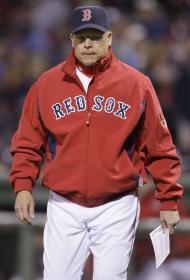
From there, Brad Mills has built a quiet, but glowing reputation and record as the bench coach of Terry Francona, first at Philadelphia, and since 2004 through 2009 at Boston. He was the man who helped Terry Francona lead the Boston Red Sox through the end of the Curse of the Bambino with two World Series victories in 2004 and 2006. He now comes to Houston with highest praise from Francona as an organizer and communicator.

Let’s hope that Mssrs. McLane, Smith, and Wade have just captured lightning in a bottle through the hiring of Brad Mills as new manager of the Houston Astros.

While we’re hard at hoping, let’s also try to hold the reins on our expectations that Brad Mills, or any other manager, could or will be able to fast-track the Astros to a pennant next year in spite of the talent depletion reality that now exists. Mills will have his hands full building a relationship of trust that will empower him to lead. It will remain up to McLane & Company to resolve the other, far-reaching issues.

Drayton McLane was quoted in this morning’s Houston Chronicle as saying, “We need to be where the Phillies are.” Unless I miss my guess, I’m counting fourteen other National League clubs who would probably offer the same sentiment. The difference-maker between those who get there and those who don’t simply reduces to these steps:

  1. Those who really want to be champions carefully study what champions do;
  2. Then they have to do some serious gut-checking: Do we have the will, the financial resources, and the administrative people in place we shall need to get the job done with a plan for success that will work for us in our town?
  3. Is a club willing  to commit to an overt plan for action without cutting corners on what is essential to long-term local success?
  4. And finally, if all these steps can be answered affirmatively, is a club willing, right now, to step forward forthrightly and “just do it.”

We fans can be terribly patient when we believe that a plan is in place to really deliver us to a World Series victory. In my book, hiring Brad Mills is a step in the right direction. Now let’s take the Phillies and Cardinals championship books and run with them into a plan that fits Houston.

A plan for similar success in Houston couldn’t look that that different. Could it?


Who Is Brad Mills?

October 28, 2009
77bfe38295_bradmills2_10202009

BRAD MILLS: FRESH EYE ON AGING TEAM CULTURE.

When the Houston Astros announced yesterday that Brad Mills would be the new field manager of the club in 2010, I was more than OK with it. I would have been all right with either Phil Garner or Dave Clark too, but both of those guys, especially Garner, were insiders to the organization and may have suffered already from one condition that the new manager is going to have to deal with next season, one way or another. It might have been a lot harder for Phil Garner, whom many of the current players already know well from his very recent tenure as the most vertically successful manager in Astros history. Dave Clark may have had a better shot at it, but even Dave has already suffered from being the interim manager for what, eighteen games at the tail end of this past awful 2008 season? It wasn’t the kind of formula for imbuing a man with much authority on the near future screen and scheme of things.

The “it” factor here is the influence of certain key veterans upon the rest of the team as producers and clubhouse politicians. I’m talking here about the impact of Lance Berkman, Carlos Lee, and Roy Oswalt. What each of these stars do, and fail to do, matters greatly. These guys can lead the younger players to get behind a manager from the start – or they can just as easily, no matter how subtly they do it, send out a message of disrespect for a manager that spreads like a virus. And why not? After all, this has been “their” club for years – and they’re the guys who get paid the big bucks to make Houston a champion. Brad Mills may have played some third base, but he was no Mike Schmidt. Who is he to tell anybody in this family what to do?

Our Houston stars didn’t invent that dynamic. The resistance of elitists to control by others viewed as less qualified by talent and tenure is as old as the proverbial hills. It goes way back and way beyond baseball as one of the great destroyers of aspiring kingdoms and expiring dynasties. We just seem to have it at play in Houston baseball today, even though we’ve never won anything but a single National League pennant.

Let’s face it. The Houston Astros cannot win without good production from Lance Berkman, Roy Oswalt, and Carlos Lee. They also cannot win if these key veterans fail to support Brad Mills as manager. Everybody, including us fans, loses if Brad Mills doesn’t have a clue as to how important these three guys are to both team production and morale. Just as importantly, Brad Mills needs to come in with an honest strategy for gaining their confidence and support as early as possible. All three of these players are also smart guys – and should quickly see how important resolving this issue is to each of them and the club, as well. Pretending it doesn’t exist is both foolish and potentially fatal to future success in the National League.

That issue, my friends, is the one that 90% of the 2010 season now turns upon, in my humble opinion. Let’s all get behind Brad Mills and wish him and our Houston Astros the best outcome possible.

Houston Buffs: Black Mike Clark!

October 27, 2009

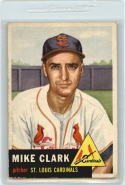
Mike ClarkWordWeb defines mediocre as (1) moderate to inferior in qualty; (2) lacking exceptional quality or ability; or (3) fair to middling in quality. This morning I may just as quickly have arrived at three ways of looking at my PC with its wonderful VISTA system, but I’m not. I’m really talking about an ancient baseball pitcher whose ability to rise above what his record said about his mediocrity to be the man on the mound in critical games was a critical memory for my once intense days as a kid fan of the Houston Buffs.

Such a rise-above-it-all man was righthander Black Mike Clark of the 1951 Houston Buffs. You’ve probably read my reference to him in an earlier piece I did on the ’51 club. Mke acquired his nickname from Buffs radio broadcaster Loel Passe, who picked up on the black glare and matching mound personality that burst forth from the deeply receding dark eyes of this mn who took control in so many critical games.

Mike was a stopper. Mike could start a game and stop a losing streak as easily as he could come in late and stop a rally. He had a good fastball, a tricky slow-breaking pitch, an ability to climb the ladder and work the corners, and a physical presence on the mound that just exuded that old gunfighter confidence that some guys show the world about themselves. Mariano Rivera has it today. Brad Lidge does not. Does that paint the picture clearly enough?

At crucial moments, Mike Clark was our Mariano Rivera.

Of course, back then, I wasn’t looking at Mike Clark as rising above the norm whenever he came to the Buffs’ needed rescue. At age 13, I just thought he was great – not  good as Mizell, but great in his own way, all the same.

Clark only posted a 10-7 win-loss mark in 1951, but his ERA was a very nice and light 2.78. I don’t have the information at my finger tips, but I’m willng to bet you that most, if not all his ten wins came in crucial, killer games, while most, if not all, the seven losses came in games that really didn’t seem to matter at the time.

Mike Clark’s second year with the 1952 Buffs was even more successful personally. At 9-5, with a 1.90 ERA, Clark was now pitching for a last place club, but still fnding the inspiration to give it his best shot. Clark’s ’52 Buff year came on the heels of an early season demotion from the parent club St. Louis Cardinals after he posted a 2-0 record there that unfortunately came with a 6.04 ERA.

In 1953, Mike Clark was again returned to Houston after going 1-0 with a 4.79 ERA at St. Louis. That second return of Mike Clark to the minors made me wonder: “What’s a guy have to do to be good enough to stick in the big leagues?” This answer came back in my own mind:  “I guess he has to be a lot more like Wilmer “Vinegar Bend” Mizell.” That made sense. Even I knew that Mike Clark was no Wilmer Mizell.

Mike Clark was only 2-2 with a 6.62 ERA for the floundering ’53 Buffs. The next season he went 13-9 with a 4.29 ERA for the champion ’54 club, but part of that record was achieved after the Buffs traded him to Beaumont, another Texas League rival.

Clark hung around the Texas League for another four seasons (1955-58) at Beaumont and Austin. He started the ’59 season with Dallas, one of the newly promoted Texas cities now playing in the AAA American Association. Dallas dealt him back to Houston, the other new AAA club, before season’s end, but Mike Clark’s career was done in ’59. With both Dallas and Houston, we was only 1-3 with a 3.66 ERA to retire upon. At age 37, Clark was done.

Signed by the St. Louis Cardinals as an amateur free agent prior to the 1940 season, an 18-year old Michael John Clark (DOB: 2-12-22) of Camden, New Jersey broke into pro ball with Class D Hamilton of the 1940 PONY League, where he spotted his first year with a not-much-to-write-home-about mark of 3 wins, 4 losses, and an inflated ERA of 7.77. He spent the heart years of World War II (1943-45) in the military, but he never gave up his baseball dream. Over the course of his 17-year career (1940-42, 1946-59), Mike Clark compiled a minor league record of 163 wins, 147 losses, and an ERA of 3.56. As a major leaguer, he finished undefeated at 3 wins and 0 losses, and with an ERA of 5.31.

According to Baseball Reference.Com, Mike Clark is still alive. And I think he still lives in New Jersey. At age 87, he remains one of the few unbeaten pitchers in major league history.

Eddie Dyer: Lots of Bang for Mr. Rickey’s Buck.

October 26, 2009

Eddie Dyer Iconic General Manager Branch Rickey of the St. Louis Cardinals had a three-pronged plan for helping himself. (1) He had a deal with club owner Sam Breadon. He got to keep a percentage of the net profits on the club’s operations, which meant, of course, that the less he paid out in personnel salaries, the more he got to keep for himself, as long as the club kept on winning. (2) He counted on the reserve clause and a loaded pipeline of talented players in the farm team system, players with no choice in baseball beyond the Cardinals, to keep him supplied with game-winning material. (3) He needed a few key people in the organization who were capable of doing more than one essential task at one time for the lowest salary he could work out with them for the price of a single employee’s salary.

Branch Rickey hit the jackpot when he met and signed a young pitcher/1st baseman/outfielder/baseball thinker/field manager/accountant/front office businessman named Eddie Dyer.

Born October 11, 1899 in Morgan City, Louisiana, Eddie Dyer’s family moved to Houston when he was still a kid, and he grew up among us as another “got here fast as I can” Houstonian with a talent and love for the game of baseball. After high school, he attended and played baseball at Rice, where he caught the attention of Branch Rickey and the Cardinals. This was around the same time that Mr. Rickey was surreptitiously taking control of the Houston Buffaloes for the Cardinals through a straw man purchaser for the sake of avoiding censure from Commissioner Landis, who thought that major league club control of minor league teams was bad for baseball.

Signed as a right handed pitcher, the Cardinals assigned Dyer to Syracuse of the International League to sharpen his skills.  Dyer’s progress was slow and mediocre. For the next five years, Eddie shuffled back and forth between the Cards and some of their top farm clubs, trying to break through as a more consistent winner. He seemed to be getting things together in 1927 when, again with Syracuse, he won his first six games before running into one of those life-changing events. An arm injury tagged Dyer with his first loss, but that was the small deficit. That 1927 arm injury ended Eddie Dyer’s pitching career.

From 1928 forward, Eddie Dyer became a Cardinals farm club manager, also continuing his playing career as an outfielder through the 1933 season he split between Greensboro and Elmira. Here’s where the Rickey touch/Dyer ability really started coming together. Wherever he went for the Cards as a manager, Dyer also served as business manager or club president – and all for the same money. What a deal!

In 1937-38, Eddie Dyer pulled leave as a manager, taking over in 1938 as Supervisor for Cardinal Farm Team Operations in the Southern and Southwestern Regions of the United States. He returned for three years (1939-40) as Manager of his home town Houstons Buffs . It turned out to be an impressively successful run, one that that would vault Dyer even higher up the Cardinal ladder of managerial plans in the years immediately following World War II. Dyer led the 1939-41 Buffs to three consecutive first place finishes in the Texas Leage, averaging 102 runs per season. His 1940 Buffs club also won the playoffs for the pennant, but then lost the Dixie Series to Nashville in five games. In 1942, Dyer moved up to the then AA Columbus (O) Redbirds of the American Association, finishing first and also winning the league pennant playoff series.

During World War II (1943-45), Dyer performed admimistrative duties for the Cardinals as Farm System Director in 1943 and then spent a couple of years (1944-45) taking care of his personal businesses in Houston. Then, when Cardinals Manager Billy Southworth suddenly departed St. Louis to take over the helm for the Boston Braves after the ’45 season, the wheel passed to Eddie Dyer to take over as Manager of the St Louis Cardinals in 1946. – What a timely move that turned out to be.

With all the big stars returning from military service, Eddie Dyer led the 1946 Cardinals to a first place tie with the Brooklyn Dodgers for the National League pennant. The Cardinals then took the flag by winning the first two games of  a best two of three games series with the Dodgers. They then faced off with Ted Williams and the Boston Red Sox in that “one for the ages” World Series in which Enos Slaughter’s “mad dash” run-scoring, game and Series-deciding tally from first base in Game Seven became one of the iconic moments in World Series history.

Dyer kept the Cardinals close again in 1947 and 1948, but lost out in the end as second place finishers to the Dodgers and Braves. When the Dyer-led Cards again narrowly missed in 1949, finishing only a game back of the Dodgers, things looked bleak. With Branch Rickey now guiding the Dodgers, the Cards no longer had the talent jam in their system that they once enjoyed. Dyer knew that too. He had worked every phase of the Cardinal operations over the years and really needed no “handwriting on the wall” to tell him what was coming soon. If anything, in fact, Eddie Dyer’s next actions were the writer of things to come for the St. Louis Cardinals.

After finishing the 1950 season in 5th place, Eddie Dyer resigned as manager of the Cardinals and retired to tend his considerable business interests in Houston. Dyer was involved in insurance, real estate, and oil. Marty Marion would take over as Cardinals Manager in 1951, but neither he nor any of the many who followed him would have the answer to winning it all again anytime soon. The Cardinals would not win another World Series until another Houstonian, Johnny Keane, got them there for that thrilling seven-game triumph over the New York Yankees in 1964.

Eddie Dyer’s retirement years in Houston were productive – and presumably content. Sadly, Eddie Dyer suffered a stroke in 1963 and then passed away in Houston on April 20, 1964 at age 65. Part of his legacy will live on as a tribute to Branch Rickey. The great Branch Rickey couldn’t have done it quite as renumeratively in baseball without the help he received from people like Eddie Dyer, but, of ourse,  it took a man like Rickey to recognize from early on what he had on his hands in the kid from Houston that he signed out of Rice (now University) Institute back in 1922.