Superdome Memories/Astrodome Regrets

January 10, 2012

As you know by now, Alabama took the BCS National Championship in Division 1 College Football last night in New Orleans by downing LSU in the Superdome, 21-0. It was a titanic defensive game, the kind that might destroy all future interest in the sport if all football games  played out like this one, but congratulations remain in order. The Crimson Tide held the “Greaux Tigers” to fewer than a hundred yards rushing on the night and only allowed them to cross the 50-yard line once late in the fourth quarter before pushing them back to stay. LSU QB Jefferson looked like a deer in the headlights most of the evening, leaving many of us to wonder why LSU Coach Les Miles didn’t consider trying the other QB guy, Lee, late in the game – if for no other reason than to see if changing something might help. Leaving things as they were wasn’t working, but Miles decided to  stay with the horse that died.

Congratulations to  Coach Nick Saban and the Alabama Crimson Tide!

About fifty years, or a working lifetime ago, I lived in New Orleans briefly after my masters degree work at Tulane, staying with the University as a member of the clinical faculty at the Department of Psychiatry and Neurology downtown near the present site of the Superdome. I left New Orleans in 1965, the first year of the Astrodome. The hue and cry was just starting in Louisiana to build a dome in New Orleans that would be bigger and better than the one that just went up in Texas.

Louisiana Governor John McKeithen led the charge, telling citizens that the Pelican States domed venue couldn’t just stop at being a domed stadium. – It had to be a “Superdome” by comparison. The name suggestion and approval for construction came about in 1967 on the heels of the NFL’s adaptation of “Super Bowl”  as their preferred title game name. You didn’t need a really sharp pencil to connect the dots between those two new cultural additions to American sports. – Where would you play a Super Bowl Game? – DUH!!! – What about playing it in the Superdome?

Governor McKeithen wasn’t the most eloquent public speaker to ever fly down the pike in Louisiana, but mumbling whole thoughts in Louisiana has always been more important than speaking in clear whole sentences. When McKeithen ran for office, his message was that he could help the people, but that he couldn’t help the people unless they first helped him get elected governor. Each of his television commercials always wrapped with McKeithen mumbling, “Whonchahepme?”

Translation: “Won’t you help me?”

The voters did. They voted him in. He pushed and got the dome built at great public expense. And here we are today. The thing still stands as a restored and viable big events venue and the home of the New Orleans Saints, Tulane football, the Sugar Bowl, and an occasional BCS Championship Game and Super Bowl. Meanwhile, the Astrodome is allowed to rot away in Houston without an active viable plan for its legitimate future use.

My two strongest memories of the Superdome probably are the same ones shared by most of us. The first is of all those horrible pictures that came to us on TV of the people trapped at the Superdome during the 2005 hurricane that struck New Orleans. The second memory is of New Orleans QB Drew Brees leading the Saints through a Super Bowl victorious season of play at the restored Superdome in 2009.

When the Saints finally won the Super Bowl and Brees was hugging and kissing his infant son on the field, the venue was actually in Miami, but it may as well have been the Superdome. That’s where my memory sorter wants to file it.

The Astrodome, Houston, Texas (as it appears today)

And last night, the present and future of the Superdome rolled on through another strong memory. It’s just too bad the grandaddy of them all, the Astrodome, is ending up with no apparent future. After all, it was the Astrodome that served as the great dream model for all this new vision on large stadium construction in the 20th century. Now it remains as a crumbling, expensively, but poorly maintained afterthought.

What are we going to do about it, Houston? Anything?
Watt’s Up!

January 8, 2012

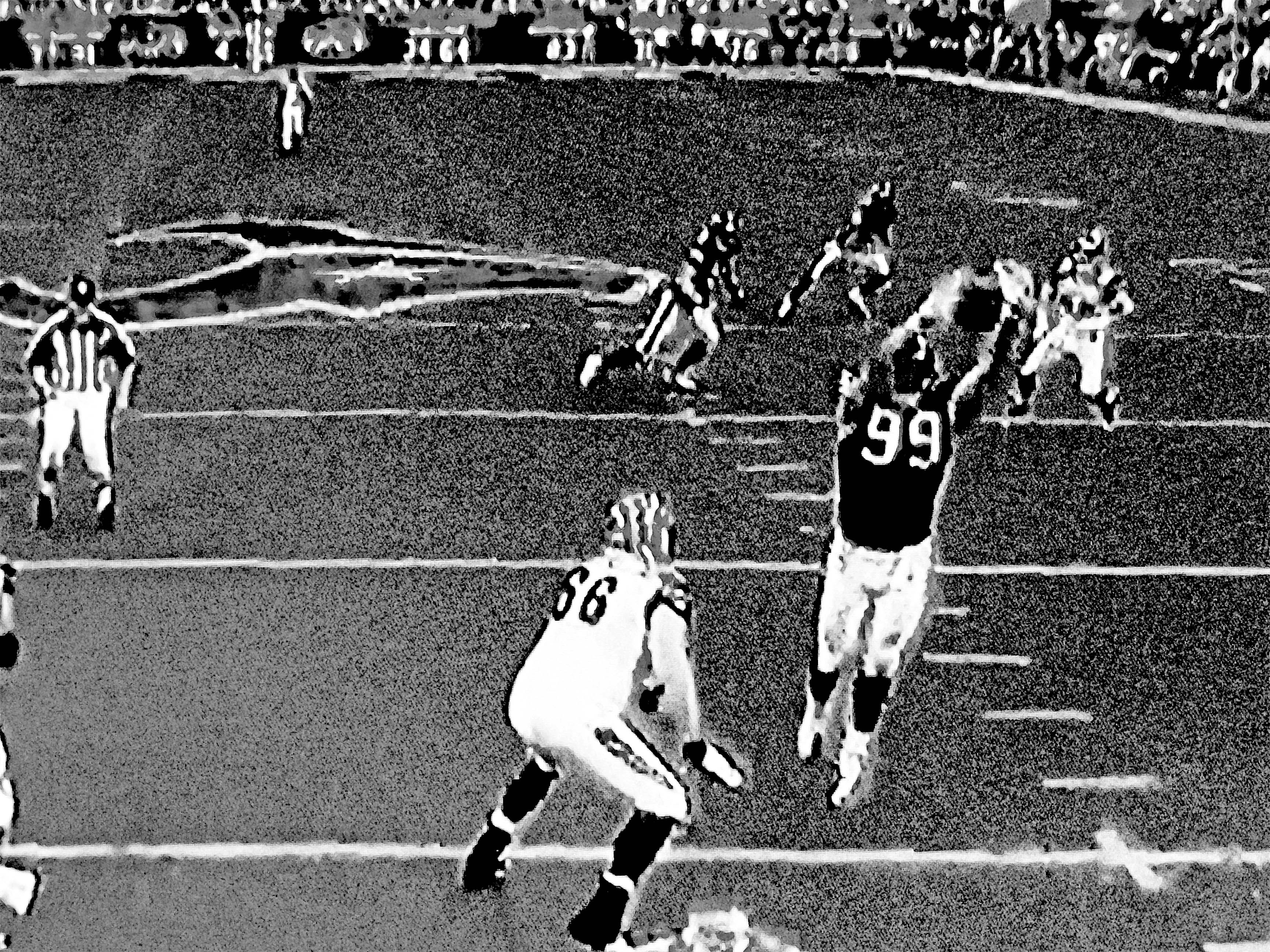
In the absence of a game ticket or TV screen at the moment it occurred, I had to rely upon this radio transcription into my brain of the interception by J.J. Watt that gave the Texans the lead near halftime and turned momentum in favor of Houston for the rest of the day in the club's 31-10 first round playoff win over the Bengals. This picture was later retrieved by a sophisticated electroencephalography process. It could not be represented in color because my brain only processes football in black and white, but I am appreciative of the fact that the scientific folks who pulled this feature off were able to recapture the fact that my brain did digest the exact moment of catch that many people missed with the naked eye. No ego intended by this statement. It just seems to be a biogenetic thing.

Watt’s going on? Watt’s happening? Watt’s up? Who dat? Whazzup!!!

What a day was Saturday! How long has it been since Houston sports fans have enjoyed such a clear day of overwhelming satisfaction with victory on one of the big stages of professional football, baseball, or basketball? I guess we could hand it to the Astros for finally winning their first and only pennant back in 2005, but that joy was quickly squelched by that 4-0 in games whitewashing put on our boys by the Chicago White Sox. I personally would have to go with the 1995 4-0 blitz by the Rockets over the young Shaq Magic in the NBA Finals.

This Houston Texan thing landed yesterday like lightning in a bottle. – Rookie Watt turns the momentum of the game around and gives the Texans a lead they will never surrender with less than a minute to play in the first half. – Rookie Yates quarterbacks the Texans to an error-free win, also making sure that veteran deep ball charmer Andre Johnson gets the first TD passing bomb in franchise history. – Aryan Foster runs wild for 153 yards and two rushing TDs. – Defensive Coach Wade Phillips leads the “D” to a scoring shutdown of the Bengals in the second half. – D back Jonathan Joseph plays flawlessly against his old Bengal mates, even getting to smoothly knock down their last meaningless passing attempt near game’s end. – Bum Phillips was present to wake up the echoes from the start, igniting a decibel level of cheering that stayed high for the rest of the day. – Owner Bob McNair and GM Rick Smith got to beam with post-game joy. – And Coach Gary Kubiak almost smiled. – Who among us could have asked for anything more?

Now it’s on to Baltimore and a chance to take this joy to an even higher level of hallelujah! Every now and then, life dishes up a little fun that stirs the heart without messing up the mind. This is one of those times. Enjoy it while it lasts.

GO TEXANS!

POSTSCRIPT

SMU’S 28-6 WIN OVER PITTSBURGH in the BBVA Compass Bowl on Saturday, Jan. 7th, pushed the Texas Division I school perfect sweep in bowls to 6 wins when combined  with earlier triumphs by Texas, Texas A&M, Baylor, TCU, and Houston. When has that ever happened in the State of Texas previously?

CONDOLENCES TO SAM HOUSTON STATE for dropping their FCS game to North Dakota State, 17-6, up in Frisco, Texas yesterday too.  A 14-1 record is reason enough to celebrate, but never when that one “L” comes is the last, most important game of the season for the small college national title.

CONDOLENCES TOO TO CHAMPION NORTH DAKOTA STATE,  if their fans get the wish expressed on one stadium placard. It read: “BRING ON LSU!” to which I can only suggest one of the world’s oldest wisdoms: “Be careful what you wish for. LSU is not Sam Houston State.”

One more nod: Tomorrow night it’s finally time for the LSU-ALABAMA BCS BOWL title game. – GEAUX TIGERS!

The 1950 Houston Buffs

January 7, 2012

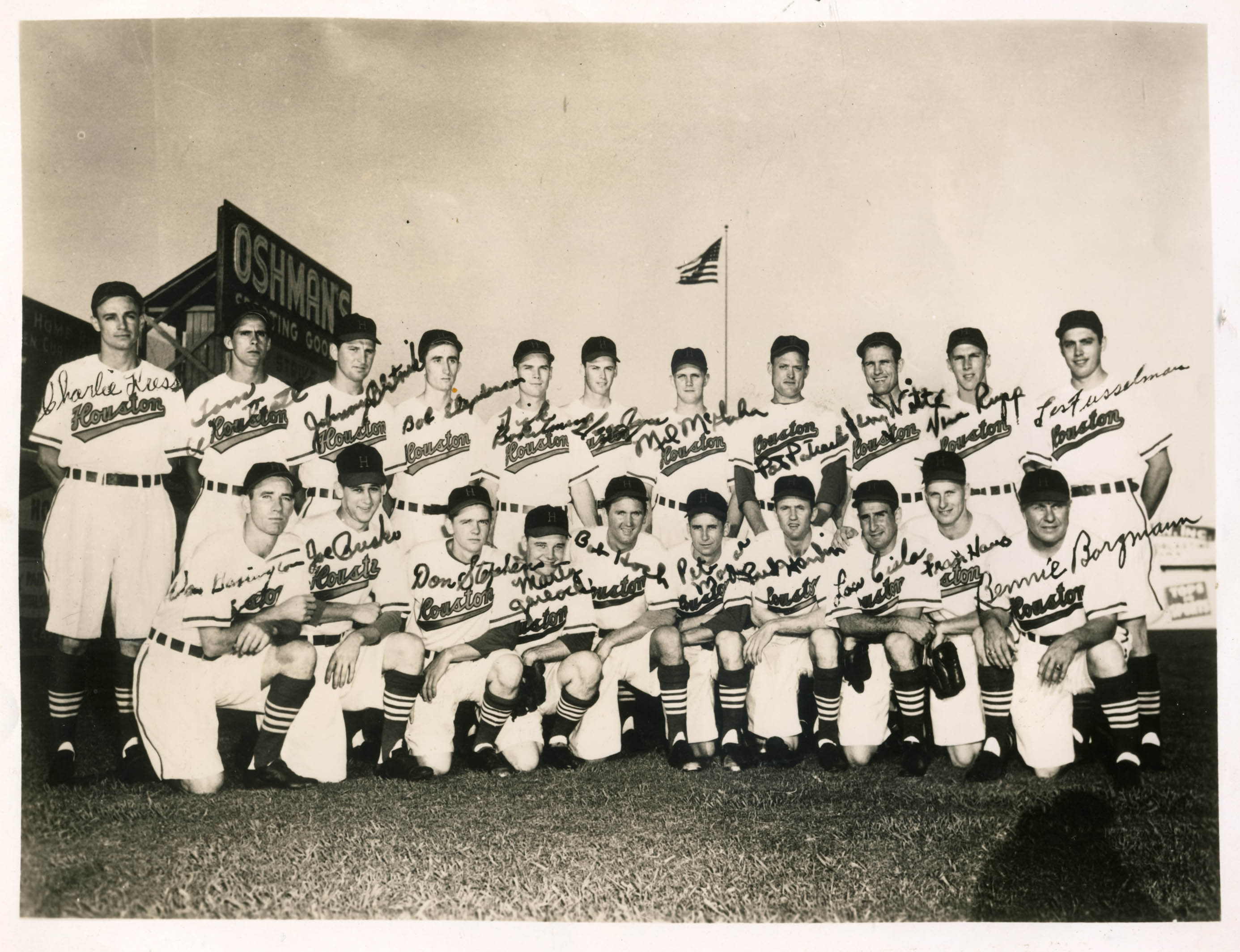
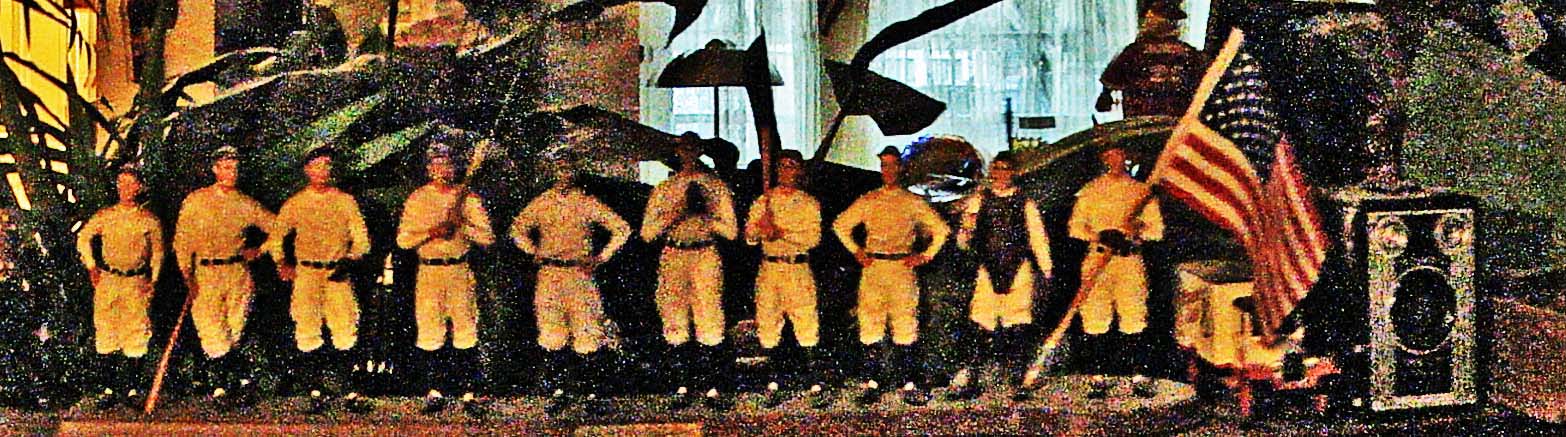
THE 1950 HOUSTON BUFFS: BACK ROW (L-R) Charlie Kress, Tom Westcott, Johnny Blatnik, Bob Stephenson, DIck Bokelmann, Elroy Joyce, Mel McGaha, Hisel "Pat" Patrick, Jerry Witte, Vern Rapp, and Les Fusselmann. FRONT ROW: Vann Harrington, Joe Presko, Don Stephens, Marty Garlock, Bob Hoch, Pete Mazar, Bud Hardin, Lou Ciola, Fran Haus, and Bennie Borgmann, Manager.

Yesterday I received this wonderful team photo of the 1950 Houston Buffs from Floyd and Sandra Vaughan. It is a late season photo of the guys during the short period they wore shorts to supposedly escape the heat as they also worked through Team President Allen Russell’s brain a new old way to boost attendance. Mosquito bites and cherry bumps from sliding in the dirt soon put an end to the not-so-grand experiment in creative mid-20th century marketing.

1950 just turned out to be one those barrel-scraping years when it came to assignments by the parent St. Louis Cardinals. The Cards had loaded AAA Rochester, New York with talent enough for a first place finish in the International League and Columbus, Oho of the AAA American Association with the studs for a third place playoff qualifier. All Houston could muster was the guys who could take them to a last place, 61-93 finish in the AA Texas League.

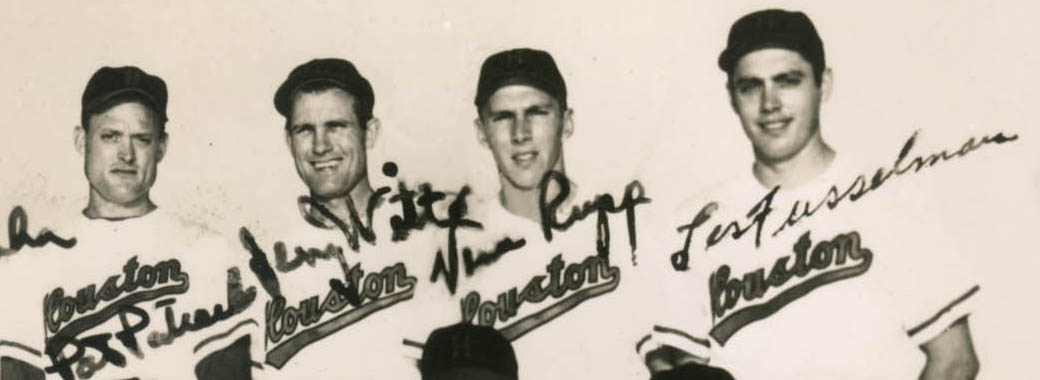
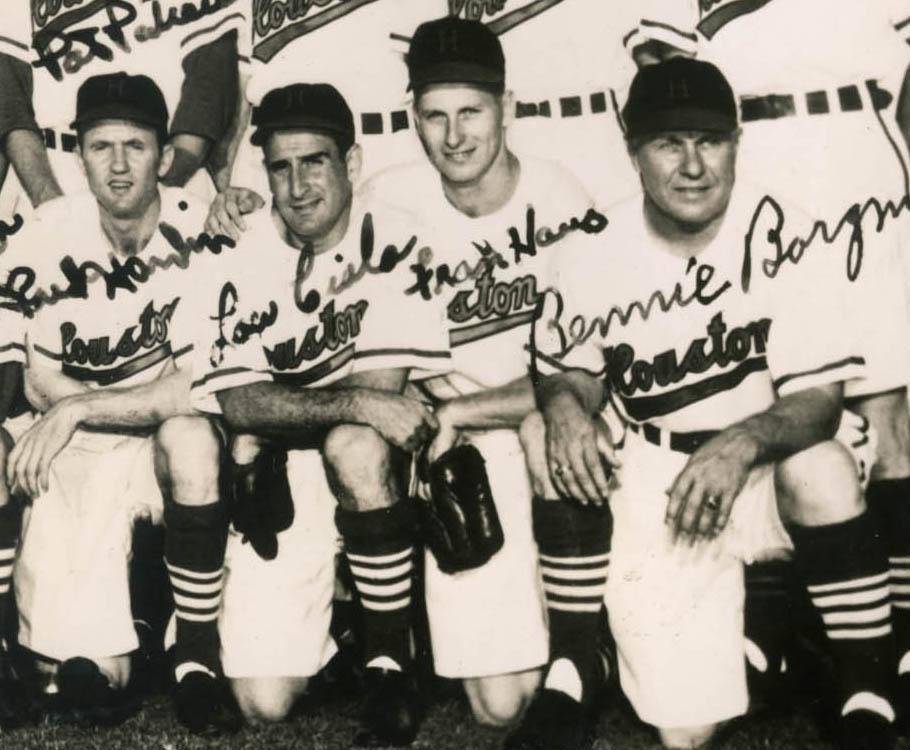
Here are close-ups of the players in this photo, starting our way left to right from the back row and then continuing in the front row. I remember most of these like the back of my hand, Two or three of the players featured here were only around long enough to have their pictures taken in short pants. The photo features 20 players and Manager Bennie Borgmann. The active roster in those days was 19.

Charlie Kress, 1B; Tom Westcott, CF; Johnny Blatnik, OF. (Yep. That's the Oshman's Sporting Goods ad hanging over the left field line scoreboard.

Kress was Houston’s lefty first sacker. Jerry Witte joined the club in June 1950 and promptly started pounding out 30 homers with a .249 BA on the season as the Buffs’ righthanded first baseman. Chuck Kress batted .297 with 12 HR; Tommy Westcott was all speed. He batted .222 with 5 HR in 1950., once beating speedy Bob Marquis from Beaumont in a 90 feet dash from home to first in a pre-game race at Buff Stadium that also played to the growing television audience.

Bob Stephenson, 3B; DIck Bokelmann, P; Elroy Joyce, P; Mel McGaha, LF.

Bob Stephenson played in only 59 games, batting .178 with 0 HR. Dick Bokelmann was an ace knuckle-balling relief pitcher with a 6-7, 4.15 ERA. In 1951, “Bokie” would hit a 10-2 mark with a 0.74 ERA with the Buffs that would finally catapult him to a 3-4, 4.90 three-year mark with the parent Cardinals. Elroy Joyce posted an 8-11, 3.34 record as a starter with the 1950 Buffs, but he never saw any big league time. Mel McGaha was  versatile guy who batted .269 with 3 homers at Houston before his 1950 promotion to Columbus. During the 1960s, in addition to some coaching and scouting time for the Astros, McGaha also had a couple of brief managerial treks with Cleveland and Kansas City.

Hisel "Pat" Patrick, P; Jerry Witte, 1B; Vern Rapp, C; Les Fusselmann, c.

Hisel “Pat” Patrick put up a 2-12, 4.80 ERA mark as a starter and never saw the light of day in the majors; Jerry Witte followed 1950 with a 38 HR year for the ’51 Buffs. His 50 HR mark for the 1949 Dallas Eagles remains as one of the highest totals in Texas League history. Jerry saw MLB time with the St. Louis Browns in ’46-’47. Vern Rapp batted .188 with 4 HR as a back up catcher; he later saw MLB managerial service with both the Cardinals and Reds. Les Fusselmann was the first string catcher with a .284 BA and 3 HR.

Vann Harrington, RF-3B; Joe Presko, P.

Vann Harrington, RF-3B, was the guy with magic stick in late innings. In 1950, Vann was the “Steady-Eddie” guy who did his quiet part to keep the fans from giving up on the future. His .296 BA in 145 games flew as “Flag Hope” for better days ahead. “Little Joe” Presko was a right-handed  finesse pitcher who was also all about heart and hope for blue skies over Houston baseball. Presko was the man among our 1950 Buff starters, racking up a 16-16 record and a 3.14 ERA that would get him to the majors by 1951 for a six-season run and a career MLB mark of 25-37, with a 4.61 ERA.

Don Stephens, P; Marty Garlock, P; Bob Hoch, P; Pete Mazar, P.

None of these fellows saw MLB time. Stephens was 2-6, 3.73 in 1950; Garlock went 8-9, 3.28; Hoch was 2-5, 3.31; and “Lefty Pete” Mazar came in at 8-15, 3.73. Mazar got that many losses by being with Presko and Bokelmann, the three best pitchers on the club. The better you are, the more chances you get to win or lose. Mazar had been 15-10 with a 2.53 ERA for the 1948 Buffs.

In a minor league career that spanned from 1941 to 1954, Pete Mazar won 100 games. Now deceased, as is his wife, the descendants of Pete Mazar are in possession a record album that contains the transcription of first Houston Baseball Honors Banquet of 1947.

Bud Hardin, SS; Lou Ciola, P; Fran, Haus, 2B; Bennie Borgmann, Manager.

Bud Hardin, SS, was one of those “good field/no hit” guys. In 143 games for the 1950 Buffs, he batted .221 with 0 homers. His MLB future came down to three games for the 1952 Cubs, 1 hit, and a .143 career MLB BA. Lou Ciola posted a 4-5, 4.59 mark in 47 games for the ’50 Buffs. Ciola came to the Buffs as a WWII (1-3, 5.56 ERA) 1943 pitcher for the Philadelphia A’s. Fran Haus, 2B,  batted .242 with 3 HR for the 1950 Buffs.

Manager Bennie Borgmann was a career .304 minor league hitter. He took over the Houston Buffs early in the year from a fellow named Kemp Wicker.  Maybe WIcker possessed the psychic powers to see what was coming and begged out.  I don’t know. He left so early that I don’t even recall him being there.

1950 also was the season in which well known players like Wally Moon and Danny Gardella passed briefly through the roster turnstile. Lucky for bothe men, neither stayed long enough to be forced into play as short-pants ballplayers.

Hope you have enjoyed a closer look at some of the faces you normally don’t see as well in team photos online. Thanks again to Floyd and Sandra Vaughan for making this little 1950 exposition possible. I will protect and treasure this photo for as long as I live and do all I can to make sure it ends up in the company of other seriously protected historical artifacts.

As a slightly expanded note here. That is another goal I m hoping that our SABR Chapter will pursue in conjunction with the publication of our book on Houston’s early baseball history. We need to develop a plan for the collection and preservation of Houston’s precious baseball artifacts.

Have a nice weekend, everybody. Go, Texans! And Go Sam Houston State!

What’s in a College Team Nickname?

January 5, 2012

There's only one Green Wave out there in the land of college football and only one Crimson Tide, but watch out for all the Eagles, Bulldogs, Cougars, and Bears. Those fierce competitors are in no short supply.

While searching a good current source of data on this topic, I ran into a Wikipedia site that claims to have been updated yesterday, 1/04/12. It runs about as deep as this subject deserves so I heartily now recommend it to you for a little amusement and fun.

http://smargon.net/nicknames/

What’s in a college team nickname these days? Well, they still range from the most unique to the most common, but the big change in this topic in recent years, of course, has been the effect of political correctness. Those powers have been strong enough to change the Stanford Indians into a singular Stanford Cardinal and the Miami (O) Indians into the Miami (0) Red Hawks. – Are they sure that (0) that follows Miami doesn’t stand for “Osage?” The big censors may need to go back and scope it out too.

Longhorns remains one of the few unique names, as does Horned Frogs. The Wikipedia site gives the UT Medical Branch in Galveston as a second university site with the nickname “Longhorns” and to which we native Texans can only smile and say, “C’mon. Get real.”

Earlham College in Richmond, Indiana is the only place that claims “Hustlin’ Quakers” as a nickname, but Notre Dame has been reduced to a simple reference as the only school calling themselves the “Irish.” What happened to the “Fightin’ Irish” description? Did the bellicosity of it all cause the fighting reference to hit the cutting floor due to the PCs? – I’ll bet there is more “fight” in the Irish than there is hustle in the Quakers. What are thee Quakers going to hustle? It certainly will not be thine electronic Apps.

If LSU takes the BCS football championship from Alabama next week it will not be due to the uniqueness of their Tiger mascot. Forty schools beyond LSU also use that Bengal name for their athletic teams. So, to all you new schools out there who may be looking for a mascot name, we strongly urge you to “hold that tiger.” It’s been done; it’s been done a whole lot.

Head for ceiling cover on game days too. 62 schools out there fly as “Eagles” into battle – with another 15 taking to the skies as “Golden Eagles.”

Georgia heads up the list as the most famous among the 39 “Bulldogs” schools and the University of Houston gets lost among the 32 schools who call themselves the “Cougars.” By the way, UH supposedly got the Cougar nickname from one of the first faculty member coaches (It’s in the Pat Nicholson book, “In Time,” but now the man’s name escapes me.) who had graduated from Washington State and thought that “Cougars” would also be good enough for Houston too.

Baylor rests among the 25 schools who hibernate as “Bears” until some guy named “RG3” comes along like Mighty Mouse to wake them up. Say, how about that idea for a change? Does the Baylor Mighty Mice streaking out of the sky to save the day do anything for you, Baylor fans?

Four schools still call themselves “Indians” and the Illinois Illini and Florida State Seminoles show no signs of caving in their identities in favor of some pleasant tree, bird, or mineral name. How about the Illinois Igneous Rocks? But would that be geologically correct for the midwest?

It’a light night In January that feels more like spring and closer to baseball spring training than it really is. Pitchers and catchers are weeks away from checking into camp. We’ve still got time to endure the LSU-Alabama college football championship next Monday, the lesser crown game involving Sam Houston State this coming Saturday, and the Houston Texans’ first march into the NFL playoffs that also starts this weekend.

Just one more closing note on Sam Houston State. There are a ton of schools who call themselves “Bearcats,” but SHSU is the only school that spells “Bearkats” with a “K.”

Have fun with the list everybody.

Astros Turn Up Heat on Interchangeable Parts View of Game

January 4, 2012

In Modern Times, Charlie Chaplin played one of our first decision-making scientists.

It figures that new Astros General Manager Jeff Luhnow and the club’s new “Director of Decision Sciences,” Sig Mejdal, are both trained engineers by academic training. You see, this newly identified field of “Decision Sciences”  is all about organizing all usable information into comparable variables and measurable patterns in all areas of the team’s organizable decision-making. Think of it as “Money Ball” or “Billy (Beane) Ball” to the nth degree – a structure which brings the design concept of interchangeable parts down to even such specifics as “how does the presence of staff who steal paper clips and post-em pads effect the overall goal of the club’s financial stability and morale for reaching the World Series.

Perhaps, I reach too far on that last one, but that’s how measurable systems go. When they succeed on the gross level of things, it becomes the property of their nature and the impulse of the egos of those who run and build them to look for new objective credit-dispersing areas to measure.

Given the logistics-driven background of new Astros club owner Jim Crane, it is not surprising that he and his on-site alter ego, CEO George Postolos would put themselves shoulder and wheel behind this fairly new to baseball approach way of doing things. I don’t have any problem with them trying to do these things beyond the one element that was never fully developed and explored in the Brad Pitts movie version of the Money Ball approach – and that one thing does trouble me.

“Money Ball” made the old-time scouts and the player-centered manager, Art Howe, seem like the bad guys for relying too much on hunches and impossible to measure qualities about a player’s heart for winning. If decision science takes things to that extreme, it really won’t matter who wins the World Series. There won’t be anyone around left to really care.

Nevertheless, SABR, the Society for American Baseball Research, stands as an example of how both the engineering and emotively driven narrative elements of architectural interest in the game may co-exist in one organizational form. Some of us in SABR even find ourselves bearing a dual attraction for things that are both measurable and mysterious. It is in the nature of human attraction that we are most magnetized by subjects which continue to mystify us for a lifetime. If not, how else do you honestly explain the fact that so many of us are still married?

Welcome to Houston, Sig Mejdal. Hope this isn’t your first rodeo, but if it is, don’t worry. The Houston version of the real rodeo takes place at another venue far away from Minute Maid Park. No decision scientists need apply.

Happy New Year, Texas College Football Teams!

January 3, 2012

The University of Houston Cougars - 30.

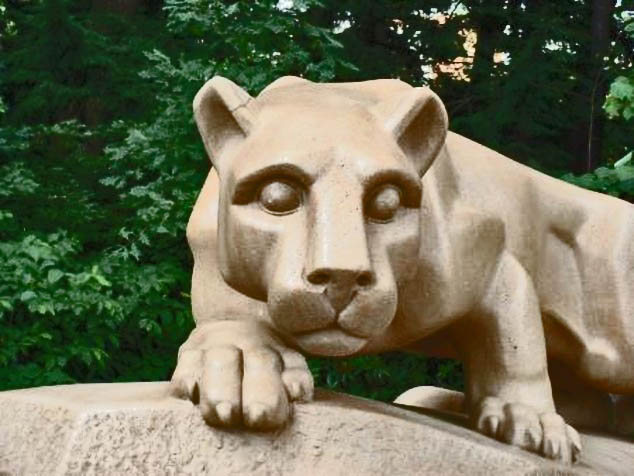
The Penn State University Nittany Lions - 14.

You didn’t really think I could slide past this one without saying something about the UH Cougars’ 30-14 victory over the Penn State Nittany Lions in that contest up in Dallas they are calling the TicketCity Bowl, did you? Well, I couldn’t, but I will try to keep it short. First of all, it capped a brilliant year for Texas Division I universities in 2011-12 bowl games:

TCU defeated Louisiana Tech, 31-24, in the Poinsettia Bowl;

Texas defeated California, 21-10, in the Holiday Bowl;

Baylor defeated Washington, 67-56, in the Alamo Bowl;

Texas A&M defeated Northwestern, 33-22, in the Meineke Bowl;

and yesterday, …

Houston defeated Penn State, 30-14, in the TicketCity Bowl.

I’m not sure if the State of Texas has ever run the table in five bowl game victories in the same season of play, but it happened this year, and most impressively in every instance. Way to go, Texas teams!

And that that’s taking nothing away from the Sam Houston State Bearkats, who already have knocked off Montana State, 49-13, and Montana, 31-28, on their undefeated way to the national title game at a lower level of competition in college football. This coming Saturday, the SHS ‘Kats face North Dakota State in the NCAA Sub-Division I Championship Game to be played at Frisco, Texas. Our best to the Bearkats for a clean 100% Texas sweep of things in college football bowl action. In the meanwhile, the rest of us who carewill stop to celebrate what the bigger clubs have done.

We Cougar fans, of course, had much to be happy about yesterday. It was wonderful watching the great but almost wholly ignored Case Keenum finish his career with 532 yards passing and three TD passes in his final game against the fifth ranked pass defense in the nation. If putting it on one of the defensive beasts of the Big Ten doesn’t prove to critics that the UH success in 2011 was no accident arising from a weak schedule, nothing will.

We, of course, or maybe I should say, “many of us,”  are most pleased to now think that we have come out of the coaching change pretty darn well at UH. Kevin Sumlin did a great job at UH before his departure for a “better opportunity” with Texas A&M, but this guy Tony Levine talks, walks, and coaches like a man who was born to be our Cougar mentor. First, he almost breaks up when UH names him interim coach. Then he says all the right things that Sumlin or no one since Bill Yeoman has said about taking the coaching job on a full-time basis.

A Tony Levine paraphrase: “My family and I love Houston. UH is a destination school, not a stepping stone to a ‘better opportunity’ elsewhere. To take the UH job seriously is to understand that the coach here needs to see it as more than just a job, but as a dedication to the long run of taking this program up to the level it deserves to be.” (And this last comment is my favorite thought from Tony’s job acceptance media conference:) “I hope you enjoy this moment today  because it’s the last ‘UH Names New Football Coach’ conference you are going to see around here for years to come.”

Yesterday also gave us a strong clue that the man Tony Levine can coach and lead too. His players didn’t just douse him with Gatorade at the end of their bowl game win. They picked him up and joyously carried him down the field. So, even if it is a bit early, I’d like to be among the first to thank former Coach Kevin Sumlin and Texas A&M for apparently leaving the UH Cougar football program now in better, truer hands than those in which it previously rested.

There’s nothing like hope that is anchored to some evidence of the truth to get the new year off to a good start.

Happy New Year again, Everybody!

Houston Street Name Eccentricities

January 2, 2012

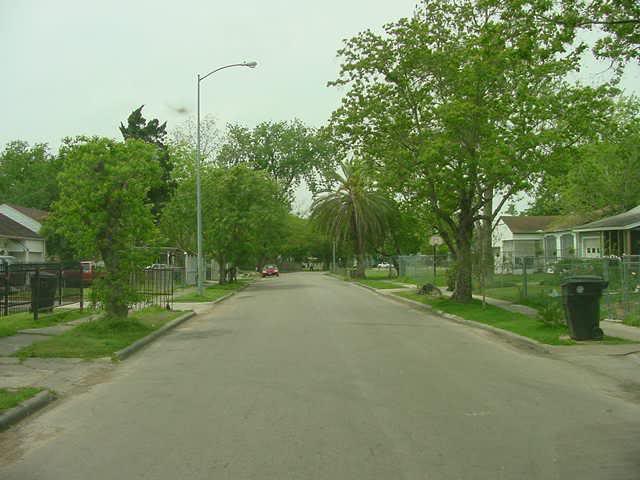
The 6600 Block of Japonica Street in Pecan Park, Heading West toward the Sandlot on Right and Myrtle Street Intersection, You Also Have to Pass Where I Grew Up at 6646 on the Left. Japonica was bunched in our East End Houston Neighborhood with Other Floral Street Names Like Kernel, Flowers, Linden, Narcissus, Ilex, Hemlock, and Moss Rose., At least, the names sounded distinctly unique from each other.

As a Houstonian, you probably have experienced the downside of one of our cute subdivision developer time bomb tricks that have been known to hatch upon the residents of certain neighborhoods on a regular basis forever. As a lifetime Houstonian, minus the first five years and three more from young adult years living elsewhere, it is my pet peeve that some of the cute similar-sounding names of more than a few areas almost always guarantee an ongoing issue with accurate mail delivery for area residents.

Eagle Field: The Sandlot, Japonica @ Myrtle, Houston.

There is a street named Wickchester in the Westwick Subdivision, very near Westchester and the major through street of Wilcrest. – You see where I’m going with this point? As residents of this general area, I couldn’t maintain a count on the number of times we have received mail intended for someone else on one of the several other like-sounding nearby streets when the only thing that fit us were the five accurate digits of the street address. The street name would be clearly indicated as one of those others I’ve mentioned here. Or worse, sometimes it would just be mail with the same address numbers intended for one one of the two dissimilar-sounding streets that parallel ours to the north.

After a while, close seems to get the cigar for US Mail delivery people in out neck of the woods.  And, after all these years, it would simply create new problems to re-name all the streets. The lesson seems to be: Get ’em right in the first place or prepare to live with the consequences forever.

My other favorite eccentricity of Houston street names, if you could even call these issues such, is the tendency of some long reaching Houston Houston cross-town streets to simply change names as they travel far enough north and south – or east and west. My favorite is Wirt Road in the Spring Branch area. Take it south and it becomes Voss Road on the south side of the Katy Freeway and then morphs into Hillcroft once you cross Wertheimer Road. As long as you know where you are going and have GPS, you won’t get lost.

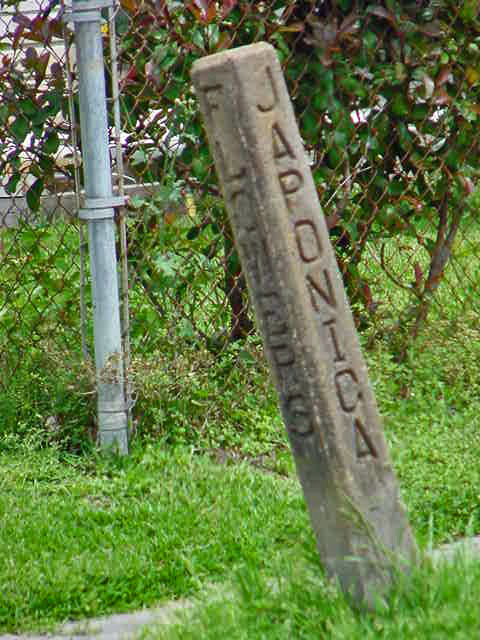
Japonica @ Flowers. Some of these old markers go back to the late 1930s and early 1940s.

Where you may have trouble, if you don’t know the local territory, occurs when you stray to far off our prominent freeway travel system. You see, or as you may already have discovered, hundreds of Houston streets exist as disconnected pieces that cannot be traveled from their true starts to their true finishes without detouring to another area where the dead ending byway(?) in one neighborhood again continues in another form by the same name.

We used to have two major thoroughfares named “Buffalo Drive” and “Buffalo Speedway” and “Richmond Road” and “Richmond Avenue” and these situations both created the kind of problems that screamed for change. Things got better when Buffalo Drive was later renamed Allen Parkway in favor of our city’s founding fathers – and Richmond Road was re-named Bissonnet. (Hope I got the latter spelling right. I always have trouble with this name and which letters – s,n, or t – get the multiple appearance treatment.)

West University has always stood out as a nice example of theme-names-for-streets-gone-well. This classic Houston municipality neighborhood just west of Rice University has most or all of its streets named for various universities. It makes for good fitting residential ambience in the neighborhood near Houston’s educational and cultural museum center.

Other places in Houston  have intersections that come together with all the pizazz of a local “Hollywood and Vine.”  – without all the fame and notoriety. I’m thinking of the intersection that reads “Courageous” at “Fearless.” – Do those streets deserve a cross street connection with each other – or not.

Then again, Houston also has “Telephone Road,” a street that once served as the artery of growth for the city into the area that became its large East End suburbia of the post World War II years – and more recently held up as the title of a book and a few songs about the history and urban legends inspired by that famous title.

As some of you who follow Houston sports may have noted as recently as Sunday’s last season date, 23-22, NFL football loss by the Houston Texans to the locally despised Tennessee Titans, we don’t always get it right in Houston, but we keep trying.

To the bitter end, we try. And we never give up.

Go, Houston, Go! And make 2012 our best year ever! – And one with no more cute-sounding neighborhoods with cute same-sounding names, if you please.

Baseball Deaths in 2011

January 1, 2012

More Baseball Souls Move On in 2011.

The world lost its usual number of famous and everyday people in 2011 and the game of professional baseball was no different, except for the fact that the game seemed to give up more than its fair share of long-remembered names in 2011.

WIth the help of Associated Press, here’s the alphabetical list of baseball’s obituaries by age at death in 2011:

Ricky Adams, 52; Bill Alhouse, 85; Matty Alou, 72; Andrew Baur, 66; Bill Bergesch, 89; Harvey Dorfman, 75; George Crowe, 89; Ryne Duren, 81; Mike Flanagan, 59; Bob Forsch, 61; Howard Fox, 90; Joe Frazier, 88; Woodie Fryman, 70; Greg Goossen, 65; Lou Gorman, 82; Greg Halman, 24; Roy Hartsfield, 85; Hideki Irabu, 42; Ernie Johnson Sr., 87; Andy Jurinko, 71; Cecil Kaiser, 94; Harmon Killebrew, 74; Charlie Lea, 54; Carl Lindner Jr., 92; Danny Litwhiler, 95; Tony Malinosky, 101; Marty Marion, 93; Emilio Navarro, 105; Jim Northrup, 71; Jose Pagan, 76; Mitchell Page, 59; Mel Queen, 69; Larry Shepard, 92; David Sisler, 79; Duke Snider, 84; Paul Splittorff, 64; Chuck Tanner, 82; Dick Williams, 82; Wally Yonamine, 85; Gus Zernial, 87.

A quick read through the list awakens numerous memories. Matty Alou was the little guy among the three fabulous Alou Brothers. George Crowe was a significant figure in the early dissolution of the roster color line with the St. Louis Cardinals. Ryne Duren was that coke-bottled glasses relief pitcher for the New York Yankees and others; Bob Forsch of the Cardinals was the pitching brother of Kenny Forsch of the Astros. Joe “Snake” Frazier was a long-time nemesis of the Houston Buffs as a player with several other Texas League clubs back in the early 1950s. Woodie Fryman was a tough-bird pitcher for the Pirates back in the 1960s. Roy Hartsfield was an infielder for the old Braves. Hideki Irabu was the over-billed Japanese pitcher that George Steinbrenner once signed and later called “a fat toad” in disappointed frustration. Harmon Killebrew was the Hall of Fame homer-bashing greatest Minnesota Twin of all all time. Danny Litwiler was a former Cardinals and Reds outfielder and a close friend of Stan Musial. Marty Marion was the arguably HOF qualified shortstop for the early 1940s Cardinals, the man they called “Slats,” and the last manager of the 1953 St. Louis Browns final club. David Sisler was the pitching brother of first baseman-outfielder Dick Sisler and the other son of the great Hall of Fame first baseman of the St. Louis Browns, George Sisler. Duke Snider of the Dodgers was once the Duke of Flatbush, one of the three center field mayors of New York City, and almost forever an indisputable Hall of Famer. Chuck Tanner and Dick Williams were both great managers, with Williams making it all the way to the Hall of Fame for his abilities. And Gus Zernial was the wonderful power-hitting outfielder for Connie Mack’s last Philadelphia A’s club,

Everybody on this departure list, even those we have failed to describe further, is deserving of a little Google time this morning. I didn’t even have time for that today, but I would like to add: Rest In Peace, Baseball People. And thanks for the memories. Remembering the old and gone on the first day of our new start, new year is not a downer anchor to the past. It is an expression of hope that 2012 continues to find us producing people of all kinds that we shall miss when they pass away from us in their own times.

Happy New Year’s Day, Everybody – and keep the torch of life moving up the mountain road to wherever it is we all seem destined to chase. And let miracles, amazement, discovery, and sweet surprises continue to rock our world far more often than bombs and hurled stones ever shall.

Happy New Year and Hello, 2012!

December 31, 2011

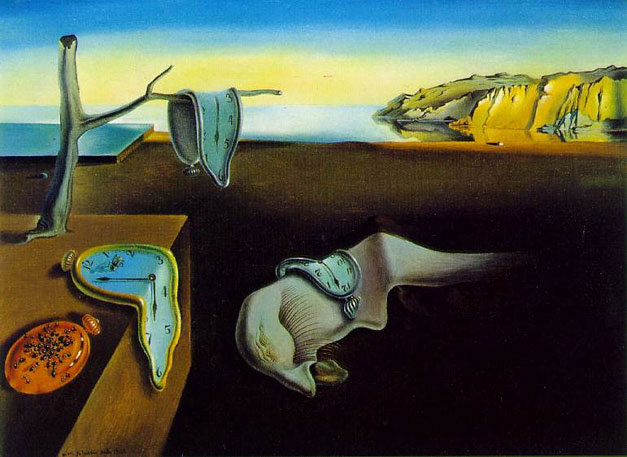
Part One of "Persistence of Time" Series by Salvador Dali.

As one born on the last day of 1937, somehow loving baseball biogenetically, I have enjoyed figuring batting averages since about the time of my tenth birthday on December 31, 1947. Hitting double digits on the age-in-years chart is big for all of us in this culture, but my fascination with it crossed over and quickly mixed into my new interest in keeping up with batting averages of players on my first favorite team, the 1947 Houston Buffs.

The problem on my tenth birthday was simple too. The 1947 baseball season had been over for three months by the time my birthday arrived and the need to do any more figuring on the Houston Buffs was complete. Their seasonal batting average were now set in stone forever, with no need for any further calculations until a fellow named Bill James and his SABR followers would come along many years later and invent other mathematical tricks to perform on measurable baseball deeds.

That being said, the ten-year old mind can be a playful calculating thing. Mine had quickly learned from the Houston Post and The Sporting News that “batting averages” were simply a percentile statement of how often batters racked up clean official “hits” in the usually larger number of “official times at bat” that each man had come to bat in the season. The only was for the enumerating figure (hits) and the denominating figure (official “tab”) to be equal was for a batter to get a hit in every single time at bat on the season and it never took long for more than a few put outs to distance the player’s hit totals from his times at bat totals.

I learned from batting averages that the very best offensive performers in baseball only succeeded in a little more than three times out of every ten official times at bat – and that for most players, succeeding at some percentage less than three times out of every ten official trips to the plate would be good enough for most of them to keep their jobs at some level of professional baseball play.

Figuring batting averages became my earliest remembered obsession. I once got sent to the principal’s office for figuring batting averages in class when we were supposed to be working on an exercise that would teach us how to do division. When I tried to point out to the nun who was my teacher that I was already doing division, she simply told me that I wasn’t supposed to be doing anything like batting averages for at least two more years. That’s when she also decided that my comment to her was an “impudent questioning of her authority” and sent me to the principal – where the only thing that happened was that I was forced to sit and do nothing for the rest of our math period that day.

At some risk, I went back to figuring batting averages in class once I regained access to pencil and paper, but I did cool it for the rest of that day that Sister Marian sent me to Sister Immaculata’s office. It’s the nature of obsession. Nobody scolds you into change.

Batting averages also flew in the face of some other teachings we were getting in parochial school. It bothered me, for example,  that we were being told by the nuns that we needed to strive for perfection in our efforts to walk in the path of Jesus Christ. Yet, I also knew that the greatest percentage hitter in baseball, Ty Cobb, only batted .367 for his long career in the big leagues – and he was only competing against other human beings. – How well could we really expect to carry out the goal of the nuns. To have a life-emulation average in the .900s, trying to copy the Son of God, seemed a little on the high, off-the-chart side.

In time, I just learned that my best shot was going to be to try to be the best person I could be, try to learn from my mistakes, try to do no harm, and try to give of myself to others, wherever possible, for the greater good. I’ve never tried to put any of that settlement style to a batting average. I just try to live it, however imperfectly it unfolds.

The batting average figuring and way of thinking does survive in me to age 74, however. It’s not lost on me that in 2011, I have lived through 74 of the 235 years that have passed since 1776 signing of the Declaration of Independence. That works out to a percentage of .315. I have been alive for 31.5% of this beautiful country’s history.

If I live another ten years to 2021, I will have jumped it up to .343 or 34.3% of the time. If I die tomorrow, my average living participation in the history of America will drop to .302 by the year 2021. Nobody bats .300 in this league for long.

Hmmm. In the League of Life in America, yes, it’s true. Nobody bats .300 forever. In light of that fact, it’s best we just keep that certainty in mind and simply live each dawn that comes along and finds us still breathing – and live it as well as we are able.

Happy New Year, Everybody! May you each find the beautiful Here and Now in Life – one day at a time, from moment to moment, from here to forever.

A ’47 Houston Buffs Reverie

December 30, 2011

The 1947 Houston Buffs were my awakening to the game of baseball.

Everything that exists has a start somewhere, even if some of those starts are so subtle and gradual that we don’t even know they are going on until they are completely upon us. Other things, like falling in love for the first time, land like a hurricane, taking over everything and changing how we see the world over night.

That’s pretty much how baseball started for me when my dad first took me to Buff Stadium for the first time back in 1947. I’m not even sure that I knew the world existed in Technicolor until we walked into that place for the first time and I saw that green, green grass and that big flag blowing from right to left from the big flag pole in faraway center field. It was the most beautiful and melodic picture that had ever fallen into my young life view of things. The organ music of Miss Lou Mahan stroked just the right theme for whatever ever was happening in the place, from the ascending scale of a baseball rolling up the protective screen behind home plate to its descending bounce down the scale, Lou was on it, even picking up the bump-tee-bump bounce of the ball as it again reached the ground and rolled into stillness.

I was only 9 years old, but I didn’t miss a thing, and it didn’t take me long to soak in the basic rules of  the game and to pick out my favorite Buff players. Second baseman Solly Hemus, the hustling guy they called “The Little Pepper Pot,” rapidly became my first hero. I loved the way that Solly and Buff infielders chattered up the game back then – and I always wanted to get there in time to watch the club take that pre-game infield practice with such style and enthusiasm. (Contemporary fans need to understand that player back in the post WWII era weren’t as perfect as today’s group. The guys from the old days needed infield practice as part of their pre-game preparation.)

Johnny Keane, Manager (Reprinted with permission from the Houston (TX) Public Library.)

Johnny Keane managed the 1947 Houston Buffs, taking the club all the way to the Texas League pennant and then to a six-game Dixie Series championship over the Mobile Bears of the Southern Association. That was a flat-out big deal back in the long shadow of Houston’s time as a member of the Texas League. Winning the Texas League pennant and the Dixie Series was a major way for any young fan to start their career as devotee of the game in this part of the world. And, for those who grew up in the East End, where Buff Stadium was built in 1928, it was even a bigger deal. Getting to games on our own, even as young kids, was pretty easy thanks to the Buffs’ sponsorship of the cheap-seat “Knothole Gang” down the left field line.

Buffs President Allen Russell didn’t miss a trick when it came to getting games played into the books either. If a rain storm came up prior to a game that would have flooded out any other club, Russell rolled up his sleeves to give God and the weather some help. He would saturate the wet grounds with gasoline and then explode the thing with a thrown lighted match as he ran away in retreat. What a sight that was.

Other Buff stars abounded. Gerry Burmeister (.210) was the Buffs catcher and Johnny Hernandez (.301) played first base. Johnny’s son Keith Hernandez later played a pretty good first base position himself with the Cardinals and Mets.

Tommy Glaviano (.245) was the starter at third base and little Billy Costa (.232) was the gardener at shortstop. Solly Hemus (.277), as I’ve already mentioned, played second base.

Eddie Knoblauch (.275), whose nephew Chuck Knoblauch later played second base for the Twins and Yankees, played left field and good old Hal Epps (.302) was best known as “The Mayor of Center Field,” and Vaughn Hazen (.280) played right field. The club’s top pitchers included Clarence Beers (25-8, 2.40) and Al Papai (21-10, 2.45). Beers could bring it – and Papai was a classic knuckleballer.

The ’47 Buffs had very little power. Hernandez led the club with 17 homers; Glaviano had 13. Nobody else made it to double figures and only three others (Epps 6, Benjamin 4, Angle 2) had more than one home run on the season.

The ’47 Buffs were a typical Johnny Keane-led club, running on situational hitting, speed, defense, and pitching. They had enough gas in the tank to edge out Fort Worth for the league crown and then take Mobile in the Dixie Series, but they will never be confused with the minor league version of the ’27 Yankees.They were more like the 1906 Chicago White Sox, the old dead ball era World Champions, the club they called “The Hitless Wonders.”

They had enough moxie in them to crank my interest in the game and I’ve never gotten enough, even if I failed to understand and appreciate any of the finer points I’m describing here today. The game caught me. Fortunately, the location of Buff Stadium in the East End and the presence of the “Knothole Gang” for kids made it easy for many of us to see a lot of games back in the safer-street days of the late 40s and early 50s.

Tonight, at year’s end, I salute you again, o favored first Buffs of my baseball fancy. Thank you for first attracting me to  the one great consoling constant of almost my entire life over the past 65 years – the game of baseball from age 9 – from here to eternity.

Now come on, Spring Training – hurry up and get here. This staring out the window with the ghost of Rogers Hornsby and waiting for spring is not my style.

Happy New Year, Everybody!