Paraprosdokians for the 2012 Baseball Season

March 11, 2012

Send in the clowns. And make one of them a designated hitter.

First of all, let’s go over the central idea behind these weird things known as paraprosdokians.

For those of you who haven’t heard, PARAPROSDOKIANS are defined as: “Figures of speech in which the latter part of a sentence or phrase is surprising or unexpected; frequently used in a humorous situation.”  For example,

You do not need a parachute to skydive. You only need a parachute to skydive twice is a fairly typical paraprosdokian.

Famed literary figure Dorothy Parker was a member of the Algonquin Club back in 1920s, and this association itself was a hot bed of alcohol inspired intellectual exchange among various members of the Broadway-Manhattan based theater world of creative people back in the 1920s. They met on a regular basis to drink and think their way through lunch and generally show off little glimmers of their individual genius. George S. Kaufman and Robert Benchley, two of the best comedic writers of their day, were also members of the lunch set too.

One day, Benchley looked across the table, out of the blue, and challenged Dorothy Parker to give them an immediate funny one-liner using the word “horticulture.” Before Benchley could sit back and long enjoy his stumping of the daunting Ms. Parker, Dorothy shot back with a phonetic answer to Benchley’s challenge:

“You can lead a whore to culture, but you can’t make her think.”

I would have loved to have been there to have witnessed the table of club members’ responses to that little example of paraprosdokian wit. WOW!

For further illustrations, simply Google the word and watch all the sites come up with their over-lapping, repetitive lists of the same anonymously presented lists of these same usually amusing little expressions.

The thing about paraprosdokians is that they all pack a whiff of fact and/or wisdom about them. I like that kind of combo, the kind of thought that packs the potential for delivering the whole weight of a collegiate course, a serious literature novel, or a valuable life lesson – and all into a one or two short sentence tagline of wit for those who may be ready to receive its deeper message too.

“Don’t jump out of a perfectly good airplane without a parachute” is good advice, but for the rebellious, it may sound like a dare or another rule to break. Our aforementioned paraprosdokian, on the other hand,  doesn’t say you can’t jump out of a plane without a parachute. It just says you can’t do it twice.

Just for fun, I thought I’d mine some of the apparently common domain paraprosdokians from multiple sites that could (and mostly likely will) come into play during the coming major league baseball season between players and umpires, media and the players, and fans and their ball clubs, et cetera. Here are my favorites:

  1. The last thing I want to do is hurt you, but it’s still on the list.
  2. A clear conscience is usually the sign of a bad memory.
  3. Light travels faster than sound. This is why some people appear bright until you hear them speak.
  4. If I agreed with you, we’d both be wrong.
  5. I thought I wanted a career; turns out I just wanted pay checks.
  6. I didn’t say it was your fault; I said I was blaming you.
  7. Do not argue with an idiot. He will drag you down to his level and beat you with experience.
  8. I’ve had a perfectly wonderful evening, but this wasn’t it.
  9. We never really grow up; we only learn how to act in public.
  10. You’re never too old to learn something stupid. *
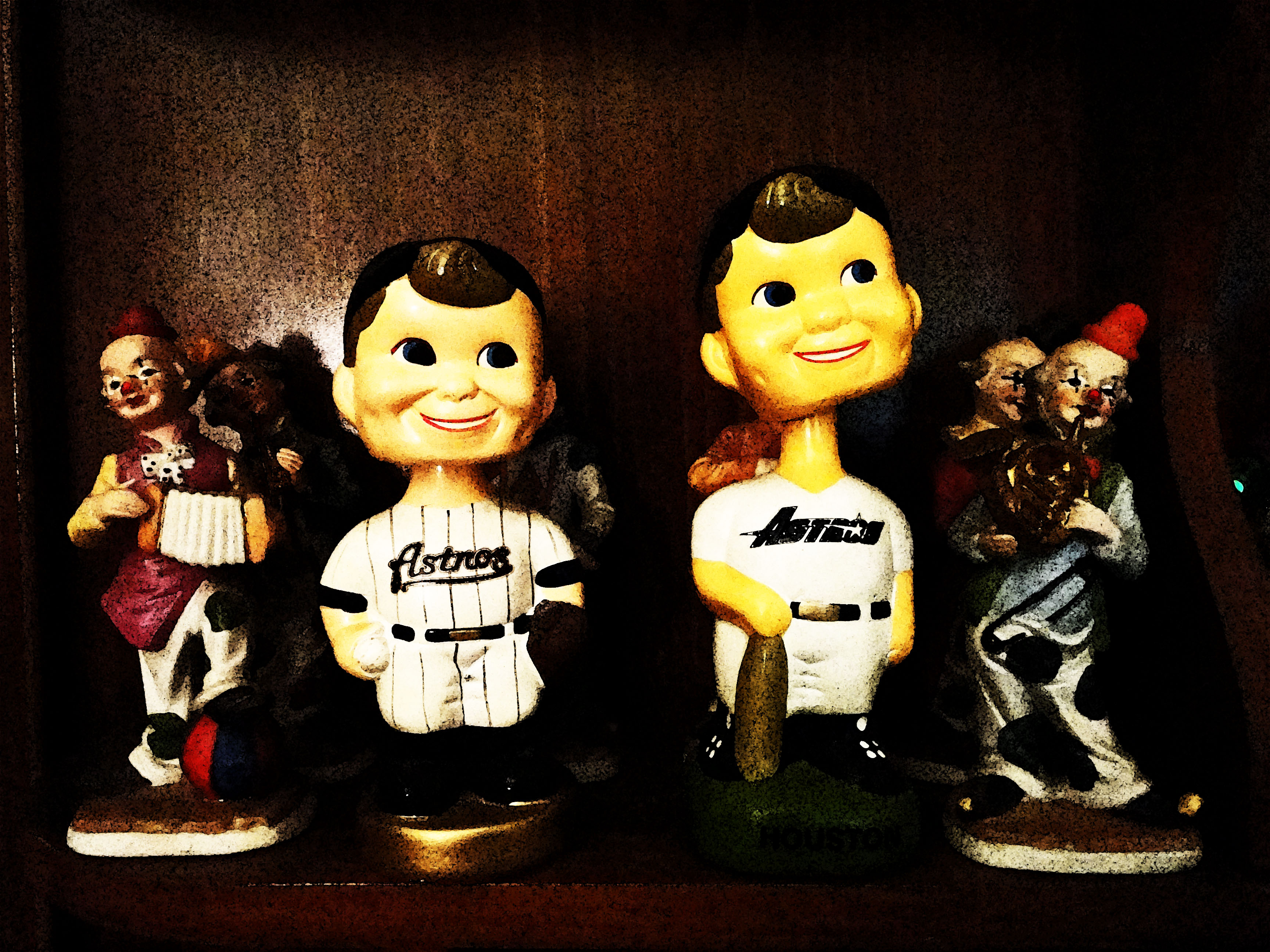
* If I live long enough, I will get to take on the challenge of paraprosdokian #10 in 2013 when I, at age 75, and all other remaining fans take on the task of learning how to enjoy our Houston Astros play DH baseball in the American League. – Have a nice Sunday, everybody, and remember: “The early bird might get the worm, but the second mouse gets the cheese.”

Whatever Buddy Wants, Buddy Gets

March 10, 2012

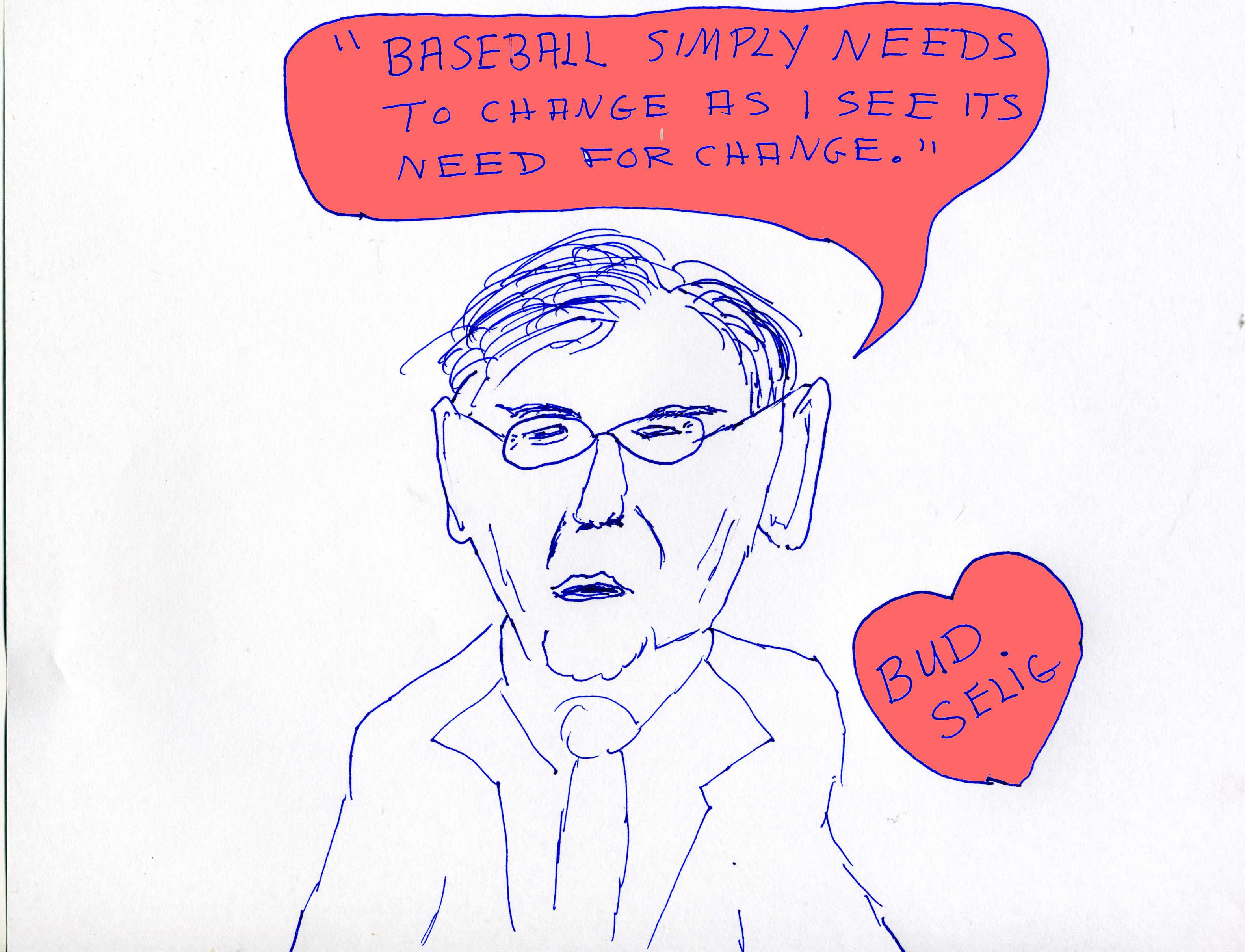
With apologies to Patrick Lopez and all the other real artists of this world.

Do you ever wonder when Baseball Commissioner Bud Selig is going to retire? Maybe most of these blurring of traditional lines between the American and National Leagues would have happened anyway, but I don’t know. Look at all that’s happened in that area in the years of Bud Selig’s “reign” as baseball’s chief executive:

(1) The two league offices and presidencies have been eliminated; (2) The individual league baseballs, once signed by the two now missing leagues presidents have been replaced by one ball that says “Major League Baseball”, signed by “Allan H. (that’s Bud) Selig; and (3) the consolidation of the two league umpiring groups into one MLB game officials group. – Now, with the forced movement of the Astros to the American League in 2013, MLB will have achieved an equal division of the two leagues into two 15-club units, making inter league play now both balanced and necessary to season game scheduling at the current pace without long dead spots for some teams of non play.

About the only difference that now remains is the absence of the “DH” rule in the now size-diminished National League. You have to wonder. How long can the NL hold out against the imposition of the DH rule. Unless I’m mistaken, the National League is now the only holdout in professional baseball against the use of the designated hitter.

Selig supporters give him credit for guiding baseball through the horrible 1994 strike and World Series lost black hole, but his adversaries are willing to give him much of the blame for it. Selig did preside over baseball’s current and ongoing introduction of the wild card and is widely credited by many for a 400 per cent increase in revenues from the time he took office. He also takes a lot of credit/blame for the handling of the steroids era and he was very definitely responsible for putting the heat on new owner Jim Crane to accept the Astros’ move to the American League as a condition of purchase of the franchise.

My larger least favorite move by Selig was his decision to juice interest in the All Star Game by awarding home field advantage in the World Series to the team representing the league that won the All Star Game earlier in the summer of the same season. To me, that was one of the dumbest, most displaced ideas that ever flowed out of any commissioner’s office. Who wants to see the Yankees or Red Sox getting home field advantage in the World Series because of a bloop game-winning single by a “have-to-to-pick-one-of-them” Kansas City Royals players in the bottom of the All Star Game 9th?

Selig was going to retire at the end of this year. Now the owners have extended his contract (over $14 million a year) through 1914 so he can make it past age 80 in office and work on to see the infusion of Houston into the American League and the new second wild card teams put into motion as part of post-season play.

Wonder what the owners will give Selig as a going away present? Maybe that will be the time the National League gets delivered to the land of the designated hitter.

Nothing personal, Mr. Selig, but as a baseball fan, I can’t help but wonder what you’re thinking. I can’t help wondering too because, apparently, whatever you are thinking comes pretty close to tomorrow’s baseball headline on what we are going to get.


Sugar Land Skeeters Open Season on April 26

March 9, 2012

Season Opens April 26 against York.

Yesterday I had to drive over to the groomers at Man’s Best Friend on the west side to pick up one of our dogs and I also  found these little season schedule packets for the new Sugar Land Skeeters.

Playing in their inaugural season as members of the independent Atlantic League, Sugar Land opens their 70-game home schedule against York (PA) at 7:05 PM on Tuesday, April 26th at their new venue off 90-A at Highway 6 on the south side, and just north of the Southwest Freeway (I-59), at a place now called Constellation Field.

Modestly priced group and season tickets are now on sale online at http://sugarlandskeeters.com

Individual game tickets will be available, starting March 17th.

Telephone orders and further information is available at 281.240.4487.

It should be a lot fun. Skeeters Manager Gary Gaetti was a bright and talented player for both the Twins and Cardinals and he also spent time as the batting coach for the Houston Astros after his playing days ended. On the public relations side, another former big leaguer and Astros batting coach, Deacon Jone, is keeping the fires of enthusiasm stoked and popping fire for the new Skeeters.

The Atlantic League includes clubs from the seven eastern cities and areas of Bridgeport, Camden, Lancaster, Long Island, Somerset, Southern Maryland, and York – in addition to our western expansion club in Sugar Land.

It’s not the big league game, but it’s baseball that plays out at modest prices in a brand new open air family-oriented ballpark down in Sugar Land. That sounds like a pretty good deal to me.

Hope to see some of the rest of you there too.

Is Space City ID Now Dead Forever?

March 8, 2012

Our son Neal McCurdy (far left in green) celebrates a 7th birthday party trip with his buddies to the Space Center at NASA back in 1991.

Is “Space City” now totally dead as Houston’s base identity with NASA? For that matter, is NASA itself dead? Will the cancellation of further manned space fights simply cause NASA to fade further into the background as just another government program we pay for with our taxes without really understanding why?

Who among us from that day will ever forget the Russian Sputnik firing into space orbit in 1957 that suddenly shocked us into realization that we were dead in the water behind our then presumptuous arch-enemy, the Soviet Union? As I remember from my sophomore year at UH, it shocked the bejabbers out of us and almost singlehandedly pointed many of my collegiate contemporaries into engineering and the physical sciences. It was the way to go.

Then along came President John F. Kennedy’s announcement at Rice Stadium here in Houston on September 12, 1962 that the new NASA center in Houston was now aiming to put a man on the moon, Who among us can ever forget the memorable punchline of JFK’s speech:

We choose to go to the moon. We choose to go to the moon in this decade and do the other things, not because they are easy, but because they are hard, because that goal will serve to organize and measure the best of our energies and skills, because that challenge is one that we are willing to accept, one we are unwilling to postpone, and one which we intend to win, and the others, too.”

Doing the right thing (at least, on the public level) became the salvo and working ethos of my generation: You do what needs to be done because it is the right thing to do, and the right thing to do is always uphill harder than downhill and easy. We weren’t aware at the time that the man who modeled these values for us also lived a private life in which hard personal outcomes were secretly achieved in the easiest ways known to mankind since the beginning of time.

The public candle that lit for us was NASA. In Houston, we celebrated our new role as the headquarters for NASA and the Manned Space Program by grabbing the title of Space City, USA and even naming our biggest, hottest, one-of-its-kind-for-a-while sports venue and renaming our relatively new big league baseball team as the Astrodome and Astros.

On July 20, 1969, we did it. We beat the Russians to the moon, with “Houston” being spoken as the first word ever expressed on the moon:

“Houston, Tranquility base here. The Eagle has landed.”

American astronaut then Neil Armstrong immortalized the first foot print of man upon any extra-Earth, celestial body with this expression:

“That’s one small step for man; one giant leap for mankind.”

Now, forty-three years later, it all seems all but over. With President Obama’s cancellation of further manned space flights, what is the role of NASA in our future?

When some brief discussion was given recently to the possibility of changing the nickname of the Houston Astros as they go into the American League in 2013 due to the fact that our identity as “Space City” is now dead, but I will still beg to ask the question:

Is Space City now dead as a future identity for the City of Houston? Has it simply been killed by a president who already writes off Houston and Texas as a place where he can expect to get votes in his own political life? For that matter, is the idea of future American manned space flight now dead because one president decided to kill it? Are American astronauts now only going into space as Russian hitch hikers or corporate flight contractors?

Look at all we now have and use daily as a direct or peripheral result of NASA: Everything from satellite communication, micro chips, weather forecasting, GPS, the Internet, certain foods and medicines, microwaves, I can’t even name them all – but all of them came from a program that our city once proudly supported as Space City, USA – and none of these things were around when JFK made his famous speech at Rice in 1962.

Quo Vadis, NASA? The American people must now answer that question for you.


Anniversary of an Ancient Friendship

March 6, 2012

Louis Armstrong and Don Marquis, Chicago, 1959.

Fifty years ago today, March 6, 1962, it was Fat Tuesday, Mardi Gras Day in New Orleans. Fifty years ago last night, at the Royal Street apartment of a very dear friend, JoAnne Yoder, one of my female classmates from Tulane University Graduate School threw a party for about thirty of us on the evening that spilled into Mardi Gras Day.

That party spilled all right – all the way through the night and into the dawn’s early light of Fat Tuesday, but we were young – and just having a good time as fun was had in a less cautious or socially more  judicious era. Those of us who grew to adulthood from that romping-stomping time of alcohol excess that was the 1950s and have survived to tell about it – don’t live like that anymore. – And those of us who failed to see the error of our ways and thus to reform “just a tad” are no longer here, but make no mistake. – Few of us, if anyone,  would change anything we did on the way up that rather steep leaning curve.

That was a special night. JoAnne’s boy friend from Cleveland, Don Marquis, had just arrived in New Orleans for his first visit to the city to spend some time among the old traditional jazz artists that still walked among us in those days. And, man! Did that plan ever turn out to be an understatement of purpose?

In addition to remaining one of my closest friends to this day, Don Marquis, now closing in on age 79 this coming May, is still there in the Crescent City. After sixteen years (1962-1978) of working most of the time as a proof reader for the New Orleans Times-Picayune, just for the purpose of keeping his mind and time clear to do research as an insider to the jazz culture, Don Marquis wrote “In Search of Buddy Bolden, First Man of Jazz” for LSU Press (1978). Here’s a link on ordering and review information:

http://books.google.com/books/about/In_search_of_Buddy_Bolden.html?id=YGeYOIhXMp4C

“Bolden” turned out to be the seminal research book on the legendary cornet player who preceded Louis Armstrong and all others as the now recognized first man of jazz. Because of his acceptance into the black jazz musician community, Don Marquis was able to eventually find his way to descendants of Bolden and all kinds of artifacts, including a portrait and a band picture of the group that once played Funky Butt Hall on Rampart Street at the far western boundary of the old French Quarter.

Success of the book led to world travel and many ancillary articles on the subject and further investigative efforts. Don Marquis was hired as Curator of the New Orleans Jazz Museum. He held that position for over twenty years prior to his retirement several years ago. Today Don still lives in the same simple one bedroom lower floor apartment home on Royal Street that he has inhabited since 1966. Don and JoAnne never married, but they remain close as ever, even though Jo has now retired and moved back to Goshen, Indiana, where Don grew up and they both went to college. They met at Goshen College in 1958.

Bill McCurdy and Don Marquis, New Orleans, 2003.

If you ask Don why he and Jo have never married, he will tell you with a straight face and a slight smile, “We don’t want to rush anything.” The truth is that both have lived happy and fulfilling lives separately and together in ways that have not distracted either from their larger purposes in this world – without sacrificing their connection as soul mates to each other – no matter what. Don Marquis’ legacy to the world has been his contribution to the documented history of Buddy Bolden. JoAnne’s contributions have been to all the veterans and others suffering from mental disabilities she has treated and assisted over the past half century as a mental health professional.

Don and Jo have missed having their own children, with each other or anyone else, but they each will leave this old world all the richer for their separate contributions to jazz history and mental health. I’m just happy to have enjoyed their friendship over all this passage of time.  I met JoAnne Yoder fifty years ago from this past September, when she and I both enrolled as students at Tulane in 1961.

I met Don Marquis fifty years ago from yesterday. This morning, it seems like yesterday.

Two final notes: An independent film maker has been working on a movie based on Don Marquis’ book for some time. Hopefully, it will be out in due time.

Secondly, I just had to mention that Don Marquis has one of the greatest senses of humor I’ve ever encountered. Years ago, when Don was proof-reading at the NO Times-Picayune, he became convinced that his editors were not really checking his corrections. So, he decided to test it. (I really think he did it out of boredom.)

Since Marquis is a big Notre Dame fan, he couldn’t keep his proof-reading hands off the starting lineup of the Fighting Irish when they came  south one late 1960s or early 1970s season to play LSU. He scratched the name of the real ND running back and wrote in the name “George Gipp” as the new printable name of the Irish RB. – According to Don Marquis, the adjusted George Gipp lineup went to press without editorial question, or maybe just as bad, without a single reader later writing in to say “you got that wrong.”

Don’t get me started on the literacy rate among New Orleans readers. Or editors.

Happy Anniversary, old Friends, wherever you may be this day.

Houston Babies Open Season, March 31st

March 5, 2012

Houston Babies

A sharply hit grounder races back over the middle.

Skimming the infield grass and sparking the fragrance

Of freshly minted chlorophyll.

Cirrus clouds roll in as the masts of every dream we ever embraced

On sandlots past – as hope startles its determined way to life again,

As a ship of new dreams, coming to life reincarnate, late in the day.

This sweet afternoon time, we pursue our joy with no leather to protect us;

No glove for the catching action; no protection from the whopping sound

Of animal hide crashing hard into the meat of every aspiring human hand.

It’s vintage base ball time again; time for second chances with one-bounce outs by the 1860 rules – but time for serious negative consequences too for those fielders who misjudge a ball’s chances for a perpendicular hop. Still, muffs are muffs – and everybody who plays the game has them.

If you’ve never played or seen a game of 19th century vintage baseball, come see the SABR-sponsored “HOUSTON BABIES” open their season as part of the March 31st Sealy, Texas Historical Society’s Spring Picnic, Vintage Base Ball, and 19th Century Quilting Meet.

For more information about the general spring festival, contact the Sealy Historical Society through the website:

http://www.sealyhistoricalsociety.org/index.html

For more specific information about the Vintage Base Ball Schedule of games involving the Houston Babies and clubs from Katy and Sealy at the March 31st event, please contact the Babies Manager, Bob Dorrill through his e-mail address:

BDorrill@aol.com

In Memoriam: Col. Fred Burley, Age 92

March 4, 2012

At LSU, Tiger Fred Burley once homered off Carl Hubbell.

In Memoriam

  • Charles “Fred” Burley, 92, of Dallas, Texas, passed away February 26, 2012, after a long illness. He was a member of the DFW Hall-Ruggles chapter and a SABR member since 1992. Fred was the longtime head of the Ex-Pros Baseball Association and served as the treasurer of the local SABR chapter. Fred, in fact, quietly helped finance many local SABR chapter activities over the years. He retired from the United States Air Force as a Colonel after 26 years and continued a successful career in business after “retiring”; he was still working at HomeVestors at the time of his death. He was a graduate of Louisiana State University, where he lettered in three sports, and obtained an MBA from Ohio State University. He was a 32nd degree Mason, was inducted into the Texas Baseball Hall of Fame, was a big Ranger fan and baseball fan in general. Fred was preceded in death by his wife of 65 years, Marj, survived by three children and many grandchildren and great-grandchildren. Services were held March 1 at Restland Memorial Park and Funeral Home in Richardson, Texas. In lieu of flowers, memorials may be made to LSU Alumni Association Dallas Chapter, Marj & Fred Burley Scholarship Fund, 14902 Preston Road, Ste 404-124, Dallas 75254. … This Week in SABR: March 2, 2012.

        Fred Burley would have been 93 later this month. His passing is yet another loss of someone who totally personified the values of those men and women we have come to recognize with the help of writers like Tom Brokaw in recent times as members of the World War II “Greater Generation.”
        Fred was also a true blue baseball man whose World War II service in the US Army Air Corps may have cost him a long-term career in the professional sport, but it never quelled his love for the game. Col. Burley was a soft-spoken man with a riveting-dedication to the business of doing things right, no matter what he was doing. It’s small wonder that a national corporation like HomeVestors kept Fred Burley around as their Chief Financial Officer until they day he died. No one ever performed that kind of function better, or more honestly, than Fred Burley.
        It was my good fortune to get to know Fred during the several years we worked together on the Board of the Texas Baseball Hall of Fame. I will always value the memory of his friendship, support, and advice – and his wonderful work in behalf of bringing so many of us together for those wonderful luncheons in Dallas. The themes were always the same, but they never grew tiresome. They were all about the love of the game and good fellowship in our shared experiences with baseball. We shall miss you, Fred. We shall always miss you.
        Fred Burley was a slugging outfielder for the LSU Tigers when they won their first 1939 SEC baseball championship. Earlier that same year, Fred had a chance to bat against the great Carl Hubbell when LSU took on the New York Giants in a spring training game at Baton Rouge. Lo and behold, Burley caught the sweet spot on a pitch from the future Hall of Famer and took it deep over the fence for a long home run that no college kid is ever going to forget.
        It’s how it was remembered by this particular kid that is the telling tale on his modest character.
        When I first asked Fred Burley how he felt about that homer off Hubbell today, he answered me softly and simply: “It just goes to show you that even the great ones make mistakes every now and then.”
        This much is no mistake, Col. Fred Burley. Where life is concerned, you will always be one of the great ones.
        Rest in Peace, Fred. Those of us who were lucky enough to know you, miss you already. And we always will.

Happy Texas Independence Day

March 2, 2012

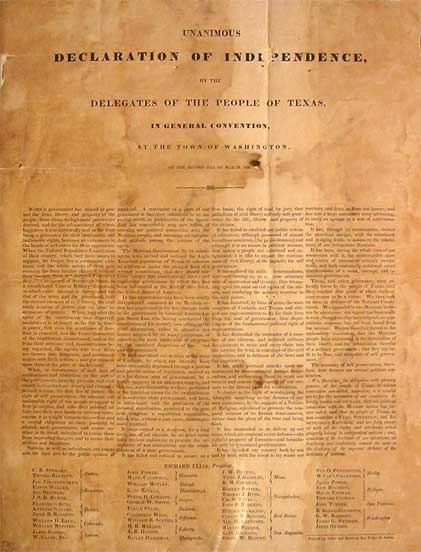
The Texas Declaration of Independence, signed March 2, 1836.

March 2nd is Texas Independence Day, the day that settlers in the Mexican State of Texas signed off on their Declaration of Independence from the government of Mexico and claimed their new independent sovereign status as the Republic of Texas.

The year was 1836, 176 years ago, at a place called Washington on the Brazos, a little place located about half way between present day Austin and Houston.

The Declaration was an action that did not come quickly or easy – or without cost and casualty to the people of Texas. It grew in power over several years of unsuccessful effort to work out problems of unfair taxation and control by the dictatorial Mexican government without fair representation of the needs and wishes of the Texas people and it resulted in a fairly quick, but costly period of combat and siege at Goliad and the Alamo in San Antonio before Texas General Sam Houston led the rebel army to victory over the forces of Mexican General Santa Anna as San Jacinto on April 21, 1836.

Even after San Jacinto, it was mid-summer 1836 before all the Mexican forces in Texas finally retreated in full, south of the Rio Grande River again. Of course, nine years later, in 1845, the independent Republic of Texas would trade in that status for membership in the United States of America, triggering the Mexican War and a much larger reallocation of Mexican territory.

These new mid-19th century boundaries of separation between the United States and Mexico would remain firm until the late 20th century, when scores of economically desperate citizens of Mexico began to regain territory claimed earlier by the USA with a quietly multiple, individually one-by-one and small group border-ignoring invasion of illegal immigrants that was welcomed with open arms by American employers seeking the large sudden presence of cheap labor.

Happy Texas Independence Day, everybody. Better get your taste of it before it all gets used up.

The Galloping Ghost of the Java Coast

March 1, 2012

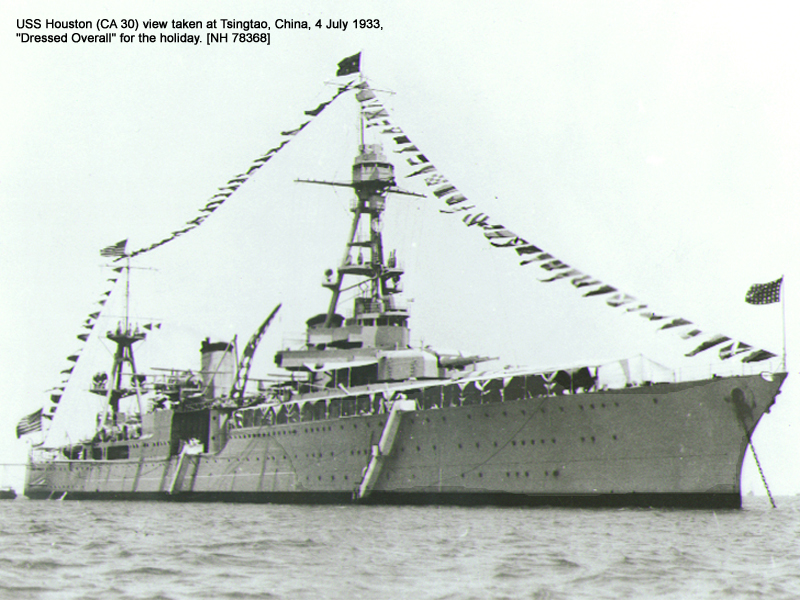
The USS Cruiser Houston


Capt. Albert Rooks went down fighting with the USS Houston on March 1, 1942.

Today, March 1, 2012, marks the 70th anniversary of the sinking of the USS Houston, the United States Navy Cruiser, that everyone called “The Galloping Ghost of the Java Coast.” The Houston and The HMAS Perth encountered a large contingent of the Japanese Imperial Navy on February 28, 1942 in waters known as Banten Bay in the Far Pacific theatre following an earlier battle in which American and Allied forces had fairly run the Japanese forces from their previous positions.

This time, the Houston and the Perth were up against all odds of survival and quickly came under heavy torpedo and artillery fire. Shortly after midnight, on March 1st, the Houston became the second of the two Allied ships to go down from the heavy assault. Of the 1,061 man crew, 368 survived and a handful of those battle combatants live on to this day to celebrate their bond with each other on this anniversary, March 1, 2012.

Captain Albert Rooks died amidst the flames on deck that night in 1942, directing counter attacks against the Japanese to the very end.

The USS Houston that went down in 1942 was the second American naval ship named for our city. It was originally commissioned for duty in 1929 at Newport News, Virginia and it served the nation proudly to the very end.  For more complete information about the history of the USS Houston, please take a look at both of these following recommended links.

http://en.wikipedia.org/wiki/USS_Houston_(CA-30)

http://www.usshouston.org/

The men of the Houston were all American souls, even fielding their own baseball club to compete with the other ships in the American Pacific fleet.

Houston can be proud of the men who served and died on the Houston that fateful day in World War II – as we also take comfort in the knowing that a special handful survive to celebrate their bond today.

It is small wonder that the World War II group is remembered today as our “greatest generation.” When it comes to old-time issues like loyalty and commitment to duty and country, and a God-fearing sense of responsibility for protecting the future of generations to come, we could use a few of them as candidates for President in 2012.

The USS Houston Baseball Club

Rest in Peace, men of the USS Houston. Thank you for representing our city and the country in a first class All American way.


When Was a Hit Also Scored as an Error?

February 29, 2012

Look it up. It's in the book.

Back in the 19th century, the rules of baseball scoring changed radically from year to year. The leaders of the professional movement responded to the complaints and criticisms of others in an ongoing struggle to fine tune the game to just the right balance between offense and defense as that sort of thing was perceived to be for that day at a time.

In 1887, for example, the rules makers gave the batter a fourth strike before he could be retired. In 1888, they took it back, The batter was back to the key spot of “three strikes and you’re out” in plenty of time to not mess up Jack Norworth’s and Albert Tilzer’s 1908 baseball anthem, “Take Me Out To the Ball Game” – or that wonderful Mudville lament about the absence of joy after Casey took strike three.

Can you imagine singing, “‘for it’s one, two, three, four strikes you’re out in the old ball game?” – Neither can I?

Perhaps the screwiest book changes of 1888 were rules 6.08 and 10.13

Rule 6.08 gave a hit batsman first base and credit for a base hit because of the pitch that struck him.

Rule 10.13, among other things, also awarded the pitcher an error for hitting the batsman with a thrown ball.

Didn’t anyone do contradiction or irony searches among the various rules changes back then? Apparently not. Where is the common sense of awarding a hit to one player and an error to another for nothing more than what happened on one thrown pitch?

The error charge to the pitcher on a hit batsman was removed the following year, 1889. I’m not really sure when the hit credit to the batter on a “HBP” was removed, but fell it did too as ludicrous, but certainly not as silly as some of the earlier rules. Back in 1869, for example, baseball gave strong attention to how many runs a player scored and no attention to the players who drove the runs across the plate. Also in 1869, baseball devalued base runners for being forced out at the next base on infield plays. The presumption was that the runner should have been fast enough to have already moved up – or athletic enough to have broken up the play before the “out” was registered.

As long as we stick with 4 balls, 3 strikes, 9 innings. 90 feet bases and a 60’6″ pitching distance theater of operations, we should be OK – if we can just find a way to bury the dad gum designated hitter option.

NOTE: I may not be writing here daily over the next two to three months. The research, writing, and editorial demands of our SABR Early Houston Baseball History Project are beginning to take a toll on the time and energy I usually have available for a daily column. It could still happen, or come close. If it doesn’t, I just wanted you to know what’s going on with me.