A Gathering of Eagles and Buffalos and Cougars

May 17, 2013
"Place no faith in tomorrow, for the hands may there be still."

“Place no faith in tomorrow, for the hands may there be still.”

Friday, May 16. 2013 was another of those golden days, time with buddies, neighbors, and classmates on the very turf where we all grew up in the Houston East End. One could plan for years to do something like this little reunion and it might not happen, but this one did, by accident or spiritual design – and I don’t believe in accidents.

From my place on the west side. I picked up another former Pecan Park Eagle named Ken Kern from his place in off 610 South and drove us to Kelley’s Country Kitchen at 8015 Park Place Blvd. off the Gulf Freeway. There we met up with a mutual friend from way back named Foster Foucheaux, who had driven up from Pearland to meet us for lunch.

Our relationship chain worked like this: Ken and I were Pecan Park neighbors from 1945 to forever. I lived on Japonica and Ken lived on Myrtle. As we got older, we both flocked to the sandlot that was bordered by both our streets. We came to name ourselves “The Pecan Park Eagles” and to play out so much of our passion for the game on that hallowed ground. By the time high school came along, I remained an eagle by enrolling at St. Thomas and commuting everyday to STHS at 4500 Memorial. Ken became a buffalo, a Milby HS Buffalo.

Foster Foucheaux grew up in Park Place, a neighborhood to the southeast of Pecan Park. We met in 1947 when my parents enrolled me as a second-grader in St. Christopher’s Catholic School. We were classmates and baseball teammates at Chris through our 1952 8th grade graduation.Then Foster went to Milby where he and Ken met and became fiends.

And those were the three legs of group relationship stool. I lost track of Foster in high school, but Ken and I still got together occasionally to commiserate over girl friend issues as we cruised the East End drive inns. Then all of us went our separate ways as working UH students, but Ken and I did share time as ROTC students.

We talked about the things yesterday that older men discuss: our health issues; the way we were; our happiness and our regrets; and our gratitude for each day we awaken on the top side of the growing grass. One sad note invaded with the news that Ken’s older brother Lloyd had died recently. I had known about it after the fact of his funeral and before today so I came prepared. I have this always-with-me desire to give of myself to those I care about and, sometimes that need gets expressed in ways that aren’t well understood by some people. That was not the case yesterday,

I gave Foster and Ken copies of my two personally most important poems, Summer Baseball (1969) and The Pecan Park Eagle (1993), plus one by an anonymous writer that has no known date stamp. It’s called “The Clock of Life”, but more importantly to me, at least, it has become my mantra for a life-in-the-moment appreciation of what fills my cup.

The guys each also received a small bottle of magic soil that I had dug up from the home plate area of our old sandlot field at Japonica and Myrtle in 2010. Ken and I played there from about 1948 to 1954. Foster never played there, but he was an East Ender too and a valued school baseball  teammate at St. Christopher’s. That was good enough for me.

Ken received two sandlot soil bottles: One for him. And one for Lloyd.

The lunch discussion over good old fashioned East End comfort food lasted three hours and we vowed to do it again, even as we kept in mind the message of the clock:

The Clock of Life

 ~ author unknown ~

 The clock of life is wound but once

And no one has the power


To know just when the hands will stop

At late or early hour


NOW Is the only time you own

 Live, Love, Toil in God’s Will


Place no faith in tomorrow

 For the clock may there be still


Have a nice weekend, everybody – one day at a time.

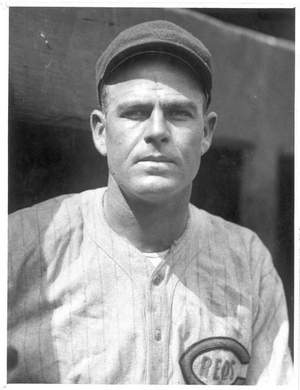
Ross Youngs vs. Curt Walker: One More Time

May 16, 2013
A new book on Ross  Youngs by David King is coming our way soon.

A new book on Ross Youngs by David King is coming our way soon.

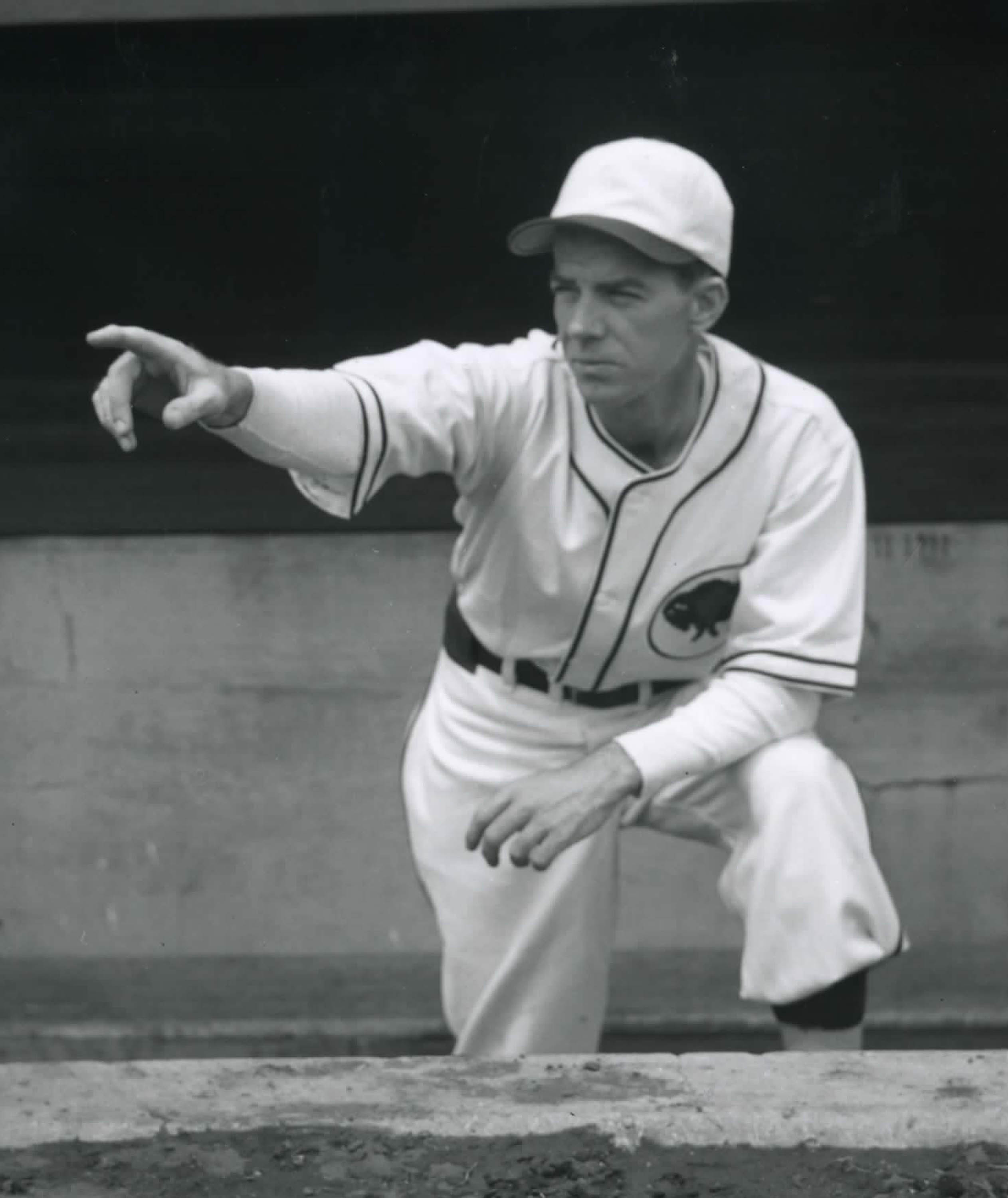
Curt Walker started his professional career as a Houston Buff in 1919.

Curt Walker was a Houston Buff in 1919.

Curt Walker of Beeville, Texas was one of my earliest baseball idols, but it had nothing to do with seeing him play or knowing first hand how really good he was. He was my dad’s friend, one of my fatherless dad’s earliest role models from our shared birthplace of Beeville. Dad and his buddies used to go to downtown Beeville as kids of the 1920s to check on Cincinnati Reds scores because of Curt. Before I was born, Dad and Curt later played town ball together for Beeville in the 1930’s. They hunted together. They grabbed coffee together at the old American Cafe on Washington, Beeville’s “main street” business drag.

By the time I reached adolescence and started accessing published records of baseball’s past performers,  I learned that our family friend, Curt Walker, had done pretty well for himself as a big league ballplayer from 1919-1930. Then, years later, in 1972, I was astonished by the news that another deserving small town Texas contemporary named Ross Youngs had been approved for induction into the Baseball Hall of Fame by the Veteran’s Committee.

What about Curt? I wondered. I’m no stat head, and this is no knock on Ross Young’s deservedness for the honor, but I just couldn’t see what made Youngs a superior candidate for that honor than Curt Walker. From anecdotal sources, I got the idea that  Youngs may have been the faster between these two fast men, but both were great defending outfielders with great batting eyes. Physically and by age too, they were virtually Texas twins. The only really major differences were that Youngs played all of his ten-year MLB career with the New York Giants and Curt Walker played most of his twelve-year career with the Cincinnati Reds.

With the new book on Youngs by David King coming out soon, I have to take us through this basically unscientific comparison one more time:

Curt Walker was born in Beeville, Texas on July 3, 1896. Ross Youngs was born in Shiner, Texas on April 10, 1897.

Curt grew to a playing height and weight of 5’9″, 170 pounds; Ross rose to 5’*8″ and 162. Both batted left and threw right.

Ross batted .322 in a career that covered 5,336 plate appearances; Curt batted .304 over 5,575 plate trips.

Ross banged out 2BH, 3BH, & HR totals of 236-93-42; Curt closed on same with totals of 235-117-64.

Ross had R/RBI totals of 812/592. Curt finished with totals of 718/688.

Ross racked up 1,491 career hits. Curt posted 1,475 total hits.

Ross registered OBP/SA totals of .399/.441; Curt went in the same tub with .374/.440 marks.

Ross walked 550 times; Curt drew 535 bases on balls.

Ross struck out only 390 times in 5,336 plate appearances, but Curt fanned only 254 times in 5,575 plate trips.

Ross Youngs died of Bright’s Disease at age 30 on September 22, 1927 in San Antonio, Texas. Curt Walker died of a heart attack at the age of 59 on December 9, 1955 in Beeville, Texas.

My Conclusion: Ross Youngs had more friends in high places than Curt Walker. Youngs also played his career in New York and was struck down by a terrible disease at the height of his career. Lot’s of sympathy votes hatch from going out that way. Curt Walker was more of an everyday, quiet kind of guy who played out his career in a small market city, lived into his retirement years to the boondocks of little Beeville, a place that hardly a Veterans Committee member ever visited.

Sabermetric guru Bill James takes this position on the Youngs/Walker controversy: He basically concludes that it isn’t so much that Walker deserves the HOF as much as Youngs, but that Ross Youngs never should have been inducted in the first place. He believes that both men were good ballplayers, just not statistically good enough in either case for the Hall of Fame.

With their shared affinity for avoiding the “K”, I would gladly take either man for the top of my batting order in 2013.

It will be interesting to see what new light David King brings to the legacy of Ross Youngs. For some of us, he will always be connected to the disappearing act that the Veterans Committee performed on Curt Walker.

Buff Biographies: Joe Medwick

May 14, 2013
Joe Medwick Outfielder Houston Buffs 1931-1932, 1948

Joe Medwick
Outfielder
Houston Buffs
1931-1932, 1948

Joe Medwick wasn’t included in the 1948 autograph book about the 1948 Houston Buffs by Morris Frank and Adie Marks. He wasn’t supposed to be back in Houston that year.

19-year-old outfielder Joe Medwick wasn’t the easiest guy to get along with when he joined the 1931 Houston Buffs in 1931. Blessed with Hall of Fame baseball skills and a thin skin to the comments and trash talk of others, many of his teammates chose to stand-off rather than set off the young powder keg in the middle of a game situation. He seemed to get a little worse as he moved into his early to mid twenties before finally mellowing out with maturity during the latter years of his total baseball career (1930-49, 1951-52). He did not leave baseball, however, for a career in any of the commercial human relationships fields, nor did he seek or find work in the State Department’s diplomatic corp.

Columnist Lloyd Gregory and a Buffs fan hung the nickname "Ducky" on Joe Medwick. Of course, they did it from afar.

Columnist Lloyd Gregory and a Buffs fan hung the nickname “Ducky” on Joe Medwick. Of course, they did it from afar.


Medwick acquired his nickname, “Ducky”, in 1931 after a female fan wrote to Houston Post Dispatch columnist Lloyd Gregory, claiming that she hard started calling him by that name because she thought he waddled like a duck when he walked. Gregory apparently agreed with the fan and started using the moniker in his own public references to Medwick in his columns.

It stuck, or “resonated”, as we might say in 2013. The Houston public saw him as “Ducky” through a second season in 1932 and then sent their slugging and swifty center fielder onward and upward to St. Louis late in the 1932 season to waddle all the way to baseball greatness, starting with the St. Louis Cardinals’ Gashouse Gang.

Medwick hit .305 with 19 league-leading homers and 126 RBI for the 1931 Texas League champion Buffs. In 1932, Ducky raised his batting average to .354 with 26 HR; this time, not leading the league in either category.

Over the course of his 17-year MLB career with the St. Louis Cardinals (1932-40, 1947-48)); Brooklyn Dodgers (1940-43, 1946); New York Giants (1943-45); and Boston Braves (1945), Joe Medwick batted .324 with 205 HR and 1,383 RBI.

For his 7 seasons as a minor leaguer (1930-32, 1948-49, 1951-52), Ducky batted .336 with 83 HR. He also served as a manager at three different minor cities in his last three active seasons (1949, 1951-52).

Joe Medwick was inducted into the Baseball Hall of Fame in 1968 He died at age 63 on March 21, 1975.


Buff Biographies: Johnny Keane

May 13, 2013
Excerpt from "Your 1948 Houston Buffs, Dixie Champions: Brief Biographies By Morris Frank and Adie Marks (1948).

Excerpt from “Your 1948 Houston Buffs, Dixie Champions: Brief Biographies By Morris Frank and Adie Marks (1948).

Johnny Keane Manager 1947 Buffs

Johnny Keane
Manager
1947 Houston Buffs

Johnny Keane managed the first team I ever followed, the 1947 Houston Buffs, to both the Texas League pennant and the Dixie Series championship. Seventeen years later, he led the comeback-romping 1964 St. Louis Cardinals to an incredible last-chapter snatching of the National League pennant from the Cincinnati Reds and the phaltering phingers of the pholding Philadelphia Phillies. The Cardinals then edged the New York Yankees in the seven-game 1964 World Series. It was a big surprise championship, but the biggest surprise followed almost immediately.

The Yankees fired Yogi Berra as their manager for losing the ’64 Series and hired Johnny Keane as his replacement. In spite of Johnny’s desire to get back at Cardinals’ owner August Bush for his own plans to fire him until the team’s miracle rally, his placement with the Yankees was quick to prove itself a very bad fit.

Keane’s authoritarian ways didn’t go over well with the arrogant Yankee big apple celebrity athletes. The 1965 Yankees slipped all the way down to 6th. Then, New York AL ’66 headed toward a last place finish in the tenth spot, Keane was fired and replaced by Ralph Houk. Johnny Keane’s baseball career was over and done.

Johnny Keane returned to his Houston home after the Yankee firing, but his health had taken a heavy silent toll from the stress. At age 55, he died of heart failure on January 6, 1967.

Johnny Keane’s baseball history with the Houston Buffs was ancient and deep. He loved the city, playing shortstop here for four seasons from 1934 to 1937. He later managed the Buffs from 1946 to 1948, even getting into a few games as a player.

Keane was a minor league manager for seventeen seasons (1938-41, 1946-58) and a major league manager for six seasons with St. Louis, NL (1961-64) and New York, AL (1965-66).

Mother’s Day Reflections 2013

May 12, 2013
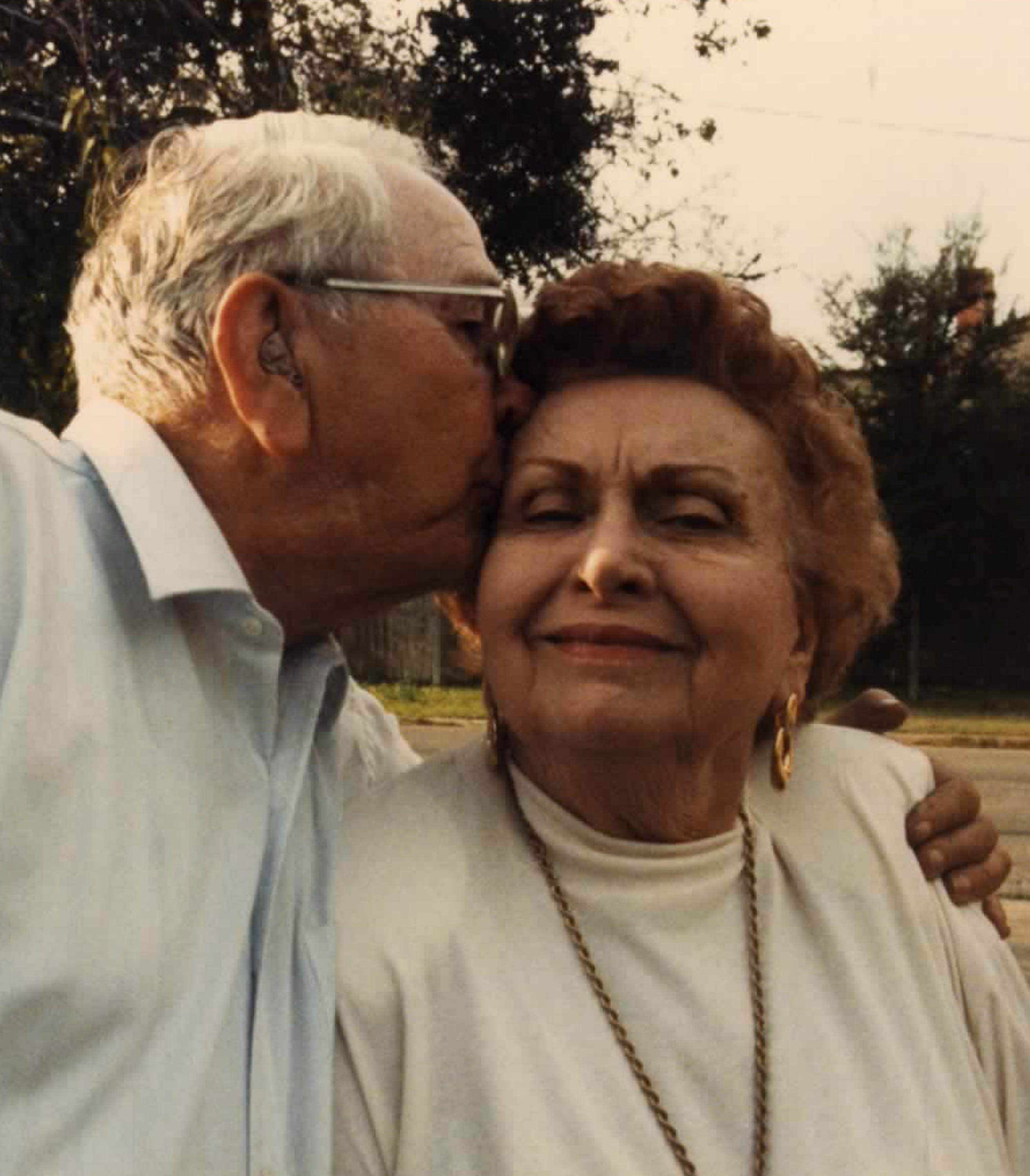
Here's my dad wishing my mom a Happy Mother's Day in 1993. They were both gone by July 1994. Mom died in early June, four days after their 58th anniversary.. Dad, who had been in good health, died exactly five weeks later.

Here’s my dad wishing my mom a Happy Mother’s Day in 1993. They were both gone by July 1994. Mom died in early June, four days after their 58th anniversary. Dad, who had been in good health, died exactly five weeks later.

Happy Mother’s Day, Mom, wherever your happy soul resides in Heaven’s broad cloudscape. We still love you, even though you are no longer with us, and we still feel the presence of your love in everything right that we take on to do.

You taught us that “God is Love”. So be it. You were right, as were you correct about all the other lessons of pure love’s true nature: All love that is giving, that is right, that is building life for the better – is God’s Love.

It took us awhile, but we got it. – Mother’s Love is God’s Love too. All caring for others and the world around us is God’s Love. And once it reaches our hearts, it stays with us forever.

God’s Love is True Love too. Any kind of notion that True Love is about having a partner that makes us feel good all the time is not Love, at all, but lust. Easy way to recall the difference: Love frees. Lust owns.

Thank you, Mom, for freeing me to live. I’m not perfect, but I give life my best.

Because of you.

Happy Mother’s Day!

Buff Biographies: Allen Russell

May 11, 2013
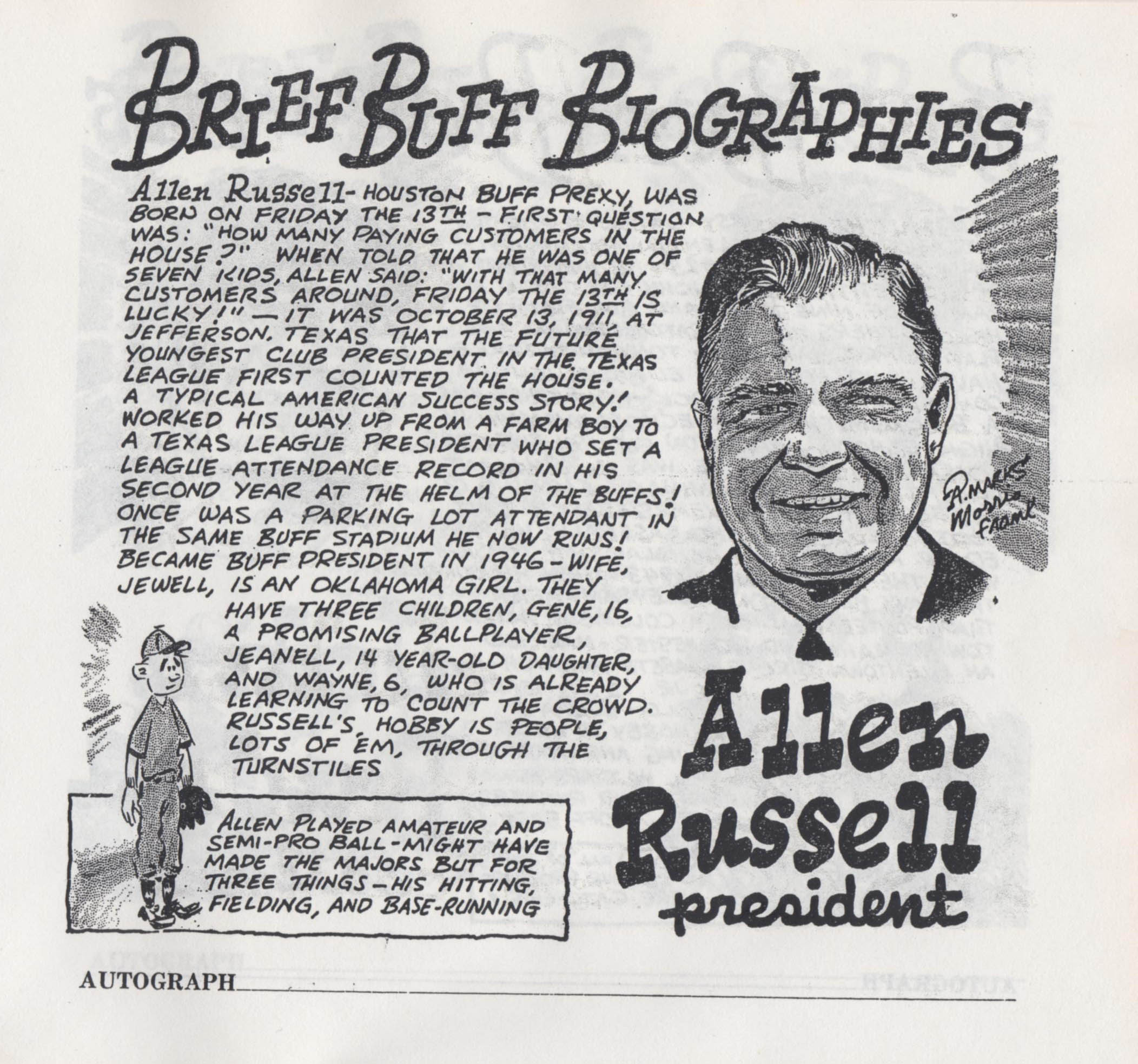
Excerpt from "Your 1948 Houston Buffs, Dixie Champions: Brief Biographies By Morris Frank and Adie Marks (1948).

Excerpt from “Your 1948 Houston Buffs, Dixie Champions: Brief Biographies By Morris Frank and Adie Marks (1948).

Allen Russell started with the Houston Buffs as a parking lot attendant back in the mid-1930s, working himself up to top as President of the club from 1946 through 1952. Short on formal education, but long on street-wisdom, vision, energy, people smarts, and a love of the game, Allen Russell did more than other single individual in local history to sell Houston as a future major league city,

Allen Russell Houston Buffs President 1946-1961

Allen Russell
Houston Buffs President
1946-1952

Several seasons of outdrawing the major league St. Louis Browns with the AA Texas League Houston Buffs was just the icing on the cake that front-loaded the serious, specific campaign by others in behalf of Houston’s big league dreams after Russell departed the Buffs following the 1952 season.

Allen Russell was Houston Baseball’s human dynamo. His read on the needs of his Buff Stadium fans was little more than an example of  the empathy he had for the needs of the people. And his ability to anticipate the future comfort needs of fans was simply one of the big reasons that Houston adopted the far reaching state of mind in its plans for baseball and is now playing the game more than a half century later in its second covered stadium.

Thank you, Allen Russell, for taking the breaker shot that set all the balls in motion for baseball success in Houston on so many critical levels at the end of World War II.

Now, if the Astros can only get back to winning more games than they lose by 2015.

Buff Biographies: Eddie Knoblauch, LF

May 10, 2013
Excerpt from "Your 1948 Houston Buffs, Dixie Champions: Brief Biographies By Morris Frank and Adie Marks (1948).

Excerpt from “Your 1948 Houston Buffs, Dixie Champions: Brief Biographies By Morris Frank and Adie Marks (1948).

Eddie Knoblauch 1947 Houston Buffs

Eddie Knoblauch
1947 Houston Buffs

Lefty hitting Eddie Knoblauch was one of those Buffs that always made me wonder: How did the guy miss getting so much as a single time at bat in the big leagues? I mean, the guy knew the strike zone as well as anyone I ever saw. He could draw walks like the great Eddie Yost and run the bases and handle the outfield with the best of them. He had no power, but he was a great contact-hitting table setter for 15 years as a mostly high level club minor leaguer. (1938-1942, 1946-1955: 2,543 hits, 20 HR, and a .313 career batting average.)

Houston fans enjoyed and suffered from a love/hate relationship with Eddie Knoblauch. He was a Buff  for 5 years (1942, 1946-1949), but then went over to the dark side in 1949 in deals that saw him also play for two other Texas League clubs at Dallas and then Shreveport. Eddie finished the last 7 seasons of his career (1949-1955) bedeviling the Buffs for teams at Dallas. Shreveport, Tulsa, and Beaumont several times over by becoming the guy who could beat your club in the 9th with either a 2-run bloop single or a bases loaded walk. – It was “pick your poison” time when Eddie Knoblauch came to bat in a late game pinch.

Eddie was the uncle of Chuck Knoblauch, who enjoyed both some good and some haunted seasons with both the Twins and the Yankees. He was also the brother of Ray Knoblauch, the long-time successful baseball coach at Bellaire High School in Houston.

Eddie Knoblauch died about 25 years ago, but neither I nor Baseball Reference.Com remembers the date. In fact, the outstanding Internet source even seems to think that Eddie Knoblauch is still alive, which he is not. When I am able to confirm the exact time and place of his death, I will include it here. I do remember that we was buried somewhere in the rural Austin-San Antonio area.

Oh, yes. Back to the question of why Eddie never got a shot at the big leagues, but I think we all know the most probable answers. For one thing, there were still only 16 MLB clubs back in the late 1940s and 1950s. For another, Knoblauch played the entire first half of his career, his prospective years, as either a farm hand in the talent rich Cardinals organization, or else, doing military duty in World War II. It wasn’t an easy time for all cream to find the top. The big league clubs owned all the player options through the reserve clause. Good players could either take what the clubs decided for them – or go home. Eddie Knoblauch, like a lot of other players from those spike-free negotiating days, did just that. He took what he could get and stayed in the game as a career Texas Leaguer.

Thanks for what you did, Eddie. You made the game an exciting thing to watch.

Amazing Duo: Adie Marks and Morris Frank

May 9, 2013
Excerpt from "Your 1948 Houston Buffs, Dixie Champions: Brief Biographies By Morris Frank and Adie Marks (1948).

Excerpt from “Your 1948 Houston Buffs, Dixie Champions: Brief Biographies By Morris Frank and Adie Marks (1948).

As a result of those two columns I’ve done this week on the work of Morris Frank and Adie Marks, this very important question came to me today as a comment from Anthony “Tony” Cavender: “Bill: Who drew those great illustrations?”

Adie Marks

Adie Marks

His name was Adie Marks, Tony. Adie Marks did the artwork and Morris Frank did the script for  their 1948 Houston Buffs autograph book of player sketches and summaries. Both were involved with the Houston Buffs as friends and working supporters of club president Allen Russell and beyond Russell’s tenure to the end of the team’s existence in 1961. Frank handled the public address duties at Buff Stadium and Marks handled the team’s advertising. Both used their differing abilities to promote the welfare of Houston baseball. Marks just did his work more quietly, but perhaps, more measurable over time.

It was Adie Marks, who continued his support of Houston baseball as the advertising man for Judge Roy Hofheinz and the Houston Astros. In those times, Marks was credited with coming up with the words and phrases “Astrodomain”  and “Eighth Wonder of the World” as usable descriptors for the world’s first covered athletic stadium. Those entries are what I mean by work that is “more measurable over time”.

It’s not how much you say, but what you say that gets remembered.

I was privileged to have met and lunched with Adie Marks during the very early years of the 21st century. He’s the one who gave me a copy of his 1948 Buffs autograph book. He was a nice guy, fun to spend time with, and a dynamo for ideas on how we could do a better job of promoting baseball in Houston. Unfortunately, Adie Marks died on August 31, 2006 at the age of 91. He went out as he lived – working all day as a Houston ad man.

Morris Frank

Morris Frank

Morris Frank was an absolute force as a Houston sports figure during the 1940’s and 50’s, especially. He wrote a column for the Houston Chronicle and he did all the greeting and announcing of lineups over the PA system at Buff Stadium. If there ever was another voice that handled those duties for the Buffs, he has been long ago forgotten by people like me. Morris Frank and his East Texas twang was – the ballpark voice of the Houston Buffaloes – and the Master of Ceremonies at any sports banquet in Houston that was worthy of holding.

Like Adie Marks, Morris Frank was a close friend and strong working associate of Buffs president Allen Russell – and another person who figured strongly in Russell’s ability to put together a winning business team. Like Marks, Frank was also a charitable man who volunteered his talents to a number of local causes that called upon him for help.

Today we even have a Houston Library branch named for Morris Frank. We ought to have one ,or a school, named for Adie Marks too – and maybe even an avenue for Allen Russell. They were all part of a generational force that has helped to make Houston a better city today.

In a post-mortem column on Morris Frank, friend and fellow writer Bob Bowman closed with the following:

“On July 16, 1975, the day after Morris passed away, the Chronicle published an editorial praising him for his qualities. The editorial concluded with these words: “Will Rogers has often been quoted as saying he never met a man he didn’t like. That was the way it was with Morris Frank, but there was more. With Morris, there never was a person he didn’t love.”

Here’s are links to two Internet pieces on the lives of each man:

Adie Marks ~

http://www.chron.com/news/houston-deaths/article/Adie-Marks-creative-adman-with-knack-for-1496472.php

Morris Frank ~

http://www.texasescapes.com/AllThingsHistorical/Morris-Frank-BB705.htm

How Some Baseball History Gets Lost

May 6, 2013
Excerpt from "Your 1948 Houston Buffs, Dixie Champions: Brief Biographies By Morris Frank and Adie Marks (1948).

Excerpt from “Your 1948 Houston Buffs, Dixie Champions: Brief Biographies By Morris Frank and Adie Marks (1948).

Any historical artifact can get lost, but it’s also true that the chances increase when people get the idea that an item has a personal monetary value that is more important than the item’s pertinence to the preservation of a fuller and more accurate portrayal of history.

So it is with baseball items. Ever since fans fell in love with the romance of finding a 1951 Mickey Mantle rookie card, or an even rarer limited production early 19th century tobacco card of Honus Wagner, or maybe stumbling upon a baseball signed by Babe Ruth,  hoarding of things has gone crazy. As a result, some items get sentenced to eons of time in attics, basements, and vaults for decades, only to be later thrown away by descendants, or else. put in garage sales or transferred mindlessly to some other storage space.

I will offer today a modest example from the Houston area.

About 2005, while I was serving as Board President of the Texas Baseball Hall of Fame, we learned through a TBHOF supporter that Mrs. Eleanor Mazar, the widow of former Houston Buffs pitcher Pete Mazar, was in possession of an item that “might” be important to us.

Important? I’ll say! According to our very reliable informer, Mrs. Jo Russell, the widow of  late Houston Buffs President Allen Russell, the Mazars somehow had ended up with the only known 78 rpm record copy of  the 1947 Houston Buffs Dixie Series Championship Banquet, the first in a long history of Houston winter baseball banquets.

Wow! At first it looked easy. Lead pipe cinch easy. Jo Russell and Eleanor Mazar were on good terms. All we wanted was the opportunity to record the albums with modern technology. In her contacts with Mrs. Russell, Mrs. Mazar seemed eager to help. When we tried to get it done, however, a different wind began to blow.

Appointments to meet and discuss ways of doing the recordings got cancelled by Mrs. Mazar for other reasons. She apparently had been talking with her family and they reportedly had some concern that the records might get broken while they were in our possession. We understood. And we began to explore ways of just coming into the Mazar home and doing the transcription recording on site.

Before we could get anything done, Mrs. Mazar’s poor health caused us all to back way off the idea until that situation clarified. Sadly, it clarified on the extreme downside when Mrs. Mazar passed away on January 20, 2006 at the age of 82. We never found another opportunity through any other surviving family member to pursue the issue.

And more time has passed.

Those historic records now are either one of four places: (1) trashed; (2) sold; (3) given away; or (4) family stored again elsewhere, and just waiting for the first person who comes along with a “what’s this?” attitude to find and trash them. They would not have made anyone rich, but Houston’s baseball history is all the poorer for their loss.

If there’s anyone out there from the Pete Mazar family that happens to read this column, please get in touch with me at

houston.buff37@gmail.com

… if you share our interest in making sure these items are copied for history. The Houston Chapter of the Society for American Baseball Research (SABR) will help you get the work done, if it is still possible, and we will make sure that your mother, Eleanor, and your father, Pete, get all the credit they so justly deserve.

Pete Mazar was another of my childhood Houston Buff heroes and I would love to see him and his family be recognized as the people who were responsible for the survival of this important item.

Thank you.

SABR Celebrates @ Skeeters Game

May 5, 2013
Constellation Field Sugar Land, Texas Twilight Time Saturday, May 4, 2013

Constellation Field
Sugar Land, Texas
Twilight Time
Saturday, May 4, 2013

On the coolest day ever registered for May 4th in the Houston area, a nice size group from our local Larry Dierker SABR chapter descended upon Constellation Field to eat, drink, and be merry on a Saturday night as the Sugar Land Skeeters rallied to take a tough 5-4 win over the Lancaster Barnstormers. It was the fourth straight win for the Skeeters over the Barnstormers and also the club’s seventh straight victory in a row.

The 5-4 win on 5/04 didn’t come easy. Trailing 4-2 n the bottom of the 6th, it took a three-run blast to left off the bat of Fernando Perez to give the Skeeters the final score edge that they would hold over the last third of the game. And all the fans went home cool and happy.

Deacon Jones of the Skeeters (center) came down to greet and chat with a couple of other Houston baseball icons, Larry Miggins and Mare "Red" Mahoney.

Deacon Jones of the Skeeters (center) came down to greet and chat with a couple of other Houston baseball icons, Larry Miggins and Marie “Red” Mahoney.

Mike Vance and his friend Ann seemed to be having a great time.

Mike Vance and his friend Ann Shelton seemed to be having a great time.

Tal Smith of the Skeeters also dropped in to say hello. Here he is with Larry Miggins.

Tal Smith of the Skeeters also dropped in to say hello. Here he is with Larry Miggins.

There were more SABR members present than I could catch with the camera, but here are the ones who did not escape the digital surveillance of a fun night with some good friends and great baseball people:

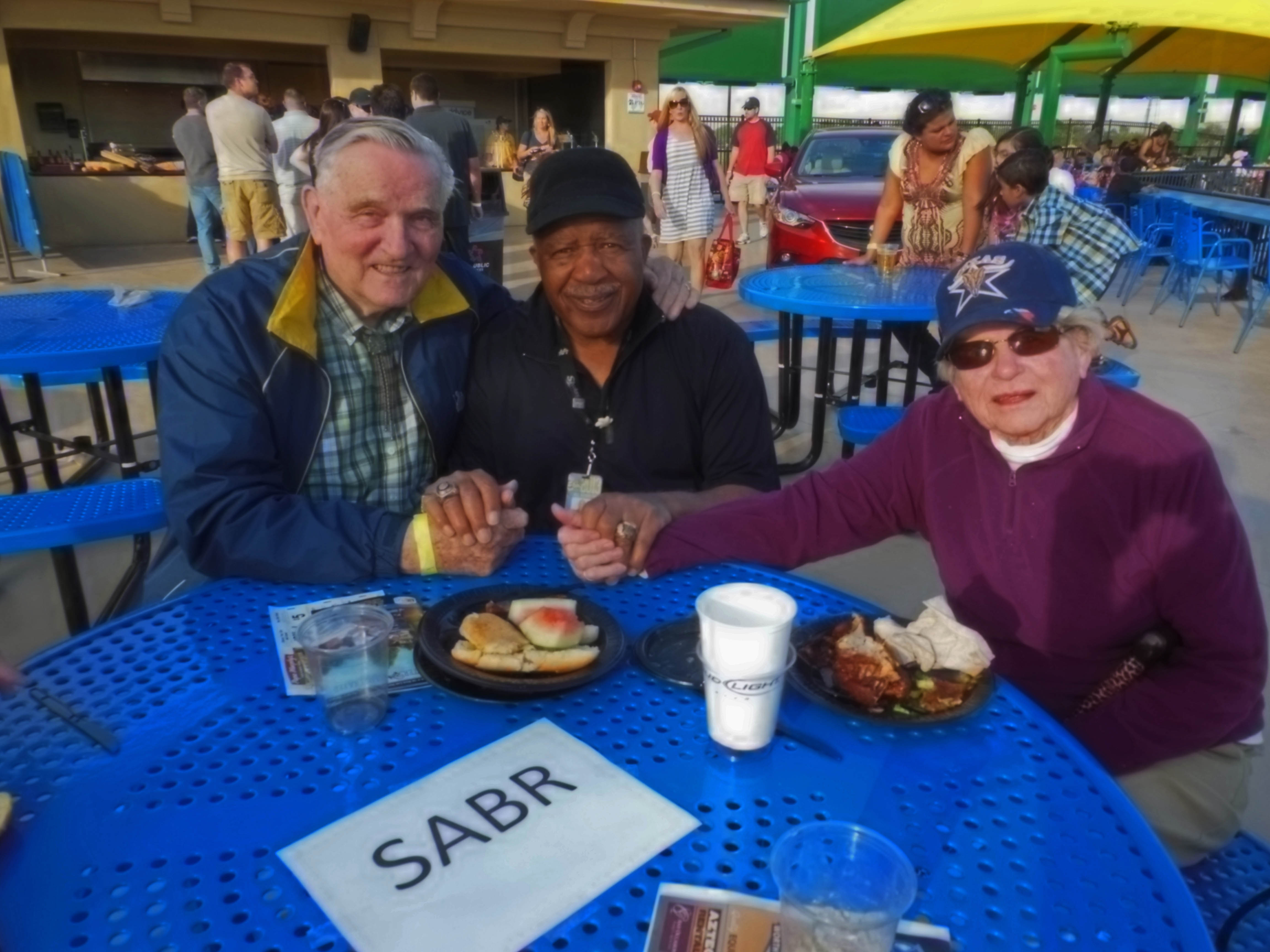
Harold Jones and SABR Chapter President Bob Dorrill.

Harold Jones and SABR Chapter President Bob Dorrill.

Sweet Peggy Dorrill

Sweet Peggy Dorrill

Mark Chestnut and his daughter.

Chris Chestnut and his cute, cute daughter.

Marsha Franty

Mellow Marsha Franty

..... and Bob Stevens.

….. and Smilin’ Bob Stevens.

SABR stands for the "Society for American Baseball Research".

SABR stands for the “Society for American Baseball Research”.

About SABR …

Contrary to popular belief, SABR is not an organizations simply for those who love statistics or for collecting all the math nerds in the world in one place. Most of us are simply baseball people who are dedicated to the story of the game and all of its rich narrative history. We come from all walks of life and our interests in the game of baseball are as variable as there are numbers of us.

Our Houston Chapter is named for Larry Dierker, the earliest of all living and present Houston Astros icons. Larry is also a member of our chapter, as is another high-flying icon named Jimmy Wynn and former Houston Buff Larry Miggins, one of the seven surviving participants in Jackie Robinson’s first professional game for Montreal in 1946.

Membership in SABR will cost you $65 per year, or $45 per year if you are either 65 or over or 30 and younger. but you will get a whole basket of good baseball stuff for the money, including free publications on baseball history that come by mail and, in Houston, a monthly meeting with other SABR members to hear presentations by some of the top local figures in the game.

In 2014, our Houston Chapter will also be hosting the SABR National Convention and also publishing a superlative research book on Early Houston Baseball: 1861-1961.

We also sponsor and play in the local vintage base ball circles by the 1860 rules as the Houston Babies, the name once given to the city’s first professional team. Have you ever played by the old rules? With no gloves? And in a game where balls caught on one bounce are valued as outs? You would love it. It’s the closest thing to the sandlot experience of childhood that any of us could have ever hoped to reprise.

We’d loved to have you join us as a SABR member too, and you can pick from there what’s for you, and what’s not. So, if you think you may be interested in joining SABR, please call or e-mail our chapter president, Bob Dorrill, for more information. Bob’s contact info is as follows:

Phone: 281-630-7151

E-Mail: bdorrill@aol.com

Just call Bob Dorrill . Bob’s a no pressure guy.