Buried Treasure at Baseball Reference.Com

October 17, 2013

images

It’s difficult being a technically challenged person with all the information that’s available to us today on the Internet, but I try – and often times I even succeed, with help of data websites that are able to anticipate the needs of researchers like me and make it easy to access. The key here is – you have to go hands and eyes on what the website is trying to make easy for you. Sometimes, they even express it in written instructions that hardly anyone could possibly misunderstand – unless a person simply refused to read the website guide material.

Baseball Reference.Com is my favorite example of a website that goes into extra innings to make their baseball history data available and usable, but you have to read the instructions to fine tune data into comparable data files. For example, let’s say you want to compare how Craig Biggio performed in his first ten years as a hitter versus how he performed in his second ten years of his twenty total year MLB career.

First, click this link to the website:

http://www.baseball-reference.com/

Second, type in his name, Craig Biggio, at the active search window and press enter.

Third, click in the last column at the end of the 1997 row in the white area. Then do the same in the 1998 row. That will produce the first summery you see below on Craig’s first ten years.

Fourth, repeat that action for the two rows that bookend the second half of Biggio’s career (1998-2007) and you will have the same data that is visible below in the second data summary.

Have some comparative fun. We are only limited now by our imaginations and our curiosities as to how we use this one tool alone.

Have a nice Day!

Craig Biggio

Craig Biggio

Data Bank One: Craig Biggio Batting Stats, 1988-1997

Year Tm G PA AB R H 2B 3B HR RBI SB CS BB SO BA OBP SLG OPS OPS+ TB GDP HBP SH SF IBB
1988-1997 HOU 1379 5949 5104 874 1470 282 36 116 545 268 82 634 753 .288 .377 .426 .803 123 2172 57 119 51 40 38
Average 138 595 510 87 147 28 4 12 54 27 8 63 75 217 6 12 5 4 4
per 162 games 162 697 598 103 172 33 5 14 64 32 10 75 89 255 7 14 6 5 5

 Data Bank Two: Craig Biggio Batting Stats, 1998-2007

Year Tm G PA AB R H 2B 3B HR RBI SB CS BB SO BA OBP SLG OPS OPS+ TB GDP HBP SH SF IBB
1998-2007 HOU 1471 6555 5772 970 1590 386 19 175 630 146 42 526 1000 .275 .351 .440 .791 102 2539 93 166 50 41 30
Average 147 656 577 97 159 39 2 18 63 15 4 53 100 254 9 17 5 4 3
per 162 games 162 722 635 107 175 43 3 20 70 17 5 58 110 280 11 19 6 5 4

Hum Drum Report on Ruth’s 60th HR

October 16, 2013
On Friday. September 30, 1927, set the 60 HR mark that would stand alone as the MLB homer record for the next 34 years.

On Friday. September 30, 1927, set the 60 HR mark that would stand alone as the MLB homer record for the next 34 years.

The headlines rolled out pretty well, but the chopped-down Associated Press story of Babe Ruth’s 60th home run that survived its two-inch column way into the Bridgeport (CN) Telegram back on Saturday morning, October 1, 1927, was about as tasty as ice-cold watermelon without a single sprinkle of salt. Also note that only 8,000 fans showed up to see Ruth hit his 60th home run on the next to last game of the season, but cut fans a break here. People worked longer hours in 1927 – and All the games were played in the daylight hours when most employed fans were still working. The last game on Saturday, Oct. 1, 1927 would attract 20,000 fans to see the Yankees edge the Senators, 4-3, for their 110th win of the season, but they would not see Ruth extend his HR record. The Babe would go 0 for 3 on the day after he blasted new record HR # 60.

At any rate, here’s how this AP account of Ruth’s Sept. 30th record game flowed, or shall we say – blandly oozed:

**************************************************************

Ruth Sets New Home Run Mark by Driving Out 60th as Yanks Beat Senators, 4-2

RECORD-BREAKING HOMER BREAKS 2-2 DEADLOCK IN EIGHTH INNING; BABE ALSO SCORES THREE RUNS

New York, Sept. 30 – (By Associated Press). Babe Ruth’s sixtieth homer of the season, creating a new major league record, carried the New York Yankees to a 4 to 2 win over the Washington Senators today.

With the score tied at 2-2 in the eighth, Koenig (NY) tripled with one out and came home as Ruth shattered his old mark of 59 homers with a full-mash (sp) shot into the sun seats of the right field stands. Ruth also hit two singles and scored three of New York’s runs. The Yankees got to (Washington’s) Tom Zachary for single runs in the fourth and sixth innings to set the stage for Ruth’s record-smashing climax.

The score:

Baseball Almanac Box Scores: Washington Senators 2, New York Yankees 4
Game played on Friday, September 30, 1927 at Yankee Stadium I
Washington Senators ab   r   h rbi
Rice rf 3 0 1 0
Harris 2b 3 0 0 0
Ganzel cf 4 0 1 0
Goslin lf 4 1 1 0
Judge 1b 4 0 0 0
Ruel c 2 1 1 1
Bluege 3b 3 0 1 1
Gillis ss 4 0 0 0
Zachary p 2 0 0 0
  Johnson ph 1 0 0 0
Totals 30 2 5 2
New York Yankees ab   r   h rbi
Combs cf 4 0 0 0
Koenig ss 4 1 1 0
Ruth rf 3 3 3 2
Gehrig 1b 4 0 2 0
Meusel lf 3 0 1 2
Lazzeri 2b 3 0 0 0
Dugan 3b 3 0 1 0
Bengough c 3 0 1 0
Pipgras p 2 0 0 0
  Pennock p 1 0 0 0
Totals 30 4 9 4
Washington 0 0 0 2 0 0 0 0 0 2 5 0
New York 0 0 0 1 0 1 0 2 x 4 9 1
  Washington Senators IP H R ER BB SO
Zachary  L(8-13) 8.0 9 4 4 1 1
Totals
8.0
9
4
4
1
1
  New York Yankees IP H R ER BB SO
Pipgras 6.0 4 2 2 5 0
  Pennock  W(19-8) 3.0 1 0 0 1 0
Totals
9.0
5
2
2
6
0

E–Gehrig (15).  DP–Washington 2. Harris-Bluege-Judge, Gillis-Harris-Judge.  2B–Washington Rice (33).  3B–New York Koenig (10).  HR–New York Ruth (60,8th inning off Zachary 1 on 1 out).  Team LOB–7.  SH–Meusel (21).  Team–4.  SB–Rice (19); Ruel (9); Bluege (15).  U–Bill Dinneen, Tommy Connolly, Brick Owens.  T–1:38.  A–8,000.

Game played on Friday, September 30, 1927 at Yankee Stadium I
Baseball Almanac Box Score | Printer Friendly Box Scores

Hot Stove Pipes: Need Fan Rule Changes for MLB

October 15, 2013
The Hot Stove League Fire is Now Kindled.

The Hot Stove League Fire is Now Kindled.

OK, with the MLB league championship games heating up and the World Series coming next, it’s not too early for those of who live in cities like Houston to strike a match and light up the Hot Stove League with topics on how our teams and the game itself can be improved. I have two related rules changes I’d like to recommend, both of which pertaining to my favorite “pet peeve” subject of fan interference, something that baseball normally just ignores, allowing mindless people to reach over the rails down the outfield lines and across the rail from front row outfield bleacher seats and kill an active play in progress by capturing or simply touching the ball that’s coming near them.

The “ground rule double” call now governs the fan-touched fair balls hit down the line. The umpire’s “home run or out by fan interference” call now controls fans touching balls hit near the outfield walls in fair play.

Neither rule curtails fan interference. And the game goes on, played by the 18/20 legal players in the lineups of each team at the time – in addition to the unwanted contributions of front row “buttinsky” fans who just have to grab for every baseball they can get their hands on. PA announcers often warn fans that they can be ejected from the ballpark for interfering with the game, but it never happens in ways that I can see. Money-tight owners apparently are fearful that these wonderful ball-grabbing fans will get their feelings hurt by a much-deserved ejection and not come back to future games.

Enough is enough. For rules to mean anything, there must be a consequence that teaches both transgressors and victims a lesson that neither cares to forget or repeat.

The transgressor is the idiot ball-grabber. The victim is the game of baseball itself, the fans who paid to see the game played as it was intended, and the owners who fear turnstile retribution from ejected transgressor fans.

Here are my two rules change suggestions for MLB. They are very simple, very clear, and very pointed toward the establishment of black and white consequences that aim to wipe out the practice of fan interference by the provision of real lessons:

Rule One Change (on fair balls touched by fans leaning over the rails down the line in foul territory): If the batted fair ball was hit by a home team batter, it is automatically ruled a ground rule single. On the other hand, if the batted fair ball was hit by a visiting team batter, it is automatically ruled a ground rule triple.

Before you get carried away with any concerns that this radical rules change would simply invite visiting clubs to plant fan-interfering visitor fans down the lines, or you get lost in fearing how unfair it now will be for the home team, remember the first intent. – That is to establish a sharp first consequence for fan interference that will demand better control of fans who violate the rules by mindlessly reaching over the rails and snatching at any baseball that moves. This rule puts the pressure on the home team to do something about all fan interference, or else, suffer the consequences that tilt heavily more harsh upon the home club. My guess is that we could make fan interference down the lines almost unheard of in a very short time. The interfering fans aren’t going to enjoy the reaction from the home crowd who just watched them hand a ground rule triple to the visitors.

The current “ground rule double” is no deterring consequence. If anything, in fact, it is nothing more than a quick way to second base that teaches nothing to no one.

Rule Two Change (on balls touched or caught by outfield fans leaning over the rail in fair play above the field): If the ball was hit by a home team batter, the play is ruled a fly out catch by the nearest fielder. On the other hand, if the ball was hit by a visiting team batter, the play is ruled a home run. – Also, if the play was unclear as to the location of the ball in relation to the field exit plane, the two stated above rules still apply.

As we recently saw in the A’s v. Tigers ALDS game in Detroit, the Tigers were awarded a home run in right field when two home fans seemed to lean over the rail to deflect a ball that might have been caught. It fell to the ground in deflection away from any possible catch and was soon awarded to the home field Tigers as a home run. Under this suggested new rule, the batter would have been declared out.

As with suggested Rule One, the pressure is all upon the home team to clean up the mess of fan interference. If clubs don’t want close calls at the outfield walls, they need to modify outfield barriers so that fans cannot reach over the line and get their hands on a ball that’s in play.

That’s it. But these are just my hard thoughts on what needs to happen. Please check in with your own opinions.

Let’s get this Hot Stove League cooking.

Buff Biographies: Harry Elliott

October 14, 2013

Buff Logo 12

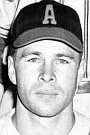
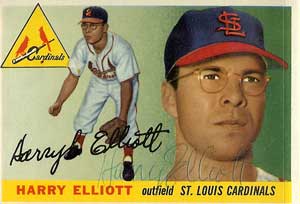
Harry Elliott

Harry Elliott

Sadly this morning, I’ve only now learned that one of my favorite former Houston Buffs from the 1953 club died this past summer. At the age of 89, Harry Elliott passed away on August 9, 2013 in his home town of Little River, Kansas.

Outfielder Harry Elliott (BR/TR) (5’9″, 175 lb.) was a slashing line drive power hitter who posted a career minor league batting average of .326 over 7 seasons (1951-54, 1956-58) that also included 205 HR. His greatest season in the minors came early when he hit .391 in 139 games for the 1951 Alexandria Aces of the Evangeline League. By 1954, Elliott banged out a .350 average for San Diego of the AAA Pacific Coast League in 168 games.

Harry had a short dip into the MLB coffee grind while he was in the Cardinal system, batting a career .256 with only 2 HR as a pinch hitter/left fielder with St. Louis of the National League during the seasons of 1953 and 1955. Back then, playing left field behind another guy named Stan Musial was no speed lane to the big time. Elliott spent the entire season of 1955 with St Louis in 1955, but he was sent down to Houston in 1953 after only 28 games of play off the Cardinal bench. Harry’s arrival in Houston was one of the few bright spots in an otherwise dull and gray hum-drum 6th place Buffs Texas League season. Elliott batted .328 with 8 HR in 115 games during his only Buffs 1953 season.

Harry Lewis Elliott was born December 30, 1923 in San Francisco, but he graduated from Watertown High School in Minnesota before attending the University of Minnesota prior to the start of his baseball career. When he broke into the big leagues on August 1, 1953, his start occurred exactly 60 years and 8 days prior to his passing from this life.

harry_elliott_autograph

Harry Elliott was an animated and spirited figure, moving productively in the foreground of the otherwise mostly gray and hapless 1953 Buffs. The Pecan Park Eagle is certain that his family must have experienced much of that energy too in their own relationships with him and that he is very missed by whomever he left behind.

Rest in Peace for now, Harry Elliott. – With a little faith, hope, and heart, – and some good old fashioned baseball luck – the herd will ride again,

A Day in Our Life with UH Football

October 13, 2013
On a day in which storms held off til game's end, the UH defense held off the Memphis Tigers as the young Cougar offense sputtered through a tough day in the learning process.

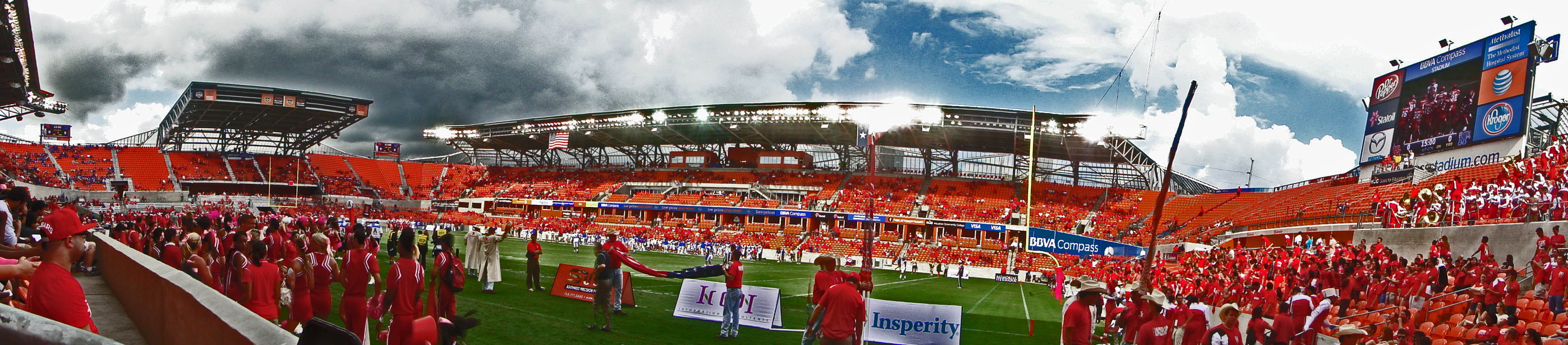
On a day in which storms held off til game’s end, the UH defense held off the Memphis Tigers as the young Cougar offense sputtered through a tough day in the learning process at BBVA Compass Stadium in Houston.

Memphis 15
(1-4, 0-2 AAC)

Houston 25
(5-0, 2-0 AAC)
Coverage: ESPNews

11:00 AM CT, October 12, 2013

BBVA COMPASS STADIUM, HOUSTON, TX

QUARTERS> 1 2 3 4 ~ FINAL
MEMPHIS 3 6 6 0 ~ 15
HOUSTON 7 3 8 7 ~ 25

Top Performers:

Passing: J. O’Korn (HOU) – 198 YDS, 1 TD
Rushing: K. Farrow (HOU) – 15 CAR, 33 YDS, 2 TD
Receiving: M. Frazier (MEM) – 5 REC, 81 YDS

The 20,000 capacity soccer stadium was only about half full for a UH football game that started at 11:00 AM.

The 20,000 capacity soccer stadium was only about half full for a UH football game that started at 11:00 AM.

In spite of the light turnout, the involved Cougar student body was there in full.

In spite of the light turnout, the involved Cougar student body was there in full.

And Shasta the Cougar masot prowled the sidelines.

And Shasta the Cougar mascot prowled the sidelines.

... as did Shasta's girl friend, Missy Shasta.

… as did Shasta’s girl friend, Missy Shasta, student spirit groups, and an assortment of beautiful cheerleader/acrobats.

The Coogs came ready ...

The Coogs came ready …

... and the UH defense played hard, forcing 4 fumble recoveries to pace their national leadership in positive turover ratios.

… and the UH defense played hard, forcing 4 fumble recoveries to pace their national leadership in positive turnover ratios.

A beautiful UH cheerleader appealed to Cougar fans to get their voices into the game behind UH - and we all gave it our best shout!

A beautiful UH cheerleader appealed to Cougar fans to get their voices into the game behind UH – and we all gave it our best shout!

A great day was enjoyed by UH Cougars everywhere.

A great day was enjoyed by UH Cougars everywhere.

It was a day in which our defense reminded us that Wade Phillips is one of us.

It was a day in which our defense reminded us that Wade Phillips is one of us.

It was a day in which UH alums again were reminded by all the spirited young people around us of the "can do" heart that beats within us all.

It was a day in which UH alums again were reminded by all the spirited young people around us of the “can do” heart that beats within us all.

It was a day in which one step upon the old UH campus would have reminded us all of where we each started our separate, but joined journeys in life.

It was a day in which one step upon the old UH campus would have reminded us all of where we each started our separate, but joined journeys in life.

Have  nice Sunday, everybody. – And “Eat ‘Em Up, Cougars!”


More on Howard Glenn’s Death in Houston

October 12, 2013
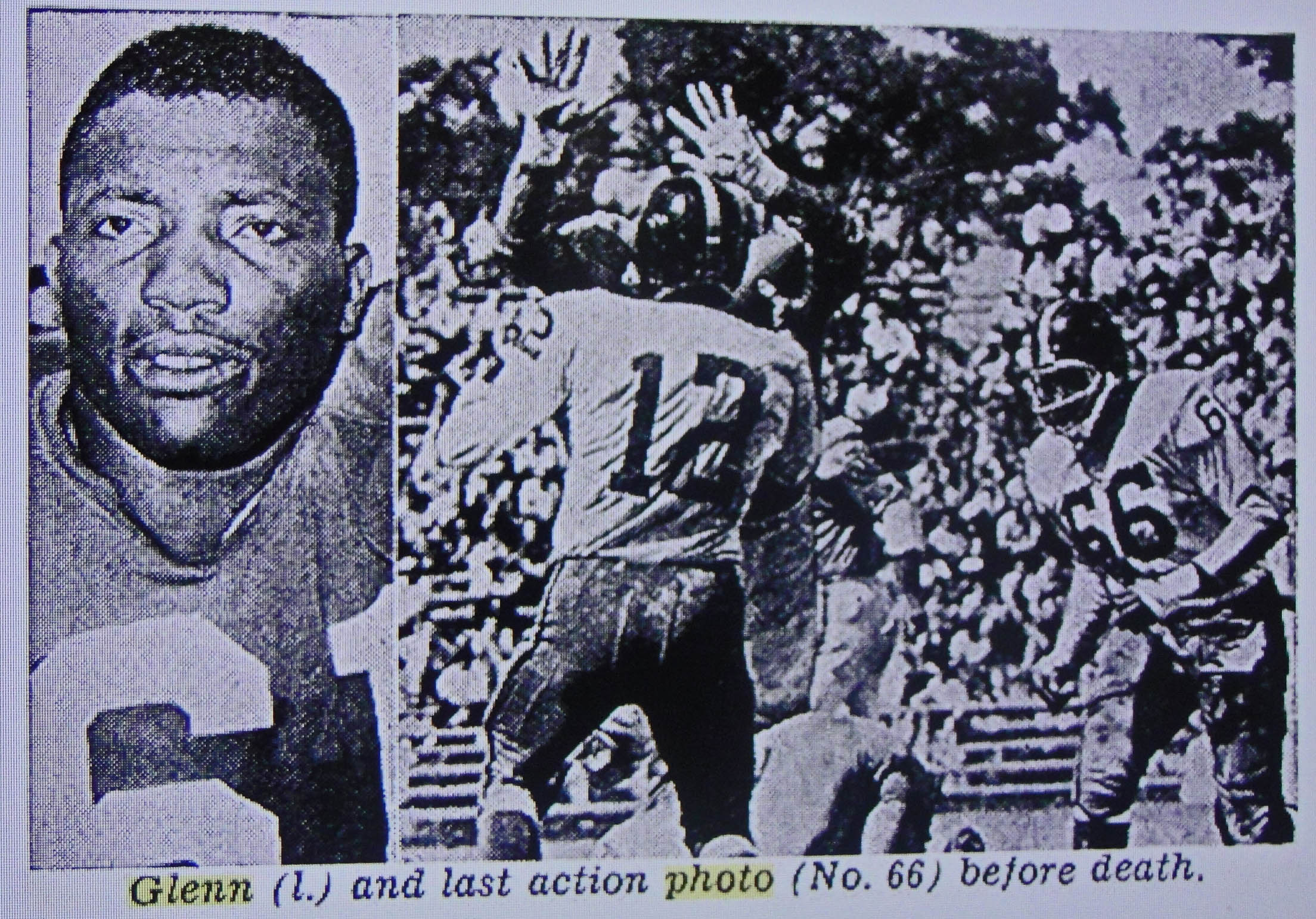
Oct. 9, 1960: #66 Howard Glenn makes the tackle on an Oiler RB. Within 3 hours, Glenn will be dead from game injuries or heat stroke.

Oct. 9, 1960: #66 Howard Glenn makes the tackle on an Oiler RB. Within 3 hours, Glenn will be dead from game injuries.

Three days ago, October 9, 2013, I wrote an article about the death of Howard Glenn, a lineman for the New York Titans, from injuries sustained in an AFL game his team played against the Houston Oilers exactly 53 years earlier at old Jeppesen Stadium on Cullen Boulevard. It is called “Houston: Death on a Football Afternoon”.

Since then, contributor Tom Hunter has forwarded me another more detailed exploration of that tragic day and what may have happened to Howard Glenn that fateful date. Howard’s death apparently brought about the formal hiring of the Titans’ team physician and a requirement by the AFL that teams have x-ray equipment available at game sites as minimal changes in the direction of providing some in-place protection from the sorry fate that long ago claimed the life of Howard Glenn.

Howard Glenn and I would be about the same age today, had he not been killed playing football under the plantation mentality that widely existed within professional football ownership and within a sadly large part of our culture back in 1960. That identification by age thought sorrows me all the more. – I got to live a long life and am hoping for more. – Howard Glenn did not get that rainbow ride, nor can he wish or work for anything else. His time here ended on a hot, humid day in Houston over a half century ago.

Life isn’t fair. – But nobody ever said it was. – If it were, the only sadness left around would be the kind that emanates from those who wallow in self-pity no matter what the truth may be.

Howard Glenn was neither a subject or object of pity. He was a victim of the times and what can happen to those who play football under the worst of circumstances – or even the best of conditions.

This recent article suggests that the New York Jets, the direct descendants of those Titans, may want to give some thought to inducting #66 Howard Glenn into their franchise Hall of Honor. Please read this piece and let The Pecan Park Eagle know your thoughts about Howard Glenn. – Do you think admitting an unremarkable skills person like Howard Glenn into the Jets Hall of Honor because he is a symbol of the once rampant neglect of its own makes sense?

Here’s a link to this recent article – and thanks again, Tom Hunter!

http://infinitejets.blogspot.com/2013/08/ny-jets-66-howard-glenn.html

Have a nice Saturday, Everybody!

Our Super Highway Dream Went South All Right

October 11, 2013
The Super Highway

The Super Highway in Houston.

Back in our less enlightened days, just after the end of World War II, we called that new big street they were going to build in Houston by the best name anyone around here could imagine. That original name of the IH-45 South, Gulf Freeway, was nothing less than wonderful tribute to magical wishes. They called it “the super highway”.

Here’s how its humble beginnings were reported in the Galveston Daily News on Page 2 of their August 7, 1947 edition:

SUPER HIGHWAY

Houston Tex., Aug. 6, (AP) – The first concrete has been poured on the new Houston-Galveston super highway. J.C. Dingwall, urban design engineer with the state highway department has announced. The concrete was poured at Pierce and Crawford streets in Houston where a #1,000,000 widening project is underway.

After the super highway was completed, it took on a more modest identity as the Gulf Freeway, but it’s job was done by early 1949. It had solved all traffic flow problems between Houston and Galveston, given all of us in southeast Houston a new easy five to ten minute sight-seeing drive to downtown from our homes, and established itself as the model design for all the other freeways that were soon to come in service to all of Houston. – The Southwest Freeway, the EastTex Freeway, the North Freeway, and the lovely 610 Loop eventually rang in as Houston’s easy new way to get around town painlessly without trains or any plan to preserve the integrity of inner city, near downtown life.

What a wonderful world!

Now, if you will excuse me, I’ve got to run to the store. This stuff I’ve been smoking this morning is a little strong.

World Series Team Marks

October 10, 2013
"In the big inning, the Lord Said to Adam: 'Beyond your love for me, family, and friends, this gift is to remind you of what else is really important in life.'"

“In the big inning, the Lord Said to Adam: ‘Beyond your love for me, family, and friends, this gift is to remind you of what else is really important in life.'”

On a day spent celebrating my little sweetheart Norma’s birthday, The Pecan Park Eagle pauses to put first things first: Love and Family own the lead here, even over baseball.

I did have time to work up a little sketch this morning, with the help of a table I constructed from data compiled by Baseball Almanac. The chart below shows the World Series record of every present and defunct team since the 1903 inception of the first such contest.

My categorizations are not pure. or example, I treat the entire Dodgers record as including all the time in Brooklyn, even those early years they were known as the Robins, through present day Los Angeles, because that franchise seems to prevail forever in our hearts and minds as “Dodgers then ~ Dodgers now. ~ Dodgers forever.” On the other hand, when a team like the old Senators moved to Minneapolis and became the Twins, when the Browns moved to Baltimore and became the Orioles, et cetera to all other city and name change examples,  those such moves are treated here as the end of one identity and the beginning of another. The A’s life in three cities left the A’s, like Dodgers, still the A’s, but the Pilots early move to Milwaukee to become the new Brewers, was another identity shift, – in my mind, at least.

In addition to win/loss records, the table graph denotes the years that each team last reached and last won a World Series, if ever.

IN THE CHART BELOW, X DENOTES A TEAM IDENTITY THAT NO LONGER EXISTS.

Hope you find some enjoyment with this information.

Gotta go now. My lady awaits.

WORLD SERIES RECORD OF PRESENT AND PAST MAJOR LEAGUE TEAMS IN THE MODERN SERIES, 1903-2012:

TEAMS WON LOST WIN % LAST WS LAST WON
BLUE JAYS 2 0 1.000 1993 1993
MARLINS 2 0 1.000 2003 2003
ANGELS 1 0 1.000 2002 2002
DIAMONDBACKS 1 0 1.000 2001 2001
PIRATES 5 2 .714 1979 1979
ATHLETICS 9 4 .692 1989 1989
YANKEES 27 13 .675 2009 2009
RED SOX 7 4 .636 2007 2007
CARDINALS 11 7 .611 2011 2011
WHITE SOX 3 2 .600 2005 2005
REDS 4 3 .571 1990 1990
TWINS 3 3 .500 1991 1991
METS 2 2 .500 2000 1986
ROYALS 1 1 .500 1985 1985
TIGERS 4 7 .455 2012 1984
ORIOLES 3 4 .429 1983 1983
INDIANS 2 3 .400 1997 1948
GIANTS 7 12 .368 2012 2012
DODGERS 6 12 .333 1988 1988
BRAVES 3 6 .333 1996 1995
X – SENATORS 1 2 .333 1933 1924
PHILLIES 2 5 .286 2009 2008
CUBS 2 8 .200 1945 1908
PADRES 0 2 .000 1984 never
RANGERS 0 2 .000 2011 never
ASTROS 0 1 .000 2005 never
BREWERS 0 1 .000 1982 never
RAYS 0 1 .000 2008 never
ROCKIES 0 1 .000 2007 never
X – BROWNS 0 1 ,000 1944 never
MARINERS never
NATIONALS never
X- EXPOS never
X – PILOTS never

Houston: Death on a Football Afternoon

October 9, 2013
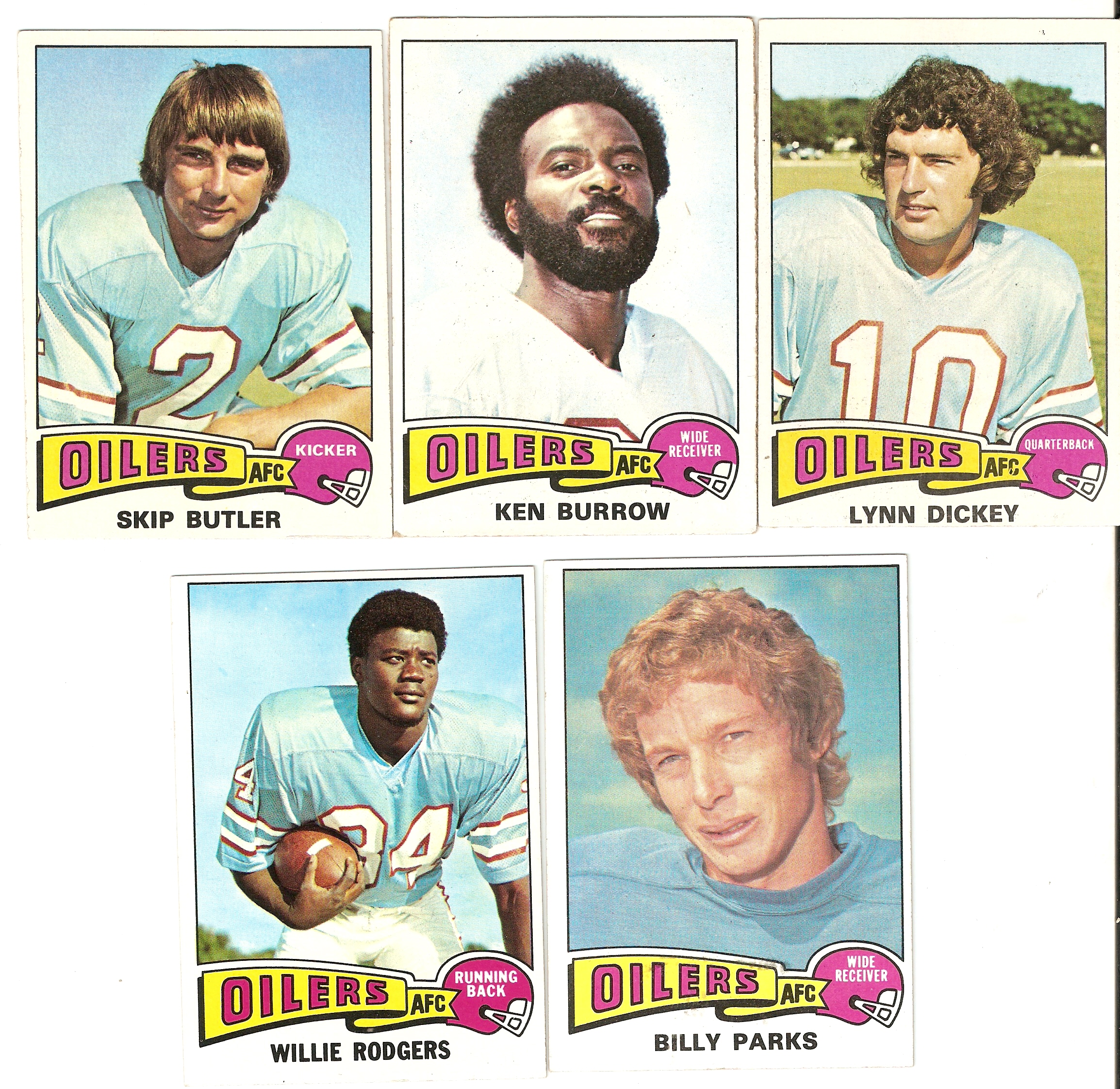
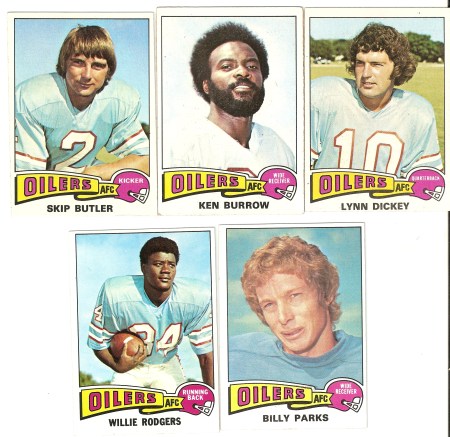
The good old days of early pro football in Houston weren't always so bright - and the darkest of these was October 9, 1960, long before even the guys in this picture were around.

The good old days of early pro football weren’t always so bright – and the darkest of these was October 9, 1960, involving the death of a New York Titans lineman in an AFL game in Houston, long before even the guys in this picture were around to play against them as the first Houston Oilers.

Today the University of Houston announced that senior quarterback David Piland was being dropped from the Cougars football team because two concussions had left him vulnerable to the imminent possibility of serious illness, injury, or even death, if he continued to play. UH didn’t use that specific language in describing the potential dangers to Piland, should he continue to play and take hard hits on the field, but that’s what they meant and we all know it.

“It was not easy to hear that I can no longer play the game that I love,” said Piland, “but I know our medical staff has my best interests in mind.”

How times have changed. We only have to go back in time fifty-three years to the same physical place were young David Piland took many of his hits, if not the career-ending ones, to find the identity of the only man officially recorded as the solely diagnosed player ever killed directly in major level professional football from a game injury. His name was Howard Glenn, a 26-year old offensive guard who played for the New York Titans of the American Football League. The Titans were in town to play a game with the Houston Oilers on a Sunday, but let’s allow an eyewitness to start our story about that day. Tom Hunter, then an 8th grade student in Pearland, Texas  and a future graduate of UH, saw it all unfold before him. Now a longtime resident of Denver, Hunter has never forgotten that fated afternoon when death rode into the mix of heat, humidity, and rules-prescribed violence to stop Howard Glenn at the toll booth.

“On Sunday, October 9, 1960, I sat near midfield in the front row of the east stands at Jeppesen Stadium for a football game between the Houston Oilers and the visiting New York Titans and saw Titans offensive guard Howard Glenn–who had been injured on a play–come out of the game and sit on the bench directly below me. His bare head lolled from side to side until two trainers came over and aided him as he walked off the field under his own power just before halftime. Later that night I learned that he had died at Hermann Hospital. He was twenty-six years old. Nowadays when a player is seriously injured on the field, he is immobilized, placed on a cart, and taken for medical evaluation. Whenever I see this, I am haunted by the memory of number “66” with his arms around the shoulders of two trainers walking towards the Jeppesen Fieldhouse locker rooms. R.I.P.” – Robert Thomas Hunter, Denver, Colorado.

As many of you know, “Jeppesen” was the name that formerly identified the old WPA constructed football stadium on Cullen at the UH campus that was later changed to “Robertson”. It was torn down after the end of the UH 2013 football season to be replaced by a modern playing facility that will open for UH in 2014. Back in 1960, it was the original home of the Houston Oilers. Their New York Titan opponents would soon enough be renamed the “Jets”, and that new nickname would stick as the lasting identity of that original AL club.

Unlike today, football clubs played variable to light to no attention to the possibility of life-threatening injury during games in 1960. The local Oilers had a couple of physicians, but the Jets traveled to Houston with no doctors to help them with in-game diagnosis and treatment of critical injuries or game-induced illnesses. And remember too. These were the days when coaches and trainers prescribed salt tablets, limited water, and no rest for fatigue on the field. Players were expected to simply suck it up and be men by playing through minor pain, injury, and fatigue.

Real men were the last men standing. – Men who took themselves out of games due to injury, pain, or nausea were simply wimps. Nothing more.

Sunday, October 9, 1960 was one of those Houston fall days that felt more like the jungle of a southeast Texas August. Temperatures reached into the 90’s and the humidity was so high that players were soaking wet in their heavier-than-these-days uniforms and helmets of that even more primitive era. It had to have been tough on everyone, but especially for the New York players. Unlike the Oiler guys, the Titans had not been in town long enough to have developed the secondary breathing gills that Houstonians needed for summer-survival in the days prior to ubiquitous air-conditioning.

As in baseball, if not even more so, because of the even lesser employment opportunities, football players put up with it. A top star like future Hall of Fame pass-catching ace Don Maynard may have made something under $10,000 a season, tops, while also working the off-seasons as a master plumber, a teacher of high school math, or a salesman of cars – or whatever.

In 1960, it was a different day and more of a plantation mode for player thought. “”You just show up when you’re supposed to play and do what you’re supposed to,” said Don Maynard. “That’s the business.”

On October 9, 1960, the football culture of bad medicine, no medicine, player dedication to pain denial, the absence of proper hydration and game rest, inferior protective equipment, and the basic violence of the game came together to kill a man who probably could have been saved in 2013. And it happened in Houston, at Jeppesen (later Robertson) Stadium, to a young fellow named Howard Glenn,  a New York Titan lineman who would not live to see his other aspirations as an artist ever develop as they might have.

Ernie Barnes described the decline of Howard Glenn quite graphically in an article by Sandy Pawde for the March 17, 1967 edition of the Sarasota Evening  Journal. Shortly after kick off on this hot sweaty day, Glenn began to say, “I don’t think I can make it.” He was greeted with butt -slap support and “suck it up” words by his teammates. Teammate Barnes, lined up next to Glenn, says he began to notice a putrid smell coming from Glenn. It wasn’t normal and it just got worse as the game wore on.

Glenn continued to say, “I don’t think I can make it,” adding, “I’m sick. I need to come out of the game.” All he got was more hang in there words and butt-slapping until the offensive drive stalled and the Titans kicked the ball away. Only then did  Howard Glenn leave the game with the rest of the offensive team. He was sweating profusely, gasping for breath, smelling awful, with a white foam building around his mouth, and about to fall. In spite of these worsening conditions, the Titans had no team doctor present to examine him – and New York Coach Sammy Baugh just kept sending him back into the game each time the offense again took the field.
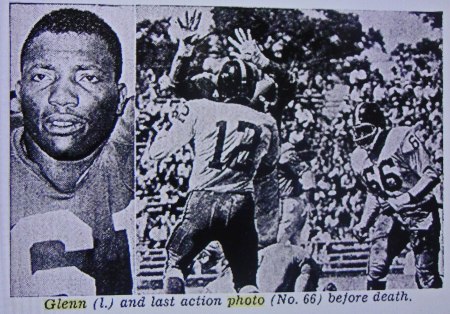
Howard Glenn

Glenn finally collapsed and had to be lifted and walked (not stretchered) to the bench by two teammates. He spent most of the second half on the bench and walked to the locker room under his own power, just before the half. At game’s end, however, Howard Glenn collapsed as he returned to the locker room. The cry “get him a doctor” started, but was soon quieted by “just sit him on a stool. He’ll be all right. It’s just football and fatigue.” Sitting dazed and glassy eyed on a stool. Howard soon slumped to the floor, as a very drunken man might,  landing flat on his back, with his eyes still open, but only staring blindly at the ceiling. He began coughing up thick green mucous, which fellow players tried to clear from his mouth with their fingers as he seemed to be strangling on it. That reeking smell from Glenn’s body filled the room. Only then did New York officials call for help from the Oilers’ two stadium-present physicians. Some time was lost finding and retrieving medical help that could have been called when Glenn first was taken out of the game, but that was not the practice of this team in that era on a fateful Sunday.

It wasn’t rocket science medicine. The two Oiler doctors quickly determined that Howard Glenn needed to be immediately transported to Hermann Hospital in the nearby Texas Medical Center. The plan was this simple: Howard Glenn would stay in Houston for emergency and critical care treatment while the team flew back to New York after the Houston game. It would not take long for that last dire denial of the reality to be swept away by the darkest rider in all our lives, eventually.

Howard Glenn was taken to the hospital for treatment at 5:30 PM. He was pronounced dead at 6:10 PM, Sunday, October 9, 1960. The stunned New York players got the sad news at Hobby Airport, shortly after boarding their plane for home. All were shaken, but the death got little attention nationally and not much changed in the almost universal neglect of an adequate medical approach to football safety until more recent times.

The next day, Harris County Medical Examiner Dr. Joseph A. Jachimczyk signed off on the loss of Howard Glenn as an “accidental death” that stemmed from a broken neck. It was subsequently first determined that Glenn had broken his neck the previous week in a game that New York played against the Dallas Texans. However, further opinion concluded that it was more likely that Glenn had suffered the broken neck in New York’s 27-21 loss to the Oilers in Houston.

Howard Glenn became the first and only, so far, man to die directly from an identified game injury. Two others, Stan Mauldin of the Chicago Cardinals (1948) and Dave Sparks of the Washington Redskins (1954), also died after games, but their deaths were due to heart attacks.

What a sad day in Houston sports history, but it brings clear attention to why football now has in place some new strong rules to protect players from concussions – and the kinds of tackling that often causes broken necks. And it is the reason that fine young men like David Piland of UH must now learn to deal with the fact that he can no longer play the game he loves.

The Pecan Park Eagle wishes to thank Tom Hunter of Denver for bringing to light the story and the research material that brought it to life, along with his open personal eye-witness comment, to the telling of this timely story.

Fifty-three years ago today, a good man lost his life playing football in Houston. His name was Howard Glenn. And he deserves to be remembered  as the man who lost his life playing football in the prehistoric era of sports medicine.

Bill Gilbert: Astros Finish Worst Year in History

October 8, 2013

Bill Gilbert 05

Astros Finish Worst Year in Club History

By Bill Gilbert, 10/07/2013

The Astros finished the season with a 15-game losing streak, capping off the worst year in their 52-year history. The 51-111 record continues a streak of three straight years with the worst record in the team’s history and also the worst record in the major leagues.

Can it get any worse? Astro fans, or what’s left of them, are asking again as they did after the 2012 season, when it appeared that it was time for the rebuilding project to start showing some results. I expected some improvement in 2013 and I feel safe in forecasting some improvement in 2014. How can it possibly get worse than a 51-111 record culminating in a 15-game losing streak?

Almost anything that could go wrong for the Astros in 2013 did so. First was the forced move to the American League which was about as unpopular as Obamacare. The anticipated rivalry with the Texas Rangers turned out to be a dud as the Rangers won 17 of the 19 games between the two teams. The new TV deal with Comcast which was supposed to bring in a big increase in revenue failed when the Comcast network was unsuccessful in negotiations with major providers leaving viewers in Houston and other Texas cities unable to see Astro games. In view of the team’s performance, maybe that was a good thing.

The Astros were well below average in essentially all aspects of the game. They were last in the major leagues in on-base percentage (.299), slugging average (.375) and ahead of only the White Sox in the AL with an average of 3.77 runs per game. The pitchers ERA was 4.79, worst in the major leagues and the team’s fielding percentage of .979 was the lowest in the major leagues as they led the major leagues in errors.

The Astros set some other dubious records along the way. They set a major league record with 1535 strikeouts and led the major leagues by being caught stealing 61 times. Chris Carter led the majors in strikeouts with 212.

Jose Altuve had another productive year, batting .283 with 35 stolen bases. Jason Castro led the team with an on-base percentage of .350 and a slugging average of .485. Carter led in home runs with 29, RBIs with 82 and walks with 70. Jordan Lyles led the pitchers in wins with only 7. Jared Cosart had a 1.95 ERA in his 10 starts after being promoted to the major leagues but he walked more batters than he struck out.

Houston minor league teams had an excellent year in 2013. Their six top minor league teams all made the post-season playoffs and two of them, Low Class A Quad-Cities and Short-Season, Tri-Cities, won league championships. While the farm system has been greatly fortified by good draft picks and trades, it hasn’t yet produced a significant number of players at the major league level that appear to have the potential to be solid major leaguers. The Astros used 25 position players and 25 pitchers at the major league level this year but only Altuve and Castro have established themselves as being the type of players that could be productive on a contending team. Third baseman Matt Dominguez is strong defensively and has some power but doesn’t hit for average. Carter has power but has pitch recognition problems resulting in strikeouts and a low batting average. Center fielder George Springer had an outstanding season split between AA Corpus Christi and AAA Oklahoma City batting .303 with 37 home runs and 45 stolen bases and should be in Houston in 2014.

Of the pitchers, Cosart and Brett Oberholtzer showed promise after being promoted late in the season and Jordan Lyles remains as a prospect. There are some promising pitchers in the minors but they are mostly a couple of years away. The big concern is that there may not be enough high-ceiling players in the system to field a contending team in the next few years.

I expected some improvement in 2013 with at least 60 wins but it didn’t happen. Part of that was due to the move to the American League where the team was even more overmatched than they were in the National League. However, some improvement must be shown in 2014 to begin recovering the dwindling fan base. A minimum of 63 wins in 2014 should be attainable to stop the string of 100-loss seasons followed by 70 wins in 2015.

Pecan Park Eagle Footnote: Bill Gilbert was a long-time Houston area resident during his years of employment at Exxon and a stabilizing leader of the Larry Dierker Chapter of SABR (The Society for American Baseball Research) during its early years in southeast Texas. Now retired in the Austin area, Bill remains active with the Rogers Hornsby Chapter of SABR, where he continues his “passionate dispassionate” ongoing evaluation of Houston Astros baseball. Thank you, Bill Gilbert, for making your assessments available to an even larger base of fans through the readership of The Pecan Park Eagle. God Willing in favor of us all, we shall look forward again to both your monthly Astros evaluation contributions in 2014 – and to whatever else you care to write for us, anytime, along this joyful baseball  way.

Bill Gilbert may be reached at billcgilbert@sbcglobal.net