Short Subject Stops, 02/11/15

February 11, 2015
Houston Chronicle Article By David Baron Wednesday, 02/11/15

Houston Chronicle Article
By David Baron
Wednesday, 02/11/15

Check out the great article in today’s Houston Chronicle by David Barron about the present state of Houston’s sport championship history flags and banners. Some of you may also be able to access the column at Chron.Com as an Internet subscriber, or as the bonus feature to your home delivery subscription.

http://www.houstonchronicle.com/sports/article/It-s-often-easy-come-easy-go-for-Houston-pro-6074304.php#/0

We know what you’re thinking. – Other than the Rockets in 1994-95 – what championship banners?


Vince Lombardi West Point Sweater Purchased for 58 cents recently at a flea market-level store.

Vince Lombardi West Point Sweater
Purchased for 58 cents recently at a flea market-level store.

Maybe the lost Houston “championship”  flags and banners are now presently covering a tattered couch in some flea market about six miles south of Grand Fork, Nebraska – and are purchasable at the same dollar store evaluation that was given to the customer who purchased Vince Lombardi’s West Point football sweater at a place of that ilk: Check out the story at the following link:

http://abcnews.go.com/US/vince-lombardi-sweater-found-goodwill-shop-sell-20000/story?id=28861037


Too Bad it Wasn't Oil and Ours! February 10, 2015

Too Bad it Wasn’t Oil and Ours!
February 10, 2015

When it rains, it pours, and sometimes it happens on a beautiful blue sky day without a cloud in the sky because the “rain” shoots up from the ground and instead of falling upon us earthlings like so many pennies from heaven. The total pennies cost of the lost water from the eroded connection at our house yesterday are too much for my micro-calculator to tabulate in this not-so-little budget-buster loss. A large portion of our front yard had been temporarily transferred to the street because of the COH repair team’s need for a hole in the ground that was large enough to consume all but the top rungs of a very tall ladder and the man who went down it to find and fix the leak. (Check out the above photo carefully and you will see the ladder barely extending up from the large black hole.) They didn’t get it completely resolved yesterday and wil be back this morning to (hopefully) finish the job. Our only compensation is a rather large one. – The COH has informed us that the cost of lost water and repairs this time is on the City.

Thank you! Thank you! Thank You!


"Sing, Sing, Sing" No. 1 Song in the USA December 31, 1937

“Sing, Sing, Sing”
No. 1 Song in the USA
December 31, 1937

Do you know what song was the most popular in the USA on the day you were born? If not, click on this fun link that Father Gerald Beirne of Narragansett, Rhode Island sent to The Pecan Park Eagle. You just type in your birthdate in the easy-to-find places and it will tell you.

http://billboard.fm/birthday-song

My birthdate top USA song was “Sing, Sing, Sing” by Benny Goodman. – Yeah, I know. – That one goes way, way back, but what do you expect? – So do I, my friend!

Have a great hump day, everybody. And if it rains at your place anytime soon, pray that the water falls from the sky – and is not simply gushing up from the ground..


The Sweet Spot of SABR is Team Work

February 10, 2015
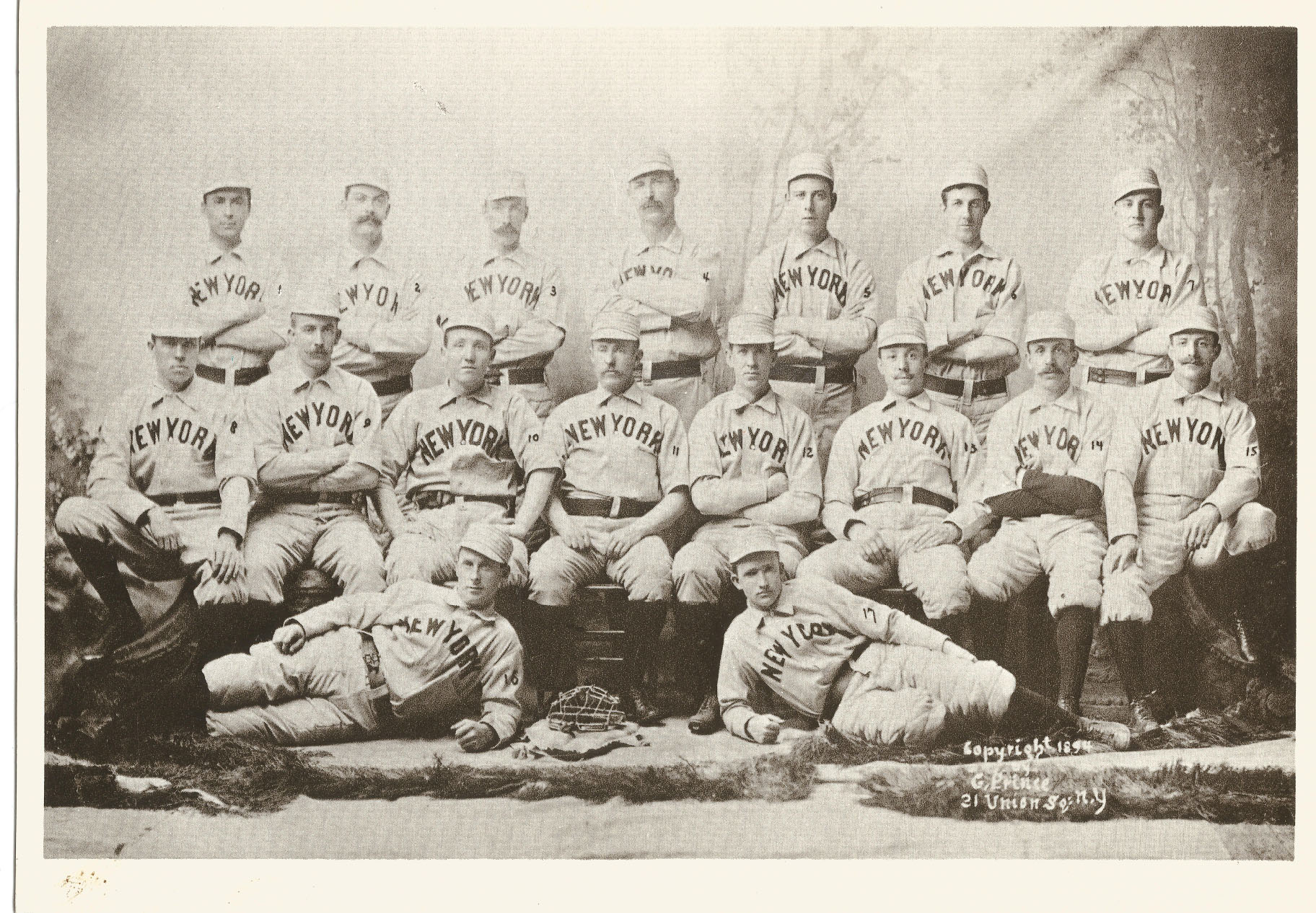
1894 New York Giants Contributed by Bob Blair

1894 New York Giants
Contributed by Bob Blair

People join SABR (The Society for American Baseball Research) for all kinds of reasons, but, once we get beyond our shared loved for the game of baseball, we probably are as different and varied from each other as the population of this wonderful country we also love and as the USA. From statistics to storytelling to poetry – from research to writing to archival item collecting to reading – and from solitary baseball pursuits to active personal involvement in our local SABR chapters – we move, explore – we do what we do for the sake of the game’s authentic preservation and promotion at the local, national, and worldwide levels.

Somewhere in the journey, many of us are happy to learn that the joy of SABR is the journey itself – and the relationship roads we touch and travel often or once n a while with our fellow SABR members.

There’s a whole lot of serendipity that comes in to play along the way. And that serendipity feeds greatly upon our willingness to form collegial relationships and sometimes close friendships with our fellow SABR members. Today’s vignette column is about the importance.

Back in 2007, after 15 years of gradually becoming more involved in my local Larry Dierker Chapter of SABR in Houston, I attended my first National SABR Convention in St. Louis, At one of the luncheons, I just happened to be seated next to Bill Hickman, a bright, friendly, and interesting fellow, originally from the Chicago area, but now  and for many years, he and his wife have been longtime residents of Rockville, Maryland. Bill and I both must have enjoyed the time we spent together because we exchanged contact information with each other at the end of that St. Louis luncheon gathering. I did not actually realize the depth of my good fortune at the time, but I soon enough learned by various things that came up in my mostly small and often arcane research projects that Bill Hickman was some kind of expert and highly skilled person when it came to baseball history, and he was particularly sharp in the area of old photo identification. It turns out that Bill  has done an incredible amount of old photograph recovery work for the SABR archives.

Like it or not (and I think he liked it just fine), that talent and expertise quickly made Bill Hickman my main “go-to” guy on all kinds of questions that arise about photographs or the identification of who’s in them. What has happened in the last 24 hours is simply a great example – but it shows how the serendipity of SABR relationships sometimes work.

Yesterday, Bob Blair of our Houston Babies vintage baseball team e-mailed me for help in identifying the players on the above ancient post card of the 1894 New York Giants. His brother Daryl Blair has been showering Bob of late with memorabilia he finds in the flea markets of small towns in California.

My first reaction was to e-mail Bill Hickman for assistance and, within a very short period of time after receiving an attachment copy of the nameless post card shot, he had shot back the following detailed photo and explanation, as follows:

____________________

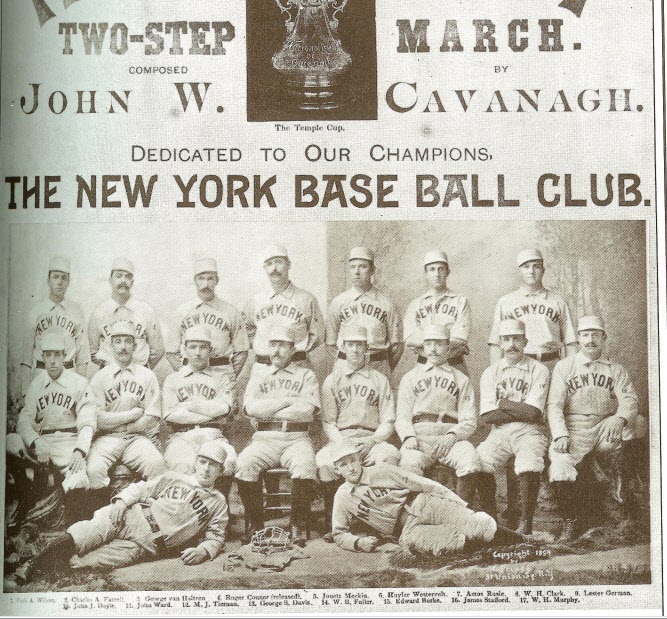
1894 New York Giants with more details Contributed by Bill Hickman

1894 New York Giants
(with the salient details)
Contributed by Bill Hickman

The 1894 New York Giants were the winners of the first Temple Cup competition in 1894.  Apparently, that resulted in the composition of some celebratory march music, and your photo appeared on the cover of that sheet music.  Said sheet music photo was published in a book called THE ULTIMATE BASEBALL BOOK, edited by Daniel Okrent and Harris Lewine.  Fortunately, that version of the photo was accompanied by a caption with the players’ names.
 
Standing in the back row (L to R):  Parke Wilson, C; Charles “Duke” Farrell, C; George Van Haltren, OF; Roger Connor, 1B; Jouett Meekin, P; Huyler Westervelt, P; Amos Rusie, P
 
Sitting in chairs (L to R):  Willie Clark ?  (There were no Clarks who played for the ’94 Giants; the caption says W.H. Clark; Willie Clark was a back-up first baseman for the ’95 Giants; I don’t have a very good exemplar photo of Willie, but as best I can tell, it looks like him); Les German, P; Jack Doyle, 1B; John Montgomery “Monte” Ward, Mgr. & 2B; Mike Tiernan, OF; George Davis, 3B; W. B. “Shorty” Fuller, SS; Eddie Burke, OF
 
Resting on ground (L to R):  James “General” Stafford, 2B; Yale Murphy, Utility
 
A copy of the Temple Cup version of the photo is attached.
~ Bill Hickman
____________________

Thank you, Daryl Blair, for sending that 1894 Giants post card to your brother, Bob!

Thank you, Bob Blair, for sending us the photo and asking the question! – Maybe it’s time you gave some thought to joining us in SABR!

Thank you, Bill Hickman, for your friendship and your affliction with a trait that was once ascribed to Tommy Henrich of the Yankees as his nickname!

Thank you, too, SABR, for making the days of winter so much fuller – and our shared baseball life so much richer!


The Ego’s Favorite Way to Lie

February 9, 2015
"The readiest and surest way to get rid of censure, is to correct ourselves." ~ Demosthenes ~

“The readiest and surest way to get rid of censure, is to correct ourselves.”
~ Demosthenes ~

“Misremembering” is the human ego’s favorite way to lie. It starts when someone either avoids the whole truth – and/or maybe sprinkles a little seasoning on a story to give it a little more zest and personal credit to the storyteller. Having never written seriously on this subject from my half century career perspective as a mental health professional until the Brian Williams example came to light, however, let’s establish some ground rules that cannot be easily “misremembered” by any of us:

(1) I don’t mean that I’ve never used the word “misremember” in print previously. I used it yesterday in “Misremembering: The Sweet Spot of Deception:”

https://thepecanparkeagle.wordpress.com/2015/02/08/misremembering-the-sweet-spot-of-deception/

I also used it earlier here at The Pecan Park Eagle in a quasi-serious column entitled “Corporate Speak at the Big League Level:” (How a word like “misremembering” could slide into a column so titled hardly requires any explanation – and I did not explain it there. – I explicated it.

https://thepecanparkeagle.wordpress.com/2014/11/28/corporate-speak-at-the-big-league-level/

SABR colleague Tom Trimble also informed me today that I included “misremember” or one of its variants in a past column, but I cannot readily find the article without a title reference and do not wish this missing piece to hold up a clear, concise treatment of how this misremembering business works in everyday life. We are talking here about the way some people – perhaps, quite a few – represent themselves to the world. Sometimes all the behavioral types who stream into this river of effect share only one broad ban of connection to each other: They all are projecting a view of the truth about themselves that is not based upon facts – but upon a projected image of what a certain individual wants the rest of the world to think about them.

Does that sound familiar? Have you ever known anyone who might do such a thing? Have you ever heard the old expression that it is important to “put your best foot forward” when you take on the world in the hopes of getting a job or starting a dynastic enterprise? Joseph Kennedy, the father of the Boston Kennedys, is famous for once telling his sons that “it isn’t so important who you are – but who the public thinks you are – that wins elections.”

Depending upon the needle pointing  of your own moral compass at this point in your life, the elder Kennedy’s “wisdom” may sound like anything from great advice to garbage that needs to be hauled away and burned. Either way, what Kennedy was suggesting was “lying” – a calculated commitment to the idea of creating an electable brand that would appeal to the voters. It didn’t have to be true. People just had to perceive it as true.

I see “misremembering” as a special kind of lie. It may start with something the individual says deliberately, but my own experience working with it in relationship therapy tells me otherwise – even if we were not calling it “misremembering” over the years. We used words that may have been equally clumsy as explanations. Words and phrases like “denial”, ” “avoidance”, “self-aggrandizement”,  and “self-delusion” flowed too easily from our tongues and typed expressions of the phenomenon. Now that same game of the ego finds new daylight as the root path of “misremembering”.

People don’t really “misremember” deliberate conscious lies. They deny them – and that denial itself is nothing more than the commission of another lie.

“Misremembering” most often occurs when someone fails to correct a false favorable comment that some significant person makes to them right away, affording the untruth to take on a life of it’s own. “Misremembering” may also occur when someone embellishes a little on a true story to make it more appealing to his or her audience. This sort of thing happens often in reported baseball history. The storytelling perpetrator probably doesn’t intend to deceive, but he or she is spicing up things to make the story more appealing. Along the way, the plain truth often gets snuffed. (Ruth’s called shot in the 1932 World Series is a prime example. – “Why let the truth get in the way of a good story?” kicks in hard and fast in tales of that magnitude.)

The St. Louis Browns Deception

Question: How Many Grandpas in the Old Days either encouraged or allowed their grandkids to grow up thinking they played for the St. Louis Browns? Answer: More than I care to recall. A few years ago, I was quite active at the old St. Louis Browns’ website handling questions from the public about the old franchise. Mixed in with all the queries about George Sisler, Eddie Gaedel, Bill Veeck, and Ned Garver were a stream of requests for confirmation of “grandpa’s” record when he played for the Browns. Guess what? Not a one of these queries ever turned out to be about someone who actually did play for the Browns. Some played minor league ball and a couple may have gone to spring training with the club, but most of those I checked out had never even played professional baseball.

It makes more sense now. There was no Internet in the really old days of the 1920s and 1930s, the decades associated in my mind with these phantom Browns.  If Grandpa wanted to let the kids think he once played big league ball, let them jump to their own conclusions that he once played for the Browns. – Once you get past Sisler, hardly any of the real ones are remembered anyway. And besides – those lying grandpas may have thought everything from “What’s the harm?” to “Maybe I did!”

The Role of the Human Ego

The human ego wants to hear what it wants to hear. It also wants to avoid anything that disparages its usually overly-inflated sense of control.

We don’t know what happened to set this credibility crisis in motion for Brian Williams, but if it’s like any of the uravelings I’ve been through in my longtime first career office, it may have gone something like the following, but I want to make it clear here first: None of us know, or may ever know, what happened in the case of Brian Williams. All we can know for sure is that it was set in motion by something he either said – or didn’t handle – immediately after the first of two helicopters was forced to the ground by enemy fire.

It wasn’t Williams’ second helicopter in the two copter mission that took on damage, but the first one that was hit.

Maybe someone on the ground after the landing – or maybe someone from NBC calling after the event said something like: “Brian, are you OK? We were very worried when we got the news that the enemy was shooting at you! That’s pretty scary stuff, isn’t it?”

Perfect Time to Say: “We were OK. They weren’t shooting at our copter! Or if they were, they didn’t hit us. It was the guys in the copter ahead of us that got forced down. They are the ones we need to be talking about.”

Also a Seductive Time to Say: “Yes, getting shot down is pretty scary stuff, alright! I’m thankful we are all still alive!”

The seductive path, if that’s what happened, feeds the ego’s need to be honest with an answer that leaves the door open for undue credit to Williams. Now all the seed of heroic occurrence needs from this point are a few more public confirmations from Williams himself and it becomes the now public perception that the ego will treat as the whole truth – even though it is not.

I do feel great compassion for Brian Williams. I think he’s a good man who made a big mistake. Unfortunately, even though none of us are perfect, the mistakes that strike directly at people’s ability to trust us are usually the most fatal ones. Brian’s best hope for survival on any level as a media man is now dependent upon time and what he does with it. If he could get some help recovering or owning up to the details of how he factually fell into building this trap trip into censure for himself, he might have a chance to restore enough confidence in a man who was brave enough to see and publicly acknowledge what he did – and didn’t do – that led him directly into the ego’s favorite way to lie.


:


Misremembering: The Sweet Spot of Deception

February 8, 2015
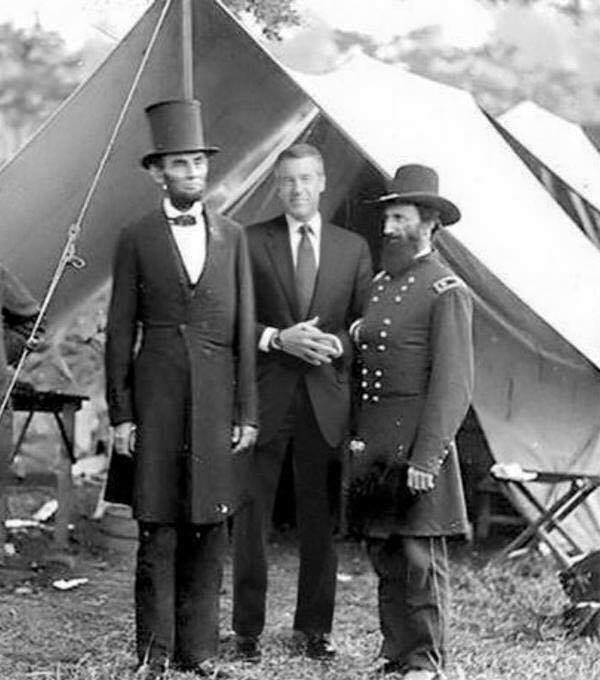
Was Brian Williams an NBC field reporter during the Civil War? In response to his admissions this week of of certain "misremembered" events in the Middle East wars, someone in social media seems to think that Williams may have been there and actually met with Lincoln.

Was Brian Williams an NBC field reporter during the Civil War? In response to his admissions this week of certain “misremembered” events in the Middle East wars, someone in social media seems to think that Williams may have been there too and actually met with Lincoln.

As one who has spent a lifetime in love with words and how great writers like Hemingway, Fitzgerald, Steinbeck, Faulkner, and others string them together differentially to paint pictures in our minds, I can honestly say that I never really heard of, or gave consideration to, the words “misremembering”, or its present and past tense variants, “misremember” and “misremembered” until I heard Roger Clemens use the last cited example as the foundation of something incriminating he may have expressed earlier for the record about his alleged use of steroids that he was now hopeful of more favorably clarifying in his testimony before a Congressional Hearing on the subject of steroid use by professional baseball players.

Then, when using the same word to explain some of the erroneous statements he has made about himself and his personal involvement with enemy fire at his helicopter during a news coverage trip to the Middle East a few years ago, NBC news anchor Brian Williams now states that he was wrong to have stated several times in public ever since then that he was riding in a chopper that was hit by enemy fire – and, apparently, some others now think that Williams also may never have seen a body floating face down in the flood waters of the French Quarter in New Orleans after the 2005 storm that ravaged the city as he has previously reported. The skepticism is in respect to the fact that the area he specified was one of the few higher areas that was not devastated by hurricane flood waters.

Here’s that word again. Williams admits that he may have “misremembered” what actually happened in the Middle East. And, as was the case with Roger Clemens, the “misremembered card” did not settle the soup. – It simply turned up the heat on a boiling pot. So much so, we’ve learned today, that Brian Williams now plans to take a few days off from his anchor spot, we suppose, in the hope that time will allow for some cooling of the issue that has made him the news itself – and not the detached reporter of same. He certainly needs the time to get far enough away from what’s going on to assess where he now stands and does next.

The trust issue is big here. When anyone claims they did something wrong because they remembered what happened incorrectly, they have just thrown a sweet spot pitch to the listening public that will get hit out of the park every time. Those who take that route may as well be telling the world: “Hey, world! Listen up! Sometimes I remember and report things from my memory that didn’t happen at all. Forgive me, please. I have a ‘misremembering’ problem and I just wanted to clear these one or two stories up with you!”

Not going to happen. Once you play that card, you’ve just told your audience to go ahead and also distrust anything else you’ve either heard me say in the past – or anything I may say in the future.  The audience figures: “If the ‘misremembering’ problem could affect you to the extent of causing you to say something that made you look more involved and heroic than you actually were, what’s to stop it from doing the same thing in all matters, large and small?”

This is not a new problem. It’s one of trust versus mistrust – the daily fodder of my half century long career day job as a psychotherapist and family counselor. The behavioral science publications on the importance of trust in human relationships fill our libraries by the acre of space we donate to the subject because of trust’s importance to the foundations of everything we hope to build together. And athletes and fans – and media professionals and their audiences – are two similarly important relationships in which trust is essential to ongoing continuity.

“Trust” is the answer to this Psychology 101 trivia question: “What’s the easiest thing to lose and also the hardest thing to find again?”

In brief, there is no miracle cure for the damage done by distrust or betrayal, but the essence of best recovery chances hinge upon the presence of these factors: (1) There needs to be enough love between the offending and offended parties to make healing desirable; (2) “I’m sorry and I promise not to do it again” are never enough. One must be both genuinely aware of and sorry for the harm they may have caused others and be willing to take an honest look at how much control they actually have over the offensive behavior. Sometimes addicts can make sorrowful apologies and promises for harm caused, but the forces of addiction and faulty perception are great; (3) if trust has any chance for restoration, it will only happen over a period of time and credible changes in behavior by the offending party –  and there, again, is where the healing love of the offended party comes into play. If one does not care enough to forgive, trust will never live again.

Why should we even consider forgiveness? I’ll have to close a very long subject here with a one paragraph answer that really is the mother lode of all other elements:

To move on in any kind of healthy way, we don’t have to forget, but we do have to forgive and learn. We forgive because that’s preferable to living with the kind of regret that eats us alive – not the person we view as our offender. We also have to learn in the hope that we will have a better choice of how to react when the same painful lesson tries to visit us again – which it almost certainly will – in some form. The price for not learning ranges from redundancy of the same old, same old to loneliness to addiction to the mental hospital to jail or to the cemetery. None of us are perfect human beings and immune to self-deception, but the human ego’s needs to sometimes take credit for good things that the individual didn’t do, while avoiding blame for acts that the same individual did do – are off the chart big in human behavior. We all need to be honest with ourselves and not get caught up in “misremembering” things that were never true. Our capacity for honest trust begins or ends with our ability to be honest with ourselves.


Baseball America: UH #3 in Pre-Season Poll

February 7, 2015
Junior Jake Lamoine will be the strong arm guy for the No.3 ranked UH Cougars to start the 2015 College baseball season.

Junior Jake Lamoine will be the strong arm guy for the No.3 ranked UH Cougars to start the 2015 College baseball season.

No other pre-season 2015 college baseball poll we’ve seen ranks the UH Cougars lower than 8th place, but Baseball America has the Houston Southeast East End Cats rated as their 3rd highest pick, trailing only #1 Vanderbilt and # 2 LSU. The complete list of Baseball America top picks are viewable at the following link:

http://www.baseballamerica.com/college/2015-college-baseball-season-preview-index/

Baseball America also features a well-stated article on how the UH return to baseball respectability began with the return of former assistant coach Todd Whiting and his staff from the very successful TCU baseball program during the summer of 2010, when Whiting took over the scattered and ineffective baseball program as head coach. 2015 marks the fifth season of full control for Whiting and Company over the recruitment of those quality athletes who are capable of looking past the prestige mantle of all the big brand schools to sign up for the renewed winning sports culture of the always lesser known UH Cougars.

The following article by Jim Shonerd on January 26. 2015 for Baseball America does a good job of summarizing how important the sensitivity of Whiting and his staff are to the recruitment challenges that always exist for UH. The messaging contact with recruits has to be honest and forthright: UH is not on your doorstep to try to win a prestige contest with UT, A&M, or LSU. That never happens. We are here to recruit you to a winning culture in college baseball in which you will be given the full opportunity to play as much as your competitive spirit and concern for team victory above all else is what matters most to you too.

Here’s a first version link to the Whiting story by Shonerd link:

http://www.baseballamerica.com/college/whitting-leads-houston-back-prominence/

Here’s a link to an even better version of the same information, which also includes some team digital film material and information on tape about Coach Whiting and the 2015 UH Cougar baseball team roster:

http://www.baseballamerica.com/college/college-preview-capsules-3-houston/

For those of with an interest in history, here’s a link to the roll call of UH’s baseball alumni fraternity, as provided by Baseball Almanac.com:

http://www.baseball-almanac.com/college/university_of_houston_baseball_players.shtml

And finally, here’s a link to how you may buy tickets for what is likely to be the biggest bang for your Houston baseball buck in 2015:

http://www.uhcougars.com/tickets/hou-tickets-m-basebl.html

C’mon, Houston fans! We have given Rice our support in the past. Now let’s do it for another of our own. Cougar Field stands to be hosting some great quality college baseball in 2015 and the prices for admission, as you can see for yourself, are really affordable. Even if your team is UT or A&M or LSU or Oklahoma State – this isn’t Austin, College Station, Baton Rouge, or Stillwater. We live in Houston – where the college baseball at all our local universities is on the rise – as fun for us – and deserving of our support.

As for all of you UH alumni baseball fans, you have no loyalty conflicts here. – Those of you can attend need to come on out and support YOUR Houston Cougars in baseball while keeping two other thoughts in mind. – Our Cougar hopes in football and basketball are also now on the rise with the arrivals of coaches Kelvin Sampson and Tom Herman. Those guys deserve and need our Cougar alumni and independent Houston fan support too!

As per usual whenever the subject is OUR Houston Cougars, The Pecan Park Eagle tries to report things to the best of our objective ability in this subject area.

Have a nice Saturday, everybody!

Jack Fisher: A Pitcher Who Danced with Destiny

February 6, 2015

Jack-Fisher-BBC

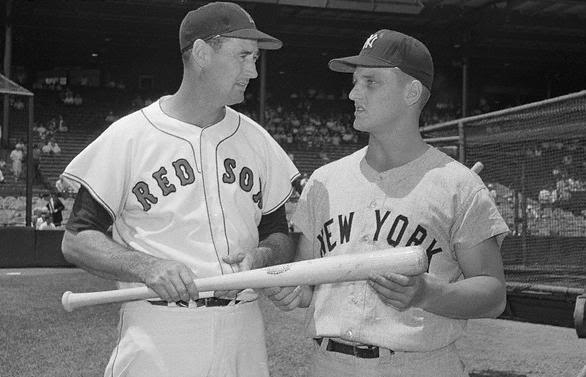
Jack Fisher (DOB: 3/04/1939) was a right handed MLB pitcher for 11 seasons with the Orioles (1959-62), Giants (1963). Mets (1964-67), White Sox (1968), and Reds (1969). In That time, he posted a career MLB record of 86 wins, 139 losses, an E.R.A. of 4.06 and 193 home runs surrendered. Of his 193 allowed homers, three served as Fisher’s ticket to minor immortality as the man who gave up three landmark HR marks in baseball history – and a place forever as the trivia quiz answer to questions about each or all.

jack fisher-tw

(1) September 28, 1960, Fenway Park in Boston. In the bottom of the 8th, and the Red Sox trailing the Orioles, 4-2, Ted Williams came to bat against Jack Fisher in what prove to his last plate appearance in history. Teddy Ballgame used it dramatically well by blasting his 521at and, of course, final home run into the right center field fans with nobody on to narrow the Boston deficit to 4-3. The Red Sox would go n to score two more runs off Fisher in the bottom of the 9th to win the game.

Later, Jack Fisher called Ted Williams to congratulate him on both his home run and great career. Word is that Williams graciously thanked Fisher fo challenging him with good stuff and not itching around him in what turned out to be his last hurrah in baseball. The Red Sox had a meaningless series yet to play in New York as the wrap on their season, but Ted Williams declined to play it out. Who could blame him? Going out with a home run at Fenway Park was the perfect place to take that last bow for students of baseball history. Ted wasn’t the kind of guy who often acknowledged the crowds cheers – probably because he remembered that the same people during bad times were capable of hurling boos and other insults upon him too. – And Jack Fisher was the pitcher who delivered the pitch that framed Ted Williams’ Golden Goodbye home run.

Baseball Almanac Box Score, Baltimore @ Boston, 9/28/60:

http://www.baseball-almanac.com/box-scores/boxscore.php?boxid=196009280BOS

Jack-Fisher-60

(2) September 26, 1961, Yankee Stadium in The Bronx, NY. Trailing, 2-0, in the bottom of the 3rd with no one one base, Roger Maris of the Yankees teed off on a pitch from Orioles pitcher Jack Fisher that sailed on a low arching liner into the right field stands to cut that lead to 2-1. The Yankees would go on to win the game, 3-2, and Fisher, as had been the case in his game against the Red Sox on 9/28/60, was again the losing pitcher of record. More importantly, today’s game marked the second year in a row that Jack Fisher was the initiating party to an historical home run. Maris’s homer that day was No. 60, the one tied him, asterisk and all, with Babe Ruth, the only other man to that time who had hit 60 home runs in a single season back in 1927. The now famous story here is that Fisher beckoned Maris to come out and take a bow of acknowledgement that the crowd’s cheers were demanding, but that Roger declined. Supposedly, Maris waived off Fisher’s invitation as the signal that he wasn’t coming out. He wanted Fisher to just go ahead pitch the next batter. History should be slw to judge here. Maris was an emotional wreck from the “Chasing Ruth” 1961 season by this time. In the same light, Jack Fisher is to be congratulated for understanding again what just had been registered for history. Again, it was no personal reflection upon the character and talent of the pretty fair and widely respected pitcher that Jack Fisher knew he was.

Baseball Almanac Box Score, Baltimore @ New York Yankees, 9/26/61:

http://www.baseball-almanac.com/box-scores/boxscore.php?boxid=196109260NYA

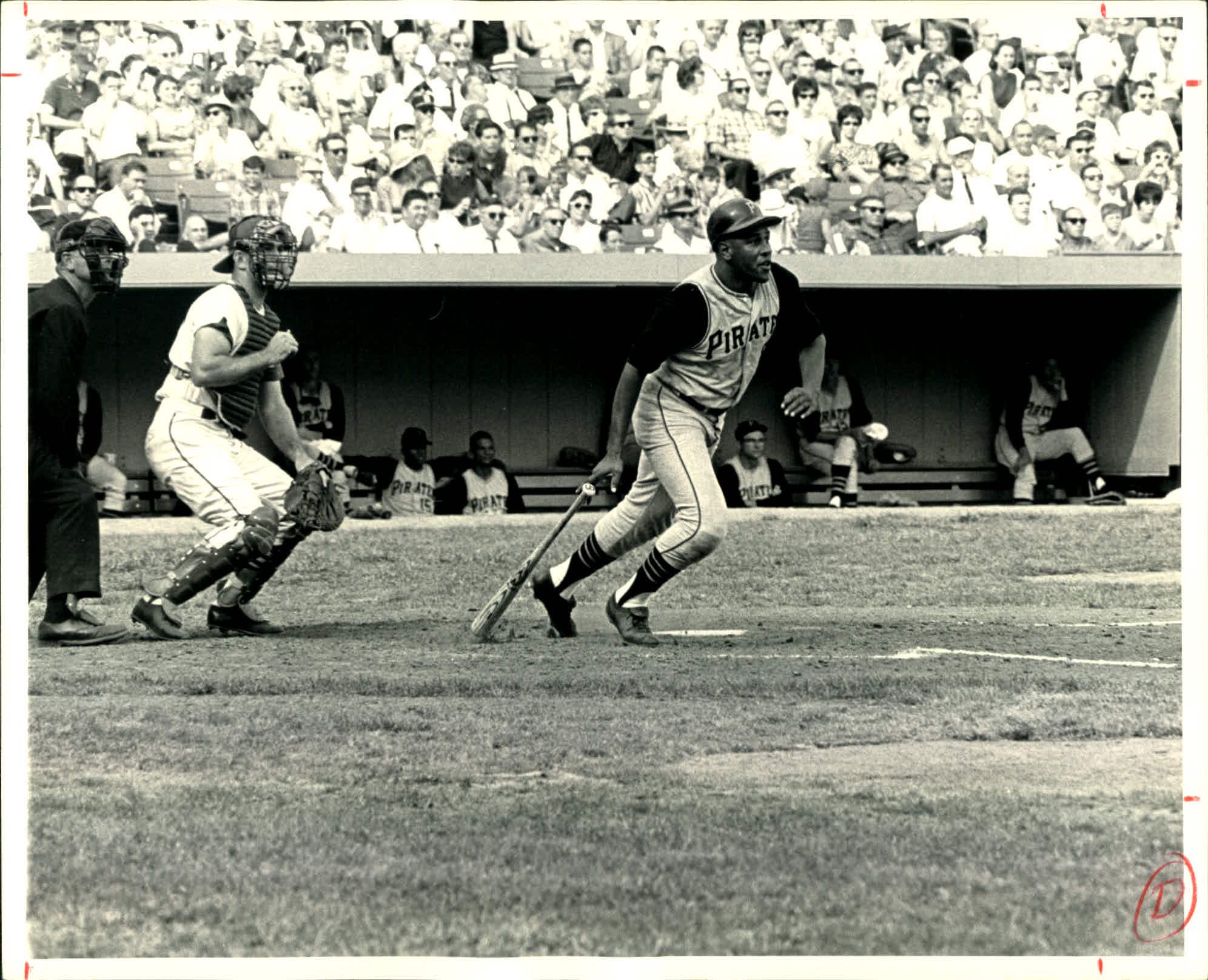
Willie Stargell ht the first HR at Shea Stadium off Mets pitcher Jack Fisher, 4/17/1964.

Willie Stargell ht the first HR at Shea Stadium off Mets pitcher Jack Fisher, 4/17/1964.

(3) April 17, 1964, Shea Stadium in Flushing Meadows, NY. In the first official regular season game ever played at the new Shea Stadium, the visiting Pittsburgh Pirates would go on to defeat the usually still hapless New York Mets, 4-3. By this time, Jack Fisher was now working as a pitcher for the Mets and had drawn the call as their first starter in the new venue. Fisher toiled the first 6 and 2/3 innings, but this time he avoided a third defeat on a monumental record day by leaving with the score still tied at 3-3 with no further damage to his game marks. In the process of playing, Fisher set a minutiae of new stadium records, with the biggest starting with his “first official pitch” to lead-0ff Pirate hitter Dick Schofield in the top of the 1st. Then came the big record-setter. When Pirate slugger Willie Stargell blasted a ball into the right field stands in the top of the and with nobody on, it handed records in bunches to both Stargell and Fisher.

Count ’em. – For Stargell, he is now credited with the first hit, first run, first RBI, first extra base hit, and first home run at Shea Stadium. And for Fisher obviously, he was recorded for all time as the pitcher who surrendered all those firsts on the defensive side of things.

Baseball Almanac Box Score, Pittsburgh @ New York Mets, 9/26/61:

http://www.baseball-almanac.com/box-scores/boxscore.php?boxid=196404170NYN

Slugging greats Ted Williams and Roger Maris shared a common destiny connection with pitcher Jack Fisher in baseball history.

Slugging greats Ted Williams and Roger Maris shared a common destiny connection with pitcher Jack Fisher in baseball history.

Closing Comments. Jack Fisher’s 76th birthday is coming up soon and, as a member of his generation, The Pecan Park Eagle would like to take the opportunity here of wishing the youngster well. We would also like to thank Robert “Shirtless” Blair too for obliquely suggesting some kind of column on Jack Fisher along these lines.

We will leave you this Friday morning with a “birds of a feather note”: Back in 1961, after Fisher gave up home run #60 to Roger Maris, as you may well remember, pitcher Tracy Stallard of the Red Sox gave up a solo home run on 10/01/61 to Roger Maris in the bottom of the 4th inning in the last game of the season for both teams at Yankee Stadium. It was the only run of the game, sending the Yankees off to their World Series date with the Reds on a winning note. It was also more than a winning hit. It was Roger Maris’s HR No. *61 – the one that broke Ruth’s record, but with Commissioner Ford Frick’s imposition of that legendary asterisk stain for Roger’s record having occurred over the course of a longer season of opportunity than the Bambino had known back in 1927.

Birds of a feather? Jack Fisher and Tracy Stallard came together in 1964 as teammate starting pitchers for the New York Mets.

Have a nice weekend, everybody! – And keep staring out that window. Baseball season is coming. Just you wait and see.

Colleague Cornucopia Day

February 5, 2015
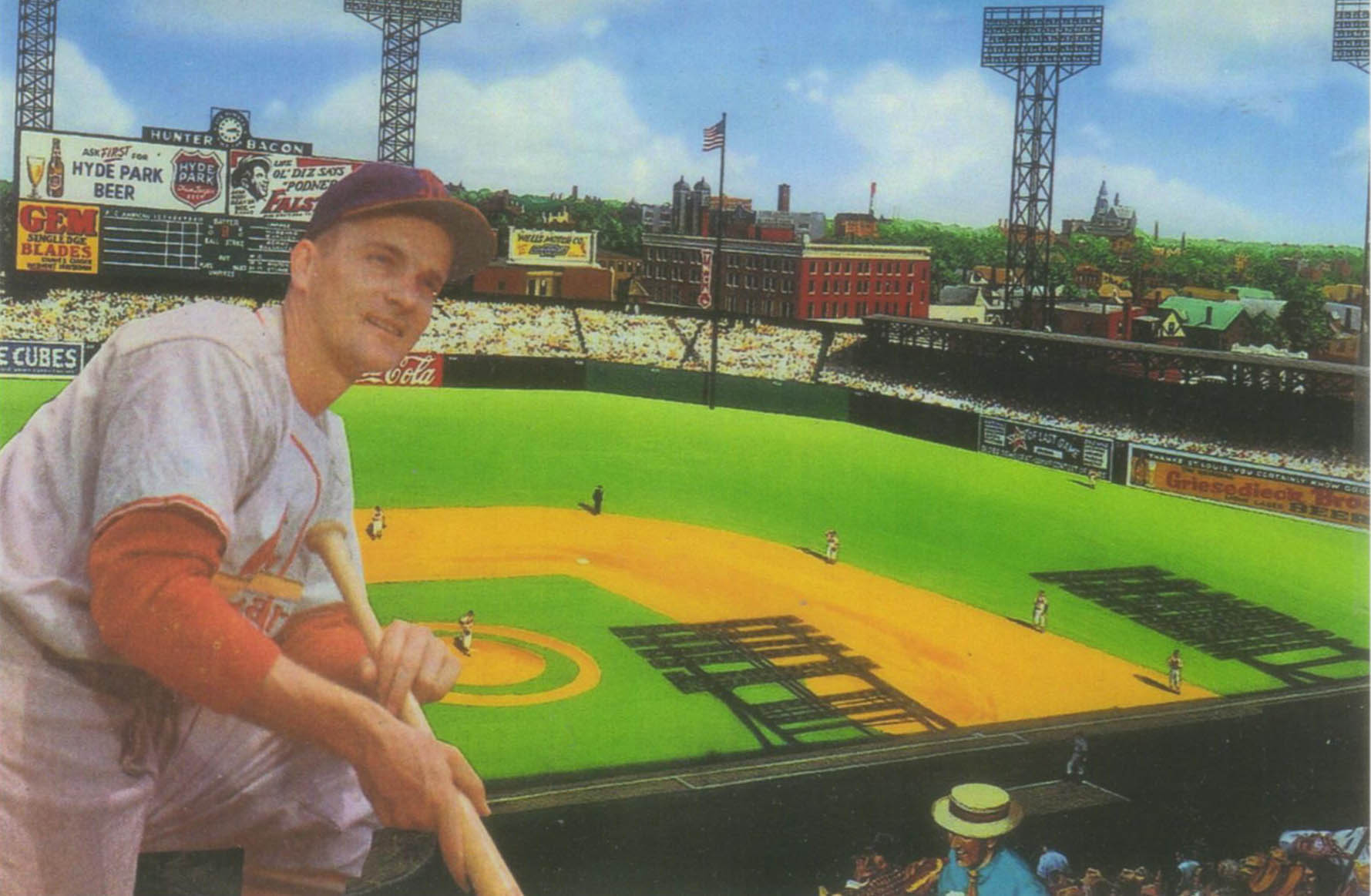
Larry Miggins at Sportsman's Park St. Louis, Missouri

Larry Miggins at Sportsman’s Park
St. Louis, Missouri

It must be the cold rain, the time of the year, or the radiant heat from the old black stove, but this has been a week of good material inundation at The Pecan Park Eagle. The stuff is so good that we simply want to share it with the rest of you with contributor credit and links to each source’s online availability.

The first item here is the most important to those of us here at The Pecan Park Eagle because of whom it’s about. The rest of these references are treats in their own rights, with their importance or interest level being totally up to each individual reader. All of these items, we think,  possess good information and entertainment value:

The Larry Miggins SABR Biography by David E. Skelton is a Legacy Piece.

The Larry Miggins SABR Biography by David E. Skelton is a Legacy Piece.

(1) Larry Miggins by David E. Skelton: A Contribution to the SABR Baseball Biography Project. This beautifully written and comprehensive biography of former Houston Buff and St. Louis Cardinal Larry Miggins by David E. Skelton is the best total work that ever has been published about the man that some of us are also privileged to know as a dear friend and fellow member of our Larry Dierker Chapter of SABR in Houston.

Beautiful job, David! And congratulations, Larry! This biography is a really deserved credit to both of you as subject and writer.

Special thanks also to fellow SABR member Rick Bush for letting us know of its readiness at the SABR Biography Project site:

http://sabr.org/bioproj/person/f925ea43

From 1962 through 2014, the Old Dutchman's Gold Mine has been no more elusive than a World Series victory for the Houston MLB club.

From 1962 through 2014, the Old Dutchman’s Gold Mine has been no more elusive than a World Series victory for the Houston MLB club.

(2) Tom Kollenborn Chronicles: Major League in Apache Junction. Thomas J. Kollenborn is the copyright owner and writer at this site. We have our friend Darrell Pittman of Astros Daily.Com to thank you for informing us of this concise, but interesting treatment of the Houston baseball club’s earliest MLB spring training experience at Apache Junction, Arizona. – Thanks, Darrell! – And enjoy the ride, everyone!

http://superstitionmountaintomkollenborn.blogspot.com/2011/01/major-league-in-apache-junction.html

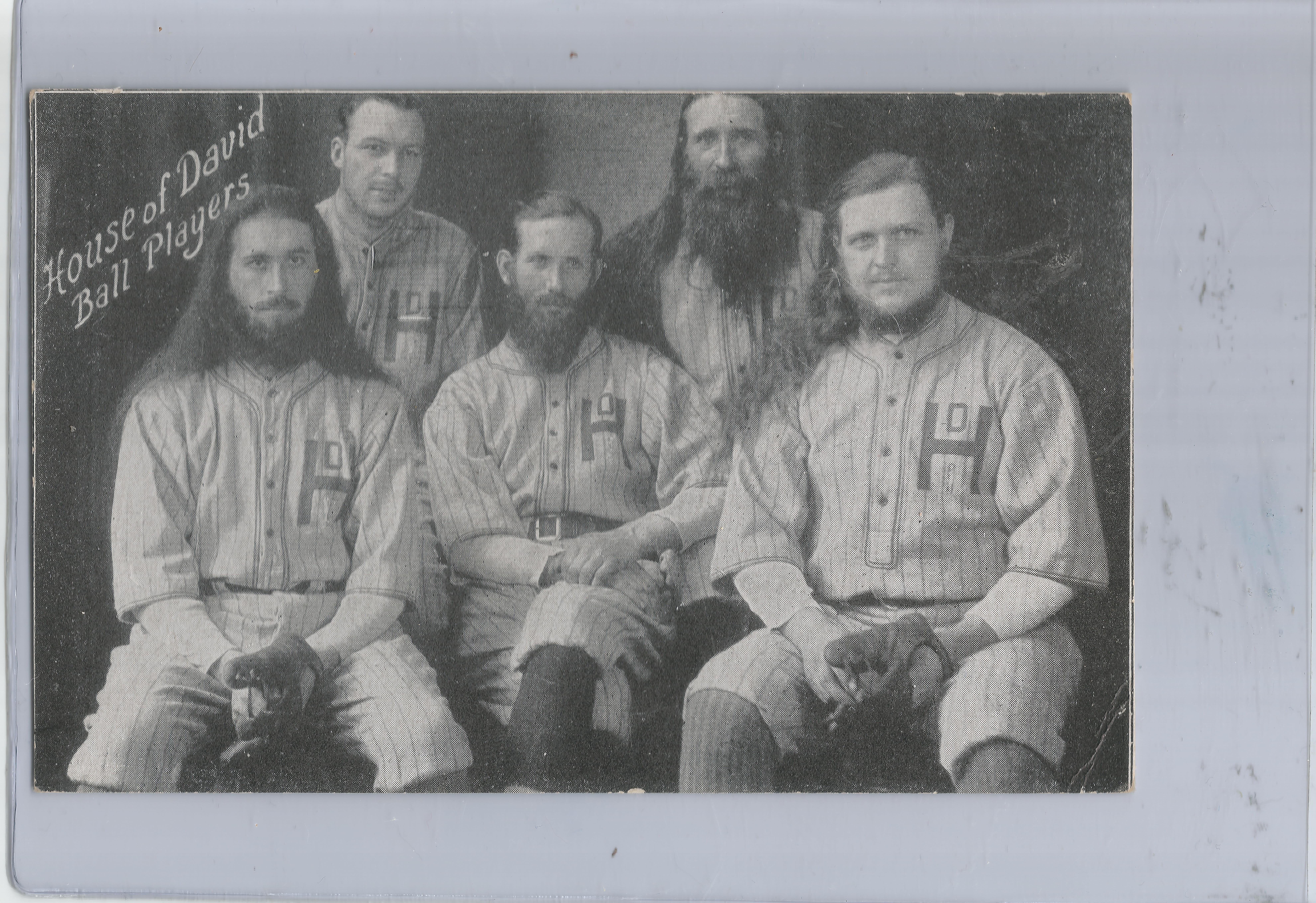
HoD2

Two Post Cards of House of David Contributed by Robert Blair.

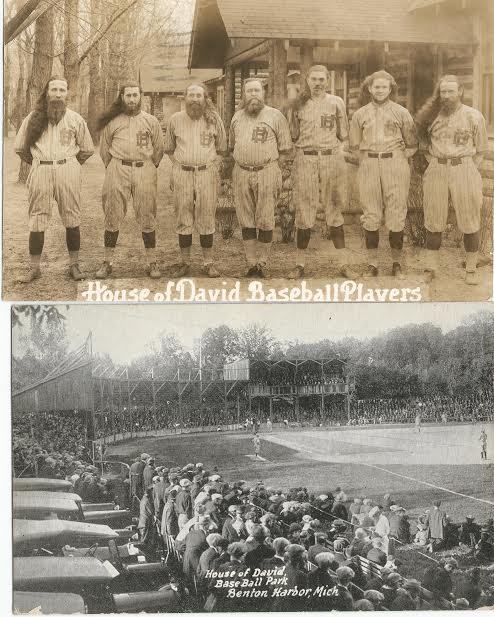
Three Post Cards of House of David Teams Contributed by Robert Blair.

(3) The House of David Baseball Team Research Project. Our c0-star pitcher for our Houston Babies vintage baseball team, Robert “Shirtless” Blair, contributed this link to what sounds like a long-term worthy plan to accurately research the history of one of baseball’s great phantom entities from the early 20th century era. The House of David was the name taken and offered to the public as the brand of those bearded men of baseball who took the field against all comers as a way of life – and they all wore beards on the level of those sported today by the NBA and Houston Rockets’ James Harden and the NFL and Indianapolis Colts’ Andrew Luck. – The House of David could have originated that now popular expression – “Fear the Beard!”

Thank you too for the pictures you sent, oh fabled-in-your-own right as the ‘shirtless wonder of the pitching world. Bob Blair’s attraction to the House of David is not a big surprise. – You see, he’s sort of a one-of-a-kind in his own athletic right. He gets batters out with pitches that loop through the air like the rainbow return of old Rip Sewell.

http://www.peppergame.com/

Joe E. Brown: "Hey, Bill! Wanna make a movie about the Cubs winning the World Series?" Bill Frawley: "Sure, Joe! Long as we make it clear were dealing with fiction, that's OK by me!"

Joe E. Brown: “Hey, Bill! Wanna make a movie about the Cubs winning the World Series?”
Bill Frawley: “Sure, Joe! Long as we make it clear were dealing with fiction, that’s OK by me!”

(4) Brief Film of a Cubs Game at Wrigley Field in the Late 1930s. The link says this action was from 1938. The opening credits on the film say “1937”. Take your pick. Either way, it was a long, long time ago – and yet – Wrigley Field and the rooftops of houses across the street in left field look pretty much the same as they do today, except for stands that owners have since built 0n their rooftops to handle their own entrepreneurship of Cubs action on game days.

This time, we again end with thanks as we began. Thank you, Rick Bush for making this visual contribution to our January baseball Kool Aid nostalgia drinks. – Only thing is – this Kool Aid will not kill us. – It will just help to fill us – as we continue to stare out our home windows into the January rain – waiting for the 2015 baseball season to get here.

Have a Happy-Thoughts Thursday, Everybody. That’s what these gifts from our baseball friends are designed to help us do.

Carroll’s Call: The Subject That Refuses to Die

February 4, 2015

surgery2

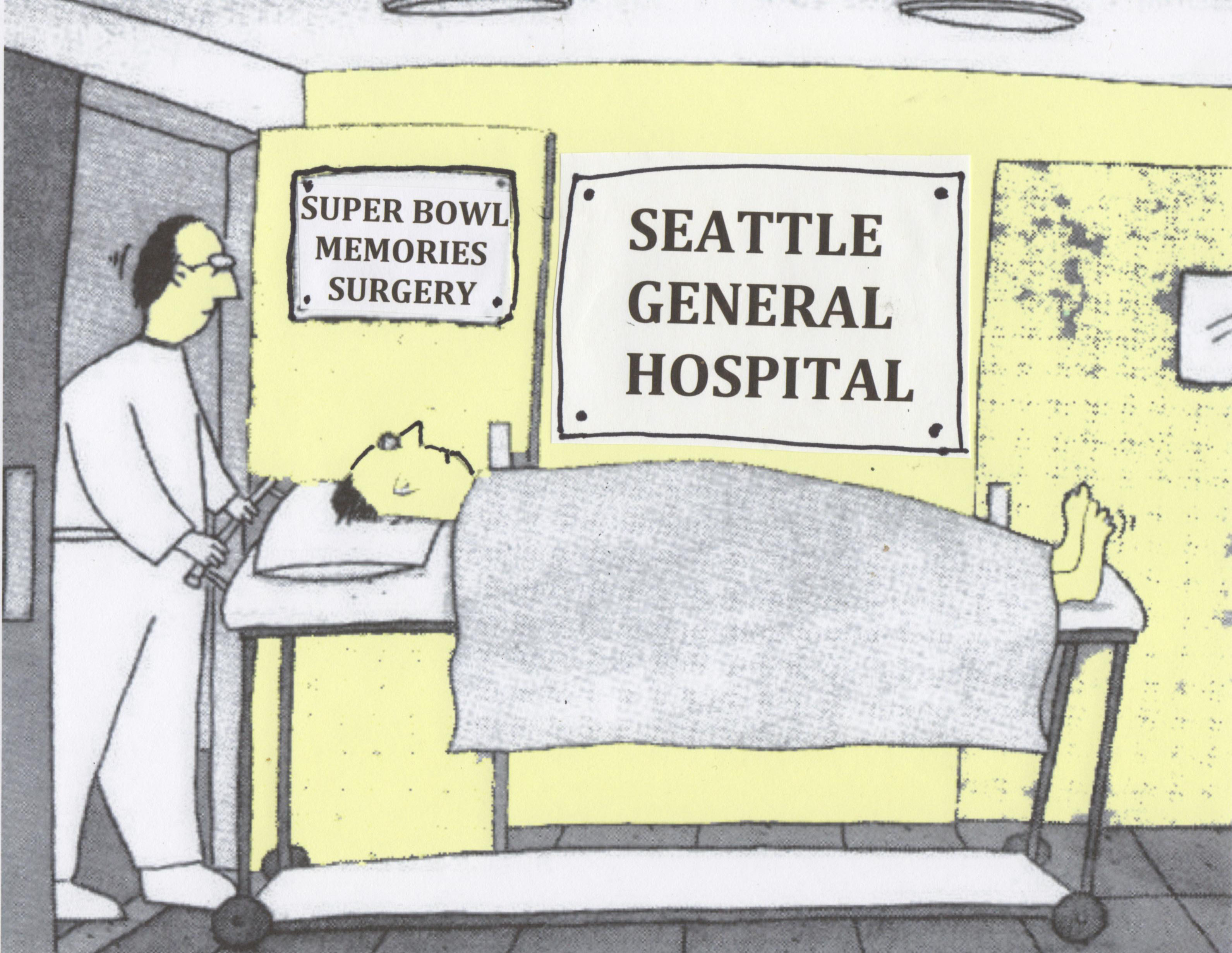
After 44 hours of post-Super Bowl redundancy in social and network media focus upon the Pete Carroll Pass Call and New England interception that killed Seattle’s almost certain chances of winning with Marshawn Lynch, their human tank runner, at the one-yard line, I thought I had finally escaped further mention of the subject when I climbed upon the operating table again today for some further skin cancer surgery on my now battle-worn nose.

As per usual, the needle descending into my nose from both sides several times was the only rough part. After that measure, my job as patient is to lay still and let the surgeon do his thing.

That’s how it started. Business in the doctor’s office per usual.

Then, with my nose covered in protection of me from flowing blood, and my eyes gauzed shut from the bright glare of the closely placed surgical lights, my doctor had one more thing to say as he began to cut into me with his scalpel.

“What did you think you about that ending to the Super Bowl? Wasn’t that a crazy ending to a very good game?”

I was speechless. My faced was covered. My body was cut into. My throat was filled with distastefully swallowable saliva. I had many thoughts. No speakable words.

“Ugrospcrcarrollstupido” – or something like that – is all I could say. And the doctor had no further questions.

I’m home tonight, feeling OK, but I really have nothing further to say about the Pete Carroll decision beyond the fact that it’s no mystery who fired the final deadly shot at their almost certain Seattle Super Bowl Hope Fulfillment March. – “The Butler did it!” – Rookie Patriot defensive back Malcolm Butler, that is. The other comment I have is about that now famous old movie title, “Sleepless in Seattle.” – Great as it was, it was really quite prophetic as well. The biggest State of Washington city didn’t even begin to understand what “Sleepless in Seattle” really meant until this past Sunday night. We also have to have some considerable empathy for the Seattle fans. – That Sunday dagger-to-the-heart play was the sort of thing we used to get down here in Southeast Texas from the Houston Oilers on a fairly regular basis.

At any rate, even though they will now need to redo their list of selections, that ESPN list of worst coaching decisions in sports history that ESPN published a while back will now require some refreshment Check out the list, especially item #7, when Kevin Steele briefly served as the Baylor football coach during the late 1990s. Although the stakes were not even close to what was lost in the Super Bowl, Steele threw away certain victory over UNLV on September 11, 1999 in Waco by going for “pile-it-on” points near the opponent’s goal line on the last play of the game. Steele’s Bears held a 24-21 lead with 20 seconds to go and only needed to take a knee to preserve a win, but they chose to go for what Steele later described as a “statement” score and ran the ball from the UNLV 8-yard line.

It turned out to be a statement, alright – a statement about stupid decision-making. The Baylor ball carrier was separated from the ball near the goal line. A fumble recovery and a 99 yard TD run by a fast UNLV defender then gave the visitors the surprising, but totally preventable 27-24 win as time expired, leaving Steele and Baylor with nothing but a heaping helping of chagrin and self-mortification..

http://espn.go.com/page2/s/list/worstdecisions.html

One more thing. – If you too are due for any kind of medical or dental surgery for the rest of this week, please ask your doctor to get his questions out of the way before he takes the knife or drill to you.


Who Hit The Last Astrodome Home Run?

February 3, 2015
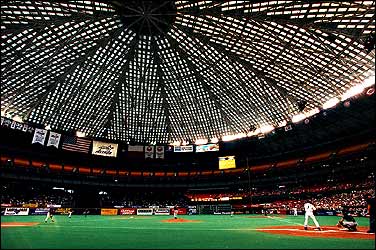
The Astrodome

The Astrodome

The date was Sunday, October 3, 1999. Under manager Larry Dierker, the Houston Astros were playing their last game in their 35-year history at the Astrodome. The year 2000 would see the team begin their first year of the new downtown venue we know today as Minute Maid Park.

In that last Dome date, the Astros would put the wraps on another successful winning season under Dierker (97-65) by going on to defeat the Los Angeles Dodgers, 9-4, that day behind ace lefty Mike Hampton (22-4), who coincidentally left his own mark in the process of closing down the club’s dome-home, as he fought through seven good innings of work to get the decision and become the last winning MLB game pitcher in the history of the Astrodome.

Larry Dierker sort of kids these days about starting to worry when the Dodgers put over “3” runs in the ninth and were still batting. With the new score now still riding comfortably at 9-4, Houston, Dierker apparently allowed his mind to roam into the scary world of “what if.”

“What if the Dodgers pulled off a miracle rally and defeated the Astros, 10-9?”

The very thought of such a disaster poured gallons of cold water on the idea of team plans for a post-last-Astronomer-game celebration the Astros had planned for their players to mark their departure from a familiar place to a new downtown location venue in 2000 for the club’s future pursuits of happy baseball destiny.

Not to worry, Dierk! – The Astro closed the door on the Dodgers at 9-4 and went on to a happy post-game “Goodbye, Dome!” party.

The answer to our column title question also brings with it a dose of its own lingering sadness and melancholia.

Astros 3rd baseman Ken Caminiti hit the last Astrodome home run in MLB service history. – Rest in Peace, “KC”!

Check out the box score at Baseball Almanac for more details on Caminiti’s homer and other items of factual interest about the team’s last moment of joy in the same stadium whose future as a landmark of world-important architecture still hangs today in the precarious balance between the interests of deserving preservation and those who want to tear it down because of its interference with their own purely commercial plans.

Here’s the box score link for the last Astrodome MLB game at Baseball Almanac:

http://www.baseball-almanac.com/box-scores/boxscore.php?boxid=199910030HOU

 Important Addendum Note: Earlier today, I received an important reminder from Mike Acosta, the highly respected records and significant items authentications specialist and artifact preservationist for the Houston Astros. Here’s what he said by e-mail this Tuesday, February 3, 2015, in response to today’s column:

____________________

“Hi Bill!

“I just read your latest edition of The Pecan Park Eagle about the final Astros home run in the Astrodome.  While Ken Caminiti did hit a home run on 10/3/99 during the final regular season game, he also hit the very last home run in the Astrodome during Game 4 of the NLDS against the Braves on 10/9.  It was a three-run shot off Hall of Famer John Smoltz in the 8th inning.  Caminiti saddled up next to Bob Aspromonte as the bookend of a third base duo that hit the first and final Astros home runs in the Astrodome.

“I thought I’d pass that note along.  Always look forward to your e-mails!

“Thanks!”

~ Mike Acosta, Houston Astros

____________________

Thank you, Mike! I’m glad I got it right, but I only got it right by accident. Thank you for coming to the rescue. I had overlooked the playoffs that followed the regular season and I allowed myself to think of the regular season ending as also the end of all MLB games there. Just another example of how important it is, although sometimes an unavailable luxury, to have some one else who knows the game working with us as a colleague or editor on anything we write.

Getting it right – not being right – is what drives me in my efforts, so please feel free to let me know anytime I get it wrong or only “get lucky” with my conclusions. I try to get things right, but, hard as I try to always do every job to the best of my ability, I long ago gave up on the expectation of ever being perfect or immune to human error.

Regards, Bill McCurdy, The Pecan Park Eagle

____________________


Legacy Plays in Sports: Add Carroll’s Pass Call

February 2, 2015
Bob Costas: "Pete Carroll, can we talk about that play that cost Seattle the Super Bowl in the final seconds?" Pete Carroll: "I'll pass!"

Bob Costas: “Pete Carroll, can we talk about that play that cost Seattle the Super Bowl in the final seconds?”
Pete Carroll: “I’ll pass!”

“The Butler did it!”

Will New England defensive back rookie Malcolm Butler always be remembered mostly for the interception that saved the Super Bowl “49” victory for the Patriots over the Seattle Seahawks in the final seconds of the game? For that matter, will Seattle coach Pete Carroll most often be remembered for the pass call that led to his team’s defeat when he had three chances at the one-yard line to try to score on the run with the human battering ram Marshawn Lynch at his disposal? We shall see. Legacy plays write their own ticket in our cultural memory bank. They just get there under the force of their own steam of joy and desolation. No other energies can put them in this special bank; no defensive spins on the facts will keep them out.

Legacy plays in sports may be positive or negative, but they all share a common feature. – They overshadow every other reason for remembering the individual who performed them or set in motion the circumstances that caused them.

Bobby Thomson and Ralph Branca from baseball’s 1951 “Shot Heard ‘Round the World” are the best examples of how the yin and the yang often works in these moments. In direct response to Thomson’s “miracle” homer that delivered the 1951 NL pennant to the New York Giants, Bobby Thomson, an otherwise average to mediocre hitter is now remembered with great embellishing regards for his ability because of those few nanoseconds it took to hit a rather ordinary and shallow-distance home run that changed our image of him forever because of the hit’s extant importance. Similarly, journeyman pitcher Ralph Branca is now most easily recalled as the sympathetic victim of this history-jolting action.

Don Larsen’s 1956 only perfect game in a World Series is another great legacy play, maybe even the brightest star in sports heaven. Don Larsen may have been a mediocre MLB pitcher, but 59 years later, people who get the chance only want to talk about what he did at Yankee stadium on the afternoon of October 3, 1956. I know that personally to be true. About fifteen years ago, Don Larsen spent about an hour with me, one-on-one in St. Louis, talking about “the game.”

Of course, people in New England, especially, might argue that Bill Buckner’s moment in Game Six of the 1986 World Series replaced Don Larsen’s positive moment as the biggest legacy play in sorts history. It certainly ranks high for many of us as the largest, most looming negative legacy play in history. Given the fact that any respectable list of legacy plays would vary somewhat from any other – and that most lists would only grow with continuous contemplation by the person who complied them – we wouldn’t begin to suppose that there is an unarguable first choice as the most remembered.

We just think that it will be a long time, if ever, before the names of Don Larsen or Bill Buckner are forgotten for what they each separately did in 1956 and 1986.

It’s an endless theme in sports and general life. Who wants to be remembered forever for s single act of negative consequence? We feel sure that, if Pete Carroll were here for us to ask, he would certainly answer: “Not me!”

Please feel free to share your own favorite positive and/or negative sports legacy moments below as comments upon this column. We would all love to know what you think.